Identification and Control of Electromechanical
Systems using State-Dependent Parameter
Estimation
Authors:
Corresponding author: Alexandre Janot,
ONERA, 2 Avenue Edouard Belin, 31055 Toulouse, France, [email protected]
Peter C. Young,
Lancaster University, Lancaster, LA1 4YW, United Kingdom; and Australian National University, Canberra, [email protected]
Maxime Gautier,
University of Nantes, IRCCyN, UMR 6597, 1 Rue de la Noë, 44321 Nantes, France, and CNRS, UMR 6597, France, [email protected]
Abstract:
1
Introduction
1.1
Robot identification
A standard method of identifying models for robotic systems is based on the use of a continuous-time inverse dynamic model and the application of Least Squares (LS) estimation based on experimental data measured while the robot is being used to track trajectories that excite its full range of dynamic behaviour. For this reason, the Inverse Dynamic Identification Model with Least Squares (IDIM-LS) method, as it is called, is applied with the system operating within a closed loop. It has been applied successfully for the identification of the inertial parameters of several prototypes and industrial robots, (Olsen, Swevers, & Verdonck, 2002; Swevers, Verdonck, & De Schutter, 2007; Hollerbach, Khalil, & Gautier, 2008; Calanca et al., 2011; Gautier, Janot, & Vandanjon, 2013; Janot, Vandanjon, & Gautier, 2014a; Janot, Vandanjon, & Gautier, 2014b), amongst others. Good results can be obtained using this approach provided appropriate bandpass filtering of the joint positions is used to calculate low noise estimates of the joint velocities and accelerations.
Other identification methods have been tried: the Total Least-Squares (Xi, 1995); the extended Kalman filter (Gautier & Poignet, 2001; Kostic et al., 2004); an algorithm based on Linear Matrix Inequality (LMI) tools (Indri et al., 2002); a Maximum Likelihood (ML) approach (Olsen, Swevers, & Verdonck, 2002); the Closed-Loop Output-Error method (Östring, Gunnarsson, &Norrlöf, 2003; Gautier, Janot, & Vandanjon, 2013); the Set Membership Uncertainty method (Ramdani & Poignet, 2005); a method which estimates the nonlinear effects in the frequency domain (Wernholt & Gunnarsson, 2008); and an instrumental variable approach that combines the direct and inverse dynamic models (Janot, Vandanjon, & Gautier, 2014a; Janot, Vandanjon, & Gautier, 2014b).
Another promising approach that allows for the identification and estimation of nonlinearities in dynamic systems is the State-Dependent-Parameter (SDP) method of nonlinear model estimation considered in the present paper. This SDP methodology is also a tool that has proven useful in a number of practical applications in various different areas of study (see e.g. (Young, 2011) and the prior references therein).
1.2
The SDP method
The SDP method is a statistical identification procedure able to identify the presence and graphical shape of nonlinearities in dynamic system models based on experimental sampled data, with a minimum of assumptions about the nature of the nonlinearities. SDP estimation is carried out in two distinct stages (see e.g. (Young, 2005)): the first, a non-parametric identification stage, where the detailed model structure is identified; and the second, a parametric estimation stage, where the (normally constant) parameters that characterize a selected parameterization of this structure are optimized in some appropriate manner.
that state dependency can induce in the parameters, the data are sorted into some other, normally non-temporal order (e.g. ascending order of magnitude), so that the rate of change of the parameter variations between samples in this sorted data space is much smaller than in the original observation space. Secondly, an iterative "back-fitting" algorithm is used to allow for the possibility of different state dependency in each parameter.
As we see in the later experimental examples, this nonparametric stage results in a plot of each SDP against its associated state variable, so providing a graphical portrayal of the non-linearity and its location within the model. In other words, non-parametric SDP estimation identifies the structure of the linear model, preparatory to the second, parametric estimation stage. Here, the non-linearities are parameterized in some parametrically efficient manner involving parameters that are normally constant and estimated using a suitable optimization approach (see e.g. (Beven et al., 2012)). It is this two-stage approach that most distinguishes the SDP method from other related approaches to nonlinear system modelling, such as linear and nonlinear parameter varying (LPV/NLPV) methods (e.g. Previdi and Lovera (2003)). The two stages are useful in practice because they help to ensure that the model is parsimonious, with nonlinearities identified and estimated only where they occur within the non-linear SDP model structure.
SDP modelling was developed in this two-stage manner so that it could act as a major tool in Data-Based Mechanistic (DBM) modelling (see, e.g. (Young, 1998b) and the prior references therein), where the non-parametric stage often allows for the interpretation of the nonlinear model elements in some physically meaningful manner. Such an interpretation is less straightforward in the case of "black-box" nonlinear models, such as LPV and NLPV, that exploit linear combinations of basis functions or neural net algorithms (see e.g. (Previdi & Lovera, 2004) and the comment on this in (Young, 2005)). Moreover, it is important to note that the non-parametric model can be used in its own right, depending on the nature of the application, and so it is not always parameterized; whereas parameterization is the norm in LPV identification.
1.3
Contributions of the paper
Surprisingly, the SDP method has not received much attention in the field of mechanical engineering (e.g. robotics), although its potential for use in this context was reported some years ago (Young, 1996, 1998). This may due to the fact that the dynamic models of electromechanical systems are most often formulated directly from the Newton’s laws or Lagrange’s equations. The models are thus available directly in a physically meaningful form and black-box identification and estimation is not considered necessary, although this does mean that the modeller is assuming that the physical interpretation is completely correct. In order to evaluate the performance of the SDP method, it is applied on two electromechanical systems: the Electro-Mechanical Positioning System (EMPS) and the second link of the TX40 robot; and its performance is compared with that of the IDIM-LS method.
graphical results provided the effects encompassed in the multi-SDP disturbance are sufficiently separable. Finally, a simulation example illustrates how the EMPS model with a SDP identified nonlinearity can be used in the design of a closed loop servomechanism control system.
The rest of the paper is organized as follows. Section 2 reviews the usual LS-based identification method, IDIM-LS, and presents the results obtained by applying this and the new SDP method to data obtained from experiments on the EMPS prototype. Section 3 presents the iterative SDP-based algorithm that is able to extract the non-linearities encompassed in a multi-SDP model and demonstrates its practical utility by application to the second link of the TX40 robot. This is followed by Section 4 that deals with SDP control system design. Concluding remarks are given in the last Section 5.
2
First case study: the Electro-Mechanical Positioning System
2.1
Experimental setup
The EMPS is a high-precision Electro-Mechanical Positioning System (see Fig. 1). It is a standard configuration of a drive system for the prismatic joints of robots or machine tools. It is connected to a dSPACE digital control system for easy control and data acquisition using Matlab and Simulink software. Its main components are
• A Maxon DC motor equipped with an incremental encoder. As we will see later, the DC motor is position-controlled.
• A Star high-precision low-friction ball screw drive positioning unit and a load in translation. • An encoder at the extremity of the ball screw. This encoder is not used in this study.
• An accelerometer on the load which measures its acceleration. The accelerometer is not used in this study.
All variables and parameters are given in SI units on the load side.
2.2
Standard Physically-Based Modelling of the EMPS
2.2.1 Direct dynamic model
The direct dynamic model (DDM) of a robot expresses the acceleration vector as a function of the motor torque, joint position and velocity vector (Khalil & Dombre, 2002). From Newton's laws, we have
τ τ
idm fric
Mqɺɺ= − −offset. (1)
where q, , are the joint position, velocity and acceleration in m, m.s-1 and m.s-2 respectively;
idm
τ is the motor force in N; τ
fric is the friction force in N; M is the mass in Kg; offset is the offset of
measurements. In the case of a ‘linear’ friction model, τ
fric is given by
( )
τ
fric =F qv ɺ+F sign qc ɺ , (2)
where Fv and Fc are the viscous and Coulomb friction parameters in N/m.s
-1
and N, respectively.
Although the friction model is usually non-linear (especially at low velocities), this simple friction model is always valid over a range of velocities (Khalil & Dombre, 2002) and the physical parameters
M, Fv, Fc and offset are referred to as the "dynamic parameters".
2.2.2 Inverse dynamic model
The inverse dynamic model (IDM) of a robot expresses τidm as a function of q, ɺq and ɺɺq (Khalil & Dombre, 2002). In the case of a linear friction model, the IDM of the EMPS is given by
( )
τidm =Mqɺɺ+F qvɺ+F sign qc ɺ +offset. (3)
The important difference between this version of the model and the DDM in (1) is that equation (3) is linear in relation to the dynamic parameters, i.e.,
(
, ,)
idm q q q
τ =IDM ɺ ɺɺ θ, (4)
where IDM
(
q q q, ,ɺ ɺɺ)
=qɺɺ ɺq sign q( )
ɺ 1 the( )
1 4x matrix of basis functions of the IDM and Tv c
M F F offset
=
θ is the
( )
4 1x vector of the 4 dynamic parameters. This linearity in theunknown parameters makes the IDM relatively easy to estimate using standard statistical methods. This is in contrast to the DDM, which is normally nonlinear with respect to the dynamic parameters and so less straightforward to identify statistically from the experimental data. As a result, it is rarely used for robot identification (Swevers, Verdonck, & De Schutter, 2007; Gautier, Janot, & Vandanjon, 2013).
2.3
Data acquisition and control of the EMPS
idm
τ =gτν, (5)
where gτ is the "drive gain" of the EMPS. Although gτis normally provided by the manufacturers, it
can be identified using special tests (Gautier & Briot, 2014). In the case of the EMPS, this yields
gτ =35.15N / V.
As the EMPS is a system involving a pure integrator, it cannot be identified in open loop and so it is first position-controlled by a Proportional-Derivative (PD) controller. In (Gautier, Janot, & Vandanjon, 2013) it has been shown that a PD control is sufficient to identify the dynamic parameters of robots because excellent tracking is not needed for this purpose. The PD control signal ν is given by
(
)
p v r v
K K q q K q
ν = − − ɺ , (6)
where Kp is the proportional gain and Kv is the derivative gain. The calculation of the control gains
p
K and Kv is based on the closed-loop block-diagram for the EMPS, as shown in Fig.2, where p denotes the differentiation operator, while wqdenotes the noise on the position.
Fig.2. Closed-loop block-diagram for the EMPS prototype
It is assumed that wqis serially independent and homoscedastic, with a bounded variance. These assumptions are usually valid in practice. The EMPS can be modelled as
(
)
2q= τ−d Mp , (7)
where d=F qv ɺ+F sign qc
( )
ɺ +offset is the linear friction model plus the offset effect, considered as a state-dependent input disturbance. Expression (7) is typical in robotics (and in mechanical engineering in general, see e.g. (Noel, Schoukens, & Kerschen, 2015)). This explains why such systems are considered as double-integrator systems with a state-dependent perturbation. Naturally, such systems cannot be identified in open loop because they are unstable.The closed-loop relations are given by
( )
( )
q r d
q=H p q −H p d, (8)
with q
( )
2 v pv v p
g K K
H p
Mp g K p g K K
τ
τ τ
=
+ + and
( )
21 d
v v p
H p
Mp g K pτ g K Kτ
=
+ + .
Kp Kv gτ
+
- +- +
- ++
p
d
q
ɺɺ
q
ɺ
q
q
measr
q
ν
ττ
q
w
1
M
1
p
1
The gains Kp and Kv are calculated by comparing Hq
( )
p with the following second-order transferfunction
( )
2
2
1 1
q
n n
p
H p η p
ω ω
= + +
, where ωn is the natural frequency of the closed loop and η is
the damping coefficient. This yields
2
2 n p
n M K
M ω ηω
= and 2 n
v
M K
gτ ηω
= . With ωn =2π⋅20 rad/s, η=1
selected to avoid overshoot and M = 95 kg from Computer-Aided-Design (CAD) values, this produces the gain settings Kp = 62.83 1/s and Kv = 679.26 V/ms
-1
.
Note that the above simple control design procedure includes approximations, so the design specifications are not met completely in practice. However, this is not important when the resulting experimental data are being used only for identification purposes. More sophisticated nonlinear control system design methods can be exploited after an adequate nonlinear model of the system has been identified. This is discussed later in Section 4.
2.4
Standard LS-based identification of the EMPS
As pointed out previously, the traditional identification method developed for robotic systems has been based on the use of the IDM combined with simple linear Least Squares (LS) estimation. However, in this example, we are considering a closed-loop situation and this requires a special approach to identification, see e.g. (Van den Hof, 1998).
First, a pragmatic approach, based on an efficient "tailor-made" data filtering, can be used (see e.g. (Gautier, Janot, & Vandanjon, 2013)). In (3), q is estimated with its estimate ˆq obtained by filtering
meas
q through a zero-phase lowpass filter; while are calculated from qusing either a central
differentiation algorithm (see e.g. (Gautier, Janot, & Vandanjon, 2013)); or preferably, as in the present paper, by an optimal filtering algorithm based on recursive fixed interval smoothing (Young
et al, 1993)1. Hence, the actual motor forceτ differs from
idm
τ by an error
idm
e because of model
mismatch, noisy measurements and data filtering. The resulting estimation model is then
(
q q qˆ, ,ˆ ˆ)
eτ =IDM ɺ ɺɺ θ+ . (9)
so that, fromNS available samples of the measured signals observed at discrete-time instants while tracking the trajectories
(
q ,q ,qr ɺ ɺɺr r)
, the following over-determined system of regression equations isobtained:
idm= idm + idm
y X θ ε , (10)
1
where yidm is the
(
NS×1)
sampled vector of τ; Xidm is the(
NS×4)
matrix ofIDM(
q q qˆ, ,ˆ ˆɺ ɺɺ)
; εidm is the(
NS×1)
vector of eidm error terms and NS is the number of samples where the sampling is regular, with a constant sampling interval Ts.The motor force τis perturbed by high-frequency disturbances and, since there is no information on
high frequencies variations because the data
( )
ˆq,q,qɺ ɺɺˆ ˆ are lowpass filtered, a parallel decimationprocedure is used to eliminate torque ripples and any samples at high frequencies that contain no information. By applying the tailor-made data prefiltering, the filtered regression model is assumed to be free of any significant circulatory noise that could lead to biased estimates, so that simple LS can be used to deliver the following estimates
(
)
1ˆ T T
LS idm idm idm idm −
=
θ X X X y . (11)
The identifiability of the LS solution (11) is ensured if Xidm is a column-full-rank matrix i.e.
( )
idm 4rank X = and this requires that the trajectories
(
q ,q ,qr ɺ ɺɺr r)
are sufficiently exciting.Provided the LS identification residuals are zero mean and white (serially uncorrelated), and it is
assumed that Xidm is deterministic, then the covariance matrix of the LS estimates can be calculated as follows using standard linear regression theory (see e.g. Young, 2011 and Janot, Vandanjon, & Gautier, 2014a):
(
)
12
ˆ
idm
T LS σε idm idm
− =
Σ X X , (12)
where ˆ2 ˆ
(
)
4
idm idm idm LS NS
ε
σ = y −X θ − .
( )
( )
2 ˆ
ˆ ,
LS i LS
i i
θ
σ = Σ is the ith diagonal coefficient of ΣLS. The relative standard deviation
( )
ˆ
%
LS i
θ
σ is given
by
( )
( ) ( )
ˆ ˆ ˆ
ˆ ˆ
% 100
LS i LS i LS
i
θ θ
σ = σ θ for θˆLS
( )
i ≠0.Note that the statistical assumptions required for these results to apply are met in the present practical context thanks to the accurate experimental data and appropriate data filtering (see Janot, Vandanjon, & Gautier, 2014a) and (Brunot et al., 2015). However, if this filtering is not adequate and the noise level is too high, then the LS estimation would need to be replaced, for instance, by the instrumental variable approach presented in (Janot, Vandanjon, & Gautier, 2014a).
2.5
SDP-based identification method of the EMPS
In the case of the EMPS, the mass Mmay be acceleration-dependent. The IDM is thus rewritten as
( )
( )
idm M q q dfric q
τ = ɺɺ ɺɺ+ ɺ , (13)
with dfric
( )
qɺ =τfric and M q( )
ɺɺ allowing for the possibility of any significant acceleration dependency. Note that dfric( )
qɺ is simply the friction force that depends only on the velocity and so it can be considered, therefore, as a state-dependent parameter (dfric( )
qɺ is used instead of d q( )
ɺ in order to avoid ambiguity with the linear friction model).The IDM (13) is now written as a linear-in-the-state-dependent-parameters form given by
(
, ,)
idm sdp q q q sdp
τ =IDM ɺ ɺɺ θ , (14)
with IDMsdp
(
q q q, ,ɺ ɺɺ)
=[
ɺɺq 1]
and θsdp=M q( )
ɺɺ dfric( )
qɺ T.As with the IDIM-LS method, the actual force τ differs from τidm by an error sdp
e and so, in a similar
fashion, the following over-determined system of equations is obtained
(
ˆ, ,ˆ ˆ)
idm = sdp q q q sdp+ sdp
y X ɺ ɺɺ θ ε , (15)
where Xsdp is the
(
NS×2)
sampled matrix of IDMsdp(
q q qˆ, ,ˆ ˆɺ ɺɺ)
; εsdp is the(
NS×1)
sampled vector ofsdp
e and q q qˆ, ,ˆ ˆɺ ɺɺ are constructed as explained in Section 2.4.
The acceleration-dependent mass M q t
( )
ɺɺ( )
and the friction nonlinearity dfric( )
qɺ( )
t are simultaneously estimated by the SDP routine in the CAPTAIN Toolbox. The SDP routine provides( )
ˆ qˆ
M ɺɺ , the estimate of M
( )
qɺɺˆ , the(
NS×1)
sampled vector of the acceleration-dependent mass( )
ˆM qɺɺ ; and dˆfric
( )
qˆɺ , the estimate of dfric( )
qˆɺ , the(
NS×1)
sampled vector of the velocity-dependent friction dfric. As a result, the SDP model residual, εˆsdp, is calculated asˆ ˆsdp = idm−diag sdp sdp
ε y X Θ , (16)
where
( )
ˆS
diag
sdp=diag N
X qɺɺ I is the
(
NS× ⋅2 NS)
matrix of Xsdp(
q q qˆ, ,ˆ ˆɺ ɺɺ)
all of whose sampled basis functions are diagonalized and horizontally stacked; diag q( )
ɺɺˆ is the(
NS×NS)
diagonal matrix whose the ith element is the ith element of qɺɺˆ the(
NS×1)
sampled vector of qɺɺˆ; INS is the(
NS×NS)
identity matrix; and ˆ ˆ
( )
ˆ ˆ( )
ˆ TT T
sdp q fric q
=
Θ M ɺɺ d ɺ is the estimate of
( )
ˆ( )
ˆT
T T
sdp q fric q
=
Θ M ɺɺ d ɺ the
2.6
Experimental results
The dynamic parameters M, Fv, Fc and offset are first identified with the standard identification IDIM-LS approach described in section 2.4.
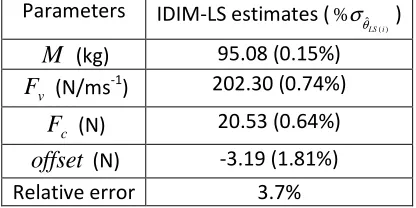
As pointed out in section 2.4, since it is possible to generate very accurate experimental data and utilize appropriate data filtering, the LS estimates can be considered as unbiased, even though the EMPS is identified in closed loop. This point is dealt with in (Janot, Vandanjon, & Gautier, 2014a) and (Brunot et al., 2015). The LS estimates and the relative errors are given in Table 1.
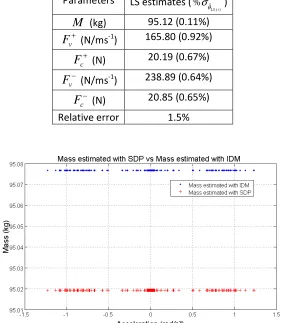
The acceleration-dependent mass estimated by the SDP method is illustrated in Fig.3. We see that the SDP estimation suggests a constant value very similar to the IDIM-LS estimate (there is only a difference of 60g which is negligible compared with 95Kg). Note also that the optimized Noise
Variance Ratio (NVR) associated with the Mˆ
( )
qɺɺˆ term in the SDP regression, which defines theamount of state dependency (see Young 2011), is 1.0e-23 i.e. virtually zero; while the NVR associated
with dˆfric
( )
qˆɺ is 2.9. This large difference between the two NVR's is consistent with our a priori knowledge and suggests that the mass is not acceleration-dependent. As similar results are obtained with a position- and velocity-dependent mass i.e. M q( )
and M q( )
ɺ , respectively, it can be assumedthat the mass is state-invariant. Given the large value of 2.9 for the NVR associated with the friction SDP estimate, the SDP method is able to reconstruct the shape of the frictional nonlinearity, as shown in Fig.4. Finally, the relative error obtained with the SDP-based identification method is only 1.5%.
At first glance, the results obtained with the standard IDIM-LS identification method and the linear friction model seems quite acceptable. Indeed, the relative error is small (less than 5%) and the estimated mass is close to its CAD value i.e. 95kg. However, the relative error obtained using SDP estimation is only 1.5% and we need to examine the reason for this discrepancy between the results. This is due to the estimates of the friction parameters, as revealed in Fig.4. Here we see that there is a small but sustained difference between the red and blue lines in the lower part of the curves (negative velocities), which suggests that there could be a small bias in the latter (see the enlarged panel in the lower right corner of Fig.4). In other words, there is a small error in the friction model identified by the standard method and the SDP friction estimate eliminates this by suggesting an asymmetrical friction model; i.e. a model that depends on the sign of qɺ where, for negative velocities, the red and blue lines are not perfectly parallel. This asymmetry can be explained by the fatigue of the screw.
In order to take this asymmetry into account, the friction model is modified to
( )
(
( )
)
( )
(
( )
)
0 0 0 0
v c v c
fric F q F sign q F q F sign q
τ = + + + + + + − − + − −
ɺ ɺ ɺ ɺ , (17)
where
0
+ and0
− are two operators defined by 0( )
1( )
2 sig qq q n
+ = +
ɺ
ɺ ɺ and 0
( )
1( )
2 sig q
q q n
− = −
ɺ
ɺ ɺ ;
v
When equation (17) is inserted into (1), it yields the following linear-in-the-parameters IDM
as
idm ym asym
τ =IDM θ , (18)
with IDMasym =ɺqɺ 0+
( )
qɺ sign(
0+( )
qɺ)
0−( )
qɺ sign(
0−( )
qɺ)
and θasym =M Fv+ Fc+ Fv− Fc−T.As in the previous situations, the actual force τ differs from τidm by an error easym and the resulting over-determined set of equations takes the form,
asym asym asy
idm = θ + m
y X ε , (19)
where yidm is the
(
NS×1)
sampled vector of τ; Xasym is the(
NS×5)
matrix of IDMasym(
q qˆ,ˆɺ ɺɺ,qˆ)
; andasym
ε is the
(
1)
S
N × vector of easym error terms. The LS estimates of (19) and their associated deviations are given by (11) and (12), Xidm being replaced with Xasym.
The resulting estimates and the relative error are given in Table 2. These confirm that the friction has
asymmetric behaviour because Fv
+ is significantly different from v
F−, while the estimate of Mhas not
[image:11.595.194.402.518.622.2]changed. Furthermore, the LS relative error has now decreased to 1.5%, a value that is compatible with the relative error obtained with the non-parametric SDP method. The direct comparison plotted in Fig.5 shows clearly that the agreement between the SDP estimated friction shape and the asymmetrical friction model reconstructed with the above LS estimates is now acceptable. This finally estimated relationship is the parameterised SDP model of the EMPS, which we will term the IDIM-SDP model. Clearly, if the prior assumptions of the IDIM-LS estimation are modified in the light of the SDP estimation, then the IDIM-LS estimation results would be the same.
Table 1 : IDIM-LS estimates of the EMPS with the standard linear friction model
Parameters IDIM-LS estimates (
( )
ˆ
%
LS i
θ
σ )
M
(kg) 95.08 (0.15%)v
F
(N/ms-1) 202.30 (0.74%)c
F
(N) 20.53 (0.64%)offset
(N) -3.19 (1.81%)Table 2 : Parametric IDIM-SDP estimates for an asymmetrical friction model
Parameters LS estimates (
( )
ˆ
%
LS i
θ
σ )
M
(kg) 95.12 (0.11%)v
F
+ (N/ms-1) 165.80 (0.92%)c
F
+ (N) 20.19 (0.67%)v
F
− (N/ms-1) 238.89 (0.64%)c
F
− (N) 20.85 (0.65%) Relative error 1.5%Fig.4. The upper panel shows a direct comparison between the friction nonlinearity reconstructed
with the LS estimates of the linear friction model (blue dots) and the nonlinearity estimated by the SDP algorithm (red crosses). The enlarged portion shown in the lower panel reveals a small but persistent error that suggests an asymmetrical friction model.
-0.2 -0.15 -0.1 -0.05 0 0.05 0.1 0.15
-60 -40 -20 0 20 40 60
F
ri
c
ti
o
n
(
N
)
Velocity (M/s)
Friction estimated with SDP VS friction estimated with IDM
Friction estimated with IDM Friction estimated with SDP
-0.05 -0.045 -0.04 -0.035 -0.03 -0.025 -0.02 -0.015 -0.01 -0.005 0 -35
-30 -25 -20 -15
F
ri
c
ti
o
n
(
N
)
Velocity (M/s)
Friction estimated with SDP VS friction estimated with IDM
Fig.5. Direct comparison between the friction nonlinearity estimated with the asymmetrical linear
friction model (2nd stage IDIM-SDP model, blue dots) and the friction nonlinearity previously estimated by the first stage SDP algorithm (red crosses), showing that the two estimates are consistent and confirm the asymmetry.
3
Second case study: TX40 robot
3.1
Introduction and presentation of the TX40 robot
In the previous section, it has been shown that the SDP method can be used as a two-stage alternative to the IDIM-LS method for estimating and evaluating the quality of the friction model; an alternative that helps to avoid over-reliance on prior conceptions about the nature of the nonlinear characteristics. In this section, SDP estimation is evaluated on a more challenging system: the TX40 robot.
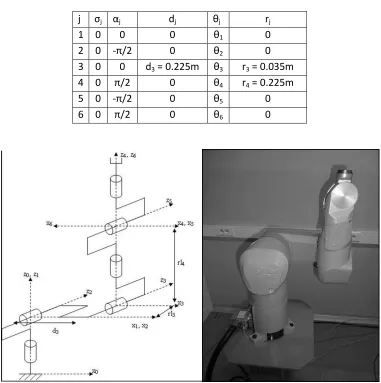
The Stäubli TX40 robot has a serial structure with six rotational joints. Its kinematics are defined by the DHM notation, as in Fig.6 (Khalil & Dombre, 2002). The geometric parameters defining the TX40 frames are given in Table 3: σj =0 means that joint j is rotational; αj and dj give, respectively, the angle and the distance between zj−1 and zj along xj−1; θj and rj give, respectively, the angle and the distance between xj−1 and xj along zj.
The joint positions and the control signals are stored with a measurement frequency
fm=5kHz. The Reference trajectories are fifth order polynomials that excite the base parameters sufficiently for identification purposes.
-0.2 -0.15 -0.1 -0.05 0 0.05 0.1 0.15
-60 -40 -20 0 20 40 60
F
ri
c
ti
o
n
(
N
)
Velocity (M/s)
Asymetrical friction estimated with IDM and friction reconstructed with SDP
Table 3: Geometric parameters of the TX40 robot
j σj αj dj θj rj
1 0 0 0 θ1 0
2 0 -π/2 0 θ2 0
3 0 0 d3 = 0.225m θ3 r3 = 0.035m
4 0 π/2 0 θ4 r4 = 0.225m
5 0 -π/2 0 θ5 0
6 0 π/2 0 θ6 0
Fig.6: Link frames of TX40 Stäubli robot
3.2
Inverse dynamic model of the second link with the usual method
When only the second link is moving, with the others maintained at their steady-sate levels, the IDM of the second link (also known as the arm of the robot) reduces to
2
2 2 2 grav fr 2 2
idm ZZ q τ τ ic offset
τ = ɺɺ + + + , (20)
where
2
idm
τ is the second joint torque;
2
grav
τ is the gravity torque of the second link given by
( )
( )
2 2 2 2 2
grav gMX cos q gMY sin q
τ =− + , MX2 and MY2 being the components of the gravity effect;
2
9.81 /
g= m s is the gravity constant; τfric2 is the friction torque of the second link; q2, qɺ2 and qɺɺ2, are, respectively, the position, velocity and acceleration of the second link; ZZ2 is the total inertia of
the second link; and offset2 is an offset parameter.
In the case of a linear friction model,
2
fric
( )
2 2 2 2 2
ric v
f F q Fc sign q
τ = ɺ + ɺ , (21)
where Fv2 and Fc2 are the viscous and Coulomb friction parameters of the second link.
The resulting IDM is linear in relation to the dynamic parameters, i.e.,
(
)
2 2, 2, 2
idm q q q
τ =IDM ɺ ɺɺ θ, (22)
where IDM
(
q q q2,ɺ ɺɺ2, 2)
=ɺɺq2 −gcos( )
q2 gsin( )
q2 qɺ2 sign q( )
ɺ2 1 is the(
1 6×)
matrix of thebasis functions of the IDM and θ=
[
ZZ2 MX2 MY2 Fv2 Fc2 offset2]
T is the(
6 1×)
vector of the dynamic parameters. As τ2 differs from2
idm
τ by an error
2
idm
e and there are NS available samples of the measured signals, it is straightforward to formulate the following over-determined system of equations
2 idm2 id 2
idm =X θ+ε m
y , (23)
where
2
idm
y is the
(
NS×1)
sampled vector of τ2;2
idm
X is the
(
NS×6)
matrix of IDM(
q q qˆ ,2 ɺ ɺɺˆ2,ˆ2)
;2
idm
ε
is the
(
NS×1)
vector of eidm2 error terms; and 2 2 2ˆ ˆ ˆ , ,
q q qɺ ɺɺ are constructed as explained in section 2.4. The LS estimates from equation (19) and their associated covariance matrix are given by (11) and (12)
, with Xidm being replaced with
2
idm
X , again under the assumption that the prefiltering has been fully
effective in its removal of noise from the variables.
3.3
Using the SDP function of the CAPTAIN Toolbox to retrieve the shapes
of gravity and friction
When using the SDP estimation method, the IDM is rewritten in the form
(
)
2 2 2 2, 2
idm ZZ q d q q
τ = ɺɺ + ɺ , (24)
with
(
)
( )
( )
2 2
2, 2 q 2 q 2
q d q
d qɺ = +dɺ qɺ where
( )
( )
( )
2 2 2 2 2 2
q
d q = −gMX cos q +gMY sin q and
( )
( )
2 2 v2 2 c2 2 2
q
dɺ qɺ =F qɺ +F sign qɺ +offset .
It is assumed here that the parameter d q q
(
2,ɺ2)
depends on the position q2 and the velocity qɺ2 so,As in the case of IDIM-LS estimation, τ2 differs from
2
idm
τ by an error
2 sdp
e and so, from NS available samples, the following system of regression equations is obtained
(
)
2 2 2 2 2 2
ˆ ˆ ,ˆ
idm =ZZ + q q + sdp
y qɺɺ d ɺ ε , (25)
where d
(
qˆ q2,ˆɺ2)
is the(
1)
S
N × sampled vector of d q q
(
ˆ2,ˆɺ2)
; 2sdp
ε is the
(
NS×1)
sampled vector of2 sdp
e ; q q qˆ ,2 ˆɺ ɺɺ2,ˆ2 are constructed as explained in Section 2.4.; and ɺɺqˆ2 is the
(
NS×1)
sampled vector of2
ˆ q
ɺɺ . The SDP iterations then involve the following, three step procedure, with steps 2 to 3 repeated until convergence is achieved:
1. Initial Step: the estimate of d
(
qˆ q2,ˆɺ2)
, denoted by(
)
2 2
ˆ q qˆ ,ˆ
d ɺ , is calculated as follows
(
)
2
2 2 2 2
ˆ
ˆ ,ˆ
idm
q q = −ZZ
d ɺ y qɺɺ ,
where ZZ2 is the CAD value ofZZ2. Then, the shapes of
( )
2 2
q q
d and
( )
2 2
q q
dɺ ɺ are initialized with
( )
2 2
0
ˆ ˆ
q q
d and
( )
2
0 2
ˆ ˆ
q q =
dɺ ɺ 0, respectively, since they are assumed to be unknown to the users.
for k=1,2, …, until convergence
At each step k,
2. the estimate of
( )
2 ˆ2
q k
q
d , denoted by
( )
2 2
ˆ ˆ
q k
q
d , is estimated using the SDP algorithm: here, the
measurement vector is
(
)
( )
2 2 2 2 2
ˆ ˆ
ˆ
ˆ ,ˆ k
k
q = q q − q q
y d ɺ dɺ ɺ ; the regressor is z=1; and the state vector is
2
ˆ
=
x q , qˆ2, being the
(
NS×1)
sampled vector of qˆ2. 3. the estimate of( )
2 2
ˆ
k
q q
dɺ ɺ , denoted by
( )
2 2
ˆk ˆ
q q
dɺ ɺ , is estimated using the SDP algorithm: here, the
measurement vector is
(
)
( )
2 2 2 2 2
ˆ ˆ ,ˆ ˆ ˆ
k
q k
q = q q − q
yɺ d ɺ d ; the regressor is again z=1; but the state
vector is now x=qˆɺ2, qˆɺ2, being the
(
NS×1)
sampled vector of qˆɺ2.end
The following convergence criterion has been found to yield good results
(
)
(
)
(
)
2 2 2 2
2 1
2
ˆ ˆ ,ˆ ˆ ,ˆ
ˆ ˆ ˆ
ˆ , k k k q q tol q q q q − − ≤ d d d ɺ ɺ ɺ ,
where
(
)
( )
( )
2 2
2 2 2 2
ˆ ˆ ,ˆ ˆk ˆ ˆk ˆ
q k
q
q
q = q + q
d ɺ d dɺ ɺ is the estimate of
(
)
( )
( )
2 2
2,ˆ2 2 ˆ2
ˆ k ˆ k
q q
k
q q = q + q
d ɺ d dɺ ɺ at step k and tol
is a threshold defined by the users (between 0.5% and 5.0%). Finally, the relative error is simply given
by
2
ˆsdp idm
ε y with
(
)
2 2 2 2 2
ˆ ˆ
ˆ k ˆ ,
sdp= idm −ZZ − q q
ε y qɺɺ d ɺ .
algorithm will be able to extract
( )
2 2 q
d q and
( )
2 2 q
dɺ qɺ from d q q
(
2,ɺ2)
in a completely separablemanner. However, as we see below, it does work reasonably well in this example when only the second link is moving.
3.4
Experimental results
3.4.1 Only the second link is moving
The dynamic parameters are first identified with the IDIM-LS method with only the second link being excited by the fifth-order polynomial trajectories that are required to ensure good estimation of the dynamic characteristics. The other links are maintained at their steady-state levels.
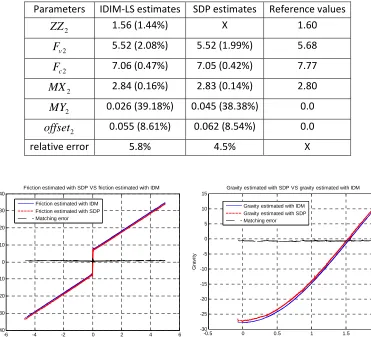
The IDIM-LS estimates are given in Table 4. The reference values are the CAD values for the inertia and gravity parameters; and the friction parameters are the estimated values given in (Janot, Vandanjon, & Gautier, 2014a). The reconstruction is quite good with a relative error of 5.8%. Finally, the estimates of inertia, gravity and friction parameters are close to the reference values.
The iterative-SDP estimation procedure outlined above in section 3.3 is initialized with
( )
2 2
0
ˆ ˆ
q q
d and
( )
2
0 2
ˆ ˆ
q q =
dɺ ɺ 0, while tol=1% is used as the convergence criterion. In order to evaluate the resulting
estimates, the SDP nonlinearities
( )
2 2
ˆ ˆ
q k
q
d and
( )
2 2
ˆk ˆ
q q
dɺ ɺ identified by this procedure are regressed on
( )
ˆ2( )
ˆ2 1gcos q gsin q
−
and qˆ2 sign
( )
qˆ2 ɺ ɺ , respectively, using standard linear least squares
estimation. These constant parameter LS estimates are referred to as the IDIM-SDP estimates in Table 4 and one would expect these to be close to the IDIM-LS estimates if the SDP method is to be
considered successful and the SDP identified nonlinearities
( )
2 2
ˆ ˆ
q k
q
d and
( )
2 2
ˆk ˆ
q q
dɺ ɺ are to be trusted. In
this case, the SDP iterative algorithm converges in 5 iterations and the results plotted in Fig.7, together with the parameter estimates given in Table 4, demonstrate that the iterative SDP algorithm does indeed yield very good results in this example. In particular, the shape of the gravity and friction nonlinearities reconstructed by the SDP-based algorithm match the shape of the same nonlinearities reconstructed with the IDIM-LS estimates pretty well. The model output is compared with the measured data in the left hand panel of Fig.8; the residuals are serially uncorrelated and the amplitude distribution of the normalized SDP error distribution appears reasonably Gaussian (see the right hand panel in Fig.8). Similar results are obtained with the IDIM-LS method but they are not shown here. In addition, the estimates of inertia, gravity and friction parameters are close to the reference values and the relative error obtained with the SDP-based algorithm is 4.5%, less than the 5.8% obtained using the IDIM-LS method.
conveniently separated the parameter offset2 into two offsets (one for the friction and one for the
[image:19.595.110.481.163.500.2]gravity).
Table 4 : IDIM-LS and IDIM-SDP estimates compared with the reference values
Parameters IDIM-LS estimates SDP estimates Reference values
2
ZZ 1.56 (1.44%) X 1.60
2
v
F 5.52 (2.08%) 5.52 (1.99%) 5.68
2
c
F 7.06 (0.47%) 7.05 (0.42%) 7.77
2
MX 2.84 (0.16%) 2.83 (0.14%) 2.80
2
MY 0.026 (39.18%) 0.045 (38.38%) 0.0
2
offset 0.055 (8.61%) 0.062 (8.54%) 0.0
relative error 5.8% 4.5% X
Fig.7.The Friction nonlinearity estimated by the non-parametric 1st stage SDP method compared with the friction effect identified with the IDIM-LS method (left panel); and a similar comparison between the two gravity effect nonlinearities in the right panel.
-6 -4 -2 0 2 4 6
-40 -30 -20 -10 0 10 20 30 40
F
ri
c
ti
o
n
Velocity
Friction estimated with SDP VS friction estimated with IDM
Friction estimated with IDM Friction estimated with SDP Matching error
-0.5 0 0.5 1 1.5 2
-30 -25 -20 -15 -10 -5 0 5 10 15
G
ra
v
it
y
Position
Gravity estimated with SDP VS gravity estimated with IDM
[image:19.595.101.492.343.505.2]Fig.8. Direct comparison of the measured data with the output of the SDP-based identification method (IDIM-SDP, left panel) and histogram of the normalized error (right panel). A similar result is obtained with the IDIM-LS method.
3.4.2 All the links are moving simultaneously
In this situation, all the six joints of the TX40 robot are now excited with fifth-order polynomial trajectories that ensure good estimation of the dynamic characteristics. The dynamic parameters of the second link are again identified using SDP estimation. Here, the gear ratio is quite high i.e. greater than 10, so the second link is seen as a one-degree-of-freedom robot and its IDM is still given by (22). As in the previous examples, the SDP estimation results are similar to those obtained by the IDIM-LS method but they provide further insight into the detailed nature of the nonlinearity.
The IDIM-LS estimates are given in Table 5 and the comparison of the model output with the experimental data is shown in Fig.9. The estimates of inertia and friction parameters are quite close to the reference values but while the amplitude distribution of the normalized IDIM-LS error looks reasonably Gaussian, the error is serially correlated. Not surprisingly, therefore, the model output does not explain the measured data very well, with a relative error of 20.0%. Such a result is a reason for concern because a relative error is expected to be less than 10%.
As reported in section 3.4.1, the iterative SDP estimation procedure is initialized with 2
( )
2 0ˆ ˆ
q q
d and
( )
2
0 2
ˆ ˆ
q q =
dɺ ɺ 0; tol=1% is used as the convergence criterion; while the SDP nonlinearities
( )
2 2
ˆ ˆ
q k
q
d and
( )
2 2
ˆk ˆ
q q
dɺ ɺ identified by this procedure are regressed on −gcos q
( )
ˆ2 gsin q( )
ˆ2 1 and qˆɺ2 sign( )
qˆɺ2 , respectively. In this case, the algorithm converges in 6 iterations and the results plotted in Fig.10 demonstrate, together with the parameter estimates given in Table 5, that the gravity and friction shapes reconstructed by the algorithm do not match the gravity and the friction shapes reconstructed with the IDIM-LS estimates. The observed mismatches that can be seen in Fig.10 are due to the fact all the links are moving in the experiments and so some neglected coupling effects are being excited. Interestingly, the mismatches reflect, and so account for, such neglected coupling effects, so that the explanation of the data using the multi-SDP model, as shown in Fig.11, is rather better than that for the IDIM-LS estimated model in Fig.9. This confirmed by the calculation of the relative errors, 20.0% with the IDIM-LS method and 11.0% with the SDP method.0 1 2 3 4 5 6 7 8
-80 -60 -40 -20 0 20 40 60
Direct comparison between the actual torque and the torque etimated by SDP method
N m time (s) Measurement Estimation Error
-4 -3 -2 -1 0 1 2 3 4 0 10 20 30 40 50 60 70 80
Normalized histogram of SDP error and estimated Gaussian
These experimental results demonstrate once again the utility of the SDP estimation approach in highlighting where problems exist in nonlinear modelling and how they may be corrected. They also show how SDP estimation can be used as a tool in Data-Based Mechanistic (DBM) modelling. This is an inductive modelling strategy where less weight is placed on prior assumptions and more weight on the information in the experimental data. Only after carefully analysing the experimental data using appropriate model identification and signal processing tools, such as SDP estimation, does the modeller consider, at the mechanistic stage of the procedure, the prior assumptions and hypotheses, in order to see if these are compatible with the identified, data-based model. Or, if the data-based model is found to be deficient in any ways, as in this case when all the links are moving simultaneously, the modeller must consider whether new data need to be collected in order to examine these deficiencies using a better experimental design. And then, depending on the new SDP estimation results, the parametric form of the nonlinearities can be modified and re-estimated.
Table 5 : IDIM-LS and SDP estimates compared with the reference values
Parameters IDIM-LS estimates SDP estimates Reference values
2
ZZ 0.9636 (2.17%) X 1.09
2
v
F 5.2358 (2.64%) 5.1711 (1.85%) 5.68
2
c
F 7.8059 (4.17%) 7.8245 (2.78%) 7.77
2
MX 0.5636 (16.53%) 0.3573 (7.31%) 2.21
2
MY -3.6043 (3.08%) -3.2864 (1.07%) 0.0
2
offset 12.8879 (8.61%) 9.5048 (3.48%) 0.0
relative error 20.0% 11.0% X
Fig.9. Direct comparison with the IDIM-LS method (left panel) and histogram of the normalized IDIM-LS error (right panel). The reconstructed torque does not match very well the measured one and although the error distribution is reasonably a Gaussian distribution the errors are serially correlated. This tends to show that the IDM given by (23) is not well specified while all the joints
are moving.
0 1 2 3 4 5 6 7 8
-100 -80 -60 -40 -20 0 20 40 60
Direct comparison with IDIM-LS method
N
Time Measurement Estimation Error
-4 -3 -2 -1 0 1 2 3
0 10 20 30 40 50 60
Normalized histogram of IDIM-LS error and estimated Gaussian
Normalized torque
P
o
p
u
la
ti
o
[image:21.595.78.525.498.662.2]Fig.10 : Friction shape reconstructed with the SDP method compared with the friction effect
identified with the IDIM-LS method (left panel) and gravity shape reconstructed with the SDP method compared with the gravity effect identified with the IDIM-LS method (right panel). The mismatches observed suggest there are missing couplings.
Fig.11. Direct comparison with the SDP-based method (left panel) and histogram of the normalized SDP-based error (right panel). A better matching between the reconstructed torque and the measured one is obtained. Furthermore, the error distribution is reasonably Gaussian but again there is some serial correlation. This shows that the IDM given by (23) is not well specified while all the joints are moving. This IDM must be therefore rejected.
4
State-Dependent Parameter Control of the EMPS System
One advantage of SDP nonlinear models is that they can form the basis for control system design based on the use of linear control theory: see (Taylor et al., 2008; and chapter 9 in Taylor et al., 2013). This SDP approach has some similarities with other methods that have been proposed, such as exact linearisation by feedback (Isidori, 1995) (better known as the computed torque in robotics: see
-6 -4 -2 0 2 4 6
-40 -30 -20 -10 0 10 20 30 40 F ri c ti o n Velocity
Friction estimated with SDP VS friction estimated with IDM Friction estimated with IDM
Friction estimated with SDP Matching error
-0.5 0 0.5 1 1.5 2
-25 -20 -15 -10 -5 0 5 10 G ra v it y Position
Gravity estimated with SDP VS gravity estimated with IDM Gravity estimated with IDM Gravity estimated with SDP Matching error
0 1 2 3 4 5 6 7 8
-100 -80 -60 -40 -20 0 20 40 60
Direct comparison with SDP-based method
N
Time Measurement Estimation Error
-4 -3 -2 -1 0 1 2 3 0 5 10 15 20 25 30
Normalized histogram of SDP error and estimated Gaussian
Khalil & Dombre 2002), velocity-based linearization (Leith & Leithead, 1998); and Linear Parameter Varying (LPV) based control design (see e.g. White et al., 2013).
In this section, we consider how this methodology can be applied to the control of the simulated EMPS system represented by the DDM in equation (1), written as:
1 2 ( ) 3 4
q=c q+c sign q + +c cτ
ɺɺ ɺ ɺ , (26)
where,
1 v
c = −F M ; c2= −F Mc ; c3= −offset M ; and c4=1M .
Based on the LS estimates given in Table 1, the values of these parameters are:
1 2.1277
c = − ; c2= −0.2123;c3=0.0336; and c4=0.0105.
4.1
Derivation of the SDP control model
Considering u=τ as the input and x=q as the output, this estimated model can be represented as follows in transfer function form:
4
( sdp)
q c
x u
p p a
y x w
= + = +
, (27)
where r r r
p =d dt is the derivative operator; wq represents the additive noise with a noise/signal ratio by standard deviation of 5%; and asdp is an SDP estimated by the SDP routine in CAPTAIN using data from the prior closed loop experiments on the EMPS unit when controlled by the linear PD controller.
As we have seen in previous sections, asdp defines the nonlinear characteristics of the open loop system and although it is denoted here as a parameter and used as such in the SDP control system design, it is a complete nonlinear function. This is illustrated in the Simulink model of the open-loop system appearing at the left of Fig.12 with the SDP nonlinearity block shown expanded at the right of
the Fig.12. The functional form of asdp is shown as the red part of the curve in Fig.13, while the blue parts of the curve are extrapolations to the estimated linear parts of the curve. These extensions of the relationship are required to handle larger fluctuations in the velocity arising from the more rapid SDP controlled response of the closed loop system. Note how the extrapolations reveal the asymmetry of the estimated nonlinearity, as exposed by the SDP estimation.
Fig.12. Simulation of the EMPS with the SDP-based control
Fig.13. Friction model used with the SDP-based control
4.2
SDP control system design: re-design of the PD controller
The idea of using SDP models to simplify nonlinear control system design has a long heritage (see e.g. Young, 1981; Young, 1996). In the latter reference, it follows from research into linear control system design based on the Non-Minimal State Space (NMSS) form of the system model (see section 4.3). The NMSS control gains in the SDP case are effectively updated at each sampling instant, based on the linear "snapshot" of the SDP model at this sampling instant. Taylor et al. (2008) have shown that, using this approach, the stability of the closed loop non-linear system is guaranteed for "all-pole" systems, such as (27) and that good control system designs can be obtained for more general models. Although stability is not guaranteed in the case of model mismatch, the Monte Carlo-based uncertainty analysis reported in the paper suggests that the SDP/PIP approach is relatively robust to such uncertainty.
-0.5 -0.4 -0.3 -0.2 -0.1 0 0.1 0.2 0.3 0.4 0.5 -150
-100 -50 0 50 100
Velocity
F
ri
c
ti
o
n
As an initial exercise in SDP control system design, let us consider re-design of the simple PD controller used for the identification studies described in section 2.3 but based on the SDP transfer function model (27) and desired closed loop characteristics with η=1.0 (critical damping) and
250 n
ω = rad/s. As in section 2.3, the design is carried out by simple block diagram analysis with an SDP-based Proportional-Derivative (SDP-PD) pre-compensator Kp+Kvp. The closed loop transfer function obtained in this manner is given by
(
)
4 2
4 4
( )
p v
sdp v p
c K K
x
a c K p c
p
p K r
+ =
+ + + , (28)
where r is the command input, i.e. the reference. Since the system is second order, this PD control is equivalent to state variable feedback, so we see that both poles are assignable. And because the open-loop system model has a free integrator, the closed loop system exhibits "type 1" performance with unity gain and zero steady-state error to step command inputs.
If the desired closed loop TF denominator has damping ηd and natural frequency ωnd, then we see
that the values for the control gains can be computed from the equations:
2 4
/
p nd
K =ω c ; Kv =(2η ωd nd−asdp) /c4, (29)
where it will be noted that the Kv gain is a function of the SDP parameter asdp and so the closed loop system synthesized with these gains includes the SDP nonlinearity, reflecting the nonlinear nature of the SDP-PD control system. In particular, because it is a state-dependent parameter, it changes or "adapts" in response to the changes in velocity.
The simulated response of the closed loop system to a step input command starting at zero, with a final value of 0.05m, is plotted in Fig.14 where it will be noted that the rapid response has a total settling time of 0.04 seconds. Also plotted in Fig.14 is the response of the conventional, linear PD controlled system used in the identification studies, where we see that the response is clearly much slower and oscillatory, with a total settling time about three times as long.
Fig.14. Output step response obtained with the SDP-based control (black solid line) and the PD control (black dash-dot line)
49.980 50 50.02 50.04 50.06 50.08 50.1 50.12 50.14 0.01
0.02 0.03 0.04 0.05 0.06 0.07
Time
O
u
tp
u
t
R
e
s
p
o
n
s
e
4.3
SDP control system design: PIP-SDP outer-loop control system design
The NMSS-based Proportional-Integral-Plus (PIP) approach to control system design has been described comprehensively in the recent book by (Taylor et al., 2013), which includes all aspects of the design process, as well as numerous examples illustrating its application. In the present EMPS example, it could be applied directly, using the EMPS model in discrete-time NMSS form, but is would then require nonlinear modification of the kind described in previous sections, which is not straightforward once the model is transformed into discrete-time, digital form.
A simple, alternative approach is to implement PIP control as an "outer-loop" or "trimming" control that considers the SDP-PD controlled system, which is effectively linearized by its SDP mechanization, as the system to be controlled. The discrete-time model required for this design is obtained by statistical identification and estimation based on input-output data from the SDP-PD controlled system using optimal Refined Instrumental Variable (RIV) estimation for continuous time systems (see Young, 2011), as implemented by the RIVCBJID and RIVCBJ routines in the CAPTAIN Toolbox.
The discrete-time model required for PIP control system design is then obtained via the Matlab c2d continuous to discrete-time conversion routine. The sampling interval for such conversion is at the discretion of the control system designer but, in this case, the discrete-time model so obtained, for a sampling interval of 0.01 s, is:
1 2 1
1 2
0.0107 0.0088 0.0025
( ) ( )
1 1.8660 0.8706
z z z
x k r k
z z
− − −
− −
− +
=
− + , (30)
where r
z− is the backward shift operator, i.e. z x k−r ( )=x k( −r).
The PIP design for this model system is based on Linear-Quadratic (LQ) optimization of the associated NMSS model form, where the NMSS control gains are computed by the the PIPOPT and GAINS routines in the CAPTAIN Toolbox. These use the numerator and denominator model coefficients in (30) together with the user specified weightings on the error, ew; control input, uw; and the non-minimal state variables xw where, in this example, ew=10; uw=1.0; and xw=1.0. A serially connected loop gain LG=5.0 is added to the design in order to tune the closed loop response so that it just meets the constraint imposed by a required 0.15 m/s velocity limit.
The full details of this PIP-SDP control system design and evaluation are given in (Young, 2015). This shows that the closed loop system responds well to any violation of hard constraints and is not sensitive to uncertainty in the estimated model parameters, including the SDP nonlinearity, unless these reach very high levels. Consequently, this control system design represents a reasonable, simulation-based starting point for future planned research and development studies.