warwick.ac.uk/lib-publications
Manuscript version: Author’s Accepted Manuscript
The version presented in WRAP is the author’s accepted manuscript and may differ from the
published version or Version of Record.
Persistent WRAP URL:
http://wrap.warwick.ac.uk/131660
How to cite:
Please refer to published version for the most recent bibliographic citation information.
If a published version is known of, the repository item page linked to above, will contain
details on accessing it.
Copyright and reuse:
The Warwick Research Archive Portal (WRAP) makes this work by researchers of the
University of Warwick available open access under the following conditions.
Copyright © and all moral rights to the version of the paper presented here belong to the
individual author(s) and/or other copyright owners. To the extent reasonable and
practicable the material made available in WRAP has been checked for eligibility before
being made available.
Copies of full items can be used for personal research or study, educational, or not-for-profit
purposes without prior permission or charge. Provided that the authors, title and full
bibliographic details are credited, a hyperlink and/or URL is given for the original metadata
page and the content is not changed in any way.
Publisher’s statement:
Please refer to the repository item page, publisher’s statement section, for further
information.
arXiv:1908.04612v1 [astro-ph.SR] 13 Aug 2019
CHAOTIC ROTATION AND EVOLUTION OF ASTEROIDS AND SMALL PLANETS IN HIGH-ECCENTRICITY ORBITS AROUND WHITE DWARFS
VALERIV. MAKAROV
U.S. Naval Observatory, 3450 Massachusetts Ave., Washington, DC 20392-5420, USA
DIMITRIVERAS
Centre for Exoplanets and Habitability, University of Warwick, Gibbet Hill Road, Coventry, CV4 7AL, UK and University of Warwick, Department of Physics, Gibbet Hill Road, Coventry, CV4 7AL, UK
Draft version August 14, 2019
ABSTRACT
Observed planetary debris in white dwarf atmospheres predominately originate from the destruction of small bodies on highly eccentric (>0.99) orbits. Despite their importance, these minor planets have coupled physical and orbital evolution which has remained largely unexplored. Here, we present a novel approach for estimating the influence of fast chaotic rotation on the orbital evolution of high-eccentricity triaxial asteroids, and formally characterize the propagation of their angular rotation velocities and orbital elements as random time processes. By employing the impulse approximation, we demonstrate that the violent gravitational interactions during periastron passages transfer energy between the orbit and asteroid’s rotation. If the distribution of spin impulses were symmetric around zero, then the net result would be a secular decrease of the semimajor axis and a further increase of the eccentricity. We find evidence, however, that the chaotic rotation may be self-regulated in such a manner that these effects are reduced or nullified. We discover that asteroids on highly eccentric orbits can break themselves apart — in a type of YORP-less rotational fission — without actually entering the Roche radius, with potentially significant consequences for the distribution of debris and energy requirements for gravitational scattering in metal-polluted white dwarf planetary systems. This mechanism provides a steady stream of material impacting a white dwarf without rapidly depleting the number of small bodies in the stellar system.
Keywords: minor planets, asteroids: general — planets and satellites: dynamical evolution and stability — planets and satellites: physical evolution — (stars:) white dwarfs — chaos
1. INTRODUCTION
Understanding the complete history and future of a plan-etary system usually requires investigating the host star as it changes phases. Nearly every star in the Milky Way will or already has traversed an evolutionary se-quence involving main sese-quence, giant branch and white dwarf phases. Snapshots of white dwarf planetary sys-tems in particular reveal exclusive and unique insights about planetary composition (Jura & Young 2014; Farihi 2016; Bonsor & Xu 2017; Harrison et al. 2018; Hollands et al. 2018; Vanderburg & Rappaport 2018; Zuckerman & Young 2018) and include striking examples of disintegrating (Vanderburg et al. 2015) and intact (Manser et al. 2019) or-biting minor planets.
Both major and minor planets which survive until the white dwarf phase have endured physical and orbital vari-ations resulting from stellar evolution (Veras 2016). Giant branch stars induce physical variations primarily through stel-lar mass loss, envelope expansion and increased luminos-ity. Gas giant planets may accrete stellar mass through its wind, altering the composition of the planetary atmospheres (Spiegel & Madhusudhan 2012). Envelope expansion may alter planetary surfaces and interior energy budgets through tidal interactions. Enhanced stellar luminosity may shear off atmospheres (Livio & Soker 1984; Nelemans & Tauris 1998; Soker 1998; Villaver & Livio 2007; Wickramasinghe et al.
Electronic address: [email protected] STFC Ernest Rutherford Fellow
Electronic address: [email protected]
2010), melt or sublimate entire planets or some of their com-ponents, and spin up, spin down and break up minor planets through YORP-induced rotational fission (Veras et al. 2014a). Better understood are the planetary orbital changes which are triggered by giant branch stars. Isotropic stellar mass loss expands orbits at prescribed rates (Omarov 1962; Hadjidemetriou 1963; Veras et al. 2011) and anisotropic mass loss (Veras et al. 2013; Dosopoulou & Kalogera 2016a,b) is not expected to become significant for bod-ies within Oort-cloud distances. Orbital variations due to stellar mass loss are effectively independent of planet mass. Tidal effects between giant stars and planets crucially set the critical displacement beyond which a planet will survive engulfment (Villaver & Livio 2009; Kunitomo et al. 2011; Mustill & Villaver 2012; Adams & Bloch 2013; Nordhaus & Spiegel 2013; Valsecchi & Rasio 2014; Villaver et al. 2014; Madappatt et al. 2016; Staff et al. 2016; Gallet et al. 2017; Rao et al. 2018; Stephan et al. 2018). Effects from giant star stellar luminosity may in fact dominate over those from gravity when altering the orbits of minor planets through the Yarkovsky effect (Veras et al. 2015a, 2019a).
2
and do so regularly: Between one-quarter and one-half of all white dwarfs contain planetary metals (Zuckerman et al. 2003, 2010; Koester et al. 2014); chemical abundances of planetary debris have been measured for white dwarfs up to 8 Gyr old (Hollands et al. 2018), and the white dwarf discs generated from minor planet break-up are recycled on short timescales of 104
−106
yr (Girven et al. 2012).
Consequently, an important issue is how to perturb minor planets (asteroids, moons and comets) on eccentric-enough orbits (e > 0.99) to reach the white dwarf. Many methods have been successfully invoked: grav-itational perturbations by a single planet (Bonsor et al. 2011; Debes et al. 2012; Frewen & Hansen 2014), mul-tiple planets (Veras et al. 2016; Payne et al. 2016, 2017; Mustill et al. 2018; Smallwood et al. 2018), multiple stars (Bonsor & Veras 2015; Hamers & Portegies Zwart 2016; Petrovich & Mu˜noz 2017; Stephan et al. 2017, 2018) and Galactic tides (Alcock et al. 1986; Parriott & Alcock 1998; Veras et al. 2014b; Stone et al. 2015; Caiazzo & Heyl 2017). The outcome of a minor planet entering the Roche radius of a white dwarf has also been explored (Debes et al. 2012; Veras et al. 2014c; Wyatt et al. 2014; Veras et al. 2015b; Brown et al. 2017), particularly with regard to the resul-tant disc evolution (Bochkarev & Rafikov 2011; Rafikov 2011a,b; Metzger et al. 2012; Rafikov & Garmilla 2012; Kenyon & Bromley 2017a,b; Miranda & Rafikov 2018). Star-planet tides negligibly affect the orbital motion of minor planets (Veras et al. 2019b), such as the ones uncovered by Vanderburg et al. (2015) and Manser et al. (2019).
However, in nearly every case listed above, the physical evolution of asteroids on highly eccentric orbits was not mod-elled, nor was the resulting feedback on the orbital angular momentum. This paper strives to address this missing com-ponent of our understanding. In Section 2 we describe our procedure for simulating the coupled evolution of these aster-oids. In Section 3 we argue that a highly-eccentric asteroid need not encounter the Roche radius before spinning itself apart. Section 4 contains a formal analysis of our simulation output in terms of random processes which describe the evo-lution of the physical and orbital elements. We derive func-tional dependencies of the orbital evolution on these random processes in Section 5 and discuss and summarize our results in Section 6. We henceforth refer to our orbiting objects as “asteroids”.
2. CHAOTIC ROTATION
Rotation of elongated bodies around their principal axes of inertia in two-body systems are mostly driven by the gradient of the force of gravitational attraction exerted by the orbit-ing companion. The tidal interactions are much smaller in magnitude for non-vanishing parameters of triaxiality σ = (B −A)/C, which are often found in smaller planets and asteroids. The A,B, and Chere and in the following des-ignate the principal moments of inertia in increasing order. In this paper, we use the term “asteroid” in its generic mean-ing, which includes celestial bodies rigid enough to maintain a permanent shape, such as comets, asteroids, and minor plan-ets. Our results are applicable to a wide range of such ob-jects, as long as they have a significantly prolate shape and highly eccentric orbits. Rotation of triaxial asteroids is known to have complex, structured sections in the parameter space (Wisdom et al. 1984). The islands of stable equilibrium in the Poincar´e sections are surrounded by bands of purely chaotic motion, which are present even for small eccentricity orbits
as long asσis finite. In the narrow boundary zone between chaos and libration zones, small secondary resonance islands may be present (Flynn & Saha 2005), but their physical valid-ity remains to be confirmed. Only Hyperion and, possibly, Prometheus and Pandora, represent satellites in chaotic ro-tation in the Solar system (Kouprianov & Shevchenko 2005; Melnikov & Shevchenko 2008). But chaotic satellites are likely common around minor planets in the outer Solar Sys-tem. Many TNOs have eccentric satellites, and a particularly instructive example is the satellite Thorondor around the large TNO (385446) Manw¨e (Grundy et al. 2014), which has an ec-centricity of 0.56. The prevalence of synchronous rotation can probably be explained by the regularization effect of tidal dissipation in dynamic systems of small and moderate eccen-tricity. The synchronously rotating satellites of significantly elongated shape, such as Phobos and Epimetheus, could not enter their current spin-orbit state without having to cross the chaotic zone (Wisdom 1987).
The case of high eccentricity (e >0.95) and significant tri-axiality is different, because chaotic behavior is the only pos-sible state for such asteroids. The islands of stable equilibrium vanish, and the tidal dissipation can not regularize the motion even in the long run. We investigate this case by means of numerical simulations for the simplest setup, in which the or-bit and the asteroid’s equator are coplanar (i.e., the obliquity of the orbit on the equator is zero) and the problem becomes one-dimensional. The tumbling rotation of prolate asteroids is certainly three-dimensional in reality, and this approximation is likely to slightly overestimate the associated acceleration. Tidal forces are ignored. Our model object of choice is sim-ilar to Proteus in size, mass, and shape, but we put it into a long-period, high-eccentricity orbit around a white dwarf primary (see Table 1 for our adopted physical and orbital ele-ments). The semimajor axis of 1.5 au was chosen for compu-tational feasibility (see Section 4), and we expect the results to be qualitatively similar for higher values ofa. The orbital parameters are constant, an assumption which is justified for a relatively short integration spanning less than10 000orbits in view of the relatively slow rate of orbital evolution, as de-scribed below.
The integrated ordinary differential equation (ODE) is
θ′′(t) +3
2n
2σ sin(2θ(t)−2ν(t))
(1−ecosE(t))3 = 0, (1)
Table 1
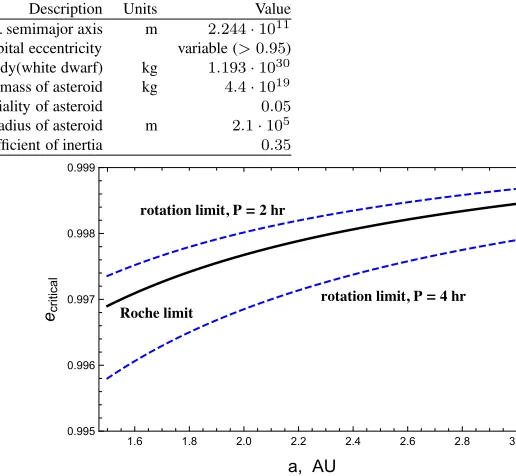
Model parameters used in simulations. The semimajor axis corresponds to 1.5 au, the white dwarf mass to0.6M⊙and the asteroid mass to a value which is
about 5% the mass of Ceres.
Name Description Units Value
a . . . semimajor axis m 2.244·1011
e . . . orbital eccentricity variable (>0.95) M1 mass of primary body(white dwarf) kg 1.193·1030
M2 . . . mass of asteroid kg 4.4·1019
σ= (B−A)/C . . . triaxiality of asteroid 0.05
R . . . radius of asteroid m 2.1·10
5
ξ . . . coefficient of inertia 0.35
0 500 1000 1500
0 500 1000 1500
time orbits
θ
/n
Figure 1.Simulated evolution of apoastron rotation velocity of a Proteus-like asteroid orbiting a white dwarf on a highly eccentric (e= 0.99), long-period (a= 1.5AU) orbit.
prudent to use outside this orbit phase interval, i.e., for 99.9% of the orbit. The ODE (1) can be integrated with two addi-tional boundary conditions forθ(0)andθ′(0).
Fig. 1 shows a typical result of numerical simulation of 1700 orbits fore = 0.99. It shows the normalized apoastron rotation velocityθ/n˙ ≡ω/nversus orbit number, for initial conditionsθ(0) = −0.04rad,θ′(0) = 801 n. The behav-ior is chaotic with a short Lyapunov exponential; hence, even a marginally small perturbation of the initial values brings about a completely different rotation curve. However, impor-tant observations can be made based on this limited example. The spin rate varies in a very broad range, but it seems to be confined to a certain interval of prograde rotation. It bounces back when it comes close to zero. The asteroid’s rotation is fast most of the time, but can it become arbitrarily fast? The first idea is that the velocity may be limited to the maximum orbital motion at the moment of closest approach, which is computed as
˙
νmax/n= √
1 +e
(1−e)32
. (2)
A few characteristic values are 124.9 ate = 0.95, 1410.7 at
e= 0.99, 15803.5 ate= 0.998. The results in Fig. 1 fore= 0.99indicate that the spin rate can become higher thanν˙max even on a relatively short time scale. Indeed, integrations with other initial conditions revealed that the rate of rotation may become as high as3000n. We give more consideration to the issue of the highest rate of rotation in§4.
3. ROTATIONAL FISSION VERSUS TIDAL BREAK-UP
Much attention has been paid in the literature to the issue of rotational fissure of Solar system asteroids (Walsh et al. 2008; Ortiz et al. 2012; Vokrouhlick´y et al. 2015), which may ac-count for a significant population of binary asteroids of small
=
=
1.6 1.8 2.0 2.2 2.4 2.6 2.8 3.0
0.995 0.996 0.997 0.998 0.999
a, AU ecritical
Figure 2. Critical values of orbital eccentricity for rotational fission by the centrifugal force (dashed lines) or by the tidal force within the Roche radius (solid curve). The vertical order of the curves is independent of semimajor axis.
mass ratio. Observations show that most minor planets with diameters smaller than 10 km have a lower bound of∼2 hr for their rotation periods (Polishook et al. 2017). Within the framework of a “rubble pile” model, where the bodies are held together predominantly by self-gravitation, the critical spin rate of fission depends on the diameter and other, less observ-able parameters. Larger asteroids with diameters greater than 10 km rotate slower than ∼ 4 hr (Warner et al. 2009). It is therefore of interest to know if impulse-like excitation of ro-tation at perihelion can drive asteroids to critical spin rates, and how large the eccentricity should be (≡ecritical) for that to happen.
Fig. 2 shows the values of critical eccentricity computed with these simplifying assumptions: 1) tidal fission takes place when the periastron distancea(1−e)becomes smaller than1R⊙, which is approximately the Roche radius for white dwarfs; 2) the highest rate of rotation is close to the maximum periastron angular velocity, Eq. 2. Rotational fission of larger asteroids, such as our Proteus analog, is achieved at lower eccentricity than the tidal break-up. The difference in eccen-tricity may seem small, but the difference in the periastron distance is significant. This result suggests that smaller parts and debris can agglomerate around white dwarfs well outside the Roche radius, to be delivered to the stellar surface by other means.
[image:4.612.297.555.101.339.2]4
4. ROTATION VELOCITY AS A RANDOM PROCESS
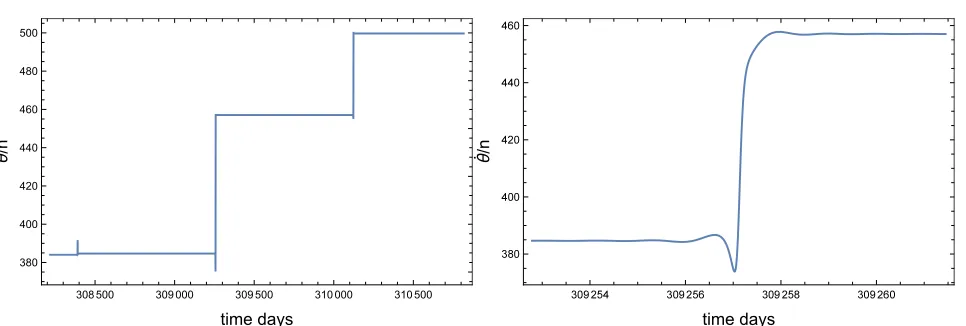
Figure 1 shows a rotation velocity curve obtained by nu-merical integration. The large changes of velocity without any pattern or periodicity suggest that this may be a random process. This figure shows only the values of velocity com-puted at apoastrons where the triaxial torque is at a minimum (Eq. 1). Fig. 3, left panel, depicts how the simulated velocity changes within each orbit. For most of the time, the varia-tion is relatively slow, but during a periastron encounter, the acceleration increases by a factor∼1million (ate= 0.99), leading to an almost step-wise change in velocity (Fig. 3, right panel). In view of these findings, the impulse approxima-tion is the most suitable model for long-period asteroids with
e >0.95.
We assume in the impulse approximation that all the dy-namical interaction takes place momentarily during the clos-est approach to the star at the periastron. The result of this interaction is an abrupt change in rotation velocity ω ≡ θ˙. It is sufficient then to measure the velocity at the apoastron whereν = E = π, and to consider the difference between two consecutive apoastron velocitiesdω,i=ωi+1−ωias the impulse magnitude. The discrete sets of tuples{ti, ωi} and {ti, dω,i}are considered to be random processes in time.
We performed several numerical integrations of ODE 1 with varying initial conditions for fast prograde rotation ve-locities,e = 0.99, and 9000 orbits. The solutions were sam-pled at apoastron times and analyzed as random processes using the Wolfram Mathematica TimeSeriesModelFit function1. This function determines which kind of random process best describes the given sequence of data and fits the corresponding model parameters. For the normalized rota-tional velocityω/n, the most frequent output is an Autore-gressive Moving Averageprocess ARMA(1,2). A time series of valuesztcan be represented in this model as
zi=c+φ zi−1+ǫi+ψ1ǫi−1+ψ2ǫi−2, (3) wherecis a constant,ǫiis a sequence of independent random numbers with a zero mean and a variance̟2
, andc,φ,ψ1, andψ2are the fitting model parameters. The presence of a nonzeroφdemonstrates the auto-regressive part of the model, in that each outcome depends on the previous value. Gen-erally, the process is stationary if|φ| < 1. The one or two nonzero parametersξindicate that the random impulses are correlated with one or two preceding impulses, which repre-sents the moving average property. It may seem puzzling why the impulse magnitude, which depends only on the apoastron velocity and orientation angle, is correlated with the preced-ing impulses, but the reason will be revealed in the followpreced-ing analysis ofdωproperties.
One particular integration and model fitting for 9000 orbits produced these results: c = 4.5,̟2
= 3010,φ = 0.998,
ψ1 = 0.009,ψ2 = −0.034. Although the values vary be-tween simulations, some common features are present. The
φvalue is close to unity, which means the process is weakly stationary. Starting the process with “unreasonable” initial conditions results in an extended transitional phase before the behavior settles down and stabilizes, which explains why long integrations covering many orbits are required to produce a reliable output. Because the root of the autoregressive poly-nomial is greater than 1, the process is causal. The values ofψ1andψ2are small, thus, the impulses are weakly
corre-1https://reference.wolfram.com/language/ref/TimeSeriesModelFit.html
lated. One of the roots of the moving average polynomial is negative, so the latter is not invertible. Finally, the positive value ofcindicates that the rotation velocity has a tendency to infinitely grow. However, this result is doubtful in view of complications, which we will now discuss.
Generally, we do not find the fitted ARMA(1,2) process to adequately represent the simulated velocity curve. Some im-portant features seem to be missing in this model. For ex-ample, nothing prevents an ARMA(1,2) process with the esti-mated parameters to descend to negative values, whereas our simulations are always confined to a range of prograde rota-tion. Although a stationary process is intuitively expected, the moving average part appears to be a distorted reflection of more intricate properties of the system, which are not cap-tured by this simple model. We believe the main reason for these shortcomings is the peculiar distribution of velocity im-pulses, which is neither Gaussian, nor identical for the process instances.
More progress can be made if we consider the time series of velocity impulsesdωas a random process. The model fit-ting procedure invariably produced aGeneralized Autoregres-sive Conditionally Heteroscedastic model GARCH(1,1). A discrete-time GARCH(1,1) processx(t)is a series of statis-tically independent random numbers with a zero conditional mean and a conditional variance
E[x2i | {xi−1}] =̟ 2
i =κ+α1x 2
i−1+β1̟ 2
i−1, (4)
whereκ,α1, andβ1 are positive-definite model parameters. This fit captures one additional curious property of the process under investigation, viz., the variance of a velocity pulse de-pends on both the variance and the realization of the previous pulse. The unconditional variance ofx(t)isκ/(1−α1−β1), so that for a weakly stationary processα1 andβ1should be between 0 and 1.
A particular numerical integration produced these model fit parameters fordω/n: κ = 28.2,α1 = 0.119,β1 = 0.872, which represent a typical outcome of this simulation. We note the strong dependence of the current variance on the preced-ing variance. There is no requirement that the underlypreced-ing dis-tribution is Gaussian. If the process wanders into a domain of small impulse values, the dispersion of impulse values is likely to remain small for a period of time. In other words, the velocity is likely to be less variable in the future if the pre-vious variations have been small. This is similar to the behav-ior of the financial market price volatility, for example, where extended periods of lull are separated by periods of elevated variability.
308 500 309 000 309 500 310 000 310 500 380
400 420 440 460 480 500
timedays
θ
/n
32
4 !" #
timedays
θ
/n
Figure 3. A segment of the simulated rotation velocity curve for the model described in Table 1 spanning three orbits (left), and the same curve shown in more detail for one periastron passage (right).
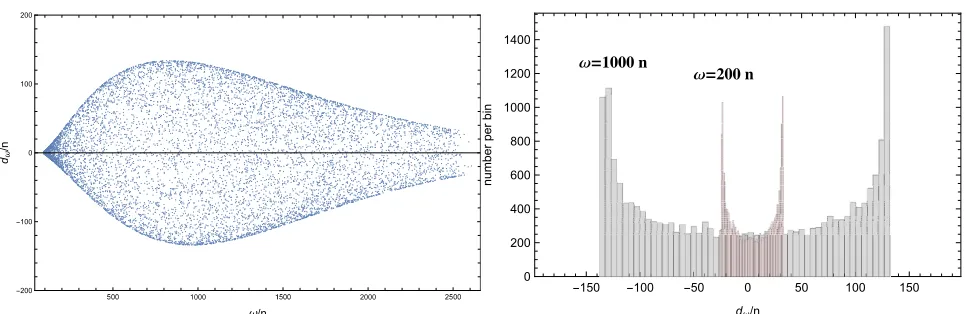
[image:6.612.70.553.53.216.2]extended period of time. The distribution of velocity impulses is not symmetric around zero. The largest positive (prograde) updates happen at a lower velocity than the largest negative (retrograde) updates. Therefore, when the velocity is smaller than∼800n, greater prograde impulses are possible and the velocity is likely to wander towards faster values. The situa-tion reverses when it becomes greater than∼1000n, where retrograde impulses of greater magnitude become possible, which will likely succeed in pushing the velocity back. This peculiar distribution allows the process to remain stationary and in the long run, vary around some median velocity range. We performed targeted numerical simulations of the peri-astron passage (instead of a continuous integration for 9000 orbits) to find out the properties of thedω distribution. For a fixed input velocityω,20 000Monte-Carlo integrations are performed with random input orientation angleθcovering a short interval around the periastron time. The resulting sam-pled distributions for ω = 200nand1000n are shown in Fig. 4, right. The width of the distributions strongly depends on the input velocity. There is also a pileup at both ends of the interval of allowable perturbations, so that impulses of great-est magnitude are more frequent than weak impulses.
These results explain why an ARMA model does not cap-ture the properties of theω(t)process well enough – the dis-tribution of “noise” is drastically non-Gaussian. The GARCH model may be more successful in representing thedω pro-cess, because it does not require the distribution to be Gaus-sian. However, the variance as a model parameter is perhaps of limited use for the observed concave distribution of veloc-ity updates.
5. ORBITAL EVOLUTION OF HIGH-ECCENTRICITY ASTEROIDS
Each periastron passage of a high-eccentricity asteroid re-sults in an abrupt change of its rotation velocity. If we ignore the dissipative tidal forces in the asteroid and the star, the total energy of the closed system should be constant:
Eorb+Erot=−G
m1m2
2a +
ξm2
2 R
2
ω2
=const. (5)
A change inωresults in a change of the orbit semimajor axis
a. Taking into account that the asteroid’s radiusR << aand its massm2<< m1, the change inais readily derived as
da
a ≃ −
ξ(2ω dω+d2ω)
n2
R a
2
. (6)
The quadratic termd2
ωmay indicate that the orbit should be secularly shrinking. However, this is only true if the distri-bution of velocity updates dω were symmetric around zero, which is not the case. As Fig. 4 (left) indicates, the distri-bution may be biased toward negative values at high rotation velocities, compensating for the positive secular term or even causing the orbit to expand. Our limited numerical experi-ments are nor sufficient to verify this. It is safe to conclude that the orbit updates also constitute a random time process. The fractional updates of the orbit are found to be small for the model parameters in Table 1 (of the order of10−9
), but they can be much larger for super-earth exoplanets.
The total angular momentum should also be conserved in this two-body closed system:
Ltot=Lorb+Lrot=G 1
2 m1m2
(m1+m2)
1 2
p
a(1−e2)
+ξ m2R2ω=const. (7)
Updating thea, e, and ω by their increments, equating the change in the angular momentum to zero, and taking into ac-count thatm2 << m1,de << 1,da << 1, the following approximate equation obtains
de
e ≃
ξ√1−e2
n e2
R a
2
dω. (8)
The fractional update of eccentricity de/eis approximately linear in the update of rotation velocitydω. The outcome of this stochastic variation is, again, uncertain, because it de-pends on the distribution ofdω. Because of the asymmetry observed in Fig. 4, left, the eccentricity is expected to grow when the asteroid rotates relatively slowly, but is likely to de-cline when the asteroid rapidly spins. The overall long-term evolution is unclear from our limited numerical integration.
6. DISCUSSION AND CONCLUSIONS
depen-6
5$% 1000 1& '( 2000 )*+,
-200
-100 0 100 200
ω/n
dω
/
n
ω=
ω=
-150 -100 -50 0 50 100 150 0
200 400 600 800 1000 1200 1400
dω/n
number
per
[image:7.612.66.549.56.213.2]bin
Figure 4. Left: Normalized perturbations of spin rate versus apoastron values of spin rate computed in a numerical simulation of 9000 orbits fore= 0.99
and star-planet parameters from Table 1. Right: Histograms ofdωperturbation distributions at fixed apoastron velocitiesω= 200nand1000ncomputed by
Monte-Carlo simulations of20 000periastron passages with random initial orientation angles.
dence of orbital action on(R/a)5
(Makarov et al. 2018). Ob-servational statistics for tumbling Solar system asteroids sug-gest that tidal dissipation inside asteroids provides long-term damping of the tumbling (chaotic, three-dimensional) motion, especially for high tensile rigidity objects (Pravec et al. 2005). However, this effect may be greatly diminished by the inverse proportionality of the tidal quality function to tidal frequency (Efroimsky 2012) for rapidly rotating high-eccentricity aster-oids around white dwarfs. The tides in the star may be more efficient on the timescale of stellar ages despite their expected low values of the tidal quality factor. Most stars rotate slower than the maximum angular velocity of the asteroid at the pe-riastron, where practically all the action takes place. The tidal bulge raised on the star lags the direction to the asteroid, and the resulting torque gradually circularizes and shrinks the or-bit.
We chose Proteus as the model object for our simulations (Table 1), which is larger, more massive, and more spherically symmetric than a typical Solar system asteroid, but the results are relevant to a broad range of objects from small comets to minor planets. The equation of motion (1) is independent of mass, but the orbital evolution is sensitive to the secondary mass. It is of interest to probe much greater triaxiality values, such as Hyperion atσ≃0.1and super-Earth exoplanets with lowσ(∼ 10−5
). Our preliminary computation for a Hyper-ion analog indicate that the behavior described in this paper and represented by Figs. 1, 3, and 4 is also found in smaller and more prolate bodies, but the velocity impulses are pro-portionally greater and their distribution around zero is more asymmetric. Such objects are likely to stochastically achieve break-up spin rates faster than the larger bodies. Conversely, they may become a viable source of white dwarf pollution at lower orbital eccentricity.
Although the behavior of rotation velocity is obviously chaotic and stochastic, modeling it with standard types of ran-dom processes is only partially successful. The reason for this is the peculiar distribution of velocity impulses, which is fi-nite at any given velocity above the minimum prograde value. The probability of a velocity impulse sharply increases toward the boundaries of the distribution, which are not symmetric around zero. As a result, the process is weakly stationary and somewhat self-regulating. If the spin rate becomes low, the range of allowable impulses tends to zero, and the asteroid may linger in this quiescent state for an extended period of time. The high-velocity end of the distribution, on the other hand, does not seem to be bounded. The spin rates may
be-come very high, but the probability of that is small, and it may take a long time for the asteroid to wander into this regime.
After the asteroid reaches a particular spin threshold, it will be disrupted by the centrifugal force. Our calculations illus-trate that rotational fission may be more efficient than tidal disruption, especially for the largest asteroids and minor plan-ets, because fission is triggered at lower values of eccentricity. The consequences for polluted white dwarfs are two-fold: (1) debris produced from break-up would populate a radial region which extends beyond the Roche radius, and (2) the orbital ec-centricity which metal-polluting asteroids need to acheive is slightly lower than previously thought. We caution that we are unable to obtain a likelihood of rotational fission (versus tidal disruption) nor predict a specific asteroid’s long-term evolu-tion, due to both computational limitations and the stochastic-ity of the systems. Nevertheless, this study represents a first step in the exploration of the coupled spin and orbital evolu-tion of the dominant source of the observaevolu-tional signatures of the vast majority of known white dwarf planetary systems.
ACKNOWLEDGMENTS
DV gratefully acknowledges the support of the STFC via an Ernest Rutherford Fellowship (grant ST/P003850/1).
REFERENCES
Adams, F. C., & Bloch, A. M. 2013, ApJL, 777, L30
Alcock, C., Fristrom, C. C., & Siegelman, R. 1986, ApJ, 302, 462 Bochkarev, K. V., & Rafikov, R. R. 2011, ApJ, 741, 36
Bonsor, A., Mustill, A. J., & Wyatt, M. C. 2011, MNRAS, 414, 930 Bonsor, A., & Veras, D. 2015, MNRAS, 454, 53
Bonsor, A., & Xu, S. 2017, Astrophysics and Space Science Library, 229. Brown, J. C., Veras, D., & G¨ansicke, B. T. 2017, MNRAS, 468, 1575 Caiazzo, I., & Heyl, J. S. 2017, MNRAS, 469, 2750
Danby, J.M.A. 1962. Fundamentals of Celestial Mechanics. MacMillan, New York
Debes, J. H., Walsh, K. J., & Stark, C. 2012, ApJ, 747, 148 Dosopoulou, F., & Kalogera, V. 2016a, ApJ, 825, 70 Dosopoulou, F., & Kalogera, V. 2016b, ApJ, 825, 71 Efroimsky, M. 2012, ApJ, 746, 150
Farihi, J. 2016, New Astronomy Reviews, 71, 9 Flynn, A. E., & Saha, P. 2005, AJ, 130, 295
Frewen, S. F. N., & Hansen, B. M. S. 2014, MNRAS, 439, 2442 Gallet, F., Bolmont, E., Mathis, S., Charbonnel, C., & Amard, L. 2017,
A&A, 604, A112
Girven, J., Brinkworth, C. S., Farihi, J., et al. 2012, ApJ, 749, 154 Grundy, W. M., Benecchi, S. D., Porter, S. B., Noll, K. S. 2014, Icarus, 237,
1
Hadjidemetriou, J. D. 1963, Icarus, 2, 440
Harrison, J. H. D., Bonsor, A., & Madhusudhan, N. 2018, MNRAS, 479, 3814
Hollands, M. A., G¨ansicke, B. T., & Koester, D. 2018, MNRAS, 477, 93 Jura, M., & Young, E. D. 2014, Annual Review of Earth and Planetary
Sciences, 42, 45
Kenyon S. J., Bromley B. C., 2017a, ApJ, 844, 116 Kenyon S. J., Bromley B. C., 2017b, ApJ, 850, 50
Koester, D., G¨ansicke, B. T., & Farihi, J. 2014, A&A, 566, A34 Kouprianov, V. V., & Shevchenko, I. I. 2005, Icarus, 176, 224
Kunitomo, M., Ikoma, M., Sato, B., Katsuta, Y., & Ida, S. 2011, ApJ, 737, 66 Livio, M., & Soker, N. 1984, MNRAS, 208, 763
Madappatt, N., De Marco, O., & Villaver, E. 2016, MNRAS, 463, 104 Makarov, V. V., Berghea, C. T., Efroimsky, M. 2018, ApJ, 857, 142 Manser, C. J., et al. 2019, Science, 364, 66
Melnikov, A. V., & Shevchenko, I. I. 2008, CMDA, 101, 31
Metzger, B. D., Rafikov, R. R., & Bochkarev, K. V. 2012, MNRAS, 423, 505 Miranda, R., & Rafikov, R. R. 2018, ApJ, 857, 135
Mustill, A. J., & Villaver, E. 2012, ApJ, 761, 121
Mustill, A. J., Villaver, E., Veras, D., G¨ansicke, B. T., Bonsor, A. 2018, MNRAS, 476, 3939
Nelemans, G., & Tauris, T. M. 1998, A&A, 335, L85 Nordhaus, J., & Spiegel, D. S. 2013, MNRAS, 432, 500
Omarov, T. B. 1962, Izv. Astrofiz. Inst. Acad. Nauk. KazSSR, 14, 66 Ortiz, J. L., Thirouin, A., Campo Bagatin, A., et al. 2012, MNRAS, 419,
2315
Parriott, J., & Alcock, C. 1998, ApJ, 501, 357
Payne, M. J., Veras, D., Holman, M. J., G¨ansicke, B. T. 2016, MNRAS, 457, 217
Payne, M. J., Veras, D., G¨ansicke, B. T., & Holman, M. J. 2017, MNRAS, 464, 2557
Petrovich, C., & Mu˜noz, D. J. 2017, ApJ, 834, 116
Polishook, D., Moskovitz, N., Thirouin, A., et al. 2017, Icarus, 297, 126 Pravec, P., Harris, A. W., Scheirich, P., et al. 2005, Icarus, 173, 108 Rafikov, R. R. 2011a, MNRAS, 416, L55
Rafikov, R. R. 2011b, ApJL, 732, L3
Rafikov, R. R., & Garmilla, J. A. 2012, ApJ, 760, 123 Rao S., et al., 2018, A&A, 618, A18
Smallwood, J. L., Martin, R. G., Livio, M., & Lubow, S. H. 2018, MNRAS, 480, 57
Soker, N. 1998, AJ, 116, 1308
Spiegel, D. S., & Madhusudhan, N. 2012, ApJ, 756, 132
Staff, J. E., De Marco, O., Wood, P., Galaviz, P., & Passy, J.-C. 2016, MNRAS, 458, 832
Stephan, A. P., Naoz, S., & Zuckerman, B. 2017, ApJL, 844, L16 Stephan, A. P., Naoz, S., & Gaudi, B. S. 2018, AJ, 156, 128 Stone, N., Metzger, B. D., & Loeb, A. 2015, MNRAS, 448, 188 Tommasini, D., & Olivieri, D. N. 2018, arXiv:1812.02273 Valsecchi, F. & Rasio, F. A. 2014, ApJ, 786, 102
Vanderburg, A., Johnson, J. A., Rappaport, S., et al. 2015, Nature, 526, 546 Vanderburg, A., & Rappaport, S. A. 2018, Handbook of Exoplanets, 37 Veras, D., Wyatt, M. C., Mustill, A. J., Bonsor, A., & Eldridge, J. J. 2011,
MNRAS, 417, 2104
Veras, D., Hadjidemetriou, J. D., & Tout, C. A. 2013a, MNRAS, 435, 2416 Veras, D., Jacobson, S. A., G¨ansicke, B. T. 2014a, MNRAS, 445, 2794 Veras, D., Shannon, A., G¨ansicke, B. T. 2014b, MNRAS, 445, 4175 Veras, D., Leinhardt, Z. M., Bonsor, A., G¨ansicke, B. T. 2014c, MNRAS,
445, 2244
Veras, D., Eggl, S., G¨ansicke, B. T. 2015a, MNRAS, 451, 2814
Veras, D., Leinhardt, Z. M., Eggl, S., G¨ansicke, B. T. 2015b, MNRAS, 451, 3453
Veras, D. 2016, Royal Society Open Science, 3, 150571
Veras, D., Mustill, A. J., G¨ansicke, B. T., et al. 2016, MNRAS, 458, 394 Veras, D., Higuchi, A., Ida, S. 2019a, MNRAS, 485, 708
Veras, D. et al. 2019b, MNRAS, In Press Villaver, E., & Livio, M. 2007, ApJ, 661, 1192 Villaver, E., & Livio, M. 2009, ApJL, 705, L81
Villaver, E., Livio, M., Mustill, A. J., & Siess, L. 2014, ApJ, 794, 3 Vokrouhlick´y, D., Bottke, W. F., Chesley, S. R., et al. 2015, Asteroids IV,
509.
Walsh, K. J., Michel, P., Richardson, D. C. 2008, Nature, 454, 188 Warner, B. D., Harris, A. W., Pravec, P. 2009, Icarus, 202, 134 Wickramasinghe, D. T., Farihi, J., Tout, C. A., Ferrario, L., & Stancliffe,
R. J. 2010, MNRAS, 404, 1984
Wisdom, J., Peale, S. J., Mignard, F. 1984, Icarus, 58, 137 Wisdom, J. 1987, AJ, 94, 1350
Wyatt, M. C., Farihi, J., Pringle, J. E., & Bonsor, A. 2014, MNRAS, 439, 3371
Zuckerman, B., & Young, E. D. 2018, Handbook of Exoplanets, 14 Zuckerman, B., Koester, D., Reid, I. N., H ¨unsch, M. 2003, ApJ, 596, 477 Zuckerman, B., Melis, C., Klein, B., Koester, D., & Jura, M. 2010, ApJ, 722,