warwick.ac.uk/lib-publications Manuscript version: Author’s Accepted Manuscript
The version presented in WRAP is the author’s accepted manuscript and may differ from the published version or Version of Record.
Persistent WRAP URL:
http://wrap.warwick.ac.uk/125617
How to cite:
Please refer to published version for the most recent bibliographic citation information. If a published version is known of, the repository item page linked to above, will contain details on accessing it.
Copyright and reuse:
The Warwick Research Archive Portal (WRAP) makes this work by researchers of the University of Warwick available open access under the following conditions.
Copyright © and all moral rights to the version of the paper presented here belong to the individual author(s) and/or other copyright owners. To the extent reasonable and
practicable the material made available in WRAP has been checked for eligibility before being made available.
Copies of full items can be used for personal research or study, educational, or not-for-profit purposes without prior permission or charge. Provided that the authors, title and full
bibliographic details are credited, a hyperlink and/or URL is given for the original metadata page and the content is not changed in any way.
Publisher’s statement:
Please refer to the repository item page, publisher’s statement section, for further information.
Open Event Extraction from Online Text using a Generative Adversarial
Network
Rui Wang† Deyu Zhou†∗ Yulan He§
†School of Computer Science and Engineering, Key Laboratory of Computer Network
and Information Integration, Ministry of Education, Southeast University, China
§Department of Computer Science, University of Warwick, UK
{rui wang, d.zhou}@seu.edu.cn, [email protected]
Abstract
To extract the structured representations of open-domain events, Bayesian graphical mod-els have made some progress. However, these approaches typically assume that all words in a document are generated from a single event. While this may be true for short text such as tweets, such an assumption does not generally hold for long text such as news articles. More-over, Bayesian graphical models often rely on Gibbs sampling for parameter inference which may take long time to converge. To address these limitations, we propose an event extrac-tion model based on Generative Adversarial Nets, called Adversarial-neural Event Model (AEM). AEM models an event with a Dirich-let prior and uses a generator network to cap-ture the patterns underlying latent events. A discriminator is used to distinguish documents reconstructed from the latent events and the original documents. A byproduct of the dis-criminator is that the features generated by the learned discriminator network allow the visu-alization of the extracted events. Our model has been evaluated on two Twitter datasets and a news article dataset. Experimental results show that our model outperforms the baseline approaches on all the datasets, with more sig-nificant improvements observed on the news article dataset where an increase of 15% is ob-served in F-measure.
1 Introduction
With the increasing popularity of the Internet, online texts provided by social media platform (e.g. Twitter) and news media sites (e.g. Google news) have become important sources of real-world events. Therefore, it is crucial to automati-cally extract events from online texts.
Due to the high variety of events discussed on-line and the difficulty in obtaining annotated data
∗
corresponding author
for training, traditional template-based or super-vised learning approaches for event extraction are no longer applicable in dealing with online texts. Nevertheless, newsworthy events are often dis-cussed by many tweets or online news articles. Therefore, the same event could be mentioned by a high volume of redundant tweets or news arti-cles. This property inspires the research commu-nity to devise clustering-based models (Popescu et al.,2011;Abdelhaq et al.,2013;Xia et al.,2015) to discover new or previously unidentified events without extracting structured representations.
To extract structured representations of events such as who did what, when, where and why, Bayesian approaches have made some progress. Assuming that each document is assigned to a sin-gle event, which is modeled as a joint distribu-tion over the named entities, the date and the loca-tion of the event, and the event-related keywords, Zhouet al.(2014) proposed an unsupervised La-tent Event Model (LEM) for open-domain event extraction. To address the limitation that LEM re-quires the number of events to be pre-set, Zhou et al. (2017) further proposed the Dirichlet Pro-cess Event Mixture Model (DPEMM) in which the number of events can be learned automatically from data. However, both LEM and DPEMM have two limitations: (1) they assume that all words in a document are generated from a single event which can be represented by a quadruple<entity, location, keyword, date>. However, long texts such news articles often describe multiple events which clearly violates this assumption; (2) Dur-ing the inference process of both approaches, the Gibbs sampler needs to compute the conditional posterior distribution and assigns an event for each document. This is time consuming and takes long time to converge.
(AEM) based on adversarial training for open-domain event extraction. The principle idea is to use a generator network to learn the projection function between the document-event distribution and four event related word distributions (entity distribution, location distribution, keyword distri-bution and date distridistri-bution). Instead of provid-ing an analytic approximation, AEM uses a dis-criminator network to discriminate between the re-constructed documents from latent events and the original input documents. This essentially helps the generator to construct a more realistic docu-ment from a random noise drawn from a Dirichlet distribution. Due to the flexibility of neural net-works, the generator is capable of learning compli-cated nonlinear distributions. And the supervision signal provided by the discriminator will help gen-erator to capture the event-related patterns. Fur-thermore, the discriminator also provides low-dimensional discriminative features which can be used to visualize documents and events.
The main contributions of the paper are summa-rized below:
• We propose a novel Adversarial-neural Event Model (AEM), which is, to the best of our knowledge, the first attempt of using adver-sarial training for open-domain event extrac-tion.
• Unlike existing Bayesian graphical modeling approaches, AEM is able to extract events from different text sources (short and long). And a significant improvement on computa-tional efficiency is also observed.
• Experimental results on three datasets show that AEM outperforms the baselines in terms of accuracy, recall and F-measure. In addi-tion, the results show the strength of AEM in visualizing events.
2 Related Work
Our work is related to two lines of research, event extraction and Generative Adversarial Nets.
Event Extraction
Recently there has been much interest in event extraction from online texts, and approaches could be categorized as domain-specific and open-domain event extraction.
Domain-specific event extraction often focuses on the specific types of events (e.g. sports events
or city events). Panem et al. (2014) devised a novel algorithm to extract attribute-value pairs and mapped them to manually generated schemes for extracting the natural disaster events. Similarly, to extract the city-traffic related event, Anantharam et al.(2015) viewed the task as a sequential tag-ging problem and proposed an approach based on the conditional random fields. Zhang (2018) pro-posed an event extraction approach based on im-itation learning, especially on inverse reinforce-ment learning.
Open-domain event extraction aims to extract events without limiting the specific types of events. To analyze individual messages and in-duce a canonical value for each event, Benson et al. (2011) proposed an approach based on a structured graphical model. By representing an event with a binary tuple which is constituted by a named entity and a date, Ritteret al.(2012) em-ployed some statistic to measure the strength of associations between a named entity and a date. The proposed system relies on a supervised la-beler trained on annotated data. In (Abdelhaq et al., 2013), Abdelhaq et al. developed a real-time event extraction system called EvenTweet, and each event is represented as a triple consti-tuted by time, location and keywords. To extract more information, Wangel al.(2015) developed a system employing the links in tweets and comb-ing tweets with linked articles to identify events. Xiael al.(2015) combined texts with the location information to detect the events with low spatial and temporal deviations. Zhouet al.(2014;2017) represented event as a quadruple and proposed two Bayesian models to extract events from tweets.
Generative Adversarial Nets
As a neural-based generative model, Generative Adversarial Nets (Goodfellow et al., 2014) have been extensively researched in natural language processing (NLP) community.
pro-~ df
Online Text Corpus Sampling d~r
Generator Network (G) Discriminator Networks (D)
Document Representation
*HQHUDWHWKHUHDOGRFXPHQWIURP2QOLQH7H[W&RUSXV
Din Dout
~
µ»Dir(~µj~®)
Hidden layer Document-event distribution layer
Document level word distributions E-dim
H-dim
V-dim
entity
loc
key
date Discriminative feature layer H-dim ~
de f
~ dl f
~ dk
f
~ dd f
[image:4.595.92.503.61.279.2]
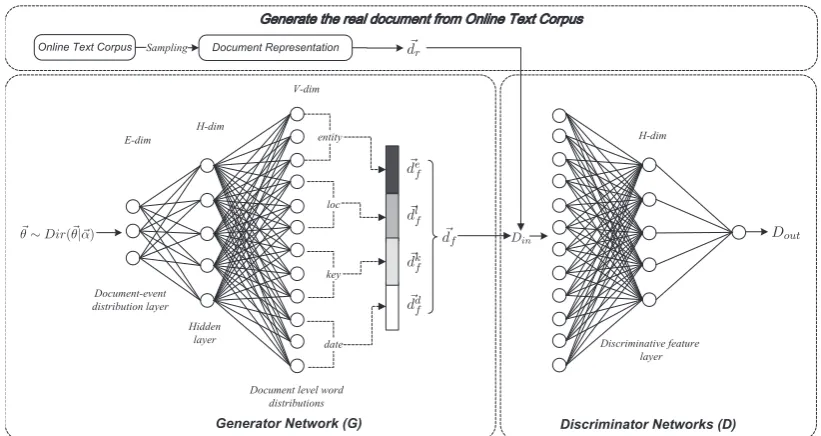
Figure 1: The framework of the Adverarial-neural Event Model (AEM), andd⃗e
f,d⃗ l f,d⃗
k f andd⃗
d
f denote the
gen-erated entity distribution, location distribution, keyword distribution and date distribution corresponding to event distribution⃗θ.
posed MaskGAN which used an actor-critic con-ditional GAN to fill in missing text conditioned on the surrounding context. Along this line, Wang et al. (2018) proposed SentiGAN to gen-erate texts of different sentiment labels. Besides, Li et al. (2018) improved the performance of semi-supervised text classification using adversar-ial training, (Zeng et al., 2018;Qin et al., 2018) designed GAN-based models for distance super-vision relation extraction.
Although various GAN based approaches have been explored for many applications, none of these approaches tackles open-domain event extraction from online texts. We propose a novel GAN-based event extraction model called AEM. Com-pared with the previous models, AEM has the fol-lowing differences: (1) Unlike most GAN-based text generation approaches, a generator network is employed in AEM to learn the projection func-tion between an event distribufunc-tion and the event-related word distributions (entity, location, key-word, date). The learned generator captures event-related patterns rather than generating text se-quence; (2) Different from LEM and DPEMM, AEM uses a generator network to capture the event-related patterns and is able to mine events from different text sources (short and long). More-over, unlike traditional inference procedure, such as Gibbs sampling used in LEM and DPEMM, AEM could extract the events more efficiently due
to the CUDA acceleration; (3) The discrimina-tive features learned by the discriminator of AEM provide a straightforward way to visualize the ex-tracted events.
3 Methodology
We describe Adversarial-neural Event Model (AEM) in this section. An event is represented as a quadruple <e, l, k, d>, where e stands for non-location named entities, l for a location, k
for event-related keywords, d for a date, and each component in the tuple is represented by component-specific representative words.
AEM is constituted by three components: (1) The document representation module, as shown at the top of Figure1, defines a document represen-tation approach which converts an input document from the online text corpus into dr⃗ ∈ RV which captures the key event elements; (2)The genera-torG, as shown in the lower-left part of Figure1, generates a fake documentd⃗f which is constituted
3.1 Document Representation
Each document doc in a given corpus C is rep-resented as a concatenation of 4 multinomial dis-tributions which are entity distribution (d⃗er), lo-cation distribution (d⃗l
r), keyword distribution (d⃗kr)
and date distribution (d⃗dr) of the document. As four distributions are calculated in a similar way, we only describe the computation of the entity distri-bution below as an example.
The entity distribution d⃗er is represented by a normalized Ve-dimensional vector weighted by
TF-IDF, and it is calculated as:
tfi,doce = n e i,doc
∑
ven e ve,doc
idfie= log|C e|
|Cie|
tf-idfei,doc =tfi,doce ×idfie
der,i = tf-idf e i,doc
∑
vetf-idf e ve,doc
whereCe is the pseudo corpus constructed by
re-moving all non-entity words fromC,Veis the to-tal number of distinct entities in a corpus, nei,doc
denotes the number ofi-th entity appeared in doc-ument doc, |Ce| represents the number of docu-ments in the corpus, and|Cie|is the number of doc-uments that contain i-th entity, and the obtained
der,idenotes the relevance betweeni-th entity and documentdoc.
Similarly, location distributiond⃗lr, keyword dis-tributiond⃗kr and date distributiond⃗dr ofdoccould be calculated in the same way, and the dimen-sions of these distributions are denoted as Vl, Vk and Vd, respectively. Finally, each docu-ment doc in the corpus is represented by a V -dimensional (V=Ve+Vl+Vk+Vd) vectord⃗rby
con-catenating four computed distributions.
3.2 Network Architecture
3.2.1 Generator
The generator networkGis designed to learn the projection function between the document-event distribution ⃗θ and the four document-level word distributions (entity distribution, location distribu-tion, keyword distribution and date distribution).
More concretely,Gconsists of aE-dimensional document-event distribution layer,H-dimensional hidden layer and V-dimensional event-related word distribution layer. Here,Edenotes the event
number, H is the number of units in the hid-den layer, V is the vocabulary size and equals to
Ve+Vl+Vk+Vd. As shown in Figure 1, G firstly
employs a random document-event distribution⃗θ
as an input. To model the multinomial property of the document-event distribution,⃗θis drawn from a Dirichlet distribution parameterized withα⃗ which is formulated as:
p(⃗θ|⃗α) =Dir(⃗θ|α)⃗ ≜ 1
△(⃗α) E
∏
t=1
θαt−1
t (1)
where ⃗α is the hyper-parameter of the dirich-let distribution, E is the number of events which should be set in AEM,△(⃗α) =
∏E t=1Γ(αt) Γ(∑Et=1αt),θt ∈ [0,1] represents the proportion of event t in the document and∑Et=1θt= 1.
Subsequently, G transforms ⃗θ into a H -dimensional hidden space using a linear layer fol-lowed by layer normalization, and the transforma-tion is defined as:
⃗sh=LN(Whθ⃗+⃗bh) (2)
⃗oh= max(⃗sh, lp×⃗sh) (3)
whereWh ∈RH×E represents the weight matrix
of hidden layer, and⃗bh denotes the bias term, lp
is the parameter of LeakyReLU activation and is set to 0.1,⃗shand⃗ohdenote the normalized hidden
states and the outputs of the hidden layer, andLN
represents the layer normalization.
Then, to project ⃗oh into four document-level
event related word distributions (d⃗ef, d⃗lf, d⃗kf and
⃗
ddf shown in Figure1), four subnets (each contains a linear layer, a batch normalization layer and a softmax layer) are employed inG. And the exact transformation is based on the formulas below:
⃗he
w=Wwe⃗oh+⃗bew, ⃗def =SM(BN(⃗h e
w)) (4) ⃗hl
w=Wwl⃗oh+⃗bwl , ⃗dlf =SM(BN(⃗h l
w)) (5) ⃗hk
w=Wwk⃗oh+⃗bwk, ⃗dkf =SM(BN(⃗h k
w)) (6) ⃗hd
w=Wwd⃗oh+⃗bdw, ⃗ddf =SM(BN(⃗h d
w)) (7)
whereSM means softmax layer, Wwe ∈ RVe×H, Wl
w ∈ RVl×H,Wwk ∈RVk×H andWwd ∈ RVd×H
distribution and date distribution, respectively, that correspond to the given event distribution⃗θ. And each dimension represents the relevance between corresponding entity/location/keyword/date term and the input event distribution.
Finally, four generated distributions are con-catenated to represent the generated documentd⃗f
corresponding to the input⃗θ:
⃗
df = [d⃗ef;d⃗lf;d⃗kf;d⃗df] (8)
3.2.2 Discriminator
The discriminator network D is designed as a fully-connected network which contains an input layer, a discriminative feature layer (discrimina-tive features are employed for event visualization) and an output layer. In AEM,Duses fake docu-mentdf⃗ and real documentdr⃗ as input and outputs the signalDoutto indicate the source of the input data (lower value denotes thatDis prone to pre-dict the input data as a fake document and vice versa).
As have previously been discussed in (Arjovsky et al.,2017;Gulrajani et al.,2017), lipschitz con-tinuity of Dnetwork is crucial to the training of the GAN-based approaches. To ensure the lips-chitz continuity ofD, we employ the spectral nor-malization technique (Miyato et al.,2018). More concretely, for each linear layerld(⃗h) =W⃗h(bias
term is omitted for simplicity) in D, the weight matrixW is normalized byσ(W). Here,σ(W)is the spectral norm of the weight matrixW with the definition below:
σ(W) := max ⃗h:⃗h̸=⃗0
∥W⃗h∥2
∥⃗h∥2
= max
∥⃗h∥2≤1∥W⃗h∥2 (9)
which is equivalent to the largest singular value ofW. The weight matrixW is then normalized using:
ˆ
WSN :=W/σ(W) (10)
Obviously, the normalized weight matrix WˆSN
satisfies that σ( ˆWSN) = 1 and further ensures
the lipschitz continuity of theDnetwork (Miyato et al.,2018). To reduce the high cost of comput-ing spectral normσ(W) using singular value de-composition at each iteration, we follow (Yoshida and Miyato,2017) and employ the power iteration method to estimateσ(W)instead. With this sub-stitution, the spectral norm can be estimated with very small additional computational time.
3.3 Objective and Training Procedure
The real document dr⃗ and fake document df⃗
shown in Figure 1 could be viewed as random samples from two distributions Pr and Pg, and
each of them is a joint distribution constituted by four Dirichlet distributions (corresponding to entity distribution, location distribution, keyword distribution and date distribution). The training objective of AEM is to let the distributionPg
(pro-duced byGnetwork) to approximate the real data distributionPras much as possible.
To compare the different GAN losses, Kurach (2018) takes a sober view of the current state of GAN and suggests that the Jansen-Shannon diver-gence used in (Goodfellow et al.,2014) performs more stable than variant objectives. Besides, Ku-rach also advocates that the gradient penalty (GP) regularization devised in (Gulrajani et al., 2017) will further improve the stability of the model. Thus, the objective function of the proposed AEM is defined as:
Ld=− E ⃗ dr∼Pr
[log(D(d⃗r))]− E ⃗ df∼Pg
[log(1−D(d⃗f))]
(11)
Lgp= E
⃗ d∗∼Pd∗
[(∥ ∇d⃗∗D(d⃗∗)∥2 −1)2] (12)
L=Ld+λLgp (13)
whereLddenotes the discriminator loss,Lgp
rep-resents the gradient penalty regularization loss,λ
is the gradient penalty coefficient which trade-off the two components of objective,d⃗∗could be ob-tained by sampling uniformly along a straight line betweendr⃗ andd⃗f,Pd∗denotes the corresponding
distribution.
The training procedure of AEM is presented in Algorithm1, whereEis the event number,nd
de-notes the number of discriminator iterations per generator iteration, m is the batch size, α′ rep-resents the learning rate, β1 and β2 are
hyper-parameters of Adam (Kingma and Ba,2014), pa
denotes{α′, β1, β2}. In this paper, we setλ= 10,
nd= 5,m= 32. Moreover,α′,β1andβ2 are set
as 0.0002, 0.5 and 0.999.
3.4 Event Generation
Algorithm 1Training procedure for AEM
Input: E,λ,nd,m,α′,β1,β2
Output: the trainedGandD.
1: InitialDparametersωdandGparameterωg 2: whileωg has not convergeddo
3: fort= 1, ..., nddo 4: forj= 1, ..., mdo 5: Sampled⃗r∼Pr,
6: Sample a random⃗θ∼Dir(⃗θ|⃗α) 7: Sample a random numberϵ∼U[0,1]
8: d⃗f ←G(⃗θ)
9: d⃗∗ ←ϵ ⃗dr+ (1−ϵ)df⃗
10: L(dj)=−log[D(dr)]⃗ −log[1−D(df⃗ )]
11: L(gpj)= (∥ ∇d⃗∗D(d⃗∗)∥ −1)2
12: L(j)←Ld(j)+λL(gpj)
13: end for
14: ωd←Adam(∇ωd 1
m m
∑
j=1
L(j), ωd, pa)
15: end for
16: Samplemnoise {
⃗
θ(j) ∼Dir(⃗θ|α)⃗
}
17: ωg ← Adam(∇ωg
1
m m
∑
j=1
log[1 −
D(G(⃗θ(j)))], ω
g, pa) 18: end while
⃗
θ′ as input, G could generate the corresponding entity distribution, location distribution, keyword distribution and date distribution.
In AEM, we employ event seed ⃗st∈{1,...,E},
an E-dimensional vector with one-hot encod-ing, to generate the event related word distribu-tions. For example, in ten event setting, ⃗s1 =
[1,0,0,0,0,0,0,0,0,0]⊺represents the event seed of the first event. With the event seed⃗s1as input,
the corresponding distributions could be generated byGbased on the equation below:
[ϕ⃗1e;ϕ⃗1l;ϕ⃗1k;⃗ϕ1d] =G(⃗s1) (14)
whereϕ⃗1e, ϕ⃗1l, ϕ⃗1k and⃗ϕ1d denote the entity distri-bution, location distridistri-bution, keyword distribution and date distribution of the first event respectively.
4 Experiments
In this section, we firstly describe the datasets and baseline approaches used in our experiments and then present the experimental results.
4.1 Experimental Setup
To validate the effectiveness of AEM for ex-tracting events from social media (e.g. Twitter) and news media sites (e.g. Google news), three datasets (FSD (Petrovic et al., 2013), Twitter, and Google datasets1) are employed. Details are summarized below:
• FSD dataset (social media) is the first story detection dataset containing 2,499 tweets. We filter out events mentioned in less than 15 tweets since events mentioned in very few tweets are less likely to be significant. The final dataset contains 2,453 tweets annotated with 20 events.
• Twitter dataset (social media) is collected from tweets published in the month of December in 2010 using Twitter streaming API. It contains 1,000 tweets annotated with 20 events.
• Google dataset (news article) is a subset of GDELT Event Database1, documents are retrieved by event related words. For exam-ple, documents which contain ‘malaysia’, ‘airline’, ‘search’ and ‘plane’ are retrieved for eventMH370. By combining 30 events related documents, the dataset contains 11,909 news articles.
We choose the following three models as the baselines:
• K-means is a well known data clustering algorithm, we implement the algorithm using sklearn2 toolbox, and represent documents using bag-of-words weighted by TF-IDF.
• LEM (Zhou et al., 2014) is a Bayesian modeling approach for open-domain event extraction. It treats an event as a latent variable and models the generation of an event as a joint distribution of its individual event elements. We implement the algorithm
1
Figure 2: Visualization of the ten randomly selected events on each dataset. Each point denotes a document. Different color denotes different events.
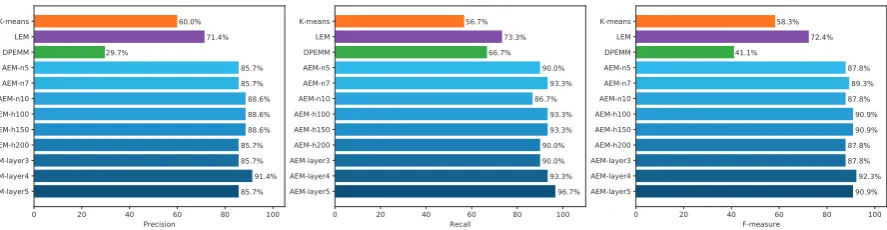
Figure 3: Comparison of methods and parameter settings,‘n’ and ‘h’ denote parameterndandH, other parameters
follow the default setting. The vertical axis represents methods/parameter settings, the horizontal axis denotes the corresponding performance value. All blue histograms with different intensity are those obtained by AEM.
with the default configuration.
• DPEMM (Zhou et al., 2017) is a non-parametric mixture model for event extrac-tion. It addresses the limitation of LEM that the number of events should be known be-forehand. We implement the model with the default configuration.
For social media text corpus (FSD and Twit-ter), a named entity tagger3 specifically built for Twitter is used to extract named entities including locations from tweets. A Twitter Part-of-Speech (POS) tagger (Gimpel et al., 2010) is used for POS tagging and only words tagged with nouns, verbs and adjectives are retained as keywords. For the Google dataset, we use the Stanford Named Entity Recognizer4 to identify the named enti-ties (organization, location and person). Due to the ‘date’ information not being provided in the
3
http://fithub.com/aritter/twitter-nlp
4https://nlp.stanford.edu/software/CRF-NER.html
Google dataset, we further divide the non-location named entities into two categories (‘person’ and ‘organization’) and employ a quadruple< organi-zation, location, person, keyword>to denote an event in news articles. We also remove common stopwords and only keep the recognized named entities and the tokens which are verbs, nouns or adjectives.
4.2 Experimental Results
To evaluate the performance of the proposed ap-proach, we use the evaluation metrics such as pre-cision, recall and F-measure. Precision is defined as the proportion of the correctly identified events out of the model generated events. Recall is de-fined as the proportion of correctly identified true events. For calculating the precision of the 4-tuple, we use following criteria:
• (1) Do the entity/organization, location, date/person and keyword that we have ex-tracted refer to the same event?
[image:8.595.79.523.274.389.2]keywords, are they informative enough to tell us what happened?
Dataset Method Precision (%) Recall (%) F-measure (%)
FSD
K-means 84.0 55.0 66.5
LEM 80.0 80.0 80.0
DPEMM 84.6 85.0 84.8
AEM 88.0 85.0 86.5
K-means 68.0 75.0 71.3
LEM 68.0 80.0 73.5
DPEMM 69.2 80.0 74.2
AEM 72.0 85.0 77.9
K-Means 60.0 56.7 58.3
LEM 71.4 73.3 72.4
DPEMM 29.7 66.7 41.3
AEM 85.7 90.0 87.8
Table 1: Comparison of the performance of event ex-traction on the three datasets.
Table1shows the event extraction results on the three datasets. The statistics are obtained with the default parameter setting thatndis set to 5,
num-ber of hidden unitsHis set to 200, andGcontains three fully-connected layers. The event numberE
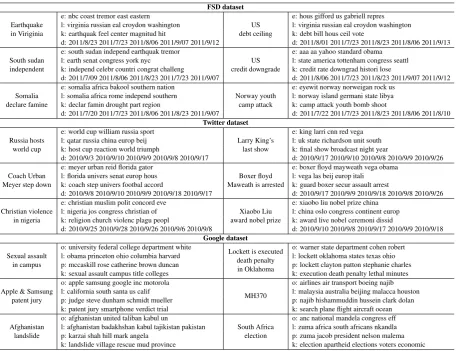
for three datasets are set to 25, 25 and 35, respec-tively. The examples of extracted events are shown in Table.2.
It can be observed that K-means performs the worst over all three datasets. On the social me-dia datasets, AEM outpoerforms both LEM and DPEMM by 6.5% and 1.7% respectively in F-measure on the FSD dataset, and 4.4% and 3.7% in F-measure on the Twitter dataset. We can also ob-serve that apart from K-means, all the approaches perform worse on the Twitter dataset compared to FSD, possibly due to the limited size of the Twitter dataset. Moreover, on the Google dataset, the proposed AEM performs significantly better than LEM and DPEMM. It improves upon LEM by 15.5% and upon DPEMM by more than 30% in F-measure. This is because: (1) the assump-tion made by LEM and DPEMM that all words in a document are generated from a single event is not suitable for long text such as news articles; (2) DPEMM generates too many irrelevant events which leads to a very low precision score. Overall, we see the superior performance of AEM across all datasets, with more significant improvement on the for Google datasets (long text).
We next visualize the detected events based on the discriminative features learned by the trained
Dnetwork in AEM. The t-SNE (Maaten and Hin-ton,2008) visualization results on the datasets are shown in Figure 2. For clarity, each subplot is plotted on a subset of the dataset containing ten
randomly selected events. It can be observed that documents describing the same event have been grouped into the same cluster.
To further evaluate if a variation of the parame-tersnd(the number of discriminator iterations per
generator iteration),H(the number of units in hid-den layer) and the structure of generatorGwill im-pact the extraction performance, additional experi-ments have been conducted on the Google dataset, withndset to 5, 7 and 10,H set to 100, 150 and
200, and three G structures (3, 4 and 5 layers). The comparison results on precision, recall and F-measure are shown in Figure3. From the results, it could be observed that AEM with the 5-layer generator performs the best and achieves 96.7% in F-measure, and the worst F-measure obtained by AEM is 85.7%. Overall, the AEM outperforms all compared approaches acorss various parameter settings, showing relatively stable performance.
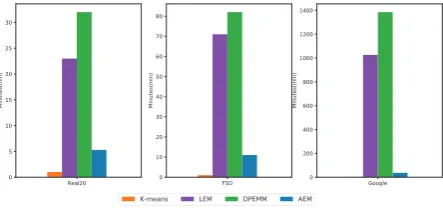
[image:9.595.310.532.509.613.2]Finally, we compare in Figure 4 the train-ing time required for each model, excludtrain-ing the constant time required by each model to load the data. We could observe that K-means runs fastest among all four approaches. Both LEM and DPEMM need to sample the event allocation for each document and update the relevant counts dur-ing Gibbs sampldur-ing which are time consumdur-ing. AEM only requires a fraction of the training time compared to LEM and DPEMM. Moreover, on a larger dataset such as the Google dataset, AEM appears to be far more efficient compared to LEM and DPEMM.
Figure 4: Comparison of training time of models.
5 Conclusions and Future Work
FSD dataset
Earthquake in Viriginia
e: nbc coast tremor east eastern
US debt ceiling
e: hous gifford us gabriell repres
l: virginia russian eal croydon washington l: virginia russian eal croydon washington
k: earthquak feel center magnitud hit k: debt bill hous ceil vote
d: 2011/8/23 2011/7/23 2011/8/06 2011/9/07 2011/9/12 d: 2011/8/01 2011/7/23 2011/8/23 2011/8/06 2011/9/13
South sudan independent
e: south sudan independ earthquak tremor
US credit downgrade
e: aaa aa yahoo standard obama
l: earth senat congress york nyc l: state america tottenham congress seattl
k: independ celebr countri congrat challeng k: credit rate downgrad histori lose
d: 2011/7/09 2011/8/06 2011/8/23 2011/7/23 2011/9/07 d: 2011/8/06 2011/7/23 2011/8/23 2011/9/07 2011/9/12
Somalia declare famine
e: somalia africa bakool southern nation
Norway youth camp attack
e: eyewit norway norweigan rock us
l: somalia africa rome independ southern l: norway island germani state libya
k: declar famin drought part region k: camp attack youth bomb shoot
d: 2011/7/20 2011/7/23 2011/8/06 2011/8/23 2011/9/07 d: 2011/7/22 2011/7/23 2011/8/23 2011/8/06 2011/8/10
Twitter dataset
Russia hosts world cup
e: world cup william russia sport
Larry King’s last show
e: king larri cnn red vega
l: qatar russia china europ beij l: uk state richardson unit south
k: host cup reaction world triumph k: final show broadcast night year
d: 2010/9/3 2010/9/10 2010/9/9 2010/9/8 2010/9/17 d: 2010/9/17 2010/9/10 2010/9/8 2010/9/9 2010/9/26
Coach Urban Meyer step down
e: meyer urban reid florida gator
Boxer floyd Maweath is arrested
e: boxer floyd mayweath vega obama
l: florida univers senat europ hous l: vega las beij europ itali
k: coach step univers footbal accord k: guard boxer secur assault arrest
d: 2010/9/8 2010/9/10 2010/9/9 2010/9/18 2010/9/17 d: 2010/9/17 2010/9/9 2010/9/18 2010/9/8 2010/9/26
Christian violence in nigeria
e: christian muslim polit concord eve
Xiaobo Liu award nobel prize
e: xiaobo liu nobel prize china
l: nigeria jos congress christian of l: china oslo congress continent europ
k: religion church violenc plagu peopl k: award live nobel ceremoni dissid
d: 2010/9/25 2010/9/28 2010/9/26 2010/9/6 2010/9/8 d: 2010/9/10 2010/9/8 2010/9/17 2010/9/9 2010/9/18
Google dataset
Sexual assault in campus
o: university federal college department white
Lockett is executed death penalty in Oklahoma
o: warner state department cohen robert
l: obama princeton ohio columbia harvard l: lockett oklahoma states texas ohio
p: mccaskill rose catherine brown duncan p: lockett clayton patton stephanie charles
k: sexual assault campus title colleges k: execution death penalty lethal minutes
Apple & Samsung patent jury
o: apple samsung google inc motorola
MH370
o: airlines air transport boeing najib
l: california south santa us calif l: malaysia australia beijing malacca houston
p: judge steve dunham schmidt mueller p: najib hishammuddin hussein clark dolan
k: patent jury smartphone verdict trial k: search plane flight aircraft ocean
Afghanistan landslide
o: afghanistan united taliban kabul un
South Africa election
o: anc national mandela congress eff l: afghanistan badakhshan kabul tajikistan pakistan l: zuma africa south africans nkandla
p: karzai shah hill mark angela p: zuma jacob president nelson malema
[image:10.595.77.534.60.411.2]k: landslide village rescue mud province k: election apartheid elections voters economic
Table 2: The event examples extracted by AEM.
long text corpora with an improvement of 15% observed in F-measure. AEM only requires a fraction of training time compared to existing Bayesian graphical modeling approaches. In fu-ture work, we will explore incorporating external knowledge (e.g. word relatedness contained in word embeddings) into the learning framework for event extraction. Besides, exploring nonparamet-ric neural event extraction approaches and detect-ing the evolution of events over time from news articles are other promising future directions.
6 Acknowledgments
We would like to thank anonymous reviewers for their valuable comments and helpful sugges-tions. This work was funded by the National Key Research and Development Program of China (2017YFB1002801), the National Natural Sci-ence Foundation of China (61772132), the Nat-ural Science Foundation of Jiangsu Province of China (BK20161430) and Innovate UK (grant no. 103652).
References
Hamed Abdelhaq, Christian Sengstock, and Michael Gertz. 2013. Eventweet: Online localized event
de-tection from twitter. Proceedings of the VLDB
En-dowment, 6(12):1326–1329.
Pramod Anantharam, Payam Barnaghi, Krishnaprasad
Thirunarayan, and Amit Sheth. 2015.
Extract-ing city traffic events from social streams. ACM
Transactions on Intelligent Systems and Technology (TIST), 6(4):43.
Martin Arjovsky, Soumith Chintala, and L´eon
Bot-tou. 2017. Wasserstein gan. arXiv preprint
arXiv:1701.07875.
Edward Benson, Aria Haghighi, and Regina Barzilay. 2011. Event discovery in social media feeds. In Proceedings of the 49th Annual Meeting of the Asso-ciation for Computational Linguistics: Human Lan-guage Technologies-Volume 1, pages 389–398. As-sociation for Computational Linguistics.
William Fedus, Ian Goodfellow, and Andrew M Dai. 2018. Maskgan: Better text generation via filling in
the . arXiv preprint arXiv:1801.07736.
Michael Heilman, Dani Yogatama, Jeffrey Flanigan, and Noah A Smith. 2010. Part-of-speech tagging for twitter: Annotation, features, and experiments. Technical report, Carnegie-Mellon Univ Pittsburgh Pa School of Computer Science.
Ian Goodfellow, Jean Pouget-Abadie, Mehdi Mirza, Bing Xu, David Warde-Farley, Sherjil Ozair, Aaron Courville, and Yoshua Bengio. 2014. Generative
ad-versarial nets. In Advances in neural information
processing systems, pages 2672–2680.
Ishaan Gulrajani, Faruk Ahmed, Martin Arjovsky, Vin-cent Dumoulin, and Aaron C Courville. 2017.
Im-proved training of wasserstein gans. In Advances
in Neural Information Processing Systems, pages 5769–5779.
Diederik P Kingma and Jimmy Ba. 2014. Adam: A
method for stochastic optimization. arXiv preprint
arXiv:1412.6980.
Karol Kurach, Mario Lucic, Xiaohua Zhai, Marcin Michalski, and Sylvain Gelly. 2018. The gan land-scape: Losses, architectures, regularization, and
nor-malization. arXiv preprint arXiv:1807.04720.
Yan Li and Jieping Ye. 2018. Learning adversarial
networks for semi-supervised text classification via
policy gradient. In Proceedings of the 24th ACM
SIGKDD International Conference on Knowledge Discovery & Data Mining, pages 1715–1723. ACM.
Kevin Lin, Dianqi Li, Xiaodong He, Zhengyou Zhang, and Ming-Ting Sun. 2017. Adversarial ranking for
language generation. InAdvances in Neural
Infor-mation Processing Systems, pages 3155–3165.
Laurens van der Maaten and Geoffrey Hinton. 2008.
Visualizing data using t-sne. Journal of machine
learning research, 9(Nov):2579–2605.
Takeru Miyato, Toshiki Kataoka, Masanori Koyama, and Yuichi Yoshida. 2018. Spectral normalization
for generative adversarial networks. arXiv preprint
arXiv:1802.05957.
Sandeep Panem, Manish Gupta, and Vasudeva Varma. 2014. Structured information extraction from
natu-ral disaster events on twitter. InProceedings of the
5th International Workshop on Web-scale Knowl-edge Representation Retrieval & Reasoning, pages 1–8. ACM.
Sasa Petrovic, Miles Osborne, Richard McCreadie, Craig Macdonald, Iadh Ounis, and Luke Shrimpton. 2013. Can twitter replace newswire for breaking
news? In Seventh international AAAI conference
on weblogs and social media.
Ana-Maria Popescu, Marco Pennacchiotti, and Deepa Paranjpe. 2011. Extracting events and event
descrip-tions from twitter. InProceedings of the 20th
inter-national conference companion on World wide web, pages 105–106. ACM.
Pengda Qin, Weiran Xu, and William Yang Wang.
2018. Dsgan: Generative adversarial training
for distant supervision relation extraction. arXiv
preprint arXiv:1805.09929.
Alan Ritter, Oren Etzioni, Sam Clark, et al. 2012. Open
domain event extraction from twitter. In
Proceed-ings of the 18th ACM SIGKDD international con-ference on Knowledge discovery and data mining, pages 1104–1112. ACM.
Ke Wang and Xiaojun Wan. 2018. Sentigan: Gener-ating sentimental texts via mixture adversarial
net-works. InIJCAI, pages 4446–4452.
Yu Wang, David Fink, and Eugene Agichtein. 2015. Seeft: Planned social event discovery and attribute
extraction by fusing twitter and web content. In
ICWSM, pages 483–492.
Chaolun Xia, Jun Hu, Yan Zhu, and Mor Naaman. 2015. What is new in our city? a framework for
event extraction using social media posts. In
Pacific-Asia Conference on Knowledge Discovery and Data Mining, pages 16–32. Springer.
Yuichi Yoshida and Takeru Miyato. 2017.
Spec-tral norm regularization for improving the
gen-eralizability of deep learning. arXiv preprint
arXiv:1705.10941.
Lantao Yu, Weinan Zhang, Jun Wang, and Yong Yu. 2017. Seqgan: Sequence generative adversarial nets
with policy gradient. InAAAI, pages 2852–2858.
Daojian Zeng, Yuan Dai, Feng Li, R Simon Sherratt, and Jin Wang. 2018. Adversarial learning for distant
supervised relation extraction. Computers,
Materi-als & Continua, 55(1):121–136.
Tongtao Zhang and Heng Ji. 2018. Event extraction
with generative adversarial imitation learning. arXiv
preprint arXiv:1804.07881.
Deyu Zhou, Liangyu Chen, and Yulan He. 2014. A simple bayesian modelling approach to event
extrac-tion from twitter. InProceedings of the 52nd Annual
Meeting of the Association for Computational Lin-guistics (Volume 2: Short Papers), volume 2, pages 700–705.