Full Terms & Conditions of access and use can be found at
http://www.tandfonline.com/action/journalInformation?journalCode=pqje20
Download by: [Dermot Lynott] Date: 25 February 2016, At: 08:02
ISSN: 1747-0218 (Print) 1747-0226 (Online) Journal homepage: http://www.tandfonline.com/loi/pqje20
Spatial Language and Converseness
Michele Burigo, Kenny R. Coventry, Angelo Cangelosi & Dermot Lynott
To cite this article: Michele Burigo, Kenny R. Coventry, Angelo Cangelosi & Dermot Lynott (2016): Spatial Language and Converseness, The Quarterly Journal of Experimental Psychology, DOI: 10.1080/17470218.2015.1124894
To link to this article: http://dx.doi.org/10.1080/17470218.2015.1124894
Accepted author version posted online: 25 Feb 2016.
Submit your article to this journal
View related articles
Accepted Manuscript
1
Publisher: Taylor & Francis & The Experimental Psychology Society
Journal: The Quarterly Journal of Experimental Psychology
DOI: 10.1080/17470218.2015.1124894
Spatial Language and Converseness
Michele Burigo
University of Bielefeld
Kenny R. Coventry
University of East Anglia
Angelo Cangelosi
University of Plymouth
Dermot Lynott
Lancaster University
Author Note
Michele Burigo, is affiliated with the Cognitive Interaction Technology (CITEC), Bielefeld
University, Bielefeld, Germany. Kenny R. Coventry is Professor at the School of Psychology,
University of East Anglia, Norwich, UK and worked on this study also during a visiting period at
the Hanse Institute for Advanced Studies, Delmenhorst, Germany. Angelo Cangelosi is Professor
at the School of Computing, Communication and Electronics, University of Plymouth, Plymouth,
UK. Dermot Lynott is affiliated with the Department of Psychology, Lancaster University,
Lancaster, UK. We are grateful to Laura Carlson for helpful discussions regarding the present
results, and to Thora Tenbrink and Elena Andonova for providing detailed comments on earlier
versions of the paper. The authors would also like to thank Valentine J. Randolph and an
anonymous reviewer for the very useful comments and suggestions. Correspondence concerning
Accepted Manuscript
2 this article should be addressed to Michele Burigo, Cognitive Interaction Technology (CITEC) –
Bielefeld University, Bielefeld, Germany.
Contact: [email protected]
Abstract
Typical spatial language sentences consist of describing the location of an object (the located
object) in relation to another object (the reference object) as in “The book is above the vase”.
While it has been suggested that the properties of the located object (the book) are not translated
into language because they are irrelevant when exchanging location information (Talmy, 1983), it
has been shown that the orientation of the located object affects the production and
comprehension of spatial descriptions (Burigo & Sacchi, 2013). In line with the claim that spatial
language apprehension involves inferences about relations that hold between objects (Coventry &
Garrod, 2004; Tyler & Evans, 2003) it has been suggested that during spatial language
apprehension people use the orientation of the located object to evaluate whether the logical
property of converseness (e.g., if “the book is above the vase” is true, then also “the vase is below
the book” must be true) holds across the objects’ spatial relation. In three experiments using
sentence acceptability rating tasks we tested this hypothesis and demonstrated that when
converseness is violated people's acceptability ratings of a scene's description are reduced
indicating that people do take into account geometric properties of the located object and use it to
infer logical spatial relations.
Keywords: spatial language, spatial relations, inference, converseness, acceptability
rating task.
Accepted Manuscript
3 Spatial Language and Converseness
Spatial language comprises part of the essential fabric of language. Words, such as in, on,
over, and in front of are among the most frequent words in the English language, and have the
important role of informing a hearer about where objects are located. For example “The acrobat is
above the chair” allows the hearer to constrain the search for the acrobat (the located object, LO)
by locating her in relation to another known or easily identifiable object (the reference object,
RO) (Talmy, 1983; Landau & Jackendoff, 1993; Regier & Carlson, 2001). Much research has
focused on the properties of the reference object showing, for example, that its orientation is
critical for selecting a reference frame (Carlson, 1999; Carlson & Van Deman, 2008;
Carlson-Radvansky & Irwin, 1994; Carlson-Carlson-Radvansky & Logan, 1997) which could be based on the
environment (absolute), on the viewer’s point of view (relative), or on the reference object
(intrinsic) (Levinson, 1996a).
On the other hand, geometric properties of the LO, such as its orientation, have remained
of secondary interest within the context of spatial language, where it has been claimed by some
that the located object and its geometric properties are irrelevant for the understanding of spatial
language (Jackendoff, 1983; Talmy, 1983). However, there is more recent evidence that
properties of the LO do play a role within the domain of spatial language comprehension in
English (Carlson-Radvansky & Radvansky, 1996; Coventry, Prat-Sala, & Richards, 2001; Feist,
2000; Feist & Gentner, 2012) and across languages (Brown, 1994; Levinson, 1996c; Valentine,
2001).
Accepted Manuscript
4 Recently it has been shown that people do process the orientation of the LO during the
comprehension and the production of spatial language (Burigo & Sacchi, 2013). In this study,
participants were asked to place the LO in the position indicated in a simple spatial description
such as “A is above B” or to describe the location of two objects presented in a scene using a
similar sentence structure. When the orientation of the LO did not match the orientation of the
RO, both the action of placing the objects in the designated location and describing their location
took longer compared to the scene where the LO orientation matched the orientation of the RO.
These results indicated that participants processed the orientation of the LO during the
apprehension of spatial descriptions and that such information somehow conflicted with the
information concerning the orientation of the RO. According to the observation that the
orientation of the objects is critical for choosing the reference frames people impose on the scene
(Carlson-Radvansky & Irwin, 1994), the fact that people gathered the orientation information also
for the LO suggested that they may have also considered a description where the LO is used as a
reference. This is in line with the claim that a spatial description is accompanied by its converse
description; so “A is above B” and “B is below A” are both acceptable descriptions of the same
scene (Levelt, 1984).
In this paper we provide some evidence in support of the idea that the divergence
between the orientation of the RO and the orientation of the LO is important for a specific type of
inference people make about the relations between the objects in the scene: converseness.
Converseness and Spatial Prepositions
Above-below, front-back, north-south are directional opposite pairs and therefore exhibit
the property of converseness (Levelt, 1984; 1996) such that, if the two-place relation expressed
by one pole is called R and the other R-1, then R(X, Y) ⇔ R-1(Y, X). Hence if X is above Y, Y
will be below X. This means that a spatial relation and its converse are both possible in describing
Accepted Manuscript
5 the spatial relations between two objects. However this is not always the case as there are
situations where the property of converseness cannot be applied, as is the case with in front of
applied within an intrinsic frame of reference. This spatial term accepts multiple reference frame
interpretations (Levinson, 1996b), but when two objects with a clear intrinsic axis are
horizontally aligned (as in Figure 1), judging the appropriateness of an in front of relation can
only depend on the intrinsic reference frame. Empirical evidence supporting this view is
discussed in a previous study (Burigo & Sacchi, 2013) where participants were asked to describe
a similar set of stimuli as the ones used here. The outcomes revealed that the majority of people
described the scene using the intrinsic perspective (less than 5% of participants used a relative
description).
PLEASE INSERT FIGURE 1 ABOUT HERE
Accordingly, “The flamingo is in front of the dog”is an acceptable description for both
Figure 1a and 1b. However, converseness holds in (b) (where the converse description “The dog
is behind the flamingo” is still a perfectly acceptable description for the scene) but not in (a),
since “The dog is behind the flamingo” is not acceptable. This example illustrates how
converseness might or might not hold for the simplest case, that is where an intrinsic reference
frame is the only available frame to judge the appropriateness of a spatial term (Levelt, 1996a).
When we consider the case of vertical spatial relations the situation is more complex as
people are likely to use a combination of absolute, relative and intrinsic reference frames to judge
the appropriateness of these spatial terms (e.g., Carlson-Radvansky & Irwin, 1993, 1994). In this
case multiple activated reference frames may compete with each other (Carlson-Radvansky &
Irwin, 1994; Carlson-Radvansky & Jiang, 1998; Carlson-Radvansky & Logan, 1997; Carlson &
Accepted Manuscript
6 Logan, 2001; Taylor & Rapp, 2004); therefore it is important to discuss also those cases where a
violation of converseness occurs for a spatial term for which multiple reference frames are active
(e.g., with above/below) which may not necessarily be the same as for those spatial terms that can
be interpreted only using an intrinsic perspective (e.g., with in front of/behind). That said, it is
critical to bear in mind that the property of converseness cannot be violated within an absolute or
relative frame of reference (under normal circumstances, such as with the viewer’s head upright)
because from these perspectives if “A is above B” the converse description “B is below A” is
always an acceptable alternative. It is only within an intrinsic reference frame that converseness
can be violated, given that the computation of the spatial relation depends on the orientation of
the reference object (instead of the orientation of the environment/viewer as for the
absolute/relative frames).
PLEASE INSERT FIGURE 2 ABOUT HERE
For example in Figure 2a and 2d “The acrobat is above the chair” is true, with respect to
the viewpoint of the viewer (or relative reference frame), with respect to the orientation of the
chair (or the intrinsic frame; the acrobat is higher than the top part of the chair), and with respect
to the gravitational plane (the absolute frame). However, according to the intrinsic reference
frame converseness holds in (a) (since “The chair is below the acrobat” is an acceptable
description) but not in (d) since the converse description does not apply (i.e., the chair, from the
intrinsic reference frame is above the acrobat, not below). In Figure 2b “The acrobat is above the
chair” is acceptable only within the intrinsic frame of reference (i.e., with respect to the axes
defined by the RO), but is unacceptable with respect to the relative (viewer-centred) or absolute
(gravitational) frames. In this case (within the intrinsic reference) converseness holds since its
Accepted Manuscript
7 converse description “The chair is below the acrobat” is a valid specification. In 2c “The acrobat
is above the chair” is acceptable within the relative and absolute frames, but is false within the
intrinsic frame, where a more appropriate description of the scene would be “The acrobat is on
the left of the chair”. According to this description based on the intrinsic perspective converseness
does not hold since the converse description “The chair is on the right of the acrobat” does not
apply to this scene. These examples show that for acceptable spatial descriptions based on
vertical spatial terms (above, below, over and under), deciding whether the logic of converseness
can or cannot be applied, depends exclusively on intrinsic interpretation, as it is the only frame
that is sensitive to changes in the orientation of the located object.
Inferences in Language
The possibility that the effect of the orientation of the located objects observed in Burigo
and Sacchi (2013) was due to the property of converseness is consistent with previous work
showing that producing and interpreting a spatial description involves speakers attempting to
construct the most informative spatial model that associates the objects involved (Coventry &
Garrod, 2004; Tyler & Evans, 2003). For example, expressions such as “The bottle is over the
glass” allow the hearer to infer that the bottle and glass are in an interactive situation where liquid
in the bottle will end up reaching the glass. The actual or potential path of falling liquid from the
mouth of a bottle affects the extent to which the bottle can be described as over or above the
glass, even when geometric positions remain constant (Coventry, et al., 2001). Furthermore when
participants are shown static images of bottles beginning to pour liquids (without showing the
liquid missing/entering the glass), participants’ eye gaze patterns reveal that they look at the
potential end path of falling objects before they return their spatial language judgements
(Coventry, Lynott, Cangelosi, Monrouxe, Joyce, & Richardson, 2010; Coventry, Christophel,
Fehr, Valdés-Conroy, & Herrmann 2013) suggesting that participants inferred whether the liquid
Accepted Manuscript
8 would end in the container. Carlson-Radvansky and Tang (2000) also found that when objects
were functionally related (e.g., a ketchup bottle and a hotdog), participants rated above
descriptions more highly for scenes where the bottle (the LO) was tilted rather than presented in
an upright (canonical) position consistent with the situation affording maximum interaction.
These results are part of a much larger body of empirical findings showing that object knowledge
and situational information are used to generate inferences that affect language comprehension
and production (see Coventry & Garrod, 2004 for a comprehensive review).
Applying these principles to spatial language, we expect the hearer to infer the spatial
relations between the objects concerned and build the best model, that is, one that supports the
strongest inferences about the relations between the objects in the scene. Thus, if it is true that the
orientation of the LO is relevant because it allows one to apply the property of converseness then
the use of spatial expressions where converseness should apply but does not, may be regarded as
poorer descriptions of spatial scenes than spatial descriptions where converseness does apply for
those spatial expressions. In other words, descriptions of spatial scenes that maintain the property
of converseness should be better descriptions of the scene than those descriptions where
converseness is violated. Then, according to the pragmatic principle that people should always
produce the most informative description (the Q-Principle; Levinson 2000; see also Asher &
Lascarides, 2003), a spatial description should be considered less informative (and therefore less
acceptable) when referring to a scene where converseness does not hold.
In the present paper we aim to investigate whether the converseness hypothesis is a valid
explanation for the effect of the located object’s orientation on the comprehension of scene
descriptions observed in Burigo and Sacchi (2013). Furthermore, we try to replicate Burigo &
Sacchi’s effect using a different methodology; an acceptability rating task (Carlson-Radvansky &
Irwin, 1993, 1994) which should better capture the effects of reduced informativeness for scenes
Accepted Manuscript
9 where converseness does not hold. The experiments examine whether the presence or absence of
converseness affects spatial language comprehension across two sets of spatial relations.
Experiment 1 focuses on relations on the horizontal axis only (in front of and behind), which
represent a simple case where the intrinsic reference frame is the only system used to decide
whether the spatial term matches the spatial relation. In fact, as discussed above, the use of
side-view objects limits the influence of the absolute and relative reference frame.
In Experiment 2 we investigate spatial prepositions on the vertical axes (above/below)
while we manipulate the reference frame selection process in order to disentangle whether a
violation of converseness occurring at the intrinsic level can still affect the acceptability of a
spatial relation whose acceptability depends also on the absolute and relative reference frames
(cases these where converseness always hold). In Experiment 3 we test the converseness
hypothesis using objects that do not show extra cost in recognition time when they are rotated (so
called polyoriented objects; Leek, 1998a) in order to show that converseness effects do not
depend on an identification cost for the objects shown in the scenes. To preview the results, we
report evidence that judgements of the extent to which spatial expressions map onto pictures are
affected by converseness.
Experiment 1
In this experiment we set out to test whether the presence/absence of converseness affects
acceptability for sentences containing in front of/behind to describe simple line drawn spatial
scenes. In particular we hypothesised that acceptability ratings for spatial expressions containing
in front of/behind to describe scenes where converseness holds (e.g., Figure 1b) would be higher
than for those scenes where converseness does not hold (e.g., Figure 1a).
Accepted Manuscript
10
Method
Participants
Twenty students (14 females and 6 males; age range from 18 to 44, mean age = 22)
participated in this study for course credit. All participants were native English speakers with
normal or corrected to normal vision.
Design and Materials
This experiment employed an acceptability-rating task where participants had to rate the
acceptability of sentences containing the spatial prepositions in front of and behind to describe
pictures. Eight objects were used, all with clear front/back orientations when presented in profile
(e.g., dog, frog, penguin, etc. See Appendix for the complete list). Each scene consisted of a pair
of objects (e.g., two dogs), with the RO and LO distinguished by four different colours. The
scenes were described by sentences of the form “The LO is PREPOSITION the RO” (e.g., “The
black dog is behind the white dog”). Objects were always positioned along the horizontal axis
placed either 9 cm or 12 cm apart (on a 17’’ monitor) and were positioned either facing to the left
or to the right, with the LO positioned to the left or right of the RO (see Figure 3 for examples).
The placement of the object pairs was randomised to different screen positions to prevent
participants from seeing objects in predictable locations.
PLEASE INSERT FIGURE 3 ABOUT HERE
The design included the following factors: 2 (preposition; in front of vs. behind) x 2
(distance; near vs. far) x 2 (converseness; present vs. absent). The distance manipulation was
incorporated into the design as it has been shown that distance can modulate the acceptability of
Accepted Manuscript
11 some spatial descriptions (Coventry et al, 2001; Hayward & Tarr, 1995; Regier & Carlson, 2001).
More specifically, the distance between the LO and RO is inversely proportional to the
acceptability of a spatial relation as reflected in the spatial template activated for the given spatial
term (Carlson-Radvansky & Logan, 1997): when the LO is placed farther away from the RO the
acceptability is reduced (but only when the LO is not vertically aligned with the RO). Given that
the effect of distance reflects different spatial template shapes (Carlson-Radvansky & Irwin,
1994), it was important to assess whether it has an effect on the applicability of converseness.
Orientation of the RO, object colours, and locations of the LO were counterbalanced within
participants resulting in a total of 512 stimuli. Half of all trials were true and half were false. A
scene was false when the located object’s location did not match the one expressed in the
description. For example given the scene in Figure 3a the description “The white dog is behind
the black dog” was false.
Procedure
Participants had to judge the appropriateness of a sentence of the form “The LO is
PREPOSITION the RO” to describe a picture that followed immediately afterwards. Participants
pressed the space bar after they read each sentence to reveal the associated picture. When ready,
participants gave their judgments by pressing a number between 1 and 9 (where 1 = not at all
acceptable and 9 = perfectly acceptable).
Results and Discussion
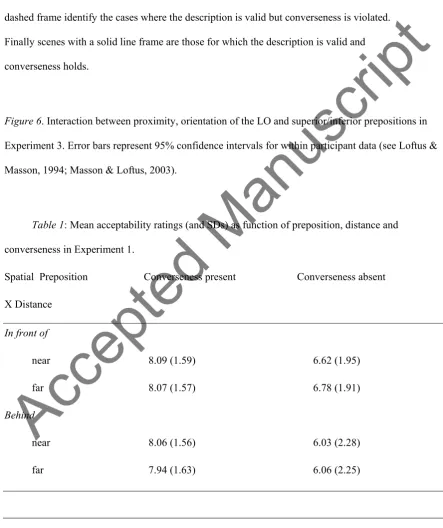
The mean acceptability ratings for true instances of in front of and behind by distance and
converseness (present or absent) are displayed in Table 1. The data were analysed using a 2
(preposition; in front of vs. behind) x 2 (distance; near vs. far) x 2 (converseness; present vs.
absent) within participants ANOVA. The results revealed a main effect of preposition, F(1,19) =
Accepted Manuscript
12 7.96, MSE = 0.71, p = 0.01, η2
p = 0.293. Overall ratings for in front of were significantly higher
(M = 7.39) than those for behind (M = 7.02). There was also a main effect of converseness,
F(1,19) = 8.07, MSE = 13.75, p = 0.01, η2
p = 0.298. When converseness was present, ratings
were significantly higher (M = 8.04) than when converseness was not present (M = 6.36). There
was no main effect of distance, nor any interactions between any of the factors. The lack of an
effect of distance is in line with previous results showing that distance does not affect the
acceptability rating for a spatial relation when the LO is aligned with the RO (Carlson-Radvansky
& Logan, 1997).
PLEASE INSERT TABLE 1 ABOUT HERE
These results support the view that the presence of converseness in a visual scene increases
people's acceptability judgements of the spatial descriptions used to describe that scene. This
suggests that people may use the property of converseness as a means of gauging the
informativeness of scene descriptions. However, this study addresses only one set of spatial
relations (in front of and behind), which operate only within a single spatial axis (i.e., the
horizontal axis) and their interpretation depends, at least in the way they are displayed in our
study, exclusively on the intrinsic reference frame. In Experiment 2, we demonstrate that the
importance of converseness in communicating spatial information extends to additional spatial
relations (e.g., above, below), to other spatial axes (i.e., the vertical axis), and affects spatial
description comprehension also when multiple reference frames are in play.
Experiment 2
This experiment set out to test whether the effect of converseness occurs also with the
vertical spatial prepositions above and below. As described before, with these prepositions the
Accepted Manuscript
13 computation of converseness can be more complex as people may ground their judgments using
all three reference frames or just a selection depending on the orientation of the RO. In particular,
with respect to these spatial terms, converseness violation occurs when the LO is rotated, as in
Figure 2d. Here “The acrobat is above the chair” is true for all three reference frames, but
converseness is violated within the intrinsic reference frame: the chair is not below the acrobat’s
head. Experiment 1 has already shown converseness is important in the case where the
acceptability of a description depends on the intrinsic frame, but whether this is also the case even
when other reference frames are applied remains to be established. Accordingly, in addition to
manipulating converseness via the degree of rotation of the LO, in this experiment we crossed
this with manipulating the orientation of the RO. This was important in order to disentangle
whether a violation of converseness within the intrinsic reference frame still affects the overall
acceptability for the given spatial relation, or whether the fact that converseness holds for the
relative and the absolute reference frames makes the violation undetected.
Method
Participants
Twenty-five students (21 females and 4 males; age range from 18 to 53, mean age = 21)
participated in this study for course credit. All the participants were English native speakers with
normal or corrected to normal vision.
Design and Materials
The variables in this study were the following: 2 (superior/inferior prepositions: above vs.
below) x 2 (distance: far vs. near) x 4 (orientations for the LO) x 4 (orientations for the RO). The
location where the LO could appear in relation to the RO was manipulated in order to present the
objects at two different distances. Figure 4 shows examples of the 10 locations where the LO
appeared around the RO: 5 locations above the RO and 5 locations below the RO. Locations 3
Accepted Manuscript
14 and 8 were included for completeness (for an extra 64 trials), but not as a level of orientation for
subsequent analyses because under some conditions ‘vertical’ and ‘pointing at’ orientations are
the same. Locations of the LO and stimuli sets were balanced within participants resulting in a
total of 624 stimuli.
PLEASE INSERT FIGURE 4 ABOUT HERE
In this experiment we used ‘vertical’, ‘pointing at’, ‘90° away’ (pointing away from the
other object) and ‘90° at’ (pointing towards the other object) orientations for the LO and the RO:
These orientations were selected because they allowed us to test all possible degrees for which
converseness holds while testing the strongest case in which converseness does not hold (that is
when objects axis are aligned but have opposite directions). Figure 5 illustrates the orientations
used. In the pointing at conditions, the axis of the LO was pointing exactly towards the
centre-of-mass of the RO and vice versa.
Critical objects had a well-defined intrinsic axis (or oriented axis objects); these are objects
with a “head” and a “tail” (e.g. a chicken, a hat, a vase, etc.). These types of objects were used as
LO as well as RO. In addition two further types of objects were used as LOs for filler trials; 24
non-oriented axis objects (such as an hourglass) and 24 no axis objects (such as a wheel) (see
Appendix for the complete list).
The assessment of converseness assessment for vertical spatial terms
A spatial description referring to a vertical spatial relation such as above or below, is
subjected to the influence of multiple reference frame (Carlson-Radvansky & Irwin, 1993, 1994).
Therefore it is critical for this study to describe how converseness is assessed in such context.
First of all, we focus on those trials where the provided description was good/acceptable
Accepted Manuscript
15 according to all reference frames. This follows the principle that people should apply the
inference of converseness only on valid descriptions because if the sentence is invalid then there
is no need to carry on any further processing.
PLEASE INSERT FIGURE 5 ABOUT HERE
Figure 5 shows all the possible orientation combinations (but not all possible locations) for
descriptions including above (left panel) and below (right panel). These two sentences are, from
the absolute/relative reference frame, all perfectly acceptable and so are their converse
descriptions, given that the LO (the cat) is always above (or below, in the right quadrant) the
grazing line (Regier & Carlson, 2001) set on the RO (the pan) which is what people use to
differentiate a “good/acceptable” region from a “bad” region (Carlson-Radvansky & Irwin,
1994). When referring to an intrinsic reference frame this is not always the case. As illustrated in
Figure 5, scenes for which the sentence is valid are those without boundaries. These are the
scenes presenting the RO with a ‘90° away’ orientation associated with the description “The cat is
above the pan” (left panel). For below scenes (right panel), the description “The cat is below the
pan” is unacceptable for the scenes with the RO ‘pointing at’ and ‘90° at’ orientations. Once we
have described how a valid and an invalid description is assessed within an intrinsic reference
frame, we can now move on identifying cases where converseness is violated according to the
simple “The cat is above the pan - then - the pan is below the cat” rule. In Figure 5, these are the
scenes with a dashed frame. Scenes where the description is valid and converseness applies are
Accepted Manuscript
16 coded with a solid line frame. All the results and the interpretation of the effects of the orientation
of the LO described in the paper are based on this coding procedure1.
Procedure
The procedure was the same as that used for Experiment 1.
Results and Discussion
The analysis focused on the oriented axis objects, as these are the only objects that allow the manipulation of converseness based on the intrinsic reference frame. Furthermore, only scenes where the given spatial description was valid across all the reference frames were analysed, excluding then those cases where a description may be valid from an absolute/relative reference frame but not for the intrinsic perspective (see Figure 5).
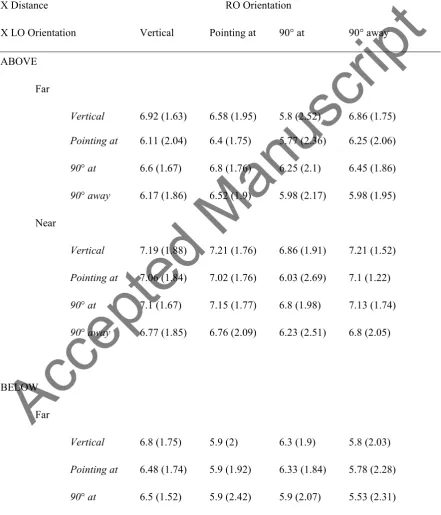
Table 2reports the mean acceptability ratings and standard deviations (collapsed by side, as no effect was found for this variable; t(24) = -.846, p = .406) for combinations of LO and RO. The acceptability ratings were submitted to a 2 (prepositions; above vs. below) x 2 (distance; near vs. far) x 4 (orientations of the LO) x 4 (orientation of the RO) repeated measures ANOVA. A summary of means for all the factors can be found in Table 2.
First we report the effects involving the orientation of the LO as they provide evidence for
the importance of converseness for terms on the vertical axes. There was a main effect of the
orientation of the LO, F(3,72) = 3.78, MSE = 1.69, p < .014, η2
p = 0.136, and there was also a
1Since the coding relies on the assumption that participants compute converseness as described in Figure 5 we
ran an additional study where 11 participants had to rate the appropriateness of two opposite descriptions referring to the same scene (e.g., “The cat is above the pan” vs. “The pan is below the cat”) in order to check that the assignment of cases where converseness does and does not hold is corroborated with impartial participants’ judgements. For the valid cases in Figure 5 we calculated a “converseness factor” (CF) by subtracting the ratings for a description (e.g., “The cat is above the pan”) and its converse description (e.g., “The pan is below the cat”). The statistics revealed a significantly higher CF difference for the scenes where converseness did not hold (M = 3.33, SD = 1.09) than for scenes where converseness held (M = .35, SD = .51) both in above, t(10) = 12.11, p < .001, and below descriptions, t(10) = 7.85, p < .001. In addition for cases where converseness held, there was no significant difference, t(10) = 0.3, p = .77, between the ratings for higher (M = 4.17, SD = 0.56) and lower relation (M = 4.14, SD = 0.47), but there was for cases where converseness did not hold, t(10) = 2.59, p < .05 (Mabove = 3.3, SD = .36; Mbelow = 3.04, SD = .46). These outcomes confirmed that participants presented the same
assessment of converseness (where it holds and does not hold) as the one described in Figure 5.
Accepted Manuscript
17 significant interaction between preposition and the orientation of LO, F(3,72) = 2.98, MSE =
2.45, p < .036, η2
p = 0.111. For above, ratings for the ‘vertical’ (M = 6.86) and ‘90° away’ (M =
6.77) orientations - orientations where converseness holds - were significantly higher than for the
‘90° at’ the RO (M = 6.50) and the ‘pointing at’ the RO (M = 6.43) orientations (both p < 0.05) –
orientations where converseness is violated. For below, the ‘vertical’ (M = 6.63) and ‘pointing at’
(M = 6.54) orientations – orientation where converseness holds - were rated significantly higher
than the ‘90° away’ orientation (M = 6.25) (both ps < 0.05) – the orientation where converseness
does not hold. None of the other effects or interactions were significant, and interestingly there
were no significant interactions involving orientation of the RO and orientation of the LO (all Fs
< 1).
We also found a significant main effects of spatial preposition, F(1,24) = 6.7, MSE = 1.64,
p < .016, η2
p = 0.218, and of distance, F(1,24) = 30.63, MSE = 5.46, p < .00001, η2p = 0.561.
Above received higher ratings (M = 6.63) than below (M = 6.47), and scenes where the LO was
positioned near the RO received higher ratings (M = 6.88) than scenes where the LO was far from
the RO (M = 6.23). The distance effect was in line with previous studies (Coventry et al, 2001;
Hayward & Tarr, 1995; Regier & Carlson, 2001) showing that in scene where the LO is not
vertically aligned with the RO (as in this experiment) acceptability ratings were inversely
proportional to the distance between the objects. The lack of an interaction between distance and
the orientation of the LO suggests that the converseness inference is indifferent to the information
about the distance between the two objects.
There was a main effect of the orientation of the RO, F(3,72) = 4.69, MSE = 1.71, p <
.004, η2
p = 0.164. The RO in the ‘vertical’ orientation received significantly higher ratings (M =
6.76) then the RO presented with a ‘pointing at’ and ‘90° at’ orientation (both M = 6.51) and ‘90°
away’ orientation (M = 6.44) (all ps < 0.01). There was also a significant interaction between
Accepted Manuscript
18 preposition and orientation of the RO, F(3,72) = 4.34, MSE = 4.94, p < .007, η2
p = 0.153. For
above, when the RO was pointing ‘90° away’ from the LO (M = 6.26) ratings were significantly
lower than for any of the other orientations as expected (p < 0.05). This is because when the RO
faces away from the LO above is false in the intrinsic frame, and the ratings are therefore lower
than for the other orientations where above is true for both the intrinsic and relative frames. For
below, ratings for the ‘vertical’ (M = 6.8) and the ‘90° away’ orientations (M = 6.62), orientations
were significantly higher than for the ‘90° at’ (M = 6.18) and ‘pointing at’ (M = 6.30)
orientations (p < 0.04). Again these differences reflect the extent to which below is true in both
intrinsic and relative frames. The effects found for the orientation of the RO are consistent with
results found previously (e.g., Carlson-Radvansky & Irwin, 1994). When the spatial preposition
maps onto a good region in both the intrinsic and relative frames ratings are higher than when the
preposition is appropriate only within a single reference frame.
PLEASE INSERT TABLE 2 ABOUT HERE
In summary the effects of the orientation of the LO are consistent with the results of
Experiment 1. Rotating the LO such that it is pointing at the RO (that is the strongest case where
converseness does not hold) is associated with lower ratings for above than when the LO is
vertical or facing away from the RO (that is the case where converseness holds). Vice versa,
while rotating the LO such that it is pointing away from the RO (that is the case where
converseness does not hold) is associated with lower ratings for below than when the LO is
vertical or pointing at the RO (that is the case where converseness holds). The presence of a
converseness effect in both Experiment 1 (where only an intrinsic reference frame was in play)
and Experiment 2 (where a combination of reference frames are likely to have been assigned) is a
Accepted Manuscript
19 clear indicator that converseness affects the acceptability of a spatial description regardless of
which reference frame has been applied on the scene.
The lack of an interaction between the orientation of the RO and the orientation of the LO
is not in contradiction with the results shown in Burigo & Sacchi (2013), where the effect of the
orientation of the LO has been measured in relation to the degree of which the LO and the RO’s
orientation match regardless of the orientation of the RO. In fact in this study, the non-canonical
orientation was always the diametrically opposite direction (180° difference: so if the RO was 0°
the conflicting orientation was 180°: if the RO was 90°, then the LO was 270°) while in
Experiment 2 of the current study only 3 (or 6 if we consider both spatial terms) out of 16 (or 32
including also below cases) scenes, that is only 18.75 % of all the possible RO and LO
orientations combination presented such contrasting orientations. Then, out of the 13 remaining
scenes, 2 had the RO and LO presented with the same orientation and 11 scenes presented the RO
and LO with discordant orientations but with some other degree of contrast. So the comparison
between the current results and the previous study concerns very different conditions and a more
sensitive comparison (focusing on the same contrasting orientations) would rely on means
calculated only on 3 data points, which are clearly not representative of the entire set of scenes
people saw. In conclusion the lack of an interaction can be reasonably interpreted as a direct
consequence of not using the strongest conflicting cases (as in Burigo & Sacchi, 2013), and not
because the orientation of the two objects did not interact.
To be sure that it is converseness that is affecting judgements of spatial language, it is
necessary to discount one alternative possible explanation for the effects found for terms on the
vertical plane. It could be that the cost in identifying the LO when it is rotated, rather than
converseness, affects ratings. All the objects used in this experiment were mono-oriented, and it
is well known that naming latencies for familiar mono-oriented objects increase as a function of
Accepted Manuscript
20 the angular distance between the orientation of the stimulus and its more familiar upright
canonical orientation (Biederman, 2000; Jolicoeur, 1985). Furthermore it is likely that
participants rotate these objects to match a familiar orientation automatically (Tarr & Pinker,
1989, 1990). We therefore chose to run a further study using objects without increased
identification costs when rotated to test whether identification costs could be discounted as an
alternative explanation for the effect.
Experiment 3
Leek (1998a, 1998b) has shown that poly-oriented objects (such as carrots and pumpkins),
unlike mono-oriented objects, do not show RT differences in recognition time as a function of
increasing rotation away from canonical orientation. This is because poly-oriented objects do not
have a canonical orientation as they are experienced from multiple views. As these views are
presumably stored rather than derived from rotation, they do not require a normalisation strategy
for their identification. This experiment therefore attempted to replicate the results of the previous
experiment using poly-oriented objects. If the effect of the orientation of the LO remained using
poly-oriented objects, we could be confident that the effect is due to converseness, and not to
identification costs for the LO. It has been also shown that the comprehension of over/under is
more affected by functional relations between objects than above/below, while the
comprehension of above/below is more affected by geometric relations than over/under (cf.
Coventry & Garrod, 2004). For that reason, it was of interest to examine also if converseness
affects the comprehension of these terms equally, so, as a secondary goal, we broadened the
range of prepositions examined to include over and under as well as above and below.
Accepted Manuscript
21 Method
Participants
Twenty-seven students (21 females and 6 males; age range from 19 to 26, mean age = 20)
participated in this study for credit course. All the participants were English native speakers with
normal or corrected to normal vision.
Design and Materials
The experiment again employed an acceptability rating task where participants had to rate the
acceptability of sentences containing the spatial prepositions above, below, over and under to describe
pictures. A pilot study checked that the poly-oriented objects selected from those used by Leek
(1998b) from the same categories of fruit and vegetables were indeed not subject to increased
identification costs as a function of degree of rotation away from the canonical plane. In order to do
this we presented 10 participants with a word picture verification task following the methodology used
by Leek (1998a). Nouns were presented for 750 ms, followed by a blank screen for 250 ms, followed
by a picture for 2500 ms during which time participants had to make a match/mismatch response. The
results confirmed no effect of object rotation on reaction times for true responses (p > 0.05) consistent
with the previous results of Leek. In another pilot study we tested 8 participants to investigate whether
there was consistency regarding the orientation (assignment of top and bottom) of these objects. The
results indicate that there was almost perfect agreement in deciding where the head of these
polyoriented objects was, with 95% of subjects providing the same answer. These 8 poly-oriented
objects were then used as LO and RO but we manipulated the orientation of LO only as we have
already shown in Experiment 2 that converseness effects can not be accounted for due to the degree of
alignment of the LO and RO. Scenes showing non-oriented axis objects (e.g., barrel, hourglass, tube,
etc. See Appendix for the complete list) as LO were treated as fillers.
Accepted Manuscript
22 Levels of orientation for the LO were: ‘vertical’, ‘upside down’, ‘pointing at’ (the RO) and
‘pointing away’ (from the RO). These orientations were selected to be consistent with orientations
used in Experiment 2 and with previous experiments that manipulated the orientation of the RO (e.g.,
Carlson-Radvansky & Irwin, 1994; Carlson & Logan, 2001). As in Experiment 2 in the pointing
conditions, the axis of the LO was pointing exactly towards, or away from, the centre-of-mass of the
RO; the distance between LO and RO was manipulated across all the orientations. The LO appeared
around the RO in 10 locations (as in Experiment 2): 5 locations above the RO and 5 locations below
the RO (see Figure 4). For this experiment trials where the LO was presented in the locations 3 and 8
and scenes with non-oriented axis objects (128) were treated as fillers for a total of 512 stimuli. The
variables in the design were: 2 (preposition sets; above-below vs. over-under) x 2 (superior/inferior
prepositions; above-over vs. below-under) x 2 (distance; near vs. far) x 4 (orientations of LO).
Procedure
The procedure was the same as that in Experiment 2.
Results and Discussion
The data were treated in the same way as in Experiment 2. Table 3 reports the mean
acceptability ratings and standard deviations (collapsed by side) for combinations of LO and RO.
The acceptability ratings were submitted to a 2 (superior/inferior preposition; over/above vs.
under/below) x 2 (preposition set; over/under vs. above/below) x 2 (distance: near vs. far) x 4
(orientations of the LO) repeated measures ANOVA.
PLEASE INSERT TABLE 3 ABOUT HERE
Accepted Manuscript
23 We focus on the effects involving orientation of the LO, as they are informative regarding
effects of converseness. The analysis revealed a significant interaction between distance and the
orientation of the LO, F(3,78) = 3.87, MSE = .288, p < .01, η2
p = 0.13, and the three-way
interaction between distance, orientation of the LO and superior/inferior prepositions was also
significant, F(3,78) = 3.75, MSE = .29, p < .015, η2
p = 0.126. This interaction is displayed in
Figure 6. Post-hoc analyses revealed that for superior prepositions in far positions, ‘vertical’ (M =
4.88) and ‘pointing away’ (M = 4.9) orientations – orientations where converseness holds - were
rated higher than ‘upside down’ (M = 4.58) and ‘pointing at’ orientations (M = 4.57) (p < .01) –
orientations where converseness does not hold. For inferior prepositions in far locations,
‘vertical’ (M = 4.74) and ‘upside down’ orientations (M = 4.78) were rated higher than ‘pointing
at’ (M = 4.52) and ‘pointing away’ (M = 4.38) orientations (p < .01), again consistent with when
converseness does versus does not hold.
PLEASE INSERT FIGURE 6 ABOUT HERE
For near locations the results were also consistent with the presence or absence of
converseness. For superior prepositions in near locations, scenes where the LO was ‘pointing
away’ from the RO were rated higher (M = 6.72) than ‘upside down’ (M = 6.42) and ‘pointing at’
(M = 6.34) scenes (p < .01). Finally for inferior prepositions in near locations, scenes where the
LO was pointing at the RO received higher ratings (M = 6.41) than ‘upside down’ orientations (M
= 6.12) (p < .01). No other pair-wise differences were found suggesting that the interaction
between distance and the orientation of the LO only reflected the overall preference for trials with
the LO placed near the RO. This is in line with previous studies showing that scenes where the
LO was placed closer to the RO received higher ratings compared to scenes where the LO was
Accepted Manuscript
24 placed farther away from the RO (Carlson-Radvansy & Logan, 1997; Hayward & Tarr, 1995). In
addition, since the distribution of the acceptability ratings for near and far are consistent (with the
exception for the ‘pointing at’ orientation at far distance for inferior prepositions) the results
suggest that the effects of the orientation of the LO described here take place regardless of the
distance between the objects.
The ANOVA also revealed significant main effects of distance, F(1,26) = 80.01, MSE =
7.98, p < .0001, η2
p = 0.755, of superior/inferior spatial prepositions, F(1,26) = 8.46, MSE = .762,
p < .007, η2
p = 0. 246, and of preposition set, F(1,26) = 13.19, MSE = 8.59, p < .001, η2p = 0.337,
together with significant interactions between distance and preposition set, F(1,26) = 13.83, MSE
= .449, p < .001, η2
p = 0.347, and between superior/inferior prepositions and preposition set,
F(1,26) = 4.33, MSE = .734, p < .047, η2
p = 0.143. These interactions revealed an overall
preference for above/below compared to over/under prepositions and support the observation that
these two sets of prepositions have different spatial templates (Coventry, Prat-Sala, & Richards,
2001 but see Regier & Carlson, 2001 for a different claim). None of the other main effects or
interactions were significant.
In summary, the current experiment replicates the effect of converseness found in the
previous experiment using poly-oriented objects rather than mono-oriented objects. Such objects
are not associated with increased identification costs, and therefore the fact that the orientation of
LO still affects comprehension for these objects allows us to discount normalisation costs as an
explanation for the effect.
General Discussion
Across four sets of spatial relations covering both vertical and horizontal axis, we
demonstrated that the presence or absence of a converseness relation in spatial scenes affects the
acceptability of scene descriptions. These findings replicated the effects of the orientation of the
Accepted Manuscript
25 located object observed previously by Burigo and Sacchi (2013). This is particularly important
according to the growing literature emphasising the relevance of replications (Cumming, 2013).
Furthermore, these results extend previous studies corroborating the idea that geometric
properties of the located object are important and contradicting the cognitive linguistics’ idea that
the located object is irrelevant for spatial language comprehension (Jackendoff, 1983; Talmy,
1983 but see Valentine, 2001 for some evidence in contrast with this view). Moreover, this study
not only provides support for the relevance of the orientation of the LO, but also shows for the
first time that the orientation of the LO is important as a function of the inferences people are able
to make - converseness - during spatial language comprehension. The degree to which X can be
said to be above Y or in front of Y is dependent on the degree to which Y can be said to be below
X or behind X. When converseness between two objects did not hold, the acceptability for the
spatial term used to describe their relation received lower ratings compared to the same spatial
term used for a scene where converseness did hold.
In Experiment 1 we tested whether flouting of converseness through manipulation of the
orientation of the LO affects the appropriateness of a spatial expression involving in front
of/behind to describe the position of an LO in relation to an RO. The outcomes established that
the orientation of the LO does affect the appropriateness of a spatial expression containing
horizontal spatial prepositions to describe simple scenes containing two objects. Specifically,
when the orientation of the LO was such that the property of converseness could not hold, the
appropriateness was lower than for scenes where the orientation of the LO allowed the
converseness property.
According to the observation that converseness could be violated only in respect to an
intrinsic reference frame, in Experiment 2 we manipulated the orientations of both LO and RO in
order to test the possibility that the comprehension of above and below is affected by the extent to
Accepted Manuscript
26 which converseness applies regardless of which reference frames have been selected. The results
indicate that the orientation of the LO is important regardless of which reference frame is active,
and also that converseness is taken into account even when there is cost associated with the
processing of reference frames for the RO.
Experiment 3 set out to test whether converseness affected judgements of a range of
prepositions on the vertical axis while eliminating other possible reasons why rotation of the LO
might impact upon language ratings for these terms. The data from this experiment allowed us to
discount an alternative explanation for the effect – cost in identifying the LO. The effect of the
orientation of LO persisted even when the LOs used were poly-oriented objects and therefore do
not have increased cost associated with their identification as a function of increasing rotation
away from the canonical orientation. Experiment 3 tested also whether converseness is important
for the comprehension of over/under in addition to above/below; the results of this experiment
provide support for the general importance of converseness across a range of spatial relations and
prepositions while discounting alternative explanations for the effect.
Now if one subscribes to the view that spatial language serves the function of narrowing
the search for an object by locating the object in relation to a second known object (e.g., Talmy,
1983; Landau & Jackendoff, 1993; Regier & Carlson, 2001), then one can ask why participants
consider converseness at all when this entails additional work in spatial language comprehension
that at first sight might appear superfluous. From the point of view of more recent accounts
attributing a greater role to the inferential mechanism (Tyler & Evans, 2003; Coventry & Garrod,
2004), where spatial language is taken to communicate information about the most informative
spatial relations present in the scene being described, consideration of converseness is not
unnecessary work, but affects just how informative a given spatial expression is. This idea is in
line with a pragmatic approach to language processing. Talking about the spatial world informs
Accepted Manuscript
27 the hearer about the state of the world at the immediate time of the utterance, but also about sets
of inferences that should follow from the given spatial expression in line with the duty speakers
have to avoid statements that are informationally weaker than their knowledge of the world
allows (Asher & Lascarides, 2003; Levinson 2000). Describing the position of X in a scene with
reference to Y carries with it the assumption that the position of Y is important also. Hence one
can argue that it is not by chance that languages such as English cluster many lexical items into
pairs so that language can reflect the multiple relations that hold between objects. As a
consequence, people are sensitive to the logical properties of language when they comprehend it
and test out whether converseness holds in order to assess the felicitousness of a given spatial
expression.
However computing the acceptability of a spatial description and/or establishing whether
converseness holds, are two distinct processes. Inferring whether converseness applies to a given
description depends only on whether the rule – A is above B than B is below A – applies. The
acceptability, on the other hand, reflects the spatial template people have built on the reference
object. For this reason acceptability presents some granularity while the logic of converseness
does not.
While the present experiments indicate that people consider converseness when judging
how well spatial expressions describe pictures involving pairs of objects, the results do not speak
to the issue of the time course of consideration of converseness during processing of spatial
language, nor do the results indicate that converseness is considered obligatorily. Further studies
using more on-line methods are required to address these issues. Nevertheless, the results have
potential implications for computational models of spatial language. Currently models of spatial
language assume that direction is assigned from the RO to the LO after multiple reference frame
activation, and that attention is directed from the RO to the LO in order to establish the goodness
Accepted Manuscript
28 of fit between a given spatial preposition and a given visual scene (e.g., Regier & Carlson, 2001).
The present research suggests that attention is distributed across both objects in the scene
(consistent with Lavie, 1995, 1997) and that there is an active search for alternative spatial
relations to describe those objects where attention must be allocated from the LO, as denoted in
the sentence, to the RO. Recent eye tracking experiments have indeed shown that visual attention
is flexibly allocated across the objects (Coventry et al., 2010) and that attentional shifts from the
LO to the RO occurs when participants are judging whether a given spatial expression correctly
describes that scene (Burigo & Knoeferle, 2015). However it remains to be established exactly
how and when attention allocation is affected by the absence of converseness in a spatial scene.
Accepted Manuscript
29 References
Asher, N., & Lascarides, A. (2003). Logics of Conversation. Cambridge University Press.
Biederman, I. (2000). Recognizing depth-rotated objects: a review of recent research and theory.
Spatial Vision, 13(2-3), 241-253.
Brown, P. (1994). The INs and ONs of Tzeltal locative expressions: The semantics of static
descriptions of location. Linguistics, 32, 743-790.
Burigo M. & Knoeferle, P. (2015). Visual Attention during Spatial Language Comprehension.
PLoS ONE, 10(1): e0115758. doi:10.1371/journal.pone.0115758
Burigo, M. & Sacchi, S. (2013). Object orientation affects spatial language comprehension.
Cognitive Science, 37, 1471-1492.
Carlson, L. A. (1999). Selecting a reference frame. Spatial Cognition and Computation, 1,
365-379.
Carlson, L. A., & Logan, G. D. (2001). Using spatial terms to select an object. Memory and
Cognition, 29(6), 883-892.
Carlson, L. A. & Van Deman, S. R. (2004). The space in spatial language. Journal of Memory
and Language, 51, 418-436.
Carlson-Radvansky, L. A., & Irwin, D. E. (1993). Frame of reference in vision and language:
Where is above? Cognition, 46(3), 223-244.
Carlson-Radvansky, L. A., & Irwin, D. E. (1994). Reference frame, activation during spatial term
assignment. Journal of Memory and Language, 33, 646-671.
Carlson-Radvansky, L. A., & Jiang, Y. (1998). Inhibition accompanies reference frame selection.
Psychological Science, 9(5), 386-391.
Accepted Manuscript
30 Carlson-Radvansky, L. A., & Logan, G. D. (1997). The influence of reference frame selection on
spatial template construction. Journal of Memory and Language, 37, 411-437.
Carlson-Radvansky, L. A. & Radvansky, G. A. (1996). The influence of functional relations on
spatial term selection. Psychological Science, 7, 56-60.
Carlson-Radvansky, L. A., & Tang, Z. (2000). Functional influences on orientering a reference
frame. Memory and Cognition, 28(5), 812-820.
Coventry, K. R., Christophel, T., Fehr, T., Valdés-Conroy, B., & Herrmann, M. (2013). Multiple
routes to mental animation: Language and functional relations drive motion processing
for static images. Psychological Science, 24(8), 1379-1388.
Coventry, K. R., & Garrod, S. C. (2004). Saying, seeing and acting.The psychological semantics
of spatial prepositions. Psychology Press Taylor & Francis Group Hove and New York.
Coventry, K. R., Lynott, D., Cangelosi, A., Monrouxe, L., Joyce, D., & Richardson, D. C. (2010).
Spatial language, visual attention, and perceptual simulation. Brain and Language, 112
(3), 202-213.
Coventry, K. R., Prat-Sala, M., & Richards, L. (2001). The interplay between geometry and
function in the comprehension of Over, Under, Above and Below. Journal of Memory
and Language, 44(3), 376-398.
Cumming, G. (2013). The New Statistics. Why and how. Psychological Science, 25(1), 7-29.
Feist, M. I. (2000). On in and on: An investigation into the linguistic encoding of spatial scenes.
(Doctoral dissertation). Retrieved from the Language Description Heritage online library
of the Max Planck Society (http://ldh.livingsources.org/2000/01/01/escidoc406832/).
Feist, M. I., & Gentner, D. (2012). Multiple influences on the use of English spatial prepositions:
The case of "in" and "on”. In C. Boonthum-Denecke, P. M. McCarthy, & T. Lamkin
Accepted Manuscript
31 (Eds.). Cross-Disciplinary Advances in Applied Natural Language Processing: Issues
and Approaches. Hershey, PA: IGI Global.
Hayward, W. G. & Tarr, M. J. (1995). Spatial language and spatial representation. Cognition,
55, 39-84.
Jackendoff, R. (1983). Semantic and cognition. Cambridge, MA: MIT Press.
Jolicoeur, P. (1985). The time to name disoriented natural objects. Memory and Cognition, 13(4),
289-303.
Landau, B., & Jackendoff, R. (1993). ‘What’ and ‘where’ in spatial language and cognition.
Behavioural and Brain Sciences, 16(2), 217-265.
Lavie, N. (1995). Perceptual load as a necessary condition for selective attention. Journal of
Experimental Psychology: Human, Perception and Performance, 21, 451–468.
Lavie, N. (1997) Feature integration and selective attention; Response competition from
unattended distractor features. Perception and Psychophysics, 59, 543-556.
Leek, E. (1998a). The analysis of orientation-dependent time costs in visual recognition.
Perception, 27(7), 803-816.
Leek, E. (1998b). Effects of stimulus orientation on the recognition of common polyoriented
objects. Psychonomic Bulletin and Review, 5, 650-658.
Levelt, W. J. M. (1984). Some perceptual limitation on talking about space. In A. J. van Doorn,
W. A. van der Grind, & J. J. Koenderik (Eds.). Limits on perception (pp. 323-358).
Utrecht : VNU Science Press.
Levelt, W. J. M. (1996). Perspective taking and ellipsis in spatial description. In P. Bloom, M. A.
Peterson, L. Nadel and M. F. Garret. (Eds.), Language and Space (pp. 78-107). Cambridge,
MA: MIT press.
Accepted Manuscript
32 Levinson, S. C. (1996a). Frames of reference and Molyneux’s question. In P. Bloom, M. A. Peterson,
L. Nadel, & M. F. Garrett (Eds.), Language and space (pp. 109-169). Cambridge, MA: MIT
Press.
Levinson, S. C. (1996b). Language and space. Annual Review of Anthropology, 25, 353-382.
Levinson, S. C. (1996c). Relativity in spatial conception and description. In J. Gumperz & S. C.
Levinson (Eds.), Rethinking linguistic relativity. Cambridge, UK: Cambridge
University Press.
Levinson, S. C. (2000). Presumptive Meanings: The theory of generalized conversational
implicature. Cambridge, MA: The MIT Press.
Loftus, G. R., & Masson, M. E. J. (1994). Using confidence intervals in within-subject designs.
Psychonomic Bulletin & Review, 1, 476-490.
Masson, M. E. J., & Loftus, G. R. (2003). Using confidence intervals for graphically based data
interpretation. Canadian Journal of Experimental Psychology, 57(3), 203-220.
Regier, T., & Carlson, L. (2001). Grounding spatial language in perception: an empirical and
computational investigation. Journal of Experimental Psychology; General, 130(2),
273-298.
Talmy, L. (1983). How language structures space. In H. Pick, & L. Acredolo (Eds.), Spatial
Orientation: Theory, research and application (pp. 225-282). New York: Plenum Press.
Tarr, M., & Pinker, S. (1989). Mental rotation and orientation-dependence in shape recognition.
Cognitive Psychology, 21(2), 233-282.
Tarr, M., & Pinker, S. (1990). When does human object recognition use a viewer-centered
reference frame? Psychological Science, 1(4), 253-256.
Accepted Manuscript
33 Taylor, H. A., & Rapp, D. N. (2004). Where is the donut? Factors influencing spatial reference
frame use. Cognitive Processing, 5(3), 175-188.
Tyler, A. & Evans, V. (2003). The Semantic of English Preposition. Spatial scenes, embodied
meaning and cognition. Cambridge: Cambridge University Press.
Valentine, R. (2001). Nishnaabemwin reference grammar. University of Toronto Press.
Accepted Manuscript
34
Appendix
List of objects employed in Experiment 1 as LO and RO:
- bear, dog, elephant, frog, horse, man, penguin, pigeon
List of objects employed in Experiments 2 as LO:
- Oriented Axis Objects: box, cat, chicken, hat, monkey, pan, squirrel, vase
- Non-oriented Axis Objects: barrel, drum, hourglass, ladder, pen (with two writing ends), stick, tube, wand.
-No Axis Objects: cogwheel, fan, football, porthole, rock, shield, ship’s wheel, wheel.
List of objects employed in Experiments 2 as RO:
- Oriented Axis Objects: box, cat, chicken, hat, monkey, pan, squirrel, vase
List of objects employed in Experiments 3 as LO and RO:
- Poly-oriented Objects: pumpkin, apple, carrot, courgette, peach, pepper, pineapple, strawberry.
List of objects employed in Experiments 3 as LO:
- Non-oriented Axis Objects: barrel, drum, hourglass, ladder, pen (with two writing ends), stick, tube, wand.
Accepted Manuscript
35 Figure captions
Figure 1. In 1a and 1b the description “The flamingo is in front of the dog” is true. However in (a)
converseness does not hold as the converse description “The dog is behind the flamingo” is false. In
(b) converseness does hold as “The dog is behind the flamingo” is true.
Figure 2. In 2a “The acrobat is above the chair” is an acceptable description within the intrinsic,
relative and absolute reference frames. In 2b it is true for the intrinsic frame but not for the relative
frame or absolute frames, and in 2c it is true for the relative and absolute frames but not for the
intrinsic frame. Given the above spatial description, its converse (“The chair is below the acrobat”) is
an acceptable description for (a), and (c) regardless of which reference frame has been selected, while
from the intrinsic perspective, it does not hold for (d) but it does in (b).
Figure 3. Examples of object pairs used in Experiment 1. The same items with different colours were
used in order to control for frequency effects and word length that could originate from using different
item labels.
Figure 4. The figure illustrates the 10 locations of the LO around the RO (the “+” in the middle).
Locations 1, 5, 6, and 10 were far locations: 2, 4, 7 and 9 were near locations. The orientations for the
‘pointing at’ conditions were as follows: 1 = 116°, 2 = 139°, 3 = 180°, 4 = 221°, 5 = 244°, 6 = 64°, 7 =
41°, 8 = 0°, 9 = 319°, 10 = 296°. The orientations for the pointing away conditions were these values +
180°.
Accepted Manuscript
[image:37.595.78.522.192.721.2]36
Figure 5. Examples of scenes used in Experiment 2. Scenes without boundaries are those for
which the description is invalid for an intrinsic reference frame interpretation. Scenes with a
dashed frame identify the cases where the description is valid but converseness is violated.
Finally scenes with a solid line frame are those for which the description is valid and
converseness holds.
Figure 6. Interaction between proximity, orientation of the LO and superior/inferior prepositions in
Experiment 3. Error bars represent 95% confidence intervals for within participant data (see Loftus &
Masson, 1994; Masson & Loftus, 2003).
Table 1: Mean acceptability ratings (and SDs) as function of preposition, distance and
converseness in Experiment 1.
Spatial Preposition Converseness present Converseness absent
X Distance
In front of
near 8.09 (1.59) 6.62 (1.95)
far 8.07 (1.57) 6.78 (1.91)
Behind
near 8.06 (1.56) 6.03 (2.28)
far 7.94 (1.63) 6.06 (2.25)