CD
SCIENCE
&
(
r.ECHNOLOGY
June,
1971
Vol.
20,
No.6
IN THIS ISSUE:
Who's Who in Data Processing -Edition 5, Supplement 1, Part 1
A Multimedia Approach to Learning Diagnostic Skills
Organizing for the Computer
I.
The Decline - and Possible Fall - of Constitutional Democracy in AmericaThe National Crime Information Center (NCIC) ofthe FBI: Do We Want It?
"SOARING"
---~---~
---
~~RIOal(ALSSEC
12633~qC45~
0104
InQ
lOS Sf
*D1271
Announcement
The Most Important of All Branches of Knowledge
(Based on the editorial in the April 1971 issue of Computers and Automation)
I t may be that there is a branch of knowledge which is the most important of all.
If so, I would maintain that it is a subject which used to have the name "wisdom" but nowadays does not have a recognized scientific name, or in any college a recognized department or faculty to teach it. This subject currently is a compound of common sense, wisdom, good judgment, maturity, the scientific method, the trained capacity to solve problems, systems analysis, operations research, and some more besides. Its earmark is that it is a general subject, not a special one like chemistry or psychology or astronautics. Useful names for this subject at this time are "generalogy" or "science in general" or "common sense, elementary and advanced".
Many editorials published in "Computers and Automa-tion" have in one way or another discussed or alluded to this subject:
Examples, Understanding, and Computers / Decem-ber 1964
The Barrels and the Elephant: Crackpot vs. Pioneer / May 1965
Some Questions of Semantics / August 1965 Perspective / April 1966
Computers and Scientific Models / May 1967 New Ideas that Organize Information / December
1967
How to Spoil One's Mind - As Well as One's Computer / August 1968
The Catching of Errors by Inspection / September 1968
Tunnel Vision / January 1969 The Cult of the Expert / May 1969
Computers, Language, and Reality / March 1970 Computers and Truth / August 1970
The Number of Answers to a Question/March 1971 In the editorial "The Cult of the Expert" we offered a leaflet that belongs in this subject, "Right Answers - A Short Guide for Obtaining Them". More than 600 readers asked for a copy; so clearly this subject is interesting to the readers of C&A.
This subject is related to computers and the computer field in at least two ways:
First, many of the general principles which this subject contains can be investigated in experimental or real situa-tions by means of a computer. In fact, far more can be investigated by computer than can possibly be investigated by ordinary analytical mathematics.
Second, since computer professionals are in charge of computing machines, many people consider these profes-sionals responsible for the worthwhileness of the results of computers. Because of "garbage in, garbage out" , computer professionals have a responsibility to apply common sense and wisdom in at least three ways:
Input - in the selection and acceptance of the data
with which they begin;
Processing - in the processing through a system; Output - in the interpretation and use of the
an-swers.
Then the computerized systems will produce stlong struc-tures that human beings can use and rely on, and not weak structures which will crash with false information or ridicu-lous results.
"·C~mputers
and Automation" for April 1971conta~ns
an article, "Common Sense, Wisdom, General Science, and Com-puters", which deals with this subject. For more than a doz-en years I have bedoz-en studying this subject - ever since I search-ed in avery large and good public library for a textbook ~mcommon sense or wisdom and found none at all. There IS, however, a great deal of i'nformation to be gathered on this subject because a large number of great men, ancient, med-ieval, and modern, have made remarks and comments (usual-ly while talking or writing about something else) that belong
in this subject. . . .
. The subject of wisdom is partIcularly Important III these
modern days. The subject has been neglected, while special sciences have been cultivated. Investigators have pursued the special sciences with the enthusiasm of a child with a new toy. Specialized science and specialized technology have rendered our earthly world almost unrecognizable:
All major cities on the planet are only a few hours apart by jet plane.
Millions upon millions of people who otherwise would be dead are alive because of miracle drugs, - thus creating a population explosion;
Nuclear weapons if used can destroy mankind and civilization in a few hours; etc.
To deal with so many diverse, vast problems we need wisdom. To use wisdom we should study it.
The staff of "Computers and Automation" have decided that it is desirable to make the drawers full of information we have been collecting on this subject more accessible and more widely distributed. We have decided to publish twice a month a publication of newsletter type called "The C&A Notebook on Common Sense, Elementary and Advanced". For more details, see the announcement on page 3 opposite. (T1.te first few issues of the Notebook are free.)
We invite you, our readers, to join us in the pursuit of this subject, as readers of the Notebook, and as partici-pators with us in the research and study.
Wisdom is a joint enterprise - and truth is not shaped so that it can fit into the palm of anyone person's hand.
~~C:-.~
Announcement
815 Washington St., Newtonville, Mass. 02160 invites your subscription to:
The C&A Notebook on
COMMON SENSE, ELEMENTARY AND ADVANCED
devoted to research, development, exposition, and illustration of the most important (or one of the most important) of all branches of knowledge, i.e., the subj ect of
WHAT IS GENERALLY TRUE AND IMPORTANT =
+
+
Purposes:
to help you (and us and anyboc to prevent mistakes before thE to display new paths around 0]
to apply in practical situati( and wisdom of great scienti!
Editor: Edmund C. Berkeley
To: Computers and Automation 815 Washington St., Newtonvilll
Yes, please enter my subscript ( ) as aRE, Please enroll me~(
~ ) as a PAl
In order to be a participator, ject of at least 400 words per dotes, proverbs, etc. (Note: contributions".
Please send me as free premium
1. Right Answers -- a Sh01 2. The Empty Column 3. The Golden Trumpets of
) I enclose $. _ _ _ _ ) PIe
Returnable in 7 days for fu
Name _ _ _ _ _ _ _ _ _ _ _ _ _ ~
Organizatidn _ _ _ _ _ _ _ _ _ _ ~
Address (including zip) _______ ~
Signature ________________ - ,
+
...L
SOME PARTS OF
+
AVOIDANCE OF
San Jose
Public Library
FOR OVERTIME A CHARGE OF 5 CENTS A DAY
Careful usage of books is expected and any soiling
+
+
~s to old problems rcefulness
lishments ies
~he editorial on
'Y and Adva nced"
-Itributions to this pro-lciples, examples, anec-;iption of "reasonable
I
s:the Elephant Ithe Beard
No.
Vol.
20,
No.
6
June,
1971
Editor
Assistant Editors
Software Editor
Advertising Director
Art Directors
Contributing Editors
Advisory Committee
Fulfillment Manager
Editorial Offices
AdzicrtisinR Contact
Edmund C. Berkeley
Linda Ladd Lovett Neil D. Macdonald
Stewart B. Nelson
Bernard Lane
Ray W. Hass Daniel T. Langdale
John Bennett
Moses M. Berlin Andrew D. Booth John W. Carr III Ned Chapin
Alston S. Householder Leslie Mezei
Ted Schoeters Richard E. Sprague
James J. Cryan -Alston S. Householder
Bernard Quint
William J. McMillan
Berkeley Enterprises, Inc.
815 Washington St., Newtonville, Mass. 02160
617-332-5453
THE PUBLISHER
Berkeley Enterprises, Inc. 815 Washington St., Newtonville, Mass. 02160
617-332-5453
Computers and Automation is published monthly (except two issues in June) at 815 Washington ,St., Newtonville, Mass. 02160, by 8erkeley
En-terprises, Inc. Printed in U.S.A.
Subscription rates: United States, 11 monthly issues and two issues in June (one of which is a directory issue) - $18.50 for 1 year, $36.00 for 2 years; 12 monthly issues (without directory issue in June) $9.50 for I yl'M; $18.00 for 2 years. Canada, add SO¢ a YI'M for postage; foreign, add $3.50 a year for postage. Address all U.S. subscription mail to: Berkeley Enterprises, Inc., 815 Washington St., Newtonville, Mass. 02160. Second Class Postage paid ilt Boston, Mass. Postmaster: Please send all forms 3579 to Berkeley Enterprises, Inc., 815 Washington SI., Newtonville, Mass. 02160. (oJ Copyright 1971, by Berkeley En-terprises, Inc.
Change of address: If your dddress changes, please send us both your new ilddrl".~ and your old address (as it appears on the rllJ9Jzine address imprint and allow three weeks for the chanrJe to be made.
computers
and automation
The nwgnziuc of the drsign, opplications. ond im})Zications
of information proccssing systcms.
Compu ter Professionals
27 WHO'S WHO IN COMPUTERS AND DATA PROCESSING [R] Edition 5, Supplement 1, Part 1, AAG to HOl
Updating information for all three volumes of the fifth edition, last names beginning AAG to HaL.
37 WHO'S WHO ENTRY FORM
38 WHO'S WHO ANNOUNCEMENT
Computers and Medicine
8 ORGANIZING FOR THE COMPUTER by Raymond R. Haggerty
[A]
A properly-organized hospital is the key to the installation of a successful computer system in that hospital.
13 A MULTIMEDIA APPROACH TO lEARNING DIAGNOSTIC SKILLS [A] by Dr. Richard F. Walters
How the ability of the computer to greatly facilitate access to non-computerized files is being used to help medical students at the Univ. of Calif. at Davis to develop dragnostic skills.
Computers and the Frustratio/l of the Public
7 COMPUTERIZED [F]
by Margo
The computer is the "illegitimate lovechild of the devil and an elephant": "the Victims are tragic characters because they are helpless-it is well nigh impossible to get a mistaken computerized bill squared away."
6 THE HANDWRITING ON THE WAll [E]
by Edmund C. Berkeley, Editor, Computers and Automation What is needed is an Ombudsman for the computer industry, which will take up specific complaints and make sure that the faulty computer program at issue is actually corrected.
Computers and the Law
16 THE NATIONAL CRIME INFORMATION CENTER (NCIC) OF THE
FBI: DO WE WANT IT? [A]
by Stanley Robinson
An evaluation of the computerized crime information center currently being implemented through local, state, and national law enforcement agencies.
Computers and Society:
The Profession of Information Engineer and His Bridges to Society
20 I. THE DECLINE - AND POSSIBLE FALL - OF CONSTITUTIONAL
DEMOCRACY IN AMERICA [A]
by Senator J. William Fulbright, Chairman, Senate Foreign Relations Committee
24 II. A NEW INTERNATIONALISM [A]
by Senator Fulbright
Why the Middle East may provide us with the best opportunity since World War II to make use of the peacekeeping pro-cedures of the .United Nations and, in so doing, create a valuable precedent for the resolution of international contro-versy in the future.
7 NEW YORK PANTHERS ACQUITTED
IN BOMBING CONSPIRACY [F]
by the Associated Press and by the Editor
Clark Squire, computer programmer, and all other New York Black Pantherdefendantsacquitted by the jury in three hours-after over two years of imprisonment without bail under Judge Murtagh's jurisdiction; and a call for impeachment of Judge Murtagh for violation of the United States Constitution.
Computers A broad
62 REPORT FROM GREAT BRITAIN by Ted Schoeters
Computers, Common Scnsc, Wisdom, and General Science
2 THE MOST IMPQRTANT OF ALL SUBJECTS
3 THE C&A NOTEBOOK ON COMMON SENSE, ELEMENTARY AND ADVANCED
Computers, Science and Assassinations
41 THE CASE OF SECRET SERVICE AGENT
ABRAHAM W. BOLDEN [A]
by Bernard Fensterwald, Attorney, Executive Director, National Committee to Investigate Assassinations
Bolden wanted to tell the Warren Commission about a Chicago plot to k ill President Kennedy, and was jailed six years on a framed-up charge for trying to do so;
The Golden Trumpet
63 TAX TREATMENT OF SOFTWARE - PROPOSED RULING BY THE
INTERNAL REVENUE SERVICE OPPOSED [G]
by Data Processing Management Association
44 DATA PROCESSING EDUCATION VS. DATA PROCESSING EXPERIENCE
by Phyllis Little, student, and the Editor
45 THE ISSUE IS HYPOCRISY
by John Kerry, Chairman, Vietnam Veterans Against the War
Computers and Puzzles
10 Numbles, by Neil Macdonald
63 Numbles Honor Roll, by G.P, Peterson
49 Problem Corner, by Walter Penney, COP
[G]
[G]
This Month's Coper
The front cover displays a com-puter-produced drawing entitled "Soaring", It was submitted in 1970 by Mr. J. Elenbaas, Techni-cal Service & Development, Dow Chemical Co., Midland, Michigan 48640.
The drawing was programmed on an IBM 1800 computer and drawn on aCal Camp 565 plotter.
NOTICE
* D ON YOUR ADDRESS IMPRINT MEANS THAT YOUR SUBSCRIP-TION INCLUDES THE COMPUTER DIRECTORY, * N MEANS THAT YOUR PRESENT SUBSCRIPTION DOES NOT INCLUDE THE COM-PUTER DIRECTORY.
-Departments
50 Across the Editor's Desk 50 Applications
51 Education News 52 Miscell aneou s 63 Advertising Index 61 Calendar of Coming
Events
63 Classified Advertisement 49 Corrections
60 Monthly Computer Census
58 New Contracts 59 New Installations 55 New Products and
Services
/\Cl'
fAl - Article
[El - Editorial
[F] - Readers' Forum
[Gl - The Golden Trumpet
C-
a
EDITORIAL
The Handwriting on the Wall
Open Letter to All Computer Professionals Dear Friends,
On the page opposite this one appears a piece entitled "Computerized" by "Margo" (whoever "Margo" may be) as printed in the Boston Globe of May 1, 1971.
I draw your attention to this piece because it zeroes in on three important facets of computers which are generally ignored by computer professionals:
• The public hatred of the computer. This, of course, in one sense is silly nonsense, because it should be hatred of the computer programming produced by thoughtless, harried, somewhat arro-gant human beings who have not done a really good job of systems analysis.
• Advocacy of ways to make trouble for the compu-ter. This is the opposition of the little man to a system which is too big for him. This evolves into passive resistance and sabotage on a large scale. And eventually this becomes repressive public legislation.
• Failure by the Computer Business to provide the "Computer Victims" with a sensible, effective procedure to use in solving the problems which afflict them from the computer.
If I get angry with my local oil delivery company (which services my home and perhaps a thousand other accounts), because a section of metal chimney pipe connecting the furnace to the chimney blew off recently and for two days (before I found out) oily soot settled on almost everything in my cellar, then I can telephone "service" in a local call, and as fast as possible they will take care of my complaint, which is legitimate, because they want me to continue buying $400 of fuel oil from them each year as a steady and satisfied customer, which I have been for a dozen years. But at present there is nothing sensible I can do when a head accounJing office for three million accounts in Des Moines, Iowa, sends me for the third time a wrong bill produced by a computer. Even if I should try to phone them long distance, there would not be anybody at the other end of the phone who could do anything sensible for me at all. The action I would logically expect is that someone would write down my complaint, incorrectly, and then Jose that also into the vast maw of the computer
6
system, the "illegitimate love-child of the devil and an elephant".
When this is the real rub, it is just plain silly to try to "improve the public relations of the computer" or to protest spreading the idea among the public that a compu-ter thinks. The trouble is elsewhere.
What is needed is an Ombudsman for the computer industry - a Ralph Nader Plus Consumer "Ambassador at the Court of St. James" for the computer field. This person (or this industry body) will take up specific complaints. He (or they) will make sure that the faulty computer program
at issue is actually corrected - no matter where it may be. Then each kind of trouble as revealed by each bug can be permanently removed from the particular computer system that produced that particular bug.
This is not impossible. For example, so far as I know, the computer for American Airlines' reservations does not make mistakes. I have never been treated badly or wrongly or mistakenly in regard to'any plane seat reservation I have ever made with American Airlines. Furthermore, I have never heard any of my friends or acquaintances complain about that computerized reservations system.
If the American Airlines computer system can do that good a job, then almost all other computer systems (that are not too gigantic) can also. It is not impossible.
The issue reduces to just this question:
• Shall we, as computer professionals, apply com-mon sense now to correct our computer programs now so that they function properly with due
friendliness and respect for the human beings affected (coefficient of success to be 99.99%, and improving)?
-• Or shall we wait until we are kicked in the teeth by an aroused public and by repressive legislation? The handwriting is on the wall. And there are many ways of implementing the idea of an Ombudsman.
Yours sincerely,
Edmund C. Berkeley Editor ,
Computers and Automation
READERS' FORUM
COMPUTERIZED
by
MargoWanna know where the computer came from?
It's the illegitimate love-child of the devil and an ele-phant.
It remembers absolutely everything it's told while show-ing a steadfast proclivity for brshow-ingshow-ing out the worst in people.
The problem with computers is that some of the in-formation they "remember" happens to be incorrect. This produces bills which have no relation to reality, and people who get cranky and frustrated.
These people shall hereinafter be called The Victims. The Victims are tragic characters because they are helpless. It is well nigh impossible to get a mistaken computerized bill squared away.
That's because it's so hard to argue with exotic ma-chines. They have hand-welded circuits, but alas, no ears.
When a Victim complains about a computer's mistake, the grievance will likely be handled by another computer. I had a secret meeting with a runaway computer expert. Unable to stand it any longer, he fled in to a repu table line of work - with people.
To purge his conscience, I suspect, for the years he provided them with aid and comfort, he confIded to me some of the ways in which Victims have gotten even with the classy adding machines.
A computer's Achilles heel, strangely enough, is printed right on the billions of statements it cranks out: Do Not Fold, Spindle, or Mutilate.
A computer, you see, cannot cope with the slightest deviation from the programmed routine. And herein lies the key to computer retaliation: Do not fold, spindle, or mutilate ... unless you want to annoy the computer and whoever is sending you the bill.
A major credit card company has computerized bills with a series of one's and zero's. Cutting off a few one's
NEW YORK PANTHERS ACQUITTED IN BOMBING CONSPIRACY CASE
1. Based on a dispatch by the Associated Press
On May 13, in New York City, thirteen Black Panthers were acquitted on bombing and murder conspiracy charges by a jury which agreed on the first ballot.
The jury received the case shortly after 1 :00 pm on May 13 after an eight month trial, and deliberated only 3 and 1/2 hours before announcing its verdict, reached unanimous-lyon the first ballot.
here and a couple of zero's there causes the computer to undergo an electronic version of indigestion. And then mechanics with PhD's have to come straighten things out. Some computerized bills have a stub you are to tear off and return with your payment. If you are having trouble getting their attention back there at the old computer center, and if you should neglect to send back the stub with your payment and write your account number instead on your check, 10 and behold, a human being must look everything up in your account records and refeed it into the computer. Because this takes manpower and costs money, you suddenly are noticed.
On bills from some IBM computers, the fIrst and second rows of punches are meaningless. They are alphabetic characters which have to do with operating the computer and not for your particular bill. The following rows stand for 0, 1, 2, 3, etc.
If the amount you owe is $25, the 2500 row will be punched out. Some very clever Victims punch a hole here or there and the computer automatically credits an er-roneous amount as the payment.
A word of caution, however. If you do this wrong, the amount you actually pay will be credited to somebody else's account.
This procedure has only been undertaken by Victims possessed of a gambler's instinct and mischievous altruism. A major gasoline company uses a computer which will accept payment of as little as a nickel a month. They will not dun you for six months, because that's how long it
takes their computer to figure out you are in arrears. Very few live bookkeepers will let you get away with that. But then they don't have hand-welded circuits.
Reprinted from the Boston Globe, May 1, 1971
The foreman of the jury, James Fox, a black musician, and one of the jurors, Frederick Hills, said that they had gone into deliberation, "feeling very tense and with little sense of where other people's minds were at". Each juror "spoke for about five minutes, feeling each other out", and the unanimous first ballot resulted.
In addition to eight months of trial the case went through seven months of pre-trial hearings. Most of the defendants have been in jail for more than two years.
The prosecution contended that the defendants were part of a massive terrorist plot for April 1969. Charges against
ORGANIZING FOR THE
COMPUTER
"During the development of our long range plans, we traveled to many
hospitals . .. to see an installation that was attacking various parts of the
total computer system with an eye on how it all/it together. This we did not
find. "
Raymond R. Haggerty William Beaumont Hospital
RoyaIOak,AIkh.48072
About four years ago, the Board of Trustees of the William Beaumont Hospital asked those of us in the hospital administration to investigate whether the hospital should become involved with computers. At that time we had no computer talent or computer equipment. It was concluded that the first step would be to hire a person with a computer background and have him prepare a feasibility study for presentation to the Board of Trustees. The plan, like most other plans, would contain a timetable of events spread over ten years, a review of the economics, and an analysis of the various equipment in the marketplace.
A Search for a Successful Hospital System
During the development of the long range plans, we traveled to many hospitals, read the literature, and talked with all the major manufacturers. It was learned that most manufacturers had studied the industry. They recognized that hospitals depended quite heavily on communications. When they talked about the capability of computers and the needs of the hospitals, they knew their equipment was a natural fit.
However, hospital after hospital we visited was plagued with problems, and we were hard pressed to find what we would classify as a highly successful hospital system. This does not mean that there were not successful applications. This was not what we were after. What we wanted to see was an installation that was attacking various parts of the total system with an eye on how it all fit together., This we did not find. Looking back, there seemed to be a number of reasons for this. Three of the most important were:
8
1. The equipment manufacturers underestimated the complexity of the system. Because of this, the equipment and software did not fulfill the hospi-tal's needs.
2. An attempt to develop communications capa-bilities at the same time as central processing capabilities was too much to undertake. Talent was spread too thin and once the system was in operation, most of the time was spent keeping it
Raymond R. Haggerty is the Associate Director of Finance of William Beaumont Hospital, a 700-bed, full-service community hospital. In 1970 it handled over 30,000 admissions and over 57,000 emergency room visits. Mr. Haggerty has been working on the development of the Hospital's computer system for four years. He received his M.B.A. from the Uiliv. of Mich., and is a member of the Data Processing Committee of the Hospital Financial Management Association.
going rather than moving ahead into other areas. 3. Not enough thought had been given to how the introduction of computers would affect the insti-tution and the interrelationship of the various dis-ciplines within the institution. As a result, the financial, operating and medical units were all developing their own system or systems in-dependent of each other.
Identifying the Goals for a Better System
From discussions within our own hospital, plus what we learned while visiting other installations, we arrived at certain conclusions.
The first was that regardless of the equipment manu-facturer finally chosen, the success of the installation would be directly related to the skills of those hired to develop the systems and the programs. As a result, when we interviewed each manufacturer to determine whose equipment we would use, very little consideration was given to the packages available.
Second, that there is such a thing as a total hospital information system. True, it could not be completely described, but it was there. Just because it was not possible or practical to install such a system at this time should not be considered important. Our goal would be a total system. To that end all equipment (input, data processing, output) would be evaluated in relationship to other equipment and the organization would be established to allow for such determina tions.
Third, the initial installation would have the capacity to store large amounts of data and would have communica-tions capability.
The Long Range Plan: Compatible Equipment
After six months of review the plan was presented to the Building Committee;the Finance Committee and the Board of Trustee~. The Board approved the long range plan and at the same time established the first and perhaps one of the more important organizational procedures. That is, they decided that no individual department or discipline could install a computer without their approval.
To obtain this approval it would be necessary to prove the equipment could serve a need and that it fit into the long range plan. The long range plan, simply stated, was that the institution would have one central computer for mass storage and communications. This same machine would also do some processing; however, the main process-ing would be accomplished through the use of small special purpose machines located in the departments. In the be-ginning these special purpose machines could work in-dependently of the central system, but before placing an order, it would have to be proven that on-line capability existed between the specialized equipment and the central computer.
Developing the Organization
With the overall guidelines established, our next im-portant job was to develop an orga!1ization and a communi-cations flow that would involve all those interested in computers. This was accomplished through the develop-ment of a centralized systems and data processing depart-ment and the establishdepart-ment of a data processing committee.
Systems and Data Processing Department
It was decided quite early in the program that if the Data Processing Department were to succeed, it had to have the responsibility for the system. This department would need the opportunity to study and recommend changes in the flow of data throughout the hospital, including forms control, input and output devices, numbering systems, and the review of various methods of patient registration.
Because of these rather broad responsibilities and be-cause of the importance of information to the entire hospital, determining to whom this department would report became the next important consideration. Based on a review of our institution, it was determined that there were three people to whom the manager could report: the Hospital Director, the Associate Director of Operations or the Associate Director of Finance.
In theory, it was our opinion that it would be best to have the manager report directly to the Hospital Director, because information processing is so very important that it deserves that status in the organization. However, it was also recognized that whoever had that function would have to devote a considerable amount of attention to the redesign of the present systems, and the hospital director just did not have that kind of time available. So the decision was whether the data processing manager would report to Operations or Finance. After considerable thought, it was finally agreed that he would report to the director of Financial Activity.
There were two primary reasons for this. The first was that the financial people spend about 80% of their time accumulating, arranging and reporting information. As a result they had a feel for what needed to be done. Second, although the system design encompassed the entire hospi-tal, the Accounts Receivable system was to be' the first major system planned for installation.
Data Processing Committee
" It was obvious in reviewing the Systems and Data Processing organization, its reporting relationship, and its first assignment, that no matter how much we stated we were working on total systems, the function would be related to the Financial Activity. This idea had to be overcome. It was decided to do this in two ways.
The first was to create a Data Processing Committee. This committee was made up of doctors plus people from the financial, operating and data processing activities. The purpose of the committee was to explore uses for the computer or for special purpose computers and to recom-mend new applications or new uses for the programs already described in the long range plans.
The second was to incorporate an on-line census system for nursing as part of the accounts receivable system. In addition, work with the laboratory on an automated system was undertaken.
Other decisions that were made which helped convince all we were working on a total system included: computer training classes for all management personnel, tours of the computer facility, and having members of the Board of Trustees, doctors, and data processing personnel attend seminars or visit at least one installation each year.
In this way all would get to participate in and feel they were part of the entire program.
Status Report
Since the long range plan was presented to the Board of Trustees in March of 1968, the following has been accom-plished.
applica-tion, accounts receivable.
In March, 1970, we installed our own equipment, a Burroughs B-2502, and in August the accounts receivable system was turned on. At that time we ended our relationship with the service bureau. In addition to accounts receivable, a preventive main-tenance program, medical record statistics, and patient origin studies were computerized.
In February, 1971, we began using C.R.T.'s for inquiry into our accounts receivable files. At this time, clerical personnel were trained to use these C.R.T.'s to determine the status of patient accounts rather than referring to paper files. Starting in April, 1971, we began parallel opera-tion on census reporting. This will be an on-line system. New admissions, transfers and discharge information will come from the Admitting Depart-ment. By June it is planned to provide computer census reporting to all that need to know and to update the room and board charges from the same
information. .
Regarding the medical program, work has been going on between our Chief of Hematology, Berkeley Scientific Laboratories and our data processing people for about a year. We plan to install a highly automated system before the end of the year. The laboratory computer and our central computer can, if it is deemed desirable, go on-line. For the time being it has been decided to use the magnetic tapes from the laboratory system to update our patient/accounts receivable file. Also, for the foreseeable future, lab results' will go directly from the laboratory computer to the patient floor and/or doctors' boxes.
Investigations have begun on communication de-vices to be installed at the nursing station and in the ancillary department. Our objective here is not the ultimate in sophistication. Rather, it is to secure a device that improves our present position, works, is economically attractive, easy to operate and can serve the needs of all. Our objective is to have equipment installed by year end.
Summary
One of the most difficult determinations facing a hospi-tal that wants to become "computerized" is that of developing the proper organization. The reason it is diffi-cult is that the computer is so useful to all the disciplines in the institution. If an organization is not developed that allows all to participate, the danger exists that each will go his own way. This will cause duplication and will lead to interpersonnel problems and added costs.
To prevent this from occurring at our hospital, the Board of Trustees has taken an active interest in all computerization; we have centralized systems and data processing, but at the same time encouraged all to partici-pate through the establishment of a data processing com-mittee, the conducting of training sessions and tours, plus the attendance of all (Board of Trustees members, doctors and data processing personnel) at seminars.
We feel it has worked for us; we hope our experience
may be of some value to others. D
10
NUMBLES
NUMBER PUZZLES FOR NIMBLE MINDS -AND COMPUTERS
Neil Macdonald Assistant Editor
Computers and Automation
A "numble" is an arithmetical problem in which: digits have been replaced by capital letters; and there are two messages, one which can be read right away and a second one in the digit cipher. The problem is to solve for the digits.
Each capital letter in the arithmetical problem stands for just one digit 0 to 9. A digit may be represented by more than one letter. The second message, which is expressed in numerical digi ts, is to be transla ted (using the same key) into letters so that it may be read; but the spelling uses puns or is otherwise irregular, to discourage cryptanalytic methods of deciphering.
We invite our readers to send us solutions, together with human programs or computer programs which will produce the solutions. This month's Numble was contributed by:
Stuart Freudberg Newton High School Newton, Mass.
NUMBLE 716
TIl E
XEARTII
T TEO
A II II 0
U TilT B=G=L=P
TIlE A = U
RIlE T
= T N SUA E N 0
+ I S A R P R T R ENS
=
I S A B L E S SIN G 42492 58172 0983 Solution to Numble 715In Numble 715 in the May issue, the digits 0 through 9 are represented by letters as follows:
L,H=O
0=1
U=2 E=3 S=4
F=5 1=6 R=7 T=8 C=9
The message is: Self-trust is the first secret of success.
A MULTIMEDIA APPROACH TO LEARNING
DIAGNOSTIC SKILLS
"If a computer retrieval system stores index numbers to separate files, it can
greatly facilitate the access to those files without having to store the files
themselves. It is this approach to computer use in education that offers
exciting possibilities of multimedia instruction without expensive
inter-facing. "
Dr. Richard F. Walters Univ. of California School of Medicine Davis, Calif. 95616
Description of Approach
The process of differential diagnosis in medicine can be learned most effectively through practice, preferably with appropriate feedback for improvement. At the early stages, a medical student feels more or less helpless to arrive at a differential diagnosis; as his skill improves, he often seeks a solution based on limited experience, only to find that he has not considered other, perhaps more logical alternatives. Analysis of the student's approach to this learning process indicates that he relies most heavily on textbook information about alternative diseases which relate to his case, and if possible on other cases showing similar signs, symptoms and etiology. Some aids that can assist the student include the record room in the hospital, diction-aries of medical diseases, and the experience and advice of colleagues and preceptors. Once the student has narrowed his alternatives to a few choices, however, the final dif-ferential diagnosis may depend on more'detailed informa-tion, involving examination of microscope slides or review of other information not routinely stored in medical records. He may also wish to review certain diagnostic procedures which would help him in his differential analysis.
Computers have begun to play an increasingly important role in education. Beginning with Computer Assisted In-struction (CAl), the capabilities of the computer have been extended into Computer Managed Instruction,! (CMI) and Simulation.2 These approaches extend the computer's
utility by assisting the instructor (CMI) as well as the learner (Simulation) at key points in the learning process. Another application in the medical world aids the clinician in reaching diagnoses in areas such as Acid-Base balance cases, where diagnosis is based primarily on analysis of laboratory tests.3 Another capability of the computer has
been partially explored in certain forms of CAl by
address-Research for the project described in this article was supported in part by the Univ. of Calif. Regents Grant for Innovative Projects and by the National Fund for Medical Education.
Dr. Richard F. WaIters is an Assistant Professor of Medical Education and Human Physiology at the School of Medicine at the Univ. of Calif. at Davis. His major research interests include simulation, informa-tion systems, and biomedical computer applicainforma-tions. Dr. Walters was born in Ploesti, Rumania, in 1930. He received his B.A. from Williams College, his M.A. from the Univ. of Wyoming, ·and his Ph.D. from Stanford Univ.
ing pictorial images through random access projectors.4 ,5 In
this capacity, the computer utilizes "its indexing capacity to extend well beyond its own image-producing capability.
The computer's utility in an educational setting lies in two prime capabilities:
(1)
rapid calculation; and (2) rapid retrieval of information. The information retrieved need not, however, be limited to the computer itself. If, for example, a computer retrieval system stores index numbers to separate files, it can greatly facilitate the access to those ftles without having to store the files themselves. It is this approach to computer use in education that offers exciting possibilities of multimedia instruction without expensive interfacing.The CONSIDER Program
Dr.
Richard F. WaltersFigure 1 - Microfiche Reader
[image:12.612.61.561.389.707.2]Limitations of CONSIDER
This approach, while extremely useful, offers certain limitations in cost and utilization. Storage of the entire patient data base, while useful for other purposes, is expensive for purposes of this program alone. Storage of medical records for patients no longer in the hospital becomes extremely costly, and some alternatives must be found in order to maintain an adequate file of diagnoses for student perusal. Furthermore, the cO"mputer-stored in-formation omits additional data such as x-rays, slides, etc. which may prove helpful in completing the differential diagnosis. In addition, the student may benefit from con-sulting a particular reference or reviewing a film illustrating a characteristic sign of the disease in question. It is at this point that the computer's capability of indexing informa-tion not actually stored in the computer can be used effectively.
Auxiliary Information to Aid in Diagnoses
The project in operation at the U.c. Davis School of Medicine uses a keyword dictionary similar to the CON-SIDER program, with the exception that additional diseases and keywords are added when the clinical faculty deems it appropriate. The student can list any combination of keywords, using AND, OR and NOT logic to combine groups of words; the program then indicates which diagnoses stored in its memory fit the student's search criteria. In addition, however, the program also indicates what auxiliary information is available to the student to review these diagnoses. The information thus indexed may include the following:
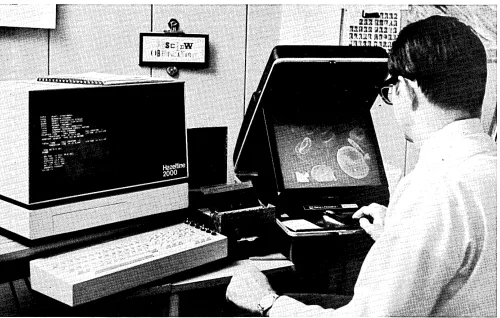
1. Microfiches of Patient Records. The recent intro-duction of color microfiches permits storage of patient charts that can include histologic material, x-rays, and other information that amplifies the data normally kept in a patient's chart. These microfiches are stored in a file box adjacent to the computer terminal sequenced according to an in-dex number referenced by the computer program. A microfiche reader (Figure 1) is also situated adjacent to the computer terminal, permitting the student to review pertinent records as they are referenced. An important feature of these charts is their use of the Problem-Oriented Record 7 which has been introduced in the pediatric ward of the Sacramento Medical Center.
2. Microfiched References. Pertinent reference ma-terial is also microfiched and stored in the same file box as the patient records.
3. The Dictionary of Current Medical Terminology. Rather than store the entire dictionary in compu-ter form, it is placed nearby the student's compu-terminal, so that he can review this material in book form. 4. Video Tapes. The multidisciplinary carrels at the School of Medicine's main campus incorporate television playback monitors hooked to a central campus facility by special cables. This system is simulated with video tape playback equipment in the hospital adjacent to the computer terminal. It
is anticipated that many of these sequences will be converted to 8 mm cartridges for more convenient storage as the project gains a greater library of video-taped sequences.
At present, plans do not call for the incorporation of other material. However, the system is designed to permit the introduction of new instructional media as they become relevant to the acquisition of diagnostic skills. To introduce a new medium, it will be necessary merely to indicate the type of medium and access number on the computerized index system.
Success Depends on Widespread Use
The success of a program of this sort is dependent on its use by more than one institution. Collection of pertinent instructional material to document different diseases is a time-consuming process, and one school can operate most effectively by working with groups of diseases, so that the student can be given a complete set of reference material when making a differential diagnosis in a particular subject area. The School of Medicine at Davis, for example, has concentrated on the areas of pediatrics and hematology to date, and will add urology and nuclear medicine in the coming year.
Programming the computer to conduct the searches has been done with the hope that the interactive program can be duplicated elsewhere with a minimum of difficulty. The cross-referenced keyword dictionary is available on request, and another interested institution would have only to write its own retrieval program with appropriate indexing.
The exchange of microfiches should be a relatively simple matter. Color microfiches prepared to teach clinical pathology have already been prepared by another ~nstitu
tion for distribution to any interested schools, USlllg the same process. Compatible film cartridges can similarly be exchanged. Thus two or more schools can expand their areas of clinical coverage by agreeing to share their libraries ,of indexed information in different disease groupings.
Current Status
The project described above is in its early operational stages. The computer program to retrieve the alternative diagnoses is operational; patient charts have been prepared for some patients, and video tapes have been made to illustrate certain key features for certain pediatric cases. The program is being introduced to third and fourth year medical students during the latter part of the spring, 1971. Funding for the extension of the project into additional charts will become available at that time. Other institutions interested in sharing in this project should contact the Office of Medical Education, School of Medicine, Uni-versity of California, Davis for further information. 0
References
1. Baker, F.B., "Computer-Based Instructional Management Sys-tems: A First Look," Rev. Educ. Research. Vol. 41, No.1, pp.
51-70:
2. Walters, R.F. and Munson, E.S., "Anesthetic Gas Exchange,"
Computer Assisted Instruction in the Health Professions,
New-buryport, Massachusetts: ENTELEK, Inc., pp. 142-152, 1970. 3. Bleich, H.L., "The Computer and a Consultant," New Eng. J.
Med. Vol. 284, No.3, pp. 141-147, 1971.
4. Bitzer, M.D. and Boudreaux, M.C., "Using a Computer to Teach Nursing," Nursing Forum, Vol. VII, No.3, 1969.
5. Alpert, D. and Bitzer, D.L., "Advances in Computer-Based Education," Science. Vol. 167, pp. 1582-1590,1970.
6. Lindberg, D.A.B., TIle Computer alld Medical Care, Thomas, pp.
135-141,1968.
7. Weed, L., Medical Records. Medical Education, and Patient Care.
THE NATIONAL CRIME INFORMATION CENTER (NCIC)
OF THE FBI: DO WE WANT IT?
Stanley Robinson 9 Wheelock Rd. Wayland, Mass.
"The FBI's National Crime Information Center plans to give its users
electronic access to 19,000,000 individual citizens' arrest records - nearly
10% of the country's population - beginning this fall. "
The FBI's computerized National Crime Information Center (NCIC) should be a growing source of alarm for all of us who are concerned with human rights - especially the rights of those who are black, poor, or politically un-popular. This article gives some of the reasons for alarm,
Stanley Robinson is a free-lance computer pro-grammer and consultant. He is the co-author of several technical articles in the field of electronics and computers, the Chairman 'of the Municipal Electric Power Committee in Wayland, Mass., a member of Computer People for Peace,' and was a speaker at ACM 70. He received his A.B. from Oberlin College and his M. Sci. from Ohio State Univ.
and describes my challenge of local police hookup to NCIC. The challenge occurred in a New England Town Meeting in Wayland, Massachusetts.
What Is NCIC?
NCIC is an automated nationwide police information network. Teletypes are installed at local police stations, connected by phone lines to state police computer centers, which in turn are connected to a central computer operated by the
FBI
in Washington, D.C. Records are stored and searched on-line with both state and federal computers. At present, the Massachusetts section, for example, provides "immediate information on stolen cars, missing and wanted persons, lost and stolen property, lost and stolen securities, stolen guns, outstanding warrants, narcotic druggence, and suspended and revoked drivers' licenses and automobile registrations."}
These services, especially the narcotic drug intelligence, seem to h~ve a potential for current misuse. Policemen are instructed, for example, to arrest "suspicious" persons for disorderly conduct to facilitate an NCIC check. 2
However, I am far more afraid of the future of the system. I cannot give an authoritative future description of NCIC for these reasons:
(1) Future plans are in a state of flux;
(2) Officials responsible for those plans insist the planning is confidential, and the public will be notified only after decisions are made;
(3) There is some variation in conception among the different sources I consulted; and
(4) Part of the sales talk for NCIC is that it is infinitely flexible and expandable.
Why the Alarm?
NCIC plans to give its users electronic access to 19,000,000 individual citizens' arrest records - nearly 10% of the country's population - beginning this fall. 3 Euphemistically termed "criminal histories" (making it sound as if any person who was ever arrested has a history of criminality), these records will help police make deci-sions about arresting, searching, detaining, questioning, and investigating suspects and "offenders".
The shabbiness of using arrest records as a guide to police action cannot be overemphasized. At present, many forms of arrest records do not note dropped charges nor results of trials and appeals. Even when complete records are kept, arrests that did not stick are listed, creating a suspicion - indeed a presumption - of guilt which can lead to further arrest and harrassment. As a local policeman told me, "a person doesn't get arrested unless he was asking for it." They believe that, judges believe it, employers believe it, and society believes it.4
Plea Bargaining
Moreover, convictions are frequently entered on arrest records as a result of the courtroom practice of plea bargaining. An attorney might get an arrested person acquitted of unjust charges, but an attorney costs money, and there is still a chance of losing, even on appeal, which costs more. Therefore many innocent defendants agree to plead guilty in exchange for a reduced fine, reduced or suspended sentence, or probation. The same idea extends to appeals of unfair trials: making an issue of anything is expensive and risky. (Several personal friends of mine have found themselves in this trap as a result of nonviolent political actions.)
Nowadays citizens can be arrested unfairly, searched illegally, charged with violating dubious laws (disorderly conduct, trespassing, blocking, loitering, or conspiracy), and railroaded into prison by ignorant or vindictive police, prosecutors, and judges.s The poor, the black, and the political radicals ("troublemakers") receive the highest in-cidence of this kind of treatment.6 Yet, in the name of modern law enforcement, all these arrests and the convic-tions that go with them will go into the NCIC system.
The I ngredients of a Police State
Computerizing and nationalizing records of arrests complete or incomplete - and inviting local police depart-ments to use them routinely - these are the ingredients of a police state. At the very best, discriminatory law enforce-ment and harassenforce-ment practices will be cascaded, because an arrest becomes a justification for another arrest, and so on. I have never seen any evidence that this kind of law enforcement helps prevent crime. There seems to be grow-ing evidence, however, of the day-to-day effect of such a system on citizens' lives. This is the chilling of free speech, free association, free petition for redress of grievances, etc. A telephone company manager recently explained this to me in this way: "It behooves a person to avoid arrest."
Proponents of NCIC Say . ..
Proponents of NCIC argue that police already have five-minute telephone access to statewide and 24-hour access to nationwide arrest records of any person. They say NCIC will provide fairer, more detailed and accurate arrest records, distinguishing convictions from acquittals, for example. They say NCIC's fast response will allow cleared suspects to be released sooner, and arrested persons with clean records to be released on recognizance, thereby enhancing civil liberties. My response is that arrest records do not constitute probable cause for arrest, regardless of their accuracy; that detention without bona fide arrest is illegal in any case; that selective release on recognizance is really preventive detention in disguise; and that police access to arrest records will be stepped up tremendously by NCIC, thereby damaging civil liberties irretrievably.
NCIC Concern About Privacy and Ethics
The Project SEARCH Staff (System for Electronic Analysis and Retrieval of Criminal Histories) has published a booklee purporting to show that privacy and individual rights are being taken into account in their system planning. (Project SEARCH is now computerizing arrest records for a ten-state federally-funded demonstration.) The booklet is instructive. On page 1 it states: "criminal justice agencies require, in making decisions regarding a suspect or offender, knowledge of his prior involvement with the criminal justice system." And on page 19: "there is every reason to believe that (FBI) rap sheets ... faithfully record the criminal histories of their subjects."
I found it difficult to read this booklet with any degree of objectivity, because of its countless euphemisms about "offenders" and "criminal justice"; it's a good illustration of the medium being the message.
Policies Suggested by SEARCI-t
However, let us examine four major areas:
(1) The SEARCH prototype "does not include sub-jective evaluations ... by police, judges, or deten-tion authorities," just "hard data" on arrest, trial, and punishment.
(If arrest, judgment, and parole decisions were made objec-tively, this world would be a different place today. I believe "hard data" is an utterly false description of arrest records, and one of the reasons why they are unsuitable for police access.)
(2) Social security number, FBI number, operators license number, and "any miscellaneous identify-ing number" are part of each person's file. These are "not (to be used) as a device to permit linkages or data sharing with other information systems."
(Who's going to believe that? It simply can't be enforced.) (3) Although highway patrols, registry authorities, prosecutors, judges, probation officers, and parole boards are to be given direct access to all records, access is denied to the general public, defense attorneys and legal aid societies, and to the "offender" himself unless he submits to fingerprinting and his state submits itself to a law change.
(4) A "code of ethics" pledges all participants in the system to limit their use to "criminal justice as a matter of government function," and other generally commendable pledges.
(When the pledges do mean something, they do not seem to be enforceable or even checkable.)
The principal author of· the booklet, Robert R. J. Gallati, also directs the New York State Identification and Intelligence System (NYSIIS) - the New York section of NCIC and a SEARCH participant. NYSIIS has been pointed out to me as a "model" for the national system in terms of human rights. Some rather bizarre misuse8 and data theft9 has occurred, but "civil liberties" and "due process" are supposedly enhanced by reducing illegal detention of sus-pects from 24 to 3 hours.10 In order to check his record,
however, an "offender" has to travel to Albany and pay a fee to NYSIIS.
A recent position paperll outlines at least four major concerns about data banks in relation to human rights:
(1) loss of privacy through security loopholes; (2) transactions about individuals without their being
notified;
(3) merging and correlating dangerous information from diverse sources; and
(4) operation without principled supervision. NCIC has no features that satisfy a single one of these concerns.
Other Reasons for Alarm
Thus I regard NCIC to be dangerous because of its basic premise that police need arrest records of citizens, and can use them safely. However, there are yet more reasons for alarm as follows:
(I) NCIC forms the basis for a total gestapo (literally "secret federal police") system, since the public has no access to its data, nor is any person
notified of inquiries and transactions affecting himself. It could take the last vestiges of the "criminal justice system" entirely out of public hands.
(2) The addition of surveillance data to NCIC is but a small step, technologically. The modern, aggressive style of surveillance and infiltration needs computer resources just like this, and there is reason to believe the NCIC system would be used for surveillance data.
(3) NCIC could easily be used in the administration's preventive detention program and in gathering data for future "conspiracy" indictments.
(4)
The FBI runs NCIC. Its large scale undercover surveillance activities force one to view the FBI's ethics with suspicion, to say the least.(5) Computers are notorious for making mistakes themselves as well as transmitting unevaluated data, while policemen may well believe "anything a computer tells them."
Who Pays for NCIC? Who Sells It?
The cost of NCIC equipment and operations, along with its substantial dangers to human rights, could hardly be ignored by responsible town officials in deciding whether to hook their police up to this sytem. The financing structure seems to be designed to circumvent this foible of democra-cy.
Towns in Massachusetts pay only their individual Tele-type rental, about $2000 annually, to join NCIC. To ease towns in painlessly, a 40% federal subsidy is provided to reduce this rental cost. (Now that 131 towns are connected to NCIC, the subsidy is ending.) Expenses borne by the state, including phone lines and computer center operation, are also subsidized federally. The rest of NCIC, including development of SEARCH, is 100% federally funded, pri-marily by the so-called Safe Streets Act of 1968. We all pay for NCIC, of course. But the fragmentation of payments fosters a carefree feeling among budget-minded local and state officials that "somebody else" is paying.
Perhaps officials might be attracted to NCIC by its apparent bargain price, but still question its merits. To minimize this problem in our state, the sales staff of New England Telephone Company (supplier of lines and Tele-types) visited 117 towns in Massachusetts last year to educate local boards and committees on the need for NCIC in modern police operations. Quite by accident, I heard one of those sales talks. It was very smooth and professional indeed. Human rights were not mentioned. The officials present agreed "the advantages outweigh the dis-advantages," and incorporated NCIC in their town's budget.
Because of indirect financing and professional selling, NCIC has begun operating almost entirely without the knowledge or approval of the public it fundamentally affects.
A Challenge to NCIC in a Town Meeting
After I was defeated in an attempt to delete the NCIC budget line pending further investigation and a full explana-tion, I introduced the following motion on the floor of the Wayland, Mass., Town Meeting on March 8, 1971:
MOVED: That the Police Department be directed to include in next 'year's Annual Report a statistical