
warwick.ac.uk/lib-publications
Original citation:
Patrick, Christopher E. and Staunton, Julie B. (2018) Rare-earth transition-metal magnets at
finite temperature : self-interaction-corrected relativistic density functional theory in the
disordered local-moment picture. Physical Review B (Condensed Matter and Materials
Physics).
Permanent WRAP URL:
http://wrap.warwick.ac.uk/102755
Copyright and reuse:
The Warwick Research Archive Portal (WRAP) makes this work by researchers of the
University of Warwick available open access under the following conditions. Copyright ©
and all moral rights to the version of the paper presented here belong to the individual
author(s) and/or other copyright owners. To the extent reasonable and practicable the
material made available in WRAP has been checked for eligibility before being made
available.
Copies of full items can be used for personal research or study, educational, or not-for-profit
purposes without prior permission or charge. Provided that the authors, title and full
bibliographic details are credited, a hyperlink and/or URL is given for the original metadata
page and the content is not changed in any way.
Publisher statement:
© 2018 American Physical Society
A note on versions:
The version presented here may differ from the published version or, version of record, if
you wish to cite this item you are advised to consult the publisher’s version. Please see the
‘permanent WRAP URL’ above for details on accessing the published version and note that
access may require a subscription.
relativistic density-functional theory in the disordered local moment picture
Christopher E. Patrick1,∗ and Julie B. Staunton1
1Department of Physics, University of Warwick, Coventry CV4 7AL, United Kingdom
(Dated: May 18, 2018)
Atomic-scale computational modeling of technologically-relevant permanent magnetic materials faces two key challenges. First, a material’s magnetic properties depend sensitively on temperature, so the calculations must account for thermally-induced magnetic disorder. Second, the most widely-used permanent magnets are based on rare-earth elements, whose highly-localized 4f electrons are poorly described by standard electronic structure methods. Here, we take two established theories — the disordered local moment picture of thermally-induced magnetic disorder and self-interaction-corrected density-functional theory — and devise a computational framework to overcome these challenges. Using the new approach, we calculate magnetic moments and Curie temperatures of the rare-earth cobalt (RECo5) family for RE=Y–Lu. The calculations correctly reproduce the
experimentally-measured trends across the series and confirm that, apart from the hypothetical compound EuCo5, SmCo5 has the strongest magnetic properties at high temperature. An order
parameter analysis demonstrates that varying the RE has a surprisingly strong effect on the Co–Co magnetic interactions determining the Curie temperature, even when the lattice parameters are kept fixed. We propose the origin of this behavior is a small contribution to the density fromf-character electrons located close to the Fermi level.
I. INTRODUCTION
In solids the 15 lanthanides (atomic numbers 57–71) usually exist in a 3+ state, with three electrons (two of s and one of d character) donated to the valence band. Grouping the lanthanides with Y and Sc, which behave in the same way, forms the group of elements known as the “rare earths” (REs) [1]. The chemical variation within the REs originates from their strongly-localized 4f spin up/down subshells, which vary from being totally empty (Sc/Y/La, 4f0) to totally filled (Lu, 4f14). Lying at the
centre of the lanthanide block, Gd (4f7) has one
com-pletely filled and one comcom-pletely empty spin subshell, and marks the boundary between the “light” (Sc–Eu) and the “heavy” REs (Gd–Lu). Notable anomalous lanthanides include Ce, whose valence varies due to the relative ease that its single 4f electron can delocalize; Pm, which is ra-dioactively unstable; and Eu and Yb which, rather than having a single hole in a spin subshell associated with the 3+ state, usually prefer to capture an additional 4f electron and adopt a 2+ state [1, 2].
Aside from their uses in e.g. catalysts, batteries and energy-efficient lighting [3], the excellent magnetic prop-erties of Sm-Co [4] and Nd-Fe-B [5, 6] compounds have led to REs becoming critical to many industries as com-ponents in high-performance permanent magnets [7]. The key principle underlying such magnets is that while elemental transition metals (TMs) like Fe and Co re-main strongly magnetic up to very high temperatures (∼1000 K), they are relatively easy to demagnetize [8]. Alloying the elemental TMs with the REs largely retains their good high-temperature properties whilst simulta-neously providing a massive increase in the coercivity
(resistance to demagnetization) [8]. The principal micro-scopic mechanism driving this increased coercivity is the electrostatic interaction of the localized RE-4f electrons with their environment (the crystal field) [9]. The mag-netic moment associated with the RE-4f electrons gains a strong directional preference, i.e. magnetocrystalline anisotropy, which anchors the TM magnetism along the same axis through the RE-TM exchange interaction. The benefits of this alloying approach can be seen in SmCo5,
whose Curie temperature (TC) of 1020 K is comparable
to pure Co (1360 K) [8, 10] but whose magnetocrystalline anisotropy energy density is 20 times larger [11]. Indeed, over 50 years since its discovery the high-temperature properties of SmCo5 remain hard to beat [7].
This simple picture—that the RE provides the coer-civity and the TM provides the large magnetization and TC—is an oversimplification, since it neglects the
contri-bution to the magnetization from the REs themselves. A more coherent picture of RE-TM intermetallics [9] mod-els the RE as an array of isolated 3+ ions interacting with the crystal field and an effective magnetic field originat-ing from RE-TM exchange interaction. Diagonalization of the crystal-field Hamiltonian gives the RE contribution to the magnetization and anisotropy. The TM contribu-tion is deduced empirically from RE-TM compounds with a nonmagnetic RE, like Y [12].
The crystal-field picture does an excellent job of ex-plaining the temperature dependence of magnetic quan-tities which are heavily RE-dependent, such as the low-temperature anisotropy and magnetization [9, 12]. How-ever, the phenomenological description of the TM limits the predictive power of the theory, especially with re-gard to TC. Since a material rapidly loses its magnetic
properties at temperatures in the vicinity of its Curie temperature, having a high TC is very useful for
FIG. 1. Schematic of the RECo5 crystal structure, showing
the RE (yellow) and Co sites (gray). The 2csites (referred to as CoIin the text) are in-plane with the RE, and the 3gsites
(CoII) lie above and below. An isosurface plot representing
the Sm-4fcharge density, obtained as the sum of the squared spherical harmonics withl= 3, m= 3,2, ...,−1 is also shown.
that TCis RE-dependent: referring to the experimental
review of Ref. 10, SmCo5has the highestTCof the
com-pounds that form stoichiometrically as RECo5(1020 K),
slightly higher than GdCo5(1014 K). Meanwhile for the
RE2Co7 and RE2Co17 series of magnets it is RE=Gd
which has the highest TC (771/1218 K) with RE=Sm
lower (713/1195 K). The fact that Gd has the largest spin moment of the REs might suggest some correlation of this quantity withTC, but the RE2Co7series provides
the counterexamples of RE=Dy and Ho, whose nomi-nal spin moments are larger than Sm but whose TC is
smaller (640 and 647 K) [10]. Magnetostructural effects could also play a role, with the RE modifying the lattice constants and thus the magnetic interactions [13]. How-ever it is by no means clear how these and other effects might combine to influenceTC.
A predictive, first-principles theory of the TCfor
RE-TM magnets could provide insight into the physical pro-cesses governing the high-temparature performance of these magnets, and suggest strategies for further opti-mization. However, such a theory is currently missing. Density-functional theory (DFT) [14] provides a practical framework to perform first-principles studies of RE-TM magnets, but is faced with the challenge of describing with sufficient accuracy (i) the finite-temperature disor-der of the magnetic moments and (ii) the complex inter-actions between the localized RE-4f electrons and their itinerant counterparts.
In this work we introduce a theory which attacks these two problems directly. Finite temperature ef-fects are modeled within the disordered local moment (DLM) [15, 16] picture, which is reviewed in Section II. Meanwhile the problematic RE-4f electrons are treated within DFT using the local self-interaction correction (LSIC) [17]. Previous modeling of REs within this frame-work has been limited to Gd [18–21], but the develop-ments described in Section III now allow investigation
of the entire RE series for the same computational cost. We use the new theory to study the RECo5 family of
magnets (Fig. 1), exploring the evolution of magnetism from 0 K (Sec. IV) toTC(Sec. V). We conclude with our
analysis of why, as is observed experimentally, the calcu-lations find SmCo5to have the highestTCof the RECo5
magnets (Sec. VI).
II. THE DFT-DLM APPROACH
At finite temperature, the functional properties of all materials are modified to some extent due to the mal population of excited vibrational states, e.g. ther-mal expansion or increased electrical resistivity [22, 23]. However, independent of lattice vibrations, the magnetic properties of a material are extremely sensitive to tem-perature. The disordered local moment (DLM) picture of magnetism provides a conceptual basis to understand this temperature variation [15]. Here the material is modeled as an array of microscopic magnetic moments (e.g. one associated with each atom), of fixed magnitude but vari-able orientation. This picture of local moments makes no assumption that the electrons themselves are local-ized; for example, the 3delectrons responsible for mag-netism in Fe, the prototypical DLM metal, are completely itinerant [24]. Rather, the spin-spin correlation between electrons near atomic sites can be strong enough to estab-lish magnetically-polarized regions which exist for much longer timescales than those associated with electron mo-tion [15]. These are the local moments.
A DLM magnetic microstate is specified by the orien-tations{eˆi}={eˆ1, ...,eˆN}of theN local moments. The grand potential energy Ω({eˆi}) is a function of these lo-cal moment orientations, and the (classilo-cal) statistilo-cal mechanics of the system is determined by the partition function
Z =
Z
dˆe1dˆe2...dˆeNexp [−βΩ({eˆi})], (1)
where 1/β = kBT, and T and kB are the temperature
and Boltzmann constant. Experimental measurements correspond to thermal averages over the magnetic mi-crostates. For instance, a magnetization measurement probes the average orientations of the local moments,
heˆjiT =
1 Z
Z
ˆ
ej dˆe1dˆe2...dˆeNexp [−βΩ({eˆi})]. (2)
The DLM paramagnetic state corresponds to each orien-tation averaging to zero,heˆjiT = 0, and the highest
tem-perature at which heˆjiT 6= 0 corresponds to the Curie
temperatureTC.
magnetizations to point along designated local moment directions{ˆei}) [15]. In practice however, any direct at-tempt to perform statistical mechanics would soon be faced with the problem of covering the huge phase space spanned by{eˆi}, requiring an effectively infinite super-cell to contain allN local moments.
A popular method of circumventing this problem is to replace the “exact” Ω with a model, e.g. a Heisenberg model based on pairwise interactions between local mo-ments. The model parameters are extracted from DFT calculations, e.g. from the Liechtenstein formula [25] or constrained DFT [26]. TCis then obtained from the
sim-pler statistical mechanics of the model, which might be solved through a mean field approach, the random-phase approximation or Monte Carlo integration [27–31].
These schemes require striking a balance between a model which is sufficiently complex to capture the nec-essary magnetic interactions, yet simple enough for the statistical mechanics problem to be tractable. The most popular pairwise model should, as its name suggests, only apply when the interaction between two local moments is independent of the alignments of all other local moments in the system. This picture is not particularly intuitive in a metal where one would expect a co-operative effect, i.e. magnetic interactions being reinforced when the material is in a global ferromagnetic state and weakened in the paramagnetic state. Practically, this issue leads to the question of whether one should parametrize the pairwise model for the ferromagnetic or paramagnetic state [25], and what to do at intermediate temperatures [32].
The DFT-DLM theory described in [15] approaches the problem in a different way. Instead of approximating the grand potential energy, one instead introduces an aux-illiary quantity Ω0({eˆi}) with a known functional form,
Ω0({eˆi}) =−
X
i
hi·eˆi, (3)
where the “Weiss fields” {hi} are obtained self-consistently. Specifically, the thermodynamic inequality
F(T)≤F0(T) +hΩi0,T− hΩ0i0,T (4)
provides a relation between the exact free energy F(T) and the free energy of the auxiliary system, F0(T) = −kBTlnZ0, with
Z0= Y
i Z
dˆeiexp[λi·eˆi] =
Y
i
4π λi
sinhλi (5)
and λi=βhi. Crucially the thermal averageshi0,T
ap-pearing in the inequality 4 are calculated with respect to the auxilliary system, e.g.
hΩi0,T =
1 Z0
Y
j Z
dˆejexp[λj ·eˆj]Ω({eˆi}). (6)
The Weiss fields are chosen to minimize the right hand side of the inequality 4. Then,
hi=−
3 4π
Z
dˆeihΩie0ˆ,Ti eˆi. (7)
The partial averagehΩieˆi
0,T integrates over all the degrees
of freedom in equation 6 except the single local moment orientationeˆi. The Weiss fields have the periodicity of the magnetic unit cell, i.e. the number of distinct Weiss fields equals the number of magnetic sublattices.
As indicated by equation 7, the Weiss fields are tem-perature dependent. The DFT-DLM estimate of TC is
the temperature at which all the Weiss fields vanish. Al-ternatively, one can introduce local order parameters,
mi(T)≡ heˆii0,T =ˆλiL(λi) (8)
with L(λi) = coth(λi)−1/λi. These quantities vary
between 1 at zero temperature and 0 atTC.
We stress that the key quantities in the DFT-DLM theory, the Weiss fields{hi}, are calculated with the full grand potential energy Ω, without any assumption on the nature of the underlying interactions e.g. pairwise, four-spin etc [18]. Furthermore, through the averaging in equation 7 the magnitudes of the Weiss fields are indeed influenced by the degree of global order in the system, ensuring self consistency between{hi}and the “reference state” used to calculate them.
The partial average hΩieˆi
0,T appearing in equation 7
still presents a challenge to the most widely-used imple-mentations of DFT, which solve the Kohn-Sham equa-tions to determine single-particle wavefuncequa-tions [14]. However, the Green’s-function-based Korringa-Kohn-Rostoker multiple-scattering formulation of DFT, in combination with the coherent potential approximation (KKR-CPA) [33] allows the partial average to be recast as an impurity problem. This impurity problem, which sees each local moment sitting in an effective medium designed to mimic the averaged properties of the disor-dered system, can be solved using the same KKR-CPA techniques originally developed to tackle compositional disorder in the simulation of alloys [34]. The DFT-DLM theory has undergone a number of developments from its original formulation, and is being applied to an increas-ingly wide range of magnetic systems [19–21, 35, 36]. The practical steps to calculating self-consistent Weiss fields and the key multiple-scattering equations are de-scribed in Refs. [16, 19, 37].
atomic sphere approximation, ASA) which, although al-lowing a compact angular momentum basis to be used to describe the Green’s function and scattering matrices, is not expected to perform equally well for cubic and non-cubic crystal structures [39]. In addition, we note that DFT-DLM is a mean-field theory, with the Weiss fields in equation 3 driving the magnetic ordering and vice versa. With these caveats in mind, we expect trends calculated across a series to be more robust than absolute values of specific quantities.
III. SOLVING THE KOHN-SHAM-DIRAC
EQUATION WITHIN THE LSIC-LSDA
A. Relativistic DFT-DLM calculations
The large atomic number of the REs necessitates the use of relativistic (R) DFT-DLM theory to describe the spin-orbit coupling inherent in RE-TM magnets as well as mass-velocity and Darwin effects. Practically, our RDFT-DLM calculations involve two steps. In the first step, a self-consistent, scalar-relativistic DFT calculation is performed for a reference magnetic state. This refer-ence magnetic state may be fully ordered (e.g. a ferro-magnetic arrangement of spins) or fully disordered (the DLM/paramagnetic state). The output of this calcula-tion is a set of atom-centered potentials. In the second step these potentials are fed into the fully-relativistic Kohn-Sham-Dirac (KSD) equation, thus treating spin-orbit coupling nonperturbatively. Combining the solu-tions of the KSD equation with the full KKR-CPA ma-chinery allows the Weiss fields and TC to be computed.
Although not a methodological necessity [40], the po-tentials here are kept “frozen” in the second step, i.e. the density derived from the Green’s function of the partially-ordered system is not used to update the potentials.
When constructing the potentials in the first step, in common with all DFT calculations it is necessary to make an approximation for the exchange-correlation energy. The local-spin-density approximation (LSDA) [14, 41] performs rather well in describing the magnetism of itin-erant electrons, but struggles to described the strongly-localized 4f states which characterize REs [42]. Further-more, the orbital moments of transition metals are gen-erally smaller than observed experimentally when calcu-lated within the LSDA [43]. As a result, it is imperative to go beyond the LSDA exchange-correlation when mod-eling RE-TM magnets.
B. Treating RE-4f electrons
Recent computational works performed at zero tem-perature have employed charge-self-consistent dynami-cal mean-field theory (DMFT) [44], in particular using the Hubbard-Iapproximation [45], to calculate the mag-netic moments of REs [46] and RE-TM intermetallics like
SmCo5 [47–49] and NdFe12 [49]. The simpler,
“open-core” scheme [50] constrains the total spin-density of the RE-4f electrons to be that predicted by Hund’s rules [31, 48, 50–52]. Such calculations, which provide much important insight into RE-TM systems, bear some resemblance to crystal-field theory in the sense that the RE-4f electrons are partitioned from the rest of the ma-terial, with the amount of hybridization they can un-dergo sensitive to how the calculation is set up [49, 51]. Alternative approaches like LDA/GGA+U [53–55], the orbital polarization correction (OPC) [56] and the self-interaction correction (SIC) [57] modify the potential at the RE site but treat all electrons equally, in principle allowing the RE-4f states to hybridize freely [53]. An advantage of these schemes when studying trends across the RE-TM series is that, beyond initial choices about how the schemes are implemented, the calculations re-quire minimal user input. Indeed the parameters en-tering the OPC and LDA/GGA+U can be calculated from first-principles, e.g. the Racah parameters calcu-lated from wavefunctions in the OPC [43], or theU and J energies calculated from linear response [58] or con-strained random-phase approximation calculations [59].
The SIC, which we employ here, aims to ensure that the exchange-correlation potential cancels the electro-static (Hartree) energy of a single electron interacting with itself, which is not automatically realized in the LSDA [42]. While the scheme becomes more compli-cated in extended systems, the localized nature of the RE-4f electrons makes them particularly suitable for the SIC [57]. Furthermore, the SIC has already been for-mulated within the KKR-CPA theory as the local self-interaction correction (LSIC) [17]. Indeed the LSIC has been previously used in DFT-DLM calculations to study Gd [18–21, 36]. However, in order to treat an arbitrary RE it is necessary to generalize the formalism. Conve-niently, this same formalism allows the OPC to be also incorporated in the RDFT-DLM framework, facilitating an improved description of the Co orbital moments.
C. An LSIC-LSDA scheme based on Hund’s rules
The LSIC formalism [17] is based on applying the self-interaction correction to individual spin and orbital an-gular channels, each characterized by the pair of quan-tum numbers σL. σ labels spin, and L is a composite quantum number which, in principle, labels a member of any complete set of angular momentum states. In the original LSIC implementation, these angular momentum states have the same symmetry as the nonmagnetic crys-tal [17]. However, since the orbicrys-tal moments are largely unquenched in the RE-TM compounds, here we choose L to label the “atomic” (l, m) quantum numbers asso-ciated with the complex spherical harmonics, i.e. eigen-functions of the orbital angular momentum operator ˆlz.
FIG. 2. Scheme to correct RE-4f states based on Hund’s rules. Each triangle corresponds to a single spin and orbital angular momentum channel i.e.σ, l(= 3), m. LSIC channels withσ=↑(↓) are represented by yellow (blue) triangles. We also show the moments obtained simply by adding the expec-tation values of the spin and orbital operators acting on the individual corrected states.
We must also choose which spin and orbital angular momentum channels we should apply the LSIC to. We propose to follow the scheme illustrated in Fig. 2, which is inspired by Hund’s rules. An extra LSIC channel is added for each RE-4f electron, filling up σL combina-tions of the same spin (↓) first with the largest available opposing m (e.g. m = +3 for Ce). After entirely fill-ing the ↓ channel at Gd, we start filling the ↑ channel, again starting with the largest available opposingm(e.g. m = −3 for Tb) in accordance with the single-electron tendency of orbital and spin momenta to antialign [11]. As shown in Fig. 2, adding up the individual spin and or-bital angular momentum contributions associated with these filled states gives quantities symmetric and anti-symmetric respectively about Gd.
D. Including the LSIC/OPC in the KSD equation
The LSIC scalar-relativistic calculation (the first step referred to in Sec. III A) proceeds as described in Ref. [17]. At the second step in the RDFT-DLM pro-cedure (and at variance with previous work [18–21, 36]) the atom-centered potentials have a contribution which depends on angular momentum, conveniently written as
VSIC(r) = X
L,σ
VLσ(r) ˆPLσ. (9)
Here Vσ
L(r) is the spherically-symmetric correction to
the potential obtained in the scalar-relativistic calcula-tion [17], while ˆPLσ is a projection operator. In the
Pauli representation these operators are 2×2 matrices which are diagonal for spin polarization along thezaxis, whose elements project out states with angular momen-tum characterL.
The angular-momentum dependent potentials result in
a modified KSD equation,
h
˜
α·pc+ ˜VSIC+ ˜I(V(r)−W)
+ ˜βImc˜ 2+ ˜σzBXC(r) i
Ψ = 0. (10)
Quantities with tildes are 4×4 matrices; Ψ is a bispinor, andW and mthe electron energy and rest mass. Com-pared to the usual KSD equation [60], equation 10 has an extra term ˜VSIC, simply related toVSICin equation 9:
˜ VSIC=
VSIC 0
0 VSIC
. (11)
We now follow the standard method of solving the radial KSD equation in multiple scattering theory [61], i.e. we investigate the solutions
Ψmjν (r) =X
κ1
gmj κ1ν(r)|χ
mj κ1i ifκmj1ν(r)|χ
mj −κ1i
. (12)
The spin-angular functions |χmjκ1i are superpositions of
the products of Pauli spinors and spherical harmonics weighted by Clebsch-Gordan coefficients [60]. They are characterized by the quantum numbersκ1 and mj, and
describe the angular character of free-particle solutions of the KSD equation. κ1 is related to j, the sum of
spin and orbital angular momentum in the spin-angular functions, with κ =−l−1 forj = l+ 1/2 and κ0 =l forj=l−1/2. As indicated, we reserve the labelκfor negative values andκ0for positive values ofκ1. The label
ν denotes the different solutions required to build the Green’s function in scattering theory, i.e. solutions with an asymptotic free-electron character which are regular or irregular at the origin [61].
After inserting the trial solution 12 into equation 10 and performing a series of manipulations [60], we obtain coupled equations for the radial functionsf andg:
dfmj κν
dr =
(κ−1) r f
mj
κν +
1 ¯
hc(V −E)g
mj κν +1 ¯ hcG mj + (κ, κ)g
mj κν + 1 ¯ hcG mj + (κ, κ0)g
mj κ0ν
dgmj κν
dr =− (κ+ 1)
r g
mj
κν +
1 ¯
hc(E−V + 2mc
2)fmj κν
+1 ¯ hcG
mj
− (−κ,−κ)f
mj
κν. (13)
Here,E =W −mc2. The differential equations forfκmj0ν andgκmj0ν are obtained from equations 13 simply by inter-changingκand κ0. Crucially, compared to previous cal-culations which only included BXC, the basic structure
of the coupled equations 13 is unchanged by the addition ofVSIC. The difference is in the coupling functions,
Gmj
± (κ1, κ2) =hχκm1j|(σzBXC±VSIC)|χ
mj
κ2i. (14)
BXC(r) is now augmented by a linear combination of the
coefficients. We give the explicit form of these coupling functions in the appendix A, but here just show an ex-ample ofGmj
± (κ, κ) withκ=−4,mj = 1/2:
G±1/2(−4,−4) = 1 7BXC±
4
7V
↑ (3,0)+
3 7V
↓ (3,1)
. (15)
We see that the coupling functions mix occupied, SI-corrected channels with unoccupied, non-SI-SI-corrected channels, as discussed more in Appendix B.
It should be noted that, when deriving the coupled equations 13, additional coupling functions of the form
Gmj
± (−κ, κ+ 1) are introduced by bothσz andVSIC.
Fol-low previous work [61] we neglect these terms, which would otherwise result in an infinite ladder of couplings between orbital angular momental,l±2,l±4 etc. [62]. The coupled equations 13, containing the appropri-ately weighted LSIC potentials, are solved numerically to give the scattering matrices and regular and irregular contributions to the Green’s function. From these quanti-ties the entire RDFT-DLM computational machinery [37] can be applied without further modification.
The OPC enters the KSD equation in exactly the same way as the LSIC. This is most easily seen by writing the OPC analogy of equation 9 as [52, 62]
VOPC(ˆr) = X
l=2 X
m,σ
−BlσmhˆlziσPˆlmσ. (16)
where Blσ is a Racah parameter, and hˆlziσ is the
spin-resolved expectation value for the relevant atom (we have anticipated applying the OPC to the d channel). Thus the OPC can be considered a special case of the LSIC where the potential is independent of r, entering
Gmj
± (κ1, κ2) weighted by the coefficients in Appendix A.
We stress that, since they only modify the coupling func-tions, the computational cost of including the LSIC or OPC is negligible.
E. Technical details
We generate the atomic-centered potentials in the fully-ordered (zero temperature) state in self-consistent scalar-relativistic LSIC-LSDA calculations [17, 41] within the ASA, as implemented in the hutsepot code [63]. Angular momentum expansions were truncated atlmax=
3, and the full Brillouin zone sampled on a 20×20×20 grid with state occupancies determined by a Fermi-Dirac distribution with an electronic temperature of 400 K. The calculations were performed using experimental lattice constants [10, 13], which are listed in Table I together with the ASA radii for the three nonequivalent sites in the RECo5 structure. We used the same relations
be-tween ASA radii as in our previous work on YCo5 and
GdCo5 [19].
For the RDFT-DLM calculations, apart from the in-clusion of the LSIC described above we used the same
a c rASA Ref.
YCo5 4.94 3.98 1.83/1.39/1.42 [13]
LaCo5 5.11 3.97 1.91/1.40/1.44 [10]
CeCo5 4.93 4.01 1.83/1.39/1.42 [13]
PrCo5 5.01 3.99 1.86/1.40/1.43 [13]
NdCo5 5.01 3.98 1.86/1.40/1.43 [13]
SmCo5 4.97 3.98 1.85/1.39/1.42 [13]
GdCo5 4.96 3.97 1.85/1.39/1.42 [13]
TbCo5 4.94 3.97 1.84/1.39/1.42 [13]
DyCo5 4.91 3.98 1.82/1.38/1.41 [13]
HoCo5 4.91 3.97 1.82/1.38/1.41 [13]
ErCo5 4.87 4.00 1.81/1.38/1.41 [10]
[image:7.612.316.563.53.225.2]TmCo5 4.86 4.02 1.81/1.38/1.41 [10]
TABLE I. Experimental lattice constants, taken from Refs. [10, 13]. The ASA radii for the three non-equivalent sites (RE/Co2c/Co3g) are also given. All units are ˚A.
computational setup (angular mesh, energy contour, elec-tronic temperature) as in [19], including an adaptive sam-pling of the Brillouin zone [38]. We applied the LSIC to the RE-4f electrons and the OPC to the Co-3delectrons. The magnitude of the OPC was determined iteratively at 0 K with the magnetization aligned along thecaxis, up-dating hˆlziσ at each iteration to self-consistency. The
Racah parameters were calculated scalar-relativistically. The same OPC was used for all temperatures, consistent with the frozen-potential approach.
IV. ZERO-TEMPERATURE CALCULATIONS
A. RECo5 moments
We first use the RDFT-DLM formalism to calculate the magnetic moments of the RECo5 series at zero
tem-perature. To illustrate the trend across the lanthanide block we consider all members of the RE=Y–Lu series, including the non-forming RE = Pm, Eu, Yb and Lu compounds. Here, we fix the lattice parameters to those of GdCo5; using the appropriate experimental RECo5
lattice parameters (where available) produces very simi-lar zero-temperature moments (Appendix C). For Ce, Pr and Nd we also performed calculations without applying the LSIC (i.e. treating the f-electrons as itinerant).
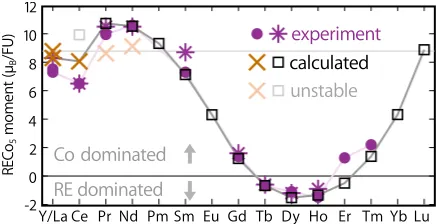
In Fig. 3 we show the calculated RECo5 moments and
[image:7.612.317.561.54.226.2]FIG. 3. Magnetic moments calculated at zero tempera-ture with (squares) and without (crosses) the LSIC applied, compared to experimental values reported in Refs. [10] (cir-cles) and [13] (stars). Faint symbols were calculated to be energetically unfavorable. The gray horizontal line at 8.78µB
corresponds to the calculated YCo5 moment.
RE-dominated at 0 K show a compensation point (mini-mum) in their magnetization versus temperature curves, and Ref. [10] reports compensation temperatures for Tb, Dy and HoCo5. Accordingly we plot the experimental
moments of these three compounds with minus signs. Considering the calculations without the LSIC first (crosses in Fig. 3) we see relatively small variation for different REs, with the moments fluctuating around the YCo5 value (shown as the gray horizontal line). We do
observe a reduction in moment on moving from YCo5to
LaCo5, despite both elements having an empty 4f shell.
In fact, the moment of YCo5 is much closer to that of
LuCo5, whose 4f shell is totally filled. This behavior
echoes that of quantities like melting points, electroneg-ativities and ionization energies, which follow more nat-urally a Sc-Y-Lu series compared to Sc-Y-La [64].
Applying the LSIC (squares in Fig. 3) has a dramatic effect on the magnetization, for instance increasing the moment of CeCo5 by 2 µB/formula unit (FU). Now a
strong variation with RE is observed, with PrCo5/DyCo5
achieving the largest TM/RE-dominated moments re-spectively. The transition from TM to RE-dominated magnetization occurs between Gd and Tb, and back to TM-dominated between Er and Tm.
In order to decide whether the calculations with or without the LSIC should be used to describe a given RE, we examine the total energies calculated at the scalar-relativistic level omitting spin-orbit coupling ef-fects. This approach follows e.g. Refs. [17] and [65], where the comparison of SIC total energies was used to deter-mine the volume triggering the α →γ transition in Ce or the valency of the rare earths and their sulphides. We find that applying the LSIC to PrCo5 and NdCo5 lowers
the total energy, i.e. it is energetically favorable. Indeed for heavier REs the non-LSIC calculations become diffi-cult to converge. However, applying the LSIC to CeCo5
increases the scalar-relativistic total energy, indicating
that the single Ce-4f electron would prefer to be delo-calized in this compound. Using this total energy as our criterion, we do not apply the LSIC to CeCo5. Indeed the
picture of the itinerant Ce-4f electron has already been established in previous theoretical work [66]. Other non-energetically-favorable calculations are shown in Fig. 3 as faint symbols.
The variation in RECo5 moment calculated with the
[image:8.612.67.287.51.163.2]LSIC largely follows the simple picture presented in Fig. 2. In general the antiferromagnetic RE-TM ex-change interaction causes the RE spin moments to point in the opposite direction to the Co moments [67], but whether or not the total RE moment aligns parallel or antiparallel depends on the sign and magnitude of the orbital contribution [68]. The lightest REs have large or-bital components pointing opposite to their spin which leads to parallel alignment of the total moments, whereas the spin and orbital moments of the heavy REs always reinforce each other to give antiparallel alignment.
B. Decomposition of RECo5 moments
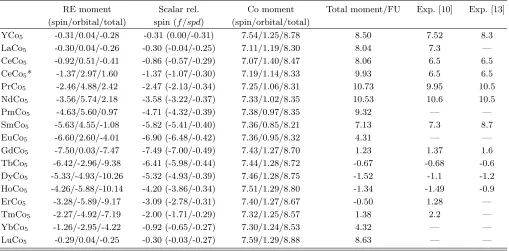
In Table II we resolve the calculated moments into spin and orbital contributions from the RE and TM. We also give the spin moments calculated at the scalar-relativistic level, which are further resolved into contributions of dif-ferent angular momentum (f orspd) character.
Concentrating first on the RE contribution to the magnetization, we see that the spin moments roughly track the expected spin of the LSIC channels, peaking at Gd. The scalar-relativistic decomposition shows the spin moments have an spd component which increases from 0.25µB for La to 0.49µB for Gd. However, the f
components of the spin moment are not simply integers. Based on the simple picture of Fig. 2 this observation is surprising, since we would expect each localized RE-4f electron to contribute ±1µB to the magnetization.
In-stead, we see that for each additional LSIC channel the change in f components is closer to ±1.1µB, until the
elements with filled spin subshells (GdCo5 and LuCo5)
are reached. This behavior indicates that the nominally unoccupied RE-4f states, which do not have the LSIC applied, are affecting the calculated properties.
The RE orbital moments also follow the general trend of Fig. 2, but are better described by µo = (2−gJ)J,
wheregJ is the Land´e factor [69]. This textbook
expres-sion is obtained by projecting the orbital moment onto the total angular momentum direction, which is valid for strong spin-orbit coupling. It is therefore natural to ask whether the spin RE moments should in fact be described by µs = 2(gJ −1)J, which is the corresponding
pro-jection for spin [69]. However, in our calculations the principal interaction affecting the spin moments is the scalar-relativistic exchange, which can be confirmed by noting the close agreement between the RDFT-DLM and scalar-relativistic spin moments in Table II. Therefore, the spin-orbit interaction plays a relatively minor role in determining the spin moment and the considerations leading toµsdo not apply. We note that this situation is
RE moment Scalar rel. Co moment Total moment/FU Exp. [10] Exp. [13] (spin/orbital/total) spin (f/spd) (spin/orbital/total)
YCo5 -0.31/0.04/-0.28 -0.31 (0.00/-0.31) 7.54/1.25/8.78 8.50 7.52 8.3
LaCo5 -0.30/0.04/-0.26 -0.30 (-0.04/-0.25) 7.11/1.19/8.30 8.04 7.3 —
CeCo5 -0.92/0.51/-0.41 -0.86 (-0.57/-0.29) 7.07/1.40/8.47 8.06 6.5 6.5
CeCo5* -1.37/2.97/1.60 -1.37 (-1.07/-0.30) 7.19/1.14/8.33 9.93 6.5 6.5
PrCo5 -2.46/4.88/2.42 -2.47 (-2.13/-0.34) 7.25/1.06/8.31 10.73 9.95 10.5
NdCo5 -3.56/5.74/2.18 -3.58 (-3.22/-0.37) 7.33/1.02/8.35 10.53 10.6 10.5
PmCo5 -4.63/5.60/0.97 -4.71 (-4.32/-0.39) 7.38/0.97/8.35 9.32 — —
SmCo5 -5.63/4.55/-1.08 -5.82 (-5.41/-0.40) 7.36/0.85/8.21 7.13 7.3 8.7
EuCo5 -6.60/2.60/-4.01 -6.90 (-6.48/-0.42) 7.36/0.95/8.32 4.31 — —
GdCo5 -7.50/0.03/-7.47 -7.49 (-7.00/-0.49) 7.43/1.27/8.70 1.23 1.37 1.6
TbCo5 -6.42/-2.96/-9.38 -6.41 (-5.98/-0.44) 7.44/1.28/8.72 -0.67 -0.68 -0.6
DyCo5 -5.33/-4.93/-10.26 -5.32 (-4.93/-0.39) 7.46/1.28/8.75 -1.52 -1.1 -1.2
HoCo5 -4.26/-5.88/-10.14 -4.20 (-3.86/-0.34) 7.51/1.29/8.80 -1.34 -1.49 -0.9
ErCo5 -3.28/-5.89/-9.17 -3.09 (-2.78/-0.31) 7.40/1.27/8.67 -0.50 1.28 —
TmCo5 -2.27/-4.92/-7.19 -2.00 (-1.71/-0.29) 7.32/1.25/8.57 1.38 2.2 —
YbCo5 -1.26/-2.95/-4.22 -0.92 (-0.65/-0.27) 7.30/1.24/8.53 4.32 — —
[image:9.612.55.564.54.305.2]LuCo5 -0.29/0.04/-0.25 -0.30 (-0.03/-0.27) 7.59/1.29/8.88 8.63 — —
TABLE II. Decomposition of zero-temperature moments. All quantities are inµB. For comparison we include the calculations
for CeCo5 with the LSIC applied (*) even though it is energetically unfavorable.
fixes the RE spin moments toµs.
Now considering the TM contribution to the magneti-zation, the most striking feature in Table II is the differ-ent behavior of the light and heavy RECo5 compounds.
The Co moments exhibit relatively small variations for the heavy REs except for LuCo5which, as already noted,
behaves similarly to YCo5. However the variations for
the light REs are much larger. Moving from La to Eu, the Co spin and orbital moments increase and decrease respectively, and in general the total Co moments are smaller than for the heavy RECo5 compounds. As we
discuss in Sec. V, a qualitative difference in light and heavy RECo5 behavior is also observed inTC.
C. Comparison to experiment
When comparing to experiment, it is important to note that there is a sizeable scatter in the published data. We have taken experimental low-temperature moments from the review articles of Refs. [10] and [13] which agree reasonably well with each other except for YCo5
and SmCo5, which deviate by approximately 1µB. Also,
we note that the RE = Tb–Tm compounds do not form with exact RECo5stoichiometry. Instead, due to defects
where the RE is substituted with pairs (dumbbells) of Co atoms [70], the compounds become increasingly Co-rich. For example, the actual stoichiometry of the RE=Tm compound reported in Ref. [10] is TmCo6.
With these limitations in mind, the calculations com-pare reasonably well to experiment in Fig. 3. Certainly
a number of qualitative features are reproduced, e.g. a drop in moment from Y to La, a large increase from Ce to Pr, and RE-dominated magnetization for Tb–Ho.
For the special case of CeCo5, we note that the
energetically-unstable LSIC calculation gives a moment which is in qualitative disagreement with the experimen-tal trend. Interestingly however, whilst the LSDA+OPC calculations are closer to experiment they still overesti-mate the CeCo5 moment. Not including the OPC on
the Co atoms rather improves the agreement (Ref. [66] and Appendix C), suggesting that, (like for the LSIC), there might be a criterion based on energetics to decide whether or not the OPC should be applied.
Apart from the cases of ErCo5 and TmCo5 where the
experiments are Co-rich, the remaining compound where the discrepancy between calculations and experiment is quite large is SmCo5, specifically compared to the value
of 8.7µB/FU in Ref. [13]. Interestingly, a recent
neu-tron diffraction experiment reported even larger local mo-ments in SmCo5, which add up to give a resultant
mag-netization in excess of 12µB/FU [71]. Studies employing
DMFT and open-core calculations have reported smaller Sm total moments of approximately -0.3µB, which would
bring the total SmCo5moment closer to 8µB/FU [47–49].
Earlier GGA+U calculations found a much larger total moment of 9.9µB/FU due to a ferromagnetic alignment
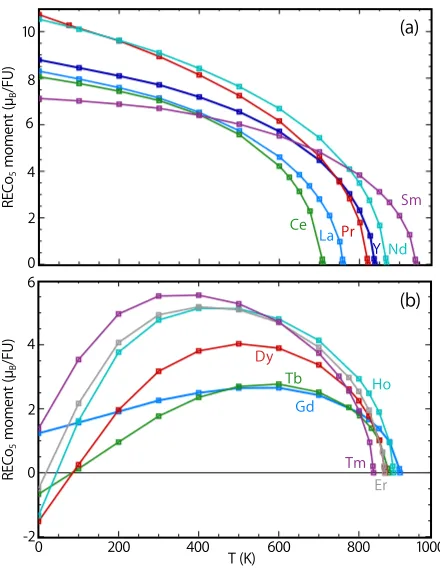
FIG. 4. Magnetization per formula unit calculated at dif-ferent temperatures for the (a) light and (b) heavy RECo5
compounds. Calculations were performed at the GdCo5
lat-tice parameters.
V. FINITE-TEMPERATURE CALCULATIONS
A. Magnetization vs. temperature curves
We now include local moment disorder within the RDFT-DLM picture. Figures 4(a) and (b) show the magnetization versus temperature (MvT) curves calcu-lated for light and heavy RECo5 compounds. These
calculations were performed at the GdCo5 lattice
con-stants (Table I). The light REs show behaviour asso-ciated with ferromagnets, i.e. a monotonic decrease in magnetization with increasing temperature. By contrast the heavy RECo5compounds have magnetizations which
initially become more positive (TM-dominated) as the temperature increases, before reducing at higher temper-atures. As we have shown previously by comparing YCo5
and GdCo5[19] this contrasting behaviour is due to the
RE moments disordering more quickly with temperature compared to the antiferromagnetically-aligned Co sub-lattice. As a result, the strong negative contribution to the total magnetization from the heavy RE diminishes quickly, leaving the positive Co magnetization.
In the case that the zero-temperature magnetization is RE-dominated, there is a compensation temperature at which the strongly-disordered RE magnetization cancels the weakly-disordered Co magnetization. Our calculated compensation temperatures are 84 K (TbCo5), 85 K
FIG. 5. RE order parametersmRE (equation 8) from the
calculations of Fig. 4 on the light (a) and heavy (b) RECo5
compounds.
(DyCo5), 45 K (HoCo5) and 19 K (ErCo5). Ref. [10]
re-ports experimental compensation temperatures of 110 K (TbCo5), 123 K (DyCo5) and 71 K (HoCo5).
We note that the calculated MvT curves have finite slopes atT= 0 K, while experimentally-measured curves tend to be flat [19]. The origin of this discrepancy is the classical statistical mechanics used in the DLM pic-ture (equation 3), which does not give an energy bar-rier between the zero-temperature arrangement of local moments and an excited state where the moments have undergone infinitesimal rotations.
B. RE order parameters
In order to analyse the RE contribution to the magne-tization in more detail, in Figs. 5(a) and(b) we plot the temperature evolution of the RE order parameter mRE
(equation 8). The heaviest REs Ho, Er and Tm disor-der very quickly with temperature, losing 50% of their ordering below 200 K. By contrast, the Sm sublattice re-tains its ordering to much higher temperatures, e.g. 50% ordering at 650 K. Although part of the reason for this behavior is the higherTCof SmCo5, plots of the order
pa-rameter against reduced temperatureT /TC (not shown)
demonstrate that even when this factor is accounted for, Sm orders the most strongly.
[image:10.612.327.548.48.334.2]use-FIG. 6. (a)TCcalculated for RECo5using the GdCo5lattice
parameters, compared to the experimental values reported in Ref. [10] (circles). Squares and crosses are calculated with and without the LSIC respectively, and the faint square is the energetically-unfavorable LSIC calculation for CeCo5. (b)
Comparison of TC calculated for GdCo5 using RECo5
lat-tice parameters (circles), RECo5using GdCo5 lattice
param-eters (squares), and RECo5 using RECo5 lattice parameters
(crosses). The faint gray lines separate light and heavy REs.
ful for permanent magnets, since the magnetocrystalline anisotropy decays faster thanmRE[9]. Therefore SmCo5
has a double advantage of having a high magnetocrys-talline anisotropy at low temperature, and a strong RE ordering to retain this anisotropy at high temperature.
C. Curie temperatures
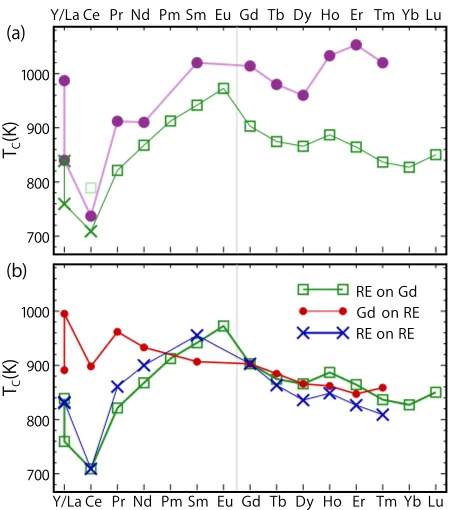
In Fig. 6(a) we compare the calculated Curie temper-atures TC (extracted from Fig. 4) to the experimental
values reported in Ref. [10]. We include TC calculated
for the non-forming Pm, Eu, Yb and LuCo5compounds.
We remind the reader that experimental values are for Co-rich heavy RECo5 compounds, for which we would
expect an increased TC. For instance, the measured TC
of Gd2Co17 is 200 K higher than GdCo5[10].
Fig. 6(a) clearly shows the contrasting behavior of the light and heavy RECo5 compounds. Apart from YCo5
and CeCo5, the TC of the light RECo5 compounds
in-creases monotonically with the number of RE-4f elec-trons. Indeed, applying the energetically-unfavorable LSIC to the Ce-4f electron also causes CeCo5 to
fol-low this trend [faint square in Fig. 6(a)]. Of the
experimentally-known RECo5compounds, SmCo5is
cal-culated to have the highestTC (942 K), but the TC of
the non-forming EuCo5 compound is found to be even
higher, at 973 K.
The trend in calculatedTC of the heavy RECo5
com-pounds is less obvious. In general, filling the remaining subshell causes a reduction inTC, but a secondary peak
is observed at HoCo5. This peak in TC coincides with a
slight peak in Co moments for HoCo5 at zero
tempera-ture (Table. II). Also, the TC of LuCo5 is very close to
that calculated for YCo5(850 and 839 K respectively).
The calculations and experiments agree on a number of qualititative features. First, there is a substantial drop in TC on moving from YCo5 to LaCo5, and
an-other from LaCo5to CeCo5. As already noted, the drop
for CeCo5 is not observed if the Ce-4f electron is
local-ized with the LSIC. Second, SmCo5 has the highest TC
of all the experimentally-attainable RECo5 compounds.
Finally, the Co-rich heavy RECo5 compounds do show
a secondary peak in TC like the calculations, although
at Er not Ho. The heavy RE2Co17 compounds, whose
stoichiometry is better defined, also show a secondary peak around Ho/Er/Tm followed by a sharp upturn for Lu [10].
The calculated variation in TC shown in Fig. 6(a)
is only due to changing the RE. In order to quan-tify the magnetostructural effect of varying the lattice, we also calculated TC for the RECo5 compounds using
experimentally-reported lattice parameters (Table I). We further performed calculations where we varied the lat-tice but fixed the RE to Gd, i.e. GdCo5 on different
RECo5 lattices. We compare the three different sets of
calculations in Fig. 6(b).
First considering the calculations with the RE fixed to Gd [red circles in Fig. 6(b)], we observe a decrease in TCacross the lanthanide block. The exception is CeCo5,
which shows a strong magnetostructural effect; as shown in Table I, CeCo5has an anomalously smallaparameter.
These calculations do not reproduce experimental trends, e.g. predicting LaCo5to have the highestTC.
If instead we vary both the RE and the lattice parame-ters [blue crosses in Fig. 6(b)] we find the an almost iden-tical trend inTCas if we had kept the lattice parameters
fixed at GdCo5(green squares). Using the RECo5lattice
parameters accentuates the drop inTC for CeCo5.
Un-fortunately the experimentally-observed difference inTC
between YCo5and LaCo5 is no longer calculated, which
can be seen as a cancellation of competing green and red symbols in Fig. 6(b). In general, the calculations find magnetostructural effects to play a less important role in determiningTC than explicitly varying the RE.
D. Order parameter expansion of the free energy
Returning to the calculations with the lattice constants fixed to GdCo5, to gain further insight into the calculated
[image:11.612.64.291.48.303.2]terms of the order parametersmRE,mCoIandmCoII[19].
The labels I and II distinguish between the inequivalent Co positions in the RECo5structure (Fig. 1), i.e. the two
Co atoms in plane with the RE (CoI, Wyckoff position
2c) and the three out-of-plane Co atoms (CoII, Wyckoff
position 3g). In this expansion, the Weiss field at each site (hRE, hCoI, hCoII) is given by the equation
hRE
2hCoI
3hCoII
=
JRE−RE JRE−CoI JRE−CoII JRE−CoI JCoI−CoI JCoI−CoII JRE−CoII JCoI−CoII JCoII−CoII
mRE
mCoI mCoII
.
(17) The prefactors in the Weiss fields account for the site mul-tiplicities. The expansion of equation 17 is valid for small m, i.e. close to TC. The coefficients JXY are obtained
by least-squares fitting of RDFT-DLM calculations. As discussed in Ref. [19], diagonalization of the matrix in equation 17 gives the RDFT-DLMTC, thus allowing the
variation shown in Fig. 6(a) to be understood in terms of the strength of the interactions between different mag-netic sublattices.
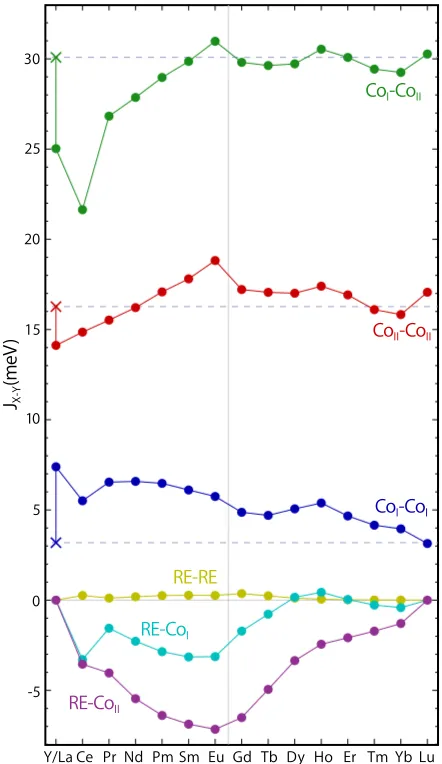
The calculated coefficients JXY are shown in Fig. 7.
A negativeJXY indicates a tendency for speciesX and
Y to align antiferromagnetically. Comparing Figs. 6(a) and 7, we see that the behavior of TC is mirrored by
the largestJXY coefficientJCoI−CoII, which describes the
inter-layer Co interaction. The next-largest coefficient JCoII−CoII, describing the intra-layer interactions of the
pure Co layer, behaves similarly except that no drop at CeCo5 is observed. It is not surprising either that TC
tracks the largest JXY coefficients or that these
coeffi-cients describe Co-Co interactions, in line with the pic-ture that the TM is responsible for the highTCin RE-TM
magnets. What is less intuitive is that these coefficients should be so strongly affected by the RE.
As found for TC, there is clear distinction between
light and heavy RECo5 compounds for JCoI−CoII and JCoII−CoII. By contrastJCoI−CoIundergoes a general
de-crease from La–Lu, with slight fluctuations around Ho and a dip at Ce. The Co interactions are very similar for Y and Lu, consistent with their similarTC.
TheJRE−Y coefficients which quantify RE interactions
are smaller in magnitude. JRE−RE is particularly weak
and correlates with the size of the spin moment of the RE. The strongest RE-Co interactions are interplanar, RE-CoII. Interestingly, neither JCoII−CoII nor JRE−CoII
show any strong anomaly at CeCo5, indicating that it
is only the CoI interactions which are affected by the
itinerant Ce-4f electron.
Again comparing the light and heavy REs, we note that the in-plane interaction quantified by JRE−CoI
ac-tually becomes ferromagnetic for DyCo5, HoCo5 and
[image:12.612.329.550.50.432.2] [image:12.612.63.308.152.198.2]ErCo5, which coincides with the secondary peak in TC
[Fig. 6(a)]. Also, we observe that the strongest RE-Co interactions occur not for GdCo5, which has the largest
RE spin moment, but rather EuCo5.
FIG. 7. DifferentJXY parameters (c.f. equation 17)
calcu-lated for RECo5 on the GdCo5 lattice Note that the Ce
cal-culation was performed without the LSIC, i.e. assuming that the Ce f-electron is itinerant. We highlightJXY for YCo5 as
crosses with horizontal dashed lines.
VI. DISCUSSION
A. The RE-TM interaction
Our calculations have found that the strength of mag-netic interactions between Co moments in RECo5 is
af-fected by the RE, even when the lattice parameters are held fixed. As a result of this variation,TCdepends
FIG. 8. Schematic of antiferromagnetic RE-Co interaction, after Fig. 2 of Ref. [67]. Wide/narrow rectangles symbolize strong/weak RE-Co hybridization in a given spin channel.
more strongly. The preferential occupation of the lower-energy hybridized spin states causes the RE-5dbands to develop a spin polarization in the direction of the Co minority spin, i.e. an antiferromagnetic coupling. Then, onsite RE 4f-5dinteractions polarize the RE-4f spins in the same sense.
In this picture, the RE-TM interaction varies accord-ing to the strength of the 4f-5dinteraction, which is ex-pected to scale with the spin moment of the RE. Accord-ingly, the strongest RE-TM interactions are expected for Gd. However, any effects on the TM magnetization are expected to proceed via the Co-3d-RE-5dhybridization, with no direct link to the RE-4f states.
B. Magnetostructural effects
Within the picture of Fig. 8, any variation inTCimplies
that the RE-5dstates are not the same for all REs. Of course, the RE-5dorbitals do vary across the lanthanide block in terms of their spatial extent, as can be seen from the experimental lattice parameters in Table I. The lat-tice parameteraof LaCo5is 3% larger than GdCo5, while
for YCo5the difference is less than 0.5%. The
experimen-tal lattice parameters of LuCo5 are not known, but the
ionic radius of Lu is much closer to Y than La [72]. Cor-respondingly, the TCvalues calculated at GdCo5 lattice
parameters are much closer for YCo5 and LuCo5(11 K)
than YCo5 and LaCo5 (80 K).
So, independent of any arguments based on the RE-4f states, the calculations on YCo5, LaCo5 and LuCo5
suggest that the size of the RE-5d orbitals affects the Co magnetism. Indeed we could have reached a similar conclusion from our calculations on GdCo5with variable
lattice parameter. Using the lattice parameters of lighter (heavier) RECo5 compounds for GdCo5 corresponds to
expansion (compression) ofa(Table I). From the red line of Fig. 6(b), we see that expansion ofais correlated with an increasedTC, while compression reduces it. Inversely,
using GdCo5 lattice parameters for the light and heavy
RECo5 compounds corresponds to compression and
ex-pansion ofarespectively. Comparing the green and blue
symbols in Fig. 6(b) confirms that compression reduces TC (green lower than blue for La–Gd) while expansion
increasesTC(green higher than blue for Gd–Tm).
This magnetostructural effect makes some contribution to the overall variation ofTC. Interestingly, the
coeffi-cients in Fig. 7 which quantify the CoI-CoI interaction
(blue symbols) resemble the behavior of TC calculated
for GdCo5with different lattice parameters [red symbols
in Fig. 6(b)]. Taken together with the fact that these CoI atoms sit in plane with the RE atoms (Fig. 1), we
assert that the variationJCoI−CoI is magnetostructural
in origin, with the RE-5dorbitals affecting the in-plane Co-3dinteractions.
However, magnetostructural effects cannot really ex-plain the observed variation in TC. First, they do not
account for the qualitative difference in behavior be-tween light and heavy RECo5 compounds. Second, the
JCoI−CoI coefficients which are sensitive to the structure
do not play a major role in determining TC, compared
to JCoI−CoII and JCoII−CoII. For example, LaCo5 has
the largestJCoI−CoI but the second lowestTC[Fig. 6(a)].
Therefore, we look for an additional explanation.
C. Densities-of-states
In Fig. 9(a) we plot the DFT Kohn-Sham density-of-states (DoS) of SmCo5. The DoS was calculated just
belowTC(i.e. at an almost completely disordered state),
using GdCo5 lattice parameters, and has been resolved
into contributions from the RE, CoI and CoII
sublat-tices. The wide energy scale of Fig. 9(a) was chosen to show explicitly the energy position of the occupied Sm-4f states, 11 eV below the Fermi levelEF. Zooming in on
the region aroundEF [Fig. 9(b)] shows the Co-3d band
(bandwidth ∼4 eV) hybridized with the RE-5d states. However, an additional prominent feature is observed in the RE DoS, which is a narrow peak above EF. The
weight of this peak is approximately two electrons, and corresponds to the two unoccupied RE-4f states in the
↓spin channel (Fig. 2).
A similar peak can be observed in the DoS of all the RECo5compounds. For REs with almost empty 4f spin
subshells, the peak is located at high energy, and comes closer toEF as the subshell becomes filled [73]. We stress
that in our DFT description, states above EF make no
contribution to calculated properties. However, the tail of this unoccupied RE-4f peak does extend below EF
and therefore contributes to the density. In fact, this tail is the origin of the noninteger contribution to the f-resolved spin moments pointed out in Sec. IV B when discussing Table II.
As indicated in Fig. 9(b), we can extract the en-ergy corresponding to the centre of this unoccupied peak (dashed line). Then, in Fig. 9(c) we plot the calculated TC as a function of this peak position. The light REs
show an apparently strong correlation, withTC
FIG. 9. DoS calculated just below TC for SmCo5, resolved
onto the Sm, CoIand CoIIsublattices, shown (a) across a wide
energy scale and (b) around the Fermi energy. The vertical dashed line intersects the center of the unoccupied 4f peak above the Fermi energy. (c) TC plotted against the center
of this unoccupied peak for the different RECo5 compounds.
Note that here the value ofTCof CeCo5 was calculated with
the LSIC applied.
contrast the heavy REs do not show any particular cor-relation. The possible exception is HoCo5, which as well
as having a higher TC than its neighbors also has the
unoccupied RE-4f peak closest toEF.
An explanation for the differing behavior of the light and heavy RECo5 compounds in Fig. 9(c) relates to the
spin character of the unoccupied peak. For the light REs, the unoccupied RE-4f peak closest to EF has the same
↓ spin as the Co-3dminority spins, i.e. the states which hybridize strongly with the RE-5dstates and lead to an-tiferromagnetic coupling (Fig. 8). By contrast, the un-occupied RE-4f peak of the heavy REs has the same
↑ spin character as the Co-d majority spins. The hy-bridization of these states with RE-5dis weak due to the energy separation; also, it favors ferromagnetic coupling. As noted when discussing Fig. 7, HoCo5does indeed have
a positive JRE−CoI coefficient, corresponding to a
ferro-magnetic RE-TM interaction. Indeed the temperature evolution of the order parameters in Fig. 5 shows how the overall antiferromagnetic RE-TM coupling is weak-ened for the heavy RECo5 compounds.
We therefore propose a mechanism where a small con-tribution off-character RE states, located just below the Fermi level, affects TC by modifying the Co-3d states,
probably indirectly through the RE-5d states. Such a mechanism could explain why we calculate higher TCs
than GdCo5 for Pm, Sm, and EuCo5, despite these
el-ements having smaller spin moments and being placed on a lattice with a compressed a parameter. The ef-fect is strong (weak) for the light (heavy) RECo5
com-pounds, and favors antiferromagnetic (ferromagnetic) RE-TM coupling as described above, consistent with the behavior ofJRE−CoI andJRE−CoII shown in Fig. 7.
We have already pointed out that the calculations have found SmCo5 both to have the highest TC of the
experimentally-realized RECo5 compounds and also a
strong RE-TM interaction, which enables Sm to stay or-dered at high temperature. Within the mechanism de-scribed here, the origin of this behavior is Sm’s almost-filled 4f spin subshell. The hypothetical EuCo5
com-pound would have an even higherTC, but unfortunately
does not form. The total energies calculated at the scalar-relativistic level find Eu to be more stable in the 3+ state than 2+, when forced to occupy the RECo5 structure.
However, we have not investigated the full compositional phase diagram where different stoichiometries and struc-tures might have a lower free energy.
VII. OUTLOOK
We have devised a physically transparent theory to model the magnetic properties of RE-TM compounds, with particular emphasis on their finite temperature properties. The magnetic disorder is described with the disordered local moment picture based on relativis-tic density-functional theory, with the RE-4f electrons treated with the local self-interaction correction which encapsulates Hund’s rules. We used the theory to cal-culate the zero and finite temperature properties of the RECo5family of magnets, comparing magnetic moments
and Curie temperatures to experimental measurements. When presenting our theory we stated that, mainly as a result of the spherical approximations and mean-field nature of the theory, we expected our approach to perform best in calculating trends across a series. This statement has been borne out by our comparisons with experimental data, where we were able to reproduce a number of qualitative features. In particular we were able to track the behavior ofTC, which to our knowledge
has never been accomplished from first principles before. We identified interesting behavior from the calcula-tions, that even though TC is generally determined by
affected by the RE. We argued that while the varying spa-tial extent of the RE-5d orbitals did affect the TM-TM interactions, this effect was not sufficient to explain the variation inTC. Instead, we proposed a mechanism based
on a smallf-character contribution to the density around the Fermi level which, for the light RECo5 compounds,
strengthens both the RE-TM and TM-TM interactions. We note that more expensive DMFT calculations do not provide an obvious pathway for a further exploration of this mechanism, neither in being able to calculateTC,
nor also since we cannot make any assumptions about the hybridization of the RE-4f electrons [49]. In terms of experimental evidence, we currently have only the observation that SmCo5 has a higher TC than GdCo5.
To our knowledge, this observation has not been ex-plained before, but on its own cannot be considered jus-tification for the correctness of the LSIC. However, the theory presented here opens the door to performing a more detailed comparision with experimental measure-ments on the temperature-dependent properties of any RE-TM compound, as was already done for YCo5 and
GdCo5 [19].
Beyond exploring the fundamental physics of RE-TM
magnets, our theoretical framework allows the study of practical aspects. In particular, the CPA formalism al-lows the effects of compositional disorder, e.g. substitu-tion of RE or TM elements, to be investigated. Further-more, with a view to optimizing high-temperature coer-civity, it is highly desirable to tackle the temperature de-pendence of the magnetocrystalline anisotropy [35]. Such calculations require a careful incorporation of crystal-field effects into our ASA calculations [74] and also spe-cial care regarding how the calculated quantities are com-pared to experimental measurements, given the ferrimag-netic nature of the RE-TM magnets [36]. Already the current calculations have found the high-temperature RE magnetic ordering to be strongest in SmCo5, the
best-performing magnet in the RECo5family.
Appendix A: Coupling introduced by the LSIC
Here we list the formulae for the different coupling functions which enter the coupled equations 13. Again we emphasize thatκ=−l−1 andκ0=l. We have also introduced the quantities ¯l1=l+ 1 and ¯l2=l−1.
G±mj(κ, κ) = 2mj
2l+ 1BXC±
Vl↑(m
j−1/2)
l+m
j+ 1/2
2l+ 1
+Vl↓(m
j+1/2)
l−m
j+ 1/2
2l+ 1
G±mj(κ0, κ0) =− 2mj
2l+ 1BXC±
Vl↑(mj−1/2)
l−mj+ 1/2
2l+ 1
+Vl↓(mj+1/2)
l+mj+ 1/2
2l+ 1
Gmj
± (κ, κ0) =− 1−
m2 j
(l+ 1/2)2 !12"
BXC∓
Vl↑(m
j−1/2)−V ↓ l(mj+1/2)
2
#
=Gmj ± (κ0, κ)
Gmj
± (−κ,−κ) =−
2mj
2¯l1+ 1
BXC±
V¯l↑
1(mj−1/2) ¯l
1−mj+ 1/2
2¯l1+ 1
+V¯l↓
1(mj+1/2) ¯l
1+mj+ 1/2
2¯l1+ 1
Gmj
± (−κ0,−κ0) =−
2mj
2¯l2+ 1
BXC±
V¯l↑
2(mj−1/2) ¯l
2−mj+ 1/2
2¯l2+ 1
+V¯l↓
2(mj+1/2) ¯l
2+mj+ 1/2
2¯l2+ 1
Appendix B: Relativistic couplings between different spin-orbital channels
As indicated by equation 15, the spin-orbit interaction mixes different (σ, m) channels, including those which do and do not have the LSIC applied. In general, since there is a large energy separation between corrected and uncor-rected states (∼10 eV), the energy denominator that ap-pears in the perturbative expansion of the state is large and thus the mixing is small. Nonetheless, the mixing can be seen by examining the zero-temperature, spin-resolved DoS at energies around the occupied (majority spin) 4f electrons.
This quantity is plotted in Fig. 10 for SmCo5 and
DyCo5. In the scalar-relativistic calculation the
occu-pied 4f electrons are spin pure, but on performing the relativistic calculation a small contribution appears in
the minority spin channel (negative scale in Fig. 10), due to the mixing described above. This contribution is big-ger for DyCo5 than SmCo5 (note change of scale)
be-cause there are two SI-corrected minority spin states lo-cated 4 eV above the majority spin peak which mix more strongly. For SmCo5 the mixing only occurs with
SI-uncorrected states lying above the Fermi level. The large energy separation suppresses the mixing in this case.
Appendix C: Zero-temperature moments calculated at experimental lattice parameters
In Fig. 11 we compare the zero temperature mo-ments calculated either using GdCo5 lattice parameters
or, where available, RECo5 lattice parameters (Table I).
. . . .
-. .
.
[image:16.612.71.545.49.337.2]
-.
FIG. 10. Spin-resolved, zero-temperature DoS for SmCo5(left) and DyCo5(right), at energies corresponding to the
majority-spin, SI-corrected states. The majority and minority spin contributions are plotted with positive and negative signs, respectively, and the lower plots zoom in on the minority contribution. Note the larger scale for DyCo5.
FIG. 11. Magnetic moments calculated at zero tempera-ture for RECo5 using GdCo5 lattice parameters (squares),
and RECo5 using RECo5 lattice parameters (stars).
OPC applied, which results in reduced Co moments com-pared to Fig. 3.
ACKNOWLEDGMENTS
The present work forms part of the PRETAMAG project, funded by the UK Engineering and Phys-ical Sciences Research Council (EPSRC), Grant no. EP/M028941/1.
[1] R. J. Elliott, inMagnetic Properties of Rare Earth Met-als, edited by R. J. Elliott (Plenum Press, London and New York, 1972) p. 1.
[2] D. C. Koskenmaki and K. A. Gschneidner Jr., in Hand-book on the Physics and Chemistry of Rare Earths, edited by K. A. Gschneidner Jr. and L. Eyring (North-Holland, Amsterdam, New York, Oxford, 1978) p. 337.
[3] V. Zepf, “Rare earth elements: What and where they are,” in Rare Earth Elements: A New Approach to the Nexus of Supply, Demand and Use: Exemplified along the Use of Neodymium in Permanent Magnets(Springer
Berlin Heidelberg, Berlin, Heidelberg, 2013) pp. 11–39. [4] K. Strnat, G. Hoffer, J. Olson, W. Ostertag, and J. J.
Becker, J. Appl. Phys.38, 1001 (1967).
[5] M. Sagawa, S. Fujimura, N. Togawa, H. Yamamoto, and Y. Matsuura, J. Appl. Phys.55, 2083 (1984).
[6] J. J. Croat, J. F. Herbst, R. W. Lee, and F. E. Pinkerton, J. Appl. Phys.55, 2078 (1984).
[image:16.612.66.288.402.513.2]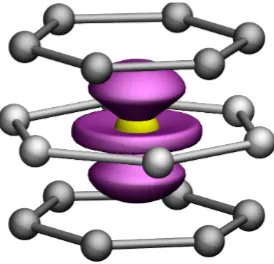

![TABLE I.Experimental lattice constants,taken fromRefs. [10, 13].The ASA radii for the three non-equivalentsites (RE/Co2c/Co3g) are also given](https://thumb-us.123doks.com/thumbv2/123dok_us/9431349.448883/7.612.316.563.53.225/table-experimental-lattice-constants-taken-fromrefs-radii-equivalentsites.webp)
![FIG. 8. Schematic of antiferromagnetic RE-Co interaction,after Fig. 2 of Ref. [67]. Wide/narrow rectangles symbolizestrong/weak RE-Co hybridization in a given spin channel.](https://thumb-us.123doks.com/thumbv2/123dok_us/9431349.448883/13.612.63.294.51.175/schematic-antiferromagnetic-interaction-narrow-rectangles-symbolizestrong-hybridization-channel.webp)

