cooperative magnetometry
G. Facchinetti1 and J. Ruostekoski21Ecole Normale Sup´´ erieure de Cachan, 61 avenue du Pr´esident Wilson, 94235 Cachan, France 2Department of Physics, Lancaster University, Lancaster, LA1 4YB, United Kingdom
(Dated: February 3, 2018)
We study strong light-mediated resonant dipole-dipole interactions in two-dimensional planar lattices of cold atoms. We provide a detailed analysis for the description of the dipolar point emitter lattice plane as a “super-atom”, whose response is similar to electromagnetically-induced transparency, but which exhibits an ultra-narrow collective size-dependent subradiant resonance linewidth. The super-atom model provides intuitively simple descriptions for the spectral response of the array, including the complete reflection, full transmission, narrow Fano resonances, and asymp-totic expressions for the resonance linewidths of the collective eigenmodes. We propose a protocol to transfer almost the entire radiative excitation to a single correlated subradiant eigenmode in a lattice and show that the medium obtained by stacked lattice arrays can form a cooperative magnetometer. Such a magnetometer utilizes similar principles as magnetometers based on the electromagnetically-induced transparency. The accuracy of the cooperative magnetometer, however, is not limited by the single-atom resonance linewidth, but the much narrower collective linewidth that results from the strong dipole-dipole interactions.
I. INTRODUCTION
Thin planar arrays of resonant emitters can couple strongly to incident electromagnetic fields, effectively making the transmission process cooperative; see, e.g., Refs. [1–4]. The phenomenon is generic and can appear for different types of scatterers with a considerable vari-ation of sizes and frequencies of radivari-ation, representing strong interactions that the electromagnetic field medi-ates between the scatterers. The resulting collective re-sponse can qualitatively also be described by arrays of dipolar point emitters [4–6], many cases even when the size of the scatterer is not negligible compared with the resonant wavelength.
Atoms are ideal dipolar point emitters and can be trapped in regular arrays using, e.g., optical lattice po-tentials [7] or optical dipole traps [8]. The idea that a two-dimensional (2D) planar array of atoms could be utilized for manipulation of light and for engineering a strong cooperative optical response with the associated super- and subradiant [9] excitation eigenmodes was re-cently put forward [10]. Among the most dramatic prop-erties of the planar arrays of dipolar point emitters with subwavelength spacing are ultra-sharp Fano resonances of transmission, with full transmission of light at the res-onance and complete reflection at a range of other fre-quencies [6]. Such systems formed by cold atoms could also exhibit quantum entanglement [11], be prepared to a giant subradiant excitation [12] and states with a non-trivial topology [13, 14]. The research in cooperative light coupling with regular planar arrays has been expanding rapidly [15–21], and with the models similar to those in Ref. [22] could be utilized to engineer also various inter-acting many-atom Hamiltonians.
Here we provide an expanded followup study of the re-cent work on dipolar point emitter arrays [6, 12] where
the cooperative response of a large array is modelled by introducing an effectivesuper-atom model, with only two coupled modes of radiative excitations. The super-atom model is reminiscent of the electromagnetically-induced transparency (EIT) [23] of independently scat-tering atoms. The model predicts the response in the limit of an infinite array, and was shown in Refs. [6, 12] to provide semi-analytic expressions for the conditions of complete reflection, full transmission, Fano resonances, and the resonance linewidths of the relevant collective ra-diative excitation eigenmodes. For finite arrays we find that it provides a good qualitative agreement with the ex-act numerical results of the spectral profiles. Although, e.g., the total reflection can be demonstrated numerically (for recent studies, see also Refs. [17, 20]), the super-atom model provides a simple intuitive description of the phys-ical process, together with a model for the entire scatter-ing spectrum.
arrays [4].
Since resonant emitters play a key role in optical de-vices for classical and quantum technologies [29], and lat-tices of atoms are particularly relevant for precision mea-surements, e.g., in metrology [30, 31], we apply the co-operatively coupled atomic arrays to precision measure-ments of weak magnetic fields. Unlike the conventional ideas of sensing [32] that are based on the independent scattering models, here the essential ingredient of the technique is the strong cooperative dipole-dipole inter-actions between the atoms, resulting in collective reso-nance linewidths and line shifts. We consider strongly coupled arrays of atoms stacked together to form a 3D medium where the spatial separation between each pla-nar lattice is sufficiently large (i.e., more than the optical wavelength), such that the interaction between the dif-ferent lattices is weak. The basic idea is closely related to the EIT magnetometry, based on the sharp dispersion in a transparent media [33]. However, as the EIT mag-netometry is based on the independent atom scattering, the frequency scales for the suppression of absorption and the sharp dispersion are determined by the single-atom
resonance linewidth. In the proposed cooperative mag-netometry the resonance linewidth of the relevant subra-diant collective eigenmode can be dramatically narrower, leading to improved accuracy.
The paper is organized as follows. The basic model of the atom-light coupling is introduced in Sec. II. We begin by a single-atom description of theJ = 0→J0 = 1 tran-sition in the absence and presence of the Zeeman energy level shifts in Sec. II A. This illustrates the basic prin-ciple of the rotation of the atomic polarization between two orthogonal directions that is then translated to the may-atom picture in Sec. II B, where we introduced both the microscopic model of atom-light interactions and the effective super-atom model. The super-atom model is explored in detail in Sec. III. We compare the effective model with the exact numerical simulations in Sec. III A and highlight the similarities of the model to the EIT of independent atoms in Sec. III B. Complete reflection and full transmission, semi-analytic models for the collective resonance linewidths, pulse delays, and spectrum of the scattered light are analyzed in Sec. III C. The cooper-ative magnetometry is described in Sec. IV and finally some concluding remarks are made in Sec. V.
II. ATOM-LIGHT COUPLING
We consider a 2D square planar lattice of cold atoms in theyzplane where the resonant dipole-dipole interac-tions are mediated between the atoms by the scattered light. We assume that the atoms are illuminated by an incident weak-intensity laser propagating in thex direc-tion with the amplitude
[image:2.612.329.552.57.147.2]E(r) =E0(y, z)ˆeyexp(ikx), (1)
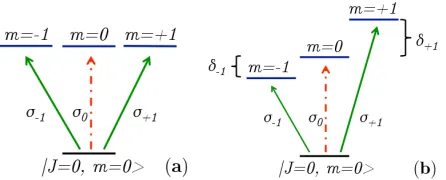
FIG. 1. The atomic level structure. The linearly polarized (alongy) incident light propagates along the positive x di-rection driving the|J = 0, mJ = 0i → |J0 = 1, mJ = ±1i transitions. The light does not directly couple to the |J = 0, mJ = 0i → |J0 = 1, mJ = 0i transition. The left panel shows the degenerate level structure and the right panel the level structure with the Zeeman splitting.
with the linear polarization ˆeyand the amplitudeE0(y, z) representing either constant or a Gaussian profile on the yz plane, perpendicular to the propagation direction. Here, and in the rest of the paper, all the field am-plitudes and the atomic polarization correspond to the slowly varying positive frequency components with os-cillations at the laser frequencyω. We consider a near-resonance J = 0 → J0 = 1 atomic transition (Fig. 1) and assume a controllable Zeeman level splitting of the J0 = 1 manifold. The Zeeman shifts could be induced by magnetic fields or, e.g., by AC Stark shifts [34].
A. Single-atom description
We first consider a single, isolated atomj. The dipole moment of the atom reads
dj=D X
σ
ˆ
eσPσ(j), (2)
whereDdenotes the reduced dipole matrix element. The atom has three polarization amplitude componentsPσ(j)
associated with the unit circular polarization vectors
ˆ e±1=∓
1
√
2(ˆex±iˆey), eˆ0= ˆez, (3)
that are coupled with the transitions|J = 0, m= 0i → |J0 = 1, m =σi. In the limit of low light intensity the excitation amplitudes satisfy
d dtP
(j)
σ = (i∆σ−γ)Pσ(j)+i
ξ
Dˆe
∗
σ·0E(rj), (4)
whereξ= 6πγ/k3and the single-atom Wigner-Weisskopf linewidth
γ= D 2k3
6π~0
. (5)
The detuning from the atomic resonance ∆σ=ω−ωσ =
ω−(ω0+σδzσ) where ω0 is the resonance frequency of the|J = 0i ↔ |J0 = 1, m= 0i transition and ±δz
the shifts of them=±1 levels (Fig. 1). They-polarized light then drives the atomic polarization componentsP±1(j)
(Fig. 1). Here we instead write the equations of motion in the Cartesian basis
dj=D(ˆexPx(j)+ ˆeyPy(j)+ ˆezPz(j)), (6)
such that
P(j)
x =
1
√
2(P (j) −1− P
(j)
+1), (7)
Py(j)=−
i
√
2(P (j) −1+P
(j)
+1). (8)
We obtain
˙
Px(j)= (i∆0−i˜δ−γ)Px(j)−δ¯P
(j)
y , (9a)
˙
P(j)
y = (i∆0−i˜δ−γ)Py(j)+ ¯δP
(j)
x +iξ0E0/D, (9b) where
˜ δ=1
2(δ
z
+−δz−), δ¯= 1 2(δ
z
++δz−), (10)
and ∆0 denotes the detuning of the m = 0 state. The incident light directly drives only Py(j), but the energy
splitting of the levels |m = ±1i introduces a coupling between Px(j) and P
(j)
y . Although the incident field is
perpendicular toPx(j), the light can therefore still excite
Px(j)by first drivingP
(j)
y . TheJ = 0→J0= 1 transition
is isotropic when the excited-state energies are degener-ate and any orientation of the orthogonal basis also forms an eigenbasis. For ¯δ6= 0, Px/y(j) no longer are eigenstates. The dipoles are consequently turned toward the x axis by the rotation around the effective magnetic field.
B. Many-atom dynamics for a planar array
1. Microscopic model
We next describe the response of the entire planar ar-ray where the light-mediated interactions between the atoms are taken into account. Analogous simulation methods can also be used in the studies of other resonant emitter systems, such as solid-state circuit resonators and plasmonics [4, 6, 35]. The single-atom picture of the light excitation and the rotation of the atomic excitation can be translated to the many-atom language. The dynam-ics of the polarization amplitudes in the many-atom pic-ture are obtained from the single-atom ones (4) by re-placing the term representing the external field contribu-tion [36, 37]
d dtP
(j)
σ = (i∆σ−γ)Pσ(j)+i
ξ
Deˆ
∗
σ·0Eext(rj), (11)
that could also be generalized to multi-level systems of alkali-metal atoms [37–39]. Here each amplitude in
Eq. (11) in the atom j is driven by the sum of the in-cident field and the fields scattered from all the N −1 other atoms
Eext(rj) =E(rj) + X
l6=j
E(Sl)(rj). (12)
The scattered dipole radiation field from the atoml is
0E (l)
S (r) =G(r−rl)D X
σ
ˆ
eσPσ(l), (13)
where G(r) is the dipole radiation kernel, such that E(Sl)(r) represents the electric field at r from a dipole
DP σˆeσP
(l)
σ residing atrl[40].
Owing to the resonant dipole-dipole interactions the atoms respond collectively to light, exhibiting collective excitation eigenmodes with distinct collective radiative linewidths and line shifts. The collective radiative exci-tation eigenmodes of the full system ofN atoms can be solved by representing the coupled system of atoms and light as
˙
b=iHb+F, (14)
wherebis a vector made of the amplitudes Pσ(j),
b3j−1+σ=Pσ(j), (15)
withσ =−1,0,1 and j = 1, . . . , N. The driving of the dipoles by the incident light [35] [due to the incident light field contribution from Eq. (12) in the last term in Eq. (11)] is given by
F3j−1+σ=i
ξ
Deˆ
∗
σ·0E(rj). (16)
The coupling matrix iH provides the light-induced in-teractions between the atoms [due to the scattered light contribution from Eq. (12) in the last term in Eq. (11)] and the first terms on the right-hand-side of Eq. (11), such that the diagonal terms read
H3j−1+σ,3j−1+σ = ∆σ+iγ (17)
and the off-diagonal terms (forj6=l)
H3j−1+σ,3l−1+σ0 =iξˆe∗σ·G(rj−rl)ˆeσ0 (18)
The matrixHhas 3N eigenmodes vjwith the
eigenval-uesδj+iυjwhereδj=ω0−ωjis the shift of the collective
mode resonanceωj from the single atom resonance and
υj is the collective radiative linewidth.
2. The effective super-atom model for the array
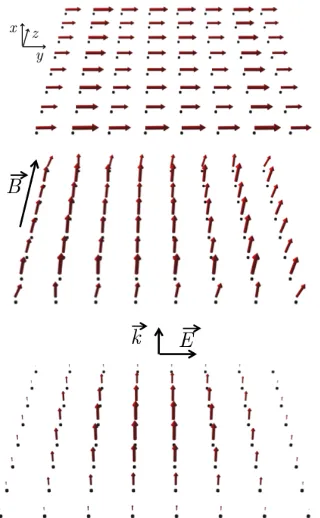
FIG. 2. Illustration of the phase-coherent response of the atoms, displaying the numerically calculated (based on the microscopic model) steady-state solutions to a small square 2D 8×8 array with one atom per site and the lattice spacing a = 0.55λ. The linearly polarized (along y) incident plane-wave light field propagates along the positivexdirection. On the top panel the Zeeman shifts vanish and the atomic dipoles oscillate in the array plane. In the middle panel the effective Zeeman splitting (due to a real or synthetic magnetic field along thez axis) drives the dipoles to be oriented normal to the plane with (δz
+, δ−z) = (0.45,1.75)γ. The bottom panel shows the collective eigenmode of the coupled system of light and atoms in the absence of the Zeeman shifts that closely resembles the uniform excitation of the atomic dipoles normal to the array plane. The dipoles oscillate normal to the planar array and the excitation amplitude decays close to the edge of the lattice.
understand the response by analyzing the behavior of the most dominant modes by formulating a super-atom model that only incorporates those modes. In this paper we consider incident field profiles that are smoothly vary-ing in the perpendicular direction to the propagation di-rection of light. The incident light is then phase-matched to a smoothly-varying, phase-coherent excitation of the atoms. Note that this situation is quite different from the planar array excitations considered in Ref. [10] where the phase profile of the incident field was modulated. This modulation resulted in spatially-localized excitations.
It turns out that in the common situations that we are interested here we only need to consider two collec-tive excitation eigenmodes (the eigenmodes of the col-lective system of atoms and light that are evaluated in the absence of the Zeeman shifts). The linear polariza-tion couples to a collective (“coherent in-plane”) mode in which all the dipoles are coherently oscillating along
they direction with the excitationPI; see Fig. 2. When
we introduce nonvanishing Zeeman shifts, this mode is no longer an eigenmode. The situation is now similar to the single-atom case where the atomic dipole is turned toward thexaxis due to the Zeeman splitting. In the col-lective lattice system that is driven by the laser with a uniform phase profile along the lattice, the atomic dipoles keep oscillating in phase even when the excited state de-generacy is broken. The dynamics in the presence of the Zeeman shifts can therefore be qualitatively analyzed by a simple two-mode model when we assume that PI is
predominantly coupled with a phase-coherent collective (“coherent perpendicular”) excitation PP where all the
atomic dipoles are oscillating in phase, normal to the plane; see Fig. 2. Also this mode is a collective eigen-mode in the absence of the Zeeman energy splitting of the electronic excited state. We can now establish an effective two-mode dynamics
˙
PP = (i∆P−iδ˜−υP)PP−δ¯PI, (19a)
˙
PI = (i∆I−iδ˜−υI)PI+ ¯δPP+iξ0E0/D, (19b)
where ˜δand ¯δare given by Eq. (10),υP andυI are the
collective linewidths of the corresponding eigenmodes of the many-atom system (forδz
±= 0) and
∆P /I=ω−ωP /I = ∆0+δP /I (20)
are the detunings of the incident light from the reso-nances of these modes (that are shifted by the collective line shiftsδP andδI).
The coupled equations for the two phase-coherent col-lective modes in Eq. (19) are almost identical to the equa-tions describing the single-atom dynamics in the Carte-sian coordinate system in Eq. (9). The only difference is that the single-atom resonance linewidthγis replaced by the collective eigenmode resonance linewidthsυP and
υI, and that the resonance of the two modes also
ex-hibit the additional collective shiftsδP and δI. The
ef-fective contribution of the collective light-mediated res-onant dipole-dipole interactions is encapsulated in these collective linewidths and line shifts. The 3N equations for theN atoms with three polarization components for the excitations are now replaced by two equations for the collective eigenmodes: one for the dipoles oscillating in the lattice plane and another one for the dipoles oscil-lating parallel to the propagation direction of the light and normal to the lattice plane. The simplicity of the effective super-atom approach becomes obvious when we compare it with the full microscopic model in Eq. (11): In the microscopic model for each atom we need to cal-culate the scattered fields from all the other atoms in Eext(rj).
The physical characteristics of the two eigenmodes are entirely different [12]. Since all the dipoles in the collec-tive mode PI are in the lattice plane, PI is responsible
0 10 20
γt 0
0.5 1
|
P
t
o
t|
20 500 1000 1500
γt 0
0.5 1
(a) (b)
0 10 20
γt 0
0.5 1
|
P
t
o
t|
20 500 1000 1500
γt 0
0.5 1
(c) (d)
FIG. 3. Comparisons between the phenomenological super-atom model (dashed, red lines) and the exact numerical sim-ulation (solid, blue lines). The Zeeman shifts and the de-tuning (δz
+, δ−z,∆0) = (1.1,1.1,0.65)γ have been chosen such that the collective polarization in the steady-state response is pointing normal to the lattice plane. In the two-mode model we have used the numerical values of the full eigenvalue cal-culation that are δP =−0.65γ, δI =−0.68γ, υP = 0.0031γ, υI = 0.79γ. The initial evolution of the laser-driven lattice before reaching the steady-state distribution for the case of (a) plane-wave excitation, (c) Gaussian beam excitation. The evolution after the incident light and the Zeeman shifts are turned off for the case of (b) plane-wave excitation, (d) Gaus-sian beam excitation. In the case of a plane-wave excitation the super-atom model differs from the full numerical solution at early times due to the contribution of additional collective modes in the dynamics (see Fig. 4). The additional modes de-cay faster and the dynamics of the calculations is more similar at later times when the slowly decaying subradiant coherent perpendicular mode dominates.
dominantly radiates within the plane, where the emission of light is directed toward the other atoms, enhancing light-mediated interactions between the atoms: For light to escape, it generally undergoes many scattering events. This is the physical explanation of the giant subradiance demonstrated for the modePP in Ref. [12]. With the
tar-geted excitation that is resonant withPP almost all the
excitation can be driven to the modePP by utilizing the
Zeeman shifts in the rotation of the atomic polarization normal to the plane [12].
III. SIMPLE DESCRIPTION OF THE LATTICE BY SUPER-ATOM
A. Comparisons with the exact calculations
The two-mode model qualitatively captures many of the essential features of the full many-body dynamics, when we substitute the numerically calculated values of υP /I andδP /I of the colective eigenmodes. In Fig. 3 we
show the comparison between the dynamics given by the two-mode model and the full numerics of all the 1200 collective excitation eigenmodes of the 20×20 array for the lattice spacinga = 0.55λ. In the numerical simula-tions we calculate the optical response by following the lattice simulation procedure introduced in Ref. [10] by solving the microscopic model described by Eqs. (11), (12), and (13). In the limit of low light intensity, for sta-tionary atoms with theJ = 0 →J0 = 1 transition the results are exact [37, 41], incorporating recurrent scatter-ing between the atoms and light-induced correlations. In a random medium such position-dependent correlations can lead to a violation of standard continuous medium electrodynamics [42, 43].
We show in Fig. 3 the dynamics of the total polar-ization of the system |Ptot| = |P
j,kP
(j)
k ˆek|/N [in all
the numerical results, the polarization amplitudes are ex-pressed in the dimensionless formP → DPk3/(6π
0E0)]. The incident light [in Fig. 3(a,b) a plane wave and in (c,d) a Gaussian beam] excites they components of the atomic dipoles. The Zeeman shifts turn the polariza-tion density toward the x direction. At the resonance (δz
+, δ−z,∆0) = (1.1,1.1,0.65)γwe find the dipoles almost entirely along thexdirection
The first part of the dynamics [in Fig. 3(a,c)] de-scribes the excitation of the atomic dipoles before the system reaches the steady state configuration. Once in the steady state, the Zeeman shifts and the incident laser are turned off, resulting in a decay of the excitations [in Fig. 3(b,d)]. Since the atomic dipoles here are approx-imately perpendicular to the plane, the excitation rep-resents giant subradiance [12] corresponding to a slow decay. For the plane-wave excitation the decay rates of the two cases differ at early times, while in the case of a Gaussian incident field excitation the agreement is bet-ter.
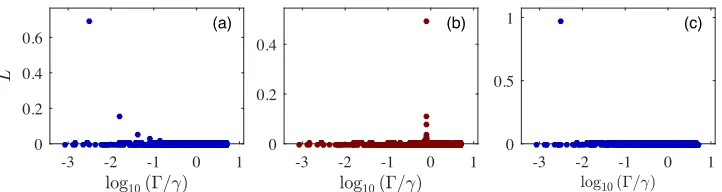
In order to explain the differences between the two excitation methods and the accuracy of the super-atom approach, we show in Fig. 4 the populations of the differ-ent eigenmodes ofHin the steady-state response. Since
His non-Hermitian, we define an overlap measure [44]
Lj =
|vTjb|2
P i|v
T i b|2
, (21)
for the eigenvector vj in the state b. We also use this
measure to determine the eigenmodes that are the closest to the ideal phase-coherent polarization excitations PI
andPP.
[image:5.612.63.290.60.239.2]-3 -2 -1 0 1
log10(!=.) 0
0.2 0.4
-3 -2 -1 0 1
log10(!=.) 0
0.2 0.4 0.6
L
(a) (b)
-3 -2 -1 0 1
log10(!=.)
0 0.2 0.4 0.6
-3 -2 -1 0 1
log10(!=.)
0 0.5 1
L
[image:6.612.125.486.51.147.2](c) (b)
FIG. 4. The measure of the mode populationLof the different eigenmodes in the steady-state response for fixed atomic positions, (a) incident plane wave excitation, (δz+, δ−z,∆0) = (1.1,1.1,0.65)γ; (b) incident plane wave excitation, (δ+z, δ−z,∆0) = (0,0,0)γ; (c) Gaussian beam excitation with the standard deviation 6a, (δ+z, δz−,∆0) = (1.1,1.1,0.65)γ. The eigenmodes are ordered by their collective radiative resonance linewidths on a logarithmic scale. In (b) the atomic polarization density is in the lattice plane and the excitation is dominated (over 50% of the total excitation) by the collective mode where the dipoles are coherently oscillating in they direction. In (a) and (c) the atomic polarization density is pointing normal to the lattice plane, and the excitation is dominated by about (a) 70%, (c) 98% by the collective subradiant mode where the atomic dipoles are coherently oscillating in thexdirection. In (a) also some modes with notably broader resonances are occupied that manifests themselves in a faster initial decay of the radiative excitation; see Fig. 3(b).
to the lattice using a plane wave the excited eigenmodes have different linewidths. For the Gaussian beam driving, only one eigenmode is notably excited. This is because the Gaussian beam intensity is better matched with the density distribution of the eigenmode in Fig. 2.
The occupation of more than a single eigenmode with different decay rates in Fig. 4(a) illustrates why the super-atom model for the plane wave excitation in Fig. 3(b) differs at early times. In fact, one can show [12] that the fitting of the radiative decay to a double-exponential provides a much better result than the fitting to a single exponential. Although the slowly-decaying case is dominated by the subradiant PP
exci-tation eigenmode with about 70% of the total exciexci-tation (and with the linewidth ofυP '3.1×10⁻³γ), the reason
for the double-exponential decay is a prominent excita-tion∼15% of an additional eigenmode whose linewidth
'0.015γnotably differs from that ofPP.
In the case of a Gaussian incident field excitation in Fig. 4(c), the agreement between the exact solution and the super-atom model is better, since in that case the en-tire excitation is dominated by a single collective eigen-mode in Fig. 4(c) that can reach about 98-99% of the total excitation [12]. The decay rate in that case can also be better described by a single exponential. In case that the atomic polarization density is in the lattice plane in Fig. 4(b), the excitation is dominated by the collective mode where the dipoles are coherently oscillating in the ydirection, and the decay rates of all the occupied modes are comparable to the linewidth of a single isolated atom.
B. Analogy to electromagnetically-induced transparency
The effective super-atom model has an analogy with EIT [23]. In a typical EIT setup of a lambda-three-level atom, shown in Fig. 5, the transition amplitudes from two electronic ground states|aiand|bito the same elec-tronic excited state|cidestructively interfere. The
inter-FIG. 5. Schematic illustration of the electromagnetically-induced transparency. The two electronic ground states |ai
and|bi are driven by the fields with the Rabi frequencies Ωc (coupling) and Ωp(probe), respectively, to the same electron-ically excited state|ci. The destructive interference between the transition amplitudes from the two electronic ground lev-els leads to the dark state|Di ∝Ωc|bi −Ωp|aithat is decou-pled from the driving light. At the same time, the absorbing state|Ai ∝Ωp|bi+ Ωc|aiis driven by the incident field. Small perturbations from the dark state result in coherent driving between the ground states.
ference results in a spectral transparency window in an otherwise opaque medium where the absorption is sup-pressed. When the population of the excited state can be neglected, EIT has a classical mechanical analogy of coupled oscillating springs [45]. In the limit of low light intensity, the EIT equations for a single atom polariza-tions for the transipolariza-tions from the ‘dark’|Diand ‘absorb-ing’ |Ai states, |Di ↔ |ci and |Ai ↔ |ci , are reminis-cent of those of the super-atom model for PP and PI,
respectively [Eq. (19)]. Here the strongly subradiant col-lective eigenmode of the interactingmany-atom system where the dipoles are pointing normal to the plane plays the role of thesingle-particle dark state superposition of the two ground states of the EIT system. The collec-tive eigenmode where the dipoles are in the lattice plane represents the absorbing state superposition in EIT.
[image:6.612.329.548.259.335.2]subradi-ant state preparation [12] the idea of transferring almost the entire atom population into a single eigenmode is based on an analogous principle: the atoms are coher-ently driven to the subradiant mode with the Zeeman shifts that are subsequently turned off after the system has reached the steady state configuration.
In the following sections the analogy between the super-atom for the lattice and single-particle EIT is fur-ther illustrated by examples of reflection, transmission, and Fano resonances. We also propose a magnetometer based on cooperative light-induced interactions that has similar principles as the EIT-magnetometry.
C. Full reflection and transmission for the array
The planar arrays of resonant emitters have been demonstrated as powerful tools for manipulating electro-magnetic radiation. The cooperative resonance phenom-ena of regular planar arrays consisting of dipolar point scatterers were analyzed in detail in Ref. [6], where sim-ple arguments for the comsim-plete reflection and transmis-sion, and the emergence of Fano resonances were de-veloped. The complete reflection for planar arrays of atomic dipoles for different geometries was also studied in Ref. [17], and the analysis of Ref. [6] was further ex-tended in Ref. [12].
Here we summarize the super-atom analysis of the transmission spectrum of Refs. [6, 12] with the focus on the complete reflection and transmission limits. These re-sults are then used in the magnetometry example based on the stacked arrays of atomic dipoles in Sec. IV.
We express the reflectance and the transmittance am-plitudes in terms of the incident and the scattered field amplitudesEI andES, respectively
r= ˆ
d·ES(−eˆx)
ˆ
d·EI(ˆex)
, t= ˆ
d·[EI(ˆex) +ES(ˆex)]
ˆ
d·EI(ˆex)
, (22)
whereES(ˆn), with ˆn=±ˆex, describes the scattered light
to the forward/backward direction from the lattice in the yz plane. The reflection and transmission amplitudes can be numerically calculated by solving for the optical response of the entire array of atoms using the micro-scopic model described by Eqs. (11), (12), and (13). The description, however, becomes particularly simple with the super-atom model, even without the precise knowl-edge of the values of the collective eigenmode resonance linewidths and line shifts,υP,υI,δP, and δI.
The steady-state solution of the super-atom model of Eq. (19) is easily obtained
PI =−i
ZP(∆0) ¯
δ2−Z
P(∆0)ZI(∆0)
f (23a)
PP =−i
¯ δ ZP(∆0)
PI, (23b)
where we have introduced the abbreviation f = iξ0E0/D, and defined
ZP /I(∆0)≡∆P /I−δ˜+iυP /I, (24)
∆P /I≡∆0+δP /I. (25)
1. Complete reflection
The atomic dipoles in the collective eigenmode exci-tation PP are oriented in the direction normal to the
plane and cannot emit in the exact forward or back di-rection. Therefore the scattering in the exact forward and back direction is solely produced by the coherent in-plane collective mode PI. Consequently, we obtain the
steady-state reflection from the steady-state solution to
PI amplitudes, given by Eq. (23a),
r=−r0
iυIZP(∆0) ¯
δ2−Z
P(∆0)ZI(∆0)
, (26)
where r0 denotes the reflectance amplitude at the reso-nance of the coherent in-plane collective mode (ZI =iυI)
when the Zeeman shifts vanish ¯δ= 0. We also have the symmetryES(ˆex) =ES(−ˆex) in Eq. (22), resulting in
t= 1 +r . (27)
The reflection and transmission properties of a planar lattice of atoms are described in the super-atom model by the simple relations Eqs. (26) and (27). The scattering problem can be further simplified when we consider an infinite lattice on theyz plane. The 2D lattice behaves similarly to a 2D diffraction grating where each atom emits light. The lattice structure generates the diffrac-tion pattern, while the atomic wave funcdiffrac-tions on indi-vidual sites correspond to the Debye-Waller factors and are responsible for overall envelope of the diffraction pat-tern [49, 50]. For subwavelength lattice spacing (a < λ) only the zeroth order Bragg peak of the scattered light survives in the far field. This corresponds to the exact forward and back scattered light. Since we defined the reflection and transmission amplitudes according to the scattered light in Eq. (22) in the exact forward and back directions, the energy conservation then states that
|r|2+|t|2= 1. (28)
Combining this with Eq. (27) yields
−Re(r) =|r|2, (29)
whose solutions generally are complex, but all the real
solutions are r = −1 and 0, corresponding to perfect reflection and perfect transmission, respectively. With the vanishing Zeeman shifts (¯δ= 0) [51], Eq. (26) reduces to
r=r0 iυI
ZI(∆0)
Even without any additional knowledge of the scattering properties of the system, we can take r0 to be real by appropriately redefining the resonance frequencies. (The scattering calculation yields a real-valuedr0even without a redefined resonance, as shown below.) The only value corresponding to a nonvanishing reflection is then
r0=−1, (31)
indicating that an incident field at the resonance of the coherent in-plane collective mode experiences a total re-flection when the Zeeman shifts are zero. Note that the amplitudes of the scattered light are equal in the for-ward and back directions, but in the forfor-ward direction the scattered light is precisely cancelled by interference with the incident field.
The expression forr0 may, in fact, be also derived in-dependently by explicitly evaluating the scattered light. In Ref. [6] the response was analyzed by calculating the transmission amplitude of Eq. (22) by deriving the ra-tio between the light amplitudes using the Fraunhofer diffraction theory from a rectangular aperture. Taking then the limit of an infinite lattice yielded the result [52]
r0=− 3γλ2 4πυIa2
. (32)
Combining this with Eq. (31) yields an expression for the linewidth of the collective eigenmode υI where the
dipoles are oscillating in the plane of the array [6]
lim
N→∞υI = 3λ2
4πa2γ . (33)
The result was shown to agree with the numerical simula-tions in the large lattice limit in Ref. [6]. The assumption in the derivation that the lattice spacing is less than the wavelength,a < λ, sets the minimum limit how subradi-ant the linewidth of this mode can beυImin/γ = 3/(4π). Moreover, whena <p3/πλ/2, the mode becomes super-radiant in the infinite lattice limit.
Although similar results to those of Eqs. (31) and (33) were also obtained using different methods in Ref. [20], the original derivations for the complete reflection that we have described here were already presented in Refs. [6, 12].
We can also solve the full expression (26) for the reflec-tion amplitude with the constraint (29). Since we have r0 6= 0 and υI 6= 0, these can be solved for arbitrary ¯δ
only forυP = 0. We obtain another result for the
collec-tive eigenmode resonance linewidths,
lim
N→∞υP = 0. (34)
In the limit of an infinite lattice, the subradiant mode where the dipoles oscillate perpendicular to the lattice becomes entirely decoupled from light with the zero linewidth. We have also numerically demonstrated it: For fixed atomic positions the mode becomes increas-ingly more subradiant in larger lattices with υP/γ '
N−0.91 [12].
2. Complete transmission
In the previous section we analyzed the response of the system when driven at the resonance of thePI mode. We
will now simplify the expression (26) for the reflection amplitude at the resonance of thePP mode, i.e., when
∆P = ˜δ. We find
r(∆P = ˜δ)≈ −
υIυP
¯ δ2+υ
IυP
(35)
where we have assumed|δP −δI| υI so that we can
neglect any difference between thePI andPP resonance
frequencies. (We find that this holds approximately true for the latticea'0.55λ.) When the Zeeman shifts sat-isfy
¯
δ2υPυI, (36)
reflectance onPP resonance is therefore suppressed, and
transmittance is enhanced. Remarkably, in the limit of a large array the response can therefore vary between a complete reflection and full transmission.
3. Spectrum of the scattered light
In the previous sections we found that in the large lattice limit the optical response can vary between the complete reflection (¯δ = 0) and full transmission (PP
resonance). We will now analyze the entire spectrum of scattered light that can exhibit very narrow features, related to the Fano resonances. The narrow linewidth υP of the subradiant eigenmode manifests itself in these
resonances.
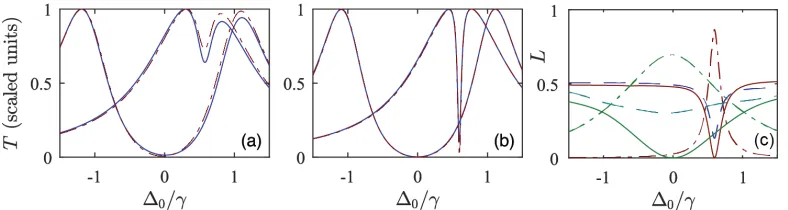
In Fig. 6(a,b) we show the spectra of the steady-state response of the forward or back scattered light into a narrow cone of|sinθ|<∼0.1 for an incident plane wave. The full numerical simulation is again compared with the two-mode atom model of Eq. (19). The super-atom model qualitatively captures the main features of the spectra, indicating that the resonance behavior is dominated by the two collective modes. The spectra in large lattices exhibit Fano resonances due to a destruc-tive interference between different scattering paths that involve either the excitationPI only, or a scattering via
PP, as in PI → PP → PI, and the interference is
anal-ogous to the interference of bright and dark modes in EIT.
The scattering of light in the exact forward and back directions is suppressed according to Eq. (36) when ¯
δ2 υPυI. The resonances correspond to high (low)
occupations of PP (PI) excitations. The ratio of the
amplitudes in the steady-state solution of Eqs. (23a) and (23b) indicates when the subradiant excitation PP
becomes dominant. At the resonance ∆P−δ˜= 0 we have
PP/PI =−δ/υ¯ P, and (assuming that|δP−δI| υI)
PP =−
¯ δ ¯ δ2+υ
IυP
f, PI =
υP
¯ δ2+υ
IυP
In Fig. 6(c) we display the measure of the eigenmode populations [obtained using Eq. (21)] of the main eigen-modes in the steady-state response as a function of the incident light frequency. These populations correspond to the scattered light spectra shown in Fig. 6(b). The occupations profiles are closely linked to the spectral pro-files. The peak of the subradiant mode excitation (and the trough in the coherent in-plane mode excitation) rep-resents the case where the light scattering in the forward or back direction vanishes, and the lattice becomes trans-parent. As explained earlier, in the limit of an infinitely large lattice with a subwavelength lattice spacing and fixed atomic positions only the exact forward or back scattering is possible, since in that case only the zeroth order Bragg peak survives.
The resonances strongly depend on the lattice size. For the 3× 3 lattice [Fig. 6(a)] the reflectance is only sup-pressed when (δz
+, δ−z) = (0.45,1.75)γ, but not in the case of (δz
+, δ−z) = (0.1,0.2)γ when ¯δ2 ∼ υPυI and the
condition of Eq. (36) is not valid.
We can express the power reflectance |r|2 in the limit υP/¯δ'0
|r|2' (r0υI) 2h
(∆P−δ)˜2+υ2P i
|(∆P−˜δ)4−(υ2I−2¯δ2)(∆P−δ)˜2+ ¯δ4|
, (38)
where we have assumed |δP −δI| υI. In this limit
we can then analytically calculate the half-width at half maximum for this resonance and obtain
w'1
2
q
υ2
I + 4¯δ2−υI
. (39)
This simple expression qualitatively explains the ob-served behavior of the spectral resonances. If PP is
strongly excited by the Zeeman shifts ¯δ, the resonance notably broadens. In the limit of a weak driving, the res-onance narrows and eventually only depends on the very narrow resonance linewidth υP, being a direct
manifes-tation of subradiance.
4. Pulse delay
We can also use the super-atom mode to calculate the group delayτg of a resonant light pulse for the 2D atom
array due to cooperative response. This is given by the derivative of the phase of the transmission amplitude with respect to the frequency
τg=
d
dωargt(ω)
∆
P−δ˜=0
' υ¯I
δ2, (40)
where we have taken the limit of a large array and as-sumed ¯δ2 υ
PυI withδP 'δI. In the limit of a large
latticeυP →0, and is generally very small, indicating the
condition ¯δ2 υPυI is not particularly restrictive and
we can still simultaneously have a very small ¯δ υI.
This corresponds to an extremely narrow transmission resonance in which case the sample is transparent at the exact resonance with a sharp variation of the dispersion curve.
By using the value of υP ∼ 10−3γ for the 35×35
lattice [12], we can obtain a sharp resonance even for ¯
δ2 ∼ 10−2γ2, and τ
g ∼ 100/γ (assuming that υI ∼ γ).
The cooperative effect is even more dramatic for the 150×
150 array for whichυP ∼10−4γ (obtained fromυP/γ ∼
N−0.91 [12]), and the group delay becomes significant τg∼103/γ even for an ultrathin 2D plane of atoms.
5. The effects of atom confinement
The atomic positions fluctuate due to the finite size of the trap. These can be taken into account in the simula-tions, as explained in Ref. [10]. For instance, in an optical lattice potential in the lowest vibrational level of each lat-tice site, the root-mean-square width of the wave function `=`y=`z=as−1/4/π, whereER=π2~2/(2ma2) is the
lattice-photon recoil energy and each site has a potential depthsER [53]. The current experiments in optical
lat-tices with the Mott-insulator state can reach the depth s'3000 [54]. The fluctuations of the atomic positions suppress the linewidth narrowing and, e.g., s = 50 lat-tice for the example considered in Sec. III A has the large array limitυP '0.15γ. Using tight confinement in the
Lamb-Dicke regime`j a, e.g., by optical tweezers by
means of nanofabrication, could further increase the life-time of the subradiant state in large systems.
IV. COOPERATIVE MAGNETOMETRY
We have demonstrated how the collective eigenmodes of the atomic dipoles in the planar lattice exhibit behav-ior that is reminiscent of independent atom EIT. In this section we show how the excitation of the collective sub-radiant state and the resulting narrow transmission res-onance could be used in the detection of weak magnetic fields. The basic idea is closely related to the EIT magne-tometry, based on the sharp dispersion in a transparent media [23, 33]. However, as in the EIT magnetometry the atoms are weakly interacting and can be described by the independent atom scattering model, the charac-teristic frequency for the suppression of absorption and the sharp dispersion is determined by the single-atom
resonance linewidth. The key element in the cooperative transmission is the interplay between thecollective sub-radiant excitationPP and strongly radiating PI. In the
large arrays, the corresponding resonance linewidths sat-isfyυP υI. This can lead to very narrow transmission
.
FIG. 6. The spectrum of forward or back scattered light for the lattices of (a) 3×3; (b) 20×20 sites, and (c) the eigenmode populationsLcorresponding to the spectral curves of (b). The curves are shown in the steady-state response as a function of the frequency of the incident light, and the spectrum of the larger lattice in (b) displays a sharp Fano resonance. We show in (a,b) both the super-atom model [red, dashed curves; with numerically calculated eigenvalues for the two dominant eigenmodes (δP +iυP)/γ ' −0.65 + 0.0031i (20×20), −0.62 + 0.12i (3×3), and (δI +iυI)/γ ' −0.68 + 0.79i (20×20), −0.59 + 0.83i (3×3)] and the exact numerical results (blue, solid curves). The two cases in (a,b) represent the two different orientations of the atomic dipoles in the steady-state configurations: (δ+z, δz−) = (0.1,0.2)γ (the orientation not far from the lattice plane; narrow resonances), (0.45,1.75)γ (the orientation approximately normal to the plane; broad resonances). The occupations of the eigenmodes for the two dipolar orientations of the (b) spectra are shown in (c) for the collective subradiant eigenmode where the atomic dipoles are coherently oscillating in thexdirection (dashed-dotted lines), the collective eigenmode where the atomic dipoles are coherently oscillating in theydirection (solid lines), the sum of the mode populations of all the other 1198 eigenmodes (dashed lines). The three mode population curves in (c) (green and cyan) for the broad resonance of (b) have the same location for the resonance and the same broad shape as the resonance in (b). The three narrow resonance population curves in (c) (red and blue) similarly follow precisely the narrow resonance in (b). Both the narrow and the broad resonanced in (b) represent the large occupations of the subradiant mode and low occupations of the coherent in-plane mode, and the spectral shape closely follows the occupation profiles of (c). The scattering resonance is approximately at the effective resonance of the subradiant mode [Eq. (19a)] ∆P−˜δ'0.
A. Independent atom EIT magnetometry
We first describe the standard independent-atom EIT magnetometry [23, 33]. We consider a lambda-three-level EIT system, shown in Fig. 5. The destructive interfer-ence between the different transition amplitudes leads to a spectral transparency window where the absorption is suppressed. This is a single-atom effect where the atoms are assumed to respond to light independently. For a small two-photon detuning between the levels |ai and
|bi, the electric susceptibility of the medium can be ap-proximated by
χ=χ0+iχ00, (41)
with
χ0 ' −24πγbcρ∆ωab
k3Ω2
c
, χ00' 12πγbcρΓab
k3Ω2
c
, (42)
where the imaginary partχ00 leads to absorption and the real part χ0 to dispersion. Here ρ denotes the density of the atoms, ∆ωab the two-photon detuning between
the levels|aiand |bi, andγbcthe single-atom resonance
linewidth of the probe |bi ↔ |ci transition. The decay rate for the loss of coherence between the levels|aiand|bi
is given by Γaband it results, e.g., from atomic collisions
and the fluctuations of the laser. Since the two-photon detuning depends on the magnetic Zeeman shifts between the levels ∆ωab'µB(maga−mbgb)/~(hereµBis Bohr’s
magneton, gj is the Land´e g-factor and mj is the
mag-netic quantum number for the level j), the dispersion
is proportional to the applied magnetic field, while the absorption at the same time is suppressed by EIT. The phase shift of the light propagating a distance L inside the sample is obtained by
∆φ=k(n−1)L' −2γbc∆ωab
Ω2
c
ρσcrL , (43)
where we have used n ' 1 +χ0/2 for the index of re-fraction n, and σcr = 3λ2/(2π) denotes the resonance cross-section.
The EIT magnetometry is based on achieving a large phase shift by propagating the light beam through a suf-ficiently large atom cloud, even when the coupling field intensity, proportional to Ω2
c, is large. Close to the EIT
resonance an otherwise opaque medium becomes almost transparent due to the destructive interference between the different atomic transitions. This results in the sup-pressed attenuation of the beam (given by χ00) and al-lows a long propagation distance inside the sample. The suppression of the absorption at the EIT resonance is associated with a sharp variation of the dispersion curve.
B. Super-atom model for cooperative magnetometry
Here we assume that the different layers are not very close to each other and are separated by a distance more than the wavelength of the resonant light λ. Instead of fully treating the entire 3D lattice [55], we can then as a first approximation ignore the recurrent scattering between the layers and add the interacting layers together analo-gously to the independent scattering approximation [56]. In the model each planar lattice is then treated as a single super-atom and the interaction between the super-atoms (different lattices) is considered weak, such that super-atoms are modelled within the independent scattering approximation.
In the limit of a large lattice and with not very closely-spaced planar lattices the PP excitation does not
con-tribute to the coherent light propagation (since only the zeroth order Bragg peak exists in the radiation zone), and we write the effective electric susceptibility as
χ' hPi
0E0
'ρDhPIi
0E0
, (44)
where the atom density can be given in terms of the layer separation ∆z as ρ'1/(a2∆z). We assume that ¯
δ2 υ
PυI and that the effective detuning from thePP
excitation resonance|∆P−δ˜| δ. Note, however, that¯
an extremely narrow transmission resonance (at which the sample is transparent and exhibits a sharp variation of the dispersion curve) can be achieved since in the limit of a large array,υP →0, and we can simultaneously have
a very small ¯δυI, γ.
We ignore the differences between the resonance fre-quencies of the two modesδP 'δI. From the two-mode
model solutions we then find
χ0' 6πγρ(∆P−δ)˜
k3δ¯2 , χ
00' 6πγρυP
k3δ¯2 . (45)
The corresponding phase shift is given by
∆φ= γ(∆P − ˜ δ) ¯
δ2 ρσcrL . (46)
Here any changes in both ¯δ and ˜δ are sensitive to the magnetic field variation. We can set the maximum al-lowed length of the sample to be defined by limiting the attenuation of the beam by absorption [given by exp(−πχ00L/π)] to be πχ00Lmax/π ∼ 1. For Lmax the
phase shift ∆φ∼(∆P−δ)/υ˜ P can still be very large due
to extremely narrow subradiant mode resonanceυP.
V. CONCLUDING REMARKS
Planar arrays of dipolar point emitters can respond strongly to light, exhibiting collective behavior. We have shown that this response can be qualitative captured by a simple model of a super-atom that shares features sim-ilar to those of independent-atom EIT. The super-atom model provides an intuitive, semi-analytic description for the optical response of the lattice, including those of the complete reflection, full transmission, and the sharp Fano resonances in the spectral response, which were obtained in Refs. [6, 12].
The analysis of the lattice responses paves a way for harnessing the strong dipole-dipole interactions between the atoms. The collective light-mediated interactions can be utilized in the controlled preparation of a giant sub-radiant excitation in a single eigenmode where the cor-related many-atom excitation spatially extends over the entire lattice and where the interactions strongly sup-press radiative losses. Although super-radiance has been extensively studied in experiments [57] – with the re-cent experiments focusing on light in confined geome-tries [58, 59], weak excitation regime [60–62], and the related shifts of the resonance frequencies [63–68] – sub-radiance generally has been elusive, due to its weak cou-pling to light.
Moreover, we proposed a scheme for a cooperative magnetometry. Unlike in a magnetometry using EIT [33] in weakly interacting vapors that can be described by in-dependent scattering approximation, the sensitivity to weak magnetic fields here is based on the strong light-induced dipole-dipole interactions between the atoms. As a result, the width of the resonance is not limited by the single atom resonance linewidth, but by the much nar-rower collective subradiant linewidth.
ACKNOWLEDGMENTS
We acknowledge financial support from EPSRC.
[1] V. A. Fedotov, N. Papasimakis, E. Plum, A. Bitzer, M. Walther, P. Kuo, D. P. Tsai, and N. I. Zheludev, “Spectral collapse in ensembles of metamolecules,” Phys. Rev. Lett. 104, 223901 (2010).
[2] Fabrice Lemoult, Geoffroy Lerosey, Julien de Rosny, and Mathias Fink, “Resonant metalenses for breaking the diffraction barrier,” Phys. Rev. Lett.104, 203901 (2010). [3] N. Papasimakis, Y. H. Fu, V. A. Fedotov, S. L. Prosvirnin, D. P. Tsai, and N. I. Zheludev,
“Meta-material with polarization and direction insensitive res-onant transmission response mimicking electromagnet-ically induced transparency,” Appl. Phys. Lett. 94, 211902 (2009).
[5] S. D. Jenkins and J. Ruostekoski, “Cooperative reso-nance linewidth narrowing in a planar metamaterial,” New Journal of Physics14, 103003 (2012).
[6] S. D. Jenkins and J. Ruostekoski, “Metamaterial trans-parency induced by cooperative electromagnetic interac-tions,” Phys. Rev. Lett.111, 147401 (2013).
[7] Christof Weitenberg, Manuel Endres, Jacob F. Sherson, Marc Cheneau, Peter Schauß, Takeshi Fukuhara, Im-manuel Bloch, and Stefan Kuhr, “Single-spin addressing in an atomic Mott insulator,” Nature471, 319 (2011). [8] F. Nogrette, H. Labuhn, S. Ravets, D. Barredo,
L. B´eguin, A. Vernier, T. Lahaye, and A. Browaeys, “Single-atom trapping in holographic 2d arrays of micro-traps with arbitrary geometries,” Phys. Rev. X4, 021034 (2014).
[9] R. H. Dicke, “Coherence in spontaneous radiation pro-cesses,” Phys. Rev.93, 99–110 (1954).
[10] Stewart D. Jenkins and Janne Ruostekoski, “Controlled manipulation of light by cooperative response of atoms in an optical lattice,” Phys. Rev. A86, 031602 (2012). [11] Martin Hebenstreit, Barbara Kraus, Laurin Ostermann,
and Helmut Ritsch, “Subradiance via entanglement in atoms with several independent decay channels,” Phys. Rev. Lett. 118, 143602 (2017).
[12] G. Facchinetti, S. D. Jenkins, and J. Ruostekoski, “Stor-ing light with subradiant correlations in arrays of atoms,” Phys. Rev. Lett.117, 243601 (2016).
[13] J. Perczel, J. Borregaard, D. E. Chang, H. Pichler, S. F. Yelin, P. Zoller, and M. D. Lukin, “Photonic band struc-ture of two-dimensional atomic lattices,” Phys. Rev. A 96, 063801 (2017).
[14] R. J. Bettles, J. Min´aˇr, C. S. Adams, I. Lesanovsky, and B. Olmos, “Topological properties of a dense atomic lat-tice gas,” Phys. Rev. A96, 041603 (2017).
[15] Robert J. Bettles, Simon A. Gardiner, and Charles S. Adams, “Cooperative ordering in lattices of interacting two-level dipoles,” Phys. Rev. A92, 063822 (2015). [16] Sung-Mi Yoo and Sun Mok Paik, “Cooperative optical
response of 2d dense lattices with strongly correlated dipoles,” Opt. Express24, 2156–2165 (2016).
[17] Robert J. Bettles, Simon A. Gardiner, and Charles S. Adams, “Enhanced optical cross section via collective coupling of atomic dipoles in a 2d array,” Phys. Rev. Lett.116, 103602 (2016).
[18] B. X. Wang, C. Y. Zhao, Y. H. Kan, and T. C. Huang, “Design of metasurface polarizers based on two-dimensional cold atomic arrays,” Opt. Express 25, 18760–18773 (2017).
[19] David Plankensteiner, Christian Sommer, Helmut Ritsch, and Claudiu Genes, “Cavity antiresonance spec-troscopy of dipole coupled subradiant arrays,” Phys. Rev. Lett.119, 093601 (2017).
[20] Ephraim Shahmoon, Dominik S. Wild, Mikhail D. Lukin, and Susanne F. Yelin, “Cooperative resonances in light scattering from two-dimensional atomic arrays,” Phys. Rev. Lett. 118, 113601 (2017).
[21] A. Asenjo-Garcia, M. Moreno-Cardoner, A. Albrecht, H. J. Kimble, and D. E. Chang, “Exponential improve-ment in photon storage fidelities using subradiance and “selective radiance” in atomic arrays,” Phys. Rev. X 7, 031024 (2017).
[22] B. Olmos, D. Yu, Y. Singh, F. Schreck, K. Bongs, and I. Lesanovsky, “Long-range interacting many-body sys-tems with alkaline-earth-metal atoms,” Phys. Rev. Lett.
110, 143602 (2013).
[23] M. Fleischhauer, A. Imamoglu, and J. P. Marangos, “Electromagnetically induced transparency: Optics in coherent media,” Rev. Mod. Phys.77, 633–673 (2005). [24] R. G. DeVoe and R. G. Brewer, “Observation of
su-perradiant and subradiant spontaneous emission of two trapped ions,” Phys. Rev. Lett.76, 2049–2052 (1996). [25] C. Hettich, C. Schmitt, J. Zitzmann, S. Khn, I. Gerhardt,
and V. Sandoghdar, “Nanometer resolution and coherent optical dipole coupling of two individual molecules,” Sci-ence298, 385–389 (2002).
[26] B. H. McGuyer, M. McDonald, G. Z. Iwata, M. G. Tarallo, W. Skomorowski, R. Moszynski, and T. Zelevin-sky, “Precise study of asymptotic physics with subradiant ultracold molecules,” Nat. Phys.11, 32–36 (2015). [27] Yosuke Takasu, Yutaka Saito, Yoshiro Takahashi,
Ma-teusz Borkowski, Roman Ciury lo, and Paul S. Julienne, “Controlled production of subradiant states of a diatomic molecule in an optical lattice,” Phys. Rev. Lett. 108, 173002 (2012).
[28] William Guerin, Michelle O. Ara´ujo, and Robin Kaiser, “Subradiance in a large cloud of cold atoms,” Phys. Rev. Lett.116, 083601 (2016).
[29] Klemens Hammerer, Anders S. Sørensen, and Eugene S. Polzik, “Quantum interface between light and atomic en-sembles,” Rev. Mod. Phys.82, 1041–1093 (2010). [30] T. L. Nicholson, S. L. Campbell, R. B. Hutson, G. E.
Marti, B. J. Bloom, R. L. McNally, W. Zhang, M. D. Barrett, M. S. Safronova, G. F. Strouse, W. L. Tew, and J. Ye, “Systematic evaluation of an atomic clock at 2×10⁻¹⁸total uncertainty,” Nat Commun6, 6896 (2015). [31] S. L. Bromley, B. Zhu, M. Bishof, X. Zhang, T. Both-well, J. Schachenmayer, T. L. Nicholson, R. Kaiser, S. F. Yelin, M. D. Lukin, A. M. Rey, and J. Ye, “Collective atomic scattering and motional effects in a dense coher-ent medium,” Nat Commun7, 11039 (2016).
[32] Dmitry Budker and Michael Romalis, “Optical magne-tometry,” Nature Physics3, 227 (2007).
[33] M. Fleischhauer, A. B. Matsko, and M. O. Scully, “Quantum limit of optical magnetometry in the presence of ac stark shifts,” Phys. Rev. A62, 013808 (2000). [34] Fabrice Gerbier, Artur Widera, Simon F¨olling, Olaf
Man-del, and Immanuel Bloch, “Resonant control of spin dy-namics in ultracold quantum gases by microwave dress-ing,” Phys. Rev. A73, 041602 (2006).
[35] S. D. Jenkins and J. Ruostekoski, “Theoretical formalism for collective electromagnetic response of discrete meta-material systems,” Phys. Rev. B86, 085116 (2012). [36] Janne Ruostekoski and Juha Javanainen, “Quantum field
theory of cooperative atom response: Low light inten-sity,” Phys. Rev. A55, 513–526 (1997).
[37] Mark D. Lee, Stewart D. Jenkins, and Janne Ru-ostekoski, “Stochastic methods for light propagation and recurrent scattering in saturated and nonsaturated atomic ensembles,” Phys. Rev. A93, 063803 (2016). [38] S. D. Jenkins, J. Ruostekoski, J. Javanainen, S.
Jen-newein, R. Bourgain, J. Pellegrino, Y. R. P. Sortais, and A. Browaeys, “Collective resonance fluorescence in small and dense atom clouds: Comparison between theory and experiment,” Phys. Rev. A94, 023842 (2016).
[40] John David Jackson,Classical Electrodynamics, 3rd ed. (Wiley, New York, 1999).
[41] Juha Javanainen, Janne Ruostekoski, Bjarne Vester-gaard, and Matthew R. Francis, “One-dimensional mod-elling of light propagation in dense and degenerate sam-ples,” Phys. Rev. A59, 649–666 (1999).
[42] Juha Javanainen, Janne Ruostekoski, Yi Li, and Sung-Mi Yoo, “Shifts of a resonance line in a dense atomic sample,” Phys. Rev. Lett.112, 113603 (2014).
[43] Juha Javanainen and Janne Ruostekoski, “Light propa-gation beyond the mean-field theory of standard optics,” Opt. Express24, 993–1001 (2016).
[44] For the isotropicJ= 0→J0 = 1 systemHis symmet-ric, and we can determine the biorthogonality condition vT
jvi = δji, except for possible zero-binorm states for which vTjvj = 0 (that we have not encountered in our system).
[45] C. L. Garrido Alzar, M. A. G. Martinez, and P. Nussen-zveig, “Classical analog of electromagnetically induced transparency,” American Journal of Physics 70, 37–41 (2002).
[46] Zachary Dutton and Lene Vestergaard Hau, “Storing and processing optical information with ultraslow light in bose-einstein condensates,” Phys. Rev. A 70, 053831 (2004).
[47] Zachary Dutton and Janne Ruostekoski, “Transfer and storage of vortex states in light and matter waves,” Phys. Rev. Lett. 93, 193602 (2004).
[48] C. Liu, Z. Dutton, C. H. Behroozi, and L. H. Hau, “Ob-servation of coherent optical information storage in and atomic medium using halted light pulses,” Nature 409, 490 (2001).
[49] J. Ruostekoski, C. J. Foot, and A. B. Deb, “Light scat-tering for thermometry of fermionic atoms in an optical lattice,” Phys. Rev. Lett.103, 170404 (2009).
[50] T. J. Elliott, W. Kozlowski, S. F. Caballero-Benitez, and I. B. Mekhov, “Multipartite entangled spatial modes of ultracold atoms generated and controlled by quantum measurement,” Phys. Rev. Lett.114, 113604 (2015). [51] In this limit we only have an equation forPI, since there
is no coupling toPP in Eq. (19).
[52] Owing to the different definition of the linewidth in Ref. [6], the atomic lattice result is obtained with the substitution ΓE → γ/2 in the expression of the meta-molecule linewidth.
[53] Oliver Morsch and Markus Oberthaler, “Dynamics of bose-einstein condensates in optical lattices,” Rev. Mod. Phys.78, 179–215 (2006).
[54] C. Gross, “Private communication,” (2017).
[55] Mauro Antezza and Yvan Castin, “Photonic band gap in an imperfect atomic diamond lattice: Penetration depth and effects of finite size and vacancies,” Phys. Rev. A88, 033844 (2013).
[56] Janne Ruostekoski and Juha Javanainen, “Emergence of correlated optics in one-dimensional waveguides for clas-sical and quantum atomic gases,” Phys. Rev. Lett.117, 143602 (2016).
[57] M. Gross and S. Haroche, “Superradiance: An essay on the theory of collective spontaneous emission,” Phys. Rep.93, 301 (1982).
[58] A. Goban, C.-L. Hung, J. D. Hood, S.-P. Yu, J. A. Muniz, O. Painter, and H. J. Kimble, “Superradiance for atoms trapped along a photonic crystal waveguide,” Phys. Rev. Lett.115, 063601 (2015).
[59] P. Solano, P. Barberis-Blostein, F. K. Fatemi, L. A. Orozco, and S. L. Rolston, “Super-radiance reveals infinite-range dipole interactions through a nanofiber,” Nature Communications8, 1857 (2017).
[60] S. J. Roof, K. J. Kemp, M. D. Havey, and I. M. Sokolov, “Observation of single-photon superradiance and the cooperative lamb shift in an extended sample of cold atoms,” Phys. Rev. Lett.117, 073003 (2016).
[61] Michelle O. Ara´ujo, Ivor Kreˇsi´c, Robin Kaiser, and William Guerin, “Superradiance in a large and dilute cloud of cold atoms in the linear-optics regime,” Phys. Rev. Lett.117, 073002 (2016).
[62] C. C. Kwong, T. Yang, M. S. Pramod, K. Pandey, D. De-lande, R. Pierrat, and D. Wilkowski, “Cooperative emis-sion of a coherent superflash of light,” Phys. Rev. Lett. 113, 223601 (2014).
[63] J. Keaveney, A. Sargsyan, U. Krohn, I. G. Hughes, D. Sarkisyan, and C. S. Adams, “Cooperative Lamb shift in an atomic vapor layer of nanometer thickness,” Phys. Rev. Lett.108, 173601 (2012).
[64] Z. Meir, O. Schwartz, E. Shahmoon, D. Oron, and R. Oz-eri, “Cooperative lamb shift in a mesoscopic atomic ar-ray,” Phys. Rev. Lett.113, 193002 (2014).
[65] Ralf R¨ohlsberger, Kai Schlage, Balaram Sahoo, Sebastien Couet, and Rudolf R¨uffer, “Collective Lamb shift in single-photon superradiance,” Science 328, 1248–1251 (2010).
[66] S. D. Jenkins, J. Ruostekoski, J. Javanainen, R. Bour-gain, S. Jennewein, Y. R. P. Sortais, and A. Browaeys, “Optical resonance shifts in the fluorescence of thermal and cold atomic gases,” Phys. Rev. Lett. 116, 183601 (2016).
[67] S. Jennewein, M. Besbes, N. J. Schilder, S. D. Jenkins, C. Sauvan, J. Ruostekoski, J.-J. Greffet, Y. R. P. Sortais, and A. Browaeys, “Coherent scattering of near-resonant light by a dense microscopic cold atomic cloud,” Phys. Rev. Lett.116, 233601 (2016).
![Fig. 3(b,d)]. Since the atomic dipoles here are approx-](https://thumb-us.123doks.com/thumbv2/123dok_us/9326013.434543/5.612.63.290.60.239/fig-b-d-atomic-dipoles-approx.webp)