US 20190175796A1
( 19 ) United States
( 12 ) Patent Application Publication ( 10 ) Pub . No
. : US 2019 / 0175796 A1
HARDY
( 43 ) Pub . Date :
Jun . 13 , 2019
( 54 ) PHOTOINITIATING POLYMERISABLE
COMPOSITION
( 71 ) Applicant : LANCASTER UNIVERSITY
BUSINESS ENTERPRISESLIMITED , Lancaster ( GB
)
Publication Classification
( 51 ) Int . Cl .
A61L 31 / 06 ( 2006 . 01 ) A61L 31 / 14 ( 2006 . 01 ) A61N 1 / 05
( 2006 . 01 )
( 52 ) U . S . CI
.
CPC
. . . . A61L 31 / 06 ( 2013 . 01 ) ; A61L 31 / 14
( 2013 . 01 ) ; A61L 2400 / 06 ( 2013 . 01 ) ; A61L
2300 / 442 ( 2013 . 01 ) ; A61N 1 / 0504 ( 2013 . 01 )
( 72 ) Inventor : John George HARDY , Lancaster ( GB )
( 21 ) Appl . No
. :
16 / 323 , 015
( 22 ) PCT Filed :
Aug . 1 , 2017
ABSTRACT
( 57 )
PCT
/ GB2017 / 052235
( 86 ) PCT No . :
$ 371 ( c ) ( 1 ) ,
( 2 ) Date :
Feb . 4 , 2019
( 30 )
Foreign Application Priority Data
The present invention provides a method of producing a
visual marking on the exterior of a human or animal body .
There is also provided a method of forming a polymer within
a human or animal body . The resultant polymer generally
has an electrical conductivity of 10 - 10 S / cm or more .
Aug . 5 , 2016 ( GB ) . . . 1613540 . 2
105
101
103
107
109
Patent Application Publication
Jun . 13 , 2019 Sheet 1 of 2
US 2019 / 0175796 A1
Figure 1
105
101
103
107
109
1131
VL
115
111
Figure 2
205
205
205
203
203
203203
[image:2.612.112.486.160.672.2]Patent Application Publication
Jun . 13 , 2019 Sheet 2 of 2
US 2019 / 0175796 A1
Figure 3
Chemistry
US 2019 / 0175796 A1
Jun . 13 , 2019
PHOTOINITIATING POLYMERISABLE COMPOSITION
[ 0001 ] The present invention relates to an injectable com
position . An in vivo method of forming a polymeric struc
ture , such as a medical device , is also described . There is
also provided a method of medical treatment including the implantation of the composition to a human or animal body , and the subsequent polymerization of the compositionwithin the human or animal body .
BACKGROUND TO THE INVENTION
[ 0002 ] It is known to use multi - photon photo - polymeriza
tion ex vivo to build a structure modelled on a biological
organ ( for example see US2013197668A1 ) . A solid block of
gel containing monomers and a 2 - photon active photo initiator is prepared as a raw material . The shape of a desired
object is traced out by the control of laser beams
, optionally
there may be additional steps such as a fixing step , and then
excess gel is washed away to leave the desired structure .
[ 0003 ] In one type of photo - polymerization , light is absorbed directly by a reactant monomer . In a second type
of photo - polymerization , light is absorbed by a photo
initiator material which absorbs the light and then transfers
energy to the monomer to effect polymerization .
[ 0004 ] It is known to use multi - photon techniques destruc
tively to induce controlled release of drugs from a structure
in vivo ( see for example US2003191458A1 ) .
10005 ] Currently the provision of structures in vivo
requires incision and implantation . The present invention is
advantageous because it permits in situ in vivo fabrication of
structures and may require as few as one implantation
( suitably one injection ) of the precursor materials .
animal body wherein the composition comprises a polymeri
sable precursor and a photo - initiator wherein the photo
initiator causes the polymerisable precursor to polymerisewhere the photo - initiator is in its excited state ;
10013 ] illuminating the site with electromagnetic radiation having a wavelength of 400 to 1600 nm , wherein absorption of two or more photons of the electromagnetic radiation excites the photo - initiator causing initiation of polymerisa tion of the polymerisable precursor to form a polymer within
the human or animal body , wherein the polymer is visible on
the exterior of the human or animal body .
[ 0014 ] Generally , the visual marking is in the form of a
tattoo .
10015 ] According to one embodiment , the composition
includes second photo - initiatable functional moieties which
become excited at a different wavelength to the photo
initiator and wherein the polymer may be dis - assembled
through illumination of the site with electromagnetic radiation having a second wavelength . The second wavelength may be at least 200 nm higher or lower than the first wavelength wherein absorption of two or more photons of
the electromagnetic radiation causes the second photo - ini
tiatable functional moieties on the polymer to become
excited and destroy the polymer .
[ 0016 ] According to an aspect of the present invention ,
there is provided an injectable composition comprising a
polymerisable precursor and a photo - initiator wherein the
photo - initiator causes the polymerisable precursor to
polymerise where the photo - initiator is in its excited state ,
[ 0017 ] wherein absorption of two or more photons of
electromagnetic radiation having a wavelength of 400
to 1600 nm excites the photo - initiator causing initiation
of polymerisation of the polymerisable precursor ,
[ 0018 ] wherein the resultant polymer has an associated
electrical conductivity of at least 10 - 10 S / cm to 104
S / cm or more .
[ 0019 ] According to a further aspect of the present inven
tion , there is provided a buffered aqueous based composition
comprising monomers that are derivatives of pyrrole , ani
line , thiophene , 3 , 4 - ethylenedioxythiophene , fluorene , phe
nylene , pyrene , azulene , napthalene , indole , azepine , p - phe
nylene sulfide , p - phenylene vinylene , and / or furans ; and
moreover
, a photo - initiator , and dye ( s ) .
[ 0020 ] According to a further aspect of the present inven
tion there is provided a buffered aqueous based composition
comprising pyrrole , a photo - initiator ( generally irgacure )
and a dye .
[ 0021 ] According to a further aspect of the present inven
tion there is provided a method of forming a polymericstructure within a human or animal body utilising the
methods as described herein .
[ 0022 ] According to a further aspect of the present inven
tion , there is provided a composition as described herein for
use in therapy .
[ 0023 ] . According to a further aspect of the present inven tion , there is provided a composition as described herein for use in the treatment of conditions that respond to electricity
( i . e . using the polymer deposited as an electrode to stimulate
the tissue surrounding it for deep brain stimulation , for
electrical stimulation of neurons , stem cells or muscle cells ) ,
or prevention of cell migration cancer cells , bacteria , etc ) ,
or the delivery of active ingredients ( drugs ) entrapped within
the polymer matrix .
STATEMENT OF INVENTION
[ 0006 ] A method of forming a polymer within a human or
animal body comprising :
[ 0007 ] implanting a composition at a site in the human
or animal body wherein the composition comprises a
polymerisable precursor and a photo - initiator wherein
the photo - initiator causes the polymerisable precursor
to polymerise where the photo - initiator is in its excited
state ;
[ 0008 ] illuminating the site with electromagnetic radia
tion having a first wavelength of 400 to 1600 nm , wherein absorption of two or more photons of the
electromagnetic radiation excites the photo - initiator
causing initiation of polymerisation of the polymeris
able precursor to form a polymer within the human or
animal body , wherein polymerisation causes a change
in physical state of the polymerisable precursor ;
[ 0009 ] wherein the polymer has an electrical conduc
tivity of 10 - 10 S / cm to 104 S / cm or more .
[ 0010 ] Generally , the change in physical state involves
solidification of the polymerisable precursor . Alternatively ,
the viscosity of the polymerisable precursor may be greatly
increased , for example to yield a gel ( including a hydrogel ) ,
paste , foam or plastic .
[ 0011 ] According to a further aspect of the present inven
tion , there is provided a method of producing a visual
marking on the exterior of a human or animal body com
prising :
[ 0012 ] implanting a composition at a site in the human or
US 2019 / 0175796 A1
Jun . 13 , 2019
[ 0024 ] There is also provided a method of medical treat -
ment comprising forming a polymer within a human or
animal body in accordance with the method described
herein .
[ 0025 ] In yet another aspect , the present teachings include
a kit , where the kit includes one or more of the compositions
of the present teachings , or the components necessary to
form the compositions of the present invention , and instruc
tions for use thereof . Generally , the kit would comprise an
energy source .
[ 0026 ] According to a further embodiment , there is pro
vided a system for performing the methods disclosed herein .
The system can include the composition as disclosed herein and one or more energy sources , typically lasers . The system may include an analytical instrument used to measure the
wavelength and intensity of the energy source ( s ) , and / or to
measure the amount of composition implanted in the human
or animal body . The system also can include a suitably programmed computer for carrying out one or more steps of the methods . For example , the suitably programmed com
puter can carry out or assist in one or more of control of the
intensity of the energy source ( s ) , measuring any fluctuations
in the intensity of the energy source ( s ) , and equivalents
thereof .
[ 0027 ] Throughout the Application , where compositions
are described as having , including , or comprising specific
components , or where processes are described as having ,
including , or comprising specific process steps , it is con
templated that compositions of the present teachings alsoconsist essentially of , or consist of , the recited components ,
and that the processes of the present teachings also consist
essentially of , or consist of , the recited process steps .
[ 0028 ] In the Application , where an element or component
is said to be included in and / or selected from a list of recited elements or components , it should be understood that the element or component can be any one of the recited elements
or components , or the element or component can be selected
from a group consisting of two or more of the recited
elements or components . Further , it should be understood
that elements and / or features of a composition , an apparatus , or a method described herein can be combined in a variety
of ways without departing from the spirit and scope of the
present teachings , whether explicit or implicit herein . [ 0029 ] The use of the terms include , ” “ includes ” ,
" including , " " have , " " has , ” or “ having ” should be generally
understood as open - ended and non - limiting unless specifi
cally stated otherwise .
[ 0030 ] The use of the singular herein includes the plural
( and vice versa ) unless specifically stated otherwise . In
addition , where the use of the term " about ” is before a quantitative value , the present teachings also include thespecific quantitative value itself , unless specifically stated
otherwise . As used herein , the term “ about ” refers to a + 10 %
variation from the nominal value unless otherwise indicated
or inferred .[ 0031 ] It should be understood that the order of steps or
order for performing certain actions is immaterial so long as the present teachings remain operable . Moreover , two or
more steps or actions may be conducted simultaneously .
[ 0032 ] As used herein , “ pharmaceutically acceptable ”
refers to a substance that is acceptable for use in pharma
ceutical applications from a toxicological perspective and
does not adversely interact with the active ingredient .
Accordingly , pharmaceutically acceptable carriers are those
that are compatible with the other ingredients in the formu
lation and are biologically acceptable . Supplementary active
ingredients can also be incorporated into the pharmaceutical
compositions .
[ 0033 ] Compounds and therapeutic combinations of the
present teachings can be useful for treating a pathological
condition or disorder in a patient , for example , a human . As
used herein , “ treating ” refers to partially or completely
alleviating and / or ameliorating the condition and / or symp
toms thereof . The present teachings accordingly include a
method of providing to a patient a pharmaceutical compo
sition that includes a compound or therapeutic combination
of the present teachings in combination or association witha pharmaceutically acceptable carrier . Compounds and
therapeutic combinations of the present teachings can be administered alone or in combination with other therapeu
tically effective compounds or therapies for the treatment of
a pathological condition or disorder .
[ 0034 ] As used herein , " patient ” refers to a human , ani
mal , fish or bird , in particular a mammal , such as a human
although mention may also be made of primates , dogs , cats ,
rats , horses , camels , farm livestock such as cattle sheep , pigs , goats , deer ; birds including chicken , geese , birds of
prey and endangered animals including endangered birds .
[ 0035 ] Because the present teachings provide pharmaceu
tical formulations and their intended use is with patientssuch as humans , each of the ingredients or compounds of a
pharmaceutical formulation described herein can be a pharmaceutically acceptable ingredient or compound .
[ 0036 ] As used herein , a “ compound ” refers to the com
pound itself and its pharmaceutically acceptable salts and
hydrates unless otherwise understood from the context of the
description or expressly limited to one particular form of the
compound , i . e . , the compound itself , or a pharmaceutically acceptable salt or hydrate thereof .
[ 0037 ] Features , integers , characteristics , described in
conjunction with a particular aspect , embodiment or
example of the invention are to be understood to be applicable to any other aspect , embodiment or example described
herein unless incompatible therewith .
DETAILED DESCRIPTION
[ 0038 ] Method
[ 0039 ] A method of forming a polymer within a human or
animal body comprising :
[ 0040 ] implanting a composition at a site in the human
or animal body wherein the composition comprises a
polymerisable precursor and a photo - initiator wherein
the photo - initiator causes the polymerisable precursor to polymerise where the photo - initiator is in its excited
state ;
[ 0041 ] illuminating the site with electromagnetic radia
tion having a first wavelength of 400 to 1600 nm , wherein absorption of two or more photons of the
electromagnetic radiation excites the photo - initiator
causing initiation of polymerisation of the polymeris
able precursor to form a polymer within the human or animal body , wherein polymerisation causes a changein physical state of the polymerisable precursor ;
[ 0042 ] wherein the polymer has an electrical conduc
tivity of 10 - 10 S / cm to 104 S / cm or more .
[ 0043 ] Generally , the change in physical state involves
solidification of the polymerisable precursor . Alternatively ,
US 2019 / 0175796 A1
Jun . 13 , 2019
uy .
increased , for example to yield a gel ( including a hydrogel ) ,
paste , foam or plastic . Advantageously , the polymerisation
causes solidification of the polymerisable precursor .
( 0044 ) Generally , the dimensions of the polymerised area
( in general the solidified area ) are at least 1 nm , typically at
least 100 nm . Typically , the polymerised area has an asso
ciated thickness of less than 1 cm .
10045 ] Currently the provision of structures in vivo
requires incision and implantation . The present invention is
advantageous because it permits in situ in vivo fabrication of structures and may require as few as one injection of the precursor materials .
[ 0046 ] The use of multi - photon technology is advanta
geous because it may be controlled so that a desired pho tochemical reaction occurs only at the point of intersection
of two or more photon beams . For example two - photon
polymerisation may provide point by point scanning to build
a desired structure .
[ 0047 ] According to one aspect of the present invention , at
least one of the beams may be scanned so as to produce a pattern .
[ 0048 ] The composition is generally implanted through
injection . The composition may be injected into the lower
layers of the skin , or subcutaneously . The composition may
be implanted via bolus injection . Alternatively , the compo
sition may be implanted through the use of a catheter .
[ 0049 ] Generally the composition is implanted 10 cm or
less from the surface of the human or animal body , typically
5 cm or less , suitably 1 cm or less , more suitably within 5 mm of the surface of the human or animal body .
[ 0050 ] According to one embodiment , the composition is
implanted to the lower layers of skin , or directly under theskin of the human or animal body . Alternatively , the com
position may be implanted directly under the surface of the
eye of the human or animal . Suitably the composition may
be injected into other tissue , for example muscle or fat , or
around an organ of the human or animal body .
[ 0051 ] Alternatively , the composition may be implanted
further from the surface of the human or animal body . The
electromagnetic radiation source may be inserted into thebody to illuminate the site of the implanted composition
( suitably through keyhole surgery ) .
[ 0052 ] The closer the site of the implanted composition to
the energy source upon illumination of the site by the energy
source , the more targeted and controllable the polymerisa
tion of the composition .
[ 0053 ] Generally , the site of the implanted composition
should be no more than 30 cm from the energy source upon
illumination of the site , suitably 10 cm or less from the
energy source . Typically the site is 5 cm or less from the
energy source upon illumination , suitably 1 cm or less from
the energy source upon illumination .
10054 ] To excite the photo - initiator , a threshold amount of
radiation must be absorbed . The wavelength of the incident
radiation is generally 400 to 1600 nm .
[ 0055 ] The threshold incident radiation is generally in the
form of at least two photons from intersecting photon beams .
[ 0056 ] Generally , the composition is subjected to electro
magnetic radiation from outside the human or animal body to initiate polymerisation of the monomer .
[ 0057 ] Absorption by the photo - initiator of a threshold
amount of electromagnetic radiation excites the photo - ini
tiator , and the excited photo - initiator initiates polymerisa
tion of the polymerisable precursor . Generally , absorption of
electromagnetic radiation from the intersection of two or
more photon beams is required to excite the photo - initiator ,
meaning that the photochemical reaction is very controllable
and predictable .
[ 0058 ] The use of multi - photon technology is advanta
geous because it may be controlled so that a desired pho
tochemical reaction occurs only at the point of intersection
of two or more photon beams
. For example , two - photon
polymerisation may provide point by point scanning to build
a desired structure .
[ 0059 ] Upon polymerisation , the polymerisable precursor
undergoes a change in physical state . Generally the
polymerisable precursor solidifies . Alternatively , a hydrogelor plastics material may be formed . Generally , the area of
polymerisation , of the precursor is within 1 , 000 , 000 nm of
the incident threshold electromagnetic radiation , typically
within 10 , 000 nm of the intersection of two or more photon
beams .
[ 0060 ] The electromagnetic radiation is generally emitted
by an energy source such as a laser .
[ 0061 ] The dimensions of the polymer formed according
to the method of the present invention ( width , length ,
thickness ) are generally at least 10 nm , typically 10 nm to 10cm , suitably 50 nm to 5 cm thick , more suitably 50 nm to 1
cm , advantageously 50 nm to 100 nm .
[ 0062 ] Generally , the polymer formed is a relatively thin
polymer film or coating , and has a relatively large associatedlength and width . The polymer generally has a thickness of
10 nm to 200 nm , ( typically a maximum thickness of 100 nm ) and a width and / or length of 1 cm to 5 cm .
[ 0063 ] According to one embodiment , the polymer formed
according to the method of the present invention ( width ,
length , thickness ) may have dimensions of from 1 nm to 2 mm .
[ 0064 ] It is envisaged that the polymer may have dimen
sions of from 10 cm to 2 m .
[ 0065 ] Where the polymer has a thickness of more than 1
cm , areas of the composition furthest from an external
surface of the human or animal body are generally polymer ised before areas of the composition closer to an external
surface of the human or animal body by controlling the
intersection of the photon beams within the human or animal
body .
[ 0066 ] In order to allow adequate control , any area of the
composition to be polymerised is generally no more than 10 cm from an external surface of the human or animal body .
Alternatively , the energy source may be inserted into the
human or animal body to allow polymerisation of compositions at greater depths .
[ 0067 ] The composition may suitably include a visual
marker such as a dye to assist medical practitioners such as surgeons as they are forming the polymer . The dye could
become apparent as the polymerisable precursor polymer
ised , or may be visible in the polymerisable precursor but
not in the polymer .
[ 0068 ] The polymer formed according to the method of
the present invention may be in the form of a polymeric
structure or medical device . According to one embodiment ,
cells from the human or animal body may colonise the
polymeric structure formed over time .
US 2019 / 0175796 A1
Jun . 13 , 2019
S / cm , suitably 10 S / cm to 1 , 000 S / cm , and this allows
potential uses in the fabrication of devices within the human
or animal body .
10070 ) Particular mention may be made of the use of a
polymer formed in vivo in accordance with the method of
the present invention in the formation of an electrode
( including an electrode with a connection to an implanted
device / chip ) , an antenna , an induction loop with connections
to power an implanted device wirelessly , an electro - mag
netic shield , a support structure , a radio , a hearing aid , ID tag
or tattoo .
[ 0071 ] According to one embodiment
, the polymer formed
may be a stimulus responsive material . The physical dimen
sions of the polymer may alter in response to a stimulus , in
particular the shape / size / properties ( for instance mechanics , optical , electrical properties ) may alter in response to the
stimulus . The polymer may deliver drugs / cells in response to
the stimulus[ 0072 ] Method of Producing a Visual Marking
[ 0073 ] According to a further aspect of the present inven
tion , there is provided a method of producing a visual
marking on the exterior of a human or animal body com
prising :
[ 0074 ) implanting a composition at a site in the human or animal body 1 cm or less from the exterior of the
human or animal body wherein the composition com
prises a polymerisable precursor and a photo - initiatorwherein the photo - initiator causes the polymerisable
precursor to polymerise where the photo - initiator is in
its excited state ;
[ 0075 ] illuminating the site with electromagnetic radia
tion having a wavelength of 400 to 1600 nm , wherein
absorption of two or more photons of the electromag
netic radiation excites the photo - initiator causing ini
tiation of polymerisation of the polymerisable precur
sor to form a polymer within the human or animal body ,
wherein the polymer is visible on the exterior of the
human or animal body .
[ 0076 ] The resultant polymer generally has an electrical
conductivity of 10 - 10 S / cm to 104 S / cm or more , suitably
0 . 0001 S / cm to 1 , 000 S / cm ; typically , 0 . 001 S / cm to 1 S / cm .
[ 0077 ] The resultant polymer is generally one colour ,
although functional groups may be added to alter the colour
of the polymer at different areas .
[ 0078 ] According to one embodiment , the resultant poly
mer shows more than one colour on the exterior of the
human or animal body .
[ 0079 ] Generally , the visual marking is in the form of a
tattoo .
[ 0080 ] The composition is suitably injected into the lower
surfaces of the skin of the human or animal body . The visualmarking may grow out as the skin is shed . Alternatively , the
composition may be injected just under the skin of the
human or animal body , to provide a permanent visual
marking .[ 0081 ] The visual marking may be altered or removed
using the polymer dis - assembling methods of the present
teachings . This can provide significant advantages over
current tattooing methods .
[ 0082 ] The visual marking of the present invention may
provide an alternative to branding animals . The visual
marking of the present teachings may be altered or removed
using the polymer dis - assembling methods of the present
teachings , and this can prove useful if the ownership of the
animal changes .
[ 0083 ] Method of Dis - Assembling Polymer
[ 0084 ] By use of suitable chemistry in the present inven
tion , a first multi - photon reaction ( using first functional
moieties ) may be used to assemble a structure ; and a second
multi - photon reaction at a different energy ( using secondfunctional moieties ) may be used later to disassemble the
same structure .
[ 0085 ] According to one embodiment
, the composition
includes second photo - initiatable functional moieties which
become excited at a different wavelength to the photo initiator . Generally the difference in wavelength is at least
200 nm . The polymerisable precursor generally includes the
second photo - initiatable functional moieties , and following
polymerisation thereof , the polymer generally comprises the
second photo - initiatable functional moieties .
[ 0086 ] The polymer formed according to the method of
the present teachings may be dis - assembled through illumi nation of the site with electromagnetic radiation having a
second wavelength . The second wavelength may be at least
200 nm higher or lower than the first wavelength wherein
absorption of two or more photons of the electromagnetic
radiation causes the second photo - initiatable functional moi eties on the polymer to become excited and destroy the
polymer .
[ 0087 ] The method described herein may include dis
assembling the polymer formed by illuminating the site with
electromagnetic radiation having a second wavelength . The
second wavelength may be different to the first wavelength
by at least 200 nm , wherein absorption of two or more
photons of the electromagnetic radiation excites second
photo - initiatable functional moieties on the polymer , and the
excited second photo - initiatable functional moieties destroy
the polymer .
[ 0088 ] As for the method of forming the polymer , the
photo - initiatable destruction is precisely targeted and con
trollable . Generally , the destruction of the polymer is limited
to 5 mm or less , typically 1 mm or less from the location of
the incident electromagnetic radiation ; typically , from the
location of the intersection of two or more photon beams
.
[ 0089 ] Upon destruction of the polymer through the reac
tion initiated through the excitation of the second photo
initiatable functional moieties , waste products are formed
and these are generally non - toxic to the human or animal
body . Generally , the waste products are bio - absorbable and
may be absorbed by the human or animal body .
10090 ) Suitable photo - initiatable functional moieties to
destroy the polymer include : azobenzene ( excitable at
around 366 to 420 nm ) , o - nitrobenzyl ( excitable at 350 , 750
nm ) , 3 , 4 - dihydroxycinnamic acid - co - 4 - hydroxycinnamic
acid ( P ( 3 , 4DHCA - CO - 4HCA ) ) ( at 254 , 280 nm ) , dipalmitoylphosphatidylcholine ( at 514 nm ) , diazonaphthoquinone
based molecules ( using UV / NIR ) .
[ 0091 ] Generally , the second photo - initiatable functional
moieties are initiated at lower wavelengths compared to the
wavelength for exciting the photo - initiator .
[ 0092 ] Composition
[ 0093 ] According to an aspect of the present invention ,
there is provided an injectable composition comprising a
polymerisable precursor and a photo - initiator wherein thephoto - initiator causes the polymerisable precursor to
US 2019 / 0175796 A1
Jun . 13 , 2019
[ 0094 ] wherein absorption of two or more photons of
electromagnetic radiation having a wavelength of 400
nm to 1600 nm excites the photo - initiator causing
initiation of polymerisation of the polymerisable pre
cursor ,
[ 0095 ] wherein the resultant polymer has an associated
electrical conductivity of at least 10 - 10 S / cm to 104
S / cm or more .
[ 0096 ] The composition generally includes a visual indi
cator which alters upon polymerisation of the polymerisable
precursor . Suitable visual indicators include dyes . Generally ,
the visual indicator is visible in the polymerisable precursor
but not in the polymer . Alternatively , the visual indicator
may be visible in the polymer but not the polymerisable
precursor .[ 0097 ) The visual indicator may be visible upon illumi nation with UV light .
[ 0098 ] The visual indicator may change colour between
monomer and polymer .
[ 0099 ] The incorporation of a visual indicator which alters
upon polymerisation of the polymerisable precursor is usefulfollowing implantation of the composition into a human or
animal body . Specifically , it can assist in showing the precise
location of the composition .
[ 0100 ] Generally said composition has a viscosity in the
range from 1 centipoise ( similar to water ) , to 250 , 000
centipoise ( similar to peanut butter ) . A viscosity of 1 cen
tipoise or more helps to ensure the injected composition is
retained in a predictable position ( generally at the site ofinjection ) . A viscosity of 250 , 000 centipoise or less reduces
the risk of blockages within the human or animal body ,
which can be of paramount importance where the composition is implanted near a blood vessel .
[ 0101 ] Typically , the composition is buffered to a pH of
4 - 10 , but most commonly pH 7 . 4 . Generally , the composi
tion is sterilised prior to implantation .
[ 0102 ] The polymerisable precursor may comprise , con
sist or consist essentially of monomers having at least one
olefinic bond , oligomers having at least one olefinic bond ,
polymers having at least one olefinic bond , olefins , haloge
nated olefins , acrylates , methacrylates , pyrroles , acrylam
ides , bisacrylamides , styrenes , epoxides , cyclohexeneoxide ,
amino acids , peptides , proteins , fatty acids , lipids , nucleo
tides , oligonucleotides , synthetic nucleotide analogues ,
nucleic acids , sugars , carbohydrates , cytokines , hormones ,
receptors , growth factors , drugs , and mixtures thereof .
[ 0103 ] The composition generally comprises 5 - 50 wt
. %
polymerisable precursor .
[ 0104 ] Generally , the polymer is an intrinsically conduc
tive polymer . The polymer generally includes repeating
units comprising at least one aromatic cycle , typically a 5 to
7 member aromatic cycle , optionally including one or more
heteroatoms
, in particular one or more N or S heteroatoms .
The repeating units may include one or more N , S or O
atoms outside the aromatic cycle .
[ 0105 ] The polymer generally includes repeating units
comprising at least one double bond .
[ 0106 ] Typically the polymer includes repeating units
comprising more than one aromatic cycle , repeating units
comprising an aromatic cycle and a double bond or repeat
ing units comprising an aromatic cycle and one or more N ,
S or O atoms outside the aromatic cycle .
[ 0107 ] Suitably the polymer comprises , consists or con
sists essentially of one or more of the group consisting of
poly ( fluorene ) s , polyanilines , polyphenylenes , polypyrenes ,
polyazulenes , polynaphthalenes , Poly ( acetylene ) s , Poly ( p
phenylene vinylene ) , poly ( pyrrole ) s , polycarbazoles , poly
indoles , polyazepines , poly ( thiophene ) s , poly ( 3 , 4 - ethylene
dioxythiophene ) , poly ( p - phenylene sulfide ) , polpyrenes ,
polyfurans .
[ 0108 ] Alternatively , the polymer may be a block copo
lymer with conductive blocks , hyperbranched polymers ,
dendrimers , supramolecular polymers , where the conductive
blocks are derivatives of derivatives of pyrrole , aniline ,
thiophene , 3 , 4 - ethylenedioxythiophene , fluorene , phe
nylene , pyrene , azulene , napthalene , indole , azepine , p - phe
nylene sulfide , p - phenylene vinylene , and / or furans .
[ 0109 ] According to one embodiment
, the polymer may
comprise , consist of or essentially consist of fullerenes , for
example bucky - balls , nanotubes and nano - horns or gra
phenes .
[ 0110 ] The polymer is biocompatible .
[ 0111 ] Generally the polymer itself has a relatively high
associated conductivity ( 10 - 10 S / cm to 104 S / cm ) .
[ 0112 ] Alternatively , the composition may include a
polymerisable precursor suitable to form a polymer having
a relatively low electrical conductivity such as ceramics or
glasses and an electrically conductive material dispersed
throughout . Suitable such conductive material includes inor ganic metals and alloys such as Au , Ti , Steel , CoCr ,
CoCrMo
, TigAl V , TigAl , Nb
, iron , WE43 magnesium alloy ,
Mg / Zn .
[ 0113 ] The composition of the present teachings includes
a polymerisable precursor and a photo - initiator .[ 0114 ] The polymerisable precursor itself may comprise
the photo - initiator , in particular , the polymeric precursor
may be functionalised with photoactivatable groups .
[ 0115 ] Alternatively , or additionally , the photo - initiator
may be provided separately from the polymerisable precur
sor .
[ 0116 ] According to one embodiment , the polymerisable
precursor may be encapsulated within , or coated with the
photo - initiator .
[ 0117 ] Any suitable photo - initiator may be used . Mention
may be made of azo compounds , azobisisobutyronitrile ,
peroxides , benzoyl peroxide , aliphatic ketones and dike
tones , aromatic diketones , benzophenone , 9 - fluorenone
2 - carboxylic acid , ion pairs , the ion pair Fe3OH®
, the ion
pair Pb2 + C1 ) , photosensitive dyes , eosin , rose Bengal
,
erydirosin , photosensitive transition metal derivatives , and
Mn ( CO ) 10 in the presence of organic halides , triarylsulfo
nium salts with complex metal halide anions , diaryliodo
nium salts with complex metal halide anions , mixed arene
cyclopentadienyl metal salts of complex metal halide
anions ,
and
( 6 - benzene ) ( 5 - cyclopentadienyl
) Fe
( II )
hexafluorophosphate .
[ 0118 ] The composition generally comprises 1 - 10 wt
. %
photo - initiator .
[ 0119 ] . The composition generally includes second photo
initiatable functional moieties which become excited at a
different wavelength to the photo - initiator . Generally the
difference in wavelength is at least 200 nm .
10120 ) Other photo - initiation systems include , but are not
limited to , redox - type photo - initiators useful in aqueous
systems ( e . g . , ion pairs such as Fe® + OH®
, and Pb2 + C1 _ ) ,
photosensitive dyes such as eosin , rose Bengal , and eryth
rosin , and transition metal derivatives such as Mn , ( CO ) , inUS 2019 / 0175796 A1
Jun . 13 , 2019
Irgacure 184 , Irgacure 369 , Irgacure 651 , Irgacure 2959 ,
azobisisobutyronitrile , peroxides such as benzoyl peroxide ,
aliphatic carbonyl compounds such as ketones and dike tones , and aromatic diketones such as benzophenone and its
derivatives , and 9 - fluorenone 2 - carboxylic acid .
[ 0121 ] The polymerisable precursor may comprise the
second photo - initiatable functional moieties .
0122 ] Generally , the composition is aqueous , although in
some embodiments non - aqueous compositions may be of
utility .[ 0123 ] The composition is generally in the form of a gel ,
cream , liquid , suspension , solution , emulsion or foam . Typi
cally , the composition is in the form of an injectable gel .
Suitable gel based carriers include synthetic polymers ( e . g .
polyethylene glycol ) and biopolymers ( e . g . polysaccharides
[ hyaluronic acid , chitin , chitosan , alginate , cellulose ] , pro
teins [ collagen , fibronectin , silk , etc . ) , lignins , polynucle
otides , extracellular matrix ) .
[ 0124 ] The composition may suitably comprise 5 - 25 % gel
based carrier .
[ 0125 ] According to one embodiment
, the composition
includes particles in an injectable carrier material , said
particles comprising a core having an electrical conductivity
of at least 10 - 10 S / cm to 104 S / cm , and a coating comprising
the photo - initiator .
[ 0126 ] The composition generally comprises polymeris
able precursors suitable for forming a polymer having an
electrical conductivity of at least 10 - 10 S / cm , a photo
initiator and a dye .
[ 0127 ] . According to a further aspect of the present inven
tion , there is provided a buffered aqueous based composition
comprising derivatives of pyrrole , aniline , thiophene , 3 , 4
ethylenedioxythiophene , fluorene , phenylene , pyrene , azu
lene , napthalene , indole , azepine , p - phenylene sulfide ,
p - phenylene vinylene , and / or furans , a photo - initiator , a dye .
[ 0128 ] According to a further aspect of the present inven
tion there is provided a buffered aqueous based composition
comprising pyrrole , a photo - initiator ( generally irgacure )
and a dye .
[ 0129 ] The present invention will now be described by
way of example only , with reference to the accompanying
Figures , in which :
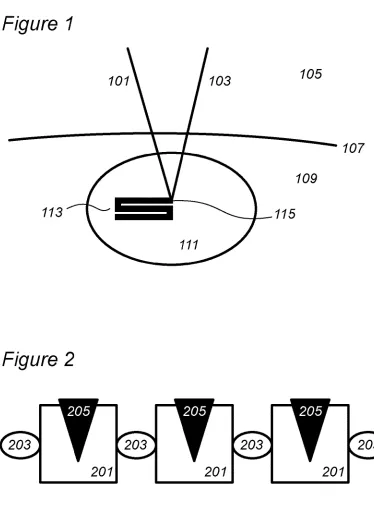
[ 0130 ] FIG . 1 provides a schematic representation of the
manufacture of a subcutaneous structure according to the
present invention . ( not to scale ) ;
[ 0131 ] FIG . 2 provides a schematic representation of
assembly and disassembly of polymers according to the
present invention ;
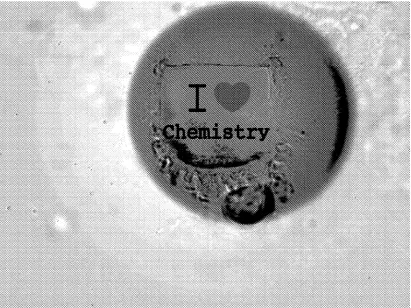
[ 0132 ] FIG . 3 is a halftone rendering of a photograph of a
polymeric structure printed into vertebrate tissue .
[ 0133 ] FIG . 1 shows schematically and not to scale the
manufacture of a subcutaneous device according to the
present invention . A first photon beam ( 101 ) and a second
photon beam ( 103 ) pass from outside ( 105 ) tissue , throughthe surface ( 107 ) of tissue , into the interior of tissue ( 109 ) .
Previously a region of precursor material ( 111 ) has been
placed into the tissue ( 109 ) . The photon beams cause
polymerisation of precursor monomers at the point of inter
section ( 115 ) , and when the beams are moved , this point
( 115 ) moves and a polymerised structure ( 113 ) results .
[ 0134 ] FIG . 2 shows schematically assembly and disas -
sembly of polymers according to the present invention . Each
square block ( 201 ) represents a monomer unit that has
polymerized via a multi - photon polymerisation reaction
creating a bond ( 203 ) to a neighbouring monomer unit ( 201 ) .
In this embodiment each monomer also comprises a suitably
designed moiety ( 205 ; represented by a triangle ) , via which
a second multi - photon process may disassemble the polymer
when required .
[ 0135 ] A composition of the present invention , was pro
vided including pyrrole as the polymerisable precursor and
irgacure as the photo - initiator . The composition was injectedunder the skin of a chicken breast . The external surface of
the chicken breast was illuminated with two laser beams , and at the location of intersection , the photo - initiator was
excited causing localised polymerisation of the pyrrole to
form polypyrrole . The lasers were used to controllably initiate polymerisation in a targeted manner . The polypyrrole
is shown in FIG . 3 as the dark lines which read “ I heart Chemistry ” .
[ 0136 ] Various modifications and variations of the
described aspects of the invention will be apparent to those
skilled in the art without departing from the scope and spirit
of the invention . Although the invention has been described
in connection with specific preferred embodiments , it should
be understood that the invention as claimed should not be
unduly limited to such specific embodiments . Indeed , vari ous modifications of the described modes of carrying out the
invention which are obvious to those skilled in the relevant fields are intended to be within the scope of the following
claims .
1 . A method of producing a visual marking on the exterior
of a human or animal body comprising :
implanting a composition at a site in the human or animal
body 1 cm or less from the exterior of the human or
animal body wherein the composition comprises a
polymerisable precursor and a photo - initiator wherein
the photo - initiator causes the polymerisable precursor
to polymerise where the photo - initiator is in its excited
state ,
illuminating the site with electromagnetic radiation hav ing a wavelength of 400 to 1600 nm , wherein absorp
tion of two or more photons of the electromagnetic
radiation excites the photo - initiator causing initiation
of polymerisation of the polymerisable precursor to
form a polymer within the human or animal body ,wherein the polymer is visible on the exterior of the
human or animal body and wherein the resultant polymer has an electrical conductivity of 10 - 10 S / cm or
more .
2 . The method as claimed in claim 1 wherein the resultant
polymer shows more than one colour on the exterior of the
human or animal body .
3 . The method as claimed in claim 1 wherein the visual
marking is in the form of a tattoo .
4 . The method as claimed in claim 1 wherein the com
position is injected into the lower surfaces of the skin of thehuman or animal body and the visual marking may grow out
as the skin is shed .
5 . The method as claimed in claim 1 wherein the com position is injected under the skin of the human or animal body , to provide a permanent visual marking .
6 . The method as claimed in claim 1 wherein the polymer
is in the form of a solid , gel , paste or foam ; generally a solid ,
hydrogel or plastics material .
7 . The method as claimed in claim 1 wherein , the dimen
sions of the polymer formed ( width , length , thickness ) are at
US 2019 / 0175796 A1
Jun . 13 , 2019
8 . The method as claimed in claim 1 wherein the two or
more photons are from intersecting photon beams
.
9 . The method as claimed claim 1 wherein the composi
tion includes second photo - initiatable functional moieties
which become excited at a second wavelength different to the first wavelength wherein the polymer may be dis
assembled through illumination of the site with electromag
netic radiation having the second wavelength , wherein
absorption of two or more photons of the electromagnetic
radiation causes the second photo - initiatable functional moi
eties on the polymer to become excited and dis - assemble the
polymer .
10 . The method as claimed in claim 9 wherein the second
wavelength is at least 200 nm higher or lower than the first wavelength .11 . The method as claimed in claim 1 wherein the composition includes a visual indicator which alters upon polymerisation of the polymerisable precursor , wherein the
visual indicator is visible in the polymerisable precursor but
not in the polymer , or the visual indicator is visible in the
polymer but not the polymerisable precursor .
12 . The method as claimed in claim 1 wherein the
composition has a viscosity of from 1 centipoise to 250 , 000
centipoise .13 . The method as claimed in claim 1 , wherein the
polymerisable precursor comprises , consists or consists
essentially of monomers having at least one olefinic bond ,
oligomers having at least one olefinic bond , polymers hav
ing at least one olefinic bond , olefins , halogenated olefins ,
acrylates , methacrylates , pyrroles , acrylamides , bisacrylamides , styrenes , epoxides , cyclohexeneoxide , amino acids ,
peptides , proteins , fatty acids , lipids , nucleotides , oligo
nucleotides , synthetic nucleotide analogues , nucleic acids ,
sugars , carbohydrates , cytokines , hormones , receptors ,
growth factors , drugs , and mixtures thereof .14 . The method as claimed in claim 1 wherein the
resultant polymer comprises , consists or consists essentially
of one or more of the group consisting of poly ( fluorene ) s ,
polyphenylenes , polypyrenes , polyazulenes , polynaphtha
lenes , Poly ( acetylene ) s , Poly ( p - phenylene vinylene ) , poly( pyrrole ) s , polycarbazoles , polyindoles , polyazepines , poly
( thiophene ) s , poly ( 3 , 4 - ethylenedioxythiophene ) , poly ( p
phenylene sulfide ) and polyanilines .
15 . The method as claimed in claim 1 wherein the