© 2019, IRJET | Impact Factor value: 7.34 | ISO 9001:2008 Certified Journal
| Page 1
Studying the Effect of an Interactive 3D Program on Increasing the
Skills of Hearing Impaired Students
Shimaa S. abass
1, Mohamed Goda
2, Mostafa Eltokhy
31,2,3
Electronics Technology Department, Faculty of Industrial Education, Helwan University, Cairo Egypt.
---***---Abstract -
The art of graphic and multimedia have become an essential and integral part of our life and daily activities. it’s an invisible motive but essential in influencing the public and direct them indirectly to engage in a matter or forming ideas and visualizations or inculcating. This study describes the influence of the use of this art in the development of the means of providing information and skills for the hard-of-hearing students and the impact of converting the content from text or images into a 3D interactive programs on the level of comprehension and the skills learned in this category of students is increased. Appling this interactive program increase the students skills which are suitable for the nature of them.Key Words: 3D software, interactive graphic, interactive education, education of the hearing impaired, interactive software for hard-of-hearing
1. INTRODUCTION
People with special needs are part of the construction of society, and their education is an urgent educational requirement that entails engaging in society, living their lives, and exercising their activities with respect and appreciation, especially if they are deficient in a certain area, they have strength and energy in other aspects more than the normal ones, so it must be invested and employed in the right way. However, we still face many problems in the education of people with special needs. The most important of these problems which is neglecting the active experience in the preparation of their curricula, most parents do not follow the results of their children’s learning, lack of training courses, lack of continuous follow-up to the needs of institutes, lack of books and references that include new teaching methods for the mentally retarded, the big number of students in the classroom, lack of appropriate educational means, lack of clarity of majority of goals, Not taking into consideration the objectives of individual differences, Not taking into account the convenience of the content with the individual differences, lack of efficiency of the spatial environment for the implementation of teaching, and lack of the workshops for the purpose of teaching and simplification of skills [1].
God Almighty has bestowed man with a set of systems and sensory organs to help him sense the stimuli around him, and the realization and understanding of what surrounds him, and the loss of auditory or visual impairment is
considered of the most severe types of sensory loss that can be experienced by the individual, due to the importance of the hearing and sight in the formation of concepts, and the cognitive world, so the injury of this sense with dysfunction, especially in the early stages of life results in poor linguistic, social, and emotional development . Morse defined the deaf as a person whose volume of hearing loss is 70 dB or more, and impedes the understanding of speech through the ear alone, using or without the medical headset. The World Health Organization indicates significant facts about deafness and hearing impairment as follows [2]:
The number of people with deafness and other hearing problems worldwide is estimated to be around 5% of the world's population, of which approximately 34 million are expected to reach 630 million people by 2030 and by 2050 they are expected to reach 900 million. 80% of people with deafness and hearing impairment live in low- and middle-income countries. Appropriate hearing aids can improve the communication ability of at least 90% of people with hearing loss. Only one out of 40 people in need of hearing aids in developing countries benefit from the appropriate hearing aids.
From this information we notice an increase in the number of the hearing impaired people around the world. This leads us to research the problems faced by Deaf students in education and to overcome obstacles in the way of integrating them into life and providing them with the required skills. The problem is not in the level of the intelligence of the Deaf students, where they feared that the mental performance of the deaf is similar in the distribution and spread of intelligent listeners, and that the deaf have no defects in the intelligence, and there is no evidence that the development of knowledge, and the intelligent they are less than listeners, and deaf perform cognitive functions within the range Natural intelligence. In
[3] highlights the similarity of thought processes between normal and deaf children, despite the difficulties faced by deaf people in expressing certain concepts, especially abstract concepts. The differences in performance between the deaf and the deaf are due to the apparent lack of intelligence instructions, Verbal, not mental abilities in particular.
© 2019, IRJET | Impact Factor value: 7.34 | ISO 9001:2008 Certified Journal
| Page 2
motivation. The study of emphasized the lack of clarity of thegoals of education in the schools of audio education in some of the workers in this field with a clear degree, and the lack of flexibility in the educational programs offered to the deaf and the hearing impaired, The invalidity of textbooks for deaf and hearing-impaired students, and the teachers’ lack of proficiency in modern methods of communication with deaf students [4].
The results of study [5] show that more than 70% of the teaching practices of teachers are confined to the textbook space, which has greatly reduced the chances of practicing direct sensory experiences, and the content was formulated beyond the reading level of these students.
There is a fatal mistake in the education of deaf and hearing-impaired students. Teachers use a distorted system of communication rather than sign language when deaf students find it difficult to understand; teachers simplify or override difficult concepts, resulting in Conceptually Loss gaps for the deaf student that his interest decreases and this decreases the level of motivation constantly.
In the study of [6], the results showed the need to raise the efficiency of teachers in the use of sign language, the computer and the Internet in the education of deaf students to increase interaction .In this study also the findings of the study determined the desired specifications from the point of view of the sample people to the six visual stimuli, used highly by the hearing impaired people in teaching. These are the written verbal symbols, photographs, illustrations, caricatures, maps, column and circular diagrams, which should be available in the visual stimuli in the textbook. Most of these studies emphasized the importance of adapting and adapting the curriculum for the hearing students to suit the needs of the Deaf students, the importance of qualifying the specialized staff in the field of teaching and education of the deaf.
The importance of educational techniques for the hearing impaired is increasing at the present time, which is witnessing a rapid growth in the use of educational techniques and technological devices. The number of users of these devices has increased very much, especially after these devices became cheap, both in terms of services and prices of their devices and the use of these technological innovations in the educational process which changed the teacher's role from the reciting and transfer of knowledge to the guide and director [8] to learners especially in the use of computer advances in the presentation of visual and interactive media, which is the best in the education of students who are hearing impaired.
The results of scientific studies have proved superiority to the method of computer-mediated education than other methods. This is shown in the results of studies such as the study that aimed at determining the extent to which films
affect the child's primary linguistic experiences and communicate with parents and teachers by matching the communication with what is presented in the film.
The study concluded that the focus on visual communication plays an important role in helping children with hearing loss to develop language and that films are important in facilitating communication.
Also, the study conducted by [7] which aim was to use the computer in teaching children with hearing disabilities the subject of geography. The results showed that computer use helped to increase students' awareness of the nature of the country, which they could not know through traditional methods. In addition to developing the skills of students' kinetics and the speed of eye and hand movement.
The study of [8] also examined the effects of the use of technology compared to traditional methods in the education of the hearing impaired. The results indicated that the use of video compared to traditional methods in the education of the hearing impaired.
In[9] also conducted a study aimed at finding out the impact of computer literacy stories on famous Americans with hearing disabilities. The results indicated that there were statistically significant differences between the attitudes of the study subjects towards the employment opportunities of the hearing impaired
We also include some of the experiences of developed countries in the use of computer to teach deaf students, The United States of America introduced computerized educational techniques after several studies on the impact on the increase in learning gain through various ways and methods of teaching deaf students using the personal computer where it has focused on how to use the computer in the curriculum, and interested in the impact of the collection of languages, according to the specific programming of the computer, where computer courses offered to students with hearing disabilities to provide a variety of programs It is used to teach and develop some intellectual skills. It has contributed to the development of the ability of hearing impaired people to predict, compare, analyze, apply and organize, besides knowledge of computer applications.
© 2019, IRJET | Impact Factor value: 7.34 | ISO 9001:2008 Certified Journal
| Page 3
some applications, such as graphics that stimulate pupils tolearn and words are associated with images that indicates them, with enhanced feedback and increased use of visual aids where possible and the use of computer as an educational tool for many applications. The technical media used provided explanations and visual commentary developed in its turn the written language of the hearing impaired and their natural oral language and contributed to the remarkable improvement in educational achievement. The interactive video also provided video programs annotated video and audio [10].
The technical services of the hearing impaired are not confined to public education institutions but in America, the University of Gallaudet in Washington provides services for the deaf, equipped with the latest educational technology and offers many educational disciplines for the hearing impaired. It is still the only higher education institution specifically designed for all programs and services to accommodate deaf and vulnerable students Hearing. , And are admitted to the graduate program, but hearing disorders do not keep them from learning because of the University's intense use of technology, interactive techniques are used for students inside and outside the classroom, These technologies are diverse, including the use of webcams on Skype, as more than 90% of the applications of Jaludet University rely on the use of forms of communication over the Internet [11].
Another example is the experience of the United Kingdom (England, Scotland, Wales and North Ireland) where the British schools have adopted several online training materials to provide technical services for the hearing impaired, and technical means have been provided through the communication methods of the hearing impaired in regular schools under the plan for the preparation of the hearing impaired and help them to qualify for work and find a job, and to be employable, as well as providing special equipment to enable the hearing impaired to achieve the academic achievement, It also worked to provide computer, video and other devices as well as mobile phones in order to improve academic communication, and there are many institutions supporting the technology of the hearing impaired, including that provides deaf and hard of hearing handheld computers which shows BSL videos explaining many programs of educational nature[12].
It is noted from the previous studies of the education and training of children with hearing impairments through computer programs, compared with their education, and training in the traditional way, that educational programs and computerized training achieve better results.
This may be due to the computer's feedback to the learner, easy to use, attractive and interesting especially with the use of evolution in graphics programs and3D graphic designs which is a wide range of knowledge branches, meaning visual creativity, and includes several aspects such as
technical direction, print design, page layout and design, information technology and other creative aspects.
This diversity means that there are fragmented areas where designers can specialize in any of them, especially virtual reality programs that enable the desired interaction of the needs of deaf students.
In[13] Virtual reality is an integrated environment that is compiled and managed by a computer program, where the learner enters and interacts with the learning environment. By this, the researcher is stimulated to study the effect of the curriculum prepared by interactive three-dimensional programs, to reach the best interactive methods that Contribute to raising the skills of sample students.
2. Proposed Study
The aim of this study is to identify the problems that hinder the education of the hearing impaired students and affect their skills which are acquired from the concepts prepared for them and to clarify the defects in the methods of preparing these concepts and the inappropriate ways of presenting them to the potentials of the students through setting comparison between previous studies and through the researcher's handling of that type of students and then prepare part of the control curriculum for the specialization of computers in the Industrial Institute with the Press through a three-dimensional graphics program that takes into account the presentation of the content in an interactive way.
This method enables the researcher to overcome the previous problems and thus increase the skills of the sample study students, so the researcher used the type of virtual reality programs simple three-dimensional design program as it is suitable for the nature of students and it is easy to provide the possibilities of such type and does not require external training to deal with them.
The researcher used the descriptive analytical method where the research sample consisted of 20 students of the hearing impaired students in the institute. A pre-test was applied to the students, then the program was applied and finally the test was carried out. The results of significant statistical differences at the level of significance of 0.05 for the benefit of the post-test, which shows the positive effect of the program applied to increase the skills of sample research students.
3. Interactive 3D programming “virtual reality"
© 2019, IRJET | Impact Factor value: 7.34 | ISO 9001:2008 Certified Journal
| Page 4
The technology of virtual reality is based on mixingimagination with facts to create a space similar to the real world we live in. This is presented in showing static and animated objects as if they were in the real world regarding their physical body, movement and sensation [14].
3.1 Types of 3D virtual world (VR) software:
3.1.1 3D virtual reality that creates a State of full
immersion. (Immersive VR)
The user lives in the virtual reality dramatically so that he does not feel the presence of the computer and the what he experiences as shown in Fig. 1 is the real world, this type requires special equipment placed on the head, eyes or gloves to bring virtual reality nearby.
Fig -1: 3D Virtual world
3.1.2 3D Virtual reality limited in job and place
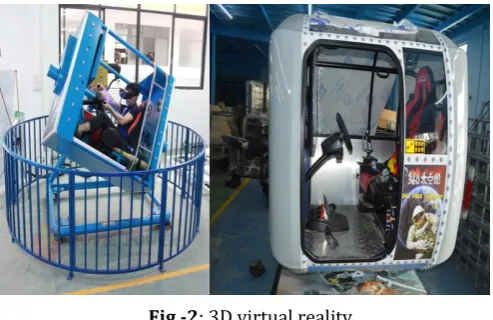
This system shown in Fig. 2 is used to simulate systems which are difficult to exist near or inside, but the simulation performs roles and complex tasks, like what happens when you simulate buildings, cars or aviation and like.
Fig -2: 3D virtual reality
3.1.3 Simple 3D virtual reality
This type which shown in Fig. 3 is handled through the computer screen, as it relies on interactive software components, for example, computer games and educational games
Fig -3:
Simple 3D Virtual reality
4. The phases of interactive design
Interactive design passes through a life cycle like normal designs, but the nature of this design imposes on the designer to increase interest in additional aspects that are the aspects linked to the user because the user here is his driving force and Design Center, these phases include [15].
4.1 Focus on the user
Since the user is the primary element in interactive design, the designer must try to see the design by the eye of the user first. the user is interested in fulfilling his goals and desires and aspires to get what he wants within the design, these needs and desires are the bases on which the designer set up his steps to support the design and develops it later, so the designer should define the target group first and then inspect the design to see what it can bring to this category and supply their needs.
4.2 Building up several models for design
This stage is the main side in the design process and it includes creating and developing several ideas and models of the site that helps the designer to reach the best and most effective design. This process is divided into two sections, namely the conceptual and physical side or the applicable aspect of the design, the conceptual section includes the initial model creation that describes what the design should do and the mechanism of meeting the requirements of the user. The applied aspect or physical side cares about the design details including colors, images, sounds used, the navigation mechanism and visual symbols……. etc.
4.3 Building physical models of designs
[image:4.595.306.543.104.232.2] [image:4.595.36.272.300.437.2] [image:4.595.36.283.527.687.2]© 2019, IRJET | Impact Factor value: 7.34 | ISO 9001:2008 Certified Journal
| Page 5
4.4 Evaluating design
The evaluation process involves determining the applicability and efficiency of the design to achieve what is hoped and desired of it, and this is measured by a set of criteria including the number of errors made by the user during use, the importance of the elements and symbols used according to Visual terms first and success in achieving the user requirements secondly and so on.
The importance of evaluation lies in increasing the chances of getting a design with the least errors. evaluating interactive design is distinguished by depending on what the user sees and what he wants as predominantly evaluation builds on the opinions of users and their experiences of the models designed.
4.5 Finding appropriate solutions
solutions to design are built on the problems and opinions reached in evaluation, in addition to the role of this process in finding solutions to design problems they earn designer experience enables him to find solutions to design problems in other designs in less time and more efficiently ,but that doesn't mean copying the entire model but to take advantage of the mechanism of the work of some of its parts because the categories of users and objectives sought by design to achieve are varied, for example a game of football on the computer is an excellent example of interactive games but we cannot copy fully interactive structure for another game.
5. 3D Interactive engines
An integral system works to create 3D designs smoothly, these modern engines offers some software to development and design professionals that are different from older non-interactive, allowing the opportunity to write codes into the design to add interaction between design, games and users at the same time. This requires programming language to make the design contains part of artificial intelligence to design and develop applications and solutions to some problems facing game developers to design output or a good game in the end. Now we will review some of these engines and highlight the features of each engine:
5.1Unreal engine
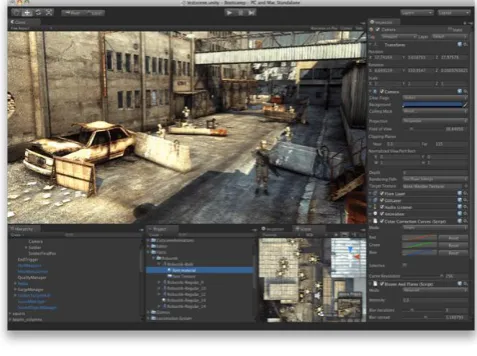
It's arguably one of the most popular design engines in the world as shown in Fig. 4 and the most successful video game engine as it was awarded by the Guinness Book of records and said it was definitely the best engine if you work on large and sophisticated game and need a 3D game engine. But it would be relatively larger games size and will require sophisticated computers to run.
Fig -4: Un real engine
5.2 Engine Unity
Another engine as shown in Fig. 5 that is widely used nowadays. about 34% of the best 1000 designs and mobile games are made with Unity. It is a platform for artists, designers and developers to create and collaborate on film content and gameplay sequences, using 2D and 3D design tools, and Instant playback mode for quick editing and redundancy, and robust system for animation.
While the Unreal might be more popular with computer games and console games, Unity is certainly more popular with mobile phone games, and it became a game engine for a lot of mobile games developers. It is also at the forefront of the evolving VR (virtual Reality) market, it has been used to obtain an estimated 90% of Samsung VR Gear games and 53% of Oculus Rift games at all.
[image:5.595.312.555.96.269.2] [image:5.595.313.552.513.691.2]© 2019, IRJET | Impact Factor value: 7.34 | ISO 9001:2008 Certified Journal
| Page 6
5.3 Cry Engine
A very powerful game engine is shown in Fig. 6 that gives you a full open source-engine with all the features free of charge, no commitments nor license fee in return.
Graphics producers commend the amazing and fantastic visuals that are designed using its instruments, enabling it to create amazing experiences at your fingertips. It also has a built in Fmod tool included in the engine, and is one of the best audio tools for games which allow for lots of creative space in terms of creating sounds for the games.
Fig -6: Cry Engine
5.4 Quest 3D design drive Engine
It is a multifunctional system to develop applications in real time and create 3D interactive programs.
Many studios and individuals around the world use Quest 3D software to develop their projects using a range of advanced features that are usually only found in custom programs. Quest 3D puts the power of the new techniques in your hands such as simulated business systems (leadership training – aviation training…….) and also you can create animations, presentations, visualizations, navigation, games, websites, screensavers and even additional Winamp components fit within your design as shown in Fig. 7.
Quest 3D is easy to use and very flexible and we can say that with Quest 3D your imagination is your only limitation.
Fig -7: Quest 3D design drive Engine
The researcher has chosen Quest 3D Engine which is one of the most famous and used engines with many features such as Visual programming and simple interface and hierarchy of node and VR support "visual reality”[16].
5. 3D software design phases
5.1 Concept art
The process of creating a software design usually starts by creating an artistic photo for some design components used by the designer as a guide to create the 3D model, this is what happens when construction workers use project plans by the architect as a guide to create buildings.
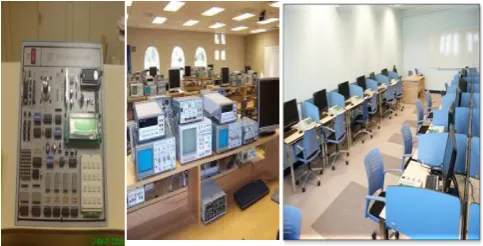
The researcher has a scenario as shown in Fig. 8 for using the software and used many pilot graphics such as:
Fig -8:Lab components
5.2 3D modeling
[image:6.595.314.551.97.228.2] [image:6.595.41.284.244.417.2] [image:6.595.308.550.466.589.2]© 2019, IRJET | Impact Factor value: 7.34 | ISO 9001:2008 Certified Journal
| Page 7
Fig -9: 3D Modeling
5.3 UV mapping
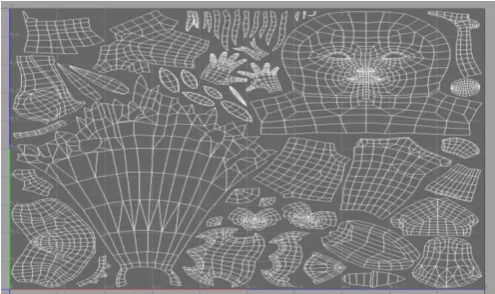
[image:7.595.40.285.102.234.2]3D modeling process gives the characters and design models the3D shape as shown in Fig. 10, but in addition to being similar to reality, the model surface usually needs some information concerning colors and definition of the material, so the model will not be just a silhouette or an undefined mass, but has distinguished characteristics such as skin, hair and clothes. These details are usually added to the form in a process called texturing but this process you need to configure your computer on how to put a picture of external object and since the computer has no way of recognizing how to apply these images, which are originally 2D, on a 3d shape, all 3D model polygons must be put on a two dimensional surface matching the pictures.
Fig -10:UV mapping
This figure illustrates how most of the similar parts of the shapes of the 3D program model which is the study axis are reversed. For example, the eyeball or shoulder armor or hands. Show on the map only once, despite having two hands in the model and this is one of the most important techniques to improve shingle space texture UV.
5.4 Texturing
It’s the stage in which the colors are adjusted and suitable Materials are inserted according to the nature (metal, wood, plastic, glass, …. etc.) And determining values of reflection, refraction, transparency, jutting promontory and tonal
distribution applicable once setting UV mapping for profile or form ready for Texturing process.
[image:7.595.314.555.269.403.2]And as mentioned earlier, the tissues, sometimes called maps or surfaces, are images applied to the surface of a 3D model, the process of creating this image is called Texturing. You can create images or external materials in a variety of ways as shown in Fig. 11. they can be drawn manually using a drawing program, or can be painted directly on the 3D model using 3D drawing program. Images can be used as decorations through using manipulation of images to combine different images together and edit their colors as well as suitability. UV mapping.
Fig -11:Texturing
The researcher carried out the process of modeling using individual images of the model on the three-dimensional object or using some of the possibilities available within the design engine program
5.5 Rigging
It is a process of connecting between the animated parts of the design to simulate the normal movement of the characters, meaning the process of connecting the bones and joints of the digital personality to form a normal movement of the model
This stage was not approached by the researcher’s design because it does not contain animated characters.
5.6 Animation
[image:7.595.37.285.436.583.2]© 2019, IRJET | Impact Factor value: 7.34 | ISO 9001:2008 Certified Journal
| Page 8
Fig -12:Circuits Animation
5.7 Rendering
[image:8.595.37.287.453.578.2]Rendering is the last basic stage as shown in Fig. 13. After modeling, rendering, and animation, we do a rendering. so that the design can appears in its final form, whether it is a picture or a video. This process usually takes a lot of time, especially if the scene contains many elements, visual effects, reflections and shadows. The high quality of Rendering requires more time and a highly efficient computer. In this stage the researcher relied on the most important feature in the design engine Quest 3D, a property of Render in real time, that the program displays the interactions and changes by the user at the same time without having to be a separate process in a long time [17].
Fig -13:Rendering
6. Test
The researcher conducted the testing process for the design by conducting a pre-test before applying the program to the student’s sample of the study and then conducting a post-test after applying the program to the students of the research sample, taking into account the arbitration of the tests to test the validity and stability of the test and the researcher modified the tests according to the amendments of the arbitrators
7. Result
7.1 The mean deviation and the standard deviation were used and both were calculated through the equations
7.2 The study used the degrees of freedom (d.f) for the sample group of students to study through the equation
d.f = N – 1
The study used the level of significance (α) of (0.05), which means that the decision, which will take the proportion of error is estimated at about 5% is correct and true by 95%. The study used the T - test to determine the significance of the differences between the average scores of the students in the research sample, both before and after, by calculating the difference between the averages and estimating the standard error of the difference between the averages, compared to the table value at the level of 0.05 = α and the corresponding degree of freedom
T (test) =
α = 0.05 , N = 20, d.f = 19 , T (test) = 1.729 The study used the Black equation to calculate the effectiveness of the program presented to the sample of the study where the rate of gain rate for Black is greater than which is the acceptable limit referred to by Black for the effectiveness and this indicates the effectiveness of the program
(X - Y) / (D-X) + (X- Y) / d
8. CONCLUSIONS
© 2019, IRJET | Impact Factor value: 7.34 | ISO 9001:2008 Certified Journal
| Page 9
finally the test was carried out. The results of significantstatistical differences at the level of significance of 0.05 for the benefit of the post-test, which shows the positive effect of the program applied to increase the skills of sample research students. Appling this interactive program increase the student’s skills which are suitable for the nature of them.
REFERENCES
[1] Scott, J.A., Goldberg, H., Connor, C.M., Lederberg, A.R. "Schooling effects on early literacy skills of young deaf and hard of hearing children", American Annals of the Deaf , 163(5), pp. 596-618, 2019.
[2] Yan, J., Li, D. "Deaf and hard of hearing students’ understanding of causal and adversative connectives in sentence reading", American Annals of the Deaf , 163(5), pp. 554-573, 2019.
[3] Cheng, S. "Conceptions of Learning and Thinking Styles Among Deaf, Hard-of-Hearing, and Hearing Student", Journal of Developmental and Physical Disabilities, 31(4), pp. 555-573, 2019.
[4] Raven, S., Whitman, G.M. "Science in Silence: How Educators of the Deaf and Hard-of-Hearing Teach Science", Research in Science Education, 49(4), pp. 1001-1012, 2019.
[5] Veyvoda, M.A., Kretschmer, R., Wang, Y. "Speech-Language Clinicians Working with Deaf Children: A Qualitative Study in Context", Journal of deaf studies and deaf education , 24(3), pp. 289-306, 2019. [6] Cheng, S., Sin, K.F. "Conceptions of learning and
quality of university life among deaf, hard of hearing, and hearing university students", International Journal of Inclusive Education, 22(12), pp. 1333-1344, 2018.
[7] Cheng, S., Sin, K.F. "Self-Determination and Integration among Deaf or Hard of Hearing and Hearing University Students", Journal of Developmental and Physical Disabilities, 30(6), pp. 819-833, 2018.
[8] Kelly, R.R., Mousley, K. "Solving word problems: More than reading issues for deaf students", American Annals of the Deaf, 146(3), pp. 251-262, 2001.
[9] Gregg, A.L., Wozar, J.A., Wessel, C.B., Epstein, B.A. "Designing a curriculum on Internet health resources for deaf high school students", Journal of the Medical Library Association , 90(4), pp. 431-436, 2002.
[10]Foster, S., Mudgett-Decaro, P., Bagga-Gupta, S., Van Weert, J., Welch, O. "Cross-cultural definitions of
inclusion for deaf students: A comparative analysis", Deafness and Education International , 5(1), pp. 1-19, 2003.
[11]Creaghead, Nancy A. "Using Scripts to facilitate communication of children with hearing impairment". Paper presented at the international congress on education of the deaf, pp 3 – 14, 1995. [12]Parmer, r. &Cawelly, J. "Analysis of Science
Textbook," Recommendations Provided for Students with disabilities, Exceptionnal children, voi.59, pp 518 – 531, 1993.
[13]Debevc, M. and Pelhan, Z. "The Role of Video Technology", in online Lectures for the Deaf .Vol. 26, No.17, pp.1048-1059, 2004.
[14]Ming , J.Ju "The Effect of Multimedia Stories About American Deaf Celebrities on Taiwanese Hearing Students, Attitudes Toward Job Opportunities" , The Deaf. Vol. 150, No. 5, pp. 353-365, 2006.
[15]Davidson, K.; Lillo-Martin, D.; Pichler, D. Chen, "Spoken English Language Development Among Native Signing Children with Cochlear Implants". Journal of Deaf Studies and Deaf Education. 19 (2), New York, PP. 238–250, 2014.
[16]Dickey, M.D. “Three-dimensional virtual worlds and distance learning: two case studies of Active Worlds as a medium for distance learning.”, British Journal of Educational Technology, 36:3, pp.439-451, 2005. [17]A. A. G. Requicha and J. R. Rossignac, "Solid modeling and beyond", IEEE Computer Graphics & Applications, (Special issue on CAGD) Vol. 12, No. 5, pp. 31-44, September 1992.
BIOGRAPHIES
Shimaa S. abass was born in cairo, Egypt on 1980. she received the BSc from Department of Electronics Technology, Faculty of Industrial Education, Helwan University, Cairo Egypt. His current research interests are software engineer and high-performance computing.
M M Gouda was born in Fayium, Egypt on 1967. He received the BSc and MSc degrees from Faculty of Electronics Engineering, Menofiya University, Egypt on 1990 and 1995 respectively. He received the Ph.D. degree from Electrical and
1’st
Author
© 2019, IRJET | Impact Factor value: 7.34 | ISO 9001:2008 Certified Journal
| Page 10
Electronics engineering Dept.School of Engineering, Northumbria University, Newcastle, England, 2002. Since January 1992, he has been with the Electronics Technology Dept, Faculty of Industrial Education, Helwan University, Cairo Egypt. His research areas are: control systems, predictive control, fuzzy systems, neural networks, adaptive fuzzy system, power system, solar systems, and building energy managements system.
Mostafa Eltokhy was born in Kaluobia, Egypt in 1970. He received the B.Sc. degree from zagazig university, banha branch, Egypt. and MSc degrees from technical university, Eindhoven, The Netherlands in 1993 and 1998, respectively. He received the Ph.D. degree from Osaka University, Osaka, Japan in 2003.presently, he is an Associate Professor of Electronics Engineering of Department of Electronics Technology, Faculty of Industrial Education, Helwan University, Cairo Egypt. His current research interests are high performance digital circuits and analog circuits. He is a member of the IEEE.