Evaluation of Students Performance using Hierarchical
Fuzzy Inference System
Abdulkadir Abdullahi
School of Computer Science and Technology,
Changchun University of Science and Technology
Changchun, Jilin Province, China
Wang Peng
School of Computer Science and Technology
Changchun University of Science and Technology
Changchun, Jilin Province, China
Abdullahi S. Saheed
School of Computer Science and Technology
Changchun University of Science and Technology
Changchun, Jilin Province, China
ABSTRACT
Fuzzy Inference Systems (FIS) has often been used to evaluate performance using few input variables as a result of fear for rules explosion. This problem is solved using Hierarchical Fuzzy Inference System (HFIS); a divide-and-conquer approach that drastically reduce the number of rules at the same time preserved the fuzzy logic reasoning. As a result, this study explore the potential of this tool in details by
applying it to evaluate students’ exam records. The proposed model is compared to classical one and results show that HFIS is more promising from the perspective of simplicity and precision. However, for optimum results, the study suggests training FIS with neural networks and emerging optimization algorithms.
General Terms
Fuzzy Logic, Hierarchical Fuzzy Inference System (HFIS).
Keywords
Hierarchical Fuzzy Inference System (HFIS), Fuzzy logic, Membership function; student performance; MATLAB
1.
INTRODUCTION
In present education system, evaluation of student performance is usually conducted traditionally by classical way of calculating the average score of students. However, despite the fact that the traditional method has achieved reasonable success, in 1965, Lofti Zadeh [1] proposed fuzzy logic as a tool for analysis and evaluation capable of handling imprecision with better accuracy. Since then, fuzzy logic has been used in many fields of research and real-world application.
According to [2] Fuzzy means “not well known or not clear enough or their closer significance depends on subjectivity, estimation and even the intuition of person who is describing these terms”. The concept of fuzzy was first proposed by Lotti Zadeh in 1965, after many trials and efforts by many researchers like Plato, Hegel, Marx, Lukasiewicz [3]. Fuzzy logic is branch of logic specially designed for representing knowledge and human reasoning. It is designed in such a way that it is amenable to vague and complex data processed by a computer. It has the ability to capture non-uniform evaluation criteria and weight them according to human linguistic judgement to finally compute an aggregated output. Rather than the usual Boolean logic approach of “True or False” (1 or 0), Fuzzy logic is an approach for implementing expert systems based on “degrees of truth”. Unlike the conventional Computer theories of (0 and 1, True or False) logic, fuzzy logic utilizes all the values in between the boundaries. This
FIS uses fuzzy logic in order to represent the knowledge of experts about certain problem in a systematic manner. The evaluation of student result based on their performance comes with some inefficiencies such as imprecision, information granularity, vagueness. However, due to the many factors involved in result evaluation, using traditional FIS generate huge number of fuzzy rules, which leads to high complexity for human processing. In order to tackle this issue, this paper propose an alternative inference system known as the Hierarchical Fuzzy Inference System (HFIS) that can be used to evaluate student performance regardless of the number of inputs.
2.
RELATED STUDIES
Since the popularity of fuzzy logic in 1965 [3], researchers have ventured it’s application in soft-computing [4] such as control systems and supply chain [5]; some applied it as the driver of concepts and properties of ontologies in Semantic knowledge representation of uncertainty [6], [7], while others recently applied it in schools for evaluation[8], [9].
In classical set theory, an item is either a part of a set or not. There is no in-between; Fuzzy logic intuitively disagree to allow partial set membership. Fuzzy logic was represented by researchers with three valued logic and some gave four valued or five valued logic, which are the extension of Boolean logic, which accepts only two values true or false (0 or 1)[3]. The general view is to represent the degree of membership in between 1 and 0 referred to as “degree of truth”. Furthermore, fuzzy represent natural human linguistic variables which are words rather than numbers[10] for many vague applications. In a survey carried out by [11], they reviewed some areas where fuzzy logic have been applied successfully. These areas include: Chemical Science [12] by apply current to a series of anodes to protect a long buried pipeline and also to minimize power used to protect the predict the result of election; Agriculture [13] for pest management, disease management and weed management; Environment [14] for detection of natural tragedies like flood and in environment change; Distance learning evaluation [15], cloud complex technology abstraction [16] Health care [12] for biomedical systems with intrinsic non-linear time varying and time delay; and Operational Research as evidently used by Pappis and Mamdani maximizing profit and minimizing the cost of production [17].
skills, attitudes and beliefs. By taking the assessment, teachers try to improve student learning. On the other hand, evaluation focuses on grades and may reflect classroom components other than course content and mastery level. Evaluation is a final review on your instruction to gauge the quality. The assessment and evaluation are performed at the end of every semester. Likewise [19] pointed out that institutions conduct examinations in objective and subjective manner. They investigated the time usually allotment for individual questions to be averagely equal, but in reality some questions are harder and time consuming than others. In their study they used measures taken from domain experts to rank the questions’ importance and complexity.
Despite the interesting prospects of fuzzy logic, little attention is given to the mathematical models, techniques and hybrid transformation of fuzzy inference system. The key contribution of this paper is the use of the hierarchical fuzzy
inference system to build the fuzzy model that can be used to reduce the number of rules and variables found in the traditional FIS models.
3.
FUZZY INFERENCE SYSTEM
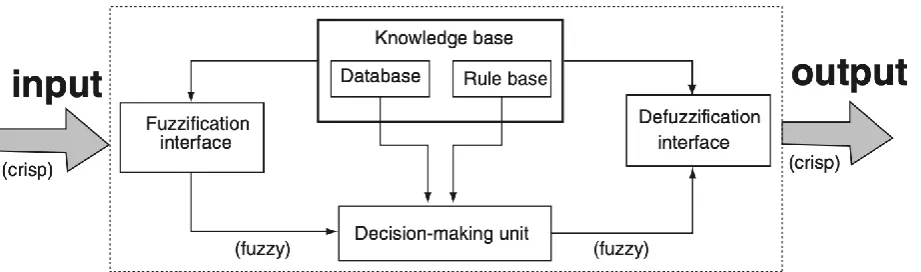
[image:2.595.69.530.269.405.2]Fuzzy inference system involves expert’ knowledge and experience when designing a system that will control a process say input-output relations defined on the set of fuzzy rules [20]. FIS contains the process of introducing fuzzy logic to formulate the mapping from the input state to an output. Two types of fuzzy inference system model widely known are Mamdani and Takagi Sugeno. For the purpose of this study Mamdani was adopted. In Mamdani, both inputs and outputs can be represented with fuzzy sets. Whereas in Takagi -Sugeno model, output is in the form of numeric or linear [21].
Fig 1: Construction and Working of a Fuzzy Inference System
Evaluating student performance based on FIS involve several inter-dependent stages.
3.1
Crisp Value (Input Data):
[image:2.595.312.544.446.599.2]This is the input given to the system. The values are in form of the normal real values. Crisp value is similar to value in the universal set before is sent to the next stage for fuzzification.
Table 1: Input Variables of the Proposed Performance Evaluation Model
S_NO English Maths Chemistry Biology
1 21 22 6 30
2 43 23 13 33 3 41 26 18 34 4 25 29 20 32 5 60 45 55 47 6 31 45 62 45 7 74 53 60 51 8 69 45 55 60 9 61 40 42 60 10 41 40 40 30 11 31 25 40 70
12 31 18 40 24 13 83 66 60 70 14 34 19 40 26 15 63 45 52 60 16 79 60 72 77 17 44 26 40 24 18 21 17 14 24 19 62 40 46 40 20 49 40 54 45
3.2
Fuzzification
Table 2: Fuzzification of input Variable SUBJECT Marks
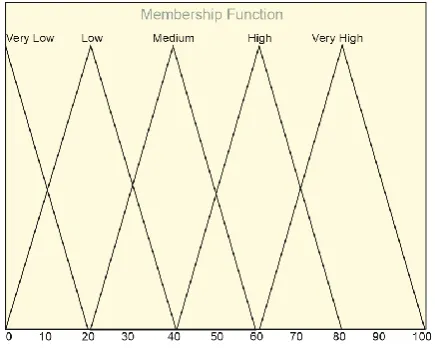
Linguistic Expression Symbol Interval Very Low VL (0,0,20)
Low L (0,20,40) Medium M (20,40,60)
High H (40,60,80) Very High VH (60,80,100)
[image:3.595.317.540.211.339.2]The student result from English, Maths, Chemistry and Biology were taken randomly from records. The percentage of the score was calculated from the mark obtained by the student in the subjects in terms of linguistic variable as shown in fig. 2.
Fig 2: Membership functions of input variable marks
3.3
Inference System
The fuzzy inference system is used in defining the different fuzzy rules such as (“If Then” Rule) for the evaluation of the student performance. It can be used to get input and output membership functions for inference processes. Example (if A and B then C). The Inference system take fuzzified inputs from the database and apply some defined rules (r) for decision making.
In crafting rules, decision makers can influence judgement. It can also make the system flexible to entertain changes making it robust for usage.
Rule 1 Rule 2 … Rule r:
IF Condition C1 , THEN restriction R1
IF Condition C2 , THEN restriction R2
…
IF Condition Cr , THEN restriction Rr
Fig 3: Membership functions of input variable marks
A Fuzzy inference system with number of inputs (n) and (v) number of linguistic variable, generates (r = vn) number of “IF
THEN” rules. In this case of evaluating student performance with four (4) inputs and five (5) linguistic variables, there is need to generate a total number of (54 = 625) rules. These
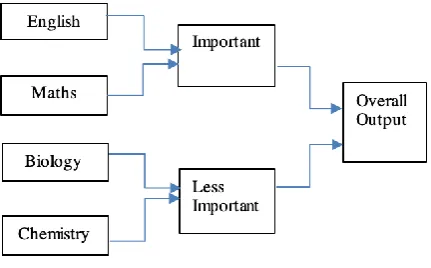
rules are overwhelming and not scalable, it can as well defeat the purpose of fuzzy inference system for evaluation. In the proposed model, Hierarchical Fuzzy Inference System (HFIS) was used to reduce these rules at the same time preserve the accuracy behind the logic. It is a form of divide-and-conquer approach were the subjects are grouped based on importance, the input variable is aggregated using two different FIS Sub-modules. The first sub-module comprises of EnglishMaths and BiologyChemistry FISs. EnglishMaths output is Important while BiologyChemistry output is Less Important. The second sub-module is PerformanceImportant and Performance_Less_Importance FIS.
Fig 4: Hierarchical fuzzy inference system
3.3.1
EnglishMath Sub-module
[image:3.595.58.276.268.442.2]As shown in fig 4, English and Math consist of two inputs Variables and one output variable (Performance_mportance) and 25 fuzzy rules.
Fig 5: EnglishMaths sub-module
Table 2: Aggregated rule of the inputs (English and Maths as P_Importance) based on their linguistic variables
Inputs Maths
VL L M H VH
Englis h
V L
V.Poor Very Poor
Poor Poor Good
L V.Poor Low Low Poor Good M Poor Goo
d
Good V.Goo d
Very Good H Poor Goo
d
V.Goo d
V.Goo d
Excelle nt V
H
Good Goo d
V.Goo d
V.Goo d
Excelle nt
3.3.2
BiologyChemistry Sub-Module
[image:3.595.314.540.403.499.2]Fig 6: BiologyChemistry sub-module Table 3: Aggregated rule of the inputs (Biology and
Chemistry as P_Less_Importance) based on their linguistic variables
Inputs Biology
VL L M H VH
Chemist ry
V L
V.Po or
Ver y Poor
Poor Poor Good
L V.Po or
Low Low Poor Good
M Poor Goo d
Good V.Goo d
Very Good
H Poor Goo d
V.Goo d
V.Goo d
Excelle nt V
H
Good Goo d
V.Goo d
V.Goo d
Excelle nt
3.3.3
Overall Performance
[image:4.595.50.286.100.399.2]This is the last stage that integrate the two sub-modules. It accept the outputs of EnglishMaths and BiologyChemistry as inputs and subject it to the FIS processes to generate a single output.
Figure 7: Membership function of the overall performance
The outputs of EnglishMaths and BiologyChemistry are within the range of 0 and 1 as such, new membership functions.
Fig 8: Performance importance and Performance less importance sub-module.
Table 4: Aggregated rule of the inputs (P_Importance and P_Less_Importance) based on their linguistic variables
Inputs P_Importance
VL L M H VH
P_Less _ Import
- ance
V L
V.Poo r
Ver y Poor
Poor Poor Good
L V.Poo r
Low Low Poor Good
M Poor Goo d
Good V.Goo d
Very Good H Poor Goo
d
V.Goo d
V.Goo d
Excelle nt
V H
Good Goo d
V.Goo d
V.Goo d
Excelle nt
3.4
Defuzzification
This is the last stage in the fuzzy based systems. It denotes a process of providing the overall output result by means of a suitable defuzzifier. It offers a medium for the fuzzy-to-crisp conversions. Since, the results from the inference engine cannot be used in the environment without been converted into numerical quantities understandable by human.
In the proposed method will use the Center of Area as a defuzzifier for the defuzzification (Performance Evaluation).
[image:4.595.53.293.480.643.2] [image:4.595.320.534.584.724.2](2)
4.
EXPERIMENTAL RESULTS
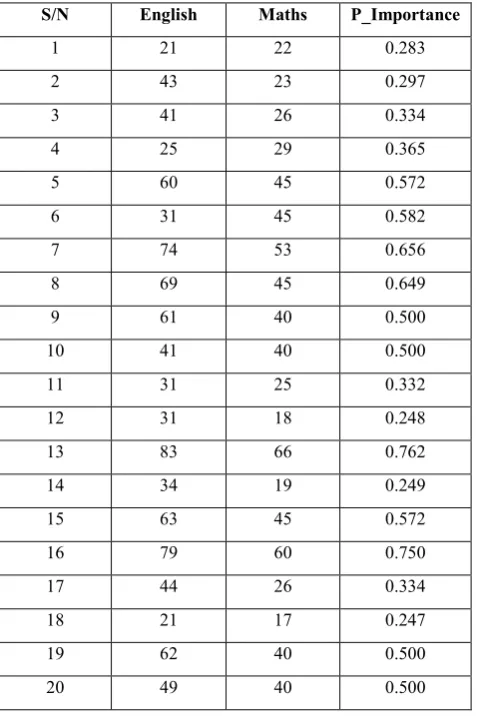
[image:5.595.309.549.70.275.2]The evaluation of students’ performance using Hierarchical Fuzzy Inference System was made with Matlab logic tools. The results are tabulated below:
Table 5: Output of for Performance Importance
S/N English Maths P_Importance
1 21 22 0.283 2 43 23 0.297 3 41 26 0.334 4 25 29 0.365 5 60 45 0.572 6 31 45 0.582 7 74 53 0.656 8 69 45 0.649 9 61 40 0.500 10 41 40 0.500 11 31 25 0.332 12 31 18 0.248 13 83 66 0.762 14 34 19 0.249 15 63 45 0.572 16 79 60 0.750 17 44 26 0.334 18 21 17 0.247 19 62 40 0.500 20 49 40 0.500
The output results of performance importance from input of English and maths is shown in table 5. Since all the twenty (20) students undergo the FIS processes, the outputs generated are in the range of [0, 1].
Table 6: Output of for Performance Importance
S/N Biology Chemistry P_Less_
Importance
1 6 30 0.311
2 13 33 0.386
3 18 34 0.414
4 20 32 0.395
5 55 47 0.594
6 62 45 0.572
7 60 51 0.635
8 55 60 0.750
9 42 60 0.750
10 40 30 0.375
11 40 70 0.750
12 40 24 0.310
13 60 70 0.782
14 40 26 0.334
15 52 60 0.750
16 72 77 0.841
17 40 24 0.310
18 14 24 0.300
19 46 40 0.500
20 54 45 0.574
[image:5.595.49.288.168.527.2]The outputs for performance less importance from the inputs of Biology and Chemistry produced the decimal results in table 6.
Table 6: Overall Performance of the Student results based on fuzzy compared to the Classical method
S/N P_Importance P_Less_
Importance
Overall
Performance
Classical method
[image:5.595.50.286.594.768.2]To further validate the output, the overall output performance is compared with classical average method, it is linearly co-related. Noticeably is the higher performance score from fuzzy output compare to classical output. The result has shown that fuzzy logic can be used to represent student performance in terms of numerical scores regardless of the number of subjects.
[image:6.595.57.278.311.420.2]Fig 10: A scatter diagram representing the compared output performance between fuzzy and classical approach
Fig. 11: 3D Surface view of the fuzzy expert system space
For ablation analysis, a 3D view of the EnglishMaths Sub-module was captured to show the distribution and verify the input and output source configurations. The output value is greatly affected for input range value between 35-60 on marking scale.
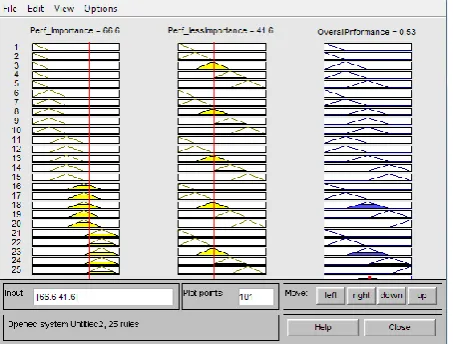
Fig 10: Surface Viewer of Overall Student performance
Referring back to the rules, inputs of student with 66.6% in Performance importance and 41.6 % in Performance less importance were plug in to generate the surface viewer.
5.
CONCLUSION
This study presents the basic principles of fuzzy logic and Fuzzy Inference System (FIS) to evaluate student
performance with precision. Using traditional FIS can lead to considerable huge number of rules. Hierarchical fuzzy inference system (HFIS) can be used to solve this problem. As a result, Hierarchical Fuzzy Inference System was implemented to demonstrate how FISs can accept reasonable increase in inputs with exponential decrease in number of rules for decision units.
Compared to the previous works including classical methods, the proposed model is promising and not affected in terms of result output due to rule reductions. However, despite the numerous advantages, HFIS can surfer from “rule explosion or curse of dimensionality” as parameters grow exponentially the FIS reasoning behind the output will become unknown. As for future work, the study suggest training HFIS with Neural networks and optimization with evolutionary algorithms and metaheuristics.
6.
ACKNOWLEDGMENTS
Special thanks to Prof. Yan Liu and Li for their valuable contributions towards the development of the research. We also wish to acknowledge the support from Petroleum Technology Development Fund (PTDF) of Nigeria. This is a funded research with project number JJKH20190601KJ.
7.
REFERENCES
[1] Z. Lotfi Aliaska, “Fuzzy Sets,” Inf. Control, no. 8, pp. 338–353, 1965.
[2] B. S. Ionescu and C. Prichici, “Potential Beneficiaries of Cloud Account- ing technology : small or large Companies ?,” Manager, no. 17, pp. 282–292, 2013.
[3] P. Kaushal, N. Mohan, P. S. S, and hu, “Relevancy of Fuzzy Concept in Mathematics,” Int. J. Innov. Manag. Technol., vol. 1, no. 3, pp. 1–4, 2010.
[4] K. Tai, A. R. El-Sayed, M. Biglarbegian, C. I. Gonzalez, O. Castillo, and S. Mahmud, “Review of recent type-2 fuzzy controller applications,” Algorithms, vol. 9, no. 2, 2016.
[5] C. Wang, “A Study of Membership Functions on Mamdani-Type Fuzzy Inference S,” Theses Diss., vol. Paper 1665, 2015.
[6] A. Çebİ and H. Karal, “An application of fuzzy analytic hierarchy process ( FAHP ) for evaluating students ’ project,” vol. 12, no. 3, pp. 120–132, 2017.
[7] C. -m. Au Yeung and H.-F. Leung, “A Formal Model of Ontology for Handling Fuzzy Membership and Typicality of Instances,” Comput. J., vol. 53, no. 3, pp. 316–341, Mar. 2010.
[8] R. S. Yadav, A. K. Soni, and S. Pal, “A study of academic performance evaluation using fuzzy logic techniques,” 2014 Int. Conf. Comput. Sustain. Glob. Dev. INDIACom 2014, no. May, pp. 48–53, 2014. [9] W. Xu, S. Zheng, and Z. Zhang, “The Application of
Fuzzy Decision in the Management for Undergraduates,” vol. 68, no. Ssmi 2018, pp. 276–281, 2019.
[10] V. Ojha, A. Abraham, and V. Snášel, “Heuristic Design of Fuzzy Inference Systems: A Review of Three Decades of Research,” Eng. Appl. Artif. Intell., vol. 85, pp. 845– 864, 2019.
[image:6.595.55.282.499.671.2][12]G. Hayward and V. Davidson, “ANALYST Fuzzy logic applications,” pp. 1304–1306, 2003.
[13]P. Roseline, N. Ganesan, B. Clarence, and J. M. Tauro, “A Study of Applications of Fuzzy Logic in Various Domains of Agricultural Sciences,” Int. J. Comput. Appl., pp. 975–8887, 2015.
[14]L. Ouboubker, M. Khafallah, and J. Lamterkati, “DTC two level and three level inverters of Induction Motor with speed control using Fuzzy Logic Controller,” no. March, 2014.
[15]J. Azimjonov, “EVALUATION OF DISTANCE LEARNING STUDENTS PERFORMANCE USING,” no. October, 2016.
[16]S. H. Muhammad, S. S. Abdullahi, and M. ABDULRASHEED, “The Need to Accelerate Cloud Adoption in Developing Countries of Africa.” .
[17] P. Gupta, “Applications of Fuzzy Logic in Daily life,” vol. 3, no. June 1989, pp. 66–70, 2017.
[18] N. ARSLAN NAMLI and O. ŞENKAL, “Using the Fuzzy Logic in Assessing the Programming Performance of Students,” Int. J. Assess. Tools Educ., vol. 5, no. 4, pp. 701–712, 2018.
[19] A. Shaout and M. K. Yousif, “Performance Evaluation – Methods and Techniques Survey,” Int. J. Comput. Inf. Technol., vol. 03, no. 05, p. 2279764, 2014.
[20] D. Wang, X.-J. Zeng, and J. A. Keane, “A Survey of Hierarchical Fuzzy Systems (Invited Paper),” 2006.