The Globalization-Deglobalization Policy Conundrum
Neil Dias Karunaratne
School of Economics, University of Queensland, Brisbane, Australia Email: [email protected]
Received January 30, 2012; revised February 10, 2012; accepted March 18, 2012
ABSTRACT
The dynamic process of economic globalization and deglobalization has been occurring in “waves” over the past 250 years. Diffusion models reveal how globalization policies occupy the policy-centre stage when the global economy is booming and is cast on the back-burner when the global economy nose-dives into a slump. According to the diffusion models, when the global economy is booming the nodes that establish crucial linkages in the economy exceed the social optimum generating negative externalities thereby eroding social welfare in such a context policy intervention is justi-fied to reduce the linkages that facilitate the spread of negative shocks or contagion that reduce the capacity for risk- sharing. The globalization-deglobalization policy conundrum also resurfaces in relation to trade flows, cross-border capital mobility, current account sustainability and technology diffusion. The latter has exacerbated the “digital divide” that has accompanied the revolutionary changes in information and communication technology (ICT) revolution by overcoming the “tyranny of distance”. The recurrent global financial crises and speculative attacks on the currency peg have ignited the debate for reshaping the international financial architecture in order to reduce the vulnerability of the domestic economy to the disruptive effects of the global financial crises.
Keywords: Globalization; Deglobalization; Diffusion Process; Macroeconomic Economic Models; “Digital Divide”;
Global Financial Crises; The Global Financial Architecture
1. Introduction
The process of economic globalization that has occurred in “waves” over the past 250 year reveals the stylised fact that policies that promote globalization occupy the policy centre stage when the global economy is booming and gets cast on to the backburner when the global economy nose dives into a slump. The central aim of this paper is to explain this policy conundrum of globaliza-tion and deglobalizaglobaliza-tion as the global economy flips from a boom to a slump. Conventional models shed light on the causes that underpin the policy conundrum and provide a rationale for the case for reshaping the global financial architecture aimed at reducing the vulnerability of the global economy to recurrent crises.
The rest of the paper is structured as follows: Section 2 presents a critical review of the on-going heated debate between the proponents of globalization and deglobaliza-tion. Here, five of the major “waves” of globalization and deglobalization have been identified. Section 3 reviews insights from models of pure theory of international trade to demonstrate that free trade is best during episodes of global prosperity and protectionist policies comes up trumps during episodes of global downturns. Section 4 reviews the controversy about current account sustain-ability and the misguided case for policy targeting the
reduction of the current account deficit when the econ-omy enjoyed fiscal balance. Section 5 examines the issue of convergence in the context of the neoclassical and endogenous growth models. Section 6 uses the gravity model to shed light on overcoming the “tyranny of dis-tance” and the exacerbation of the “digital divide” due revolutionary changes in Information and Communica-tion Technology (ITC) revoluCommunica-tion. SecCommunica-tion 7 deals with the phenomena of currency crises and exchange rate misalignment. Section 8 examines the case for reshaping the International Economic Architecture. Section con-cludes the paper
2. The Globalization Deglobalization
Conundrum
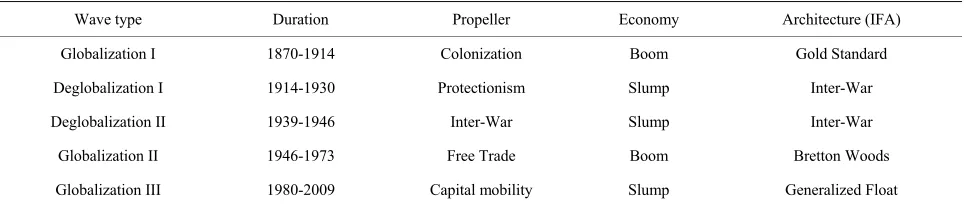
The paper analyses mainly the dynamic processes of economic globalization whilst deliberately side-tracking the analysis of non-economic issues of globalization linked to cultural homogenization, climate change, hu-man rights abuse and the war against terrorism based on the author’s own perceptions by drawing on other studies on the subject by O’Rourke and Williamson [1] and Dol-lar [2], five main waves of globalization and deglobaliza-tion have been identified in this paper (see Table 1).
Table 1. Waves of globalization & deglobalization.
Wave type Duration Propeller Economy Architecture (IFA)
Globalization I 1870-1914 Colonization Boom Gold Standard
Deglobalization I 1914-1930 Protectionism Slump Inter-War
Deglobalization II 1939-1946 Inter-War Slump Inter-War
Globalization II 1946-1973 Free Trade Boom Bretton Woods
Globalization III 1980-2009 Capital mobility Slump Generalized Float
Sources: O’Rourke et al. [1] and Dollar [2].
and deglobalizers relate to the issue of reduction of pov-erty and income inequality. The deglobalizers have al-leged that despite waves of globalization more than 1 billion people live below the poverty line of less than 1 US $ per day. In this morass of poverty more than 30,000 children were perishing daily due to malnutrition and over 72 million children of whom 57% were girls had no primary education and entered the new millennium as illiterates. The above poverty facts and stats constitute a strong indictment of past globalization as it has failed to work to improve the welfare of the poor in developing countries as observed by Shah [3] (Table 2).
Nonetheless, a more incisive analysis of the poverty and income inequality data based on the percentage of population living below the poverty line of US $1 per day over two decades 1960-1980 analysed according to the major regions of the global economy reveal that the percentage of population living below the poverty line has fallen significantly in the emerging market econo-mies of East Asia, South Asia and the oil producing na-tions of the Middle East while only Sub-Saharan Africa has been bypassed by the globalization process and showed no significant reduction in poverty. Overall, the percentage of persons living below the poverty line has fallen by nearly 10% and for the first time the growing trend of income inequality has reversed mainly due to rapid growth and poverty alleviation programs that have implemented by the mega Asian economies of China and India as shown by Salvatore [4] (Table 3).
During this last wave or Wave III of globalization, the economic centre of gravity that was located in the US-North Europe region started to shift to the East Asia-Pacific region ushering in new era of globalization centred on the emergent economies of East Asia and the Pacific. World development indicators revealed that in the East-Asia Pacific region per capita GDP growth had in-creased at a whopping rate of nearly 9% per year, pro-ductivity had more than trebled, carbon dioxide emis-sions nearly doubled indicating that region was turning into the leading engine of global economic growth whilst at the same time improving the quality of life as shown by reduction of infant mortality by nearly half ,
increas-ing life-expectancy from 67 to 71 years and increasincreas-ing the ratio of enrolment in tertiary education to more than 20% (Table 4).
In this paper, we use the modelling of diffusion proc-ess to explain the working of the paradox high started with the adverse shock of the US subprime mortgage meltdown, which spread apidly erupting as a full-blown financial crisis. This ended the longest wave of prosper-ity, Wave III of Globalization, also known as the “Great Moderation” and engulfed the global economy in a full blown financial crisis in August 2007 and commenced Wave III of deglobalization policies during the worst slump that occurred since the Great Depression of the 1930s. The US subprime mortgage meltdown, which had its origin in the US housing market, had spread rapidly worldwide and posed a systemic threat of a collapse of the global financial architecture or system. Based on in-sights from diffusion models during a global lump he interconnection between crucial nodes exceed what is desired from the social optimum requiring disconnecting nodes or deglobalization in order to regain economic stability. The adverse shock of the US subprime mort-gage meltdown is transmitted around the network in two ways. First, the original shock may be sub-divided among the nodes resulting in risk-sharing. The analysis of the US subprime mortgage meltdown reveals that the root cause of the current global financial crisis can be traced to the financial innovation of securitization which re-packaged prime and subprime mortgages and increase the marketability of these repackaged assets by creating mortgage backed securities (MBS). The shift from “origi-nate and hold” model to the “origi“origi-nate and distribute” model increased the marketability of securitized assets but at the same time by increasing counterparty risk cre-ated: a “credit crunch” and a “liquidity crisis” which ren-dered Wall Street institutions insolvent... However, the Wall Street financial institutions were deemed to be ei-ther “too big to fail” or “too interconnected to fail” that justified a tax-payer funded bailout creating a serious moral hazard problems. The recurrent global financial crises has led to calls to reshaping the international
Table 2. Poverty facts and stats.
Indicator of Developing Country Poverty
1. 50% of the world population (3 billion) live on less than 2 dollars a day.
2. 80% of the world’ population live in countries widening income inequality.
3. 20% of the world’s rich enjoy 75% of the global wealth while 40% of the world’s poorest account only 5% of the world’s wealth.
4. 30,000 children die every day due to poverty (UNICEF).
5. 28% of children in DCs are underweight or stunted.
6. 72 million children of primary school age do not attend school, 57% are girls.
7. Over 1 billion people entered the new millennium illiterate.
Source: Shah [3].
Table 3. Number & percentage living below the poverty line (1960-2000) during Globalization Wave II & III.
Region 1960 (%) 1980 2000
East Asia 729 (77.5) 955 (67.2) 114 (6.0)
South Asia 209 (37.2) 310 (34.4) 105 (7.8)
Sub-Saharan Africa 118 (53.2) 188 (49.4) 362 (54.8)
Mid-East & N. Africa 32 (24.3) 10 (4.3) 29 (7.2)
Latin America 35 (16.0) 13 (3.6) 27 (5.2)
Eastern Europe 29 (9.2) 7 (1.7) 0 (0)
Developing World 1131 (52.5) 1479 (43.5) 647 (13.1)
Source: Salvatore [4]. Notes: (Poverty line: Living on less than US $1.00 per day measured in 1985 PPP = Living on less than US $1.50 per day measured in 1993 PPP).
Table 4. World development indicators (1990-2006).
Region % ΔPCGDP % ΔPROD % ΔCO2 Infant Mortality Life Exp. Tertiary ed. Enrol. Ratio
East-Asia Pacific 8.6 315 198 56 to 29 67 to 71 20
Sub-Sahara Africa 3.0 12 12 123 to 83 50 to 50 5
High Income 2.2 135 122 12 to 7 76 to 79 67
World 2.6 141 128 92 to 73 65 to 68 24
Source: Klein [7].
3. Models of Pure Theory of Trade &
Protectionism
A major force of driving economic globalization is trade liberalisation or the removal of tariff and non-tariff bar-riers on the trade in goods and services. Pure theory of international trade as exposited in the Riparian model, see Appleyard et al. [5] demonstrates that specialisation in the production of goods based on the principle of comparative advantage maximizes national and global welfare or is first best. However, when factor endow-ments are taken into account the Heckscher-Ohilin model demonstrates that free trade results in income distribution
effects or winners and losers. If the winners from trade can potentially compensate losers and still be better off the free trade is still first best. Although the rhetoric of free trade is strongly supported in multilateral trade ne-gotiations as discussed by Pattnaik [6], under the aus-pices of the World Trade Organisation by the champions of free trade in reality these very champions cave into demands of special interest groups and perpetuate, for example, farm subsidies undermining both national and global welfare. The stalling of the 9th round of MTN or
[image:3.595.57.539.468.555.2]slow-down. The benefits of free trade clearly demon-strate that the Asian miracle has delivered high growth rates to a group of High Performance Asian Economies (HPAEs) that implemented export oriented industrial strategies in contrast to several developing countries that pursued inward looking import substituting industrializa-tion (ISI) strategies. Besides, new trade theories that take into account the effects of economies of scale and mo-nopolistic competition show that trade in similar but dif-ferentiated products between countries or intraindustry trade as opposed to inter-industry or Heckscher-Ohlin trade in dissimilar products do not take into account per-verse income distributional effects.
The world’s centre of economic gravity has shifted from the North America and Pacific region. Data on overall economic activity, national accounts, demograph-ics, sexual specifdemograph-ics, health life expectancy, energy, and output show that growth centres have shifted from North America and Europe to Asia and America according to Klein [7]. Empirical studies show that this reduction led to the reduction of the tyranny distance for countries like Australia. The reduction of the distance from the North America-Europe to the Asian Pacific region has increased the potential for trade with the fast growing emerging market economies in China and India.
The last wave or Wave III, of economic globalization dubbed the “Great Moderation” delivered unprecedented prosperity due to the financial innovations nurtured by the spread of free market capitalism. However, unregu-lated free market capitalism also sowed its own seeds of destruction and resulted in the Wave III of economic globalization that imploded in the US subprime mortgage meltdown, which exploded as a full-blown global finan-cial crisis in August 2007 engulfing the world in the worst global recession since the Great Depression of the 1930s.
The insights garnered from the diffusion models reveal that when the global economy is booming the interde-pendencies of the real and financial assets increase en-hancing social welfare. However, when the global econ-omy plunges into a slump the private incentives exceed the social welfare optimum eroding the capacity of fi-nancial networks to reduce risk-sharing due to the crisis contagion that arises from the increase in volatility. Risk-sharing is defined as the subdivision of the original shock amongst the nodes of a network and crisis conta-gion is defined as the spread (multiplication) of the shock among nodes of network (convergence). Diffusion proc-esses suggest that during a global slump policy interven-tion should aim at disconnecting the economy at crucial nodes to reduce private incentives that exceed the social optimum. Besides, policy intervention should be directed at revamping institutions and not rescuing bad managers increased inefficiency by causing the divergence of
pri-vate from the social welfare optimum.
The subprime mortgage meltdown which unravelled as the worst global recession in August 2007 since the Great Depression of the 1930 ended the Great Moderation or a long-boom in the global economy plunging the global economy in a slump. As predicted by the diffusion proc-esses model the global slump increase the interdepend-encies between the financial and real sectors. The sub-prime mortgage meltdown affected securitization or the pooling of prime and subprime mortgages and obtaining for these asset backed securities high rating from hedge funds thereby increasing their marketability world-wide. The process of pooling subprime mortgages with prime mortgages which radically changed banking lending from the “Originator to Hold” model to “Originator to Distribute” model enabling banks to obtain high ratings from hedge funds for the asset backed securities and in-crease their marketability world-wide. During economic booms when house prices were rising subprime mort-gagees were able to refinance their loans and meet their repayments. However, the US housing price bubble burst and housing prices plummeted the subprime mortgagees were unable to meet the high interest payments and there-fore they sold their houses increasing the supply house at a time when demand was low. This caused a further fall in house prices and forced subprime mortgagees to de-fault on their repayments and banks to foreclose on them. The negative feedbacks arising from the US subprime mortgage meltdown was transmitted globally because many foreign banks, hedge funds, superannuation funds and other investors had bought asset backed securities which had mispriced risks in their search for higher yields.
The US subprime mortgage meltdown created a “credit crunch” which spawned a “liquidity crisis” and lending agencies were unable to obtain loans from the interbank market to meet the demand for credit for maturities of more than month because of the widening gap in inter-bank spreads due to increase in counterparty risk. This drove Wall Street financial institutions to the throes of bankruptcy and insolvency. However these Wall Street financial institutions were deemed to be “too big to fail” or “too interconnected to fail”.
network (convergence). Diffusion processes suggest that during a global slump policy intervention should aim at disconnecting the economy at crucial nodes to reduce private incentives that exceed the social optimum. Be-sides, policy intervention should be directed at revamp-ing institutions and not rescurevamp-ing bad managers increased inefficiency by causing the divergence of private from the social welfare optimum as analysed by Gallegati et al. [8].
The subprime mortgage meltdown which unravelled as the worst global recession in August 2007 since the Great Depression of the 1930 ended the “Great Moderation” or the long-boom in the global economy plunging the global economy in a slump. As predicted by the diffusion proc-esses model the global slump increase the interdepend-encies between the financial and real sectors. The sub-prime mortgage meltdown affected securitization or the pooling of prime and subprime mortgages and obtaining for these asset backed securities high rating from hedge funds thereby increasing their marketability world-wide. The process of pooling subprime mortgages with prime mortgages which radically changed banking lending from the “Originator to Hold” mode to “Originator to Distribute” mode enabled banks to obtain high ratings from hedge funds for the asset backed securities and market them world-wide. During economic booms when house prices were rising subprime mortgagees were able to refinance their loans and meet their repayments. However, the US housing price bubble burst and housing prices plummeted the subprime mortgagees were unable to meet the high interest payments and therefore they sold their houses increasing the supply house at a time when demand was low. This caused a further fall in house prices and forced subprime mortgagees to default on their repayments and banks to foreclose on them. The negative feedbacks arising from the US subprime mort-gage meltdown was transmitted globally because many foreign banks, hedge funds, superannuation funds and other investors had bought asset backed securities which had mispriced risks in their search for higher yields.
The US subprime mortgage meltdown created a “credit crunch” and “liquidity crisis” because the widen-ing spreads of counter-party risks. This drove Wall Street financial institutions to the throes of bankruptcy and in-solvency. However these Wall Street financial institu-tions were deemed to be “too big to fail” or “too inter-connected to fail”.
In this paper we have identified five waves of global-ization and deglobalglobal-ization of different duration, each propelled by its own major engine of economic force (see
Table 1). The issue of globalization has been the subject
of heated controversy as pro-globalizers have highlighted those emerging market economies that embraced the globalization policies have experienced miracle growth
rates and reduced poverty and income inequality and converged to the living standards of the industrial coun-tries. Proponents of deglobalization or anti-globalization have voiced their serious dissent on the rosy view of globalization and they highlight the fact that more than 1 billion people live below the poverty line of less than one US $ a day. They argue that globalization has made the rich in the rich countries richer all at the expense of the poor in poor countries and increased the vulnerability of the global economy to catastrophic crises that strike the global economy with increasing frequency and virulence and motivating the deglobalizers to demand a radical reshaping of the global financial architecture to make globalization deliver for the poor and make the world a better place to live in industrial economies richer and widen the economic This paradoxical policy switch from globalization to deglobalization as the global economy flips from a boom to a slump is the central focus of analysis of this paper. The global economy experienced the longest wave of prosperity during the post War pe-riod in Wave II and Wave III which has ended with the sudden eruption of a global financial crisis in August 2007, engulfing the global economy in the worst reces-sion since the Great Depresreces-sion of the 1930s (see Table 1).
bailed out at tax-payers’ expense creating a moral hazard problem. The central issue investigated in this paper is how an adverse domestic shock like the subprime mort-gage meltdown spread rapidly across the globe plunging a global economy that was booming and promoting poli-cies of globalization into a slump where deglobalization policies surfaces to the policy centre stage. This para-doxical shift from promoting globalization to policies that promote deglobalization as the global economy plunges from booms to slumps is manifest in the conven-tional macroeconomic models that explain trade, cross- border capital flows, technology transfer and labour flows.
In modelling the diffusion process we define a nega-tive shocks that can be subdivided among nodes of a net work is defined as risk-sharing ( mean reversion), while a negative shocks that can be spread among nodes of a network (multiplied) is defined as contagion (conver-gence). The examination of the subprime mortgage melt- down through the lens of a diffusion process models re-veals that financial innovations like securitization or the pooling of subprime and prime mortgages that was made possible by off-balance-sheet activities under the “origi-nate and distribute” banking increased the marketability of the securitized assets by obtaining high ratings for them from hedge-funds that mis-priced the risk of asset backed subprime mortgage assets or securitized assets. As long as the US housing prices soared the subprime mortgagees could refinance their mortgages on favour-able terms. However, when the US housing price bubble burst the subprime mortgages were unable to meet their interest payment obligations and they were forced to sell their properties. This increased the supply of houses at a time when demand had collapsed causing house prices to fall further and interest rates to rise resulting in wide-spread default on repayment and foreclosures by banks and other nonbank lending agencies. The turbulence in the housing market adverse repercussions in the inter-bank market increasing counterparty risks and impeding central banks role to function as ‘ lender of last resort’ as banks and lending agencies could not obtain credit to finance loans with maturity over one month creating a “credit crisis” and then a “liquidity crisis” according to Mizen [9]. The liquidity crisis drove the Wall Street fi-nancial institutions to insolvency. However, these Wall Street institutions were deemed to be “too big” or “too interconnected’ to allow them to fail. Therefore, they were bailed-out at the taxpayers’ expense sparking off a heated debate on moral hazard problems that were cre-ated by tax-payer funded bailouts o Wall Street financial institutions.
4. External Imbalance and Current
Account Sustainability
A dominant paradigm that provided policy guidelines to
achieve internal and external balance in a small open economy was the Mundell-Fleming model. This model under a fixed exchange rate regime directed that policies should aim at reducing high current account deficits that exceeded 5% as a ratio of GDP flashed a red light that the country was living beyond its means as warned by Milesi-Ferrrati and Razin [10]. However, the rationale for targeting the reduction of the current account deficit became obsolete when the exchange rate was floated and capital controls were dismantled as the current ac-count deficit was the residual outcome of optimizing de- cisions of rational agents rendering policy actions to re-duce current account deficits was misplaced as hypothe-sised by Pitchford [11] and Corden [12]. The polemics relating to the sustainability of high current account defi-cits and the fetish exhibited by policymakers in Australia to an obsolete open economy model has been revisited critically reviewing the implications of following policies based on the obsolete Mundell-Fleming model in contrast to policies based on intertemporal optimization under a flexible exchange rate regime as analysed by Karuna-ratne [13]. The evolution of monetary policy as the ex-change rate was floated in Australian in 1983Q4, and capital controls were dismantled, and this required that fixed exchange rate anchor be abandoned and that poli-cymakers combine the options of a floating exchange rate regime with monetary policy autonomy instead of running into the “impossible trinity” or the open econ-omy “trilemma” according to Obstfeld et al. [14]. The redesigning of the Australian monetary policy by shifting from the Mundell-Fleming model to the intertemporal optimization approach in Australia was reinforced with Australia joining the leaguer of inflation targeters with the add-on the institutional of Central Bank Independ-ence. These institutional innovations facilitated the pro-moting of globalization of the Australian economy with-out creating an inflation bias and underming policy credibility by succumbing into time-inconsistent policies. Therefore, for nearly two decades advanced countries like Australia integrated with the global economy re-porting low inflation and high growth rates. However, as we foreshadowed in Section 2 the eruption of the global financial crisis due to the subprime mortgage meltdown completely reversed the trends toward globalisation by plunging the global economy into an unprecedented re-cession.
5. Convergence—Neoclassical and
Endogenous Growth Models
the Solow model also uses a growth accounting equation to analyse the major drivers of economic growth. There-fore, policies aimed at promoting economic growth should focus on providing incentives to nurture to tech-nological progress or innovation, also referred to as “in-spiration”. Empirical studies of growth in the Asian tiger economies reveal that much of the growth was due to increase in physical inputs (capital and labour) or “per-spiration” rather than technological progress. But since physical factor inputs are subject to the law of diminish-ing marginal productivity of physical capital and was predicted that high growth rates of the Asian Tiger economies will would peter out producing an economic crisis as demonstrated by Kurgan [17] and Young [18]. The Solow-Swan model also provide insights on the poli-cies that should be pursued to reduce current consump-tion and in order to increase the consumpconsump-tion of future generations giving what is known as a Golden Rule pol-icy prescription which requires “that you should do unto others what you would have them do unto you.” accord-ing to Phelps [19]. These are conflictaccord-ing perspectives on the interactions of population growth and the rate of capital accumulation, which according to the dismal Malthusian model on population growth will drive an economy to an eternal cycle of poverty and misery but according to the more optimistic Kremerian model population growth emerges as the motor of technological innovation and new ideas that will deliver everlasting prosperity.
The Solow-Swan model predicts absolute convergence or low income developing countries that grow faster will eventually “catching-up” high capita income levels of rich countries. However, empirical studies based on the pooling of ACs and DCs fail to support the prediction of absolute convergence and instead indicate conditional convergence where low income DCs converge to their own steady state per capita income levels, while rich ACs converge their own high steady per incomes result-ing in the formation of poor country and rich country “convergence clubs” according to Barro et al. [20]. There- fore, based on the evidence of conditional convergence deglobalizers have argued that globalization has contrib-uted to the divergence of per capita incomes of ACs and DCs rather than their convergence.
The Solow-Swan model and its growth accounting empirics indicate that benefits of growth are mixed mainly because it assumes that technological progress is exoge-nous. However, endogenous growth models, which in-digenise technological progress indicate that economic growth can deliver everlasting growth. For example the simple AK model assumes a broader definition of capital (K). Here capital includes not only physical capital that is subject to the law of diminishing marginal returns, but human capital that gives increasing returns under the
assumption of constant returns to scale therefore policies that promote the development of human capital and skill formation according to the AK model predicts that growth could be perpetual because of the absence of the deleterious effects of exogenous technological progress.1
Trade between ACs and DCs based on the principle of comparative advantage can occur through different modes. First, trade between nations could be interindus-try trade as explained by the Heckscher-Ohlin model. Second, trade could be inertemporal trade or exchange of goods and services for future goods and services. Third, assets could be traded for other assets in order to diver-sify asset portfolios and maximise expected risk adjusted according to the Markowitz portfolio selection model [21]. The rationale underpinning portfolio diversification has been summed by the late Nobel Laureate James Tobin as the gains from “not to put all your eggs in one basket”. The gains from asset trade by the home and a foreign country due to international portfolio diversifica-tion that results in the reducdiversifica-tion in risks can be measured by the decrease in the volatility of returns of assets. Moreover, by international portfolio diversification of asset portfolios nations can reduce systematic risks by converting them into non-systematic risks due to the fact that international business cycles are non-synchronized. Empirical evidence reveals that in the recent past finan-cial deregulation and increase in capital mobility has increased international portfolio diversification, but yet they remain at sub-optimal levels (Table 5).
The degree of international portfolio diversification has been measured through the correlation between the national saving rate and the investment rate. Studies for OECD countries revealed a high correlation between the above two rates implying low capital mobility and port-folio diversification according to the analysis of Feldstein and Horioka [22]. Moreover, the foreign exchange mar-ket is a key mechanism that promotes the efficient allo-cation of capital internationally. If the foreign exchange market is functioning efficiently the foreign exchange rate will reveal all the available information through price of foreign exchange. The efficiency of the foreign exchange market has been evaluated using three tests based on the uncovered the uncovered interest parity (UIP) condition, the risk adjusted interest parity condi-tion and models of exchange rate forecasting. These tests fail to support that capital account liberalisation has pro- moted foreign exchange market efficiency, thereby cast-ing aspersions about benefits of portfolio diversification
1Y = AK where Y: Output, K: Capital stock. A: constant measuring the
Table 5. Percentage of Assets (A) and Liabilities (L) as a ratio of GDP for ACs.
Country 1993 (A/Y) 2004 (A/Y) 1993 (L/Y) 2004 (L/Y)
Australia 13 77 52 137
Canada 24 101 70 114
UK 152 208 136 369
USA 29 84 25 107
Source: Lane, P.R., and Milesi-Ferretti [32] (see an updated dataset).
through capital account liberalisation, particularly in DCs according to Krugman and Obstfeld [23].
6. The Gravity Model and the “Digital
Divide”
The Information Technology (ICT) Revolution while overcoming the ‘tyranny of distance’ has exacerbated the “digital divide” or the gap between information haves and information have-nots both within ACs and DCs. The measurement of the “digital divide” in terms tele-communication access lines per 100 inhabitants is an indicator of the universal service in telecommunications and a key measure of the international “digital divide” The digital divide by promoting competition and deregu-lation generate social benefits , spillover or positive ex-ternalities that deepen the country’s skill base. It facili-tates economic activity that supports electronic-com- merce. The rigorous implementation of competition re-sults in falling prices and increases innovative new products. The digital divide benefits those who have ac-cess to telecommunication infrastructure and marginal-ises further the ICT “have-nots”.2 have increased in all regions except in Africa where growth has been negligi-ble as shown by the study on the “digital divide” by the OECD [24]. The evidence of the benefits of liberalisation in this area is mounting in a number of DCs. Which have seen growth in wireless networks from competition.
The social benefits or positive externalities that are generated by access telecommunications infrastructure by promoting competition and creating innovative prod-ucts will lead to fall in prices of telecommunication ser-vices. The “digital divide” measured in terms of internet access is much larger that when measured in terms of 100 lines per inhabitant .
The gravity model pioneered by Tinbergen [25] and Pyhonen [26] provide useful insights on how trade is
directly related to country size as measured by GDP and inversely related to the “death of distance” been brought about the revolutionary changes in information technol-ogy. The communications superhighway concept ex-plains how the convergence of new technologies will lay the groundwork for establishing activities such as e-com- merce, telemedicine, education to germinate and address the policy issues posed by the digital divide paving the way to enhance productivity and growth.
The rationale underpinning the application of the grav-ity model to explain trade flows between countries can be formulated as follows:
ij i j ijT YY d (1)
where
Tij: measures the trade between countries i and j;
Yi: economic mass normally measured by as GDP;
dij: is the distance between country i and j;
α, β: parameters to be estimated.
Country shares and a range of other related policy variables can be included as additional explanatory vari-ables on the right hand side of the gravity equation.
Recently, Battersby and Ewing [27] employed the gravity trade equation to explore Australia’s trade open-ness. Their work found that the most important factor in explaining Australia’s low trade to GDP ratio was the distance of the ROW and Australia’s large geographic size. The application of the gravity model in the Austra-lian context has been supplemented by a new indicator of remoteness.
The specification of the gravity model in Equation (2) , has been expanded to include population and remoteness effects and common border effect through a dummy variable:
j
jij i j ij i j i j
T YY d PP R R e
5 where
2The communications superhighway which combines the technology
determinist and social constructionist view of technology and liberali-sation of telecommunication markets had in 1998 the world’s access lines numbered over 852 million, with 64.5% in OECD countries and in low GDP countries there were only 1.6 line per 100 inhabitants. Over the 1990s the share of OECD countries has steadily fallen partly because access lines in China has risen from 6.6million in 1990 to 87.4 million in 1998.
ij
C
j
model indicates that Australia’s trade performance is de- termined by its economic size and labor productivity.
7. Currency Crises and Exchange Rate
Misalginment
The global economy has been ravaged by frequent cur-rency crises before the current global financial crisis due to the Latin American debt crisis in the 1980s, the Asian currency crisis 1997-1998, followed by turmoil in Mexi-can crisis 1997-1990, Russia 1998 and Argentina 2001. A major issue that confronts policymakers in developing countries relate to the choice of the exchange rate regime, the exchange rate being the most important price of an open economy. Many DCs are pursuing globalization through the implementation of export-led growth strate-gies and avoiding an overvalued exchange rate is vital to maintain the international competitiveness of exports. A major insight from the Asian currency crisis was the fo-cus on the bipolar case where it has been argued that de-veloping countries to avoid recurrent currency crises have to choose one of the two corner solutions of a hard peg or a soft peg implying a floating exchange rate. However, DCs have shown a “fear of floating” because floating could increase exchange rate volatility by re-moving the exchange rate anchor that has tied up infla-tion expectainfla-tions. However, empirical studies do not support the bipolar case and countries should choose the exchange rate regime taking into account its own macro-economic fundamentals aimed at insulating the economy from external real shocks or internal monetary shocks as shown by Rogoff et al. [29].
Globalization has forced many developing countries to resolve the “open economy trilemma” by choosing inde-pendent monetary policy and capital account liberalisa-tion thereby giving up exchange rate stability or com-mitment to an exchanger rate peg. Following the Asian currency crisis there has been distinct trend among emergent market economies to adopt more flexible ex-change rate regimes an accumulate vast foreign exex-change rate reserves to deter a possible speculative attacks of the currency peg.
Globalisation and the cross-border hyper mobility of capital have increased the vulnerability of DCs to cur-rency crises due to sudden reversal of capital inflows. At least three generic models have been stylised to describe how speculative attacks forced a collapse of the ex-change rate peg posing formidable policy challenges to DCs that have liberalized the capital account.
8. Reshaping the International Financial
Architecture
The International Financial Architecture (IFA) refers to the three institution that were established under the
Bret-ton Woods System (1946) to regulate the world monetary and banking system through the International Monetary Fund (IMF), cross-border capital flows to alleviate pov-erty and promote growth in developing countries through the World Bank or the International Bank for Recon-struction and Development (IBRD), to promote free trade through multilateral trade negotiations (MTN) through the General Agreement on Tariff and Trade (GATT) which was established as the World Trade Organisation (WTO) in 1995 more formal institution during the 8th
MTN round or the Uruguay Round and its scope was expanded beyond trade in manufactures to cover trade in services through the in services through the General Agreement on Trade in Services (GATs) and trade in Intellectual Property Rights (TRIPs). Furthermore, dur-ing the 9th MTN round or the Doha round it was
antici-pated that the WTO will promote liberalisation o trade in agriculture by Industrial Countries reducing agricultural subsidies, import quotas on cars, steel, timber on a non- reciprocal basis.
The three institutions were the nodes in the IFA and established networks that promoted globalization policies during Wave II and Wave III when the global economy was experiencing stability and prosperity also referred to as the Great Moderation.
In mid-1997 the IFA was severely jolted by the East Asian Currency Crisis that turned overnight miracle growth economies in East Asia into debacle economies. The East Asian currency crisis highlighted the two forces of conundrum and banking institutions that were estab-lished under the BWS (1946) The International Monetary Fund (IMF) was expected promote policies that achieved internal and external balance of member nations can achieve global economic stability. The mission of the World Bank or the International Bank for Reconstruction and Development (IBRD) was to promote long-term growth and development and reduce poverty n member countries. The General Agreement on Tariffs and Trade (GATT) which was established formally as the World Trade Organisation (WTO) in 1995 during the 8th MTN
round or the Uruguay round extended MTN negotiations from the reduction of tariff and nontariff barriers on the reduction of trade in manufactures to cover the liberaliz-ing trade in services through the General Agreement on Trade in Services (GATS) and in Trade Related Intellec-tual Property Rights (TRIPs). in the 9th MTN or Doha
round. The WTO-MTN witnessed scaling down of tariffs and NTBs.
The General Agreement for Tariff and Trade (GATT) to promote free trade in manufactured goods through multilateral trade negotiations (MTN). At the 8th MTN
through General Agreement in Trade in Services (GATs) and trade in patents, trademarks or trade related to intel-lectual property rights (TRIPs). The Doha round, the 9th
round of MTN which anticipated to the reduction of massive farm subsidies and non tariff barriers (NTBs) by industrial countries against imports from developing coun-tries has stalled with the sudden collapse of the Wave III globalization which had delivered spectacular growth of financial innovations under free market capitalism. The global economy plunged into the worst recession since the Great Depression of the 1930s.
The Nobel Laureate Joesph Stiglitz, amongst others who worked on the coal face international monetary functioned as the chief economist of the Bank identified eight channels through which mismanagement of the proc-ess of globalization by the IFA has undermined the work-ing of globalization. One of the most important channels is the increasing risk of the developing countries likely to face from the mismanagement of globalizations, and the highest risks can have adverse effects on growth. The lesson Stiglitz draws from his analysis is that it is not that nations should walk away from globalization but rather should implement policies mitigate these downside risks instruments. Equity finance reduces debt repayments when the economy is in a recession and unlike debt fi-nance does not require fixed repayments regardless of the state of the economy. In reshaping the IFA facilities for increasing equity financing as opposed to debt financing of CADs and foreign debt should be promoted.
9. Concluding Observations
The structural malaise that has trapped DCs in a vicious circle of poverty retarding their capacity to harness the benefits of globalization has sparked off a debate be-tween the Geography School spearheaded by Diamond [30] asserts that the vicious circle of poverty that impedes the globalization of DCs occurs because of the impedi-ments imposed by geography resulting in debilitating tropical disease and unfavourable climate. The Institu-tional School associated with Acemoglu et al. [31] con-tends that the lack of proper institutions (enforcement of law and order, property rights) resulting in corruption re-tards growth and globalization of DCs. Although these rival schools offer new policy insights on why poor coun-tries remain poor they have not yet distilled meaningful policy guidelines to tap into the virtuous cycle of global-ization and growth in order to release DCs from the trap of grinding poverty and income inequality. Perhaps mod-ern econometric analysis using appropriate instrumental variables on time-series cross-section data may offer solu-tions to this policy problem.
The central thesis addressed in this paper is that main-stream macroeconomic models provide insights that both support policies that promote the globalization or
de-globalization of DCs depending on whether the global economy is experiencing economic prosperity or an eco-nomic downturn. Until recently the long wave (Wave III) of economic prosperity provided support for policies that promoted globalization of DCs as a way to reduce pov-erty and income inequality. However, the recent crisis contagion emanating from the global financial crisis trig-gered by the US subprime mortgage crisis has raised se-rious questions about the benefits of unregulated free market capitalism as the vehicle for promoting the glob-alization of DCs. The global financial crisis has reignited the debate on deglobalization or delinking of DCs from the international economy in order to avoid the recurrent crises originating from policy mistakes in ACs from keeping the DCs entrapped in vicious circle of poverty and income inequality.
REFERENCES
[1] K. A. O’Rourke and J. G. Williamson, “Globalization and History: The Evolution of the Nineteenth-Century Atlan- tic Economy,” Cambridge University Press, Cambridge, 1999.
[2] D. Dollar, “Globalization, Inequality and Poverty since 1980,” World Bank, Washington DC, 2001.
[3] A. Shah, “Poverty Facts and Stats,” Global Issues, 2008. [4] D. Salvatore, “Growth and Poverty in a Globalizing World,”
Journal of Policy Modeling, Vol. 26, No. 4, 2004, pp. 543- 551. doi:10.1016/j.jpolmod.2004.04.009
[5] D. R. Appleyard, A. J. Field and S. J. Cobb, “Interna- tional Economics,” McGraw-Hill, New York, 2006. [6] S. Pattnaik, “The Global Financial Stability Financial Ar-
chitecture Fails Again: Sub-Prime Crisis Lessons for Poli- cymakers,” Asia Pacific Economic Literature, Vol. 23, No. 1, 2009, pp. 21-47.
doi:10.1111/j.1467-8411.2009.01221.x
[7] L. R. Klein, “Measurement of Shift in the World’s Canter of Economic Gravity,” Journal of Policy Modelling, Vol. 31, No. 4, 2009, pp. 489-492.
doi:10.1016/j.jpolmod.2009.05.005
[8] M. Gallegati, B. Greenwald, G. R. Matteo and J. E. Stig- litz, “The Asymmetric Effects of Diffusion Process: Risk Sharing and Contagion,” Global Economy Journal, Vol. 8, No. 3, 2008, pp. 1-20. doi:10.2202/1524-5861.1365 [9] P. Mizen, “The Credit Crunch of 2007-2008: A Discus-
sion of the Background, Market Reaction, and Policy Re- sponses,” Federal Reserve Bank of St. Louis Review, Vol. 90, No. 5, 2008, pp. 531-568.
[10] G. Milesi-Ferrati and A. Razin, “Current Account Sustain- ability Report,” Princeton University, Princeton, 1966. [11] J. Pitchford, “Australia’s Foreign Debt: Myth and Reality,”
Allen and Unwin, Sydney, 1990.
[12] W. M. Corden, “Economic Policy, Exchange Rates and the International System,” University of Chicago Press, Chi- cago, 1994.
Current Account Deficits—A Reappraisal after the Global Financial Crisis,” Journal of Policy Modeling, Vol. 32, No. 1, 2007, pp. 81-97.
doi:10.1016/j.jpolmod.2009.10.002
[14] M. Obstfeld, J. Shambaugh and A. Taylor, “The Trilem- ma in History: Tradeoffs among Exchange Rates, Mone- tary Policies, and Capital Mobility,” The Review of Eco- nomics and Statistics, Vol. 87, No. 3, 2005, pp. 423-438. doi:10.1162/0034653054638300
[15] T. W. Swan, “Economic Growth and Capital Accumula- tion,” Economic Record, Vol. 32, No. 2, 1956, pp. 334- 361. doi:10.1111/j.1475-4932.1956.tb00434.x
[16] R. M. Solow, “A Contribution to the Theory of Economic Growth,” Quarterly Journal of Economics, Vol. 70, No. 1, 1956, pp. 65-94. doi:10.2307/1884513
[17] P. Krugman, “The Myth of Asia’s Miracle,” Foreign Af- fairs, Vol. 73, No. 6, 1994.
[18] A. W. Young, “The Tyranny of Numbers Confronting the Statistical Realities of the East Asian Growth Experience,” Quarterly Journal of Economics, Vol. 101, No. 3, 1995, pp. 641-680. doi:10.2307/2946695
[19] E. Phelps, “The Golden Rule of Accumulation: A Fable for Growth Men,” American Economic Review, Vol. 51, 1996, pp. 638-643.
[20] R. J. Barro and X. Sala-I-Martin, “Convergence Across States and Regions,” Brookings Papers on Economic Ac-tivity, Vol. 1991, No. 1, 1991, pp. 107-182.
doi:10.2307/2534639
[21] H. Markovitz, “Portfolio Selection,” Journal of Finance, Vol. 7, No. 3, 1952, pp. 77-92.
[22] M. Feldstein and C. Horioka, “Domestic Saving and In- ternational Capital Flows,” Economic Journal, Vol. 90,
No. 358, 1980, pp. 314-329. doi:10.2307/2231790 [23] P. Krugman and M. Obstfeld, “International Economics:
Theory and Policy,” Pearson Addison-Wesley, Boston, 2009.
[24] OECD, “Understanding the Digital Divide,” OECD, Paris, 2009, pp. 1-32.
[25] J. Tinbergen, “Shaping the World Economy,” Twentieth Century Fund, New York, 1992.
[26] P. Pyhonen, “A Tentative Model for the Volume of Trade between Countries,” Welwirtschafliches Archive, Vol. 90, 1963, pp. 93-99.
[27] B. Battersby and R. Ewing, “International Trade Perfor- mance: The Gravity of Australia’s Remoteness,” Treasury Working Paper, Australia, 2005, pp. 1-20.
[28] D. T. Coe, A. Subramaniam and N. T. Taminsa, “The Miss- ing Globalization Puzzle,” IMF Working Paper 02/171, The International Monetary Fund, Washington DC, 2002. [29] K. S. Rogoff, A. M. Husain, A. Mody, R. Brooks and N.
Omes, “Evolution and Performance of Exchange Rate Regimes,” The International Monetary Fund, Washington DC, 2004.
[30] J. Diamond, “Guns, Germs and Steel: The Fate of Human Societies,” Norton, New York, 1997.
[31] D. Acemoglu and J. Robinson, “The Colonial Origins of Comparative Development: An Empirical Interpretation,” American Economic Review, Vol. 94, No. 5, 2001, pp. 1369-1321. doi:10.1257/aer.91.5.1369