RESEARCH ARTICLE
AN EXPERIMENTAL STUDY ON SENSIBLE HEATING OF SUGARCANE JUICE
*
Mahesh Kumar
1, Pankaj Khatak
1, Rakesh Kumar
1and Om Prakash
21Mechanical Engineering Department, Guru Jambheshwar University of Science & Technology,
Hisar (India)-125001
2Mechanical Engineering Department, National Institute of Technology, Patna, India
ARTICLE INFO ABSTRACT
In this research work, the convective heat transfer coefficients for sensible heating of sugarcane juice in stainless steel and aluminum pots during jaggery making are evaluated. Various indoor experiments were performed by varying heat inputs from 200 to 360 watts. The effects of heat inputs on the convective heat transfer coefficients were determined by applying the Nusselt number expression with the constants obtained from the experiments by simple linear regression method. The convective heat transfer coefficients were found to increase with an increase in rate of heat input and the operating temperature. The convective heat transfer coefficients were observed higher for heating the sugarcane juice in an aluminum pot. The experimental errors in terms of percent uncertainty were also determined.
© Copy Right, IJCR, 2011, Academic Journals. All rights reserved
INTRODUCTION
In India, about 273 million tonnes of sugarcane is produced annually. About 50% of the total sugarcane juice produced is used for manufacture of 8 million tonnes of jaggery under the decentralized sector. Jaggery is often used for domestic consumption and it is the most nutritious product among all the sweeteners. In addition to its sweetening characteristics it has several valuable medicinal properties [1, 2]. Jaggery is concentrated form of sugarcane juice which is produced by heating and boiling of the sugarcane juice. Dunkle [3] and Clark [4] developed thermal models to determine the rate of evaporation for distillation under indoor conditions. Tiwari and Lawrence [5] and Adhikari et al. [6-8] attempted to modify the values of these coefficients under simulated conditions. Kumar and Tiwari [9] and Tiwari et al. [10] have developed a thermal model for heat and mass transfer for indoor as well as outdoor conditions. Tiwari et al. [11] studied the effect of varying voltage on heat and mass transfer behavior of sugarcane juice during natural convection heating for preparation of jaggery under the open and closed conditions in an aluminum pot for varying mass. Recently, Kumar et al. [12] experimentally investigated the convective and evaporative heat transfer coefficients of milk during khoa making which were found to vary between 3.00 to 6.01 W/m2
o
C and 16.09 to 95.16 W/m2oC, respectively. The aim of the present experimental work is to compare the heating performance of stainless steel and aluminum pot surfaces
*Corresponding author: [email protected]
during sensible heating of sugarcane juice under the following conditions: (i) for varying heat inputs from 200 to 360 watts, and (ii) for constant mass of the juice. The temperature ranges were classified as: sensible heating of sugarcane juice is up to 90 oC and pool boiling starts at 90-95 oC [11, 13-14]. The present research work would be highly useful in designing sugarcane juice processing equipment for jaggery production.
MATERIALS AND METHODS
Experimental set-up
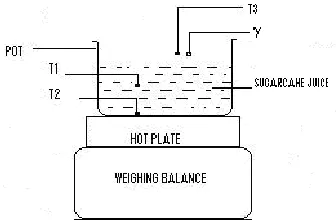
The schematic view of the experimental unit is shown in Fig. 1. It consists of a hot plate connected through a variac to
control the rate of heating of the sugarcane juice in a pot of capacity 3.2 liters. The temperatures of Juice (T1) and pot
bottom (T2) were measured by a digital temperature indicator
(least count of 0.1 oC) with calibrated copper-constantan thermocouples. The relative humidity (γ) and temperature above the juice surface (T3) were measured by a digital
humidity/temperature meter (model Lutron-HT3006 HA). It had a least count of 0.1% relative humidity and 0.1 oC temperature. The heat input was measured by a calibrated digital wattmeter having a least count of 1 watt. The mass of juice evaporated during its heating was measured by an electronic weighing balance (capacity 6 kg; Scaletech, model TJ-6000) having a least count of 0.1g.
ISSN:
0975-833X
International Journal of Current Research
Vol. 3, Issue, 7, pp.247-251, July, 2011
INTERNATIONAL JOURNAL OF CURRENT RESEARCH
Article History:
Received 15th
February, 2011 Received in revised form 29th
March, 2011 Accepted 29th
April, 2011 Published online 16th
July 2011
Key words:
Sugarcane juice; Jaggery making; Sensible heating;
Fig. 1. Schematic view of experimental unit
Experimental procedure
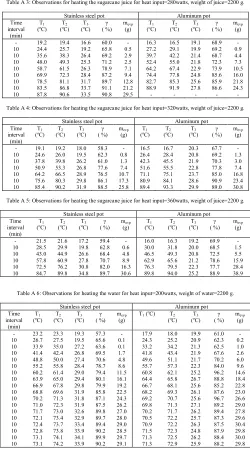
Fresh sugarcane juice sample purchased from the local market was heated in a stainless steel cylindrical pot (200 mm in diameter, 102 mm deep and 1.6 mm thick) for different heat inputs ranging from 200 to 360 watts. The necessary data of temperature, mass evaporated and relative humidity were recorded up to 90 oC (i.e. sensible heating mode range). All the experimental parameters were recorded after every 10 minute time interval. The mass evaporated during heating of sugarcane juice for each set of observations were obtained by subtracting two consecutive readings in a given time interval. Different sets of heating of sugarcane juice were obtained by varying the input power supply from 200 to 360 watts. In order to know the relative heating performance, the same experimentation procedure was followed in an aluminum pot. The experimental results at different rates of heat inputs for both the pots are reported in Appendix-A (Tables A1-A5). For every run of the sugarcane juice heating, constant mass of the juice sample was taken i.e. 2200 g. To draw a comparison, the above mentioned process was also repeated for water under the same working conditions. The experimental results for water heating at 200 watts are reported in Table A6 (Appendix-A).
Thermal modeling and theoretical considerations
The convective heat transfer coefficient for evaporation was determined by using the following relations [15]:
n vc CGr
K X h
Nu Pr Or
n vc CGr
X K
h Pr (1)
The rate of heat utilized to evaporate moisture is given as [16]
c e
c
e h PT PT
Q 0.016
.
(2)
(
T
c
T
1and
T
e
T
3 Used from Appendix-A, Tables A1-A6)On substituting
h
c from Eq. (1), Eq. (2) becomes
c
e
n v
e C Gr PT PT
X K
Q 0.016 Pr
.
(3)
The moisture evaporated is determined by dividing Eq. (3) by latent heat of vaporization
and multiplying the area ofpan
A
p and time interval
t
.Gr
P T P T
AtC X K t
A Q
m c e p
n v p
e
ev
0.016 Pr
.
(4)
Let
PT PT
A t KX K
p e c
v
016 . 0
n ev CGrK m
Pr
(5)
Taking the logarithm of both sides of Eq. (5),
Pr
ln ln
ln C n Gr
K
mev
(6)
This is the form of a linear equation,
c
mx
y
Where
K m
y ev
ln ,
m
n
,x
ln
Gr
Pr
andc
ln
C
Values of
m
andc
in Eq. (7) are obtained by using the simple linear regression method and then, the constant ‘C
’ and exponent ‘n
’ can be obtained from the above equations. The different thermal physical properties of humid air, such as specific heat (C
v), thermal conductivity (K
v), density (
v),viscosity (
v), and partial vapor pressure,P
T
were determined by using expressions given elsewhere [12, 17]. The experimental errors were evaluated in terms of percent uncertainty (internal + external) for the mass of sugarcane juice evaporated. The following two equations were used for internal uncertainty [18]: % internal uncertainty = (UI/mean ofthe total observations) ×100 (8)
And
o N I
N U
2 2
2 2
1
Where
is the standard deviation andN
o are the number of sets. For external uncertainty, the least counts of all the instruments used in measuring the observation data were considered.RESULTS AND DISCUSSION
The convective heat transfer coefficients for sensible heating of sugarcane juice in stainless steel and aluminum pots were calculated by using the experimental data from Tables A1- A5 (Appendix A). These data were used to determine the values of constants (C & n) in the Nusselt number expression. The values of ‘C’ and ‘n’ obtained for sensible heating of sugarcane juice in a stainless steel pot at different rate of heat inputs are reported in Table 1. After evaluating the values of constants, the values of convective heat transfer coefficients were determined from Eq. (1). The results for the convective heat transfer coefficients are also reported in Table 1. The values of constants and the convective heat transfer coefficients for sensible heating of sugarcane juice in an aluminum pot are given in Table 2. It can be seen from Tables 1 & 2 that the values of convective heat transfer coefficients increase with the increase in the rate of heat inputs.
Table 1: Values of C, n and hc for sugarcane juice and water
heating in a stainless steel pot at different heat inputs
Heat input (W) Weight (g) C n hc (W/m2 oC)
Sugarcane juice
200 2200 1.10 0.20 2.17-2.44
240 2200 1.03 0.22 2.74-3.25
280 2200 0.97 0.23 3.04-3.72
320 2200 1.01 0.23 3.25-4.22
360 2200 0.99 0.24 3.65-4.86
Water
[image:2.612.318.548.658.744.2]Table 2: Values of C, n and hc for sugarcane juice and water heating in
aluminum pot at different heat inputs
Heat input (W)
Weight (g)
C n hc (W/m2 oC)
Sugarcane juice
200 2200 1.01 0.21 2.34-2.75
240 2200 1.01 0.23 3.41-3.85
280 2200 0.99 0.24 3.93-4.44
320 2200 1.00 0.24 4.02-4.67
360 2200 1.01 0.25 4.20-5.83
Water
200 2200 1.03 0.27 5.13-5.92
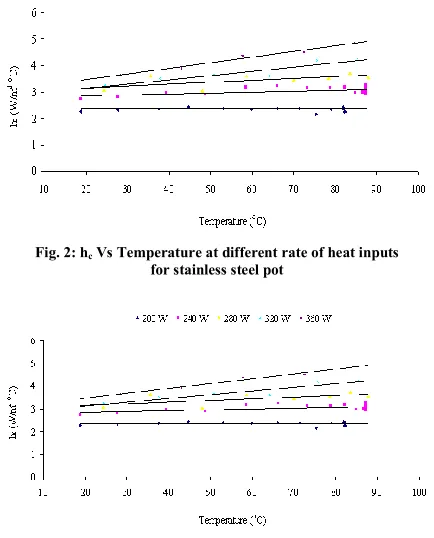
[image:3.612.328.538.128.232.2]The effect of rate of heat inputs on the convective heat transfer coefficients for sugarcane juice heating in stainless steel and aluminum pots are shown in Figs. 2 & 3 respectively. It can be seen from Figs. 2 & 3 that the convective heat transfer coefficients increase with the increase in heat inputs. Further it can also be seen that the convective heat transfer coefficients increase with the increase in operating temperature for each rate of heat inputs. These results are in accordance with those reported in literature [11].
Fig. 2: hc Vs Temperature at different rate of heat inputs
for stainless steel pot
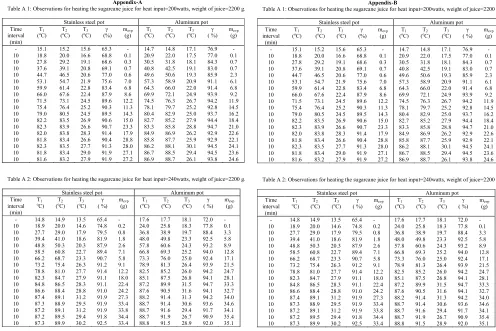
Fig. 3: hc Vs Temperature at different rate of heat inputs for an
aluminum pot
The average values of convective heat transfer coefficients for sugarcane juice were also calculated to compare the heating performance of stainless steel and aluminum pots which are plotted in Fig. 4. It can be seen from Fig. 4 that the convective heat transfer coefficients during heating of sugarcane juice in an aluminum pot are higher for the given range of heat inputs and it varies from 8.94% to 22.32%. In order to make a comparison, the convective heat transfer coefficients during heating of water in both the pots were also determined at 200 watts which are also reported in Tables 1 & 2. It can be seen from Tables 1 & 2 that the convective heat transfer coefficients for sugarcane juice are lower in comparison to water which may be due to the presence of sugar and other
minerals particulates. The percent uncertainty (internal + external) was observed to be in the range of 34.31 % to 52.87% and the different values of the convective heat transfer coefficients were found to be within the range of the percent experimental error.
Fig. 4: h Vs heat inputs for stainless steel and an aluminum pot
Conclusions
The following results have been drawn from the present research work:
1. The values of convective heat transfer coefficients increase with an increase in rate of heat inputs from 200 to 360 watts. It was observed to vary from 2.17 to 4.86 W/m2oC and 2.34 to 5.83 W/m2oC for stainless steel and aluminum pots respectively. It was found higher in the case of aluminum pot surfaces and was observed to vary from 8.94% to 22.32%.
2. The convective heat transfer coefficient increases with an increase in operating temperature.
3. The value of convective heat transfer coefficient of sugarcane juice was observed lower in comparison to water which may be due to the presence of sugar and other minerals particulates.
4. The experimental errors in terms of percent uncertainty were found to be in the range of 34.31 % to 52.87%. 5. It is expected that this study will be beneficial to design
sugarcane juice processing equipment for jaggery making.
REFERENCES
[1] Madan, HK, Jaiswal, UK, Kumar, S and Khanna, SK, (2004), ‘Improvement on the Gur (Jaggery) making plant for rural areas’, J. of Rural Tech., 1(4), pp 194-196.
[2] Anwar, SI, (2010), ‘Fuel and energy saving in open pan furnace used in jaggery making through modified juice boiling/concentrating pans’, Energy Conversion and Management, 51, pp 360-364.
[3] Dunkle, RV, (1961), ‘Solar water distillation: the roof type still and a multiple effect diffusion still’, International Development in Heat Transfer, ASME, Proc. International Heat Transfer, Part V, University of Colorado, pp 895-902.
[4] Clark, JA, (1990), ‘The steady state performance of a solar still’, Solar Energy, 44, pp 43-49.
[image:3.612.70.287.298.567.2][6] Adhikari, RS, Kumar, A and Kumar, A, (1990), ‘Estimation of mass transfer rates in solar stills’, Energy Res., 14, pp 737-744.
[7] Adhikari, RS, Kumar, A and Sodha, MS, (1991), ‘Thermal performance of a multi-effect diffusion solar still’, Energy Res., 15, pp 769-779.
[8] Adhikari, RS, Kumar, A and Sotha, GD, (1995), ‘Simulation studies on a multi stage tray solar still’ Solar Energy, 54(5), pp 317-325.
[9] Kumar, S and Tiwari, GN, (1996), ‘Estimation of convective mass transfer in solar distillation system’ Solar Energy, 57(6), pp 459-464.
[10] Tiwari, GN, Minocha, A, Sharma, PB and Khan, ME, (1997), ‘Simulation of convective mass transfer in solar distillation process’, Energy Conversion Management 38(8), pp 761-770.
[11] Tiwari, GN, Kumar, S and Prakash, O, (2003), ‘Study of heat and mass transfer from sugarcane juice for evaporation, Desalination, 159, pp 81-96.
[12] Kumar, M, Prakash, O and Kasana, KS, (In press), ‘Experimental investigation on natural convective heating of milk’, Journal of Food Process Engineering, accepted on July, 2010.
[13] Tiwari, GN, Prakash, O and Kumar, S, (2004), ‘Evaluation of convective heat and mass transfer for pool boiling of sugarcane juice’, Energy Conversion and Management, 45, pp 171-179.
[14] Rane, MV and Jabade, SK, (2005), ‘Freeze concentration of sugarcane juice in a jaggery making process’, Applied Thermal Engineering, 25, pp 2122-2137.
[15] Tiwari, GN, “Solar Energy Fundamentals, Design, Modelling and Applications”, Narosa Publishing House, New Delhi, 1997, pp 58-74.
[16] Malik, MAS, Tiwari, GN, Kumar, A and Sodha, MS, “Solar distillation”, Oxford Pergamon press, New York, 1982, pp 1-58.
[17] Anwar, SI and Tiwari, GN, (2001), ‘Evaluation of convective heat transfer coefficient in crop drying under open sun drying conditions’, Energy Conversion Management, 42(5), pp 627-637.
[18] Nakra, BC and Chaudhary, KK, ‘Instrumentation, measurement and analysis’, Tata McGraw Hill, New Delhi, 1985, pp 33.
[image:4.612.59.555.338.669.2]Appendix-A
Table A 1: Observations for heating the sugarcane juice for heat input=200watts, weight of juice=2200 g. Stainless steel pot Aluminum pot
Time interval
(min) T1
(oC)
T2
(oC)
T3
(oC)
γ (%)
mevp
(g) T1
(oC)
T2
(oC)
T3
(oC)
γ ( %)
mevp
(g) - 15.1 15.2 15.6 65.3 - 14.7 14.8 17.1 76.9 - 10 18.8 20.0 16.6 68.8 0.1 20.9 22.0 17.5 77.0 0.1 10 27.8 29.2 19.1 68.6 0.3 30.5 31.8 18.1 84.3 0.7 10 37.6 39.1 20.8 69.1 0.7 40.8 42.5 19.1 83.0 0.7 10 44.7 46.5 20.6 77.0 0.6 49.6 50.6 19.3 85.9 2.3 10 53.1 54.7 21.9 75.6 7.0 57.3 58.9 20.9 91.1 6.1 10 59.9 61.4 22.8 83.4 6.8 64.3 66.0 22.0 91.4 6.8 10 66.0 67.6 22.4 87.9 8.6 69.9 72.1 24.9 93.9 9.2 10 71.5 73.1 24.5 89.6 12.2 74.5 76.3 26.7 94.2 11.9 10 75.4 76.4 25.2 90.3 11.3 78.1 79.7 25.2 92.8 14.5 10 79.0 80.5 24.5 89.5 14.3 80.4 82.9 25.0 93.7 16.2 10 82.2 83.5 26.9 90.6 15.0 82.7 85.2 27.9 94.4 18.4 10 82.3 83.9 26.6 90.7 23.3 83.3 85.8 28.8 94.7 21.0 10 82.0 83.8 28.3 91.4 17.9 84.9 86.9 26.2 92.9 22.6 10 81.8 83.4 26.6 90.4 28.8 85.8 87.7 25.9 92.9 22.1 10 82.3 83.5 27.7 91.3 28.0 86.2 88.1 30.1 94.5 24.1 10 81.8 83.4 29.0 91.9 27.1 86.7 88.5 29.4 94.5 23.6 10 81.6 83.2 27.9 91.9 27.2 86.9 88.7 26.1 93.8 24.6
Table A 2: Observations for heating the sugarcane juice for heat input=240watts, weight of juice=2200 g. Stainless steel pot Aluminum pot
Time interval (min) T1 o C) T2 (o C) T3 (o C) γ ( %) mevp (g) T1 (o C) T2 (o C) T3 (o C) γ ( %) mevp (g) - 14.8 14.9 13.5 65.4 - 17.6 17.7 18.1 72.0 - 10 18.9 20.0 14.6 74.8 0.2 24.0 25.8 18.3 77.8 0.1 10 27.7 29.0 17.9 79.5 0.8 36.8 38.9 19.7 88.4 3.3 10 39.4 41.0 18.6 81.9 1.8 48.0 49.8 23.3 92.5 5.8 10 48.8 50.3 20.3 87.9 2.6 57.8 60.6 24.3 93.2 8.9 10 58.5 60.8 22.7 89.4 7.1 66.8 69.3 25.2 94.0 12.8 10 66.2 68.7 23.3 90.7 5.8 73.3 76.0 25.0 92.4 17.1 10 73.2 75.4 26.3 91.2 9.1 78.9 81.3 26.4 93.9 21.5 10 78.8 81.0 27.7 91.4 12.2 82.5 85.2 26.0 94.2 24.7 10 82.3 84.7 27.9 91.1 18.0 85.1 87.5 26.8 94.1 28.1 10 84.8 86.5 28.3 91.1 22.4 87.2 89.9 31.5 94.7 33.3 10 86.6 88.4 28.8 91.0 24.2 87.6 90.5 31.6 94.1 32.7 10 87.4 89.1 31.2 91.9 27.3 88.2 91.4 31.3 94.2 34.0 10 87.3 88.9 29.5 91.9 33.4 88.7 91.4 30.6 93.6 34.6 10 87.2 89.1 31.2 91.9 33.8 88.7 91.6 29.4 91.7 34.1 10 87.2 89.5 29.4 91.8 34.4 88.7 91.9 26.7 90.9 35.4 10 87.3 89.9 30.2 92.5 33.4 88.8 91.5 28.9 92.0 35.1
Appendix-B
Table A 1: Observations for heating the sugarcane juice for heat input=200watts, weight of juice=2200 g. Stainless steel pot Aluminum pot
Time interval (min) T1 (o C) T2 (o C) T3 (o C) γ (%) mevp (g) T1 (o C) T2 (o C) T3 (o C) γ ( %) mevp (g) - 15.1 15.2 15.6 65.3 - 14.7 14.8 17.1 76.9 - 10 18.8 20.0 16.6 68.8 0.1 20.9 22.0 17.5 77.0 0.1 10 27.8 29.2 19.1 68.6 0.3 30.5 31.8 18.1 84.3 0.7 10 37.6 39.1 20.8 69.1 0.7 40.8 42.5 19.1 83.0 0.7 10 44.7 46.5 20.6 77.0 0.6 49.6 50.6 19.3 85.9 2.3 10 53.1 54.7 21.9 75.6 7.0 57.3 58.9 20.9 91.1 6.1 10 59.9 61.4 22.8 83.4 6.8 64.3 66.0 22.0 91.4 6.8 10 66.0 67.6 22.4 87.9 8.6 69.9 72.1 24.9 93.9 9.2 10 71.5 73.1 24.5 89.6 12.2 74.5 76.3 26.7 94.2 11.9 10 75.4 76.4 25.2 90.3 11.3 78.1 79.7 25.2 92.8 14.5 10 79.0 80.5 24.5 89.5 14.3 80.4 82.9 25.0 93.7 16.2 10 82.2 83.5 26.9 90.6 15.0 82.7 85.2 27.9 94.4 18.4 10 82.3 83.9 26.6 90.7 23.3 83.3 85.8 28.8 94.7 21.0 10 82.0 83.8 28.3 91.4 17.9 84.9 86.9 26.2 92.9 22.6 10 81.8 83.4 26.6 90.4 28.8 85.8 87.7 25.9 92.9 22.1 10 82.3 83.5 27.7 91.3 28.0 86.2 88.1 30.1 94.5 24.1 10 81.8 83.4 29.0 91.9 27.1 86.7 88.5 29.4 94.5 23.6 10 81.6 83.2 27.9 91.9 27.2 86.9 88.7 26.1 93.8 24.6
Table A 2: Observations for heating the sugarcane juice for heat input=240watts, weight of juice=2200 g. Stainless steel pot Aluminum pot
Table A 3: Observations for heating the sugarcane juice for heat input=280watts, weight of juice=2200 g. Stainless steel pot Aluminum pot
Time interval
(min) T1
(o
C) T2
(o
C) T3
(o
C) γ ( %)
mevp
(g) T1
(o
C) T2
(o
C) T3
(o
C) γ ( %)
mevp
(g) - 19.2 19.4 16.6 60.0 - 16.3 16.5 19.1 68.9 - 10 24.4 25.7 19.2 65.8 0.5 27.2 29.1 19.9 69.2 0.9 10 35.6 38.3 26.4 69.2 2.9 39.7 42.2 21.4 68.7 4.4 10 48.0 49.3 25.3 71.2 2.5 52.4 55.0 21.8 72.3 7.3 10 58.7 61.5 26.3 78.9 7.1 64.2 67.4 22.9 73.9 10.5 10 69.9 72.3 28.4 87.2 9.4 74.4 77.8 24.8 85.6 16.0 10 78.5 81.1 31.7 89.7 12.8 82.7 85.3 25.6 85.9 21.8 10 83.5 86.8 33.7 91.1 21.2 88.9 91.9 27.8 86.6 24.3 10 87.8 90.6 33.5 90.8 29.5 - - - - - Table A 4: Observations for heating the sugarcane juice for heat input=320watts, weight of juice=2200 g.
Stainless steel pot Aluminum pot Time
interval (min)
T1
(oC)
T2
(oC)
T3
(oC)
γ ( %)
mevp
(g) T1
(oC)
T2
(oC)
T3
(oC)
γ ( %)
mevp
(g) - 19.1 19.2 18.0 58.3 - 16.5 16.7 20.3 67.7 - 10 24.6 26.0 19.5 62.3 0.8 26.4 28.4 20.8 69.2 1.3 10 37.8 39.8 26.2 61.0 1.3 42.3 45.5 21.9 70.3 3.0 10 50.9 53.3 26.8 77.6 7.4 51.6 55.5 22.8 77.8 7.4 10 64.2 66.5 28.9 76.5 10.7 71.1 75.1 23.7 85.0 16.8 10 75.6 80.3 29.8 86.1 17.3 80.9 84.1 28.6 90.9 23.4 10 85.4 90.2 31.9 88.5 25.8 89.4 93.3 29.9 89.0 30.8 Table A 5: Observations for heating the sugarcane juice for heat input=360watts, weight of juice=2200 g.
Stainless steel pot Aluminum pot Time
interval (min)
T1
(oC)
T2
(oC)
T3
(oC)
γ ( %)
mevp
(g) T1
(oC)
T2
(oC)
T3
(oC)
γ ( %)
mevp
(g) - 21.5 21.6 17.2 59.4 - 16.0 16.3 19.2 69.9 - 10 28.5 29.9 19.8 62.8 0.6 30.0 31.8 20.0 68.5 1.5 10 43.0 44.9 26.6 68.4 4.8 46.5 49.3 20.8 72.5 5.5 10 57.8 60.9 27.8 70.7 8.9 62.9 65.6 21.2 78.6 15.9 10 72.5 76.2 30.8 82.0 16.3 76.3 79.5 22.3 77.7 28.4 10 84.7 89.8 34.8 89.7 30.6 89.8 94.0 25.2 88.9 38.9
Table A 6: Observations for heating the water for heat input=200watts, weight of water=2200 g. Stainless steel pot Aluminum pot Time
interval (min)
T1
(oC)
T2
(oC)
T3
(oC)
γ ( %)
mevp
(g)
T1 (oC) T2
(oC)
T3
(oC)
γ ( %)
mevp