Analysis of Fractional PID Controller Parameters on Time Domain
Specifications using Nelder-Mead Algorithm & Interior Point Algorithm
D. Shanmukha Chandra Kumar
1, B.T.Krishna
21
Student, Dept. of ECE, UCEK, JNTU Kakinada, AP, India
2
Professor, Dept. of ECE, UCEK, JNTU Kakinada
,
AP, India
---***---Abstract - Fractional PID controller is an extension ofclassical order PID controller having five parameters rather than three guidelines for the effect of classical PID controller parameters on the time domain analysis are available but for fractional order PID controller there is no guidelines available particularly for the order of integration and order of differentiation. To assist fine tuning ,the effect of the order of differentiation and integration parameters on the time domain specification on various order plants are investigated using nelder mead algorithm and interior point algorithm. The relation between parameters (integration and differentiation) and time domain parameters (rise time, peak time, overshoot, settling time) are observed using nelder mead algorithm and interior point algorithm. The design and simulation is done by using MATLAB and fractional order modeling and control tool box. In general classical PID controller is a kind of feedback control loop mechanism that is widely used in control systems. PID has good stability, In order to improve its stability in control systems several attempts to enhance the classical PID controller, one of them is Fractional order PID controller.
Key Words: fractional order PID controller, fractional order calculus, effect of parameters
1. INTRODUCTION
In general for classical PID controller guidelines are available for the effect of classical controller parameters on the time domain specifications. However, no guidelines are available for fractional PID controllers, particularly for the order of differentiation (µ) and integration (λ). To assist with fine tuning, the effect of the order of differentiation and integration parameters on the time domain specifications for various plants are investigated.
Fractional calculus provides an excellent instrument for the description of memory and hereditary properties of various materials and processes. This is the primary advantage of fractional derivatives in comparison to classical integer order models, where such dynamics not taken into account. The advantages of fractional derivatives become more appealing in the modeling of mechanical, electrical and electro-mechanical properties of real materials, as well as in the description of rheological properties of rocks, and in many other fields. Recent times have wide application of field fractional integrals and derivatives also in the theory of control of dynamical systems, where the controlled system
or/and the controller is described by a set of fractional differential equations
2. FRACTIONAL PID CONTROLLER
A. FRACTIONAL CALCULUS:
The mathematical modeling and simulation of systems and processes, based on the description of their properties in terms of fractional derivatives, naturally leads to differential equations of fractional order the necessity to solve such equations to obtain the response for a particular input. Thought in existence for more than 300 years, the idea of fractional derivatives and integrals has remained quite a strange topic, very hard to explain, due to absence of a specific tool for the solution of fractional order differential equations. Fractional order calculus has gained acceptance in last couple of decades. J.Liouville made the first major study of fractional calculus in 1832. In 1867, A.K.Grunwald worked on the fractional operations. G. F. B. Riemann developed the theory of fractional integration in 1892. Fractional order mathematical phenomena allow us to describe and model a real object more accurately than the classical “integer” methods. Earlier due to lack of available methods, a fractional order system was used to be approximated as an integer order model. But at the present time, there are many available numerical techniques which are used to approximate the fractional order derivatives and integrals.
In fractional calculus, the differentiation integration operator, is defined as follows
Here α >0 it becomes differentiation if α<0 it becomes integration.
B. DEFINITIONS:
© 2019, IRJET | Impact Factor value: 7.34 | ISO 9001:2008 Certified Journal
| Page 610
where n is an integer number, which satisfies the condition (n−1) ≤ α ≤ n, α is a real number, and a and t are the limits of integration. For example, if α is 0.8, then n would be 1 because 0 ≤ 0.8 ≤ 1.
The Riemann Liouville (RL) fractional definition is given by the following equation
=
where n is an integer number, which satisfies the condition (n−1) ≤ α ≤ n, α is a real number, J is the integral operator, and a and t are the limits of integration .
In the Grunwald-Letnikov, the derivative and integral have the same definition which is depending on the multi derivative integer calculus, so the general definition of Grunwald-Letnikov is:
Where = represents the coefficients of the
polynomial . The coefficients can also be obtained recursively from
=1, = r =1,2…………
A fractional PID controller has five parameters for tuning, Fig. 1 shows a block diagram of the fractional PID controller, which has the following structure
fig1. Fractional order PID controller
E(s) is the Laplace of error signal, KP is the proportional constant gain, KI is the integration constant gain, KD is the derivative constant gain, λ is the order of integration and µ is the order of differentiator. A fractional PID controller becomes a PID controller if λ = µ = 1 as shown in the Fig. 2.
Fig 2. Fractional order pid controller
3. literature survey:
This section provides a brief survey of the state of the art techniques in fractional order controller design. The main difference between integer order PID controller and fractional order PID controller is where iopid fails to complete the task there fopid works efficiently complete them successfully. for example in fractional order designed for wind turbine generator fractional order PI controller properly tracks the input command while integer order pad controller unable to cope up with the input command due backlash phenomena. The fractional order controller accurately tracks the reference input under parameter variations while integer order pad controller becomes unstable under the same conditions.
Podlubny given a more flexible structure PIλDµ by
extended in traditional notion of PID controllers [11] with the controller gains define the fractional differ-integrals as design variables. And givens several intelligent techniques for efficient tuning of such fractional order PIλDµ controllers.
Fractional order control works in controlled environment that suffers from classical problems of overshoot and resonance.
4.Proposed method:
Five different systems were simulated to study the relationships between the order of fractional parameters and the time domain specifications by varying the order of fractional parameters in the fractional PID controller. As mentioned earlier, the plants were of first order, second order, higher order, fractional order systems, and first order system with delay time system (FOPDT). The higher-order plant was described by H. Panagopoulos in 2002 [32], whereas the fractional-order plant was described by I. Podlubny in 1994 [24]. The general structure of the first order delay time and second-order systems was considered for the simulations.
The optimization approach used for tuning the plants is shown in Fig. 3. The Nelder Mead method was used for the simulation [33] for optimizing the parameters of the fractional PID controller. This method finds out minimum of a function from more than one independent variables without using derivatives. A simplex has n+1 points in n dimensional space, which represents the number of independent variables. For tuning of fractional PID controller, the integrated square error (ISE) was chosen as the performance index. This measure is more useful because the range of error was large in most cases and was thus more appropriate for designing the controller. ., and it is given for unity feedback system considering unit step input,
fig3. Optimization approach for fopid controller
The procedure to apply optimization can be seen in fomcon toolbox. Using manual we can derive the fopid controller values in simulink.
Fopid controller values for neldermead optimization
λ μ
Plant1 991.71 248.02 0.999 1.912*10-5 0.098
Plant 2 987.89 43.683 0.185 999.92 1.063 Plant 3 3.56 0.0002 0.145 6.98 1.7791 Plant 4 92.143 549.08 0.8479 392.2 1.176 Plant 5 0.1191 0.2738 0.6750 0.8728 0.7918
Fopid controller values for interior point optimization
λ μ
Plant1 991.71 227.482 0.443 208.327 1.077 Plant 2 764.09 53.54 0.9936 996.93 1.034 Plant 3 0.782 0.1017 0.0699 0.2851 0.4876 Plant 4 157.65 181.47 1.176 137.92 1.245 Plant 5 0.328 0.0425 1.1923 0.046 0.0202
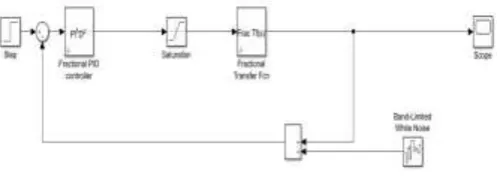
These values are used in the simulink to find the behavior of rise time, peak time, settling time percentage of peak overshootcan be followed in fig4.
Fig 4: simulink diagram
By using the algorithms and simulink diagram we obseve the various values of λ, μ for changing of rise time, peak time, settling time, percentage of peak overshoot for each plant.
Nelder mead optimization values for
[image:3.595.310.561.381.469.2]© 2019, IRJET | Impact Factor value: 7.34 | ISO 9001:2008 Certified Journal
| Page 612
The bar graphs for changing μ values for the plant 1
The bar graphs for changing λ values for the plant2
The bar graphs for changing μ values for the plant2
The bar graphs for changing λ values for the plant3
The bar graphs for changing μ values for the plant3
The bar graphs for changing μ values for the plant4
The bar graphs for changing λ values for the plant5
The bar graphs for changing μ values for the plant5
Interior point optimization graphs
The bar graphs for changing λ values for the plant1
The bar graphs for changing μ values for the plant1
© 2019, IRJET | Impact Factor value: 7.34 | ISO 9001:2008 Certified Journal
| Page 614
The bar graphs for changing μ values for the plant2
The bar graphs for changing λ values for the plant3
The bar graphs for changing μ values for the plant3
The bar graphs for changing λ values for the plant4
The bar graphs for changing μ values for the plant4
The bar graphs for changing μ values for the plant5
5. CONCLUSIONS
In this paper, the effect of differentiation (µ) and integrator (λ) order are investigated on various time domain specifications. Maximum overshoot has a particular characteristic of the order of differentiation from 0 to 2. Other specifications (rise, peak, and settling times) showed no particular pattern that matched the increase in the value of the parameters independently. However, following points are observed:
–There exists a particular relationship between µ and maximum overshoot (MP).
–By changing the values of λ and µ, the time domain specifications can be further improved, which is advantage of the fractional PID controller.
–For a fractional order model, the influence is almost same for different values of λ on time domain specifications.
–The settling time goes worst as µ approaches 2 for integer order system.
The finding will facilitate in the tuning of fractional PID controllers, an especially useful feature for the plug-and-play type of controllers. The effect on the fractional-order parameters may be estimated for a given system, such as a first-order system or a second-order system.
REFERENCES
[1] Experimental analysis of fractional order PID controller on time domain specifications. Pritesh Shah1,∗and Sudhir Agashe2, Progr. Fract. Differ. Appl. 3, No. 2, 141-154 (2017)
[2] M. Patil, V. Vyawahare and M. Bhole, A new and simple method to construct root locus of general fractionalorder systems, ISA Transact. 53(2), 380-390 (2014).
[3] M. A. Rahimian and M. S. Tavazoei, Improving integral square error performance with implementable fractional-order PI controllers, Opt. Contr. Appl. Meth. 35(3), 303-323 (2014).
[4] A Flexible MATLAB Tool for Optimal Fractional order PID controller Design Subjected to specifications
TEPLJAKOV Aleksei1, PETLENKOV Eduard1, BELIKOV Juri1,2 (2012).
[5] Y. Luo, Y. Q. Chen, C. Y. Wang and Y. G. Pi, Tuning fractional order proportional integral controllers for fractional order systems, J. Proc. Contr. 20(7), 823-831 (2010)
[6] I. Podlubny, Fractional differential equations: an introduction to fractional derivatives, fractional differential equations, to methods of their solution and some of their applications, vol. 198, Academic Press, 1998.
[7] C. A. Monje, Y. Q. Chen, B. M. Vinagre, D. Xue and V. Feliu, Fractional-order systems and controls: fundamentals and applications, Springer, 2010