TO STUDY THE THERMODYNAMIC PARAMETERS OF
SUBSTITUTED THIOCARBAMIDOPHENOL IN 70% MIXED
SOLVENTS AT CONSTANT TEMPERATURE BY
CONDUCTOMETRIC METHOD.
S.O. Mohoda* and D.T. Tayadea
a
*Department of Chemistry, Government Vidarbha Institute of Science and Humanities, Amravati 444 604, Maharashtra State, India.
a
Department of Chemistry, Government Vidarbha Institute of Science and Humanities, Amravati 444 604, Maharashtra State, India.
ABSTRACT
Recently in laboratory, thermodynamic parameters of 2-p-chlorophenyl thiocarbamidophenol [p-CPTCP] and 2-tolyl thiocarbamidophenol [TTCP] have been investigated conductometrically at different concentration in 70% ethanol-water mixed solvent at constant temperature. Conductivity play vital role in drug diffusion. This work hightlight investigation of G,k,µ values. The thermodynamic parameters ΔH,ΔG and ΔS for the ion pair formation
determine from the value of ion association constant at constant temperature. This measurement revealed that solvent-solvent, solute-solvent and solute-solute interaction and the effects of various substitutents.
KEYWORDS: Substituted thiocabamidophenol, Dissociation
constant, Thermodynamic parameters.
INTRODUCTION
Conduction of electrolytic solution explained by number of ions of electrolyte in solution. A Conductometric measurement of electrolytic solution provided valuable information concerned to solubility and permeability of drugs, which are essential biopharmaceutical
parameters. These two parameters are accountable for effective bioavailability and good in
Volume 6, Issue 3, 1712-1716. Research Article ISSN 2277– 7105
*Corresponding Author
S.O. Mohod
Department of Chemistry,
Government Vidarbha
Institute of Science and
Humanities, Amravati 444
604, Maharashtra State,
India.
Article Received on 18 Jan. 2017,
Revised on 08 Feb. 2017, Accepted on 28 Feb. 2017
enhance the solubility dissociation rate and oral bioavailability of weakly water soluble drugs.[2] Hydrotropic solubalisation is considered as one of secure method of solubalisation.[3] Many researchers investigated stability of drugs by solubility enhancer[4,5] but no one has given proper explanation of this phenomenon. Conductometric measurements of alkali metals in different proportions of mixed solvents were investigated by Izonfuo and Obunwo6 and Roy et al.[7] Bald et al[8] investigated thermodynamic and conductometric studies on NaI solutions in water-isobutanol mixtures at 298.15K. Nasrabadi et al[9] investigated conductomtric study of complex formations between some substituted pyrimidines and some
metal ions in acetonitrile and the determination of thermodynamic parameters. Conductometric studies of the thermodynamic of complexation of Zn2+, Ni2+, Co2+, Pb2+, Mn2+, Cu2+ ions with 1,13-bis (8-quinolyl)-1,4,7,10,13-pentaoxatridecane in binary solvent mixtures were reported by Payehghadr et al.[10]
In this study the investigation of 2-p-chlorophenyl thiocarbamidophenol [p-CTCP] (L3) and 2-tolylthiocarbamido phenol [TTCP] (L4) at different concentration at constant temperature
(308.15K). The analysis of data done by shedlovasky method. The observed values of ion association constant at various concentrations provide information to examine thermodynamic parameters.
EXPERIMENTAL SECTION
In this research work all solutions are freshly prepared. AR grade chemical are used. The solutions 0.1M, 0.05M, 0.025M and 0.0125M of 2-p-chlorophenyl thiocarbamidophenol
[p-CTCP] (L3) and 2-tolylthiocarbamido phenol [TTCP] (L4) were prepared in 70% ethanol-water mixtures. Thermostat was used to maintain the thermal equilibrium of drug solution. After thermal equilibrium the conductance of solution was measured.
RESULT AND DISCUSSION
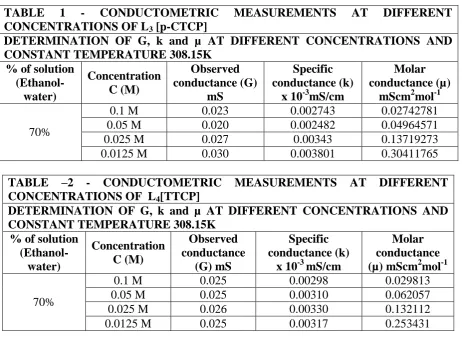
The solution of 0.1M was firstly prepared then after by using serial dilution method the solutions of 0.05M, 0.025M and 0.0125M were prepared in 70% ethanol-water mixture. The
conductances of solutions were measured by using conductivity bridge at 303.15K.
TABLE 1 - CONDUCTOMETRIC MEASUREMENTS AT DIFFERENT
CONCENTRATIONS OF L3 [p-CTCP]
DETERMINATION OF G, k and µ AT DIFFERENT CONCENTRATIONS AND CONSTANT TEMPERATURE 308.15K
% of solution (Ethanol-water) Concentration C (M) Observed conductance (G) mS Specific conductance (k)
x 10-3mS/cm
Molar conductance (µ)
mScm2mol-1
70%
0.1 M 0.023 0.002743 0.02742781
0.05 M 0.020 0.002482 0.04964571
0.025 M 0.027 0.00343 0.13719273
0.0125 M 0.030 0.003801 0.30411765
TABLE –2 - CONDUCTOMETRIC MEASUREMENTS AT DIFFERENT
CONCENTRATIONS OF L4[TTCP]
DETERMINATION OF G, k and µ AT DIFFERENT CONCENTRATIONS AND CONSTANT TEMPERATURE 308.15K
% of solution (Ethanol-water) Concentration C (M) Observed conductance (G) mS Specific conductance (k)
x 10-3 mS/cm
Molar conductance (µ) mScm2mol-1
70%
0.1 M 0.025 0.00298 0.029813
0.05 M 0.025 0.00310 0.062057
0.025 M 0.026 0.00330 0.132112
0.0125 M 0.025 0.00317 0.253431
With the known literature method, the specific constant(Ksp), log(Ksp) and thermodynamic parameters viz. change in free energy(ΔG), change in entropy(ΔS) and change in enthalpy(ΔH) of [p-CTCP] and [TTCP] at various molar concentration at constant
temperature which is shown in Table-3 and Table-4.
TABLE 3- CONDUCTOMETRIC MEASUREMENTS AT DIFFERENT
CONCENTRATIONS OF L3[p-CTCP]
DETERMINATION OF Ksp, log Ksp, ∆G,∆H and ∆S AT DIFFERENT CONCENTRATIONS AND CONSTANT TEMPERATURE
SYSTEM:LIGAND-4 [TTCP] MEDIUM - 70% Ethanol-Water Mixture
Temp T (°C)
Conc.
C (M) Ksp Log Ksp
∆G kJmol-1
∆H kJmol-1
∆S kJmol-1K-1
308.15K
0.1 0.00044858 -3.34816 19424.62 -62444.92 -270.20 0.05 0.00036742 -3.43484 19927.49 -64056.68 -277.18 0.025 0.00070146 -3.15400 18298.18 -58804.05 -254.46 0.0125 0.00086172 -3.06464 17779.74 -57138.04 -247.25
TABLE 3- CONDUCTOMETRIC MEASUREMENTS AT DIFFERENT
CONCENTRATIONS OF L4[TTCP]
DETERMINATION OF Ksp, log Ksp, ∆G,∆H and ∆S AT DIFFERENT CONCENTRATIONS AND CONSTANT TEMPERATURE
[image:3.595.69.532.67.406.2] [image:3.595.65.530.508.777.2]T (°C) C (M) kJmol-1 kJmol-1 kJmol-1K-1
308.15K
0.1 0.00062764 -3.20229 18578.34 -59693.69 -258.32 0.05 0.00067988 -3.16757 18376.93 -59046.37 -255.52 0.025 0.00077031 -3.11333 18062.26 -58052.05 -251.20 0.0125 0.00070868 -3.14955 18272.40 -58727.77 -254.13
CONCLUSION
Table-1 and Table-2 showed that the observed conductance (G), specific conductance (k)
decreases and molar conductance (µ) were increases at constant temperature. The specific conductance (G) decreases and molar conductance (µ) increases along with decreasing molar concentrations.
Table-3 and Table-4 specifies that when we going from molar concentration 0.1M to
0.125M concentration solutions the values Ksp, log Ksp, ΔH, ΔS decreases while ΔG decreases at constant temperature. These parameters influence by structures and nature of synthesized compounds. The temperatures, molar concentration and percentages composition directly affects the thermodynamic parameters. These parameters links with other like solute-solute, solute-solvent and solvent-solvents interactions. Internal geometry and inter and intra-hydrogen bonding also affects these parameters.
REFERENCES
1. Chakrabarty S., Shukla D., Jain A., Mishra B., Singh S., “Assessment of solubilization characteristics of different surfactants for carvedilol phosphate as function of pH.” J.
Coll. Int. Sci., 2009; 335(2): 242-249.
2. Pouton C.W., “Enhancement of solubility and dissolution rate of oral bioavailability of poorly water soluble drugs are still challenging aspect for pharmaceutical technology.” Euro. J. Pharma. Sci., 2006; 29: 278-287.
3. Drug information for health care professional, 17th Ed., USPDI, 1997; 16-46.
4. Agrawal S., Pancholi S.S., Jain N.K., Agrawal G.P., “Hydrotropic solubilization of
nimesulide for parenteral administration.” Int. J. Pharma., 2004; 274(2): 149-155. 5. Poochkian G.D., Gradock J.C., J. Pharma. Sci., 1994; 68: 728-732.
6. Izonfuo W.A.L., Obunwa C.C., Ind. J. Chem., 1999; 939.
7. Roy M.N., Nandi D., Hazra D.K., “Conductance studies of alkali metal chlorides and bromides in aqueous binary mixture of tetrahydrofuran at 25.” J. Ind. Chem. Soc., 1993;
8. Bald A., Gregorowicz J., Szejgis A., “Thermodynamic and conductrometric studies on NaI solutions in water-isobutanol mixture at 298.15 K.” Physics and Chemistry of
Liquids, 1993; 26(2): 121-133.
9. Nasrabadi N.R., Ahmadi F., Pourmortazavi S.M., Ganjali N.R., Alizadeh K., “Conductorometric study of complex formation between some substituted pyrimidines and some metal ions in acetonitrile and the determination of thermodynamic parameters.”
J. of Molecular Liquids, 2009; 144(1-2): 97-101.
10.Payehghadr M., Taghdiri M., Zamani A., Hesaraki N., “Conductometric studies of the
thermodynamic of complexation of Zn2+, Ni2+, Co2+, Pb2+, Mn2+, Cu2+ ions with 1,13-bis (8-quinolyl)-1,4,7,10,13-pentaoxatridecane in binary solvent mixtures.” Iranian J. of