www.wjpr.net Vol 4, Issue 1, 2015. 1197
FORMULATION DEVELOPMENT AND
IN VITRO
EVALUATION OF
PULSATILE RELEASE TABLET OF BUDESONIDE
S. Jeganath a* and K. Senthilkumaranb
a
Department of Pharmaceutics, Padmavathi College of Pharmacy and Research Institute,
Dharmapuri, Tamil nadu, India.
b
Department of Pharmaceutics, K.K. College of Pharmacy, Chennai, India.
ABSTRACT
The objective of this study was to develop a ileo caecal targeted drug
delivery of budesonide for the treatment of IBD. Budesonide were
selected as model standard drugs to treat IBD. Budesonide is a potent,
synthetic non-halogenated corticosteroid with high topical
anti-inflammatory effect and little systemic effects. Tablets were prepared
by using Crospovidone and Eudragit L30D coating for the burst release
in the ileo caecal region. The formulations were evaluated for
pharmacopoeial quality control tests and all the physical parameters
evaluated were within the acceptable limits. Formulation F11 was
proved to be good drug content, dimensional stability, lag time and
drug release in the ileo caecal region as compared to the other
formulations. Stability studies were carried out on the optimized
formulation F11 for period of 3 months at 400c/75 %RH. Finally it was observed that there was no change in physiochemical and physical properties as well as in drug release profile
even after storage at 45 °C and 75 % for three months.
KEYWORDS: Budesonide. ileo caecal, Lag time, Stability study.
INTRODUCTION
Colon specific drug delivery system (CSDDS) refers to targeting of drugs into the lower GIT,
which occurs primarily in the large intestine or also referred as colon. The delivery of drugs
to the colon has number of therapeutic implications in the field of drug delivery. CSDDS is
considered to be beneficial in the local and systemic treatment of ileo caecal and colon
related diseases and disorders. These include the topical treatment of diseases associated with
Volume 4, Issue 01, 1197-1208. Research Article ISSN 2277– 7105
Article Received on 25 October 2014,
Revised on 20 Nov 2014, Accepted on 15 Dec 2014
*Correspondence for
Author
S. Jeganath
Department of
Pharmaceutics,
Padmavathi College of
Pharmacy and Research
Institute, Dharmapuri,
www.wjpr.net Vol 4, Issue 1, 2015. 1198
the colon like inflammatory bowel disease (IBD) and inflammatory bowel syndrome (IBS),
colon cancer, diverticula and amebiasis. Also it may be used for the oral delivery of proteins
and peptides. Colon is rich in lymphoid tissue, uptake of antigens into the mast cells of
colonic mucosa produces rapid local production of antibodies and this helps in efficient
vaccine delivery.[1] CSDDS is of importance when delay in absorption is desired from therapeutic point of view in treatment of diseases showing peak symptoms in early morning
i.e. chronotherapy that are sensitive to circadian rhythms e.g. nocturnal asthma, rheumatic
disease, ischemic heart disease (IHD) and angina attack. As dosage forms remains longer in
the colon rather than in the small intestine, hence colon specific formulations could be used to
prolong drug delivery.[2-3]
Colonic delivery is considered to be better than rectal delivery of dosage form (suppositories
and enemas) due to lack of efficacy and a high variability in distribution of drugs, e.g.
suppositories are effective only in rectum due to their confined use, while enemas can offer
only topical treatment only to the sigmoid and descending colon. Thus, oral route is preferred
but absorption and degradation in upper GIT is major obstacle and must be circumvented for
successful colonic delivery.[4-5]
Treatment might be more effective if the drug substances were targeted directly on the site of
action in the colon. Lower doses might be adequate and if so systemic side effects may be
reduced. This region of the colon is recognized as having a somewhat less hostile
environment with less diversity and intensity of activity than in the stomach and small
intestine. Additionally, the colon has a longer retention time and appears highly responsive to
agents that enhance the absorption of poorly absorbed drugs. As colon is relatively free of
peptidases such special delivery systems will have a fair chance for oral administration
undigested, unchanged and fully active peptide drugs. The simplest method for targeting of
drugs to the colon is to obtain slower release for longer period of time or immediate release in
abundant quantity. The special placement of drugs into selected locations in the GIT is quite
difficult due to physiological constraints, namely, motility and mucus turnover. In some cases
drugs may be unstable in upper GIT and are generally not well absorbed from the lumen of
the GIT due to their relatively large molecular size and high peptidase activity. Protecting
drugs from hydrolysis in GIT and subsequently releasing these drugs in the ileum or colon
may result in better systemic bioavailability. Specific systemic absorption in the colonic
region offers interesting possibilities for the treatment of disease susceptible to circadian
www.wjpr.net Vol 4, Issue 1, 2015. 1199
Budesonide were selected as model standard drugs to treat IBD. Budesonide is a potent,
synthetic non-halogenated corticosteroid with high topical anti-inflammatory effect and little
systemic effects. Additionally, budesonide has low incidence of adverse effects and high
topical effects and has important suggestions in the pharmacotherapy of IBD, both in
treatment of UC and CD. It was found that less than 5% of drug was available beyond the
ileum and caecum, and hence, colonic delivery still needs to be optimized by a more reliable
targeted system. The objective of the study is to develop budesonide loaded tablets with
Crospovidone and based on coating with Eudragit L30D Presently in the market there is no
immediate release Budesonide formulation to target ileo caecal region. Most common site for the occurrence of Crohn’s disease is ileo caecal region; hence it is necessary to target
Budesonide in this region without being release in stomach or small intestine for effective
treatment.[10-12]
MATERIAL AND METHODS
Material
Budesonide was a kind gift from Ethypharma Pvt. Ltd. (Mumbai, India). Eudragit L30D was
purchased from the Research-Lab Fine Chem Industries (Mumbai, India). Polyethylene
Glycol was purchased from Clariant Pvt. Ltd. (Mumbai, India). Magnesium Stearate, lactose,
polyvinyl pyrolidone (PVP K30), Methylene chloride were purchased from Signet India Pvt.
Ltd, Mumbai. Crospovidone and Isopropyl alcohol (IPA) were purchased from Loba
Chemicals (Mumbai, India). Other excipients used were of standard pharmaceutical grade
Methods
Preparation of budesonide pulsatile release tablets
The granules were prepared by wet granulation method. The drug budesonide, crospovidone
and lactose were passed through sieve 40# separately and blended thoroughly. After proper
mixing then slowly added the binding solution containing PVP K-30 in IPA till fine uniform
granules were obtained. The wet mass was passed through sieve 16# and dried at 50°C for 30
minutes to get the moisture content less than one. Then lubricate the dried granules with
magnesium stearate which were already passed through sieve 40#. Then lubricated granules
were compressed on cadmach tablet punch machine for all formulations.[13] Granules were evaluated for micromeritic properties such as bulk density, tapped density, angle of repose
www.wjpr.net Vol 4, Issue 1, 2015. 1200 Coating of Eudragit L30D over drug containing tablets
Eudragit L30D coating dispersion requires addition of glycol as plasticizer and stirred the
solution for few minutes with a magnetic stirrer. This solution was sprayed over the above
processed tablets up to 5, 10, 15, 20, 25, 30 and 35% weight gain.
Table 1: Composition of budesonide preliminary experimental batch F1-F8 (all
quantities in mg)
Formulation code F1 F2 F3 F4 F5 F6 F7 F8
Budesonide 9 9 9 9 9 9 9 9 Crospovidone 15 20 25 25 20 25 20 25 PVP K30 10 10 10 10 10 10 10 10 Magnesium stearate 10 10 10 10 10 10 10 10 Lactose 136 131 126 126 131 126 131 126 Eudragit L30D
Weight gain 5% 5% 5% 10% 10% 15% 15% 20%
Table 2: Composition of budesonide preliminary experimental batch F9-F15 (all
quantities in mg)
Formulation code F9 F10 F11 F12 F13 F14 F15
Budesonide 9 9 9 9 9 9 9 Crospovidone 20 25 20 25 20 25 20 PVP K30 10 10 10 10 10 10 10 Magnesium stearate 10 10 10 10 10 10 10 Lactose 131 126 131 126 131 126 131 Eudragit L30D
Weight gain 20% 25% 25% 30% 30% 35% 35%
Evaluation of granules
Angle of repose: Granules flowability was determined by calculating angle of repose by
funnel technique. A funnel with 10 mm inner diameter of stem was fixed at a height of 2 cm
above theplatform. About 20 g of granules was slowly passed along the wall of funnel till the
tip of the pile produced and touches the stem of the funnel. A rough circle was drawn about
the pile base and the radius of the sample cone was measured.[14] Angle of repose was calculated from average radius using formula:
θ = tan-1 (h/r) Where,
θ = angle of repose
h = height of the pile
www.wjpr.net Vol 4, Issue 1, 2015. 1201 Bulk Density
Apparent bulk density of granules was determined by the graduated cylinder and measuring the volume and weight “as it is”.[15]
Bulk density was calculated by using following formula:
Weight of sample in grams Bulk density (g/mL) =
Volume occupied by the sample
Tapped Density
Tapped density was determined with the aid of tapped density tester apparatus. In this method
20 gm of sample was poured gently through a glass funnel in to a 100mL graduated cylinder.
The cylinder was then placed in the apparatus and parameters were set to carry out the test.
[15]
Volume occupied by the sample after tapping were recorded and tapped density was
calculated by following formula:
Weight of sample in grams Tapped density (g/mL) =
After tapping volume occupied by the sample
Hausner ratio
It provides an indication of the degree of densification which could result from vibration of
the feed hopper. Hausner ratio closer of less than 1.25 indicates good flow, while greater than
1.5 indicates poor flow materials.[16]
Tapped density Hausner ratio = Bulk density
Carr’s index or % compressibility
Carr’s index or % compressibility [16]
was calculated by using following equations:
Tapped density - Bulk density
Carr’s index = × 100 Tapped density
Tablet thickness and diameter
Tablet Thickness and diameter were accurately measured by using digital vernier caliper in
mm.[17]
Hardness and Friability
Hardness of tablet was determined by Monsanto hardness tester. Friability test was done by
Roche friabilator. Ten tablets were weighed and were subjected to the combined effect of
www.wjpr.net Vol 4, Issue 1, 2015. 1202
at distance of 6 in. with each revolution. Operated for 100 revolutions, the tablets were de
dusted and reweighed. [18] The percentage friability was calculated. W1 −W2
F = × 100 W1
Where F represents the percentage weight loss, and W1 and W2 are the initial and final tablet
weights, respectively.
Weight variation
Twenty tablets were selected at random and average weight was determined. Then individual
tablets were compared with the average weight.[18]
Drug content uniformity
For determination of drug content, weighed and powder 5 tablets, then weighed accurately a
quantity of the powder equivalent to 9mg of budesonide were transferred to the conical flask
and suitably diluted with 10mL phosphate buffer (pH 7.4) respectively. The solution was
filtered through Whatman filter paper (no.41), and assayed at 245nm, using a JASCO V630,
Japan UV- spectrophotometer.[19]
In vitrodrug release study
The test was carried out in a rotating basket method specified in the USP XXIII dissolution
tester (Electrolab, TDT-08L, India) at a rotation speed of 100 rpm in 900 ml dissolution
medium at 37 ± 0.5 °C in media with pH 1.2 (HCl 0.1 N), pH 7.4 and pH 6.8 (phosphate
buffer) for 2 h, 3 h, and till the end of the test, respectively. 5 ml aliquots of the dissolution
fluid were removed at specified time intervals and replaced with fresh dissolution medium
and assayed for the amount of budesonide by spectrophotometer (JASCO V630, Japan) at
wavelength 245 nm. The dissolution data was analyzed to calculate % drug released at
different time intervals.[20-21]
Stability study
Stability Study was carried out for formulations to assess its stability, as per ICH guidelines.
The optimized formulation were wrapped in the laminated aluminum foils and was placed in
the accelerated stability chamber (6CHM-GMP, Remi Instrument Ltd., Mumbai) at elevated
temperature and humidity conditions of 400C/ 75% RH and a control sample was placed at an ambient condition for a period of three months. Sampling was done at a predetermined time
www.wjpr.net Vol 4, Issue 1, 2015. 1203
[image:7.595.77.523.363.636.2]analyzed for the drug content, in vitro drug release and other physicochemical parameters.
[22-23]
RESULT AND DISCUSSION
Granules evaluation
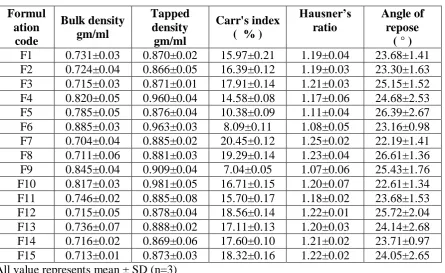
The physical characteristics of the granules (F1 to F15) such as bulk density, tapped density,
carr's index, hausner ratio, angle of repose were determined. The results are given in Table 3.
The bulk densities were ranged from 0.704-0.885 gm/ml. The tapped densities were ranged
from 0.886-0.981 gm/ml. The carr's compressibility index were ranged from 7.04-20.45%.
The hausners rations were found to be in the limit 1.07-1.25. The angles of repose of all
formulation were found to be between the limit 22.19°-26.61°. All the formulation shows
excellent flow properties. So, the granules passes the evaluated tests and subjected to next
stage of work compression.
Table 3: Evaluation of budesonide pulsatile release tablets granules (F1-F15)
Formul ation
code
Bulk density gm/ml
Tapped density
gm/ml
Carr's index ( % )
Hausner’s ratio
Angle of repose
( ° )
F1 0.731±0.03 0.870±0.02 15.97±0.21 1.19±0.04 23.68±1.41 F2 0.724±0.04 0.866±0.05 16.39±0.12 1.19±0.03 23.30±1.63 F3 0.715±0.03 0.871±0.01 17.91±0.14 1.21±0.03 25.15±1.52 F4 0.820±0.05 0.960±0.04 14.58±0.08 1.17±0.06 24.68±2.53 F5 0.785±0.05 0.876±0.04 10.38±0.09 1.11±0.04 26.39±2.67 F6 0.885±0.03 0.963±0.03 8.09±0.11 1.08±0.05 23.16±0.98 F7 0.704±0.04 0.885±0.02 20.45±0.12 1.25±0.02 22.19±1.41 F8 0.711±0.06 0.881±0.03 19.29±0.14 1.23±0.04 26.61±1.36 F9 0.845±0.04 0.909±0.04 7.04±0.05 1.07±0.06 25.43±1.76 F10 0.817±0.03 0.981±0.05 16.71±0.15 1.20±0.07 22.61±1.34 F11 0.746±0.02 0.885±0.08 15.70±0.17 1.18±0.02 23.68±1.53 F12 0.715±0.05 0.878±0.04 18.56±0.14 1.22±0.01 25.72±2.04 F13 0.736±0.07 0.888±0.02 17.11±0.13 1.20±0.03 24.14±2.68 F14 0.716±0.02 0.869±0.06 17.60±0.10 1.21±0.02 23.71±0.97 F15 0.713±0.01 0.873±0.03 18.32±0.16 1.22±0.02 24.05±2.65 All value represents mean ± SD (n=3)
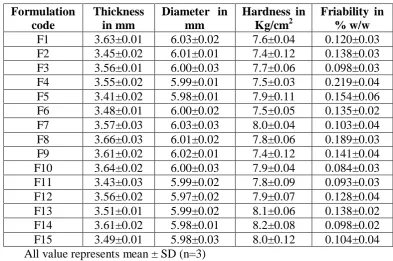
Tablet thickness and diameter: The thickness of the tablets range from 3.41-3.66 mm
respectively. The diameter of the tablet in the range of 5.97-6.03mm.There is no variation in
www.wjpr.net Vol 4, Issue 1, 2015. 1204 Hardness, friability and weight uniformity of tablets: The hardness of the tablets was
within the range and optimum for burst release, and ranging from 7.4-8.2 Kg/cm2 for all F1-F15 formulations.The friability of all formulations was ranging from 0.093-0.219 % w/w and
passes as per IP limit should not be more than 1 % w/w. The weight uniformity of tablet in all
formulation was observed to be within the IP limit 10 %. All formulations were complying
with the official test. The values were mentioned in Table 4 and Table 5.
Drug content: The assays of all formulation from F1-F15 were found to be between
99.19-99.71 %. The result shows that all formulation containing drug were within the limit (99-101
%). The values were mentioned in Table 5.
Table 4: Evaluation of budesonide pulsatile release tablets (F1-F15)
Formulation code
Thickness in mm
Diameter in mm
Hardness in Kg/cm2
Friability in % w/w
[image:8.595.99.493.303.564.2]F1 3.63±0.01 6.03±0.02 7.6±0.04 0.120±0.03 F2 3.45±0.02 6.01±0.01 7.4±0.12 0.138±0.03 F3 3.56±0.01 6.00±0.03 7.7±0.06 0.098±0.03 F4 3.55±0.02 5.99±0.01 7.5±0.03 0.219±0.04 F5 3.41±0.02 5.98±0.01 7.9±0.11 0.154±0.06 F6 3.48±0.01 6.00±0.02 7.5±0.05 0.135±0.02 F7 3.57±0.03 6.03±0.03 8.0±0.04 0.103±0.04 F8 3.66±0.03 6.01±0.02 7.8±0.06 0.189±0.03 F9 3.61±0.02 6.02±0.01 7.4±0.12 0.141±0.04 F10 3.64±0.02 6.00±0.03 7.9±0.04 0.084±0.03 F11 3.43±0.03 5.99±0.02 7.8±0.09 0.093±0.03 F12 3.56±0.02 5.97±0.02 7.9±0.07 0.128±0.04 F13 3.51±0.01 5.99±0.02 8.1±0.06 0.138±0.02 F14 3.61±0.02 5.98±0.01 8.2±0.08 0.098±0.02 F15 3.49±0.01 5.98±0.03 8.0±0.12 0.104±0.04 All value represents mean ± SD (n=3)
Table 5: Evaluation of budesonide pulsatile release tablets (F1-F15)
Formulation code
Weight variationin mg
Drug content (%)
www.wjpr.net Vol 4, Issue 1, 2015. 1205
F10 183.71±3.74 99.19±0.07 F11 185.40±2.53 99.52±0.11 F12 181.82±1.85 99.37±0.06 F13 175.73±1.25 99.43±0.06 F14 183.66±3.07 99.62±0.17 F15 184.91±1.18 99.71±0.06 All value represents mean ± SD (n=3)
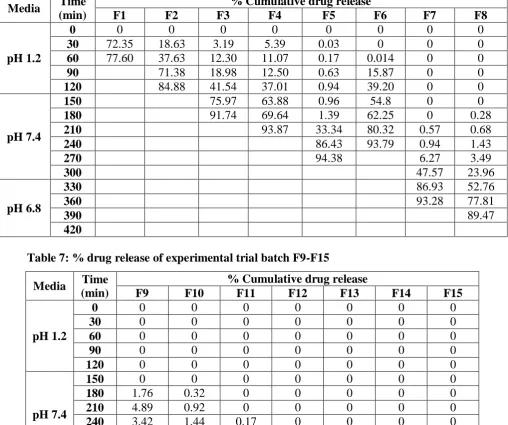
In vitro drug release study of budesonide experimental trial batches
In vitro drug release study was conducted in pH 1.2, 7.4 and 6.8 simulated to stomach, small
[image:9.595.135.460.72.160.2]intestine and colon respectively.
Table 6: % drug release of experimental trial batch F1-F8
Media Time
(min)
% Cumulative drug release
F1 F2 F3 F4 F5 F6 F7 F8
pH 1.2
0 0 0 0 0 0 0 0 0
30 72.35 18.63 3.19 5.39 0.03 0 0 0
60 77.60 37.63 12.30 11.07 0.17 0.014 0 0
90 71.38 18.98 12.50 0.63 15.87 0 0
120 84.88 41.54 37.01 0.94 39.20 0 0
pH 7.4
150 75.97 63.88 0.96 54.8 0 0
180 91.74 69.64 1.39 62.25 0 0.28
210 93.87 33.34 80.32 0.57 0.68
240 86.43 93.79 0.94 1.43
270 94.38 6.27 3.49
300 47.57 23.96
pH 6.8
330 86.93 52.76
360 93.28 77.81
390 89.47
420
Table 7: % drug release of experimental trial batch F9-F15
Media Time (min)
% Cumulative drug release
F9 F10 F11 F12 F13 F14 F15
pH 1.2
0 0 0 0 0 0 0 0
30 0 0 0 0 0 0 0
60 0 0 0 0 0 0 0
90 0 0 0 0 0 0 0
120 0 0 0 0 0 0 0
pH 7.4
150 0 0 0 0 0 0 0
180 1.76 0.32 0 0 0 0 0
210 4.89 0.92 0 0 0 0 0
240 3.42 1.44 0.17 0 0 0 0
270 23.91 5.48 1.97 0.40 0 0 0
300 63.52 9.83 3.49 1.81 6.483 2.27 2.277
[image:9.595.45.554.296.721.2]www.wjpr.net Vol 4, Issue 1, 2015. 1206 360 92.68 91.74 93.79 86.936
390 93.283
420
Accelerated stability study
Budesonide optimized formulation F11 was found to be stable during accelerated stability
studies for drug content 99.52, 99.46, 99.32 and 99.27% at 0, 1, 2 and 3 months respectively
at 400c/75% RH. In vitro drug release studied and found to be 93.98, 93.18, 93.09 and 91.25% at 0, 1, 2 and 3 months respectively at 400c/75% RH. Results obtained were shown in Table 8. Finally it was observed that there was no change in physiochemical and physical
properties as well as in drug release profile even after storage at 45 °C and 75 % for three
months. It may be inferred that there was no degradation of physical properties and change in
[image:10.595.70.529.72.117.2]the matrix system of the formulation.
Table 8: Results of Accelerated stability study of optimized formulations
Optimized formulation Drug content
(%) % drug release
Initial 99.52 93.98
One month
Ambient 99.50 93.29 400c / 75%RH 99.46 93.18
Two month
Ambient 99.41 93.14 400c / 75%RH 99.32 93.09
Three month
Ambient 99.39 91.89 400c / 75%RH 99.27 91.25
CONCLUSION
UC and CD are two features of IBD. They are recognized by chronic relapsing inflammation
in the whole GI tract from mouth to anus, but are two distinct entities. Recently researchers
have shown an increased interest in investigating the effect of different anti-inflammatory
drugs used for the treatment of IBD. Hence budesonide a first line therapy drug for long term
treatment of CD and for effective short term remedy to treat UC, was selected in this research
work.
In the formulation after budesonide mixed with crospovidone in order to bring rupture of the
outer functional Eudragit L30D coat. When crosspovidone comes in contact of aqueous
[image:10.595.158.439.348.542.2]www.wjpr.net Vol 4, Issue 1, 2015. 1207
outer coat. It was observed that the process parameters and solution composition used in
Eudragit L30D coating worked with good efficiency. Increasing level of crosspovidone creats
more pressure over outer Eudragit L30D coat due to its wicking and swelling ability of
disintegrant is best utilized and thus releases drug immediately by rupturing the outer
membrane. Which confirms that the formulation have ability to target drug release in ileo
caecal region.
REFERENCES
1. Raffi R, Frankline W, Cerniglia CE. Azoreductase activity of anaerobic bacteria islolated
from human intestinal microflora. Appl Environ Microb. 1990; 56: 2146-51.
2. Arora J, Talwar N. Colonic drug delivery challenges and opportunity: An overview. Eur
Gastro Rev. 2006; 1: 165-72.
3. Friend DR. Colon specific drug delivery. Adv Drug Deliver Rev.1991; 7: 149-99.
4. Bussemer T, Otto I, Bodmeier R. Pulsatile drug delivery systems. Crit Rev Ther Drug
Carrier Syst. 2001; 18: 433-58.
5. Friend DR. Glycoside prodrugs: novel pharmacotherapy for colonic diseases. STP Pharm
Sci. 1995; 5: 70-76.
6. Watts P, Illum L. Colonic drug delivery. Drug Dev Ind Pharm. 1997; 23: 893-913.
7. Kothawade PD, Gangurde HH, Surawase RK, Wagh MA, Tamizharasi S. Conventional
and novel approaches for colon specific drug delivery: a review. e –JST. 2011; 6:33-56.
8. Chourasia MK, Jain SK. Pharmaceutical approaches to colon targeted drug delivery
systems. J Pharm Pharm Sci. 2003; 6: 33-66.
9. Gangurde HH, Chordiya MA, Tamizharasi S, Sivakumar T, Upasani CD. Approaches for
Peptides and Proteins by colon specific delivery: Review. Int J Pharm Fro Res. 2011; 1:
110-25.
10.Travis SPL, Stange EF, Lemann M, et al. European evidence based consensus on the diagnosis and management of Crohn’s disease: current management. Gut. 2006;
55:16-35.
11.Truelove SC, Witts LJ. Cortisone in ulcerative colitis. Final report on a therapeutic trial.
BMJ. 1955; 2:1041-48.
12.Podolsky DK. Inflammatory bowel disease. N Engl J Med. 2002; 347:417-29.
www.wjpr.net Vol 4, Issue 1, 2015. 1208
14.Fiese EF, Hagen TA. Preformulation In: The Theory and Practice of Industrial Pharmacy.
Lachman L, Lieberman HA, Kanig JL. 3rd Ed. Varghese Publishing House,1990; p:
183-84.
15.Wells JI, Aulton ME. Pharmaceutical Preformulation, In: Aulton’s Pharmaceutics,
Churchill Livingstone Elsevier., 3rd Ed, p. 355-56.
16.Hausner H. H. Friction condition in a mass of metal powders. Int J Powder Metall. 1967;
3: 713.
17.Khan FN, Dehghan MH. Enhanced bioavailability of atorvastatin calcium from stabilized
gastric resident formulation. AAPS Pharm Sci Tech. 2011; 12(4): 1077-1086.
18.Veerareddy PR, Nama M, Gonugunta CR. Formulation and evaluation of gastroretentive
dosage forms of clarithromycin. AAPS Pharm Sci Tech. 2008; 9(1): 231-237.
19.Jantzen GM, Robinson JR 1996. Sustained and Controlled-Release Drug Delivery
Systems in: Banker G., Rhodes, C. (Editors) Modern Pharmaceutics, 3rd ed., New York:
Marcel Dekker Inc. 575.
20.Jaleh V, Ahmadi F, Emami J, Tavakoli N, et al. Colon delivery of Budesonide using solid
dispersion in Dextran for the treatment and secondary prevention of Ulcerative colitis in
rats. Int J Prev Med. 2010; 12: 116-24.
21.Crcarevska MS, Dodov MG, Goracinova K. Chitosan coated Ca–alginate microparticles
loaded with Budesonide for delivery to the inflamed colonic mucosa. Eur J Pharm
Biopharm.2008; 68: 565-78.
22.Akhgari A, Garekani HA, Sadeghi F, Azimaie M. Statistical optimization of
Indomethacin pellets coated with pH dependent methacrylic polymers for possible
colonic drug delivery. Int J Pharm. 2005; 305: 22-30.
23.Gohel MC, Amin AF. Formulation optimization of controlled release diclofenac sodium