ISSN Online: 1945-3124 ISSN Print: 1945-3116
DOI: 10.4236/jsea.2017.105025 May 26, 2017
Tree Automata for Extracting Consensus from
Partial Replicas of a Structured Document
Maurice Tchoupé Tchendji, Milliam M. Zekeng Ndadji
Department of Mathematics and Computer Science, Faculty of Sciences, University of Dschang, Dschang, Cameroon
Abstract
In an asynchronous cooperative editing workflow of a structured document, each of the co-authors receives in the different phases of the editing process, a copy of the document to insert its contribution. For confidentiality reasons, this copy may be only a partial replica containing only parts of the (global) document which are of demonstrated interest for the considered co-author. Note that some parts may be a demonstrated interest over a co-author; they will therefore be accessible concurrently. When it’s synchronization time (e.g. at the end of an asynchronous editing phase of the process), we want to merge all contributions of all authors in a single document. Due to the asynchronism of edition and to the potential existence of the document parts offering con-current access, conflicts may arise and make partial replicas unmergeable in their entirety: they are inconsistent, meaning that they contain conflictual parts. The purpose of this paper is to propose a merging approach said by consensus of such partial replicas using tree automata. Specifically, from the partial replicas updates, we build a tree automaton that accepts exactly the consensus documents. These documents are the maximum prefixes contain-ing no conflict of partial replicas merged.
Keywords
Structured Documents, Workflow of Cooperative Edition, Merging Partial Replicas, Conflict, Consensus, Tree Automata, Automata Product, Lazy Evaluation
1. Introduction
A significant proportion of documents handled and/or exchanged by appli- cations has a regular structure defined by a grammatical model (DTD: Document Type Definition, schema [1]): they are called structured documents. The ever- increasing power of communication networks in terms of throughput and How to cite this paper: Tchendji, M.T.
and Ndadji, M.M.Z. (2017) Tree Automata for Extracting Consensus from Partial Rep- licas of a Structured Document. Journal of Software Engineering and Applications, 10, 432-456.
https://doi.org/10.4236/jsea.2017.105025
Received: March 14, 2017 Accepted: May 23, 2017 Published: May 26, 2017
Copyright © 2017 by authors and Scientific Research Publishing Inc. This work is licensed under the Creative Commons Attribution International License (CC BY 4.0).
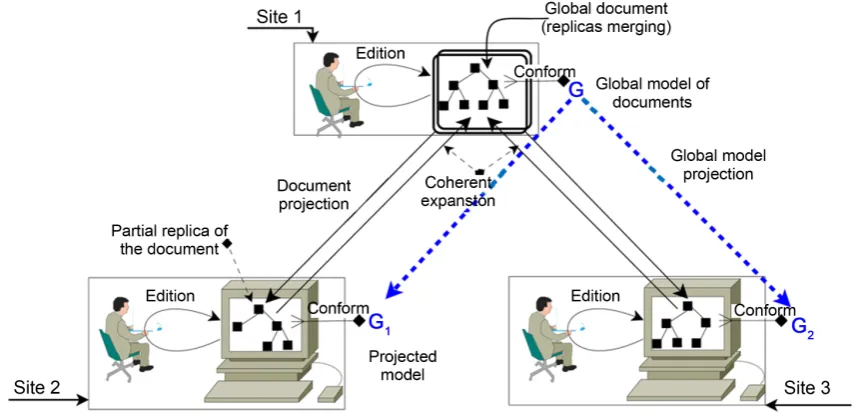
433 security, as well as efficiency is concerned, has revolutionized the way of editing such documents. Indeed, to the classical model of an author, editing locally and autonomously his document, was added the (asynchronous) cooperative editing in which, several authors located on geographically distant sites, coordinate to edit asynchronously a same structured document (Figure 1): it is an asyn- chronous cooperative editing workflow.
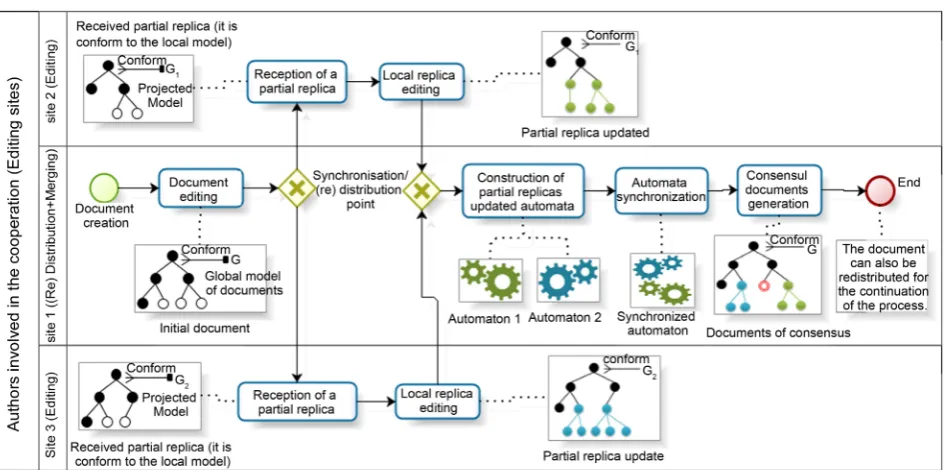
In such editing workflows (Figure 2), the desynchronized editing phases in which each co-author edits on his site his copy of the document, alternate with the synchronization-redistribution phases in which the different contributions (local replicas) are merged (on a dedicated site) into a single document, which is then redistributed to the various co-authors for the continuation of the edition. This pattern is repeated until the document is completely edited.
In the literature, there are several cooperative editing systems offering, for some, a concurrent collaborative edition of the same document (Etherpad [2], Google Docs [3], Fidus Writer [4], …), or on the other hand, a truly distributed and asynchronous edition (Wikis [5][6], Git [7][8], …) in which the co-authors work on replicas of the document; replication techniques as well as recon- ciliation strategies must then be addressed. If the collectively edited document is structured, it may in some cases be desirable for reasons of confidentiality, for example, a co-author has access only to certain information, meaning that he only has access to certain parts of the document belonging to certain given types (sorts1) of the document model. Thus, the replica
i
t edited by co-author
i
[image:2.595.107.536.450.657.2]c from the site i may be only a partial replica of the (global2) document t, obtained via a projection operation, which conveniently eliminates from global
Figure 1. The desynchronized cooperative editing of partial replicas of a structured document.
1A sort is a datum used to define the structuring rules (syntax) in a document model. Example: a
non-terminal symbol in a context free grammar, an ELEMENT in a DTD.
2We designate by global document or simply document when there is no ambiguity, the document
434
Figure 2. An orchestration diagram of an asynchronous cooperative editing workflow.
document t parts which are not accessible to the co-author in question. We call “view” of a co-author, the set of sorts that he can access [9]. Figure 1 is an illustration of such a cooperative edition in which, the edition and the merging of the (global) document in conformity to the (global) model G of documents are perform on site 1; while on site 2 and 3, other co-authors perform the edition of the partial replicas in accordance with projected models of documents G1 and G2 obtained from the global model G.
When asynchronous local editions are done on partial replicas, it can be assumed that each co-author has on his site a local document model guiding him in his edition. This local model can help to ensure that for any update maj
i
t of a partial replica ti (conform to the considered (local) model), there is at least one document t conform to the global model so that maj
i
t is a partial replica of t: for this purpose, the local model should be coherent towards the global one3. Thus, because of the asynchronism of the editing, the only inconsistencies that we can have when the synchronization time arrives are those from the concurrent edition of the same node4 (in the point of view of the global document) by several co-authors: the partial replicas concerned are said to be in conflict. This paper proposes an approach of detection and resolution of such conflicts by consensus during the synchronisation-redistribution phase, using a tree auto- maton said of consensus, to represent all documents that are the consensus of competing editions realised on the different partial replicas.
3Intuitively, a local model of document is coherent towards a global model if any (partial) document
ti that is conform to it, is the partial replica of at least one (global) document t conform to the global
model.
4Manipulated documents are structured; they can be intentionally represented by a tree. Intuitively,
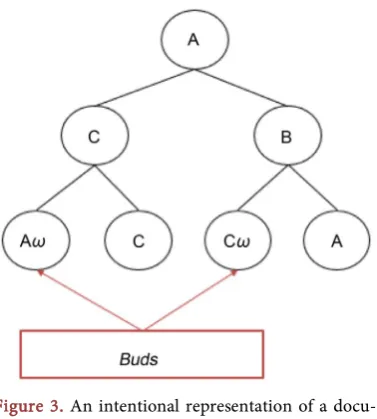
435 A structured document t is intentionally represented by a tree that possibly contains buds5[9] (see Figure 3). Intuitively, synchronizing or merging consens- ually the updates t1, , tn of n partial replicas of a document t, consists in finding a document tc conform to the global model, integrating all the nodes of
i
t not in conflict and in which, all the conflicting nodes are replaced by buds. Consensus documents are therefore the largest prefixes without conflicts in merged documents. The algorithm of consensual merging presented in this paper is an adaptation of the fusion algorithm presented in [9] which does not handle conflicts. Technically, the process for obtaining the documents forming part of the consensus is: 1) for each update maj
i
t of a partial replica ti, we associate a tree automaton with exit states A( )i recognizing the trees (conform to the global model) for which maj
i
t is a projection [9]. 2) The consensual automaton A( )sc generating the consensus documents is obtained by perfor-
ming a synchronous product of the automata A( )i with a commutative and associative operator noted
⊗
that we define. It is such that: A( )sc = ⊗A( )i . 3)It only remains to generate the set of trees (or those most representative) accepted by the automaton A( )sc , to obtain the consensus documents.
In the subsequent sections, after the presentation (Section 2) of some concepts and definitions related to the cooperative editing and tree automata, we expose (Section 3) the construction process of the operator
⊗
and a proof of cor-rection of the algorithm proposed for its implementation. The Section 4 is de- voted to the conclusion. In the appendices, we fully unfold the example intro- duced in Section 3 highlighting the major concepts outlined in this paper
(Appendix A), as well as some screenshots of an asynchronous cooperative
editor prototype operating in a distributed environment that we have developed for the experimental purposes of the algorithms described in this paper
[image:4.595.280.469.487.697.2](Appendix B).
Figure 3. An intentional representation of a docu- ment containing buds.
5A bud is a leaf node of a tree indicating that an edition must be done at that level in the tree. Edit a
436
2. Structured Cooperative Edition and Notion of Partial
Replication
2.1. Structured Document, Edition and Conformity
In the XML6 community, the document model is typically specified using a Document Type Definition (DTD) or a XML Schema [1]. It is shown that these DTD are equivalent to (regular) grammars with special characteristics called XML grammars[10]. The (context free) grammars are therefore a generalization of the DTD and on the basis of the studies they have undergone, mainly as formal models for the specification of programming languages, they provide an ideal framework for formal study of the transformations involved in XML technologies. That’s why we use them in our work as tools for specifying the structure of documents.
We will therefore represent the abstract structure of a structured document by a tree and its model by an abstract context free grammar; a valid structured document will then be a derivation tree for this grammar. A context free grammar defines the structure of its instances (the documents that are conform to it) by means of the productions. A production, generally denoted
0 1
: n
p X →X X is comparable in this context, to a structuring rule which show how the symbol X0 located in the left part of the production is divided into a sequence of other symbols X1Xn located on its right side. More formally.
Definition 1. A abstract context free grammar is given by =
(
S P, ,A)
composed of a finite set S of grammatical symbols or sorts corresponding to the different syntactic categories involved, a particular grammatical symbolA∈S called axiom, and a finite set P S S⊆ × * of productions. A production ( ) ( ) ( )
(
P0, P1, , P n)
P= X X X is denoted P X: P( )0 →XP( )1XP n( ) and P de-
notes the length of the right hand side of P. A production with the symbol X as left part is called a X-production.
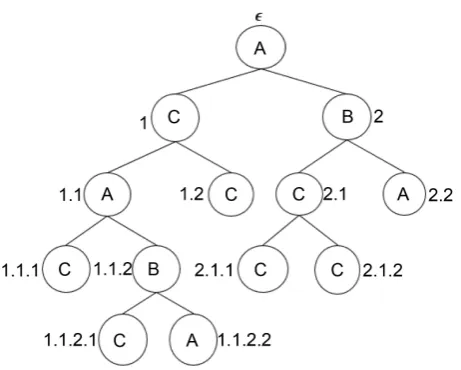
For certain treatments on trees (documents) it is necessary to designate precisely a particular node. Several indexing techniques exist, among them, the so-called Dynamic Level Numbering [11] based on identifiers with variable lengths inspired by the Dewey decimal classification (see Figure 4). According to this indexing system, a tree can be defined as follows:
Definition 2. A tree whose nodes are labelled in an alphabet S is a partial map t:* →S whose domain Dom t
( )
⊆* is a prefix closed set such that, for all u Dom t∈( )
the set{
i∈ | u i Dom t⋅ ∈( )
}
is a not empty interval of integers[
1, , n]
∩ (ε
∈Dom t( )
is the root label); the integer n is the arity of the node whose address is u. t w( )
is the value (label) of the node in t whose address is w. If t1, , tn are trees anda
∈
S
, we denote t a t=[
1, , tn]
the tree t of domain Dom t( ) { }
= ε ∪ ⋅{
i u | 1≤ ≤i n u Dom t, ∈( )
i}
with t( )
ε
=a and( )
i( )
t i u⋅ =t u .Let t be a document and =
(
S P, ,A)
a grammar. t is a derivation tree for437
Figure 4. Example of an indexed tree.
if its root node is labelled by the axiom A of , and if for all internal node 0
n labelled by the sort X0, and whose sons n1, , nn, are respectively labelled by the sorts X1, , Xn, there is one production P∈P such that,
0 1
: n
P X →X X and P n= . It is also said in this case that t belongs to the language generated by from the symbol A and it is denoted t∈L
(
, A)
or
t
∴
.There is a bijective correspondence between the set of derivation trees of one grammar and all its Abstract Syntax Tree (AST). In an AST, nodes are labelled by the names of the productions.
Definition 3. The set AST
(
,X)
of abstract syntax trees according to the grammar associated with grammatical symbol X consists of trees in the form P t[
1, , tn]
where P is a production such that X =XP( )0 , n P= and(
,)
, ( )i i i P i
t ∈AST X X = X for all
1
≤ ≤
i n
.AST are used to show that a given tree labelled with grammatical symbols is an instance of a given grammar.
A structured document being edited is represented by a tree containing buds (or open nodes) which indicate in a tree, the only places where editions (i.e. updates) are possible7. Buds are typed; a bud of sort X is a leaf node labelled by
Xω: it can only be edited (i.e extended to a sub-tree) by using a X-production of
the form P X: →X1Xn which have as effect, 1) the replacement of Xω
labelled bud by a P labelled node and, 2) the creation of n buds labelled respectively by Xiω,1≤ ≤i n. Thus, a structured document being edited and
that have the grammar =
(
S P, ,A)
as model, is a derivation tree for the extended grammar Ω =(
S S P S∪ ω, ∪ Ω,A)
obtained from as follows:for all sort X, we not only add in the set S of sorts a new sort Xω, but we also
add a new ε-production XΩ:Xω →ε in the set P of productions; so we
have: Sω=
{
X Xω, ∈S}
and SΩ={
X XΩ: ω →ε
, Xω∈Sω}
.7We are interested in this paper only in the positive edition, based on a partial optimistic replication
438
When we look at the productions of a grammar, we can notice that each sort is associated with a set of productions. From this point of view, therefore, we can consider a grammar as an application
[
]
(
)
: ,
gram symb→ prod symb (1)
which associates to each sort a list of pairs formed by a production name and the list of sorts in the right hand side of this production. Such an observation suggests that a grammar can be interpreted as a (descending) tree automaton that can be used for recognition or for the generation of its instances.
Definition 4. A (descending) tree automaton defined on Σ is a quadruplet
(
, , ,Q R q0)
= Σ
A of a set Σ of symbols; its elements are the labels of the nodes of the trees to be generated (or recognized), a set Q of states, a particular state
0
q ∈Q called initial state, and a finite set R Q⊆ × Σ ×Q* of transitions.
• An element of R is denoted q→
(
σ, , ,[
q1 qn]
)
or in an equivalent way(
1, , n)
qσ→ q q : intuitively,
[
]
1, , n
q q is the list of states accessible from the q state by crossing a transition labelled σ .
• If 1
(
)
(
)
1
1 1
1, , , , k 1, , k
k k
n n
q→σ q q q→σ q q denotes the set of transitions
associated to the state q, we denote
(
1)
(
)
1 1
1 1 1
, , , , , , k, , kk
n k n
next q=
σ
q q σ
q q the list that consists of pairs(
, 1, , i)
i i i q qn
σ . A transition of the form q→
(
σ,[ ]
)
is called final tran- sition and a state possessing this transition is a final state.One can interpret a grammar =
(
S P, ,A)
as a (descending) tree auto- maton [13] A= Σ(
, , ,Q R q0)
considering that: 1) Σ =P is the type of labels of the nodes forming the tree to recognize. 2) Q=S is the type of states and, 3)[
]
(
, , ,1 n)
q→ σ q q is a transition of the automaton when the pair
[
]
(
σ, , ,q1 qn)
appears in the list(
gram q)
8. We note A the tree auto-maton derived from .
To obtain the set ASTA of AST generated by a tree automaton A from an
initial state q0, you must: 1) Create a root node r, associate the initial state q0 and add it to the set ASTA initially empty. 2) Remove from ASTA an AST t
under construction i.e with at least one leaf node node unlabelled. Let q be the state associated to node. For all transition qσ→
(
q1, , qn)
of A, add inASTA the trees t′ which are replicas of t in which the node node has been substituted by a node node′ labelled σ and possessing n (unlabelled) sons, each associated to a (distinct) state qi of
[
q1, , qn]
. 3) Iterate step (2) until you obtain trees with all the leaf nodes labelled (they are consequently associated to the final states of A): these are AST. We note At q the fact that the tree automaton A accepts the tree t from the initial state q, and L(
A,q)
(tree language) the set of trees generated by the automaton A from the initial state q. Thus,
(
At q)
⇔ ∈(
t L(
A,q)
)
.As for automata on words, one can define a synchronous product on tree automata to obtain the automaton recognizing the intersection, the union, …, of
8Reminder: gram is the application obtained by abstraction of and have as type:
[
]
(
)
: ,
439 regular tree languages [13]. We introduce below the definition of the synchronous product of k tree automata whose adaptation will be used in the next section for the derivation of the consensual automaton.
Definition 5. Synchronous product of k automata:
Let
(
( )1 ( )1 ( )1)
(
( ) ( ) ( ))
1= Σ,Q R q, , 0 , , k = Σ,Qk ,Rk ,q0k
A A be k tree automata.
The synchronous product of these k automata A1⊗ ⊗ Ak denoted ⊗ki=1A( )i ,
is the automaton A( )sc = Σ
(
, , ,Q R q0)
defined as follows: 1) Its states arevectors of states : Q Q= ( )1 ××Q( )k ; 2) Its initial state is the vector formed by
the initial states of the different automata :
(
( )1 ( ))
0 0 , , 0kq = q q ; 3) Its transitions
are given by:
( ) ( )
(
)
(
(
( ) ( ))
(
( ) ( ))
)
( )
(
( ) ( ))
(
)
1 1 1
1 1
1
, , , , , , , ,
, , , 1
k a k k
n n
i a i i
n
q q q q q q
q q q i i k
→
⇔ → ∀ ≤ ≤
2.2. Notions of View, Projection, Reverse Projection and Merging
2.2.1. View, Associated Projection and MergingThe derivation tree giving the (global) representation of a structured document edited in a cooperative way makes visible the set of grammatical symbols of the grammar that participated in its construction. As we mentioned in Section 1 above, for reasons of confidentiality (accreditation degree), a co-author mani- pulating such a document will not necessarily have access to all of these gram- matical symbols; only a subset of them can be considered relevant for him: it is his view. A view V is then a subset of grammatical symbols (V ⊆S).
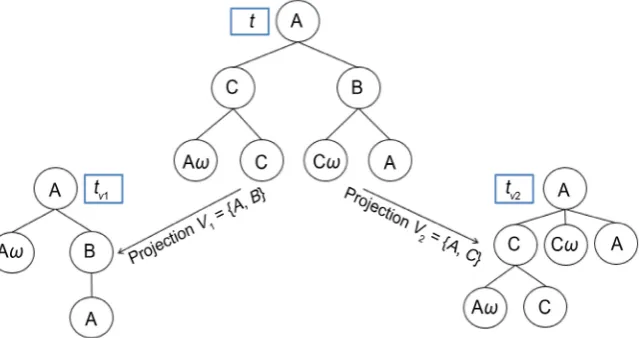
A partial replica of t according to the view V, is a partial copy of t obtained by deleting in t all the nodes labelled by symbols that are not in V. Figure 5 shows a document t (center) and two partial replicas tv1 (left) and tv2 (right) obtained
[image:8.595.215.535.544.713.2]respectively by projections from the views V1=
{
A B,}
and V2 ={
A C,}
. Practically, a partial replica is obtained via a projection operation denoted π. We therefore denoteπ
V( )
t =tV the fact that tV is a partial replica obtained by projection of t according to the view V.440
Let’s note t i ≤tmaji
V V the fact that the document i
maj
tV is an update of the document tVi, i.e. tmaji
V is obtained from tVi by replacing some of its buds by
trees. In an asynchronous cooperative editing process, there are synchronization points9 in which one tries to merge all contributions
i
maj
tV of the various co- authors to obtain a single comprehensive document tf10. A merging algorithm that does not incorporate conflict management and that relies on a solution to the reverse projection problem is given in [9].
2.2.2. Partial Replica and Reverse Projection (Expansion)
The reverse projection (also call the expansion) of an updated partial replica
i
maj
tV relatively to a given grammar =
(
S P, ,A)
, is the set TiSmaj ofdocuments conform to that admit tmaji
V as partial replica according to Vi:
( )
{
| i i}
maj maj maj maj
i i i
TS = tS ∴ πV tS =tV .
A solution to this problem using tree automata is given in [9]; in that solution, productions of the grammar are used, to bind to a view Vi⊆S a tree automaton A( )i such as the trees he recognizes from an initial state built from
i
maj
tV are exactly those having this partial replica as projection according to the view Vi: TiSmaj =L
(
A( )i, qtVi)
. Practically, a state q of the automaton A( )i is a pair(
Tag X ts ,)
where X is a grammatical symbol, ts is a forest (tree set), and Tag is a label that is either Open or Close and indicates whether the concerned state q can be used to generate a closed node or a bud. The states of A( )i are typed: a state of the form(
TagX,ts)
is of type X. We also have a function named typeState which, when applied to a state returns its type11. A transition from one state q is of one of the forms(
Close X ts ,)
→(
p q, , ,[
1 qn]
)
or[ ]
(
Open X,)
→(
Xω,[ ]
)
. A transition of the form(
Close X ts ,)
→(
p q, , ,[
1 qn]
)
is used to generate AST of type X (i.e. those whose root is labelled by a X-production) admitting “ts” for projection ac- cording to the view Vi if X does not belong to Vi, and “X ts[ ]
” otherwise. Similarly, a transition of the form(
Open X,[ ]
)
→(
Xω,[ ]
)
is used to generate asingle AST reduced to a bud of type X.
The interested reader may consult [9] for a more detailed description of the process of associating a tree automaton with a view and Appendix A for an illustration.
3. Reconciliation by Consensus
3.1. Issue and Principle of the Solution of Reconciliation by
Consensus
There are generally two distinct phases when synchronizing replicas of a
9A synchronization point can be defined statically or triggered by a co-author as soon as certain
properties are satisfied.
10It may happen that the edition must be continued after the merging (this is the case if there are still
buds in the merged document): we must redistribute to each of the n co-authors a (partial) replica
i
tV of tf such that tVi =πVi
( )
tf for the continuation of the editing process.11typeState state:: →symb
( , )
typeState Open X ts =X
( , )
441 document [14]: the updates detection phase which consists of recognizing the different replica nodes (locations) where updates have been made since the last synchronization, and the propagation phase which consists in combining the updates made on the various replicas to produce a new synchronized state (document) for each replica. In an asynchronous cooperative editing workflow of several partial replicas of a document, when you reach a synchronization point, you can end up with unmergeable replicas in their entirety as they contain not compatible updates12 they must be reconciled. This can be done by ques- tioning (cancelling) some local editing actions in order to resolve conflicts and result in a coherent global version said of consensus.
Studies on reconciling a document versions are based on heuristics [15]
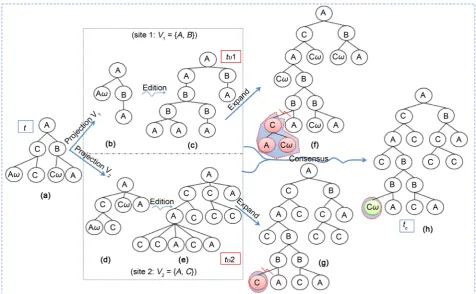
insofar as there is no general solution to this problem. In our case, since all editing actions are reversible13 and it is easy to locate conflicts when trying to merge the partial replicas (see Section 3.2), we have a canonical method to eliminate conflicts: when merging, we replace any node (of the global document) whose replicas are in conflict by a bud. Thus, we prune at the nodes where a conflict appears, replacing the corresponding sub-tree with a bud of the ap- propriate type, indicating that this part of the document is not yet edited: the documents obtained are called consensus. These are the maximum prefixes without conflicts of the fusion of the documents resulting from the different expansions of the various updated partial replicas. For example, in Figure 8, the parts highlighted (blue backgrounds) in trees (f) and (g) are in conflict; they are replaced in the consensus tree (h) by a bud of type C (node labelled Cω).
The problem of the consensual merging of k updated partial replica whose global model is given by a grammar =
(
S P, ,A)
can therefore be stated as follows :Problem of the consensual merging: Given k views
( )
Vi 1≤ ≤i k and k partialreplica
( )
maji 1 i kt
≤ ≤
V , merge consensually the family
( )
tVmaji 1≤ ≤i k is to find the mostlarge documents tmaj
S conforming to such that, for any document t con-
forming to and admitting tmaji
V as projection according to the view Vi, maj
tS and t are eventually updates each for other. i.e. (formula 2):
(
1)
( )
1
i) ,1 , such that , .
,
ii) such that ,
i i
maj maj
maj k maj
i i i i maj k maj
i i i i
i i k t t t t t
t t t T
t t t t t T
π
==
∀ ≤ ≤ ∀ ∴ = ≅
∈ ⊗ ∈ ⇔
′ ′
∃ ≤ ∈ ⊗ ∈
V V S
S S
S S
14 (2)
The solution that we propose to this problem stems from an instrumenta- lization of that proposed for the expansion (Section 2.2.2). Indeed, we use an associative and commutative operator noted
⊗
to synchronize the tree auto-mata A( )i constructed to carry out the various expansions in order to generate the tree automaton of consensual merging. Noting A( )sc this automaton, the
12This is particularly the case if there is at least one node of the global document accessible by more
than one co-author and edited by at least two of them using different productions.
13Reminder: the editing actions made on a partial replica may be cancelled as long as they do not
have been incorporated into the global document.
14The binary relation ≅ when it exists between two trees t
1 and t2 expresses the fact that they are
442
documents of the consensus are the trees of the language generated by the automaton A( )sc from an initial state built from the vector made of the initial
statesof the automata
( )
A( )i :( ), , maj ( ) maj
i i
i
sc qt consensus qt
=
L L
V V
A A .
( )sc
A is obtained by proceeding as follows: 1) For each view Vi, build the automaton A( )i who will carry out the expansion of the partial replica
i
maj
tV as previously indicated (Section 2.2.2): ( ),
maj i
i maj i t
q T
=
L
A S
A . 2) Using the op-
erator
⊗
, compute the automaton generating the consensus language( )sc = ⊗ki=1 ( )i
A A .
3.2. Consensus Calculation
Before presenting the consensus calculation algorithm, let us specify using the concepts introduced in Section 2.1 the notion of (two) documents in conflict. Let
* 1 2, :
t t →A be two trees (documents) with respectively Dom t
( )
1 and( )
2Dom t their domains. We say that t1 and t2 admit a consensus, and we note t1 t2, if theirs roots are of the same type15i.e.
(
t1 t2)
⇔(
typeNode t(
1( )
ε)
=typeNode t(
2( )
ε)
)
16. It is then say that t1 and 2t are in conflict, and it is noted t1 t2, when they admit a consensus but are
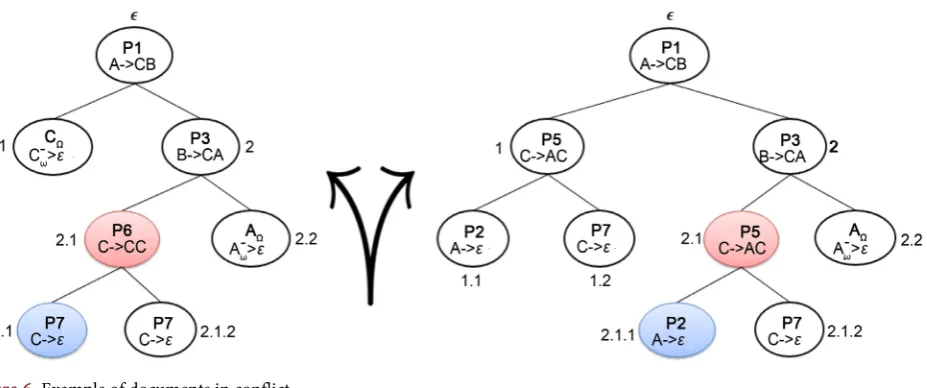
not mergeable in their entirety. Intuitively, two documents t1 and t2 (not reduced to buds) are not fully mergeable (see Figure 6), if there exists an address
( )
1( )
2 [image:11.595.73.537.444.638.2]w Dom t∈ ∩Dom t such that if we note n1 (resp. n2) the node located to address w in t1 (resp. in t2), then, n1 and n2 which are not buds are of the same type but have different labels. i.e. (formula 3):
Figure 6. Example of documents in conflict.
15Trees we handle are AST and therefore, the nodes are labelled by productions names. Any node
labelled by a X-production is said of type X. Furthermore, there is a function type Node such that type Node (t(w)) returns the type of the node located at the address w in t.
16It may then be noted that two documents (AST) admit no consensus if their roots are of different
443
( )
( )
(
)
(
)
( )
( ) ( )
( )
(
( )
(
)
(
( )
))
1 2 1 2
1 2
1 2 1 2
1 2
,
and
, and
t t with t X t X
t t
w Dom t Dom t t w t w X
typeNode t w typeNode t w
ω ω
ω
ε ≠ ε ≠
[image:12.595.271.485.71.159.2] ⇔ ∃ ∈ ∪ ≠ ≠ = (3)
Figure 6 shows two conflicting documents. In fact, at address 2.1 we have two
nodes of the same type (“C”) but edited with different C-productions: pro- duction
C
→
C C
in the first document, and productionC
→
AC
in thesecond one.
3.2.1. Consensus among Multiple (Two) Documents
Let *
1 2, :
t t →A be two trees (documents) in conflict with respectively
( )
1Dom t and Dom t
( )
2 their domains. The consensual tree tc:*→A de- rived from t1 and t2 (tc= ⊗t1 t2) has as domain the union of domains of the two trees in which we subtract elements belonging to domains of sub-trees derived from the conflicting nodes. In fact, we prune at the nodes in conflict and they appear in the consensus tree as a (unique) bud. So,( ) ( )
( )
(
( )
)
(
( )
)
( )
( )
( )
(
( )
)
(
( )
)
( )
( )
(
( )
)
(
( )
)
( )
( )
( )
( )
(
( )
)
(
( )
)
( )
1 1 2 1 2
1 1 2 2
2 1 2 1
*
1 2
2 1 2
2
if and
if and
if and
if and , . ,
, and
if
c c
t w typeNode t w typeNode t w t w t w
t w typeNode t w typeNode t w t w X
t w typeNode t w typeNode t w t w X
t w w Dom t u v tq w u v
w Dom t t w t u X typeNode t u typeNode t u
t w w Dom
ω ω ω = = = = = = ∉ ∃ ∈ = ∀ ∈ = = = ∉
( )
( )
(
( )
)
(
( )
)
( )
(
)
(
( )
)
( )
( )
( )
( )
* 11 1 2
1 2 1
2 1 2
and , . , and
if and
and and
t u v tq w u v
t u X typeNode t u typeNode t u
X typeNode t w typeNode t w t w X
t w X t w t w
[image:12.595.250.500.539.708.2]ω ω ω ω ∃ ∈ = = = = ≠ ≠ ≠ (4)
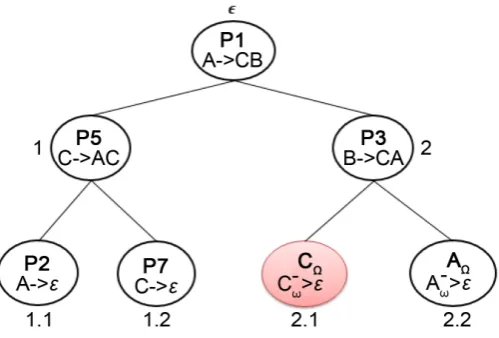
Figure 7 present the document resulting from the consensual merging of the
444
documents in Figure 6. We have prume at the level of nodes 2.1 in both do- cuments who are in conflict.
When tc = ⊗t1 t2, there may be nodes of t1 and those of t2 which are updates of the nodes of tc: it is said in this case that t1 (resp. t2) and tc are updates each for other.
Definition 6. Let t t1 2, be two documents that are not in conflict. It will be said that they are updates each for other and it is noted t t1≅ 2, if there exists at least two addresses w w, ′ of their respective domains such that t w1
( )
(resp.( )
2
t w′ ) is a bud and t w2
( )
(resp. t w1( )
′ ) is not.3.2.2. Construction of Consensus Automaton
Consideration of documents with buds requires the readjustment of some models. For example, in the following, we will handle the tree automata with exit states instead of tree automata introduced in definition 4. Intuitively, a state q of an automaton is called an exit state if there is a unique transition q→
(
Xω,[ ]
)
associated to it for generating a tree reduced to a bud of type X∈ Σ: q is then of the form (Open X,[]).
A tree automata with exit states A is a quintuplet
(
Σ, , , ,Q R q exit0)
where 0, , ,Q R q
Σ designate the same objects as those introduced in the definition 4, and
exit
is a predicate defined on the states (exit Q: →Bool). Any state q of Q for which exit q isTrue
is an exit state.A type for automata with exit states can be defined in Haskell [16][17] by:
In Section 3.2.1 above, we said that, when two nodes are in conflict, “they appear in the consensus tree as a (unique) bud”. From the point of view of automata synchronization, the concept of “nodes in conflict” is the counterpart of the concept of “states in conflict” (as we specify below) and the above extract is reflected in the automata context by “when two state are in conflict, they appear in the consensus automaton in the form of a (single) exit state”. Thus, if we consider two states of the same type 1
0
q and 2 0
q (which are not exit states) of two automata auto1 and auto2 with associated transitions families re-
spectively 1
(
1)
(
11 1)
0 1, 1 , , n, n
q → a qs a qs
and 2
(
2)
(
12 2)
0 1, 1 , , n , n
q → a qs′ a qs′ , we say that the states 1
0
q and 2 0
q are in conflict (and we note q10 q02) if there is no transition starting from each of them and with the same label, i.e.
(
1 2)
(
3(
3) {
1} (
3) {
2}
)
0 0 , , , ,o , o
q q ⇔ ∃a a qs ∈ next q a qs′ ∈ next q qs = qs′
445 If X is the type of two states q and q′ in conflict, they admit a single con- sensual state qω =
(
Open X ,[ ]
)
such as next q ,ω = (
Xω[ ]
)
. It is thereforeobvious that two given automata admit a consensual automaton when their initials states are of the same type. The following function performs this test.
The operator
⊗
used to calculate the synchronized consensual automaton ( )sc = ⊗ki ( )iA A is a relaxation of the operator used for calculating the automata product presented in the definition 5. A( )sc = Σ
(
, , , , Q R q exit0)
is an auto-maton with exit states and is constructed as follows: • Its states are vectors of states : Q Q= ( )1 ××Q( )k ;
• its initial state is formed by the vector of initial states of different automata: ( ) ( )
(
1)
0 0 , , 0k
q = q q ;
• For the exit function , it is considered that when a given automaton A( )j
reached an exit state17, it no longer contributes to behavior, but is not opposed to the synchronization of the others automata: it is said “asleep” (see listing “Consensus Listing” below, lines 16, 18 and 23). So, a state
(
1, , k)
q= q q is an exit state if: (a) all composite states qi are asleep (see listing “Consensus Listing” below, line 5) or (b) there exist any two states qi and q i jj, ≠ , components of q that are in conflict (see listing “Consensus
Listing” below, line 11) ( ) ( )
(
)
(
)
( )
{
}
(
)
(
( ) ( ))
(
)
1
, ,
, 1, , or , , ,
k
i i j
exit q q
exit q i k i j i j q q
⇔ ∀ ∈ ∃ ≠
• Its transitions are given by:
a) If exit q then q→
(
Xω,[ ]
)
is the unique transition of q; X is the type of q.b) Else
(
( )1 ( ))
(
(
( )1 ( ))
(
( )1 ( ))
)
1 1
, , k a , , k , , , , k , 1
n n
q q → q q q q ⇔ ∀i ≤ ≤i k
b1) exit q( )i and
(
( )i(
,[ ]
)
, , 1)
j
q = Open X ∀j ≤ ≤j n /*q( )i is asleep*/, else
b2) q( )i a→
(
q1( )i , , qn( )i)
.a) reflects the fact that if a state q is an exit one, we associate a single transition for generating a tree reduced to a bud of the type of q (see listing “Consensus Listing” below, line 11).
With (b1) we say that, if the component q( )i of q is an exit state, then for all
composite state
(
( )1, , ( )k)
j jq q , (1≤ ≤j n) appearing in the right hand side in the transition (b), the ith component should be asleep. Since it must not prevent other non-asleep states to synchronize, it must be of the form
(
Open X ,[ ]
)
where X is the type of the other states ( )l j
q (being yet synchronized) belonging
17The corresponding node in the reverse projection of the document is a bud and reflects the fact
446
to
(
( )1, , ( )k)
j jq q (see function forward Sleep State defined in listing “Consensus Listing” below line 23 and used in lines 16 and 18). Finally, with (b2) we stipulate that if q( )i a→
(
q1( )i , , qn( )i)
is a transition of the automaton Ai,then for all composite state
(
( )1, , ( )k)
j jq q , (1≤ ≤j n) appearing in the right
part in the transition (b) above, the ith component is ( )i j
q (see listing “Con- sensus Listing” below, lines 12 to 15).
Consensus Listing
Proposition 7. The tree automaton ( )
1 i
k i=
= ⊗
A A recognizes/generates from the initial state q0=
(
q01, , q0k)
all the trees from the consensual merging of trees recognized/generated by each automaton A( )i from the initial state q0i. Moreover, these trees are the biggest prefixes without conflicts of merged trees.( )
(
)
( )(
( ))
0
1 0
1 0
i) and
ii) prefix of ,
i
i i i i
i k
i k i
i
i t t q t t
t q
t t t q
=
=
∀ ∃ ≅
⊗ ⇔
′ ′
∀ ¬ ⊗
A
A
A (5)
Proof. A tree t is recognized by the synchronized automaton ( )
1 i
k i=
⊗ A if, and only if, one can label each of its nodes by a state of the automaton in accordance with what is specified by the transitions of the automaton. Moreover, all the leaf nodes of t must be labelled by using final transitions; in our case, they are of the form q→
(
p,[ ]
)
. This means that if a node whose initial label is a is labelled bythe state q and if it admits n successors respectively labelled by q1, , qn, then
(
1, ,)
a
n
q→ q q must be a transition of the automaton. As the automaton is deterministic18 this labelling is unique elsewhere (including the initial state attached to the root of the tree). By focusing our attention both on the state q labelling a node and its ith component
i
q, on each of the branches of t, 1) we cut as soon as we reach an exit state in relation to the automaton A( )i (i.e.
i q is
18Automata ( )i
A being deterministic (see proposition 3.3.3 of [18]), ( ) 1
i k i=
447 an exit state), or, 2) if q is an exit state (in this case we are handling a leaf) and
i
q is not, relative to A( )i (in this case, qi was in conflict with at least one other component qj of q); we replace that node with any sub-tree ti′ that can be generated by A( )i from the state
i q . So, ( )
(
)
(
( ))
1 i 0 i 0 and
k
i= t q i ti ti qi ti t
⊗ A ⇒ ∀ ∃ A ≅ (6)
since a state of A is an exit one if and only if each of its components is (in the i
A ) or if at least two of its components are in conflict. Conversely, suppose ( )
0
i
i i
t q
A , by definition of the synchronized con-
sensual automaton, we have ⊗ki=1A( )i ⊗ik=1ti
(
q01, , q0k)
. So overall( )
(
)
{
( )}
1 i, |0 1 i 0
k k
i i i i i
L ⊗=A q = ⊗=t A t q (7)
Suppose that t is recognized by ( )
1 i
k i=
⊗ A ; thus there is a labelling of its nodes with the states of ( )
1 i
k i=
⊗ A and as the transitions used for the labelling of its leaves are final. Let tp be a prefix of t. Let us show that tp is not recognized
by ( )
1 i
k i=
⊗ A using the fact that any labelling of tp has at least one leaf node labelled by a state that is not associated to a final transition. The labels associated to the nodes of tp are the same as those associated to the nodes of same addresses in t because tp is a prefix of t and ⊗ik=1A( )i is deterministic. tp is obtained from t by pruning some sub-trees of t; so naturally he has a (non-zero) number of leaf nodes that can be developed to obtain t. Let us choose a such node and call it nf. Suppose that it is labelled p and was associated with a state
(
1, ,)
f k
q = q q when labelling t. The p_transition that permit to recognize nf is not a final transition. Indeed, nf has in t p sons whose labels can be suppose to be the states qf1, , qf| |p. This means according to the labelling process and considering the fact that ( )
1 i
k i=
⊗ A is deterministic, that the single transition used for labelling nf and of its p sons is
(
1, , p)
p
f f f
q → q q
which is not a final transition. Therefore, tp is not recognized by ⊗ki=1A( )i . □
3.3. Illustration
Figure 8 is an illustration of an asynchronous cooperative editing process
generating partial replicas (Figure 8(c) and Figure 8(e)) in conflict19 from the grammar having as productions:
1 3 5
2 4 6
7
: : :
: : :
:
P A C B P B C A P C A C
P A P B B B P C C C
P C
ε
ε
→ → →
→ → →
→
(8)
Initially in the process, two partial replicas (Figure 8(b) and Figure 8(d)) are obtained by projections of the global document (Figure 8(a)). After their update
(Figure 8(c) and Figure 8(e)) a synchronization point is reached and, by
applying the approach described in Section 3.1 i.e, association of tree automata ( )1
A and A( )2 respectively to the partial replicas
tv
1
andtv
2
, their con- sensual synchronization in the automaton A( )sc =A( )1 ⊗A( )2 , and finally,19By realising expansions of each of the replicas, we respectively obtain among others, the documents
448
Figure 8. An edition with conflicts and corresponding consensus.
generation of consensus trees (Figure 8(h)). Remember that this example is fully unfold in Appendix A: therein, we present the different manipulated automata and a set of the simplest consensus documents (Figure 9).
4. Conclusions
We presented in this paper a reconciliation approach said by consensus, of partial replicas of a document submitted to an asynchronous cooperative editing process: so we opted for a partial optimistic replication approach [12]. The approach proposed is based on a relaxation of the synchronous product of auto- mata to construct an automaton capable of generating consensus documents.
The approach proposed in this paper is supported by mathematical proofs of the proposals. The presented algorithms have been implemented in Haskell [16]
and experienced in many examples (including the one introduced in Section 3.3 and fully unfold in Appendix A) with convincing results. These algorithms can be also experienced in a truly distributed environment via the graphical editor prototype that we have built for this need; some screenshots are provided in
Appendix B.
449 her dedicated publishing environment including, for example, among others: a dedicated editor with conventional facilities of currents editors (syntax high- lighting, code completion, etc.), tools for asking synchronizations, tools for back- up and restoration of partial replicas being edited etc.
References
[1] W3C. eXtensible Markup Language (xml) (2000) W3C Recommendation 1.0. 2nd Edition. http://www.w3.org/TR/2000/REC-xml-20001006
[2] Official Site of the Open Source Version of Etherpad. http://www.etherpad.org/ [3] Official Site of Google Docs. https://docs.google.com/
[4] Wilm, J. and Frebel, D. (2015) Real-World Challenges to Collaborative Text Crea-tion. Proceedings of the 2nd International Workshop on (Document) Changes:
Modeling, Detection, Storage and Visualization, New York, 1-4. [5] Ward Cunningham (2014) Wikiwikiweb History.
http://c2.com/cgi/wiki?WikiHistory
[6] Wikimedia. Wikipedia: The Free Encyclopedia That Anyone Can Edit.
https://en.wikipedia.org/
[7] Scott Chacon. Official Site of Git. https://git-scm.com/ [8] Wikipédia. git—Wikipédia. https://fr.wikipedia.org/wiki/git
[9] Badouel, E. and Tchoupé, M. (2008) Merging Hierarchically Structured Documents in Workflow Systems. Electronic Notes in Theoretical Computer Science, 203, 3-24. [10] Berstel, J. and Boasson, L. (2000) Xml-Grammars. In: Nielsen, M. and Rovan, B.,
Eds., Mathematical Foundations of Computer Science 2000. MFCS 2000. Lecture Notes in Computer Science, Vol. 1893, Springer, Berlin, Heidelberg, 182-191. [11] Timo, B. and Erhard, R. (2004) Supporting Efficient Streaming and Insertion of
XML Data in RDBMS. 3rd International Workshop on Data Integration over the Web, 8 June 2004, Riga, Latvia, 70-81.
[12] Saito, Y. and Shapiro, M. (2005) Optimistic Replication. ACM Computing Surveys, 37, 42-81.
[13] Comon, H., Dauchet, M., Gilleron, R., Lugiez, D., Tison, S. and Tommasi, M. (2005) Tree Automata Techniques and Applications. Draft.
http://www.grappa.univ-lille3.fr/tata/
[14] Balasubramaniam, S. and Pierce, B.C. (1998) What Is a File Synchronizer? Pro-ceeding of 4th International Conference on Mobile Computing and Networking
(MOBICOM), ACM/IEEE, Dallas, TX, 25-30 October 1998, 98-108.
https://doi.org/10.1145/288235.288261
[15] Mens, T. (2002) A State-of-the-Art Survey on Software Merging. IEEE Transactions on Software Engineering, 28, 449-462. https://doi.org/10.1109/TSE.2002.1000449
[16] Haskell, A Purely Functional Language. http://www.haskell.org
[17] Davie, A. (1992) An Introduction to Functional Programming Systems Using Haskell. Cambridge University Press, Cambridge.
[18] Maurice Tchoupé, T. (2009) Une approche grammaticale pour la fusion des répli-cats partiels d’un document structuré: Application à l’édition coopérative asyn-chrone. Thèse de Doctorat/PhD, Université de Rennes I/Université de Yaoundé I, Rennes/Yaoundé.
[19] Van Deursen, A., Klint, P. and Visser, N.D.J. (2000) Domain-Specific Languages: An Annotated Bibliography. ACM SIGPLAN Notices, 35, 26-36.
450
Appendix A. An Illustration of the Merging Algorithm
We illustrate the consensual merging algorithm with the grammar of Section 3.3 (formula 8). We associate the automata A( )1 and A( )2 respectively to the updated partial replicas
tv
1
andtv
2
(Figure 8(c) and Figure 8(e)), then we build the automaton of consensus A( )sc =A( )1 ⊗ΩA( )2 by applying the ap-proach described in Section 3.2.2 and finally, present the simplest documents of consensus (Figure 9).
Linearization of a Structured Document
To simplify the presentation, we represent in the following, trees by their linearization in the form of a Dyck word. To do this, we associate a (various) pair of brackets to each grammatical symbol and the linearization of a tree is obtained by performing a Depth First Search (DFS) of the resulting tree.
The Transition Schemas for the View {
A
,
B
}
A list of trees (forest) is represented by the concatenation of their lineari- zations.We use the opening parenthesis “(‘and the closing one’)” to represent Dyck symbols associated with the visible symbol A and the opening bracket “[” and closing “]” to represent those associated with the visible symbol B. Each transition of the automata associated to partial replicas according to the view
{ }
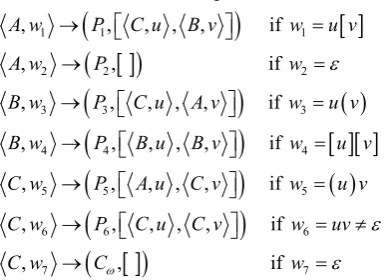
A B, is conform to one of the following transition schema20(
)
[ ]
[ ]
(
)
(
)
( )
(
)
[ ][ ]
(
)
( )
(
)
[ ]
(
)
1 1 1
2 2 2
3 3 3
4 4 4
5 5 5
6 6 6
7 7
, , , , , if
, , if
, , , , , if
, , , , , if
, , , , , if
, , , , , if
, , if
A w P C u B v w u v
A w P w
B w P C u A v w u v
B w P B u B v w u v
C w P A u C v w u v
C w P C u C v w uv
C w Cω w
ε
ε ε
→ =
→ =
→ =
→ =
→ =
→ = ≠
→ =
(9)
These schemas are obtained from the grammar productions [9] and the pairs
, i
X w are states where X is a grammatical symbol and wi a forest encoded in the Dyck language. The first schema for example, states that the Abstract Syntax Tree (AST) generated from the state A w, 1 are those obtained using the pro- duction P1 to create a tree of the form P t t1 1 2
[ ]
, ; t1 and t2 being generated respectively from the states C u, and B v, such that w u v1=[ ]
. The state C w, 7 with w7 =ε being an exit state [9], the rule[ ]
(
)
7, ,
C w → Cω linked to the production P7 states that the AST generated from the state C w, 7 is reduced to a bud of type C (C is the symbol located at the left hand side of P7).
20We do not represent the whole set of transition schemas in this example; only the useful subset for
[image:19.595.268.464.389.529.2]451
Figure 9. Consensual trees generated from the automaton A( )sc .
Construction of the Automaton
A
( )1Associated to
tv
1
Having associated Dyck symbols “(‘and’)” (resp. “[‘and’]”) to the grammatical symbol A (resp. B), the linearization of the partial replica
tv
1
(Figure 8(c)) gives (([[()()][()]])[()]). As A is the axiom of the grammar, the initial state of the automaton A( )1 is 10 ,([[()()][()]])[()]
q = A . When considering only the states
accessible from 1 0
q and by applying the previous schema of transition, we obtain the following automaton (Table 1) for the replica
tv
1
(Figure 8(c)).The state 1
4 ,
q = C ε in Table 1 is the only exit state of A( )1 . It is easy to verify that the document of Figure 8(f) resulting from the reverse projection of
1
tv
belongs to the language accepted by the automaton A( )1 .Construction of the Automaton
A
( )2Associated to
tv
2
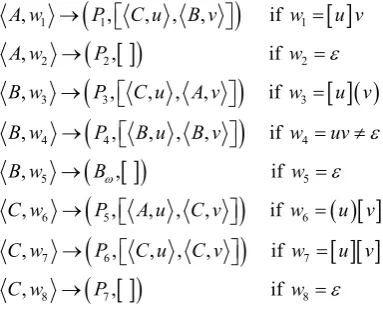
As before, by associating to the grammatical symbol C (resp. A) the Dyck symbols “[‘and’]” (resp. “(‘and’)”), we obtain the transition schemas (formula 10) for the automata associated to the partial replicas according to the view
{ }
A C, .(
)
[ ]
[ ]
(
)
(
)
[ ]
( )
(
)
[ ]
(
)
(
)
( )
[ ]
(
)
[ ][ ]
[ ]
(
)
1 1 1
2 2 2
3 3 3
4 4 4
5 5
6 5 6
7 6 7
8 7 8
, , , , , if
, , if
, , , , , if
, , , , , if
, , if
, , , , , if
, , , , , if
, , if
A w P C u B v w u v
A w P w
B w P C u A v w u v
B w P B u B v w uv
B w B w
C w P A u C v w u v
C w P C u C v w u v
C w P w
ω
ε
ε ε
ε
→ =
→ =
→ =
→ = ≠
→ =
→ =
→ =
→ =
(10)
The linearization of the partial replica
tv
2
(Figure 8(e)) is [image:20.595.268.460.547.702.2]452
Table 1. Automaton accepting updates of the (partial) replica tv1.
(
)
1 1 1 0 1, 1, 2
q → P q q with 1
1 ,([[()()][()]]) q = C and 1
2 ,() q = B
(
)
1 1 1 1 5, 3, 4q → P q q with 1
3 ,[[()()][()]] q = A and 1
4 , q = Cε
(
) (
)
1 1 1 1 1 1 6, 4, 1 | 6, 1, ]4 q → P q q P q q (
)
1 1 1 2 3, 4, 5q → P q q with 1
5 , q = Aε
(
)
1 1 1 3 1, 4, 6q → P q q with 1
6 ,[()()][()] q = B
( )
1 4 ,[] q → Cω
( )
1 5 2,[] q → P
(
)
1 1 1 6 4, 7, 2q → P q q with 1
7 ,()()
q = B
(
)
1 1 1 7 3, 8, 5q → P q q with 1 8 ,() q = C
(
)
1 1 1 8 5, 5, 4q → P q q
(
) (
)
1 1 1 1 1
8 6, 8, 4 | 6, 4, 8
q → P q q P q q
initial state 2
0 ,[([][]()[]())[]][[][]]()
q = A and its transitions are given in Table 2.
Let’s note that, the state 2
8 ,
q = Bε is the only exit state of the automaton ( )2
A .
Construction of the Consensus Automaton
A
( )scBy application of synchronous product of several tree automata described in Section 3.2.2 to the automata A( )1 and A( )2 , the consensual automaton
( )sc = ( )1 ⊗Ω ( )2
A A A has
(
1 2)
0 0, 0
q = q q as initial state. A( )1 has a transition
from 1
0
q to 1 1
1, 2
q q
labelled P1. Similarly, ( ) 2
A has a transition from 2 0 q
to 2 2
1, 2
q q
labelled P1. So we have in A( )sc a transition labelled P1 for
accessing states
(
1 2)
(
1 2)
1 1, 1 , 2 2, 2
q q q q q q
= =
from the initial state q0=
(
q q10, 02)
.Following this principle, we construct the following consensual automaton
(Table 3).
The states
{
q q q q q q q q10, , , , , , ,11 12 15 16 17 21 22}
are the exit states of the auto- maton A( )sc . They are states whose composite states are either in conflict (forexample
(
1 2)
10 2, 7
q = q q et 1 2
2 7
q q ), or are all exit states (for example
(
1)
22 4, s1q = q q ).
The use of function that generates the simplest AST (with buds) of a tree language from its automaton [9] on A( )sc , produced four AST whose derivation
trees (the consensus) are shown schematically in Figure 9.