Numerical Study to Represent Non-Isothermal
Melt-Crystallization Kinetics at Laser-Powder Cladding
V. G. Niziev1, F. Kh. Mirzade1, V. Ya. Panchenko1, M. D. Khomenko1, R. V. Grishaev1, S. Pityana2, C. V. Rooyen2
1Institute on Laser and Information Technology Russian Academy of Sciences, Moscow, Russia 2CSIR-National Laser Centre, Pretoria, South Africa
Email: [email protected]
Received November 14, 2012; revised December 15, 2012; accepted December 24,2012
Copyright © 2013 V. G. Niziev et al. This is an open access article distributed under the Creative Commons Attribution License, which permits unrestricted use, distribution, and reproduction in any medium, provided the original work is properly cited.
ABSTRACT
The study of laser-powder cladding process subject to heat transfer, melting and crystallization kinetics has been carried out numerically and experimentally. The Kolmogorov-Avrami equation was applied to describe the kinetics of the phase transitions. Characteristic behavior of temperature and conversion fields has been analyzed. Melt pool dimensions, clad height dependences on mass feed rate, laser power and scanning velocity have been investigated. It has been de- monstrated that the melt zone has the boundary distinct from the melting isotherm due to the fact that melting occurs with superheating and crystallization takes place at undercooling. The calculated melt pool depth and clad height are in a good agreement with the experimental results.
Keywords: Laser Cladding; Numerical Modeling; Kinetics of Phase Change
1. Introduction
Laser-powder cladding (LC) is one of the intensively developing field of laser technology in direct modifica-tion of surface characteristics of materials. It has been widely used in many practical applications such as coat-ing, component repair, and 3D rapid prototyping. The LC needs orientation in wide range of technological regimes, search of optimal energy characteristics of laser radiation and particle flux parameters, physical properties and fraction composition of powder. The quality and micro- structure of clad layer are governed by all of these pa-rameters. Process optimization requires both theoretical and experimental understanding of the associated physi-cal phenomena. An empiriphysi-cal optimization is difficult, time-consuming and expensive. Numerical modeling offers a cost-efficient way for understanding the related complex physics in a laser cladding process. An accurate model can be used in process prediction and system con-trol.
There are several numerical and theoretical studies on melt pool dynamics in the LC process in the literature [1-4]. The 1D model of selective laser melting of two- components powder composition that account for heat and mass diffusion and fluid flow is investigated in [5,6]. It includes the movement of the solid particles due to
shrinkage because of the density change of the powder mixture and the convective fluxes depend on surface tension and gravity forces. Liquid flow is determined by Darcy filtration law. The effect of surface settlement of the powder has been obtained.
In earlier works, height of clad layer was predefined [3]. Recently, level set method was adopted to track free
surface evolution [7-10]. Han et al. [7] used a 2D
mathe-matical model for the laser cladding to investigate
pow-der impinging process. Qi et al. [8] developed a self-
consistent 3D model for direct metal deposition with
coaxial powder injection. He et al. [9] used that model
for investigation of transport phenomena. Modeling of heat-and-mass transfer during plasma deposition manu-facturing has some similar solutions [10] such as level set method to track evolution of free boundary.
where the phase change kinetics is considered. Numeri-cal Numeri-calculations and experimental measures are used [11, 13] to obtain powder stream temperature in coaxial LC.
Commonly, the kinetics of phase change is ignored both for melt pool estimations and particle melting mod-els. In all papers mentioned above, Stephan model is used for melting and crystallization modeling reasonable for equilibrium process. However, laser material treatment is characterized as a rule by rapid and non-equilibrium processes. It is essential to account for kinetic character of the processes [14]. Multiscale model was introduced by authors [15] in order to couple microstructure evolu-tion with macro parameters of the LC process. Neverthe-less, phase change problem at LC is not studied enough.
Two approaches for modeling phase change can be un- derlined. The first is based on description of non-sta- tionary nucleus evolution by unit events of atoms (mole- cules) attachment and detachment. The cluster size distri- bution function is quantity characteristic of phase change here. Its behavior is described by Fokker-Planck equation. There are different approximate solutions of it for vari- ous simplifying conditions [16-17].
The second simplified approach is in use of Kolmo-gorov-Avrami equation which allows to obtain explicit expression for volume fraction of new phase with the known nucleation and growth rates. This approximate approach is convenient when associated heat and phase transition kinetics equations are solved together. Earlier, this approach was used, for example, for phase change analysis of silicon exposed short laser impulses [18].
In this study, an improved phase change problem is in-troduced to involve rapid melting and crystallization which is typical for LC technology. The model is devel-oped to reveal almost all phenomena occur at LC includ-ing heat diffusion, meltinclud-ing, crystallization, particle heat and mass addition, laser substrate interaction and free boundary evolution. It consists of 3D heat and phase change (melting/crystallization) equations solved in fully explicit way. Phase change is considered to be non-equi- librium kinetic process and associated with appearance and growth of nucleus in metastable (overheated or su-percooled) medium. Modeling of phase change kinetics is based on Kolmogorov-Avrami equation.
2. Model Assumptions
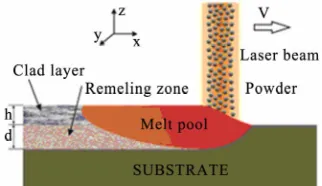
The process of powder deposition at LC is realized by feeding the powder through nozzles (often coaxial) to laser exposed area of substrate. The scheme of LC
proc-ess with coaxial powder injection is presented on Figure
1. The substrate is exposed by laser radiation moving in
positive x direction with constant velocity V. Powder of
radius rp0 and temperature 0 is delivered onto the
substrate coaxially with the laser beam. The laser beam, when passing through the coaxial powder stream, loses
[image:2.595.343.504.86.179.2]T
Figure 1. The scheme of laser cladding by powder injection.
energy due to reflection and absorption on particles. Area of substrate that absorbed enough energy forms melting pool. Cooling, further crystallization and clad building up follows after, when laser beam leaves the area. Laser beam profile is assumed to be Gaussian, the depth-of-focus effect is ignored. Particles reaching mol-ten pool get melt immediately. This approximation is made due to the fact that melting can be completed dur-ing 0.1 ms approximately for a 25 µm radius particle
gained by calculation. We restrict laser intensity
I0 tothe values which does not result in particle and substrate vaporization. The higher intensity results in plasma torch formation and decreases powder capture efficiency that influences negatively on laser cladding. The effect of fluid motion due to Marangoni forces is modeled by in-troducing an enhanced thermal conductivity factor in the melt pool region [19].
3. The Physical Model
The mathematical model involves heat transfer for three phases (solid, liquid and gas) with simultaneous melting and crystallization and evolution of free boundary be-tween liquid and gas.
3.1. The Free Boundary Equation
One of the main problems at LC modeling is to obtain boundary of clad layer. Numerical modeling with mov-ing boundaries is complex task. In earlier papers re-searcher used to predefine geometry of the surface. In [3], for example, 2D thermal model with spherical geometry of cladding surface was introduced to predict thermal fields.
The convenient level-set method has recently been adopted in the deposition modeling to investigate free surface evolution [2,4,7-10]. The key idea here is not to find the boundary, but to track it with the use of special function of the form:
x y z t, , ,
d ,
here d is actual distance from the metal boundary, and
level set functions which satisfy the equation. The zero level set is the position of the free surface and other lev-els has no physical meaning. The interface tracking problem reduces to solving a partial differential equation [20]. In general case, when evolution of free boundary is governed by powder injection and hydrodynamic fluid flow, level set equation takes the form:
0
t F
, (1)
where F is the speed function that acts in the normal
direction of the interface:
, , ,
p
FF n U x y z t ,
2 2
2
8 exp 8
π
p p p j m
j
F r d
d
,
here Fp describes the movement of the interface due to
powder addition, is the normal of the interface, is
the local fluid velocity
n U
p
is the powder catchment
efficiency, m is the mass feed rate, p is the powder
density, dj is the jet diameter.
3.2. The Thermal Balance equation
For two phase solid-liquid system heat transfer equation with phase change takes the form
1 l
l
с T t divT f c T t
L f t
(2)
where с, и are specific heat, heat conductivity
and density, respectively, L is the latent heat. The
de-tailed justification can be taken from the work [21]. In Equation (2) the first term in the right side is the heat diffusion due to thermal conductivity, the second and third terms are the power density of thermal sources
due to phase change. f x y z tl
, , ,
t
is the mass fraction
of liquid phase, at the moment ( fl for solid
re-gion, l is for the liquid and can change from 0 to 1
in binary region).
0
1
f
Laser radiation
las is absorbed on metal-gasboundary, particles bring/take
q
qp energy dependingon the particle temperature. From the other side
evapora-tion
qev , Stephan cooling
st occurs on the metalsurface. Gas convective cooling also plays the role at LC. Diffusion of gas phase is incorporated into heat equation, so diffusion cooling is considered automatically. So for the flux on metal-gas boundary we have:
q
4 4
0 las con st las
q q q q q h T T T T0 2
2 2 2
3
2 exp 2 exp ,
π π
ext las
b b p p
Q mh
P r
q
R R r D v
where P is the laser power, r
x Vt
2y2 , V isthe scanning speed, second exponent in the formula for
las takes in account attenuation of laser beam coaxial
powder stream,
q
p
r and vp are the powder radius and
speed, respectively, is the diameter of powder flux
on the substrate, ext is the contact ratio. Laser beam
radius is supposed to be close to powder stream radius
D Q
Qext 1
.Boundary condition can be included into heat transfer Equation (2) as a volume source term, using a delta
func-tion
, where is the level-set value
1 l
l .с T t divT q
f c T t L f t
(3)
Delta function
for laser source incorporationcan be calculated as a derivative of Heaviside function. Coefficients for heat transfer equation are defined as follows. All coefficients in gas and metal phases are cal-culated using Heaviside function:
1
a H amH ag
here a
, ,c k
, values with subscripts m and g denotemetal and gas phase, respectively.
In this expression we use smeared Heaviside function, assigned by equation [20]:
1 1
0, 0.5 1,
,
π sin , ,
1 H
where is level set function described in Section 2.1,
is half-thickness of transition region.
We suppose metal to be a continuum media which is consist of solid, liquid and mushy region. Mass fractions
of liquid fl and solid fs phases are defined in the
following
1s lg
1
l s
f g l , fs 1 fl,
where gl and gsare the volume fractions of liquid and
solid phases, sand lare the densities of solid and
liquid phases, respectively. Coefficients in mushy region
are expressed by the values of mass
f and volume
g fractions:
1
m l
c f c cl, c cs cl,
m s sg l lg
,
1
1 1
m l s s l l l
k f k f k m
where the values with subscripts l and s denote liquid and
solid phase, respectively. Using the defined mixture variables, the energy equation is applied for the whole calculation domain.
3.3. The Phase Change Kinetics
evolution. Phase change is taken as kinetic process which is associated with nucleation and growth of nuclei of liquid/solid phase in metastable condensed matter. Let
J T and are nucleation and growth rates,
re-spectively, which are local functions of temperature. According to [22] the basic phase change kinetic law is Kolmogorov-Avrami equation, which couple volume fraction with nucleation rate
U T
J
0
, 1 exp , , d
t
g t J V t
r r r
, (4)
where V
r,tt
is the volume of nucleus, generated
to time , and r
x y z, ,
. Nuclei volume estimationin single-component system is based on accounting of
atoms (molecules) thermal oscillations, i.e. is determined
by their transition probability through the phase bound-ary. In the case of spherical geometry for the nuclei
volume we have V
r,t
4π3
R r,t
r
3
,
where r the critical radius of nuclei is. Radius
,R r t
U T
is connected with the linear growth rate by the following relationship
,
dt
R U T t t
rThus kinetic Equation (5) we can rewrite in the form
30
,
4π 1 exp
3
, , d
t t
g t
J T r U T t t
d
r r r
(5)where m is superheating in the case of
melt-ing, and is supercooling in the case of crystallization.
T T T
The form of the nucleation rate J
T depends onthe phase change mechanism. The nucleation rate rises up rapidly on heterogeneous centers (impurities, grain boundary). But the influence of heterogeneous nucleation decreases with cooling/heating rate growth, and homo-geneous nucleation plays the essential role, namely fluc-tuation nucleation of new phase in the unblended regions [22].
In the case then melting/crystallization occurs by ho-mogeneous nucleation in metastable system (superheated or undercooled) the nucleation rate is described by the formula:
3 2 0 2 16π1 exp exp
3 a B B B J T E k T N g
h k T k T S T
where N0K —number of atoms per unit volume
(K—number of atoms per one cell, in the case of
vol-ume-centric cube K = 2; 3
0 d
—elementary volume of
new phase, d0 is the lattice parameter); kB is the
Boltzmann constant; a is the activation energy of
at-oms for the phase boundary transition; is the Planck constant,
E
h
is the surface tension; is the entropy
change.
S
The growth rate as a function of temperature has the form:
0 B exp a 1 expB B
E
k T S T
U T d
h k T k T
(7)
The system (1), (4) and (5) is closed and can fully de-scribe the behavior of temperature and new phase vol-ume fraction fields at LC process with coaxial powder feeding.
4. Numerical Algorithm
The numerical implementation of the heat equation is based on the semi-implicit finite-difference approxima-tion method. The stabilizing correcapproxima-tion method is used to solve numerical equations which are second order accu-racy for time and space dimensions. The detailed proce-dure of calculation method can be depicted through the following iterative steps:
1) Initialize the calculation variables: let the level set function be the signed normal distance to the surface; set
liquid volume fraction g identically zero in the whole
calculation domain, and T as room temperature.
2) Compute the laser source term and the thermal co-efficients for the computation domain by the temperature on previous layer.
3) Use stabilizing correction method to solve the heat transfer equation
4) Update old liquid volume fraction with Equation (6) for new temperature.
5) Go back to step (2) for the next iteration until con-
vergence criterion
Ti1Ti
2 N is reached.6) Advance the level set function in time in an explicit way.
7) Update old temperature, liquid volume fraction, and level set function by new values, and go to the next time step.
5. Numerical Results and Comparison with
Experiment
(6)
The numerical modeling of heat transfer with phase
changes (melting/crystallization) at LC of Fe powder
been held on 2D and 3D formulations. Single track is modeled till temperature get stationary. The convection cooling boundary condition was applied to each side of the substrate except for the free surface where clad forms. Substrate material is considered to be the same as in powder particles. Laser power varied in (0.6 - 4.4) kW diapason. Scanning speed is ranged from 6 mm/s to 4 sm/s and laser beam diameter was 0.35 - 4 mm. Powder feed rate varied in the range of 1 - 8.9 g/min and powder flow diameter was 0.8 - 2 mm on the substrate. Typical values of thermo-physical parameters for Metco 42C powder have been used in calculations.
The calculated sequential 3D track evolution is
illus-trated in Figure 2. The spatial selectivity of laser energy
at LC can be seen. A small zone is affected and the mate-rial is not degraded elsewhere. The regimes where the laser heat causes substrate melting, are taken in to con-sideration, because only that generates a good bonding between the cladding layer and the substrate.
The cross section of temperature field along the
scan-ning direction is presented on Figure 3. Temperature
field is displayed by color contours and volume fraction of liquid is shown by black lines. Note that temperature
profiles are stretched along the x-axis due to the
influ-ence of laser scanning speed. Melting temperature
iso-therm 1809К is also shown on Figure 3 and melting/
crystallization are seen to take place with considerable
superheating/undercooling. This occurs due to the fact that nucleation rate is zero at melting temperature, as it will be shown below, and gets significant values only after superheating (or undercooling in the case of crystal-lization).
The distribution of cooling rate values is introduced on
Figure 4 i
Figure 2. 3D dynamics of temperature fields; t = 62 ms (up) and t = 122 ms (down).
3 4
n x-z plane. One can note that cooling rate
de-creases with temperature decrease away from the laser source. Latent heat of phase change is consumed in melting region and is released in crystallization region, so cooling speed is lower in the latter one. The top of crystallization zone is cooling strongly than the bottom, because the intensive heat exchange with air.
Numerical modeling shows that cooling rate is a func-tion of laser power and has a size of order 10 - 10 K/s. The warmer crystallization zone begins to cool rapidly (cooling rate rises). Also cooling rate showed the de-crease with time till temperature gets stationary.
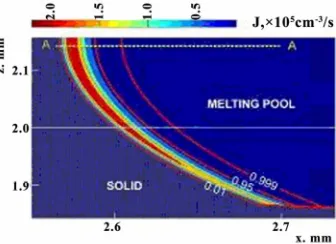
Nucleation rate is displayed on Figure 5 in cross
sec-tion along the scanning direcsec-tion by the shades of gray (with corresponding scale of values). Black dashed line represents the substrate level, and solid lines are three
[image:5.595.307.539.374.515.2]contours of volume fraction gl = 0.01, gl = 0.95 and
Figure 3. The x-z cross-section of temperature field, t = 130 m/s.
[image:5.595.308.539.554.701.2]0.99
l
g . Nucleation rate is seen to get appreciable
values for phase change in transition liquid-solid zone. Temperature dependences of nucleation and growth rates
on the line A-A (see Figure 5) are presented on Figure 6.
Note that intensive nucleation occurs at temperature. Nucleation rate increases exponentially to the values of
105 sm−3·s−1. Large quantity of nucleus restrain
nuclea-tionrate, so further growth of its value changes by rapid decrease due to solid fraction increase.
Large quantity of nucleus restrain nucleation rate, so further growth of its value changes by rapid decrease due to solid fraction increase. The calculation shows that typical undercooling [23] is reached at cooling rate ob-served at LC. One can note that at such undercooling first exponent in (7) associated with activation energy do not plays any role and decrease of nucleation rate occurs due
to multiplier
1g
. Also one can note that maximumof growth rate is in the region where nucleation doesn't occur yet, and it appears to be decreasing function in the nucleation region. Equation (6) shows that volume frac-tion of new phase can increase due to nucleafrac-tion and growth processes.
The temperature and volume fraction dynamics are found to have qualitative difference at crystallization for
different cooling rate (Figures 7 and 8). At the beginning
[image:6.595.89.257.445.567.2]of the process when cooling rate is high temperature change is monotonous (black solid line). Volume fraction of solid phase grows rapidly (grey solid line). When the cooling rate decreases behavior of temperature is non-
Figure 5. The x-z cross-section distribution of nucleation rate, t = 156 ms.
Figure 6. The temperature dependences of nucleation (J) and growth rates (v); t = 156 ms.
monotonous (black dot-dashed line) and volume fraction of solid phase grows smoother (grey, dot-dashed line). This behavior is associated with heat release at crystalli-zation: nonessential in the first case and essential in the second.
The laser power, scanning speed and mass feed rate are known to be the main input parameters. The output parameters are system maximum temperature, melt pool depth and cladding height. These are tree essential
pa-ed out at a constant mass fepa-ed rate and a scan-ni
rameters to characterize melt pool thermal behavior and they are calculated different input parameters. The para-metric investigation was conducted on 3D model. Calcu-lated (solid line) and experimental values (dot line) of clad height and melt pool depth as functions of laser
power are shown on Figures 9 and 10. The calculations
are carri
ng velocity. Melt pool size is defined by full molten state.
For comparison with the calculated clad heights were performed experiments were carried out. Laser clad-
1600
1580
1560
1540
1520
T, K
0 10 20 30 40 50 t, ms
1500
1 2 3
Figure 7 The temperature dynamics for different cooling rates. (1) 4500 K/s; (2) 2400 K/s; and (3) 1200 K/s.
1.0 0.8
0.6
0.4
0.2
0
0 10 20 30 40 50 t, ms
gs
[image:6.595.355.493.494.583.2]1 2 3
Figure 8. The time dependences of volume fraction of solid phase for different cooling rates. (1) 4500 K/s; (2) 2400 K/s,
[image:6.595.106.239.605.710.2]nd (3) 1200 K/s. a
Figure 9. Clad height dependence on laser po er. Dotted curve is experiment, solid line is numerical calculations. feed rate m = 8.9 g/min, scanning velocity V = 40 mm/min.
[image:6.595.360.487.635.697.2]ding of 431 martensitic stainless steel was deposited onto 10mm flat bar C-steel substrate. A 4.4 kW Rofin DY044
iode pumped N d
K
d: YAG laser coupled to a Kuka R60L30 articulated arm robot and Precitec YW50 welding head with 300 mm focal length was used. Pow-der cladding was performed with Metco 42C powPow-der and a coaxial nozzle with powder focus diameter of 2.0 mm. Laser spot sizes of 2.0 mm and 4.0 mm were selected to determine the effect of laser power, cladding speed and
r powder feed rate on dilution and clad height. The ex-perimental methodology was based on a constant powder feed rate per unit length. Powder feed per unit length fo the 2 mm spot size was 3.8 g/m and 3.8 and 9.2 g/m for
the 4 mm spot size. Process parameters are shown in
Ta-ble 1. Powder feed rate was converted from rpm to g/min
by measuring the weight of powder fed per unit time. The results of experimental data (dotted lines) for the value of the deposited layer depending on the laser power
are shown in Figures 9 and 10. It is seen that the
nu-merical results (solid line) a satisfactory agreement with the experimental data.
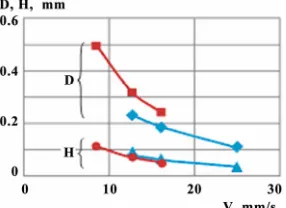
Clad height (H) and melt pool depth (D) as functions
of scanning speed are shown on Figure 11. Calculations
are carried out at constant mass feed rate
m 1 g min
[image:7.595.59.285.411.690.2]and for two values of laser power P = 0.6 kW and P =
Table 1. Processing conditions.
Powder Spot size (mm) Powder spot Size (mm)
42C 4 2
Power (Laser/workpiece) (W)
Scanning Powder feed rate velocity (mm/s) (g/min)
8 9186
Laser power ( Gas flow rate min)
3.3 2.781 3.244 3.707
40 .
kW) gas (L/
3.85 4.4
[image:7.595.59.286.414.689.2]He 5
Figure 10. Experimental (do line) and nume al (solid line) valu melt pool width (red) and depth (blue) as a function of laser power. Feed rate m = 8.9 g/min, scanning velocity V = 40 mm/min.
0.75 kW. observes similar decreasing trends both for
lad height and melt pool depth with the increase of laser power, but the last decreases weaker.
The energy that is brought into melting pool increases with laser power increase which results in melt pool depth growth. The clad height influences on the melt pool dimensions so it was fixed by mass feed rate and scanning speed for melt pool depth investigations. The melt pool depth dependence on laser power at xed clad
tted ric
es of
One c
fi
height is presented on Figure 12. Results for the clad
height h = 60 µm (1 g/min, V = 16 mm/s) are represented
by grey line and for the clad height h = 182 µm
(m 3 g min, V 16 mm s) are shown in white color. Melt pool depth increases with laser power growth. Also one can see the influence of mass feed rate on the melt pool depth. The denser stream attenuates more laser en-ergy so melt pool depth decreases.
6. Conclusions
The numerical model of LC has been presented, which considers the spatial dynamics forecasting of temperature and volume fraction of liquid phase fields at laser depo-sition of single-component powder on the substrates. The model is based on self-consistent nonlinear equations of heat transfer and kinetics of phase transition.
[image:7.595.353.496.428.532.2]The time-space dynamics of temperature field, the free boundary evolution and profiles of distribution of liquid
Figure 11. Melt pool depth (D) and clad height (H) depend-ence on scanning speed for different laser power (, — P
= 0.6 kW; , —P = 0.75 kW). 0.7
0.6
0.5
0.4
0.3
0.2
0.1
0 D, mm
0 0.5 1.0 1.5 2.0 P, kW
[image:7.595.360.488.583.687.2]and solid phases for different process parameters and characteristics of laser radiation are calculated. Due to the fact that melting occurs with superheating and c tallization—with undercooling, the melt zone has the boundary distinct to the melting temperature isotherm.
Qualitative difference of the crystallization process at high and low cooling speeds is discovered. Temperat dynamics is monotonous at the beginning of the pr at high cooling speeds. Then, the process continues while cooling speed decreases and temperature ynamics is
nd science of Russia (Grant N
rys-ure ocess
d
nonmonotonic. This is due to the influence of latent heat of crystallization: inessential of the first case and quit appreciable in the second.
The influence of laser power, mass feed rate and scan-ning speed on maximum temperature and the melt pool behavior is analyzed. It is determined how melt pool depth increases with laser power growth, and cladding height decreases with the scanning speed. Clad layer pro-file modeling agrees with experimental data. This infor-mation provides the starting data for simulations of the microstructure and the residual stress field.
7. Acknowledgements
This research has been supported by the Russian
Founda-tion for Basic Research (Grant No 11-08-93966-SA_а)
and Ministry of education a o 07.524.12.4019).
REFERENCES
[1] G. G. Gladush and I. Smurov, “Physics of Laser Materials Processing: Theory and Experiment,” Springer-Verlag, Berlin, 2011. doi:10.1007/978-3-642-19831-1
[2] S. Wen and Y. C. Shin “Modeling of Transport Phenom- ena during the Coaxial Laser Direct Deposition Proces
, Vol. 108, No. 4, 2010, Article .3474655
s,”
Journal of Applied Physics
ID: 044908. doi:10.1063/1
d Y. Hua, “Modeling and Experiments ,” Journal of Heat Transfer, Vol. 127, No. 9, 2005, pp. 978-986.
[5] V. G. Niziev, . Mirzade, V. Ya.
[3] A. F. A. Hoadley and M. Rappaz, “A Thermal Model of Laser Cladding by Powder Injection,” Metallurgical Transactions B, Vol. 23, No. 5, 1992, pp. 631-642. [4] J. Choi, L. Han an
of Laser Cladding with Droplet Injection
A. V. Koldoba, F. Kh
Panchenko, Yu. A. Poveschenko and M. V. Popov,
Mathematical Models and Computer Simulations, Vol. 3, No. 6, 2011, pp. 753-761.
doi:10.1134/S2070048211060081
[6] V. G. Niziev, F. Kh. Mirzade, V. Ya. Panchenko, G. V. Ustugova and V. M. Chechetkin, Mathematical Models and Computer Simulations, Vol. 3, No. 6, 2011, pp. 723-731.
[7] L. Han, F. W. Liou and K. M. Phatak, “Modeling of La- ser Cladding with Powder Injection,” Metallurgical and Materials Transactions B, Vol. 35, No. 6, 2004, pp. 1139- 1150.
[8] H. Qi, J. Mazumder and H. Ki, “Numerical Simulation of Heat Transfer and Fluid Flow in Coaxial Laser Cladding Process for Direct Metal Deposition,” Journal of Applied Physics, Vol. 100, No. 2, 2006, Article ID: 024903. doi:10.1063/1.2209807
[9] X. He and J. Mazumder, “
Direct Metal Deposition,” Transport Phenomena during Journal of Applied Physics, Vol. 101, No. 5, 2007, Article ID: 053113.
doi:10.1063/1.2710780
[10] H. O. Shang, F. R. Kong, G. L. Wang and L. F. Zeng, “Numerical Simulation of Multiphase Transient Field during plasma deposition manufacturing,” Journal of Ap- plied Physics, Vol. 100, No. 12, 2006, pp. 123522- 123531. doi:10.1063/1.2399341
[11] S. Y. Wen, Y. C. Shin, J. Y. Murthy and P. E. Sojka,
ade, f Heating and Melting of
Mi-r StMi-reams in ,” Optics and Laser Technology, “Modeling of Coaxial Powder Flow for the Laser Direct Deposition Process,” International Journal of Heat and Mass Transfer, Vol. 52, No. 25-26, 2009, pp. 5867-5877. [12] R. V. Grishaev, M. D. Khomenko and F. Kh. Mirz
“Numerical Modeling o
croparticles under Laser Radiation,” Proceedings of SPIE, Vol. 7994, No. 1, 2011, Article ID: 79940U1-9.
[13] J. Lin, “Temperature Analysis of the Powde Coaxial Laser Cladding
Vol. 31, No. 8, 1999, pp. 565-570. doi:10.1016/S0030-3992(99)00115-2
[14] F. Kh. Mirzade, M. D. Khomenko, V. G. Niziev, R. V. Grishaev and V. Ya. Panchenko, “Three Dimensional Model of Melting and Crystallization Kinetics during
s in Met-
s,” In: V. Ya. Pan-
ern Laser-Informa-
Laser Cladding Process,” SPIE Proceedings of 19th In- ternational Symposium on High-Power Laser Systems and Applications, Istanbul, 10 September 2012, Article ID: 86770R.
[15] Y. Cao and J. Choia, “Multiscale Modeling of Solidifica- tion during Laser Cladding Process,” Journal of Laser Applications, Vol. 18, No. 3, 2006, pp. 245-257.
[16] J. W. Christian, “The Theory of Transformation als and Alloys,” Pergamon Press, Oxford, 1975, p. 586. [17] F. Kh. Mirzade, “Kinetics of Nucleation and Nanostruc-
ture Formation in Condensed System chenko and V. S. Golubev, Eds., Mod
tion Technologies, Intercontact Nauka, Moscow, 2005, pp. 62-78.
[18] S. P. Zhvavyi, “Simulation of the Melting and Crystalli- zation Processes in Monocrystalline Silicon Exposed to Nanosecond Laser Radiation,” Technical Physics, Vol. 45, No. 8, 2000, pp. 1014-1018. doi:10.1134/1.1307010 [19] C. Lampay, A. F. H. Kaplanz, J. Powellyx and C. Mag-
nusson, “An Analytical Thermodynamic Model of Laser Welding,” Journal of Physics D: Applied Physics, Vol. 30, No. 9, 1997, pp. 1293-1299.
doi:10.1088/0022-3727/30/9/004
[20] J. A. Sethian, “Level Set Methods and Fast Marching
Heat Transfer, Part B, Vol. 19, No. 2, 1991, pp. Methods,” 2nd Edition, Cambridge University Press, Cambridge, 1999.
57-582. 175-189.
[22] V. P. Skripov and V. P. Koverda, “Spontaneous Crystal- lization of Undercooled Liquid,” Nauka, Moscow, 1984. [23] A. V. Evteev, A. T. Kosilov, E. V. Levchenko and O. B.