warwick.ac.uk/lib-publications
Original citation:
Fenske, James. (2014) The battle for rubber in Benin. The Economic History Review, 67 (4). pp. 1012-1034.
Permanent WRAP URL:
http://wrap.warwick.ac.uk/85604
Copyright and reuse:
The Warwick Research Archive Portal (WRAP) makes this work by researchers of the University of Warwick available open access under the following conditions. Copyright © and all moral rights to the version of the paper presented here belong to the individual author(s) and/or other copyright owners. To the extent reasonable and practicable the material made available in WRAP has been checked for eligibility before being made available.
Copies of full items can be used for personal research or study, educational, or not-for profit purposes without prior permission or charge. Provided that the authors, title and full bibliographic details are credited, a hyperlink and/or URL is given for the original metadata page and the content is not changed in any way.
Publisher’s statement:
"This is the peer reviewed version of the following articleFenske, James. (2014) The battle for rubber in Benin. The Economic History Review, 67 (4). pp. 1012-1034. which has been published in final form at http://dx.doi.org/10.1111/1468-0289.12044 . This article may be used for non-commercial purposes in accordance with Wiley Terms and Conditions for Self-Archiving."
A note on versions:
The version presented here may differ from the published version or, version of record, if you wish to cite this item you are advised to consult the publisher’s version. Please see the ‘permanent WRAP URL’ above for details on accessing the published version and note that access may require a subscription.
ABSTRACT. Nigerian rubber exports expanded rapidly during the Second World War “battle for rubber”. This was achieved by overcoming obstacles to greater exploitation of both wild and planted rubber. I outline Nigeria’s wartime experience, focusing on the Benin region that dominated smallholder production after the war. British policies initially restricted rubber planting. After Japan occupied Southeast Asia, Britain encouraged maximum production. Late in the war, officials struggled with the planting boom that had occurred. The war was a period of both continuity and change for Benin, and exposed the limited capacity of the colonial state.
1.INTRODUCTION
By 1942, Japanese conquests in Southeast Asia accounted for more than 80% of pre-war global rubber production.1 The Allies called upon producers in Africa, Latin America, and South Asia to expand natural rubber production for the war effort. The Nigerian response was remarkable, and is shown in Table 1 and Figure 1. From 1941 to 1943, Nigerian rubber exports more than tripled.
How was this achieved? Projections for 1943-44 provide one estimate of the sources of supply. Officials expected 22% of Nigerian production to come from the formerly German “Cameroons Plantations,” 19% from the United Africa Company’s Pamol holdings at the Jamieson River in Benin and near Calabar, 1% from the J.A. Thomas estate at Sapele, and 26% from smallholders concentrated in Benin, Warri, and Owerri.2 The remainder would come from wild rubber – 19% Funtumia from the Western Provinces and 12% vine rubber from the middle belt, Cross River, and Cameroons. Wild rubber made up 25% of Nigerian exports in 1942, 29% in 1943 and 11% in 1944 before falling below 2% at the end of the war.3
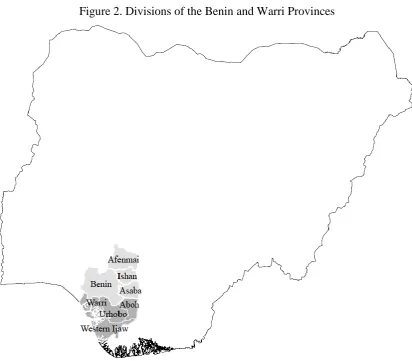
In this paper, I provide a narrative of rubber production in Nigeria’s Benin region during the Second World War. Before 1942, the Colonial Office discouraged planting, worried that Nigerian rubber undermined British interests in other colonies. Japanese occupation of Southeast Asia initiated the “battle for rubber,” and Britain sought maximum production from Nigeria. Once it was clear the Allies would win the war, the government fought to contain the unexpected planting boom. Although rubber was produced throughout southern Nigeria, I focus on the Benin and Warri Provinces, shown in Figure 2. Smallholders in Benin and Warri dominated Nigeria’s post-war rubber sector. It is in this region that the war is most important for understanding later Nigerian rubber production.
Despite the rapid increase in output, several obstacles hindered expansion of Nigerian rubber production. These barriers reflected the heterogeneous incentives, motives, and capacities of the key participants. The Colonial Office, initially concerned Nigerian rubber would harm other colonies, pivoted to focus on maximum production after the loss of
Southeast Asia. The Government of Nigeria pursued contradictory aims of development and
raw materials for Britain. Specific departments had divergent objectives; the Forestry
1 International Rubber Study Group, “World” 2
National Archives of the United Kingdom (NAUK), CO 852/515/7: Commodities, Rubber, West Africa (CRWA), West African Rubber Mission Report on Nigeria and British Cameroons (RMR).
2
Department’s mandate to preserve forest resources was inconsistent with the Agriculture Department’s promotion of agriculture.
African producers pursued their own interests. Smallholders in particular faced high labour costs, uncompetitive buyers, and a rising cost of living. They found it more profitable to produce low-quality rubber than the higher quality grades sought by the government.
Expatriate trading firms and rubber estates focused on profits. Trading firms were inexperienced and wary, and, like smallholders, found it profitable to ship low-grade rubber. While production expanded relatively smoothly on larger estates, these struggled to maintain labour supplies during and after the war. State efforts to expand output, the experiences of the key participants, and the obstacles to expansion are the focus of this paper.
Related literature
This narrative fills gaps in the history of rubber production. Excepting work on rubber’s initial difficulties and its effects on land tenure,4 all historical work on rubber in Benin is contained in broader pieces on the region.5 Writers have paid limited attention to wartime tropical rubber production, particularly in Africa.6
I contribute, first, to a literature asking “What was the effect of the Second World War on African economies?” Many colonies faced government controls, scarce imports, inflation, forced labour, and conscription.7 The burden of intensified production fell heavily on the labouring classes.8 These pressures were not limited to Allied colonies. Spanish and Portuguese Africa also experienced coerced cultivation of crops, forced labour, and food scarcity, as well as entrenchment of undemocratic rule and distraction of the international humanitarian lobby.9
Was the war a watershed? One view claims the war initiated greater intervention in African economies. Post-war intrusions such as marketing boards and requisitioning owed their origins to wartime pressures.10 Trade was transformed, and the output of some products increased permanently.11 Another perspective stresses continuity between the pre-war and post-war periods. Martin situates the war in a longer African depression.12 Recent work, then, identifies both continuity and change. The Malawian agricultural extension service, for example, revised its strategies, but not its aims.13 Byfield provides a review.14
In Benin, the war brought continuity and change. Direct restrictions on tree planting were undermined. Firms became familiar with rubber and continued the trade afterwards. Farmers gained experience and the position of smallholders was solidified. Conversely, forest reservation hindered planting before the war and remained afterwards. Throughout, the
4
Fenske, “Rubber” and “Trees”.
5 E.g. Usuanlele “Environment.” 6 Clarence-Smith, “Battle”.
7 Killingray and Rathbone “Africa”, UNESCO, “Africa”. 8
Cline-Cole, “Economic”.
9 Clarence-Smith “Spanish”.
10 Byfield, “Feeding”, Olorunfemi “Effects”, Meredith, “State”. 11 Oyebade “Feeding”, Dumett “Minerals”.
12
Martin, “Depression”.
3
Nigerian government could not prevent African smallholders from producing the low-quality grades that were most profitable.
Second, I contribute to a literature asking “What limited the capacity of colonial states?” Lacking resources and blinded by prejudices and misinformation, colonial governments relied on local elites.15 Projects failed due to inadequate preparation and overconfidence.16 Conflicting objectives hobbled colonial states. The goals of raising living standards, securing raw materials, and supplying a market for manufactures often clashed.17 Colonial responses to problems were piecemeal. The war heightened these difficulties. Colonial states strained to motivate producers facing declining terms of trade. Labour demands for mines and public works undermined crop production, and sterling balances were a persistent challenge.18 States struggled to increase production of necessities, and resorted to rationing schemes that local elites manipulated.19
In Benin, the state contended with conflicting interest groups, and worked to provide incentives to both producers and traders. External constraints, particularly Colonial Office demands and scarce imports, restricted the tools available. The state lacked knowledge of local conditions, and so its interventions harmed producers, while its decrees were resisted or manipulated. Throughout, the state responded to established facts. Actions were poorly coordinated, leading to contradictory efforts. Despite these limitations, state intervention spurred a dramatic increase in production.
2.THE BATTLE FOR RUBBER DURING THE SECOND WORLD WAR
Before the Japanese invasion of Southeast Asia, wartime disruption of the global rubber market was limited. The International Rubber Regulation Agreement continued to restrict output and set prices.20 Signed in 1934, this arrangement supported prices by restricting supply. Britain remained in the scheme to secure dollar earnings.21 Production lagged behind capacity in many producing countries, in part because of the disincentive effects of excess profits taxes.22 At a meeting in August 1941, the International Rubber Regulation Committee rebuffed proposals by the British Ministry of Supply to suspend output restrictions.23
In the United States, American chemical companies began the war with no clear idea how to manufacture a synthetic alternative.24 From 1940, the American Rubber Reserve Company centralized purchases as the United States stockpiled rubber.25 Technical assistance, equipment and capital poured into suppliers in the Western Hemisphere, particularly Brazil.26
15 Berry, “Hegemony”; Phillips “Enigma”. 16
Hogendorn and Scott “Groundnut”.
17 Meredith “British”. 18 Olukoju, “British”. 19 Falola, “Salt”. 20
Dean, “Brazil”, p. 87.
21 Bauer, “Rubber”, p. 154. 22 Bauer, “Rubber”, p. 163. 23 Bauer, “Rubber”, p. 167. 24
Dean, “Brazil”, p. 87.
4
These efforts turned urgent after the Japanese offensives of December 1941. Ceylon and India were the only Far Eastern territories that escaped Japanese occupation, and India was a net importer of rubber in 1941.27 Authorities in Ceylon increased output through a combination of higher prices, direct appeals to producers, tax breaks, and incentives to slaughter-tap existing trees.28 American efforts to obtain greater supplies of natural rubber from the Western Hemisphere and Africa focused on higher prices, and were aided by the maturing of trees in Liberia.29 The International Rubber Regulation Committee continued to exist, but suspended restriction in 1942 and permitted unlimited new planting in Ceylon and India.30 In 1943, the Colonial Office decided rubber regulation would not continue after the war.31
The Ministry of Supply coordinated British control of raw materials.32 Its main tools included import licensing and state purchasing, which prevented private buyers from competing with Ministry demands.33 In particular, the Ministry’s Rubber Control Board made all purchases through the London rubber market. Import and export restrictions directed rubber towards the war effort and conserved foreign exchange.34 The Rubber Control set grades and f.o.b. prices.35 The Government of Nigeria set ex-scale prices.36 Shipments were graded in the UK before distribution to manufacturers.37 The Combined Raw Materials Board ensured cooperation with the United States. From 1942 to 1945, Ceylon accounted for 55% of natural rubber exports, Africa 25%, Latin America and Oceania 18%, and India less than 2%.38
Nigeria produced 5.3% of natural rubber within the British sphere of Africa and unoccupied Asia, and 4.1% of output within the Allied sphere including the Americas.39
Rubber came mostly from two sources. First, wild rubber from the native Funtumia elastica
was usually exploited by mobile gangs of tappers. Funtumia could only be tapped a few times per year.40 Second, planted rubber came mostly from Hevea brasiliensis. This came originally from Brazil. Hevea surpassed Funtumia on smallholdings after 1914 due to its higher yield, better wound response, and more rapid growth. Hevea matured in seven years. Smallholdings were often tapped daily after the war, excepting a “wintering” period during which trees could not be tapped. Rubber was collected by cutting grooves into the bark and allowing the latex to flow into a container such as a snail shell. This latex was then
27 Bauer, “Rubber”, p. 303.
28 Bauer, “Rubber”, p. 304. 29 Bauer, “Rubber”, p. 305. 30
Bauer, “Rubber”, p. 305.
31 Bauer, “Rubber”, p. 307. 32 Byfield, “Feeding” p. 78. 33
Hurstfield, “Control”, p. 161-178.
34 Olukoju, “British”, p. 364.
35 CO 852/451/6: Commodities, Rubber, West Africa. Draft Telegram 30/6/42.
36 CO 852/451/6: Commodities, Rubber, West Africa. Note on A Meeting Held at the Colonial Office on Wed
10th June 1942.
37 CO 852/451/6: Commodities, Rubber, West Africa. 23/7/43: Memo by Jacks 38 Bauer, “Rubber”, p. 306.
39 International Rubber Study Group, “World” 40
5
coagulated, rolled into thin ribbed sheets, and smoked. Apart from these “ribbed smoked sheets,” Nigerian rubber was generally lump or crepe. Lower-quality lump was less labour-intensive, produced by simply cleaning the coagulated latex. Lumps and poor-quality sheet could be re-milled in order to produce crepe rubber.
3.AMBIVALENCE AND RESTRICTION,1937-42
Ambivalence
The Colonial Office was initially concerned African production could undermine quantity restrictions imposed by the International Rubber Regulation Agreement. In 1940, the Colonial Office remarked on Nigeria’s “striking” increase in exports, and asked the Nigerian government for a report on planting.41 Officials felt Nigeria was typical of colonies outside the agreement that were “parasitic on the scheme,” benefitting from high prices without curtailing output..42
The Colonial Office had additional concerns. Firms such as the British Bata Shoe Company (Bata) and the United Africa Company (UAC) had leased African holdings for tapping.43 This circumvented Britain’s policy of preventing non-Nigerians from obtaining permanent interests in land.44 This, officials feared, could undermine the control exercised by local chiefs who were essential to indirect rule.45 Bata began buying hides, cotton and rubber in Nigeria during the 1930s, and its leases amounted to some 50,000 trees by 1940.46 The Colonial Office heard that the UAC wished to lease all African rubber in the country.47 Smallholders let out several of Nigeria’s “large number of small and widely scattered” African plantations before the war. These leases comprised 11,000 trees in the Eastern Provinces and probably more in the Western Provinces.48
By contrast, the Nigerian Agricultural Department did not wish to harm the industry, due to revenue concerns and the depressed state of trade. The Government claimed the industry was “of substantial value to the African planter,” as the price for palm produce had remained low through the 1930s.49 The Agricultural Department believed rubber slowed destruction of forest cover, converted un-cleared bush into valuable growth, and could stand a high export duty.50 Producers did not understand why palm oil was promoted despite low prices, while rubber was ignored. Agricultural Department policy was “neither to encourage nor to discourage rubber production but to give advice and assistance to farmers when asked.”51
This included instruction in laying out plots, tapping and preparation, provision of planting
41 CO 852 320 9: War Trade. Commodities - Rubber, Nigeria (WTCRN). 12 June, 1940, Officer Administering
the Government (OTG) to Dolobran.
42 CO 852 320 9: WTCRN, unsigned minute, 29 July, 1940. 43 Nominally British, Bata was a Czech company.
44 CO 852 320 9: WTCRN. 12 June, 1940, OTG to Dolobran. 45
Phillips, “Enigma”.
46 Hlavkova, “Bata”.
47 CO 852 320 9: WTCRN. 12 June, 1940, OTG to Dolobran. 48 CO 852 320 9: WTCRN. 12 June, 1940, OTG to Dolobran. 49
CO 852 320 9: WTCRN. 12 June, 1940, OTG to Dolobran.
6
material, and allowing some planting in forest reserves. The Government of Nigeria supported this position, and the Colonial Office agreed.
Restriction
Despite this stance, coordination was imperfect, and two policies discouraged planting. First, forest reservation set land off limits to planting. Reserves favoured the timber industry and provided royalties to the state. Reserves covered half to two thirds of Benin Division on the eve of the war.52 These interfered with planters who, under “customary” rules, could plant anywhere in Benin. Reserves also checked the growth of larger holdings by powerful interests. In 1921, the Commissioner of Forests refused an application from the Oba (the traditional head of the local Native Authority) to extend his rubber plantations in two reserves, on the grounds that further clearing of trees would restrict water flow into the Ogba River.53 The UAC, similarly, found that the government would not consider a rubber plantation in a reserve in 1937. The District Officer felt that, since the Oba held the land on behalf of the people, it would be a “gross breach of trust” to lease it to a firm for a rubber plantation.54
Because of the state’s limited capacity, enforcement was delegated, creating opportunities for corruption. In 1940, for example, one timber contractor accused a Forest Guard of aiding a man accused of illegally farming in the Ohosa Reserve to evade prosecution.55 Similarly, a petitioner complained in 1941 that a Native Authority agricultural assistant had “corruptly demanded” and received money from the planters in his village “in the name of the Government”.56
The second policy limiting planting was the Permanent Crops Order (PCO), passed in 1937. The Agricultural Department, fearing tree crops were locking up land needed for food crops, pushed the Native Authority to take this action.57 Further, the Oba opposed the appropriation of communal lands for private plantations.58 Under the order, no one was to plant any tree without the permission of the Village Council.59 Applicants required signatures from the odionwere (chief) and Oba.
At first, objections were received, mostly in response to what the District Officer believed was “false propaganda” from planters’ associations that the order would be used to collect taxes. Once this was quashed, the order became popular.60 In the first few months, hundreds of applications were approved, with permits being treated as titles by the farmers.61
Enforcement was delegated out of necessity, so the order was unevenly enforced. It was used mostly against strangers, especially those living in Benin City. Few local planters
52
Shokpeka and Nwaokocha, “Colonial”, p. 4; von Hellerman and Usuanlele, “Owner”, Usuanlele, “Environment”, p. 112-145.
53 National Archives of Nigeria in Ibadan (NAI), BP 10 1921 Oba's Rubber Plantation in Ogba Forest Reserve. 54 BD 680: UAC Ltd: 26 April, 1937: DO to Resident.
55
NAI, Ben Dist 6 BD 142 Usen Native Court and District Affairs; 2 Feb, 1940: Oronsaye to DO.
56 Ben Dist 1 BD 28 Vol 11 Oba’s Court Appeals, 1941, Daniel Ijirigho to DO 57 Rowling, “Notes”, p. 6.
58 Usuanlele, “Environment”, p. 146-147. 59
BP 1470 Vol 2: Permanent Crops in the Benin Division (PCBD): 21 Oct, 1940: Circular from DO, Benin.
7
bothered to obtain a permit.62 In 1941, urban residents complained of discrimination.63 The District Officer recognized these were based in fact, but that enforcement would require a costly and possibly corrupt staff of inspectors.64 In 1940, the Commissioner of Forests noted that permits had been issued in Forest Reserves. Recipients were, in some cases, prosecuted.65 By 1941, a backlog of applications had formed.66
4.THE STATE AND THE BATTLE FOR RUBBER,1942-44
Efforts of the Agriculture and Forestry Departments
An early 1942 telegram from the British government called upon Nigeria to achieve “maximum output of rubber both plantation and wild.”67
Three days later, the Agriculture and Forestry Departments issued circulars. Another circular was soon sent with instructions on finding and preparing wild rubber. Several others followed during 1942-43.68 These departments offered instruction to officers and to Native Authorities, whose employees trained locals in production. Three inspectors of produce and twenty five produce examiners in the Western Provinces were trained in April 1942 to prepare wild rubber, and similar training was conducted at Benin and Aba.69 Some European staff of the Agricultural Department devoted more than half their time to rubber at first, and many African staff were fully employed in rubber.70 By May, wild rubber was sold at the local “canteens.”71
Later in 1942, the Forestry Department took over the wild rubber drive, leaving the Agricultural Department responsible for plantation rubber.72 This required reviving an industry abandoned decades earlier. Only a few elderly inhabitants had experience, and written records were sparse.73 The Forestry Department established buying organizations and erected smoke houses.74 Fees and licenses covering wild rubber were waived. In mid-1943, seven European Forest Officers and most of the African Forestry staff were almost entirely occupied by wild rubber, and forty six others had been engaged as rubber demonstrators and propagandists.75 School teachers were instructed to guide children collecting rubber during holidays.76 One consequence was destruction of Nigeria’s wild rubber. By the end of 1944, wild rubber output was declining.77 The 1945 report of the Agricultural Department admitted
62 Rowling, “Notes”, p. 6.
63 BP 1470 Vol 2: PCBD, Minute (n.d. - 1941): GCW to Resident. 64
BP 1470 Vol 2: PCBD: PCO Benin Division (Memo by DO).
65 BP 1470 Vol 2: PCBD: Notes of Meeting Held in Resident's Office on 6 July 1940 66 BP 1470 Vol 2: PCBD: 30 April, 1941: DO to Resident.
67
CO 852/515/7: RMR.
68 CO 852/515/7: RMR.
69 CO 583/258/16: Annual Report: Produce inspection for the period 1 April 1942 to 31 March 1943. 70 CO 852/451/7: CRWA, 17 April 1943: Agricultural Department, Ibadan to Tempany.
71
CO 852/515/7: RMR.
72 CO 852/515/7: RMR.
73 CO 852/451/7: CRWA, 17 April 1943: Agricultural Department, Ibadan to Tempany. 74 CO 657/55: Annual report on the forest administration for 1942.
75
CO 852/515/7: RMR.
76 CO 852/515/7: RMR.
8
“trees were worn out and vines destroyed. But the object was achieved, wild rubber being produced when the shortage of rubber was most acute.”
Rubber took priority over other Agricultural Department Work.78 There were hundreds of small plantations to deal with, some no bigger than a garden.79 By May 1942, the Agricultural Department believed tapping on these Hevea farms was reaching full capacity.80 In July, the Agricultural Department began to survey Hevea plantings in Benin Province.81 The government encouraged tapping on Sundays, and shortening the annual rest period during which workers visited their families.82 Staff trained girls to assist smallholders in collecting latex, picking scraps, and other tasks.83
Native Authorities assisted in buying. Lorries toured outlying villages each month. Native Authorities also trained rubber graders, organized tapping, established processing stations, supplied tapping knives, rollers, climbing ropes, and other equipment, and built
smokehouses.84 A “Rubber Challenge” was organized for districts to compete in
production.85
Challenges for the government
The state began the war unsure what could be expected for Nigerian rubber. Officials used pre-war exports and early twentieth century figures as guides.86 The Agricultural Department initiated surveys to determine the whereabouts of untapped trees and investigated stocks of coagulants and equipment. In 1943, T.J. Cumming and W. Richards traveled to West Africa as an expert “Rubber Mission” to investigate production.87 The Rubber Control instructed the Government of Nigeria that rubber of “any shape or form” was wanted, even rubber that washed up on the coast.88 Scientific staff investigated the suitability of untested species.89
The government had to satisfy conflicting incentives of trading firms and African producers. An early challenge was the system of inspection and grading. Initially, produce inspection staff carried out unofficial grading at the request of firms. In July 1942, the Ministry of Supply informed the Government of Nigeria of new grades and prices that were adopted on a trial basis after consultation with representatives of the African territories.90 The Association of West African Merchants (AWAM) complained that local buyers could not
78 CO 852/451/7: CRWA, 17 April 1943: Agricultural Department, Ibadan to Tempany. 79 CO 852/515/7: RMR.
80
CO 852/451/7: CRWA, 17 April 1943: Agricultural Department, Ibadan to Tempany.
81 CO 852/451/7: CRWA, 17 April 1943: Agricultural Department, Ibadan to Tempany. 82 NAI, ID 744: 21 Oct, 1942: Sheffield to Resident.
83
ID 744: memo on "Neglected Plantations".
84 CO 852/451/7: CRWA, Memorandum on West African Rubber Prepared for the Information of the West
African Mission (MOWAR).
85 ID 744: 3 Nov, 1943: DO Owo to DO Ishan. 86
CO 852/451/6: CRWA, 1 July, 1942: Letter to Innes
87 NAUK, AVIA 22/260: Rubber Mission to West Africa, 14 Oct, 1942: Elkington to Shillito. 88 CO 852/451/7: CRWA, 29 October, 1942: Telegram from Governor of Nigeria.
89 CO 852/451/6: CRWA, 8 June 1942: Memo from the Secretary, Nigeria Supply Board and CO 852/451/6:
CRWA, 11 April, 1942: Mackie to Tempany, and Draft Letter 1 May 1942: SOSC to Governor of Nigeria.
90 CO 583/258/16: Agricultural Department Reports, Annual Report: Produce inspection for the period 1 April
9
follow these grades, since no simple accurate tests for adulteration or moisture were available.91 Several shipments had been downgraded in the UK. Local agents were disgruntled in 1943.92 They did not trust their UK representatives or the Rubber Trade Association in London to make specifications that were comprehensible in West Africa.93
The Governor proposed a simplified system that collapsed several grades together, allowing deductions for adulteration and moisture.94 This recognized the limited skills of colonial staff and local agents of trading firms. Similar suggestions were made by
Daarnhouwer and Company and the AWAM.95 The Rubber Control feared these
simplifications would lead buyers to purchase wild rubber at the lowest price, discouraging production. The Rubber Control had intended multiple grades based on adulteration and moisture content to discourage adulteration and ensure producers received compensation related to f.o.b. prices.96 The Ministry of Supply adopted an alternative proposal, under which shippers were relieved of responsibility for discrepancies between the contracted quality and what arrived in the UK, though those consistently shipping below the contracted grade could be removed from the list of approved shippers.97
The remoteness of rubber production and coordination problems within the Colonial Office made changes difficult. The Rubber Mission found many up-country buyers were unaware of the Rubber Control’s quality guarantee in 1943. Others were suspicious of its powers to take action against shippers.98 In July, Colonial Office representatives met with the AWAM to discuss the possibility of inspection by the Produce Inspection Department, a second grading at the ports, and bulked shipping. Negotiations collapsed when the Rubber Control stated it would not accept the second grading as final.99 The compromise that emerged in 1942 remained until the end of the war. Government Produce inspection began in October 1943.100
5.PRODUCERS AND THE BATTLE FOR RUBBER,1942-44
Tappers and smallholders
Encouraging African producers proved difficult. Pamphlets written in English were unsuited to illiterate or non-English producers and staff.101 High prices were insufficient – Africans needed “incentive goods”. In 1942, the government sought to obtain a variety of
91 CO 852/451/6: CRWA; Draft Telegram for Governor of Nigeria, 30/6/42 92 CO 852/515/7: RMR.
93
CO 852/515/7: RMR.
94 CO 852/451/6: CRWA; 24 June 1942: Telegram 857: OTG to SOSC
95 CO 852/451/7: CRWA. 25 Aug 1942: Letter from Daarnhouwer and Company Ltd and 7 July, 1942: Stevens
to Deputy Controller, Ministry of Supply.
96
CO 852/451/6: CRWA, 30 June, 1942: Pierson to Figg
97 CO 852/451/6: CRWA; Draft Telegram for Governor of Nigeria, 30/6/42 98 CO 852/515/7: RMR.
99 CO 852/451/7: CRWA, 23, July, 1943: Memo by Jacks.; also, 30 Jul 1943: Draft Telegram to the Governor of
Nigeria (also CO 852/451/7).
10
these under Lend/Lease, mostly household goods and hardware.102 In Esan, gunpowder was an incentive good.103 The Rubber Mission worried higher rubber prices enabled producers to live by working less, raised prices of luxuries, and encouraged producers to hoard in anticipation of higher prices.104 The failure of subsidies in remote areas appeared to confirm these fears.105 Officials debated whether price increases would raise production.106
Though the terms of trade for most Nigerians fell, rubber producers fared better; import prices between 1940 and 1944 were 80% higher than they had been from 1935 to 1939, while the price of RSS 1 sheet in London rose 97%.107 Still, Africans found the battle for rubber intrusive. Other wartime policies raised labour costs. Farm owners and communities with wild trees were required to tap them. Regulations enabled Residents (provincial governors) to order trees or vines that were not being fully exploited to be turned over to alternative tappers.108 Agricultural staff reported farmers who refused to tap trees; the government issued about 200 warnings to farmers in 1943.109 Compensation was to be paid only if the authority saw fit.
For smallholders, these notices came as a shock. One owner complained that the person who reported his rubber was untapped did so maliciously.110 Another wrote that he was tapping his rubber, but the Resident informed him the three young boys he employed were insufficient, when eight to ten men would be needed.111 Others complained that the government had turned their plantations over to alternative tappers with no notice given.112 Wild rubber was treated similarly. In 1942, the District Officer gave the people of Egoro permission to exploit untapped Funtumia on the Kukuruku side of the district boundary.113
Africans resisted. Individuals served with notice would begin tapping, only to soon abandon it.114 At Ujogoa, farmers refused to show plantations to production assistants. Assistants not accompanied by policemen lacked authority.115 Labour shortages explain this resistance. Many men had left for the army or for large estates. With labour diverted to food production after the failure of the yam crop, farmers in Esan in 1943 were not able to obtain labour at 10s per month, the wage they stated they could pay.116
Further, producers faced monopolistic buyers who often cheated them. Buyers routinely ignored ex-scale prices. Administrative officers did little to protect producers.117 Because
102
CO 852/451/7: CRWA, Action by Minister and Governor.
103 ID 744: 14 Aug, 1943: DO Ishan to Onogie and Council, Ewatto and Ekpon 104 CO 852/515/7: RMR.
105 CO 852/515/8: Production, Rubber, Nigeria Part I. 21, Sept 1943: OTG to SOSC 106 CO 852/515/8: Production, Rubber, Nigeria Part I. e.g. 10 Nov 1943: Peirson to Bromley 107
Martin, “Depression” p. 90; International Rubber Study Group, “World”.
108 ID 744: No. 33 of 1944: Regulations Made under the Emergency Powers (Defence) Acts, 1939 and 1940. 109 Shokpeka and Nwaokocha, “Colonial”, p. 11.
110
NAI, Ben Prof 1 BP 2287: Rubber Farms Taken Over by the Government for Alternative Tapping (RFTO). 8 Jan, 1943: Obasadesuwa (?) to Resident.
111 Ben Prof 1 BP 2287: RFTO. 14 Dec, 1942: Chief Obazogbon to Resident and 17 Dec, 1942: Resident to
Chief Obazogbon.
112
Ben Prof 1 BP 2287: RFTO. n.d. Chief Osula to Resident.
113 ID 744: 21 Aug, 1942: DO Ishan to DO Kukuruku and 21 Aug, 1942: DO Kukuruku to Agricultural Officer
Ishan.
114 Ben Prof 1 BP 2287: RFTO. 13 Mar 1944: Agricultural Officer to Resident. 115
ID 744: 8 May, 1944: Agricultural Officer to DO Ishan.
11
country buyers feared reprisal from their parent companies if rubber was later de-graded, the firms most active in the wild rubber trade were those with only a few offices and free from fear of their superiors. Others offered prices one or two grades below what was actually bought.118 The Elders of Ekpoma, in Esan, complained that the UAC clerk there had offered a price below the official one and turned them out, refusing 200 sheets of rubber.119 He weighed small parcels on scales designed for larger amounts, and informed the District Officer that he rounded weights down to the nearest pound.120 Several producers refused to sell to local representatives of commercial firms unless an administrative officer was present.121 Middlemen, knowing they would face deductions at the buying centres, took these out of the prices they paid producers.122 Larger planters coped by combining into organizations, directly importing equipment, and directly exporting rubber.123
Producers faced scams and a rising cost of living. The “Rubber Health Maintenance Co” defrauded smallholders. Company representatives issued notices in 1944 that they had the right to inspect and treat plantations, threatening farmers that refusal to treat their plantations would lead to prosecution.124 Costs of living and nominal wages rose.125 There was a shortage of supplies such as formic acid and wire gauze.126 Officials did not treat smallholders’ demands for equipment favourably. When asking for assistance in acquiring knives and gauze, officials suggested that locally produced knives were excellent, and that producers could adequately strain latex using raphia in a perforated tin.127 Officials scolded farmers who asked for price increases that their cost of production was no more than 4d per lb, that “they were among the very few people to whom the war had brought abnormal profits,” and that they were the only rubber planters in the empire not subject to excess profits tax. If they pressed for a revision, it might go against them.128 Farmers complained tappers and transport were scarce and that their views were not forwarded beyond the production office.129
The government saw the quality of rubber produced by Africans as a problem. The proportion of high grade rubber fell throughout the war.130 Africans adulterated rubber with resinous latex.131 Shipments arrived in the UK containing pieces of wood or palm kernels.132 Much of the rubber arrived tacky, and articles made from it perished quickly. For Funtumia,
this was because producers overheated it during preparation and left it to dry in the sun.133 Smallholders’ “unnecessary large proportion” of low grade rubber impressed the Rubber
118 CO 852/515/7: RMR.
119 ID 744: 24 June, 1942: Elders of Ekpoma to DO Ishan
120 ID 744: 3 Aug, 1942: DO Ishan to District Manager, UAC Umunede 121
ID 744: 18 Aug, 1942: DO Ishan to Resident
122 CO 852/515/7: RMR.
123 Usuanlele, “Environment”, p. 162-163. 124
Ben Prof 1, BP 1273, Vol II: RIBP. 28 June, 1944: Asemota (for Rubber Health Maintenance Co.) to Chief Commissioner and 21 Sept, 1944: Resident to DOs, Kukuruku, Ishan and Asaba.
125 Usuanlele, “Environment”, p. 153.
126 ID 744: 19 Oct, 1943: Agricultural Officer to DO Ishan 127
CO 852/515/7: RMR.
128 CO 852/515/7: RMR.
129 Ben Prof 1, BP 2174: Rubber Purchase, Benin Province. 13 March, 1943: Production Officer to ADA 130 CO 657/53: Agricultural Department Report, 1943 and CO 657/55: Agricultural Department Report, 1945. 131
CO 852/451/6: CRWA; Note on A Meeting Held at the Colonial Office on Wed 10th June 1942
12
Mission.134 While capable of higher grades, farmers were satisfied with profits from lower quality rubber. Producers rolled latex into balls and dried it over a fire on a permeable platform exposed to the sun. This became tacky, would not dry properly, and could lose half its caoutchouc content before reaching the UK.135 Producers threw tree scrap in the same container as bark shavings and sold it for whatever price it could fetch. The Rubber Mission reported one farmer with an idle rolling machine; the effort needed to improve quality was not worth the better price.136
The war prompted Hevea planting, despite only slight government encouragement.137 In Esan, one official estimated in 1943 that 1323 farmers had 605 acres of mature rubber, with roughly another 1,000 acres of young trees.138 In Kwale-Aboh, another official estimated the acreage under rubber had expanded from 660 acres before 1937 to 7067 by the end of 1944.139 By 1948, some 25% of Benin Division was under rubber.140
While officials believed this was an ill-informed price response, pressures towards land appropriation intensified during the war.141 The state confronted new planting in 1942. While officials supposed a large area of rubber in Malaya would be destroyed, they thought it was too early to consider long term projections.142 The Resident of Warri Province did not believe an acute land shortage was likely, but the possibility should be kept in mind. The people themselves were, in his view, mostly uninterested in the question.143 Other officials worried synthetic rubber would pose a threat after the war, or that planting diverted labour from production.144 The matter was dropped without a decision.
Buyers
Trading firms were unfamiliar with rubber and wary.145 Unanticipated losses in weight meant firms were “buying their experience.”146 Further, import controls raised costs. In October 1942, Bata complained that the differential between the ex-scale and f.o.b. prices was not sufficient to meet expenses. They claimed packing, overhead, transport, bank expenses and depreciation cost them 1.52d per lb, while the difference between the f.o.b. price net of duty and the ex-scale price was only 2d. Employees at the company’s Nigerian stations were demanding a cost of living allowance that would cause Bata to lose money on rubber. 147
134 CO 852/515/7: RMR.
135 CO 852/515/7: RMR. 136
CO 852/515/7: RMR.
137 CO 852/605/3: Rubber. Nigeria. 16 Feb, 1943. Memo by the Assistant Director, Agricultural Department:
“The Necessity for a Hevea Rubber Policy for Nigeria” (Hevea Memo).
138
NAI, ID 744: Unsigned minute, dated 23/6 1943: List of African plantations. Also see NAI, ID 744 23 June, 1944: Minute to Allen from Executive.
139 NAI, WP 149 rubber production: 5 Sept, 1945: Agricultural Officer to Resident, Warri. 140 Usuanlele, “Environment”, p. 161.
141
Usuanlele, “Environment”, p. 163.
142 CO 852/451/6: CRWA, 6 Feb, 1942: Bourdillon to Levine
143 NAI, CSO 26 39243 Control of Rubber Planting: 13 Jan, 1942: SWP to Chief Secretary 144 CO 852/451/7: CRWA, Memo by Caine: 18 August 1942
145
CO 852/515/7: RMR.
13
The government and the Rubber Mission were not convinced the trading firms were innocent. The government believed shipments were delayed so that local agents could await instructions from their head offices. The UAC, for example, temporarily suspended shipments in July 1942.148 The Rubber Mission accused firms of giving little attention to supply board notices and failing to consult Forest Officers for advice.149 In January 1943, Paterson Zochonis had ceased buying, owing to the loss made on their first shipment, while C.F.A.O. refused to purchase certain grades.150 Several firms had ceased buying at many of their canteens in 1943.151
Where firms could save money by trading in low quality rubber, they did. Many shipments arrived below the contracted grade. Shippers demanded maximum prices for cases shipped without a declared grade. Other cases were shipped as flake, on which no export duty was charged, only for shippers to demand higher prices when these were found to contain sheet on arrival.152 This duty was roughly 1d per lb on rubber exceeding 6d per lb in value in 1941. This was raised to 2d per lb in 1942 and not removed until 1947.153 The UAC believed this particularly discouraged Africans, whose product fetched lower prices.154 One official proposed removing the duty as an “obvious solution,” but this did not occur.155 Officials chastised clerks in Esan for refusing to buy certain types of rubber in 1944.156
Buyers also contributed to problems of rubber quality. Bata graded above the grade offered to them.157 Bata pursued this policy in other countries before the war to increase market share. During the war, it undermined the supply of usable material. It created rumours of corruption, as other firms suspected Bata had a preferential relationship with the Rubber Control.158 Though inspection was introduced in 1943, no regulations banned adulteration until 1945. The Bata agent at Benin purchased un-exportable rubber with the intention of creping it at Sapele. He surrendered 37 tons that proved impossible to process.159
At buying centres, agents dried rubber on sheets of corrugated iron in the sun. This made it tacky.160 In 1944, a Bata buyer near Ekpoma was storing “considerable quantities” of steadily-deteriorating lump rubber on an earthen floor, while the agent for Thomopulos, a firm owned by Greek expatriates, was holding a large amount of sheet that was growing mouldy.161 Rubber packed in hessian became tacky, adhered to its packaging, and was
148 CO 852/451/7: CRWA. 9 July 1942: OATG to SOSC 149 CO 852/515/7: RMR.
150 CSO 26/14451/S13 VOL 2: Rubber Prices. 25 Jan, 1943: Resident Ijebu to Director of Wild Rubber
Production
151
CO 852/451/7: CRWA, 29 April, 1943: Minute by Mr. Beaumont and CO 852/515/7: RMR.
152 CO 852/451/7: CRWA, MOWAR.
153 CO 657/54-61: Trade Reports for 1941-1947. If the value of the rubber was between 6d and 7d, only the
difference between the price and 6d was charged. A 25% surcharge was applied above 9d.
154 CO 852/451/6: CRWA, 17 Jan, 1942: Garson to Figg, enclosed report on “Rubber Producing Territories not
Party to the IRRA”.
155 CO 852/451/7: CRWA, Note of a meeting held in the conference room at the Colonial office Dover House
on 1/10/42.
156 ID 744: 14 Aug, 1944: Inspector of Produce to Prov Forest Officer Ishan 157 CO 852/515/7: RMR.
158 CO 852/515/7: RMR. 159
CO 852/605/5: 15 May 1946: Governor of Nigeria to SOSC
160 CO 852/515/7: RMR.
14
difficult to clean. Talcum powder for dusting was not available.162 Ground snail shells used as a substitute harmed the rubber.163 The sole European representative of Thomopulos in the Benin and Warri provinces defended a bad shipment by claiming it was impossible for him to personally supervise the buying stations, so that it was left to the company’s African employees.164
Although it was possible to crepe rubber to remove moisture and refuse, there were only two creping plants available in West Africa.165 Even this small capacity was not fully used. The creping batteries owned by Pamol and Thomas at Sapele only ran two to four hours a day on off-grade rubber produced on those plantations. It was not profitable for the firms to crepe purchased rubber at the scheduled prices. In 1942, Thomas lost £372 creping 36.82 tons it
purchased.166 By July 1944, Pamol’s creping battery was obsolete and Thomas’ broke down
frequently.167 In 1946, the rollers were glass smooth and only embedded dirt more firmly in the crepe after repeated passes.168
The estate sector
Apart from former German holdings in the Cameroons, estates in Nigeria were mostly in Benin and Warri.169 These were the properties of Pamol Ltd, J.A. Thomas, and I.T. Palmer.170 Thomas and Palmer were both Africans. These varied in size; the Rubber Commission anticipated Pamol would produce nearly 1,500 tons of rubber over the 1943-44 season, while Thomas would produce only 80.171 Production increased smoothly on these. By October 1942, intensification presented few problems, and growers were “going all out.”172 Palmer faced the most difficulty. A “worn out property,” tappers made cuts wherever bark remained.173 Other estates were exempt from grading, while the government intentionally excluded Palmer after the plantation’s manager was dismissed and took legal action against the company.174 After the war, management remained “chaotic” due to a personal feud among the directors, labourers had left without due notice, and workers at Sapoba went on strike after non-payment of wages.175
162 CO 852/451/7: CRWA, MOWAR 163 CO 852/451/7: CRWA, MOWAR.
164 CO 583/605/4: Rubber, Nigeria. 5 January 1945: Governor to SOSC
165 CO 852/451/7: CRWA, Note of a meeting held in the conference room at the Colonial office Dover House
on 1/10/42 to consider the production and export of Rubber from Nigeria.
166 CO 852/515/7: RMR.
167 CO 852/605/3: Rubber. Nigeria. 27 July 1944: Governor to SOSC. 168
CO 852/605/5: 15 May 1946: Governor of Nigeria to SOSC
169 I follow the primary sources and refer to larger rubber holdings as “estates.” No limit of 100 acres was used
to distinguish “estates” in Benin, though European holdings classified as “estates” here were above this size.
170 CO 852/515/7: RMR. 171
CO 852/515/7: RMR.
172 CO 852/451/7: CRWA, Note of a meeting held in the conference room at the Colonial office Dover House
on 1/10/42 to consider the production and export of Rubber from Nigeria.
173 CO 852/515/7: RMR. 174
CO 852/515/8: Production, Rubber, Nigeria Part I. 12 Oct, 1943: OATG to SOSC
175 NAI, WP 260 IT Palmer estate, 16 Sept, 1947: Assistant DO to Resident Warri and and 11 Sept, 1947: Letter
15
Estates struggled to maintain labour supplies during and after the war. Employers believed workers only pursued agitation after the industry became important to the war.176 Workers on the UAC’s Jamieson River estate staged a two day strike in January 1944. They demanded a cost of living increase and war bonus, in part because they wrongly believed workers at Sapele had received similar increases.177 A meeting with the manager resolved this temporarily, but in February workers’ delegates asked that money no longer be withheld as surety for tapping utensils.178 In May, workers launched an additional strike, and seven workers were tried under the Defence Regulations.179
In 1944, the government launched an inquiry into conditions on African plantations. These were “so notorious” that many workers from Esan and Kwale were unwilling to accept employment except in Government or European concerns, necessitating recruitment from Iboland, Umuahia, and more distant areas.180 Typically, employees on African plantations worked from April until February, returning home during the period when the trees could not be tapped.181 Generally, they were only paid “ration money” until the end of the year. A worker who left early surrendered all arrears. The Labour Officer objected that estates could thus dictate terms, worsen living conditions, and take advantage of illiterate labourers who had could not record the amount owed them.182 Though he believed workers’ hours were reasonable, their daily wage of 3½d was “ridiculous.” African planters feared the government would impose minimum wages that would make rubber unprofitable. Labourers would not be motivated, they argued, unless they were paid by results. Further, desertions were frequent, and changes would make it easier for other employers to entice deserters rather than recruiting workers themselves.183
These problems outlasted the war. In 1946, the UAC’s Jamieson River estate was grossly overcrowded.184 At Palmer’s Sapoba estate, the main camp was overfull, susceptible to rain, in disrepair, with a single usable pit latrine and poor kitchens.185 At Palmer’s Kwale estate, workers lived in mud houses, and the dispensary assistant was a former gardener without training. Workers were discontent over their cost of living allowance.186 Many labourers left rubber for timber after price controls were removed in 1946.187
When the UAC let 67 workers go in November 1948, they demanded repatriation and leave pay. The manager asked for police protection.188 After a strike of the roughly 190 workers at Palmer’s Kwale estate, an inspector reported on conditions there. Tappers worked
176 Ben Prof 1, BP 1273, Vol II: Rubber Industry Benin Province (RIBP): Report by JCG Allen enclosed in 14
April, 1944: Commissioner of Labour to Secretary, Southern Provinces (Allen Report).
177
BP 2093: Messrs UAC Limited: Jamieson Rubber Estate: General Correspondence (UACJREGC). 16 Jan, 1942: Ag Resident to SWP
178 BP 2093: UACJREGC. 10 March, 1942: Cowan to Resident 179
BP 2093: UACJREGC. 28 May, 1942: Letter to Resident
180 Ben Prof 1, BP 1273, Vol II: RIBP: Allen Report. 181 Ben Prof 1, BP 1273, Vol II: RIBP: Allen Report. 182 Ben Prof 1, BP 1273, Vol II: RIBP: Allen Report. 183
Ben Prof 1, BP 1273, Vol II: RIBP: Allen Report.
184 BP 1656: Inspection of Plantations Labour Advisory Boards (IPLAB). 23 Dec, 1948: Ag Labour Officer to
Resident
185 BP 1656: IPLAB. 23 Dec, 1948: Ag Labour Officer to Resident 186
BP 1656: IPLAB. 23 Dec, 1948: Ag Labour Officer to Resident
187 BP 1656: IPLAB. 15 Jan, 1948: Letter to Resident
16
some 46.5 hours a week, while factory boys put in 70 hour weeks.189 Wives had been employed at 7d-8d per day for farm work, but were dropped as this was unprofitable. Many workers were juveniles under the care of elder employees. Absenteeism was high, as workers were torn between the estate and their own farms during peak seasons. No overtime was paid. Labour was fined “almost recklessly.” The nearest market was seven miles away. Labour was often paid late.
6.THE END OF THE WAR,1945-48
The return to a free market
At the end of the war, the state lacked resources to smoothly manage restoration of private trade and removal price controls. Despite the opening of the Far East, forecasts predicted demand would continue to exceed supply. The exception was low-grade rubber, of which the Colonial Office sought to end collection as rapidly as possible.190 The Board of Trade discontinued rubber purchases at the end of 1946. Private trade resumed on January 1, 1947. This operated under exchange control, ostensibly to curb speculation. By 1948, a decline in Nigerian production had begun.191 In August 1947, the export duty was removed to alleviate the worst hardship for producers, and import duties on some inputs to rubber production were waived.192
The system of grading again became a challenge. Firms such as Bata had shown that a trade in low-grade rubber could be profitable, undermining attempts to improve quality.193 The government informed shippers that, after stocks held on March 15 1946 cleared, several low quality grades would become un-exportable.194 The Board of Trade wanted Nigeria to follow Rubber Marketing Association grades. The Governor did not believe African personnel of the Produce Inspection Department could be trained to recognize the small differences between these categories, especially as Nigerian rubber was produced by a multiplicity of smallholders, varying in quality “not only from sheet to sheet but often as between one part of a single sheet and another.”195
He proposed a simplified system that
continued the wartime system.196 Though the AWAM opposed continued grading by African
inspectors that they believed was not credible in England,197 the Governor prevailed, and government inspection and grading continued.198
Other issues complicated the post-war transition. The government gave only three days notification for the cancellation of price schedules, leaving firms unable to buy until new
189 BP 1656: IPLAB. 18 March, 1948: Letter to Commissioner of Lab 190
CO 583/605/4: Rubber, Nigeria. 18 Dec 1945: SOSC to OATG
191 CO 657 62 Annual Reports, Annual Report for the Commerce and Industries Department 1947-48. CO
852/605/3: Rubber. Nigeria. Extract from a semi-official letter of 20 December, 1943: Creasy to Carstairs.
192 CO 657 62 Annual Reports, Annual Report for the Commerce and Industries Department 1947-48. 193
CO 852/605/5: 15 May 1946: Governor of Nigeria to SOSC and Ben Prof 1, BP 1273, Vol II: RIBP. 30 May, 1946: Letter to Secretary, Western Provinces
194 CO 852/605/5: 15 May 1946: Governor of Nigeria to SOSC 195 CO 852/605/5: 15 May 1946: Governor of Nigeria to SOSC 196
CO 852/605/5: 19 Aug 1946: Governor to SOSC
197 CO 852/605/5: 10 June 1945: SOSC to Governor Nigeria
17
prices were known.199 Wild rubber subsidies were cancelled without notice.200 During 1946, “Bata Nationalised Industries,” Bata’s nationalized Czechoslovakian former affiliate, sent two representatives to Nigeria. They attempted to entice employees away from Bata, take over expiring plantation leases, and acquire stocks at inflated prices.201 Because formic acid was scarce, it was nearly impossible for smallholders to produce high-grade rubber in early 1947.202 The UAC, after using its stocks for its own plantations, had no acid to sell to others.203
Order in Council 26 of 1946 imposed a minimum wage of 10d per day for trained workers on rubber plantations. This was not binding on European estates, which paid 1s to 1s 3d per day.204 In December, African planters complained they could not pay this, asking for a suspension until prices improved. Unlike European firms, they could not supplement their incomes with profits on imports. Officials were unsympathetic, proposing short grace periods,205 arguing the minimum wage would weed out inefficient firms,206 or suggesting it only imposed a light burden.207 Enforcement was suspended throughout 1947 and 1948 as the supply of acid did not improve.208 By September 1948, it was clear the order would be unenforceable except on larger estates.209
In September 1945, the Agricultural Officer recognized production work was not improving quality and proposed ending these activities.210 In October, almost the entire rubber staff was dismissed, with four assistants retained until the end of the year to distribute sieves and acid.211 Smallholders gained predominance, and quality declined.212 They possessed limited knowledge, had little machinery, used “dirty methods of production,” and frequently let out their plantations to others.213 Correspondence on low wages, low prices, and low quality continued into the early 1950s.214
Planting and restrictions
Throughout 1944, the Colonial Office re-considered planting restrictions. Officials feared that rubber expanded at the expense of food crops, and that the industry could not survive
199
Ben Prof 1, BP 2174: Rubber Purchase, Benin Province. Nov 29, 1946: DO to Resident
200 CO 583/605/4: Rubber, Nigeria. 10 Feb 1945: Balfour to Oliver 201 CO 852/605/5: 5 July 1946: Tusa to Riddell
202 Ben Prof 1, BP 1273, Vol II: RIBP. Extract from Labour Department file No 167/320/07 (dated 19/1/1947) 203 Ben Prof 1, BP 1273, Vol II: RIBP. 15 May, 1947: Acting DO to Resident
204
Ben Prof 1, BP 1273, Vol II: RIBP. 2 Jan, 1947: Acting Labour Officer to Resident
205 Ben Prof 1, BP 1273, Vol II: RIBP. 6 Jan, 1947: DO to Resident and 31 Dec, 1946: DO to Resident 206 Ben Prof 1, BP 1273, Vol II: RIBP. 2 Jan, 1947: Acting Labour Officer to Resident
207
Ben Prof 1, BP 1273, Vol II: RIBP. 10 Jan, 1947: Resident to SWP and 24 Jan, 1947: Commissioner of Labour to SWP
208 Ben Prof 1, BP 1273, Vol II: RIBP. 26 Feb 1947: SWP to Resident and 20 May, 1947: Acting Resident to
SWP
209
Ben Prof 1, BP 1273, Vol II: RIBP. 12 September, 1948: Labour Officer to Commissioner of Labour
210 Ben Prof 1, BP 1273, Vol II: RIBP. 27 Sept, 1945: Agricultural Officer to Residents Warri and Benin 211 Ben Prof 1, BP 1273, Vol II: RIBP. 10 Oct, 1945: Agricultural Officer to Residents Warri and Benin 212 Ben Prof 1, BP 1273, Vol II: RIBP. 2 Aug, 1946: Resident Benin to SWP
213
Ben Prof 1, BP 1273, Vol II: RIBP. 12 September, 1948: Labour Officer to Commissioner of Labour
214 Ben Prof 1, BP 1273, Vol II: RIBP. Jan 26, 1950: Petition by owners of rubber plantations in Benin City to
18
international competition.215 Before the war, global capacity had exceeded consumption, and synthetic rubber would make competition particularly severe. Others within the Ministry of Supply worried labour and training costs would be the greatest problems.216 The Colonial Office considered restricting planting to certain areas.217
The Agricultural Department believed price fluctuations and the lack of an internal market made rubber unsuitable for Nigeria.218 The Agricultural Department opposed planting restrictions. The only precedent was the PCO, which had “not been particularly successful”.219
Before the war, producers were willing to export if ex-scale prices were not below 3d per lb, and so they might weather post-war competition.220 The policy that emerged was gradual price reduction and propaganda discouraging planting.221
In Benin, the PCO was not revived. In 1943, the Oba and Council forbade all planting after the end of the 1943 season. The District Officer sent a memo telling councils this restriction was “for your own good, in a few years' time the price of rubber will again be very low, and if you have used all your farm-land for rubber you will have neither money nor food ... Tap all the rubber you can now, and save some of the money to make palm plantations after the war.”222
The ban was lifted in 1944.223 Peace and food shortages in 1945 and 1948 re-opened discussion.224 Planters continued to resist restrictions, for example by concealing young trees.225 In 1946, the Agricultural Officer noted difficulties in enforcing restrictions when extension staff combined duties of “policeman” and “farmer's friend.” He suggested creating a uniformed corps of inspectors.226 Four of thirteen agricultural inspectors were converted to inspectors of permanent crops.227 The government also considered using the PCO to appropriate illegally-planted land to test the effect of rubber on food yields. This was never undertaken, due to concerns about fairness and legality, and because staff were unprepared for data collection.228 By 1948, the PCO was a dead letter.229 In 1951, the most recent information on the Permanent Crop Inspectors dated to 1949, and there was no evidence of attempts to enforce it.230
In Warri, local authorities implemented new regulations based on the PCO. In 1944, the Senior Resident expressed alarm about the area planted to rubber.231 The Aboh and Kwale
215 CO 852/605/3: Rubber. Nigeria. Memorandum by Colonial Office – The Prospects for rubber planting in
Nigeria, March 1944 (Prospects Memo).
216 CO 852/605/3: Rubber. Nigeria. 8 March 1944: Ministry of Supply to Carstairs 217 CO 852/605/3: Prospects Memo.
218 CO 852/605/3: Hevea Memo 219 CO 852/605/3: Hevea Memo 220
CO 852/605/3: Hevea Memo
221 Ben Prof 1, BP 1273, Vol II: RIBP. 4 Nov, 1945: Chief Secretary to Governor and Secretary, Western
Provinces (SWP)
222
BP 1470 Vol 2: PCBD: 16 Oct, 1943: DO to All Councils Benin Division.
223 Usuanlele, “Environment”.
224 Shokpeka and Nwaokocha, “Colonial”. 225 Interview No. 6.
226
BP 1470 Vol 2: PCBD: 1 June, 1946: Agricultural Officer to Resident.
227 BP 1470 Vol 2: PCBD: 22 June, 1946: DO to Resident and 17 Sept, 1946: DO to Resident.
228 BP 1470 Vol 2: PCBD: 31 July, 1948: SWP to Resident and 17 July, 1950: Resident to Secretary, Western
Provinces.
229
Rowling, “Notes”.
230 BP 1470 Vol 2: PCBD: 12 Aug, 1951: Resident to DO.
19
Native Authorities had made rules prohibiting planting permanent crops without their permission, reserving the best land for food crops. The Itsekiri Native Authority had made a similar rule. Local authorities put in place other restrictions after the war in Ora, in the Ika clans, and at Ogwashi-Uku.232
Like restrictions before the war, local authorities enforced these opportunistically. While Aboh and Kwale had passed the first restrictions, they did not enforce them until scared by a food shortage.233 The District Officer for Aboh reported in 1946 that “very large numbers of people” had planted “enormous quantities of rubber (for a fee paid to the Okparuku etc), without any reference to the District Officer.”234
Inadequate staff made this impossible to prevent. In Kwale, the District Court resisted prosecution of illegal planters, arranging adjournment of cases until the District Officer went on leave.235 The District Officer guessed that ten times as many individuals were planting surreptitiously as had received permits, hiding plantations by leaving bush between them and any major path or stream.236 When a count of rubber plantations was extended to reserved areas, it was taken by planters as if it were registration. A planter drove out one inspector in the prohibited area at Abedei on the grounds that the government had ordered all land to be planted with rubber, and that he was trespassing on the planter’s private land. The District Officer in Kwale, like his counterpart in Aboh, also advocated a full ban on planting.
Forestry Department agents were accused of corruption.237 H.I. Aikhionbare, a permanent crops inspector in Benin, was suspended in 1947 pending police investigation of charges of extortion and official corruption.238 In 1945, an inspector in the Warri Province was charged with accepting a bribe. Though he “got away with it” when called before the authorities, he was relieved of duty, admitting he had been let off lightly.239 Africans continued to resist by bribing inspectors or planting in secret.240
7.CONCLUSION
At the end of the war, Nigerian rubber output reverted towards pre-war levels. The decline on the return to a free market was especially noted among smallholders.241 Before 1950, world prices did not provide a sufficient incentive for most producers, given their high costs. In Warri, labour was attracted instead to timber.242 The Korean War marked a reversal. The United States imposed a rubber blockade on China and stockpiled rubber. Prices rose.
232 Rowling, “Notes”, p. 19-33. 233
NAI, WP 149 rubber production: 3 June, 1946: Resident Warri to Senior DO Urhobo.
234 NAI, WP 149 rubber production: 6 May, 1945: DO Aboh to Resident Warri.} 235 NAI, WP 149 rubber production: 26/4/45: NA Agricultural Assistant to DO Kwale. 236 NAI, WP 149 rubber production: 31 May, 1945: DO (Kwale?) to Resident Warri. 237
NAI, WP 149 rubber production: 27 June, 1945: Agricultural Officer to DO Kwale.
238 BP 1470 Vol 2: PCBD: 11 June, 1947: Acting DO to Resident.
239 NAI, WP 149 rubber production: 27 June, 1945: Agricultural Officer to DO Kwale, 10 Aug, 1945: Resident
Warri to DO Aboh, and 30 Aug, 1945: DO Aboh to Resident Warri
240
Interview No. 4.
20
Nigerian rubber exports surpassed their 1946 peak in 1950, and rose steadily from 1953 through independence in 1960.243
Wartime changes had set many of the conditions for this boom. International supply restrictions had collapsed. Farmers and trading companies had gained experience, and planting restrictions had fallen into disuse. Trees that had been planted before 1945 reached maturity. Still, this post-war response was not a complete rupture with the pre-1945 period. Forest reservation continued to restrict rubber production.244 Renewed tapping in Benin created a serious shortage of farm labour, and planting resumed in both Warri and Benin.245 The Department of Agriculture worried that farmers were over-exploiting their plantations and doing little to maintain their trees.246 The quality of Nigerian rubber remained poor. Producers focused on quantity, and the prices offered by exporters fell into a range too narrow to induce improved quality.247 88 percent of production in 1952-53 fell into the lowest possible grade.248 Much of this rubber required cleaning and preparation before it could be classified as exportable. Exporters attempted to export the prohibited categories of scrap, lump and ball rubber without inspection.249
Nigeria achieved a rapid increase in output during the Second World War despite multiple obstacles. The colonial state was weakened by its lack of information and resources, and by its need to pursue multiple, conflicting objectives. Producers were compelled, scammed, and exploited, but gained experience and a stock of capital for future use. Firms distrusted the new trade, initially lost money, struggled for labour, and chafed against grades, prices, and quality standards. Many of these difficulties survived into the post-war years.
REFERENCES
Bauer, P. T. (1948). The rubber industry: a study in competition and monopoly. Harvard University Press.
Berry, S. (1992) "Hegemony on a shoestring: Indirect rule and access to agricultural land"
Africa 62(3):327-355
Byfield, J. A. (2013). Beyond Impact: Toward a New Historiography of Africa and World War II. in Dubois, D. M. and Zeiler, T.W. (eds). A Companion to World War II, John Wiley & Sons, 652-665.
Byfield, J. A. (2007) Feeding the Troops: Abeokuta (Nigeria) and World War II. African Economic History, 35: 77-87
Clarence-Smith, W. G. (1985) The Impact of the Spanish Civil War and the Second World War on Portuguese and Spanish Africa The Journal of African History, 26(4): 309-326. Clarence-Smith, William G. (forthcoming) "The battle for rubber in the Second World War:
Cooperation and Resistance" in Curry-Machado (ed.) Commodities of empire. Palgrave-Macmillan.
243
International Rubber Study Group, “World”
244 NAI, BD 24 Vol 1: Benin Native Administration Forestry Prosecutions: 245 CO 657/73: Annual Report of the Department of Agriculture, 1950-51. 246 CO 657/89-90: Annual Report of the Department of Agriculture, 1951-52. 247
CO 657/74 and 76: Annual Report of the Department of Marketing and Exports, 1950-51 and 1951-52.