warwick.ac.uk/lib-publications
Original citation:
Rahman, A. T. M. A., Frangeskou, A. C., Kim, M. S., Bose, S., Morley, G. W. and Barker, P. F.
(2016) Burning and graphitization of optically levitated nanodiamonds in vacuum. Scientific
Reports, 6 . 21633.
Permanent WRAP URL:
http://wrap.warwick.ac.uk/79361
Copyright and reuse:
The Warwick Research Archive Portal (WRAP) makes this work of researchers of the
University of Warwick available open access under the following conditions.
This article is made available under the Creative Commons Attribution 4.0 International
license (CC BY 4.0) and may be reused according to the conditions of the license. For more
details see:
http://creativecommons.org/licenses/by/4.0/
A note on versions:
The version presented in WRAP is the published version, or, version of record, and may be
cited as it appears here.
Burning and graphitization of
optically levitated nanodiamonds in
vacuum
A. T. M. A. Rahman
1,2, A. C. Frangeskou
2, M. S. Kim
3, S. Bose
1, G. W. Morley
2& P. F. Barker
1A nitrogen-vacancy (NV−) centre in a nanodiamond, levitated in high vacuum, has recently been
proposed as a probe for demonstrating mesoscopic centre-of-mass superpositions and for testing quantum gravity. Here, we study the behaviour of optically levitated nanodiamonds containing NV−
centres at sub-atmospheric pressures and show that while they burn in air, this can be prevented by replacing the air with nitrogen. However, in nitrogen the nanodiamonds graphitize below ≈10 mB.
Exploiting the Brownian motion of a levitated nanodiamond, we extract its internal temperature (Ti) and find that it would be detrimental to the NV− centre’s spin coherence time. These values of Ti
make it clear that the diamond is not melting, contradicting a recent suggestion. Additionally, using the measured damping rate of a levitated nanoparticle at a given pressure, we propose a new way of determining its size.
Even though diamond is thermodynamically metastable in ambient conditions, it has extremely high thermal con-ductivity, Young’s modulus, electrical resistivity, chemical stability, and optical transparency1–4. Nanodiamonds inherit most of these spectacular properties from their bulk counterparts and the inclusion of color centres such the NV− centre has increased their realm of applications1,5. Proposed and demonstrated applications of diamond, nanodiamonds and nanodiamonds with NV− centres include tribology1,6, nanocomposites7, UV detection in space applications8, magnetometry9, biological imaging10, quantum information processing11,12 and thermome-try13. More recently nanodiamonds with NV− centres have been suggested for testing quantum gravity14 and for demonstrating centre of mass (CM) superpositions of mesoscopic objects15,16. These superpositions and interfer-ometry also point towards a broader future application of levitated diamonds in sensing and gravitinterfer-ometry. In the scheme for testing quantum gravity, an NV− centre in a nanodiamond is exploited in a Ramsey-Borde interfer-ometer14 and, in the non-relativistic limit, the first order correction to the energy dispersion scales with the size of a nanodiamond. In the case of creating CM superpositions, the NV− centre’s spin is utilized and the spatial separation of the superposed CM states depends on the size of a nanodiamond15,16. To prevent the adverse effects of motional decoherence, these proposals14–16 have been conceptualized in high vacuum (10−6 mB). It is, however, well known that at atmospheric temperature and pressure graphite is the most stable form of carbon both in the bulk as well as at the nanoscale (> 5.2 nm)3,4,17–19 while diamond is stable between ≈ 1.9 nm and ≈ 5.2 nm17. Since the utility of diamond and diamond with various color centres depends on its crystalline existence, it is imperative to study the behaviour of diamond in vacuum for scientific as well as for practical purposes. Furthermore, while the determination of the size of nanoparticles using electron microscopy and dynamic light scattering are well established, their utility in levitated experiments is limited if not completely excluded. As a result it seems reason-able to devise a way by which one can determine the size of an individual levitated object while performing the experiment. This is particularly useful in experiments in which the size of a nanoparticle plays important roles. The significance of in situ size determination is further emphasized by the polydisperse nature of nanoparticles.
In this article, we levitate high pressure high temperature (HPHT) synthesized nanodiamonds containing ≈ 500 NV− centres (ND-NV-100 nm, Adamas Nanotechnology, USA) using an optical tweezer and study their behaviour under different levels of vacuum. We show that as the pressure of the trapping chamber is reduced, the internal temperature (Ti) of a trapped nanodiamond can reach ≈ 800 K. Due to this elevated temperature levitated nanodiamonds burn in air. We also demonstrate that the burning of nanodiamond is preventable under
1Department of Physics and Astronomy, University College London, Gower Street, WC1E 6BT, UK. 2Department
of Physics, University of Warwick, Gibbet Hill Road, CV4 7AL, UK. 3QOLS, Blackett Laboratory, Imperial College
London, SW7 2BW, UK. Correspondence and requests for materials should be addressed to A.T.M.A.R. (email: [email protected]) or P.F.B. (email: [email protected])
received: 09 December 2015 accepted: 27 January 2016 Published: 22 February 2016
www.nature.com/scientificreports/
a nitrogen environment down to 10 mB, but beyond that, it graphitizes. The source of heating is believed to be the absorption of 1064 nm trapping laser light by the impurities in diamond and the amorphous carbon on the surface. Lastly, exploiting the measured damping rate of a levitated object, we present a new way of determining its size in situ.
Experimental Setup
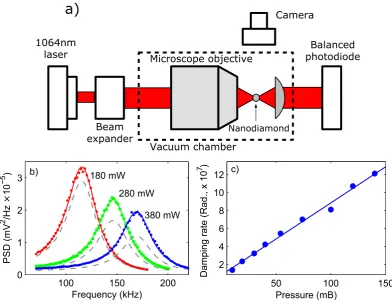
Figure 1a shows a schematic of our experimental setup where we use a 0.80 numerical aperture (NA) microscope objective to focus a 1064 nm laser beam into a diffraction limited spot. The force resulting from the electric field gradient forms the basis of our dipole trap20. The balanced photodiode visible in Fig. 1a provides a voltage signal generated from the interference between the directly transmitted trapping laser light and the oscillator’s position dependent scattered electromagnetic radiation20. Performing a Fourier transform on this voltage signal provides the measured spectral information as well as the damping rate of a levitated nanoparticle. We use this spectral information and damping rate to retrieve Ti and the size of a nanodiamond.
In the regime where the oscillation amplitude of a trapped particle is small, the trapping potential of an opti-cal tweezer can be approximated as harmonic20. Under this condition, the motion of a levitated object can be expressed as
γ ω
+ + = ( ), ( )
Md x
dt M
dx
dt M x f t 1
CM 2
2 02
where x is the displacement of a trapped particle from the centre of the trap along the x-axis. M and γCM, respec-tively, are the mass and the damping rate of a trapped particle while ω0= κ/M is the trap frequency and κ is the spring constant of the trap20. f(t) is a Gaussian random force exerted by the gas molecules on a trapped particle with f t( ) =0 and f t f t( ) ( )1 2 =2k TB CM CMγ M tδ(2−t1), where kB is the Boltzmann constant, TCM is the CM temperature of a trapped particle, and δ(t2− t1) is the Dirac delta function20. Similar analyses for the remaining two axes are also valid. After performing a Fourier transform and rearrangement, the power spectral density (PSD) of (1) can be written as
1064nm laser
Beam expander
Microscope objective
Vacuum chamber
Balanced photodiode Camera
a)
Nanodiamond
100 150 200
0 1 2 3
Frequency (kHz)
PSD (mV
2 /H
z
×
10
−5 )
380 mW
b) 180 mW
280 mW
50 100 150
2 4 6 8 10 12
Pressure (mB)
Damping rate (Rad., x 10
[image:3.595.157.550.45.348.2]7 ) c)
ω γ
ω ω γ ω
( ) =
( − ) + . ( )
S k T
M
2
2
x B CM CM
CM 2
02 2 2 2
We fit (2) with the experimental data.
Figure 1b shows the PSDs corresponding to the measured voltage signals from a levitated nanodiamond for different trapping powers along with the respective fits (solid lines) of equation (2) at 20 mB. For the purpose of comparison, in Fig. 1b we have also included the relevant theoretical PSDs (dashed grey lines). In plotting the the-oretical PSDs we have assumed that all parameters are identical to the measured PSDs except TCM which has been taken equal to 300 K. Figure 1c demonstrates the measured damping rate as a function of pressure at a constant trapping power of 180 mW. Later, we use this damping rate to find the size of a nanoparticle.
Levitated Nanodiamonds in Vacuum
To study the behaviour of diamond below atmospheric pressure, after levitating a nanodiamond with the mini-mum possible trapping power (180 mW), we gradually take it to different levels of vacuum whilst continuously monitoring its scattering intensity (size) using a camera. Figure 2a shows a typical plot of scattering intensity versus pressure (pink circles) from a levitated nanodiamond (for more data points see supplementary information Fig. S1). It can be observed that as we evacuate the trapping chamber, the scattering intensity diminishes: a levi-tated nanodiamond shrinks in size as the pressure is reduced. We attribute this reduction in size to the removal of physisorbed water and organic substances such as the carboxyl groups (nanodiamonds as obtained from the sup-plier are in water and are coated with carboxyl groups for stabilization) present on the surface of nanodiamonds down to 20 mB where the temperature reaches ≈ 450 K (see Fig. 3). Physisorbed water and organic impurities normally disappear21 at or below 473 K. This is further confirmed when we keep a levitated nanodiamond in a vacuum of less than 10 mB for an extended period of time (about an hour) and take it to back to atmospheric pressure (red squares in Fig. 2a) and bring it down to the low pressures again. In the second round of evacuation, the scattering intensity remains constant down to 10 mB. This unaltered scattering intensity in the second round of evacuation indicates the absence of substances which evaporate/burn at relatively lower temperatures.
The reduction in size below 10 mB is attributed to the burning of amorphous carbon or diamond. Amorphous carbon is generally found as an outer layer on the surface of nanodiamonds21–23. The burning temperature of amorphous carbon21 at atmospheric pressure varies between 573–723 K while the oxidation temperature of nan-odiamonds21,22,24 ranges from 723–769 K. Also, the exact oxidation temperature of nanodiamonds depend on the surface quality, the crystallographic faces, and the densities of impurities in nanodiamonds21,22,24. To confirm the presence of amorphous carbon as well as diamond in the nanoparticles that we have used in our experiments, we performed Raman spectroscopy using a 785 nm laser. At this wavelength amorphous carbon is more sensitive than diamond25. Figure 2b presents the relevant data. This figure clearly shows the presence of amorphous carbon and diamond peaked at ≈ 1400 cm−1 and at ≈ 1335 cm−1, respectively23,25–27. Given that amorphous carbon is a strongly absorbing material28–31, trapping light (1064 nm) absorption and hence raised Ti and consequent burning in an air environment is highly probable. This burning of nanodiamond in air can potentially be a major hurdle in applications where vacuum is inevitable.
[image:4.595.155.555.48.173.2]Based on the idea that an oxygen-less environment may be a cure to this problem, we have studied the behav-iour of levitated nanodiamonds in a nitrogen environment. This is shown in Fig. 2a as blue crosses for a constant
www.nature.com/scientificreports/
trapping power of 300 mW. It can be observed that at pressures > 10 mB the scattering intensity hence the size of a nanodiamond remains unchanged; even though temperature is quite high (see Fig. 3). This is due to the fact that for burning to occur, a nanodiamond requires oxygen which is absent in a nitrogen rich environment. However, if the pressure is reduced below 10 mB, the scattering intensity of the nanodiamond gradually diminishes. Given that there is almost no oxygen in the chamber and the reduced pressure means less cooling due to gas molecules and hence higher internal temperature, we believe this is the onset of graphitization of the nanodiamond. At atmospheric pressure graphitization of nanodiamonds starts in the temperature range 943–1073 K and depends on the surface quality of nanodiamonds24,26. Since we are operating at sub-atmospheric pressures, graphitization at a lower temperature is most likely to happen. Lastly, it is noteworthy that irrespective of an air or a nitrogen environment, below 5 mB levitated nanodiamonds rapidly shrink in size and by ≈ 2 mB completely disappear from the trap.
Internal Temperature of a Levitated Nanodiamond
[image:5.595.166.511.47.261.2]Even though the nanodiamonds that we use in our experiments contain NV− centres, most of them do not fluo-resce upon levitation - consistent with the results of a previous study32 by Neukirch et al. It has been shown that the resonant frequency of optically-detected magnetic resonance from the fluorescing levitated nanodiamonds can reveal the internal temperature32, but in this article we instead use a Brownian motion based temperature determination technique developed by Millen et al. in ref. 33. According to this technique, the interaction between two thermal baths - one consisting of the impinging gas molecules while the other is composed of the emerging gas molecules, is mediated by a levitated object whose internal temperature is higher than that of the impinging gas molecules. The temperature of the impinging gas molecules is Timp while that of the emerging gas molecules is Tem. TCM can be expressed as TCM=
(
Timp impγ +Tem emγ)
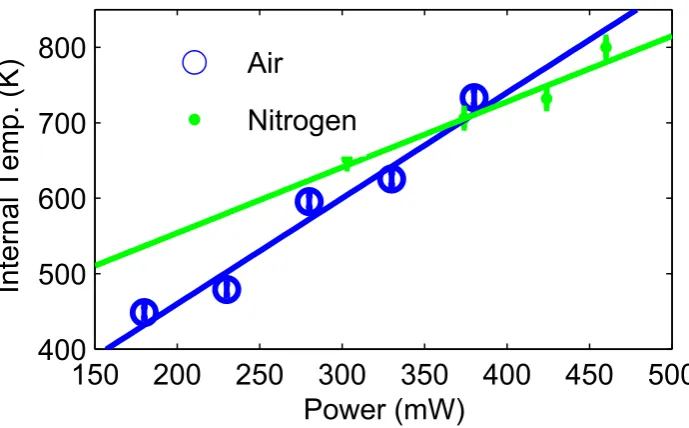
/(γimp+γem), where γimp and γem are the damping rates due to the impinging and emerging gas molecules, respectively33. Using this methodology and assuming a full accommodation (Ti = Tem), in Fig. 3 we present Ti obtained from the same nanodiamond used in Fig. 2 as a function of trapping power in air (blue circles) at 20 mB. In measuring Ti we have assumed that a levi-tated nanodiamond is at room temperature at ≈ 150 mB (see supplementary info Fig. S2). This assumption is also supported by the optically detected magnetic resonance based temperature measurements performed on nanodi-amonds by Hoang et al. using a similar setup to ours34. Also, since fitting uncertainties increase with the increas-ing pressure, Ti has been plotted as a function of trapping power at a constant pressure and it was measured during the 2nd round of evacuation at which a levitated nanodiamond maintains its size. Constancy in size/mass is a requirement of the PSD analysis. From Fig. 3 one can see that the internal temperature reaches ≈ 750 K at 380 mW of trapping power in air. This is well within the reported burning temperature of amorphous carbon or diamond21,22,24. In Fig. 3 we have also included Tis obtained from a levitated nanodiamond submerged in a nitro-gen environment. In this case Ti reaches approximately 800 K at the maximum trapping power. At pressures below 20 mB, temperatures are expected to be higher given that the cooling due to gas molecules becomes less effective while the absorption remains constant. It is noteworthy that the fluorescence from NV− centres in diamond decreases significantly at temperatures beyond 550 K and by 700 K it reduces to 20% of the room temperature value13. Also, at Ti = 700 K, NV− centre’s fluorescence lifetime and the contrast between electron spin resonances reduce below 20% of the room temperature value13. At a temperature above 625 K, the spin coherence time of the NV− centre decreases as well13. Furthermore, the highest temperature that we have measured here, using trapping powers higher than those have been used by Neukirch et al.32, rules out the possibility of melting diamond asFigure 3. Internal temperature (Ti) - blue circles in air and green dots in nitrogen at 20 mB as a function of
suggested in ref. 32. Diamond usually melts at temperatures ≥ 4000 K and requires pressure above atmospheric pressure35. A slight difference between the temperatures at a constant power such as at 300 mW in Fig. 3 between different environments can be attributed to the variation in surface qualities and the densities of impurities in different nanodiamonds24,36. Additionally, it has been demonstrated that bigger particles heat up rapidly com-pared to smaller particles under the same experimental conditions33. As a result, variation in the internal temper-atures is expected unless all the attributes of different particles are identical. However, due to the inherent nature of levitated experiments, it is difficult to levitate particles with the same attributes in different runs of an experi-ment. This is further worsened by the polydispersity of nanoparticles. For example, the average size of the nano-diamonds that we have used in our experiment is quoted to be 100 nm by the manufacturer. A representative scanning electron microscope (SEM) image of this nanodiamond is shown in Fig. 4a. Nanodiamonds from a few tens of nanometers to a few hundred nanometers are visible. Consequently, trapping different sizes of nanodia-monds in different runs of an experiment is possible. Nevertheless, to be consistent throughout the experiment, we levitate nanodiamonds of similar size by monitoring their scattering intensities. Also, next we present a way of determining the size of an individual levitated object from the measured damping rate (γCM) that it encounters while oscillating inside the trap. For the purpose of following calculations, we assume that a levitated nanodia-mond is of spherical shape.
Determination of the Size of a Levitated Nanodiamond
The effective damping rate as shown in Fig. 1c can be expressed as γCM = γimp + γem, where γimp and γem are the damping rates due to the impinging and emerging gas molecules, respectively33. γimp can be written as πmNR v
M 4
3
imp
2
while γem is related to γimp by γem= π8 TTemγimp
imp , where R, N, m, and vimp= π
k T m
8B imp are the radius of a trapped
particle, the number density of gas molecules at pressure P, molecular mass, and the mean thermal velocity of impinging gas molecules, respectively33. N can further be expressed as N= N
0P/P0, where N0 is the number of gas molecules per cubic meter at atmospheric conditions and P0 is the atmospheric pressure. On substitutions of various terms, one can express R as
ργ π = + , ( )
R mv N T
T 1 8 3 imp cm em imp
where M has been expressed as 43π ρR3 and ρ is the mass density of diamond.
Given that the levitated nanodiamonds burn, equation (3) gives the ultimate size of a nanodiamond for which we previously found temperatures. That is, it is the size of the nanodiamond after the first round of evacuation. The actual size of a nanodiamond before burning can be found using scattering theory. The scattering intensity of a Rayleigh particle (Rλ) is given by Is= 83πk R4 6 εε+−21 I
2
, where = π λ
k 2 and I is the intensity of the trapping light37. Provided that we know the scattering intensity (see Fig. 2b) at different pressures, we can find the actual size of a nanodiamond using equation (4):
= , ( ) / R I
I R 4
p s
s 1 6
p
where Rp and Isp are the radius and the scattering intensity of the particle at pressure P, respectively.
As examples, using the model developed here, we estimate the sizes of the nanodiamonds for which we have presented internal temperatures in Fig. 3. Using equations (3) and (4), and parameters N0 = 2.43 × 1025,
[image:6.595.159.552.47.178.2]Timp = 300 K, Tem = 450 K, ρ = 3500 kg/m3, m = 4.81 × 10⁻²⁶ kg, P = 20 mB and γcm = 2.18 × 10⁵ radian with the
www.nature.com/scientificreports/
minimum trapping power of 180 mW, Fig. 4b shows the radius of the trapped nanodiamond at various pressures in air. It can be observed that when the nanodiamond was initially trapped at atmospheric pressure, its diame-ter was ≈ 41 nm. Similarly, for the nitrogen case using the same paramediame-ters except γcm = 2.22 × 10⁵ radian and
Ti = 650 K, we get the ultimate diameter of the nanodiamond is ≈ 38 nm. Given the uncertainty in the shape of nanodiamonds as visible in Fig. 4a, the nanodiamonds that we have used to find Tis in air and nitrogen ambients are of similar size. This is also in good agreement with the technique (initial scattering intensities) that we have utilized to trap similar size nanodiamonds in different runs of an experiment. Furthermore, even though the actual dimensions of a nanodiamond will be different from R due to its asymmetric shape, the estimated size provided by our model is well within the distribution visible in the SEM image (Fig. 4a). Lastly, we believe that the method developed here for the determination of size of an individual particle can be used in any levitated experiment.
Conclusions
We have demonstrated that nanodiamonds burn in air while they graphitize in a nitrogen ambient by absorbing trapping laser (1064 nm) light as the cooling due to gas molecules becomes less effective with decreasing pressure. We believe that amorphous carbon, a strongly absorbing material, present on the surface of nanodiamonds is a key reason for this. We also think that purer nanodiamonds instead of the currently available HPHT synthesized nanodiamonds can be a cure to this problem. Our Brownian motion based analysis has shown that the internal temperature of a levitated nanodiamond can reach up to 800 K. This rules out the possibility of melting diamond which requires35 a temperature ≥ 4000 K. Lastly, exploiting the damping rate that a particle encounters while in motion, we have developed a new way of determining its size. We consider that this new technique will be useful in present and future levitated experiments where the traditional electron microscopy and dynamic light scatter-ing based size determinations are not suitable.
Methods
Nanodiamonds containing ≈ 500 NV− centres (ND-NV-100 nm) were bought from Adamas Nanotechnology Inc, USA. The average size of the nanodiamonds quoted by the manufacturer is 100 nm. To prevent agglomeration we sonicate as received nanodiamonds for ≈ 10 minutes in an ultrasonic bath and then put them into a nebulizer and inject them into the trapping chamber. The trapping chamber is continuously monitored by a CMOS camera (Thorlabs Inc). Once a nanodiamond is trapped, the trapping chamber is evacuated to study the behaviour of nanodiamonds in vacuum. Power spectral density data were collected using a balanced photodiode (Thorlabs Inc) and a Picoscope oscilloscope (Pico Technology, UK). In the case of nanodiamonds immersed in nitrogen, the trapping chamber was purged with nitrogen fifteen times.
References
1. Mochalin, V. N., Shenderova, O., Ho, D. & Gogotsi, Y. The properties and applications of nanodiamonds. Nat. Nano.7, 11–23 (2012). 2. Khmelnitsky, R. A. & Gippius, A. A. Transformation of diamond to graphite under heat treatment at low pressure. Phase Transit.87,
175–192 (2014).
3. Davies, G. & Evans, T. Graphitization of diamond at zero pressure and at a high pressure. P Roy. Soc. Lond. A Mat.328, 413–427 (1972).
4. Shenderova, O. A., Zhirnov, V. V. & Brenner, D. W. Carbon nanostructures. Crit. Rev. Solid State27, 227–356 (2002). 5. Doherty, M. W. et al. The nitrogen-vacancy colour centre in diamond. Phys. Rep.528, 1–45 (2013).
6. Ivanov, M. G., Pavlyshko, S. V., Ivanov, D. M., Petrov, I. & Shenderova, O. Synergistic compositions of colloidal nanodiamond as lubricant-additive. J. Vac. Sci. Technol. B28, 869–877 (2010).
7. Behler, K. D. et al. Nanodiamond-polymer composite fibers and coatings. ACS Nano3, 363–369, PMID: 19236073. (2009) 8. Pace, E. & Sio, A. D. Diamond detectors for space applications. Nucl. Instrum. Meth. A514, 93–99 (2003).
9. Taylor, J. M. et al. High-sensitivity diamond magnetometer with nanoscale resolution. Nat. Phys.4, 810–816 (2008).
10. Balasubramanian, G. et al. Nanoscale imaging magnetometry with diamond spins under ambient conditions. Nat. Phys.455,
648–651 (2008).
11. Dutt, M. V. G. et al. Quantum register based on individual electronic and nuclear spin qubits in diamond. Science316, 1312–1316 (2007).
12. Fuchs, G. D., Burkard, G., Klimov, P. V. & Awschalom, D. D. A quantum memory intrinsic to single nitrogen-vacancy centres in diamond. Nat. Phys.7, 789–793 (1999).
13. Toyli, D. et al. Measurement and control of single nitrogen-vacancy center spins above 600 K. Phys. Rev. X2, 031001 (2012). 14. Albrecht, A., Retzker, A. & Plenio, M. B. Testing quantum gravity by nanodiamond interferometry with nitrogen-vacancy centers.
Phys. Rev. A90, 033834 (2014).
15. Scala, M., Kim, M. S., Morley, G. W., Barker, P. F. & Bose, S. Matter-wave interferometry of a levitated thermal nano-oscillator induced and probed by a spin. Phys. Rev. Lett.111, 180403 (2013).
16. Yin, Z.-q., Li, T., Zhang, X. & Duan, L. Large quantum superpositions of a levitated nanodiamond through spin-optomechanical coupling. Phys. Rev. A88, 033614 (2013).
17. Barnard, A. S., Russo, S. P. & Snook, I. K. Size dependent phase stability of carbon nanoparticles: Nanodiamond versus fullerenes.
J Chem. Phys.118, 5094–5097 (2003).
18. Wang, X., Scandolo, S. & Car, R. Carbon phase diagram from Ab Initio molecular dynamics. Phys. Rev. Lett.95, 185701 (2005). 19. Bundy, F. et al. The pressure-temperature phase and transformation diagram for carbon; updated through 1994. Carbon34, 141–153
(1996).
20. Gieseler, J., Deutsch, B., Quidant, R. & Novotny, L. Subkelvin parametric feedback cooling of a laser-trapped nanoparticle. Phys. Rev. Lett.109, 103603 (2012).
21. Osswald, S., Yushin, G., Mochalin, V., Kucheyev, S. O. & Gogotsi, Y. Control of sp2/sp3 carbon ratio and surface chemistry of nanodiamond powders by selective oxidation in air. J Am. Chem. Soc.128, 11635–11642 (2006).
22. Gaebel, T. et al. Size-reduction of nanodiamonds via air oxidation. Diam. Relat. Mater.21, 28–32 (2012).
23. Smith, B. R., Gruber, D. & Plakhotnik, T. The effects of surface oxidation on luminescence of nano diamonds. Diam. Relat. Mater. 19, 314–318 (2010).
25. Ferrari, A. C. & Robertson, J. Raman spectroscopy of amorphous, nanostructured, diamond–like carbon, and nanodiamond. Philos. T. Roy. Soc. A362, 2477–2512 (2004).
26. Chen, J., Deng, S. Z., Chen, J., Yu, Z. X. & Xu, N. S. Graphitization of nanodiamond powder annealed in argon ambient. Appl. Phys. Lett.74, 3651–3653 (1999).
27. Merkulov, V. I. et al. uv studies of tetrahedral bonding in diamondlike amorphous carbon. Phys. Rev. Lett.78, 4869–4872 (1997). 28. Nagano, A., Yoshitake, T., Hara, T. & Nagayama, K. Optical properties of ultrananocrystalline diamond/amorphous carbon
composite films prepared by pulsed laser deposition. Diam. Relat. Mater.17, 1199–1202 (2008).
29. Stagg, B. & Charalampopoulos, T. Refractive indices of pyrolytic graphite, amorphous carbon, and flame soot in the temperature range 25 to 600 °C. Combust. Flame94, 381–396 (1993).
30. Maron, N. Optical properties of fine amorphous carbon grains in the infrared region. Astrophys. Space Sci.172, 21–28 (1990). 31. Duley, W. W. Refractive indices for amorphous carbon. Astrophys. J.287, 694–696 (1984).
32. Neukirch, L. P., von Haartman, E., Rosenholm, J. M. & Vamivakas, N. Multi-dimensional single-spin nano-optomechanics with a levitated nanodiamond. Nat. Photon.9, 653–657 (2015).
33. Millen, J., Deesuwan, T., Barker, P. & Anders, J. Nanoscale temperature measurements using non-equilibrium brownian dynamics of a levitated nanosphere. Nat. Nano.9, 425–429 (2014).
34. Hoang, T. M., Ahn, J., Bang, J. & Li, T. Observation of vacuum-enhanced electron spin resonance of levitated nanodiamonds.
arXiv:1510.06715 (2015).
35. Eggert, J. H. et al. Melting temperature of diamond at ultrahigh pressure. Nat. Phys.6, 40–43 (2010).
36. Qian, J., Pantea, C., Huang, J., Zerda, T. & Zhao, Y. Graphitization of diamond powders of different sizes at high pressure–high temperature. Carbon42, 2691–2697 (2004).
37. Bohren, C. F. & Huffman, D. R. Particles Small Compared with the Wavelength 130–157 (Wiley-VCH Verlag GmbH, 2007).
Acknowledgements
This work is supported by the U.K. Engineering and Physical Sciences Research Council through grants EP/ J014664/1 and EP/M003019/1 as well as EP/M013243/1 (the UK Quantum Technology Hub for Networked Quantum Information Technologies). G.W.M. is supported by the Royal Society.
Author Contributions
P.F.B. and G.W.M. conceived the experiment while A.T.M.A.R. and A.C.F. built the experiment. A.T.M.A.R. collected the data. P.F.B. and A.T.M.A.R. analysed the data. A.T.M.A.R. and G.W.M. wrote the manuscript. All authors, A.T.M.A.R., A.C.F., M.S.K., S.B., G.W.M. and P.F.B., discussed the results and commented on the manuscript.
Additional Information
Supplementary information accompanies this paper at http://www.nature.com/srep
Competing financial interests: The authors declare no competing financial interests.
How to cite this article: Rahman, A. T. M. A. et al. Burning and graphitization of optically levitated nanodiamonds in vacuum. Sci. Rep.6, 21633; doi: 10.1038/srep21633 (2016).