University of Warwick institutional repository:http://go.warwick.ac.uk/wrap
A Thesis Submitted for the Degree of PhD at the University of Warwick
http://go.warwick.ac.uk/wrap/71064
This thesis is made available online and is protected by original copyright. Please scroll down to view the document itself.
Using Poly(lactide) Crystallization to
Probe Nanostructure Morphologies
for Biomedical Applications
Liang Sun
Submitted for the degree of Doctor of Philosophy
Department of Chemistry
I
II
Table of Contents ... II
Acknowledgements ... X
Declaration of authorship ... XI
List of publications... XII
Summary ... XIII
Abbreviations ... XIV
Chapter 1. Introduction ... 1
1.1 Overview ... 2
1.2 Living polymerization ... 3
1.3 Reversible-deactivation radical polymerization ... 5
1.4 Reversible addition-fragmentation chain transfer (RAFT) polymerization... 8
1.5 Poly(lactide)s and controlled ring-opening polymerization of lactide ... 12
1.6 Stereocomplexation between PLLA and PDLA ... 15
1.7 Macromolecular self-assembly in solution ... 20
1.8 Polymeric cylindrical nanoparticles ... 24
1.9 Crystallization-driven self-assembly to prepare cylindrical nanoparticles ... 27
1.10 Functionalization of polymeric nanoparticles ... 31
III
1.12 References ... 34
Chapter 2. Tuning the Dimensions of Cylindrical Micelles from Poly(
L-Lactide)-containing Diblock Copolymers based on Crystallization-Driven
Self-Assembly ... 43
2.1 Abstract ... 44
2.2 Introduction ... 45
2.3 Results and discussion ... 49
2.3.1 Synthesis and characterization of PLLA-b-PTHPA diblock copolymers ... 49
2.3.2 Crystallization-driven self-assembly of various PLLA-b-PTHPA diblock copolymers 58 2.3.3 Tuning the lengths of polymeric cylinders through variation of the hydrophobic PLLA block length ... 59
2.3.4 Tuning the widths of polymeric cylinders through variation of the PAA block length and hydrophobic weight fraction ... 71
2.3.5 Study of the effect of different pH values on the PLLA-b-PAA cylindrical morphologies ... 79
2.4 Conclusions ... 82
2.5 Experimental section ... 83
2.5.1 Materials ... 83
2.5.2 Instrumentation ... 83
IV
2.5.4 Synthesis of poly(L-lactide) using ROP ... 89
2.5.5 Synthesis of PLLA-b-PTHPA diblock copolymers using RAFT polymerization ... 89
2.5.6 Crystallization-driven self-assembly of PLLA-b-PTHPA diblock copolymers to obtain cylindrical micelles ... 90
2.5.7 Changing the pH conditions of crystallization-driven self-assembly of PLLA38-b-PAA333 diblock copolymers ... 90
2.6 Acknowledgements ... 92
2.7 References ... 93
Chapter 3. Poly(lactide) Stereocomplexation-Triggered Morphological
Transition of Cylindrical Nanoparticles ... 98
3.1 Abstract ... 99
3.2 Introduction ... 100
3.3 Results and discussion ... 103
3.3.1 Synthesis of precursor PLLA31-b-PTHPA332, 1, and PDLA28-b-PTHPA315, 2, diblock Copolymers ... 103
3.3.2 Formation of stereocomplex particles achieved from the precursor diblock copolymers, 1 and 2 ... 107
3.3.3 Stereocomplexation-triggered morphological transition from homochiral cylinders to stereocomplex spheres ... 113
V
3.4 Conclusions ... 143
3.5 Experimental section ... 144
3.5.1 Materials ... 144
3.5.2 Instrumentation ... 144
3.5.3 Self-assembly of the mixture of 1 and 2 to realize stereocomplex particles ... 148
3.5.4 Crystallization-driven self-assembly of 1 or 2 to obtain homochiral cylindrical micelles, 3 or 4 ... 149
3.5.5 Preparation of amorphous spheres from diblock copolymer, 1 ... 149
3.5.6 Addition of PDLA-b-PAA unimers into PLLA-b-PAA cylinder, 3, to induce a cylinder-to-sphere morphological transition... 150
3.5.7 Synthesis and characterization of PEO-b-PLLA and PEO-b-PDLA diblock copolymers150 3.5.8 Using stereocomplexation as a trigger to induce a morphological transition from the mixture of PEO-b-PLLA cylinders and PEO-b-PDLA cylinders ... 152
3.6 Acknowledgements ... 153
3.7 References ... 154
Chapter 4. Fluorescent Aminobromomaleimide Functional Group
Containing Cylindrical Micelles towards Bioimaging Contrast Agents157
4.1 Abstract ... 1584.2 Introduction ... 159
VI
4.3.1 Synthesis of DTM containing Y-shaped (PLLA)2-b-PTHPA block copolymers ... 162
4.3.2 Crystallization-driven self-assembly of DTM containing Y-shaped (PLLA)2-b-PTHPA block copolymer, 6... 167
4.3.3 Synthesis and characterization of fluorescent ABM functional ROP/RAFT dual headed initiator, 4 ... 169
4.3.4 Synthesis and characterization of fluorescent ABM containing PLLA-b-PTHPA ... 171
4.3.5 Crystallization-driven self-assembly of ABM containing PLLA-b-PTHPA diblock copolymer, 8, to obtain cylindrical micelles ... 177
4.3.6 Preparation of biocompatible ABM containing cylindrical micelles ... 181
4.3.7 Fluorescence lifetime studies of various ABM containing materials... 190
4.4 Conclusions ... 195
4.5 Experimental section ... 196
4.5.1 Materials ... 196
4.5.2 Instrumentation ... 196
4.5.3 Synthesis of (PLLA)2, 5 by ROP using DTM containing initiator, 3 ... 200
4.5.4 Synthesis of Y-shaped DTM containing (PLLA)2-b-PTHPA block copolymer, 6, using RAFT polymerization ... 201
4.5.5 Crystallization-driven self-assembly of DTM functional Y-shaped (PLLA)2-b-PTHPA block copolymer, 6 ... 201
VII
4.5.8 Synthesis of ABM containing PLLA-b-PTHPA, 8, and PDLLA31-b-PTHPA230 diblock
copolymers using RAFT polymerization ... 205
4.5.9 Crystallization-driven self-assembly of ABM functional group containing PLLA-b-PTHPA diblock copolymer, 8 ... 206
4.5.10 Synthesis of ABM containing triblock copolymers, 10, 11 and 12 ... 206
4.5.11 Crystallization-driven self-assembly of ABM functional group containing triblock copolymers, 10, 11 and 12... 207
4.5.12 Direct PEGylation of ABM functional PLLA-b-PAA cylindrical micelles to prepare biocompatible cylinders ... 207
4.5.13 Preparation of PDLLA-b-PAA spherical micelles ... 208
4.6 Acknowledgement ... 209
4.7 References ... 210
Chapter 5. Core Functionalization of Polymeric Cylindrical Nanoparticles
Using Photo-initiated Thiol-ene Radical Reactions ... 213
5.1 Abstract ... 214
5.2 Introduction ... 215
5.3 Results and discussion ... 218
5.3.1 Copolymerization of LLA and MAC using ROP ... 218
5.3.2 Synthesis of P(LLA-co-MAC)-b-PTHPA block copolymer, 2, using RAFT polymerization ... 221
VIII
5.3.4 Synthesis of PLLA-b-PMAC-b-PTHPA triblock copolymer, 6 ... 226
5.3.5 Crystallization-driven self-assembly of PLLA-b-PMAC-b-PTHPA triblock copolymer, 6 ... 230
5.3.6 Core functionalization of PLLA-b-PMAC-b-PAA cylindrical micelles, 7, using photo-initiated thiol-ene radical reactions ... 232
5.4 Conclusions ... 237
5.5 Experimental section ... 238
5.5.1 Materials ... 238
5.5.2 Instrumentation ... 238
5.5.3 Synthesis of P(LLA-co-MAC), 1, using ROP ... 240
5.5.4 Synthesis of P(LLA-co-MAC)-b-PTHPA block copolymer, 2, using RAFT polymerization of THPA ... 241
5.5.5 Crystallization-driven self-assembly of P(LLA-co-MAC)-b-PTHPA block copolymer, 2242 5.5.6 Synthesis of PMAC homopolymer and PLLA-b-PMAC diblock copolymer, 5, using ROP ... 242
5.5.7 Synthesis of PLLA-b-PMAC-b-PTHPA triblock copolymer, 6, using RAFT polymerization of THPA ... 243
5.5.8 Crystallization-driven self-assembly of PLLA-b-PMAC-b-PTHPA triblock copolymer, 6 ... 244
5.5.9 Functionalization of PLLA-b-PMAC-b-PAA cylindrical micelles, 7, using photo-initiated thiol-ene radical reactions ... 244
IX
5.6 References ... 247
X My sincere thanks goes to my supervisors, Professor Rachel O’Reilly and Professor Andrew Dove, not only for their invaluable guidance and advice during my PhD study but also for their support and encouragement. I feel very lucky to work with them in both well-organized research groups.
I would like to thank all of the group members from both groups for their collaborations, especially Dr. Nikos Petzetakis for his kind help at the begginning of my PhD; Dr. Anaïs Pitto-Barry, Dr. Helen Willcock, Dr. Mathew Robin, Yan Kang and Dafni Moatsou for their help and precious advice and discussions during my PhD.
A big thank you goes to my parents, Changfa Sun and Guirong Tan, not only for their financial support of my PhD study but also for their continuous caring and love.
XII 1. Tuning the Size of Cylindrical Micelles from Poly(L-Lactide)-b-Poly(Acrylic Acid) Diblock Copolymers based on Crystallization-Driven Self-Assembly, L. Sun, N. Petzetakis, A. Pitto-Barry, T. Schiller, N. Kirby, D. Keddie, B. Boyd, R.K. O'Reilly, A.P. Dove, Macromolecules, 2013, 46, 9074–9082. (Chapter 2)
2. Structural Reorganization of Cylindrical Nanoparticles Triggered by Polylactide Stereocomplexation, L. Sun, A. Pitto-Barry, N. Kirby, T. Schiller, A. Sanchez, M. Dyson, J. Sloan, N. Wilson, R.K. O'Reilly, and A.P. Dove, Nature
XIII Chapter 1 gives the introduction of the main concepts and techniques throughout this thesis.
Chapter 2 describes the control over the dimensions of various poly(L
-lactide)-b-poly(acrylic acid) cylindrical micelles based on crystallization-driven self-assembly. Such change of the dimensions was realized by tuning the compositions of the precursor diblock copolymers. We have also explored the window to access cylindrical micelles as well as the relationship between poly(L-lactide) core block and crystallinity of resultant cylindrical micelles.
In Chapter 3, we have studied the stereocomplexation between the crystalline-coil poly(L-lactide)-b-poly(acrylic acid) and poly(D-lactide)-b-poly(acrylic acid) diblock copolymers in an aqueous system. We have also observed an unexpected morphological transition from homochiral cylindrical micelles to stereocomplex spherical micelles which was proposed to follow a “unimer-exchange” mechanism.
Chapter 4 discusses the preparation of fluorescent dithiomaleimide and aminobromomaleimide labelled polymers and nanoparticles and compares their different fluorescent properties. The potential applications of these fluorescent materials as bioimaging contrast agents were also illustrated.
XIV
°C degrees Celsius
ÐM molar-mass dispersity
λ wavelength
δ chemical shift
AIBN azobisisobutyronitrile
ATRP atom transfer radical polymerization
br broad (1H NMR)
CDSA crystallization-driven self-assembly
cm-1 wavenumber
CTA chain transfer agent
CuAAC copper-catalyzed azide-alkyne cycloaddition
d doublet (1H NMR)
Da Daltons
DCM dichloromethane
DCTB trans-2-[3-(4-tert-butyl-phenyl)-2-methyl-2-propenylidene] malononitrile
Dh hydrodynamic diameter
DLS dynamic light scattering DMA N,N’-dimethylacylamide
DMF N,N-dimethylformamide
DMSO dimethyl sulfoxide
Dn number-average diameter
XV
DP degree of polymerization
DSC differential scanning calorimetry
EDC N-(3-dimethylaminopropyl)-N’-ethylcarbodiimide
eq. equivalents
FT-IR Fourier transform infrared
g grams
h hours
HEA 2-hydroxyehthyl acrylate
Hz hertz
HR-MS high resolution mass spectroscopy
J coupling constant (1H NMR)
kDa kiloDaltons
LLA L-Lactide
Ln number-average length
Lw weight-average length
m meters / multiplet (1H NMR)
MAC 5-methyl-5-allyloxycarbonyl-1,3-dioxan-2-one
MALDI-ToF matrix assisted laser desorption/ionization time of flight
MHz megahertz
min minutes
mg milligrams
mL millilitres
mmol millimoles
Mn number-average molecular weight
XVI
mol moles
NaTFA sodium trifluoroacetate
nm nanometers
NMP nitroxide mediated polymerization
NMR nuclear magnetic resonance
OEGA poly(ethylene glycol) methyl ether acrylate
PAA poly(acrylic acid)
PCL poly(ε-caprolactone)
PLA poly(lactide)
PLLA poly(L-Lactide)
PD polydispersity
PDLA poly(D-lactide)
PMMA poly(methyl methacrylate)
ppm parts per million
PDMA poly(dimethylacylamide)
PEG poly(ethylene glycol)
PFS poly(ferrocenyldimethylsilane) PHEA poly(2-hydroxyethyl acrylate)
PMAC poly(5-methyl-5-allyloxycarbonyl-1,3-dioxan-2-one) POEGA poly(poly(ethylene glycol) methyl ether acrylate)
PS poly(styrene)
PTHPA poly(tetrahydropyran acrylate)
q scattering vector (SAXS)
RAFT reversible addition-fragmentation chain transfer
XVII ROP ring-opening polymerization
rt room temperature
s singlet (1H NMR)
SAXS small-angle X-ray scattering
SEC size exclusion chromatography
t triplet (1H NMR)
TCSPC time-correlated single-photon counting
TEA triethylamine
TEGA triethylene glycol methylether acrylate TEM transmission electron microscopy TEMPO (2,2,6,6-tetramethylpiperidin-1-yl)oxy
Tg glass transition temperature
THF tetrahydrofuran
THPA tetrahydropyran acrylate
Tm melting temperature
UV ultraviolet
2 1.1 Overview
This chapter describes a detailed background of concepts and methodologies used throughout this thesis. Firstly, living polymerization, reversible-deactivation radical polymerizations (especially reversible addition-fragmentation chain transfer polymerization) and the ring-opening polymerization of lactide are introduced. These polymerization techniques allow control over polymer synthesis and can be exploited to prepare amphiphilic polymers suitable for solution self-assembly of various nanoparticles. The special stereocomplexation phenomenon between poly(L-lactide) and
3 1.2 Living polymerization
As defined by International Union of Pure and Applied Chemistry (IUPAC), a living polymerization is a chain growth polymerization from which both chain transfer and chain termination are absent.1 A number of experimental criteria have been developed to identify whether a polymerization process is living:2 1. Polymerization proceeds until all of the monomer has been consumed and
further addition of monomer results in continued polymerization.
2. A linear correlation between number average molecular weight (or number average degree of polymerization (DP)) and conversion should be observed. 3. The number of growing polymer chains and active centers is constant and
independent of conversion.
4. The DP of the resultant polymers can be controlled by the ratio of monomer to initiator.
5. Polymers with narrow molecular weight distributions are produced.
6. Chain-end functionalized polymers can be prepared in a quantitative yield. 7. Block copolymers can be prepared via sequential addition of a second
monomer.
5 1.3 Reversible-deactivation radical polymerization
Conventional free radical polymerization has been widely used in research and industry as it can be applied to a variety of monomers, it is tolerant to a range of functional groups and is a relatively simple and inexpensive technique to undertake. In a typical free radical polymerization, a monomer is first initiated by a radical initiator such as azobisisobutyronitrile (AIBN) to generate a reactive monomer radical. Then the successive addition of monomer to the radical chain end results in polymer chain growth. The termination of a free radical polymerization can occur by either recombination or disproportionation. However, there are several drawbacks to conventional free radical polymerizations. For example, the average life of a propagating chain in a free radical polymerization is only a few seconds and this short lifetime will result in difficulties for synthetic manipulation, chain end modification or the synthesis of block copolymers by adding a second monomer. Also, in conventional free radical polymerization initiation is much slower than propagation which means some polymer chains have reached high molecular weights while some are still being initiated.4 The above disadvantages of free radical polymerization lead to uncontrolled polymer chain growth and further result in unpredictable molecular weights and broad molecular weight distributions.
6 equilibrium between active and dormant species, all polymer chains are given an equal opportunity to grow, enabling controlled polymerization.4 Therefore, reversible-deactivation polymerization can generate polymers with well-defined architectures along with narrow dispersities, predictable degrees of polymerization and uniform chain compositions.10
NMP was the first reversible-deactivation radical polymerization technique to be developed.5, 11 The NMP equilibrium is based on a principle in which the propagating species are reversibly captured by the free nitroxide radicals to form dormant alkoxyamine species (Scheme 1.1). When this equilibrium is shifted toward the dormant species, the concentration of the active species is low and chain termination is thus avoided. However, NMP often requires high polymerization temperatures (typically > 100 °C) and has shown limited control over methacrylate species.12
Scheme 1.1. A typical NMP equilibrium using (2,2,6,6-Tetramethylpiperidin-1-yl)oxy
(TEMPO).
7 To be more specific, the dormant species P-X reversibly reacts with Cu(I)X/ligand which is an activator to intermittently form the propagating radical (P•) and Cu(II)X2/ligand which is a deactivator. The deactivator then reacts with
the propagating radical to reform the dormant species and the activator. As the deactivation process is significantly favored in such an equilibrium, a low concentration of propagating radicals is guaranteed and therefore termination can be minimized and the polymerization is controlled. The structure of the ligand, the polymer/dormant species and the polymerization conditions affect the equilibrium constant and play decisive roles in an ATRP.14
8
1.4 Reversible addition-fragmentation chain transfer (RAFT)
polymerization
Reversible addition-fragmentation chain transfer (RAFT) polymerization was reported in 1998 by a group at the Commonwealth Scientific and Industrial Research Organisation (CSIRO) in Australia.8 In this work, different types of dithioesters were utilized as RAFT chain transfer agents (CTAs) to polymerize a number of monomers including styrene, methyl methacrylate and butyl acrylate in bulk, solution and emulsion respectively. At a similar time, Zard and co-workers reported macromolecular design via the interchange of xanthates (MADIX)9 which follows an identical mechanism to RAFT polymerization, as reported by CSIRO. MADIX is thus considered as a specific type of RAFT polymerization using xanthates as RAFT chain transfer agents.
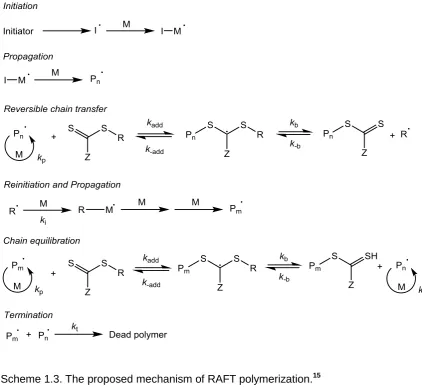
RAFT is thought to follow the mechanism shown in Scheme 1.3.15 Firstly, monomer M is initiated by a radical initiator such as AIBN to form a propagating polymer chain Pn•. Then, Pn• undergoes a fast reversible chain transfer
equilibrium with a CTA to release another radical R•. R• can re-initiate the monomer to give another propagating chain Pm• which subsequently enters the
main chain equilibirum with Pn• via reaction with the thiocarbonyl end group.
The fast exchange between dormant species, 4 and active species, 5 allows polymer chains to grow simultaneously and narrow molecular weight distributions to be obtained.
9 although to a lesser extent than the Z group.10 Figure 1.1 illustrates the choices of R groups of a RAFT CTA, starting from the most reactive species.10
Scheme 1.3. The proposed mechanism of RAFT polymerization.15
Figure 1.1. R groups of RAFT CTAs. Fragmentation rates decrease from top left to
[image:28.595.114.537.156.543.2]10 The function of the Z group of a RAFT CTA, 1 is to stabilize the thiocarbonylthio radical intermediates 3 and 5. Strong stabilizing Z groups will favour the formation of the intermediate and improve the reactivity of the C=S bond toward radical addition. However, if the intermediate species is too stable, fragmentation to generate the reinitiating radical R• and Pn• will be hindered.
Therefore, the choice of Z group is highly important. Figure 1.2 illustrates the choices of Z groups of a RAFT CTA, starting from the most stabilizing species.10 Based on the different types of Z group, RAFT CTAs can be subdivided into dithioester (C), trithiocarbonate (S), xanthate (O) and dithiocarbamate (N) (Figure 1.3).
Figure 1.2. Z groups of RAFT CTAs. Fragmentation rates increase from left to right.10
11 RAFT polymerization has shown many outstanding advantages. It controls the polymerizations of a variety of monomers in varying solvents including water. It is tolerant to a wide range of functional monomers and therefore allows the facile synthesis of polymer chains with different functionalities. Complicated polymer architectures such as block copolymers, graft copolymers, star-shaped polymers and hyperbranched polymers can be obtained by using RAFT polymerization. It is also compatible to many polymerization methods such as solution, bulk, emulsion, and dispersion.16
12 1.5 Poly(lactide)s and controlled ring-opening polymerization of lactide Poly(lactide) (PLA) is a biodegradable aliphatic poly(ester) which can be derived from renewable resources such as corn or sugarcane. It has attracted great interest given the successful application of PLA in the biomedical and pharmaceutical fields, in areas such as tissue engineering and drug delivery, due to the outstanding biodegradability, biocompatibility and low toxicity of PLA.18-20 PLA can be synthesized by the ring-opening polymerization (ROP) of the corresponding cyclic ester monomers, L-lactide, D-lactide, meso-lactide or
rac-lactide. Metal-based catalysts/initiators, such as tin octanoate (Sn(Oct)2),
are often utilized for the ROP of lactide.21 Sn(Oct)2 is an efficient active site
precursor to yield PLAs and the ROP process was generally considered to follow a coordination-insertion mechanism.22 However, using Sn(Oct)2 catalyst
during the ROP of lactide has shown to undergo undesirable transesterifications that led to broad molecular weight distributions.23 Several metal-free catalysts,24, 25 such like thiourea/(-)-sparteine co-catalyst system (Figure 1.4), offered an alternative route to realize narrow dispersities and precise architectures of PLAs.26-28 It was found that by using the thiourea/(-)-sparteine co-catalyst system, the ROP of L-lactide was highly effective with 95%
conversion of monomer achieved after only 2 h when the targeting degree of polymerization (DP) was 100.27 The proposed mechanism of the thiourea/(-)-sparteine co-catalyst system for ROP is shown in Figure 1.4.27 The carboxyl group of lactide is activated by the thiourea increasing its electrophilicity, while the initiating alcohol or propagating alcohol is activated by the tertiary amines of (-)-sparteine increasing the alcohols’ nucleophilicity.27
13 propagating alcohol and the ring-opening of the lactide monomer. It was found that the supramolecular recognition between the thiourea and cyclic lactide ester is in preference to the linear s-trans ester so that the initiating or propagating alcohol would avoid attack of the already formed PLA and thus minimal epimerisation and transesterification can be guaranteed.25, 27 However, as (-)-sparteine is no longer commercially available, a dibenzyl-functionalized bispidine organocatalyst (Figure 1.5) was recently developed to successfully replace (-)-sparteine by Dove and co-workers.29 The use of the thiourea/dibenzyl bispidine co-catalyst system showed a similar polymerization rate with that of thiourea/(-)-sparteine during the ROP of lactide monomers.29 Furthermore, the thiourea/dibenzyl bispidine co-catalyst system allowed control over the molecular weight of PLA with minimal transesterification and narrow dispersities.29
Figure 1.4. Proposed mechanism of ROP by using metal-free thiourea/(-)-sparteine
14
Figure 1.5. Chemical structure of dibenzyl bispidine organocatalyst which can be used
15 1.6 Stereocomplexation between PLLA and PDLA
The polymerization of pure enantiomeric monomer, L-lactide or D-lactide, leads
to the formation of isotatic poly(L-lactide) (PLLA) or poly(D-lactide) (PDLA).
When semi-crystalline left-handed poly(L-lactide) (PLLA) and right-handed
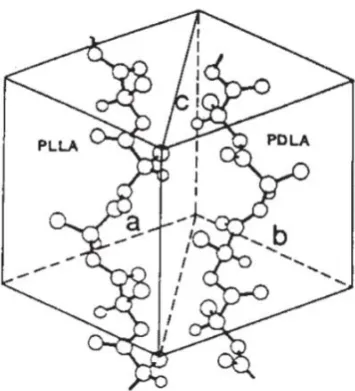
poly(D-lactide) (PDLA) co-crystallize, stereocomplex formation between PLLA and PDLA occurs. By careful study on the X-ray diffraction patterns of the stereocomplex crystals, it was found that PLLA and PDLA polymer chains adopted 31 helical conformations in a triangular stereocomplex crystal (Figure
1.6).30, 31 The stereocomplex PLA crystallites are stabilized by the CH3•••O=C
[image:34.595.241.419.431.627.2]hydrogen-bonding interaction between the two opposite homochiral polymer chains, allowing a more compact conformation and more dense polymeric packing than observed for homochiral crystallites.32
Figure 1.6. Crystal structure of PLA stereocomplexation.33
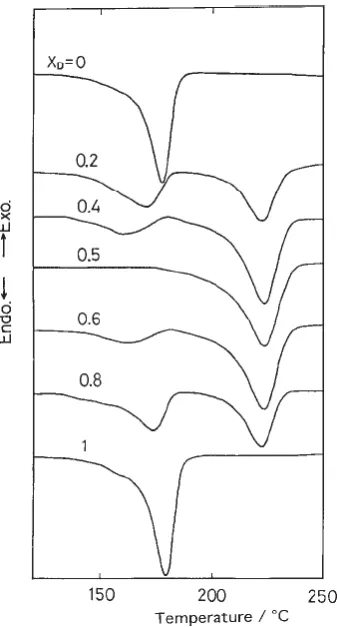
16 of PLLA and PDLA were much more stable and showed a 50 °C higher melting temperature than that of PLLA or PDLA homopolymer as proved by differential scanning calorimetry (DSC) (Figure 1.7).34 Also, higher values of tensile strength, Young’s modulus and elongation at break were observed for the stereocomplex film materials during tensile tests.35
Figure 1.7. DSC thermograms of PLLA/PDLA blends with different compositions of
PDLA that highlight that the melting temperature of stereocomplexation is much higher
than that of PLLA or PDLA.34
[image:35.595.242.411.238.552.2]17 mixture of poly(L-lactide)-b-poly(ethylene glycol) (PLLA-b-PEG) and
poly(D-lactide)-b-poly(ethylene glycol) (PDLA-b-PEG) diblock copolymers in
water were reported to promote drug releasing kinetics with improved stability.36 Stereocomplex micelles prepared from Y-shaped PEG-b-PLLA-b -PLLA and PEG-b-PDLA-b-PDLA miktoarm copolymers showed high loadings of paclitaxel.37 Furthermore, the stereocomplexation of poly(L-lactide)-b-poly(N
-isopropylacrylamide) (PLLA-b-PNIPAAM) and PDLA-b-PEG diblock copolymers were found to possess temperature-responsive behaviour which is suitable for potential delivery vehicles.38 The stereocomplexation of PLLA and PDLA has also led to many interesting self-assembled morphologies both in solution and in bulk. For example, Hedrick and co-workers obtained patchy polymeric micelles from a mixture of PLLA-b-PNIPAM and PDLA-b-PEG (Figure 1.8A).38 Hsiao and co-workers reported onion-like particles due to an imbalance in the surface stress from the stereocomplexation of poly(L-lactide)-b-poly(ethylene oxide) (PLLA-b-PEO) and poly(D-lactide)-b-poly(ethylene-co-1-butene)
18
Figure 1.8. Patchy micelles (A, TEM image),38 onion-like particles (B, TEM image)39
and flower-shaped particles (C, SEM image)40 obtained from the stereocomplexation of
PLLA- and PDLA- containing polymers in solution or in bulk.
19
Figure 1.9. Wide-angle X-ray diffraction profiles for PDLA homopolymer and blended
polymers: 50/50 PLLA/PDLA blend and 25/75 PLLA/PDLA blend.41
20 1.7 Macromolecular self-assembly in solution
Amphiphilic block copolymers which contain a hydrophilic block and a hydrophobic block can self-assemble in water to form micelle structures. Such a self-assembly process is often driven by the solvophobic effect to minimize the unfavourable interactions between the hydrophobic core block and the solvent. Since Eisenberg and co-workers found that poly(styrene)-b-poly(acrylic acid) (PS-b-PAA) and polystyrene-b-poly(ethylene oxide) (PS-b-PEO) could form various self-assembled structures by tuning block lengths twenty years ago,44-46 macromolecular self-assembly has received increasing attention. In a coil-coil block copolymer system, the resultant self-assembly morphology depends on three factors: the interfacial tension between the core and the solvent, the stretching of the core-forming block and the interaction of the coronal block.47 Any contributions such as changing the hydrophilic/hydrophobic ratio of the block copolymer composition48 and self-assembly conditions (temperature,49 solvent selectivity50 and salt concentration51) that can affect these three factors will influence the resultant self-assembled structures. A dimensionless packing parameter p (p = v/al, where v is the volume of the hydrophobic block, a is the optimal area of interface and l is the length of the hydrophobic chain) can be calculated based on the knowledge of the three factors given above to predict the potential structure of the assemblies. Generally, when p ≤ 1/3, spherical micelles are
favoured; when 1/3 ≤ p ≤ 1/2, cylindrical micelles are preferred; while one can
21
Figure 1.10. Schematic representation of different morphologies obtained from
macromolecular self-assembly governed by the packing parameter, p.52
The most common micelle morphology obtained through macromolecular self-assembly is spherical micelles which possess a soluble shell shielding an insoluble spherical core. Spherical micelles have been intensively studied44, 48,
53-55
and are often obtained when the weight fraction of the hydrophilic block is larger than that of the hydrophobic block.
Cylindrical micelles have an elongated morphology with a high aspect ratio (the dimension of the length is larger than that of diameter). More information of polymeric cylindrical micelles will be discussed in the next section.
22 vesicles are more stable and robust57 and can be given various properties by careful design of the precursor polymers.58, 59 Also, the relatively large interior cavities of vesicles allow the encapsulation of water soluble guest molecules.
Figure 1.11. TEM image (left) showing the bilayer structure of polymeric vesicular
micelles and a schematic representation (right) of their structure.56
Unlike a coil-coil block copolymer system, in a crystalline-coil copolymer system, the resultant self-assembly structure depends on the balance between crystallization of the core block and the stretching of the corona block.60 As the free energy of crystallization is so large and accounts for the majority of the total free energy, the crystalline block has to adopt a folded structure consisting of a crystalline lamellar domain sandwiched by two stretching corona faces to minimize the total free energy.61 However, if the stretching of the corona block is stronger, cylindrical micelles can be obtained.62
23 particles,63-65 multicompartment micelles,66, 67 core- and shell-crosslinked particles68, 69 and stimuli-responsive nanoobjects.70, 71
24 1.8 Polymeric cylindrical nanoparticles
Due to their long dimensions, polymeric cylindrical nanoparticles undergo a much longer in vivo circulation time78 and altered cell internalization pathways79 when compared to spherical particles and therefore exhibit great potential for biomedical applications. Cylindrical nanoparticles have also been successfully used for ion etching,80 adding toughness to epoxy resin81 and in the preparation of metal encapsulated nanoparticles.82
One approach to obtain cylindrical nanoparticles is using macromolecular self-assembly. Early in the 1990s, Bates et al. observed that poly(ethylene oxide)-b -poly(butadiene) diblock copolymers formed cylindrical micelles in water when the PEO weight fraction was 50%, using transmission electron microscopy (TEM) and small-angle neutron scattering (SANS) techniques.83 Meanwhile, Wu and co-workers reported that poly(styrene)-b-poly(isoprene) spherical nanoparticles fused into cylindrical structures when they were extruded through a special membrane with numerous nanoscale pores.84 Hedrick et al.
25 RAFT aqueous dispersion polymerization, various self-assembly nanostructures (spheres, worms or vesicles) were obtained due to the formation of amphiphilic block copolymers with different DP of PHPMA hydrophobic block.87 Cylindrical nanoparticles can also be obtained from bottle brush copolymers. For example, poly(4-(3-butenyl)styrene) side chains were grown from a PEO-b-PLA diblock backbone using RAFT polymerization by Rzayev et al. and after cross-linking of the poly(4-(3-butenyl)styrene) side chains, short cylindrical nanoparticles (Ln < 100 nm) were obtained.89
In addition to smooth and straight cylindrical morphologies, some other interesting structures of polymeric cylinders have been synthesized to date using both conventional and crystallization-driven self-assembly. For instance, segmented cylinders were obtained due to the phase separation between the fluorinated poly(butadiene) block and poly(4-tert-butoxystyrene) block in the core domain of cylindrical micelles (Figure 1.12A).90 Helical cylinders were also realized using a similar method but with the addition of an organic diamine to complex with the PAA blocks of poly(acrylic acid)-b-poly(methacrylate)-b -poly(styrene) triblock copolymers (Figure 1.12B).91 Furthermore, pointed-oval shaped cylinders were achieved via crystallization-driven self-assembly of poly(ferrocenyldimethylsilane)-b-poly(2-vinylpyridine) (PFS-b-P2VP) and poly(ferrocenyldimethylsilane)-b-poly(bis(trifluoroethoxy)-phosphazene)
26
Figure 1.12. TEM images showing segmented cylinders90 (A), helical cylinders91 (B)
27
1.9 Crystallization-driven self-assembly to prepare cylindrical
nanoparticles
In the late 1990s and early 2000s, Manners, Winnik and co-workers reported that organometallic poly(ferrocenyldimethylsilane) (PFS) containing diblock copolymers, poly(ferrocenyldimethylsilane)-b-poly(dimethylsiloxane) (PFS-b -PDMS), can undergo a self-assembly process to yield cylindrical nanoparticles in n-hexane (a selective solvent for PFS).93-95 The PFS-b-PDMS diblock copolymers used by these researchers were designed with a relatively short PFS core block and a relatively long PDMS corona block (block ratio > 1 : 6) and were expected to form spherical micelles instead.93 Several subsequent studies have shown that the crystallization of the crystalline PFS core block is the driving force to realize such anisotropic cylindrical micelles rather than the solvophobic effect in the conventional macromolecular self-assembly. Furthermore, when a poly(ferrocenyldimethylsilane)-b-poly(dimethylsiloxane) (PFS-b-PDMS) block copolymer solution was heated above the Tm of the PFS
28 poly(ferrocenyldimethylsilane)-b-poly(isoprene) (PFS-b-PI) unimers from PFS nanocrystals98 (Figure 1.13B), while scarf-shaped architectures with cylindrical tassels were realized by growing PFS-b-PI unimers on PFS-b-PI plate-like substrates99 (Figure 1.13C). Other groups have also explored CDSA using crystalline or semicrystalline poly(3-hexylthiophene),100, 101 poly(acrylonitrile),102 poly(ethylene)103 and poly(N-decylglycine)104 block containing copolymers and CDSA is becoming an increasingly powerful technique to access cylindrical micelles.
Figure 1.13. TEM images showing A) pentablock co-micelles,99 B) multi-armed
cylindrical micelles,105 and C) scarf-shaped architectures99 obtained from CDSA. Scale
bar = 500 nm.
Inspired by the seminal work listed above, our group have focused on the use of semi-crystalline poly(L-lactide)-b-poly(acrylic acid) (PLLA-b-PAA) diblock
29 diblock copolymers were synthesized by a combination of the ROP of L-lactide
and the RAFT polymerization of tetrahydropyran acrylate (THPA). The diblock copolymers were designed with a large fraction of hydrophilic block to access a cylindrical morphology. Hydrolysis of PTHPA in mild acidic conditions whilst heating above the Tg of the lactide block yielded PLLA-b-PAA cylindrical
micelles. Similar to other CDSA systems,108 the process of the formation of PLLA-b-PAA cylinders followed a sphere-to-rod transition.107 To be more specific, amphiphilic PLLA-b-PAA diblock copolymers formed spherical micelles first which underwent a crystallization process to yield crystalline micelle seeds above the Tg of the PLLA core block. The addition of PLLA-b-PAA unimers from
the solution onto the two ends of these seeds was thought to cause the resultant cylinder growth. The sphere-to-rod transition was confirmed by TEM (Figure 1.14) and DLS analyses while the crystallization process of the core block during the CDSA was proven by WAXD analysis. The PLLA-b-PAA cylinders also showed a linear correlation between micelle length and assembly time whilst heated above Tg indicating a living character in their growth.106
30 erased when the hollow cylindrical micelles were redispersed in water. Instead of PAA, other hydrophilic corona blocks such as poly(4-acryloyl morpholine) (P4AM), poly(ethylene oxide) (PEO) and poly(N,N-dimethylacrylamide) (PDMA) were utilized to prepare cylindrical micelles, although a mixture of cylinders and spheres was obtained and the formation of cylinders was much slower in these cases.110
Figure 1.14. TEM images showing the sphere-to-rod transition during the CDSA of
31 1.10 Functionalization of polymeric nanoparticles
To afford nanoparticles with different features and functions, chemical modification is often required. Functionalized nanoparticles can be achieved either by modification of the precursor amphiphilic polymers followed by self-assembly or by direct functionalization of the nanostructures. For the former route, it is more flexible to design a polymer with a specific target but this is time-consuming and requires multiple synthetic steps. In contrast, the post-assembly functionalization of micellar scaffolds is a faster and easier route as it avoids the synthesis and polymerization of new functional monomers and subsequent self-assembly.
A number of chemical modifications have been used to functionalize polymeric nanoparticles. Amidation modification is one of the most widely used methods. For example, Wooley, Welch and co-workers modified PS-b-PAA spherical micelles via reaction between the PAA shell block and PEG-NH2 to prepare
biocompatible nanostructures.111 Amidation modification has also been used for cross-linking purposes.112, 113 Click-chemistry is another important modification route to functionalize polymeric micelles. A variety of click-type reactions have been demonstrated so far. These include the Diels-Alder reaction,114 thiol-ene reaction,28, 115 and copper-catalyzed azide-alkyne cycloaddition (CuAAC) reaction.116
33 1.11 Conclusions
34 1.12 References
(1) Jenkins, A. D.; Kratochvíl, P.; Stepto, R. F. T.; Suter, U. W. Pure Appl. Chem 1996, 68, 2287–2311.
(2) Quirk, R. P.; Lee, B. Polym. Int. 1992, 27, 359-367. (3) Szwarc, M. Nature 1956, 178, 1168-1169.
(4) Braunecker, W. A.; Matyjaszewski, K. Prog. Polym. Sci. 2007, 32, 93-146. (5) Hawker, C. J. J. Am. Chem. Soc. 1994, 116, 11185-11186.
(6) Wang, J.-S.; Matyjaszewski, K. J. Am. Chem. Soc. 1995, 117, 5614-5615. (7) Kato, M.; Kamigaito, M.; Sawamoto, M.; Higashimura, T. Macromolecules 1995, 28, 1721-1723.
(8) Chiefari, J.; Chong, Y. K.; Ercole, F.; Krstina, J.; Jeffery, J.; Le, T. P. T.; Mayadunne, R. T. A.; Meijs, G. F.; Moad, C. L.; Moad, G.; Rizzardo, E.; Thang, S. H. Macromolecules 1998, 31, 5559-5562.
(9) Corpart, P. C., D.; Biadatti, T.; Zard, S. Z.; Michelet, D. PCT Int. Pat. Appl. WO 9858974, 1998.
(10) Perrier, S.; Takolpuckdee, P. J. Polym. Sci., Part A: Polym. Chem. 2005, 43, 5347-5393.
(11) Georges, M. K.; Veregin, R. P. N.; Kazmaier, P. M.; Hamer, G. K.
Macromolecules 1993, 26, 2987-2988.
(12) Grubbs, R. B. Polym. Rev. 2011, 51, 104-137.
(13) di Lena, F.; Matyjaszewski, K. Prog. Polym. Sci. 2010, 35, 959-1021. (14) Matyjaszewski, K. Macromolecules 2012, 45, 4015-4039.
35 (17) Willcock, H.; O'Reilly, R. K. Polym. Chem. 2010, 1, 149-157.
(18) Rezwan, K.; Chen, Q. Z.; Blaker, J. J.; Boccaccini, A. R. Biomaterials 2006, 27, 3413-3431.
(19) Feng, J.; Zhuo, R. X.; Zhang, X. Z. Prog. Polym. Sci. 2012, 37, 211-236. (20) Sun, H. L.; Guo, B. N.; Li, X. Q.; Cheng, R.; Meng, F. H.; Liu, H. Y.; Zhong, Z. Y. Biomacromolecules 2010, 11, 848-854.
(21) Dechy-Cabaret, O.; Martin-Vaca, B.; Bourissou, D. Chem. Rev. 2004, 104, 6147-6176.
(22) Ryner, M.; Stridsberg, K.; Albertsson, A.-C.; von Schenck, H.; Svensson, M. Macromolecules 2001, 34, 3877-3881.
(23) Baran, J.; Duda, A.; Kowalski, A.; Szymanski, R.; Penczek, S. Macromol. Symp. 1997, 123, 93-101.
(24) Dove, A. P. Chem. Comm. 2008, 6446-6470. (25) Dove, A. P. ACS Macro Lett. 2012, 1, 1409-1412.
(26) Dove, A. P.; Pratt, R. C.; Lohmeijer, B. G. G.; Waymouth, R. M.; Hedrick, J. L. J. Am. Chem. Soc. 2005, 127, 13798-13799.
(27) Pratt, R. C.; Lohmeijer, B. G. G.; Long, D. A.; Lundberg, P. N. P.; Dove, A. P.; Li, H. B.; Wade, C. G.; Waymouth, R. M.; Hedrick, J. L. Macromolecules 2006, 39, 7863-7871.
(28) Tempelaar, S.; Mespouille, L.; Dubois, P.; Dove, A. P. Macromolecules 2011, 44, 2084-2091.
(29) Todd, R.; Rubio, G.; Hall, D. J.; Tempelaar, S.; Dove, A. P. Chem. Sci. 2013, 4, 1092-1097.
(30) Brizzolara, D.; Cantow, H.-J.; Diederichs, K.; Keller, E.; Domb, A. J.
36 (31) Fukushima, K.; Kimura, Y. Polym. Int. 2006, 55, 626-642.
(32) Zhang, J.; Sato, H.; Tsuji, H.; Noda, I.; Ozaki, Y. Macromolecules 2005, 38, 1822-1828.
(33) Tsuji, H. Macromol. Biosci. 2005, 5, 569-597.
(34) Tsuji, H.; Hyon, S. H.; Ikada, Y. Macromolecules 1991, 24, 5657-5662. (35) Tsuji, H.; Ikada, Y. Polymer 1999, 40, 6699-6708.
(36) Kang, N.; Perron, M. E.; Prud'homme, R. E.; Zhang, Y. B.; Gaucher, G.; Leroux, J. C. Nano Lett. 2005, 5, 315-319.
(37) Nederberg, F.; Appel, E.; Tan, J. P. K.; Kim, S. H.; Fukushima, K.; Sly, J.; Miller, R. D.; Waymouth, R. M.; Yang, Y. Y.; Hedrick, J. L. Biomacromolecules 2009, 10, 1460-1468.
(38) Kim, S. H.; Tan, J. P. K.; Nederberg, F.; Fukushima, K.; Yang, Y. Y.; Waymouth, R. M.; Hedrick, J. L. Macromolecules 2009, 42, 25-29.
(39) Sun, L.; Zhu, L.; Rong, L. X.; Hsiao, B. S. Angew. Chem. Int. Ed. 2006, 45, 7373-7376.
(40) Hu, J. L.; Tang, Z. H.; Qiu, X. Y.; Pang, X.; Yang, Y. K.; Chen, X. S.; Jing, X. B. Biomacromolecules 2005, 6, 2843-2850.
(41) Ikada, Y.; Jamshidi, K.; Tsuji, H.; Hyon, S. H. Macromolecules 1987, 20, 904-906.
(42) Portinha, D.; Boue, F.; Bouteiller, L.; Carrot, G.; Chassenieux, C.; Pensec, S.; Reiter, G. Macromolecules 2007, 40, 4037-4042.
(43) Portinha, D.; Bouteiller, L.; Pensec, S.; Richez, A.; Chassenieux, C.
Macromolecules 2004, 37, 3401-3406.
37 (46) Yu, K.; Zhang, L. F.; Eisenberg, A. Langmuir 1996, 12, 5980-5984.
(47) Zhang, L. F.; Eisenberg, A. Polym. Advan. Technol. 1998, 9, 677-699. (48) He, Y. Y.; Li, Z. B.; Simone, P.; Lodge, T. P. J. Am. Chem. Soc. 2006, 128, 2745-2750.
(49) Rank, A.; Hauschild, S.; Forster, S.; Schubert, R. Langmuir 2009, 25, 1337-1344.
(50) Mihut, A. M.; Drechsler, M.; Moller, M.; Ballauff, M. Macromol. Rapid Commun. 2010, 31, 449-453.
(51) He, W. N.; Xu, J. T.; Du, B. Y.; Fan, Z. Q.; Wang, X. S. Macromol. Chem. Phys. 2010, 211, 1909-1916.
(52) Blanazs, A.; Armes, S. P.; Ryan, A. J. Macromol. Rapid Commun. 2009, 30, 267-277.
(53) Hansell, C. F.; O’Reilly, R. K. ACS Macro Lett. 2012, 1, 896-901.
(54) Robin, M. P.; Mabire, A. B.; Damborsky, J. C.; Thom, E. S.; Winzer-Serhan, U. H.; Raymond, J. E.; O’Reilly, R. K. J. Am. Chem. Soc. 2013, 135, 9518-9524. (55) Zhang, L. F.; Eisenberg, A. J. Am. Chem. Soc. 1996, 118, 3168-3181. (56) Du, J. Z.; O'Reilly, R. K. Soft Matter 2009, 5, 3544-3561.
(57) Discher, B. M.; Won, Y.-Y.; Ege, D. S.; Lee, J. C.-M.; Bates, F. S.; Discher, D. E.; Hammer, D. A. Science 1999, 284, 1143-1146.
(58) Du, J. Z.; Armes, S. P. J. Am. Chem. Soc. 2005, 127, 12800-12801.
(59) Du, J. Z.; Tang, Y. P.; Lewis, A. L.; Armes, S. P. J. Am. Chem. Soc. 2005, 127, 17982-17983.
(60) Vilgis, T.; Halperin, A. Macromolecules 1991, 24, 2090-2095. (61) Hamley, I. W. Adv. Polym. Sci. 1999, 148, 113.
38 (63) Moughton, A. O.; Hillmyer, M. A.; Lodge, T. P. Macromolecules 2012, 45, 2-19.
(64) Du, J. Z.; O'Reilly, R. K. Chem. Soc. Rev. 2011, 40, 2402-2416. (65) Walther, A.; Muller, A. H. E. Soft Matter 2008, 4, 663-668.
(66) Pochan, D. J.; Zhu, J. H.; Zhang, K.; Wooley, K. L.; Miesch, C.; Emrick, T.
Soft Matter 2011, 7, 2500-2506.
(67) Dupont, J.; Liu, G. Soft Matter 2010, 6, 3654-3661.
(68) O'Reilly, R. K.; Joralemon, M. J.; Hawker, C. J.; Wooley, K. L. New J. Chem. 2007, 31, 718-724.
(69) Moughton, A. O.; Stubenrauch, K.; O'Reilly, R. K. Soft Matter 2009, 5, 2361-2370.
(70) Chen, W.; Meng, F. H.; Cheng, R.; Zhong, Z. Y. J. Control. Release 2010, 142, 40-46.
(71) Ieong, N. S.; Brebis, K.; Daniel, L. E.; O'Reilly, R. K.; Gibson, M. I. Chem. Comm. 2011, 47, 11627-11629.
(72) Giacomelli, C.; Schmidt, V.; Aissou, K.; Borsali, R. Langmuir 2010, 26, 15734-15744.
(73) Lin, L. Y.; Lee, N. S.; Zhu, J. H.; Nystrom, A. M.; Pochan, D. J.; Dorshow, R. B.; Wooley, K. L. J. Control. Release 2011, 152, 37-48.
(74) Nisisako, T.; Torii, T.; Takahashi, T.; Takizawa, Y. Adv. Mater. 2006, 18, 1152-1156.
(75) Cotanda, P.; O'Reilly, R. K. Chem. Comm. 2012, 48, 10280-10282.
(76) Cotanda, P.; Lu, A.; Patterson, J. P.; Petzetakis, N.; O’Reilly, R. K.
Macromolecules 2012, 45, 2377-2384.
39 (78) Geng, Y.; Dalhaimer, P.; Cai, S. S.; Tsai, R.; Tewari, M.; Minko, T.; Discher, D. E. Nat. Nanotechnol. 2007, 2, 249-255.
(79) Zhang, K.; Rossin, R.; Hagooly, A.; Chen, Z. Y.; Welch, M. J.; Wooley, K. L.
J. Polym. Sci., Part A: Polym. Chem. 2008, 46, 7578-7583.
(80) Cao, L.; Massey, J. A.; Winnik, M. A.; Manners, I.; Riethmuller, S.; Banhart, F.; Spatz, J. P.; Moller, M. Adv. Funct. Mater. 2003, 13, 271-276.
(81) Liu, J.; Thompson, Z. J.; Sue, H. J.; Bates, F. S.; Hillmyer, M. A.; Dettloff, M.; Jacob, G.; Verghese, N.; Pham, H. Macromolecules 2010, 43, 7238-7243. (82) Wang, H.; Wang, X. S.; Winnik, M. A.; Manners, I. J. Am. Chem. Soc. 2008, 130, 12921-12930.
(83) Won, Y.-Y.; Davis, H. T.; Bates, F. S. Science 1999, 283, 960-963.
(84) Chen, Q. J.; Zhao, H.; Ming, T.; Wang, J. F.; Wu, C. J. Am. Chem. Soc. 2009, 131, 16650-16651.
(85) Kim, S. H.; Nederberg, F.; Jakobs, R.; Tan, J. P. K.; Fukushima, K.; Nelson, A.; Meijer, E. W.; Yang, Y. Y.; Hedrick, J. L. Angew. Chem. Int. Ed. 2009, 48, 4508-4512.
(86) Sugihara, S.; Blanazs, A.; Armes, S. P.; Ryan, A. J.; Lewis, A. L. J. Am. Chem. Soc. 2011, 133, 15707-15713.
(87) Blanazs, A.; Madsen, J.; Battaglia, G.; Ryan, A. J.; Armes, S. P. J. Am. Chem. Soc. 2011, 133, 16581-16587.
(88) Li, Y.; Armes, S. P. Angew. Chem. Int. Ed. 2010, 49, 4042-4046. (89) Huang, K.; Rzayev, J. J. Am. Chem. Soc. 2009, 131, 6880-6885.
(90) Fang, B.; Walther, A.; Wolf, A.; Xu, Y. Y.; Yuan, J. Y.; Muller, A. H. E.
40 (91) Zhong, S.; Cui, H. G.; Chen, Z. Y.; Wooley, K. L.; Pochan, D. J. Soft Matter 2008, 4, 90-93.
(92) Soto, A. P.; Gilroy, J. B.; Winnik, M. A.; Manners, I. Angew. Chem. Int. Ed. 2010, 49, 8220-8223.
(93) Raez, J.; Barjovanu, R.; Massey, J. A.; Winnik, M. A.; Manners, I. Angew. Chem. Int. Ed. 2000, 39, 3862-3865.
(94) Massey, J. A.; Temple, K.; Cao, L.; Rharbi, Y.; Raez, J.; Winnik, M. A.; Manners, I. J. Am. Chem. Soc. 2000, 122, 11577-11584.
(95) Massey, J.; Power, K. N.; Manners, I.; Winnik, M. A. J. Am. Chem. Soc. 1998, 120, 9533-9540.
(96) Wang, X. S.; Guerin, G.; Wang, H.; Wang, Y. S.; Manners, I.; Winnik, M. A.
Science 2007, 317, 644-647.
(97) He, F.; Gaedt, T.; Manners, I.; Winnik, M. A. J. Am. Chem. Soc. 2011, 133, 9095-9103.
(98) Qiu, H.; Cambridge, G.; Winnik, M. A.; Manners, I. J. Am. Chem. Soc. 2013, 135, 12180-12183.
(99) Gadt, T.; Ieong, N. S.; Cambridge, G.; Winnik, M. A.; Manners, I. Nat. Mater. 2009, 8, 144-150.
(100) Gwyther, J.; Gilroy, J. B.; Rupar, P. A.; Lunn, D. J.; Kynaston, E.; Patra, S. K.; Whittell, G. R.; Winnik, M. A.; Manners, I. Chem. Eur. J. 2013, 19, 9186 - 9197.
(101) Patra, S. K.; Ahmed, R.; Whittell, G. R.; Lunn, D. J.; Dunphy, E. L.; Winnik, M. A.; Manners, I. J. Am. Chem. Soc. 2011, 133, 8842-8845.
(102) Lazzari, M.; Scalarone, D.; Vazquez-Vazquez, C.; Lopez-Quintela, M. A.
41 (103) Schmalz, H.; Schmelz, J.; Drechsler, M.; Yuan, J.; Walther, A.; Schweimer, K.; Mihut, A. M. Macromolecules 2008, 41, 3235-3242.
(104) Lee, C.-U.; Smart, T. P.; Guo, L.; Epps, T. H.; Zhang, D. Macromolecules 2011, 44, 9574-9585.
(105) Qiu, H.; Cambridge, G.; Winnik, M. A.; Manners, I. J. Am. Chem. Soc. 2013, 135, 12180-12183..
(106) Petzetakis, N.; Dove, A. P.; O'Reilly, R. K. Chem. Sci. 2011, 2, 955-960. (107) Petzetakis, N.; Walker, D.; Dove, A. P.; O'Reilly, R. K. Soft Matter 2012, 8, 3408-3414.
(108) Shen, L.; Wang, H.; Guerin, G.; Wu, C.; Manners, I.; Winnik, M. A.
Macromolecules 2008, 41, 4380-4389.
(109) Petzetakis, N.; Robin, M. P.; Patterson, J. P.; Kelley, E. G.; Cotanda, P.; Bomans, P. H. H.; Sommerdijk, N. A. J. M.; Dove, A. P.; Epps, T. H.; O’Reilly, R. K. ACS Nano 2013, 7, 1120-1128.
(110) Pitto-Barry, A.; Kirby, N.; Dove, A. P.; O'Reilly, R. K. Polym. Chem. 2014, 5, 1427-1436.
(111) Sun, G.; Hagooly, A.; Xu, J.; Nyström, A. M.; Li, Z.; Rossin, R.; Moore, D. A.; Wooley, K. L.; Welch, M. J. Biomacromolecules 2008, 9, 1997-2006.
(112) Zhang, K.; Rossin, R.; Hagooly, A.; Chen, Z.; Welch, M. J.; Wooley, K. L.
J. Polym. Sci. A Polym. Chem. 2008, 46, 7578-7583.
(113) Huang, H.; L. Wooley, K.; E. Remsen, E. Chem. Comm. 1998, 1415-1416. (114) Shi, M.; Wosnick, J. H.; Ho, K.; Keating, A.; Shoichet, M. S. Angew. Chem. Int. Ed. 2007, 46, 6126-6131.
42 (116) O'Reilly, R. K.; Joralemon, M. J.; Hawker, C. J.; Wooley, K. L. Chem. Eur. J. 2006, 12, 6776-6786.
44 2.1 Abstract
In this chapter, a number of poly(L-lactide)-b-poly(acrylic acid) (PLLA-b-PAA)
cylindrical micelles were prepared based on crystallization-driven self-assembly (CDSA). It was observed that by simply changing the compositions of PLLA-b -PAA diblock copolymers, the dimensions of these cylindrical micelles could be tuned. The precursor poly(L-lactide)-b-poly(tetrahydropyran acrylate) (PLLA-b
-PTHPA) was synthesized by a combination of ring-opening polymerization (ROP) and reversible addition-fragmentation chain transfer (RAFT) polymerization. The CDSA process was carried out in a tetrahydrofuran/water (THF/H2O) mixture during the hydrolysis of PTHPA block at 65°C by using an
evaporation method. We found that most PLLA-b-PAA diblock copolymers led to cylindrical micelles with narrow size distributions (Lw/Ln < 1.30) by
45 2.2 Introduction
Crystallization-driven self-assembly (CDSA) of amphiphilic block copolymers has provided a powerful technique for the selective synthesis of cylindrical or worm-like micelles. While such phases were first reported in the early 1990s,1, 2 the narrow composition window in which cylindrical micelles can form significantly limits the access to this morphology when using the hydrophobic effect as the main driving force for assembly (within the region 1/3 ≤ packing parameter p ≤ 1/2).3 In turn, by comparison to spherical4-6 or vesicular7-10 micelles, cylinders have received more limited study to date. Despite the difficulty in obtaining pure cylindrical phases, several examples have demonstrated the outstanding advantages of cylinders in numerous applications. For instance, the addition of cylinders into epoxy resin improved its mechanical properties,11 the encapsulation of metallic nanoparticles inside cylinders yielded templates for electronic materials,12, 13 while the most notable potential applications are in the biomedical arena due to the in vivo long circulation time14 and altered cell internalization pathways of cylindrical morphologies compared to spherical constructs.15
Several methodologies to control particle morphology have been explored to access cylindrical particles. The groups of Wooley and Rzayev studied the preparation of cylinders obtained from bottle brush copolymers by using “grafting through”16 and “grafting from”17
46 micelles.19 Still, living CDSA of crystalline20, 21 or semi-crystalline22, 23 block containing polymers has emerged as one of the most powerful methods to realize cylindrical micelles by altering the conventional rules of self-assembly. The concept was first reported by Manners, Winnik and co-workers who focused on organometallic and crystalline poly(ferrocenylsilane) (PFS)-containing diblock copolymers.24-28 The general process developed by these researchers was to grow the same or other analogous PFS-based unimers on the two living ends of a PFS-based cylindrical micelle seed to achieve cylinders with increased lengths or cylinders with multiple blocks.21, 29 Interestingly, when a PFS-containing block copolymer solution was heated above the melting temperature, Tm, of the PFS block to destroy the crystallinity of the core,
spherical micelles rather than cylindrical micelles were observed, which indicated the significant importance of crystallinity in defining the cylindrical morphology phase.30 The key importance of the crystallization process in the formation of cylindrical morphologies in combination with the active nature of the two ends of the micelle nuclei, led to the assembly process being described as a living CDSA.20, 30 Extension of this concept has enabled the synthesis of other complicated morphologies such like 9-block co-micelles,29 star-shaped supermicelles,31 scarf-shaped architectures32 and multi-armed micelles grown from nanocrystals.33
47 have also explored CDSA in aqueous systems using semi-crystalline poly(L-lactide)-containing diblock copolymers.41-45 The formation of cylindrical
micelles from poly(L-lactide)-b-poly(acrylic acid) (PLLA-b-PAA) copolymers was
found to follow a sphere-to-rod transition in which amorphous spheres undergo a crystallization process to yield short crystalline cylindrical seeds that are proposed to grow by a unimer exchange mechanism. Moreover, under high dilution conditions, the PLLA-b-PAA cylinders showed a linear correlation between the micelle length and CDSA time, which indicates a living character to their growth.
While several systems have now been reported in this area, the factors that control the dimensions of the micelles have received relatively little study. Only a few examples have been reported to govern the lengths of cylindrical micelles. For example, Manners, Winnik and co-workers have grown unimers onto the short crystalline PFS-containing seeds and by adjusting the unimer to seed ratio, cylinders with accurate lengths were realized.20, 37 Our group has tuned the lengths of PLLA-b-PAA cylinders by varying the ratio of THF in THF/H2O
mixture during CDSA and we found that increasing the amount of THF led to longer cylinders as a consequence of the enhanced mobility of polymer chains.45 Herein, we demonstrate the first study into the control over the cylinder lengths and widths by changing the compositions of PLLA-b-PAA diblock copolymers using CDSA. All of the resultant cylinders showed narrow size distributions (Lw/Ln < 1.30) from transmission electron microscopy (TEM)
49 2.3 Results and discussion
2.3.1 Synthesis and characterization of PLLA-b-PTHPA diblock copolymers
The synthesis of the PLLA-b-PTHPA diblock was achieved by a combination of ring-opening polymerization (ROP) and reversible addition-fragmentation chain transfer (RAFT) polymerization from a dual-headed initiator/chain transfer agent as reported previously by the group (Scheme 2.1).44
Scheme 2.1. Synthesis and CDSA of PLLA-b-PTHPA diblock copolymers.
Firstly, ROP of L-lactide was performed using the highly selective
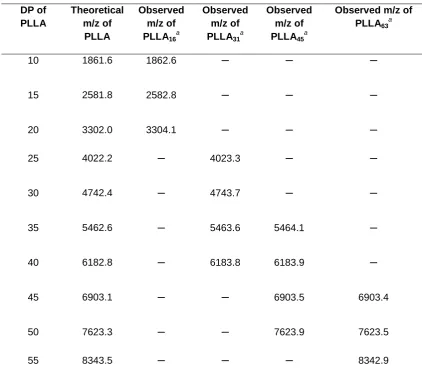
50 = 5.30 - 5.40 ppm). SEC analysis revealed narrow dispersities in all cases (Figure 2.2 and Table 2.1). MALDI-ToF MS measurement of the various PLLA macro-initiators was consistent with the expected molar mass and minimal transesterification was observed (Figure 2.3, Table 2.2).
Figure 2.1. 1H NMR spectra (400MHz, CDCl3) of various PLLA macro-initiators with
51
Figure 2.2. SEC chromatograms (THF with 2% TEA as eluent) of various PLLA
macro-initiators using RI detector.
Table 2.1. Characterization data of PLLA homopolymers
Polymer Mn (kDa)
a Đ
M
b
Tg (°C)
c
PLLA16 2.7 1.17 50.5
PLLA31 4.9 1.07 51.0
PLLA45 6.9 1.06 50.5
PLLA63 9.5 1.10 51.0
a Measured by 1H NMR spectroscopy in CDCl
3 . b Measured by SEC analysis (THF
with 2% TEA as eluent, RI detection). c Measured by DSC analysis in the first heating
run with a heating rate of 10 °C/min.
52 units at δ = 6.20 - 5.68 ppm (Scheme 1, Figure 2.4 and Figure 2.5). The diblock copolymers, 1 - 5 (Table 2.3), were designed with DP of PLLA but a similar hydrophobic weight fraction, optimized to ca. 18% in line with our previous studies.45 In contrast, diblock copolymers, 6 - 11 (Table 2.3), were targeted with the same DP of PLLA but different DPs of PTHPA to enable exploration of the effect of hydrophobic weight fraction upon the dimensions of the resultant particles. All of the diblock copolymers used in this chapter showed narrow dispersities by SEC analysis (ĐM < 1.20) (Table 2.3, Figure 2.6 and Figure 2.7)
53
In
te
n
sity
Figure 2.3. MALDI-ToF mass spectra of PLLA macro-initiators.
2009.7 2227.0 0_M19\1: +MS 1429.3 1573.4 1717.5 1862.6 2006.6 2150.7 2294.8 2438.8 2582.8 2726.9 2870.9 3015.0 3160.0 3304.1 3448.1 3592.1 3736.2 3880.2 0_H17\1: +MS 0 50 100 150 Intens. 0 250 500 750 1000 1250
1500 2000 2500 3000 3500 4000 m/z
3448.1 3592.1 3736.2 3880.2 0_H17\1: +MS 3735.2 3879.1 4023.3 4167.6 4311.6 4455.5 4599.6 4743.7 4888.0 5031.8 5175.6 5319.6 5463.6 5608.3 5751.8 5895.8 6040.2 6183.8 0_K21\1: +MS 0 100 200 300 400 Intens. 0 250 500 750 1000 1250
3500 4000 4500 5000 5500 6000 6500 m/z
5031.8 5175.6 5319.6 5463.6 5608.3 5751.8 5895.8 6040.2 6183.8 0_K21\1: +MS 5175.0 5320.0 5464.1 5608.0 5752.0 5896.0 6039.8 6183.9 6327.8 6471.6 6615.6 6759.5 6903.5 7047.4 7191.5 7335.3 7479.5 7623.9 7767.2 0_L18\1: +MS 0 250 500 750 1000 1250 Intens. 0 200 400 600 800 1000 1200
5000 5500 6000 6500 7000 7500 8000 m/z
6327.8 6471.6 6615.6 6759.5 6903.5 7047.4 7191.5 7335.3 7479.5 7623.9 7767.2 0_L18\1: +MS 6471.6 6615.2 6759.0 6903.4 7047.2 7191.6 7335.4 7479.3 7623.57767.3 7911.3 8055.38199.0 8342.9 8487.4 8631.0 8775.7 8919.3 9063.8 9207.4 9351.2 9495.2 9638.9 0_M19\1: +MS 0 200 400 600 800 1000 1200 Intens. 0 200 400 600 800 1000 1200
6500 7000 7500 8000 8500 9000 9500 m/z
PLLA31
PLLA45
PLLA16
54
Table 2.2. Comparisons of theoretical and observed m/z of different PLLA
macro-initiators DP of PLLA Theoretical m/z of PLLA Observed m/z of PLLA16 a Observed m/z of PLLA31 a Observed m/z of PLLA45 a
Observed m/z of PLLA63a
10 1861.6 1862.6 ─ ─ ─
15 2581.8 2582.8 ─ ─ ─
20 3302.0 3304.1 ─ ─ ─
25 4022.2 ─ 4023.3 ─ ─
30 4742.4 ─ 4743.7 ─ ─
35 5462.6 ─ 5463.6 5464.1 ─
40 6182.8 ─ 6183.8 6183.9 ─
45 6903.1 ─ ─ 6903.5 6903.4
50 7623.3 ─ ─ 7623.9 7623.5
55 8343.5 ─ ─ ─ 8342.9
a Measured by MALDI-ToF mass-spectrometry using trans-2-[3-(4-tert
-butyl-phenyl)-2-methyl-2-propenylidene] malononitrile (DCTB) as matrix and sodium trifluoroacetate
[image:73.595.113.536.119.495.2]55
Table 2.3. Characterization data of PLLA-b-PTHPA diblock copolymers
Diblock copolymer Mn (kDa)a ĐM
b
Hydrophobic %wtc
PLLA16-b-PTHPA151 1 26.3 1.12 17.5
PLLA31-b-PTHPA278 2 48.3 1.13 18.2
PLLA38-b-PTHPA333 3 57.9 1.11 18.6
PLLA45-b-PTHPA393 4 68.3 1.16 18.6
PLLA63-b-PHTPA603 5 103.7 1.20 17.3
PLLA45-b-PTHPA52 6 15.0 1.09 63.4
PLLA45-b-PTHPA156 7 31.2 1.10 36.6
PLLA45-b-PTHPA244 8 45.0 1.11 26.9
PLLA45-b-PTHPA305 9 54.5 1.14 22.8
PLLA45-b-PTHPA514 10 87.2 1.13 14.9
PLLA45-b-PTHPA612 11 102.5 1.17 12.8
a Measured by 1H NMR spectroscopy (400 MHz, CDCl
56
Figure 2.4. 1H NMR spectra (400MHz, CDCl3) of PLLA-b-PTHPA diblock copolymers,
1, 2, 4, and 5.
Figure 2.5. 1H NMR spectra (400MHz, CDCl3) of PLLA-b-PTHPA diblock copolymers,