A&A 593, A75 (2016)
DOI:10.1051/0004-6361/201526326
c
ESO 2016
Astronomy
&
Astrophysics
Direct Imaging discovery of a second planet candidate
around the possibly transiting planet host CVSO 30
?
T. O. B. Schmidt
1,2, R. Neuhäuser
2, C. Briceño
3, N. Vogt
4, St. Raetz
5, A. Seifahrt
6, C. Ginski
7, M. Mugrauer
2,
S. Buder
2,8, C. Adam
2, P. Hauschildt
1, S. Witte
1, Ch. Helling
9, and J. H. M. M. Schmitt
11 Hamburger Sternwarte, Gojenbergsweg 112, 21029 Hamburg, Germany
e-mail:[email protected]
2 Astrophysikalisches Institut und Universitäts-Sternwarte, Universität Jena, Schillergäßchen 2-3, 07745 Jena, Germany 3 Cerro Tololo Inter-American Observatory CTIO/AURA/NOAO, Colina El Pino s/n. Casilla 603, 1700000 La Serena, Chile 4 Instituto de Física y Astronomía, Universidad de Valparaíso, Avenida Gran Bretaña 1111, 2340000 Valparaíso, Chile 5 European Space Agency ESA, ESTEC, SRE-S, Keplerlaan 1, 2201 AZ Noordwijk, The Netherlands
6 Department of Astronomy and Astrophysics, University of Chicago, 5640 S. Ellis Ave., Chicago, IL 60637, USA 7 Sterrewacht Leiden, PO Box 9513, Niels Bohrweg 2, 2300 RA Leiden, The Netherlands
8 Max-Planck-Institute for Astronomy, Königstuhl 17, 69117 Heidelberg, Germany
9 School of Physics and Astronomy SUPA, University of St. Andrews, North Haugh, St. Andrews, KY16 9SS, UK
Received 16 April 2015/Accepted 14 March 2016
ABSTRACT
Context.Direct imaging has developed into a very successful technique for the detection of exoplanets in wide orbits, especially around young stars. Directly imaged planets can be both followed astrometrically on their orbits and observed spectroscopically and thus provide an essential tool for our understanding of the early solar system.
Aims.We surveyed the 25 Ori association for direct-imaging companions. This association has an age of only few million years. Among other targets, we observed CVSO 30, which has recently been identified as the first T Tauri star found to host a transiting planet candidate.
Methods.We report on photometric and spectroscopic high-contrast observations with the Very Large Telescope, the Keck telescopes, and the Calar Alto observatory. They reveal a directly imaged planet candidate close to the young M3 star CVSO 30.
Results.TheJHK-band photometry of the newly identified candidate is at better than 1σconsistent with late-type giants, early-T and early-M dwarfs, and free-floating planets. Other hypotheses such as galaxies can be excluded at more than 3.5σ. A lucky imaging
z0
photometric detection limitz0=
20.5 mag excludes early-M dwarfs and results in less than 10MJupfor CVSO 30 c if bound. We
present spectroscopic observations of the wide companion that imply that the only remaining explanation for the object is that it is the first very young (<10 Myr) L – T-type planet bound to a star, meaning that it appears bluer than expected as a result of a decreasing cloud opacity at low effective temperatures. Only a planetary spectral model is consistent with the spectroscopy, and we deduce a best-fit mass of 4–5 Jupiter masses (total range 0.6–10.2 Jupiter masses).
Conclusions.This means that CVSO 30 is the first system in which both a close-in and a wide planet candidate are found to have a common host star. The orbits of the two possible planets could not be more different: they have orbital periods of 10.76 h and about 27 000 yr. The two orbits may have formed during a mutual catastrophic event of planet-planet scattering.
Key words. stars: pre-main sequence – stars: low-mass – planetary systems – planets and satellites: detection – planets and satellites: atmospheres – planets and satellites: formation
1. Introduction
Since the first definite detection of a planet around another main-sequence star, 51 Peg (Mayor & Queloz 1995) made with high-precision radial velocity measurements, various de-tection techniques have been applied to find a diverse popu-lation of exoplanets. The transit method, which was first used for HD 209458 (Charbonneau et al. 2000), later allowed for a boost of exoplanet discoveries after the successful launch of two dedicated satellite missions, CoRoT (Baglin et al. 2007) and
Kepler(Koch et al. 2010;Borucki et al. 2010). These two
meth-ods indirectly discern the presence of a planet by the influence ? Based on observations made with ESO Telescopes at the La
Silla Paranal Observatory under programme IDs 090.C-0448(A), 290.C-5018(B), 092.C-0488(A) and at the Centro Astronómico Hispano-Alemán in programme H15-2.2-002.
the planet has on its host star. The methods are most sensitive to small and moderate planet-star-separations around old main-sequence stars that are fairly inactive because of their age. The sensitivity diminishes fast for separations beyond 5 au because transits become less likely and the radial velocity amplitude de-clines with increasing orbital period. In contrast, direct imaging allows discovering planets on wide orbits around nearby pre-main-sequence stars because such young planets are still bright at infrared wavelengths as a result of the gravitational contrac-tion during their still-ongoing formacontrac-tion process.
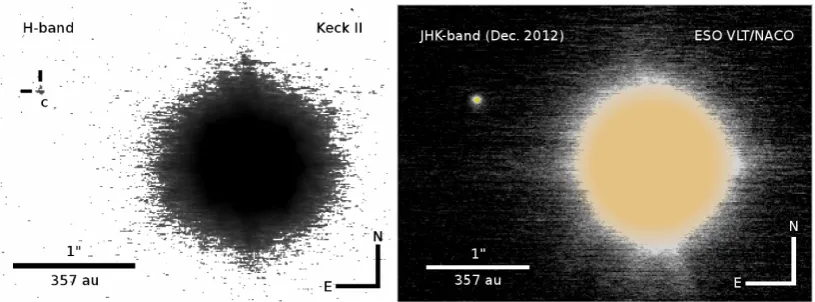
Fig. 1.Direct images of CVSO 30 c.Left: Keck image of data byvan Eyken et al.(2012), re-reduced. We note that the companion is north-east and not a contaminant south-east, as given invan Eyken et al.(2012).Right: our new VLT epoch, clearly showing the planetary companion, which has similar colour as its host star (Fig.2). This excludes that it is a false positive for the inner planet candidate CVSO 30 b.
dwarfs from planets according to the current IAU working def-inition, together with the planet candidate around the brown dwarf 2M1207 (Chauvin et al. 2005a). A summary can be found inNeuhäuser & Schmidt(2012), and the current status is always available in several online encyclopaediae, such as the Extrasolar Planets Encyclopaedia atwww.exoplanet.eu(Schneider et al. 2011). As in situ formation at ∼100 au to a few hundreds of au separation seems unlikely according to models,Boss(2006) argued that a third body must exist that tossed these planets out-ward to their present distance from their young host stars. An alternative explanation might be a stellar encounter (Adams & Laughlin 2001).
While early-type stars have less favourable planet-to-star contrast ratios, increasing evidence was found by millimeter-continuum measurements for larger and more massive proto-planetary disks that are available for planet formation around these stars (Mannings & Sargent 1997;Andrews et al. 2013). These conclusions were further strengthened when three of the most prominent planet candidates were found in 2008 and 2009 around the early F-type star HR 8799 (Marois et al. 2008), which is the first system with multiple planets imaged around a star. The other two were around the A-type stars Fomalhaut (Kalas et al. 2008), which is the first planet candidate discovered in the optical regime using the HubbleSpace Telescope (HST), and β Pic (Lagrange et al. 2009, 2010), a planet within the large edge-on disk at only about twice the separation of Jupiter from the Sun. This had previously been predicted byFreistetter et al. (2007), for instance, from the structural gaps in the disk.
Most of the direct-imaging surveys conducted so far have concentrated on AFGK stars. In 2012 a (proto-)planet candidate was discovered around the∼2 Myr young solar-like star LkCa 15 (Kraus & Ireland 2012). This is a close (∼11 AU) object found by single-dish interferometry, which is a technique that is also referred to as sparse aperture masking. Two companions of 4–5MJupwere recently discovered around GJ 504 (Kuzuhara et al. 2013), which is a 160 Myr old solar-like star, and around HD 95086 (Rameau et al. 2013), an A-type star at about 10– 17 Myr. Additionally, first results from imaging surveys around M dwarfs were published during the past two years, which in-creased our understanding of planetary systems around the most numerous stars in the Milky Way (Delorme et al. 2013;Bowler et al. 2015).
In this article we describe for the first time the direct detec-tion of a wide-separadetec-tion (1.8500 or 662 au, see Fig.1) directly imaged planet candidate around a star (CVSO 30) that also hosts
a short-period transiting planet candidate; we refer to a more de-tailed discussion of this object invan Eyken et al.(2012),Barnes et al.(2013),Yu et al.(2015), andRaetz et al.(2016). A system that harbours two planets with such extreme orbits gives us for the first time the opportunity to study by observations the pos-sible outcome of planet-planet scattering theories, which have been used to explain the existence of close-in hot Jupiters in 1996 (Rasio & Ford 1996).
2. 25 Ori group and the CVSO 30 system properties
Despite their importance for the evolution of protoplanetary disks and the early phases in the planet formation process, suf-ficiently large samples of 10 Myr old stars have been difficult to identify, mainly because the parent molecular clouds dissipate after a few Myr and no longer serve as markers of these popu-lations (seeBriceño et al. 2007band references therein). The 25 Ori cluster (25 Ori, Briceño et al. 2007a) contains>200 PMS stars in the mass range 0.1 < M/M < 3. The Hipparcos OB and earlier A-type stars in 25 Ori are on the zero-age main se-quence (ZAMS,Hernández et al. 2005), implying a distance of ∼330 pc, with some of the A-type stars harbouring debris disks (Hernández et al. 2006). Isochrone fitting of the low-mass stars yields an age of 7–10 Myr (Briceño et al. 2007b). This is the most populous 10 Myr old sample within 500 pc, which we con-sequently chose for a direct-imaging survey with ESO’s VLT, the Very Large Telescope of the European Southern Observatory, to find young planetary and sub-stellar companions at or shortly af-ter their formation. For this same reason, the 25 Ori clusaf-ter was also targeted in searches for transiting planets, like the Young Exoplanet Transit Initiative (YETI,Neuhäuser et al. 2011) and the Palomar Transient Factory (PTF,van Eyken et al. 2012).
orbital period, is still debated (van Eyken et al. 2012; Koen 2015). Kamiaka et al. (2015) concluded that the stellar spin period is shorter than 0.671 d.
In 2012 the PTF team (van Eyken et al. 2012) re-ported a young transiting planet candidate around CVSO 30, named PTFO 8-8695 b, with a fast rotating or near co-rotating 0.448413 day orbit. The very same object, henceforth CVSO 30 b for simplicity, was independently detected with smaller telescopes within the YETI (Neuhäuser et al. 2013; Errmann et al. 2014), confirming the presence of the transit events by quasi-simultaneous observations.
Keck and Hobby-Eberly Telescope (HET) spectra (van Eyken et al. 2012) set an upper limit to the mass of the transiting companion of 5.5±1.4MJupfrom the radial velocity variation, which exhibits a phase offset that is likely caused by spots on the surface of the star. This RV limit was already corrected for the derived orbital inclination 61.8±3.7◦of the system. With an or-bital radius of only about twice the stellar radius and a planetary radius of 1.91±0.21RJup, the object appears to be at or within its Roche-limiting orbit, raising the possibility of past or ongo-ing mass loss. A false positive by a blended eclipsongo-ing binary is unlikely because the only present contaminant in Keck near-IR images (see Fig.1) with 6.96 mag of contrast to the star would have to be very blue to be bright enough in the optical to mimic a transit; it is unlikely to be a star in that case.
In 2013Barnes et al.(2013) fit the two separate light curves observed in 2009 and 2010, which exhibited unusual diff er-ing shapes, simultaneously and self-consistently with planetary masses of the companion of 3.0–3.6MJup. They assumed transits across an oblate, gravity-darkened stellar disk and precession of the planetary orbit ascending node. The fits show a high degree of spin-orbit misalignment of about 70◦, which leads to the pre-diction that transits disappear for months at a time during the precession period of this system. The lower planet radius result of ∼1.65 RJupis consistent with a young, hydrogen-dominated planet that results from hot-start formation mechanisms (Barnes et al. 2013).
3. Astrometric and photometric analysis
After the discovery of the transiting planet candidate by van Eyken et al. (2012) and our independent detection of the transit signals with YETI, we included the system in our 25 Ori VLT/NACO direct-imaging survey with the intent to prove that the object labelled as a contaminant by van Eyken et al.(2012) is not able to produce the detected transiting signal and to confirm it as second planet. We performed our first high-resolution direct observations in December 2012 and obtained
JHK-band photometry (Tables2and3and Fig.1).
During the course of their study of the transiting planet CVSO 30 b, the PTF team used Keck II/NIRC2H-band images obtained in 2010 to identify contaminants capable of creating a false-positive signal mimicking a planet. We re-reduced these data and found that they already contain the planetary compan-ion CVSO 30 c that we report here. In Fig.1we show the com-panion, erroneously given to lie south-east in van Eyken et al. (2012); it is located north-east of the host star CVSO 30.
[image:3.595.305.558.96.331.2]We astrometrically calibrated the VLT/NACO detector epoch using a sub-field of 47 Tuc (Table5) to determine pixel scale and detector orientation in order to find precise values for the sepa-ration of CVSO 30 c with respect to CVSO 30 in right ascension and declination. From this, we find the object to be∼1.8500NE of CVSO 30 at a position angle of∼70◦from north towards east, corresponding to a projected separation of 662±96 au at the
Table 1.Previously known CVSO 30 system data.
CVSO 30
Altern. designations 2MASS J05250755+0134243, PTF1 J052507.55+013424.3 Location 25 Ori/Orion OB 1a [1,2]
RA, Dec 05h 25m 07.57s,+01◦34024.500[2]
Spectral type M3 (weak-line T Tauri, WTTS) [2]
Mass 0.34/0.44M[2]
Luminosity 0.25L[2]
Radius 1.39R/1.07±0.10R/[1.03/1.04±0.01R] [2, 3, 4]
Temperature 3470 K [2]
Opt. extinction 0.12 mag [2] Distance h323+233
−96,322+ 504 −122
i
pc/357±52 pc [2, 5]
Age 2.39+3.41
−2.05Myr [2, here] Hαequivalent width −11.40 Å [2] LiI equivalent width 0.40 Å [2] vsin(i)∗ 80.6±8.1 km s−1[3]
Proper motion [E, N] [−0.1±5.3, 0.9±5.5] mas/yr [6]
B,V,Rphotometry [18.35, 16.26, 15.19] mag [7, 2, 3]
J,H,Kphotometry [12.232±0.028, 11.559±0.026, 11.357±0.021] mag [8] CVSO 30 b/PTFO 8-8695 b
(Projected) separation 0.00838±0.00072 au [3] Period (circular) 0.448413±0.000040 d [3] Orbit. inclination 61.8±3.7◦[3]
Orbit. misalignment 69±2◦/73.1±0.5◦[4]
References.[1]Briceño et al.(2007a); [2]Briceño et al.(2005); [3]van Eyken et al.(2012); [4]Barnes et al.(2013); [5]Downes et al.(2014); [6]Zacharias et al.(2013); [7]Zacharias et al.(2004); [8]Cutri et al. (2003),Skrutskie et al.(2006).
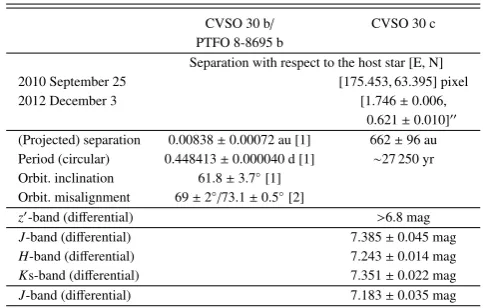
Table 2.CVSO 30 astrometry and photometry.
CVSO 30 b/ CVSO 30 c PTFO 8-8695 b
Separation with respect to the host star [E, N] 2010 September 25 [175.453, 63.395] pixel 2012 December 3 [1.746±0.006,
0.621±0.010]00
(Projected) separation 0.00838±0.00072 au [1] 662±96 au Period (circular) 0.448413±0.000040 d [1] ∼27 250 yr Orbit. inclination 61.8±3.7◦[1]
Orbit. misalignment 69±2◦/73.1±0.5◦[2]
z0-band (differential) >6.8 mag
J-band (differential) 7.385±0.045 mag
H-band (differential) 7.243±0.014 mag
Ks-band (differential) 7.351±0.022 mag
J-band (differential) 7.183±0.035 mag References.[1]van Eyken et al.(2012); [2]Barnes et al.(2013).
distance of the star. No astrometric calibrator could be found in the night of the Keck observations (hence the position of the ob-ject is given in pixels in Table2), but we note that the position is consistent with the VLT data. We used the nominal pixel scale of NIRC2 of 0.00994200/pixel (±0.0000500) and assumed 0◦ detec-tor orientation for the Keck epoch, which results in 1.744 arcsec right ascension and 0.630 arcsec declination separation in the relative position of CVSO 30 c with respect to its host star. The consistency was expected for a companion because the proper motion of CVSO 30 is too small to distinguish a background source from a sub-stellar companion based on common proper motion (Table1).
[image:3.595.309.551.408.562.2]Table 3.VLT/NACO, VLT/SINFONI, archival KeckII/NIRC2, and Calar Alto/2.2 m/AstraLux observation log.
Instrument JD-2 455 000 Date of DIT NDIT # Airmass DIMMa τ
0b Strehl S/N
[days] observation [s] images Seeing [ms] [%] (brightest pixel)
NACOJ 1264.69416 03 Dec. 2012 15 4 15 1.13 0.8 3.7 3.2 5.9
NACOH 1264.70764 03 Dec. 2012 15 4 15 1.12 0.6 4.6 11.2 24.6
NACOKs 1264.72079 03 Dec. 2012 15 4 15 1.11 0.7 4.6 23.7 11.1
NACOJ 1266.72899 05 Dec. 2012 30 2 15 1.12 1.3 2.8 2.0 6.6
SINFONIH+K 1592.82609 27 Oct. 2013 300 2 3 1.12 0.5 5.0 /15
NIRC2H 465.05374 25 Sep. 2010 3 10 12 1.25 0.4 7.0 7.8
AstraLuxz0
2260.6696 26 Aug. 2015 0.02945 1 70 000 1.73 1.1 no AO non-detection
Notes. Remarks:(a)Differential image motion monitor (DIMM) seeing average of all images;(b)coherence time of atmospheric fluctuations.
0.0 0.2 0.4 0.6
H−Ks [mag] 1.0
0.8 0.6 0.4 0.2
J−H [mag]
A−K dwarfs
White dwarfs
M dwarfs
L dwarfs
T dwarfs
SDSS 0909
CVSO 30
CVSO 30 c
HD 35367 cc3
1RXS 1609 b
PZ Tel B
0.0 0.2 0.4 0.6
H−Ks [mag] 1.0
0.8 0.6 0.4 0.2
J−H [mag]
0.0 0.2 0.4 0.6
H−Ks [mag] 1.0
0.8 0.6 0.4 0.2
J−H [mag]
Quasars
Galaxies
CVSO 30
CVSO 30 c
S Ori 64
F8III
G6III
K0III
K7III
HD 204585/M4.5III
HD 175865/
M5III
M7III
M9III
M9III
0.0 0.2 0.4 0.6
H−Ks [mag] 1.0
0.8 0.6 0.4 0.2
J−H [mag]
Fig. 2.CVSO 30, CVSO 30 c, and comparison objects, superimposed onto the colour data fromHewett et al.(2006). CVSO 30 c clearly stands out in the lower left corner, approximately consistent with colours of giants, early-M and early-T dwarfs, and free-floating planetary mass objects (Zapatero Osorio et al. 2000;Peña Ramírez et al. 2012), e.g. consistent with absolute magnitude andJ−Ks colour of S Ori 64. Its unusual blue colour can most likely be attributed to the youth of these objects (Saumon & Marley 2008), leading to L–T transition opacity drop at high brightnesses (see Fig.11). See Fig.A.5for details. For CVSO 30 c we give the colours before (grey) and after (red) correcting for the NACO to the 2MASS filter set and we give the maximum possible systematic photometric offsets caused by the variability of the primary star that is used as reference (black).
dedicated orbit estimation for the wide companion. The analy-sis shows that even after two to three years of epoch difference, no significant orbital motion is expected for the wide companion (Fig.A.1).
Using the Two Micron All Sky Survey (2MASS;Cutri et al. 2003;Skrutskie et al. 2006) photometry for the primary and our NACO images for differential brightness measurements, we find CVSO 30 c to exhibit an unusually blueH−Ks colour, while its
J−Hcolour indicates the companion candidate to be redder than the primary. This implies that the companion is too red to be an eclipsing background binary mimicking the transiting signal of CVSO 30 as a false-positive signal, which is further indication for the planetary nature of CVSO 30 b.
The differential photometry (Table 2) of CVSO 30 c was achieved using psf fitting with the Starfinder package of IDL (Diolaiti et al. 2000) using the primary star CVSO 30 as psf reference. First the noise of the final jittered image was computed, taking the photon noise, the gain, RON, and the
number of combined images into account, and then it was trans-ferred to the starfinder routine for psf fitting. This resulted in the values given in Table2. The values were checked with aperture photometry.
As given in van Eyken et al. (2012), our psf reference CVSO 30 varies by 0.17 mag (min to max) in the R-band, consistent with our estimates within YETI. The present steep wavelength dependence of the variability amplitudes is best de-scribed by hot star-spots (Koen 2015), therefore we can extrap-olate from measurements of the very similar T Tauri GQ Lup (Broeg et al. 2007). According to this, 0.17 mag inRcorrespond to about 0.1 mag and 0.055 mag variability in JandKs-band, respectively. As the hot spots change the bands simultaneously, this gives rise to a maximum systematic offset of 0.045 mag in
[image:4.595.43.552.242.486.2]Table 4.CVSO 30 deduced planetary properties.
CVSO 30 b/ CVSO 30 c PTFO 8-8695 b
Opt. extinction 0.19+2.51 −0.19mag Luminosity (vs.) −3.78+0.33
−0.13dex Eff. temperatureTeff 1600+120
−300K Surface gravity logg 3.6+1.4
−0.6dex Radius 1.91±0.21RJup[1]
1.64/1.68±0.07RJup[2] 1.63−+00..8734RJup Mass <5.5±1.4MJup[1] 4.3+−34..97MJup(logg& Roche)
3.0±0.2MJup[2] 4.7+−52..50MJup(L, age) 3.6±0.3MJup[2] 4.7−+23..60MJup(L,Teff, age)
[image:5.595.40.287.98.244.2]<10MJup(z0imaging limit) References.[1]van Eyken et al.(2012), [2]Barnes et al.(2013).
Table 5.Astrometric calibration of VLT/NACO.
Object JD – 2 456 000 Pixel scale PAa
[days] [mas/pixel] [deg]
47 Tuc 264.62525 13.265±0.041 +0.60±0.31
Notes.All data fromKs-band images.(a)PA is measured from N over
E to S.
The colours of CVSO 30 and CVSO 30 c are very similar (Table2and Fig.2). We currently lack a spectrum of CVSO 30 c in J-band, therefore we used the M3V star Gl 388 (Cushing et al. 2005; Rayner et al. 2009) and the L3/L4 brown dwarf 2MASS J11463449+2230527 (Cushing et al. 2005) to derive a preliminary filter correction between 2MASS and NACO for CVSO 30 and CVSO 30 c. The colours of CVSO 30 are well known from 2MASS (Table 1), the differential brightnesses to CVSO 30 c vary from NACO to 2MASS by 28 mmag in J, −21 mmag in H, and −38 mmag in Ks. Thus CVSO 30 c is 49 mmag redder in J−H and 17 mmag redder in H−Ks in 2MASS (red in Fig.2) than in the NACO results (grey in Fig.2). In Fig.2and Table6we compare CVSO 30 c to the colours of several possible sources. We find that background stars of spectral types OBAFGK are too blue in J−H, late-M dwarfs are too blue in J−H and too red inH−K, while foreground L- and late T-dwarfs are either too red inH−Kor too blue in
J−H. In addition, background galaxies, quasars, and H/He white
dwarfs are also inconsistent with the values of CVSO 30 c. Only late-type giants, early-M and early-T dwarfs, and planetary mass free-floating objects such as are found in theσOrionis star clus-ter have comparable colours (Zapatero Osorio et al. 2000;Peña Ramírez et al. 2012).
4. CVSO 30 c spectroscopic analysis
A common proper motion analysis is not feasible because of the low proper motion of the host star (Table1), therefore we car-ried out spectroscopic follow-up observations at the end of 2013, using the ESO VLT integral field unit SINFONI. The observa-tions were made inH+K-band with 100 mas/spaxel scale (FoV:
3 arcsec×3arcsec). The instrument provides information in the two spatial directions of the sky in addition to the simultaneous
H- andK-band spectra. An unfortunate timing of the observa-tions led to a parallactic angle at which a spike, probably of the
Table 6.Photometric rejection significance, spectroscopic reducedχ2
results, and corresponding formal significance without systematics for different comparison objects.
Object SpT Photometry add. Spectroscopy
J−H H−Ks Ref. H-band K-band [σ] [σ] [σ/χ2
r] [σ/χ2r]
HD 237903 K7V 3.4 0.5 [1] >6/2.66 >6/1.60 Gl 846 M0V 2.8 1.8 [1] >6/2.38 5.4/1.51 Gl 229 M1V 0.6 0.3 [1] >6/2.37 5.3/1.50 Gl 806 M2V 4.5 2.5 [1] >6/2.73 4.3/1.40 Gl 388 M3V 3.7 2.8 [2], [1] >6/2.57 3.7/1.33 Gl 213 M4V 5.5 2.6 [2], [1] >6/2.80 2.5/1.21 Gl 51 M5V 3.8 3.5 [2], [1] >6/2.47 2.6/1.21 Gl 406 M6V 3.4 4.6 [2], [1] >6/2.50 2.5/1.20 Gl 644C M7V 4.1 5.1 [2], [1] >6/2.87 2.2/1.17 Gl 752B M8V 2.6 6.4 [2], [1] >6/2.76 2.3/1.18 LHS 2065 M9V 1.7 7.5 [1] >6/2.45 2.2/1.17 LHS 2924 L0 1.4 6.5 [2], [1] >6/2.77 2.1/1.16 2MUCD 20581 L1 2.2 7.5 [2] >6/3.96 3.7/1.33 Kelu-1AB L2+L3.5 2.2 9.8 [2] >6/3.68 3.6/1.32 2MUCD 11291 L3 1.8 >10 [2] >6/3.66 3.8/1.34 2MUCD 12128 L4.5 5.5 >12 [2] >6/3.09 3.4/1.29 2MUCD 11296 L5.5 1.3 >10 [2] >6/4.60 5.5/1.52 2MUCD 11314 L6 2.0 8.4 [2] >6/3.64 >6/1.66 2MUCD 10721 L7.5 5.8 >11 [2] >6/3.49 3.4/1.29 2MUCD 10158 L8.5 2.5 9.8 [2] >6/4.87 5.0/1.47 SDSS 1520+354 T0 1.0 5.4 [3] >6/4.63 >6/2.15 SDSS 0909+652 T1.5 0.3 0.4 [4] >6/8.04 >6/3.64 SDSS 1254-012 T2 0.8 2.0 [2] >6/7.97 >6/2.90 2MASS 055-140 T4 9.4 0.1 [2] >6/16.2 >6/19.1 HD 204585 M4.5III 0.4 0.8 [1] >6/1.86 >6/1.88 HD 175865 M5III 0.1 0.5 [1] >6/1.91 >6/1.78 BK Vir M7III 0.4 0.9 [1] >6/2.47 >6/1.72 HY Aqr M8-9III 0.6 8.5 [1] >6/5.78 >6/1.61 Galaxies various 4.2 3.0 [5], [6] >6/2.28 >6/1.61
Quasars – 4.4 3.9 [5] – –
White Dwarfs various 6.4 3.9 [5] – – CVSO 30 M3 2.7 1.7 >6/3.31 6.0/1.57 PZ Tel B M7 2.1 1.4 [7] >6/3.29 3.0/1.25 CT Cha b M9 0.4 1.3 [8], [9] >6/2.27 1.8/1.13 2M0441 Bb L1 0.5 2.4 [10] >6/3.13 1.9/1.13 1RXS 1609 b L4 1.1 3.0 [11] >6/2.70 2.3/1.18
βPic b L4 1.0 3.5 [12] >6/2.06 – 2M1207 b L7 3.5 4.4 [13] >6/2.66 2.5/1.20
S Ori 64 L/T 0.9 0.7 [14] – – DP (Fig.4) – – – [15] 2.2/1.16 2.0/1.14 References. [1] Rayner et al. (2009); [2] Cushing et al. (2005); [3] Burgasser et al. (2010a); [4] Chiu et al. (2006); [5] Hewett et al. (2006); [6] Mannucci et al. (2001); [7] Schmidt et al.(2014); [8] Schmidt et al. (2009); [9] Schmidt et al. (2008); [10] Bowler & Hillenbrand (2015); [11] Lafrenière et al. (2008); [12] Chilcote et al. (2015); [13] Patience et al. (2010); [14] Peña Ramírez et al. (2012); from VISTA to 2MASS magnitudes using colour equations
from http://casu.ast.cam.ac.uk/surveys-projects/vista/
technical/photometric-properties; [15]Helling et al.(2008).
telescope secondary mounting, was superimposed onto the well-separated spectrum of the companion candidate CVSO 30 c.
After correcting, the resulting spectrum can be compared to model atmospheres to determine its basic properties and to other sub-stellar companions to assess its youth and the reliabil-ity of the models at this low age, surface gravreliabil-ity, and temperature regime.
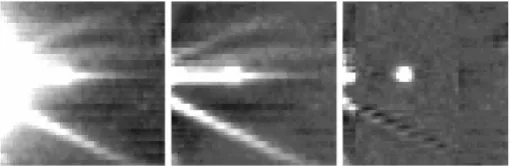
[image:5.595.307.553.123.540.2]Fig. 3.Median in wavelength direction of the reduced VLT/SINFONI integral field cubes.Left: cube after reduction.Centre: cube after re-moving the primary halo, assumed to be centred at the separation of 1.8500, as measured in the VLT/NACO images. North is about 70◦
from theright-hand sidetowardsthe bottom of the plots.Right: cube after re-moving the primary halo, spectral deconvolution, and polynomial flat-tening of the resulting background, used for the extraction of the final spectrum.
cube reconstruction, we found that the spike was superimposed onto the companion in every one of the three individual ex-posures, but at slightly different orientation angles (Fig.3, left panel). As a first step, we used the NACO astrometry to deter-mine the central position of the primary, which is itself outside the observed field of view of the integral field observations. The orientation of the SINFONI observations was intentionally cho-sen to leave the connection line of primary and companion ex-actly inxdirection. The primary is about 1.85 arcsec exactly to the left of CVSO 30 c in the data because the xdirection offers
a twice as good sampling regarding the number of pixels for the separation. We were thus able to subtract the radial symmetric halo of the host star from the data cube (Fig.3, central panel) us-ing the nominal spatial scale. This is necessary because the halo of the primary star is determined by the AO performance at the different wavelength. At this stage, we extracted a first spectrum by subtracting an average spectrum of the spike, left and right of the companion psf from the superposition of companion and spike. We find the results in Fig.A.2before (red spectrum) and after (blue spectrum) spike subtraction, which also removes the still-present OH lines. The horizontal spike in Fig.3appears too narrow to the right. This is a projection effect because the rota-tion of the spike within the three median-combined cubes leads to less overlap on the right-hand side of the cube than on the left-hand side. For this reason, the continuum in Fig.A.2is not trustworthy because the flux of the spike below the companion candidate is not the average of the spike flux to the left and right of the object.
We tried several methods to remove the spike and decided to follow the spectral deconvolution technique (Sparks & Ford 2002;Thatte et al. 2007). This method is able to distinguish both the wavelength-dependent airy rings and speckles and the spike from the light of the wavelength-independent companion posi-tion by using the long wavelength coverage of the observed data cube. As given inThatte et al.(2007) for the same instrument, the bifurcation radius for SINFONIH+Kis for=1.1r=246 mas, and for=1.2r=268 mas, which means that parts of the data without contamination of the companion could be found at the much higher separation of about 1.85 arcsec. The reduction was then completed by applying a polynomial background correc-tion around CVSO 30 c because the previous reduccorrec-tion steps left a low spatial frequency remnant around it (Fig.3, right panel). Finally, the optimal extraction algorithm (Horne 1986) was per-formed around the companion and subtracted by the correspond-ing background flux from the close, well-corrected vicinity, and the telluric atmosphere correction using HD 61957, a B3V spec-troscopic standard observed in the same night.
We first compare the spectrum of CVSO 30 c to spectra derived from Drift-Phoenix atmosphere simulations. These are dedicated radiative transfer models that take the strong contin-uum altering influence of dust cloud formation in the detectable parts of planetary atmospheres into account (Helling et al. 2008). From aχ2comparison of theH- andK-band spectra to the model grid, we find an effective temperature of about 1800–1900 K, while the individual fit of the H- and K-band spectrum give a lowerTeffof about 1600 K. In addition, the slope of the blue part of the triangularH-band is too steep in the atmosphere models of about 1800 K and does not fit the continuum well. The higher
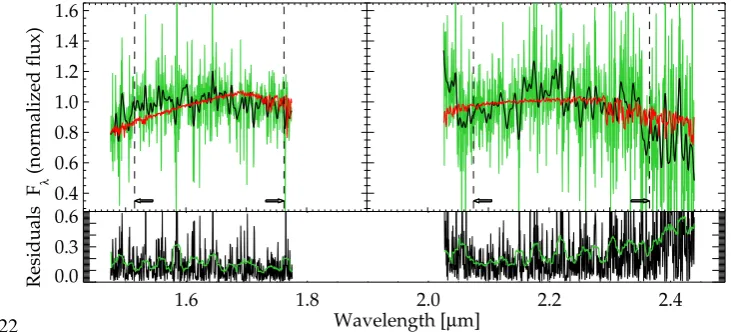
Teffis only needed to fit the unusually blueH−Ks colour of the object, as already discussed in the previous photometry section and visible in Fig.2, since the models do yet not include a good description of the dust opacity drop at the L-T transition. We thus decided to fit theHandK-band simultaneously, but normalising them individually, to cope with the unusual colours, while us-ing all the present information for the fit. In this way, we find a best-fittingTeff =1600+−120300K, an extinctionAV =0.19+−2.510.19mag, a surface gravity logg[cm/s2]=3.6+−1.40.6 dex, and a metallicity log[(M/H)/(M/H)]=0.3−0.9dex at the upper supersolar edge of the grid. The 1σfitting contours are shown in Fig.5, where they delineate the full regime for the error bars, and the best fit itself is shown in Fig.4.
In Fig.6we compare the spectrum of CVSO 30 c to the tri-angular shapedH-band spectrum of theβPic b planet that was obtained with the Gemini Planet Imager (GPI, Chilcote et al. 2015). We also compare this to other planetary mass objects.β Pic b is particularly suited as comparison object because it is young (10–20 Myr) and has about the same luminosity and ef-fective temperature (1600–1700 K) while being of higher mass (10–12 MJup). We show linear fits to the blue and red part of theH-band and the triangular shape of the chosen Drift-Phoenix models. In contrast to M5 – L5 companions, for which the H2O index inAllers et al.(2007) shows an increase in water absorp-tion, the absorption becomes shallower for later spectral types. This means that even though the formalχ2 fit finds a best tem-perature of 1600 K for CVSO 30 c, the temtem-perature is likely to be lower than forβPic b, exhibiting a steeperH-band spec-trum. The object’s spectrum is not consistent with a giant of any spectral type. The best-fitting giants with consistent photome-try (Fig.2and Table6) are shown as comparison in Fig. 6and would be at a distance of about 200 Mpc. To improve the fit in theK-band, the spectral type would have to be later than M7III, while theH-band does not fit for these objects. Finally, CVSO 30 c, which is comparable but younger, must have a lower sur-face gravity thanβPic b, which is determined to have a 1σupper limit of logg[cm/s2]=4.3 dex according to the linear prior orbit fit inBonnefoy et al.(2014b). This corrects the surface gravity of CVSO 30 c to logg[cm/s2]=3.6+0.7
−0.6dex.
5. AstraLux lucky imaging follow-up observations
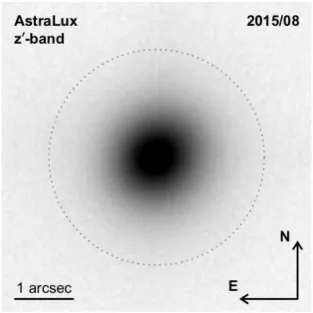
We performed a follow-up of CVSO 30 with 2000 s of AstraLux integration in z0. The individual AstraLux images were com-bined using our own pipeline for the reduction of lucky imaging data. The fully reduced AstraLux image is shown in Fig.7.z0 photometry of CVSO 30 was not measured so far, but can be de-rived from its magnitudes in other photometric bands using the colour transformation equations1fromJordi et al.(2006). TheV -andR-band photometry of CVSO 30, as given byBriceño et al. (2005) andvan Eyken et al.(2012) (V =16.26±0.19 mag, and 1 r−R=0.77·(V−R)−0.37 andr−z0=
22 0.4 0.6 0.8 1.0 1.2 1.4 1.6
F λ
(normalized flux)
1.6 1.8 2.0 2.2 2.4
Wavelength [µm] 0.0
0.3 0.6
[image:7.595.115.481.81.247.2]Residuals
Fig. 4.Spectrum of CVSO 30 c as extracted from the spectral deconvolution-corrected cube in the right panel of Fig.3.Top: the spectrum in resolution 700 (black) is shown after binning of the original extracted spectrum in resolution 1500 (green). The best-fitting Drift-Phoenix model ofHelling et al.(2008) is shown in red, fitting both the individually normalisedHand Kspectra. This type of normalisation was necessary because the redder colour of the models, in comparison to the unusually blue nature of CVSO 30 c, would steer the best-fitting model to higher temperatures, which would prevent fitting the individual features inHandK-band. The best-fitting model (red) corresponds to 1600 K, surface gravity logg3.6 dex, metallicity [M/H] 0.3 dex, and 0.19 mag of visual extinction.Bottom: absolute value of the difference between spectrum and
model from the top panel (black) versus noise floor at the corresponding position (green).
1000 1500 2000 2500
Effective temperature [K] 0.0
0.5 1.0 1.5 2.0 2.5 3.0
Optical extinction [mag]
1000 1500 2000 2500
Effective temperature [K] 3.0
3.5 4.0 4.5 5.0
Surface gravity log g [dex]
1000 1500 2000 2500
Effective temperature [K] −0.6
−0.4 −0.2 −0.0 0.2
Metallicity [M/H] [dex]
Fig. 5.1σcontour plots of theχ2Drift-Phoenix model fit to the
spec-trum shown in Fig.4. Contour plot in extinction vs. effective temper-ature (top), surface gravity loggvs. effective temperature (centre) and metallicity [M/H] vs. effective temperature (bottom). The fit shows a best fit at 1600 K, low extinction of 0.19 mag, higher values becom-ing increasbecom-ingly less likely, and a best fit at logg3.6. While all surface gravities seem to be almost of equal probability, a high surface gravity foreground brown dwarf can be excluded from the shape of theH-band in Fig.6. Although the young planetary models differ in photometric colours, this could be because of a not yet fully understood change in the cloud properties at the L-T transition that is indicated by the change in brightness of the L-T transition with age of the system, which we show in Fig.11.
R=15.19±0.085 mag), and theI-band photometry of the star, listed in the 2005 DENIS database (I = 13.695±0.030 mag), yieldz0=13.66 mag.
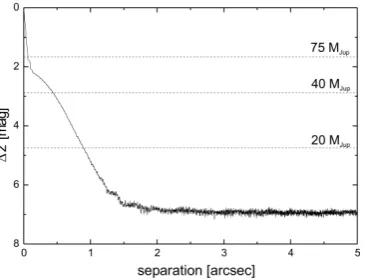
The (S/N =5) detection limit reached in the AstraLux ob-servation is given in Fig. 8. At an angular separation of about 1.8 arcsec from CVSO 30 (or∼640 au of projected separation), companions that are∆z0=6.8 mag fainter than the star are still detectable atS/N=5. The reached detection limit at this angular separation isz0 =20.5 mag, which is just a tenth of magnitude above the limiting magnitude in the background-noise-limited region around the star at angular separations larger than 2 arcsec. This results in a limiting absolute magnitude ofMz0=12.7 mag, allowing the detection of sub-stellar companions of the star with masses down to 10MJupaccording to the evolutionary models of Baraffe et al.(2015).
Furthermore, the AstraLux observations also exclude all young (3 Myr) stellar objects (mass higher than 75MJup) that are unrelated to CVSO 30, which are located in the AstraLux field of view at distances closer than about 3410 pc. All young M dwarfs with an age of 3 Myr and masses above 15MJup(Teff >2400 K) can be ruled out up to 530 pc. All old stellar objects (mass higher than 75MJup) with an age of 5 Gyr can be excluded when they are located closer than about 130 pc.
The AstraLux upper limit results in z0–Ks& 1.75 mag, which corresponds to excluding&0.2Mor&3300 K (Baraffe et al. 2015) as possible sources or about earlier than M4.5V in spectal type (Kenyon & Hartmann 1995). Because any object later than∼M2V/M3V can be excluded by &4σfrom JHKs photometry (Table6), no M dwarf can be a false positive of the new companion candidate CVSO 30 c.
6. Mass determination and conclusions
With the object brightness determined from the direct near-IR imaging and the information provided by the spectroscopic anal-ysis, we can directly estimate the basic parameters of CVSO 30 c. To determine the luminosity, we considered the extinction law byRieke & Lebofsky(1985), a bolometric correction of BCK =
[image:7.595.78.251.346.596.2]1.50 1.55 1.60 1.65 1.70 1.75 1.80
wavelength [µm]
0 1 2 3
normalized flux F
λ
+ offset
HD 35367 cc3
Galaxy
SDSS 0909 A
T1.5 1RXS 1609 b
2M1207 b
Beta Pic b
CT Cha b
CVSO 30 c
1.5 1.6 1.7 1.8
wavelength [µm]
CVSO 30 A
M3 B
1550 K 1650 K 1700 K 1800 K
Drift−Phoenix C
1.50 1.55 1.60 1.65 1.70 1.75
wavelength [µm]
2M 0441 Bb
Gl 229 M1V
Gl 213 M4V
Gl 644C M7V
LHS 2924 L0 D
2.0 2.1 2.2 2.3 2.4
wavelength [µm]
CVSO 30 c CT Cha b
HD 204585 / HD 175865
[image:8.595.45.555.81.318.2]M4.5III / M5III E
Fig. 6. H-band spectrum of CVSO 30 c (lower left) compared to several known planetary candidates and background objects (subplots A, D, E). The triangular shape of theH-band (A), with red linear fits guiding the eye, indicates that it is not a background galaxy, but a sub-stellar companion. Beta Pic b has approximately the same luminosity and temperature (Chilcote et al. 2015) but a different surface gravity, hence about twice the mass of CVSO 30 c. As shown (C), the Drift-Phoenix models indicate that theH-band becomes less steep with temperature. This means that CVSO 30 c is even slightly lower in temperature thanβPic b. Inthe upper left panelanother candidate is shown, detected at 4.300
from the A1 star HD 35367, which is about 0.5 mag brighter in theK-band than CVSO 30 c, but is obviously located in the background. In addition, the
H-band (D) andK-band (E) of CT Cha b and 2M 0441 Bb, the best-fitting comparison objects, are given inK-band. These two and CVSO 30 c are given in (D, E) with identical offsets inH-band andK-band. Additionally, the best-fitting giants and a sample of late-type dwarfs is shown for comparison. References and individual reducedχ2
r comparison values are given in Table6. Low-resolution spectra of free-floating planetary candidates are not shown, but can be found inMartín et al.(2001).
logLbol/L=−3.78+−0.330.13dex. From the luminosity and effective temperature, we calculate the radius to beR=1.63+−0.870.34RJup. In combination with the derived surface gravity, this would corre-spond to a mass of M = 4.3 MJup, dominated in its errors by high distance and surface gravity uncertainties. While the latter value and the photometry (Fig. 2) would be consistent with a high surface gravity, thus old foreground T-type brown dwarf, but inconsistent with an L-type brown dwarf, the available spec-troscopy excludes an old T-type brown dwarf (Fig.6 and Table 6). While the photometry is also consistent with early-M dwarfs, the K-band spectroscopy andz0 upper limit show the opposite behaviour, being only consistent with late-M dwarfs, excluding all types with high significance. Similarly, the remainingH-band spectroscopy excludes all comparison objects. Only the best-fitting Drift-Phoenix model (Fig.4) shows low deviation in H -band, consistent with the fact that the only available very young directly imaged planet candidates exhibit higher temperatures, thus a steeperH-band (Fig.6).
Although recent observations by Yu et al. (2015) cast doubts on the existence of the inner transiting planet candidate CVSO 30 b or PTFO 8-8695 b, we assume its existence through-out the remaining discussion because all five hypotheses have difficulties in reproducing the observations presented inYu et al. (2015), including for example different types of starspots. More recently Raetz et al.(2016) and Johns-Krull et al.(2016) pre-sented further evidence for the planetary nature. The inner. The inner planet hypothesis gives another constraint, namely that the system has to be stable with both its planets. As described in van Eyken et al.(2012), CVSO 30 b is very close to its Roche radius, the radius of stability. Assuming the values for mass of
Fig. 7.AstraLuxz0
-band image of CVSO 30, taken on Aug 27, 2015. The dotted circle indicates an angular separation of 1.8 arcsec to CVSO 30 (see Fig.8). No other objects are detected except for the star, which is located in the centre of the AstraLux image.
[image:8.595.352.509.444.601.2]Fig. 8. S/N = 5 detection limit of our AstraLux observation of CVSO 30 (Fig.7). The reached magnitude difference that is dependent on the angular separation to the star is shown. The horizontal dashed lines indicate the expected magnitude differences of sub-stellar com-panions of the star at an age of 3 Myr. Beyond about 1.8 arcsec (or
∼640 au of projected separation), all companions with masses down to 10MJupcan be excluded around CVSO 30.
6.0 6.5 7.0 7.5 8.0
log (age) [yr] -7
-6 -5 -4 -3 -2 -1
log (L/L
O
•
)
13.6 M Jup
Brown dwarfs
Stars
Planets
78 M Jup
10 M Jup 5 M
Jup 4 M
Jup 3 M
Jup CVSO 30 c
GJ 504 b HD 95086 b 2M1207 b
HR 8799 b
HR 8799 e HR 8799 c & d
Beta Pic b 1RXS 1609 b
LkCa15 b & c & ROXs 42B b
DH Tau b & SR 12 AB c
CT Cha b & CXHR 73 b 2M044144 b
PZ Tel B
GQ Lup b
2M0103 AB b AB Pic b
UScoCTIO 108 b & GSC 06214 b HD 106906 b GU Psc b
2M0219 b
51 Eri b
[image:9.595.306.558.82.292.2]HD 100546 b
Fig. 9.Evolution of young stars, brown dwarfs, and planets with BT-Settl evolutionary tracks (Allard 2014;Baraffe et al. 2015). Shown are a few of the planet candidates known so far in comparison to the new sub-stellar companion candidate CVSO 30 c (see TableA.1).
CVSO 30 b, the previous calculations result in a mass estimate ofM=4.3+−4.93.7 MJupfor CVSO 30 c.
For the approximate age of CVSO 30, 2–3 Myr BT-Settl evo-lutionary models (Allard 2014;Baraffe et al. 2015) predict an apparent brightness of mK ∼ 18.5 mag (assuming the distance to 25 Ori), effective temperature∼1575 K, mass 4–5MJup, and
0 2 4 6 8
separation [arcsec] 8
6 4 2 0
reached depth 3 sigma above background relative to primary [mag]
CVSO 30 c
Hydrogen Burning Limit
Deuterium Burning Limit
Fig. 10.Dynamic range per pixel achieved in our VLT/NACOKs-band observations, given as 3σcontrast to the primary star. The companion would have been detectable until 0.48 arcsec or 171 au separation. A depth of 20.2 mag was reached at maximum, corresponding to 2.8MJup.
logLbol/L∼ −3.8 dex. These expected values are very close to the best-fit atmospheric model spectra fits above, and even the derived visual extinction of about 0.19 mag is very close to the value of the primary∼0.12 mag (Briceño et al. 2005).
Of course, these evolutionary models can also be used to de-termine the resulting mass, or as mass depends on initial entropy assumptions rather a lower limit (Marleau & Cumming 2014), from the luminosity and age of the companion candidate and system, respectively. To put CVSO 30 c into context, we show the models and several of the currently known directly imaged planet candidates in Fig. 9. The new companion is one of the youngest and lowest mass companions, and we find a mass of 4.7+−5.52.0 MJupbecause the luminosity is not very precise as a re-sult of the rather scarce knowledge of the distance of the system. However, if we take temperature additionally into account, we find a more precise mass determination of 4.7+−3.62.0 MJup, which places CVSO 30 c well within the planetary regime and would mean that it is very close in mass to the probable inner com-panion of the system CVSO 30 b with about 2.8–6.9MJup(van Eyken et al. 2012;Barnes et al. 2013).
In Fig. 10we show the depth reached per pixel in theK s-band epoch of 20.2 mag, corresponding to 2.8MJupat the age of CVSO 30, using the same models as above. Brown dwarfs could be found from 30 au outwards, planets from 79 au outwards, and CVSO 30 c could have been found from 171 au outwards.
The core-accretion model (Safronov & Zvjagina 1969; Goldreich & Ward 1973;Pollack et al. 1996), one of the much debated planet formation scenarios, is unlikely to form an object in situ at≥662 au because the timescale would be prohibitively long at such separations. In principle, the object could also have formed in a star-like fashion by turbulent core fragmentation as in the case of a binary star system, since the opacity limit for fragmentation is a few Jupiter masses (Bate 2009), but the large separation and high mass ratio argue against this hypothesis.
[image:9.595.53.280.316.650.2]0.0 0.5 1.0 1.5 2.0 2.5 3.0 J−K [mag]
14 13 12 11 10 9 8
M
K
[mag]
L1
L3
L5.5 L7.5
T2
T4.5
CVSO 30 c
DH Tau b
CT Cha b 2M0441 Bb
2M1207 A
AB Pic b
Beta Pic b
2M1207 b
HR 8799 b HR 8799 c HR 8799 d
GJ 504 b
1RXS 1609 b
< 5 Myr
10 Myr 50 Myr
100 Myr
200 Myr 500 Myr
0.0 0.5 1.0 1.5 2.0 2.5 3.0
J−K [mag] 14
13 12 11 10 9 8
M
K
[image:10.595.43.292.82.401.2][mag]
Fig. 11.Colour–magnitude diagram of a simulated cluster brown dwarf population fromSaumon & Marley(2008). Each sequence corresponds to a different age as given in the legend. Superimposed we show the positions of several planet candidates and CVSO 30 c. Its unusual blue colour can most likely be attributed to its youth; it is about 2.4 Myr old. The younger the objects, the brighter they are because of not-yet-occurred contraction. Hence they reach the L- and T-dwarf regime at higher brightnesses. If this extrapolation is correct, CVSO 30 c is at the L-T transition, which is roughly consistent with its low effective temperature results. See the discussion and TableA.2and Fig.A.5for details.
events and found mostly highly eccentric orbits for the outer scattered planets of up to 100s or 1000s of au (Stamatellos & Whitworth 2009;Nagasawa & Ida 2011), which is similar to the minimum separation of our outer planet candidate of 662 au. The closest match to CVSO 30 bc of a model simulation was presented by Nagasawa & Ida (2011) with an object at∼300 au, which has an inner hot planet with which it was scattered. Scattering or gravitational interaction might not be that uncom-mon as 72%±16% of hot Jupiters are part of multi-planet and/or multi-star systems (Ngo et al. 2015).
The luminosity of CVSO 30 c is only consistent with hot-start models that usually represent the objects formed by grav-itational disk-instability, not with cold-start models that are at-tributed to core-accretion-formed planets (Marley et al. 2007). However, as stated inSpiegel & Burrows(2012), first-principle calculations cannot yet specify the initial (post-formation) en-tropies of objects with certainty in the different formation sce-narios, hence CVSO 30 c could have formed through a gravi-tational disk-instability or core accretion and might have been scattered with CVSO 30 b afterwards.
In this context, it would also be important to clarify the na-ture of the unusually blueH−Ks colour of CVSO 30 c. It is con-sistent with colours of free-floating planets (Fig.2) and might be caused by its youth, allowing the companion to be very bright, still already being at the L-T transition, which would be con-sistent with simulations of cluster brown dwarfs at very young ages and their colours in Saumon & Marley (2008; Fig. 11). This would imply a temperature at the lower end of the 1σ er-rors found for CVSO 30 c,≤1400 K, which is consistent with the less steepH-band in comparison toβPic b of about 1600– 1700 K (Chilcote et al. 2015), however, as shown in Fig.6. For old brown dwarfs the L-T transition occurs atTeff1200–1400 K, when methane absorption bands start to be ubiquitously seen. However, in the∼30 Myr old planet candidates around HR 8799 no strong methane is found, while the spectrum of the∼90 Myr old object around GU Psc shows strong methane absorption (Naud et al. 2014) all at temperatures of about 1000–1100 K. Thus the L-T transition might be gravity dependent (Marley et al. 2012). Binarity of CVSO 30 c cannot be excluded either, which would also explain the unusual blueH−Ks colour.
Since we cannot confirm that CVSO 30 c is co-moving with its host star from our proper motion analysis, we cannot exclude the possibility that CVSO 30 c is a free-floating young planet be-longing to the 25 Ori cluster, which is not gravitationally bound to CVSO 30. However, such a coincidence is highly improba-ble.Zapatero Osorio et al.(2000) searched 847 arcmin2 of the σ Orionis star cluster for free-floating planets and found only six candidates in the survey with similar colours as CVSO 30 c. This means that the probability to find a free-floating planet by chance within a radius of 1.8500around the transiting planet host star CVSO 30 is about 2×10⁻⁵.
With a mass ratio of planet candidate to star q = 0.0115± 0.0015, CVSO 30 c (and CVSO 30 b) is among the imaged plan-ets with the lowest mass ratio (see e.g.De Rosa et al. 2014).
In summary, CVSO 30 b and c for the first time allow a com-prehensive study of both a transiting and a directly imaged planet candidate within the same system, hence at the same age and even similar masses, using RV, transit photometry, direct imag-ing, and spectroscopy. Within a few years, the GAIA satellite mission (Perryman 2005) will provide the distance to the system to a precision of about 10 pc, which will additionally restrict the mass of CVSO 30 c. Simulations of a possible scattering event will profit from the current (end) conditions found for the sys-tem. Considering that the inner planet is very close to the Roche stability limit and the outer planet is far away from its host star, the future evolution and stability of the system is also very inter-esting for dedicated modelling. To investigate how often these scattering events occur, inner planets need also be searched for around other stars with directly imaged wide planets.
and Space Administration and the National Science Foundation. This research has made use of the VizieR catalog access tool and the Simbad database, both operated at the Observatoire Strasbourg. This research has made use of NASA’s Astrophysics Data System.
References
Adams, F. C., & Laughlin, G. 2001,Icarus, 150, 151
Allard, F. 2014, in IAU Symp. 299, eds. M. Booth, B. C. Matthews, & J. R. Graham, 271
Aller, K. M., Kraus, A. L., Liu, M. C., et al. 2013,ApJ, 773, 63 Allers, K. N., Jaffe, D. T., Luhman, K. L., et al. 2007,ApJ, 657, 511
Andrews, S. M., Rosenfeld, K. A., Kraus, A. L., & Wilner, D. J. 2013,ApJ, 771, 129
Artigau, É., Gagné, J., Faherty, J., et al. 2015,ApJ, 806, 254
Baglin, A., Auvergne, M., Barge, P., et al. 2007, in Fifty Years of Romanian Astrophysics, eds. C. Dumitrache, N. A. Popescu, M. D. Suran, & V. Mioc, AIP Conf. Ser., 895, 201
Bailey, V., Meshkat, T., Reiter, M., et al. 2014,ApJ, 780, L4
Baraffe, I., Homeier, D., Allard, F., & Chabrier, G. 2015,A&A, 577, A42 Barnes, J. W., van Eyken, J. C., Jackson, B. K., Ciardi, D. R., & Fortney, J. J.
2013,ApJ, 774, 53
Bate, M. R. 2009,MNRAS, 392, 590
Béjar, V. J. S., Zapatero Osorio, M. R., Pérez-Garrido, A., et al. 2008,ApJ, 673, L185
Biller, B. A., Liu, M. C., Wahhaj, Z., et al. 2010,ApJ, 720, L82 Binks, A. S., & Jeffries, R. D. 2014,MNRAS, 438, L11
Bonavita, M., Daemgen, S., Desidera, S., et al. 2014,ApJ, 791, L40 Bonnefoy, M., Boccaletti, A., Lagrange, A.-M., et al. 2013,A&A, 555, A107 Bonnefoy, M., Chauvin, G., Lagrange, A.-M., et al. 2014a,A&A, 562, A127 Bonnefoy, M., Marleau, G.-D., Galicher, R., et al. 2014b,A&A, 567, L9 Borucki, W. J., Koch, D., Basri, G., et al. 2010,Science, 327, 977 Boss, A. P. 1997,Science, 276, 1836
Boss, A. P. 2006,ApJ, 637, L137
Bowler, B. P., & Hillenbrand, L. A. 2015,ApJ, 811, L30
Bowler, B. P., Liu, M. C., Shkolnik, E. L., & Dupuy, T. J. 2013,ApJ, 774, 55 Bowler, B. P., Liu, M. C., Shkolnik, E. L., & Tamura, M. 2015,ApJS, 216, 7 Briceño, C., Calvet, N., Hernández, J., et al. 2005,AJ, 129, 907
Briceño, C., Hartmann, L., Hernández, J., et al. 2007a,ApJ, 661, 1119 Briceño, C., Preibisch, T., Sherry, W. H., et al. 2007b,Protostars and Planets V,
345
Broeg, C., Schmidt, T. O. B., Guenther, E., et al. 2007,A&A, 468, 1039 Burgasser, A. J., Cruz, K. L., Cushing, M., et al. 2010a,ApJ, 710, 1142 Burgasser, A. J., Simcoe, R. A., Bochanski, J. J., et al. 2010b,ApJ, 725, 1405 Burningham, B., Leggett, S. K., Homeier, D., et al. 2011,MNRAS, 414, 3590 Cameron, A. G. W. 1978,Moon and Planets, 18, 5
Carson, J., Thalmann, C., Janson, M., et al. 2013,ApJ, 763, L32
Charbonneau, D., Brown, T. M., Latham, D. W., & Mayor, M. 2000,ApJ, 529, L45
Chauvin, G., Lagrange, A.-M., Dumas, C., et al. 2004,A&A, 425, L29 Chauvin, G., Lagrange, A.-M., Dumas, C., et al. 2005a,A&A, 438, L25 Chauvin, G., Lagrange, A.-M., Lacombe, F., et al. 2005b,A&A, 430, 1027 Chauvin, G., Lagrange, A.-M., Zuckerman, B., et al. 2005c,A&A, 438, L29 Chilcote, J., Barman, T., Fitzgerald, M. P., et al. 2015,ApJ, 798, L3 Chiu, K., Fan, X., Leggett, S. K., et al. 2006,AJ, 131, 2722 Close, L. 2010,Nature, 468, 1048
Close, L. M., Siegler, N., Freed, M., & Biller, B. 2003,ApJ, 587, 407 Close, L. M., Zuckerman, B., Song, I., et al. 2007,ApJ, 660, 1492 Currie, T., Burrows, A., & Daemgen, S. 2014,ApJ, 787, 104 Cushing, M. C., Rayner, J. T., & Vacca, W. D. 2005,ApJ, 623, 1115
Cutri, R. M., Skrutskie, M. F., van Dyk, S., et al. 2003, 2MASS All Sky Catalog of point sources
De Rosa, R. J., Patience, J., Ward-Duong, K., et al. 2014,MNRAS, 445, 3694 Delorme, P., Gagné, J., Girard, J. H., et al. 2013,A&A, 553, L5
Diolaiti, E., Bendinelli, O., Bonaccini, D., et al. 2000, in SPIE Conf. Ser. 4007, ed. P. L. Wizinowich, 879
Downes, J. J., Briceño, C., Mateu, C., et al. 2014,MNRAS, 444, 1793 Ducourant, C., Teixeira, R., Chauvin, G., et al. 2008,A&A, 477, L1 Dupuy, T. J., Liu, M. C., & Ireland, M. J. 2014,ApJ, 790, 133
Errmann, R., Raetz, S., Kitze, M., Neuhäuser, R., & YETI Team 2014, Contributions of the Astronomical Observatory Skalnate Pleso, 43, 513 Faherty, J. K., Rice, E. L., Cruz, K. L., Mamajek, E. E., & Núñez, A. 2013,AJ,
145, 2
Ford, E. B., & Rasio, F. A. 2008,ApJ, 686, 621
Freistetter, F., Krivov, A. V., & Löhne, T. 2007,A&A, 466, 389 Galicher, R., Rameau, J., Bonnefoy, M., et al. 2014,A&A, 565, L4
Gauza, B., Béjar, V. J. S., Pérez-Garrido, A., et al. 2015,ApJ, 804, 96 Gizis, J. E., Allers, K. N., Liu, M. C., et al. 2015,ApJ, 799, 203 Goldreich, P., & Ward, W. R. 1973,ApJ, 183, 1051
Golimowski, D. A., Leggett, S. K., Marley, M. S., et al. 2004,AJ, 127, 3516 Helling, C., Dehn, M., Woitke, P., & Hauschildt, P. H. 2008, ApJ, 675,
L105
Hernández, J., Calvet, N., Hartmann, L., et al. 2005,AJ, 129, 856 Hernández, J., Briceño, C., Calvet, N., et al. 2006,ApJ, 652, 472
Hewett, P. C., Warren, S. J., Leggett, S. K., & Hodgkin, S. T. 2006,MNRAS, 367, 454
Hinkley, S., Pueyo, L., Faherty, J. K., et al. 2013,ApJ, 779, 153 Horne, K. 1986,PASP, 98, 609
Ireland, M. J., Kraus, A., Martinache, F., Law, N., & Hillenbrand, L. A. 2011, ApJ, 726, 113
Itoh, Y., Hayashi, M., Tamura, M., et al. 2005,ApJ, 620, 984 Jayawardhana, R., & Ivanov, V. D. 2006,Science, 313, 1279
Jenkins, J. S., Pavlenko, Y. V., Ivanyuk, O., et al. 2012,MNRAS, 420, 3587 Johns-Krull, C. M., Prato, L., McLane, J. N., et al. 2016, ArXiv-eprints
[arXiv:1606.02701]
Jordi, K., Grebel, E. K., & Ammon, K. 2006,A&A, 460, 339 Kalas, P., Graham, J. R., Chiang, E., et al. 2008,Science, 322, 1345 Kamiaka, S., Masuda, K., Xue, Y., et al. 2015,PASJ, 67, 94 Kenyon, S. J., & Hartmann, L. 1995,ApJS, 101, 117
Kirkpatrick, J. D., Reid, I. N., Liebert, J., et al. 2000,AJ, 120, 447 Kirkpatrick, J. D., Dahn, C. C., Monet, D. G., et al. 2001,AJ, 121, 3235 Koch, D. G., Borucki, W. J., Basri, G., et al. 2010,ApJ, 713, L79 Koen, C. 2015,MNRAS, 450, 3991
Konopacky, Q. M., Barman, T. S., Macintosh, B. A., & Marois, C. 2013,Science, 339, 1398
Kraus, A. L., & Ireland, M. J. 2012,ApJ, 745, 5
Kraus, A. L., Ireland, M. J., Cieza, L. A., et al. 2014,ApJ, 781, 20 Kuzuhara, M., Tamura, M., Ishii, M., et al. 2011,AJ, 141, 119 Kuzuhara, M., Tamura, M., Kudo, T., et al. 2013,ApJ, 774, 11
Lafrenière, D., Jayawardhana, R., & van Kerkwijk, M. H. 2008, ApJ, 689, L153
Lafrenière, D., Jayawardhana, R., Janson, M., et al. 2011,ApJ, 730, 42 Lagrange, A.-M., Gratadour, D., Chauvin, G., et al. 2009,A&A, 493, L21 Lagrange, A.-M., Bonnefoy, M., Chauvin, G., et al. 2010,Science, 329, 57 Latham, D. W., Rowe, J. F., Quinn, S. N., et al. 2011,ApJ, 732, L24 Lissauer, J. J., Jontof-Hutter, D., Rowe, J. F., et al. 2013,ApJ, 770, 131 Liu, M. C., Magnier, E. A., Deacon, N. R., et al. 2013,ApJ, 777, L20 Luhman, K. L., Adame, L., D’Alessio, P., et al. 2005a,ApJ, 635, L93 Luhman, K. L., D’Alessio, P., Calvet, N., et al. 2005b,ApJ, 620, L51 Luhman, K. L., Wilson, J. C., Brandner, W., et al. 2006,ApJ, 649, 894 Luhman, K. L., Patten, B. M., Marengo, M., et al. 2007,ApJ, 654, 570 Macintosh, B., Graham, J. R., Barman, T., et al. 2015,Science, 350, 64 Mamajek, E. E., & Bell, C. P. M. 2014,MNRAS, 445, 2169
Mannings, V., & Sargent, A. I. 1997,ApJ, 490, 792
Mannucci, F., Basile, F., Poggianti, B. M., et al. 2001,MNRAS, 326, 745 Marleau, G.-D., & Cumming, A. 2014,MNRAS, 437, 1378
Marley, M. S. 2013,Science, 339, 1393
Marley, M. S., Fortney, J. J., Hubickyj, O., Bodenheimer, P., & Lissauer, J. J. 2007,ApJ, 655, 541
Marley, M. S., Saumon, D., Cushing, M., et al. 2012,ApJ, 754, 135 Marois, C., Macintosh, B., Barman, T., et al. 2008,Science, 322, 1348 Marois, C., Zuckerman, B., Konopacky, Q. M., Macintosh, B., & Barman, T.
2010,Nature, 468, 1080
Martín, E. L., Zapatero Osorio, M. R., Barrado y Navascués, D., Béjar, V. J. S., & Rebolo, R. 2001,ApJ, 558, L117
Mayor, M., & Queloz, D. 1995,Nature, 378, 355 Metchev, S. A., & Hillenbrand, L. A. 2006,ApJ, 651, 1166
Mohanty, S., Jayawardhana, R., Huélamo, N., & Mamajek, E. 2007,ApJ, 657, 1064
Montet, B. T., Bowler, B. P., Shkolnik, E. L., et al. 2015,ApJ, 813, L11 Moya, A., Amado, P. J., Barrado, D., et al. 2010,MNRAS, 405, L81
Muñoz, D. J., Kratter, K., Vogelsberger, M., Hernquist, L., & Springel, V. 2015, MNRAS, 446, 2010
Mugrauer, M., & Neuhäuser, R. 2005,Astron. Nachr., 326, 701
Mugrauer, M., Vogt, N., Neuhäuser, R., & Schmidt, T. O. B. 2010,A&A, 523, L1
Nagasawa, M., & Ida, S. 2011,ApJ, 742, 72
Naud, M.-E., Artigau, É., Malo, L., et al. 2014,ApJ, 787, 5
Neuhäuser, R., & Schmidt, T. O. B. 2012, Topics in Adaptive Optics (InTech), in press
Neuhäuser, R., Guenther, E. W., Wuchterl, G., et al. 2005,A&A, 435, L13 Neuhäuser, R., Errmann, R., Berndt, A., et al. 2011,Astron. Nachr., 332, 547 Neuhäuser, R., Errmann, R., Raetz, S., et al. 2013, in Protostars and Planets VI
Ngo, H., Knutson, H. A., Hinkley, S., et al. 2015,ApJ, 800, 138 Pani´c, O., Hogerheijde, M. R., Wilner, D., & Qi, C. 2009,A&A, 501, 269 Patience, J., King, R. R., de Rosa, R. J., & Marois, C. 2010,A&A, 517, A76 Peña Ramírez, K., Béjar, V. J. S., Zapatero Osorio, M. R., Petr-Gotzens, M. G.,
& Martín, E. L. 2012,ApJ, 754, 30
Pecaut, M. J., Mamajek, E. E., & Bubar, E. J. 2012,ApJ, 746, 154
Perryman, M. A. C. 2005, in Astrometry in the Age of the Next Generation of Large Telescopes, eds. P. K. Seidelmann, & A. K. B. Monet,ASP Conf. Ser., 338, 3
Pollack, J. B., Hubickyj, O., Bodenheimer, P., et al. 1996,Icarus, 124, 62 Potter, D., Martín, E. L., Cushing, M. C., et al. 2002,ApJ, 567, L133
Preibisch, T., Brown, A. G. A., Bridges, T., Guenther, E., & Zinnecker, H. 2002, AJ, 124, 404
Quanz, S. P., Amara, A., Meyer, M. R., et al. 2013,ApJ, 766, L1 Quanz, S. P., Amara, A., Meyer, M. R., et al. 2015,ApJ, 807, 64 Raetz, S., Schmidt, T. O. B., Czesla, S., et al. 2016,MNRAS, 460, 2834 Rameau, J., Chauvin, G., Lagrange, A.-M., et al. 2013,ApJ, 772, L15 Rasio, F. A., & Ford, E. B. 1996,Science, 274, 954
Rayner, J. T., Cushing, M. C., & Vacca, W. D. 2009,ApJS, 185, 289
Rebolo, R., Zapatero Osorio, M. R., Madruga, S., et al. 1998,Science, 282, 1309
Reid, I. N., & Walkowicz, L. M. 2006,PASP, 118, 671 Reipurth, B., & Clarke, C. 2001,AJ, 122, 432 Rieke, G. H., & Lebofsky, M. J. 1985,ApJ, 288, 618 Safronov, V. S., & Zvjagina, E. V. 1969,Icarus, 10, 109
Sallum, S., Follette, K. B., Eisner, J. A., et al. 2015,Nature, 527, 342 Saumon, D., & Marley, M. S. 2008,ApJ, 689, 1327
Schmidt, T. O. B., Neuhäuser, R., Seifahrt, A., et al. 2008,A&A, 491, 311
Schmidt, T. O. B., Neuhäuser, R., Mugrauer, M., Bedalov, A., & Vogt, N. 2009, in 15th Cambridge Workshop on Cool Stars, Stellar Systems, and the Sun, ed. E. Stempels,AIP Conf. Ser., 1094, 852
Schmidt, T. O. B., Mugrauer, M., Neuhäuser, R., et al. 2014, A&A, 566, A85
Schneider, J., Dedieu, C., Le Sidaner, P., Savalle, R., & Zolotukhin, I. 2011, A&A, 532, A79
Siess, L., Dufour, E., & Forestini, M. 2000,A&A, 358, 593 Skrutskie, M. F., Cutri, R. M., Stiening, R., et al. 2006,AJ, 131, 1163 Sparks, W. B., & Ford, H. C. 2002,ApJ, 578, 543
Spiegel, D. S., & Burrows, A. 2012,ApJ, 745, 174
Stamatellos, D., & Whitworth, A. P. 2009,MNRAS, 392, 413 Thatte, N., Abuter, R., Tecza, M., et al. 2007,MNRAS, 378, 1229 Todorov, K., Luhman, K. L., & McLeod, K. K. 2010,ApJ, 714, L84 Tutukov, A. V., & Fedorova, A. V. 2012,Astron. Rep., 56, 305 van Eyken, J. C., Ciardi, D. R., von Braun, K., et al. 2012,ApJ, 755, 42 Vorobyov, E. I. 2013,A&A, 552, A129
Wahhaj, Z., Liu, M. C., Biller, B. A., et al. 2011,ApJ, 729, 139 Weinberg, M. D., Shapiro, S. L., & Wasserman, I. 1987,ApJ, 312, 367 Wright, J. T., Upadhyay, S., Marcy, G. W., et al. 2009,ApJ, 693, 1084 Yu, L., Winn, J. N., Gillon, M., et al. 2015,ApJ, 812, 48
Zacharias, N., Monet, D. G., Levine, S. E., et al. 2004, in BAAS 36, AAS Meeting Abstracts, 1418
Zacharias, N., Finch, C. T., Girard, T. M., et al. 2013,AJ, 145, 44
Zapatero Osorio, M. R., Béjar, V. J. S., Martín, E. L., et al. 2000,Science, 290, 103
Appendix A: Supplementary material
0.0 0.1 0.2 0.3 0.4 0.5 0.6 0.7 0.8 0.9
e 0.0
0.1 0.2 0.3 0.4 0.5 0.6
∆
sep
[
ma
s
]
i = 0 deg i = 52 deg i = 89 deg
0.0 0.1 0.2 0.3 0.4 0.5 0.6 0.7 0.8 0.9
e
0.00 0.01 0.02 0.03 0.04 0.05 0.06 0.07
∆
P
A
[d
eg
]
[image:13.595.301.560.81.211.2]i = 0 deg i = 52 deg i = 89 deg
Fig. A.1.Expected maximum separation (top) and position angle ( bot-tom) change, dependent on inclination and eccentricity of the compan-ion for an epoch difference of three years (early in 2016, since the first calibrated epoch was made at the end of 2012).
CVSO 30 is currently not suitable for a common proper mo-tion analysis (Table1). Because orbital motion around the host star might be detectable, we simulated the expected maximum separation (top) and position angle (bottom) change in Fig.A.1, dependent on inclination and eccentricity of the companion for an epoch difference of three years. This corresponds to our first astrometrically calibrated epoch from 2012 to a tentative new observation early in 2016. The dedicated orbital analysis shows that even after two to three years of epoch difference, no signifi-cant orbital motion is expected for the wide companion.
A first spectrum of CVSO 30 c at an intermediate reduc-tion step, shown in Fig.3(central panel), by subtracting an av-erage spectrum of the spike, left and right of the companions psf from the superposition of companion and spike is given in Fig.A.2. We find the results before (red spectrum) and after (blue spectrum) spike subtraction, which also removes the still-present OH lines. In addition, the spectrum of the host star CVSO 30 is shown in black for comparison.
In Fig.A.3we show the expected signal-to-noise ratio (S/N) for the given conditions and integration times (Tables3and1) using ESO’s exposure time calculator for SINFONI and the lat-est available Pickles template spectrum M6 (blue). We derive an almost identical S/N using the flux of the companion after spike removal (Fig.3) compared to the noise of the background next to the spike (black). However, these S/N estimates are not
1.4 1.6 1.8 2.0 2.2 2.4
wavelength [micron] 0
10 20 30 40 50
normalized Flux F
λ
+ offset
Fig. A.2.Spectrum of the primary (black) and the companion at the best illuminated pixel as given in the central panel of Fig.3(red; with OH lines), together with the spectrum after subtracting the average spike east and west of the companion (blue), which contributes about 30% of the light (beforehand). While theH-band spectrum presents a triangu-lar shape and bluer colour, indicating a young sub-steltriangu-lar companion, the full continuum of the companion is not reliable because different amounts of flux are superimposed by the rotating primary spike, which changes the overall continuum shape because of the different spike re-moval quality.
achieved for our final extracted spectrum and its noise estimate (Fig.4) because the spike itself adds slight additional noise, and more importantly, because of the imperfect removal of the spike that dominates the final S/N (red). To take this effect that is most likely caused by imperfect primary star positioning into account, we derived our final noise estimate, given as noise floor in Fig.4, as the standard deviation of the neighbouring spectral channels after removing the continuum at the spectral position of interest. This noise was also used for the spectral model fit-ting (Figs. 4and 5) and the reducedχ2 estimation for several comparison objects (Table6).
We show the colour-magnitude diagram given in Fig.11in the main document with the identification of all the unlabelled objects in a full version in Fig.A.5with the corresponding refer-ences in TableA.2. The objects seem to follow the prediction of Saumon & Marley(2008) quite well, especially around 10 Myr. Only 2M1207 b seems to be far off, possibly because of an edge-on disk that heavily reddens the object (Mohanty et al. 2007). Whether HR 8799 c and d are unusual can hardly be judged be-cause no similar object with a very low luminosity is known at this age. HR 8799 b is very low in luminosity (Fig.9), however. The younger the objects, the higher in luminosity they are at sim-ilar spectral type because of their larger radius because they are still experiencing gravitational contraction. The plot (Fig.A.5) implies that CVSO 30 c is the first very young (<10 Myr) L-T transition object.
[image:13.595.63.260.108.433.2]