Local and Global Context
for Supervised and Unsupervised Metonymy Resolution
Vivi Nastase HITS gGmbH Heidelberg, Germany
Alex Judea University of Stuttgart
Stuttgart, Germany [email protected]
Katja Markert University of Leeds
Leeds, UK [email protected]
Michael Strube HITS gGmbH Heidelberg, Germany
Abstract
Computational approaches to metonymy res-olution have focused almost exclusively on the local context, especially the constraints placed on a potentially metonymic word by its grammatical collocates. We expand such approaches by taking into account the larger context. Our algorithm is tested on the data from the metonymy resolution task (Task 8) at SemEval 2007. The results show that incorpo-ration of the global context can improve over the use of the local context alone, depending on the types of metonymies addressed. As a second contribution, we move towards unsu-pervised resolution of metonymies, made fea-sible by considering ontological relations as possible readings. We show that such an unsu-pervised approach delivers promising results: it beats the supervised most frequent sense baseline and performs close to a supervised approach using only standard lexico-syntactic features.
1 Introduction
With the exception of explicit tasks in metonymy and metaphor analysis, computational treatment of language relies on the assumption that the texts to be processed have a literal interpretation. This contrasts with the fact that figurative expressions are com-mon in language, as exemplified by the metonymy in the excerpt from a Wikipedia article in Exam-ple 1 and another in ExamExam-ple 2 from the SemEval 2007 metonymy resolution task (Markert and Nis-sim, 2009).
(1) In the gold medal game, Canadadefeated the American team 2-0 to win their third consecu-tive gold.
(2) This keyword is only required when your rela-tional database isOracle.
The defeating in Example 1 will not be done by the country as such, but by a team represent-ing the country in a sportrepresent-ing event. Hence, in a metonymy a potentially metonymic expression or word (here Canada) stands for a conceptually re-lated entity (here, people of Canada). In the sec-ond Example, a company name (Oracle) stands for a product (database) developed by the company.
Metonymy resolution can be important for a variety of tasks. Textual entailment may need metonymy resolution (Bentivogli et al., 2007): for example, we would like to be able to induce from Example 1 the hypothesis
The Canadian team won . . ..
Leveling and Hartrumpf (2008) show that metonymy recognition on location proper names helps geographical information retrieval by ex-cluding metonymically used place names from consideration (such as Example 1 or the use of
Vietnamfor theVietnam war). Metonymies also fre-quently interact with anaphora resolution (Nunberg, 1995; Markert and Hahn, 2002), as in Example 1 where the metonymic use ofCanada is referred to by a plural pronoun afterward (their).
Metonymies can be quite regular: company names can be used for their management or their products, country names can be used for associated sports teams. Following from this, the currently
prevalent set-up for metonymy resolution — as in the SemEval 2007 task — provides a manually com-piled list of frequent readings or metonymic patterns such asorganization-for-productfor pre-specified semantic classes (such as organizations) as well as annotated examples for these patterns so that systems can then treat metonymy resolution as a (su-pervised) word sense disambiguation task. How-ever, this approach needs novel, manual provision of readings as well as annotated examples for each new semantic class.
In contrast, we will see readings as relations be-tween the potentially metonymic word (PMW) and other concepts in a large concept network, a priori allowing all possible relations as readings. We base this approach on the observation that metonymic words stand in for concepts that they are related with – e.g. the part for the whole, the company for the product. These readings are obtained on the fly and are therefore independent of manually provided, preclassified interpretations or semantic classes, leading eventually to the possibility of un-supervised metonymy resolution. We achieve this by first linking a PMW to an article in Wikipedia. Then we extract from a large concept network de-rived from Wikipedia the relations surrounding the PMW.
As there will be (many) more than one such rela-tion, these need to be ranked or scored. We achieve this in a probabilistic framework where we condi-tion the probability of a relacondi-tion on the context of the PMW. This ranking showcases our second major innovation in that the flexibility of our framework al-lows us to incorporate a wider context than in most prior approaches. Let us consider the indications for metonymic readings and its interpretation in Exam-ple 1, on the one hand, and ExamExam-ple 2, on the other hand. In Example 1, the grammatical relation to the verbdefeatand the verb’s selectional preferences in-dicate the metonymy. We will call all such grammat-ically related words and the grammatical relations
the local context of the PMW. Such types of local context have been used by most prior approaches (Pustejovsky, 1991; Hobbs et al., 1993; Fass, 1991; Nastase and Strube, 2009, among others). However, Example 2 shows that the local context can be am-biguous or often weak, such as the verb to be. In these examples, the wider context (database,
key-word) is a better indication for a metonymy but has not been satisfactorily integrated in prior approaches (see Section 2). We here call all words surround-ing the PMW but not grammatically related to itthe global context.
In our approach we integrate both the local and the global context in our probabilistic framework. For the local context, we compute the selectional preferences for the words related to the PMW from a corpus of English Wikipedia articles and generalize them in the Wikipedia concept network, thus (auto-matically) providing a set ofabstractions– general concepts in the network that capture the semantic classes required by the local context. In the next step we compute probabilities of the global con-text surrounding the PMWs under each (locally re-quired) abstraction, and combine this with the se-lectional preferences of the grammatically related words. That we can integrate local and global con-text in one probabilistic but also knowledge-based framework is possible because we combine two de-scriptions of meaning – ontological and distribu-tional – by exploiting different sources of informa-tion in Wikipedia (category-article hierarchy and ar-ticle texts).
We compute the probabilities of the relations (= readings) between the concept corresponding to the PMW and its directly related concepts. These can be used either (i) as additional features in a super-vised approach or (ii) directly for unsupersuper-vised res-olution. We do both in this paper and show that (i) the supervised approach using both local and global context can outperform one using just local con-text, dependent on the semantic class studied and (ii) that an unsupervised approach — although lower than the supervised one — outperforms the super-vised most frequent reading baseline and performs close to a standard supervised model with the basic set of lexico-syntactic features (Nissim and Markert, 2005).
2 Related Work
The approaches building on this work (Farkas et al., 2007; Nicolae et al., 2007, among others) are supervised, mostly using shallow surface features as well as grammatical relations.1 Most effective in the SemEval task as summarized in Markert and Nissim (2009) has been the local, grammatical context, with the two systems relying on the global context or the local/global context in a BOW model (Leveling, 2007; Poibeau, 2007) not outperforming the most frequent reading baseline. We believe that might be due to the lack of a link between the local and global context in these approaches — in our work, we condition the global context on the abstractions and selectional preferences yielded by the local context and achieve better results.
Lapata (2003), Shutova (2009) as well as Roberts and Harabagiu (2011) deal with the issue of logical metonymy, where the participant stands in for the full event: e.g. Mary enjoyed the book., wherebook
stands in forreading the book, and this missing event (reading) can be inferred from a corpus. Utiyama et al. (2000), Lapata (2003) propose a probabilis-tic model for finding the correct interpretation of such metonymies in an unsupervised manner. How-ever, these event type metonymies differ from the problem dealt with in our paper and the SemEval 2007 task in that their recognition (i.e. their distinc-tion from literal occurrences) is achieved simply by grammatical patterns (a noun instead of a gerund or to-infinitive following the verb) and the problem is limited to interpretation.
Our view of relations in a concept network being the interpretations of metonymies is strongly remi-niscent of older work in metonymy resolution such as Hobbs et al. (1993), Fass (1991), Markert and Hahn (2002) or the use of a generative lexicon and its relations in Pustejovsky (1991), which also are unsupervised. However, these approaches lacked scalability due to the use of small hand-modeled knowledge bases which our use of a very large Wikipedia-derived ontology overcomes. In addition, most of these approaches (Fass, 1991; Hobbs et al., 1993; Pustejovsky, 1991; Harabagiu, 1998) rely on the view that metonymies violate selectional restric-tions in their immediate, local context, usually those
1Brun et al. (2007) is semi-supervised but again relies on the local grammatical context.
imposed by the verbs on their arguments. As can be seen in the Example 2, this misses metonymies which do not violate selectional restrictions. Nas-tase and Strube (2009) use more flexible proba-bilistic selectional preferences instead of strict con-straint violations as well as WordNet as a larger tax-onomy but are also restricted to the local context. Markert and Hahn (2002) do propose a treatment of metonymies that takes into account the larger dis-course in the form of anaphoric relations between a metonymy and the prior context. However, they constrain discourse integration to potential PMWs that are definite NPs and the context to few previous noun phrases. In addition, their framework uses a strict rule-based ranking of competing readings that cannot be easily extended.
The work presented here also relies on a con-cept network, built automatically from Wikipedia. This resource provides us with links between enti-ties in the text, and also a variety of ontological re-lations for the PMW, that will allow us to identify a wide variety of metonymic interpretations. Our ap-proach combines information from the concept net-work with automatically acquired selectional prefer-ences as well as a possibility to combine in a prob-abilistic framework the influence of the local and global context on the interpretation of a potentially metonymic word.
3 The Approach
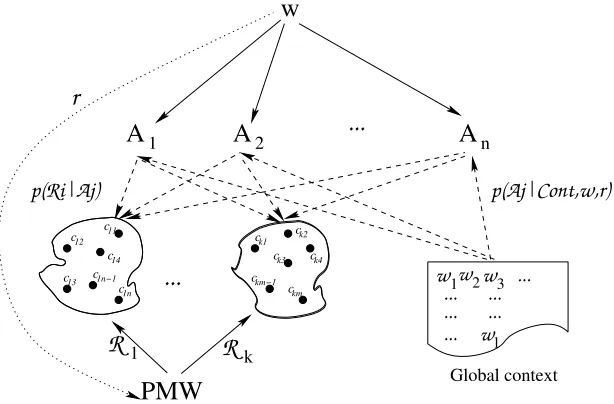
The approach we present takes into account both the local, grammatical, context and the larger textual context of a potentially metonymic word. Figure 1 presents a graphical representation of our approach. On the one hand, the word/term to be interpreted (the potentially metonymic word/term – PMW) is mapped onto a concept in the concept network (Sec-tion 3.3), which gives us access to the conceptual relations (Ri) between the PMW and other concepts
(cx ∈ CRi). On the other hand, any wordw gram-matically related to the PMW via a grammatical re-lationrprovides us with semantic restrictions on the interpretation of the PMW, namely preferred seman-tic classesAj (we call themabstractions) and a
se-lectional preference score.2 These are automatically
A
1
A
21
R
R
kA
n
12
c
14
c
11
c
13
c c1n−1
1n
c
k1
c ck2
k4
c
k3
c
km
c
km−1
c w
1w2w3
wl
w
r
...
...
PMW
p(Ri|Aj) p(Aj|Cont,w,r)
Global context
...
[image:4.612.151.458.57.259.2]... ... ... ... ...
Figure 1: Metonymy resolution using selectional preferencesAjderived from local contextwandr, semantic relations Rito the PMW from a concept network, and the global context surrounding a term to be interpreted
acquired by using a corpus of Wikipedia articles and a repository of encyclopedic knowledge (presented in Section 3.1), as described in detail in 3.2. Because the abstractionsAj and the PMW’s related concepts
(cx) come from the same structured resource, we
can compute the probabilities for eachRigiven the
grammatically related wordwand the grammatical relation r. The global context can also easily be added to the computation, as the probability of each word in the context relative to an abstractionAjcan
be computed through the resource’sis a hierarchy and its link to Wikipedia articles. This is detailed in Section 3.4.
3.1 A concept network obtained from
Wikipedia
We use a Wikipedia article dump (January 2011) which provided over 3.5 million English articles, interconnected through a hierarchy of categories and hyperlinks. This partly structured repository is transformed into a large-scale multilingual con-cept network, whose nodes are concon-cepts correspond-ing to articles or categories in Wikipedia (Nastase et al., 2010). Concepts in this network are con-nected through a variety of semantic relations (e.g.
is a, member of, nationality) derived from category names and infoboxes. The version of WikiNet used
to the PMW.
had 3,707,718 nodes and 49,931,266 relation in-stances of 494 types, and is freely available3.
WikiNet is used here as a concept inventory, and its links and structure to generalize more spe-cific concepts identified in texts to general concepts. The fact that nodes in WikiNet correspond to arti-cles/categories in Wikipedia is used to link article texts in Wikipedia to general concepts, for the pur-pose of computing various probability scores (de-tailed in Section 3.4).
3.2 Selectional preferences and abstractions
To compute selectional preferences we use the set of English Wikipedia articles, which describe specific concepts. Wikipedia contributors are encouraged to insert hyperlinks, which link important terms in an article to the corresponding articles. A hyperlink consists of two parts, the actual link (i.e. a URL) and a phrase to appear in the text. Hyperlinks then constitute a bridge from the textual level to the con-ceptual level without the need for word sense dis-ambiguation. We exploit these links to gather con-cept arguments for verbs and adjectives, and gen-eralize these using the concept network built from Wikipedia.
The corpus of Wikipedia articles was first en-riched with hyperlinks, making the “one sense per
3http://www.h-its.org/english/research/
Algorithm 1computeSelPrefs(G,WkN)
Input: G– grammatical relation triples WkN – WikiNet
M – maximum number of generalization steps
Output: Γ
Γ ={}
for all(w, r)such that(c, r, w)∈Gdo
S ={(c, f)|f is the frequency of(c, r, w)inG} Γw,r=S
mdl = MDL(Γw,r,S)
for alli = 1,Mdo
Γ0=abstract(S, W kN) mdlΓ0 = MDL(Γ0,S)
ifmdlΓ0 <mdlthen
Γw,r = Γ0
Γ ={Γw,r} ∪Γ
returnΓ
Algorithm 2MDL(Γ,S)
Input: Γ ={(c, f)}– a scored list of concepts S– the set of observations (concept collocates)
Output: MDL(Γ,S)
b
θ=< f1, ..., fn>; (ci, fi)∈Γ
remove{(c, f) ∈ Γ|f = 1} // parameter description length :
L(θb|Γ) =| Γ|−1
2 ∗log(|S|) // data description length : for all(c, f)∈Γdo
L(S|Γ,bθ) =L(S|Γ,θb) +f∗log(hyponymsf (c)∗|Γ|)
returnL(θb|Γ)−L(S|Γ,bθ)
Algorithm 3 abstract(S,WkN)
Input: S={(c, f)|(w,R, c)∈G} WkN – WikiNet
Output: S0
S0={}
forc|(c, )∈ Sdo
whilechas only oneis a linkdo
c=c0,(c,is a, c0)∈W kN C={(c0, c)|(c,is a, c0)∈W kN}
for(c0, c)∈Cdo if(c0, f0)∈ S0then
replace(c0, f0)with(c0, f0+ |Cf|),(c, f)∈ S inS0
else
S0∪={(c0, f)},(c, f)∈ S
// Remove hyponyms.
for all{(c, c0)∈ S0|(c0,is a, c)∈W kN}do
// update frequencyf ofc fc=fc+fc0, f∈ S
deletec0
returnS0
discourse” assumption – a phrase that appears as-sociated with a hyperlink once in the article body will be associated with the same hyperlink through-out the article (this applies to the article title as well, which is not hyperlinked in the article itself). This new version of the corpus was then split into sen-tences, and those without hyperlinks were removed. The remaining 18 million sentences were parsed with a parallelized version of Ensemble4 (Surdeanu and Manning, 2010), and we extractedG, the set of all grammatical relations of the type (verb, depen-dency, hyperlink) and (adjective, dependency, hy-perlink), with the hyperlinks resolved to their cor-responding node (concept) in the network ( |G| = 1,578,413 triples). For each verb and adjective in the extracted collocations, and for each of their depen-dency relations, their collocates were generalized in the network defined by the hypernym/hyponym re-lations in WikiNet following a method similar to the Minimum Description Length principle (Li and Abe, 1998).
Essentially, we aimed to determine a small set of (more general) concepts that describe the set of col-locates for a word w and grammatical relation r. Starting from the concept collocates gathered, we go upwards following WikiNet’sis a links, and for each node found that covers at least N concept col-locates (N is a parameter, N=2 in the experiments presented here), the MDL score of the node is com-puted (Algorithm 2). We place a limit M on the number of upward steps in the hierarchy (M=3 in our experiments). The disjoint set of nodes that has the lowest overall MDL score is chosen (Γ), and for each node in this cut (which we call abstraction), we compute the selectional preference score, based on the number of concepts it dominates.
As an example, for the verb defeat, the corpus leads to collocations such as5:
defeat
nsubj
Earle Page (10357) – 8, Manuela Maleeva (1092361) – 7, New York Yankees (10128601) – 5, Tommy Haas (1118005) – 5, . . .
obj
4
http://www.surdeanu.name/mihai/ ensemble/
5The format is:
New York Yankees (10128601) – 9, Oak-land Athletics (11641124) – 6, Phoenix Suns (11309373) – 4, Jason Suttie (10080653) – 3, Ravana (100234) – 3, . . .
Determining abstractions and selectional prefer-ences leads to the following information6:
defeat
nsubj
Martial artists (118977183) – 0.5, Person (219599) – 0.3518, Interest (146738) – 0.037, . . .
obj
Video games (9570081) – 0.25, British games (24489088) – 0.25, Person (219599) – 0.1445, Interest (146738) – 0.1341, . . .
3.3 Linking the PMW to the concept network
In our environment, linking the PMW to the con-cept network is equivalent to finding its correspond-ing concept in our ontology, WikiNet. We see this corresponding concept as the literal reading of the PMW. Doing so is a non-trivial task (see the Cross-Lingual Link Discovery task at NTCIR-9 (Tang et al., 2011) and the Cross-Lingual Entity Linking task – part of the Knowledge Base Population track – at TAC 20117). In our particular setting, where we use the metonymy data from SemEval 2007, the domain of the PMW is well defined: locations and compa-nies, respectively. Using these constraints, finding the corresponding Wikipedia articles is much sim-plified, by using the category hierarchy and con-straining the concepts to fall under the Geography
andCompaniescategories respectively. When mul-tiple options are present, we find instead a matching disambiguation page. In this case we pick the article that is listed first on this disambiguation page. On a manually checked random sample, the accuracy of the approach was 100% (on a sample of 100 PMWs).
3.4 Scoring conceptual relations with local and
global context
We work under the assumption that the concept cor-responding to the PMW is related to the possible in-terpretations through a semantic relation, in particu-lar one that is captured in the concept network. After
6
The format is:
Concept name (Concept Id) – selectional preference score. 7http://nlp.cs.qc.cuny.edu/kbp/2011/
countries :Administrator of, Architect of, Based in, Built in, Continent, ...
companies :Association, Brand, Company, Dis-tributed by, Executive of, ...
Table 1: Example conceptual relations
establishing the connection to the resource by link-ing the PMW to the conceptcP M Wcorresponding to
its literal interpretation (see Section 3.3), we extract the relations in which it is involved (Ri, i = 1, k), and the concepts it is connected to through these re-lations (CRi ={cx|(cP M WRicx)}). Table 1 shows
examples of conceptual relations extracted for com-panies and countries.
We are interested in computing the likelihood of a conceptual relation being the correct interpreta-tion of a PMW, given its local and global context p(Ri|Cont, w, r).
3.4.1 The local context
The local context considered in this work are all grammatically related verbs and adjectives w and their associated grammatical relationr. The gram-matical analysis (see Section 3.2) provides the set of abstractions corresponding to the grammatically re-lated wordw and grammatical relationr: Aj, j =
1, n. Remember that these are local context con-straints on the interpretation of the PMW.
Through the knowledge resource used we can es-tablish and quantify connections between each cx
andAj, and thus between eachRiandAj:
p(Ri|Aj) =
X
x∈CRi
p(cx|Aj)
(3)
wherep(cx|Aj)is the probability of conceptcx
un-der abstractionAj, which is computed based on the
semantic relations in WikiNet:
p(cx|Aj) =
X
H
Y
hi∈H
p(hi|hi+1)
whereHis in turn each path fromcxtoAjfollowing
is a links in WikiNet, starting withcx(i.e.h0=cx)
p(hi|hi+1) =
1
|descendants(hi+1)|
Through this, it is straightforward that
P
cxp(cx|Aj) = 1 when cx ranges over all concepts subsumed by Aj, and is thus a valid
probability distribution.
3.4.2 The global context
The abstractions obtained before are concepts. We extract all nodes in the network subsumed by these concepts, and their corresponding articles in Wikipedia (if they have one). This produces “abstraction-specific” article sets, based on which we compute the probability of the global context of a PMW for each abstraction. We are interested in the probability of an abstraction, given the context and the wordw and grammatical relation r, which we compute as:
p(Aj|Cont, w, r) =
p(Cont|Aj, w, r)∗p(Aj, w, r) p(Cont, w, r)
which, considering that p(Cont, w, r) is the same for a given context, we approximate as
p(Aj|Cont)≈p(Cont|Aj)∗p(Aj, w, r)
p(Aj, w, r) =p(Aj|w, r)∗p(w, r), and we
approxi-mate it through the computed selectional preference p(Aj|w, r), sincep(w, r)is constant for a given
ex-ample to analyze.
p(Cont|Aj, w, r) = n
X
j=1
p(Cont|Aj)p(Aj|w, r)
=
n
X
j=1 (
m
Y
l=1
p(wl|Aj))p(Aj|w, r)
where Cont is the global context consisting of m wordswl, l= 1, m.8
8
The global context therefore could be all words in a text or all words in a sentence or any other token-based definition in our framework. As the SemEval 2007 data gives metonymic examples in a three-sentence context we use all the words in the 3 sentences as our global context.
p(wl|Aj) =
count(wl,Aj)
|Aj|
whereAj is the set of articles subsumed by
abstrac-tionAj, and count(wl,Aj)is the number of times
wordwlappears in the article collectionAj.
3.4.3 Putting it all together
This enables us now to computep(Ri|Cont, w, r)
based on the formulas 3, 4:
p(Ri|Cont, w, r) =
n
X
j=1
(p(Ri|Aj)∗p(Aj|Cont, w, r))
4 Experiments
The computed probabilities for each conceptual re-lation (= potential readings) of the PMW in the con-cept network can be used as features in a supervised framework or directly as an unsupervised prediction, returning the most likely conceptual relation given the context as the required reading.
Although the latter is our ultimate goal, to allow comparison with related work from the metonymy resolution task (Task 8) at SemEval 2007, we first investigate the supervised set-up. We then simulate the unsupervised setting in Section 4.3.
4.1 Data
We use the data from the metonymy resolution task (Task 8) at SemEval 2007. It consists of training and test data for country and company names which are potentially metonymic. Table 2 shows the statistics of the data, and the possible interpretations for the PMWs. The training-test division was achieved ran-domly so that the test data can have metonymic read-ings for which no training data exists, showing again the limitations of a supervised approach of prespec-ified readings.
Grammatical features The features used by
Nis-sim and Markert (2005), and commonly used for the supervised classification of metonymy readings (Markert and Nissim, 2009):
• grammatical role of PMW (subj, obj, ...);
reading train test
locations 925 908
literal 737 721
mixed 15 20
othermet 9 11
obj-for-name 0 4
obj-for-representation 0 0
place-for-people 161 141
place-for-event 3 10
place-for-product 0 1
organizations 1090 842
literal 690 520
mixed 59 60
othermet 14 8
obj-for-name 8 6
obj-for-representation 1 0
org-for-members 220 161
org-for-event 2 1
org-for-product 74 67
org-for-facility 15 16
[image:8.612.99.273.56.369.2]org-for-index 7 3
Table 2: Statistics for the Task 8 data
• determiner of PMW (def, indef, bare, demonst, other, ...);
• grammatical number of PMW (sg, pl);
• number of grammatical roles in which the PMW appears in its current context;
• number of words in PMW.
All these features can be extracted from the gram-matically annotated and POS tagged data provided by the organizers.
The annotations provided are dependency rela-tions, many of which contain a preposition as an ar-gument (e.g. (to,pp, UK) from the example... the visit to the UK of ...). Such relations are not infor-mative, but together with the head that dominates the prepositional complement (e.g.visit to) they may be. Because of this, we process the provided annotations and add wherever possible to the simple prepositions the head of their subsuming constituent. This would change the above mentioned dependency to (visit,
prep-to, UK).
Semantic relations as features To evaluate the
proposed approach we use the PMW’s conceptual relations as features. The feature values are the p(Ri|Cont, w, r)scores.
For the “countries” portion of the data this adds 109 semantic relation features, and for companies 29 features. Table 1 showed examples of these new features.
4.2 Supervised learning
We use the SMO classifier in the WEKA machine learning toolkit (Witten and Frank, 2000) with its standard settings, training on the SemEval 2007 (Task 8) training set.
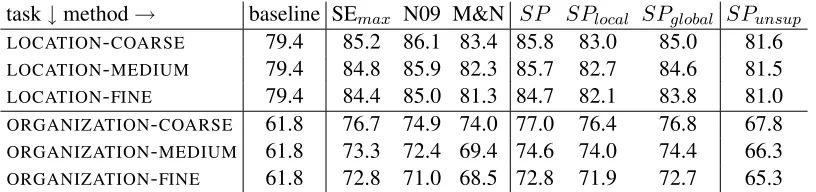
Table 3 shows the results of various configura-tions on the test data, in comparison with a most frequent reading baseline (assigning literal to all PMWs) as well as a system M&N that shows the re-sults computed using only the features proposed by Nissim and Markert (2005). In addition, we com-pare to the best results9 at SemEval 2007 (SEmax)
and Nastase and Strube (2009) (N09). Nastase and Strube (2009) added WordNet supersenses as fea-tures, and their values are selectional preferences computed with reference to WordNet. These are similar to our abstractions, which in our approach serve to link the local and the global context to the ontological relations, but do not appear as features.
Our system SP shows the results obtained us-ing the M&N features plus the conceptual relation features conditioned on both local and global con-text whereas SPlocal and SPglobal use conceptual
relations conditioned on local (p(Aj|Cont, w, r) ≈ p(Aj|w, r)) or global context (p(Aj|Cont, w, r) ≈ p(Aj|Cont) =Pnj=1(Qml=1p(wl|Aj))) only.
While the differences in overall accuracies are small, there are significant differences in classifying individual classes, as shown in Tables 4 – 510, where thedistrib.column shows the class distribution in the test data. It is interesting to note that, in our set-ting, the global context is more useful than the local
9
We show the best result for each category, not necessarily from the overall best performing system. This holds for Tables 4 and 5 as well.
[image:8.612.101.271.63.363.2]task↓method→ baseline SEmax N09 M&N SP SPlocal SPglobal SPunsup
LOCATION-COARSE 79.4 85.2 86.1 83.4 85.8 83.0 85.0 81.6
LOCATION-MEDIUM 79.4 84.8 85.9 82.3 85.7 82.7 84.6 81.5
LOCATION-FINE 79.4 84.4 85.0 81.3 84.7 82.1 83.8 81.0
ORGANIZATION-COARSE 61.8 76.7 74.9 74.0 77.0 76.4 76.8 67.8 ORGANIZATION-MEDIUM 61.8 73.3 72.4 69.4 74.6 74.0 74.4 66.3
[image:9.612.104.512.57.153.2]ORGANIZATION-FINE 61.8 72.8 71.0 68.5 72.8 71.9 72.7 65.3
Table 3: Accuracy scores
task↓method→ distrib. SEmax N09 SP
LOCATION-COARSE
literal 79.4 91.2 91.6 91.4
non-literal 20.6 57.6 59.1 58.5
LOCATION-MEDIUM
literal 79.4 91.2 91.6 91.4
metonymic 18.4 58.0 61.5 61.6
mixed 2.2 8.3 16 9.1
LOCATION-FINE
literal 79.4 91.2 91.6 91.4
place-for-people 15.5 58.9 61.7 61.1
place-for-event 1.1 16.7 0 0
obj-for-name 0.4 66.7 0 0
mixed 2.2 8.3 16 9.1
Table 4: Fine-grained results for each classification task for countries (F-scores)
one for resolving metonymies. Combining local and global evidence improves over both, indicating that the information they provide is not redundant.
For companies the difference is small in terms of accuracy, but in classification of individual classes the difference in performance is higher, but because of the small data size not statistically significant.
Countries in WikiNet have a high number of sur-rounding relations, because they are used as cat-egorization criteria for professionals, for example, which generates fine-grained relations such as Ad-ministrator of, Ambassador of, Chemist of .... Such a fine grained distinction between different profes-sions for people in a country is not necessary, or in-deed, desirable, for the metonymy resolution task. The results show that despite this shortcoming, the results are on par with the state-of-the-art, but in fu-ture work we plan to explore the task of relation gen-eralization and its impact on the current task.
task↓method→ distrib. SEmax N09 SP
ORGANIZATION-COARSE
literal 61.8 82.5 81.4 82.7
non-literal 38.2 65.2 61.6 65.5
ORGANIZATION-MEDIUM
literal 61.8 82.5 81.4 82.7
metonymic 31.0 60.4 58.7 63.1
mixed 7.2 30.8 26.8 27.4
ORGANIZATION-FINE
literal 61.8 82.6 81.4 82.7
org-for-members 19.1 63.0 59.7 66.5
org-for-product 8.0 50.0 44.4 35.0
org-for-facility 2.0 22.2 36.3 45.5
org-for-name 0.7 80.0 58.8 44.4
mixed 7.2 34.3 27.1 27.4
Table 5: Fine-grained results for each classification task for companies (F-scores)
4.3 Simulating unsupervised metonymy
resolution
In an unsupervised metonymy resolution approach, we would assign as interpretation the conceptual re-lation whose probability given the PMW, global and local contexts is highest. To simulate then the un-supervised metonymy resolution task, we make the relation features (used in the supervised approach) binary, where for each instance the relation that has highest probability has the value 1, the others 0.
Using only the relation features simulates an un-supervised approach – this set-up learns a map-ping between the relations used as features and the metonymy classes in the data used. Column SPU nsup in Table 3 shows the results obtained in
setting. The results also significantly beat the base-line (apart from the Location-Fine setting). One fea-ture that contributes greatly to the results, especially for the company semantic class, is the grammatical role of the PMW, but we could not incorporate this in the unsupervised setting.
The results in the simulated unsupervised set-ting indicate that relations are a viable substitute for manually provided classes in an unsupervised framework, while leaving space for improvement.
5 Conclusion
We have explored the usage of local and global con-text for the task of metonymy resolution in a prob-abilistic framework. The global context has been rarely used for the task of determining the intended reading of a potentially metonymic word (PMW) in context. We rely on automatically computed se-lectional preferences, extracted from a corpus of Wikipedia articles, and generalized based on a con-cept network also extracted from Wikipedia. De-spite relying on automatically derived resources, the presented approach produces results on-a-par with current state-of-the-art systems. The method de-scribed here is also a step towards the unsupervised resolution of metonymic words in context, by tak-ing into account knowledge about the concept cor-responding to the literal interpretation of the PMW, and its relations to other concepts. This frame-work would also allow for exploring the metonymy resolution phenomena in various languages (since Wikipedia and WikiNet are multilingual), and inves-tigate whether the same relations apply or different languages have different metonymic patterns.
Acknowledgments
Katja Markert is the recipient of an Alexander-von-Humboldt Fellowship for Experienced Researchers. This work was financially supported by the EC-funded project CoSyne (FP7-ICT-4-24853) and the Klaus Tschirra Foundation. We thank the review-ers for the helpful comments, and Helga Kr¨amer-Houska for additional support for conference partic-ipation.
References
Luisa Bentivogli, Elena Cabrio, Ido Dagan, Danilo Gi-ampiccolo, Medea Lo Leggio, and Bernardo Magnini. 2007. Building textual entailment specialized data sets: A methodology for isolating linguistic phenom-ena relevant to inference. In Proceedings of the 7th International Conference on Language Resources and Evaluation,La Valetta, Malta, 17–23 May 2010. Caroline Brun, Maud Ehrmann, and Guillaume Jacquet.
2007. XRCE-M: A hybrid system for named en-tity metonymy resolution. In Proceedings of the 4th International Workshop on Semantic Evaluations (SemEval-1), Prague, Czech Republic, 23–24 June 2007, pages 488–491.
Rich´ard Farkas, Eszter Simon, Gy¨orgy Szarvas, and D´aniel Varga. 2007. GYDER: Maxent metonymy res-olution. InProceedings of the 4th International Work-shop on Semantic Evaluations (SemEval-1), Prague, Czech Republic, 23–24 June 2007, pages 161–164. Dan C. Fass. 1991. met∗: A method for discriminating
metonomy and metaphor by computer.Computational Linguistics, 17(1):49–90.
Sanda M. Harabagiu. 1998. Deriving metonymic co-ercions from WordNet. In Proceedings of the Work-shop on the Usage of WordNet in Natural Language Systems,Montral, Quebec, Canada, 16 August, 1998, pages 142–148.
Jerry Hobbs, Mark Stickel, Douglas Appelt, and Paul Martin. 1993. Interpretation as abduction. Artificial Intelligence, 63(1-2):69–142.
Maria Lapata. 2003. Probabilistic text structuring: Ex-periments with sentence ordering. InProceedings of the 41st Annual Meeting of the Association for Compu-tational Linguistics,Sapporo, Japan, 7–12 July 2003, pages 545–552.
Johannes Leveling and Sven Hartrumpf. 2008. On metonymy recognition for geographic information re-trieval. International Journal of Geographical Infor-mation Science, 22(3):289–299.
Johannes Leveling. 2007. FUH (FernUniversit¨at in Ha-gen): Metonymy recognition using different kinds of context for a memory-based learner. InProceedings of the 4th International Workshop on Semantic Eval-uations (SemEval-1),Prague, Czech Republic, 23–24 June 2007, pages 153–156.
Hang Li and Naoki Abe. 1998. Generalizing case frames using a thesaurus and the MDL principle. Computa-tional Linguistics, 24(2):217–244.
Katja Markert and Udo Hahn. 2002. Metonymies in dis-course.Artificial Intelligence, 135(1/2):145–198. Katja Markert and Malvina Nissim. 2009. Data and
Vivi Nastase and Michael Strube. 2009. Combining collocations, lexical and encyclopedic knowledge for metonymy resolution. In Proceedings of the 2009 Conference on Empirical Methods in Natural Lan-guage Processing,Singapore, 6-7 August 2009, pages 910–918.
Vivi Nastase, Michael Strube, Benjamin B¨orschinger, C¨acilia Zirn, and Anas Elghafari. 2010. WikiNet: A very large scale multi-lingual concept network. In Proceedings of the 7th International Conference on Language Resources and Evaluation, La Valetta, Malta, 17–23 May 2010.
Cristina Nicolae, Gabriel Nicolae, and Sanda Harabagiu. 2007. UTD-HLT-CG: Semantic architecture for metonymy resolution and classification of nominal re-lations. InProceedings of the 4th International Work-shop on Semantic Evaluations (SemEval-1), Prague, Czech Republic, 23–24 June 2007, pages 454–459. Malvina Nissim and Katja Markert. 2005. Learning to
buy a Renault and talk to BMW: A supervised ap-proach to conventional metonymy. InProceedings of the 6th International Workshop on Computational Se-mantics,Tilburg, Netherlands, January 12-14, 2005. Geoffrey Nunberg. 1995. Transfers of meaning.Journal
of Semantics, 12(1):109–132.
Thierry Poibeau. 2007. Up13: Knowledge-poor meth-ods (sometimes) perform poorly. In Proceedings of the 4th International Workshop on Semantic Evalu-ations (SemEval-1), Prague, Czech Republic, 23–24 June 2007, pages 418–421.
James Pustejovsky. 1991. The generative lexicon. Com-putational Linguistics, 17(4):209–241.
Kirk Roberts and Sanda M. Harabagiu. 2011. Unsuper-vised learning of selectional restrictions and detection of argument coercions. In Proceedings of the 2011 Conference on Empirical Methods in Natural Lan-guage Processing, Edinburgh, UK, 27-29 July 2011, pages 980–990.
Ekaterina Shutova. 2009. Sense-based interpretation of logical metonymy using a statistical method. In Pro-ceedings of the Joint Conference of the 47th Annual Meeting of the Association for Computational Lin-guistics and the 4th International Joint Conference on Natural Language Processing,Singapore, 2–7 August 2009, pages 1–9.
Mihai Surdeanu and Christopher D. Manning. 2010. En-semble Models for Dependency Parsing: Cheap and Good? In Proceedings of Human Language Tech-nologies 2010: The Conference of the North American Chapter of the Association for Computational Linguis-tics, Los Angeles, Cal., 2–4 June 2010, pages 649– 652.
Ling-Xiang Tang, Shlomo Geva, Andrew Trotman, Yue Xu, and Kelly Y. Itakura. 2011. Overview of the
NTCIR-9 crosslink task: Cross-lingual link discovery. In Proceedings of the 9th NII Test Collection for IR Systems Workshop meeting – NTCIR-9Tokyo, Japan, 6–9 December 2011.
Masao Utiyama, Masaki Murata, and Hitoshi Isahara. 2000. A statistical approach to the processing of metonymy. In Proceedings of the 18th Inter-national Conference on Computational Linguistics,
Saarbr¨ucken, Germany, 31 July – 4 August 2000, pages 885–891.