Source Language Adaptation for Resource-Poor Machine Translation
Pidong Wang
Department of Computer Science National University of Singapore
13 Computing Drive Singapore 117417
Preslav Nakov QCRI Qatar Foundation Tornado Tower, P.O. 5825
Doha, Qatar
Hwee Tou Ng
Department of Computer Science National University of Singapore
13 Computing Drive Singapore 117417
Abstract
We propose a novel, language-independent approach for improving machine translation from a resource-poor language toXby
adapt-ing a large bi-text for a related resource-rich
language and X (the same target language). We assume a small bi-text for the resource-poor language to X pair, which we use to learn word-level and phrase-level paraphrases and cross-lingual morphological variants be-tween the resource-rich and the resource-poor language; we then adapt the former to get closer to the latter. Our experiments for Indonesian/Malay–English translation show that using the large adapted resource-rich bi-text yields 6.7 BLEU points of improvement over the unadapted one and 2.6 BLEU points over the original small bi-text. Moreover, combining the small bi-text with the adapted bi-text outperforms the corresponding com-binations with the unadapted bi-text by 1.5– 3 BLEU points. We also demonstrate applica-bility to other languages and domains.
1 Introduction
Statistical machine translation (SMT) systems learn how to translate from large sentence-aligned bilin-gual corpora of human-generated translations, called bi-texts. Unfortunately, collecting sufficiently large, high-quality bi-texts is hard, and thus most of the 6,500+ world languages remain resource-poor. For-tunately, many of these resource-poor languages are related to some resource-rich language, with whom they overlap in vocabulary and share cog-nates, which offers opportunities for bi-text reuse.
Example pairs of such resource rich–poor lan-guages include Spanish–Catalan, Finnish–Estonian,
Swedish–Norwegian, Russian–Ukrainian, Irish–
Gaelic Scottish, Standard German–Swiss
Ger-man, Modern Standard Arabic–Dialectical Arabic (e.g., Gulf, Egyptian), Turkish–Azerbaijani, etc.
Previous work has already demonstrated the ben-efits of using a bi-text for a related resource-rich
language to X (e.g., X=English) to improve
ma-chine translation from a resource-poor language to
X (Nakov and Ng, 2009; Nakov and Ng, 2012).
Here we take a different, orthogonal approach: we adapt the resource-rich language to get closer to the resource-poor one.
We assume a small bi-text for the resource-poor language, which we use to learn word-level and phrase-level paraphrases and cross-lingual morpho-logical variants between the two languages.
Assum-ing translation into the same target languageX, we
adapt (the source side of) a large training bi-text for
a related resource-rich language andX.
Training on the adapted large bi-text yields very significant improvements in translation quality com-pared to both (a) training on the unadapted version, and (b) training on the small bi-text for the resource-poor language. We further achieve very sizable im-provements when combining the small bi-text with the large adapted bi-text, compared to combining the former with the unadapted bi-text.
While we focus on adapting Malay to look like Indonesian in our experiments, we also demonstrate the applicability of our approach to another language pair, Bulgarian–Macedonian, which is also from a different domain.
2 Related Work
One relevant line of research is on machine trans-lation between closely related languages, which is arguably simpler than general SMT, and thus can be handled using word-for-word translation, man-ual language-specific rules that take care of the nec-essary morphological and syntactic transformations,
or character-level translation/transliteration. This
has been tried for a number of language pairs in-cluding Czech–Slovak (Hajiˇc et al., 2000), Turkish– Crimean Tatar (Altintas and Cicekli, 2002), Irish– Scottish Gaelic (Scannell, 2006), and Bulgarian– Macedonian (Nakov and Tiedemann, 2012). In con-trast, we have a different objective – we do not carry out full translation but rather adaptation since our
ultimate goal is to translate into a third languageX.
A special case of this same line of research is the translation between dialects of the same language, e.g., between Cantonese and Mandarin (Zhang, 1998), or between a dialect of a language and a stan-dard version of that language, e.g., between some Arabic dialect (e.g., Egyptian) and Modern Standard Arabic (Bakr et al., 2008; Sawaf, 2010; Salloum and Habash, 2011). Here again, manual rules and/or language-specific tools are typically used. In the case of Arabic dialects, a further complication arises by the informal status of the dialects, which are not standardized and not used in formal contexts but
rather only in informal online communities1such as
social networks, chats, Twitter and SMS messages. This causes further mismatch in domain and genre.
Thus, translating from Arabic dialects to Modern Standard Arabic requires, among other things, nor-malizing informal text to a formal form. In fact, this is a more general problem, which arises with informal sources like SMS messages and Tweets for just any language (Aw et al., 2006; Han and Bald-win, 2011). Here the main focus is on coping with spelling errors, abbreviations, and slang, which are typically addressed using string edit distance, while also taking pronunciation into account. This is dif-ferent from our task, where we try to adapt good, formal text from one language into another.
A second relevant line of research is on language adaptation and normalization, when done specifi-cally for improving SMT into another language.
1
The Egyptian Wikipedia is one notable exception.
For example, Marujo et al. (2011) described a rule-based system for adapting Brazilian Portuguese (BP) to European Portuguese (EP), which they used to adapt BP–English bi-texts to EP–English. They report small improvements in BLEU for EP–English translation when training on the adapted “EP”–En bi-text compared to using the unadapted BP–En (38.55 vs. 38.29), or when an EP–English bi-text is used in addition to the adapted/unadapted one (41.07 vs. 40.91 BLEU). Unlike this work, which heav-ily relied on language-specific rules, our approach is statistical, and largely language-independent; more-over, our improvements are much more sizable.
A third relevant line of research is on reusing bi-texts between related languages without or with very little adaptation, which works well for very closely related languages. For example, our previous work (Nakov and Ng, 2009; Nakov and Ng, 2012) ex-perimented with various techniques for combining a small bi-text for a resource-poor language (In-donesian or Spanish, pretending that Spanish is resource-poor) with a much larger bi-text for a re-lated resource-rich language (Malay or Portuguese); the target language of all bi-texts was English. How-ever, our previous work did not attempt language adaptation, except for very simple transliteration for Portuguese–Spanish that ignored context entirely; since it could not substitute one word for a com-pletely different word, it did not help much for Malay–Indonesian, which use unified spelling. Still, once we have language-adapted the large bi-text, it makes sense to try to combine it further with the small bi-text; thus, below we will directly compare and combine these two approaches.
Another alternative, which we do not explore in this work, is to use cascaded translation using a pivot language (Utiyama and Isahara, 2007; Cohn and Lapata, 2007; Wu and Wang, 2009). Unfortu-nately, using the resource-rich language as a pivot
(poor→rich→X) would require an additional
paral-lel poor–rich bi-text, which we do not have. Pivoting
over the targetX (rich→X→poor) for the purpose
of language adaptation, on the other hand, would miss the opportunity to exploit the relationship be-tween the resource-poor and the resource-rich lan-guage; this would also be circular since the first step would ask an SMT system to translate its own
3 Malay and Indonesian
Malay and Indonesian are closely related, mutually intelligible Austronesian languages with 180 million speakers combined. They have a unified spelling, with occasional differences, e.g., kerana vs. karena (‘because’), Inggeris vs. Inggris (‘English’), and wang vs. uang (‘money’).
They differ more substantially in vocabulary, mostly because of loan words, where Malay typi-cally follows the English pronunciation, while In-donesian tends to follow Dutch, e.g., televisyen vs. televisi, Julai vs. Juli, and Jordan vs. Yordania.
While there are many cognates between the two languages, there are also a lot of false friends, e.g., polisi means policy in Malay but police in Indone-sian. There are also many partial cognates, e.g., nanti means both will (future tense marker) and later in Malay but only later in Indonesian.
Thus, fluent Malay and fluent Indonesian can dif-fer substantially. Consider, for example, Article 1 of
the Universal Declaration of Human Rights:2
• Semua manusia dilahirkan bebas dan samarata dari segi kemu-liaan dan hak-hak. Mereka mempunyai pemikiran dan perasaan hati dan hendaklah bertindak di antara satu sama lain dengan semangat persaudaraan. (Malay)
• Semua orang dilahirkan merdeka dan mempunyai marta-bat dan hak-hak yang sama. Mereka dikaruniai akal dan hati nurani dan hendaknya bergaul satu sama lain dalam
semangat persaudaraan. (Indonesian)
There is only 50% overlap at the word level, but the actual vocabulary overlap is much higher, e.g., there is only one word in the Malay text that does not exist in Indonesian: samarata (‘equal’). Other differences are due to the use of different morpho-logical forms, e.g., hendaklah vs. hendaknya (‘con-science’), derivational variants of hendak (‘want’).
Of course, word choice in translation is often a matter of taste. Thus, we asked a native speaker of Indonesian to adapt the Malay version to Indonesian while preserving as many words as possible:
• Semua manusia dilahirkan bebas dan mempunyai martabat dan hak-hak yang sama. Mereka mempunyai pemikiran dan perasaan dan hendaklah bergaul satu sama lain dalam
semangat persaudaraan. (Indonesian)
2
English: All human beings are born free and equal in
dig-nity and rights. They are endowed with reason and conscience and should act towards one another in a spirit of brotherhood.
Obtaining this latter version from the original Malay text requires three word-level operations: (1) deletion of dari, segi, (2) insertion of yang, sama, and (3) substitution of samarata with mempunyai.
Unfortunately, we do not have parallel Malay-Indonesian text, which complicates the process of learning when to apply these operations. Thus, be-low we restrict our attention to the simplest and most common operation of word substitution only,
leav-ing the other two3operations for future work.
Note that word substitution is enough in many cases, e.g., it is all that is needed for the following
Malay-Indonesian sentence pair:4
• KDNK Malaysia dijangka cecah 8 peratus pada tahun 2010.
• PDB Malaysia akan mencapai 8 persen pada tahun 2010.
4 Method
We improve machine translation from a resource-poor language (Indonesian) to English by adapting a bi-text for a related resource-rich language (Malay) and English, using word-level and phrase-level para-phrases and cross-lingual morphological variants.
4.1 Word-Level Paraphrasing
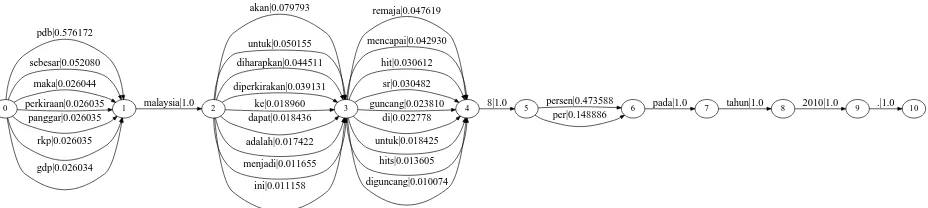
Given a Malay sentence, we generate a confusion network containing multiple Indonesian word-level paraphrase options for each Malay word. Each such Indonesian option is associated with a correspond-ing weight in the network, which is defined as the probability of this option being a translation of the original Malay word (see Eq. 1 below). We decode this confusion network using a large Indonesian
lan-guage model, thus generating a ranked list ofn
cor-responding adapted “Indonesian” sentences.
Then, we pair each such adapted “Indonesian” sentence with the English counter-part for the Malay sentence it was derived from, thus obtain-ing a synthetic “Indonesian”–English bi-text. Fi-nally, we combine this synthetic bi-text with the original Indonesian–English one to train the final Indonesian–English SMT system.
Below we first describe how we generate word-level Indonesian options and corresponding weights for the Malay words. Then, we explain how we build, decode, and improve the confusion network.
3
There are other potentially useful operations, e.g., a correct translation for the Malay samarata can be obtained by splitting it into the Indonesian sequence sama rata.
4
4.1.1 Inducing Word-Level Paraphrases
We use pivoting over English to induce potential Indonesian translations for a given Malay word.
First, we generate separate word-level alignments for the Indonesian–English and the Malay–English bi-texts. Then, we induce Indonesian-Malay word translation pairs assuming that if an Indonesian word
i and a Malay word m are aligned to the same
English word e, they could be mutual translations.
Each translation pair is associated with a conditional probability, estimated by pivoting over English:
Pr(i|m) = X
e
Pr(i|e)Pr(e|m) (1)
Pr(i|e) and Pr(e|m) are estimated using
maxi-mum likelihood from the word alignments. Follow-ing (Callison-Burch et al., 2006), we further assume
thatiis conditionally independent ofmgivene.
4.1.2 Confusion Network Construction
Given a Malay sentence, we construct an Indone-sian confusion network, where each Malay word is augmented with a set of network transitions:
pos-sible Indonesian word translations. The weight
of such a transition is the conditional Indonesian-Malay translation probability as calculated by Eq. 1; the original Malay word is assigned a weight of 1.
Note that we paraphrase each word in the in-put Malay sentence as opposed to only those Malay words that we believe not to exist in Indonesian, e.g., because they do not appear in our Indonesian mono-lingual text. This is necessary because of the large number of false friends and partial cognates between Malay and Indonesian (see Section 3).
Finally, we decode the confusion network for a Malay sentence using a large Indonesian language
model, and we extract an n-best list.5 Table 1
shows the 10-best adapted “Indonesian” sentences6
we generated for the confusion network in Figure 1.
4.1.3 Further Refinements
Many of our paraphrases are bad: some have very low probabilities, while others involve rare words for which the probability estimates are unreliable.
5For balance, in case of less than
nadaptations for a Malay sentence, we randomly repeat some of the available ones.
6
According to a native Indonesian speaker, options 1 and 3 in Table 1 are perfect adaptations, options 2 and 5 have a wrong word order, and the rest are grammatical though not perfect.
Moreover, the options we propose for a Malay word are inherently restricted to the small Indone-sian vocabulary of the IndoneIndone-sian–English bi-text. Below we describe how we address these issues.
Score-based filtering. We filter out translation
pairs whose probabilities (Eq. 1) are lower than some threshold (tuned on the dev dataset), e.g., 0.01.
Improved estimations forPr(i|e). We
concate-natekcopies of the Indonesian–English bi-text and
one copy of the Malay–English bi-text, where the
value ofk is selected so that we have roughly the
same number of Indonesian and Malay sentences. Then, we generate word-level alignments for the resulting bi-text. Finally, we truncate these align-ments keeping them for one copy of the original Indonesian–English bi-text only. Thus, we end up with improved word alignments for the Indonesian– English bi-text, and with better estimations for Eq. 1. Since Malay and Indonesian share many cognates, this improves word alignments for Indonesian words that occur rarely in the small Indonesian–English bi-text but are relatively frequent in the larger Malay– English one; it also helps for some frequent words.
Cross-lingual morphological variants. We
in-crease the Indonesian options for a Malay word us-ing morphology. Since the set of Indonesian op-tions for a Malay word in pivoting is restricted to the Indonesian vocabulary of the small Indonesian– English bi-text, this is a severe limitation of pivot-ing. Thus, assuming a large monolingual Indone-sian text, we first build a lexicon of the words in the text. Then, we lemmatize these words using two dif-ferent lemmatizers: the Malay lemmatizer of Bald-win and Awab (2006), and a similar Indonesian lem-matizer. Since these two analyzers have different strengths and weaknesses, we combine their outputs to increase recall. Next, we group all Indonesian words that share the same lemma, e.g., for minum,
we obtain {diminum, diminumkan, diminumnya, makan-minum,
makananminuman, meminum, meminumkan, meminumnya, meminum-minuman, minum, minum-minum, minum-meminum-minuman, meminum-minuman,
0 1
pdb|0.576172
sebesar|0.052080
maka|0.026044
perkiraan|0.026035 panggar|0.026035
rkp|0.026035
gdp|0.026034
2
malaysia|1.0 3
akan|0.079793
untuk|0.050155
diharapkan|0.044511
diperkirakan|0.039131
ke|0.018960 dapat|0.018436
adalah|0.017422
menjadi|0.011655
ini|0.011158
4
remaja|0.047619
mencapai|0.042930
hit|0.030612
sr|0.030482
guncang|0.023810 di|0.022778
untuk|0.018425
hits|0.013605
diguncang|0.010074
5
8|1.0 persen|0.473588 6
per|0.148886 7
pada|1.0 tahun|1.0 8 2010|1.0 9 .|1.0 10
Figure 1: Indonesian confusion network for the Malay sentence “KDNK Malaysia dijangka cecah 8 peratus pada tahun 2010.” Arcs with scores below 0.01 are omitted, and words that exist in Indonesian are not paraphrased (for better readability).
Rank “Indonesian” Sentence
[image:5.612.76.540.57.161.2]1 pdb malaysia akan mencapai 8 persen pada tahun 2010 . 2 pdb malaysia untuk mencapai 8 persen pada tahun 2010 . 3 pdb malaysia diperkirakan mencapai 8 persen pada tahun 2010 . 4 maka malaysia akan mencapai 8 persen pada tahun 2010 . 5 maka malaysia untuk mencapai 8 persen pada tahun 2010 . 6 pdb malaysia dapat mencapai 8 persen pada tahun 2010 . 7 maka malaysia diperkirakan mencapai 8 persen pada tahun 2010 . 8 sebesar malaysia akan mencapai 8 persen pada tahun 2010 . 9 pdb malaysia diharapkan mencapai 8 persen pada tahun 2010 . 10 pdb malaysia ini mencapai 8 persen pada tahun 2010 .
Table 1: The 10-best “Indonesian” sentences extracted from the confusion network in Figure 1.
The union of these groups is the set of morpholog-ical variants that we will add to the confusion
net-work as additional options for the Malay word.7 For
example, given seperminuman (‘drinking’) in the Malay input, we first find its stem minum, and then we get the above example set of Indonesian words, which contains some reasonable substitutes such as minuman (‘drink’). In the confusion network, the weight of the original Malay word is set to 1, while the weight of a morphological option is one minus the minimum edit distance ratio (Ristad and Yian-ilos, 1998) between it and the Malay word, multi-plied by the highest probability for all pivoting vari-ants for the Malay word.
4.2 Phrase-Level Paraphrasing
Word-level paraphrasing ignores context when gen-erating Indonesian variants, relying on the Indone-sian language model to make the right contextual choice. We also try to model context more directly by generating adaptation options at the phrase level.
7
While the different morphological forms typically have dif-ferent meanings, e.g., minum (‘drink’) vs. peminum (‘drinker’), in some cases the forms could have the same translation in En-glish, e.g., minum (‘drink’, verb) vs. minuman (‘drink’, noun). This is our motivation for trying morphological variants, even though they are almost exclusively derivational, and thus quite risky as translational variants; see also (Nakov and Ng, 2011).
Phrase-level paraphrase induction. We use standard phrase-based SMT techniques to build sep-arate phrase tables for the Indonesian–English and the Malay–English bi-texts, where we have four
conditional probabilities: forward/reverse phrase
translation probability, and forward/reverse lexical-ized phrase translation probability. We pivot over English to generate Indonesian-Malay phrase pairs, whose probabilities are derived from the corre-sponding ones in the two phrase tables using Eq. 1.
Cross-lingual morphological variants. While
phrase-level paraphrasing models context better, it remains limited in the size of its Indonesian vocab-ulary by the small Indonesian–English bi-text, just like word-level paraphrasing was. We address this by transforming the sentences in the development and the test Indonesian–English bi-texts into confu-sion networks, where we add Malay morphological variants for the Indonesian words, weighting them as before. Note that we do not alter the training bi-text.
4.3 Combining Bi-texts
We combine the Indonesian–English and the syn-thetic “Indonesian”–English bi-texts as follows:
Balanced concatenation with repetitions.
How-ever, the two bi-texts are not directly comparable and are clearly not equally good as a source of training data for an Indonesian-English SMT system. For one thing, the “Indonesian”–English bi-text is
ob-tained from n-best lists, i.e., it has exactlyn very
similar variants for each Malay sentence. Moreover, the original Malay–English bi-text is much larger in size than the Indonesian–English one, and now
it has been further expandedntimes in order to
be-come an “Indonesian”–English bi-text, which means that it will dominate the concatenation due to its size. In order to counter-balance this, we repeat the smaller Indonesian–English bi-text enough times so that we can make the number of sentences it contains roughly the same as for the “Indonesian”–English bi-text; then we concatenate the two bi-texts and we train an SMT system on the resulting bi-text.
Sophisticated phrase table combination. Fi-nally, we experiment with a method for combining phrase tables proposed in (Nakov and Ng, 2009;
Nakov and Ng, 2012). The first phrase table is
extracted from word alignments for the balanced concatenation with repetitions, which are then trun-cated so that they are kept for only one copy of the Indonesian–English bi-text. The second table is built from the simple concatenation. The two tables are then merged as follows: all phrase pairs from the first one are retained, and to them are added those phrase pairs from the second one that are not present in the first one. Each phrase pair retains its orig-inal scores, which are further augmented with 1–3 additional feature scores indicating its origin: the first/second/third feature is 1 if the pair came from the first/second/both table(s), and 0 otherwise. We experiment using all three, the first two, or the first feature only; we also try setting the features to 0.5 instead of 0. This makes the following six combina-tions (0, 00, 000, .5, .5.5, .5.5.5); on testing, we use the one that achieves the highest BLEU score on the development set.
Other possibilities for combining the phrase ta-bles include using alternative decoding paths (Birch et al., 2007), simple linear interpolation, and direct phrase table merging with extra features (Callison-Burch et al., 2006); they were previously found in-ferior to the last two approaches above (Nakov and Ng, 2009; Nakov and Ng, 2012).
5 Experiments
We run two kinds of experiments: (a) isolated, where we train on the synthetic “Indonesian”– English bi-text only, and (b) combined, where we combine it with the Indonesian–English bi-text.
5.1 Datasets
In our experiments, we use the following datasets, normally required for Indonesian–English SMT:
• Indonesian–English train bi-text (IN2EN):
28,383 sentence pairs; 915,192 English tokens; 796,787 Indonesian tokens;
• Indon.–English dev bi-text (IN2EN-dev):
2,000 sentence pairs; 36,584 English tokens; 35,708 Indonesian tokens;
• Indon.–English test bi-text (IN2EN-test):
2,018 sentence pairs; 37,101 English tokens; 35,509 Indonesian tokens;
• Monolingual English text (EN-LM): 174,443
sentences; 5,071,988 English tokens.
We also use a Malay–English set (to be turned into “Indonesian”–English), and monolingual In-donesian text (for decoding the confusion network):
• Malay–English train bi-text (ML2EN):
290,000 sentence pairs; 8,638,780 English tokens; 8,061,729 Malay tokens;
• Monolingual Indonesian text (IN-LM):
1,132,082 sentences; 20,452,064 Indonesian tokens.
5.2 Baseline Systems
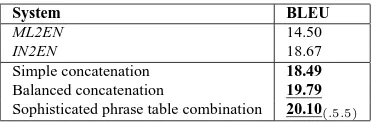
We build five baseline systems – two using a sin-gle bi-text, ML2EN or IN2EN, and three combin-ing ML2EN and IN2EN, uscombin-ing simple concatenation, balanced concatenation, and sophisticated phrase ta-ble combination. The last combination is a very strong baseline and the most relevant one we need to improve upon.
5.3 Isolated Experiments
The isolated experiments only use the adapted “Indonesian”–English bi-text, which allows for a di-rect comparison to using ML2EN / IN2EN only.
5.3.1 Word-Level Paraphrasing
• CN:pivot – using word-level pivoting only;
• CN:pivot′ – using word-level pivoting, with
probabilities from word alignments for IN2EN that were improved using ML2EN;
• CN:pivot′+morph – CN:pivot′augmented with
cross-lingual morphological variants.
There are two parameter values to be tuned on IN2EN-dev for the above confusion networks: (1) the minimum pivoting probability threshold for the Malay-Indonesian word-level paraphrases, and
(2) the number of n-best Indonesian-adapted
sen-tences that are to be generated for each input Malay
sentence. We try {0.001,0.005,0.01,0.05} for the
threshold and{1,5,10}forn.
5.3.2 Phrase-Level Paraphrasing
In our phrase-level paraphrasing experiments, we use pivoted phrase tables (PPT) with the following features for each phrase table entry (in addition to the phrase penalty; see Section 4.2 for more details):
• PPT:1 – only uses the forward conditional
translation probability;
• PPT:4 – uses all four conditional probabilities;
• PPT:4::CN:morph – PPT:4 but used with a
cross-lingual morphological confusion network for the dev/test Indonesian sentences.
Here we tune one parameter only: the number of
n-best Indonesian-adapted sentences to be generated
for each input Malay sentence; we try{1,5,10}.
5.4 Combined Experiments
These experiments assess the impact of our adap-tation approach when combined with the original Indonesian–English bi-text IN2EN as opposed to combining ML2EN with IN2EN (as was in the last three baselines). We experiment with the same three combinations: simple concatenation, balanced con-catenation, and sophisticated phrase table combina-tion. We tune the parameters as before; for the last combination, we further tune the six extra feature combinations (see Section 4.3 for details).
6 Results and Discussion
For all tables, statistically significant improvements (p < 0.01), according to Collins et al. (2005)’s sign test, over the baseline are in bold; in case of two baselines, underline is used for the second baseline.
System BLEU
ML2EN 14.50
IN2EN 18.67
Simple concatenation 18.49 Balanced concatenation 19.79 Sophisticated phrase table combination 20.10(.5.5)
Table 2: The five baselines. The subscript indicates the parameters found on IN2EN-dev and used for IN2EN-test. The scores that are statistically significantly better than
ML2EN and IN2EN (p < 0.01, Collins’ sign test) are shown in bold and are underlined, respectively.
6.1 Baseline Experiments
The results for the baseline systems are shown in Ta-ble 2. We can see that training on ML2EN instead of IN2EN yields over 4 points absolute drop in BLEU (Papineni et al., 2002) score, even though ML2EN is about 10 times larger than IN2EN and both bi-texts are from the same domain. This confirms the exis-tence of important differences between Malay and Indonesian. While simple concatenation does not help, balanced concatenation with repetitions im-proves by 1.12 BLEU points over IN2EN, which shows the importance of giving IN2EN a proper weight in the combined bi-text. This is further re-confirmed by the sophisticated phrase table combi-nation, which yields an additional absolute gain of 0.31 BLEU points.
[image:7.612.334.520.56.117.2]6.2 Isolated Experiments
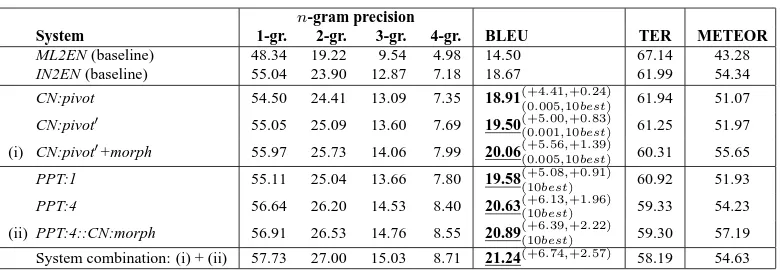
Table 3 shows the results for the isolated
experi-ments. We can see that word-level paraphrasing
improves by up to 5.56 and 1.39 BLEU points over the two baselines (both statistically signifi-cant). Compared to ML2EN, CN:pivot yields an
ab-solute improvement of 4.41 BLEU points, CN:pivot′
adds another 0.59, and CN:pivot′+morph adds 0.56
more. The scores for TER (v. 0.7.25) and METEOR (v. 1.3) are on par with those for BLEU (NIST v. 13). Table 3 further shows that the optimal parameters for the word-level SMT systems (CN:*) involve a very low probability cutoff, and a high number of
n-best sentences. This shows that they are robust to
noise, probably because bad source-side phrases are unlikely to match the test-time input. Note also the effect of repetitions: good word choices are shared
by manyn-best sentences, and thus they would have
n-gram precision
System 1-gr. 2-gr. 3-gr. 4-gr. BLEU TER METEOR ML2EN (baseline) 48.34 19.22 9.54 4.98 14.50 67.14 43.28 IN2EN (baseline) 55.04 23.90 12.87 7.18 18.67 61.99 54.34 CN:pivot 54.50 24.41 13.09 7.35 18.91(+4(0.005.41,,10+0best.24)) 61.94 51.07 CN:pivot′ 55.05 25.09 13.60 7.69 19.50(+5.00,+0.83)
(0.001,10best) 61.25 51.97
(i) CN:pivot′+morph 55.97 25.73 14.06 7.99 20.06(+5.56,+1.39)
(0.005,10best) 60.31 55.65
PPT:1 55.11 25.04 13.66 7.80 19.58(10(+5best.08,)+0.91) 60.92 51.93 PPT:4 56.64 26.20 14.53 8.40 20.63(10(+6best.13,)+1.96) 59.33 54.23 (ii) PPT:4::CN:morph 56.91 26.53 14.76 8.55 20.89(10(+6best.39,)+2.22) 59.30 57.19 System combination: (i) + (ii) 57.73 27.00 15.03 8.71 21.24(+6.74,+2.57) 58.19 54.63
Table 3: Isolated experiments. The subscript shows the best tuning parameters, and the superscript shows the absolute test improvement over the ML2EN and the IN2EN baselines. The last line shows system combination results.
Combining IN2EN with an adapted version of ML2EN
Combination with Simple Concatenation Balanced Concatenation Sophisticated Combination (i) + ML2EN (unadapted; baseline) 18.49 19.79 20.10(.5.5)
+ CN:pivot 19.99(+1(0.001.50),1best) 20.16(0(+0.001.37),10best) 20.32(+0(0.01.22),10best,.5.5) + CN:pivot′ 20.03(+1.54)
(0.05,1best) 20.80 (+1.01)
(0.05,10best) 20.55 (+0.45) (0.05,10best,.5.5)
(ii) + CN:pivot′+morph 20.60(+2.11)
(0.01,10best) 21.15 (+1.36)
(0.01,10best) 21.05 (+0.95) (0.01,5best,00)
+ PPT:1 20.61(+2(1best.12)) 20.71(+0(10best.92)) 20.32(+0(1best,.22)000) + PPT:4 20.75(+2(1best.26)) 21.08(5(+1best.29)) 20.76(+0(10best,..66)5.5.5) (iii) + PPT:4::CN:morph 21.01(+2(1best.52)) 21.31(+1(5best.52)) 20.98(+0(10best,..88)5)
System combination: (i) + (ii) + (iii) 21.55(+3.06) 21.64(+1.85) 21.62(+1.52)
Table 4: Combined experiments: BLEU. The best tuning parameter values are in subscript, and the absolute test improvement over the corresponding baseline (on top of each column) is in superscript.
The gap between ML2EN and IN2EN for unigram precision could be explained by vocabulary differ-ences between Malay and Indonesian. Compared to IN2EN, all CN:* models have higher 2/3/4-gram precision. However, CN:pivot has lower unigram precision, which could be due to bad word
align-ments, as the results for CN:pivot′show.
When morphological variants are further added, the unigram precision improves by almost 1%
ab-solute over CN:pivot′. This shows the importance
of morphology for overcoming the limitations of the small Indonesian vocabulary of the IN2EN bi-text.
The lower part of Table 3 shows that phrase-level paraphrasing performs a bit better. This confirms the importance of modeling context for closely-related languages like Malay and Indonesian, which are rich
in false friends and partial cognates. We further
see that using more scores in the phrase table is better. Extending the Indonesian vocabulary with cross-lingual morphological variants is still helpful, though not as much as at the word-level.
Finally, the combination of the output of
the best PPT and the best CN systems using MEMT (Heafield and Lavie, 2010) yields even fur-ther improvements, which shows that the two kinds of paraphrases are complementary. The best overall BLEU score for our isolated experiments is 21.24, which is better than the results for all five baselines in Table 2, including the three bi-text combination baselines, which only achieve up to 20.10 BLEU.
[image:8.612.113.503.54.189.2]6.3 Combined Experiments
Table 4 shows the performance of the three bi-text combination strategies (see Section 4.3 for ad-ditional details) when applied to combine IN2EN (1) with the original ML2EN and (2) with various adapted versions of it.
Note that while there is a difference of 0.31 BLEU points between the balanced concatenation and the sophisticated combination for the original ML2EN, they differ little for the adapted versions. This is probably due to the sophisticated combination as-suming that the second bi-text is worse than the first one, which is not really the case for the adapted ver-sions: as Table 3 shows, they all outperform IN2EN. Overall, phrase-level paraphrasing performs a bit better than word-level paraphrasing, and system combination with MEMT improves even further. This is consistent with the isolated experiments.
7 Further Analysis
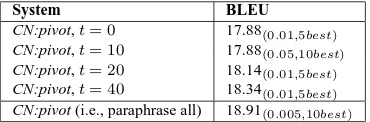
Paraphrasing non-Indonesian words only. In CN:* above, we paraphrased each word in the Malay input, because of false friends like polisi and partial cognates like nanti. This risks proposing worse al-ternatives, e.g., changing beliau (‘he’, respectful) to ia (‘he’, casual), which confusion network weights and LM would not always handle. Thus, we tried paraphrasing non-Indonesian words only, i.e., those not in IN-LM. Since IN-LM occasionally contains some Malay-specific words, we also tried
paraphras-ing words that occur at most ttimes in IN-LM.
Ta-ble 5 shows that this hurts by up to 1 BLEU point fort= 0; 10, and a bit less fort= 20; 40.
System BLEU
CN:pivot,t= 0 17.88(0.01,5best)
CN:pivot,t= 10 17.88(0.05,10best)
CN:pivot,t= 20 18.14(0
.01,5best)
CN:pivot,t= 40 18.34(0
.01,5best)
[image:9.612.319.534.147.212.2]CN:pivot (i.e., paraphrase all) 18.91(0.005,10best)
Table 5: Paraphrasing non-Indonesian words only: those appearing at mostttimes in IN-LM.
Manual evaluation. We asked a native
Indone-sian speaker who does not speak Malay to judge whether our “Indonesian” adaptations are more un-derstandable to him than the original Malay in-put for 100 random sentences. We presented him with two extreme systems: (a) the conservative
CN:pivot,t=0 vs. (b) CN:pivot′+morph. Since the
latter is noisy, the top 3 choices were judged for
it. Table 6 shows that CN:pivot,t=0 is better/equal
to the original 53%/31% of the time. In contrast,
CN:pivot′+morph is typically worse than the
orig-inal; even compared to the best in top 3, the bet-ter:worse ratio is 45%:43%.
Still, this latter model works better, which means that phrase-based SMT systems are robust to noise and prefer more variety. Note also that the judg-ments were at the sentence level, while phrases are sub-sentential, i.e., there can be many good phrases in a “bad” sentence.
System Better Equal Worse CN:pivot,t= 0(
Rank1) 53% 31% 16%
CN:pivot′+morph
(Rank1) 38% 8% 54%
CN:pivot′+morph
(Rank2) 41% 9% 50%
CN:pivot′+morph
(Rank3) 32% 11% 57%
CN:pivot′+morph
[image:9.612.94.279.435.496.2](Ranks:1−3) 45% 12% 43%
Table 6: Human judgments: Malay vs. “Indonesian”. The parameter values are those from Tables 3 and 5.
Reversed Adaptation. In all experiments above,
we were adapting the Malay sentences to look like Indonesian. Here we try to reverse the direction of adaptation, i.e., to adapt Indonesian to Malay: we thus build a “Malay” confusion network for each dev/test Indonesian sentence to be used as an in-put to a Malay–English SMT system trained on the ML2EN dataset. We tried two variations of this idea:
• lattice: Use Indonesian-to-Malay confusion
networks directly as input to the ML2EN SMT system, i.e., tune a log-linear model using con-fusion networks for the source side of the IN2EN-dev dataset, and then evaluate the tuned system using confusion networks for the source side of the IN2EN-test dataset.
• 1-best: Use the 1-best output from the
Indonesian-to-Malay confusion network for each sentence of IN2EN-dev and IN2EN-test. Then pair each 1-best output with the
corre-sponding English sentence. Finally, get an
adapted “Malay”–English development set and an adapted “Malay”–English test set, and use them to tune and evaluate the ML2EN SMT system.
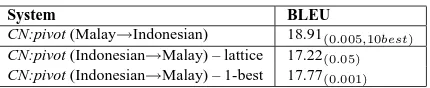
Table 7 shows that both variations perform worse than CN:pivot. We believe this is because lattice en-codes many options, but does not use a Malay LM, while 1-best uses a Malay LM, but has to commit
to 1-best. In contrast, CN:pivot uses both n-best
System BLEU
CN:pivot (Malay→Indonesian) 18.91(0.005,10best)
CN:pivot (Indonesian→Malay) – lattice 17.22(0.05)
[image:10.612.80.295.55.99.2]CN:pivot (Indonesian→Malay) – 1-best 17.77(0.001)
Table 7: Reversed adaptation: Indonesian to Malay.
Adapting Macedonian to Bulgarian. We
ex-perimented with another pair of closely-related
lan-guages,8Macedonian (MK) and Bulgarian (BG),
us-ing data from a different, non-newswire domain: the OPUS corpus of movie subtitles (Tiedemann, 2009). We used datasets of sizes that are comparable to those in the previous experiments: 160K MK2EN and 1.5M BG2EN sentence pairs (1.2M and 11.5M EN words). Since the sentences were short, we used 10K MK2EN sentence pairs for tuning and testing (77K and 72K English words). For the LM, we used 9.2M Macedonian and 433M English words.
Table 8 shows that both CN:* and PPT:* yield statistically significant improvements over balanced concatenation with unadapted BG2EN; system com-bination with MEMT improves even further. This indicates that our approach can work for other pairs of related languages and even for other domains.
We should note though that the improvements here are less sizeable than for Indonesian/Malay. This may be due to our monolingual MK dataset be-ing smaller (10M MK vs. 20M IN words), and too noisy, containing many OCR errors, typos, concate-nated words, and even some Bulgarian text. More-over, Macedonian and Bulgarian are arguably some-what more dissimilar than Malay and Indonesian.
System BLEU TER METEOR
BG2EN (baseline) 24.57 57.64 41.60 MK2EN (baseline) 26.46 54.55 46.15 Balanced concatenation of MK2EN with an adapted BG2EN + BG2EN (unadapted) 27.33 54.61 48.16 + CN:pivot′+morph 27.97(+0.64,+1.51) 54.08 49.65
+ PPT:4::CN:morph 28.38(+1.05,+1.92) 53.35 48.21
Combining last three 29.05(+1.72,+2.59) 52.31 50.96
Table 8: Improving Macedonian–English SMT by
adapting Bulgarian to Macedonian.
8There is a heated political and linguistic debate about
whether Macedonian represents a separate language or is a re-gional literary form of Bulgarian. Since there are no clear cri-teria for distinguishing a dialect from a language, linguists are divided on this issue. Politically, the Macedonian remains un-recognized as a language by Bulgaria and Greece.
8 Conclusion and Future Work
We have presented a novel approach for improving machine translation for a resource-poor language by adapting a bi-text for a related resource-rich lan-guage, using confusion networks, word/phrase-level paraphrasing, and morphological analysis.
We have achieved very significant improvements over several baselines (6.7 BLEU points over an un-adapted version of ML2EN, 2.6 BLEU points over IN2EN, and 1.5–3 BLEU points over three bi-text combinations of ML2EN and IN2EN), thus proving the potential of the idea. We have further demon-strated the applicability of the general approach to other languages and domains.
In future work, we would like to add word dele-tion, inserdele-tion, splitting, and concatenation as al-lowed editing operations. We further want to ex-plore tighter integration of word-based and phrase-based paraphrasing. Finally, we plan experiments with other language pairs and application to other linguistic problems.
Acknowledgments
We would like to give special thanks to Harta Wijaya and Aldrian Obaja Muis, native speakers of Indone-sian, for their help in the linguistic analysis of the input and output of our system. We would also like to thank the anonymous reviewers for their construc-tive comments and suggestions, which have helped us improve the quality of this paper.
This research is supported by the Singapore Na-tional Research Foundation under its InternaNa-tional Research Centre @ Singapore Funding Initiative and administered by the IDM Programme Office.
References
Kemal Altintas and Ilyas Cicekli. 2002. A machine translation system between a pair of closely related languages. In Proceedings of the 17th International
Symposium on Computer and Information Sciences,
ISCIS ’02, pages 192–196.
AiTi Aw, Min Zhang, Juan Xiao, and Jian Su. 2006. A phrase-based statistical model for SMS text normal-ization. In Proceedings of the 21st International
[image:10.612.71.299.504.588.2]Hitham Abo Bakr, Khaled Shaalan, and Ibrahim Ziedan. 2008. A hybrid approach for converting written Egyp-tian colloquial dialect into diacritized Arabic. In
Pro-ceedings of the 6th International Conference on Infor-matics and Systems, INFOS ’08.
Timothy Baldwin and Su’ad Awab. 2006. Open source corpus analysis tools for Malay. In Proceedings of the
5th International Conference on Language Resources and Evaluation, LREC ’06, pages 2212–2215.
Alexandra Birch, Miles Osborne, and Philipp Koehn. 2007. CCG supertags in factored statistical machine translation. In Proceedings of the Second Workshop
on Statistical Machine Translation, WMT ’07, pages
9–16.
Chris Callison-Burch, Philipp Koehn, and Miles Os-borne. 2006. Improved statistical machine transla-tion using paraphrases. In Proceedings of the Human
Language Technology Conference of NAACL,
HLT-NAACL ’06, pages 17–24.
Trevor Cohn and Mirella Lapata. 2007. Machine trans-lation by triangutrans-lation: Making effective use of multi-parallel corpora. In Proceedings of the 45th Annual
Meeting of the Association for Computational Linguis-tics, ACL ’07, pages 728–735.
Michael Collins, Philipp Koehn, and Ivona Kuˇcerov´a. 2005. Clause restructuring for statistical machine translation. In Proceedings of the 43rd Annual
Meet-ing of the Association for Computational LMeet-inguistics,
ACL ’05, pages 531–540.
Jan Hajiˇc, Jan Hric, and Vladislav Kuboˇn. 2000. Ma-chine translation of very close languages. In
Proceed-ings of the Sixth Conference on Applied Natural Lan-guage Processing, ANLP ’00, pages 7–12.
Bo Han and Timothy Baldwin. 2011. Lexical normal-isation of short text messages: Makn sens a #twitter. In Proceedings of the 49th Annual Meeting of the
As-sociation for Computational Linguistics: Human Lan-guage Technologies, ACL-HLT ’11, pages 368–378.
Kenneth Heafield and Alon Lavie. 2010. Combin-ing machine translation output with open source: The Carnegie Mellon multi-engine machine transla-tion scheme. The Prague Bulletin of Mathematical
Linguistics, 93(1):27–36.
Lu´ıs Marujo, Nuno Grazina, Tiago Lu´ıs, Wang Ling, Lu´ısa Coheur, and Isabel Trancoso. 2011. BP2EP -adaptation of Brazilian Portuguese texts to European Portuguese. In Proceedings of the 15th Conference
of the European Association for Machine Translation,
EAMT ’11, pages 129–136.
Preslav Nakov and Hwee Tou Ng. 2009. Improved statis-tical machine translation for resource-poor languages using related resource-rich languages. In Proceedings
of the Conference on Empirical Methods in Natural Language Processing, EMNLP ’09, pages 1358–1367.
Preslav Nakov and Hwee Tou Ng. 2011. Trans-lating from morphologically complex languages: A paraphrase-based approach. In Proceedings of the
49th Annual Meeting of the Association for Compu-tational Linguistics: Human Language Technologies,
ACL-HLT ’11, pages 1298–1307.
Preslav Nakov and Hwee Tou Ng. 2012. Improving statistical machine translation for a resource-poor lan-guage using related resource-rich lanlan-guages. Journal
of Artificial Intelligence Research, 44:179–222.
Preslav Nakov and J ¨org Tiedemann. 2012. Combin-ing word-level and character-level models for machine translation between closely-related languages. In
Pro-ceedings of the 50th Annual Meeting of the Association for Computational Linguistics, ACL-Short ’12.
Kishore Papineni, Salim Roukos, Todd Ward, and Wei-Jing Zhu. 2002. BLEU: a method for automatic eval-uation of machine translation. In Proceedings of the
40th Annual Meeting of the Association for Computa-tional Linguistics, ACL ’02, pages 311–318.
Eric Ristad and Peter Yianilos. 1998. Learning string-edit distance. IEEE Transactions on Pattern Analysis
and Machine Intelligence, 20(5):522–532.
Wael Salloum and Nizar Habash. 2011. Dialectal to Standard Arabic paraphrasing to improve Arabic-English statistical machine translation. In Proc. of the
Workshop on Algorithms and Resources for Modelling of Dialects and Language Varieties, pages 10–21.
Hassan Sawaf. 2010. Arabic dialect handling in hybrid machine translation. In Proceedings of the 9th
Confer-ence of the Association for Machine Translation in the Americas, AMTA ’09.
Kevin P. Scannell. 2006. Machine translation for closely related language pairs. In Proceedings of the LREC
2006 Workshop on Strategies for Developing Machine Translation for Minority Languages.
J¨org Tiedemann. 2009. News from OPUS - a collection of multilingual parallel corpora with tools and inter-faces. In Recent Advances in Natural Language
Pro-cessing, volume V, pages 237–248.
Masao Utiyama and Hitoshi Isahara. 2007. A com-parison of pivot methods for phrase-based statistical machine translation. In Proceedings of the Human
Language Technology Conference of NAACL,
HLT-NAACL ’07, pages 484–491.
Hua Wu and Haifeng Wang. 2009. Revisiting pivot lan-guage approach for machine translation. In
Proceed-ings of the Joint Conference of the 47th Annual Meet-ing of the ACL, ACL ’09, pages 154–162.
Xiaoheng Zhang. 1998. Dialect MT: a case study be-tween Cantonese and Mandarin. In Proceedings of the