Learning Latent Semantic Annotations
for Grounding Natural Language to Structured Data
Guanghui Qin1∗ Jin-Ge Yao2 Xuening Wang3 Jinpeng Wang2 Chin-Yew Lin2 1Peking University, 2Microsoft Research Asia, 3University of California Los Angeles
[email protected], [email protected]
{jinge.yao, jinpwa, cyl}@microsoft.com
Abstract
Previous work on grounded language learn-ing did not fully capture the semantics under-lying the correspondences between structured world state representations and texts, espe-cially those between numerical values and lex-ical terms. In this paper, we attempt at learn-ing explicit latent semantic annotations from paired structured tables and texts, establishing correspondences between various types of val-ues and texts. We model the joint probabil-ity of data fields, texts, phrasal spans, and la-tent annotations with an adapted semi-hidden Markov model, and impose a soft statistical constraint to further improve the performance. As a by-product, we leverage the induced an-notations to extract templates for language generation. Experimental results suggest the feasibility of the setting in this study, as well as the effectiveness of our proposed framework.1
1 Introduction
The meaning of natural language should always
be accompanied by a context. Grounded
lan-guage acquisition aims at learning the meaning
of language in the context of an observed world state. A solution framework typically addresses the following subproblems: segmenting the text into meaningful phrasal units, determining which world state information is being referred to, and finding proper alignments from these units to the events of values in the world state.
The task has attracted much attention from the NLP community with a special focus on align-ing text descriptions onto processed, structured
event records (Snyder and Barzilay, 2007;Liang
et al.,2009;Hajishirzi et al.,2011). Various sta-tistical models have been proposed, attempting at
∗
Contribution during internship at Microsoft Research Asia.
1Our implementation is available at https:
//github.com/hiaoxui/D2T-Grounding.
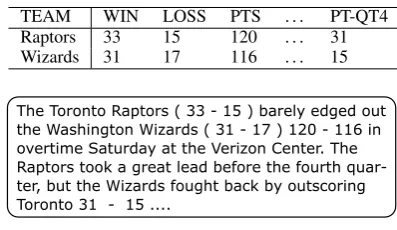
TEAM WIN LOSS PTS . . . PT-QT4
Raptors 33 15 120 . . . 31
Wizards 31 17 116 . . . 15
[image:1.595.314.513.219.334.2]The Toronto Raptors ( 33 - 15 ) barely edged out the Washington Wizards ( 31 - 17 ) 120 - 116 in overtime Saturday at the Verizon Center. The Raptors took a great lead before the fourth quar-ter, but the Wizards fought back by outscoring Toronto 31 - 15 ....
Figure 1: An example of the summary and the corre-sponding table.
characterizing the interaction between text spans
and categorical values (e.g., direction=‘East’) or
strings (e.g., person names). The previously
ad-dressed term semantic correspondencesnarrowly
describes the process of aligning natural language spans to different data fields.
However, there still exists a gap between align-ment results and the underlying semantics. People tend to use various phrases to describe information that are inferred from different amounts of numer-ical values in a data field, or values derived from additional operations over fields. Consider the ex-ample description for a basketball game shown in
Figure 1. The phrase edged out in the first
sen-tence implies the fact thatthe Toronto Raptorshad beaten their opponent by a relatively narrow mar-gin. This could only be derived from an operation of subtraction between two scores that correspond to the fieldPTSfor both teams in the event table, which leads to a relatively small difference of only four points. Previous efforts on learning
seman-tic correspondences relying oncategorical
distri-butions (Liang et al.,2009) orstring pattern
fea-tures (Hajishirzi et al., 2012; Koncel-Kedziorski
et al., 2014) do not have the capability to
accu-rately capture numerical information, especially
Such kind of language grounding is important both for natural language understanding and for
natural language generation. For language
un-derstanding, establishing explicit connections be-tween symbols and values beyond ungrounded symbolic meaning representations will be useful for acquisition and inference of numerical
com-monsense (Narisawa et al., 2013). For language
generation, properly aligned information is the key to acquiring patterns of various lexical choices un-der different world states (Roy and Reiter,2005).
In this work, we make a step towards more explicit semantic correspondences between struc-tured data and texts. Rather than only produc-ing coarse alignments between data fields and text spans, we try to detect the latent semantics under-lying these alignments by prompting explicit se-mantic annotations. We make the first attempt at utilizing publicly available datasets originally pre-pared for data-to-text language generation to pro-duce such annotations for words and phrases in natural language without additional supervision.
Specifically, we conduct our study on a recently released dataset of descriptions for NBA basket-ball games with structured tables of game records. Different from a few popular datasets that have been well conjectured to be produced from rules (Reiter, 2017), the summaries are all written by
humans. The text contains some numbers and
proper nouns, which are easier to establish corre-spondence with data. However, the majority of texts contain many informative words, some of which need to be inferred indirectly from various types of values in the data cells. We want to estab-lish explicit correspondences for them.
We derive a set of semantic labels from
orig-inal data fields (Sec 4.1). These labels could be
executed to establish direct correspondences to one or more values in the structured table. No annotation on the original dataset means unsu-pervised learning from weak distant supervision should be conducted. We design a semi-hidden
Markov model to address this problem (Sec4.2),
which could align a semantic label to a word span. In the model, we leverage continuous probabil-ity distributions to model the correspondences be-tween numerical values and lexical terms, which has not been well captured in previous work. To address the emerged issue of “garbage collection” that commonly appears in statistical alignment
models (Sec 4.5), we add a soft statistical
con-straint via posterior regularization (Ganchev et al.,
2010). As a by-product, we also show how the
derived semantic annotations could be used to in-duce descriptive templates for data-to-text genera-tion (Sec5). Experimental results (Sec6) suggest the feasibility of the setting in this study, and show the effectiveness of our proposed framework.
2 Related work
Grounded language acquisition has aroused wide interest in various disciplines (Siskind, 1996;Yu and Ballard, 2004; Gorniak and Roy, 2007; Yu and Siskind, 2013;Chrupała et al.,2015). Later work in the community of natural language pro-cessing also moved in this direction by relax-ing the amount of supervision to enable a model
to learn from ambiguous alignments (Kate and
Mooney, 2007;Chen and Mooney, 2008). Some research aimed at establishing coarse alignments between simulated robot soccer game records and
commentary sentences (Chen and Mooney,2008;
Chen et al., 2010;Bordes et al., 2010;Hajishirzi et al.,2011). For weather forecast domain,Liang et al. (2009) used a hierarchical hidden Markov model in order to map utterances to world states, which coped with segmentation and alignment
to-gether. More recently, Koncel-Kedziorski et al.
(2014) tried to obtain the correspondences
be-tween real commentaries and structured football (soccer) events in multiple resolutions. We are distinct from this line of work in the fact that we aim at producing explicit semantic annotations that could capture information from structured ta-bles. To achieve this goal, we need additional scal-ing or operations to enable data fields and values to be faithfully mapped onto texts. This will address the issue of the lack of consideration for the rela-tionship between lexical terms and numerical val-ues. Our approach makes a significant difference in that our framework could generalize to numeri-cal values or value combinations that are unseen in training, and will not be simply reciting cooccur-rence patterns of exact values in the training data.
Our work relates to learning executable
se-mantic parsers under weak supervision. Early
semantic parsing started from fully supervised training with annotated meaning representations available (Zettlemoyer and Collins,2005;Ge and Mooney, 2006; Snyder and Barzilay, 2007), but more recent work focused on reducing the amount
2013). The intuition behind weakly supervised executable semantic parsing is that once the la-tent semantic representation has been executed, one could test whether the execution results could match the information with available weak super-vision signals such as answers to natural language queries (Clarke et al., 2010;Liang et al., 2011), or task completion from instructional navigations (Misra et al.,2017). Such formulations have been adapted for question answering over structured
tables (Pasupat and Liang, 2015;Krishnamurthy
et al., 2017). However, the current research fo-cus is to convert a natural language question into executable table queries and to directly retrieve re-sults. They do not have the need of inference in-volving numerical commonsense implied by
var-ious lexical patterns. A few unsupervised
ap-proaches exist (Poon and Domingos,2009;Poon,
2013) but only specific to translating language into queries in the highly structured database and can-not be applied to our domain.
Our approach is implemented as assigning tag annotations over text spans, which is conceptu-ally related to fine-grained named entity tagging (Ling and Weld,2012). Our setting only requires a rather weak and distant form of supervision from paired tables and texts without annotations for fine-grained alignments between phrases and data cells. Similar modeling and learning strate-gies could potentially be useful for considerably large tag space derived from structured knowledge bases in the future (Choi et al.,2018).
The feasibility of this work is partly due to the availability of data, mostly comes from the field of data-to-text language generation. Related work in data-to-text generation mainly focused on directly generating summary descriptions for structured data (Mei et al., 2016; Kiddon et al., 2016; Mu-rakami et al.,2017;Wiseman et al., 2017), with-out establishing underlying semantic correspon-dences. Texts generated thereby can be fluent but not conforming to the input data, unlike template-based approaches where lexical choices could be
directly controlled. In our work, we find the
derived semantic correspondences between data and texts to be useful for template induction, ei-ther with simple heuristics to automatically ex-tract description patterns (how to say) and corre-sponding triggers (what & when to say), or with more crafted discriminative learning approaches (cf.Angeli et al.(2010)).
3 Technical overview
Task LetS be the set of all world states,W be
the set of all texts,O be the set of all executable
operators, and V be the output space of O. A
world state s ∈ S is a table storing some
infor-mation, or more specifically in this work, a tabular
recording for a sports game. An operatoro ∈ O
can be executed on a world state to retrieve
val-ues, i.e., eachocould be treated as a mapping of
S → V. The result of an operation can be a string,
a continuous values or a discrete value.
Mean-while, each world states is accompanied with a
piece of description w ∈ W. Here w consists
of a sequence of word tokens{wi ∈ w}. We
fur-ther define a segmentation variableπ, which could
convertwinto a sequence of word spans c,
con-taining each span of tokens ct ∈ c that could be
interpreted as a phrase. Note that we use super-scripttto denote indices of phrases, and subscript ito denote indices of individual words. We further definelas a sequence of latent labels, and value of
eachlt is an operator oi ∈ O. 2 For each world
statesand corresponding descriptionw, we want
to jointly find a proper segmentationπto obtainc, and assign labels to every word spanct.
We conduct this study on the ROTOWIRE
sub-set of the openly available datasub-set released by
Wiseman et al. (2017), containing text descrip-tions for NBA basketball games with structured
tables of game statistics. Take Figure1 as an
ex-ample. The proper nouns (e.g. Toronto Raptors)
appeared in the sentence can be assigned with a tagTeam Name in our tag set, which could then
be aligned to the Team Name field in the table.
Some numbers appearing in the text, such as 15
in the example, can be assigned with the label Team Losses, with the executable annotation to extract the number of previously lost matches of the mentioned team. What we are more interested
in is where the phraseedge out comes from. We
are aiming at a model which is capable to capture
the semantics behind the phrase edge out, which
is used to describe an event that one team has
beaten the other with close scores. In our
an-notation scheme, this phrase should be assigned
with the tagTeam Points Delta, and
execut-ing that will return the score difference between two teams.
The task is challenging in that there does not
2We will interchangeably use
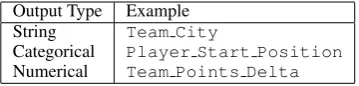
Output Type Example
String Team City
Categorical Player Start Position
[image:4.595.92.272.62.105.2]Numerical Team Points Delta
Table 1: Examples from the derived tag set, where each tag could correspond to one of three types of values.
exist any other additional supervision signal. The learning process will mostly rely on statistical cooccurrences of information between the struc-tured data and its text descriptions. Note that we assume a consistent structure (schema) throughout the whole dataset upon which the learning process will be performed.
Model To jointly learn word segmentations c
and latent semantic annotations l between world
statesand textwin a unified framework, we
pro-pose a generative model to characterize the joint distributionPs(l, π,w;θ), parameterized byθ.
Learning The data contain paired texts and
ta-bles only, thus our model must learn segmenta-tions and latent semantic annotasegmenta-tions in an unsu-pervised fashion. The target is to maximize the complete data likelihood
L(θ) = Y
(s,w)∈ D X
l,π
Ps(l, π,w;θ),
where D represents the whole training data. To
reduce the search space in inference and to cap-ture some patterns of content planning in the text descriptions, we adopt a Markov assump-tion over phrase segments, which leads to a
hid-den semi-Markov model (semi-HMM) (Murphy,
2002;Sarawagi and Cohen,2005). The key part is to characterize different types of correspondences
(Sec4.2). We derive an expectation-maximization
(EM) algorithm to perform maximum likelihood estimation, and introduce a soft statistical regular-ization to guide the model towards a better solu-tion (Sec4.5).
Inference Once the model has been trained, we
use a Viterbi-like dynamic programming process to perform MAP inference to segment the texts and to assign the most likely tags for each span.
4 Framework
4.1 The set of annotations
We describe the process of how we derived our set of semantic annotations here. There are two kinds of specific tables for each NBA game in the
dataset: Box-ScoresandLine-Scores, respectively
showing the performance statistics for individual players and the whole teams. The types of pos-sible values for data fields are strings, categorical
values and numerical values. Box-Scoreconsists
of 24 fields, of which four are string-values, one is categorical, the other 19 being numerical.
Line-Scoreconsists of 16 fields, containing two
string-valued, one categorical, and 13 numerical fields. A semantic tag works on a specified kind of field type, from either team statistics or player statis-tics. For a tag that could align to one single field in the table, we let it return the exact value in the cell that could maximize the likelihood. For
ex-ample, the tagTeam Cityis used to extract the
name of the team in the table that corresponds to the current word span. For fields taking numeri-cal values, we additionally allow tags to be able to perform mathematical operations, such as
sub-traction, between two values in the same field. 3
For example, the tagTeam Points Deltacan
be executed to return the score difference between two teams. We list the different types of tags with
examples shown in Table1and leave the entire tag
set to Appendix A. Along with all these tags de-rived from the original data fields, we also include
a specialNULL tag which are supposed to be
as-signed to non-informative words or words contain-ing information not contained in the given table.
Note that we impose little prior knowledge in this step. We simply over-generate all possible la-bels, and let the model figure out which part of
them should be eventually used. Although the
only compositional operation we used in this work is numeric subtraction, common operations that could produce string, categorical values or num-bers could be easily introduced for other domains.
4.2 Semi-HMMs with continuous values
As previously mentioned, we will be modeling the
joint distribution of word segmentationc and the
latent semantic annotationslbetween paired world
statesand textw, which could be factorized as:
Ps(l, π,w) =Ps(w, π|l)·Ps(l),
and we write Ps(w, π|l) as Ps(c|l). In this
sec-tion, we focus on the probability of the alignments between word spans and labels, namely,Ps(c|l).
FollowingLiang et al.(2009), we consider two aspects. One issaliencethat captures the intuition
3We limit the number of arguments within two in this
that some fields should be more frequently men-tioned than others (henceforth some latent tags should be more frequently triggered). The other
is (local) coherence, which refers to the order in
which the writer mentioning certain information tends to follow some patterns. To capture these two phenomena, we define a Markov model:
Ps(c,l) =
Y
t
P(lt|lt−1)·P
s(ct|lt),
whereltis the annotated label at time stampt, and we assume that the transition probabilities are in-dependent of world states. It resembles a standard form of HMMs, despite the subscriptsinPs(c|l).
For different types of correspondences betweenlt
andct, we define different probability distributions
to modelPs(ct|lt):
(1) Numerics-to-numerics: The numbers
in texts could sometimes be inaccurate
due to some rounding customs, thus
we use a Gaussian model for this type:
Sof tIndicator(x, y|σ) = N(x − y|0, σ),
where N is the Gaussian density. When
the output type of tag lt is numeric and
the word span ct is a number, we set
Ps(c|l) = Sof tIndicator(c, vl|σl), where
σl is different for different tags, andvl is the
corresponded value in the table for tagl. Note
that whenσ → 0,Sof tIndicatorreduces to
an indicator function that only allows exact matching.
(2) String-to-string: Similarly for strings, since
simple matching could fail if the text
con-tains Bob to refer to Bob Smith. We simply
use string matching to model the probability:
Ps(c|l) ∝ M atch(vl, c), where the M atch
function returns the number of shared words between cell valuevland wordc.
(3) Category-to-string: For labels correspond to
discrete categorical values, such asSunday,
PG (point guard, a basketball position), we
adopt the same method used by Liang et al.
(2009): using a multinomial distribution over all word spans for each possible category:
Ps(c|l) =νc,vl,
X
c
νc,v = 1, (1)
wherevlis again the output value of tagl.
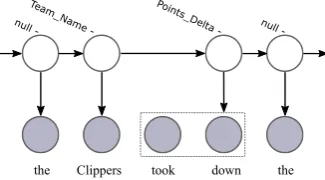
the Clippers took down the
Team_Name - Points_ Delt
a - null null
-Figure 2: A Semi-HMM that can yield an entire phrase from one tag.
(4) Numerics-to-string: When the tag
corre-spond to a numeric value vl while the word
spancis not a number, the problem resembles
speech modeling (Huang et al.,1990). Apply-ing the Bayes rule, we get:4
Ps(c|l) =P(c|l, vl)∝P(vl|c, l)·P(c|l),
where we collapse the relevant part from
world state s into vl. The intuition
be-hind P(vl|c, l) is that when an
informa-tive word (e.g. routed) appears in the
text, the corresponding values should have different chances to happen in the world,
e.g. P(30|routed,Points Delta) >
P(3|routed,Points Delta).
Due to the lack of prior knowledge on the dis-tribution, we also model this term as Gaussian.
5 The result resembles a Gaussian mixture:
Ps(c|l)∝ N(vl;µc,l, σc,l)·ηc,l,
X
c
ηc,l= 1,
whereP(c|l) =ηc,lis also multinomial.
4.3 Modeling phrasal spans
Our model can enable phrase segmentation. Pre-viously, Liang et al.(2009) treated the words in-side a phrase individually and independently. This could be problematic in our scenario. For
exam-ple,take downis used to describe a team defeating
another, while separately bothtake anddownare
frequent words in general, making them difficult to be jointly assigned with the correct label as a whole. Instead, in our model we treat the phrasal
4We noticed that in parallel with our work, another study
(Zhang et al., 2018) on verb selection for data-to-text gen-eration also use the same strategy of Bayes rule to estimate parameters, and provide a noisy-channel interpretation.
5The double tails in Gaussian pdf have different
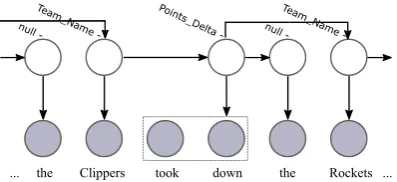
[image:5.595.335.498.63.153.2]Team_Name
... the Clippers took down the Rockets ... Points_
Delt a -
null - null
Team_Name
-Figure 3: A slightly different Semi-HMM whose tran-sition score is calculated by skippingNULLfields.
word span as a unit. The probability is assigned to the whole span of phrase instead of individual words, which will break the token-wise Markov
property (Fig.2, henceforth Semi-HMM). For
effi-cient parameter estimation, We use a variant of the standard forward-backward algorithm by adding
a parameter k, which is the maximum length of
word spans, onto the Markov chain. We leave de-tailed descriptions to Appendix B.
4.4 Skipping null labels
Preliminary experiments suggest that the initial
model have too many words assigned to theNULL
tag. Informative alignments may not be
adja-cent, which breaks the simplest Markov assump-tions. In our model, the transition score of two
non-NULL labels can be calculated by skipping
all theNULLs in between, as shown in Figure3.
This is implemented without breaking the over-all Markov property with the following trick used
in earlier work on statistical alignments (Brown
et al., 1993): Suppose we have m labels (i.e., m
latent states), we can designmdifferentNULL
la-bels that share the same emission score, while pre-serving their original outward-transition
probabil-ities. The types ofNULLlabels are inherited from
the previous label. This might seem to be waste-ful at first sight as we use two-fold latent states, but the Markov property is successfully preserved, therefore simplifying our implementation.
4.5 Posterior regularization
The structured tables and text descriptions of the dataset were originally crawled from different sources. As a consequence, a non-negligible pro-portion of texts is in fact describing information outside the given table, such as historical records (e.g.,“win streak”). Ideally, words in these parts of the text should remain unaligned, or in our
set-ting, be annotated with theNULL tag. However,
due to the notorious effect of garbage collection
from statistical alignment (Brown et al., 1993), these words tend to be aligned to some irrelevant fields in the table which are rarely mentioned.
We address this issue by adding a soft statisti-cal constraint in the form of posterior regulariza-tion (Ganchev et al., 2010; Grac¸a et al., 2010). With posterior regularization, we could add cer-tain types of statistical constraints to the E-step in the EM procedure, while keeping the inference tractable. The constraints should be in the form of:
E[f(w,l)] =X
i
E[f(w, li)]≤bw, (2)
where the features f should be defined on local
cliques for tractable inference.
We use projected gradient descent to solve the E-step sub-problem in this work. The statistical constraint we add to the posterior is rather simple: For each sentence, we “encourage” at least a
pro-portion of words to be aligned toNULLlabels:
E[−f(w,l)]≤ −r0·n, (3)
f(w,l) =
n
X
i=1
1(li=NULL), (4)
where r0 is a adjustable ratio, nis the length of
w. We also tried other constraints but found this
simple soft regularization performing well.
5 By-product: template induction
Intuitively, the assigned semantic correspondences could be useful to derive templates and trigger rules for language generation. In this work, we use the most straightforward heuristics to perform template induction, utilizing the established
cor-respondences and inferred parameters.
Specifi-cally, we first blank out the correspondences of numerics-to-numerics and string-to-string to be empty slots and replace with the tag names. In
the example of Figure1, we could replaceRaptors
withTeam Name, and 120 withTeam Points,
if they have been correctly aligned.
We also need to know when to use each tem-plate. We define atemplate triggerto be a
quadru-ple(c, l, µc,l, σc,l), where cis a phrase,lis a tag,
µc,l and σc,l are estimated Gaussian parameters.
6 We assign each template with a score to be the
minimum probability for all triggers inside:
score(s,t) = min
i N(ti.l(s);ti.µ, ti.σ), (5)
6To use a unified notation, for categorical-value triggers
[image:6.595.83.282.61.152.2]where t = {ti} denotes all possible triggers in
the template, and the tag l can be executed over
the world statesto retrieve a valuel(s). We only consider sentences satisfying both of the following conditions in order to extract templates with high
quality: (1) sentences aligned to≤two teams or
one player, and (2) sentences with triggers derived from continuous distributions.
Now that the templates and triggers are ready for use, we will experiment with the following straightforward rules to perform data-to-text gen-eration: For every game, we first generate a sen-tence describing the scoreline result, followed by three sentences describing other information about team performance. While keeping that no tem-plate is repeatedly used, we will then choose the template with the highest score for top ten players sorted by their game points.
6 Experiments
6.1 Experimental setup
We conducted experiments on the ROTOWIRE
sub-set of the Wiseman et al.(2017) dataset. In our
experiment, we restricted the maximum length of word span to two as a trade-off of speed and per-formance. Empirically, most of the phrases in the dataset are at a length of at most two. We empiri-cally set the expectedNULLratio to ber0 = 0.5.
We did the following pre-processing steps for all systems in comparison: we lemmatized all to-kens in the sentences, and filtered out sentences containing less than five words since they are meaningless short sentences. To utilize the game dates, we converted them from calendar date to the
day of week, e.g. 11/28/2016 is converted to
Mon-dayas a categorical value. Due to the huge noise
in the ROTOWIRE dataset, containing many
sen-tences irrelevant with their corresponding tables, we filtered out the sentences that contain no team or player names, or those that mention more than 2 players, as most of them are irrelevant texts.
FollowingLiang et al.(2009), we also used the parameters of a simpler model without Markov de-pendency (which was uniformly initialized) to ini-tialize our complete model with obtained param-eters, and then trained it until convergence. We adaptedLiang et al.(2009)’s framework to the
ta-ble schema in the ROTOWIREdataset, and ran
ex-periments accordingly as our baseline model.
6.2 Evaluation
6.2.1 Intrinsic evaluation
It is difficult to evaluate the accuracy of tag as-signments for the entire dataset, since the tags are not annotated in the original data. We recruited three human annotators with familiarity in the do-main of basketball games to label 300 sentences (around 8,000 tokens in total, and 30% of them are annotated with tags) from the test set. There exists a fraction (18%) where agreements were not made, we included all the proposed tags from the annotators to be correct. Also, because of the ambiguity of annotations, we use the base names
of derived tags (e.g. Rebounds Delta) for
numerics-to-string relationship evaluation. (e.g.
Rebounds Delta is reduced to Rebounds)
Finally, we calculated the precision and recall for
non-NULLtag assignments at word-level.
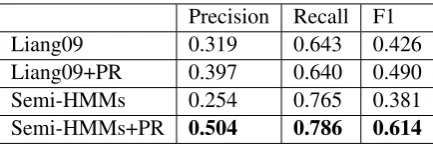
Precision Recall F1
Liang09 0.319 0.643 0.426
Liang09+PR 0.397 0.640 0.490
Semi-HMMs 0.254 0.765 0.381
Semi-HMMs+PR 0.504 0.786 0.614
Table 2: Word-level tag assignment results.
Correspondence type Proportion Accuracy
numerics-to-numerics 0.369 0.950
numerics-to-string 0.283 0.402
string-to-string 0.252 0.892
[image:7.595.308.525.322.395.2]category-to-string 0.095 0.936
Table 3: The performance of Semi-HMMs+PR for dif-ferent types of correspondences.
The results are shown in Table 2. The Liang
et al.(2009) framework could still achieve around 65% recall, because there exist a large proportion of correspondences that could be easily captured by exact matches and simple categorical distribu-tions. Our model without PR achieves lower pre-cision than the baseline, because the baseline did not model numerics-to-string relationships and en-countered less severe issues of garbage collection. We can observe that our initial model indeed out-performs the baseline system in recall, while PR helps a lot to avoid distraction from irrelevant
in-formation that should be tagged asNULL.
We also include more fine-grained results for different types of correspondences, shown in
correspon-The Boston Celtics ( 7 - 5 ) blew out the Brooklyn Nets ( 2 - 11 ) 120 - 95 on Friday .
null
-Team_Name - Points_
Delt
a - null - null
-Team_P
oints null null
-Team_Wins - Team_Name
-null - null
null -Team_Ci ty -Team_Loss es null -Team_Ci
ty - null
-Team_Wins -Team_Loss
es
-Team_P
oints - Date
-(a)
Hessan Whiteside led the charge of Miami with 23 points on super efficient 10 - of - 11 shooting , ...
Pla yer_Na
me -Pla
yer_P
oints - null - * Bloc
k - null
-Team_Ci ty - null
-Pla yer_P
oints - null -FG_P
ecent
FG_Made
null null null -FG_A ttempt null -FG_P ecent -(b)
Burke added 18 points , including a perfect 8 - of - 8 from the charity stripe , in 22 minutes ...
null -Pla
yer_Na
me - Minute
-Pla yer_P oints -Pla yer_P oints -FT_P ercent -* Assi st -FT_A
ttempt - FT_M
ade - Minute -null - null
-FT_M
ade -null -null -null - null - null - null - null null
-(c)
Burke added 18 points , including a perfect 8 - of - 8 from the charity stripe , in 22 minutes ...
* FG_Ma de -* R ebound -Pla yer_Na me -* FG3_A
ttempt - Minute
-Pla yer_P
oints -Pla
yer_P
oints - * Assi
st -* FG3_A
ttempt -FT_Percent
-* F T_A ttempt -* FG_A ttempt -* Assi st -* FG_A ttempt -FT_A ttempt -* R
ebound - FT_M
ade
-* FG3_A
ttempt -* FG3_A
ttempt - Minute
[image:8.595.74.535.61.338.2]-(d)
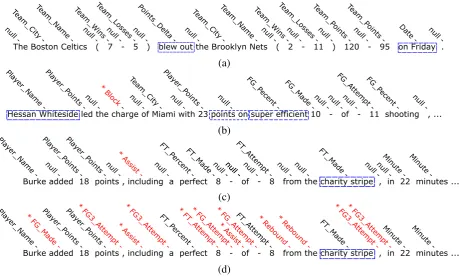
Figure 4: Example of latent tag assignment. Words in blue dashed boxes are phrases recognized by our model. The labels red with asterisks (*) are false assignments. (a), (b), (c) are example of Semi-HMMs-PR, while (d) is produced from the initial Semi-HMMs.
dences are the most difficult part in this study. Another notable thing is that although we found that around 40% of numerics-to-numerics corre-spondences were ambiguous due to the appear-ance of identical values from different table cells, our model could still achieve a high accuracy of 95.0%.
6.2.2 Extrinsic evaluation
We also tested how the derived templates could perform in language generation, when compared with the baseline using the same heuristics
de-scribed in Sec5. We report automatic metrics
in-cluding BLEU scores and those based on relation
extraction as proposed byWiseman et al.(2017):
precision & number of unique relations in genera-tion (RG), precision & recall for content selecgenera-tion (CS), and content ordering (CO) score. These au-tomatic metrics were designed for various aspects in NLG and may not all suit our main focus well, so we also conducted human evaluation on infor-mation correctness (1-5 scale ratings, the higher the better). We asked four human raters who are fluent in English and with familiarity in basketball terms to rate over outputs for 30 random games.
Results are shown in Table4. We can observe that
templates derived from our model indeed
outper-form those from the baseline.
We put some inducted templates and generated text examples in the Appendix.
6.3 Analysis
Figure4shows some examples produced from our
methods. Some of the alignments are
meaning-ful, for example, the model assigned the word
per-fectwith the annotationFT Percent, which
rep-resents the percentage of free throws. Without PR, our model performed poorly by aligning many common words to those rarely mentioned cells.
In this example, theFT MadeandFT Attempt
fields in the input table both have the same value 8, making it difficult for a model without proper local coherence modeling to distinguish between them. Because our initial model without PR
can-not ancan-notate NULL correctly, the Markov
transi-tion between these two numbers was intercepted by three meaningless tokens. However, after in-jecting the PR constraint, most of the unmentioned words were successfully identified. The model
captured the pattern thatFT Attemptalmost
al-ways follows FT Made, making it correctly
as-signed these two labels.
Model RG(P%) RG(#) CS(P%) CS(R%) CO BLEU Correctness
Liang09+PR 85.83 33.29 14.33 31.09 6.25 8.34 2.60
Semi-HMMs+PR 90.47 41.79 21.63 50.17 9.63 9.45 3.58
[image:9.595.93.508.63.122.2]Gold-standard 91.77 12.84 100 100 100 100 4.88
Table 4: Results for data-to-text generation (Kendall’s W=0.83 from correctness raters)
of the components (Table 5). When setting the
maximum phrase length to bek = 1, the model
degenerates to a normal HMM. The performance measured by F1-score drops for only a little. One possible reason is that Semi-HMMs tend to out-put some meaningless combinations of words as
phrases, such as the phrase points on in
Fig-ure 4 (b), which could lead to many redundant
annotations that hampers precision albeit its help to recall. We also tried to disable the transition probabilities during both training and inference, which led to lower precision and lower recall natu-rally as there was no modeling for local coherence. Finally, by canceling the NULL-skipping mecha-nism, we found that the numerics-to-numerics an-notation accuracy dropped from 95.0% to 88.8%. Many of the spurious numerics-to-numerics anno-tations, such as the8 - of - 8in Figure4(d), could be corrected using transition probabilities under
the skipping-NULL mechanism (Figure4(c)).
Precision Recall F1
Semi-HMMs+PR 0.504 0.786 0.614
HMM+PR 0.545 0.694 0.610
No transition 0.468 0.633 0.538
[image:9.595.317.519.158.271.2]No skip 0.454 0.737 0.562
Table 5: Ablation results.
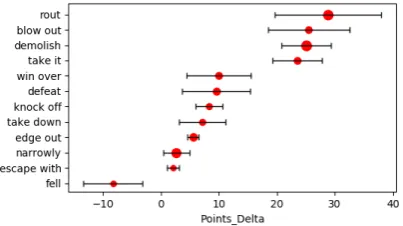
One additional advantage of our model is that we can easily verify what the model has captured.
For the latent annotationTeam Points Delta,
we sort its corresponding phrases by weightsPP((cc|l)) and we list the top 12 weighted words in
Fig-ure5. We can observe that most of the displayed
phrases have strong semantic relationship with score differences. More interestingly, we found the mean and variance values estimated by the Gaussian distributions rather informative. When
l = Teams Points Delta, we observed that
µl,narrowly ≈ 2 while µl,blow out ≈ 26. We could
infer the conditions under which some phrases should be used, providing useful insights for lexi-cal choices in language generation.
Figure 5: Mean±std for the top 12 weighted phrases
assigned with Team Points Delta. (circle sizes
are proportional to weights)
7 Conclusion
In this paper, we attempt to learn executable la-tent semantic annotations from paired structured tables and texts. We model the joint probability of data fields, texts, phrasal spans, and latent annota-tions with an adapted semi-hidden Markov model and impose a soft statistical constraint via poste-rior regularization. Experimental results suggest the feasibility of the setting in study and the effec-tiveness of our framework.
This is a preliminary study for using weak su-pervision from structured data and texts to address the challenging problem of language grounding. For future study, one could collect large-scale data and texts in other domains where more complex grounding on phrases such as “increasing trends” should be done. To enhance modeling power, un-supervised discriminative models that utilize rich features (Berg-kirkpatrick et al.,2010) could also be explored. We are also interested in collecting more high-quality parallel data to induce grounded compositional logic representations.
Acknowledgements
[image:9.595.72.291.451.525.2]References
G. Angeli, P. Liang, and D. Klein. 2010. A
Sim-ple Domain-Independent Probabilistic Approach to
Generation. InEmpirical Methods in Natural
Lan-guage Processing (EMNLP).
Y. Artzi and L. S. Zettlemoyer. 2013. Weakly Super-vised Learning of Semantic Parsers for Mapping In-structions to Actions. Transactions of the Associa-tion for ComputaAssocia-tional Linguistics (TACL).
T. Berg-kirkpatrick, A. Bouchard-Cˆot´e, J. DeNero, and D. Klein. 2010. Painless unsupervised learning with
features. InNorth American Association for
Com-putational Linguistics (NAACL).
A. Bordes, N. Usunier, and J. Weston. 2010. Label Ranking under Ambiguous Supervision for
Learn-ing Semantic Correspondences. In International
Conference on Machine Learning (ICML).
P. F. Brown, S. A. D. Pietra, V. J. D. Pietra, and R. L. Mercer. 1993. The mathematics of statistical
ma-chine translation: Parameter estimation.
Computa-tional Linguistics.
D. L. Chen, J. Kim, and R. J. Mooney. 2010. Training a multilingual sportscaster: Using perceptual context to learn language. Journal of Artificial Intelligence Research (JAIR).
D. L. Chen and R. J. Mooney. 2008. Learning to
sportscast: a test of grounded language acquisition. In International Conference on Machine Learning (ICML).
E. Choi, O. Levy, Y. Choi, and L. Zettlemoyer. 2018. Ultra-fine entity typing. InAssociation for Compu-tational Linguistics (ACL).
G. Chrupała, ´A. K´ad´ar, and A. Alishahi. 2015.
Learn-ing language through pictures. In Association for
Computational Linguistics (ACL).
J. Clarke, D. Goldwasser, M. Chang, and D. Roth. 2010. Driving Semantic Parsing from the World’s
Response. In Computational Natural Language
Learning (CoNLL).
K. Ganchev, J. V. Grac¸a, J. Gillenwater, and B. Taskar. 2010. Posterior Regularization for Structured Latent
Variable Models. Journal of Machine Learning
Re-search (JMLR).
R. Ge and R. J. Mooney. 2006. Discriminative rerank-ing for semantic parsrerank-ing. InAssociation for Compu-tational Linguistics (ACL).
P. Gorniak and D. Roy. 2007. Situated language under-standing as filtering perceived affordances. Cogni-tive Science.
J. V. Grac¸a, K. Ganchev, and B. Taskar. 2010. Learn-ing Tractable Word Alignment Models with Com-plex Constraints. Computational Linguistics.
H. Hajishirzi, J. Hockenmaier, Erik T. Mueller, and E. Amir. 2011. Reasoning about RoboCup Soccer Narratives. InUncertainty in Artificial Intelligence (UAI).
H. Hajishirzi, M. Rastegari, A. Farhadi, and J.
Hod-gins. 2012. Semantic Understanding of
Proefes-sional Soccer Commentaries. InUncertainty in
Ar-tificial Intelligence (UAI).
X. D. Huang, Y. Ariki, and M. A. Jack. 1990. Hidden
Markov Models for Speech Recognition. Edinburgh University Press.
R. J. Kate and R. J. Mooney. 2007. Learning language
semantics from ambiguous supervision. In
Associ-ation for the Advancement of Artificial Intelligence (AAAI).
C. Kiddon, L. Zettlemoyer, and Y. Choi. 2016. Glob-ally Coherent Text Generation with Neural Checklist
Models. InEmpirical Methods in Natural Language
Processing (EMNLP).
R. Koncel-Kedziorski, H. Hajishirzi, and A. Farhadi. 2014. Multi-Resolution Language Grounding with
Weak Supervision. InEmpirical Methods in Natural
Language Processing (EMNLP).
J. Krishnamurthy, P. Dasigi, and M. Gardner. 2017. Neural Semantic Parsing with Type Constraints for
Semi-Structured Tables. In Empirical Methods in
Natural Language Processing (EMNLP).
P. Liang, M. I. Jordan, and D. Klein. 2009. Learn-ing Semantic Correspondences with Less Supervi-sion. InAssociation for Computational Linguistics and International Joint Conference on Natural Lan-guage Processing (ACL-IJCNLP).
P. Liang, M. I. Jordan, and D. Klein. 2011. Learning
Dependency-Based Compositional Semantics. In
Association for Computational Linguistics (ACL).
X. Ling and D. S. Weld. 2012. Fine-Grained Entity
Recognition. In AAAI Conference on Artificial
In-telligence (AAAI).
H. Mei, M. Bansal, and M. R. Walter. 2016. What to talk about and how? Selective Generation
us-ing LSTMs with Coarse-to-Fine Alignment. In
North American Association for Computational Lin-guistics and Human Language Technology (NAACL-HLT).
D. Misra, J. Langford, and Y. Artzi. 2017. Mapping Instructions and Visual Observations to Actions with
Reinforcement Learning. In Empirical Methods in
Natural Language Processing (EMNLP).
S. Murakami, A. Watanabe, A. Miyazawa,
K. Goshima, T. Yanase, H. Takamura, and
Y. Miyao. 2017. Learning to Generate Market
Comments from Stock Prices. In Association for
K. P. Murphy. 2002. Hidden Semi-Markov Models (HSMMs).
K. Narisawa, Y. Watanabe, J. Mizuno, N. Okazaki, and
K. Inui. 2013. Is a 204 cm Man Tall or Small?
Acquisition of Numerical Common Sense from the
Web. InAssociation for Computational Linguistics
(ACL).
P. Pasupat and P. Liang. 2015. Compositional Semantic
Parsing on Semi-Structured Tables. In Association
for Computational Linguistics (ACL).
H. Poon. 2013. Grounded Unsupervised Semantic
Parsing. InAssociation for Computational Linguis-tics (ACL).
H. Poon and P. Domingos. 2009. Unsupervised
seman-tic parsing. InEmpirical Methods in Natural
Lan-guage Processing (EMNLP).
E. Reiter. 2017. You Need to Understand your Cor-pora! The Weathergov Example.
D. Roy and E. Reiter. 2005. Connecting language to the world. Artificial Intelligence.
S. Sarawagi and W. W. Cohen. 2005. Semi-Markov Conditional Random Fields for Information Extrac-tion. InAdvances in Neural Information Processing Systems (NIPS).
J. M. Siskind. 1996. A computational study of cross-situational techniques for learning word-to-meaning mappings. Cognition.
B. Snyder and R. Barzilay. 2007. Database-text
align-ment via structured multilabel classification. In
International Joint Conference on Artificial Intelli-gence (IJCAI).
S. Wiseman, S. M. Shieber, and A. M. Rush. 2017.
Challenges in Data-to-Document Generation. In
Empirical Methods in Natural Language Processing (EMNLP).
C. Yu and D. H. Ballard. 2004. On the Integration of
Grounding Language and Learning Objects. In
As-sociation for the Advancement of Artificial Intelli-gence (AAAI).
H. Yu and J. M. Siskind. 2013. Grounded Language Learning from Video Described with Sentences. In
Association for Computational Linguistics (ACL).
L. S. Zettlemoyer and M. Collins. 2005. Learning to Map Sentences to Logical Form: Structured Classi-fication with Probabilistic Categorial Grammars. In
Uncertainty in Artificial Intelligence (UAI).