ICT: System Description for CoNLL-2012
Hao Xiong and Qun Liu
Key Lab. of Intelligent Information Processing Institute of Computing Technology
Chinese Academy of Sciences P.O. Box 2704, Beijing 100190, China
{xionghao, liuqun}@ict.ac.cn
Abstract
In this paper, we present our system de-scription for the CoNLL-2012 coreference resolution task on English, Chinese and Arabic. We investigate a projection-based model in which we first translate Chinese and Arabic into English, run a publicly available coreference system, and then use a new projection algorithm to map the coreferring entities back from English in-to mention candidates detected in the Chi-nese and Arabic source. We compare to a baseline that just runs the English coref-erence system on the supplied parses for Chinese and Arabic. Because our method does not beat the baseline system on the development set, we submit outputs gen-erated by the baseline system as our final submission.
1 Introduction
[image:1.612.313.530.235.332.2]Modeling multilingual unrestricted coreference in the OntoNotes data is the shared task for CoNLL-2012. This is an extension of the CoNLL-2011 shared task and would involve automatic anaphoric mention detection and coreference res-olution across three languages – English, Chinese and Arabic – using OntoNotes v5.0 corpus, giv-en predicted information on the syntax, proposi-tion, word sense and named entity layers. Au-tomatic identification of coreferring entities and events in text has been an uphill battle for sev-eral decades, partly because it can require world knowledge which is not well-defined and partly owing to the lack of substantial annotated data.
Figure 1: The overall process of our system, where we use Google Translator to translate Chinese and Arabic into English.
For more details, readers can refer to (Pradhan et al., 2012).
Before this year’s task, researchers proposed t-wo typical novel methods to address the prob-lem of natural language processing across multiple languages: projection and joint learning (Rahman and Ng, 2012). Specific to this year’s coreference resolution task, for projection based method, we could first develop a strong resolver or utilize a publicly available system on English, and trans-late other languages into English, eventually, we could project the coreferring entities resolved on English back into other language sides. General-ly, a projection method is easier to develop since it doesn’t need sentence alignment across multiple languages. Thus, in this year’s task, we investigate a translation based model to resolve coreference on English, Chinese and Arabic. The whole pro-cess is illustrated in figure 1, in which we first use Google Translator to translate Chinese and Ara-bic into English, and we then employ a strong En-glish coreference resolver to generate coreferring entities, after mapping entities from English into
Chinese and Arabic mention candidates, we could obtain coreferring entities for these languages.
Intuitively, the performance of coreference re-solver on English should perform better than that on Chinese and Arabic since we have substantial corpus for English and coreference resolution on English is well studied compared to another two languages. Thus we could imagine that projecting the results from English into Chinese and Arabic should still beats the baseline system using mono-lingual resolution method. However, in our exper-iments, we obtain negative results on developing set that means our projection based model perfor-m worse than the baseline systeperfor-m. According to our experimental results on developing set, final-ly, we submit results of baseline system in order to obtain better ranking.
The rest of this paper is organized as follows, in section 2, we will introduce our method in details, and section 3 is our experimental results, we draw conclusion in section 4.
2 Projection based Model
As the last section mentioned, we propose to use a projection based model to resolve coreference on multiple languages. The primary procedures of our method could be divided into three steps: first step is translation, where Google Translator is employed to translate Chinese and Arabic into En-glish, second is coreference resolution for EnEn-glish, last is the projection of coreferring entities. Since the first step is clear that we extract sentences from Chinese and Arabic documents and translate them into English using Google Translator, hence in this section we will mainly describe the configuration of our English resolver and details of projection method.
2.1 English Resolver
In last year’s evaluation task, the Standford Natural Language Processing Group ranked the first position and they also open their toolkit for research community, namely Standford CoreNLP (Lee et al., 2011)1, better yet, their toolkit is op-timized for CoNLL task. Thus we could use their toolkit as our English resolver and concentrate on bettering the projection of coreferring entities.
1
[image:2.612.330.510.62.312.2]http://nlp.stanford.edu/software/ corenlp.shtml
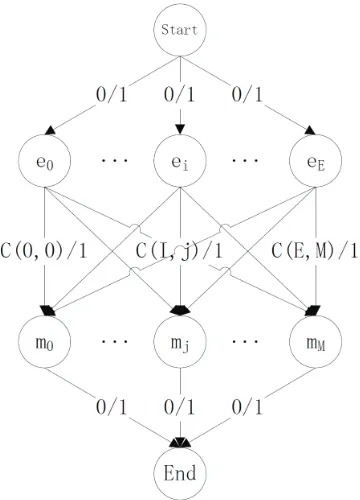
Figure 2: A minimum cost and maximum flow structure is used to solve the problem that map-ping coreferring entities into each mention candi-dates with highest probability.
We use the basic running script that is “java -cp joda-time.jar:stanford-corenlp.jar:stanford-corenlp-models.jar:xom.jar -Xmx3g e-du.stanford.nlp.pipeline.StanfordCoreNLP -filelist filelist.txt” to resolve the resolution, where “filelist” involves all documents need to be performed coreference resolution.
2.2 Projection of Coreferring Entities
After generating coreferring entities on English, the key step of our system is how to map them into mention candidates detected on Chinese and Ara-bic. For instance, assuming we translate Chinese documents into English and obtain coreferring en-tities e1, e2, ei,.., eE on translated English
doc-uments through aforementioned step, meanwhile, we consider all noun phrases(NP) in original Chi-nese documents and generate mention candidates m1,m2,mj,..,mM. Therefore, our task is to map
eachei into one mention candidatemj with
max-Algorithm 1Algorithm for computing similarity between two phrases in different languages.
1: Input: we1, .., wen,wc1, .., wcm, Phrase Table
P T
2: s[n] = [0,−inf, ..,−inf]
3: fori←1..ndo
4: forj←0..10do
5: s[i+ j] = max(s[i+j], s[i−1] +
p(i, i+j))
6: Output:s[n]V
imization of the following formula,
ˆ
P = ∑
ei∈E,mj∈M
{a(i, j)b(j, i)p(i, j)} (1)
with constrains ∑i,j{a(i, j)} = 1 and
∑
i,j{b(j, i)} = 1, where p(i, j) is the
prob-ability of ei mapping into mj and a(i, j) as
well as b(i, j) are integers guaranteeing each coreferring entity map into one mention and each mention has only one entity to be mapped into. To solve this problem, we reduce it as a Cost Flow problem since it is easier to understand and implement compared to other methods such as integer linear programming. Note that the number of mention candidates is theoretically larger than that of coreferring entities, thus this problem couldn’t be reduced as the bipartite graph matching problem since it needs equal number of nodes in two parts.
Figure 2 shows the graph structure designed to solve this problem, where the symbols labeled on each edge is a two tuples(Cost,Flow), indicating the cost and flow for each edge. Since object of Cost Flow problem is to minimize the cost while maximizing the flows, thus we compute thec(i, j)
as 1− p(i, j) in order to be consistent with the equation 1. To satisfy two constraints aforemen-tioned, we set up two dummy nodes “Start” and “End”, and connect “Start” to each entityei with
cost0and flow1ensuring each entity is available to map one mention. We also link each mention candidate mj to node “End” with the same
val-ue ensuring each mention could be mapped into by only one entity. Clearly, there is an edge with tuple(1−p(i, j),1)between each entity end men-tion indicating that each entity could map into any mention while with different probabilities. Thus,
solving this Cost-Flow problem is equal to maxi-mizing the equation 1 with two constraints. Since Cost-Flow problem is well studied, thus some al-gorithm can solve this problem in polynomial time (Ahuja et al., 1993). One may argue that we can modify translation decoder to output alignments between Chinese and translated English sentence, unfortunately, Google Translator API doesn’t sup-ply these information while its translation quality is obviously better than others for translating doc-uments in OntoNotes, moreover, it is impossible to output alignment for each word since some trans-lation rules used for directing transtrans-lation include some unaligned words, thus an algorithm to map each entity into each mention is more applicable.
Clearly, another problem is how to compute p(i, j)for each edge between entity and mention candidate. This problem could be casted as how to compute similarity of phrases across multiple languages. Formally, given an English phrases we1, .., wenand a Chinese phrasewc1, .., wcm, the
problem is how to compute the similar scoreS be-tween them. Although we could compute lexical, syntactic or semantic similar score to obtain ac-curate similarity, here for simplicity, we just com-pute the lexical similarity using the phrase table extracted by a phrased-based machine translation decoder (Koehn et al., 2003). Phrase table is a rich resource that contains probability score for phrase in one language translated into another language, thus we could design a dynamic algorithm shown in Algorithm 1 to compute the similar score. E-quation in line 5is used to reserve highest simi-lar score for its sub-phrases, andp(i, i+j)is the similar score between sub-phraseswi, .., wi+jand
its translation. When we compute the score of the sub-phraseswi, .., wi+j, we literately pick onepti
fromP T and check whetherwc1, .., wcminvolves
pti’s target side, if that we record its score
un-til we obtain a higher score obtained by another ptj and then update it. For instance, assuming the
bilingual phrase table: “The world ’s fifth Disney-land => 全球的第五个迪斯尼乐园 (probabili-ty=0.6) ” and “The world ’s fifth Disneyland => 全球第五个迪斯尼乐园(probability=0.4)”. S-ince the Chinese translation of both rules all con-tain the noun phrase “全球 第五 个 迪斯尼 乐 园” in the original Chinese input, we thus add this noun phrase into the coreferring entities as the En-glish resolve finding with the probability 0.6.
3 Experiments
3.1 English Results
In this section, we will report our experimental re-sults in details. We use Standford CoreNLP toolkit to generate results for English. Table 1 lists the F-score obtained on developing set.
3.2 Chinese and Arabic Results
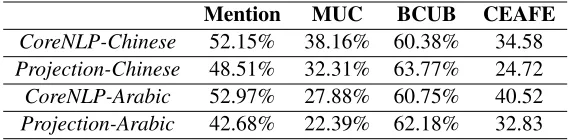
As last section mentioned, we first translate Chinese and Arabic into English and then use CoreNLP to resolve coreference on English. To obtain high translation quality, we use Google Translator Toolkit 2. And to compute similarity score, we run Giza++(Och and Ney, 2003) 3, an open source toolkit for word alignment, to perfor-m word alignperfor-ment. For Chinese, we use 1 perfor-million bilingual corpus provided by NIST MT evaluation task to extract phrase table, and for Arabic its size is 2 million. Note that, we extract phrase table from English to Chinese and Arabic with maxi-mum phrase length 10. The reason is that our al-gorithm check English phrase whose length is less than 10 tokens. To compare our results, we al-so use CoreNLP to generate results for Chinese and Arabic. Since CoreNLP use some syntac-tic knowledge to resolving coreference, it can al-so output coreferring entities for other languages. From table 2 we find that although CoreNLP is not designed for other languages, it still obtain accept-able scores and beat our projection based mod-el. The main reason is that our method is coarse and obtain lower precision for mention detection, while CoreNLP use some manually written rules to detect mention candidates. Another explana-tion is that projecexplana-tion based model is hard to map
2http://www.google.cn/url?source=
transpromo&rs=rsmf&q=http://translate. google.com/toolkit
3http://code.google.com/p/giza-pp/
some phrases back into original languages, such as “that, it, this”. Moreover, translation quality for some corpus like web corpus is far from perfect, translation errors will surely affect the precision of coreference resolution. Thus, for the final testing set, we run the CoreNLP to generate the results.
3.3 Testing Results
Since CoreNLP beats our system in Chinese and Arabic, thus we run CoreNLP for all three lan-guages. Table 3 lists the final results, and we also give results using golden parse tree for prediction in table 4. From these two tables, we find that for any language, the system using golden parse tree show better performance than the one using pre-dicted system in term of each metric. The reason is that the CoreNLP resolve coreference on parse tree and employ some parse features to corefer. On the other hand, we could also see that the improve-ment is slight, because parsing errors affect lit-tle on finding mention candidates benefiting from high precision on noun phrase prediction. Final-ly, since we use an open source toolkit to generate results, unfortunately, we have no ranking in this task.
4 Conclusion
In this paper, we present a projection based mod-el for coreference resolution. We first translate Chinese and Arabic into English, and then em-ploy a strong English resolver to generate core-ferring entities, after that a projection algorithm is designed to map coreferring entities into mention candidates detected in Chinese and Arabic. How-ever, since our approach is coarse and due to limit time preparing for this task, the output generate by CoreNLP beats our results in three languages, thus we submit results generated by CoreNLP as our final submission.
Acknowledgments
Mention MUC BCUB CEAFE
[image:5.612.162.448.122.192.2]CoreNLP 73.68% 64.58% 70.60% 46.64
Table 1: Experimental results on developing set(F-score) for English.
Mention MUC BCUB CEAFE
CoreNLP-Chinese 52.15% 38.16% 60.38% 34.58
Projection-Chinese 48.51% 32.31% 63.77% 24.72
CoreNLP-Arabic 52.97% 27.88% 60.75% 40.52
Projection-Arabic 42.68% 22.39% 62.18% 32.83
Table 2: Experimental results on developing set(F-score) for Chinese and Arabic using CoreNLP and our system.
Mention MUC BCUB CEAFE
CoreNLP-Chinese 49.82% 37.83% 60.30% 34.93
CoreNLP-Arabic 53.89% 28.31% 61.83% 42.97
[image:5.612.162.446.333.390.2]CoreNLP-English 73.69% 63.82% 68.52% 45.36
Table 3: Experimental results on testing set(F-score) using predicted parse tree.
Mention MUC BCUB CEAFE
CoreNLP-Chinese 53.42% 40.60% 60.37% 35.75
CoreNLP-Arabic 55.17% 30.54% 62.36% 43.03
CoreNLP-English 75.58% 66.14% 69.55% 46.54
Table 4: Experimental results on testing set(F-score) using golden parse tree.
References
R.K. Ahuja, T.L. Magnanti, and J.B. Orlin. 1993. Net-work flows: theory, algorithms, and applications. 1993.
P. Koehn, F.J. Och, and D. Marcu. 2003. Statistical phrase-based translation. InProceedings of the 2003 Conference of the North American Chapter of the Association for Computational Linguistics on Hu-man Language Technology-Volume 1, pages 48–54. Association for Computational Linguistics.
H. Lee, Y. Peirsman, A. Chang, N. Chambers, M. Sur-deanu, and D. Jurafsky. 2011. Stanford’s multi-pass sieve coreference resolution system at the conll-2011 shared task. InProceedings of the Fifteenth Conference on Computational Natural Language Learning: Shared Task, pages 28–34. Association for Computational Linguistics.
F.J. Och and H. Ney. 2003. A systematic comparison of various statistical alignment models. Computa-tional linguistics, 29(1):19–51.
Sameer Pradhan, Alessandro Moschitti, Nianwen Xue, Olga Uryupina, and Yuchen Zhang. 2012.
CoNLL-2012 shared task: Modeling multilingual unrestrict-ed coreference in OntoNotes. In Proceedings of the Sixteenth Conference on Computational Natural Language Learning (CoNLL 2012), Jeju, Korea.