Manuscript received January 11, 2010. This work was supported in part by Department of Computer Science and Engineering, Yuan-Ze University.
I-Shyan Hwang is with the Department of Computer Science and Engineering, Yuan-Ze University, Chung-Li, Taiwan.
Jhong-Yue Lee is currently pursuing the Ph.D. degree at the Department of Computer Science and Engineering, Yuan-Ze University, Chung-Li, Taiwan.
clarify this problem, refer Figure 3 illustrates the waiting time,
1 2 t
t − , which is the time elapsed from when the packets begin
to arrive to before the start of data transmission. In the DBA scheme, each ONU experiences a waiting time between sending the REPORT message and sending the buffered frames. Consequently, packets that arrive during the waiting time have to be delayed to the next transmission cycle, potentially leading to longer delays. To address this, predictive schemes can be used so that traffic arrival during the waiting time is taken into consideration to avoid longer packet delay and network performance degradation.
ONU2 ONU3 ONUN
Cycle Time (Tcycle)
DBA Time
REPORT Message GATE Message
OLT
ONUs
ONU1 ONUN-1 ONU1
Idle Period
ONU2 ONU3
Figure 2. Traditional DBA mechanism
REPORT: Ri GATE: Bgrant = Ri
ONUi
ONUi
(N+1)th Cycle
Nth Cycle
Waiting Time
OLT
ONUi
t0 t1 t2
Queue: Ri Ri'
Ri' Ri
Packet Arriving
Figure 3. Queue state between waiting time
In this paper, the problem of inconsistent queue states caused by waiting time is considered and an accurate prediction mechanism is proposed to reduce packet delay and allocate bandwidth efficiently. We also discuss the precision of an accurate traffic prediction mechanism, which is necessary to avoid over-estimation or under-estimation that can result in longer packet delays and degrade the network performance [8-11]. Although exhaustive queue size prediction mechanism have been proposed (which can be credit-based [7,8,12], linear-based [5,8,9], proportion-based [9,13], waited-based [4] or QoS-based [6,7,10,11,14]), these traffic prediction mechanism are unable to provide feasible solutions for differentiated services and have not addressed the queue size inconsistent problem. In this paper, the proposed traffic prediction mechanism supports differentiated services with their various requirements.
Previous researches have suggested that the maximum of
Tcycle is 1ms [15,16], which is set to meet the ITU-T
recommendation, G.114, i.e. the delay for voice traffic in the
access network to be set at 1.5ms [17]. On one hand, making
Tcycle too large will lead to longer packet delays for all
Ethernet frames because a larger cycle time incurs a larger transmission window size and results in the ONU ineffectively holding the transmission channel. As a result, the backlogged traffic at the next ONU experiences longer packet
delays. On the other hand, making Tcycle too small will result in
more bandwidth being wasted by guard intervals and an increase in CPU processing load.
From our previous studies [9], we noted that the idle period problem of IPACT can be resolved by using Early-DBA
mechanism with Prediction-based Fair Excessive Bandwidth Reallocation Scheme (PFEBR), which includes the unstable degree list to provide more accurate predictions. However, the Early-DBA has a jitter performance problem, which is due to a change in the transmission orders of some ONUs. A scalable Interleaved Dynamic Bandwidth Allocation (IDBA) mechanism is proposed in this paper, which uses the concept of Early-DBA to resolve the idle period problem. Nevertheless, the proposed IDBA does not change the granting order for ONUs to reduce the jitter problem.
In proposed IDBA mechanism, shown in Fig. 4, the Tcycle is
divided by halving the ONUs. One part is the first subgroup (Group1) of ONUs, which is denoted by Sn,1 transmission
time for cycle n, and the other part is the second subgroup
(Group2) of ONUs, which is denoted by Sn,2 transmission
time for cycle n. The subgroup Sn+1,1 upstream transmission
period is calculated in the nth cycle. At Group2 DBA time,
the OLT performs the DBA computation for ONUs in
subgroup Sn,2. At this time, the OLT has granted the GATE
message to ONUs in subgroup Sn+1,1, so that the ONUs in
subgroup Sn+1,1 can transmit upstream data during idle time
while the OLT computes DBA for subgroup Sn+1,2 (Group2
DBA). ONUs in subgroup Sn+1,2 is allowed to transmit
upstream data as soon as the last ONU in subgroup Sn+1,1
finishes transmission. Then, ONUs in Group1 DBA time also
performs what Group2 DBA time has done in the same way.
The OLT lets the DBA process execute the QoS-based prediction, the limit bandwidth allocation (LBA), and the excessive bandwidth reallocation (EBR) for each part. When the predicted bandwidth has been over-estimated, the unused bandwidth is simply reserved for the next part, and the total transmission time of two successive parts is limited in one
Tcycle. The proposed IDBA has two contributions: one is
eliminating the idle period problem in the traditional DBA mechanism, and the other is ensuring QoS services by
dynamically adjusting the bandwidth between Sn,1 and Sn,2,
which not only supports differentiated services architecture but also offers various levels of QoS.
Cycle Time (n) Cycle Time (n+1)
Group2 DBA Time Group1 DBA Time Group2 DBA Time Group1 DBA Time
REPORT Message GATE Message
OLT
ONUs
ONU1 ONUN/2ONUN/2+1 ONUN ONU1 ONUN/2ONUN/2+1 ONUN
Sn+1,1transmission timeSn+1, 2transmission time
Sn, 1transmission timeSn, 2transmission time
Figure 4. Operation of the proposed IDBA mechanism
The rest of this paper is organized as follows. Section II presents the proposed interleaved DBA and QoS-based scheduling scheme. Simulation evaluations are presented in Section III, and conclusions are drawn in Section VI.
II. PROPOSED INTERLEAVED DBAMECHANISM
The Interleaved Dynamic Bandwidth Allocation (IDBA)
mechanism is proposed to resolve the idle period problem and
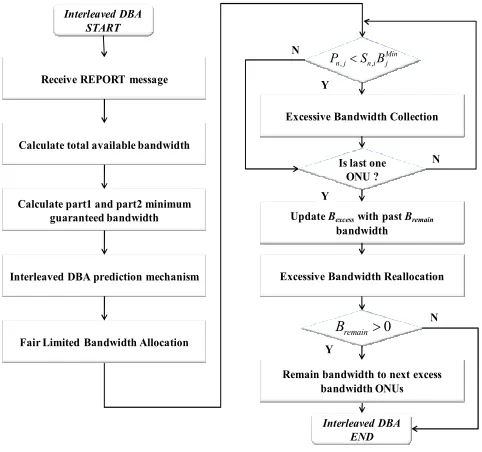
enhance the QoS for differentiated services by using prediction and EBR in the EPON system. The flowchart of the
as the bandwidth request prediction of ONUj for cycle n,
, Min
n i j
S B is defined as the minimum guaranteed bandwidth
belonging to part i of ONUj for cycle n, which can be
calculated by the service level agreement (SLA), Bexcess the
excess bandwidth which is calculated by the sum of the under
exploited bandwidth of lightly-loaded ONUs and Bremain, the
unused bandwidth after excess bandwidth reallocation from heavily-loaded ONUs.
Interleaved DBA START
Calculate total available bandwidth Receive REPORT message
Interleaved DBA prediction mechanism Calculate part1 and part2 minimum
guaranteed bandwidth
Fair Limited Bandwidth Allocation
Excessive Bandwidth Collection
Excessive Bandwidth Reallocation
Interleaved DBA END Y
N
N
, ,
Min n j n i j
P <S B
0
remain
B > Is last one
ONU ?
Update Bexcesswith past Bremain bandwidth
Y
Remain bandwidth to next excess bandwidth ONUs N
[image:3.595.49.290.152.378.2]Y
Figure 5. Flowchart of IDBA mechanism
When receiving whole REPORT messages from each ONU, the total available bandwidth can be calculated as
( ( Max ) 512)
cycle g
r×T − ×N T − ×N , where r is the transmission speed of
the EPON in bits per second, TcycleMax is the maximum cycle time,
N is the number of ONUs, Tg is the guard time and the control
message length is 512bits for the EPON system. Next, the QoS-based IDBA executes the prediction mechanism based on the current traffic status. The limited bandwidth allocation mechanism then compares the minimum guaranteed bandwidth with the predicted bandwidth of each ONU. If
, ,
Min
n j n i j
P ≤S B , then excessive bandwidth collection for
lightly-loaded ONUs is executed, followed by excessive bandwidth reallocation mechanism for heavily-loaded ONUs. In the end, the unused bandwidth from the over-estimated bandwidth can be reserved for the next group of ONUs for DBA. Therefore, the IDBA can support QoS and enhance system performance for differential services and efficiently reallocates excessive bandwidth in EPON. The prediction mechanism of IDBA is described in Section A, limited bandwidth allocation (LBA) mechanism with fairness in Section B and excessive bandwidth reallocation (EBR) mechanism in Section C respectively.
Initially, the available bandwidth for part one, S Bn,1 available, and part two, S Bn,2 available, for cycle n, can be calculated by applying equations (1) and (2).
,1 ,2
/ 2 1 1
N
n available n j
j N
S B total availible bandwidth S W
= +
= × −
∑
(1)
/ 2
,2 ,1
1
1 ,
N
n available n j
j
S B total availible bandwidth S W =
= × −
∑
(2)
where Wj is the weight assigned to each ONUj based on its
SLA.
A. Interleaved DBA prediction mechanism
In relation to resolving queue variation between waiting times and reducing the packet delay, the prediction mechanism of IDBA takes differential traffic characteristic into account to enhance the prediction accuracy for each ONU. In this paper, we divide traffic data into three priority classes, EF, AF, and BE by the definition of Differentiated Services [8,18]. To achieve better performance for a time-critical application, for instance constant bit rate (CBR) for EF traffic and non-busty traffic mode, bandwidth should be assigned to the ONUs according to the rate of these applications. Therefore, the proposed prediction mechanism assigns the CBR bandwidth to EF traffic as it multiplies the previous request of EF by one plus the proportion of waiting time,
Twaiting,j, and cycle time, Tcycle,j, for ONUj. Moreover, the
traffic characteristic of AF and BE are variable bite rate (VBR) and busty traffic mode, and the proposed prediction
mechanisms of AF and BE traffic compare the difference
between the requested transmission window at the present cycle and a mean value requested transmission window of historical cycles. The predicted value of bandwidth requirements for differentiated traffic is expressed in equation
(3), where ,
T n j
R represents bandwidth request of each traffic
type of ONUj in cycle n, and
T j
H is the average bandwidth
requirements of the history cycle of each traffic type of ONUj,
where T∈{EF,AF,BE}..
, , ,
, ,
, ,
(1 / )
EF EF
n j j waiting j cycle j
AF AF AF
n j n j j
BE BE BE
n j n j j
P H T T
P R H
P R H
= × +
= −
= −
(3)
After the traffic forecast value is calculated in each ONU,
the prediction mechanism can derive ,
T n j
P which represents the
prediction value of each ONUj in cycle n, where
} , ,
{EF AF BE
T∈ . For AF and BE traffics, if , 0
T n j
P > , the
demand tends to increase gradually and so we update the forecast value to obtain the new bandwidth requirements.
Otherwise, if , 0
T n j
P ≤
, we do not update.
B. Fair limited bandwidth allocation mechanism
During dynamic allocation, the allocated timeslot will be adapted to the requested bandwidth. To prevent the allocation of excessive bandwidth (which can increase packet delay) or too little bandwidth (which can result in wasted bandwidth),
the proposed LBA is set as , min( ,, , )
Min
n i j n j n i j
S G = P S B , where
,
n i j
S G is the granted bandwidth timeslot in GATE message for
ONUj (which belongs to the ith part in the nth cycle), Pn j, is
the predicted value of bandwidth requirements for ONUj, and
, Min
n i j
S B is the minimum guaranteed bandwidth of ONU
j
(which belongs to the ith part in the nth cycle) that will
equalize the bandwidth for each ONUs in part i. If Pn j, < , Min
n i j
S B ,
the limited granted bandwidth from the OLT is the same as the
predicted bandwidth; otherwise, the grant for the ONUj equals
, Min
n i j
S B . The proposed LBA not only solves the problem of an
ONU with heavy traffic load monopolizing the upstream channel, but also supports the priority servicing of
differentiated services to guarantee QoS. The ,
Min
n i j
S B and
, T
n i j
each traffic class are described as follows:
, ,
, n i available Min
n i j
n i
S B S B
Numbers of S ONU
= (4)
, ,
, , , , 1
, , , ,
min( , )
min( , )
EF EF Min
n i j j n i j
AF AF Min EF
n i j j n i j n i j n
BE Min EF AF
n i j n i j n i j n i j
S G P S B
S G P S B S G
S G S B S G S G
+
=
= −
= − −
(5)
C. Excessive bandwidth reallocation mechanism
After LBA grants all bandwidth timeslot to the active ONUj,
lightly loaded ONUs with bandwidth requirements less than
the ,
Min
n i j
S B may still be present. The sum of the under utilized
bandwidth of lightly-loaded ONUs, excessive bandwidth (Bexcess)[9,10], can be expressed as equation (6).
, ,
( Min )
excess j L n i j n j
B =
∑
∈ S B −P (6)where , ,
Min
n i j n j
S B >P , L is the set of lightly-loaded ONUs and
j is a lightly-loaded ONU in L.
In the proposed EBR mechanism, Bexcess is redistributed
among the heavily-loaded ONUs. A heavily-loaded ONU obtains an additional bandwidth based on the EBR mechanism. If the bandwidth has not yet been distributed to
the heavily-loaded ONUs after Bexcess has been allocated, we
assign the remaining available bandwidth as Bremain, which can
be retained to the next excessive bandwidth collection to enhance the bandwidth efficiency in the next cycle. It also
needs to be noted that Bremain must be restricted at half cycle
time to avoid the piling up of unused available bandwidth , which can result in unfair resource distribution. The EBR mechanism gives considerable improvement in average packets delay and network throughput as indicated by the
reported simulation results. Bremain is expressed in equation (7)
as follows:
, ,
( Min)
remain excess j H n j n i j
B =B −
∑
∈ P −S B (7)where , ,
Min
n i j n j
S B <P , H is the set of heavily-loaded ONUs
and j is a heavily-loaded ONU in H. The proposed EBR
mechanism operational procedure is illustrated in Fig. 6. After EBR, if the excessive bandwidth is larger than the sum of the bandwidth request among the heavily-loaded ONUs, then the excess bandwidth can satisfy the extra requirement of the
heavily-loaded ONUs completely. Bremain can then be
calculated by using equation (7), which can be retained as excessive bandwidth for the next ONUs group.
The proposed EBR mechanism in the IDBA can provide fairness to EBR based on the guaranteed bandwidth rather than the requested bandwidth, with no partiality and increase in bandwidth utilization. Moreover, the EBR mechanism not only alleviates the unfairness problem but also supports QoS by fairly distributing in a priority manner to improve LBA scheduling and enhance the traffic class.
III. PERFORMANCE EVALUATION
In this section, comparisons are performed using the PFEBR scheme, IDBA_Fixed without LBA, EBR and prediction, IDBA_EBR without prediction mechanism, IDBA_EBR_Pre incorporated QoS-based prediction with EBR, hybrid double-phase polling algorithm (DPA)[7], with respect to end-to-end delay, throughput, jitter performance,
ratio of packet lossand fairness. The system model is set up
within the OPNET simulator with one OLT and 32 ONUs. The simulation scenario is summarized in Table 1. For the traffic model considered, an extensive study has shown that most network traffic can be characterized by self-similarity and long-range dependence (LRD) [19]. In order to simulate the effect of high priority traffic, the proportion of traffic profile is analyzed by simulating the three significant scenarios in (EF, AF, and BE) with (20%, 40%, 40%), (40%, 30%, 30%), and (60%, 20%, 20%), respectively [10,20].
Table 1. Simulation scenario
Number of ONUs in the system 32
Upstream/downstream link capacity 1Gbps
OLT-ONU distance (uniform)
10
−
20
km
Buffer size
10
M
Maximum transmission cycle time
1
ms
Guard time
5
µ
s
Computation time of DBA
10 s
µ
Control message length 64bytes
A. End-to-end packet delay
Figure 7 compares the mean end-to-end packet delay and EF traffic classes with end-to-end delay vs. different traffic
loads for PFEBR, IDBA_Fixed, IDBA_EBR,
IDBA_EBR_Pre and hybrid DPA. The simulation results obtained show that hybrid DPA has a higher average end-to-end packet delay than IDBA when the traffic load exceeds 60%. However, the mean end-to-end packet delay of IDBA_Fixed and IDBA_EBR_Pre increased when traffic load exceeded 70% while for IDBA_EBR, it increased when traffic load exceeded 80% regardless of the scenario. One
possible reason is that the idle period problem can be
resolved by IDBA mechanism and that the excess bandwidth can be reallocated effectively by using the EBR mechanism. Additionally, the EBR mechanism in IDBA mechanism that is based on the guaranteed bandwidth and exceeds requested bandwidth not only guarantees bandwidth but also avoids over-allocation. Figure 7(a) shows that the IDBA mechanism has better performance in terms of mean end-to-end packet delay when the ratio of EF traffic increases. One possible reason is that the network environment will converge to a stable state when the proportion of CBR traffic and the IDBA mechanism satisfies the bandwidth requirements of EF traffic first and then the requirements of AF and BE traffics in LBA and EBR. To enhance the performance of high priority traffic, the QoS-based prediction mechanism decreases the resources allocated to low priority traffic and allocates more resources to EF traffic which will decrease the overall system performance when the proportion of VBR traffic is higher. Figure 7(b) shows that the IDBA_EBR_Pre can guarantee the bandwidth for EF traffic class, and result in lower EF end-to-end delay for each ONU. The PFEBR mechanism can reduce the overall EF traffic delay through using the accurate prediction mechanism but with a traffic load of 90%. The IDBA mechanism meets the ITU-T recommendation G.114 that specifies the delay for voice traffic in the access network at
1.5ms [17]. The end-to-end delay of EF traffic in the
PFEBR _244 IDBA_Fixed_244 IDBA_EBR_244 Hybrid DPA_244 IDBA_EBR_Pre_244 PFEBR_433 IDBA_Fixed_433 IDBA_EBR_433 Hybrid DPA_433 IDBA_EBR_Pre_433 PFEBR_622 IDBA_Fixed_622 IDBA_EBR_622 Hybrid DPA_622 IDBA_EBR_Pre_622
0 50 100 150
10% 20% 30% 40% 50% 60% 70% 80% 90% Traffic load (%)
D e la y (m s) 0 0.5 1 1.5 2
10% 20% 30% 40% 50% 60% 70% 80% 90% Traffic load (%)
D e la y ( m s) (a) (b)
Figure 7. (a) Average end-to-end packet delay and (b) EF end-to-end delay vs. different traffic loads for PFEBR, IDBA_Fixed, IDBA_EBR,
IDBA_EBR_Pre and hybrid DPA.
B. System throughput
6.00E+08 7.00E+08 8.00E+08
10% 20% 30% 40% 50% 60% 70% 80% 90% Traffic load (%)
T h ro u g h p u t (b it s/ se c) 1.E+00 1.E+08 2.E+08 3.E+08 4.E+08 5.E+08 6.E+08
10% 20% 30% 40% 50% 60% 70% 80% 90% Traffic load (%)
T h ro u g h p u t (b it s/ se c)
(a) (b)
0.E+00 1.E+08 2.E+08 3.E+08 4.E+08
10% 20% 30% 40% 50% 60% 70% 80% 90% Traffic load (%)
T h ro u g h p u t (b it s/ se c) 0.00E+00 5.00E+07 1.00E+08 1.50E+08 2.00E+08 2.50E+08 3.00E+08
10% 20% 30% 40% 50% 60% 70% 80% 90% Traffic load (%)
T h ro u g h p u t (b it s/ se c)
(c) (d)
Figure 8. (a) Mean system throughput and (b) EF traffic throughput (c) AF traffic throughput (d) BE traffic throughput vs. different traffic loads for
PFEBR, IDBA_Fixed, IDBA_EBR, IDBA_EBR_Pre and hybrid DPA.
Figure 8 shows the mean system throughput and EF, AF, BE traffic throughput against different traffic loads for the PFEBR, IDBA_Fixed, IDBA_EBR, IDBA_EBR_Pre and hybrid DPA. Figure 8(a) shows that the proposed IDBA mechanism outperforms hybrid DPA in mean system throughput, and this is because interleaved transmissions can eliminate the problem of idle time in traditional DBA and support efficient EBR as well as the interleaved remain compensation mechanism. The four mechanisms have the same mean system throughput until the traffic load exceeds 60%. The PFEBR and hybrid DPA has gradually achieved a consistent performance when the traffic load exceeds 60%. In this case, the IDBA_EBR has the best mean throughput performance and begins to become saturated when traffic load exceeds 80% due to effective excess bandwidth reallocation and the interleaved remain compensation mechanism. As for the EF throughput, as shown in Fig 8(b), the proposed IDBA_EBR_Pre mechanism outperforms the other mechanisms because the EF traffic obtains additional bandwidth by using QoS-based prediction mechanism which can enhance high priority traffic adaptively for different traffic proportions. For the AF and BE throughput, as shown in Fig 8(c) and Fig 8(d), the IDBA_EBR has the best throughput performance because the guaranteed bandwidth can enhance requirements of the subscriber, and at the same time not over-estimate the demand of bandwidth allocation for subscribers. The AF throughput performance of hybrid DPA begins to decrease when traffic load exceeds 70% in scenario (40%, 30%, 30%) and scenario (60%, 20%, 20%);
whereas the BE throughput performance of hybrid DPA begins to decrease when traffic load exceeds 70% in every scenario. One possible reason is that the QoS-based prediction mechanism of hybrid DPA guarantees the requirement of high priority and disregards the requirement of low priority traffic (which results in lower AF and BE throughput) when the proportion of EF traffic is high.
C. EF jitter and Packet loss ratio
PFEBR _244 IDBA_Fixed_244 IDBA_EBR_244 Hybrid DPA_244 IDBA_EBR_Pre_244 PFEBR_433 IDBA_Fixed_433 IDBA_EBR_433 Hybrid DPA_433 IDBA_EBR_Pre_433 PFEBR_622 IDBA_Fixed_622 IDBA_EBR_622 Hybrid DPA_622 IDBA_EBR_Pre_622
0.00E+00 5.00E+01 1.00E+02 1.50E+02 2.00E+02 2.50E+02 3.00E+02 3.50E+02 4.00E+02
10% 20% 30% 40% 50% 60% 70% 80% 90% Traffic load (%)
D e la y v a ri a n ce (m s^ 2 ) \ 0% 1% 2% 3% 4% 5%
10% 20% 30% 40% 50% 60% 70% 80% 90% Traffic load (%)
R a ti o ( % )
(a) (b)
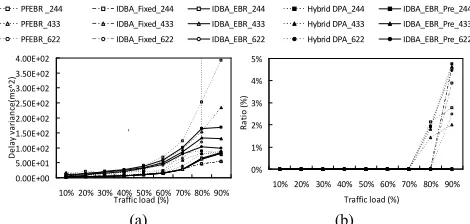
Figure 9. (a) EF jitter and (b) Average packet loss ratio vs. different traffic loads for PFEBR, IDBA_Fixed, IDBA_EBR, IDBA_EBR_Pre and hybrid
DPA.
Figure 9 shows the comparison of delay variance of EF class and packet loss against different traffic loads among PFEBR, IDBA_Fixed, IDBA_EBR, IDBA_EBR_Pre and hybrid DPA, respectively. In the proposed IDBA mechanism, we can see that the EF jitter of PFEBR can be improved by using IDBA, especially IDBA_Fixed. The reason is that the transmission order of each ONU is sequential and that PFEBR changes the transmission order of ONUs. However, IDBA_EBR_Pre has a higher EF jitter when the traffic load exceeds 60%, especially in scenario (20%, 40%, 40%). This could be due to the prediction mechanism allocating additional prediction bandwidth according to the requirements of subscribers and therefore, yields a larger ratio of VBR traffic in scenario (20%, 40%, 40%). Figure 9(b) shows that the hybrid DPA begins to have packet loss when the traffic load exceeds 70% in every scenario due to over allocation of the requested bandwidth to ONUs [21] for the EBR mechanism in hybrid DPA. This is
termed the redundant bandwidth problem [9] to decrease
overall system throughput. IDBA_Fixed starts to have packet loss when traffic load exceeds 80% in every scenario because lake an effective excess bandwidth reallocation mechanism. Furthermore, IDBA integrates the EBR and remaining bandwidth compensation mechanism to improve bandwidth utilization that prevents packet loss build up in high traffic load for each scenario.
D. Fairness
Figure 10 shows the comparison of fairness against different traffic loads among PFEBR, IDBA_Fixed,
IDBA_EBR, IDBA_EBR_Pre and hybrid DPA,
respectively. Recently, fairness and QoS on DBA schemes have become important issues, which we are also evaluating.
The fairness index f (0≦f≦1) has been addressed [22]
[image:5.595.47.288.52.175.2] [image:5.595.310.545.166.278.2] [image:5.595.52.287.201.388.2],where N is the total number of ONUs and G[i] is the granted
bandwidth of ONUi. Jain’s fairness index f, ranging from 0
to 1, becomes 1 when all ONUs have the same amount of bandwidth allocated by the OLT. Simulation results show
that Jain’s fairness index f of IDBA is better than hybrid
DPA, especially in IDBA_EBR_Pre when the traffic load exceeds 70%. IDBA_EBR_Pre has the best fairness
performance, where the average Jain’s fairness index f is
about 0.9. One possible reason of this is that the proposed IDBA_EBR_Pre utilizes the idle period and remaining bandwidth by performing DBA computation for fair bandwidth allocation and that the fairness EBR mechanism is based on the guaranteed bandwidth rather than requested bandwidth, with no partiality and increase in bandwidth utilization. The fairness of hybrid DPA begins to gradually vary from traffic load 40% to traffic load 70%. Two possible causes of this is that 1) the hybrid DPA changes the transmission mechanism between online polling and double phase polling and 2) the EBR based on the requested bandwidth in hybrid DPA has some drawbacks, namely unfairness and excessive bandwidth allocated to ONUs over what has been requested.
7.E-01 8.E-01 9.E-01 1.E+00
10% 20% 30% 40% 50% 60% 70% 80% 90% Traffic load (%)
F
a
ir
n
e
ss
Figure 10. Fairness using Jain’s index vs. different traffic loads for PFEBR, IDBA_Fixed, IDBA_EBR, IDBA_EBR_Pre and hybrid DPA.
IV. CONCLUSIONS
In this study, important factors that can improve the performance of EPON are discussed and evaluated. The IDBA mechanism executes an interleaved transmission
process to automatically adjust cycle time to resolve the idle
period problem for traditional DBA scheme, enhancing the system performance to reduce end-to-end packet delay and improving the throughput. Moreover, it not only accounts for the prediction for differential traffic characteristic but also allocates bandwidth for differential traffic adaptively and improves the utilization of bandwidth by using EBR and the remaining bandwidth compensation mechanism. The simulation results obtained show that the throughput of IDBA is better than that of PFEBR and hybrid DPA, especially in relation to EF traffic performance and average packet loss ratio. Furthermore, the proposed QoS-based prediction mechanism outperforms the hybrid DPA by lowering the EF packet delay. Finally, the IDBA can effectively improve the EF jitter problems faced by PFEBR. It makes use of excess bandwidth and remaining bandwidth to have higher system throughput, lower packet loss and end-to-end delay of each ONU. Future work includes finding out the optimal number of subgroups and having a more appropriate prediction mechanism to improve system performance.
REFERENCES
[1] P.E. Green, “Fiber to the Home: The Next Big Broadband Thing,”
IEEE Communications Magazine, Vol. 42, pp. 100-106, Sept. 2004.
[2] G. Kramer, B. Mukherjee and G. Pessavento, “Ethernet PON (ePON):
Design and Analysis of An Optical Access Network,” Photonic
Network Communications, Vol. 3, No. 3, pp. 307-319, July 2001.
[3] IEEE Draft P802.3ah/D1.0TM, Media Access Control Parameters,
Physical Layers and Management Parameters for Subscriber Access Networks, Aug. 19, 2002.
[4] Y. Luo and N. Ansari, “Bandwidth Allocation for Multiservice Access
on EPON,” IEEE Communications Magazine, Vol. 43, No. 2, pp.
S16-S21, Feb. 2005.
[5] M. McGarry, M. Maier and M. Reisslein, “Ethernet PONs: A Survey of
Dynamic Bandwidth Allocation (DBA) Algorithms,” IEEE
Communications Magazine, Vol. 42, No. 8, pp. S8-S15, Aug. 2004.
[6] J. Hwang and M. Yoo, “QoS-aware Class Gated DBA Algorithm for
the EPON System,” International Conference on Advanced
Technologies for Communications, pp. 363-366, Oct. 2008.
[7] S.Y. Choi, S. Lee, T.J. Lee, M.Y. Chung and H. Choo, “Double-Phase
Polling Algorithm Based on Partitioned ONU Subgroups for High
Utilization in EPONs,” IEEE/OSA Journal of Optical
Communications and Networking, Vol. 1, Issue 5, pp. 484-497, Oct. 2009.
[8] G. Kramer, B. Mukherjee and G. Pesavento, “Interleaved Polling with
Adaptive Cycle Time (IPACT): A Dynamic Bandwidth Distribution
Scheme in an Optical Access Network,” Photonic Network
Communications, Vol. 4, No. 1, pp. 89-107, Jan. 2002.
[9] I.S. Hwang, Z.D. Shyu, L.Y. Ke and C.C. Chang, “A Novel Early DBA
Mechanism with Prediction-based Fair Excessive Bandwidth
Allocation Scheme in EPON,” Computer Communications, Vol. 31,
Issue 9, pp. 1814-1823, Jun. 2008.
[10] C.M. Assi, Y. Ye, S. Dixit and M.A. Ali, “Dynamic Bandwidth
Allocation for Quality-of-Service over Ethernet PONs,” IEEE J.
Selected Areas Communications, Vol. 21, No. 9, pp. 1467-1477, Nov. 2003.
[11] G. Kramer, B. Mukherjee, S. Dixit, Y. Ye and R. Hirth, “Supporting
Differentiated Classes of Service in Ethernet Passive Optical
Networks,” Journal of Optical Networks, Vol. 1, Issue 8, pp. 280-298,
Aug. 2002.
[12] C.C. Sue and H.W. Cheng, “A Fitting Report Position Scheme for the
Gated IPACT Dynamic Bandwidth Algorithm in EPONs,” IEEE/ACM
Transactions on Networking: Accepted for future publication, 2010.
[13] J. Zheng, “Efficient Bandwidth Allocation Algorithm for Ethernet
Passive Optical Networks,” IEE Proceedings Communications, Vol.
153, Issue 3, pp. 464-468, June 2006.
[14] J. Chen, B. Chen and L. Wosinska, “Joint Bandwidth Scheduling to
Support Differentiated Services and Multiple Service Providers in 1G
and 10G EPONs,” Journal of Optical Communications and
Networking, Vol. 1, Issue 4, pp. 343-351, Sept. 2009.
[15] G. Kramer, “Ethernet Passive Optical Networks,” McGraw-Hill
Professional, ISBN: 0071445625, Mar. 2005.
[16] H. Naser and H.T. Mouftah, “A Joint-ONU Interval-based Dynamic
Scheduling Algorithm for Ethernet Passive Optical Networks,”
IEEE/ACM Transactions on Networking, Vol. 14, No. 4, pp. 889-899, Aug. 2006.
[17] ITU-T Recommendation G.114, One-Way Transmission Time, in
Series G: Transmission Systems and Media, Digital Systems and Networks, Telecommunication Standardization Sector of ITU, May 2000.
[18] S. Blake, D. Black, M. Carlson, E. Davies, Z. Wang and W. Weiss, “An
Architecture for Differentiated Services,” RFC 2475,
www.ietf.org/rfc/rfc2475.txt, 1998.
[19] W. Willinger, M.S. Taqqu and A. Erramilli, “A Bibliographical Guide
to Self-similar Traffic and Performance Modeling for Modern High-speed Networks,” Stochastic Networks: Theory and Applications, Royal Statistical Society Lecture Notes Series, Vol. 4, Oxford University Press, 1996.
[20] X. Bai and A. Shami, “Modeling Self-Similar Traffic for Network
Simulation”, Technical report, NetRep-2005-01, 2005.
[21] B. Chen, J. Chen and S. He, “Efficient and fine scheduling algorithm
for bandwidth allocation in Ethernet passive optical networks,” IEEE
Journal of Selected Topics in Quantum Electronics, Vol. 12, No. 4, pp. 653-660, July-Aug. 2006.
[22] R. Jain, A. Durresi and G. Babic, “Throughput fairness index: an
[image:6.595.67.279.325.433.2]