Deterministic Word Segmentation
Using Maximum Matching with Fully Lexicalized Rules
Manabu Sassano
Yahoo Japan Corporation
Midtown Tower, 9-7-1 Akasaka, Minato-ku, Tokyo 107-6211, Japan [email protected]
Abstract
We present a fast algorithm of word seg-mentation that scans an input sentence in a deterministic manner just one time. The algorithm is based on simple max-imum matching which includes execu-tion of fully lexicalized transformaexecu-tional rules. Since the process of rule match-ing is incorporated into dictionary lookup, fast segmentation is achieved. We eval-uated the proposed method on word seg-mentation of Japanese. Experimental re-sults show that our segmenter runs consid-erably faster than the state-of-the-art sys-tems and yields a practical accuracy when a more accurate segmenter or an annotated corpus is available.
1 Introduction
The aim of this study is to improve the speed of word segmentation. Applications for many Asian languages including Chinese and Japanese require word segmentation. Such languages do not have explicit word delimiters such as white spaces. Word segmentation is often needed before every task of fundamental text processing such as count-ing words, searchcount-ing for words, indexcount-ing docu-ments, and extracting words. Therefore, the per-formance of word segmentation is crucial for these languages. Take for instance, information retrieval (IR) systems for documents in Japanese. It typi-cally uses a morphological analyzer1 to tokenize the content of the documents. One of the most time consuming tasks in IR systems is indexing, which uses morphological analysis intensively.
Major approaches to Japanese morphological analysis (MA) are based on methods of finding
1
Japanese has a conjugation system in morphology and does not put white spaces between words. Therefore, we have to do morphological analysis in order to segment a given sentence into words and give an associated part-of-speech (POS) tag to each word. In the main stream of the research of Japanese language processing, morphological analysis has meant to be a joint task of segmentation and POS tagging.
the best sequence of words along with their part-of-speech tags using a dictionary where they use the Viterbi search (e.g., (Nagata, 1994), (Kudo et al., 2004)). However, computation cost of mod-ern MA systems is mainly attributed to the Viterbi search as Kaji et al. (2010) point out.
One of methods of improving the speed of MA or word segmentation will be to avoid or reduce the Viterbi search. We can avoid this by using maximum matching in the case of word segmenta-tion. Since there are many applications such as IR and text classification, where part-of-speech tags are not mandatory, in this paper we focus on word segmentation and adopt maximum matching for it. However, maximum matching for Japanese word segmentation is rarely used these days because the segmentation accuracy is not good enough and the accuracy of MA is much higher. In this paper we investigate to improve the accuracy of maximum-matching based word segmentation while keeping speedy processing.
2 Segmentation Algorithm
Our algorithm is basically based on maximum matching, or longest matching (Nagata, 1997). Al-though maximum matching is very simple and easy to implement, a segmenter with this algo-rithm is not sufficiently accurate. For the pur-pose of improving the segmentation accuracy, sev-eral methods that can be combined with maximum matching have been examined. In previous studies (Palmer, 1997; Hockenmaier and Brew, 1998), the combination of maximum matching and character-based transformational rules has been investigated for Chinese. They have reported promising results in terms of accuracy and have not mentioned the running time of their methods, which might sup-posedly be very slow because we have to scan an input sentence many times to apply learned trans-formational rules.
In order to avoid such heavy post processing, we simplify the type of rules and incorporate the process of applying rules into a single process of maximum matching for dictionary lookup. We
Input:ci: sentence which is represented as a char-acter sequence. N: the number of characters in a given sentence. t: dictionary, the data structure of which should be a trie.oj: map an IDjto a single word or a sequence of words. hj: total length of
oj.
Function: Lookup(t, c,i, N): search the dic-tionarytfor the substringcstarting at the position
iup toN by using maximum matching. This re-turns the ID of the entry in the dictionarytwhen it matches and otherwise returns−1.
procedure Segment(c,N,t)
vari: index of the character sequencec varj: ID of the entry in the trie dictionaryt
begin i←1
while (i≤N) do begin
j=Lookup(t,c,i,N)
if (j =−1) then
{unknown word as a single character} printci;i=i+ 1
else
printoj ;i=i+hj
{ifoj is a sequence of words, print each word in the sequence with a delimiter. Otherwise printoj as a single token.}
endif
print delimiter
{delimiter will be a space or something.}
end end
Figure 1: Algorithm of word segmentation with maximum matching that incorporates execution of transformational rules.
show in Figure 1 the pseudo code of the algorithm of word segmentation using maximum matching, where the combination of maximum matching and execution of simplified transformational rules is realized. If each of the dataojin Figure 1 is a sin-gle token, the algorithm which is presented here is identical with segmentation by maximum match-ing.
We use the following types of transformational rules:c0c1...cl−1cl →w0...wmwhereciis a char-acter andwj is a word (or morpheme). Below are sample rules for Japanese word segmentation:
• はないか (ha-na-i-ka) → は (ha;
topic-marker)ない(na-i; “does not exist”) か(ka;
“or”)2
• 大工学部(dai-ko-gaku-bu)→大(dai; “uni-versity”)工学部(ko-gaku-bu; “the faculty of engineering”)
Note that the form of the left hand side of the rule is the sequence of characters, not the sequence of words. Due to this simplification, we can combine dictionary lookup by maximum matching with ex-ecution of transformational rules and make them into a single process. In other words, if we find a sequence of characters of the left hand side of a certain rule, then we write out the right hand side of the rule immediately. This construction enables us to naturally incorporate execution (or appli-cation) of transformational rules into dictionary-lookup, i.e., maximum matching.
Although the algorithm in Figure 1 does not specify the algorithm or the implementation of function Lookup(), a trie is suitable for the struc-ture of the dictionary. It is known that an effi-cient implementation of a trie is realized by using a double-array structure (Aoe, 1989), which en-ables us to look up a given key at theO(n) cost, wherenis the length of the key. In this case the computation cost of the algorithm of Figure 1 is
O(n).
We can see in Figure 1 that the Viterbi search is not executed and the average number of dictio-nary lookups is fewer than the number of char-acters of an input sentence because the average length of words is longer than one. This contrasts with Viterbi-based algorithms of word segmenta-tion or morphological analysis that always require dictionary lookup at each character position in a sentence.
3 Learning Transformational Rules
3.1 Framework of Learning
The algorithm in Figure 1 can be combined with rules learned from a reference corpus as well as hand-crafted rules. We used here a modified ver-sion of Brill’s error-driven transformation-based learning (TBL) (Brill, 1995) for rule learning.
In our system, an initial system is a word seg-menter that uses maximum matching with a given
w0
0w10 · · ·w0n→w0w1· · ·wm
L w0
0w10 · · ·w0n→L w0w1· · ·wm
w0
0w10 · · ·wn0 R→w0w1· · ·wmR
L w0
0w10 · · ·wn0 R→L w0w1· · ·wmR
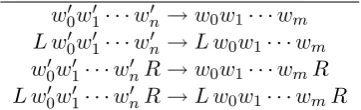
Table 1: Rule templates for error-driven learning
word list and words which occur in a given ref-erence corpus (a training corpus). Our segmenter treats an unknown word, which is not in the dictio-nary, as a one-character word as shown in Figure 1.
3.2 Generating Candidate Rules
In order to generate candidate rules, first we compare the output of the current system with the reference corpus and extract the differences (Tashiro et al., 1994) as rules that have the follow-ing form: L w00w01· · ·wn0 R → L w0w1· · ·wmR wherew00w01· · ·wn0 is a word sequence in the sys-tem output and w0w1· · ·wm is a word sequence in the reference corpus andLis a word in the left context andRis a word in the right context. After this extraction process, we generate four lexical-ized rules from each extracted rule by using the templates defined in Table 1.
3.3 Learning Rules
In order to reduce huge computation when learn-ing a rule at each iteration of TBL, we use some heuristic strategy. The heuristic scorehis defined as: h = f ∗(n+m) wheref is a frequency of the rule in question andnis the number of words inw00w01· · ·w0n andm is the number of words in
w0w1· · ·wm. After sorting the generated rules
as-sociated with the scoreh, we apply each candidate rule in decreasing order ofhand compute the error reduction. If we get positive reduction, we obtain this rule and incorporate it into the current dictio-nary and then proceed to the next iteration. If we do not find any rules that reduce errors, we termi-nate the learning process.
4 Experiments and Discussion
4.1 Corpora and an Initial Word List
In our experiments for Japanese we used the Kyoto University Text Corpus Version 4 (we call it KC4) (Kurohashi and Nagao, 2003), which includes newspaper articles, and 470M Japanese sentences (Kawahara and Kurohashi, 2006), which is com-piled from the Web. For training, we used two sets of the corpus. The first set is the articles on
January 1st through 8th (7,635 sentences) of KC4. The second one is 320,000 sentences that are se-lected from the 470M Web corpus. Note that the Web corpus is not annotated and we use it after word segmentation is given by JUMAN 6.0 (Kuro-hashi and Kawahara, 2007). The test data is a set of sentences in the articles on January 9th (1,220 sentences). The articles on January 10th were used for development.
We used all the words in the dictionary of JU-MAN 6.0 as an initial word list. The number of the words in the dictionary is 542,061. They are generated by removing the grammatical informa-tion such as part-of-speech tags from the entries in the original dictionary of JUMAN 6.0.
4.2 Results and Discussion
[image:3.595.91.272.62.117.2]Segmentation Performance We used word based F-measure and character-wise accuracy to evaluate the segmentation performance.
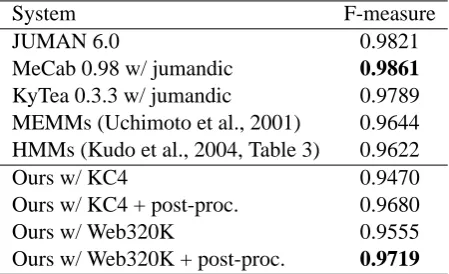
Table 2 shows comparison of various systems including ours. It is natural that since our sys-tem uses only fully lexicalized rules and does not use any generalized rules, it achieves a moderate performance. However, by using the Web cor-pus that contains 320,000 sentences, it yields an F-measure of near 0.96, which is at the same level as the F-measure of HMMs (baseline) in (Kudo et al., 2004, Table 3). We will discuss how we can improve it in a later section.
Segmentation Speed Table 3 shows comparison of the segmentation speed of various systems for 320,000 sentences of the Web corpus. Since, in general, such comparison is heavily dependent on the implementation of the systems, we have to be careful for drawing any conclusion. However, we can see that our system, which does not use the Viterbi search, achieved considerably higher pro-cessing speed than other systems.
Further Improvement The method that we have presented so far is based on lexicalized rules. That is, we do not have any generalized rules. The system does not recognize an unknown English word as a single token because most of such words are not in the dictionary and then are split into sin-gle letters. Similarly, a number that does not ap-pear in the training corpus is split into digits.
System # of Sent. F-measure Char. Acc. # of Rules
JUMAN 6.0 NA 0.9821 0.9920 NA
MeCab 0.98 w/ jumandic 7,958 0.9861 0.9939 NA
Ours w/o training corpus 0 0.8474 0.9123 0
Ours w/ KC4 7,635 0.9470 0.9693 2228
[image:4.595.72.297.328.465.2]w/ Web320K 320,000 0.9555 0.9769 24267
Table 2: Performance summary of various systems and configurations. Jumandic for MeCab (Kudo et al., 2004) is stemmed from the dictionary of JUMAN.
System (Charset Encoding) Model/Algorithm Time (sec.)
JUMAN 6.0 (EUC-JP) Markov model w/ hand-tuned costs 161.09
MeCab 0.98 (UTF-8) w/ jumandic CRFs 13.71
KyTea 0.3.3 (UTF-8) w/ jumandic Pointwise prediction w/ SVM 188.01
Ours (UTF-8) Maximum matching w/ rules 3.22
Table 3: Running time on the Web320K corpus. We used a PC (Intel Xeon 2.33 GHz with 8GB memory on FreeBSD 6.3). The model for segmentation of KyTea (Neubig et al., 2011) in our experiments is trained with the word list of JUMAN on KC4 (see in Section 4.1).
System F-measure
JUMAN 6.0 0.9821
MeCab 0.98 w/ jumandic 0.9861
KyTea 0.3.3 w/ jumandic 0.9789
MEMMs (Uchimoto et al., 2001) 0.9644
HMMs (Kudo et al., 2004, Table 3) 0.9622
Ours w/ KC4 0.9470
Ours w/ KC4 + post-proc. 0.9680
Ours w/ Web320K 0.9555
Ours w/ Web320K + post-proc. 0.9719
Table 4: Performance comparison to other sys-tems.
kanji3, Latin characters, and katakana4ones. This type of post processing is commonly used in Japanese morphological analysis. JUMAN and MeCab have a similar mechanism and use it.
As an additional experiment, we incorporated this post processing into our segmenter and mea-sured the performance. The result is shown in Ta-ble 4. The segmenter with the post processing yields an F-measure of 0.9719 when it is trained on the 320k Web corpus. We observed that the performance gap between state-of-the-art systems such as JUMAN and MeCab and ours becomes smaller. Additional computation time was +10%
3Kanji in Japanese, or hanzi in Chinese, is a ideographic script. Kanji means Chinese characters.
4Katakana is one of the phonetic scripts used in Japanese. It is mainly used to denote loan words and onomatopoeias. Such type of words are very productive and are often un-known words in Japanese language processing.
for the post processing and this means the seg-menter with the post processing is still much faster than other sophisticated MA systems. Many ap-plications which have to process a huge amount of documents would gain the benefits from our pro-posed methods.
5 Related Work
The use of transformational rules for improving word segmentation as well as morphological anal-ysis is not new. It is found in previous work (Papa-georgiou, 1994; Palmer, 1997; Hockenmaier and Brew, 1998; Gao et al., 2004). However, their ap-proaches require the Viterbi search and/or a heavy post process such as cascaded transformation in order to rewrite the output of the base segmenter. This leads to slow execution and systems that in-corporate such approaches have much higher cost of computation than ours.
6 Conclusion
References
Jun-Ichi Aoe. 1989. An efficient digital search
al-gorithm by using a double-array structure. IEEE
Transactions on Software Engineering, 15(9):1066–
1077.
Eric Brill. 1995. Transformation-based error driven learning and natural language processing: A case study in part-of-speech tagging. Computational
Lin-guistics, 21(4):543–565.
Jianfeng Gao, Andi Wu, Cheng-Ning Huang,
Hong qiao Li, Xinsong Xia, and Hauwei Qin.
2004. Adaptive Chinese word segmentation. In
Proc. of ACL-2004, pages 462–469.
Julia Hockenmaier and Chris Brew. 1998. Error-driven learning of Chinese word segmentation. In Proc. of
PACLIC 12, pages 218–229.
Nobuhiro Kaji, Yasuhiro Fujiwara, Naoki Yoshinaga, and Masaru Kitsuregawa. 2010. Efficient staggered decoding for sequence labeling. In Proc. of ACL
2010, pages 485–494.
Daisuke Kawahara and Sadao Kurohashi. 2006.
Case frame compilation from the web using high-performance computing. In Proc. of LREC 2006, pages 1344–1347.
Taku Kudo, Kaoru Yamamoto, and Yuji Matsumoto.
2004. Appliying conditional random fields to
Japanese morphological analysis. In Proc. of
EMNLP 2004, pages 230–237.
Sadao Kurohashi and Daisuke Kawahara. 2007.
JUMAN (a User-Extensible Morphological
An-alyzer for Japanese). http://nlp.ist.
i.kyoto-u.ac.jp/index.php?JUMAN,
http://nlp.ist.i.kyoto-u.ac.jp/EN/ index.php?JUMAN.
Sadao Kurohashi and Makoto Nagao. 2003. Build-ing a Japanese parsed corpus. In Anne Abeille, edi-tor, Treebanks: Building and Using Parsed Corpora, pages 249–260. Kluwer Academic Publishers.
Masaaki Nagata. 1994. A stochastic Japanese morpho-logical analyzer using a forward-DP backward-A* n-best search algorithm. In Proc. of COLING-94, pages 201–207.
Masaaki Nagata. 1997. A self-organizing Japanese word segmenter using heuristic word identification and re-estimation. In Proc. of WVLC-5, pages 203– 215.
Graham Neubig, Yosuke Nagata, and Shinsuke Mori.
2011. Pointwise prediction for robust, adaptable
Japanese morphological analysis. In Proc. of
ACL-2011.
David D. Palmer. 1997. A trainable rule-based algo-rithm for word segmentation. In Proc. of ACL-1997, pages 321–328.
Constantine P. Papageorgiou. 1994. Japanese word segmentation by hidden Markov model. In Proc. of
HLT-1994, pages 283–288.
Toshihisa Tashiro, Noriyoshi Uratani, and Tsuyoshi Morimoto. 1994. Restructuring tagged corpora with morpheme adjustment rules. In Proc. of
COLING-1994, pages 569–573.