Learning Translations via Matrix Completion
Derry Wijaya1, Brendan Callahan1, John Hewitt1, Jie Gao1, Xiao Ling1,
Marianna Apidianaki12andChris Callison-Burch1
1Computer and Information Science Department, University of Pennsylvania 2LIMSI, CNRS, Universit´e Paris-Saclay, 91403 Orsay
Abstract
Bilingual Lexicon Induction is the task of learning word translations without bilin-gual parallel corpora. We model this task as a matrix completion problem, and present an effective and extendable frame-work for completing the matrix. This method harnesses diverse bilingual and monolingual signals, each of which may
be incomplete or noisy. Our model
achieves state-of-the-art performance for both high and low resource languages.
1 Introduction
Machine translation (MT) models typically re-quire large, sentence-aligned bilingual texts to learn good translation models (Wu et al., 2016; Sennrich et al., 2016a; Koehn et al., 2003). How-ever, for many language pairs, such parallel texts may only be available in limited quantities, which
is problematic. Alignments at the word- or
subword- levels (Sennrich et al., 2016b) can be in-accurate in the limited parallel texts, which can in turn lead to inaccurate translations. Due to the low quantity and thus coverage of the texts, there may still be “out-of-vocabulary” words encountered at run-time. The Bilingual Lexicon Induction (BLI) task (Rapp, 1995), which learns word translations from monolingual or comparable corpora, is an at-tempt to alleviate this problem. The goal is to use plentiful, more easily obtainable, monolingual or comparable data to infer word translations and re-duce the need for parallel data to learn good trans-lation models. The word transtrans-lations obtained by BLI can, for example, be used to augment MT systems and improve alignment accuracy, cover-age, and translation quality (Gulcehre et al., 2016; Callison-Burch et al., 2006; Daum´e and Jagarla-mudi, 2011).
fridge house
fri
dg
e
ho
use
sleep
sl
ee
p
ku
lka
s
ko
ki
tid
ur
hijzelf koelkast kokkien
EN
NL
fridge house
fri
dg
e
ho
use
sleep
sl
ee
p
ku
lka
s
ko
ki
tid
ur
kast koelkast kokkien
[image:1.595.309.526.219.318.2]EN ID EN ID
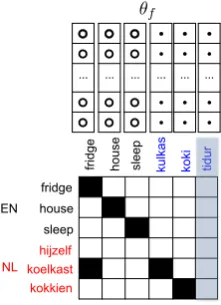
Figure 1: Our framework allows us to use a di-verse range of signals to learn translations, in-cluding incomplete bilingual dictionaries, infor-mation from related languages (like Indonesian loan words from Dutch shown here), word embed-dings, and even visual similarity cues.
Previous research has explored different sources for estimating translation equivalence from mono-lingual corpora (Schafer and Yarowsky, 2002; Klementiev and Roth, 2006; Irvine and Callison-Burch, 2013, 2017). These monolingual signals, when combined in a supervised model, can en-hance end-to-end MT for low resource languages (Klementiev et al., 2012a; Irvine and Callison-Burch, 2016). More recently, similarities between words in different languages have been approxi-mated by constructing a shared bilingual word em-bedding space with different forms of bilingual su-pervision (Upadhyay et al., 2016).
We present a framework for learning transla-tions by combining diverse signals of translation that are each potentially sparse or noisy. We use matrix factorization (MF), which has been shown to be effective for harnessing incomplete or noisy distant supervision from multiple sources of in-formation (Fan et al., 2014; Rockt¨aschel et al., 2015). MF is also shown to result in good cross-lingual representations for tasks such as alignment (Goutte et al., 2004), QA (Zhou et al., 2013), and cross-lingual word embeddings (Shi et al., 2015).
Specifically, we represent translation as a matrix with source words in the columns and target words in the rows, and model the task of learning trans-lations as a matrix completion problem. Starting from some observed translations (e.g., from exist-ing bilexist-ingual dictionaries,) we infer missexist-ing trans-lations in the matrix using MF with a Bayesian Personalized Ranking (BPR) objective (Rendle et al., 2009). We select BPR for a number of reasons: (1) BPR has been shown to outperform traditional supervised methods in the presence of positive-only data (Riedel et al., 2013), which is true in our case since we only observe positive translations. (2) BPR is easily extendable to incor-porate additional signals for inferring missing val-ues in the matrix (He and McAuley, 2016). Since observed translations may be sparse, i.e. the “cold start” problem in the matrix completion task, in-corporating additional signals of translation equiv-alence estimated on monolingual corpora is useful. (3) BPR is also shown to be effective for multi-lingual transfer learning (Verga et al., 2016). For low resource source languages, there may be re-lated, higher resource languages from which we can project available translations (e.g., translations of loan words) to the target language (Figure 1).
We conduct large scale experiments to learn translations from both low and high resource lan-guages to English and achieve state-of-the-art per-formance on these languages. Our main contribu-tions are as follows:
• We introduce a MF framework that learns translations by integrating diverse bilingual and monolingual signals of translation, each potentially noisy/incomplete.
• The framework is easily extendable to incor-porate additional signals of translation equiv-alence. Since ours is a framework for integra-tion, each signal can be improved separately to improve the overall system.
• Large scale experiments on both low and high resource languages show the effectiveness of our model, outperforming the current state-of-the-art.
• We make our code, datasets, and output trans-lations publicly available.1
2 Related Work
Bilingual Lexicon Induction Previous research has used different sources for estimating
transla-1http://www.cis.upenn.edu/%7Ederry/translations.html
tions from monolingual corpora. Signals such as contextual, temporal, topical, and ortographic sim-ilarities between words are used to measure their translation equivalence (Schafer and Yarowsky, 2002; Klementiev and Roth, 2006; Irvine and Callison-Burch, 2013, 2017).
With the increasing popularity of word em-beddings, many recent works approximate simi-larities between words in different languages by constructing a shared bilingual embedding space (Klementiev et al., 2012b; Zou et al., 2013; Vuli´c and Moens, 2013; Mikolov et al., 2013a; Faruqui and Dyer, 2014; Chandar A P et al., 2014; Gouws et al., 2015; Luong et al., 2015; Lu et al., 2015; Upadhyay et al., 2016). In the shared space, words from different languages are represented in a language-independent manner such that similar words, regardless of language, have similar repre-sentations. Similarities between words can then be measured in the shared space. One approach to in-duce this shared space is to learn a mapping func-tion between the languages’ monolingual semantic spaces (Mikolov et al., 2013a; Dinu et al., 2014). The mapping relies on seed translations which can be from existing dictionaries or be reliably cho-sen from pseudo-bilingual corpora of compara-ble texts e.g., Wikipedia with interlanguage links. Vuli´c and Moens (2015) show that by learning a linear function with a reliably chosen seed lexicon, they outperform other models with more expen-sive bilingual signals for training on benchmark data.
Most prior work on BLI however, either makes use of only one monolingual signal or uses unsu-pervised methods (e.g., rank combination) to ag-gregate the signals. Irvine and Callison-Burch (2016) show that combining monolingual signals in a supervised logistic regression model produces higher accuracy word translations than unsuper-vised models. More recently, Vuli´c et al. (2016) show that their multi-modal model that employs a simple weighted-sum of word embeddings and vi-sual similarities can improve translation accuracy. These works show that there is a need for combin-ing diverse, multi-modal monolcombin-ingual signals of translations. In this paper, we take this step further by combining the monolingual signals with bilin-gual signals of translations from existing bilinbilin-gual dictionaries of related, “third” languages.
probabilis-tic model of MF in collaborative filtering (Koren et al., 2009; Rendle et al., 2009). We represent our translation task as a matrix with source words in the columns and target words in the rows (Fig-ure 1). Based on some observed translations in the matrix found in a seed dictionary, our model learns low-dimensional feature vectors that encode the latent properties of the words in the row and the words in the column. The dot product of these vectors, which indicate how “aligned” the source and the target word properties are, captures how likely they are to be translations.
Since we do not observe false translations in the seed dictionary, the training data in the matrix con-sists only of positive translations. The absence of values in the matrix does not imply that the cor-responding words are not translations. In fact, we seek to predict which of these missing values are true. The BPR approach to MF (Rendle et al., 2009) formulates the task of predicting missing values as a ranking task. With the assumption that observed true translations should be given higher values than unobserved translations, BPR learns to optimize the difference between values assigned to the observed translations and values assigned to the unobserved translations.
However, due to the sparsity of existing bilin-gual dictionaries (for some language pairs such dictionaries may not exist), the traditional for-mulation of MF with BPR suffers from the “cold start” issue (Gantner et al., 2010; He and McAuley, 2016; Verga et al., 2016). In our case, these are situations in which some source words have no translations to any word in the target or related languages. For these words, additional in-formation, e.g., monolingual signals of translation equivalence or language-independent representa-tions such as visual representarepresenta-tions, must be used. We use bilingual translations from the source to the target language, English, obtained from Wikipedia page titles with interlanguage links. Since Wikipedia pages in the source language may be linked to pages in languages other than English, we also use high accuracy, crowdsourced transla-tions (Pavlick et al., 2014) from these third lan-guages to English as additional bilingual transla-tions. To alleviate the cold start issue, when a source word has no existing known translation to English or other third languages, our model backs-off to additional signals of translation equivalence estimated based on its word embedding and visual
representations. 3 Method
In this section, we describe our framework for integrating bilingual and monolingual signals for learning translations. First we formulate the task of Bilingual Lexicon Induction, and introduce our model for learning translations given observed translations and additional monolingual/language-independent signals. Then we derive our learning procedure using the BPR objective function.
Problem Formulation Given a set of source wordsF, a set of target wordsE, the pair he,fi where e ∈ E and f ∈ F is a candidate trans-lation with an associated score xe,f ∈ [0,1]
in-dicating the confidence of the translation. The input to our model is a set of observed transla-tionsT :={he, fi |xe,f = 1}. These could come
from an incomplete bilingual dictionary. We also add word identities to the matrix i.e., we define
Tidentity := {he, ei}, whereTidentity ⊂ T. The
task of Bilingual Lexicon Induction is then to gen-eratemissingtranslations: for a given source word
f and a set of target words{e| he, fi ∈/ T}, pre-dict the scorexe,f of how likely it is foreto be a
translation off.
Bilingual Signals for Translation One way to predictxe,f is by using matrix factorization. The
problem of predictingxe,f can be seen as a task of
estimating a matrixX:E×F.Xis approximated by a matrix product of two low-rank matricesP :
|E| ×kandQ:|F| ×k:
ˆ
X :=P QT
where k is the rank of the approximation. Each rowpeinPcan be seen as a feature vector
describ-ing the latent properties of the target worde, and each rowqf ofQdescribes the latent properties of
the source wordf. Their dot product encodes how aligned the latent properties are and, since these vectors are trained on observed translations, it en-codes how likely they are to be translation of each other. Thus, we can write this formulation of pre-dicted scoresxˆe,f with MF as:
ˆ xMF
e,f =pTeqf = k
X
i=1
pei. qfi (1)
fridge house fri dg e ho use sleep sl ee p ku lka s ko ki tid ur hijzelf koelkast kokkien EN NL ¢ ¢ ... ¢ ¢ ¢ ¢ ... ¢ ¢ ¢ ¢ ... ¢ ¢ ... ... ... 4 300 301 302 303 304 305 306 307 308 309 310 311 312 313 314 315 316 317 318 319 320 321 322 323 324 325 326 327 328 329 330 331 332 333 334 335 336 337 338 339 340 341 342 343 344 345 346 347 348 349 350 351 352 353 354 355 356 357 358 359 360 361 362 363 364 365 366 367 368 369 370 371 372 373 374 375 376 377 378 379 380 381 382 383 384 385 386 387 388 389 390 391 392 393 394 395 396 397 398 399 EMNLP 2017 Submission 1161. Confidential Review Copy. DO NOT DISTRIBUTE.
fridge house fri d g e h o u se sleep sl e e p ku lka s ko ki tid u r hijzelf koelkast kokkien EN NL ¢ ¢ ... ¢ ¢ 4 300 301 302 303 304 305 306 307 308 309 310 311 312 313 314 315 316 317 318 319 320 321 322 323 324 325 326 327 328 329 330 331 332 333 334 335 336 337 338 339 340 341 342 343 344 345 346 347 348 349 350 351 352 353 354 355 356 357 358 359 360 361 362 363 364 365 366 367 368 369 370 371 372 373 374 375 376 377 378 379 380 381 382 383 384 385 386 387 388 389 390 391 392 393 394 395 396 397 398 399 EMNLP 2017 Submission ***. Confidential Review Copy. DO NOT DISTRIBUTE.
fridge house fri dg e ho use sleep sl ee p ku lka s ko ki tid ur hijzelf koelkast kokkien EN NL
[image:4.595.127.238.63.216.2]EN ID
Figure 2: The wordtidur(id) is a cold word with no associated translation in the matrix.
to estimate their latent dimensions accurately (Fig-ure2). Additional signals for measuring transla-tion equivalence can help alleviate this problem. Hence, in the case ofcold words, we use a formu-lation ofxˆu,ithat involves auxiliary features about
the words for measuring translation:
ˆ xAUX
u,i =✓Tu✓i
✓irepresents an auxiliary feature vector of thecold
wordie.g., its word embedding or image vector representation, while✓uis a feature vector to be
trained, whose elements model the interaction be-tween worduand wordi: the extent to which the wordumatches the auxiliary features of wordi. In practice, learning✓uamounts to learning a
classi-fier, one for each target worduthat learns weights ✓ugiven the feature vectors✓iof its translations.
Since each word can have multiple additional feature vectors, we can formulate xˆAUX
u,i as a
weighted combination of all the auxiliary features available to us:
ˆ xAUX
u,i =↵1✓uT✓i+↵2 u iT +...+↵n u iT
where↵mare parameters assigned to control the
contribution of each auxiliary feature.
Learning with Bayesian Personalized Ranking The objective of Bayesian Personalized Ranking (BPR) is to
4 Experiments
Data Results
5 Results and conclusion References
Sarath Chandar AP, Stanislas Lauly, Hugo Larochelle, Mitesh Khapra, Balaraman Ravindran, Vikas C
Raykar, and Amrita Saha. 2014. An autoencoder approach to learning bilingual word representations. InAdvances in Neural Information Processing Sys-tems. pages 1853–1861.
Chris Callison-Burch, Philipp Koehn, and Miles Os-borne. 2006. Improved statistical machine transla-tion using paraphrases. InProceedings of the main conference on Human Language Technology Con-ference of the North American Chapter of the As-sociation of Computational Linguistics. Association for Computational Linguistics, pages 17–24. Georgiana Dinu, Angeliki Lazaridou, and Marco
Ba-roni. 2014. Improving zero-shot learning by miti-gating the hubness problem. InICLR Workshop Pa-pers.
Miao Fan, Deli Zhao, Qiang Zhou, Zhiyuan Liu, Thomas Fang Zheng, and Edward Y Chang. 2014. Distant supervision for relation extraction with ma-trix completion. InACL (1). Citeseer, pages 839– 849.
Manaal Faruqui and Chris Dyer. 2014. Improving vec-tor space word representations using multilingual correlation. Association for Computational Linguis-tics.
Zeno Gantner, Lucas Drumond, Christoph Freuden-thaler, Steffen Rendle, and Lars Schmidt-Thieme. 2010. Learning attribute-to-feature mappings for cold-start recommendations. In Data Mining (ICDM), 2010 IEEE 10th International Conference on. IEEE, pages 176–185.
Cyril Goutte, Kenji Yamada, and Eric Gaussier. 2004. Aligning words using matrix factorisation. In Pro-ceedings of the 42nd Annual Meeting on Associa-tion for ComputaAssocia-tional Linguistics. Association for Computational Linguistics, page 502.
Stephan Gouws, Yoshua Bengio, and Greg Corrado. 2014. Bilbowa: Fast bilingual distributed represen-tations without word alignments.stat1050:9. Caglar Gulcehre, Sungjin Ahn, Ramesh Nallapati,
Bowen Zhou, and Yoshua Bengio. 2016. Pointing the unknown words. InProceedings of the 54th An-nual Meeting of the Association for Computational Linguistics (ACL). Association for Computational Linguistics.
Ruining He and Julian McAuley. 2016. Vbpr: Visual bayesian personalized ranking from implicit feed-back. InThirtieth AAAI Conference on Artificial In-telligence.
Ann Irvine and Chris Callison-Burch. 2013. Su-pervised bilingual lexicon induction with multiple monolingual signals. Citeseer.
Ann Irvine and Chris Callison-Burch. 2016. End-to-end statistical machine translation with zero or small parallel texts.Natural Language Engineering
22(04):517–548. ¢ ¢ ... ¢ ¢ ¢ ¢ ... ¢ ¢ ... ... ...
Figure 2: The wordtidur(id) is a cold word with no associated translation in the matrix. Auxiliary features✓fabout the words can be used to predict
translations for cold words.
Auxiliary Signals for Translation Because the
observed bilingual translations may be sparse, the MF approach can suffer from the existence ofcold items: words that have too few associated ob-served translations to estimate their latent dimen-sions accurately (Figure 2). Additional signals for measuring translation equivalence can allevi-ate this problem. Hence, in the case of cold words, we use a formulation ofxˆu,ithat involves auxiliary
features about the words in the predictedxˆu,i: ˆ
xAUX
u,i =✓Tu✓i+ T✓i (2)
✓irepresents an auxiliary information about the
cold wordie.g., its word embedding or visual fea-tures. ✓u is a feature vector to be trained, whose
dot product with✓imodels the extent to which the
wordumatches the auxiliary features of wordi. In practice, learning✓uamounts to learning a
classi-fier, one for each target worduthat learns weights ✓ugiven the feature vectors✓iof its translations.
models the target words’ overall bias toward a given wordi.
Since each word can have multiple additional feature vectors, we can formulate xˆAUX
u,i as a
weighted sum of available auxiliary features1: ˆ
xAUX
u,i =↵1✓Tu✓i+↵2 u iT +...+↵n u iT
where↵m are parameters assigned to control the
contribution of each auxiliary feature.
In practice, we can combine the MF and auxil-iary formulations by defining:
ˆ
xu,i= ˆxMFu,i + ˆxAUXu,i 1we omit bias terms for brevity
However, since bilingual signals that are input to
ˆ
xMF
u,i are often precise but sparse, while
monolin-gual signals that are input toxˆAUX
u,i are often noisy
and not sparse, in our model we only back-off to the less precisexˆAUX
u,i for cold source words that
have none or too few associated translations (more detalis are given in the experiments, Section 4). For other source words, we useˆxMF
u,i to predict. Learning with Bayesian Personalized Ranking
The objective of Bayesian Personalized Ranking (BPR) is to maximize the difference in scores assigned to the observed translations compared to those assigned to the unobserved translations. Given a training setDconsisting of triples of the formhu, i, ji, wherehu, ii 2 T andhu, ji 2/ T, BPR wants to maximizexˆu,i,j, defined as:
ˆ
xu,i,j= ˆxu,i xˆu,j
wherexˆu,iand ˆxu,j can be defined either by eq.
1 or eq. 2 (for cold words). Specifically, BPR optimizes (Rendle et al., 2009):
X
hu,i,ji2D
ln (ˆxu,i,j) ⇥||⇥||2
where is the logistic sigmoid function, ⇥ is the parameter vector ofxˆu,i,j to be trained, and
⇥ is its hyperparameter vector. BPR can be
trained using stochastic gradient ascent where a triplehu, i, ji is sampled fromDand parameter updates are performed:
⇥ ⇥ +⌘.( ( ˆxu,i,j)@xˆ@u,i,j⇥ ⇥⇥)
⌘is the learning rate. Hence, for the MF formula-tion ofxˆu,i,j, we can sample a triplehu, i, jifrom
Dand update its parameters as:
pu pu+⌘.( ( ˆxMFu,i,j)(qi qj) Ppu)
qi qi+⌘.( ( ˆxu,i,jMF)(pu) Q+qi) qj qj+⌘.( ( ˆxu,i,jMF)( pu) Q qj)
while for the auxiliary formulation ofxˆu,i,j; we
we can sample a triplehu, i, jifromDand update its parameters as:
✓u ✓u+⌘.( ( ˆxAUXu,i,j)(✓i ✓j) ⇥✓u) +⌘.( ( ˆxAUX
u,i,j)(✓i ✓j) ) Figure 2: The wordtidur(id) is a cold word with
no associated translation in the matrix. Auxiliary featuresθf about the words can be used to predict
translations for cold words.
MF approach can suffer from the existence ofcold
items: words that have none or too few associ-ated observed translations to estimate their latent dimensions accurately (Figure 2). Additional sig-nals for measuring translation equivalence can al-leviate this problem. Hence, in the case of cold words, we use a formulation ofxˆe,f that involves
auxiliary features about the words in the predicted
ˆ xe,f:
ˆ
xAUXe,f =θTeθf+βTθf (2)
θf represents an auxiliary information about the
cold wordfe.g., its word embedding or visual fea-tures. θe is a feature vector to be trained, whose
dot product with θf models the extent to which
the wordematches the auxiliary features of word
f. In practice, learningθe amounts to learning a
classifier, one for each target word e that learns weightsθegiven the feature vectorsθf of its
trans-lations. β models the targets’ overall bias toward a given wordf.
Since each word can have multiple additional feature vectors, we can formulate xˆAUX
e,f as a
weighted sum of available auxiliary features2:
ˆ
xAUXe,f =α1θTeθf+α2γeTγf +...+αnδeTδf
whereαm are parameters assigned to control the
contribution of each auxiliary feature.
In practice, we can combine the MF and auxil-iary formulations by defining:
ˆ
xe,f = ˆxMFe,f + ˆxAUXe,f
2We omit bias terms for brevity.
However, since bilingual signals that are input to
ˆ xMF
e,f are often precise but sparse, while
monolin-gual signals that are input toxˆAUX
e,f are often noisy
and not sparse, in our model we only back-off to the less precisexˆAUX
e,f for cold source words that
have none or too few associated translations (more details are given in the experiments, Section 4). For other source words, we usexˆMF
e,f to predict. Learning with Bayesian Personalized Ranking
Unlike traditional supervised models that try to maximize the scores assigned to positive instances (in our case, observed translations), the objec-tive of Bayesian Personalized Ranking (BPR) is to maximize thedifferencein scores assigned to the observed translations compared to those assigned to the unobserved translations. Given a training set
Dconsisting of triples of the formhe, f, gi, where he, fi ∈ T andhe, gi ∈/ T, BPR wants to maxi-mizexˆe,f,g, defined as:
ˆ
xe,f,g = ˆxe,f−xˆe,g
where xˆe,f and xˆe,g can be defined either by eq.
1 or eq. 2 (for cold words). Specifically, BPR optimizes (Rendle et al., 2009):
X
he,f,gi∈D
lnσ(ˆxe,f,g)−λΘ||Θ||2
where σ is the logistic sigmoid function, Θ is the parameter vector of xˆe,f,g to be trained, and
λΘ is its hyperparameter vector. BPR can be
trained using stochastic gradient ascent where a triplehe, f, gi is sampled from Dand parameter updates are performed:
Θ←Θ +η.(σ(−xˆe,f,g)∂xˆ∂e,f,gΘ −λΘΘ)
ηis the learning rate. Hence, for the MF formula-tion ofxˆe,f,g, we can sample a triplehe, f, gifrom
Dand update its parameters as:
pe←pe+η.(σ(−xˆe,f,gMF )(qf −qg)−λP pe)
qf ←qf +η.(σ(−xˆMFe,f,g)(pe)−λQ+ qf)
qg ←qg+η.(σ(−xˆMFe,f,g)(−pe)−λQ−qg)
while for the auxiliary formulation of xˆe,f,g, we
can sample a triplehe, f, gifromDand update its parameters as:
θe ←θe+η.(σ(−xˆe,f,gAUX)(θf −θg)−λΘθe)
4 Experiments
To implement our approach, we extend the imple-mentation of BPR in LIBREC3which is a publicly
available Java library for recommender systems. We evaluate our model for the task of Bilingual Lexicon Induction (BLI). Given a source wordf, the task is to rank all candidate target wordseby their predicted translation scores xˆe,f. We
con-duct large-scale experiments on 27 low- and high-resource source languages and evaluate their trans-lations to English. We use the 100K most frequent words from English Wikipedia as candidate En-glish target words (E).
At test time, for each source language, we eval-uate the top-10 accuracy (Acc10): the percent of
source language words in the test set for which a correct English translation appears in the top-10 ranked English candidates.
4.1 Data 4.1.1 Test sets
We use benchmark test sets for the task of bilin-gual lexicon induction to evaluate the performance
of our model. The VULIC1000 dataset (Vulic
and Moens, 2016) comprises 1000 nouns in Span-ish, Italian, and Dutch, along with their one-to-one ground-truth word translations in English.
We construct a new test set (CROWDTEST) for a larger set of 27 languages from crowdsourced dictionaries (Pavlick et al., 2014). For each lan-guage, we randomly pick up to 1000 words that have only one English word translation in the crowdsourced dictionary to be the test set for that language. On average, there are 967 test source words with a variety of POS per language. Since different language treats grammatical categories such as tense and number differently (for example, unlike English, tenses are not expressed by spe-cific forms of words in Indonesian (id); rather, they are expressed through context), we make our evaluation on all languages in CROWDTEST generic by treating a predicted English translation of a foreign word as correct as long as it has the same lemma as the gold English translation. To facilitate further research, we makeCROWDTEST publicly available in our website.
4.1.2 Bilingual Signals for Translation
We use Wikipedia to incorporate information from a third language into the matrix, with
ob-3https://www.librec.net/index.html
fridge house
fri
dg
e
ho
use
sleep
sl
ee
p
ku
lka
s
ko
ki
tid
ur
id-wiki/Kucing id-wiki/Kulkas id-wiki/Koki
EN
WIKI
EN ID
it-wiki/Sonno
es-wiki/Sommeil
[image:5.595.333.501.65.176.2]WIKI+CROWD
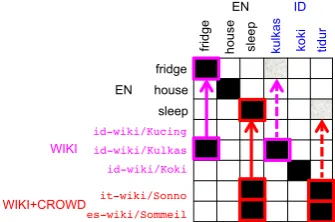
Figure 3: Wikipedia pages with observed trans-lations to the source (id) and the target (en) lan-guages act as athirdlanguage in the matrix.
served translations to both the source language and the target language, English. We first col-lect all interlingual links from English Wikipedia
pages to pages in other languages. Using
these links, we obtain translations of Wikipedia page titles in many languages to English e.g.,
id.wikipedia.org/wiki/Kulkas→ fridge(en). The observed translations are projected to fill the missing translations in the matrix (Figure 3). We call these bilingual translationsWIKI.
From the links that we have collected, we can also infer links from Wikipedia pages in the source language to other pages in non-target lan-guages e.g.,id.wikipedia.org/wiki/Kulkas→ it.wikipedia.org/wiki/Frigorifero. The
ti-tles of these pages can be translated to English if they exist as entries in the dictionaries. These non-source, non-target language pages can act as yet another third language whose observed trans-lations can be projected to fill the missing transla-tions in the matrix (Figure 3). We call these bilin-gual translationsWIKI+CROWD.
4.1.3 Monolingual Signals for Translation
We definecoldsource words in our experiments as source words that have no associatedWIKI trans-lations and fewer than 2 associatedWIKI+CROWD translations. For each cold source wordf, we pre-dict the score of its translation to each candidate English wordeusing the auxiliary formulation of
ˆ
xe,f (Equation 2). There are two auxiliary signals
about the words that we use in our experiments: (1) bilingually informed word embeddings and (2) visual representations.
Bilingually Informed Word Embeddings For each language, we learn monolingual embed-dings for its words by training a standard
et al., 2013b) on tokenized Wikipedia pages of that language using Gensim ( ˇReh˚uˇrek and Sojka, 2010). We obtain 100-dimensional word embed-dings with 15 epochs, 15 negatives, window size of 5, and cutoff value of 5.
Given two monolingual embedding spacesRdF andRdE of the source and target languagesF and
E, wheredf andde denote the dimensionality of
the monolingual embedding spaces, we use the set of crowdsourced translations that are not in the test set as our seed bilingual translations4 and learn a mapping function W ∈ RdE×dF that maps the target language vectors in the seed translations to their corresponding source language vectors.5
We learn two types of mapping: linear and non-linear, and compare their performances. The linear mapping (Mikolov et al., 2013a; Dinu et al., 2014) minimizes:||XEW−XF||2F where, following the notation in (Vuli´c and Korhonen, 2016), XE and XF are matrices obtained by respective concate-nation of target language and source language vec-tors that are in the seed bilingual translations. We solve this optimization problem using stochastic gradient descent (SGD).
We also consider a non-linear mapping (Socher et al., 2013) using a simple four-layer neural net-work,W= (φ(1), φ(2), φ(3), φ(4)) that is trained to
minimize:
X
xf∈XF X
xe∈XE
||xf −φ(4)s(φ(3)s(φ(2)s(φ(1)xe)))||2
where φ(1) ∈ Rh1×dE, φ(2) ∈ Rh2×h1, φ(3) ∈ Rh3×h2,φ(4) ∈RdF×h3,hnis the size of the hid-den layer, ands= tanhis the chosen non-linear function.
Once the mapWis learned, all candidate target word vectors xe can be mapped into the source
language embedding space RdF by computing
xT
eW. Instead of the raw monolingual word
em-beddings xe, we use these bilingually-informed
mapped word vectorsxT
eWas the auxiliary word
featuresWORD-AUXto estimatexˆAUX e,f .
Visual Representations Pilot Study Recent work (Vuli´c et al., 2016) has shown that combin-ing word embeddcombin-ings and visual representations of words can help achieve more accurate bilingual translations. Since the visual representation of a
4On average, there are 9846 crowdsourced translations per language that we can use as seed translations.
[image:6.595.314.518.61.176.2]5We find that mapping from target to source vectors gives better performances across models in our experiments.
Figure 4: Five images for the French word eau
and its top 4 translations ranked using visual sim-ularities of images associated with English words (Bergsma and Van Durme, 2011)
word seems to be language-independent (e.g. the concept ofwater has similar images whether ex-pressed in English or French (Figure 4), the visual representations of a word may be useful for infer-ring its translation and for complementing the in-formation learned in text.
We performed a pilot study to include visual features as auxiliary features in our framework. We use a large multilingual corpus of labeled im-ages (Callahan, 2017) to obtain the visual repre-sentation of the words in our source and target lan-guages. The corpus contains 100 images for up to 10k words in each of 100 foreign languages, plus images of each of their translations into English. For each of the images, a convolutional neural net-work (CNN) feature vector is also provided fol-lowing the method of Kiela et al. (2015). For each word, we use 10 images provided by this corpus and use their CNN features as auxiliary visual fea-turesVISUAL-AUXto estimatexˆAUX
e,f . 4.1.4 Combining Signals
During training, we trained the parameters ofxˆMF e,f
andxˆAUX
e,f using a variety of signals:
• xˆMFe,f−Wis trained usingWIKItranslations as the set of observed translationsT
• xˆMFe,f−W+C is trained using WIKI+CROWD translations as the set of observedT
• xˆAUXe,f −WE is trained using the set of word identitiesTidentityandWORD-AUXasθf
• xˆAUXe,f −VIS is trained using the set of word identitiesTidentityandVISUAL-AUXasθ
f
ˆ
xe,f=
ˆ
xMF−W
e,f iffhas≥1associatedWIKI,
ˆ
xMF−W+C
e,f else iffhas≥2
associatedWIKI+CROWD,
ˆ
xAUX
e,f otherwise wherexˆAUX
e,f =αwexˆe,fAUX−WE+αvisxˆAUXe,f −VIS 4.2 Results
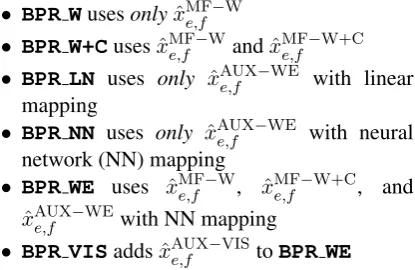
We conduct experiments using the following vari-ants of our model, each of which progressively in-corporates more signals to rank candidate English target words. When a variant uses more than one formulation ofxˆe,f, it applies them using the
back-off scheme that we have described before. • BPR WusesonlyxˆMFe,f−W
• BPR W+CusesxˆMFe,f−WandxˆMFe,f−W+C
• BPR LN uses only xˆAUXe,f −WE with linear mapping
• BPR NN uses only xˆAUXe,f −WE with neural network (NN) mapping
• BPR WE uses xˆMF−W
e,f , xˆMFe,f−W+C, and
ˆ
xAUXe,f −WEwith NN mapping
[image:7.595.83.291.276.411.2]• BPR VISaddsxˆAUXe,f −VIStoBPR WE
Table 1:Acc10performance onVULIC1000
Baseline BPR+MNN BPR LN BPR WE (MNN)
IT-EN 78.8% 79.4% 81.3% 86.0%
ES-EN 81.8% 82.1% 83.4% 87.1%
NL-EN 80.8% 81.6% 83.2% 87.2%
We evaluate the performance ofBPR WE against a baseline that is the state-of-the-art model of Vuli´c and Korhonen (2016), on benchmark
VULIC1000 (Table 1). The baseline (MNN) learns a linear mapping between monolingual em-bedding spaces and finds translations in an unsu-pervised manner: it ranks candidate target words based on their cosine similarities to the source word in the mapped space. As seed translation pairs, MNN uses mutual nearest neighbor pairs (MNN) obtained from pseudo-bilingual corpora constructed from unannotated monolingual data of the source and target languages (Vulic and Moens, 2016). We train MNN and our models using the
same 100-dimensional word2vec monolingual
word embeddings.
As seen in Table 1, we see the benefit of learning translations in a supervised manner.
BPR+MNNuses the same MNN seed translations asMNN, obtained from unannotated monolingual data of English and the foreign language, to learn the linear mapping between their embedding spaces. However, unlikeMNN,BPR+MNNuses the mapped word vectors to predict ranking in a su-pervisedmanner with BPR objective. This results in higher accuracies thanMNN. Using seed trans-lations from crowdsourced dictionaries to learn the linear mapping (BPR LN) improves accuracies even further compared to using MNN seed trans-lations obtained from unannotated data. Finally, BPR WE that learns translations in a supervised manner and uses third language translations and non-linear mapping (trained with crowdsourced translations not in the test set) performs consis-tently and very significantly better than the state-of-the-art on all benchmark test sets. This shows that incorporating more and better signals of trans-lation can improve performance significantly.
Evaluating on CROWDTEST, we observe a
similar trend over all 27 languages (Figure 5). Par-ticularly, we see thatBPR WandBPR W+Csuffer from thecoldstart issue where there are too few or no observed translations in the matrix to make ac-curate predictions. Incorporating auxiliary infor-mation in the form of bilingually-informed word embeddings improves the accuracy of the predic-tions dramatically. For many languages, learn-ing these billearn-ingually-informed word embeddlearn-ings with non-linear mapping improves accuracy even more. The top accuracy scores achieved by the model vary across languages and seem to be in-fluenced by the amount of data i.e., Wikipedia to-kens and seed lexicons entries available for train-ing. Somali (so) for example, has only 0.9 million tokens available in its Wikipedia for training the
word2vecembeddings and only 3 thousand seed
translations for learning the mapping between the word embedding spaces. In comparison, Span-ish (es) has over 500 million tokens available in its Wikipedia and 11 thousand seed translations. We also believe that our choice of tokenization may not be suitable for some languages – we use a simple regular-expression based tokenizer for many languages that do not have a trained NLTK6 tokenization model. This may influence perfor-mance on languages such as Vietnamese (vi) on which we have a low performance despite its large Wikipedia corpus.
0% 10% 20% 30% 40% 50% 60% 70% 80% 90% 100%
[image:8.595.100.507.71.230.2]so uz vi ne gu ta te az bn lv hi cy hu bs sq uk sk id sv tr nl bg it fr sr ro es BPR_W BPR_W+C BPR_LINEAR BPR_NN BPR_WE
Figure 5: Acc10 on CROWDTEST across all 27 languages show that adding more and better signals
for translation improves translation accuracies. The top accuracies achieved by our model: BPR WE vary across languages and appear to be influenced by the amount of data (Wikipedia tokens and seed translations) and tokenization available for the language.
Table 2: Top-5 translations of the Indonesian wordkesadaran(awareness) using different model variants
BPR W BPR LN BPR NN BPR WE kesadaran kesadaran kesadaran kesadaran consciousness consciousness consciousness conscience goddess awareness empathy awareness friendship empathy awareness understanding
night perception perceptions consciousness nation mindedness perception acquaintance
Some example translations of an Indonesian word produced by different variants of our model are shown in Table 2. Adding third language trans-lation signals on top of the bilingually-informed auxiliary signals improves accuracies even fur-ther.7 The accuracies achieved by BPR WE on these languages are significantly better than pre-viously reported accuracies (Irvine and Callison-Burch, 2017) on test sets constructed from the same crowdsourced dictionaries (Pavlick et al., 2014)8.
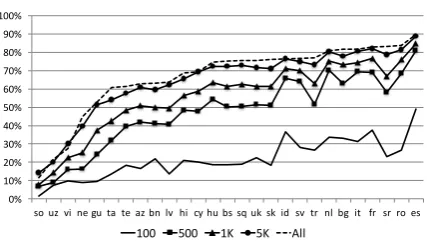
The accuracies across languages appear to im-prove consistently with the amount of signals be-ing input to the model. In the followbe-ing exper-iments, we investigate how sensitive these im-provements are with varying training size.
In Figure 6, we show accuracies obtained by
7Actual improvement per language depends on the cover-age of the Wikipedia interlangucover-age links for that langucover-age
8The comparison however, cannot be made apples-to-apples since the way Irvine and Callison-Burch (2017) select test sets from the crowdsourced dictionaries maybe different and they do not release the test sets
[image:8.595.174.423.361.435.2]0% 10% 20% 30% 40% 50% 60% 70% 80% 90% 100%
so uz vi ne gu ta te az bn lv hi cy hu bs sq uk sk id sv tr nl bg it fr sr ro es
100 500 1K 5K All
[image:9.595.75.289.59.180.2]Figure 6:Acc10across different seed lexicon sizes
Table 3: Acc10 performance on the multilingual
image corpus test set (Callahan, 2017)
Baseline BPR VIS # Seeds (CNN-AvgMax)
IT-EN 31.4% 55.8% 581
ES-EN 33.0% 58.3% 488
NL-EN 35.5% 69.2% 1857
FR-EN 37.1% 65.9% 1697
ID-EN 36.9% 45.3% 462
10 images (CNN features) of the words in this set as auxiliary visual signals to predict their transla-tions. In this experiment, we weigh auxiliary word embedding and visual features equally. To train the mapping of our word embedding features, we use as seeds crowdsourced translations not in test set.
We compare the quality of our translations with the baseline CNN-AVGMAX (Bergsma and
Van Durme, 2011), which considers cosine simi-larities between individual images from the source and target word languages and takes average of their maximum similarities as the final similarity between a source and a target word. For each source word, the candidate target words are ranked according to these final similarities. This base-line has been shown to be effective for inducing translations from images, both in the uni-modal (Bergsma and Van Durme, 2011; Kiela et al., 2015) and multi-modal models (Vuli´c et al., 2016). As seen in Table 3, incorporating additional bilingual and textual signals to the visual signals improves translations. Accuracies on these image corpus’ test sets are lower overall as they contain a lot of translations from our crowdsourced dictio-naries; thus we have much less seeds to train our word embedding mapping. Furthermore, these test sets contain 10 times as many translations as our previous test sets. Using more images instead of just 10 per word may also improve performance.
5 Conclusion
In this paper, we propose a novel framework for combining diverse, sparse and potentially noisy multi-modal signals for translations. We view the problem of learning translations as a matrix com-pletion task and use an effective and extendable matrix factorization approach with BPR to learn translations.
We show the effectiveness of our approach in large scale experiments. Starting from minimally-trained monolingual word embeddings, we con-sistently and very significantly outperform state-of-the-art approaches by combining these features with other features in a supervised manner using BPR. Since our framework is modular, each in-put to our prediction can be improved separately to improve the whole system e.g., by learning bet-ter word embeddings or a betbet-ter mapping func-tion to input into the auxiliary component. Our framework is also easily extendable to incorporate more bilingual and auxiliary signals of translation equivalence.
Acknowledgments
This material is based in part on research spon-sored by DARPA under grant number HR0011-15-C-0115 (the LORELEI program). The U.S. Gov-ernment is authorized to reproduce and distribute reprints for Governmental purposes. The views and conclusions contained in this publication are those of the authors and should not be interpreted as representing official policies or endorsements of DARPA and the U.S. Government.
This work was also supported by the French Na-tional Research Agency under project ANR-16-CE33-0013, and by Amazon through the Amazon Academic Research Awards (AARA) program.
References
Shane Bergsma and Benjamin Van Durme. 2011. Learning Bilingual Lexicons Using the Visual Similarity of Labeled Web Images. In IJCAI Proceedings-International Joint Conference on Ar-tificial Intelligence, pages 1764–1769, Barcelona, Spain.
Brendan Callahan. 2017. Image-based bilingual lexi-con induction for low resource languages. Master’s thesis, University of Pennsylvania.
Human Language Technology Conference of the NAACL, Main Conference, pages 17–24, New York City.
Sarath Chandar A P, Stanislas Lauly, Hugo Larochelle, Mitesh Khapra, Balaraman Ravindran, Vikas C Raykar, and Amrita Saha. 2014. An Autoencoder Approach to Learning Bilingual Word Representa-tions. InAdvances in Neural Information Process-ing Systems 27, pages 1853–1861.
Hal Daum´e and Jagadeesh Jagarlamudi. 2011. Do-main Adaptation for Machine Translation by Min-ing Unseen Words. InProceedings of the 49th An-nual Meeting of the Association for Computational Linguistics: Human Language Technologies, pages 407–412, Portland, Oregon.
Georgiana Dinu, Angeliki Lazaridou, and Marco Ba-roni. 2014. Improving zero-shot learning by miti-gating the hubness problem. InProceedings of ICLR Workshop, San Diego, California.
Miao Fan, Deli Zhao, Qiang Zhou, Zhiyuan Liu, Thomas Fang Zheng, and Edward Y. Chang. 2014. Distant Supervision for Relation Extraction with Matrix Completion. InProceedings of the 52nd An-nual Meeting of the Association for Computational Linguistics (Volume 1: Long Papers), pages 839– 849, Baltimore, Maryland.
Manaal Faruqui and Chris Dyer. 2014. Improving Vec-tor Space Word Representations Using Multilingual Correlation. InProceedings of the 14th Conference of the European Chapter of the Association for Com-putational Linguistics, pages 462–471, Gothenburg, Sweden.
Zeno Gantner, Lucas Drumond, Christoph Freuden-thaler, Steffen Rendle, and Lars Schmidt-Thieme. 2010. Learning attribute-to-feature mappings for cold-start recommendations. In Data Mining (ICDM), 2010 IEEE 10th International Conference on, pages 176–185. IEEE.
Cyril Goutte, Kenji Yamada, and Eric Gaussier. 2004. Aligning words using matrix factorisation. In Pro-ceedings of the 42nd Annual Meeting on Association for Computational Linguistics, page 502. Associa-tion for ComputaAssocia-tional Linguistics.
Stephan Gouws, Yoshua Bengio, and Greg Corrado. 2015. BilBOWA: Fast Bilingual Distributed Rep-resentations without Word Alignments. In Proceed-ings of the 32nd International Conference on Ma-chine Learning, ICML 2015, pages 748–756, Lille, France.
Caglar Gulcehre, Sungjin Ahn, Ramesh Nallapati, Bowen Zhou, and Yoshua Bengio. 2016. Pointing the Unknown Words. InProceedings of the 54th An-nual Meeting of the Association for Computational Linguistics (Volume 1: Long Papers), pages 140– 149, Berlin, Germany.
Ruining He and Julian McAuley. 2016. Vbpr: Visual bayesian personalized ranking from implicit feed-back. InAAAI Conference on Artificial Intelligence, pages 144–150. AAAI Press.
Ann Irvine and Chris Callison-Burch. 2013. Super-vised Bilingual Lexicon Induction with Multiple Monolingual Signals. In Proceedings of the 2013 Conference of the North American Chapter of the Association for Computational Linguistics (NAACL 2013), pages 518–523, Atlanta, Georgia.
Ann Irvine and Chris Callison-Burch. 2016. End-to-end statistical machine translation with zero or small parallel texts.Natural Language Engineering, 22(04):517–548.
Ann Irvine and Chris Callison-Burch. 2017. A Com-prehensive Analysis of Bilingual Lexicon Induction.
Computational Linguistics, 43(2):273–310.
Douwe Kiela, Ivan Vuli´c, and Stephen Clark. 2015. Vi-sual Bilingual Lexicon Induction with Transferred ConvNet Features. InProceedings of the 2015 Con-ference on Empirical Methods in Natural Language Processing, pages 148–158, Lisbon, Portugal. Alexandre Klementiev, Ann Irvine, Chris
Callison-Burch, and David Yarowsky. 2012a. Toward Statis-tical Machine Translation without Parallel Corpora. InProceedings of the 13th Conference of the Euro-pean Chapter of the Association for Computational Linguistics, pages 130–140, Avignon, France. Alexandre Klementiev and Dan Roth. 2006. Weakly
Supervised Named Entity Transliteration and Dis-covery from Multilingual Comparable Corpora. In
Proceedings of the 21st International Conference on Computational Linguistics and 44th Annual Meet-ing of the Association for Computational LMeet-inguis- Linguis-tics, pages 817–824, Sydney, Australia.
Alexandre Klementiev, Ivan Titov, and Binod Bhat-tarai. 2012b. Inducing Crosslingual Distributed Representations of Words. InProceedings of COL-ING 2012, pages 1459–1474, Mumbai, India. Philipp Koehn, Franz Josef Och, and Daniel Marcu.
2003. Statistical Phrase-Based Translation. In
Proceedings of the 2003 Conference of the North American Chapter of the Association for Computa-tional Linguistics on Human Language Technology-Volume 1, pages 48–54.
Yehuda Koren, Robert Bell, and Chris Volinsky. 2009. Matrix Factorization Techniques for Recommender Systems.Computer, 42(8):30–37.
Thang Luong, Hieu Pham, and Christopher D. Man-ning. 2015. Bilingual Word Representations with Monolingual Quality in Mind. InProceedings of the 1st Workshop on Vector Space Modeling for Natural Language Processing, pages 151–159, Denver, Col-orado.
Tomas Mikolov, Quoc V Le, and Ilya Sutskever. 2013a. Exploiting similarities among languages for ma-chine translation. arXiv preprint arXiv:1309.4168.
Tomas Mikolov, Ilya Sutskever, Kai Chen, Greg S Cor-rado, and Jeff Dean. 2013b. Distributed Representa-tions of Words and Phrases and their Composition-ality. InAdvances in Neural Information Processing Systems 26, pages 3111–3119.
Ellie Pavlick, Matt Post, Ann Irvine, Dmitry Kachaev, and Chris Callison-Burch. 2014. The language de-mographics of Amazon Mechanical Turk. Transac-tions of the Association for Computational Linguis-tics, 2:79–92.
Reinhard Rapp. 1995. Identifying Word Translations in Non-Parallel Texts. InProceedings of the 33rd Annual Meeting of the Association for Computa-tional Linguistics, pages 320–322, Cambridge, Mas-sachusetts.
Radim ˇReh˚uˇrek and Petr Sojka. 2010. Software Frame-work for Topic Modelling with Large Corpora. In
Proceedings of the LREC 2010 Workshop on New Challenges for NLP Frameworks, pages 45–50, Val-letta, Malta.
Steffen Rendle, Christoph Freudenthaler, Zeno Gant-ner, and Lars Schmidt-Thieme. 2009. BPR: Bayesian Personalized Ranking from Implicit Feed-back. In Proceedings of the Twenty-Fifth Confer-ence on Uncertainty in Artificial IntelligConfer-ence, pages 452–461.
Sebastian Riedel, Limin Yao, Andrew McCallum, and Benjamin M. Marlin. 2013. Relation Extraction with Matrix Factorization and Universal Schemas. InProceedings of the 2013 Conference of the North American Chapter of the Association for Computa-tional Linguistics: Human Language Technologies, pages 74–84, Atlanta, Georgia.
Tim Rockt¨aschel, Sameer Singh, and Sebastian Riedel. 2015. Injecting Logical Background Knowledge into Embeddings for Relation Extraction. In Pro-ceedings of the 2015 Conference of the North Amer-ican Chapter of the Association for Computational Linguistics: Human Language Technologies, pages 1119–1129, Denver, Colorado.
Charles Schafer and David Yarowsky. 2002. Inducing Translation Lexicons via Diverse Similarity Mea-sures and Bridge Languages. In Proceedings of the 6th Conference on Natural Language Learning - Volume 20, COLING-02, pages 1–7, Taipei, Tai-wan.
Rico Sennrich, Barry Haddow, and Alexandra Birch. 2016a. Improving Neural Machine Translation Models with Monolingual Data. InProceedings of the 54th Annual Meeting of the Association for Com-putational Linguistics (Volume 1: Long Papers), pages 86–96, Berlin, Germany.
Rico Sennrich, Barry Haddow, and Alexandra Birch. 2016b. Neural Machine Translation of Rare Words with Subword Units. InProceedings of the 54th An-nual Meeting of the Association for Computational Linguistics (Volume 1: Long Papers), pages 1715– 1725, Berlin, Germany.
Tianze Shi, Zhiyuan Liu, Yang Liu, and Maosong Sun. 2015. Learning Cross-lingual Word Embed-dings via Matrix Co-factorization. InProceedings of the 53rd Annual Meeting of the Association for Computational Linguistics and the 7th International Joint Conference on Natural Language Processing (Volume 2: Short Papers), pages 567–572, Beijing, China.
Richard Socher, Milind Ganjoo, Christopher D Man-ning, and Andrew Ng. 2013. Zero-Shot Learn-ing Through Cross-Modal Transfer. In Advances in Neural Information Processing Systems 26, pages 935–943.
Shyam Upadhyay, Manaal Faruqui, Chris Dyer, and Dan Roth. 2016. Cross-lingual models of word em-beddings: An empirical comparison. In Proceed-ings of the 54th Annual Meeting of the Association for Computational Linguistics (Volume 1: Long Pa-pers), pages 1661–1670, Berlin, Germany.
Patrick Verga, David Belanger, Emma Strubell, Ben-jamin Roth, and Andrew McCallum. 2016. Multi-lingual relation extraction using compositional uni-versal schema. In Proceedings of the 2016 Con-ference of the North American Chapter of the As-sociation for Computational Linguistics: Human Language Technologies, pages 886–896, San Diego, California.
Ivan Vuli´c, Douwe Kiela, Stephen Clark, and Marie-Francine Moens. 2016. Multi-Modal Representa-tions for Improved Bilingual Lexicon Learning. In
Proceedings of the 54th Annual Meeting of the As-sociation for Computational Linguistics (Volume 2: Short Papers), pages 188–194, Berlin, Germany. Ivan Vuli´c and Anna Korhonen. 2016. On the Role of
Seed Lexicons in Learning Bilingual Word Embed-dings. InProceedings of the 54th Annual Meeting of the Association for Computational Linguistics (Vol-ume 1: Long Papers), pages 247–257, Berlin, Ger-many.
Ivan Vuli´c and Marie-Francine Moens. 2015. Bilingual Word Embeddings from Non-Parallel Document-Aligned Data Applied to Bilingual Lexicon Induc-tion. In Proceedings of the 53rd Annual Meet-ing of the Association for Computational LMeet-inguistics and the 7th International Joint Conference on Natu-ral Language Processing (Volume 2: Short Papers), pages 719–725, Beijing, China.
Ivan Vulic and Marie-Francine Moens. 2016. Bilingual Distributed Word Representations from Document-Aligned Comparable Data. Journal of Artificial In-telligence Research, 55:953–994.
Yonghui Wu, Mike Schuster, Zhifeng Chen, Quoc V Le, Mohammad Norouzi, Wolfgang Macherey, Maxim Krikun, Yuan Cao, Qin Gao, Klaus Macherey, et al. 2016. Google’s Neural Machine Translation System: Bridging the Gap between Human and Machine Translation. arXiv preprint arXiv:1609.08144.
Guangyou Zhou, Fang Liu, Yang Liu, Shizhu He, and Jun Zhao. 2013. Statistical machine translation im-proves question retrieval in community question an-swering via matrix factorization. InProceedings of the 51st Annual Meeting of the Association for Com-putational Linguistics (Volume 1: Long Papers), pages 852–861, Sofia, Bulgaria.