Supervised Keyphrase Extraction as Positive Unlabeled Learning
Lucas Sterckx∗, Cornelia Caragea†, Thomas Demeester∗, Chris Develder∗ ∗Ghent University – iMinds, Ghent, Belgium
{lusterck,tdmeeste,cdvelder}@intec.ugent.be
†University of North Texas, Texas, USA
Abstract
The problem of noisy and unbalanced train-ing data for supervised keyphrase extraction results from the subjectivity of keyphrase as-signment, which we quantify by crowdsourc-ing keyphrases for news and fashion magazine articles with many annotators per document. We show that annotators exhibit substantial disagreement, meaning that single annotator data could lead to very different training sets for supervised keyphrase extractors. Thus, an-notations from single authors or readers lead to noisy training data and poor extraction per-formance of the resulting supervised extractor. We provide a simple but effective solution to still work with such data by reweighting the importance of unlabeled candidate phrases in a two stage Positive Unlabeled Learning set-ting. We show that performance of trained keyphrase extractors approximates a classi-fier trained on articles labeled by multiple an-notators, leading to higher average F1scores
and better rankings of keyphrases. We ap-ply this strategy to a variety of test collec-tions from different backgrounds and show improvements over strong baseline models.
1 Introduction
Keyphrase extraction is the task of extracting a se-lection of phrases from a text document to concisely summarize its contents. Applications of keyphrases range from summarization (D’Avanzo et al., 2004) to contextual advertisement (Yih et al., 2006) or sim-ply as aid for navigation through large text corpora.
Existing work on automatic keyphrase extraction can be divided in supervised and unsupervised
ap-proaches. While unsupervised approaches are do-main independent and do not require labeled train-ing data, supervised keyphrase extraction allows for more expressive feature design and is reported to outperform unsupervised methods on many occa-sions (Kim et al., 2012; Caragea et al., 2014). A requirement for supervised keyphrase extractors is the availability of labeled training data. In literature, training collections for supervised keyphrase extrac-tion are generated in different settings. In these col-lections, keyphrases for text documents are either supplied by the authors or their readers. In the first case, authors of academic papers or news articles as-sign keyphrases to their content to enable fast index-ing or to allow for the discovery of their work in electronic libraries (Frank et al., 1999; Hulth, 2003; Bulgarov and Caragea, 2015). Other collections are created by crowdsourcing (Marujo et al., 2012) or based on explicit deliberation by a small group of readers (Wan and Xiao, 2008). A minority of test collections provide multiple opinions per document, but even then the amount of opinions per document is kept minimal (Nguyen and Kan, 2007).
The traditional procedure for supervised keyphrase extraction is reformulating the task as a binary classification of keyphrase candidates. Supervision for keyphrase extraction faces several shortcomings. Candidate phrases (generated in a separate candidate generation procedure), which are not annotated as keyphrases, are seen as non-keyphrase and are used as negative training data for the supervised classifiers. First, on many occasions these negative phrases outnumber true keyphrases many times, creating an unbalanced
0.0 0.2 0.4 0.6 0.8 1.0 Fraction of Users Agree
0.0 0.1 0.2 0.3 0.4 0.5 0.6
F
ra
ct
io
n
of
K
ey
ph
ra
se
s
Online News Lifestyle Magazines
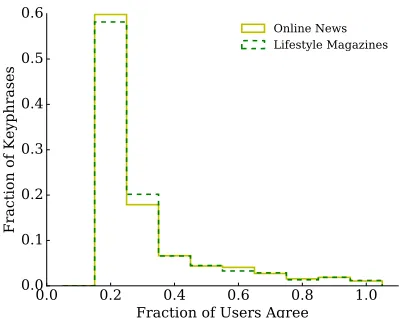
Figure 1: This plot shows the fraction of all keyphrases from the training set agreed upon versus the fraction of all annotators.
training set (Frank et al., 1999; Kim et al., 2012). Second, as Frank et al. (1999) noted: authors do not always choose keyphrases that best describe the content of their paper, but they may choose phrases to slant their work a certain way, or to maximize its chance of being noticed by searchers. Another problem is that keyphrases are inherently subjective, i.e., keyphrases assigned by one annotator are not the only correct ones (Nguyen and Kan, 2007). These assumptions have consequences for training, developing and evaluating supervised models. Unfortunately, a large collection of annotated documents by reliable annotators with high overlap per document is missing, making it difficult to study disagreement between annotators or the resulting influence on trained extractors, as well as to provide a reliable evaluation setting. In this paper, we address these problems by creating a large test collection of articles with many different opinions per article, evaluate the effect on extraction per-formance, and present a procedure for supervised keyphrase extraction with noisy labels.
2 Noisy Training Data for Supervised Keyphrase Extraction
A collection of online news articles and lifestyle magazine articles was presented to a panel of 357 annotators of various ages and backgrounds,
(se-Figure 2: Effect of overlap on extraction perfor-mance.
lected and managed by iMinds - Living Labs1) who
were trained to select a limited number of short
phrases that concisely reflect the documents’ con-tents. No prior limits or constraints were set on the amount, length, or form of the keyphrases. Each document was presented multiple times to different users. Each user was assigned with 140 articles, but was not required to finish the full assignment. The constructed training collections have on average six and up to ten different opinions per article.
We visualize the agreement on single keyphrases in Figure 1, which shows the fraction of annotated keyphrases versus agreement by the complete set of readers. Agreement on keyphrases appears low, as a large fraction of all keyphrases assigned to doc-uments (>50%) are only assigned by single
annota-tors. We note that different sets of keyphrases by dif-ferent annotators are the result of the subjectiveness of the task, of different interpretations by the anno-tators of the document, but also because of seman-tically equivalent keyphrases being annotated in dif-ferent forms, e.g., “Louis Michel” vs. “Prime Min-ister Louis Michel” or “Traffic Collision” vs. “Car Accident”.
The observation in Figure 1 has important con-sequences for training models on keyphrases anno-tated by a single annotator, since other annotators may have chosen some among the ones that the
[image:2.612.77.281.68.227.2] [image:2.612.311.538.68.224.2]gle selected annotator did not indicate (and hence these should not be used as negative training data).
A single annotator assigning keyphrases to 100 documents results on average in a training set with 369 positive training instances and 4,981 negative training instances generated by the candidate ex-tractor. When assigning these 100 documents to 9 other annotators, the amount of positive instances in-creases to 1,258 keyphrases, which means that labels for 889 keyphrase candidates, or 17% of the original negative candidates when training on annotations by a single annotator, can be considered noise and rela-beled. As a result, ratios of positive to negative data also change drastically. We visualize the effect of using training data from multiple annotators per doc-ument in Figure 2. Classifiers trained on the aggre-gated training collection with multiple opinions (us-ing all assigned keyphrases at least once as positive training data) perform better on held-out test collec-tions containing only keyphrases of high agreement (assigned by>2annotators).
When using keyphrases from many different an-notators per document, the amount of positive can-didates increases and as a result, the Macro Average F1 (MAF1) of the corresponding classifier. We
de-tail our experimental setup and supervised classifier in Section 4.
3 Reweighting Keyphrase Candidates
Observations described in Section 2 indicate that unlabeled keyphrase candidates are not reliable as negative examples by default. A more suitable as-sumption is to treat supervised keyphrase extraction as Positive Unlabeled Learning, i.e., an incomplete set of positive examples is available as well as a set of unlabeled examples, of which some are positive and others negative. This topic has received much attention as it knows many applications (Ren et al., 2014; du Plessis et al., 2014), but has not been linked to supervised keyphrase extraction. We base our ap-proach on work by Elkan and Noto (2008) and mod-ify the supervised extractor by assigning individual weights to training examples. Instead of assuming the noise to be random, we assign weights depend-ing on the document and the candidate.
By reweighting importance of training samples, we seek to mimic the case of multiple annotators, to
Feature Definition
Head match headkeyphrase==headcandidate Extent match extentkeyphrase==extentcandidate Substring headkeyphrasesubstring ofheadcandidate Alias acronym(headkeyphrase) ==headcandidate
Table 1: String relation features for coreference res-olution
model the uncertainty of negative keyphrase candi-dates, based only on annotations by a single annota-tor. In a first stage, we train a classifier on the single annotator data and use predictions on the negative or unlabeled candidates, to reweigh training instances. The reweighted training collection is then used to train a second classifier to predict a final ranking or the binary labels of the keyphrase candidates.
Positive examples are given unit weight and unla-beled examples are duplicated; one copy of each un-labeled keyphrase candidatexis made positive with
weight w(x) = P(keyphrase|x, s = 0) and the other copy is made negative with weight1−w(x) withsindicating whetherxis labeled or not.
Instead of assigning this weight as a constant fac-tor of the predictions by the initial classifier as in Elkan and Noto (2008), we found that two modifica-tions allow improving the weight estimate,w(x) ≤ 1. We normalize probabilitiesP(keyphrase, x, s= 0) to candidates not included in the initial set of keyphrases per document. Next to this self-predicted probability, we include a simple mea-sure indicating pairwise coreference between unla-beled candidates and known keyphrases in a func-tion Coref(candidate, keyphrase) ∈ {0,1}, re-turning1if one of the binary indicator features, pre-sented in (Bengtson and Roth, 2008) and shown in Table 1, is present. In this description, the term
headmeans the head noun phrase of a candidate or keyphrase and theextentis the largest noun phrase headed by the head noun phrase. The self-predicted probability is summed with the output of the coref-erence resolver and the final weight becomes:
w(x) =min
1, P(keyphrase|x)
max(x0,s=0)∈dP(keyphrase|x0)
.
+ max
∀keyphrase∈dCoref(x, keyphrase)
(1)
with dbeing a document from the training
Test Collections
Name Online News Lifestyle Magazines WWW KDD Inspec Type Sports Articles Fashion, Lifestyle WWW Paper Abstracts KDD Paper Abstracts Paper Abstracts
# Documents 1,259 2,202 1,895 1,011 500
# Keyphrases 19,340 29,970 3,922 1,966 4,913
Keyphrases/User 5.7 4.7 / / /
Keyphrases/Document 15.4 13.7 2.0 1.8 9.8
Tokens/Document 332 284 164 195 134
Candidate Keyphrases/Doc. 52 49 47 54 34
[image:4.612.70.550.57.252.2]1/2/3/3+ -gram distribution (%) 55/27/9/9 58/25/9/8 63/27/8/2 60/28/9/3 13/53/25/9
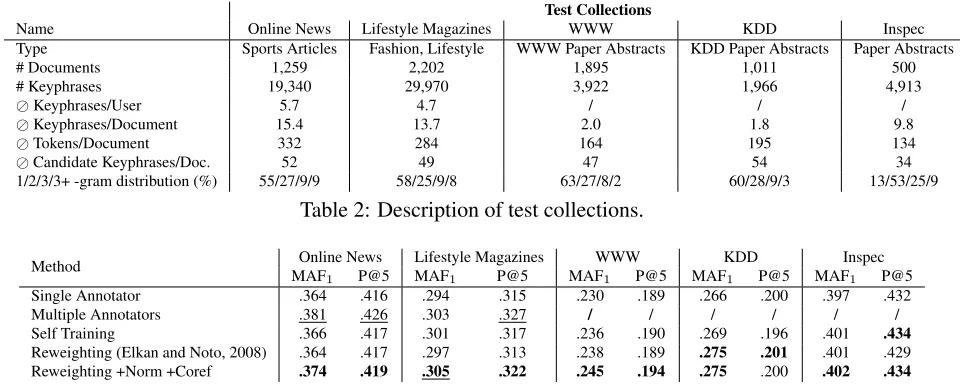
Table 2: Description of test collections.
Method MAFOnline News Lifestyle Magazines WWW KDD Inspec
1 P@5 MAF1 P@5 MAF1 P@5 MAF1 P@5 MAF1 P@5
Single Annotator .364 .416 .294 .315 .230 .189 .266 .200 .397 .432 Multiple Annotators .381 .426 .303 .327 / / / / / / Self Training .366 .417 .301 .317 .236 .190 .269 .196 .401 .434
Reweighting (Elkan and Noto, 2008) .364 .417 .297 .313 .238 .189 .275 .201 .401 .429 Reweighting +Norm +Coref .374 .419 .305 .322 .245 .194 .275 .200 .402 .434 Table 3: Mean average F1score per document and precision for five most confident keyphrases on different
test collections.
4 Experiments and Results
Hasan and Ng (2010) have shown that techniques for keyphrase extraction are inconsistent and need to be tested across different test collections. Next to our collections with multiple opinions ( On-line News and Lifestyle Magazines), we apply the reweighting strategy on test collections with sets of author-assigned keyphrases: two sets from Cite-Seer abstracts from the World Wide Web Conference (WWW) and Knowledge Discovery and Data Min-ing (KDD), similar to the ones used in (Bulgarov and Caragea, 2015). TheInspecdataset is a collec-tion of 2,000 abstracts commonly used in keyphrase extraction literature, where we use the ground truth phrases from controlled vocabulary (Hulth, 2003). Descriptive statistics of these test collections are given in Table 2.
We use a rich feature set consisting of statis-tical, structural, and semantic properties for each candidate phrase, that have been reported as ef-fective in previous studies on supervised extrac-tors (Frank et al., 1999; Hulth, 2003; Kim and Kan, 2009): (i) term frequency, (ii) number of tokens in the phrase, (iii) length of the longest term in the phrase, (iv) number of capital letters in the phrase, (v) the phrase’s POS-tags, (vi) rel-ative position of first occurrence, (vii) span (rela-tive last occurrence minus rela(rela-tive first occurrence), (viii) TF*IDF (IDF’s trained on large background
collections from the same source) and (ix) Topical Word Importance, a feature measuring the similar-ity between the word-topic topic-document distribu-tions presented in (Sterckx et al., 2015), with topic models trained on background collections from a corresponding source of content.
As classifier we use gradient boosted decision trees implemented in the XGBoost package (Chen and Guestrin, 2016). During development, this clas-sifier consistently outperformed Naive Bayes and linear classifiers like logistic regression or support vector machines.
We compare the reweighting strategy with uni-form reweighting and strategies to counter the im-balance or noise of the training collections, such as subsampling, weighting unlabeled training data as in (Elkan and Noto, 2008), and self-training in which only confident initial predictions are used as positive and negative data. For every method, global thresh-olds are chosen to optimize the macro averaged F1
per document (MAF1). Next to the threshold
sensi-tive F1, we report on ranking quality using the
Pre-cision@5 metric.
imbalance and noise tends to have less effect when the ratio of keyphrases versus candidates is high (as forInspec) or training collection is very large. When the amount of training documents increases, the ra-tio of noisy versus true negative labels drops.
5 Conclusion
It has been suggested that keyphrase annotation is highly subjective. We present two data sets where we purposely gathered multiple annotations of the same document, as to quantify the lim-ited overlap between keyphrases selected by differ-ent annotators. We suggest to treat non-selected phrases as unlabeled rather than negative training data. We further show that using multiple anno-tations leads to more robust automatic keyphrase extractors, and propose reweighting of single an-notator labels based on probabilities from a first-stage classifier. This reweighting approach outper-forms other single-annotator state-of-the-art auto-matic keyphrase extractors on different test collec-tions, when we normalize probabilities per docu-ment and include co-reference indicators.
Acknowledgments
The authors like to thank the anonymous review-ers for their helpful comments. The research presented in this article relates to STEAMER
(http://www.iminds.be/en/projects/
2014/07/12/steamer), a MiX-ICON project
facilitated by iMinds Media and funded by IWT and Innoviris.
References
[Bengtson and Roth2008] Eric Bengtson and Dan Roth. 2008. Understanding the value of features for coref-erence resolution. In 2008 Conference on Empiri-cal Methods in Natural Language Processing, EMNLP 2008, Proceedings of the Conference, 25-27 October 2008, Honolulu, Hawaii, USA, A meeting of SIGDAT, a Special Interest Group of the ACL, pages 294–303. [Bulgarov and Caragea2015] Florin Adrian Bulgarov and
Cornelia Caragea. 2015. A comparison of super-vised keyphrase extraction models. InProceedings of the 24th International Conference on World Wide Web Companion, WWW 2015, Florence, Italy, May 18-22, 2015 - Companion Volume, pages 13–14.
[Caragea et al.2014] Cornelia Caragea, Florin Adrian Bulgarov, Andreea Godea, and Sujatha Das Gollapalli.
2014. Citation-enhanced keyphrase extraction from research papers: A supervised approach. In Proceed-ings of the 2014 Conference on Empirical Methods in Natural Language Processing (EMNLP), pages 1435– 1446, Doha, Qatar, October. Association for Compu-tational Linguistics.
[Chen and Guestrin2016] Tianqi Chen and Carlos Guestrin. 2016. Xgboost: A scalable tree boosting system. CoRR, abs/1603.02754.
[D’Avanzo et al.2004] Ernesto D’Avanzo, Bernardo Magnini, and Alessandro Vallin. 2004. Keyphrase extraction for summarization purposes: The LAKE system at DUC-2004. In Proceedings of the 2004 DUC.
[du Plessis et al.2014] Marthinus Christoffel du Plessis, Gang Niu, and Masashi Sugiyama. 2014. Analysis of learning from positive and unlabeled data. In Ad-vances in Neural Information Processing Systems 27: Annual Conference on Neural Information Processing Systems 2014, December 8-13 2014, Montreal, Que-bec, Canada, pages 703–711.
[Elkan and Noto2008] Charles Elkan and Keith Noto. 2008. Learning classifiers from only positive and unla-beled data. InProceedings of the 14th ACM SIGKDD International Conference on Knowledge Discovery and Data Mining, Las Vegas, Nevada, USA, August 24-27, 2008, pages 213–220.
[Frank et al.1999] Eibe Frank, Gordon W. Paynter, Ian H. Witten, Carl Gutwin, and Craig G. Nevill-manning. 1999. Domain specific keyphrase extraction. In Pro-ceedings of the 16th International Joint Conference on AI, pages 668–673.
[Hasan and Ng2010] Kazi Saidul Hasan and Vincent Ng. 2010. Conundrums in unsupervised keyphrase extrac-tion: Making sense of the state-of-the-art. In Proceed-ings of the 23rd COLING, COLING 2010, pages 365– 373, Stroudsburg, PA, USA.
[Hulth2003] Anette Hulth. 2003. Improved automatic keyword extraction given more linguistic knowledge. In Proceedings of the 2003 conference on Empirical methods in natural language processing, pages 216– 223.
[Kim and Kan2009] Su Nam Kim and Min-Yen Kan. 2009. Re-examining automatic keyphrase extraction approaches in scientific articles. InProceedings of the workshop on multiword expressions: Identification, in-terpretation, disambiguation and applications, pages 9–16. Association for Computational Linguistics. [Kim et al.2012] Su Nam Kim, Olena Medelyan,
[Marujo et al.2012] Luis Marujo, Anatole Gershman, Jaime Carbonell, Robert Frederking, and Jo ao P. Neto. 2012. Supervised topical key phrase extraction of news stories using crowdsourcing, light filtering and co-reference normalization. InProceedings of LREC 2012. ELRA.
[Nguyen and Kan2007] Thuy Dung Nguyen and Min-Yen Kan. 2007. Key phrase extraction in scientific publi-cations. InProceeding of International Conference on Asian Digital Libraries, pages 317–326.
[Ren et al.2014] Yafeng Ren, Donghong Ji, and Hong-bin Zhang. 2014. Positive unlabeled learning for deceptive reviews detection. In Proceedings of the 2014 Conference on Empirical Methods in Natural Language Processing, EMNLP 2014, October 25-29, 2014, Doha, Qatar, A meeting of SIGDAT, a Special Interest Group of the ACL, pages 488–498.
[Sterckx et al.2015] Lucas Sterckx, Thomas Demeester, Johannes Deleu, and Chris Develder. 2015. Topi-cal word importance for fast keyphrase extraction. In Proceedings of the 24th International Conference on World Wide Web Companion, pages 121–122. Interna-tional World Wide Web Conferences Steering Com-mittee.
[Wan and Xiao2008] Xiaojun Wan and Jianguo Xiao. 2008. Single document keyphrase extraction using neighborhood knowledge. InProceedings of the 23rd National Conference on Artificial Intelligence - Vol-ume 2, AAAI 2008, pages 855–860.