Joint Transition-based Dependency Parsing and Disfluency Detection for
Automatic Speech Recognition Texts
Masashi Yoshikawa and Hiroyuki Shindo and Yuji Matsumoto
Graduate School of Information and Science Nara Institute of Science and Technology 8916-5, Takayama, Ikoma, Nara, 630-0192, Japan
{ masashi.yoshikawa.yh8, shindo, matsu }@is.naist.jp
Abstract
Joint dependency parsing with disfluency de-tection is an important task in speech lan-guage processing. Recent methods show high performance for this task, although most au-thors make the unrealistic assumption that in-put texts are transcribed by human annota-tors. In real-world applications, the input text is typically the output of an automatic speech recognition (ASR) system, which implies that the text contains not only disfluency noises but also recognition errors from the ASR system. In this work, we propose a parsing method that handles both disfluency and ASR errors us-ing an incremental shift-reduce algorithm with several novel features suited to ASR output texts. Because the gold dependency informa-tion is usually annotated only on transcribed texts, we also introduce an alignment-based method for transferring the gold dependency annotation to the ASR output texts to struct training data for our parser. We con-ducted an experiment on the Switchboard cor-pus and show that our method outperforms conventional methods in terms of dependency parsing and disfluency detection.
1 Introduction
Spontaneous speech is different from written text in many ways, one of which is that it contains disfluen-cies, that is, parts of the utterance that are corrected by the speaker during the utterance. NLP system performance is reported to deteriorate when there are disfluencies, for example, with SMT (Cho et al., 2014). Therefore, it is desirable to preprocess the speech before passing it to other NLP tasks.
There are a number of studies that address the problem of detecting disfluencies. Some of these studies include dependency parsing (Honnibal and Johnson, 2014; Wu et al., 2015; Rasooli and Tetreault, 2014), whereas others are dedicated sys-tems (Qian and Liu, 2013; Ferguson et al., 2015; Hough and Purver, 2014; Hough and Schlangen, 2015; Liu et al., 2003). Among these studies, Hon-nibal (2014) and Wu (2015) address this problem by adding a new action to transition-based dependency parsing that removes the disfluent parts of the in-put sentence from the stack. Using this approach, they achieved high performance in terms of both de-pendency parsing and disfluency detection on the Switchboard corpus.
However, the authors assume that the input texts to parse are transcribed by human annotators, which, in practice, is unrealistic. In real-world applications, in addition to disfluencies, the input texts contain ASR errors; these issues might degrade the parsing performance. For example, proper nouns that are not contained in the ASR system vocabulary may break up into smaller pieces, yielding a difficult problem for the parsing unit (Cheng et al., 2015):
REF: what can we get atLitanfeeth
HYP: what can we getit leaks on feet
In this work, we propose a method for joint de-pendency parsing and disfluency detection that can robustly parse ASR output texts. Our parser handles both disfluencies and ASR errors using an incremen-tal shift-reduce algorithm, with novel features that consider recognition errors of the ASR system.
Furthermore, to evaluate dependency parsing
they may flip flop when they get to be uh N N older
they made slipped flop when they get to be uh old way older
ROOT
Trans:
error error error
ASR:
ROOT error
ASR-to-NULL:
ASR output token aligns to NULL in gold transcription.
NOT MATCH:
Aligned tokens does not match on character.
what age are your children
what age N your children
error error
ROOT ROOT
ROOT
Trans-to-NULL:
Transcription token aligns to NULL in ASR output text.
[image:2.612.110.495.56.184.2](a) (b)
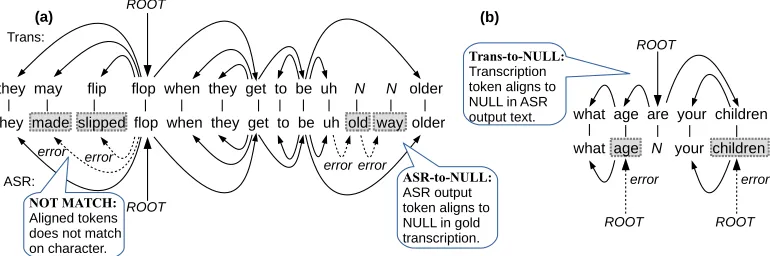
Figure 1: Examples of three problematic cases. Above shows the gold transcription and its tree, below shows the aligned ASR output and its newly transferred tree, where the dotted edges are ASR error edges.
formance on real human utterances, we create a tree-annotated corpus that contains ASR errors.1
2 Data Creation
To evaluate dependency parsing performance on real speech texts, we must create a tree-annotated corpus of ASR output texts.
Given a corpus that consists of speech data, tran-scription text and its syntactic annotation (e.g., the Switchboard corpus), we first apply the ASR sys-tem to the speech data. Next, we perform alignment between the ASR output texts and the transcription. Then, we transfer the gold syntactic annotation to the ASR output texts based on this alignment (Fig-ure 1). The alignment is performed by minimizing the edit distance between the two sentences. We in-clude “NULL” tokens in this alignment to allow for some tokens not having an aligned conterpart (“N” tokens in the Figure 1).
In the constructed trees, there are three problem-atic cases based on how an ASR output text and its transcription are aligned with each other: (1) a word in the ASR output text aligns with a NULL token in the transcription (ASR-to-NULL), (2) a word in the gold transcription aligns with a NULL in the
ASR output (Trans-to-NULL), and (3) two words
align, but do not match exactly in terms of characters (NOT MATCH). To create a consistent dependency tree that spans the entire sentence, we must address each of these cases.
1There are also studies that tackle the problem of disfluency
detection in the context of speech recognition such as (Liu et al., 2003). Our work is novel in that our aim is to extend the joint method of disfluency detection with dependency parsing so that it can be applicable to the output of ASR system.
2.1 ASR-to-NULL
In the case of ASR-to-NULL, a token from the ASR system has no corresponding token in the gold tran-scription. In this case, we automatically annotate a dependency relation with an “error” label such that the token’s head becomes the previous word token.
Figure 1(a) shows an example of this case. In the figure, the words “old” and “way” have no cor-responding words in the gold transcription. Thus, we automatically annotate the dependency relations between (“old”, “uh”) and (“way”, “old”), respec-tively, with the “error” label.
2.2 Trans-to-NULL
Although NULL tokens are introduced to facilitate alignment, as these tokens in the ASR output are not actual words, we must remove them in the final tree. Without any treatment, the gold transcription tokens aligned to these tokens are also deleted along with them. This causes the child tokens in the sentence not to have heads; consequently, these child tokens are not included in the syntactic tree. To avoid this problem, we instead attach them to the head of the deleted token.
For example, in Figure 1(b), the word “are” is missing in the ASR hypothesis. Then, this token’s children lose their head in the transfer process. Thus, we rescue these children by attaching them to the head of “are”, which, in this case, is ROOT token.
2.3 NOT MATCH
In cases in which two aligned tokens do not match exactly on the character level, the mismatch is re-garded as an instance of a substitution type of ASR error. Therefore, we encode this fact in the label of the arc from the token to its head.
In Figure 1(a), the words “made” and “slipped” in the ASR hypothesis do not match the gold transcrip-tion tokens, “may” and “flip”, respectively. There-fore, we automatically re-label the arc from each to-ken to its head as “error”.
3 Transition-based Dependency Parsing
To parse texts that contain disfluencies and ASR er-rors, we extend the ArcEager shift-reduce depen-dency parser of (Zhang and Nivre, 2011). Our pro-posed parser adopts the sameShift,Reduce,LeftArc, andRightArcactions as ArcEager. To this parser we add three new actions, i.e., Edit, LeftArcError, and
RightArcError, to handle disfluencies and ASR er-rors.
Edit action removes a disfluent token when it is the first element of the stack. This is different from Honnibal (2014)’s Edit action: theirs accumulates consecutive disfluent tokens on the top of the stack and removes them all at once, whereas our method removes this kind of token one-by-one. Use of this
Edit action guarantees that the length of the action sequence is always2n−1. This property is advanta-geous because the parser can use the standard beam search and does not require normalization, such as those adopted in (Honnibal and Johnson, 2014) and (Zhu et al., 2013).
LeftArcError and RightArcErroract in the same way as LeftArcandRightArc, except that these act only on ASR error tokens, whereas the original Left-ArcandRightArcare reserved for non ASR error to-kens. Using two different kinds ofArc actions for the two types of tokens (ASR error or not) allows for the weights not to be shared between them, and is expected to yield improved performance.
In the experiment below, we train all of the mod-els using structured perceptron with max violation (Huang et al., 2012). The feature set is mainly based on (Honnibal and Johnson, 2014), such as the dis-fluency capturing features to inquire whether the to-ken sequence inside the two specific spans match on
word forms or POS tags. We adjusted these features to inspect the content of the buffer more carefully, because our parser decides if the word token is dis-fluent or not every time new token is shifted and hints for the decision lies much more in the buffer.
3.1 Backoff Action Feature
With the newly proposed LeftArcError and
RightArcError actions, we fear that the relatively low frequency of “error” tokens may cause the weights for these actions to be updated too infre-quently to be accurately generalized. We resort to using the “backoff action feature” to avoid this situation. This means that, for each action
a ∈ {Lef tArc, Lef tArcError}, the score of
performing it in a statesis calculated as follow:
SCORE(a, s) =w·f(a, s) +w·f(a′, s) (1)
where a′ = LeftArcBackoff, w is the weight vec-tor andf(·,·) is the feature representation,
respec-tively. LeftArcBackoff is not actual action
per-formed by our parser, rather it is used to provide the
common feature representation which both LeftArc
andLeftArcError can “back off” to. RightArc and
RightArcErroractions also calculate their scores as in Eq.(1), with a′ = RightArcBackoff. The scores for all the other actions are calculated in the normal
way:SCORE(a, s) =w·f(a, s).
3.2 WCN Feature
To better capture which parts of the texts are likely to be ASR errors, we use additional features ex-tracted from a word confusion network (WCN) gen-erated by ASR models. Marin (2015) reports his observation that WCN slots with more arcs tend to correspond to erroneous region. Following (Marin, 2015), we use mean and standard deviation of arc posteriors and the highest arc posterior in each WCN slot corresponding to each word token. We include in the feature vector these real-valued features for to-kens on top of the stack and the first three elements of the buffer.
4 Experiment
al., 1992). This corpus consists of speech data and its transcription texts, and subset of which is anno-tated with POS tags, syntactic trees and disfluency information (repair, discourse marker and interjec-tion) based on (Shriberg, 1994).2
4.1 ASR Settings
To obtain the ASR output texts of the corpus, we used the off-the-shelf NeuralNet recipe (Zhang
et al., 2014) presented by Kaldi.3 We used the
jackknife method to obtain the ASR output texts throughout the syntactically annotated part of the corpus.4
From these ASR output texts, we created the tree-annotated corpus by applying the data creation method introduced in§2. Out of all 857,493 word tokens, there are 32,606 ASR-to-NULL, 34,952 Trans-to-NULL, and 93,138 NOT MATCH cases, meaning 15.6% of all word tokens had “error” la-beled arcs.
4.2 Parsing Settings
We assigned POS tags to the created corpus using the Stanford POS tagger (Toutanova et al., 2003) trained on a part of the gold Switchboard corpus.5
We adopt the same train/dev/test split as in (Hon-nibal and Johnson, 2014), although the data size re-duces slightly during the process of data creation. We report the unlabeled attachment score (UAS), which indicates how many heads of fluent tokens are correctly predicted. As for disfluency detection, we report precision/recall/F1-score values following the previous work in the literature.
As a baseline (To which we refer as Basein the following), we use an ArcEager parser with our pro-posedEdit action and the disfluency capturing fea-tures, trained on the train part of the gold Switch-board corpus. Using this parser on ASR output test data can be seen as reproducing the typical situation, 2We converted the phrase structure trees to dependency ones
using the Stanford converter (de Marneffe et al., 2006).
3http://kaldi-asr.org/
4The average Word Error Rate of resulting models were
13.9 % on the Switchboard part of HUB5 evaluation dataset: https://catalog.ldc.upenn.edu/LDC2002S09
5We used a part of the corpus that is annotated with POS
in-formation but not syntactic one. The performance of the tagger is evaluated on the syntactically annotated part of the corpus; the tagger has an accuracy score of 95.0%.
Model UASDep Prec. DisflRec. F1 Base 72.7 58.6 62.2 60.3
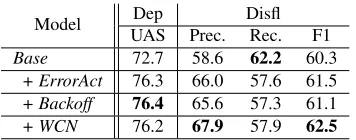
[image:4.612.339.517.56.126.2]+ ErrorAct 76.3 66.0 57.6 61.5 + Backoff 76.4 65.6 57.3 61.1 + WCN 76.2 67.9 57.9 62.5 Table 1: Dependency parsing and disfluency detection results of the proposed methods. We used our created corpus as both train and test data.
Train Test Model UASDep Prec. DisflRec. F1
T rans T rans Base 89.7 90.4 76.8 83.1
T rans ASR Base 74.7 58.5 65.6 61.8
ASR ASR Base 72.7 58.6 62.2 60.3
ASR ASR Ours 76.2 67.9 57.9 62.5 Table 2:Parsing result on different train-test settings. T rans
refers to original Switchboard transcription text,ASRthe text created through the data creation in§4.1.Oursis our proposed parser:Base + ErrorAct + Backoff + WCN.
in which a parser is trained on ASR-error-free texts, but nevertheless needs to parse the ASR output texts.
4.3 Results and Analysis
In Table 1, based on the baseline Base parser, we report scores with the additional (and additive) use ofLeft/RightArcErroractions (ErrorAct), the WCN feature (WCN), and the backoff action feature ( Back-off), on our created corpus. UsingErrorActresulted in 3.6% and 1.2% improvement in UAS and disflu-ency detection F1, respectively. Backoffcontributes
to further improved UAS, whereas WCN cause an
increase in disfluency detection accuracy.
Table 2 reports performance on various train and test data settings. In Table 2, the Train and Test columns represent which data to use in training and testing; T ransrefers to the gold transcription
text of the Switchboard corpus, and ASR the text
created through the data creation in §4.1. When
ASR-error-specific actions, Left/RightArcError mitigates this problem by separately treating the ASR error tokens and non ASR error tokens. Finally, with the newly proposed features, the parser trained on ASR texts outperforms the parser trained on the transcrip-tion texts with the improvement of 1.5% and 0.7% for UAS and disfluency detection, respectively.
However, when compared with the case of (Train,Test) = (T rans, T rans), we observe sig-nificant decreases in performance in both of the tasks conducted on ASR texts. This result clearly poses a new challenge for the disfluency detection community.
5 Conclusion
In this work, we have proposed a novel joint transition-based dependency parsing method with disfluency detection. Using new actions, and new feature set, the proposed parser can parse ASR out-put texts robustly. We have also introduced a data construction method to evaluate dependency parsing and disfluency detection performance for real speech data. As the experimental results for ASR texts is significantly lower than that achieved for the gold transcription texts, we have clarified the need to de-velop a method that is robust to recognition errors in the ASR system.
6 Acknowledgements
We thank the three anonymous reviewers for their detailed and insightful comments on an earlier draft of this paper. This work was supported by JSPS KAKENHI Grant Number 15K16053, 26240035.
References
Hao Cheng, Hao Fang, and Mari Ostendorf. 2015. Open-domain name error detection using a multi-task rnn. In Proceedings of the 2015 Conference on Empirical Methods in Natural Language Processing, pages 737– 746. Association for Computational Linguistics. Eunah Cho, Jan Niehues, and Alex Waibel. 2014. Tight
integration of speech disfluency removal into smt. In Proceedings of the 14th Conference of the European Chapter of the Association for Computational Linguis-tics, volume 2: Short Papers (EACL), pages 43–47. Association for Computational Linguistics.
Marie-Catherine de Marneffe, Bill MacCartney, and Christopher D. Manning. 2006. Generating typed
dependency parses from phrase structure parses. In In Proceedings of the 5th International Conference on Language Resources and Evaluation (LREC). James Ferguson, Greg Durrett, and Dan Klein. 2015.
Disfluency detection with a semi-markov model and prosodic features. In Proceedings of the 2015 Con-ference of the North American Chapter of the Asso-ciation for Computational Linguistics: Human Lan-guage Technologies (NAACL), pages 257–262. Asso-ciation for Computational Linguistics.
J. J. Godfrey, E. C. Holliman, and J. McDaniel. 1992. “switchboard: Telephone speech corpus for research and development”. InAcoustics, Speech, and Sig-nal Processing, 1992. ICASSP-92., 1992 IEEE Inter-national Conference on (Volume:1 ). Proc. IEEE Int. Conf. Acoust. Speech Sig. Proc.
Matthew Honnibal and Mark Johnson. 2014. Joint incre-mental disfluency detection and dependency parsing. In Transactions of the Association of Computational Linguistics Volume 2, Issue 1 (TACL), pages 131–142. Association for Computational Linguistics.
Julian Hough and Matthew Purver. 2014. Strongly in-cremental repair detection. InProceedings of the 2014 Conference on Empirical Methods in Natural Lan-guage Processing (EMNLP), pages 78–89. Associa-tion for ComputaAssocia-tional Linguistics.
Julian Hough and David Schlangen. 2015. Recurrent neural networks for incremental disfluency detection. Interspeech 2015.
Liang Huang, Suphan Fayong, and Yang Guo. 2012. Structured perceptron with inexact search. In Proceed-ings of the 2012 Conference of the North American Chapter of the Association for Computational Linguis-tics: Human Language Technologies. Association for Computational Linguistics.
Yang Liu, Elizabeth Shriberg, and Andreas Stolcke. 2003. Automatic disfluency identification in coversa-tional speech using multiple knowledge sources. InIn Proceedings of the 8th Eurospeech Conference. Marius Alexandru Marin. 2015. In Effective Use of
Cross-Domain Parsing in Automatic Speech Recogni-tion and Error DetecRecogni-tion. Ph.D. thesis. University of Washington.
Xian Qian and Yang Liu. 2013. Disfluency detection using multi-step stacked learning. InProceedings of the 2013 Conference of the North American Chapter of the Association for Computational Linguistics: Hu-man Language Technologies. Association for Compu-tational Linguistics.
pages 48–53. Association for Computational Linguis-tics.
Elizabeth Shriberg. 1994. In Preliminaries to a The-ory of Speech Disfluencies. Ph.D. thesis. University of California, Berkeley.
Kristina Toutanova, Dan Klein, Christopher Manning, and Singer Yoram. 2003. Feature-rich part-of-speech tagging with a cyclic dependency network. InIn Pro-ceedings of the 2003 Human Language Technology Conference of the North American Chapter of the As-sociation for Computational Linguistics, pages 173– 180. Association for Computational Linguistics. Shuangzhi Wu, Dongdong Zhang, Ming Zhou, and
Tiejun Zhao. 2015. Efficient disfluency detection with transition-based parsing. In Proceedings of the 53rd Annual Meeting of the Association for Computational Linguistics and the 7th International Joint Conference on Natural Language Processing (Volume 1: Long Pa-pers) (ACL), pages 495–503. Association for Compu-tational Linguistics.
Yue Zhang and Joakim Nivre. 2011. Transition-based dependency parsing with rich non-local features. In Proceedings of the 49th Annual Meeting of the Asso-ciation for Computational Linguistics: Human Lan-guage Technologies (ACL), pages 188–193. Associa-tion for ComputaAssocia-tional Linguistics.
Xiaohui Zhang, Jan Trmal, Daniel Povey, and San-jeev Khudanpur. 2014. Improving deep neural work acoustic models using generalized maxout net-works. In IEEE International Conference on Acous-tics, Speech and Signal Processing (ICASSP). Muhua Zhu, Yue Zhang, Wenliang Chen, Miu Zhang, and