Combining Distant and Partial Supervision for Relation Extraction
Gabor Angeli, Julie Tibshirani, Jean Y. Wu, Christopher D. Manning Stanford University
Stanford, CA 94305
{angeli, jtibs, jeaneis, manning}@stanford.edu
Abstract
Broad-coverage relation extraction either requires expensive supervised training data, or suffers from drawbacks inherent to distant supervision. We present an ap-proach for providing partial supervision to a distantly supervised relation extrac-tor using a small number of carefully se-lected examples. We compare against es-tablished active learning criteria and pro-pose a novel criterion to sample examples which are both uncertain and representa-tive. In this way, we combine the ben-efits of fine-grained supervision for diffi-cult examples with the coverage of a large distantly supervised corpus. Our approach
gives a substantial increase of 3.9%
end-to-end F1 on the 2013 KBP Slot Filling
evaluation, yielding a net F1 of37.7%.
1 Introduction
Fully supervised relation extractors are limited to relatively small training sets. While able to make
use of much more data, distantly supervised
ap-proaches either make dubious assumptions in or-der to simulate fully supervised data, or make use of latent-variable methods which get stuck in local optima easily. We hope to combine the benefits of supervised and distantly supervised methods by annotating a small subset of the available data us-ing selection criteria inspired by active learnus-ing.
To illustrate, our training corpus contains
1 208 524 relation mentions; annotating all of these mentions for a fully supervised classifier, at an average of $0.13 per annotation, would cost
ap-proximately $160 000. Distant supervision allows
us to make use of this large corpus without requir-ing costly annotation. The traditional approach is based on the assumption that every mention of an
entity pair (e.g., ObamaandUSA) participates in
the known relation between the two (i.e.,born in).
However, this introduces noise, as not every men-tion expresses the relamen-tion we are assigning to it.
We show that by providing annotations for only
10 000 informative examples, combined with a large corpus of distantly labeled data, we can yield notable improvements in performance over the distantly supervised data alone. We report results on three criteria for selecting examples to anno-tate: a baseline of sampling examples uniformly at random, an established active learning criterion,
and a new metric incorporating both the
uncer-tainty and the representativenessof an example.
We show that the choice of metric is important
– yielding as much as a 3% F1 difference – and
that our new proposed criterion outperforms the standard method in many cases. Lastly, we train a supervised classifier on these collected exam-ples, and report performance comparable to dis-tantly supervised methods. Furthermore, we no-tice that initializing the distantly supervised model using this supervised classifier is critical for ob-taining performance improvements.
This work makes a number of concrete contri-butions. We propose a novel application of active learning techniques to distantly supervised rela-tion extracrela-tion. To the best of the authors knowl-edge, we are the first to apply active learning to the class of latent-variable distantly supervised mod-els presented in this paper. We show that anno-tating a proportionally small number of examples yields improvements in end-to-end accuracy. We compare various selection criteria, and show that this decision has a notable impact on the gain in performance. In many ways this reconciles our results with the negative results of Zhang et al. (2012), who show limited gains from na¨ıvely an-notating examples. Lastly, we make our
annota-tions available to the research community.1
1http://nlp.stanford.edu/software/ mimlre.shtml
2 Background
2.1 Relation Extraction
We are interested in extracting a set of relations
y1. . . ykfrom a fixed set of possible relationsR,
given two entities e1 and e2. For example, we
would like to extract that Barack Obama was born in Hawaii. The task is decomposed into two steps:
First, sentences containing mentions of both e1
and e2 are collected. The set of these sentences
x, marked with theentity mentionsfore1 ande2,
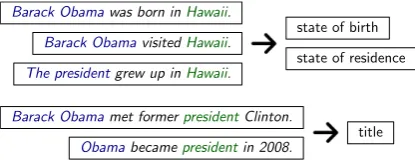
becomes the input to the relation extractor, which then produces a set of relations which hold be-tween the mentions. We are predominantly in-terested in the second step – classifying a set of pairs of entity mentions into the relations they ex-press. Figure 1 gives the general setting for
re-lation extraction, with entity pairsBarack Obama
andHawaii, andBarack Obamaandpresident.
Traditionally, relation extraction has fallen into one of four broad approaches: supervised classi-fication, as in the ACE task (Doddington et al., 2004; GuoDong et al., 2005; Surdeanu and Cia-ramita, 2007), distant supervision (Craven and Kumlien, 1999; Wu and Weld, 2007; Mintz et al., 2009; Sun et al., 2011; Roth and Klakow, 2013) deterministic rule-based systems (Soder-land, 1997; Grishman and Min, 2010; Chen et al., 2010), and translation from open domain informa-tion extracinforma-tion schema (Riedel et al., 2013). We focus on the first two of these approaches.
2.2 Supervised Relation Extraction
Relation extraction can be naturally cast as a su-pervised classification problem. A corpus of
rela-tion menrela-tions is collected, and each menrela-tionxis
annotated with the relationy, if any, it expresses.
The classifier’s output is then aggregated to decide the relations between the two entities.
However, annotating supervised training data is generally expensive to perform at large scale. Although resources such as Freebase or the TAC KBP knowledge base have on the order of millions of training tuples over entities it is not feasible to manually annotate the corresponding mentions in
the text. This has led to the rise ofdistantly
su-pervisedmethods, which make use of this indirect
supervision, but do not necessitate mention-level supervision.
Barack Obamawas born inHawaii.
Barack ObamavisitedHawaii.
The presidentgrew up inHawaii.
state of birth
state of residence
Barack Obamamet formerpresidentClinton.
Obamabecamepresidentin 2008.
[image:2.595.312.520.62.142.2]title
Figure 1: The relation extraction setup. For a pair of entities, we collect sentences which men-tion both entities. These sentences are then used to predict one or more relations between those entities. For instance, the sentences containing
both Barack Obama and Hawaii should support
thestate of birthandstate of residencerelation.
2.3 Distant Supervision
Traditional distant supervision makes the assump-tion that for every triple(e1, y, e2)in a knowledge
base, every sentence containing mentions for e1
ande2 express the relationy. For instance,
tak-ing Figure 1, we would create a datum for each
of the three sentences containing BARACKOBAMA
and HAWAII labeled with state of birth, and
like-wise with state of residence, creating 6 training
examples overall. Similarly, both sentences
in-volving Barack Obama and president would be
marked as expressing thetitlerelation.
While this allows us to leverage a large database effectively, it nonetheless makes a number of na¨ıve assumptions. First – explicit in the formulation of the approach – it assumes that every mention ex-presses some relation, and furthermore exex-presses the known relation(s). For instance, the
sen-tenceObama visited Hawaiiwould be erroneously
treated as a positive example of theborn in
rela-tion. Second, it implicitly assumes that our knowl-edge base is complete: entity mentions with no known relation are treated as negative examples.
The first of these assumptions is addressed by multi-instance multi-label (MIML) learning, de-scribed in Section 2.4. Min et al. (2013) address the second assumption by extending the MIML model with additional latent variables, while Xu et al. (2013) allow feedback from a coarse relation extractor to augment labels from the knowledge base. These latter two approaches are compatible with but are not implemented in this work.
2.4 Multi-Instance Multi-Label Learning
. . .
. . . . . .
[image:3.595.116.250.59.203.2]. . .
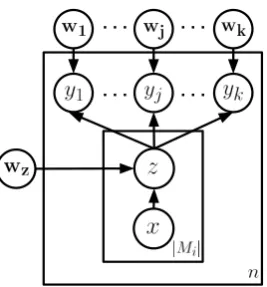
Figure 2: The MIML-RE model, as shown in Sur-deanu et al. (2012). The outer plate corresponds to
each of thenentity pairs in our knowledge base.
Each entity pair has a set of mention pairsMi, and
a corresponding plate in the diagram for each
men-tion pair inMi. The variable xrepresents the
in-put mention pair, whereasyrepresents the positive
and negative relations for the given pair of entities.
The latent variablezdenotes a mention-level
pre-diction for each input. The weight vector for the
multinomialzclassifier is given bywz, and there
is a weight vectorwj for each binaryyclassifier.
by Hoffmann et al. (2011) and Riedel et al. (2010), addresses the assumptions of distantly supervised relations extractors in a principled way by positing a latent mention-level annotation.
The model groups mentions according to their entity pair – for instance, every mention pair with
ObamaandHawaiiwould be grouped together. A
latent variable zi is created for every mention i,
where zi ∈ R ∪ {None} takes a single relation
label, or ano relationmarker. We create |R|
bi-nary variablesy representing the known positive
and negative relations for the entity pair. A set of binary classifiers (log-linear factors in the graphi-cal model) links the latent predictionsz1. . . z|Mi|
and eachyj. These classifiers include two classes
of features: first, a binary feature which fires ifat
least oneof the mentions expresses a known
rela-tion between the entity pair, and second, a feature for each co-occurrence of relations for a given en-tity pair. Figure 2 describes the model.
2.5 Background on Active Learning
We describe preliminaries and prior work on ac-tive learning; we use this framework to propose two sampling schemes in Section 3 which we use to annotate mention-level labels for MIML-RE.
One way of expressing the generalization error
of a hypothesisˆhis through its mean-squared error
with the true hypothesish:
E[(h(x)−ˆh(x))2]
=E[E[(h(x)−ˆh(x))2|x]] =
Z
xE[(h(x)−
ˆ
h(x))2|x]p(x)dx.
The integrand can be further broken into bias and variance terms:
E[(h(x)−ˆh(x))2] = (E[ˆh(x)]−h(x))2
+E[(ˆh(x)−E[ˆh(x)])2]
where for simplicity we’ve dropped the condition-ing onx.
Many traditional sampling strategies, such as query-by-committee (QBC) (Freund et al., 1992; Freund et al., 1997) and uncertainty sampling (Lewis and Gale, 1994), work by decreasing the variance of the learned model. In QBC, we first create a ‘committee’ of classifiers by ran-domly sampling their parameters from a distribu-tion based on the training data. These classifiers then make predictions on the unlabeled examples, and the examples on which there is the most dis-agreement are selected for labeling. This
strat-egy can be seen as an attempt to decrease the
ver-sion space– the set of classifiers that are
consis-tent with the labeled data. Decreasing the version space should lower variance, since variance is in-versely related to the size of the hypothesis space. In most scenarios, active learning does not con-cern itself with the bias term. If a model is fun-damentally misspecified, then no amount of ad-ditional training data can lower its bias. How-ever, our paradigm differs from the traditional set-ting, in that we are annotating latent variables in a model with a non-convex objective. These an-notations may help increase the convexity of our objective, leading us to a more accurate optimum and thereby lowering bias.
The other component to consider is
R
x· · ·p(x)dx. This suggests that it is
impor-tant to choose examples that are representative
of the underlying distribution p(x), as we want
uncertainty sampling (McCallum and Nigam, 1998; Settles, 2010).
2.6 Active Learning for Relation Extraction
Several papers have explored active learning for relation extraction. Fu and Grishman (2013) em-ploy active learning to create a classifier quickly for new relations, simulated from the ACE corpus. Finn and Kushmerick (2003) compare a number of selection criteria – including QBC – for a su-pervised classifier. To the best of our knowledge, we are the first to apply active learning to distantly supervised relation extraction. Furthermore, we evaluate our selection criteria live in a real-world setting, collecting new sentences and evaluating on an end-to-end task.
For latent variable models, McCallum and Nigam (1998) apply active learning to semi-supervised document classification. We take in-spiration from their use of QBC and the choice of metric for classifier disagreement. However their model assumes a fully Bayesian set-up, whereas ours does not require strong assumptions about the parameter distributions.
Settles et al. (2008) use active learning to im-prove a multiple-instance classifier. Their model is simpler in that it does not allow for unobserved variables or multiple labels, and the authors only evaluate on image retrieval and synthetic text clas-sification datasets.
3 Example Selection
We describe three criteria for selection examples to annotate. The first – sampling uniformly – is a baseline for our hypothesis that intelligently se-lecting examples is important. For this criterion, we select mentions uniformly at random from the training set to annotate. This is the approach used in Zhang et al. (2012). The other two criteria rely on a metric for disagreement provided by QBC; we describe our adaptation of QBC for MIML-RE as a preliminary to introducing these criteria.
3.1 QBC For MIML-RE
We use a version of QBC based on bootstrap-ping (Saar-Tsechansky and Provost, 2004). To create the committee of classifiers, we re-sample the training set with replacement 7 times and train a model over each sampled dataset. We
mea-sure disagreement on z-labels among the
classi-fiers using a generalized Jensen-Shannon
diver-gence (McCallum and Nigam, 1998), taking the average KL divergence of all classifier judgments. We first calculate the mention-level
confi-dences. Note thatzi(m) ∈ Mi denotes the latent
variable in entity pairiwith indexm; z(i−m) de-notes the set of all latent variables exceptzi(m):
p(zi(m)|yi,xi) = p(yi, z (m)
i |xi) p(yi|xi)
=
P
z(i−m)p(yi,zi|xi) P
zi(m)p(yi, z(im)|xi)
.
Notice that the denominator just serves to nor-malize the probability within a sentence group. We can rewrite the numerator as follows:
X
z(i−m)
p(yi,zi|xi)
= X
z(i−m)
p(yi|zi)p(zi|xi)
=p(zi(m)|xi) X
z(i−m)
p(yi|zi)p(z(i−m)|xi).
For computational efficiency, we approximate
p(z(i−m)|xi) with a point mass at its maximum.
Next, we calculate the Jensen-Shannon (JS)
diver-gence from thekbootstrapped classifiers:
1
k
k
X
c=1
KL(pc(zi(m)|yi,xi)||pmean(zi(m)|yi,xi)) (1)
wherepcis the probability assigned by each of the
kclassifiers to the latentzi(m), andpmeanis the av-erage of these probabilities. We use this metric
to capture thedisagreementof our model with
re-spect to a particular latent variable. This is then used to inform our selection criteria.
We note that QBC may be especially useful in our situation as our objective is highly nonconvex. If two committee members disagree on a latent variable, it is likely because they converged to dif-ferent local optima; annotating that example could help bring the classifiers into agreement.
3.2 Sample by JS Disagreement
We propose a novel active learning sampling cri-terion that incorporates not only disagreement but
also representativeness in selecting examples to
annotate. Prior work has taken a weighted combi-nation of an example’s disagreement and a score corresponding to whether the example is drawn from a dense portion of the feature space (e.g., McCallum and Nigam (1998)). However, this re-quires both selecting a criterion for defining den-sity (e.g., distance metric in feature space), and tuning a parameter for the relative weight of dis-agreement versus representativeness.
Instead, we account for choosing representa-tive examples by sampling without replacement proportional to the example’s disagreement. For-mally, we define the probability of selecting an
example zi(m) to be proportional to the
Jensen-Shannon divergence in (1). Since the training set is an approximation to the prior distribution over ex-amples, sampling uniformly over the training set is an approximation to sampling from the prior
prob-ability of seeing an inputx. We can view our
crite-rion as an approximation to sampling proportional to the product of two densities: a prior over
exam-plesx, and the JS divergence mentioned above.
4 Incorporating Sentence-Level Annotations
Following Surdeanu et al. (2012), MIML-RE is trained through hard discriminative Expectation
Maximization, inferring the latentzvalues in the
E-step and updating the weights for both thezand
yclassifiers in the M-step. During the E-step, we
constrain the latentz to match our sentence-level
annotations when available.
It is worth noting that even in the hard-EM regime, we can in principle incorporate annotator uncertainty elegantly into the model. At each E
step, eachziis set according to
zi(m)∗ ≈arg max z∈R
p(z|x(im),wz)×
Y
r
p(yi(r)|z0i,w(yr))
where z0
i contains the inferred labels from the
previous iteration, but with itsmth component
re-placed byzi(m).
By setting the distributionp(z|x(im),wz)to
re-flect uncertainty among annotators, we can leave
open the possibility for the model to choose a re-lation which annotators deemed unlikely, but the model nonetheless prefers. For simplicity, how-ever, we treat our annotations as a hard assign-ment.
In addition to incorporating annotations during training, we can also use this data to intelligently initialize the model. Since the MIML-RE objec-tive is non-convex, the initialization of the
classi-fier weightswy andwz is important. The y
clsifiers are initialized with the “at-least-once”
as-sumption of Hoffmann et al. (2011);wzcan be
ini-tialized either using traditional distant supervision or from a supervised classifier trained on the an-notated sentences. If initialized with a supervised classifier, the model can be viewed as augment-ing this supervised model with a large distantly labeled corpus, providing both additional entity pairs to train from, and additional mentions for an annotated entity pair.
5 Crowdsourced Example Annotation
Most prior work on active learning is done by sim-ulation on a fully labeled dataset; such a dataset doesn’t exist for our case. Furthermore, a key aim of this paper is to practically improve state-of-the-art performance in relation extraction in addition to evaluating active learning criteria. Therefore, we develop and execute an annotation task for col-lecting labels for our selected examples.
We utilize Amazon Mechanical Turk to crowd-source annotations. For each task, the annotator (Turker) is presented with the task description, fol-lowed by 15 questions, 2 of which are randomly placed controls. For each question, we present Turkers with a relation mention and the top 5 re-lation predictions from our classifier. The Turker also has an option to freely specify a relation not presented in the first five options, or mark that there is no relation. We attempt to heuristically match common free-form answers to official rela-tions.
To maintain the quality of the results, we dis-card all submissions in which both controls were answered incorrectly, and additionally discard all submissions from Turkers who failed the controls
on more than 13 of their submissions. Rejected
Figure 3: The task shown to Amazon Mechanical Turk workers. A sentence along with the top 5 re-lation predictions from our classifier are shown to Turkers, as well as an option to specify a custom relation or manually enter “no relation.” The cor-rect response for this example should be either no relation or a custom relation.
the case of deciding between a relation and no re-lation, in which case the relation was always cho-sen.
A total of23 725examples were annotated,
cov-ering10 000examples for each of the three
selec-tion criteria. Note that there is overlap between the examples selected for the three criteria. In
ad-dition,10 023examples were annotated during
de-velopment; these are included in the set of all an-notated examples, but excluded from any of the three criteria. The compensation per task was 23 cents; the total cost of annotating examples was
$3156, in addition to $204spent on developing the
task. Informally, Turkers achieved an accuracy of
around 75%, as evaluated by a paper author,
per-forming disproportionately well on identifying the
no relationlabel.
6 Experiments
We evaluate the three high-level research contri-butions of this work: we show that we improve the accuracy of MIML-RE, we validate the effec-tiveness of our selection criteria, and we provide a corpus of annotated examples, evaluating a super-vised classifier trained on this corpus. The train-ing and testtrain-ing methodology for evaluattrain-ing these contributions is given in Sections 6.1 and 6.2; ex-periments are given in Section 6.3.
6.1 Training Setup
We adopt the setup of Surdeanu et al. (2012) for training the MIML-RE model, with minor modifi-cations. We use both the 2010 and 2013 KBP
of-ficial document collections, as well as a July 2013 dump of Wikipedia as our text corpus. We
sub-sample negatives such that 13 of our dataset
con-sists of entity pairs with no known relations. In all experiments, MIML-RE is trained for 7 iterations
of EM; for efficiency, thezclassifier is optimized
using stochastic gradient descent;2theyclassifiers
are optimized using L-BFGS.
Similarly to Surdeanu et al. (2011), we as-sign negative relations which are either incompat-ible with the known positive relations (e.g., re-lations whose co-occurrence would violate type constraints); or, are actually functional relations in which another entity already participates. For example, if we know that Obama was born in the
United States, we could addborn inas a negative
relation to the pair Obama and Kenya.
Our dataset consists of325 891entity pairs with
at least one positive relation, and 158 091 entity
pairs with no positive relations. Pairs with at least
one known relation have an average of4.56
men-tions per group; groups with no known relamen-tions
have an average of1.55mentions per group. In
to-tal,1 208 524distinct mentions are considered; the annotated examples are selected from this pool.
6.2 Testing Methodology
We compare against the original MIML-RE model using the same dataset and evaluation methodol-ogy as Surdeanu et al. (2012). This allows for an evaluation where the only free variable between this and prior work is the predictions of the rela-tion extractor.
Additionally, we evaluate the relation extractors in the context of Stanford’s end-to-end KBP sys-tem (Angeli et al., 2014) using the NIST TAC-KBP 2013 English Slotfilling evaluation. In the end-to-end framework, the input to the system is a query entity and a set of articles, and the output is a set ofslot fills– each slot fill is a candidate triple in the knowledge base, the first element of which is the query entity. This amounts to roughly pop-ulating a data structure like Wikipedia infoboxes automatically from a large corpus of text.
Importantly, an end-to-end evaluation in a top-performing full system gives a more accurate idea of the expected real-world gain from each model. Both the information retrieval component provid-ing candidates to the relation extractor, as well as
Method Init Not Used UniformActive Learning CriterionHigh JS Sample JS All Available
P R F1 P R F1 P R F1 P R F1 P R F1
Mintz++ — 41.3 28.2 33.5 — — — —
MIML-RE DistSup 38.0 30.5 33.835.1 35.6 35.4 39.234.4 30.435.0 34.734.2 41.746.2 30.8 37.0 39.4 36.228.9 34.1 36.6 31.1 37.733.6 37.536.0 37.130.6 33.736.5
[image:7.595.74.527.64.160.2]Supervised — — 35.5 28.9 31.9 31.3 33.2 32.2 33.5 35.0 34.2 32.9 33.4 33.2
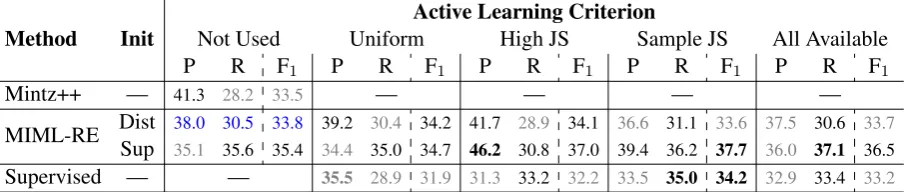
Table 1: A summary of results on the end-to-end KBP 2013 evaluation for various experiments. The first column denotes the algorithm used: either traditional distant supervision (Mintz++), MIML-RE, or a supervised classifier. In the case of MIML-RE, the model may be initialized either using Mintz++, or the corresponding supervised classifier (the “Not Used” column is initialized with the “All” supervised classifier). One of five active learning scenarios are evaluated: no annotated examples provided, the three active learning criteria, and all available examples used. The entry in blue denotes the basic MIML-RE model; entries in gray perform worse than this model. The bold items denote the best performance among selection criteria.
the consistency and inference performed on the classifier output introduce bias in this evaluation’s sensitivity to particular types of errors. Mistakes which are easy to filter, or are difficult to retrieve using IR are less important in this evaluation; in contrast, factors such as providing good confi-dence scores for consistency become more impor-tant.
For the end-to-end evaluation, we use the offi-cial evaluation script with two changes: First, all systems are evaluated with provenance ignored, so as not to penalize any system for finding a new provenance not validated in the official evaluation
key. Second, each system reports its optimal F1
along its P/R curve, yielding results which are optimistic when compared against other systems entered into the competition. However, this also yields results which are invariant to threshold tun-ing, and is therefore more appropriate for compar-ing between systems in this paper.
Development was done on the KBP 2010–2012 queries, and results are reported using the 2013 queries as a simulated test set. Our best system
achieves an F1 of37.7; the top two teams at KBP
2013 (of 18 entered) achieved F1 scores of 40.2
and37.1respectively, ignoring provenance.
6.3 Results
Table 1 summarizes all results for the end-to-end task; relevant features of the table are copied in subsequent sections to illustrate key trends. Mod-els which perform worse than the original MIML-RE model (MIML-MIML-RE, initialized with “Dist,” un-der “Not Used”) are denoted in gray. The best
per-System P R F1
Mintz++ 41.3 28.2 33.5
MIML + Dist 38.0 30.5 33.8
MIML + Sup 35.1 35.6 35.4
MIML + Dist + SampleJS 36.6 31.1 33.6
MIML + Sup + SampleJS 39.4 36.2 37.7
Table 2: A summary of improvements to MIML-RE on the end-to-end slotfilling task, copied from Table 1. Mintz++ is the traditional distantly su-pervised model. The second row corresponds to the unmodified MIML-RE model. The third row corresponds to MIML-RE initialized with a su-pervised classifier (trained on all examples). The fourth row is MIML-RE with annotated exam-ples incorporated during training (but not initial-ization). The last row shows the best results ob-tained by our model.
forming model improves on the base model by 3.9
F1points on the end-to-end task.
We evaluate each of the individual contribu-tions of the paper: improving the accuracy of the MIML-RE relation extractor, evaluating our example selection criteria, and demonstrating the annotated examples’ effectiveness for a fully-supervised relation extractor.
[image:7.595.303.528.301.382.2]System P R F1
MIML + Sup 35.1 35.6 35.4
MIML + Sup + Uniform 34.4 35.0 34.7
MIML + Sup + HighJS 46.2 30.8 37.0
MIML + Sup + SampleJS 39.4 36.2 37.7
[image:8.595.71.292.63.146.2]MIML + Sup + All 36.0 37.1 36.5
Table 3: A summary of the performance of each example selection criterion. In each case, the model was initialized with a supervised classifier. The first row corresponds to the MIML-RE model initialized with a supervised classifier. The middle three rows show performance for the three selec-tion criteria, used both for initializaselec-tion and during training. The last row shows results if all available annotations are used, independent of their source.
System P R F1
Mintz++ 41.3 28.2 33.5
MIML + Dist 38.0 30.5 33.8
Supervised + SampleJS 33.5 35.0 34.2
MIML + Sup 35.1 35.6 35.5
MIML + Sup + SampleJS 39.4 36.2 37.7
Table 4: A comparison of the best performing su-pervised classifier with other systems. The top section compares the supervised classifier with prior work. The lower section highlights the im-provements gained from initializing MIML-RE with a supervised classifier.
(2014) incorporates labeled data to guide MIML-RE during training. They make use of labeled data
to extracttraining guidelines, which are intended
to generalize across many examples. We show that we can match or outperform their improvements with our best criterion.
A few interesting trends emerge from the end-to-end results in Table 2. Using annotated sen-tences during training alone did not improve per-formance consistently, even hurting perper-formance when the SampleJS criterion was used. This supports an intuition that the initialization of the model is important, and that it is relatively difficult to coax the model out of a local optimum if it is initialized poorly. This is further supported by the improvement in performance when the model is initialized with a supervised classifier, even when no examples are used during training. Similar trends are reported in prior work, e.g., Smith and Eisner (2007) Section 4.4.6.
0.2 0.3 0.4 0.5 0.6 0.7
0 0.05 0.1 0.15 0.2 0.25 0.3
P
recision
Recall
[image:8.595.308.526.67.199.2]MIML-RE Surdeanu et al. (2012) Mintz++
Figure 4: MIML-RE and Mintz++ evaluated ac-cording to Surdeanu et al. (2012). The original model from the paper is plotted for comparison, as our training methodology is somewhat different.
0.2 0.3 0.4 0.5 0.6 0.7
0 0.05 0.1 0.15 0.2 0.25 0.3
P
recision
Recall
Sample JS Pershina et al. (2014) MIML-RE
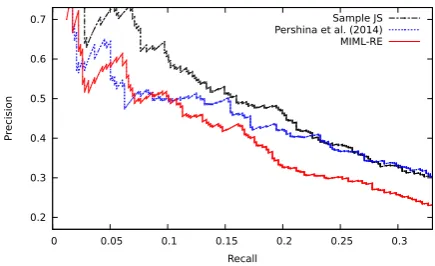
Figure 5: Our best active learning criterion evalu-ated against our version of MIML-RE, alongside the best system of Pershina et al. (2014).
Also interesting is the relatively small gain MIML-RE provides over traditional distant super-vision (Mintz++) in this setting. We conjecture that the mistakes made by Mintz++ are often rel-atively easily filtered by the downstream consis-tency component. This is supported by Figure 4; we evaluate our trained MIML-RE model against Mintz++ and the results reported in Surdeanu et al. (2012). We show that our model performs as well or better than the original implementation, and consistently outperforms Mintz++.
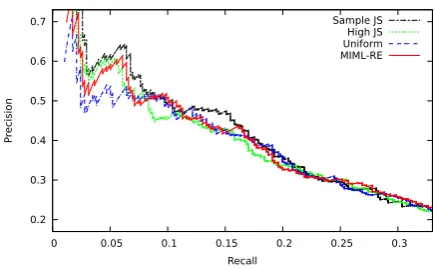
[image:8.595.308.526.288.421.2] [image:8.595.72.292.294.377.2]cri-terion performs comparably to or better than the other criteria.
At least two interesting trends can be noted from these results: First, the uniformly sampled crite-rion performed worse than MIML-RE initialized with a supervised classifier. This may be due to noise in the annotation: a small number of an-notation errors on entity pairs with only a single corresponding mention could introduce dangerous noise into training. These singleton mentions will rarely have disagreement between the committee of classifiers, and therefore will generally only be selected in the uniform criterion.
Second, adding in the full set of examples did not improve performance – in fact, performance generally dropped in this scenario. We conjecture that this is due to the inclusion of the uniformly sampled examples, with performance dropping for the same reasons as above.
Both of these results can be reconciled with the results of Zhang et al. (2012); like this work, they annotated examples to analyze the trade-off between adding more data to a distantly super-vised system, and adding more direct supervi-sion. They conclude that annotations provide only a relatively small improvement in performance. However, their examples were uniformly selected from the training corpus, and did not make use of the structure provided by MIML-RE. Our re-sults agree in that neither the uniform selection criterion nor the supervised classifier significantly outperformed the unmodified MIML-RE model; nonetheless, we show that if care is taken in se-lecting these labeled examples we can achieve no-ticeable improvements in accuracy.
We also evaluate our selection criteria on the evaluation of Surdeanu et al. (2012), both initial-ized with Mintz++ (Figure 7) and with the super-vised classifier (Figure 6). These results mirror those in the end-to-end evaluation; when initial-ized with the supervised classifier the high dis-agreement (High JS) and sampling proportional to disagreement (Sample JS) criteria clearly outper-form both the base MIML-RE model as well as the uniformly sampling criterion. Using the an-notated examples only during training yielded no perceivable benefit over the base model (Figure 7).
Supervised Relation Extractor The examples collected can be used to directly train a supervised classifier, with results summarized in Table 4. The most salient insight is that the performance of the
0.2 0.3 0.4 0.5 0.6 0.7
0 0.05 0.1 0.15 0.2 0.25 0.3
P
recision
Recall
[image:9.595.309.527.66.199.2]Sample JS High JS Uniform MIML-RE
Figure 6: A comparison of models trained with various selection criteria on the evaluation of Sur-deanu et al. (2012), all initialized with the corre-sponding supervised classifier.
0.2 0.3 0.4 0.5 0.6 0.7
0 0.05 0.1 0.15 0.2 0.25 0.3
P
recision
Recall
Sample JS High JS Uniform MIML-RE
Figure 7: A comparison of models trained with various selection criteria on the evaluation of Sur-deanu et al. (2012), all initialized with Mintz++.
best supervised classifier is similar to that of the MIML-RE model, despite being trained on nearly two orders of magnitude less training data.
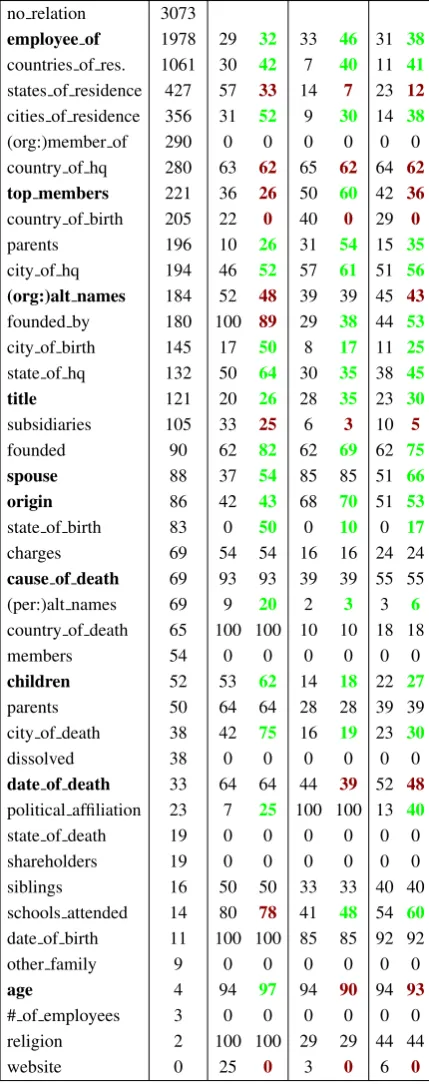
[image:9.595.308.526.312.447.2]Relation # P R F1 no relation 3073
employee of 1978 29 32 33 46 31 38
countries of res. 1061 30 42 7 40 11 41
states of residence 427 57 33 14 7 23 12
cities of residence 356 31 52 9 30 14 38
(org:)member of 290 0 0 0 0 0 0
country of hq 280 63 62 65 62 64 62
top members 221 36 26 50 60 42 36
country of birth 205 22 0 40 0 29 0
parents 196 10 26 31 54 15 35
city of hq 194 46 52 57 61 51 56
(org:)alt names 184 52 48 39 39 45 43
founded by 180 100 89 29 38 44 53
city of birth 145 17 50 8 17 11 25
state of hq 132 50 64 30 35 38 45
title 121 20 26 28 35 23 30
subsidiaries 105 33 25 6 3 10 5
founded 90 62 82 62 69 62 75
spouse 88 37 54 85 85 51 66
origin 86 42 43 68 70 51 53
state of birth 83 0 50 0 10 0 17
charges 69 54 54 16 16 24 24
cause of death 69 93 93 39 39 55 55
(per:)alt names 69 9 20 2 3 3 6
country of death 65 100 100 10 10 18 18
members 54 0 0 0 0 0 0
children 52 53 62 14 18 22 27
parents 50 64 64 28 28 39 39
city of death 38 42 75 16 19 23 30
dissolved 38 0 0 0 0 0 0
date of death 33 64 64 44 39 52 48
political affiliation 23 7 25 100 100 13 40
state of death 19 0 0 0 0 0 0
shareholders 19 0 0 0 0 0 0
siblings 16 50 50 33 33 40 40
schools attended 14 80 78 41 48 54 60
date of birth 11 100 100 85 85 92 92
other family 9 0 0 0 0 0 0
age 4 94 97 94 90 94 93
# of employees 3 0 0 0 0 0 0
religion 2 100 100 29 29 44 44
[image:10.595.73.288.76.619.2]website 0 25 0 3 0 6 0
Table 5: A summary of relations annotated, and end-to-end slotfilling performance by relation. The first column gives the relation; the second shows the number of examples annotated. The subsequent columns show the performance of the unmodified MIML-RE model and our best per-forming model (SampleJS). Changes in values are bolded; positive changes are shown in green and negative changes in red. The most frequent 10 re-lations in the evaluation are likewise bolded.
6.4 Analysis By Relation
In this section, we explore which of the KBP rela-tions were shown to Turkers, and whether the im-provements in accuracy correspond to these rela-tions. We compare only the unmodified MIML-RE model, and our best model (MIML-MIML-RE initial-ized with the supervised classifier, under the Sam-pleJS criterion). Results are shown in Table 5.
A few interesting trends emerge from this
anal-ysis. We note that annotating even 80+examples
for a relation seems to provide a consistent boost in accuracy, whereas relations with fewer anno-tated examples tended to show little or no change. However, the gains of our model are not univer-sal across relation types, even dropping noticeably
on some – for instance, F1 drops on bothstate of
residenceandcountry of birth. This could suggest
systematic noise from Turker judgments; e.g., for foreign geography (state of residence) or ambigu-ous relations (top members).
An additional insight from the table is the mis-match between examples chosen to be annotated, and the most popular relations in the KBP evalu-ation. For instance, by far the most popular KBP relation (title) had only 121 examples annotated.
7 Conclusion
We have shown that providing a relatively small number of mention-level annotations can improve the accuracy of MIML-RE, yielding an end-to-end
improvement of3.9F1on the KBP task.
Further-more, we have introduced a new active learning criterion, and shown both that the choice of crite-rion is important, and that our new critecrite-rion per-forms well. Lastly, we make available a dataset of mention-level annotations for constructing a tradi-tional supervised relation extractor.
Acknowledgements
References
Gabor Angeli, Arun Chaganty, Angel Chang, Kevin Reschke, Julie Tibshirani, Jean Y. Wu, Osbert Bas-tani, Keith Siilats, and Christopher D. Manning. 2014. Stanford’s 2013 KBP system. InTAC-KBP. Zheng Chen, Suzanne Tamang, Adam Lee, Xiang
Li, Wen-Pin Lin, Matthew Snover, Javier Artiles, Marissa Passantino, and Heng Ji. 2010. CUNY-BLENDER. InTAC-KBP.
Mark Craven and Johan Kumlien. 1999. Constructing biological knowledge bases by extracting informa-tion from text sources. InAAAI.
George R Doddington, Alexis Mitchell, Mark A Przy-bocki, Lance A Ramshaw, Stephanie Strassel, and Ralph M Weischedel. 2004. The automatic content extraction (ACE) program–tasks, data, and evalua-tion. InLREC.
Aidan Finn and Nicolas Kushmerick. 2003. Active learning selection strategies for information extrac-tion. In International Workshop on Adaptive Text Extraction and Mining.
Yoav Freund, H Sebastian Seung, Eli Shamir, and Naf-tali Tishby. 1992. Information, prediction, and query by committee. InNIPS.
Yoav Freund, H Sebastian Seung, Eli Shamir, and Naf-tali Tishby. 1997. Selective sampling using the query by committee algorithm. Machine learning, 28(2-3):133–168.
Lisheng Fu and Ralph Grishman. 2013. An efficient active learning framework for new relation types. In IJCNLP.
Ralph Grishman and Bonan Min. 2010. New York University KBP 2010 slot-filling system. InProc. TAC 2010 Workshop.
Zhou GuoDong, Su Jian, Zhang Jie, and Zhang Min. 2005. Exploring various knowledge in relation ex-traction. InACL.
Raphael Hoffmann, Congle Zhang, Xiao Ling, Luke Zettlemoyer, and Daniel S Weld. 2011. Knowledge-based weak supervision for information extraction of overlapping relations. InACL-HLT.
David D Lewis and William A Gale. 1994. A sequen-tial algorithm for training text classifiers. InSIGIR. Andrew McCallum and Kamal Nigam. 1998.
Employ-ing EM and pool-based active learnEmploy-ing for text clas-sification. InICML.
Bonan Min, Ralph Grishman, Li Wan, Chang Wang, and David Gondek. 2013. Distant supervision for relation extraction with an incomplete knowledge base. InNAACL-HLT.
Mike Mintz, Steven Bills, Rion Snow, and Dan Juraf-sky. 2009. Distant supervision for relation extrac-tion without labeled data. InACL.
Maria Pershina, Bonan Min, Wei Xu, and Ralph Gr-ishman. 2014. Infusion of labeled data into distant supervision for relation extraction. InACL.
Sebastian Riedel, Limin Yao, and Andrew McCallum. 2010. Modeling relations and their mentions with-out labeled text. InMachine Learning and Knowl-edge Discovery in Databases. Springer.
Sebastian Riedel, Limin Yao, Andrew McCallum, and Benjamin M Marlin. 2013. Relation extraction with matrix factorization and universal schemas. In NAACL-HLT.
Benjamin Roth and Dietrich Klakow. 2013. Feature-based models for improving the quality of noisy training data for relation extraction. InCIKM.
Maytal Saar-Tsechansky and Foster Provost. 2004. Active sampling for class probability estimation and ranking. Machine Learning, 54(2):153–178.
Burr Settles, Mark Craven, and Soumya Ray. 2008. Multiple-instance active learning. In Advances in neural information processing systems, pages 1289– 1296.
Burr Settles. 2010. Active learning literature survey. University of Wisconsin Madison Technical Report 1648.
Noah Smith and Jason Eisner. 2007. Novel estimation methods for unsupervised discovery of latent struc-ture in natural language text. Ph.D. thesis, Johns Hopkins.
Stephen G Soderland. 1997. Learning text analysis rules for domain-specific natural language process-ing. Ph.D. thesis, University of Massachusetts.
Ang Sun, Ralph Grishman, Wei Xu, and Bonan Min. 2011. New York University 2011 system for KBP slot filling. In Proceedings of the Text Analytics Conference.
Mihai Surdeanu and Massimiliano Ciaramita. 2007. Robust information extraction with perceptrons. In ACE07 Proceedings.
Mihai Surdeanu, Sonal Gupta, John Bauer, David Mc-Closky, Angel X Chang, Valentin I Spitkovsky, and Christopher D Manning. 2011. Stanfords distantly-supervised slot-filling system. InProceedings of the Text Analytics Conference.
Mihai Surdeanu, Julie Tibshirani, Ramesh Nallap-ati, and Christopher D. Manning. 2012. Multi-instance multi-label learning for relation extraction. InEMNLP.
Wei Xu, Le Zhao, Raphael Hoffman, and Ralph Grish-man. 2013. Filling knowledge base gaps for distant supervision of relation extraction. InACL.