Question Answering over Linked Data Using First-order Logic
∗Shizhu He, Kang Liu, Yuanzhe Zhang, Liheng Xu and Jun Zhao National Laboratory of Pattern Recognition
Institute of Automation, Chinese Academy of Sciences, Beijing, 100190, China
{shizhu.he, kliu, yzzhang, lhxu, jzhao}@nlpr.ia.ac.cn
Abstract
Question Answering over Linked Data (QALD) aims to evaluate a question an-swering system over structured data, the key objective of which is to translate questions posed using natural language into structured queries. This technique can help common users to directly ac-cess open-structured knowledge on the Web and, accordingly, has attracted much attention. To this end, we propose a novel method using first-order logic. We formulate the knowledge for resolving the ambiguities in the main three steps of QALD (phrase detection, phrase-to-semantic-item mapping and semantic item grouping) as first-order logic clauses in a Markov Logic Network. All clauses can then produce interacted effects in a unified framework and can jointly resolve all am-biguities. Moreover, our method adopts a pattern-learning strategy for semantic item grouping. In this way, our method can cover more text expressions and answer more questions than previous methods us-ing manually designed patterns. The ex-perimental results using open benchmarks demonstrate the effectiveness of the pro-posed method.
1 Introduction
With the rapid development of the Web of Data, many RDF datasets have been published as Linked Data (Bizer et al., 2009), such as DBpedia (Auer et al., 2007), Freebase (Bollacker et al., 2008) and YAGO (Suchanek et al., 2007). The grow-ing amount of Linked Data contains a wealth of knowledge, including entities, classes and rela-tions. Moreover, these linked data usually have ∗Shizhu He and Kang Liu have equal contribution to this
work.
complex structures and are highly heterogeneous. As a result, there are gaps for users regarding ac-cess. Although a few experts can write queries us-ing structured languages (such as SPARQL) based on their needs, this skill cannot be easily utilized by common users (Christina and Freitas, 2014). Thus, providing user-friendly, simple interfaces to access these linked data becomes increasingly more urgent.
Because of this, question answering over linked data (QALD) (Walter et al., 2012) has recently received much interest, and most studies on this topic have focused on translating natural lan-guage questions into structured queries (Freitas and Curry, 2014; Yahya et al., 2012; Unger et al., 2012; Shekarpour et al., 2013; Yahya et al., 2013; Bao et al., 2014; Zou et al., 2014). For example, with respect to the question
“Which software has been developed by
organi-zations founded in California, USA?”,
the aim is to automatically convert this utterance into an SPARQL query that contains the
follow-ing subject-property-object (SPO) triple format:
h?url rdf:type dbo:Software, ?url dbo:developer ?x1, ?x1 rdf:type dbo:Company, ?x1 dbo:foundationPlace dbr:Californiai1.
To fulfill this objective, existing systems (Lopez et al., 2006; Unger et al., 2012; Yahya et al., 2012; Zou et al., 2014) usually adopt a pipeline frame-work that contains four major steps: 1) decompos-ing the question and detectdecompos-ing phrases, 2) map-ping the detected phrases into semantic items of Linked Data, 3) grouping the mapped semantic items into semantic triples, and 4) generating the correct SPARQL query.
However, completing these four steps and con-structing such a structured query is not easy. The first three steps mentioned above are subject to the
1The prefixes in semantic items indicate the source of their vocabularies.
problem of ambiguity, which is the major chal-lenge in QALD. Using the question mentioned
above as an example, we can choose
Califor-nia or California, USA when detecting phrases,
the phrase California can be mapped to the
en-tityCalifornia StateorCalifornia Film, and the class Software (mapped from the phrase software) can be matched with the first argument of the rela-tion producerordeveloper(these two relations can
be mapped from the phrase developed).
Previ-ous methods (Lopez et al., 2006; Lehmann et al., 2012; Freitas and Curry, 2014) have usu-ally performed disambiguation at each step only, and the subsequent step was performed based on the disambiguation results in the previous step(s). However, we argue that the three steps men-tioned above have mutual effects. In the
previ-ous example, the phrase founded in (verb) can
be mapped to the entities (Founding of Rome and Founder (company)), classes (Company and Depart-ment) or relations (foundedBy and foundationPlace). If we know that the phrase California can refer to the entityCalifornia State, and which can be the second argument of the relation foundationPlace,
together with a verb phrase being more likely
to be mapped to Relation, we should map the
phrase founded in to foundationPlace in this ques-tion. Thus, we aim to determine if joint disam-biguation is better than individual disambigua-tion.(Question One)
In addition, previous systems usually employed manually designed patterns to extract predicate-argument structures that are used to guide the dis-ambiguation process in the three steps mentioned above (Yahya et al., 2012; Unger et al., 2012; Zou et al., 2014). For example, (Yahya et al., 2012) used only three dependency patterns to group the mapped semantic items into semantic triples. Nev-ertheless, these three manually designed patterns miss many cases because of the diversity of the question expressions. We gathered statistics on 144 questions and found that the macro-average F1 and micro-average F1 of the three patterns2
used in (Yahya et al., 2012) are only 62.8 and 66.2%, respectively. Furthermore, these specially designed patterns may not be valid with variations in domains or languages.Therefore, another im-portant question arises: can we automatically learn rules or patterns to achieve the same ob-2They are 1) verbs and their arguments, 2) adjectives and their arguments and 3) propositionally modified tokens and objects of prepositions.
jective?(Question Two)
Focusing on the two problems mentioned above, this paper proposes a novel algorithm based on a learning framework, Markov Logic Networks (MLNs) (Richardson and Domingos, 2006), to learn a joint model for constructing structured queries from natural language utterances. MLN is a statistical relational learning framework that combines first-order logic and Markov networks. The appealing property of MLN is that it is read-ily interpretable by humans and that it is a natural framework for performing joint learning. We for-mulate the knowledge for resolving the ambigui-ties in the main three steps of QALD (phrase de-tection, phrato-semantic-item mapping and se-mantic item grouping) as first-order logic clauses in an MLN. In the framework of MLN, all clauses will produce interacted effects that jointly resolve all problems into a unified process. In this way, the result in each step can be globally optimized. Moreover, in contrast to previous methods, we adopt a learning strategy to automatically learn the patterns for semantic item grouping. We de-sign several meta patterns as opposed to the spe-cific patterns. In addition, these meta patterns are formulated as the first-order logic formulas in the MLN. The specific patterns can be generated by these meta patterns based on the training data. The model will learn the weights of each clause to de-termine the most effective patterns for semantic triple construction. In this way, with little effort, our approach can cover more semantic expressions and answer more questions than previous meth-ods, which depend on manually designed patterns. We evaluate the proposed method using several benchmarks (QALD-1, QALD-3, QALD-4). The experimental results demonstrate the advantage of the joint disambiguation process mentioned above. They also prove that our approach, employing MLN to automatically learn the patterns of seman-tic triple grouping, is effective. Our system can answer more questions and obtain better perfor-mance than the traditional methods based on man-ually designed heuristic rules.
2 Background
2.1 Linked Data Sources
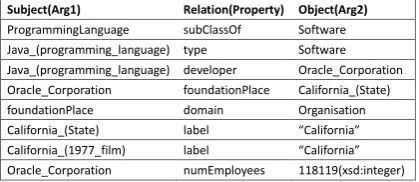
Subject(Arg1) Relation(Property) Object(Arg2) ProgrammingLanguage subClassOf Software Java_(programming_language) type Software Java_(programming_language) developer Oracle_Corporation Oracle_Corporation foundationPlace California_(State) foundationPlace domain Organisation California_(State) label “California” California_(1977_film) label “California” Oracle_Corporation numEmployees 118119(xsd:integer)
Figure 1: Sample knowledge base facts.
DBpedia3 and some classes from Yago4. These
knowledge bases (KBs) are composed of many on-tological and instance statements, and all state-ments are expressed by SPO triple facts. Figure 1 shows some triple fact samples from DBpedia.
Each fact is composed of threesemantic items. A semantic item can be an entity (California (State), Oracle Corporation, etc.), a class (Software, Organ-isation, etc.) or a relation (called a property or predicate in some occasions). Some entities are literals including strings, numbers and dates (118119(xsd:integer), etc.). Relations contain stan-dard Semantic Web relations (subClassOf,type, do-mainandlabel) and ontological relations (developer, foundationPlaceandnumEmployees).
2.2 Task Statement
Given a knowledge base (KB), our objective is to translate a natural language question qNL into a
formal language queryqF Lthat targets the
seman-tic vocabularies given by the KB, and the query
qF Lshould capture the user information needs
ex-pressed byqNL.
Following (Yahya et al., 2012), we focus on the factoid questions, and the answers to such ques-tions are an entity or a set of entities. We ignore the questions that need the aggregation5(max/min,
etc.) and negation operations. That is, we generate queries that consist of a plentiful number of triple patterns, which are multiple conjunctions ofSPO search conditions.
3 Framework
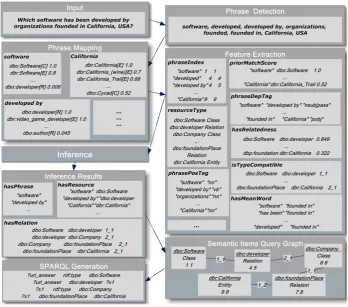
Figure 2 shows the entire framework of our system for translating a question into a formal SPARQL query. The first three steps address the input ques-tion through 1) Phrase Detecques-tion (detecting pos-sible phrases), 2) Phrase Mapping (mapping all
3http://dbpedia.org/
4http://www.mpi-inf.mpg.de/yago-naga/yago/
5We can address thecountquery questions, which will be explained in Section 3.
phrase candidates to the corresponding seman-tic items), and 3) Feature Extraction (extracting the linguistic features and semantic item features from the question and the Linked Data, respec-tively). As a result, a space of candidates is con-structed, including possible phrases, mapped se-mantic items and the possible argument match re-lations among them. Next, the fourth step (In-ference) formulates the joint disambiguation as a generalized inference task. We employ rich fea-tures and constraints (including hard and soft con-straints) to infer a joint decision through an MLN. Finally, with the inference results, we can con-struct a semantic item query graph and generate an executable SPARQL query. In the following subsection, we demonstrate each step in detail.
1) Phrase detection. In this step, we detect phrases (sequences of tokens) that probably indi-cate semantic items in the KB. We do not use a named entity recognizer (NER) because of its low coverage. We perform testing on two commonly used question corpora, QALD-3 and free9176,
us-ing the Stanford NER tool7. The results
demon-strate that only 51.5 and 23.8% of the NEs are correctly recognized, respectively. To avoid miss-ing useful phrases, we retain all n-grams as phrase candidates, and then use some rules to filter them. The rules include the following: the span length must be less than 4 (accepting that all contiguous tokens are capitalizations), the POS tag of the start token must be jj, nn, rb and vb, all contiguous capitalization tokens must not be split, etc. For instance, software, developed by, organizations,
founded inandCaliforniaare detected in the
ex-ample of the first section.
2) Phrase mapping. After the phrases are de-tected, each phrase can be mapped to the corre-sponding semantic item in KB (entity, class and
relation). For example, software is mapped to
dbo:Software, dbo:developer, etc., and California is mapped to dbr:California, dbr:California (wine), etc. For different types of semantic items, we use dif-ferent techniques. For mapping phrases to en-tities, considering that the entities in DBpedia and Wikipedia are consistent, we employ anchor, redirection and disambiguation information from Wikipedia. For mapping phrases to classes, con-sidering that classes have lexical variation,
espe-cially synonyms, e.g., dbo:Film can be mapped
6http://www.cis.temple.edu/∼ yates/open-sem-parsing/index.html
Which software has been developed by
organizations founded in California, USA? software, developed, developed by, organizations, founded, founded in, California, USA
software
developed by
... ... ... California
phraseIndex
phrasePosTag resourceType
priorMatchScore
hasMeanWord phraseDepTag
hasRelatedness
...
isTypeCompatible
hasPhrase hasResource
[image:4.595.125.474.63.370.2]hasRelation
Figure 2: Framework of our system.
fromfilm,movieandshow, we compute the
simi-larity between the phrase and the class in theKB with theword2vectool8. Theword2vectool
com-putes fixed-length vector representations of words with a recurrent-neural-network based language model (Mikolov et al., 2010). The similarity scor-ing methods are introduced in Section 4.2. Then, the top-N most similar classes for each phrase are returned. For mapping phrases to relations, we employ the resources from PATTY (Nakashole et al., 2012) and ReVerb (Fader et al., 2011). Specif-ically, we first compute the associations between the ontological relations in DBpedia and the re-lation patterns in PATTY and ReVerb through in-stance alignments as in (Berant et al., 2013). Next, if a detected phrase is matched to some relation pattern, the corresponding ontological relations in DBpedia will be returned as a candidate. This step only generates candidates for every possible map-ping, and the decision of the best selection will be performed in the next step.
3) Feature extraction and joint inference.
There exist ambiguities in phrase detection and in mapping phrases to semantic items. This step fo-cuses on addressing these ambiguities and
deter-8https://code.google.com/p/word2vec/
mining the argument match relations among the mapped semantic items. This is the core compo-nent of our system, and it performs disambigua-tion in a unified manner. First, feature extracdisambigua-tion is performed to prepare a rich number of features from the input question and from the KB. Next, the disambiguation is performed in a joint fashion with a Markov Logic Network. Detailed informa-tion will be presented in Secinforma-tion 4.
4) Semantic item query graph construction.
Based on the inference results, we construct a query graph. The vertices contain the following: the detected phrase, the token span indexes of the phrases, the mapped semantic items and their types. The edge indicates the argument match re-lation between two semantic items. For example, we use 1 2 to indicate that the first argument of
an item matches the second argument of another item9. The right bottom in Figure 2 shows an
ex-ample of this.
5) Query generation. The SPARQL queries require the grouped triples of semantic items. Thus, in this step, we convert a query graph into multiple joined semantic triples. Three in-terconnected semantic items, whereby it must
be ensured that the middle item is a rela-tion, are converted into a semantic triple
(mul-tiple joined facts containing variables). For
example, the query graph Vdbo:Book[Class] 1 2←→ dbo:author[Relation]1 1←→dbr:Danielle Steel[Entity]W is converted into h?x rdf:type dbo:Book, dbr:Danielle dbo:author ?xi, and Vdbo:populationTotal[Relation] 1 2
←→dbo:capital[Relation]1 1←→dbr:Australia[Entity]W10is converted into h?x1 dbo:populationTotal ?answer, ?x1 dbo:capital dbr:Australiai. If the query graph only contains one vertex that indicates a classClassURI,
we generate h?x rdf:type ClassURIi. If the query graph only contains two connected vertexes, we append a variable to bind the missing match argu-ment of the semantic item.
The final SPARQL query is constructed by join-ing the semantic item triples based on the cor-responding SPARQL template. We divide the questions into three types: Yes/No, Normal and
Number. Yes/No questions use the ASK WHERE
template. Normal questions use the SELECT ?url
WHERE template. Number questions first use the
normal question template, and if they cannot ob-tain a correct answer (a valid numeric value), we
use the SELECT COUNT(?url) WHERE template to
generate a query again. For instance, we construct
the SPARQL query SELECT(?url) WHERE{ ?url
rdf:type dbo:Software. ?url dbo:developer ?x1. ?x1 rdf:type dbo:Company. ?x1 dbo:foundationPlace dbr:California.} for this example.
4 Joint Disambiguation with MLN
In this section, we present our method for ques-tion answering over linked data using a Markov Logic Network (MLN). In the following subsec-tions, we first briefly describe the MLN. Then, we present the predicates and the first-order logic for-mulas used in the model.
4.1 Markov Logic Networks
Markov logic networks combine Markov networks with first-order logic in a probabilistic framework
(Richardson and Domingos, 2006). An MLNM
consists of several weighted formulas{(φi, wi)}i,
where φi is a first order formula and wi is the
penalty (the formula’s weight). In contrast to the first-order logic, whereby a formula repre-sents a hard constraint, these logic formulas are relaxed and can be violated with penalties in the
10This corresponds to the question “How many people live
in the capital of Australia?”
MLN. Each formulaφi consists of a set of
first-order predicates, logical connectors and variables. These weighted formulas define a probability dis-tribution over a possible world. Letydenote a pos-sible world. Thenp(y)is defined as follows:
p(y) = Z1exp
X
(φi,wi)∈M
wi X
c∈Cnφi
fφi
c (y)
,
where eachcis a binding of the free variables in
φi to constants; fcφi is a binary feature function that returns 1 if the ground formula that we ob-tain through replacing the free variables inφiwith
the constants inc under the given possible world
yis true and is 0 otherwise; andCnφi is the set of
all possible bindings for the free variables inφi.
Z is a normalized constant. The Markov network
corresponds to this distribution, where nodes rep-resent ground atoms and factors reprep-resent ground formulas.
4.2 Predicates
In the MLN, we design several predicates to re-solve the ambiguities in phrase detection, map-ping phrases to semantic items and semantic item grouping. Specifically, we design a hidden pred-icatehasPhrase(i) to indicate that the i-th candi-date phrase has been chosen. The predicate hasRe-source(i,j)indicates that thei-th phrase is mapped to the j-th semantic item. The predicate hasRe-lation(j,k,rr)indicates that thej-th semantic item and thek-th semantic item should be grouped to-gether with the argument-match-typerr. Note that we define four argument match types between two semantic items: 1 1, 1 2, 2 1and2 2. Here, the argument match typet sdenotes that thet-th argu-ment of the first semantic item corresponds to the s-th argument of the second semantic item11. The
detailed illustration is shown in Table 1.
Type Example Question
1 1 dbo:height 1 1 dbr:Michael Jordan How tall is Michael Jor-dan?
1 2 dbo:River 1 2 dbo:crosses Which river does the Brooklyn Bridge cross? 2 1 dbo:creator 2 1 dbr:Walt Disney Which television shows
were created by Walt Disney?
[image:5.595.308.521.615.704.2]2 2 dbo:birthPlace 2 2 dbo:capital Which actors were born in the capital of American?
Table 1: Examples of the argument match types.
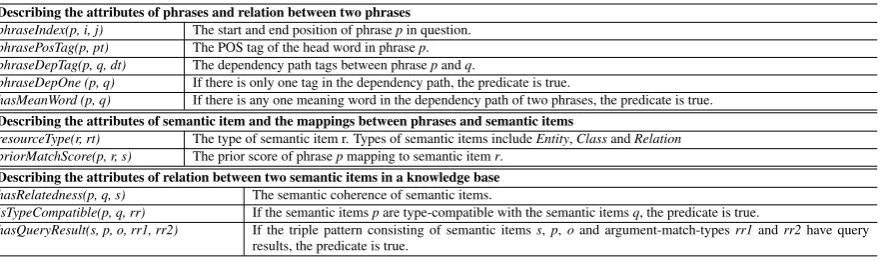
Describing the attributes of phrases and relation between two phrases
phraseIndex(p, i, j) The start and end position of phrasepin question.
phrasePosTag(p, pt) The POS tag of the head word in phrasep.
phraseDepTag(p, q, dt) The dependency path tags between phrasepandq.
phraseDepOne (p, q) If there is only one tag in the dependency path, the predicate is true.
hasMeanWord (p, q) If there is any one meaning word in the dependency path of two phrases, the predicate is true. Describing the attributes of semantic item and the mappings between phrases and semantic items
resourceType(r, rt) The type of semantic item r. Types of semantic items includeEntity,ClassandRelation priorMatchScore(p, r, s) The prior score of phrasepmapping to semantic itemr.
Describing the attributes of relation between two semantic items in a knowledge base
hasRelatedness(p, q, s) The semantic coherence of semantic items.
isTypeCompatible(p, q, rr) If the semantic itemspare type-compatible with the semantic itemsq, the predicate is true.
[image:6.595.82.523.61.191.2]hasQueryResult(s, p, o, rr1, rr2) If the triple pattern consisting of semantic itemss,p,oand argument-match-typesrr1andrr2have query results, the predicate is true.
Table 2: Descriptions of observed predicates. Moreover, we define a set of observed
predi-cates to describe the properties of phrases, seman-tic items, relations between phrases and relations between semantic items. The observed predicates and descriptions are shown in Table 2.
Previous methods usually designed some heuristic patterns to group semantic items, which usually employed a human-designed syntactic path between two phrases to determine their re-lations. In contrast, we collect all the tokens in the dependency path between two phrases as pos-sible patterns. The predicatesphraseDepTag and
hasMeanWordare designed to indicate the
possi-ble patterns. Note that if these tokens only contain POS tagsdt|in|wdt|to|cc|ex|pos|wporstop words, the value of the predicatehasMeanWord is false; otherwise, it is true. In this way, our system is ex-pected to cover more question expressions. More-over, the SPARQL endpoint is used to verify the type compatibility of two semantic items and if one triple pattern can obtain query results.
The predicatehasRelatednessneeds to compute the coherence score between two semantic items. Following (Yahya et al., 2012), we use the Jaccard coefficient (Jaccard, 1908) based on the inlinks be-tween two semantic items.
The predicate priorMatchScoreassigns a prior score when mapping a phrase to a semantic item. We use different methods to compute this score according to different semantic item types. For entities, we use a normalized score based on the frequencies of a phrase referring to an entity. For classes and relations, we use different meth-ods. We first define the following three similar-ity metrics: a)s1: The Levenshtein distance score (Navarro, 2001) between the labels of the seman-tic item and the phrase; b)s2: The word embed-ding (Mikolov et al., 2010) score, which measures the similarity between two phrases and is the max-imum cosine value of the words’ word
embed-dings between two phrases; and c)s3: the instance overlap score, which is computed using the Jac-card coefficient of the instance overlap. All scores are normalized to produce a comparable scores in the interval of (0, 1). The final prior scores for mapping phrases to classes and relations are
γs1+ (1−γ)s2andαs1+βs2+ (1−α−β)s3, respectively. The parameters are set to empirical values12.
4.3 Formulas
According to these predicates, we design several first-order logic formulas for joint disambiguation. As mentioned in the first section, these formulas represent the meta patterns. The concrete terns can be generated through these meta pat-terns with training data. Specifically, we use two types of formulas for the joint decisions: Boolean
and Weighted formulas. Boolean formulas are
hard constraints, which must be satisfied by all of the ground atoms in the final inference results.
Weightedformulas are soft constraints, which can
be violated with some penalties.
4.3.1 Boolean Formulas (Hard Constraints)
Table 3 lists the Boolean formulas used in this work. The “ ” notation in the formulas indicates an arbitrary constant. The “|f|” notation expresses the number of true grounded atoms in the formula
f. These formulas express the following
con-straints:
hf1: If a phrase is chosen, then it must have a mapped semantic item;
hf2: If a semantic item is chosen, then its mapped phrase must be chosen;
hf3: A phrase can be mapped to at most one se-mantic item;
hf4: If the phrase is not chosen, then its mapped
hf1 hasP hrase(p)⇒hasResource(p,)
hf2 hasResource(p,)⇒hasP hrase(p)
hf3 |hasResource(p, )| ≤1
hf4 !hasP hrase(p)⇒!hasResource(p, r)
hf5 hasResource(, r)⇒hasRelation(r, , )∨hasRelation(, r, )
hf6 |hasRelation(r1, r2, )| ≤1
hf7 hasRelation(r1, r2,)⇒hasResource(, r1)∧hasResource(, r2)
hf8 phraseIndex(p1, s1, e1)∧phraseIndex(p2, s2, e2)∧overlap(s1, e1, s2, e2)∧hasP hrase(p1)⇒!hasP hrase(p2)
hf9 resourceT ype(r,“Entity”)⇒!hasRelation(r, ,“2 1”)∧!hasRelation(r, ,“2 2”)
hf10 resourceT ype(r,“Entity”)⇒!hasRelation(, r,“2 1”)∧!hasRelation(r, ,“2 2”)
hf11 resourceT ype(r,“Class”)⇒!hasRelation(r, ,“2 1”)∧!hasRelation(r, ,“2 2”)
hf12 resourceT ype(r,“Class”)⇒!hasRelation(, r,“2 1”)∧!hasRelation(r, ,“2 2”)
[image:7.595.74.523.60.186.2]hf13 !isT ypeCompatible(r1, r2, rr)⇒!hasRelation(r1, r2, rr)
Table 3: Descriptions of Boolean formulas.
sf1 priorMatchScore(p, r, s)⇒hasP hrase(p)
sf2 priorMatchScore(p, r, s)⇒hasResource(p)
sf3 phraseP osT ag(p, pt+)∧resourceT ype(r, rt+)⇒hasResource(p, r)
sf4 phraseDepT ag(p1, p2, dp+)∧hasResource(p1, r1)∧hasResource(p2, r2)⇒hasRelation(r1, r2, rr+)
sf5 phraseDepT ag(p1, p2, dp+) ∧ hasResource(p1, r1) ∧ hasResource(p2, r2)∧!hasMeanW ord(p1, p2) ⇒
hasRelation(r1, r2, rr+)
sf6 phraseDepT ag(p1, p2, dp+) ∧ hasResource(p1, r1) ∧ hasResource(p2, r2) ∧ phraseDepOne(p1, p2) ⇒
hasRelation(r1, r2, rr+)
sf7 hasRelatedness(r1, r2, s)∧hasResource(, r1)∧hasResource(, r2)⇒hasRelation(r1, r2,)
sf8 hasQueryResult(r1, r2, r3, rr1, rr2)⇒hasRelation(r1, r2, rr1)∧hasRelation(r2, r3, rr2)
Table 4: Descriptions of weighted formulas. semantic item should not be chosen;
hf5: If a semantic item is chosen, then it should have at least one argument match relation with other semantic items;
hf6: Two semantic items have at most one argu-ment match relation;
hf7: If an argument match relation for two seman-tic items is chosen, then they must be chosen; hf8: Each of two chosen phrases must not overlap; hf9, hf10, hf11, hf12: The semantic item with
typeEntityandClassshould not have a second
ar-gument that matches with others;
hf13: The chosen argument match relation for two sematic items must be type compatible.
4.3.2 Weighted Formulas (Soft Constraints)
Table 4 lists the weighted formulas used in this work. The “+” notation in the formulas indicates that each constant of the logic variable should be weighted separately. Those formulas express the following properties in joint decisions:
sf1, sf2: The larger the score of the phrase map-ping to a semantic item, the more likely the cor-responding phrase and semantic item should been chosen;
sf3: There are some associations between the POS tags of phase and the types of mapped semantic items;
sf4, sf5, sf6: There are some associations be-tween the dependency tags in the dependency pat-tern path of two phases and the types of argument match relations of two mapped semantic items;
sh7: The larger the relatedness of two
seman-tic items, the more likely they have an argument match relation;
sf8: If the triple pattern has query results, these se-mantic items should have corresponding argument match relations.
5 Experiments
5.1 Dataset & Evaluation Metrics
We use the following three collections of questions
from the QALD13 task for question answering
over linked data: 1, 3 and QALD-4. The generated SPARQL queries are evaluated on Linked Data from DBpedia and YAGO using a Virtuoso engine14. A typical example question
from the QALD benchmark is“Which books
writ-ten by Kerouac were published by Viking Press?”.
As mentioned in Section 2.2, our system is not de-signed to answer questions that contain numbers, date comparisons and aggregation operations such
as group by or order by. Therefore, we remove
these types of questions and retain 110 questions from the QALD-4 training set for generating the specific formulas and for training their weights in MLN. We test our system using 37, 75 and 26 questions from the training set of QALD-115, and
the testing set of QALD-3 and QALD-4 respec-tively. We use #T, #Q and #A to indicate the total
13www.sc.cit-ec.uni-bielefeld.de/qald/
number of questions in the testing set, the num-ber of questions we could address and the numnum-ber of questions answered correct, respectively. We select Precision (P = ##AQ), Recall (R = ##AT), and F1-score (F1 = 2·P·R
P+R) as the evaluation
met-rics. To assess the effectiveness of the disambigua-tion process in the MLN, we computed the overall quality measures by precision and recall with the manually obtained results.
5.2 Experimental Configurations
The Stanford dependency parser (De Marneffe et al., 2006) is used for extracting features from the dependency parse trees. We use the toolkit
the-beast16 to learn the weights of the formulas and
to perform the MAP inference. The inference al-gorithm uses a cutting plane approach. In addi-tion, for the parameter learning, we set all ini-tial weights to zero and use an online learning algorithm with MIRA update rules to update the weights of the formulas. The number of iterations for the training and testing are set to 10 and 200, respectively.
5.3 Results and Discussion
5.3.1 The Effect of Joint Learning
To demonstrate the advantages of our joint learn-ing, we design a pipeline system for compari-son, which independently performs phrase detec-tion, phrase mapping, and semantic item grouping by removing the unrelated formulas in MLN. For example, the formulas17 related to the predicates
hasResource and hasRelation are removed when
detecting phrases in questions.
Table 5 shows the results, where Joint
de-notes the proposed method with joint inference and Pipeline denotes the compared method per-forming each step independently. We perform a comparison with the question answering results of QALD (QA), and comparisons at each of the fol-lowing steps: PD (phrase detection), PM (phrase mapping) and MG (mapped semantic items group-ing). From the results, we observe that our method answers over half of the questions. Moreover, our joint model based on MLN can obtain better per-formance in question answering compared to the pipeline system. We also observe that Joint ex-hibits better performance than Pipeline in most steps, except for MG in QALD-3. We believe this
16http://code.google.com/p/thebeast
17including entire formulas, excludinghf8andsf1
is because the three tasks (phrase detection, phrase mapping, and semantic item grouping) are con-nected with each other. Each step can provide use-ful information for the other two tasks. Therefore, performing joint inference can effectively improve the performance. Finally, we observe that the for-mer task usually produces better results than the subsequent tasks (phrase detection exhibits a bet-ter performance than phrase mapping, and phrase mapping exhibits a better performance than se-mantic item grouping). The main reason is that the latter subtask is more complex than the former task. The decisions of the latter subtask strongly rely on the former results even though they have interacted effects.
5.3.2 The Effect of Pattern Learning
Table 6 shows a comparison of our system with
DEANNA (Yahya et al., 2012), which is based
on a joint disambiguation model but which em-ploys hand-written patterns in its system. Because
DEANNA only reports its results of the QALD-1
dataset, we do not show the results for QALD-3 and QALD-4 for equity. From the results, we can see that our system solved more questions and
ex-hibited a better performance than did DEANNA.
One of the greatest strengths of our system is that the learning system can address more questions than hand-written pattern rules.
System #T #Q #A P R F1
DEANNA (Yahya et al., 2012) 50 27 13 0.48 0.26 0.33 Ours 50 37 20 0.54 0.4 0.46
Table 6: Comparisons with DEANNA using the
QALD-1 test questions.
Compared to the ILP (Integer Linear Program-ming) used in (Yahya et al., 2012) for joint disam-biguation, we argue that there are two major dif-ferences to our method. 1) Our method is a data-driven approach that can learn effective patterns or rules for the task. Therefore, it exhibits more robustness and adaptability for various KBs. 2) We design several meta rules in MLN as opposed to specific ones. The specific rules can be gen-erated by these meta rules based on the training data. By contrast, the traditional approach using ILP needs to set specific rules in advance, which requires more intensive labor than our approach.
Benchmark P PDR F1 P PMR F1 P MGR F1 #T #Q #A QAP R F1 QALD-1(Joint) 0.93 0.981 0.955 0.895 0.944 0.919 0.703 0.813 0.754 50 37 20 0.54 0.4 0.46 QALD-1(Pipeine) 0.921 0.972 0.946 0.868 0.917 0.892 0.585 0.859 0.696 50 34 17 0.5 0.34 0.41 QALD-3(Joint) 0.941 0.941 0.941 0.878 0.918 0.898 0.636 0.798 0.708 99 75 45 0.6 0.46 0.52 QALD-3(Pipeline) 0.912 0.912 0.912 0.829 0.867 0.848 0.677 0.789 0.729 99 75 42 0.56 0.42 0.48 QALD-4(Joint) 0.947 0.978 0.963 0.937 0.967 0.952 0.776 0.865 0.817 50 26 15 0.58 0.3 0.4 QALD-4(Pipeline) 0.937 0.967 0.952 0.905 0.935 0.920 0.683 0.827 0.748 50 24 13 0.54 0.26 0.35
Table 5: The performance of joint learning on three benchmark datasets.
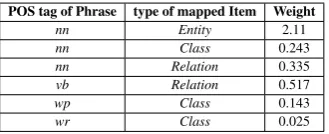
we can see thatnn18is more likely mapped to
En-tity19 than to Class andRelation, and vb is most
likely mapped to Relation. This proves that our model can learn effective and reasonable patterns for QALD.
POS tag of Phrase type of mapped Item Weight
nn Entity 2.11
nn Class 0.243
nn Relation 0.335
vb Relation 0.517
wp Class 0.143
[image:9.595.100.265.254.321.2]wr Class 0.025
Table 7: Sample weights of formulas, correspond-ing with formulasf3.
5.3.3 Comparison to the state of the art
To illustrate the effectiveness of the proposed method, we perform comparisons to the state-of-the-art methods. Table 8 shows the results using QALD-3 and QALD-4. These systems are the participants in the QALD evaluation campaigns. From the results, we can see that our system out-performs most systems at a competitive perfor-mance. They further prove the effectiveness of the proposed method.
Test set System #T #Q #A P R F1
QALD-3
CASIA (He et al.,
2013) 99 52 29 0.56 0.3 0.38 Scalewelis (Joris
and Ferr´e, 2013) 99 70 32 0.46 0.32 0.38 RTV (Cristina et
al., 2013) 99 55 30 0.55 0.3 0.39 Intui2 (Corina,
2013) 99 99 28 0.28 28 0.28 SWIP (Pradel et al.,
2013) 99 21 15 0.71 0.15 0.25 Ours 99 75 45 0.6 0.46 0.52
QALD-420
gAnswer 50 25 16 0.64 0.32 0.43 Intui3 50 33 10 0.30 0.2 0.24 ISOFT 50 50 10 0.2 0.2 0.2 RO FII 50 50 6 0.12 0.12 0.12 Ours 50 26 15 0.58 0.3 0.4
Table 8: Comparisons with state-of-the-art sys-tems using the QALD benchmark.
18The POS tag of the head word in the phrase 19The type of semantic item
20Because the QALD-4 conference does not start un-til after submission, we have no citation for the
state-of-5.3.4 The Effect of Different Formulas
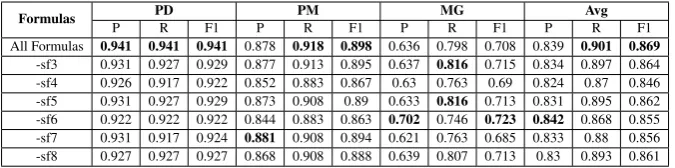
To determine which formulas are more useful for QALD, we evaluate the performance of the pro-posed method with different predicate sets. We subtract one weighted formula from the original sets at a time, except retaining the first two for-mulassf1andsf2for basic inference. Because of space limitations, only the results using QALD-3 testing set are shown in Table 9.
From the results, we can observe that remov-ing some formulas can boost the performance on some single tasks, but employing all formulas can produce the best performance. This illustrates that solely resolving the steps in QALD (phrase detec-tion, phrase mapping, semantic items grouping) can obtain local results, and that making joint in-ference is necessary and useful.
6 Related Work
Our proposed method is related to two lines of
work:Question Answering over Knowledge bases
andMarkov Logic Networks.
Question answering over knowledge bases
has attracted a substantial amount of interest over a long period of time. The initial attempts in-cluded BaseBall (Green Jr et al., 1961) and Lu-nar (Woods, 1977). However, these systems were mostly limited to closed domains due to a lack of knowledge resources. With the rapid development of structured data, such as DBpedia, Freebase and Yago, the need for providing user-friendly inter-face to these data has become increasingly urgent. Keyword (Elbassuoni and Blanco, 2011) and se-mantic (Pound et al., 2010) searches are limited to their ability to specify the relations among the different keywords.
The open topic progress has also been pushed by the QALD evaluation campaigns (Walter et al., 2012). Lopez et al. (2011) gave a comprehensive survey in this research area. The authors devel-oped thePowerAquasystem (Lopez et al., 2006) to
[image:9.595.74.288.520.673.2]Formulas P PDR F1 P PMR F1 P MGR F1 P AvgR F1 All Formulas 0.941 0.941 0.941 0.878 0.918 0.898 0.636 0.798 0.708 0.839 0.901 0.869
[image:10.595.131.469.62.146.2]-sf3 0.931 0.927 0.929 0.877 0.913 0.895 0.637 0.816 0.715 0.834 0.897 0.864 -sf4 0.926 0.917 0.922 0.852 0.883 0.867 0.63 0.763 0.69 0.824 0.87 0.846 -sf5 0.931 0.927 0.929 0.873 0.908 0.89 0.633 0.816 0.713 0.831 0.895 0.862 -sf6 0.922 0.922 0.922 0.844 0.883 0.863 0.702 0.746 0.723 0.842 0.868 0.855 -sf7 0.931 0.917 0.924 0.881 0.908 0.894 0.621 0.763 0.685 0.833 0.88 0.856 -sf8 0.927 0.927 0.927 0.868 0.908 0.888 0.639 0.807 0.713 0.83 0.893 0.861
Table 9: Performance comparisons of different weighted formulas evaluated using the QALD-3 question set.
answer questions on large, heterogeneous datasets. For questions containing quantifiers, comparatives or superlatives, Unger et al. (2012) translated
NL to FL using several SPARQL templates and
using a set of heuristic rules mapping phrases to semantic items. The system most similar to
ours isDEANNA (Yahya et al., 2012). However,
DEANNA extracts predicate-argument structures
from the questions using three hand-written pat-terns. Our system jointly learns these mappings and extractions completely from scratch.
Recently, the Semantic Parsing (SP) community targeted this problem from limited domains (Tang and Mooney, 2001; Liang et al., 2013) to open do-mains (Cai and Yates, 2013; Berant et al., 2013). The methods in semantic parsing answer questions by first converting natural language utterances into meaningful representations (e.g., the lambda cal-culus) and subsequently executing the formal
log-ical forms over KBs. Compared to deriving the
complete logical representation, our method aims to parse a question into a limited logic form with the semantic item query, which we believe is more appropriate for answering factoid questions.
Markov Logic Networks have been widely used in NLP tasks. Huang (2012) applied MLN to compress sentences by formulating the task as a word/phrase deletion problem. Fahrni and Strube (2012) jointly disambiguated and clustered con-cepts using MLN. MLN has also been used in coreference resolution (Song et al., 2012). For the task of identifying subjective text segments and of extracting their corresponding explanations from product reviews, Zhang et al. (2013) mod-eled these segments with MLN. To discover log-ical knowledge for deep question answering, Liu (2012) used MLN to resolve the inconsistencies of multiple knowledge bases.
Meza-Ruiz and Riedel (2009) employed MLN for Semantic Role Labeling (SRL). They jointly performed the following tasks for a sentence:
predicate identification, frame disambiguation, ar-gument identification and arar-gument classification. The semantic analysis of SRL solely rested on the lexical level, but our analysis focuses on the knowledge-base level and aims to obtain an exe-cutable query and to support natural language in-ference.
7 Conclusions and Future Work
For the task of QALD, we present a joint learn-ing framework for phrase detection, phrase map-ping and semantic item groumap-ping. The novelty of our method lies in the fact that we perform joint inference and pattern learning for all subtasks in QALD using first-order logic. Our experimental results demonstrate the effectiveness of the pro-posed method.
In the future, we plan to address the follow-ing limitations that still exist in the current sys-tem: a) numerous hand-labeled data are required for training the MLN, and we could use a la-tent form of semantic item query graphs (Liang et al., 2013); b) more robust solutions can be devel-oped to find the implicit relations in questions; c) our system can be scaled up to large-scale open-domain knowledge bases (Fader et al., 2013; Yao and Van Durme, 2014); and d) the learning system has the advantage of being easily adapted to new settings, and we plan to extend it to other domains and languages (Liang and Potts, 2014).
Acknowledgments
References
S¨oren Auer, Christian Bizer, Georgi Kobilarov, Jens Lehmann, Richard Cyganiak, and Zachary Ives. 2007. Dbpedia: A nucleus for a web of open data. InThe semantic web, pages 722–735. Springer. Junwei Bao, Nan Duan, Ming Zhou, and Tiejun Zhao.
2014. Knowledge-based question answering as ma-chine translation. InACL.
Jonathan Berant, Andrew Chou, Roy Frostig, and Percy Liang. 2013. Semantic parsing on freebase from question-answer pairs. InEMNLP.
Christian Bizer, Tom Heath, and Tim Berners-Lee. 2009. Linked data-the story so far. International journal on semantic web and information systems, 5(3):1–22.
Kurt Bollacker, Colin Evans, Praveen Paritosh, Tim Sturge, and Jamie Taylor. 2008. Freebase: a col-laboratively created graph database for structuring human knowledge. InSIGMOD.
Qingqing Cai and Alexander Yates. 2013. Large-scale semantic parsing via schema matching and lexicon extension. InACL.
Unger Christina and Andr Freitas. 2014. Question an-swering over linked data: Challenges, approaches, trends. InESWC.
Dima Corina. 2013. Intui2: A prototype system for question answering over linked data. In Work. Multilingual Question Answering over Linked Data (QALD-3).
Giannone Cristina, Bellomaria Valentina, and Basili Roberto. 2013. A hmm-based approach to question answering against linked data. In Work. Multilin-gual Question Answering over Linked Data (QALD-3).
Marie-Catherine De Marneffe, Bill MacCartney, Christopher D Manning, et al. 2006. Generat-ing typed dependency parses from phrase structure parses. InLREC.
Shady Elbassuoni and Roi Blanco. 2011. Keyword search over rdf graphs. InCIKM.
Anthony Fader, Stephen Soderland, and Oren Etzioni. 2011. Identifying relations for open information ex-traction. InEMNLP.
Anthony Fader, Luke Zettlemoyer, and Oren Etzioni. 2013. Paraphrase-driven learning for open question answering. InACL.
Angela Fahrni and Michael Strube. 2012. Jointly disambiguating and clustering concepts and entities with markov logic. InCOLING.
Andre Freitas and Edward Curry. 2014. Natural language queries over heterogeneous linked data graphs: A distributional-compositional semantics approach. InIUI.
Bert F Green Jr, Alice K Wolf, Carol Chomsky, and Kenneth Laughery. 1961. Baseball: an automatic question-answerer. InPapers presented at the May 9-11, 1961, western joint IRE-AIEE-ACM computer conference, pages 219–224. ACM.
Shizhu He, Shulin Liu, Yubo Chen, Guangyou Zhou, Kang Liu, and Jun Zhao. 2013. Casia@qald-3: A question answering system over linked data. In
Work. Multilingual Question Answering over Linked Data (QALD-3).
Minlie Huang, Xing Shi, Feng Jin, and Xiaoyan Zhu. 2012. Using first-order logic to compress sentences. InAAAI.
Paul. Jaccard. 1908. Nouvelles recherches sur la dis-tribution florale. Bulletin de la Soci`ete Vaudense des Sciences Naturelles, 44:223–270.
Guyonvarc’H Joris and S´ebastien Ferr´e. 2013. Scalewelis: a scalable query-based faceted search system on top of sparql endpoints. In Work. Multilingual Question Answering over Linked Data (QALD-3).
Jens Lehmann, Tim Furche, Giovanni Grasso, Axel-Cyrille Ngonga Ngomo, Christian Schallhart, An-drew Sellers, Christina Unger, Lorenz B¨uhmann, Daniel Gerber, Konrad H¨offner, et al. 2012. Deqa: deep web extraction for question answering. In
ISWC.
Percy Liang and Christopher Potts. 2014. Bringing machine learning and compositional semantics to-gether. Annual Reviews of Linguistics (to appear). Percy Liang, Michael I Jordan, and Dan Klein. 2013.
Learning dependency-based compositional seman-tics. Computational Linguistics, 39(2):389–446. Zhao Liu, Xipeng Qiu, Ling Cao, and Xuanjing Huang.
2012. Discovering logical knowledge for deep ques-tion answering. InCIKM.
Vanessa Lopez, Enrico Motta, and Victoria Uren. 2006. Poweraqua: Fishing the semantic web. In
The Semantic Web: research and applications, pages 393–410. Springer.
Vanessa Lopez, Victoria Uren, Marta Sabou, and En-rico Motta. 2011. Is question answering fit for the semantic web?: a survey. Semantic Web, 2(2):125– 155.
Ivan Meza-Ruiz and Sebastian Riedel. 2009. Jointly identifying predicates, arguments and senses using markov logic. InNAACL.
Tomas Mikolov, Martin Karafi´at, Lukas Burget, Jan Cernock`y, and Sanjeev Khudanpur. 2010. Recur-rent neural network based language model. In IN-TERSPEECH, pages 1045–1048.
Gonzalo Navarro. 2001. A guided tour to approximate string matching. ACM Comput. Surv., 33(1):31–88. Jeffrey Pound, Ihab F Ilyas, and Grant Weddell. 2010.
Expressive and flexible access to web-extracted data: a keyword-based structured query language. InSIGMOD.
C Pradel, G Peyet, O Haemmerl´e, and N Hernandez. 2013. Swip at qald-3: results, criticisms and les-son learned (working notes). InWork. Multilingual Question Answering over Linked Data (QALD-3). Matthew Richardson and Pedro Domingos. 2006.
Markov logic networks. Machine learning, 62(1-2):107–136.
Saeedeh Shekarpour, Axel-Cyrille Ngonga Ngomo, and S¨oren Auer. 2013. Question answering on in-terlinked data. InWWW.
Yang Song, Jing Jiang, Wayne Xin Zhao, Sujian Li, and Houfeng Wang. 2012. Joint learning for coref-erence resolution with markov logic. InEMNLP. Fabian M Suchanek, Gjergji Kasneci, and Gerhard
Weikum. 2007. Yago: a core of semantic knowl-edge. InWWW.
Lappoon R. Tang and Raymond J. Mooney. 2001. Us-ing multiple clause constructors in inductive logic programming for semantic parsing. InProceedings of the 12th European Conference on Machine Learn-ing, pages 466–477.
Christina Unger, Lorenz B¨uhmann, Jens Lehmann, Axel-Cyrille Ngonga Ngomo, Daniel Gerber, and Philipp Cimiano. 2012. Template-based question answering over rdf data. InWWW.
Sebastian Walter, Christina Unger, Philipp Cimiano, and Daniel B¨ar. 2012. Evaluation of a layered approach to question answering over linked data. In The Semantic Web–ISWC 2012, pages 362–374. Springer.
William A Woods. 1977. Lunar rocks in natural en-glish: Explorations in natural language question an-swering. InLinguistic structures processing, pages 521–569.
Mohamed Yahya, Klaus Berberich, Shady Elbas-suoni, Maya Ramanath, Volker Tresp, and Gerhard Weikum. 2012. Natural language questions for the web of data. InEMNLP.
Mohamed Yahya, Klaus Berberich, Shady Elbassuoni, and Gerhard Weikum. 2013. Robust question an-swering over the web of linked data. InCIKM. Xuchen Yao and Benjamin Van Durme. 2014.
Infor-mation extraction over structured data: Question an-swering with freebase. InACL.
Qi Zhang, Jin Qian, Huan Chen, Jihua Kang, and Xu-anjing Huang. 2013. Discourse level explanatory relation extraction from product reviews using first-order logic. InACL.