Abstract – The new product development (PD) phase of automotive vehicles in particular and of any complex product in general is a process that requires effective use of knowledge and experience generated from the past. It also involves a large amount of uncertainty which is very difficult to incorporate in well established methodologies and techniques such as quality tools without a large number of assumptions. The use of expert systems combined with artificial intelligence methods is the modern approach to incorporate uncertainty into the various estimations necessary for the improvement of the product development process. This paper introduces a new concept for the design of a reliability improvement system for the automotive industry that combines some of the newest approaches in the discipline of knowledge engineering. The methodology presented aims to make the most effective use of, and prevent the loss of, knowledge that organisations generate through their product development processes.
Index Terms - Expert Systems, fuzzy logic, knowledge engineering, product development.
I. INTRODUCTION
It is widely accepted that modern industries are under immense pressure to deliver high quality and reliable products at the minimum possible cost. Higher quality levels, higher service levels, customisation and continuous innovation paired with lower production costs have been deemed as necessary since the 1980s but are no longer enough in the modern era. The new product development phase and its optimisation has become a very important aspect in the requirements for survival in this modern industrial era, which requires continuous development of new products and exploration of new markets [1-3].
The optimisation of the new product development (PD)
Manuscript Received March 2, 2007. This work was supported by a studentship from the Department of Mechanical Engineering at the University of Birmingham.
S. Lolas is a PhD Student in the Department if Mechanical Engineering at the University of Birmingham, UK (phone: +44 121 414 4171, email:
O.A. Olatunbosun is a Senior Lecturer in Automotive Engineering at the University of Birmingham, UK (phone: +44 121 414 4164; fax: +44 (0) 121 414 3958; email: [email protected] ).
D. Steward is a Technical Specialist on Brakes at Jaguar and Land Rover Cars. (email: [email protected] ).
J. Buckingham is a Senior Manager for Vehicle Capability and Robustness at Ford Motor Company. (email: [email protected] ).
phase requires extensive knowledge about all the various procedures that are involved with it. Liao [5] has commented that knowledge, in general, is a very important resource for presenting valuable heritage, learning new things, solving problems, creating core competences and initiating new situations for both individuals and organisations now and in the future. In the recent years the study of Knowledge Management (KM) and knowledge engineering has become very important, evidenced by the fact that a wide range of relevant technologies and applications have been developed by both academic research and industrial practice [4].
The aim of this paper is to present a new approach used in the construction of the fuzzy logic knowledge base for a new reliability improvement expert system (RIES), whose main objectives are to be able to improve the reliability of new vehicle systems through targeted work based on transfer functions derived from expert knowledge, past experience and pre-production testing. It also aims to provide a repository of knowledge based on lessons learned from previous vehicle programs in a form that enables the knowledge to be easily retrieved and applied in new vehicle programs as a decision making tool.
Summarising, the proposed approach and architecture aims to address the problem of the effective use knowledge in the modern industrial environment in a way that the knowledge, experience and expertise gained in the past will not be lost. Furthermore the proposed approach aims to provide the required knowledge in order to assist the decision making process of the organisation’s management during the concept design and the early stages of the PD phase, establishing a pro-active approach to the development process of new products. Therefore the proposed system can be classified as a knowledge-based expert system within the more general KM domain.
II. BACKGROUND
A. Definition of the problem
As discussed in section I,the optimisation of the new product DP and the effective use of knowledge has become very important. The problem is accentuated when the product is very complex [5] such as an automotive vehicle. As the product complexity increases the difficulty in analysing its performance and improving its reliability also increases due to the high amount of uncertainty that is inherent in the engineering design and development [6]. Many statistical tools have been developed but in most cases these tools depend on parameters
Fuzzy Logic Knowledge Base Construction for a
Reliability Improvement Expert System
that in many cases are just assumed [7]. Thus a methodology that can deal with the uncertainty and the complexity is needed. Also according to prior communication with J. Buckingham and other industrial sources it is apparent that the knowledge about previous failure modes are not robustly used during the decision making process. Adding to this problem is the fact that a significant number of employees change jobs every year, meaning that it is not unusual for the design and development team of the new product to have little or no experience about the product being replaced. For that reason, methods that will capture, retain, and facilitate the use of the knowledge when necessary are important for the PD phase optimisation.
The proposed approach has been designed to deal with the complex problems and the uncertainties encountered during the development phase of new products, and will be also be capable of dealing with the issues of KM within an organisation.
B. Knowledge-based Expert Systems
The main reason for the need of a knowledge-based expert system in the early stage of the product development phase in the automotive industry is that such systems can deal with the main issues that have been discussed in the previous section.
[image:2.612.347.525.466.716.2]By definition Expert Systems are knowledge-based systems that contain expert knowledge; they are programs that can provide expertise for solving problems in a defined application domain [8]. They have been applied successfully in almost every field of human activities due to their abilities to represent, accommodate and learn knowledge; they are capable of taking decisions and communicating with their users in a friendly way [6, 8, 9].
Liao [4] reviewed and discussed in detail the most commonly known approaches in KM. Chapters 3, 6 and 8 refer to the knowledge based systems (KBS) and their applications, expert systems (ES) and their applications, and finally, modelling and its applications. Despite the fact that these three different approaches are presented and discussed separately, in reality they have a high degree of overlap and many common concepts. This means that many of the concepts and methodologies of each approach can be used under the same domain of knowledge management in order to adequately satisfy the specific needs of the problem on hand.
The interesting concepts and attributes from the KBS, ES and modelling for application on this specific work are presented here. The KBS are human centred and have their roots in artificial intelligence aiming to understand and initiate human knowledge in computer systems [4]. They usually consist of a knowledge base, an inference engine, a knowledge engineering tool and a specific user interface [4, 10]. ES can be considered as AI methods but they can also be combined with other AI methods such as artificial neural networks and fuzzy logic. Finally, according to Liao, modelling is an interdisciplinary methodology of KM which is necessary for building qualitative logical models and architectures in different knowledge problem domains.
The individual concepts described in the previous paragraph have been used for the development of the knowledge-based RIES. The normal ES has been combined in this case with
fuzzy logic for developing the knowledge base and inference engine. The reason for using fuzzy logic is its ability to represent inexact data and knowledge, which is closer to human like thinking [8]. As it has been mentioned previously the early stages of the PD is full of gaps and uncertainties [6, 7], therefore fuzzy logic satisfies the requirements.
III. KNOWLEDGE-BASED RELIABILITY IMPROVEMENT EXPERT
SYSTEM (RIES)
In this section the proposed approach for the comprehensive mapping of an automotive vehicle will be presented. As discussed earlier, generating adequate amount of knowledge for the product can help in optimising the development phase of the product. In a complex system, such as an automotive vehicle the analysis for generating knowledge is usually carried out from the complete vehicle cascading down to the component level, Fig. 1 [11].
A. RIES architecture concept overview
The main concept behind the RIES is to try and calculate the effect, on the customer, of decisions and changes made during the development phase and other key periods in the life of an automotive vehicle. The decisions and changes include changes to the vehicle due to the introduction of new models, or new versions of systems and sub-systems or simply actions that have resulted in reliability improvement or deterioration. The reason for this type of analysis is to construct a knowledge base, which will be in an action-and-effect format and will be able to be used in future projects as an assisting tool for decision making, DP optimisation and also resource
management.
In this RIES case the propagation though the system has the reverse direction to that of Fig 1. It links the component level to the sub-system level, to the system level and finally to the complete vehicle. Therefore as it will be demonstrated in more detail later in the case example, the RIES can perform reliability performance estimation (customer level) for the overall vehicle due to changes in specific components (pre-production and testing).
B. RIES components
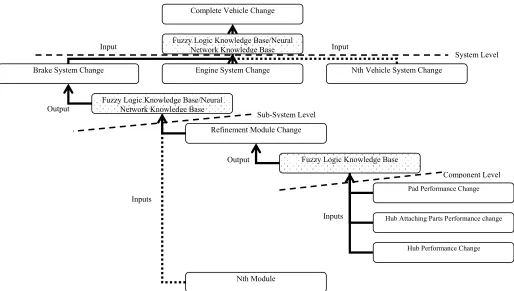
This section will discuss briefly the components of the RIES. Fig 2 is an expanded version of Fig.1, presenting in more detail the components and arrangement of the RIES architecture.
Due to the space constraint full expansion in Fig.2 has only been done for the brake system and for the refinement module of the brake system. These are the components of the system that will be used for the case study example later in the paper. Other components such as the engine component have similar expansion architecture as the brake system from the system level until the component level.
As shown in Fig.2 the system has four main levels, which are the component level, the sub-system/module level, the system level and the full vehicle level. Starting from the component level and moving through the architecture towards the complete vehicle system it can be seen that each level connects with its superior level by a knowledge-base component. For the connection of the component level with the sub-system/module
level a knowledge-based fuzzy logic system is used. The reason is that at the component level there is a lot of uncertainty and also there are many gaps in the data that can only be filled by qualitative assessments by experts. This makes the use of fuzzy logic the best solution according to [6, 8]. For the rest of the connections above the sub-system module level there is a fuzzy logic or a neural network module. The reason for that is that the main development of the initial RIES system has been done by using fuzzy logic but for the higher level connections in the RIES there is only complete numerical data, which makes the use of neural networks a good possibility. At the moment the neural network version of the system is currently being tested for performance and effectiveness. Therefore for this work we only consider the connection knowledge-based modules to be using fuzzy logic.
IV. CASE STUDY EXAMPLE
This section will present a real case example considering the development and application of the RIES to a real vehicle system. The system under consideration will be the braking system of real vehicle. Due to the confidential nature of the data used for this application they have been modified to protect sensitive information.
[image:3.612.50.564.413.704.2]As previously discussed, the RIES system architecture and function revolves around the knowledge-based fuzzy logic connection modules between the different levels. The methodology used for each connection module in the RIES is
Figure 2 The RIES organisational architecture
Complete Vehicle Change
Fuzzy Logic Knowledge Base/Neural Network Knowledge Base
Brake System Change Engine System Change
Fuzzy Logic Knowledge Base/Neural Network Knowledge Base
Refinement Module Change
Nth Vehicle System Change
Nth Module
Fuzzy Logic Knowledge Base
Pad Performance Change
Hub Attaching Parts Performance change
Hub Performance Change
Input Input
Inputs Inputs
Output Output
Component Level Sub-System Level
identical therefore only an example about the refinement module of the braking system will be considered here. The main task in the construction of the RIES is the development of the knowledge based fuzzy logic module, which the paper will concentrate on. The refinement module considers all the problems of the braking system that have to do with noise and vibration. This classification is a common practice in the automotive industry.
A. Fuzzy Logic Module Construction
The fuzzy logic system consists of three main parts, which are the inputs, the outputs and the rules. The rules are used to link the inputs with the outputs [8, 12]. In the RIES the fuzzy logic knowledge-base modules have as input, information coming from lower levels, i.e. the component level, which they link through the use of rules to their output, i.e. refinement module of the sub-system/module level (see Fig.2 and Fig.3, which depicts the fuzzy system in more detail).
1) Knowledge Acquisition phase
This phase is the most important phase in the whole fuzzy logic construction process. The information generated during this phase usually determines the capability of the fuzzy system to perform efficiently and effectively [4, 6, 8, 12]. In the field of
automotive engineering there is a large number of available information sources where knowledge engineers can extract information from. Some of them are discussed in [13] and they include design of experiments tools (DOE), failure mode and effect analysis (FMEA), computer aided engineering packages (CAE) and, of course, human expertise.
The methodology that has been developed as a result of this project for knowledge acquisition will be briefly presented in this paragraph. The first task is to identify all the failure modes of the automotive system under consideration. This is done through the analysis of warranty data and attribute cascades. Then the causes of the failure modes and the performance parameters of the individual components that contributed to the failure modes need to be defined and linked to the specific actions taken that led to the improvement or deterioration of the component’s performance (input calculation). Note that
performance parameteris defined as that parameter, which is used for assessment of the performance of each individual component during testing. The next step is the calculation of the effect on the overall reliability of the module or system due to this change in the performance characteristic of the component (output calculation). This calculation considers data from the customer. This is how the system, through the fuzzy logic knowledge-base, is able to link the effect of changes in the component level during pre-production and testing with the effect on the customer.
2) Calculation of the inputs
The inputs of the fuzzy systems are calculated in terms of change index (CI) as defined in equation 1 [13]. The change refers to the improvement or deterioration in the performance of the component during testing.
100 ×
= changeprevious
CI (1)
[image:4.612.42.300.57.210.2]For this specific case study one of the contributors to the refinement problems is the pad. The performance of the pad during testing is assessed by a number of parameters, i.e. subjective noise index (SNI), objective noise index (ONI) and wear. Changes to the pad materials, design or other are likely to
Figure 3 Fuzzy logic module layout showing information sources
Figure 4 Membership functions for both improvement and deterioration performance (original shape)
Fuzzy
System
Inputs:New Component Performance Improvement
(CI)
Outputs: Overall Effect
in Module Reliability (OMRCI) Warranty Data Analysis Human
knowledge Fuzzy Rules Historical Test Failure
Analysis and Other Information Sources
[image:4.612.98.519.567.717.2]cause a change to one or all of the above performance parameters. This change is captured and linked through the fuzzy module to the output.
3) Calculation of the outputs
The calculation of the output, in this case the overall module reliability change index (OMRCI), is done in similar fashion as with the inputs with equation 1. The only difference is in the values used for the calculation. Here the index is calculated in terms of number of warranty claims per 1000 vehicles sold. So the number of claims before the change or modification of the component and the number of claims after the date at which the change is introduced to the vehicle are considered for the calculation of the effect of the change in reliability performance.
4) Fuzzy rules and membership functions
The construction of the fuzzy rules also requires extensive knowledge about the problem. Fig.3 illustrates all the sources of information that have been used to create the membership functions and the rules base. The sources of information include human knowledge, historical test failure results, historical field analysis and warranty data analysis.
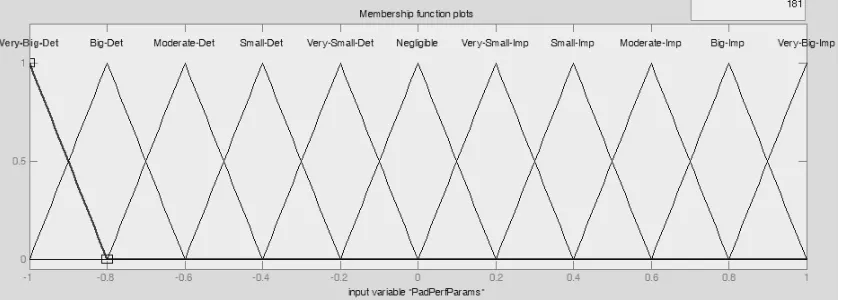
The membership functions used for definition of the fuzzy sets can be seen in Fig.4. There are a number of different shapes that can be used for membership functions [8, 12], but the triangular shape has been selected due to its simplicity. It has also been suggested in the literature that the triangular membership functions are more easily comprehended than others [6, 13]. During the design of the various fuzzy logic knowledge bases for the RIES it has been necessary to change the limits of the membership functions in order to optimise the representation of the real conditions. The effect of the membership function optimisation can be seen in Fig.5. It must be noted that there is no standard procedure for the optimisation
of the membership functions; instead trials with continuous adjustments of the simulated results need to be carried out until the shape of the curve that describes the behaviour of the simulated results matches the one that describes the real world. The real curves similar to the ones in Fig.5 have been constructed with the help of the system engineers and the system experts.
The construction of the fuzzy if-then type rules has been carried out for all the components that are included in the refinement module (Fig.3), i.e. the pad performance (combination of ONI, SNI and wear), the hub performance (stiffness) and the hub attaching parts (ability to withstand cornering loads). The rules must cover all the possible combinations between the three components of the system in order to accommodate their cumulative effects. In total around 440 rules just for the refinement module were necessary to adequately cover all the possible combinations between the three components. The amount of rules would be significantly larger without the classification of the problems in modules at the sub-system level. It is suggested in [8] that modular representation reduces the number of necessary rules.
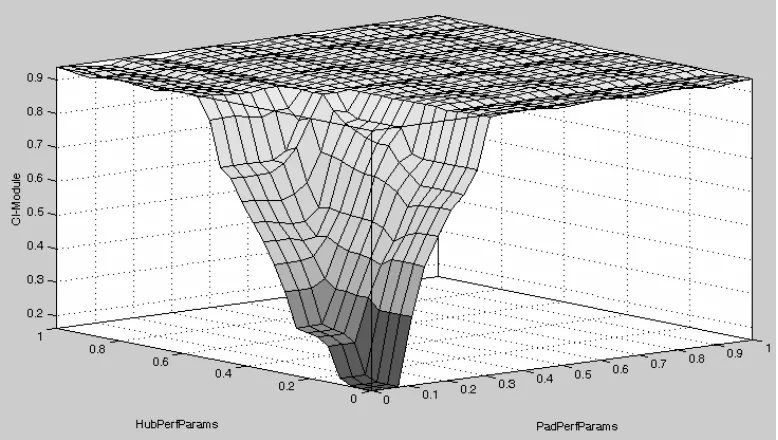
[image:5.612.315.575.44.150.2]The integrity of the rules for describing adequately the required tasks has been checked by using the surface graphs (fig.6) [12, 13]. Unfortunately the surface graphs are limited to
Figure 5 Effect of the membership function optimisation
Figure 6 Surface graph example, graphical representation of fuzzy rules
0 20 40 60 80 100 120
10 20 30 40 50 60 70 80 90 100
Improvement In Pad Performance
E
ff
ec
t i
n R
ef
in
em
ent
M
odul
e
Mod CI due to N17-Pad Perf
Fuzzy Simulated Results
[image:5.612.112.501.499.719.2]three dimensions thus the comparison of more than two parameters at a time is not possible. Figure 6 shows the cumulative effect of the improvements in the pad performance parameter and the hub performance parameter on the refinement module.
5) Fuzzy inference
After the completion of the previous steps the system is ready to be used to calculate the effect of improvement or deterioration of the performance of each one of the refinement module components on the overall module reliability. The process followed for the fuzzy information processing phase is adequately explained in [6, 8, 12, 13].
The same process has been used for the rest of the braking system modules that include ABS warning light problems, electronic parking brake (EPB) problems, pedal feel and brake leaking problems. Therefore the effect of change of any component of any of the modules can be calculated. The outputs of the modules will then become the inputs for the next fuzzy knowledge-base module that links the sub-system/module level with the system level. This knowledge-based fuzzy logic component, at the sub-system to system level has been developed by using the information about the interactions and contributions of all the different modules and therefore can calculate the effect of change at the brake system level. Calculations from the other systems will be available at that point and the process is repeated to calculate the effect at the complete vehicle level. This way the reliability change of the complete vehicle can be linked with the changes and decisions that have been taken at the component level even before the release of the vehicle to the customer.
V. CONCLUSIONS
This paper has presented a concept for an intelligent expert system that can be used for the reliability improvement and optimisation of the new product development process of automotive vehicles, a very complex and difficult task.
The system in its current state has managed to make big steps towards the objectives that were discussed at the beginning of the paper. Through its application to more vehicle systems it will be available to the automotive industry to:
• be used to improve the reliability of a new vehicle based on the experience gained in the past
• be used as assisting tool for decision making • be used as additional attachment to the currently
used tools or initiatives e.g. six-sigma, quality tools, FMEA, DOE and others
• reinforce the effort for customer satisfaction and high product quality with less cost in less time • create the foundations for better management and
use of the gained knowledge and experience
• provide an “independent” memory for the organization for application within its processes • help to eliminate the loss of knowledge
Despite the encouraging initial results from the trials of the
RIES there are a number of areas in the methodology and the structure that need to be improved by further research. Automatic processing of new information, automatic learning capability and a user friendly interface are still features that can be added to the system to enhance its performance and usability.
Full validation of the system in real conditions is not possible immediately because of the nature of the data that is required. Warranty data from up to three years from the beginning of the production of the system is needed to test the system suggesting that full validation of the RIES is a lengthy process. On the other hand the system has managed to capture the knowledge.
REFERENCES
[1] M. Ozer, "A Survey of New Product Evaluation Models,"
Journal of Product Innovation Management, vol. 16, pp. 77-94, 1999.
[2] G. Hamel, C.K. Prahalad, "Corporate Imagination and Expeditionary Marketing," Harvard Business Review, vol. 69, pp. 81-92, 1991.
[3] W. M. Cohen and D. A. Levinthal, "Fortune Favors the Prepared Firm," Management Science, vol. 40, pp. 227-251, 1994.
[4] S. H. Liao, "Knowledge Management Technologies and Applications - Literature Review from 1995 to 2002,"
Expert Systems with Applications, vol. 25, pp. 155-164, 2003.
[5] L. Zadeh, "Outline of a new approach to the analysis of complex systems and decision process," IEEE Transaction on Systems, Manufacturing and Cybernetics, vol. SMC - 3, pp. 28-44, 1973.
[6] J. B. Bowles and C.E. Pelaez, "Application of Fuzzy Logic to Reliability Engineering," IEEE Proceedings, vol. 83, pp. 435-449, 1995.
[7] W. Q. Meeker and L. A. Escobar, "Pitfalls of Accelerated Testing," IEEE Transactions on Reliability, vol. 47, pp. 114-118, 1998.
[8] N. K. Kasabov, Foundations of Neural Networks, Fuzzy Systems, and Knowledge Engineering, 2 ed: MIT Press, 1996.
[9] B. Welinga, J. Sandberg, and G. Schreiber, "Methods and techniques for Knowledge Management: What has Knowledge Engineering to Offer?" Expert Systems with Applications, vol. 13, pp. 73-84, 1997.
[10] J. S. Dhaliwal and I. Benbasat, "The Use and Effects of Knowledge-based System Explanations: Theoretical Foundations and a Framework for Emperical Evaluation,"
Information Systems Research, vol. 7, pp. 342-362, 1996. [11] T. P. Davis, "Reliability Improvement in Automotive
Engineering," Spring Research Conference on Statistics in Industry and Technology, 1999.
[12] MathWorks, "Neural Network Toolbox User's Guide," in
MATLAB 7.0, Release 14: MATLAB Manual, 2004. [13] O.P. Yadav, N. Singh, R.B. Chinnam, and P. S. Goel, "A
![Figure 1 Cascading analysis of an automotive vehicle [11]](https://thumb-us.123doks.com/thumbv2/123dok_us/1332883.664392/2.612.347.525.466.716/figure-cascading-analysis-automotive-vehicle.webp)