Empirical analysis of IPv6 transition technologies
using the IPv6 Network Evaluation Testbed
Marius Georgescu
∗, Hiroaki Hazeyama, Youki Kadobayashi, Suguru Yamaguchi
Nara Institute of Science and Technology, 8916-5 Takayama, Ikoma, Nara 630-0192, JAPAN
Abstract
IPv6 has yet to become more than a worthy successor of IPv4, which remains, for now, the dominant Internet Protocol. This is due to the complicated transition period through which the Internet will have to go, until IPv6 will completely replace IPv4. One of the challenges introduced by this transition is to decide which technology is more feasible for a particular network scenario. To that end, this article proposes the IPv6 Network Evaluation Testbed (IPv6NET), a research project whose ultimate goal is to obtain feasibility data in order to formulate a coherent, scenario-based IPv6 transition strategy. The paper presents the overview of IPv6NET, the testing methodology and empirical results for a specific network scenario. The presented empirical feasibility data includes network performance data such as latency, throughput, packet loss, and operational capability data, such as configuration, troubleshooting and applications capability.
Keywords:IPv6transition,IETFIPv6scenario,464scenario,Enterprise Networks,IPv6NET,Asamap, MAPe,MAPt,DSLite,464XLAT
1. Introduction
Threatened by the limitations of IPv4, the Internet community turned to IPv6 as means to continue the expansion of the Internet. IPv6 uses a 128 bit address, extending the address space to 2128 ≈ 3.4 · 1038
unique IP addresses, enough for many years to come. However the appeal of IPv6 has diminished since 1998, mainly because it is not able to communicate directly with its predecessor, IPv4. This introduced the Internet community with a great challenge, namely the transition to IPv6, which is represented by the stages the Internet will have to undergo until IPv6 will completely replace IPv4.
Given the complexity of the current IPv4-dominated Internet, the transition to IPv6 will be a long and complex process. So far, only a small number of pro-duction networks are IPv6-capable. The APNIC Labs IPv6 deployment report[1] shows that only about 2% of the worldwide users have IPv6 connectivity. IPv6 transition scenarios have been researched within the IETF by the v6ops and Softwire Working Groups. The scenarios were dedicated to four main types of net-works: ISP Networks[2], Enterprise Networks[3], 3GPP Networks[4] and Unmanaged Networks[5]. The IETF Next Generation Transition (ngtrans) Working Group has made many efforts to propose and analyze viable transition mechanisms. Many transition mechanisms
∗
Corresponding [email protected]
have been proposed and implemented. All have advan-tages and disadvanadvan-tages considering a certain transition scenario, but no transition mechanism can be consid-ered most feasible for all the scenarios. This opens many research opportunities. One of which is a scenario-based analysis of IPv6 transition implementations, and represents the ultimate goal of our research.
In this article, we are proposing the IPv6 Network Evaluation Testbed (IPv6NET), which is dedicated to measuring the feasibility of transition mechanisms in a series of scenario-based network tests. As a study case, the article focuses on one of the scenarios, introduced by the IETF for Enteprise Networks in [3].The scenario targets enterprises using an IPv6-only core network technology, but with IPv4-capable nodes, which need to communicate over the IPv6 infrastructure.
The paper is organized as follows: section 2 presents related literature, section 3 introduces the IPv6NET concept and the testing methodology, in section 4 the empirical results are introduced, and the feasibility of the tested implementation is analyzed in relation to the specific scenario, section 5 discusses our approach and lastly section 6 states the conclusions and future work.
2. Related Work
There are a variety of articles dedicated to IPv6 tran-sition experimental environments in current literature. They can be generally classified into closed ments and open environments. The closed environ-ments are usually small scale, local environenviron-ments,
Received on 20 May 2014, accepted on 08 November 2014, published on 25 February 2015
Copyright © 2015Marius Georgescu et al., licensed to ICST. This is an open access article distributed under the terms of the Creative Commons Attribution licence (http://creativecommons.org/licenses/by/3.0/), which permits unlimited use, distribution and reproduction in any medium so long as the original work is properly cited.
doi: 10.4108/inis.2.2.e1
which are isolated from production networks or the Internet. In [6], two 6-over-4, and IPv6 in IPv4 tun-neling implementations are tested and experimental performance results are analyzed, in comparison with a homogeneous IPv6-only network. In [7], the per-formance of Linux operating systems is evaluated in relation to an IPv4-v6 Configured Tunnel and a 6to4 Tunnel. Four workstations were employed to build the testbed. In [8], differences in bandwidth requirements for common network applications like remote login, web browsing, voice communication, database trans-action, and video streaming are analyzed over 3 types of networks: IPv4-only, IPv6-only and a 6to4 tunnel-ing mechanism. The environment was built ustunnel-ing the OPNET simulator, which also served as the basis for the testbed presented in [9], dedicated to the performance analysis of transition mechanisms over a MPLS back-bone. [10] evaluates the performance of DNS64 imple-mentations, BIND9 and TOTD, running on OpenBSD and FreeBSD. A common trait of the above mentioned closed environments, is the thorough performance anal-ysis, which resulted in quantifiable data such as CPU and memory utilization, throughput, end-to-end delay, jitter and execution time.
However, as [11] also underlines, before transition mechanisms are applied in a large scale environment, a systematic and quantitative performance analysis should be performed. This gets us to the second group of experimental environments, namely: open environ-ments. They can be defined as experimental networks connected to a large scale production network or to the Internet. In [12], poor implementation and erroneous operations are identified in an dual-stack environment. A hotel Internet service is presented as a case study. Operational issues such as lack of path/peering, Bad TCP reaction or misbehaving DNS resolution are iden-tified. [13] describes the lessons learned from deploy-ing IPv6 in Google’s heterogeneous corporate network. The report presents numerous operational troubles: the lack of dual-stack support of the customer-premises equipments (CPE), or the immature IPv6 support of operating systems and applications. One of their con-clusions was that the IPv6 transition can affect every operational aspect in a production environment, hence interoperability considerations have to be made. In [14], experiences with IPv6-only Networks are presented. NAT64 and DNS64 technologies are tested in two open environments: an office and a home environment. Com-mon applications such as web browsing, streaming, instant messaging, VoIP, online gaming, file storage and home control were tested. Application issues in relation to the NAT64/DNS64 technology are identified, for example Skype’s limitation to connect to IPv6 destina-tions, or the lack of network operational diagnostics for certain standalone games. Experiences with IPv6-only Networks from previous WIDE Camp events in
[15] present a great deal of meaningful interoperability data such as IPv6 capability of OSes, applications and network devices. Many operational issues have been identified. Some examples are long fall-back routine, low DHCPv6 capability of certain OSes, lack of IPv6 support in some network devices, DNS64 overload, inappropriate AAAA replies or inappropriate selec-tion of DNS resolvers. Considering these examples we can conclude that open environment testing has the potential of exposing interoperability issues, which can otherwise get overlooked.
Combing the advantages of the two testing methods can lead to a complete feasibility analysis. Hence we are considering both methods for testing.
3. Testing Methodology of IPv6NET
The IPv6 Network Evaluation Testbed (IPv6NET) is dedicated to quantifying the feasibility of IPv6 transi-tion implementatransi-tions in relatransi-tion to a specific network scenarios. IPv6NET has two main components: the test-ing component and the infrastructure component. The testing component has the following building blocks: a specific network scenario, an associated network tem-plate and a test methodology. The infrastructure com-ponent is represented by the implementations under testing and the network test environment. As men-tioned prior, we are considering building both closed and open environments.
The scenario targeted in this article was introduced by the IETF in [3] as Scenario 3. It is dedicated to an enterprise which decided to use IPv6 as the main protocol for network communications. Some applications and nodes, which are IPv4-capable would need to communicate over the IPv6 infrastructure. In order to achieve this, the Enterprise would need to apply an IPv6 transition technology, which would allow both protocols to coexist in the same environment. For simplicity, the technologies suitable for this specific scenario will be referred to as464 technologies.
3.1. IPv6NET Feasibility indicators and metrics
shows how a certain technology fits in with the existing environment or how it manages to solve operational problems. To the best of our knowledge, there are no associated metrics for operational feasibility of network devices in current literature. Consequently we have introduced the following three metrics:
• configuration capability: measures how capable a network implementations is in terms of contextual configuration or reconfiguration
• troubleshooting capability: measures how capable a network implementation is at isolating and identifying faults
• applications capability: measures how capable a device is at ensuring compatibility with common user-side protocols
Details about the measurement process for these three metrics, as well as other methodology and infrastructure details, are presented in the following subsections.
3.2. Closed environment
Infrastructure. The basic, small scale template for
464 technologies is composed of a set of network routers: a Customer Edge (CE) router which encap-sulates/translates the IPv4 packets in IPv6 packets, and a Provider Edge (PE) router, which handles the decapsulation/translation from IPv6 back to IPv4. The IPv4-only backbone is used for forwarding the IPv4 traffic. The IPv6 traffic would be directly forwarded by the IPv6 backbone. The closed experiment’s design, presented in Fig.1a, follows the basic network template, including one Customer Edge (CE) machine and one Provider Edge (PE) machine.
Multiple technologies can be considered suitable for the 464 scenario: MAPe[16], MAPt[17], DSLite[18], 464XLAT[19], SA46T[20]. Some implementations sup-porting these technologies have been proposed. One of those is the Asamap vyatta distribution[21], which covers 4 of those technologies: MAPe, MAPt, DSLite and 464XLAT. Both 464 PE and 464CE machines have used as Operating System the Asamap vyatta distribution.
For the underlaying infrastructure, the closed experi-ment uses StarBED [22], a large scale general purpose network testbed, administered by the National Insti-tute of Information and Communications Technology (NICT) of Japan. Four Cisco UCS C200 M2 servers were used for this experiment: two for the devices under test (DUT), 464 PE and 464 CE, and two for the testing platform. As hardware details, each computer used a dual Intel Xeon X5670 CPU and 49.152 GB of RAM. The testing platform computers have used Ubuntu 12.04.3 server as base operating system. The traffic was generated using the Distributed Internet
Traffic Generator (D-ITG) [23]. One of the computers performed the ITGSend function, generating the traffic, while the other ran the ITGRecv function, receiving the generated traffic.
Methodology. The experimental workload is
repre-sented by the amount of traffic inserted into the exper-imental network. We have considered the combina-tions of frame size and frame rates displayed in Table 1. These have been recommended in RFC5180, IPv6 Benchmarking Methodology for Network Interconnect Devices [24], as maximum frame rates×frame sizes for
10 Mbps and 100 Mbps Ethernet. For future tests we intend to expand to 1Gbps as well.
We have considered the following parameters as potentially affecting the network performance: the IP version, IPv4 and IPv6, the upper layers protocols, UDP and TCP, the IPv6 transition technology and the IPv6 transition implementation. A full factorial design was employed. As recommended by RFC2544 [25], the duration of each experiment was 60 seconds after the first timestamp is sent. Each test was repeated 20 times and the average of the recorded values was reported.
3.3. Open environment
Infrastructure. The open experiment topology,
pre-sented in Fig. 1b also follows the basic, small scale 464 network template. The major difference is that the testing platform is replaced by open up-link and down-link connections. We have built this type of environ-ment as part of a bigger experienviron-mental network, which supplied Internet access to participants at the WIDE Camp 1309, a networking event, held between Septem-ber 10 and SeptemSeptem-ber 13 2013, at Shinsu-Matsushiro Royal Hotel, Nagano, Japan. The 464 network consisted of two virtual machines, the Customer Edge machine (CE) and the Provider Edge machine (PE). The two machines have ran on a virtual environment consisting of a Dell PowerEdge R805, with the following hardware description: Six-Core AMD Opteron 2400 CPU and 8GB of RAM. For the hypervisor a Citrix XenServer 6.0 distribution was employed. Previous experiences with building and analyzing a similar 464 open envi-ronment are presented in [26]. The base implementa-tion for all four tested transiimplementa-tion technologies, MAPe, MAPt, DSLite, 464XLAT has been the Asamap vyatta distribution. On the up-link, the IPv4 and IPv6 traffic was routed by a dual-stack core router. WIDE Camp participants were able to connect to the environments trough a single SSID, 464exp, handled by the Layer 2 Cisco WiFi Mesh.
Methodology. For operational capability the proposed
ITGSend
ITGRecv
Generated Traffic path 464
CE
464 PE
Encapsulation/ Translation IPv6 Traffic
IPv4 Traffic
(a)Closed experiment topology
WIDEhIPv6h
WIDE IPv4
464exph Network
IPv6honly Backbone CE
router
PE router
IPv4honly Network
Layerh2hMesh SSID:h464exphh
(b)Open experiment topology
Figure 1. Experimental setup
Table 1. Workload Framesize×Framerate
No Size Rate 10 Mbps Rate 100 Mbps No Size Rate 10Mbps Rate 100 Mbps
1 64 14880 148809 7 1518 812 8127
2 128 8445 84459 8 1522 810 8106
3 256 4528 45289 9 2048 604 6044
4 512 2349 23496 10 4096 303 3036
5 1024 1197 11973 11 8192 152 1523
6 1280 961 9615 12 9216 135 1353
a number of configuration tasks, which have been inspired by the abstracted guidelines presented in [27]. The tasks can be organized in three generic groups, initial setup,reconfigurationandconfirmation. For ease of reference we have associated each task with a task code in accordance with the respective group association.
1. IinitialSetup1: Configure an encapsula-tion/translation virtual interface using a command line interface or a graphical user interface
2. IinitialSetup2: Save the current temporary config-uration commands in a file which can be loaded at start-up
3. IinitialSetup3: Self configuration according to contextual configuration details
4. InitialSetup4: Display warnings in the case of misconfiguration and reject the misconfigured command
5. InitialSetup5: Display warnings in the case of missing command and reject saving the temporary configuration
6. InitialSetup6: Display contextual configuration commands help
7. Reconfiguration1: Convert current configuration settings to configuration commands
8. Reconfiguration2: Back-up and restore the current configuration
9. Confirmation1: Show the current configuration
10. Confirmation2: Show abstracted details for the 464 virtual interface
tasks follow the fault isolation, fault determination and root cause analysis (RCA) guidelines presented in [27]. Consequently the tasks can be organized into the three generic categories:fault isolation,fault determinationand root cause analysis RCA. For ease of reference, these tasks were associated as well with group codes:
1. FaultIsolation1: Capture and analyze IPv4 and IPv6 packets
2. FaultIsolation2: Send and receive contextual ICMP messages
3. FaultDetermination1: Identify a misconfigured contextual route
4. FaultDetermination2: Identify a misconfigured contextual line in the virtual 464 interface configuration
5. FaultDetermination3: Perform self-check trou-bleshooting sequence
6. RCA1: Log warning and error messages
7. RCA2: Display log
8. RCA3: Display in the user console the critical messages with contextual details
9. RCA4: Log statistical network interface informa-tion
10. RCA5: Display detailed statistical network inter-face information
The troubleshooting capability can also be expressed as a ratio of successful tasks over total number of troubleshooting tasks.
To measure applications capability, inspired by the efforts presented in [14], we have tested a non-exhaustive list of common user applications in relation with the 464 transition technologies. The measurement result can be presented as a ratio between the number of successfully-tested applications and the total number of applications.
4. Empirical results
4.1. Closed Experiment results
The network performance of the devices under testing (DUTs) was compared with a Direct Connection setup, in which the two test platform servers were connected directly. The results have been graphed as a function of frame size. The error bars present the margin of error for the mean, calculated at a 99% level of confidence, using the formula1
moe=zα/2√σn
σ−standard deviation, n−sample size
zα/2= 2.575
(1)
The average of the results for the 10Mbps and 100Mbps workloads have been summarized in Table2and Table 3.
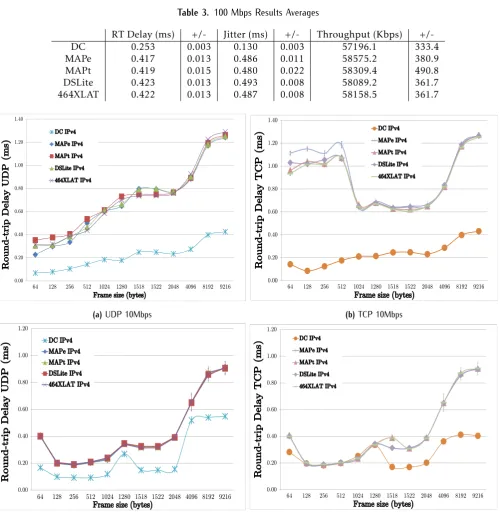
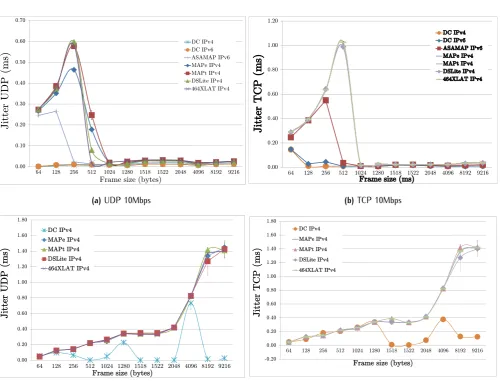
The latency results for the 10Mbps workload, composed of end-to-end delay (Fig. 2a, 2b) and jitter (Fig.3a,3b) indicate a better performance for 464XLAT, by comparison with the rest of the technologies. Also, in terms of average, translation-based technologies (MAPt, 464XLAT) had a better performance than encapsulation-based technologies (MAPe, DSLite).
The average throughput results, presented in Fig.4, show a similar performance for the four technologies. The overall average shows a small lead for DSLite and encapsulation-based technologies in the case of the 10 Mbps workload.
In the case of the 100 Mbps workload results , presented in Fig. 2c, 2d for delay, 3c 3d for jitter, and 4c 4d for throughput, the high values of the Margin of Error do not allow us to draw any clear overall conclusion. However, the results help to point out some unexpected behaviours, which are consistent. One example of this is the decrease in throughput for the 1280 frame size, presented in Fig. 4c and 4d. Another example is the lower throughput of the Direct Connection, which is counter-intuitive. The root causes of these behaviors need further analysis.
The loss rates, with the exception of some outliers for translation-based technologies over UDP (MAPt and 464XLAT), are very close to 0. For the outliers, the maximum loss-rate is approximately 0.003%, considered negligible in most cases.
Considering the overall average of these measure-ments, the best performance was achieved by MAPe, followed closely by DSLite, MAPt and 464XLAT.
4.2. Data collection and repeatability
For the closed experiment a full factorial design was employed, hence 12(f rame sizes)×
2(transport layer protocols)×2(workloads)×
5(transition technologies)×1(implementation) = 240
different experiments were conducted. Each experiment was repeated 20 times. The estimated time for each of the experiments was approximately 70 sec , resulting in a total data collection time of5600 min, or 93 h. For post-processing the raw data we have spent an average of 20 sec for each experiment, bringing us to a total of 1600 minor26 h.
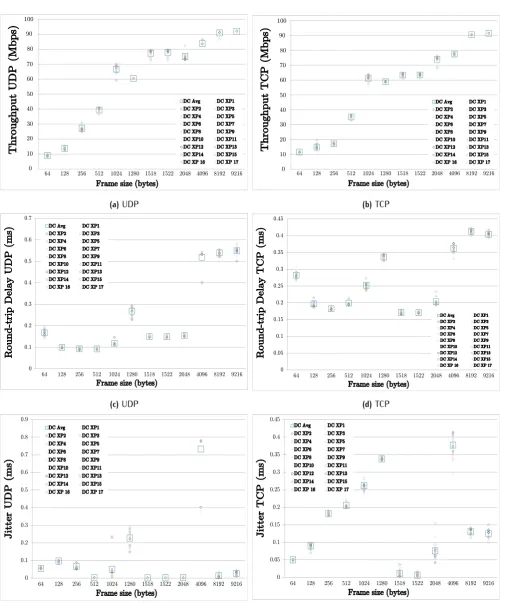
The 100 Mbps workload experiment was replicated 17 times on 68 different StartBED nodes to check the repeatability of the experiments. The repeatability results for the Direct Connection have been plotted in Fig.5.
Table 2. 10 Mbps Results Averages
RT Delay (ms) +/- Jitter (ms) +/- Throughput (Kbps)
+/-DC 0.225 0.000 0.016 0.000 8039.0 0.4
MAPe 0.809 0.001 0.167 0.000 7951.8 1.4
MAPt 0.802 0.001 0.177 0.001 7934.6 1.7
DSLite 0.810 0.001 0.167 0.001 7953.5 1.4
464XLAT 0.787 0.001 0.167 0.000 7810.4 1.5
Table 3. 100 Mbps Results Averages
RT Delay (ms) +/- Jitter (ms) +/- Throughput (Kbps)
+/-DC 0.253 0.003 0.130 0.003 57196.1 333.4
MAPe 0.417 0.013 0.486 0.011 58575.2 380.9
MAPt 0.419 0.015 0.480 0.022 58309.4 490.8
DSLite 0.423 0.013 0.493 0.008 58089.2 361.7
464XLAT 0.422 0.013 0.487 0.008 58158.5 361.7
0.00 0.20 0.40 0.60 0.80 1.00 1.20 1.40
64 128 256 512 1024 1280 1518 1522 2048 4096 8192 9216
R
o
u
n
d
-t
ri
p
FD
e
la
y
FU
D
P
FS
m
sL
F
FrameFsizeFSbytesL
DCFIPv4
MAPeFIPv4
MAPtFIPv4
DSLiteFIPv4
464XLATFIPv4
(a)UDP 10Mbps
0.00 0.20 0.40 0.60 0.80 1.00 1.20 1.40
64 128 256 512 1024 1280 1518 1522 2048 4096 8192 9216
R
o
u
n
d
-t
ri
p
)D
e
la
y
)T
C
P
)S
m
sL
)
Frame)size)SbytesL DC)IPv4
MAPe)IPv4
MAPt)IPv4
DSLite)IPv4
464XLAT)IPv4
(b)TCP 10Mbps
0.00 0.20 0.40 0.60 0.80 1.00 1.20
64 128 256 512 1024 1280 1518 1522 2048 4096 8192 9216
R
o
u
n
d
-t
ri
p
FD
e
la
y
FU
D
P
FS
m
s
LF
FrameFsizeFSbytesL
DCFIPv4 MAPeFIPv4
MAPtFIPv4 DSLiteFIPv4
464XLATFIPv4
(c)UDP 100Mbps
0.00 0.20 0.40 0.60 0.80 1.00 1.20
64 128 256 512 1024 1280 1518 1522 2048 4096 8192 9216
R
o
u
n
d
-t
ri
p
)D
e
la
y
)T
C
P
)S
m
sL
)
Frame)size)SbytesL DC)IPv4
MAPe)IPv4
MAPt)IPv4
DSLite)IPv4
464XLAT)IPv4
(d)TCP 100Mbps
0.00 0.10 0.20 0.30 0.40 0.50 0.60 0.70
64 128 256 512 1024 1280 1518 1522 2048 4096 8192 9216
J
it
te
r
U
D
P
(
m
s)
Frame size (bytes)
DC IPv4 DC IPv6 ASAMAP IPv6 MAPe IPv4 MAPt IPv4 DSLite IPv4 464XLAT IPv4
(a)UDP 10Mbps
0.00 0.20 0.40 0.60 0.80 1.00 1.20
64 128 256 512 1024 1280 1518 1522 2048 4096 8192 9216
J
it
te
r
T
C
P
(
m
s)
Frame size (ms)
DC IPv4 DC IPv6 ASAMAP IPv6 MAPe IPv4 MAPt IPv4 DSLite IPv4 464XLAT IPv4
(b)TCP 10Mbps
0.00 0.20 0.40 0.60 0.80 1.00 1.20 1.40 1.60 1.80
64 128 256 512 1024 1280 1518 1522 2048 4096 8192 9216
Jitte
r UDP (ms)
Frame size (bytes)
DC IPv4
MAPe IPv4 MAPt IPv4
DSLite IPv4 464XLAT IPv4
(c)UDP 100Mbps
-0.20 0.00 0.20 0.40 0.60 0.80 1.00 1.20 1.40 1.60 1.80
64 128 256 512 1024 1280 1518 1522 2048 4096 8192 9216
Jitte
r TCP (ms)
Frame size (bytes) DC IPv4
MAPe IPv4 MAPt IPv4 DSLite IPv4 464XLAT IPv4
(d)TCP 100Mbps
Figure 3. Jitter results
Table 4. Relative standard deviation average
RT Delay (%) Jitter (%) Throughput (%)
DC 2.21 3.42 0.93
MAPe 5.10 3.71 1.04
MAPt 5.90 7.48 1.34
DSLite 4.85 2.60 0.99
464XLAT 5.67 5.41 0.93
%rsd= σx¯ ×100
σ−standard deviation,x¯−mean (2)
The low percentages indicate a low variability among datasets, and by extrapolation a high repeatability for the experiments.
4.3. Open Experiment results
During the four days of the WIDE Camp 1309 event, we had the chance to test the operational capability of
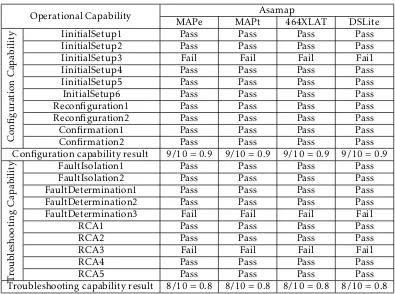
the Asamap implementation. However the results are only limited to our experiences. The detailed tasks are included in Appendix A for configuration capability and Appendix B for troubleshooting capability. The results for configuration and troubleshooting capability have been summarized in table5.
64 128 256 512 1024 1280 1518 1522 2048 4096 8192 9216
T
h
ro
u
g
h
p
u
ty
U
D
P
y(Mbps)
Frameysizey(bytes)
DCyIPv4 DCyIPv6 ASAMAPyIPv6 MAPtyIPv4 464XLATyIPv4 MAPeyIPv4 DSLiteyIPv4
(a)UDP 10Mbps
D
64 128 256 512 1024 1280 1518 1522 2048 4096 8192 9216
T
h
ro
u
g
h
p
u
tD
T
C
P
DDD3Mbps)D
FrameDsizeD3bytes)
DCDIPv4 DCDIPv6 ASAMAPDIPv6 MAPtDIPv4 464XLATDIPv4 MAPeDIPv4 DSLiteDIPv4 10
D9
D8
D7
D6
D5
D4
D3
D2
D1
D0
(b)TCP 10Mbps
64 128 256 512 1024 1280 1518 1522 2048 4096 8192 9216
T
h
ro
u
g
h
p
u
t
U
D
P
(M
bps
)
Frame size (bytes) DC IPv4
MAPe IPv4 MAPt IPv4 DSLite IPv4 464XLAT IPv4 100
90
80
70
60
50
40
30
20
10
0
(c)UDP 100Mbps
64 128 256 512 1024 1280 1518 1522 2048 4096 8192 9216
T
h
ro
u
g
h
p
u
tD
T
CPD3Mbps)
FrameDsizeD3bytes) DCDIPv4
MAPeDIPv4
MAPtDIPv4
DSLiteDIPv4
464XLATDIPv4
D 100
D90
D80
D70
D60
D50
D40
D30
D20
D10
DD0
(d)TCP 100Mbps
Figure 4. Throughput results
would be a beneficial feature. For the troubleshooting capability, most of the tasks have been completed successfully. Two of the troubleshooting tasks could not be completed: FaultDetermination3: Displaying critical messages with associated details and RCA3: self-check sequence. Regarding the first one, some critical messages were displayed in the user console. However these are hard to interpret and understand. We believe this feature needs improvement. As for the second one, a self-check sequence is not available yet. This would represent a substantial improvement of the troubleshooting capability.
In terms of applications capability, we tested a non-exhaustive list of common applications, in accordance with [14]. The full list of applications and the results are presented in table 6. To summarize we did not encounter any applications troubles for any of the four technologies.
5. Discussion
IPv6 transition scenarios and IPv6 transition technolo-gies have already been known for some time to the Internet community. However the worldwide deploy-ment rate of IPv6 is still very low. Given the complexity and the diversity of transition technologies, one of the biggest challenges is understanding which technology to use in a certain network scenario.
This article is proposing an answer to that challenge in the form of a network evaluation testbed, called IPv6NET. The contribution of this paper is the detailed testing methodology associated with IPv6NET and the empirical feasibility results, which to the best of our knowledge represent a first in current literature.
Analyzing the empirical results we found that one transition technology is more feasible than the rest,
64 128 256 512 1024 1280 1518 1522 2048 4096 8192 9216
T
h
ro
u
g
h
p
u
ty
U
D
P
y(Mbps)
Frameysizey(bytes) DCyAvg DCyXP1 DCyXP2 DCyXP3 DCyXP4 DCyXP5 DCyXP6 DCyXP7 DCyXP8 DCyXP9 DCyXP10 DCyXP11 DCyXP12 DCyXP13 DCyXP14 DCyXP15 DCyXPy16 DCyXPy17 100 y90 y80 y70 y60 y50 y40 y30 y20 y10 yy0 (a)UDP64 128 256 512 1024 1280 1518 1522 2048 4096 8192 9216
T h ro u g h p u tD T C P D(Mbps) FrameDsizeD(bytes) DCDAvg DCDXP1 DCDXP2 DCDXP3 DCDXP4 DCDXP5 DCDXP6 DCDXP7 DCDXP8 DCDXP9 DCDXP10 DCDXP11 DCDXP12 DCDXP13 DCDXP14 DCDXP15 DCDXPD16 DCDXPD17 (b)TCP 0 0.1 0.2 0.3 0.4 0.5 0.6 0.7
64 128 256 512 1024 1280 1518 1522 2048 4096 8192 9216
R o u n d -t ri p sD e la y sU D P sg m sX FramessizesgbytesX DCsAvg DCsXP1 DCsXP2 DCsXP3 DCsXP4 DCsXP5 DCsXP6 DCsXP7 DCsXP8 DCsXP9 DCsXP10 DCsXP11 DCsXP12 DCsXP13 DCsXP14 DCsXP15 DCsXPs16 DCsXPs17 (c)UDP 0 0.05 0.1 0.15 0.2 0.25 0.3 0.35 0.4 0.45
64 128 256 512 1024 1280 1518 1522 2048 4096 8192 9216
R o u n d -t ri p sD e la y sT C P sX m s7 FramessizesXbytes7 DCsAvg DCsXP1 DCsXP2 DCsXP3 DCsXP4 DCsXP5 DCsXP6 DCsXP7 DCsXP8 DCsXP9 DCsXP10 DCsXP11 DCsXP12 DCsXP13 DCsXP14 DCsXP15 DCsXPs16 DCsXPs17 (d)TCP 0 0.1 0.2 0.3 0.4 0.5 0.6 0.7 0.8 0.9
64 128 256 512 1024 1280 1518 1522 2048 4096 8192 9216
J it te rv U D P v( m s) Framevsizev(bytes) DCvAvg DCvXP1 DCvXP2 DCvXP3 DCvXP4 DCvXP5 DCvXP6 DCvXP7 DCvXP8 DCvXP9 DCvXP10 DCvXP11 DCvXP12 DCvXP13 DCvXP14 DCvXP15 DCvXPv16 DCvXPv17 (e)UDP 0 0.05 0.1 0.15 0.2 0.25 0.3 0.35 0.4 0.45
64 128 256 512 1024 1280 1518 1522 2048 4096 8192 9216
J it te rg T C P g( m s) Framegsizeg(bytes) DCgAvg DCgXP1 DCgXP2 DCgXP3 DCgXP4 DCgXP5 DCgXP6 DCgXP7 DCgXP8 DCgXP9 DCgXP10 DCgXP11 DCgXP12 DCgXP13 DCgXP14 DCgXP15 DCgXPg16 DCgXPg17 (f)TCP
Figure 5. Repeatability of the DC results
Table 5. Operational capability results
Operational Capability Asamap
MAPe MAPt 464XLAT DSLite
C
onfigur
ation
C
apability
IinitialSetup1 Pass Pass Pass Pass
IinitialSetup2 Pass Pass Pass Pass
IinitialSetup3 Fail Fail Fail Fail
IinitialSetup4 Pass Pass Pass Pass
IinitialSetup5 Pass Pass Pass Pass
InitialSetup6 Pass Pass Pass Pass
Reconfiguration1 Pass Pass Pass Pass
Reconfiguration2 Pass Pass Pass Pass
Confirmation1 Pass Pass Pass Pass
Confirmation2 Pass Pass Pass Pass
Configuration capability result 9/10 = 0.9 9/10 = 0.9 9/10 = 0.9 9/10 = 0.9
T
roubleshooting
C
apability
FaultIsolation1 Pass Pass Pass Pass
FaultIsolation2 Pass Pass Pass Pass
FaultDetermination1 Pass Pass Pass Pass
FaultDetermination2 Pass Pass Pass Pass
FaultDetermination3 Fail Fail Fail Fail
RCA1 Pass Pass Pass Pass
RCA2 Pass Pass Pass Pass
RCA3 Fail Fail Fail Fail
RCA4 Pass Pass Pass Pass
RCA5 Pass Pass Pass Pass
Troubleshooting capability result 8/10 = 0.8 8/10 = 0.8 8/10 = 0.8 8/10 = 0.8
Table 6. Applications capability results
Applications Asamap
MAPe MAPt 464XLAT DSLite
W
in
7
/
W
in
8
/
Ubun
tu
12.04
/
Android
2.3
Browsing
Chrome Pass Pass Pass Pass
Firefox Pass Pass Pass Pass
Dolphin Pass Pass Pass Pass
Outlook Pass Pass Pass Pass
Thunderbird Pass Pass Pass Pass
Aquamail Pass Pass Pass Pass
IM&VoIP
Skype Pass Pass Pass Pass
Facebook Pass Pass Pass Pass
Google+ Pass Pass Pass Pass
VoIP Buster Pass Pass Pass Pass
Viber Pass Pass Pass Pass
DigiOriunde Pass Pass Pass Pass
VPN OpenVPN Pass Pass Pass Pass
Spotflux Pass Pass Pass Pass
Cloud Dropbox Pass Pass Pass Pass
GDrive Pass Pass Pass Pass
FTP Filezilla Pass Pass Pass Pass
Troubleshooting
puTTY Pass Pass Pass Pass
WinSCP Pass Pass Pass Pass
ConnectBot Pass Pass Pass Pass
namelyMAPe. We have also identified possible perfor-mance trends in IPv6 transition technologies bench-marking, for example, encapsulation-based technolo-gies seem to have better throughput performance and translation-based technologies better latency perfor-mance. However, we must note that the empirical results are highly dependent on the quality of the implementation. In other words, the same transition technology can perform differently under different implementations. This is why we decided to test the IPv6 transition technologies on a per-implementation basis.
We were also able to point out some unexpected behaviors, which could have been overlooked if simulators or analytical tools are employed. This underlines the need for a testbed and gives us motivation for a further root cause analysis. The high repeatability results indicate that the methodology is also easy to replicate on systems with the same hardware and software characteristics.
A limitation of this method is represented by the lack of control data, given there is no similar alternative system to act as a comparison base for the empirical results. We are planning to solve this by comparing the current open-source-based measurement system with existing commercial network benchmarking tools.
The empirical results can serve as a direct guideline to enterprise network operators faced with a similar transition scenario. Many enterprise networks nowa-days include industrial segments, which in many cases run over IP networks. The performance and operational aspects of the underlaying networks can have a critical impact on industrial applications. In this context, the guidelines and empirical data can serve as a rough impact analysis of the IPv6 transition on the industrial network segments.
Another limitation of this approach is represented by the diversity and complexity of existing production networks by comparison with the presented scenario. However by using the detailed methodology any interested party could potentially implement it and obtain customized feasibility data. The methodology can also serve as guideline for other researchers interested in joining this effort. Coping with a large number of technologies and their future developments may very well be solved by research collaboration, which can transform this project in an exhaustive IPv6 transition resource.
6. Conclusion
In this article we have introduced IPv6NET, a project aiming to empirically analyze the feasibility of IPv6 transition technologies in relation with specific network scenarios. From the methodology standpoint, IPv6NET combines two types of testing environments: closed
environments for thorough network performance data, and open environments for operational data. By using the proposed IPv6NET and the associated methodology we were able to indicate MAPe as having the best network performance, followed closely by DSLite, MAPt and 464XLAT. We were also able to identify some performance general guidelines, e.g. for latency, the translation-based technologies (464XLAT, MAPt) had a better performance. For throughput, the results were in favor of encapsulation-based technologies (MAPe, DSLite). However, we must note that the empirical results are highly dependent on the quality of the used implementation. Consequently, this results should be interpreted in association with the Asamap implementation.
Some of the empirical results also pointed out unexpected behaviors, which further underline the need for a testbed. By replicating the experiments 17 times, on 68 different nodes, we have shown that the proposed methodology has a a high level of repeatability. In terms of operational capability, we have proposed a task-based methodology. However, the data we have so far is limited to our experiences. As a future plan, we would like to replicate the proposed system and the associated methodology, and organize a survey with people of different network operating skills. Also as future work, we intend to increase the scale of the network template, and propose an associated metric for scalability. Another future step is proposing a unique general feasibility indicator (GFI), associated with each transition technology, which would help to better centralize and compare the the results.
Acknowledgments
The authors would like to thank Mr. Masakazu Asama for providing the vyatta Asamap distribution, upon which the experimental networks were implemented. Special thanks should be given to the teams at NICT StarBED and WIDE Project for their continuous support.
Appendix A. Configuration capability tasks
For the Asamap vyatta implementation the tasks were:
'
&
$
%
configure
set interfaces map map0 br-address ’2001:200:16a:2109::a/64’
set interfaces map map0 default-forwarding-mode ’encapsulation’ set interfaces map map0 default-forwarding-rule ’true’
set interfaces map map0 ipv6-fragment-size ’1500’
set interfaces map map0 ipv4-fragment-inner false
set interfaces map map0 role ’br’
set interfaces map map0 rule 1 ea-length ’8’
set interfaces map map0 rule 1 ipv4-prefix ’163.221.135.16/28’
set interfaces map map0 rule 1 ipv6-prefix ’2001:200:16a:2100::/56’ commit
exit
These commands should create a new 464 virtual interface called map0. To check the existence of the map0 interface please input the following command:
show interfaces detail
The command should display details about all interfaces, including the map0 interface. Was the map0 interface created successfully ?
2Yes
2No
2. InitialSetup2: Please input the following com-mands in the console:
configure save
The command should have saved the temporary configuration which should be loaded at start-up.
Reboot the machine by typing in the console the command:
sudo reboot
To check that the setup of the map0 interface was saved use again:
show interfaces
Was the configuration saved successfully ?
2Yes
2No
3. InitialSetup3: The non-existence of a self-configuration command can be verified by pressing theTab key while using the console. It should display the existing commands. To check also the configuration mode we must enter it by typing:
configure
and pressing again theTabkey. Is there any self-configuration command available:
2Yes
2No
4. InitialSetup4: Please input the following com-mand:
shw interfaces
The console should display a message warning the user that the command is invalid and should discard it. Was the warning displayed and the command discarded ?
2Yes
2No
5. InitialSetup5: Please input the following com-mands:
configure
set interfaces map map1 default-forwarding-mode ’encapsulation’ set interfaces map map1 default-forwarding-rule ’true’
The console should accept the commands, as they are formally correct. However after trying to commit the temporary configuration:
commit
the console should display a message warning that additional configuration details are needed and discarding the action. Was a warning message displayed and the commit action discarded ?
2Yes
2No
6. InitialSetup6: While typing the command:
set interfaces ethernet eth0 address
press theTabkey.
2Yes
2No
7. Reconfiguration1: Input the following command:
show configuration commands
The console should display all commands needed to rebuild the current configuration. Was the set of commands displayed?
2Yes
2No
8. Reconfiguration2: Input the following commands:
configure
save backup.config
The console should display a message confirming the current was saved and showing the location of the back-up file. To restore the configuration type:
load backup.config
A message confirming the configuration file was loaded successfully should be displayed.
Were the back-up and restore actions successful ?
2Yes
2No
9. Confirmation1: Type the command:
show configuration
The console should display the detailed configu-ration. Was the detailed configuration displayed ?
2Yes
2No
10. Confirmation2: Type the command:
show interface map map0
The console should display the details of the previously configured map0 interface. Was the detailed configuration of the map0 interface displayed ?
2Yes
2No
Appendix B. Troubleshooting capability tasks
The troubleshooting capability test of the Asamap vyatta implementation contained the following tasks.
1. FaultIsolation1: Type the command:
sudo tcpdump -i map0
The console should display in a human readable form IPv4 and IPv6 packets captured on the map0 interface. Were there analyzed packets displayed ?
2Yes
2No
2. FaultIsolation2: Type the command:
ping 192.168.255.1
The console should display statistics about the round-trip ICMPv4 packet exchange with the host identified with the IPv4 address 192.168.255.1 . Type the command:
ping 2001:200:16a:2101::2
The console should display statistics about the round-trip ICMPv6 packet exchange with the host identified with the IPv6 address 2001:200:16a:2101::2 .
2Yes
2No
3. FaultDetermination1: Type the command:
show ipv6 route show ip route
The console should display the IPv4 and IPv6 routing details. This information should be able to help identify a misconfigured IPv4 or IPv6 route. Were the routing details displayed ?
2Yes
2No
4. FaultDetermination2: Input the command:
show interface map map0 show interface map map0 rule
The console should display detailed information about the map0 interface and the mapping rule it employs. The information should help identify a misconfigured line of the 464 virtual interface, map0. Was the information displayed ?
2Yes
2No
5. FaultDetermination3: The non-existence of a self-troubleshooting command can be verified by pressing the Tab key while using the console. It should display the existing commands. To check also the configuration mode we must enter it first by typing:
configure
and pressing again theTabkey. Is there any self-troubleshooting command available:
2Yes
2No
6. RCA1 and RCA2: Type the commands:
show log all | tail show log all
The first command should confirm that error and warning messages are being logged. The second command should confirm all log information can be displayed. Were the log information displayed ?
2Yes
2No
7. RCA3: Create a critical event by intentionally failing to login on a parallel console. The critical events should be displayed in the current console with contextual details. Was any information displayed about these events ?
2Yes
2No
8. RCA4 and RCA5: Type the command:
show interfaces detail
The command should confirm that statistical network information are being logged and can be displayed. Were the network statistics displayed ?
2Yes
2No
References
[1] APNIC, “IPv6 measurements for The World,” Apr. 2014. [2] M. Lind, V. Ksinant, S. Park, A. Baudot, and P. Savola, “Scenarios and Analysis for Introducing IPv6 into ISP Networks.” RFC 4029 (Informational), Mar. 2005. [3] J. Bound, “IPv6 Enterprise Network Scenarios.” RFC
4057 (Informational), June 2005.
[4] J. Wiljakka, “Analysis on IPv6 Transition in Third Generation Partnership Project (3GPP) Networks.” RFC 4215 (Informational), Oct. 2005.
[5] C. Huitema, R. Austein, S. Satapati, and R. van der Pol, “Unmanaged Networks IPv6 Transition Scenarios.” RFC 3750 (Informational), Apr. 2004.
[6] I. Raicu and S. Zeadally, “Evaluating ipv4 to ipv6
transition mechanisms,”IEEE International Conference on
Telecommunications 2003, 2003.
[7] S. Narayan, P. Shang, and N. Fan, “Network performance evaluation of internet protocols ipv4 and ipv6 on
oper-ating systems,” inProceedings of the Sixth international
conference on Wireless and Optical Communications Net-works, WOCN’09, (Piscataway, NJ, USA), pp. 242–246, IEEE Press, 2009.
[8] S. Sasanus and K. Kaemarungsi, “Differences in bandwidth requirements of various applications due to
ipv6 migration,” inProceedings of the The International
Conference on Information Network 2012, ICOIN ’12, (Washington, DC, USA), pp. 462–467, IEEE Computer Society, 2012.
[9] P. Grayeli, S. Sarkani, and T. Mazzuchi, “Performance analysis of ipv6 transition mechanisms over mpls,” International Journal of Communication Networks and Information Security, vol. 4, no. 2, 2012.
[10] G. Lencse and S. Repas, “Performance analysis and comparison of different dns64 implementations for
linux, openbsd and freebsd,” in Proceedings of the
2013 IEEE 27th International Conference on Advanced Information Networking and Applications, AINA ’13, (Washington, DC, USA), pp. 877–884, IEEE Computer Society, 2013.
[11] P. Wu, Y. Cui, J. Wu, J. Liu, and C. Metz, “Transition
from ipv4 to ipv6: A state-of-the-art survey,” IEEE
Communications Surveys and Tutorials, vol. 15, no. 3, pp. 1407–1424, 2013.
[12] R. Hiromi and H. Yoshifuji, “Problems on ipv4-ipv6
network transition,” in Proceedings of the International
Symposium on Applications on Internet Workshops, SAINT-W ’06, (SAINT-Washington, DC, USA), pp. 38–42, IEEE Computer Society, 2006.
[13] H. Babiker, I. Nikolova, and K. K. Chittimaneni, “Deploying ipv6 in the google enterprise network
lessons learned,” inProceedings of the 25th international
conference on Large Installation System Administration, LISA’11, (Berkeley, CA, USA), pp. 10–10, USENIX Association, 2011.
[14] J. Arkko and A. Keranen, “Experiences from an IPv6-Only Network.” RFC 6586 (Informational), Apr. 2012. [15] H. Hazeyama, R. Hiromi, T. Ishihara, and O. Nakamura,
Experiences from IPv6-Only Networks with Transition Technologies in the WIDE Camp Spring 2012, Mar 2012. draft-hazeyama-widecamp-ipv6-only-experience-01.txt. [16] O. Troan, W. Dec, X. Li, C. Bao, S. Matsushima, T. Murakami, and T. Taylor, “Mapping of Address and Port with Encapsulation (MAP).” draft-ietf-softwire-map-08, Aug. 2013.
[17] X. Li, C. Bao, W. Dec, O. Troan, S. Matsushima, and T. Murakami, “Mapping of Address and Port using Translation (MAP-T).” draft-ietf-softwire-map-t-04, Sept. 2013.
[19] M. Mawatari, M. Kawashima, and C. Byrne, “464XLAT: Combination of Stateful and Stateless Translation.” RFC 6877, Apr. 2013.
[20] N. Matsuhira, “ Stateless Automatic IPv4 over IPv6 Encapsulation / Decapsulation.” draft-matsuhira-sa46t-spec-07, July 2013.
[21] M. Asama, “MAP supported Vyatta. Online available: http://enog.jp/ masakazu/vyatta/map/,” Mar. 2014. [22] T. Miyachi, K. Chinen, and Y. Shinoda, “Starbed
and springos: large-scale general purpose network
testbed and supporting software,” inProceedings of the
1st international conference on Performance evaluation methodolgies and tools, valuetools ’06, (New York, NY, USA), ACM, 2006.
[23] A. Botta, A. Dainotti, and A. Pescapè, “A tool for the generation of realistic network workload for emerging
networking scenarios,” Computer Networks, vol. 56,
no. 15, pp. 3531–3547, 2012.
[24] C. Popoviciu, A. Hamza, G. V. de Velde, and D. Dugatkin, “Ipv6 benchmarking methodology for network intercon-nect devices,” 2008.
[25] S. Bradner and J. McQuaid, “Benchmarking methodol-ogy for network interconnect devices,” 1999.
[26] M. Georgescu, H. Hazeyama, Y. Kadobayashi, S. Yamaguchi, “An empirical study of IPv6 transition in an open environment - experiences from WIDE camp’s
Life with IPv6 Workshop,” in The Fourteenth Workshop
on Internet Technology, June 2013.
[27] D. Harrington, “Guidelines for Considering Operations and Management of New Protocols and Protocol Extensions.” RFC 5706 (Informational), Nov. 2009.