Proceedings of the 2019 Conference on Empirical Methods in Natural Language Processing and the 9th International Joint Conference on Natural Language Processing, pages 6112–6121,
6112
Mask-Predict: Parallel Decoding of
Conditional Masked Language Models
Marjan Ghazvininejad∗ Omer Levy∗ Yinhan Liu∗ Luke Zettlemoyer Facebook AI Research
Seattle, WA
Abstract
Most machine translation systems generate text autoregressively from left to right. We, instead, use a masked language modeling ob-jective to train a model to predict any subset of the target words, conditioned on both the input text and a partially masked target trans-lation. This approach allows for efficient it-erative decoding, where we first predict all of the target words non-autoregressively, and then repeatedly mask out and regenerate the subset of words that the model is least confi-dent about. By applying this strategy for a con-stant number of iterations, our model improves state-of-the-art performance levels for non-autoregressive and parallel decoding transla-tion models by over 4 BLEU on average. It is also able to reach within about 1 BLEU point of a typical left-to-right transformer model, while decoding significantly faster.1
1 Introduction
Most machine translation systems use sequen-tial decoding strategies where words are predicted one-by-one. In this paper, we present a model and a parallel decoding algorithm which, for a rela-tively small sacrifice in performance, can be used to generate translations in a constant number of decoding iterations.
We introduce conditional masked language models (CMLMs), which are encoder-decoder ar-chitectures trained with a masked language model objective (Devlin et al., 2018; Lample and Con-neau, 2019). This change allows the model to learn to predict, in parallel, any arbitrary subset of masked words in the target translation. We use transformer CMLMs, where the decoder’s self at-tention (Vaswani et al., 2017) can attend to the
∗ ∗
Equal contribution, sorted alphabetically. 1Our code is publicly available at:
https://github.com/facebookresearch/Mask-Predict
entire sequence (left and right context) to pre-dict each masked word. We train with a simple masking scheme where the number of masked tar-get tokens is distributed uniformly, presenting the model with both easy (single mask) and difficult (completely masked) examples. Unlike recently proposed insertion models (Gu et al.,2019;Stern et al.,2019), which treat each token as a separate training instance, CMLMs can train from the en-tire sequence in parallel, resulting in much faster training.
We also introduce a new decoding algorithm, mask-predict, which uses the order-agnostic na-ture of CMLMs to support highly parallel decod-ing. Mask-predict repeatedly masks out and re-predicts the subset of words in the current trans-lation that the model is least confident about, in contrast to recent parallel decoding translation approaches that repeatedly predict the entire se-quence (Lee et al.,2018). Decoding starts with a completely masked target text, to predict all of the words in parallel, and ends after a constant num-ber of mask-predict cycles. This overall strategy allows the model to repeatedly reconsider word choices within a rich bi-directional context and, as we will show, produce high-quality translations in just a few cycles.
Experiments on benchmark machine translation datasets show the strengths of mask-predict de-coding for transformer CMLMs. With just 4 it-erations, BLEU scores already surpass the perfor-mance of the best non-autoregressive and parallel decoding models.2
With 10 iterations, the approach outper-forms the current state-of-the-art parallel
decod-2
ing model (Lee et al.,2018) by gaps of 4-5 BLEU points on the WMT’14 English-German transla-tion benchmark, and up to 3 BLEU points on WMT’16 English-Romanian, but with the same model complexity and decoding speed. When compared to standard autoregressive transformer models, CMLMs with mask-predict offer a trade-off between speed and performance, trading up to 2 BLEU points in translation quality for a 3x speed-up during decoding.
2 Conditional Masked Language Models
A conditional masked language model (CMLM) predicts a set of target tokensYmaskgiven a source text X and part of the target text Yobs. It makes the strong assumption that the tokens Ymask are conditionally independent of each other (givenX andYobs), and predicts the individual probabilities P(y|X, Yobs)for eachy∈Ymask. Since the num-ber of tokens in Ymask is given in advance, the model is also implicitly conditioning on the length of the target sequenceN =|Ymask|+|Yobs|.
2.1 Architecture
We adopt the standard encoder-decoder trans-former for machine translation (Vaswani et al., 2017): a source-language encoder that does self-attention, and a target-language decoder that has one set of attention heads over the encoder’s out-put and another set for the target language (self-attention). In terms of parameters, our architec-ture is identical to the standard one. We deviate from the standard decoder by removing the self-attention mask that prevents left-to-right decoders from attending on future tokens. In other words, our decoder is bi-directional, in the sense that it can use both left and right contexts to predict each token.
2.2 Training Objective
During training, we randomly selectYmaskamong the target tokens. We first sample the number of masked tokens from a uniform distribution be-tween one and the sequence’s length, and then ran-domly choose that number of tokens. Following Devlin et al. (2018), we replace the inputs of the tokensYmask with a specialMASKtoken.
We optimize the CMLM for cross-entropy loss over every token in Ymask. This can be done in parallel, since the model assumes that the tokens in Ymaskare conditionally independent of each other.
While the architecture can technically make pre-dictions over all target-language tokens (including Yobs), we only compute the loss for the tokens in Ymask.
2.3 Predicting Target Sequence Length
In traditional left-to-right machine translation, where the target sequence is predicted token by token, it is natural to determine the length of the sequence dynamically by simply predicting a spe-cial EOS (end of sentence) token. However, for CMLMs to predict the entire sequence in paral-lel, they must know its length in advance. This problem was recognized by prior work in non-autoregressive translation, where the length is pre-dicted with a fertility model (Gu et al.,2018) or by pooling the encoder’s outputs into a length classi-fier (Lee et al.,2018).
We followDevlin et al.(2018) and add a special LENGTHtoken to the encoder, akin to theCLS to-ken in BERT. The model is trained to predict the length of the target sequence N as theLENGTH token’s output, similar to predicting another token from a different vocabulary, and its loss is added to the cross-entropy loss from the target sequence.
3 Decoding with Mask-Predict
We introduce the mask-predict algorithm, which decodes an entire sequence in parallel within a constant number of cycles. At each iteration, the algorithm selects a subset of tokens to mask, and then predicts them (in parallel) using an underly-ing CMLM. Maskunderly-ing the tokens where the model has doubts while conditioning on previous high-confidence predictions lets the model re-predict the more challenging cases, but with more infor-mation. At the same time, the ability to make large parallel changes at each step allows mask-predict to converge on a high quality output sequence in a sub-linear number of decoding iterations.
3.1 Formal Description
src Der Abzug der franzsischen Kampftruppen wurde am 20. November abgeschlossen .
t= 0 The departure of the French combat completed completed on 20 November . t= 1 The departure of French combat troops was completed on 20 November . t= 2 The withdrawal of French combat troops was completed on November 20th .
Figure 1: An example from the WMT’14 DE-EN validation set that illustrates how mask-predict generates text. At each iteration, the highlighted tokens are masked and repredicted, conditioned on the other tokens in the sequence.
Mask For the first iteration (t = 0), we mask all the tokens. For later iterations, we mask then tokens with the lowest probability scores:
Ymask(t) = arg min
i (pi, n)
Yobs(t)=Y \Ymask(t)
The number of masked tokensnis a function of the iteration t; specifically, we use linear decay n=N·TT−t, whereTis the total number of itera-tions. For example, ifT = 10, we will mask 90% of the tokens att= 1, 80% att= 2, and so forth.
Predict After masking, the CMLM predicts the masked tokensYmask(t) , conditioned on the source text X and the unmasked target tokensYobs(t). We select the prediction with the highest probability for each masked tokenyi ∈Ymask(t) and update its probability score accordingly:
yi(t)= arg max
w P(yi=w|X, Y (t) obs)
p(it)= max
w P(yi =w|X, Y (t) obs)
The values and the probabilities of unmasked to-kensYobs(t)remain unchanged:
y(it)=y(it−1)
p(it)=p(it−1)
We tried updating or decaying these probabilities in preliminary experiments, but found that this heuristic works well despite the fact that some probabilities are stale.
3.2 Example
Figure1illustrates how mask-predict can generate a good translation in just three iterations.
In the first iteration (t = 0), the entire target sequence is masked (Ymask(0) = Y andYobs(0) = ∅), and is thus generated by the CMLM in a purely non-autoregressive process:
P(Ymask(0) |X, Yobs(0)) =P(Y|X)
This produces an ungrammatical translation with repetitions (“completed completed”), which is typical of non-autoregressive models due to the multi-modality problem (Gu et al.,2018).
In the second iteration (t = 1), we select 8 of the 12 tokens generated in the previous step; these token were predicted with the lowest probabilities att = 0. We mask them and repredict with the CMLM, while conditioning on the 4 unmasked tokens Yobs(1) = {“The”,“20”,“November”,“.”}. This results in a more grammatical and accurate translation. Our analysis shows that this second it-eration removes most repetitions, perhaps because conditioning on even a little bit of the target se-quence is enough to collapse the multi-modal tar-get distribution into a single output (Section5.1).
In the last iteration (t = 2), we select the 4 of the 12 tokens that had the lowest probabilities. Two of those tokens were predicted at the first step (t = 0), and not repredicted at the second step (t= 1). It is quite common for earlier predictions to be masked at later iterations because they were predicted with less information and thus tend to have lower probabilities. Now that the model is conditioning on 8 tokens, it is able to produce an more fluent translation; “withdrawal” is a better fit for describing troop movement, and “November 20th” is a more common date format in English.
3.3 Deciding Target Sequence Length
When generating, we first compute the CMLM’s encoder, and then use the LENGTH token’s en-coding to predict a distribution over the target se-quence’s length (see Section2.3). Since much of the CMLM’s computation can be batched, we se-lect the top ` length candidates with the highest probabilities, and decode the same example with different lengths in parallel. We then select the se-quence with the highest average log-probability as our result:
1
N
X
Our analysis reveals that translating multiple can-didate sequences of different lengths can improve performance (see Section5.3).
4 Experiments
We evaluate CMLMs with mask-predict decoding on standard machine translation benchmarks. We find that our approach significantly outperforms prior parallel decoding machine translation meth-ods and even approaches the performance of stan-dard autoregressive models (Section 4.2), while decoding significantly faster (Section4.3).
4.1 Experimental Setup
Translation Benchmarks We evaluate on three standard datasets, WMT’14 EN-DE (4.5M sen-tence pairs), WMT’16 EN-RO (610k pairs) and WMT’17 EN-ZH (20M pairs) in both directions. The datasets are tokenized into subword units us-ing BPE (Sennrich et al.,2016). We use the same preprocessed data asVaswani et al.(2017) andWu et al.(2019) for WMT’14 EN-DE and WMT’17 EN-ZH respectively, and use the data from Lee et al. (2018) for WMT’16 EN-RO. We evaluate performance with BLEU (Papineni et al., 2002) for all language pairs, except from EN to ZH, where we use SacreBLEU (Post,2018).3
Hyperparameters We follow most of the stan-dard hyperparameters for transformers in the base configuration (Vaswani et al.,2017): 6 layers per stack, 8 attention heads per layer, 512 model di-mensions, 2048 hidden dimensions. We also ex-periment with 512 hidden dimensions, for com-parison with previous parallel decoding models (Gu et al., 2018; Lee et al., 2018). We follow the weight initialization scheme from BERT (De-vlin et al., 2018), which samples weights from
N(0,0.02), initializes biases to zero, and sets layer normalization parameters toβ = 0, γ = 1. For regularization, we use 0.3 dropout, 0.01 L2 weight decay, and smoothed cross validation loss with ε = 0.1. We train batches of 128k to-kens using Adam (Kingma and Ba, 2015) with β = (0.9,0.999) and ε = 10−6. The learning rate warms up to a peak of5·10−4within 10,000 steps, and then decays with the inverse square-root schedule. We trained all models for 300k steps, measured the validation loss at the end of each epoch, and averaged the 5 best checkpoints
3SacreBLEU hash: BLEU+case.mixed+lang.en-zh
+numrefs.1+smooth.exp+test.wmt17+tok.zh+version.1.3.7
to create the final model. During decoding, we use a beam size of b = 5for autoregressive de-coding, and similarly use`= 5length candidates for mask-predict decoding. We trained with mixed precision floating point arithmetic on two DGX-1 machines, each with eight DGX-16GB Nvidia VDGX-100 GPUs interconnected by Infiniband (Micikevicius et al.,2018).
Model Distillation Following previous work on non-autoregressive and insertion-based machine translation (Gu et al.,2018;Lee et al.,2018;Stern et al., 2019), we train CMLMs on translations produced by a standard left-to-right transformer model (large for DE and ZH, base for EN-RO). For a fair comparison, we also train standard left-to-right base transformers on translations pro-duced by large transformer models for EN-DE and EN-ZH, in addition to the standard baselines. We analyze the impact of distillation in Section5.4.
4.2 Translation Quality
We compare our approach to three other parallel decoding translation methods: the fertility-based sequence-to-sequence model of Gu et al. (2018), the CTC-loss transformer ofLibovick´y and Helcl (2018), and the iterative refinement approach of Lee et al.(2018). The first two methods are purely non-autoregressive, while the iterative refinement approach is only non-autoregressive in the first de-coding iteration, similar to our approach. In terms of speed, each mask-predict iteration is virtually equivalent to a refinement iteration.
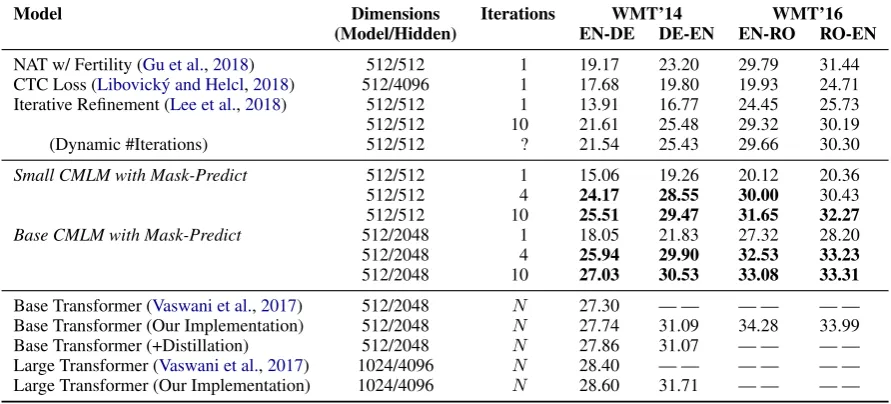
Table1shows that among the parallel decoding methods, our approach yields the highest BLEU scores by a considerable margin. When control-ling for the number of parameters (i.e. considering only the smaller CMLM configuration), CMLMs score roughly 4 BLEU points higher than the pre-vious state of the art on WMT’14 EN-DE, in both directions. Another striking result is that a CMLM with only 4 mask-predict iterations yields higher scores than 10 iterations of the iterative refinement model; in fact, only 3 mask-predict iterations are necessary for achieving a new state of the art on both directions of WMT’14 EN-DE (not shown).
Model Dimensions Iterations WMT’14 WMT’16 (Model/Hidden) EN-DE DE-EN EN-RO RO-EN
NAT w/ Fertility (Gu et al.,2018) 512/512 1 19.17 23.20 29.79 31.44 CTC Loss (Libovick´y and Helcl,2018) 512/4096 1 17.68 19.80 19.93 24.71 Iterative Refinement (Lee et al.,2018) 512/512 1 13.91 16.77 24.45 25.73
512/512 10 21.61 25.48 29.32 30.19
(Dynamic #Iterations) 512/512 ? 21.54 25.43 29.66 30.30
Small CMLM with Mask-Predict 512/512 1 15.06 19.26 20.12 20.36
512/512 4 24.17 28.55 30.00 30.43
512/512 10 25.51 29.47 31.65 32.27
Base CMLM with Mask-Predict 512/2048 1 18.05 21.83 27.32 28.20
512/2048 4 25.94 29.90 32.53 33.23
512/2048 10 27.03 30.53 33.08 33.31
Base Transformer (Vaswani et al.,2017) 512/2048 N 27.30 — — — — — — Base Transformer (Our Implementation) 512/2048 N 27.74 31.09 34.28 33.99
Base Transformer (+Distillation) 512/2048 N 27.86 31.07 — — — —
[image:5.595.76.522.64.266.2]Large Transformer (Vaswani et al.,2017) 1024/4096 N 28.40 — — — — — — Large Transformer (Our Implementation) 1024/4096 N 28.60 31.71 — — — —
Table 1: The performance (BLEU) of CMLMs with mask-predict, compared to other parallel decoding machine translation methods. The standard (sequential) transformer is shown for reference. Bold numbers indicate state-of-the-art performance among parallel decoding methods.
Model Dimensions Iterations WMT’17
(Model/Hidden) EN-ZH ZH-EN
Base CMLM with Mask-Predict 512/2048 1 24.23 13.64
512/2048 4 32.63 21.90
512/2048 10 33.19 23.21
Base Transformer (Our Implementation) 512/2048 N 34.31 23.74 Base Transformer (+Distillation) 512/2048 N 34.44 23.99 Large Transformer (Our Implementation) 1024/4096 N 35.01 24.65
Table 2: The performance (BLEU) of CMLMs with mask-predict, compared to the standard (sequential) trans-former on WMT’ 17 EN-ZH.
than 4% in translation quality. In many scenarios, this is an acceptable price to pay for a significant speedup from parallel decoding.
Table 2 shows that these trends also hold for English-Chinese translation, in both directions, despite major linguistic differences between the two languages.
4.3 Decoding Speed
Because CMLMs can predict the entire sequence in parallel, mask-predict can translate an entire sequence in a constant number of decoding iter-ations. Does this appealing theoretical property translate into a wall-time speed-up in practice? By comparing the actual decoding times, we show that, for some sacrifice in performance, our paral-lel method can translate much faster than standard sequential transformers.
Setup As the baseline system, we use the base transformer with beam search (b = 5) to trans-late WMT’14 EN-DE; we also use greedy search
(b = 1) as a faster but less accurate baseline. For CMLMs, we vary the number of mask-predict it-erations (T = 4, . . . ,10) and length candidates (`= 1,2,3). For both models, we decode batches of 10 sentences.4 For each decoding run, we measure the performance (BLEU) and wall time (seconds) from when the model and data have been loaded until the last example has been trans-lated, and calculate the relative decoding speed-up (CMLM time / baseline time) to assess the speed-performance trade-off.
The implementation of both the baseline trans-former and our CMLM is based on fairseq (Gehring et al., 2017), which efficiently decodes left-to-right transformers by caching the state. Caching reduces the baseline’s decoding speed from 210 seconds to 128.5; CMLMs do not use cached decoding. All experiments used exactly the same machine and the same single GPU.
4The batch size was chosen arbitrarily; mask-predict can
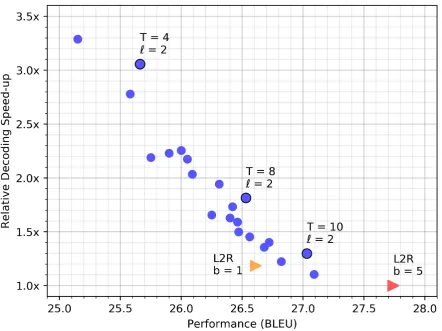
[image:5.595.117.483.324.419.2]Figure 2: The trade-off between speed-up and translation quality of a base CMLM with mask-predict, compared to the standard sequentially-decoded base transformer on the WMT’14 EN-DE test set, with beam sizesb = 1
(orange triangle) andb= 5(red triangle). Each blue circle represents a mask-predict decoding run with a different number of iterations (T = 4, . . . ,10) and length candidates (`= 1,2,3).
Results Figure 2 shows the speed-performance trade-off. We see that mask-predict is versatile; on one hand, we can translate over 3 times faster than the baseline at a cost of 2 BLEU points (T = 4,`= 2), or alternatively retain a high qual-ity of 27.03 BLEU while gaining a 30% speed-up (T = 4, ` = 2). Surprisingly, this latter config-uration outperforms an autoregressive transformer with greedy decoding (b = 1) in both quality and speed. We also observe that more balanced con-figurations (e.g. T = 8,` = 2) yield similar per-formance to the single-beam autoregressive trans-former, but decode much faster.
5 Analysis
To complement the quantitative results in Sec-tion 4, we present qualitative analysis that pro-vides some intuition as to why our approach works and where future work could potentially improve it.
5.1 Why Are Multiple Iterations Necessary?
Various non-autoregressive translation models, in-cluding our own CMLM, make the strong as-sumption that the individual token predictions are conditionally independent of each other. Such a model might consider two or more possible trans-lations, A and B, but because there is no coordi-nation mechanism between the token predictions, it could predict one token from A and another to-ken from B. This problem, known as the multi-modality problem (Gu et al., 2018), often man-ifest as token repetitions in the output when the model has multiple hypotheses that predict the same wordwwith high confidence, but at different positions.
Iterations WMT’14 EN-DE WMT’16 EN-RO BLEU Reps BLEU Reps
T = 1 18.05 16.72% 27.32 9.34%
T = 2 22.91 5.40% 31.08 2.82%
T = 3 24.99 2.03% 32.19 1.26%
T = 4 25.94 1.07% 32.53 0.87%
[image:7.595.327.504.63.134.2]T = 5 26.30 0.72% 32.62 0.61%
Table 3: The performance (BLEU) and percentage of repeating tokens when decoding with a different num-ber of mask-predict iterations (T).
hypothesis, we measure the percentage of repet-itive tokens produced by each iteration of mask-predict as a proxy metric for the multi-modality problem.
Table 3 shows that, indeed, the proportion of repetitive tokens drops drastically during the first 2-3 iterations. This finding suggests that the first few iterations are critical for converging into a uni-modal distribution. The decrease in repeti-tions also correlates with the steep rise in trans-lation quality (BLEU), supporting the conjecture ofGu et al. (2018) that multi-modality is a major roadblock for purely non-autoregressive machine translation.
5.2 Do Longer Sequences Need More Iterations?
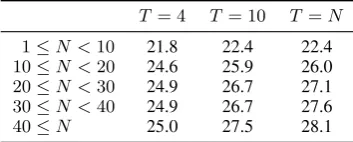
A potential concern with using a constant amount of decoding iterations is that it may be effective for short sequences (where the number of iterationsT is closer to the output’s lengthN), but insufficient for longer sequences. To determine whether this is the case, we usecompare-mt(Neubig et al., 2019) to bucket the evaluation data by target sen-tence length and compute the performance with different values ofT.
Table4shows that increasing the number of de-coding iterations (T) appears to mainly improve the performance on longer sequences. Having said that, the performance differences across length buckets are not very large, and it seems that even 4 mask-predict iterations are enough to produce de-cent translations for long sequences (40≤N).
5.3 Do More Length Candidates Help?
Traditional autoregressive models can dynami-cally decide the length of the target sequence by generating a special END token when they are done, but that is not true for models that de-code multiple tokens in parallel, such as CMLMs. To address this problem, our model predicts the
T = 4 T = 10 T =N
1≤N <10 21.8 22.4 22.4
10≤N <20 24.6 25.9 26.0
20≤N <30 24.9 26.7 27.1
30≤N <40 24.9 26.7 27.6
[image:7.595.307.523.215.352.2]40≤N 25.0 27.5 28.1
Table 4: The performance (BLEU) of base CMLM with different amounts of mask-predict iterations (T) on WMT’14 EN-DE, bucketed by target sequence length (N). Decoding with`= 1length candidates.
Length WMT’14 EN-DE WMT’16 EN-RO Candidates BLEU LP BLEU LP
`= 1 26.56 16.1% 32.75 13.8%
`= 2 27.03 30.6% 33.06 26.1%
`= 3 27.09 43.1% 33.11 39.6%
`= 4 27.09 53.1% 32.13 49.2%
`= 5 27.03 62.2% 33.08 57.5%
`= 6 26.91 69.5% 32.91 64.3%
`= 7 26.71 75.5% 32.75 70.4%
`= 8 26.59 80.3% 32.50 74.6%
`= 9 26.42 83.8% 32.09 78.3%
Gold 27.27 — 33.20 —
Table 5: The performance (BLEU) of base CMLM with 10 mask-predict iterations (T = 10), varied by the number of length candidates (`), compared to decoding with the reference target length (Gold). Length preci-sion (LP) is the percentage of examples that contain the correct length as one of their candidates.
length of the target sequence (Section2.3) and de-codes multiple length candidates in parallel (Sec-tion 3.3). We compare our model’s performance with a varying number of length candidates to its performance when conditioned on the reference (gold) target length in order to determine how ac-curate it is at predicting the correct length and assess the relative contribution of decoding with multiple length candidates.
Iterations WMT’14 EN-DE WMT’16 EN-RO Raw Dist Raw Dist
T = 1 10.64 18.05 21.22 27.32
T = 4 22.25 25.94 31.40 32.53
T = 10 24.61 27.03 32.86 33.08
Table 6: The performance (BLEU) of base CMLM, trained with either raw data (Raw) or knowledge dis-tillation from an autoregressive model (Dist).
5.4 Is Model Distillation Necessary?
Previous work on non-autoregressive and insertion-based machine translation reported that it was necessary to train their models on text generated by an autoregressive teacher model, a process known as distillation. To determine CMLM’s dependence on this process, we train a models on both raw and distilled data, and compare their performance.
Table6 shows that in every case, training with model distillation substantially outperforms train-ing on raw data. The gaps are especially large when decoding with a single iteration (purely non-autoregressive). Overall, it appears as though CMLMs are heavily dependent on model distilla-tion.
On the English-Romanian benchmark, the dif-ferences are much smaller, and after 10 iterations the raw-data model can perform comparably with the distilled model. A possible explanation is that our teacher model was weaker for this dataset due to insufficient hyperparameter tuning. Alterna-tively, it could also be the case that the German dataset is much noisier than the English-Romanian one, and that the teacher model essen-tially cleans the training data. Unfortunately, we do not have enough evidence to support or refute either hypothesis at this time.
6 Related Work
Training Masked Language Models with Translation Data Recent work by Lample and Conneau (2019) shows that training a masked language model on sentence-pair translation data, as a pre-training step, can improve performance on cross-lingual tasks, including autoregressive machine translation. Our training scheme builds on their work, with the following differences: we use separate model parameters for source and target texts (encoder and decoder), and we also use a different masking scheme. Specifically, we
mask a varying percentage of tokens, only from the target, and do not replace input tokens with noise. Most importantly, the goal of our work is different; we do not use CMLMs for pre-training, but to directly generate text with mask-predict decoding.
Concurrently with our work,Song et al.(2019) extend the approach of Lample and Conneau (2019) by using separate encoder and decoder pa-rameters (as in our model) and pre-training them jointly in an autoregressive version of masked language modeling, although with monolingual data. While this work demonstrates that pre-training CMLMs can improve autoregressive ma-chine translation, it does not try to leverage the parallel and bi-directional nature of CMLMs to generate text in a non-left-to-right manner.
Generating from Masked Language Models
One such approach for generating text from a masked language model casts BERT (Devlin et al., 2018), anon-conditional masked language model, as a Markov random field (Wang and Cho,2019). By masking a sequence of length N and then iteratively sampling a single token at each time from the model (either sequentially or in arbitrary order), one can produce grammatical examples. While this sampling process has a theoretical jus-tification, it also requiresN forward passes of the model; mask-predict decoding, on the other hand, can produce text in a constant number of itera-tions.
Parallel Decoding for Machine Translation
our approach outperforms all of these models by wide margins.
Arbitrary Order Language Generation Fi-nally, recent work has developed insertion-based transformers for arbitrary, but fixed, word order generation (Gu et al., 2019; Stern et al., 2019). While they do not decode in a constant number of iterations,Stern et al.(2019) show strong results in logarithmic time. Both models treat each token in-sertion as a separate training example, which can-not be computed in parallel with every other in-sertion in the same sequence. This makes training significantly more expensive that standard trans-formers (which use causal attention masking) and our CMLMs (which can predict all of the masked tokens in parallel).
7 Conclusion
This work introduces conditional masked lan-guage models and a novel mask-predict decod-ing algorithm that leverages their parallelism to generate text in a constant number of decoding iterations. We show that, in the context of ma-chine translation, our approach substantially out-performs previous parallel decoding methods, and can approach the performance of sequential au-toregressive models while decoding much faster. While there are still open problems, such as the need to condition on the target’s length and the dependence on knowledge distillation, our re-sults provide a significant step forward in non-autoregressive and parallel decoding approaches to machine translation. In a broader sense, this pa-per shows that masked language models are useful not only for representing text, but also for gener-atingtext efficiently.
Acknowledgements
We thank Abdelrahman Mohamed for sharing his expertise on non-autoregressive models, and our colleagues at FAIR for valuable feedback.
References
Jacob Devlin, Ming-Wei Chang, Kenton Lee, and Kristina Toutanova. 2018. Bert: Pre-training of deep bidirectional transformers for language understand-ing. arXiv preprint arXiv:1810.04805.
Jonas Gehring, Michael Auli, David Grangier, Denis Yarats, and Yann N Dauphin. 2017. Convolutional Sequence to Sequence Learning.ArXiv e-prints.
Alex Graves, Santiago Fern´andez, Faustino Gomez, and J¨urgen Schmidhuber. 2006. Connectionist temporal classification: Labelling unsegmented se-quence data with recurrent neural networks. In Pro-ceedings of the 23rd international conference on Machine learning, pages 369–376. ACM.
Jiatao Gu, James Bradbury, Caiming Xiong, Victor OK Li, and Richard Socher. 2018. Non-autoregressive neural machine translation. InICLR.
Jiatao Gu, Qi Liu, and Kyunghyun Cho. 2019. Insertion-based decoding with automatically inferred generation order. arXiv preprint arXiv:1902.01370.
Diederik P Kingma and Jimmy Ba. 2015. Adam: A method for stochastic optimization. InInternational Conference for Learning Representations.
Guillaume Lample and Alexis Conneau. 2019. Cross-lingual language model pretraining. arXiv preprint arXiv:1901.07291.
Jason Lee, Elman Mansimov, and Kyunghyun Cho. 2018. Deterministic non-autoregressive neural se-quence modeling by iterative refinement. In Pro-ceedings of the 2018 Conference on Empirical Meth-ods in Natural Language Processing, pages 1173– 1182, Brussels, Belgium. Association for Computa-tional Linguistics.
Jindˇrich Libovick´y and Jindˇrich Helcl. 2018. End-to-end non-autoregressive neural machine translation with connectionist temporal classification. In Pro-ceedings of the 2018 Conference on Empirical Meth-ods in Natural Language Processing, pages 3016– 3021, Brussels, Belgium. Association for Computa-tional Linguistics.
Paulius Micikevicius, Sharan Narang, Jonah Alben, Gregory Diamos, Erich Elsen, David Garcia, Boris Ginsburg, Michael Houston, Oleksii Kuchaiev, Ganesh Venkatesh, and Hao Wu. 2018. Mixed preci-sion training. InInternational Conference on Learn-ing Representations.
Graham Neubig, Zi-Yi Dou, Junjie Hu, Paul Michel, Danish Pruthi, and Xinyi Wang. 2019. compare-mt: A tool for holistic comparison of language gener-ation systems. In Meeting of the North American Chapter of the Association for Computational Lin-guistics (NAACL) Demo Track, Minneapolis, USA.
Kishore Papineni, Salim Roukos, Todd Ward, and Wei-Jing Zhu. 2002. Bleu: a method for automatic eval-uation of machine translation. InProceedings of the 40th Annual Meeting of the Association for Com-putational Linguistics, pages 311–318, Philadelphia, Pennsylvania, USA. Association for Computational Linguistics.
Rico Sennrich, Barry Haddow, and Alexandra Birch. 2016. Neural machine translation of rare words with subword units. InProceedings of the 54th An-nual Meeting of the Association for Computational Linguistics (Volume 1: Long Papers), pages 1715– 1725, Berlin, Germany. Association for Computa-tional Linguistics.
Kaitao Song, Xu Tan, Tao Qin, Jianfeng Lu, and Tie-Yan Liu. 2019. Mass: Masked sequence to sequence pre-training for language generation. arXiv preprint arXiv:1905.02450.
Mitchell Stern, William Chan, Jamie Kiros, and Jakob Uszkoreit. 2019. Insertion transformer: Flexible se-quence generation via insertion operations. arXiv preprint arXiv:1902.03249.
Ashish Vaswani, Noam Shazeer, Niki Parmar, Jakob Uszkoreit, Llion Jones, Aidan N Gomez, Łukasz Kaiser, and Illia Polosukhin. 2017. Attention is all you need. InAdvances in Neural Information Pro-cessing Systems, pages 5998–6008.
Alex Wang and Kyunghyun Cho. 2019. Bert has a mouth, and it must speak: Bert as a markov random field language model. arXiv preprint arXiv:1902.04094.