Proceedings of the 2019 EMNLP and the 9th IJCNLP (System Demonstrations), pages 157–162 157
MY-AKKHARA
:
A Romanization-based Burmese (Myanmar) Input Method
Chenchen Ding, Masao Utiyama, and Eiichiro Sumita
Advanced Translation Technology Laboratory,
Advanced Speech Translation Research and Development Promotion Center, National Institute of Information and Communications Technology
3-5 Hikaridai, Seika-cho, Soraku-gun, Kyoto, 619-0289, Japan
{chenchen.ding, mutiyama, eiichiro.sumita}@nict.go.jp
Abstract
MY-AKKHARA is a method used to input Burmese texts encoded in the Unicode standard, based on commonly accepted Latin transcription. By using this method, arbitrary Burmese strings can be accurately inputted with26lowercase Latin letters. Meanwhile, the 26 uppercase Latin letters are designed as shortcuts of lowercase letter sequences. The frequency of Burmese characters is considered in MY-AKKHARA to realize an efficient keystroke distribution on aQWERTY
keyboard. Given that the Unicode standard has not been extensively used in digitization of Burmese, we hope thatMY-AKKHARAcan contribute to the widespread use ofUnicode in Myanmar and can provide a platform for smart input methods for Burmese in the future. An implementation ofMY-AKKHARA
running in Windows is released at http: //www2.nict.go.jp/astrec-att/ member/ding/my-akkhara.html
1 Introduction
Burmese (Myanmar) script is an abugida system, wherein basic characters can be modified using di-acritics at all directions or can be combined verti-cally, rather than a simple left-to-right horizontal
writing (Ding et al.,2016). Details of the Burmese
language can be referred to in Okell and Allott
(2001),Okell(2010a,b), andOkano(2007). Although its use is encouraged in the
govern-ment and universities, the use of Unicode for
Burmese script1is not currently widespread.
Tra-ditional shape-based typefaces such as Zawgyi2
are preferred for daily use. The issue can be
regarded as path dependence due to traditional
typewriters, wherein the input is exactly based
1
https://www.unicode.org/charts/PDF/ U1000.pdf
2https://code.google.com/archive/p/ zawgyi/downloads
ခြ ကြ ခြြိ ကြြိ ခြ ကြ ခြြိ ကြြိ
မ ဲ့ မြိ ဲ့ ခမြိ ြို့
8 shape variants of Zawgyifor Unicode103Cခ
3 position variants in Zawgyifor Unicode1037 ဲ့
[image:1.595.309.527.222.339.2]2 size and position variants in Zawgyifor Unicode102F
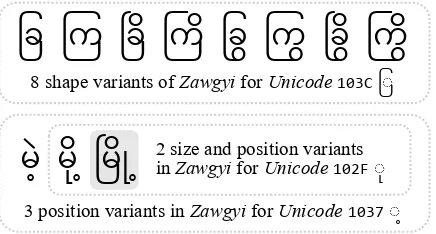
Figure 1: Shape, size, and position variants inZawgyi for identicalUnicodecharacters. The characters may affect each other: for those with gray background, the shape of103Cis determined by the inside combina-tion, size and position of102Fby103C, and the posi-tion of1037by102F.
on character shape, rather than the phonetic
val-ues of characters (Fig. 1). Zawgyi separately
en-codes all possible variants of characters and dia-critics, and allows users to select correct variants manually. Hence, a redundant character set
be-comes incompatible with the Unicode standard,
and extra effort is required for users to utilize typeface in detail. To provide a better interface
and promote Unicode for Burmese digitization,
we design a Burmese input method referred to asMY-AKKHARA by Romanization based on the
Unicode standard. MY-AKKHARA is generally
based on the mnemonics used in Unicode and
theMyanmar Language Committee Transcription
System (Department of the Myanmar Language
Commission,2014). The efficiency of the key
dis-tribution on theQWERTY keyboard layout is also
considered in the design ofMY-AKKHARA.
The implementation ofMY-AKKHARArunning
in Windows has been released. In this paper, we first review the default layouts of Burmese
provided in Windows (Win) and Macintosh
(Mac) and subsequently provide detailed
descrip-tions ofMY-AKKHARA. In addition, the keystroke
2 WinandMacBurmese Keyboards
The keyboard layouts used to input Burmese in
Unicode have been provided in Win and Mac
operating systems. Figure 2 illustrates the
de-fault layouts of the Burmese Unicode keyboard
in these two mainstream operating systems. Both of the layouts are a simple mapping from
char-acters to keys. Excluding special punctuation
marks and native number digits,63Unicode
char-acters are required to represent modern standard
Burmese textual data, from Unicode 1000 to
104F.3 Therefore,26keys with shift are not
suf-ficient to cover the character set. In both of the layouts, extra punctuation (or digit), or alternative keys are necessary in typing.
TheWinlayout is adjusted from the traditional
layout of a typewriter, by removing redundant character varieties and re-arranging the characters
inputted using theShift-key. Considering that
this layout has a large portion of the traditional one
but with a certain difference, manyWinusers are
not interested in switching to this layout. Hence non-Unicodefonts are still inputted using the
tra-ditional keyboard in practice. Moreover, theMac
layout is completely redesigned based on Roman-ization manner, wherein the Burmese characters are arranged on the basis of their pronunciations
as represented by the letters on a QWERTY
key-board. However, the design is inflexible, without considering the practical use of Burmese charac-ters. Thus, the positioning of fingers when typing is tricky. The comparison of the keystroke
distri-bution will be presented in Section4.
3 MY-AKKHARA: Proposed Input Method
The proposed MY-AKKHARA is inspired by the
Mac layout and deemed highly natural and
ef-ficient. Rather than a simple mapping between
the Unicode characters and keys, we also
fa-cilitate character alternation processing by using
the inputted Latin letters. Specifically, double
keystrokes of e, f, h, i, j, r, u, v, w, and y,
and theh-andg-keys at the middle of aQWERTY
keyboard are used to alternate characters. This de-sign naturally integrates the Romanization into the
character alternation processing. Theq-key is
re-served to disambiguate in obscure cases through which the input method can precisely input any
3Within this range, from1040to104Bare Burmese
dig-its and punctuation marks;1022,1028,1033,1034, and
1035are not used for standard Burmese.
strings with the Unicode Burmese characters.4
Lowercase a, o, x, and 26 uppercase Latin
let-ters are assigned as optional shortcuts. Figure 3
shows an example on the technique of inputting a Burmese string with rare and stacked characters using the proposed method.
The instruction of the proposed input method
can be printed by users on anA4paper (Fig. 4).
The proposed method can be formulated primarily
through a finite-state automaton (Hopcroft et al.,
2013), receiving strings comprising23lowercase
Latin letters (excludinga, o, and x) and
transit-ing among different states that represent Burmese
characters. The Appendixprovides the
descrip-tion of the automaton.
The shortcuts can be grouped in the following four categories:
• three lowercase letters for common
combina-tions:a=qevq,o=qiuq, andx=qngfq;
• uppercase letters to save double keystrokes:
E=qee, F=qff, H=qhh, I=qii, J=qjj, R=qrr,U=quu,V=qvv,W=qww, andY=qyy;
• uppercase letters to saveh/g: B=qbh,C=qch,
D=qdh, G=qgh, K=qkh, L=qlg, M=qmg, P=qph,Q=qg,T=qth, andZ=qzh; and
• uppercase letters for other cases: A=qegg,
N=qny,O=qsr,S=quug, andX=qng.
Lowercase letters a, o, and x can
consider-ably save keystrokes. Note that the shortcuts
have a precedingqin the implementation through
which disambiguation can be realized. The
recom-mended uppercase letters are Y, H, and Q, which
can resolve almost all ambiguous cases when typ-ing orthographically correct Burmese texts.
Two issues related to normalizing the encoding
of the Burmese script inUnicodeare addressed:
• 102B is a variant of 102C, exclusively used
for narrow characters of1001, 1002, 1004,
1012,1015, and101D. This alternation is
ex-ecuted automatically when typingv ora (i.e.,
shortcut forev). However,qvandqvgcan
ex-actly input102Cand102B, respectively.
• 1037and103Acan appear successively;
how-ever, their order is not precisely identified. 103A 1037will always be normalized in
Uni-codeinto the recommended order1037 103A.
4It is possible to intentionally input orthographically
17 31
3E 3B
2E 2D
39 3A
3D 2B
36 37
32 3C
12 2F
13 30
02 38
07 16
0C 11
03 01
20 1C
1A 18
09 0A
26 2C 08
06 1D 10
23 14
4E 19
24 21
4C 15
25 00
4D 04
3F 1E
0F 05
27 1F
2A 29 4F
0D 0B 1B
0E
Win
4F 3A 2D 2F
32
3127 3C 1B
110C
100B 3B 1A
3026
2F25
2E24
2D23 31 2C29
16
15 36 312C3A2A 4E 4D
4C
2B 2C
3F 1E
130E
120D 3A 39
03 02
3E 1F
08 07
01 00
20 1C
0A 09 38
043A39 04 21
06 05
3D 1D
18 17
0F 14
36 19 37
[image:3.595.72.525.62.139.2]Mac
Figure 2: Default Burmese layout inWin(left) andMac(right). Only the final two digits ofUnicodeare shown for a compact presentation. The places off- andj- keys on aQWERTYkeyboard are marked by bold frame. For each key, the lower character is inputted using simple keystroke, whereas the upper character requires pressing the
Shift-key. On theMackeyboard, some character combinations are mapped on one key, which is underlined in the figure. Meanwhile several rare characters requireAlt-key, which is in gray color. Note that103Aand1036
marked with gray background appear two times on theMackeyboard.
k
က
n
ကန
g
ကင
g
ကဏ
t
ကဏတ
h
ကဏထ
g
ကဏ္ဌ
k
ကဏ္ဌက
a
ကဏ္ဌကကော
c
ကဏ္ဌကကောစ ကဏ်
f
ကဏ္
f
X F T ကဏ္ဌကက
e v
Figure 3: Example of the proposed input method. The top row is the typed Latin letters; the inputted Burmese string after each keystroke is presented in an increasing manner. Latin letters with frame are the shortcuts and those with dark background are special design that should be remembered by users. Burmese strings with gray background have a character alternation from their previous status. Althoughgandhare regarded as alternation operators, they are also part of the Romanization, i.e., the firstgafternandhaftert. The shortcuts mainly save the extra alternation byg,hand double keystroke (i.e.,X,T, andF). Lowercaseais a shortcut for an extremely common character combination that can be inputted usingev.
4 Keystroke Distribution
The Burmese language has two different styles: literary and colloquial. For the literary style data, the publicly accessible Burmese dataset in the
Asian Language Treebank (ALT) project (Riza
et al., 2016) is used, containing approximately
20,000long sentences from news articles.5 For
the colloquial style data, we use an in-house
trans-lated Burmese version of the Basic Travel
Ex-pression Corpus (BTEC) (Kikui et al., 2003),
comprising approximately400,000daily
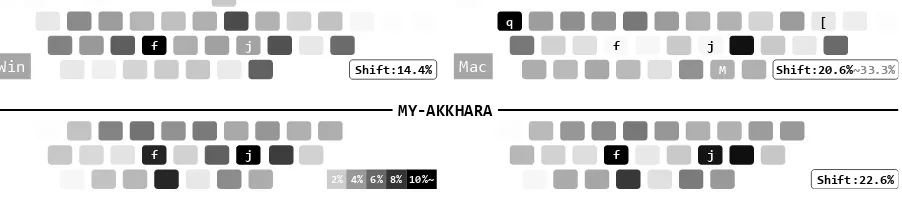
expres-sions. Figures5and6show the comparison of the
keystroke distribution inWinandMackeyboards
and byMY-AKKHARA, respectively.
The middle area of the Mac keyboard has not
been efficiently used. Although the uppercase F
can be used instead of lowercaseq, the frequency
of theShift-key will increase considerably. The
keystroke is more focused at the middle of the
key-board byMY-AKKHARAthan that on theWinand
Mackeyboards. The use of theShift-key is
op-tional in MY-AKKHARA, depending on the users’
5http://www2.nict.go.jp/astrec-att/ member/mutiyama/ALT/my-nova-170405.zip
preference. When the Shift-key is completely
applied, the frequency is less than two times that
of used inWinkeyboard, and it is approximately
equal to the lower bound used in Mac keyboard.
Generally, index fingers are mostly utilized and
lit-tle fingers have fewer burdens inMY-AKKHARA.
5 Conclusion and Future Work
In this study, a Romanization-based Burmese
in-put method called MY-AKKHARA is proposed to
promote the Unicode standard for Burmese
digi-tization. MY-AKKHARA can also be regarded as
a Burmese-specified, lossless coding version of Ding et al.(2018), providing a platform to develop a further fuzzy and smart Burmese input method.
References
Department of the Myanmar Language Commission. 2014. Myanmar-English dictionary (Myanma-anggalip abidan), 12 edition. Ministry of Educa-tion, the Republic of the Union of Myanmar.
[image:3.595.74.524.241.303.2]1000 1001 1002 1003 1004 1021 1023 1024 1025 1026 1027 1029 102A က ခ ဂ ဃ င အ ဣ ဤ ဥ ဦ ဧ ဩ ဪ k kh|K g|Q gh|G ng|X vv|V ig iig|Ig ug uug|Ug|S eg sr|O srg|Og 1005 1006 1007 1008 100A 1009 စ ဆ ဇ ဈ ည ဉ c ch|C z zh|Z ny|N nyg|Ng 100B 100C 100D 100E 100F 102B 102C 102D 102E 102F 1030 1031 1032 ဋ ဌ ဍ ဎ ဏ ါ ါ ါ ါ ါ ါ ေါ ါ tg thg|Tg dg dhg|Dg ngg|Xg vg v i ii|I u uu|U e ee|E 1010 1011 1012 1013 1014 တ ထ ဒ ဓ န t th|T d dh|D n 1015 1016 1017 1018 1019 1036 1037 1038 1039 103A 102D 102F 1031 102C 1004 103A ပ ဖ ဗ ဘ မ ါ ါ ါ ါ ါ ါ ါ ေါ ါ င p ph|P b bh|B m mg|M jj|J j ff|F f o a x 101A 101B 101C 101D 101E 103F ယ ရ လ ဝ သ ဿ yy|Y rr|R l ww|W s sg 101F 1020 1021 103B 103C 103D 103E 104C 104D 104E 104F ဟ ဠ အ ါ ြါ ါ ါ ၌ ၍ ၎ ၏ hh|H lg|L vv|V y r w h nggg|Xgg rrg|Rg lgg|Lg egg|A Consonants Various Signs
Dependent Consonant Signs
Independent Vowels
Dependent Vowel Signs
Various Signs
Combined Vowel Signs
q [
M
f j
Shift:22.2%~36.2%
f j
Shift:25.3%
f j
Shift:13.7%
f j
2% 4% 6% 8%10%~
Win Mac
[image:5.595.75.526.64.168.2]MY-AKKHARA
Figure 5: Keystroke distribution on the ALT literary data. The upper-left and upper-right diagrams are Win
andMackeyboards, respectively. The lower images areMY-AKKHARA, withShiftnot used (left) andShift
completely used (right) manners, respectively. The usage frequency of theShift-key is also presented. Note that
103Aand1036appear twice on theMackeyboard. The two characters are counted by usingqand[to input in the diagram, where the frequency ofShift-key is22.2%. The two character can be also inputted by uppercaseF
andM. If they are always inputted using theShift-key, then the frequency ofShift-key increases to36.2%.
q [
M
f j
Shift:20.6%~33.3%
f j
Shift:22.6%
f j
Shift:14.4%
f j
2% 4% 6% 8%10%~
Win Mac
MY-AKKHARA
Figure 6: Keystroke distribution on the BTEC colloquial data. The configuration is the same as that of Fig.5.
Chenchen Ding, Ye Kyaw Thu, Masao Utiyama, and Eiichiro Sumita. 2016. Word segmentation for
Burmese (Myanmar).ACM TALLIP, 15(4):22.
John E. Hopcroft, Rajeev Motwani, and Jeffrey D. Ull-man. 2013. Introduction to Automata Theory, Lan-guages, and Computation, 3 edition. Pearson.
Genichiro Kikui, Eiichiro Sumita, Toshiyuki Takezawa, and Seiichi Yamamoto. 2003.
Cre-ating corpora for speech-to-speech translation. In
Proc. of EUROSPEECH, pages 381–384.
Kenji Okano. 2007. Colloquial Burmese (Myanmar) Grammar. Kokusai Gogakusha. (in Japanese).
John Okell. 2010a. Burmese – An introduction to the Spoken Language, Book 1. Northern Illinois Univer-sity Press.
John Okell. 2010b. Burmese – An introduction to the Spoken Language, Book 2. Northern Illinois Univer-sity Press.
John Okell and Anna Allott. 2001. Burmese / Myan-mar Dictionary of Grammatical Forms. Routledge.
Hammam Riza, Michael Purwoadi, Teduh Ulinian-syah, Aw Ai Ti, Sharifah Mahani Aljunied, Lu-ong Chi Mai, Vu Tat Thang, Nguyen PhuLu-ong Thai, Vichet Chea, Rapid Sun, Sethserey Sam, Sopheap Seng, Khin Mar Soe, Khin Thandar Nwet, Masao Utiyama, and Chenchen Ding. 2016. Introduction
of the Asian language treebank. In Proc. of
O-COCOSDA, pages 1–6.
Appendix
Figure7shows the overall configuration. Routes
connecting the the initial (qs) and final (qs) states
are listed in Figs.8–16, whereqn,(n ∈ N)are
Burmese characters.6 Although all qn can be the
final states, a separateqeis used for clarity, and a
qis marked explicitly on all the arcs toqe.
qs
start qe
Figs.8–16
Figure 7: Overall configuration of the automaton.
qs q1 q2 qe
σ1 σ2
q q
Figure 8: Simplest case. Whenσ2ish, (σ1,q1,q2) can be (k,00,01), (g,02,03), (c,05,06),
(z,07,08), (p,15,16), and (b,17,18). Whenσ2is
g, (σ1,q1,q2) is (m,19,36). Whenσ2=σ1, (σ1,q1,q2) can be (y,3B,1A), (w,3D,1C), and (h,3E,1D). Allσ1are natural Romanization. When
σ2ish, it is also a part of the Romanization.
[image:5.595.76.527.265.364.2]qs q1 q2 q3 qe
σ1 σ2
q
g
[image:6.595.315.528.82.189.2]q q
Figure 9: Two-step alternation. When (σ1,σ2) is (l,g), (q1,q2,q3) is (1C,20,4E). Here,lis a natural Romanization for101Cand1020, whereas104Eis a special abbreviated mark withlas onset. When (σ1,σ2) is (r,r), (q1,q2,q3) is (3C,1B,4D), respectively. Here,ris a natural Romanization for
103Cand101B, whereas104Dis a special abbreviated mark withras onset.
qs v q1 v q2 q3 qe g
q
q q
Figure 10: Alternation variant of Fig.9. (q1,q2,q3) is (2C,21,2B). Considering that102Cand1021are frequently used, the convenientv-key is assigned instead the natural Romanization bya.
qs s q1 q2 q3 q4 qe g
r q
q g
q q
Figure 11: Alternation in Fig.8with an extra branch. (q1,q2,q3,q4) is (1E,3F,29,2A). Here,sis a natural Romanization for101E, whereas103F,
1029, and102Aare extremely obscure.
qs σ q1 h q2 q3 q4 qe g
q
g q
q q
Figure 12: Alternation byhandg. (σ,q1,q2,q3,q4) can be (t,10,11,0B,0C), and (d,12,13,0D,0E). Bothtanddare the natural Romanization, andhis also a part of the Romanization.
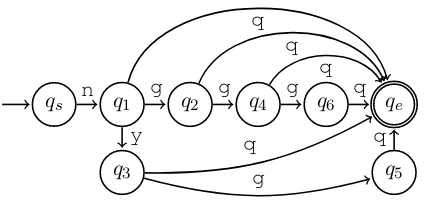
qs q1 q2 q4 q6 qe
q3 q5
n g
y
q
g
q
g q
g q
q q
Figure 13: Most complex alternation.
(q1,q2,q3,q4,q5,q6) is (14,04,0A,0F,09,4C). Here,n,ngandnyare the natural Romanization for
1014,1004, and100A, respectively. Other alternated characters are rare.
qs σ q1 q2 qe
σ
q
σ q
Figure 14: Doubled and looped alternation. (σ,q1,q2) can be (j,38,37), and (f,3A,39). Here,1038and
103Aare remarkably frequent marks; hence convenientj- andf-keys are assigned, respectively.
qs σ q1 q2 q3 q4 qe
σ g
q
σ
g q
q q
Figure 15: Combination of Figs.12and14. (σ,q1,q2,q3,q4) can be (i,2D,2E,23,24), and (u,2F,30,25,26). Here,ianduare the natural Romanization for the corresponding characters.
qs e q1 q2 q3 q4 qe
e g
q
e
q g
q q
Figure 16: Alternation in Fig.14with an extra branch. (q1,q2,q3,q4) is (31,32,27,4F). Here,eis a natural Romanization for1031,1032and1027, whereas