Semi-supervised Semantic Role Labeling
Using the Latent Words Language Model
Koen Deschacht
Department of computer science K.U.Leuven, Belgium
koen.deshahts.kuleuven. be
Marie-Francine Moens Department of computer science
K.U.Leuven, Belgium
sien.moenss.kuleuven.be
Abstract
Semantic Role Labeling (SRL) has proved to be a valuable tool for performing auto-matic analysis of natural language texts. Currently however, most systems rely on a large training set, which is manually an-notated, an effort that needs to be repeated whenever different languages or a differ-ent set of semantic roles is used in a cer-tain application. A possible solution for this problem is semi-supervised learning, where a small set of training examples is automatically expanded using unlabeled texts. We present the Latent Words Lan-guage Model, which is a lanLan-guage model that learns word similarities from unla-beled texts. We use these similarities for different semi-supervised SRL methods as additional features or to automatically ex-pand a small training set. We evaluate the methods on the PropBank dataset and find that for small training sizes our best per-forming system achieves an error reduc-tion of 33.27% F1-measure compared to a state-of-the-art supervised baseline.
1 Introduction
Automatic analysis of natural language is still a
very hard task to perform for a computer.
Al-though some successful applications have been de-veloped (see for instance (Chinchor, 1998)), im-plementing an automatic text analysis system is still a labour and time intensive task. Many ap-plications would benefit from an intermediate rep-resentation of texts, where an automatic analysis is already performed which is sufficiently general to be useful in a wide range of applications.
Syntactic analysis of texts (such as Part-Of-Speech tagging and syntactic parsing) is an ex-ample of such a generic analysis, and has proved
useful in applications ranging from machine trans-lation (Marcu et al., 2006) to text mining in the bio-medical domain (Cohen and Hersh, 2005). A syntactic parse is however a representation that is very closely tied with the surface-form of natural language, in contrast to Semantic Role Labeling (SRL) which adds a layer of predicate-argument information that generalizes across different syn-tactic alternations (Palmer et al., 2005). SRL has received a lot of attention in the research commu-nity, and many systems have been developed (see section 2). Most of these systems rely on a large dataset for training that is manually annotated. In this paper we investigate whether we can develop a system that achieves state-of-the-art semantic role labeling without relying on a large number of la-beled examples. We aim to do so by employing the Latent Words Language Model that learns latent
words from a large unlabeled corpus. Latent words
are words that (unlike observed words) did not oc-cur at a particular position in a text, but given se-mantic and syntactic constraints from the context could have occurred at that particular position.
In section 2 we revise existing work on SRL and on semi-supervised learning. Section 3 outlines our supervised classifier for SRL and section 4 dis-cusses the Latent Words Language Model. In sec-tion 5 we will combine the two models for semi-supervised role labeling. We will test the model on the standard PropBank dataset and compare it with state-of-the-art semi-supervised SRL systems in section 6 and finally in section 7 we draw con-clusions and outline future work.
2 Related work
Gildea and Jurafsky (2002) were the first to de-scribe a statistical system trained on the data from the FrameNet project to automatically assign se-mantic roles. This approach was soon followed by other researchers (Surdeanu et al., 2003; Prad-han et al., 2004; Xue and Palmer, 2004),
ing on improved sets of features, improved ma-chine learning methods or both, and SRL became a shared task at the CoNLL 2004, 2005 and 2008
conferences1. The best system (Johansson and
Nugues, 2008) in CoNLL 2008 achieved an
F1-measure of 81.65% on the workshop’s evaluation
corpus.
Semi-supervised learning has been suggested by many researchers as a solution to the annota-tion bottleneck (see (Chapelle et al., 2006; Zhu, 2005) for an overview), and has been applied suc-cessfully on a number of natural language pro-cessing tasks. Mann and McCallum (2007) ap-ply Expectation Regularization to Named Entity Recognition and Part-Of-Speech tagging, achiev-ing improved performance when compared to su-pervised methods, especially on small numbers of training data. Koo et al. (2008) present an algo-rithm for dependency parsing that uses clusters of semantically related words, which were learned in an unsupervised manner. There has been lit-tle research on semi-supervised learning for SRL. We refer to He and Gildea (2006) who tested ac-tive learning and co-training methods, but found little or no gain from semi-supervised learning, and to Swier and Stevenson (2004), who achieved good results using semi-supervised methods, but tested their methods on a small number of Verb-Net roles, which have not been used by other SRL systems. To the best of our knowledge no sys-tem was able to reproduce the successful results of (Swier and Stevenson, 2004) on the PropBank roleset. Our approach most closely resembles the work of Fürstenau and Lapata (2009) who auto-matically expand a small training set using an au-tomatic dependency alignment of unlabeled sen-tences. This method was tested on the FrameNet corpus and improved results when compared to a fully-supervised classifier. We will discuss their method in detail in section 5.
3 Semantic role labeling
Fillmore (1968) introduced semantic structures called semantic frames, describing abstract ac-tions or common situaac-tions (frames) with common roles and themes (semantic roles). Inspired by this idea different resources were constructed, includ-ing FrameNet (Baker et al., 1998) and PropBank (Palmer et al., 2005). An alternative approach to semantic role labeling is the framework developed
1See http://www.cnts.ua.ac.be/conll/ for an overview.
by Halliday (1994) and implemented by Mehay et al. (2005). PropBank has thus far received the most attention of the research community, and is used in our work.
3.1 PropBank
The goal of the PropBank project is to add seman-tic information to the syntacseman-tic nodes in the En-glish Penn Treebank. The main motivation for this annotation is the preservation of semantic roles across different syntactic realizations. Take for in-stance the sentences
1. The window broke.
2. John broke the window.
In both sentences the constituent “the window” is broken, although it occurs at different syntactic
positions. The PropBank project defines for a
large collection of verbs (excluding auxiliary verbs such as “will”, “can”, ...) a set of senses, that reflect the different meanings and syntactic
alternations of this verb. Every sense has a
number of expected roles, numbered from Arg0 to Arg5. A small number of arguments are shared among all senses of all verbs, such as temporals (Arg-TMP), locatives (Arg-LOC) and directionals (Arg-DIR). Additional to the frame definitions, PropBank has annotated a large training corpus
containing approximately 113.000 annotated
verbs. An example of an annotated sentence is
[JohnArg0][brokeBREAK.01] [the windowArg1].
Here BREAK.01 is the first sense of the “break” verb. Note that (1) although roles are defined for every frame separately, in reality roles with iden-tical names are ideniden-tical or very similar for all frames, a fact that is exploited to train accurate role classifiers and (2) semantic role labeling systems typically assume that a frame is fully expressed in a single sentence and thus do not try to instanti-ate roles across sentence boundaries. Although the original PropBank corpus assigned semantic roles to syntactic phrases (such as noun phrases), we use the CoNLL dataset, where the PropBank corpus was converted to a dependency representation, as-signing semantic roles to single (head) words.
3.2 Features
Split path feature are taken from existing
seman-tic role labeling systems, see for example (Gildea and Jurafsky, 2002; Lim et al., 2004; Thompson et al., 2006). The number in brackets denotes the number of unique features for that type.
Word We split every sentence in (unigram) word tokens, including punctuation. (37079)
Stem We reduce the word tokens to their stem, e.g. “walks” -> “walk”. (28690)
POS The part-of-speech tag for every word, e.g. “NNP” (for a singular proper noun). (77)
Neighbor POS’s The concatenated part-of-speech tags of the word before and the word just after the current word, e.g. “RBS_JJR”. (1787)
Path This important feature describes the path through the dependency tree from the current word to the position of the predicate, e.g.
“coord↑obj↑adv↑root↓dep↓nmod↓pmod”,
where ‘↑’ indicates going up a constituent
and ‘↓’ going down one constituent.
(829642)
Split Path Because of the nature of the path fea-ture, an explosion of unique features is found in a given data set. We reduce this by split-ting the path in different parts and using every part as a distinct feature. We split, for exam-ple, the previous path in 6 different features:
“coord”, “↑obj”, “↑adv”, “↑root”, “↓dep”,
“↓nmod”, “↓pmod”. Note that the split path
feature includes the POS feature, since the first component of the path is the POS tag for the current word. This feature has not been used previously for semantic role detection. (155)
For every word wi in the training and test set we
construct the feature vector f(wi), where at every
position in this vector 1 indicates the presence for the corresponding feature and 0 the absence of that feature.
3.3 Discriminative model
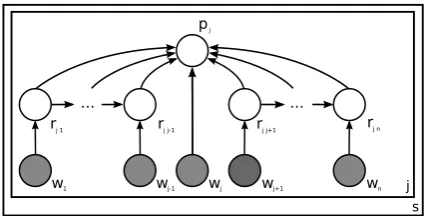
[image:3.595.310.523.61.169.2]Discriminative models have been found to outper-form generative models for many different tasks including SRL (Lim et al., 2004). For this reason we also employ discriminative models here. The structure of the model was inspired by a similar
Figure 1: Discriminative model for SRL. Grey circles represent observed variables, white circles hidden variables and arrows directed dependen-cies. s ranges over all sentences in the corpus and
j over the n words in the sentence.
(although generative) model in (Thompson et al., 2006) where it was used for semantic frame clas-sification. The model (fig. 1) assumes that the role
label ri j for the word wi is conditioned on the
fea-tures fi and on the role label ri−1 j of the previous
word and that the predicate label pj for word wjis
conditioned on the role labels Rj and on the
fea-tures fj. This model can be seen as an extension
of the standard Maximum Entropy Markov Model (MEMM, see (Ratnaparkhi, 1996)) with an extra dependency on the predicate label, we will hence-forth refer to this model as MEMM+pred.
To estimate the parameters of the MEMM+pred model we turn to the successful Maximum En-tropy (Berger et al., 1996) parameter estimation method. The Maximum Entropy principle states that the best model given the training data is the model such that the conditional distribution de-fined by the model has maximum entropy subject to the constraints represented by the training ex-amples. There is no closed form solution to find this maximum and we thus turn to an iterative method. In this work we use Generalized
Itera-tive Scaling2, but other methods such as (quasi-)
Newton optimization could also have been used.
4 Latent Words Language Model
4.1 Rationale
As discussed in sections 1 and 3 most SRL sys-tems are trained today on a large set of manually annotated examples. PropBank for example con-tains approximately 50000 sentences. This man-ual annotation is both time and labour-intensive, and needs to be repeated for new languages or
2We use the maxent package available on
for new domains requiring a different set of roles. One approach that can help to solve this problem is semi-supervised learning, where a small set of annotated examples is used together with a large set of unlabeled examples when training a SRL model.
Manual inspection of the results of the super-vised model discussed in the previous section showed that the main source of errors was in-correct labeling of a word because the word to-ken did not occur, or occurred only a small num-ber of times in the training set. We hypothesize that knowledge of semantic similar words could overcome this problem by associating words that occurred infrequently in the training set to
sim-ilar words that occurred more frequently.
Fur-thermore, we would like to learn these similar-ities automatically, to be independent of knowl-edge sources that might not be available for all languages or domains.
The Distributional Hypothesis, supported by theoretical linguists such as Harris (1954), states that words that occur in the same contexts tend to have similar meanings. This suggests that one can learn the similarity between two words auto-matically by comparing their relative contexts in a large unlabeled corpus, which was confirmed by different researchers (e.g. (Lin, 1998; McDonald and Ramscar, 2001; Grefenstette, 1994)). Differ-ent methods for computing word similarities have been proposed, differing between methods to rep-resent the context (using dependency relationship or a window of words) and between methods that, given a set of contexts, compute the similarity be-tween different words (ranging from cosine simi-larity to more complex metrics such as the Jaccard index). We refer to (Lin, 1998) for a comparison of the different similarity metrics.
In the next section we propose a novel method to learn word similarities, the Latent Words Lan-guage Model (LWLM) (Deschacht and Moens, 2009). This model learns similar words and learns the a distribution over the contexts in which cer-tain types of words occur typically.
4.2 Definition
The LWLM introduces for a text T=w1...wN of
length N for every observed word wi at position i
a hidden variable hi. The model is a generative model for natural language, in which the latent variable hiis generated by its context C(hi)and the
observed word wi is generated by the latent
vari-able hi. In the current model we assume that the context is C(hi) =hii−1−2hii++21where hii−1−2=hi−2hi−1 is the two previous words and hii++21=hi+1hi+2 is
the two next words. The observed wi has a value
from the vocabulary V , while the hidden variable
hi is unknown, and is modeled as a probability
distribution over all words of V . We will see in the next section how this distribution is estimated from a large unlabeled training corpus. The aim of this model is to estimate, at every position i, a distribution for hi, assigning high probabilities
to words that are similar to wi, given the context
of this word C(hi), and low probabilities to words
that are not similar to wiin this context.
A possible interpretation of this model states
that every hidden variable hi models the
“mean-ing” for a particular word in a particular context. In this probabilistic model, when generating a sen-tence, we generate the meaning of a word (which is an unobserved representation) with a certain probability, and then we generate a certain obser-vation by writing down one of the possible words that express this meaning.
Creating a representation that models the mean-ing of a word is an interestmean-ing (and controversial) topic in its own right, but in this work we make the assumption that the meaning of a particular word can be modeled using other words. Model-ing the meanModel-ing of a word with other words is not an unreasonable one, since it is already employed in practice by humans (e.g. by using dictionar-ies and thesauri) and machines (e.g. relying on a lexical resource such as WordNet) in word sense disambiguation tasks.
4.3 Parameter estimation
As we will further see the LWLM model has three probability distributions: P(wi|hi), the probability
of the observed word wj given the latent variable
hj, P(hi|hii−−12), the probability of the hidden word
hj given the previous variables hj−2and hj−1, and
P(hi|hii++21), the probability of the hidden word hj
given the next variables hj+1and hj+2. These
dis-tributions need to be learned from a training text Ttrain=<w0...wz>of length Z.
4.3.1 The Baum-Welch algorithm
previous states. However, we are not able to use the standard Baum-Welch (or forward-backward)
algorithm, because the hidden variable hiis
mod-eled as a probability distribution over all words in the vocabulary V . The Baum-Welch algorithm
would result in an execution time of O(|V|3NG)
where |V|is the size of the vocabulary, N is the
length of the training text and G is the number of iterations needed to converge. Since in our dataset the vocabulary size is more than 30K words (see section 3.2), using this algorithm is not possible. Instead we use techniques of approximate infer-ence, i.e. Gibbs sampling.
4.3.2 Initialization
Gibbs sampling starts from a random initializa-tion for the hidden variables and then improves the estimates in subsequent iterations. In prelimi-nary experiments it was found that a pure random initialization results in a very long burn-in-period and a poor performance of the final model. For this reason we initially set the distributions for the hidden words equal to the distribution of words as
given by a standard language model3.
4.3.3 Gibbs sampling
We store the initial estimate of the hidden vari-ables in Mtrain0 =<h0...hZ>, where hi generates
wiat every position i. Gibbs sampling is a Markov
Chain Monte Carlo method that updates the esti-mates of the hidden variables in a number of
it-erations. Mτtrain denotes the estimate of the
hid-den variables in iteration τ. In every iteration a
new estimate Mtrainτ+1 is generated from the
previ-ous estimate Mτtrain by selecting a random
posi-tion j and updating the value of the hidden vari-able at that position. The probability distributions
Pτ(wj|hj), Pτ(hj|hjj−−12) and Pτ(hj|hjj++21)are con-structed by collecting the counts from all positions
i6=j. The hidden variable hjis dependent on hj−2,
hj−1, hj+1, hj+2 and wj and we can compute the
distribution of possible values for the variable hj
as
Pτ(hj|wj,h0j−1,hZj+1) =
Pτ(wj|hj)Pτ(hj|hjj−−12h j+2 j+1) ∑hiPτ(wi|hi)Pτ(hj|hjj−−21hjj++21)
We set P(hj|hjj−−12h j+2
j+1) =P(hj|hjj−−21)·P(hj|hjj++21) which can be easily computed given the above
dis-3We used the interpolated Kneser-Ney model as described
in (Goodman, 2001).
tributions. We select a new value for the hidden variable according to Pτ(hj|wj,h0j−1,hZj+1) and place it at position j in Mtrainτ+1. The current esti-mate for all other unobserved words remains the same. After performing this iteration a large
num-ber of times (|V| ∗10 in this experiment), the
dis-tribution approaches the true maximum likelihood distribution. Gibbs sampling however samples this distribution, and thus will never reach it exactly. A
number of iterations (|V| ∗100) is then performed
in which Gibbs sampling oscillates around the cor-rect distribution. We collect independent samples
of this distribution every|V| ∗10 iterations, which
are then used to construct the final model.
4.4 Evaluation of the Language Model
A first evaluation of the quality of the automat-ically learned latent words is by translation of this model into a sequential language model and by measuring its perplexity on previously unseen texts. In (Deschacht and Moens, 2009) we per-form a number of experiments, comparing differ-ent corpora (news texts from Reuters and from Associated Press, and articles from Wikipedia) and n-gram sizes (3-gram and 4-gram). We also compared the proposed model with two state-of-the-art language models, Interpolated Kneser-Ney smoothing and fullibmpredict (Goodman, 2001), and found that LWLM outperformed both models on all corpora, with a perplexity reduction ranging
between 12.40% and 5.87%. These results show
that the estimated distributions over latent words are of a high quality and lead us to believe they could be used to improve automatic text analysis, like SRL.
5 Role labeling using latent words
The previous section discussed how the LWLM learns similar words and how these similarities im-proved the perplexity on an unseen text of the lan-guage model derived from this model. In this sec-tion we will see how we integrate the latent words model in two novel semi-supervised SRL models and compare these with two state-of-the-art semi-supervised models for SRL and dependency pars-ing.
Latent words as additional features
position as additional probabilistic features for the discriminative model. More specifically, we
ap-pend|V|extra values to the feature vector f(wj),
containing the probability distribution over the|V|
possible words for the hidden variable hi4. We call
this the LWFeatures method.
This method has the advantage that it is simple to implement and that many existing SRL systems can be easily extended by adding additional fea-tures. We also expect that this method can be em-ployed almost effortless in other information ex-traction tasks, such as Named Entity Recognition or Part-Of-Speech labeling.
We compare this approach to the semi-supervised method in Koo et al. (2008) who em-ploy clusters of related words constructed by the Brown clustering algorithm (Brown et al., 1992)
for syntactic processing of texts. Interestingly,
this clustering algorithm has a similar objective as LWLM since it tries to optimize a class-based lan-guage model in terms of perplexity on an unseen test text. We employ a slightly different clustering method here, the fullibmpredict method discussed
in (Goodman, 2001). This method was shown
to outperform the class based model proposed in (Brown et al., 1992) and can thus be expected to discover better clusters of words. We append the
feature vector f(wj)with c extra values (where c is
the number of clusters), respectively set to 1 if the
word wibelongs to the corresponding cluster or to
0 otherwise. We call this method the
ClusterFea-tures method.
Automatic expansion of the training set using predicate argument alignment
We compare our approach with a method proposed by Fürstenau and Lapata (2009). This approach is more tailored to the specific case of SRL and is summarized here.
Given a set of labeled seed verbs with annotated semantic roles, for every annotated verb a number of occurrences of this verb is found in unlabeled texts where the context is similar to the context of the annotated example. The context is defined here as all words in the sentence that are direct depen-dents of this verb, given the syntactic dependency tree. The similarity between two occurrences of a particular verb is measured by finding all different
alignments σ : Mσ → {1...n} (Mσ ⊂ {1,...,m})
4Probabilities smaller than 1e10−4 were set to 0 for
effi-ciency reasons.
between the m dependents of the first occurrence and the n dependents of the second occurrence.
Every alignmentσis assigned a score given by
∑
i∈MσA·syn(gi,gσ(i)) +sem(wi,wσ(i))−B
where syn(gi,gσ(i)) denotes the syntactic
simi-larity between grammatical role5 gi of word wi
and grammatical role gσ(i) of word wσ(i), and
sem(wi,wσ(i)) measures the semantic similarity
between words wi and wσ(i). A is a constant
weighting the importance of the syntactic simi-larity compared to semantic simisimi-larity, and B can be interpreted as the lowest similarity value for which an alignment between two arguments is possible. The syntactic similarity syn(gi,gσ(i)) is defined as 1 if the dependency relations are
iden-tical, 0 <a<1 if the relations are of the same
type but of a different subtype6 and 0 otherwise.
The semantic similarity sem(wi,wσ(i))is automat-ically estimated as the cosine similarity between
the contexts of wi and wσ(i) in a large text
cor-pus. For details we refer to (Fürstenau and Lapata, 2009).
For every verb in the annotated training set we find the k occurrences of that verb in the unlabeled texts where the contexts are most similar given the best alignment. We then expand the training set with these examples, automatically generating an annotation using the discovered alignments. The variable k controls the trade-off between anno-tation confidence and expansion size. The final model is then learned by running the supervised training method on the expanded training set. We
call this method AutomaticExpansionCOS7. The
values for k, a, A and B are optimized automati-cally in every experiment on a held-out set (dis-joint from both training and test set).
We adapt this approach by employing a different method for measuring semantic similarity. Given
two words wi and wσ(i) we estimate the
distri-bution of latent words, respectively L(hi) and
5Note that this is a syntactic role, not a semantic role as
the ones discussed in this article.
6Subtypes are fine-grained distinctions made by the parser
such as the underlying grammatical roles in passive construc-tions.
7The only major differences with (Fürstenau and
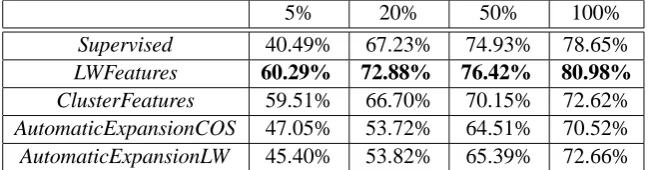
5% 20% 50% 100%
Supervised 40.49% 67.23% 74.93% 78.65%
LWFeatures 60.29% 72.88% 76.42% 80.98%
ClusterFeatures 59.51% 66.70% 70.15% 72.62%
AutomaticExpansionCOS 47.05% 53.72% 64.51% 70.52%
[image:7.595.137.463.63.148.2]AutomaticExpansionLW 45.40% 53.82% 65.39% 72.66%
Table 1: Results (in F1-measure) on the CoNLL 2008 test set for the different methods, comparing the supervised method (Supervised) with the semi-supervised methods LWFeatures, ClusterFeatures,
AutomaticExpansionCOS and AutomaticExpansionLW. See section 5 for details on the different methods.
Best results are in bold.
L(hσ(i)). We then compute the semantic similarity
measure as the Jensen-Shannon (Lin, 1997) diver-gence
JS(L(hi)||L(hσ(i))) = 1
2
D(L(hi)||avg) +D L(hσ(i))||avg
where avg= (L(hi) +L(hσ(i)))/2 is the average
between the two distributions and D(L(hi)||avg)
is the Kullback–Leiber divergence (Cover and Thomas, 2006).
Although this change might appear only a slight deviation from the original model discussed in (Fürstenau and Lapata, 2009) it is potentially an important one, since an accurate semantic similar-ity measure will greatly influence the accuracy of the alignments, and thus of the accuracy of the au-tomatic expansion. We call this method
Automat-icExpansionLW.
6 Experiments
We perform a number of experiments where we compare the fully supervised model with the semi-supervised models proposed in the previous sec-tion. We first train the LWLM model on an
unla-beled 5 million word Reuters corpus8.
We perform different experiments for the super-vised and the four different semi-supersuper-vised meth-ods (see previous section). Table 1 shows the re-sults of the different methods on the test set of the CoNLL 2008 shared task. We experimented with different sizes for the training set, ranging from 5% to 100%. When using a subset of the full train-ing set, we run 10 different experiments with ran-dom subsets and average the results.
We see that the LWFeatures method performs better than the other methods across all train-ing sizes. Furthermore, these improvements are
8See http://www.daviddlewis.com/resources
larger for smaller training sets, showing that the approach can be applied successfully in a setting where only a small number of training examples is available.
When comparing the LWFeatures method with the ClusterFeatures method we see that, although the ClusterFeatures method has a similar perfor-mance for small training sizes, this perforperfor-mance drops for larger training sizes. A possible expla-nation for this result is the use of the clusters em-ployed in the ClusterFeatures method. By defini-tion the clusters merge many words into one clus-ter, which might lead to good generalization (more important for small training sizes) but can poten-tially hurt precision (more important for larger training sizes).
A third observation that can be made from table 1 is that, although both automatic expansion meth-ods (AutomaticExpansionCOS and
AutomaticEx-pansionCOS) outperform the supervised method
for the smallest training size, for other sizes of the training set they perform relatively poorly. An in-formal inspection showed that for some examples in the training set, little or no correct similar occur-rences were found in the unlabeled text. The algo-rithm described in section 5 adds the most similar
k occurrences to the training set for every
7 Conclusions and future work
We have presented the Latent Words Language Model and showed how it learns, from unla-beled texts, latent words that capture the mean-ing of a certain word, dependmean-ing on the con-text. We then experimented with different meth-ods to incorporate the latent words for Semantic Role Labeling, and tested different methods on the PropBank dataset. Our best performing method showed a significant improvement over the su-pervised model and over methods previously pro-posed in the literature. On the full training set
the best method performed 2.33% better than the
fully supervised model, which is a 10.91% error
reduction. Using only 5% of the training data the
best semi-supervised model still achieved 60.29%,
compared to 40.49% by the supervised model,
which is an error reduction of 33.27%. These
re-sults demonstrate that the latent words learned by the LWLM help for this complex information ex-traction task. Furthermore we have shown that the latent words are simple to incorporate in an ex-isting classifier by adding additional features. We would like to perform experiments on employing this model in other information extraction tasks, such as Word Sense Disambiguation or Named Entity Recognition. The current model uses the context in a very straightforward way, i.e. the two words left and right of the current word, but in the future we would like to explore more advanced methods to improve the similarity estimates. Lin (1998) for example discusses a method where a syntactic parse of the text is performed and the context of a word is modeled using dependency triples.
The other semi-supervised methods proposed here were less successful, although all improved on the supervised model for small training sizes. In the future we would like to improve the de-scribed automatic expansion methods, since we feel that their full potential has not yet been reached. More specifically we plan to experiment with more advanced methods to decide whether some automatically generated examples should be added to the training set.
Acknowledgments
The work reported in this paper was supported by the EU-IST project CLASS (Cognitive-Level Annotation using Latent Statistical Structure, IST-027978) and the IWT-SBO project AMASS++
(IWT-SBO-060051). We thank the anonymous re-viewers for their helpful comments and Dennis N. Mehay for his help on clarifying the linguistic mo-tivation of our models.
References
C.F. Baker, C.J. Fillmore, and J.B. Lowe. 1998. The Berkeley FrameNet project. In Proceedings of the
36th Annual Meeting of the Association for Com-putational Linguistics and 17th International Con-ference on Computational Linguistics, volume 98.
Montreal, Canada.
A.L. Berger, V.J. Della Pietra, and S.A. Della Pietra. 1996. A maximum entropy approach to natural language processing. Computational linguistics,
22(1):39–71.
T. Briscoe, J. Carroll, and R. Watson. 2006. The sec-ond release of the RASP system. In Proceedings of
the Interactive Demo Session of COLING/ACL,
vol-ume 6.
P.F. Brown, R.L. Mercer, V.J. Della Pietra, and J.C. Lai. 1992. Class-based n-gram models of natural lan-guage. Computational Linguistics, 18(4):467–479.
O. Chapelle, B. Schölkopf, and A. Zien, editors. 2006.
Semi-Supervised Learning. MIT Press, Cambridge,
MA.
N.A. Chinchor. 1998. Overview of MUC-7/MET-2. In
Proceedings of the Seventh Message Understanding Conference (MUC-7), volume 1.
A.M. Cohen and W.R. Hersh. 2005. A survey of cur-rent work in biomedical text mining. Briefings in
Bioinformatics, 6(1):57–71.
T.M. Cover and J.A. Thomas. 2006. Elements of
In-formation Theory. Wiley-Interscience.
Koen Deschacht and Marie-Francine Moens. 2009. The Latent Words Language Model. In
Proceed-ings of the 18th Annual Belgian-Dutch Conference on Machine Learning.
C. J. Fillmore. 1968. The case for case. In E. Bach and R. Harms, editors, Universals in Linguistic Theory. Rinehart & Winston.
Hagen Fürstenau and Mirella Lapata. 2009. Semi-supervised semantic role labeling. In Proceedings of
the 12th Conference of the European Chapter of the ACL (EACL 2009), pages 220–228, Athens, Greece.
Association for Computational Linguistics.
D. Gildea and D. Jurafsky. 2002. Automatic label-ing of semantic roles. Computational Llabel-inguistics, 28(3):245–288.
G. Grefenstette. 1994. Explorations in automatic
the-saurus discovery. Springer.
M.A.K. Halliday. 1994. An Introduction to Functional
Grammar (second edition). Edward Arnold,
Lon-don.
Zellig S. Harris. 1954. Distributional structure. Word, 10(23):146–162.
S. He and D. Gildea. 2006. Self-training and Co-training for Semantic Role Labeling: Primary Re-port. Technical reRe-port. TR 891.
Richard Johansson and Pierre Nugues. 2008.
Dependency-based syntactic–semantic analysis with propbank and nombank. In CoNLL 2008:
Pro-ceedings of the Twelfth Conference on Computa-tional Natural Language Learning, pages 183–187,
Manchester, England, August. Coling 2008 Orga-nizing Committee.
T. Koo, X. Carreras, and M. Collins. 2008. Simple semi-supervised dependency parsing. In
Proceed-ings of the Annual Meeting of the Association for Computational Linguistics (ACL), pages 595–603.
J.-H. Lim, Y.-S. Hwang, S.-Y. Park, and H.-C. Rim. 2004. Semantic role labeling using maximum en-tropy model. In Proceedings of the Eighth
Confer-ence on Computational Natural Language Learning,
pages 122–125, Boston, Massachusetts, USA. ACL.
D. Lin. 1997. Using syntactic dependency as local context to resolve word sense ambiguity. In
Pro-ceedings of the 35th Annual Meeting of the Asso-ciation for Computational Linguistics, volume 35,
pages 64–71. ACL.
Dekang Lin. 1998. Automatic retrieval and clustering of similar words. In Proceedings of the 17th
inter-national conference on Computational Linguistics,
pages 768–774. Association for Computational Lin-guistics Morristown, NJ, USA.
G.S. Mann and A. McCallum. 2007. Simple, ro-bust, scalable semi-supervised learning via expecta-tion regularizaexpecta-tion. In Proceedings of the 24th
In-ternational Conference on Machine Learning, pages
593–600. ACM Press New York, USA.
D. Marcu, W. Wang, A. Echihabi, and K. Knight. 2006. SPMT: Statistical machine translation with syntact-ified target language phrases. In Proceedings of the
Conference on Empirical Methods for Natural Lan-guage Processing, pages 44–52.
S. McDonald and M. Ramscar. 2001. Testing the dis-tributional hypothesis: The influence of context on judgements of semantic similarity. In Proceedings
of the 23rd Annual Conference of the Cognitive Sci-ence Society, pages 611–616.
Dennis Mehay, Rik De Busser, and Marie-Francine Moens. 2005. Labeling generic semantic roles. In
Proceedings of the Sixth International Workshop on Computational Semantics.
J. Nivre, J. Hall, and J. Nilsson. 2006. MaltParser: A datadriven parser-generator for dependency parsing. In Proceedings of the Fifth International
Confer-ence on Language Resources and Evaluation, pages
2216–2219.
M. Palmer, D. Gildea, and P. Kingsbury. 2005. The proposition bank: An annotated corpus of semantic roles. Computational Linguistics, 31(1):71–106.
S. Pradhan, W. Ward, K. Hacioglu, J. Martin, and D. Jurafsky. 2004. Shallow semantic parsing using support vector machines. In Proceedings of the
Hu-man Language Technology Conference/North Amer-ican chapter of the Association of Computational Linguistics, Boston, MA.
A. Ratnaparkhi. 1996. A maximum entropy model for part-of-speech tagging. In Proceedings of the
Con-ference on Empirical Methods in Natural Language Processing, pages 133–142. Association for
Com-putational Linguistics.
M. Surdeanu, S. Harabagiu, J. Williams, and P. Aarseth. 2003. Using predicate-argument struc-tures for information extraction. In Proceedings of
the 41st Annual Meeting on Association for Compu-tational Linguistics, pages 8–15.
R.S. Swier and S. Stevenson. 2004. Unsupervised se-mantic role labelling. In Proceedings of the 2004
Conference on Empirical Methods in Natural Lan-guage Processing, pages 95–102.
C. Thompson, R. Levy, and C. Manning. 2006. A gen-erative model for FrameNet semantic role labeling . In Proceedings of the 14th European Conference on
Machine Learning, Cavtat-Dubrovnik, Croatia.
N. Xue and M. Palmer. 2004. Calibrating features for semantic role labeling. In Proceedings of the
Con-ference on Empirical Methods in Natural Language Processing, volume 4.