EVALUATING THE VIABILITY OF INTRUSION
DETECTION SYSTEM BENCHMARKING
A Thesis in TCC 402
Presented to:
The Faculty of the School of Engineering and Applied Science
University of Virginia
In Partial Fulfillment
of the Requirements for the Degree
Bachelor of Science in Computer Engineering
By
Kenneth J. Pickering
Computer Engineering
On my honor as a University student, on this assignment I have neither given nor
received unauthorized aid as defined by the Honor Guidelines for Papers in TCC Courses
________________________________________________________________________
APPROVED: Dr. Patricia Click, TCC Advisor__________________________________
ii
PREFACE
I would like to thank Dr. David Evans, my Technical Advisor, for his
support and advisory work during the course of this project, and Dr. Patricia Click
for helping me keep this task managed properly, as well as the aid she provided as
my TCC advisor with editing. I would also like to thank MIT’s Lincoln Labs for
providing the data sets and documentation necessary to produce this project. The
CS Systems Department provided me with resources and lab space, for which I
am very grateful. Lastly, I would like to thank the Snort development staff for
producing a great, free product and the users on the mailing list for providing help
when it was needed.
The main reason I undertook this endeavor was to improve the quality of
intrusion detection systems, which can be a valuable tool in detecting malicious
attacks that strike corporate networks. If one of these systems is utilized, it is
imperative to maintain it and make sure it is able to detect the newest forms of
exploits, as well as the older methods of attack. An efficient way to do this would
be to devise an evaluation of intrusion detection systems, which is something that
Lincoln Labs attempted to do. I believe this test and the methodology behind it
are not up to the task, and it should not be as frequently used as it is. It was the
goal of this project to invalidate the Lincoln Labs test and point out the flaws. In
the conclusion, I put forth ideas that could be used to develop a better and more
iii
TABLE OF CONTENTS
PREFACE ... ii
TABLE OF FIGURES ...vi
ABSTRACT... vii
INTRODUCTION ... 1
Scope and Method... 1
Overview ... 3
INTRUSION DETECTION... 5
Snort... 5
Improving Current Systems ... 6
Making IDS More Intelligent ... 7
EVALUATING IDS ... 9
1998 Evaluation: Background Information ... 9
Problems With 1998 Evaluation... 10
1999 Evaluation: General Information and Problems ... 12
General Problems with DARPA-LL... 13
EXPERIMENTATION SET-UP ... 15
Initial Set-Up... 15
Resulting Decisions ... 16
Secondary Set-Up ... 16
Configuring Snort ... 17
EXPERIMENTATION AND CREATION OF RULE SETS ... 21
iv
Snort Configuration Methodology... 24
IDS PERFORMANCE... 26
Snort 1.7 Custom ... 26
Snort 1.7 Full ... 27
Snort 1.8.3 Full ... 28
Snort 1.8.3 Custom ... 28
Results ... 29
CHAPTER 7: CONCLUSION ... 30
Summary... 30
Interpretation... 30
Recommendations for Further Research... 32
APPENDIX A: WORKS CITED... 34
APPENDIX B: BIBLIOGRAPHY ... 36
APPENDIX C: SNORT CONFIGURATION FILES ... 39
Snort 1.7 Full Configuration... 39
Snort 1.7 Custom ... 40
Snort 1.8.3 Full Rule Set ... 41
Snort 1.8.3 Custom Rules: ... 42
APPENDIX D: ATTACK DESCRIPTIONS ... 43
1998 Attack Listings ... 43
1999 Learning Data Exploits: Week 2 ... 45
Attack Descriptions - 1999 ... 47
v
1998 Learning Data Week 6 ... 49
1998 Learning Data Week 7 ... 52
1999 Test Data Week 1 ... 53
1999 Test Data Week 2 ... 57
APPENDIX F: NUMBER OF ALERTS ... 62
APPENDIX G: FULL ATTACK DATABASE ... 65
Denial of Service Attacks ... 65
User to Root Attacks... 67
Remote to Local... 68
Probes... 71
vi
TABLE OF FIGURES
Figure 1 – Initial Set-Up ... 15
Figure 2 – Snort Pre-Run Screen ... 22
Figure 3 – Snort Post-Run Screen... 23
vii
ABSTRACT
This report evaluates the DARPA-LL intrusion detection system
evaluation. Intrusion detection systems are not easily constructed or maintained
due to the almost daily evolution of network traffic and known exploits. The most
popular and rigorous system devised to date is the DARPA-LL 1998 and 1999
Intrusion Detection System Evaluation. I will evaluate it through analysis of the
documentation published for the lab as well as experimentation using different
rule customizations.
Snort was selected because of its price and easy customization. Through
manipulation of its rules files, it was to be customized to perform better in certain
situations using the DARPA-LL evaluation criteria. This shows that this
benchmarking system can be easily manipulated. Developers looking to enhance
performance can alter their rules files to better detect attacks. This system could
be manipulated to produce better results, and thus becomes less a test of
developers testing their true systems and more a test of how well developers can
interpret the testing data.
This project shows that benchmarking intrusion detections systems cannot
be done effectively at this time. Until we develop more advanced artificial
intelligence and datamining techniques, it will be very hard to evaluated intrusion
detection systems. The amount of customization that goes into effectively using
one, as well as the ever-changing number of viable network exploits makes it
1
INTRODUCTION
For my undergraduate thesis, I evaluated the Lincoln Labs’ (LL) DARPA
(Defense Advanced Research Projects Agency) intrusion detection system
benchmarking data set and evaluation. This project found discrepancies by
analyzing the data set between different years the evaluation was performed.
Running the data through an intrusion detection system with a variety of
configuration settings discovered these inconsistencies. The thesis also analyzes
the actual way in which the test was taken and evaluated originally. This research
will try to prove that the DARPA evaluation is not an acceptable way to measure
the performance of an intrusion detection system, and may actually impede
development of better systems due to evaluation based on a bad standard.
Scope and Method
Network security is a thriving industry in this country as more and more of
the corporate workspace is converted to digital media. Because companies and
home users keep sensitive information on their computers, there is a great need to
protect that information from those who would exploit it. One way to help keep
attackers at bay is by using an intrusion detection system (IDS), which are
designed to locate and notify systems administrators to the presence of malicious
traffic. The current systems are not effective right now because detecting
intrusions and other forms of malicious traffic in a large, modern corporate
network is difficult. Something must be done in order to improve performance
2 We can classify IDS’s as host-based and network-based. Host-based
intrusion detection systems monitor the computer the software is running on and
often integrates closely with the operating system (Durst et al., 54). Network IDS
“monitor network traffic between hosts. Unlike host-based systems, which detect
malicious behavior outright, these systems deduce behavior based on the content
and format of data packets on the network” (Durst et al., 55). This project looked
exclusively at network-based intrusion detection systems, as opposed to
host-based intrusion detection. My thesis used MIT’s Lincoln Labs data (also known
as DARPA-LL data), available at http://www.ll.mit.edu/. This data consists of two
weeks of traffic captured using tcpdump, a well-known open-source packetsniffer,
which can be replayed in a network environment. The documentation and
procedures produced by Lincoln Labs are analyzed in Chapter 3.
Snort, the IDS that this project utilizes, can take tcpdump files as an input
and scan the traffic for abnormalities. All of the malicious traffic introduced into
the DARPA-LL test data set is known, so administrators know how well their
system picks up the given exploits and also know when false positives are
generated. Most of the academic IDS’s researched, as well as a lot of commercial
systems, use the DARPA data as a common benchmark. Two different years of
the provided tcpdump traffic were used to determine whe ther Lincoln Labs’
information and procedures can be used as a viable benchmark for something as
complex as an intrusion detection system that is thrown into a much larger and
3 My main purpose for undertaking this study was to improve the overall
quality intrusion detection system benchmarking through analyzing the current
ways to test these systems. Based on my previous experience as a network
systems administrator, I can attest to the shortcomings of the current commercial
and open-source solutions. They generate many “false positives,” which is
standard traffic being diagnosed as malicious data, and sometimes a few “false
negatives,” which are attacks gone unnoticed by the IDS. Both of these lead to a
viable system’s resources being wasted. The amount of false positives clogs up
log files with erroneous reports, thus masking a legitimate attack in a sea of false
alarms. Most systems administrators will ignore the IDS’s data due to this fact.
The other problem stems from attacks appearing to be friendly, normal traffic,
which is even more alarming, since an attacker would be able to creep into the
network without an alert from the IDS.
By evaluating the current academic standard in benchmarking using Snort,
it can be determined whether the benchmark is, in fact, a valid test to run. A
positive performance on these tests can give IDS programmers a false sense of
security, which could lead to a degeneration of future development. If the data
MIT provides is not up to par, perhaps a newer, more rigorous form of testing can
be used.
Overview
This report will consist of a few major sections. Chapter 2 reviews
4 intrusion detection systems and suggestions made to improve the current systems.
Past IDS evaluations and the problems found within DARPA-LL after analysis of
their documentation will be discussed in Chapter 3. The set up of my project and
decisions made to change my initial proposal is discussed in Chapter 4.
The next chapters delve into the actual experimentation of my project and
the four runs of the DARPA-LL evaluation using the Snort IDS. Chapter 5 gives
examples of output of Snort and SnortSnarf and discusses how the rules sets were
developed. Chapter 6 discusses my analysis of the project, where I delve into the
information collected and try to determine the validity of DARPA-LL’s
5
INTRUSION DETECTION
A reliable and efficient intrusion detection system (IDS) is a necessary
component in any network. It can alert administrators of possible attackers and
give a good view of the network’s status. This section of the proposal looks at
current systems, proposals for new types of IDSs, and higher level ideas that
could be carried over into IDS development. Many of the academic and
commercial systems available were tested using the DARPA-LL IDS test, so all
of the systems presented could benefit from a viable benchmark. It is the main
goal of this project to look at how the DARPA-LL tested systems perform in a
real-world environment and, if the Lincoln Labs’ test is determined to be a bad
benchmark, propose new ways to test all forms of IDS.
Snort
The IDS looked at most closely in this project, Snort, is a rules-based
network intrusion detection system (NIDS). Martin Roesch, in his paper entitled
“Snort – Lightweight Intrusion Detection for Networks,” says “Snort fills an
important ‘ecological niche’ in the realm of network security: a cross-platform,
lightweight network intrusion detection tool that can be deployed to monitor small
TCP/IP networks and detect a wide variety of suspicious network traffic as well
as outright attacks” (1). The SANS Institute also reported Snort as becoming the
standard among intrusion detection experts due to the fact that it is open-source,
frequently updated, and free of charge (2). Snort generates a number of false
6 Interne t running a default installation of Snort (Hoagland, 376). Thankfully, many
programs, like SnortSnarf, are available to help parse through large amounts of
false alerts to access relevant data.
Improving Current Systems
Many IDS experts have proposed different ideas for improving the current
systems in use. Sekar et al. propose that a new universal intrusion detection rules
language be developed to make creating rules for different IDSs easier in their
paper “A High-Performance Network Intrusion Detection System” (8). Also, Lee
and Stolfo point out that building an IDS is a huge engineering task and imply
that, in order to make production of rules easier, a debugger for rules languages
should be developed to reduce the amount of effort involved in implementation
(228-9). Barruffi, Milano, and Montanari think that automated responses should
be added into current IDSs to block attacks without relying on the administrator
and allow the system to manage intrusion recovery (74). Another possible
improvement would be making systems fault-tolerant, so that a hacker cannot
subvert the IDS itself. Shen et al. proposed “a hybrid of distributed, redundant,
and cross-corroborating techniques” (425).
Others believe that a new system of communication protocols or a
redesign of routing protocols should be developed to help combat many problems
stemming from an inability to effectively trace attackers. Schnackenberg et al.
proposed a new Cooperative Intrusion Traceback and Response Architecture
7 “(1) trace intrusions across network boundaries, (2) prevent or mitigate
subsequent damage from intrusions, (3) consolidate and report intrusion activities
and (4) coordinate responses on a system-wide basis” (56). A denial of service
attack could be performed on routers, either by a malformed router or malicious
attacker. Cheung and Levitt say smarter routers must be developed to detect and
ignore bad or compromised routers (94).
Making IDS More Intelligent
Many academic programmers are using new techniques to make IDSs
more intelligent. Fawcett and Provost at Bell Atlantic Science and Technology
theorized a high- level approach to intrusion detection in their article about activity
monitoring. They believe that the same theories used in detecting cellular
telephone fraud, which rely on user profiling, can be used in a computer network
environment (59-60). Statistical Process Control, developed by Arizona State
University and used in their system ISA-IDS, uses Chi-square techniques to detect
anomalies in a network environment as well as a rules-based system, which they
call “Clustering” (Ye, Emran, Li, and Chen , 3, 10). In another paper by Ye and a
different group of professors entitled “Probabilistic Techniques for Intrusion
Detection Based on Computer Audit Data,” Ye et al. propose other probabilistic
techniques “including Hotelling’s T2 Test, chi-square multivariate test, and
Markov chain,” and use these methods with the same data set to gauge efficiency
(Ye, Li, Emran, and Xu 266). Johns Hopkins University attempted to set up an
8 and Heinbuch, 1171). The system they proposed was host-based, protecting a
network server.
Many experts in the network security and intrusion detection field have
proposed viable solutions to the problems with network security. All of the above
solutions, especially the ones that used the DARPA-LL IDS test data, could
9
EVALUATING IDS
Lincoln Labs’ intrusion detection evaluation was not the first effort at
testing IDS systems, but was the first attempt at an all-conclusive test of whole
categories of standard network exploits and other forms of malicious traffic. In
Lippmann et al.’s paper on the 1999 DARPA evaluation, they discuss the
previous endeavors. Before the DARPA- LL test, the most advanced
benchmarking system previously tried involved simple telnet and FTP traffic with
automated attacks (Lippmann et al, 2000, 2). Along the same lines, there was also
a product comparison of 10 commercial IDS products in 1999 done by G. Shipley
(Lippmann et al, 2000, 2).
1998 Evaluation: Background Information
The 1998 evaluation consisted of seven weeks of test learning data. The
purpose behind producing this was to give IDS evaluators a chance to tweak their
rules based and anomaly detection systems by familiarizing them with the typical
traffic running through the network. There were also attacks thrown into each of
the learning data files, to show typical attacks. It gave the systems using
datamining and learning algorithms a chance to have sample data, which helped
them “learn” how the network operated (Lippmann et al, 1999, 2).
The MIT lab used a test bed to generate all its background data for the
1998 evaluation. Since it was difficult to take Air Force network data and manage
to remove sensitive information from it for evaluation purposes, the lab used
10 activities of hundreds of programmers, managers and secretaries, as well as make
a few hosts appear to be thousands of terminals. A packetsniffer was located on
the internal network to capture the generated traffic. All simulated attacks were
launched from “outside” the base, so a traffic sniffer located at the gateway would
be able to catch it all (Lippmann et al, 1999, page 3).
Intrusion detection systems were supposed to detect the following
categories: denial of service (DoS), port scanning and probes, user to root attacks
(U2R), and remote to local (R2L). In the DoS categories, which should be fairly
easy to detect, the best system could only pick up 65% of attacks. The probes
category had two of the systems detecting 90% of probing activities. In the U2R
category, the best systems could only find 60% to 70% of attacks. In what is
probably the most serious of attacks, the R2L, which allows remote users to gain
local access (in some cases root access), the best system could only find 35% of
attacks. The systems that could interpret BSM audit data on Sun workstations
could improve performance slightly (Lippmann et al, 1999, 9-12).
Problems With 1998 Evaluation
There were several problems with the 1998 evaluatio n, some of which
Lincoln Labs’ acknowledged in its write- up of the 1999 evaluation. Lincoln Labs
cited that the 1998 evaluation was only to provide exploits against UNIX hosts
and was only supposed to initially be used for IDS that had been developed using
DARPA grants (Lippmann et al, 2000, 4). The oversight of Windows NTwhen it
11 evaluation, was probably used by government and military personal as well.
Leaving this particular operating system out really harms the 1998 evaluation’s
credibility.
One of the major drawbacks in running the evaluation is that a listing of
attacks in the actual test data is not available. I instead had to use two of the
normal “learning data” weeks. In week 6 of the testing data, a bad router added
too many ICMP packets into the data set, as computers constantly “pinged” each
other. This generated massive log files and a major slowdown in Snort
performance, as it logged over 1.5 million alerts upon completion, in some
instances.
The two biggest problems, though, were the methodology used to come up
with the exploits, and the way they were executed. There were 38 different kinds
of malicious traffic used, but they were executed in no real logical order. Some
sort of attacker intelligence should have been placed into the attack routines, even
in the preliminary data. Merely adding malicious traffic is not sufficient. Attacks
and exploits are sent for a purpose and usually come in a set order. Similar to
real-life crime, there is always some amount of reconnaissance before an attack takes
place. Even relatively unsophisticated attacks like DoS are usually performed for
a purpose and are probably somewhat calculated.
Lincoln Lab used a scoring method that weighed amount of attacks
detected versus the amount of false positives found, using receiver operating
12 al, 1999, 2). It should also have taken the amount of resources used by the system,
ease-of- use, and what type of system it is.
System resources and ease-of-use are huge factors in using any sort of
system. Snort, for instance, can run on a variety of computers, depending on the
amount of traffic it has to handle. For home and small networks, it is possible to
get away using a low-grade Intel Pentium or even Intel i486 processor. If a system
can only run on a super-computer cluster, it will severely affect how feasible the
system is. Also, if a system is extremely complex or not well documented, it
could affect how easily users can manipulate it.
1999 Evaluation: General Information and Problems
The 1999 evaluation set out to improve upon the evaluation performed a
year earlier, with extensions added on and more attack types. This included the
addition of Windows NT exploits. The test bed to generate this particular data was
similar to the 1998 tool, but also included updated statistics and the addition of
Windows NT hosts. Also, the same attack sub-categories were used and are listed
above (Lippmann et al, 2000, 7-10).
The full results of this evaluation can be seen in the summary of the results
that Lincoln Labs published on pages 14 - 18 of its summary. The scoring method
Lincoln Labs showed in their charts was the percentage of attacks found with
below 10 false alarms of that attack instance per day, and also had a detection rate
13 This evaluation had many improvements over its predecessor, although it
was still far from perfect. The scoring mechanism is similar to the one used in the
1998 evaluation and is, once again, a problem. I found the listings of the
individual IDS performance to be confusing and the evaluation still did not use
the criteria discussed in the section on the 1998 evaluation. A less confusing and
more honest representation of the data would be to just list the amount of attacks
found versus the amount of false positives. Capping it at a certain number and
detection percentage leaves out the systems that did not “make the grade.” The
full listing is easier to represent and makes more sense (Lippmann et al, 2000,
14-18).
General Problems with DARPA-LL
DARPA meets its goal of being the most advanced IDS benchmarking
system to date, but is still lacking in some areas. The major flaws in the system
itself deal with the test bed, and how the researchers decided to evaluate the
systems.
The test bed generates a series of generic packets based on statistical
properties and uses a minimum of hosts. Even though the tool is not publicly
available and the statistical properties used to develop it are unknown, it can not
be as accurate as capturing real-time traffic in a corporate or government network.
This helps avoid security implications of publicizing government network traffic,
but comes with an inherent cost. It is extremely difficult to replicate people’s
14 reasonably good job. From an accuracy point of view, it would have been much
better to use real traffic.
System type factors heavily into how well certain attacks are detected. For
instance, local-only attacks, where a user abuses software on his own computer,
could not be detected by a network-based IDS, unless it somehow uses an
Ethernet adapter (like a “land” attack, which the user issues packets to himself).
On the other hand, host-based systems will miss attacks against routers and other
computers in most cases. Since the two systems vary heavily in operation and
purpose, it would make sense to evaluate them separately.
Although this evaluation was quite advanced, it could have been more
inclusive, or at least more open in its methods, after the evaluation was complete.
Not knowing how all of the background traffic was generated is a serious
drawback to the system. Also, the scoring methodology and separate evaluations
for the different types of IDSs could also have helped to evaluate systems after the
15
EXPERIMENTATION SET-UP
Initial Set-Up
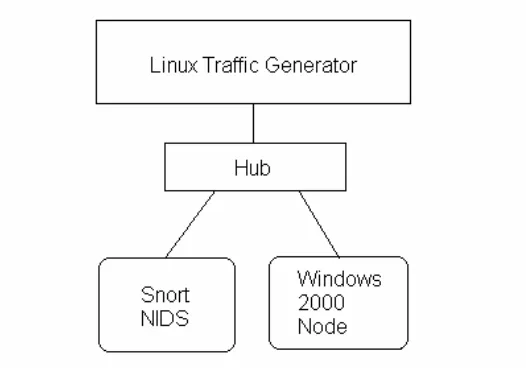
The initial set-up was, with three computers connected with a hub (Figure
1). This process was as not easy as anticipated. The main problems that occurred
stemmed from lack of time and resources. In order to do what was originally
specified, I would have had to edit NetPoke so that I could funnel all the data to
one host-based system, unlike the original Lincoln Labs closed configuration,
which consisted of several interconnected computers. Also, a separated routing
infrastructure would have to be set up in order to get the Linux and Windows
computers to be able to recognize each other. This was too much to ask of the CS
Systems staff, who were kind enough to provide me with a lab space, computers,
[image:22.612.193.456.435.619.2]and assistance.
16 Resulting Decisions
The host-based system was dropped and Snort was exclusively used, with
two different versions of this IDS ran against the data set. Snort 1.7, which was
released over a year ago, is timed much closer to the actual date the data was
captured, since the evaluations were created in 1998 and 1999. Snort 1.8.3 is also
used, as it was the most recent stable release of the software package at the time
this thesis was performed. Different rules sets are to be plugged into each IDS,
giving each different functionality, even though they use similar engines.
Secondary Set-Up
One computer, with the DARPA data sets stored locally and Snort running
in a Red Hat Linux 7.1 environment, was used. Snort has the ability to parse the
tcpdump logs itself, so no outside utility (NetPoke) was utilized. This computer
needed a lot of disk space in order to adequately hold the results of several data
sets. I ran both of the applications twice: once with full settings, where any sort of
abnormality is noticed, and once with a lightweight, customized rules set that only
looks for the specific attacks that I want Snort to recognize.
The sole computer used in my experiment had a reasonably fast AMD
Athalon processor (1.2 GHz) and 768 MB of RAM. An additional 70 GB hard
disk was added to the machine to hold the massive alert files Snort was
generating, and the data parsed with SnortSnarf. At one point, the video card in
this computer ceased to function, causing a delay of about 3 days while the
17 Initially, the CS systems staff installed the 70 GB disk formatted in
FAT32 format. This caused errors with Snort 1.8.3 (but not Snort 1.7), as some of
the automatic filenames it generates are Linux Ext2 specific. Because of the
massive amount of data already run through using Snort 1.7, it was impossible to
salvage it before formatting the disk, resulting in a time loss of about a week’s
worth of work.
Configuring Snort
Snort is an open-source project started by Martin Roesch and is available
on a variety of platforms for download, including Windows, Linux, and Solaris. It
has been around for a few years and acquired a decent number of developers and
users. From personal use, it seems to be quite easy to customize and very flexible
in terms of possible uses.
Snort has a main configuration file that allows you to add and remove
pre-processor requirements as well as the rules files included. This is where you
typically specify the limit of fragmentation you want to take notice of and if you
want the packets reconstructed or not. Below is a selection of the configuration
file that allows you to select how the tcp stream is reassembled. The comments in
the file are very descriptive (comments are preceded with the ‘#’ symbol) and
there are a number of options defined, such as what network ports to watch and
which side (client, server or both) of the connection.
# tcp stream reassembly directive
# no arguments loads the default configuration # Only reassemble the client,
18 # Give alerts for "bad" streams
#
# Available options (comma delimited):
# clientonly - reassemble traffic for the client side of a connection only
# serveronly - reassemble traffic for the server side of a connection only
# both - reassemble both sides of a session
# noalerts - turn off alerts from the stream reassembly stage of stream4
# ports [list] - use the space separated list of ports in [list], "all"
# will turn on reassembly for all ports, "default" will turn # on reassembly for ports 21, 23, 25, 53, 80, 143, 110, 111 # and 513
preprocessor stream4_reassemble
Another important selection of the configuration file is the rules specification,
where you can add and remove rules libraries, in a very similar fashion to a
typical programming language. The custom rules file includes I used for Snort
version 1.8.3 is seen here:
#========================================= # Include all relevant rulesets here #
19 include web-attacks.rules include sql.rules include x11.rules include icmp.rules include netbios.rules include misc.rules include attack-responses.rules # include backdoor.rules
# include shellcode.rules # include policy.rules # include porn.rules # include info.rules # include icmp-info.rules # include virus.rules
# include experimental.rules include local.rules
There is also a specific language to specify the rules themselves. This is
where Snort’s true flexibility lies. You can basically choose to filter any kind of
network traffic you want. Full documentation of rules specification language is
available in the Snort documentation (http://www.snort.org). A few things to
notice in a typical “rule” are the type of protocol, the destinations to be watched,
the sources to be watched, the label of the attack, the contents of the packet to be
searched for, and a reference describing the attack, if applicable. A small selection
of the “backdoor” rules file is shown below:
# (C) Copyright 2001, Martin Roesch, Brian Caswell, et al. All rights reserved.
# $Id: backdoor.rules,v 1.16 2001/12/19 18:40:04 cazz Exp $ #---
# BACKDOOR RULES #--- #
alert tcp $EXTERNAL_NET 27374 -> $HOME_NET any (msg:"BACKDOOR subseven 22"; flags: A+; content:
"|0d0a5b52504c5d3030320d0a|"; reference:arachnids,485; sid:103; classtype:misc-activity; rev:3;)
alert tcp $EXTERNAL_NET 1024: -> $HOME_NET 2589 (msg:"BACKDOOR - Dagger_1.4.0_client_connect"; flags: A+; content: "|0b 00 00 00 07 00 00 00|Connect"; depth: 16;
20 alert tcp $HOME_NET 2589 -> $EXTERNAL_NET 1024: (msg:"BACKDOOR -
Dagger_1.4.0"; flags: A+; content:
"|3200000006000000|Drives|2400|"; depth: 16;
reference:arachnids,484; sid:105; classtype:misc-activity; rev:3;)
alert tcp $EXTERNAL_NET 80 -> $HOME_NET 1054 (msg:"BACKDOOR ACKcmdC trojan scan"; seq: 101058054; ack: 101058054; flags: A;reference:arachnids,445; sid:106; classtype:misc-activity; rev:3;)
alert tcp $EXTERNAL_NET 16959 -> $HOME_NET any (msg:"BACKDOOR subseven DEFCON8 2.1 access"; content: "PWD";
content:"acidphreak"; nocase; flags: A+; sid:107; classtype:misc-activity; rev:4;)
alert tcp $EXTERNAL_NET any -> $HOME_NET 7597 (msg:"BACKDOOR QAZ Worm Client Login access"; flags: A+; content:"|71 61 7a 77 73 78 2e 68 73 71|"; reference:MCAFEE,98775; sid:108; classtype:misc-activity; rev:3;)
alert tcp $HOME_NET 12345 -> $EXTERNAL_NET any (msg:"BACKDOOR netbus active"; flags: A+; content: "NetBus";
reference:arachnids,401; sid:109; classtype:misc-activity; rev:3;)
The particular type of Snort installation used in this particular experiment
just places the alerts of positive attacks in an “alerts” text file. Other versions of
this IDS allow you to place the data in a MySQL or ACID data base, which were
not used in this project. There are several open-source solutions to parsing the
data from the text file into a useable output. SnortSnarf by James Hoagland is a
perl script that takes the text file and sorts it by alert type and IP address into a
slick HTML interface. Snort and SnortSnarf will be discussed in further detail in
21
EXPERIMENTATION AND CREATION OF RULE SETS
The data set used in this experiment was selected from the listings at
Lincoln Labs’ web site, and has just recently become publicly available (where
before, they were available only through correspondence with the lab). I chose to
use the Week 6 and Week 7 preliminary test data from 1998 and the actual two
weeks of evaluation data from 1999. The incident logs, which are listings of the
attacks and abnormalities, were not available for the actual 1998 test data.
MIT provides an open-source tool, called NetPoke, that can replay
tcpdump files on a network at a user specified rate. I noticed that on a 10 Mbit
network, a large number of packets were being dropped by the traffic generation
machine, requiring me to run the logs in “real-time,” which would have taken me
approximately four months to complete the all the log files. Since I made the
changes listed in the previous chapter, it was much quicker and more efficient to
run the data through the Snort IDS, itself. Snort will not drop any packets and can
run most of the days in a couple hours.
Snort Configuration
The preliminary configuration of Snort was reasonably straightforward,
although there were a few problems with the rpm packages, which are essentially
Red Hat’s solution to easy installation. It instead had to be compiled manually,
using the source code on the web site. A few additional libraries had to be
installed in order to get the IDS to function properly, as Snort requires packet
22 After the installation, Snort was activated in real-time detection mode to
make sure it was configured properly. After a few minutes of intercepting live
traffic and examining the logs, it was then time to use offline DARPA-LL data. I
selected a few of the data files and proceeded to run them through Snort. The
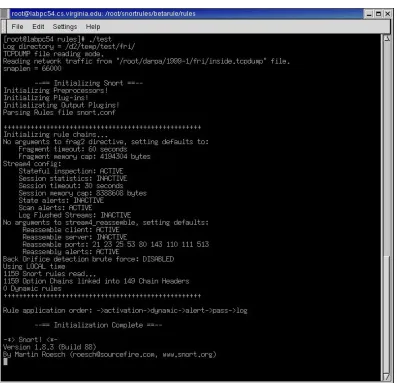
[image:29.612.128.525.202.585.2]typical output from the start-up of the IDS can be seen below (Fig 2).
Figure 2 – Snort Pre -Run Screen
I looked at the alerts that had been generated and noticed their large size.
23 file inputted. The task of going through these text files manually was going to be
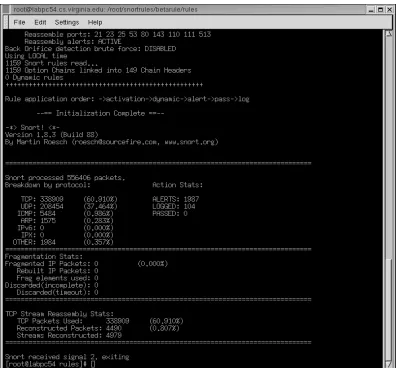
too time and labor intensive. Snort lists the number of packets scanned and alerts
found when it has completed running, as can be seen in Fig. 3. Thankfully,
SnortSnarf, can take these massive files and put them into a easy-to-read HTML
[image:30.612.126.522.206.574.2]format.
Figure 3 – Snort Post-Run Screen
I took the practice data I had been working with, and parsed the resultant
text files into HTML using SnortSnarf. After some rudimentary configuration, the
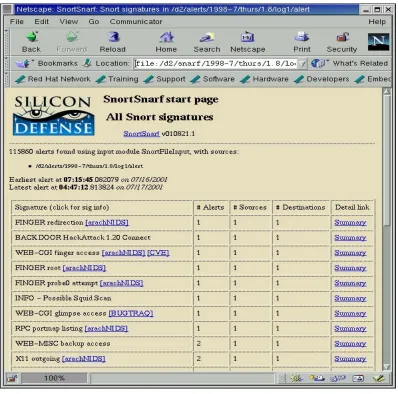
24 because it links all the data and sorts it by alert type and IP, plugging in fairly
seamlessly with Snort’s classifications and logging methodology. A screen shot of
[image:31.612.126.524.151.545.2]the typical HTML output can be seen below, in Fig 4.
Figure 4 – SnortSnarf Output
Snort Configuration Methodology
The configuration files for each particular run of the IDS were selected to
show the variance that rules manipulation can cause to the IDS system. Based on
25 predict the exploits used in the actual offline test given in 1999. Each particular
run of the separate rules files is discussed in the next chapter, in my analysis
section.
The exploits in 1998 Week 6 and Week 7 learning data, which the systems
were run against, as well at the listings of the 1999 Week 2 learning data (used for
reference) are listed in Appendix D. This data shows a very close correlation to
actua l test data used in 1999, which can be seen in Appendix G. The Snort 1.8.3
engine was run with two different configurations, one with a complete set of rules
minus icmp- info rules. This particular rule set was left out because it generated
too many false positives in the Snort 1.7 run. The Snort 1.8.3 custom
configuration had a few rule sets removed, which, with the exception of a few
attacks that it missed, had far fewer false positives. This would give it a much
better performance rating on the Lincoln Labs’ test.
The configuration files for each of the Snort builds are included in the
Appendix section of this paper. A full listings of the libraries used is available on
26
IDS PERFORMANCE
Four types of system configurations were used in this project. The first
IDS used was Snort 1.7 with the default rules set fully enabled. The second run
opted to ignore the ICMP informational rules, while including everything else.
The configuration files are included in the Appendix C. The second version I
utilized was the latest stable build of Snort, 1.8.3. I used the a full rules set for this
particular version as well as a customized version, created after viewing the 1998
and 1999 test data. The full rules set that Snort used listed all the rules except for
icmp- info, which generated too many false positives under Snort 1.7. The second
configuration file included rules that were purposely chosen to run better on the
evaluation data because they had a decrease in the amount of false positives over
the fuller rules set.
All of the results for the four different runs of the evaluation are included
in Appendix E of this thesis paper, as well as the total number of alerts for each
instance, which are found in Appendix F. The glossary of the attack abbreviations
used for both of the evaluation years can be found in Appendix G.
Snort 1.7 Custom
The rules used in this particular instance of the build were derived from
the rules bundle that came with this initially. The icmp- info rules file was left out,
but all the others were left in.
This particular build had almost no false positives, but also picked up a
27 was Denial of Service (DoS) attacks that were comprised of malformed packets in
some way, like the Ping of Death (PoD) or teardrop attacks. It did not detect
portscans or remote-to- local attacks, so performed abysmal in these particular
categories.
However, the minumum of false positives on the DoS attacks it picked up
would give it a pretty favorable rating in that category.
Snort 1.7 Full
The rules file for this particular build was the full set of rules from the
Snort 1.7 bundle that was used. It logged a large portion of ICMP traffic as a
result.
This particular configuration was very good at detecting some Denial of
Service (DoS) attacks as well as scanning attempts (port and IP scans). It
performed much better than customized rules set (Snort 1.7 Custom, see above). It
generated an enormous amount of false positives, however, since it was tracking
ICMP traffic. In order to pick up portscans, ipsweeps, notice FTP probes, and
pick up vulnerability scanners, you need to capture some of this traffic.
This particular build did much worse at detecting Remote-to-Local attacks
28 Snort 1.8.3 Full
The rules configuration for this particular run was the majority of rules
listed in the current CVS, except for rules which would generate a large number
of false positives, with little to no gain in performance.
This particular build performed the best, as far as strictly detecting attacks.
It performed admirably at noticing a variety of remote-to-local, DoS and
reconnais sance attacks, although had a reasonably high false positive rate (second
to the Snort 1.7 Full configuration). The improvement over the 1.7 runs is readily
visible.
Snort 1.8.3 Custom
This build was the one designed to prove my thesis, as it was customized
to perform well on the benchmark. I added the rules sets that would notice the
most attacks with a minimum of false positives.
The performance of this system was the best, according to DARPA-LL
standards. It detected almost the same amount of attacks as the Snort 1.8.3 Full
configuration, with a reduction in false positive rates. It was possible, looking at
past traffic and types of attacks, to predict which rule sets would be the best at
29 Results
The results of this particular section led to invalidating the DARPA-LL
benchmark. Since it was possible to use a variety of rules to attain a varying level
of performance, this particular test was easily manipulated. A true benchmark
should be resistant to manipulation in this fashion. Based on 1998 and 1999 test
data, a superior performing rules configuration of Snort was easily found. The
developers of the systems to be tested should not be given any inclination of the
vulnerabilities to be present or the exact weighting of the scores. A blind test is
really the only good option in testing these systems, otherwise you run the risk of
testing an organization’s ability at forecasting what the test will be, rather than
30
CHAPTER 7: CONCLUSION
Summary
Looking at the documentation of the Lincoln Labs’ Intrusion Detection
System Evaluation, it was easy to find several flaws in its system. The major
problems that need to be addressed are the test bed software and the actual
evaluation criteria. Since the test bed traffic generation software is not publicly
available, it is not possible to determine how accurate the background traffic
inserted into the evaluation is. Also, the evaluation criteria does not account for
system resources used, ease of use, or even what type of system it is (Host,
Network, or a combination of the two).
The experimentation of my project revealed how easy it was to edit
Snort’s rule sets based on attack listings in the 1998 evaluation and 1999 test data.
It was possible to drastically reduce the number of false positives in the 1999 test
data while still being able to detect most, if not all, attacks that the full rule set
could detect.
Interpretation
This paper points out the flaws of the DARPA-LL Intrusion Detection
System Evaluation in order to be able to improve upon them and develop a better
method of testing, if, indeed, one could be found. It is my opinion, based on my
investigation of this benchmark, that it falls short of its intended goals, although it
31 chapters are things that can be taken into consideration when improving upon this
system, or building a new one.
To build an all- inclusive intrusion detection benchmarking system would
be a monumental task, but not necessarily an unreasonable one. Several factors
would need to be considered in order to do this properly. The Bugtraq mailing list
(http://www.securityfocus.com), reports a number of new system vulnerabilities
every day. The system would have to evolve as network applications and systems
evolve. Also, since these systems are used to protect a variety of networks, all
with different needs and configurations, a system based on each ne tworks average
traffic should be used, with the attacks listings inserted.
Basically, the “ideal” system, or even a really useful system, is a
somewhat unreasonable goal, until we get more advanced datamining and
artificial intelligence capabilities at our disposal. The system Lincoln Labs
designed was a passable, although somewhat easy to manipulate, evaluation when
it first came out. However, a large amount of users have downloaded the data
since then to evaluate their own systems, for whatever reason (Lippman et al,
2000, 6). This should be cautioned against for the reasons listed in this paper.
Evaluating your system with an invalid benchmark can be worse than not having
an evaluation at all, especially if it leads to placing a weak system on the market.
If evaluators are making corrections to their systems based on information found
in the preliminary data, as was very easy to do with Snort, then it can give them a
much better score on the test. This test can give the developers a false sense of
32 not to suggest that testing pre- and post-production systems is useless during
development and verification, but that coming up with a common system of
evaluating different IDS serves no real use unless the “ideal” testing system is
created.
There is adequate evidence presented in this paper to suggest that the
Lincoln Labs’ DARPA-funded evaluation is not up to speed. Unless certain
changes are made, benchmarking, testing and evaluating these extremely complex
systems is not useful unless serious breakthroughs in machine intelligence are
made.
Recommendations for Further Research
Designing an easily updated, intelligent evaluation system for IDS would
be quite useful, but data sets would vary from company to company, as the usual
traffic of most corporate networks can vary greatly. Developing a test similar to
the Lincoln Labs evaluation would not be very useful. Further advances in
datamining and artificial intelligence could help devise better evaluations.
Also, this paper does not mean to suggest that testing individual systems is
too complicated. Anyone who uses an intrusion detection system should
constantly test and configure it for the network they are trying to protect. Another
topic of further research would be to establish a set of guidelines that systems
administrators could use to devise their own tests. The main problem with
33 systems, and sys tems to be run on a variety of networks. This, as has been shown,
34
APPENDIX A: WORKS CITED
Barruffi, Rosy, Michela Milano, and Rebecca Montanari. “Planning for Security Management”. IEEE Intelligent Systems & Their Applications. Los Alamitos, CA: IEEE Computer Society, Publications Office.
Cheung, Steven and Karl Levitt. Protecting Routing Infrastructures from Denial of Service Using Cooperative Intrusion Detection. 1997 New Security Paradigms Workshop. Langdale, Cumbria, UK, 23-26 September 1997. New York: ACM Press, 1999.
Durst, Robert et al. “Testing and Evaluating Computer Intrusion Detection Systems”. Communications of the ACM Volume 42 Issue 7 (July 1999): 53-61
Hoagland, James A., and Stuart Staniford. Viewing IDS alerts: Lessons from SnortSnarf. Proceedings of 2001 DARPA Information Survivability Conference and Exposition (DISCEX 2001). Anaheim, CA, 12-14 June 2001. New York: Institute of Electrical and Electronics Engineers, 2001.
Fawcett, To m and Foster Provost. Activity Monitoring: Noticing interesting changes in behavior. Proceedings of the fifth ACM SIGKDD international conference on Knowledge discovery and data mining (KDD-99). San Diego, CA, 1999. New York: ACM Press, 1999.
Lee, Susan C., and David V. Heinbuch. Building a True Anomaly Detector for Intrusion Detection. Proceedings of MILCOM 2000, 21st Century Military Communications Conference. Los Angeles, CA, 22-25 Oct. 2000. New York: Institute of Electrical and Electronics Engineers, 2001.
Lee, Wenke and Salvatore J. Stolfo. “A Framework for Constructing Features and Models for Intrusion Detection Systems”. ACM Transactions on
Information and System Security (TISSEC) Volume 3 Issue 4 (November 2000): 227-261.
Lippmann, Richard et al. Evaluating Intrusion Detection Systems: The 1998 DARPA Off- line Intrusion Detection Evaluation. Proceedings of DARPA Information Survivability Conference & Exposition (DISCEX), Hilton Head, South Carolina, 25-27 January 2000. Los Alamitos, CA: IEEE Computer Society, 1999: Vol. 2, 12-26.
35 Nash, David A., and Ragsdale, Daniel J. Simulation of self- similarity in network
utilization patterns as a precursor to automated testing of intrusion
detection systems. Proceedings of the 1st Annual IEEE Systems, Man, and Cybernetics Information Assurance Workshop, West Point, NY, June 6-7, 2000, pp. 53-57
Roesch, Martin. “Snort – Lightweight Intrusion Detection for Networks”. http://www.snort.org/docs/lisapaper.txt. 1999.
SANS Institute. “101 Security Solutions”.
http://www.101com.com/solutions/security/article.asp?articleid=569. 2001.
Schnakenberg, Dan et al. Cooperative Intrusion Traceback and Response Architecture. Proceedings of 2001 DARPA Information Survivability Conference and Exposition (DISCEX 2001). Anaheim, CA, 12-14 June 2001. New York: Institute of Electrical and Electronics Engineers, 2001.
Sekar, R. et al. A High-Performance Network Intrusion Detection System. Proceedings of the 6th ACM conference on Computer and
Communications Security. Singapore, November 1999. New York: ACM Press, 1999.
Shen, Y. Peggy et al. Attack Tolerant Enhancement of Intrusion Detection Systems. Proceedings of MILCOM 2000, 21st Century Military
Communications Conference. Los Angeles, CA, 22-25 Oct. 2000. New York: Institute of Electrical and Electronics Engineers, 2001.
Ye, Nong, Syed Masum Emran, Xiangyang Li, and Qiang Chen. Statistical Control for Computer Intrusion Detection. Proceedings of 2001 DARPA Information Survivability Conference and Exposition (DISCEX 2001). Anaheim, CA, 12-14 June 2001. New York: Institute of Electrical and Electronics Engineers, 2001.
36
APPENDIX B: BIBLIOGRAPHY
Barruffi, Rosy, Michela Milano, and Rebecca Montanari. “Planning for Security Management”. IEEE Intelligent Systems & Their Applications. Los Alamitos, CA: IEEE Computer Society, Publications Office.
Cheung, Steven and Karl Levitt. Protecting Routing Infrastructures from Denial of Service Using Cooperative Intrusion Detection. 1997 New Security Paradigms Workshop. Langdale, Cumbria, UK, 23-26 September 1997. New York: ACM Press, 1999.
Cole, Eric. Hackers Beware: Defend ing Your Network From the Wiley Hacker. Indianapolis, Indiana: New Riders Publishing, 2002.
Durst, Robert et al. “Testing and Evaluating Computer Intrusion Detection Systems”. Communications of the ACM Volume 42 Issue 7 (July 1999): 53-61
Hoagland, James A., and Stuart Staniford. Viewing IDS alerts: Lessons from SnortSnarf. Proceedings of 2001 DARPA Information Survivability Conference and Exposition (DISCEX 2001). Anaheim, CA, 12-14 June 2001. New York: Institute of Electrical and Electronics Engineers, 2001.
Fawcett, Tom and Foster Provost. Activity Monitoring: Noticing interesting changes in behavior. Proceedings of the fifth ACM SIGKDD international conference on Knowledge discovery and data mining (KDD-99). San Diego, CA, 1999. New York: ACM Press, 1999.
Lee, Susan C., and David V. Heinbuch. Building a True Anomaly Detector for Intrusion Detection. Proceedings of MILCOM 2000, 21st Century Military Communications Conference. Los Angeles, CA, 22-25 Oct. 2000. New York: Institute of Electrical and Electronics Engineers, 2001.
Lee, Wenke and Salvatore J. Stolfo. “A Framework for Constructing Features and Models for Intrusion Detection Systems”. ACM Transactions on
Information and System Security (TISSEC) Volume 3 Issue 4 (November 2000): 227-261.
Lippmann, Richard et al. Evaluating Intrusion Detection Systems: The 1998 DARPA Off- line Intrusion Detection Evaluation. Proceedings of DARPA Information Survivability Conference & Exposition (DISCEX), Hilton Head, South Carolina, 25-27 January 2000. Los Alamitos, CA: IEEE Computer Society, 1999: Vol. 2, 12-26.
37 Nash, David A., and Ragsdale, Daniel J. Simulation of self- similarity in network
utilization patterns as a precursor to automated testing of intrusion
detection systems. Proceedings of the 1st Annual IEEE Systems, Man, and Cybernetics Information Assurance Workshop, West Point, NY, June 6-7, 2000, pp. 53-57
Northcutt, Steven, and Jud y Novak. Network Intrusion Detection: An Analysts Handbook. Indianapolis, IN: New Riders Publishing, 2001.
Roesch, Martin. “Snort – Lightweight Intrusion Detection for Networks”. http://www.snort.org/docs/lisapaper.txt. 1999.
SANS Institute. “101 Security Solutions”.
http://www.101com.com/solutions/security/article.asp?articleid=569. 2001.
Scambray, Joel, Stuart McClure, and George Kurtz. Hacking Exposed: Network Security Secrets and Solutions Second Ed ition. Berkeley, CA:
Osborne/McGraw-Hill, U.S. National Security Agency. NSA Guide Windows 2000 Security Recommendation Guide, 2001. Available at http://nsa1.www.conxion.com/win2k/index.html 2001.
Schnakenberg, Dan et al. Cooperative Intrusion Traceback and Response Architecture. Proceedings of 2001 DARPA Information Survivability Conference and Exposition (DISCEX 2001). Anaheim, CA, 12-14 June 2001. New York: Institute of Electrical and Electronics Engineers, 2001.
Sekar, R. et al. A High-Performance Network Intrusion Detection System. Proceedings of the 6th ACM conference on Computer and
Communications Security. Singapore, November 1999. New York: ACM Press, 1999.
Shen, Y. Peggy et al. Attack Tolerant Enhancement of Intrusion Detection Systems. Proceedings of MILCOM 2000, 21st Century Military
Communications Conference. Los Angeles, CA, 22-25 Oct. 2000. New York: Institute of Electrical and Electronics Engineers, 2001.
38 Ye, Nong, Xiangyang Li, Syed Masum Emran, and Mingming Xu. “Probabilistic
39
APPENDIX C: SNORT CONFIGURATION FILES
This section contains the configuration files that were used for each build
of Snort that I used. To learn more about the role of configuration files, and the
rules that Snort uses, please visit http://www.snort.org.
Snort 1.7 Full Configuration
#--- # http://www.snort.org Snort 1.7.0 Ruleset # Ruleset Release -- 05/21/2001
# Contact: Jim Forster - [email protected] #---
40 Snort 1.7 Custom
#--- # http://www.snort.org Snort 1.7.0 Ruleset # Ruleset Release -- 05/21/2001
# Contact: Jim Forster - [email protected] #---
# NOTE:This ruleset only works for 1.7.0 and later #---
include local.rules include exploit.rules include scan.rules include finger.rules include ftp.rules include telnet.rules include smtp.rules include rpc.rules include rservices.rules include backdoor.rules include dos.rules include ddos.rules include dns.rules include netbios.rules include sql.rules include web-cgi.rules
41 Snort 1.8.3 Full Rule Set
#--- # http://www.snort.org Snort 1.8.1 Ruleset # Contact: [email protected] #---
# NOTE:This ruleset only works for 1.8.0 and later #---
# $Id: snort.conf,v 1.79 2002/01/02 16:12:54 cazz Exp $
#################################################### include bad-traffic.rules include exploit.rules include scan.rules include finger.rules include ftp.rules include telnet.rules include smtp.rules include rpc.rules include rservices.rules include dos.rules include ddos.rules include dns.rules include tftp.rules include web-cgi.rules include web-coldfusion.rules include web-frontpage.rules include web- iis.rules
include web- misc.rules include web-attacks.rules include sql.rules include x11.rules include icmp.rules include netbios.rules include misc.rules include attack-responses.rules include backdoor.rules include shellcode.rules include policy.rules include porn.rules include info.rules
# include icmp- info.rules include virus.rules
42 Snort 1.8.3 Custom Rules:
#--- # http://www.snort.org Snort 1.8.1 Ruleset # Contact: [email protected] #---
# NOTE:This ruleset only works for 1.8.0 and later #---
# $Id: snort.conf,v 1.79 2002/01/02 16:12:54 cazz Exp $
#################################################### include bad-traffic.rules include exploit.rules include scan.rules include finger.rules include ftp.rules include telnet.rules include smtp.rules include rpc.rules include rservices.rules include dos.rules include ddos.rules include dns.rules include tftp.rules include web-cgi.rules include web-coldfusion.rules include web-frontpage.rules include web- iis.rules
include web- misc.rules include web-attacks.rules include sql.rules include x11.rules include icmp.rules include netbios.rules include misc.rules include attack-responses.rules # include backdoor.rules # include shellcode.rules # include policy.rules # include porn.rules # include info.rules # include icmp- info.rules # include virus.rules
43
APPENDIX D: ATTACK DESCRIPTIONS
This section contains explanations for all the different abbreviations and
definitions of the attacks used in the DARPA- LL trials, as well as the actual
results from my evaluation of the data sets.
1998 Attack Listings
Data from 1998 evaluation website at http://www.ll.mit.edu/IST/ideval/
back Denial of service attack against apache webserver where a client requests a URL containing many backslashes.
dict Guess passwords for a valid user using simple variants of the account name over a telnet connection.
eject Buffer overflow using eject program on Solaris. Leads to a user to root transition if successful.
ffb Buffer overflow using the ffbconfig UNIX system command leads to root shell
format Buffer overflow using the fdformat UNIX system command leads to root shell
ftp-write Remote FTP user creates .rhost file in world writable anonymous FTP directory and obtains local login. guest Try to guess password via telnet for guest account.
imap Remote buffer overflow using imap port leads to root shell
ipsweep Surveillance sweep performing either a port sweep or ping on multiple host addresses.
land Denial of service where a remote host is sent a UDP packet with the same source and destination
loadmodule Non-stealthy loadmodule attack which resets IFS for a normal user and creates a root shell
multihop Multi-day scenario in which a user first breaks into one machine
neptune Syn flood denial of service on one or more ports.
44 perlmagic Perl attack which sets the user id to root in a perl script and
creates a root shell
phf Exploitable CGI script which allows a client to execute arbitrary commands on a machine with a misconfigured web server. pod Denial of service: ping of death
portsweep Surveillance sweep through many ports to determine which services are supported on a single host.
rootkit Multi-day scenario where a user installs one or more components of a rootkit
satan Network probing tool which looks for well-known weaknesses. Operates at three different levels. Level 0 is light
smurf Denial of service icmp echo reply flood.
spy Multi-day scenario in which a user breaks into a machine with the purpose of finding important information where the user tries to avoid detection. Uses several different exploit methods to gain access.
syslog Denial of service for the syslog service connects to port 514 with unresolvable source ip.
teardrop Denial of service where mis- fragmented UDP packets cause some systems to reboot.
warez User logs into anonymous FTP site and creates a hidden directory.
warezclient Users downloading illegal software which was previously posted via anonymous FTP by the warezmaster.
45 1999 Learning Data Exploits: Week 2
ID Date Start_Time Score Name
1 03/08/1999 08:01:01 1 NTinfoscan
2 03/08/1999 08:50:15 1 pod
3 03/08/1999 09:39:16 1 back
4 03/08/1999 12:09:18 1 httptunnel
5 03/08/1999 15:57:15 1 land
6 03/08/1999 17:27:13 1 secret
7 03/08/1999 19:09:17 1 ps attack
8 03/09/1999 08:44:17 1 portsweep
9 03/09/1999 09:43:51 1 eject
10 03/09/1999 10:06:43 1 back
11 03/09/1999 10:54:19 1 loadmodule
12 03/09/1999 11:49:13 1 secret
13 03/09/1999 14:25:16 1 mailbomb
14 03/09/1999 13:05:10 1 ipsweep
15 03/09/1999 16:11:15 1 phf
16 03/09/1999 18:06:17 1 httptunnel
17 03/10/1999 12:02:13 1 satan
18 03/10/1999 13:44:18 1 mailbomb
19 03/10/1999 15:25:18 1 perl (Failed)
46
21 03/10/1999 23:23:00 1 eject (console)
22 03/10/1999 23:56:14 1 crashiis
23 03/11/1999 08:04:17 1 crashiis
24 03/11/1999 09:33:17 1 satan
25 03/11/1999 10:50:11 1 portsweep
26 03/11/1999 11:04:16 1 neptune
27 03/11/1999 12:57:13 1 secret
28 03/11/1999 14:25:17 1 perl
29 03/11/1999 15:47:15 1 land
30 03/11/1999 16:36:10 1 ipsweep
31 03/11/1999 19:16:18 1 ftp-write
32 03/12/1999 08:07:17 1 phf
33 03/12/1999 08:10:40 1 perl (console)
34 03/12/1999 08:16:46 1 ps (console)
35 03/12/1999 09:18:15 1 pod
36 03/12/1999 11:20:15 1 neptune
37 03/12/1999 12:40:12 1 crashiis
38 03/12/1999 13:12:17 1 loadmodule
39 03/12/1999 14:06:17 1 perl (Failed)
40 03/12/1999 14:24:18 1 ps
41 03/12/1999 15:24:16 1 eject
47
43 03/12/1999 17:43:18 1 ftp-write
Attack Descriptions - 1999
back Denial of service attack against apache webserver where a client
requests a URL containing many backslashes.
crashiis A single, malformed http request causes the webserver to crash.
dict Guess passwords for a valid user using simple variants of the
account name over a telnet connection.
eject Buffer overflow using eject program on Solaris. Leads to a
user->root transition if successful.
ffb Buffer overflow using the ffbconfig UNIX system command leads to
root shell
format Buffer overflow using the fdformat UNIX system command leads to
root shell
ftp-write Remote FTP user creates .rhost file in world writable anonymous
FTP directory and obtains local login.
guest Try to guess password via telnet for guest account.
httptunnel There are two phases to this attack:
Setup - a web "client" is setup on the machine being attacked, which is configured, perhaps via crontab, to periodically make requests of a "ser ver" running on a non-privilaeged port on the attacking machine. Action - When the periodic requests are recieved, the server
encapsulates commands to be run by the "client" in a cookie.. things like "cat /etc/passwd".. etc..
imap Remote buffer overflow using imap port leads to root shell
ipsweep Surveillance sweep performing either a port sweep or ping on
multiple host addresses.
land Denial of service where a remote host is sent a UDP packet with the
same source and destination
loadmodule Non-stealthy loadmodule attack which resets IFS for a normal user
and creates a root shell
mailbomb A Denial of Service attack where we send the mailserver many large
messages for delivery in order to slow it down, perhaps effectively halting normal operation.
multihop Multi-day scenario in which a user first breaks into one machine
neptune Syn flood denial of service on one or more ports.
nmap Network mapping using the nmap tool. Mode of exploring network
will vary--options include SYN
ntinfoscan A process by which the attacker scans an NT machine for
information concerning its configuration, including ftp services, telnet services, web services, system account information, file systems and permissions.
perlmagic Perl attack which sets the user id to root in a perl script and creates
48
phf Exploitable CGI script which allows a client to execute arbitrary
commands on a machine with a misconfigured web server.
pod Denial of service ping of death
portsweep Surveillance sweep through many ports to determine which services
are supported on a single host.
ps Ps takes advantage of a racecondition in the ps command in Sol.
2.5, allowing a user to gain root access.
rootkit Multi-day scenario where a user installs one or more components of
a rootkit
satan Network probing tool which looks for well-known weaknesses.
Operates at three different levels. Level 0 is light
smurf Denial of service icmp echo reply flood.
spy Multi-day scenario in which a user breaks into a machine with the
purpose of finding important information where the user tries to avoid detection. Uses several different exploit methods to gain access.
syslog Denial of service for the syslog service connects to port 514 with
unresolvable source ip.
teardrop Denial of service where mis-fragmented UDP packets cause some
systems to reboot.
warez User logs into anonymous FTP site and creates a hidden directory.
warezclient Users downloading illegal software which was previously posted via
anonymous FTP by the warezmaster.
warezmaster Anonymous FTP upload of Warez (usually illegal copies of
49
APPENDIX E: IDS EVALUATION RESULTS
1998 Learning Data Week 6
Week Day Attack Name
Snort 1.7
Full
Snort 1.7
Custom
Snort 1.8
Full
Snort 1.8
Custom
6 Mon phf N N Y Y
6 Mon satan N N Y Y
6 Mon neptune N N N N
6 Tues portsweep N N N N
6 Tues pod M M Y Y
6 Tues land N N Y Y
6 Wed ipsweep Y N Y Y
6 Wed neptune N N N N
6 Wed back N N Y Y
6 Thurs ipsweep **Y/M** N NA* NA*
6 Thurs ipsweep **Y/M** N NA* NA*
6 Thurs eject N N NA* NA*
6 Thurs ffb N N NA* NA*
6 Thurs eject N N NA* NA*
6 Thurs eject N N NA* NA*
6 Thurs eject N N NA* NA*
50
6 Thurs pod Y Y NA* NA*
6 Thurs pod Y Y NA* NA*
6 Thurs dict N N NA* NA*
6 Thurs ipsweep **Y/M** N NA* NA*
6 Thurs phf N N NA* NA*
6 Thurs neptune N N NA* NA*
6 Thurs portsweep **Y/M** N NA* NA*
6 Thurs eject N N NA* NA*
6 Thurs portsweep **Y/M** N NA* NA*
6 Thurs smurf Y N NA* NA*
6 Thurs land N N NA* NA*
6 Thurs neptune N N NA* NA*
6 Thurs teardrop Y Y NA* NA*
6 Thurs satan **Y/M** N NA* NA*
6 Thurs ipsweep **Y/M** N NA* NA*
6 Thurs eject N N NA* NA*
6 Thurs portsweep **Y/M** N NA* NA*
6 Thurs ffb N N NA* NA*
6 Thurs ipsweep **Y/M** N NA* NA*
6 Thurs land N N NA* NA*