Binding and Selectivity in L-Type Calcium Channels:
A Mean Spherical Approximation
Wolfgang Nonner,* Luigi Catacuzzeno,* and Bob Eisenberg†
*Department of Physiology and Biophysics, University of Miami School of Medicine, Miami, Florida 33101-4819; and†Department of Molecular Biophysics and Physiology, Rush Medical College, Chicago, Illinois 60612 USA
ABSTRACT L-type calcium channels are Ca2⫹binding proteins of great biological importance. They generate an essential intracellular signal of living cells by allowing Ca2⫹ions to move across the lipid membrane into the cell, thereby selecting an ion that is in low extracellular abundance. Their mechanism of selection involves four carboxylate groups, containing eight oxygen ions, that belong to the side chains of the “EEEE” locus of the channel protein, a setting similar to that found in many Ca2⫹-chelating molecules. This study examines the hypothesis that selectivity in this locus is determined by mutual electrostatic screening and volume exclusion between ions and carboxylate oxygens of finite diameters. In this model, the eight half-charged oxygens of the tethered carboxylate groups of the protein are confined to a subvolume of the pore (the “filter”), but interact spontaneously with their mobile counterions as ions interact in concentrated bulk solutions. The mean spherical approximation (MSA) is used to predict ion-specific excess chemical potentials in the filter and baths. The theory is calibrated using a single experimental observation, concerning the apparent dissociation constant of Ca2⫹in the presence of a physiological concentration of NaCl. When ions are assigned their independently known crystal diameters and the carboxylate oxygens are constrained, e.g., to a volume of 0.375 nm3in an environment with an effective dielectric coefficient
of 63.5, the hypothesized selectivity filter produces the shape of the calcium binding curves observed in experiment, and it predicts Ba2⫹/Ca2⫹and Na⫹/Li⫹competition, and Cl⫺exclusion as observed. The selectivities for Na⫹, Ca2⫹, Ba2⫹, other alkali metal ions, and Cl⫺ thus can be predicted by volume exclusion and electrostatic screening alone. Spontaneous coordination of ions and carboxylates can produce a wide range of Ca2⫹selectivities, depending on the volume density of carboxylate groups and the permittivity in the locus. A specific three-dimensional structure of atoms at the binding site is not needed to explain Ca2⫹selectivity.
INTRODUCTION
Ca2⫹binding proteins of high specificity are used by cells to control vital intracellular processes, and transmembrane proteins with a hole down their middle (calcium channels) generate Ca2⫹signals by regulating the movement of Ca2⫹ into the cell. These proteins specifically accumulate Ca2⫹ from a large excess of other ions into a binding site that includes a cluster of carboxylate groups. Carboxylate groups are provided by adjacent aspartate or glutamate residues, e.g., the “EEEE locus” of calcium channels (Heinemann et al., 1992; Mikala et al., 1993; Yang et al., 1993; Ellinor et al., 1995), or the “EF hand” motif found in many Ca2⫹regulated proteins (reviewed by Nelson and Chazin, 1998). A cluster of tethered carboxylate groups is found also in Ca2⫹ chelating compounds, such as EGTA. Ca2⫹specific binding thus seems to arise as a generic property of carboxylate clusters.
The selectivity of L-type calcium channels depends on the solutions bathing them. Although these channels con-duct Ca2⫹in the presence of a hundredfold excess of alkali cations (Reuter and Scholz, 1977; Lee and Tsien, 1984), they can pass large currents of monovalent cations when divalent ions are absent (Kostyuk et al., 1983; Almers and
McCleskey, 1984). They accept cations as large as tetram-ethylammonium (TMA; McCleskey and Almers, 1985) sug-gesting to Almers and McCleskey a relatively wide aqueous pore with specificity arising from unknown chemical inter-actions in “calcium-binding pockets.”
The idea of localized binding sites, or pockets, has been the basis of chemical kinetic descriptions of ionic conduc-tion in calcium channels (Hille and Schwartz, 1978; Almers and McCleskey, 1984; Hess and Tsien, 1984; Dang and McCleskey, 1998). Ions are viewed as hopping between discrete binding sites formed by a specific arrangement of the atoms of the protein (Miller, 1999). The interactions of ions with binding sites are quantified by free enthalpies assumed to be independent of the ionic densities in the solutions around the channel. The sites are thought to bind ions in 1:1 stoichiometry, such that a site either is vacant or holds one univalent or one divalent cation. The electrical charge now known to be an integral part of the selectivity filter was not included in these kinetic models, and so electrical energy and forces between the filter and con-ducted ions were treated vaguely, if at all.
Here, we approach the problem of Ca2⫹-specific binding by considering two forces that are both necessarily involved in determining permeation, the short-range core-core repul-sion of ionic spheres that determine the “goodness of fit” between permeating ion and channel protein (Armstrong, 1989), and the long-range electrical force (Eisenman and Horn, 1983) acting on those spheres. In this model, selec-Received for publication 28 February 2000 and in final form 12 June 2000.
Address reprint requests to Dr. Robert S. Eisenberg, Dept. of Molecular Biophysics, Rush Medical Center, 1750 W. Harrison St., Chicago, IL 60612-3824. Tel.: 312-942-6467; Fax: 312-942-8711; E-mail: beisenbe@ rush.edu.
Ionic specificity is computed in our model in a hypothe-sized setting of minimal structure. Ions and carboxylate groups are assumed to associate like charged molecules of a homogeneous fluid without predefined structure. Electro-static and excluded volume interactions are described by the primitive MSA (mean spherical approximation) model of electrolytes (Blum, 1975; Triolo et al., 1976, 1978a, 1978b; Blum and Hoye, 1977; Simonin et al., 1996, 1998; Simonin, 1997) that describes the activity coefficient of ionic solu-tions from infinite dilution to saturation and is even useful in anhydrous melts of pure salt (Boda et al., 1999).
We use the MSA as an approximation that is analytical and hence easy to compute and understand physically. The particular theory used to describe electrostatic and core-core repulsive forces is not central to our theme: other theories will be used in future work, no doubt. The central theme is that electrostatics and core-core repulsion are enough to explain the essential aspects of physiological selectivity in Ca2⫹channels. In this view, selectivity among physiologi-cal ions springs from the diameters and charges of the selected mobile ions and the selecting carboxylate oxygens of the protein. The protein architecture has surprisingly little role in this view of selectivity; it sets the dielectric coeffi-cient and the volume density of structural oxygen anions and accommodates the resulting mechanical forces. The specific arrangement of atoms in the hypothesized binding arises spontaneously. It is the result, not the cause, of the specified forces. Two parameters—filter volume and dielec-tric coefficient— can set the Ca2⫹ dissociation constant of the channel over the range from millimolar to subnanomo-lar, which includes the range found in Ca2⫹selective chan-nels and Ca2⫹binding proteins.
THEORY AND METHODS
Binding of ions to the L-type calcium channel is computed here from a theory that treats the selectivity filter of the channel as an ion exchange “resin” containing negative fixed charge, much as macroscopic theories treated ion exchange membranes some time ago (Teorell, 1953; Helfferich, 1962; Coster et al., 1969; Coster, 1973). The resin and baths are assumed to be at equilibrium, at the same electrochemical potential: the equilibrium equation of state is solved numerically to determine the densities of ions in the resin and the electrical potential there. Previous analysis of a micro-scopic selectivity filter, using Poisson-Nernst-Planck theory, showed the utility of this approach: when the electrostatic screening length remains short compared to the dimensions of the filter (Nonner and Eisenberg, 1998), a quasi-macroscopic analysis captures most of the behavior of the system (except the anomalous mole fraction effect, see Fig. 3).
We assume that the ion exchanger of the L-type calcium channel is made of the selectivity oxygens of the EEEE locus. The contents of the selectivity filter and the baths are described as the two phases in a Donnan system of classical physiology. The oxygens are described as tethered ions with the same properties as carboxylate ions in bulk, but confined to the subvolume of the selectivity filter. They are assigned a partial charge of
⫺1
2e0each. Ions such as Ca
2⫹, Na⫹, and Cl⫺can move from phase to
phase, but the “selectivity oxygens” cannot. The permeating ions and ionized oxygens of the channel assume mean positions that minimize the free energy of the system. The selectivity oxygens are part of this system,
but their exact position and that of the permeating ions are not predefined by a specific architecture.
Ions bind in, or are excluded from, the filter because the system has a more (or less) favorable free energy when ions are bound than when they are free. The free energy of binding/exclusion involves “ideal” terms, the concentration and electrical terms of the electrochemical potential of an ideal electrolyte solution, but also “excess” terms that arise in real solu-tions. (The chemical potential of an ion is the change of free energy of the system that occurs when the mean density of the ion is changed by a tiny amount. Note that a chemical potential for a species of ion exists even if that ion is not present in the system, just as an electric potential exists even when no probing charges are present.)
The novel part of our analysis is the computation of the thermodynamic excess properties of ions in the selectivity filter using a statistical mechan-ical theory of bulk electrolyte solutions, the so-called “primitive” version of the MSA. This theory represents ions as charged hard spheres and water as a continuous dielectric. In the primitive model, the dielectric coefficient (which varies with the composition of the solution) describes the attenua-tion by water of electrostatic interacattenua-tions between the ions and some of the interactions of ions with water. The mutual exclusion of the finite ionic volumes and the electrostatic interactions (screening) among the ions produce the non-ideal (excess) components of the chemical potentials. The excess chemical potentials generally are different for different ionic spe-cies. No other effects (such as specific interactions between atomic orbitals of Ca2⫹and the molecular orbitals of the carboxylic groups) are invoked in this model of the selectivity filter.
Inside the selectivity filter, the excess chemical potentials computed by the MSA describe the selective “binding” of ions to the channel protein. In the bath, the excess chemical potentials computed by the MSA establish the reference state from which the channel accumulates ions selectively. In this section, we summarize the computation of excess chemical potentials and other relevant quantities of MSA theory, and describe their use in predict-ing the partitionpredict-ing of ions between the bath and the channel.
The MSA theory
MSA theory derives thermodynamic properties of electrolyte solutions from statistical mechanics. The volume density of the Helmholtz free energy⌬A is expressed as the sum of ideal and excess contributions.
⌬A⫽⌬Aid⫹⌬Aex (1)
The excess free energy has two components: 1) excluded volume effects that arise in a solution of uncharged hard spheres, usually called the “hard-sphere” (HS) component⌬AHS, and 2) electrostatic effects that arise from the mutual screening of charged hard spheres, usually called the “electrostatic” (ES), or sometimes “MSA,” component⌬AES.
⌬Aex⫽⌬AHS⫹⌬AES (2)
The hard-sphere effects are entropic and depend on how space can be occupied by spheres. Excluded volume effects of this sort have been included in treatments of excess free energy since the time of van der Waals. Analytical expressions describing the hard-sphere effects have been derived in the Percus-Yevick theory of uncharged liquids (see Mansoori et al., 1971; Salacuse and Stell, 1982; and original references cited in foot-notes 5 and 6 of the latter paper). The expressions used will be simply stated below (Eqs. 19 –22).
free energy density
⌬AES⫽⌬EES⫺T⌬SES (3)
involves ⌬EES, the excess electrostatic energy produced by the ionic charges, and⌬SES, the excess entropy associated with the screening con-figurations sought by the ions.⌬EESis the sum of the self-energies of each ion and its surrounding ionic cloud, by which the central ion is perfectly screened:
⌬EES⫽⫺ e0 2
40
冘
i
i
冉
zi 2i⫹1/⌫⫹
zii/⌫
i⫹1/⌫
冊
(4)The form of this equation suggests that the countercharge of ion i can be thought of as smeared over a spherical surface that has the diameteri⫹ 1/⌫ and is centered about the ion. Here,i,i, and ziare the number density, diameter, and valence of ionic species i.⌫is the MSA screening parameter, in units of inverse length;is a measure of the difference in diameter of different types of ions (see Eq. 8; e0is the charge on a proton;
0is the permittivity of the vacuum, andis the relative permittivity of the solvent, i.e., its dielectric “coefficient.”
The ES excess entropy is
⌬SES⫽⫺kB
3⌫
3 (5)
The variational principle (Blum, 1980; Rosenfeld and Blum, 1986; Blum and Rosenfeld, 1991)
⭸
⭸⌫ ⌬AES⫽0 (6)
yields the screening parameter⌫from the implicit relation (Blum, 1975; Blum and Hoye, 1977)
4⌫2⫽ e0 2
kBT0
冘
i i冋
zi⫺i2
1⫹⌫i
册
2
(7)
where kBand T are the Boltzmann constant and absolute temperature, and the MSA parameterrepresents the effects of nonuniform ionic diameters.
⫽⍀1 2⌬
冘
kkkzk
1⫹⌫k (8)
is zero when all ions have the same diameter, and its effect is small in our calculations:兩i2兩⬍0.04.⍀is determined by
⍀⫽1⫹ 2⌬
冘
k kk3
1⫹⌫k (9)
⌬measures the volume fraction not filled by ionic hard-spheres:
⌬⫽1⫺ 6
冘
k
kk3 (10)
In the limit of point charges (i3 0), the MSA screening parameter reduces to
4⌫2共i 3 0兲⫽ e0 2
kBT0
冘
i izi
2⫽2 (11)
whereis the Debye-Hu¨ckel screening parameter.
The MSA screening parameter⌫is defined in an implicit equation (7), with⌫on both sides, and so its computation requires an iterative solution of Eq. 7. The iteration is usually started using the DH screening length as the initial guess⌫(0)⫽/2.
The MSA can be constructed as an interpolation between limiting laws, both of which it describes exactly (Blum and Rosenfeld, 1991):
1. The classical limit described by Debye-Hu¨ckel theory, namely low concentration and low ionic charge. Here ion size does not matter, and MSA and Debye-Hu¨ckel theory are identical;
2. The Onsager limits. When the ionic concentration goes to infinity and at the same time the ionic charge diverges to infinity, then the limiting energy and free energy is bounded by the energy of the ions encapsu-lated by a thin metal grounded foil (Onsager, 1939; Rosenfeld and Blum, 1986). In the infinite density and infinite charge limits, free energy is asymptotically equal to the internal (that is, electrostatic) energy, and the entropy term is asymptotically small. This limit is also approached at zero temperature and the limit is sometimes named that way.
MSA theory is a natural extension of DH theory, in which electrostatic interactions among ions are constrained by finite ionic diameters. The results can be stated in analytical form and have a striking formal similarity to those of DH theory (Blum, 1975; Bernard and Blum, 1996; Blum et al., 1996): the excess thermodynamic properties can be expressed as functions of a screening parameter (called⌫in MSA), which is analogous to, but numerically different from, the screening parameterof DH theory. The MSA screening length excluding the radius of the central ion—that is, (2⌫)⫺1—is greater than the DH screening length⫺1, because the finite diameter of ions in the MSA prevents them from approaching as closely as the point charges in DH.
Excess chemical potentials and osmotic coefficients
The MSA determines the excess chemical potential and osmotic coeffi-cients from the excess free energy⌬Aex. The excess chemical potential
⌬iexis computed as two components, one arising from the free energy change due to electrostatic screening (ES component), the other from the pressure work due to the excluded volume of hard spheres (HS compo-nent):
⌬iex⫽⌬iES⫹⌬iHS
(12)
The (molar) osmotic coefficientis also expressed in those components
⫽1⫹⌬ES⫹⌬HS (13)
The ES components in these expressions are negative because they arise from the mutual electrostatic attraction of the ions. The HS parts are positive because they are due to the increase of pressure (i.e., mechanical) work arising from the mutual exclusion of the ions of finite diameter. The excess chemical potentials can be positive or negative, depending on which component dominates, and thus can imply a tendency of the solution to “attract” or “repel” ions of the species. Selectivity arises in this way.
MSA derives expressions for the electrostatic parts of the excess chem-ical potentials and osmotic coefficients using standard thermodynamics (Blum, 1980):
⌬iES⫽ ⭸
⭸i⌬AES (14)
⌬iES⫽ i
kBT ⭸ ⭸i
⌬AES
in which the differentiation is performed at constant⌫, because of Eq. 6. The results derived from these relations automatically satisfy the Gibbs-Duhem relation that constrains the chemical potentials of all components of a solution, including the solvent.
The explicit expressions for the individual excess chemical potentials and the mean osmotic coefficient are:
⌬iES⫽⫺ e0 2
40
冋
⌫zi21⫹⌫i⫹i
冉
2zi⫺i2
1⫹⌫i ⫹
i2
3
冊册
(16)⌬ES⫽⫺ ⌫ 3
3t⫺
e02
40kBT
22
t (17)
t⫽
冘
kk (18)
The hard-sphere components of the excess chemical potential and of the osmotic coefficient are (Salacuse and Stell, 1982)
⌬iHS⫽k BT
冋
32i⫹31i2
⌬ ⫹
922i2
2⌬2
⫹0i3共
1⫹⌬HS兲⫺ln⌬
册
(19)
⌬HS⫽3
⌬⫹ 312
0⌬2⫹
323
0⌬3 (20)
using the geometrical measure variables
n⫽6
冘
kkkn (21)
⌬⫽1⫺3 (22)
The HS components arise solely from a change in entropy that is negative because fewer configurations are available to a solution containing spheres than to a solution containing mass points. The hard-sphere excess free energy density is
⌬AHS⫽⫺T⌬SHS ⫽
冘
i
i⌬iHS⫺⌬HSk BT
冘
i i
(23)
The osmotic pressure⌸is determined by the osmotic coefficientand densities
⌸⫽䡠kBT
冘
ii (24)
Selectivity filter of the calcium channel
Consider a system of two connected compartments, one the selectivity filter containing the selectivity oxygens, the other, the bath remote from the selectivity filter (Fig. 1). The fixed charge of the selectivity oxygens determines the local concentration of mobile ions, chiefly the counterions, Ca2⫹and Na⫹. The concentration of ions in the bath far from the selec-tivity filter is determined by the experimenter. The local concentrations of ions are in equilibrium with the concentration of ions in the bath that is
varied in typical experiments, e.g., Fig. 2. Equilibrium is only possible if another force opposes the gradient of concentration between local and remote ions. One other force is the gradient of the long-range electric potential between local and remote locations. The value of this boundary potential or Donnan potential⌿depends on the concentration of selectivity oxygens and of ions in the bath. Another force comes from the specific local excess chemical potentials that are created by the selectivity filter, and generally differ from those in the bath. We compute the long-range and local binding forces in our theory of selective binding.
We describe the selectivity filter of the L-type calcium channel as a thermodynamic system surrounded by a larger reservoir of controlled composition (the two baths, which are merged in this treatment). Variables describing the filter have no subscripts (for tidiness). The system is at equilibrium so it exchanges heat at the temperature of the reservoir, and it exchanges mobile ions at the chemical potential of the reservoir. Variables describing the baths are marked with the subscript 0 (zero). The equilib-rium is defined by the minimum of the “availability function” of Clausius (see p. 92 of Mandl, 1988) that describes the work that can be done by a system in contact with an environment, when certain exchange rules are enforced among them. The functionmight be also called the grand canonical free energy.
⫽E⫺T0S⫹P0V⫺
冘
i0,iNi (25)
where E is the internal energy of the system, T0is the temperature of the baths, S is the entropy of the filter, P0is the pressure in the bath, V is the volume of the filter,0, iis the chemical potential of component i in the baths, and Niis the number of molecules of species i in the filter.
The Helmholtz free energy A (not the density A) in the selectivity filter is
A⫽E⫺T0S
⫽Aex⫹k BT0
冘
i
共Nilni⫺Ni兲⫹e0⌿
冘
iziNi (26)
where Aexis the excess free energy (not density) of the molecules in the selectivity filter,iis the number density (Ni/V) of molecules of species i in the filter, and⌿is the electrical potential (often called the Donnan potential or voltage) of the selectivity filter minus that of the surrounding baths (i.e., reservoir).
At equilibrium the partial derivatives of A with respect to the indepen-dent variables are all zero, i.e., the partial derivatives with respect to Niand
⌿are all zero. Setting the partial derivatives with respect to Niequal to zero implies that the chemical potentials in the baths and selectivity filter are equal, namely
i⫽i0⫹iex⫹
kBT lni⫹e0zi⌽
⫽0,i0 ⫹0,iex⫹
kBT ln0,i (27)
Setting the partial derivative with respect to electrical potential to zero implies electroneutrality,
e0
冘
iziNi⫽0 (28)
simulta-neously solved the Poisson and Nernst-Planck equations for a channel geometry (Nonner and Eisenberg, 1998) with essentially similar results. The issue of mechanical work is discussed later in this paper and will be analyzed in a subsequent publication.
Numerical procedures: solving the Donnan system
The filter and baths are required to have the same electrochemical poten-tial. The resulting equation of state is solved to determine the densities of ions in the filter and the electrical potential there. The inputs of the computation are densities (number per volume) in the bath of the ex-changeable ion species, 0, i, and the density of the tethered carboxyl oxygens in the selectivity filter,x. The outputs of the computation are the densities in the filter of all exchangeable ion speciesi, the electrical potential in the filter with respect to the bath⌿, measured in units of
kBT/e0, and the excess chemical potentials of all ions species in the bath
0, iex and filteriex, expressed in units of kBT.
Excess chemical potentials of ions and the Donnan potential depend on the ionic concentrations of all species in each compartment. Conversely,
the partitioning into (and hence the concentrations in) the filter compart-ment depend on the excess chemical potentials and Donnan potential. The ion concentrations in the filter are initially unknown, and so the system needs to be solved by a numerical iteration. The numerical iteration has to be done anew each time the composition of the bath or properties of the selectivity filter are changed.
The MSA equations allow the excess chemical potentials to be very steep functions of concentration. Two numerical safeguards (described below) were found necessary to ensure convergence even in extreme cases; these safeguards limit the iterative pace of change in the excess chemical and electrical potentials.
The plan of the computation was
1. Solve the MSA to compute the excess chemical potentials0, i ex in the
baths for the given set of densities of ions in the bath0, i;
2. Initialize the estimates of the Donnan potential and excess chemical potentials in the filter. The argument of the functions refers to the iteration number m
[image:5.605.217.549.58.487.2]⌿共0兲⫽0; iex共0兲⫽0; (29)
3. Compute the ionic densities in the filter,i, from the Boltzmann rela-tions
kBT lni共m⫹1兲⫽kBT ln0,i (30)
⫹0,iex⫺z
ie0⌿共m兲⫺iex共m兲;
4. Solve the MSA to compute the excess chemical potentialsiexfor all ion species in the selectivity filter, including the selectivity oxygen ions. These excess chemical potentials are used to update those from the preceding (mth) iterationiex(m) by the formula
iex共m⫹1兲⫽␣i ex共
m兲⫹iex
1⫹␣ (31)
The lag factor␣is needed to ensure stability (typically␣⫽5) because the ionic densities in the filter are exponential functions of the excess chemical potentials there. In some rare situations,␣was as large as 100; 5. Update the electrical potential in the filter using the formula
⌿共m⫹1兲⫽⌿共m兲⫹⌬⌿ (32)
The iterative variation of the potential⌬⌿depends on the charge and ionic densities in the selectivity filteri, including the selectivity oxygens.
⌬⌿⫽
冘
i zii冘
izi2i
[image:6.605.91.516.59.416.2](33)
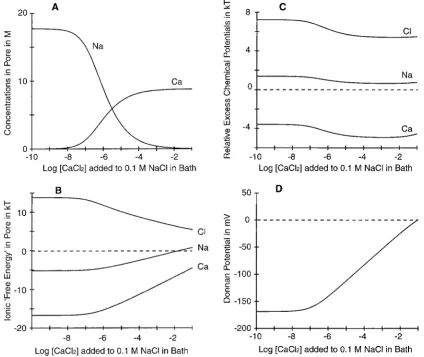
FIGURE 2 Ca2⫹, Na⫹, and Cl⫺selectivities in the hypothesized filter. In a simulated experiment, CaCl2is added to the 0.1 M NaCl solution so the bath
Ca2⫹concentration is varied from 10⫺10to 10⫺1M while NaCl remains at 10⫺1M. The selectivity filter is described using the standard pore of Fig. 1 A and the dielectric coefficient is assigned the value of 63.5. (A) Ionic concentrations in the selectivity filter. As bath Ca2⫹is increased to micromolar concentrations, Na⫹is replaced by Ca2⫹in the selectivity filter. The replacement is half complete at 1M bath Ca2⫹(the dielectric coefficient was chosen to match this apparent dissociation constant). In this graph, the Cl⫺curve is indistinguishable from the baseline. (B) Free energies of partitioning⌬Gifor
Ca2⫹, Na⫹, and Cl⫺vary as the ionic compositions in the bath (and hence the selectivity filter) are varied.⌬Gi⫽i
ex⫺
0, i
ex⫹z
ie0⌿, where i identifies
The potential from the mth iteration thus is changed by an amount proportional to the remaining deviation from electroneutrality, but the size of the change is controlled by the ratio of the deviation from electroneutrality to the ionic strength in the selectivity filter; 6. If兩⌬⌿兩⬎eps, the iteration is done again from step 3 above. Otherwise,
the calculation is stopped; eps is a convergence criterion, typically 10⫺8.
Solving the MSA
The solution of the MSA is given by a set of algebraic equations, but involves one iterative loop to determine the screening parameter⌫. We use a simple iteration with m as the index. The MSA equations used for the selectivity filter have been defined above.
1. Set the screening parameter⌫to an initial value⌫(m⫽0)⫽/2; 2. Compute a new estimate⌫(m⫹1) for the screening parameter from Eq.
7 using the previous estimate ⌫(m) on the right-hand side of the equation;
3. Apply a convergence criterion: if兩⌫(m⫹1)⫺ ⌫(m)兩/⌫(m)⬎eps, where eps⫽10⫺8, reiterate from step 2; otherwise proceed to step 4; 4. Compute the electrostatic part of the excess chemical potentials from
Eq. 16. Compute the excluded volume part of the excess chemical potentials from Eq. 19. Combine the electrostatic and excluded volume parts to compute the total excess chemical potentials by Eq. 12.
The MSA was solved for both the bath and selectivity filter. The computation for the filter used fixed ionic diameters and a permittivity that was supplied as an external parameter. Selectivity oxygens were assigned the partial charge (valence)⫺1
2e0. Crystal diameters (in nm) are given in Table 1.
The computation for the baths used concentration-dependent ionic di-ameters and a concentration-dependent permittivity. The didi-ameters and permittivity were calculated as described by Simonin et al. (1996) and Simonin (1997) using coefficients from Table 2 of Simonin, 1997. The concentration dependence of these parameters adds additional terms in the excess chemical potentials, beyond those given in Eqs. 16 and 19. The full expressions used for bath calculations are found in Simonin, 1997 (his equations 1 and 4).
RESULTS
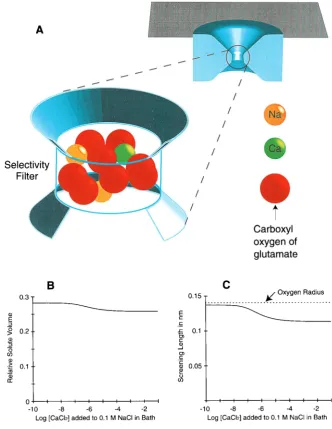
Fig. 1 A shows our image of the hypothesized selectivity filter, i.e., binding site, 0.5 nm long and⬃1 nm in diameter. The filter is formed by the narrowest constriction of a transmembrane pore, and more than 1⁄4 of its volume is
filled by oxygen ions and their counterions (Fig. 1 B). These oxygens are thought to belong to the four glutamate residues of the EEEE locus and are held in the filter by their tethers, that is, by the covalently linked atoms of the acid side and main chains. The tethers only act to localize the selectivity oxygens in this model. The oxygens and conducted ions in the selectivity filter behave like a concentrated (10 –20 M)
ionic solution on the biologically relevant time scale (⬎1s). The tethers do not add to the free energy of ion binding in any other way in this model. The ions in the filter are assigned crystal diameters (Table 1) and are drawn to scale. The oxygen ions are given the diameter of water oxygens as determined in hydration shells of ions (0.278 nm; Table 1). Each oxygen carries a charge of⫺12e0. Water
molecules in the filter and solutions outside the filter are not shown in the sketch. A volume of physiological bath solu-tion (⬃0.1 M), equal to the volume of the filter, contains ⬃12 water molecules. The MSA screening radius computed for the concentrated solution in the filter is less than the oxygen radius (Fig. 1 C).
Ca2⫹binding in L-type calcium channels is inferred from measurements of the current or conductance of the mem-branes of whole cells or of membrane patches containing a single channel. The channel bathed in a pure NaCl solution has a large conductance, and adding CaCl2to one or both
baths reduces the (time or population) average of conduc-tance approximately as described by a first-order isotherm (Kostyuk et al., 1983; Almers et al., 1984). At ⬃1 M external Ca2⫹, current between⫺20 to 0 mV is reduced to half its maximal value. The isotherm is thought to reflect the entry of Ca2⫹into the selectivity filter. Current or conduc-tance is reduced because Ca2⫹ is less mobile than Na⫹. Following this lead, we assume that the selectivity filter holds equal charges (not amounts) of Na⫹and Ca2⫹when it is at the midpoint of the current isotherm. We choose values of the filter volume and dielectric coefficient that produce equal amounts of charge at the midpoint of the isotherm. The filter volume usually had the dimensions shown in Fig. 1 A, 0.5 nm long and ⬃1 nm in diameter (volume 0.375 nm3), and the theory was calibrated to data by adjusting only the dielectric coefficient, which is 63.5 for the volume 0.375 nm3.
This paper focuses on the competition among alkali and alkali earth ions, and the anion Cl⫺, and is restricted to the roles of electrostatic screening and excluded volume effects in this competition. The chemical binding of protons to carboxylate ions, which results in conduction block, is not included in the present description. Thus, all computations apply to low proton concentrations (pH⬎ 9).
Fig. 2 A shows the filter concentrations of Na⫹and Ca2⫹ computed for an experiment in which CaCl2is added to a
[image:7.605.52.294.639.672.2]0.1 M NaCl bath solution. Ca2⫹replaces Na⫹as the coun-terion in the filter as Ca2⫹is added to the bath. The theory predicts exchange isotherms with a midpoint at 1M bath Ca2⫹ when the dielectric coefficient is set to 63.5 and the volume of the filter is 0.375 nm3. This result shows that electrostatics and core-core repulsion can produce selective binding of Ca2⫹and Na⫹that varies with concentration like that in a real Ca2⫹ channel. We will show below that the model produces a wide range of selectivities if we assign different values to the filter volume or dielectric coefficient.
TABLE 1 Ionic diameters
Li⫹ Na⫹ K⫹ Rb⫹ Cs⫹ Mg2⫹ Ca2⫹ Ba2⫹ Cl⫺ O⫺1/2
0.148 0.204 0.276 0.298 0.340 0.144 0.200 0.272 0.362 0.278
The isotherms in Fig. 2 A have slopes smaller than in a first-order hyperbola because the free enthalpy of partition-ing varies with the bath concentration of Ca2⫹(Fig. 2 B). As
Ca2⫹is increased, selectivity is reduced, mostly because of
changes in the long-range electrical (Donnan) potential be-tween the filter and bath compartments (Fig. 2 D). Differ-ences in the binding of different ions are reduced.
The concentration of Ca2⫹in the bath has little effect on
the other, local components of the free energy: the filter-bath differences in excess chemical potentials for each ion are approximately independent of bath concentration (Fig. 2 C). The Donnan potential and approximately constant differences of excess chemical potentials of cations com-puted using MSA theory are in good agreement with pre-vious empirical estimates obtained from a PNP model of the L-type calcium channel (Nonner and Eisenberg, 1998). The MSA computation also gives an estimate of the excess chemical potential for Cl⫺(Fig. 2 C); this potential is more repulsive than was postulated previously.
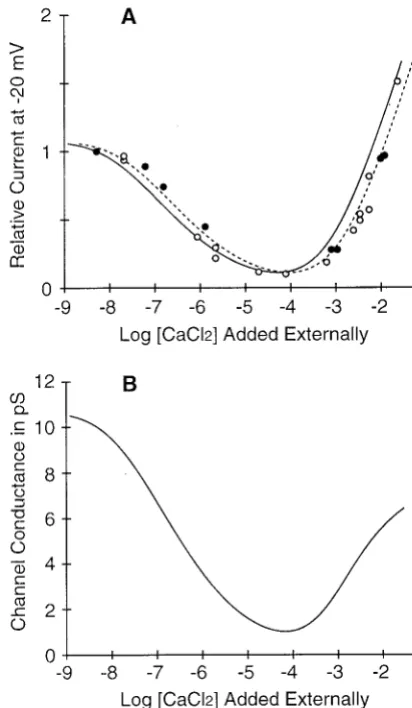
The Ca2⫹-dependent reduction of Na⫹ current through Ca2⫹ channels has been previously described by a first-order isotherm (Kostyuk et al., 1983; Almers and McCles-key, 1984; Almers et al., 1994), so it is interesting to see if the experimental observations are compatible with the dif-ferent kind of isotherm that we compute. Fig. 3 A replots the data of Almers and McCleskey (1984, their Fig. 11) to-gether with a theoretical curve (solid line) computed from a Poisson-Nernst-Planck model (PNP2) of the Ca2⫹channel (Nonner and Eisenberg, 1998; see also legend to Fig. 3), usually called the self-consistent drift-diffusion equations in physical chemistry (Newman, 1991) and semiconductor physics (Ashcroft and Mermin, 1976; Hess, 2000).
PNP2 describes the flux of ions produced by the mean electrochemical gradient, including the mean electric field computed from all the charges in the system.
The PNP2 theory of the Ca2⫹ channel involves a
long-range (Donnan) potential similar to that computed in the present work (Figs. 2 and 4 A of Nonner and Eisenberg, 1998), and thus variable free energies of ion binding. The excess chemical potentials assigned to individual ions in the PNP2 model (their Table 1: 4 carboxyls) are constants, however, whereas they are variables in the MSA theory of the present paper. The numerical values of these constants in the PNP2 model are similar to the approximately constant excess chemical potential produced by the MSA theory (see our Fig. 2 B). Therefore, the PNP2 model produces the same kind of binding curves as we find here using MSA theory. A summary of theoretical binding curves has been pub-lished by Dang and McCleskey (1998, their Fig. 1) for three chemical-kinetic models that involve first-order binding with fixed free enthalpies. Fig. 4 A of the present paper shows the curve computed from our PNP2 model superim-posed on the experimental points of Almers and McCleskey (1984). The curve computed from PNP2 theory follows the data more accurately than those of the kinetic models,
[image:8.605.325.531.60.414.2]although this curve was not obtained by a fit of the shown data: the model was calibrated using idealized measure-ments on single Ca2⫹channels as described in Nonner and Eisenberg (1998). A small horizontal shift of the predicted curve (dashed line) is enough to fit these specific data.
Chemical kinetic descriptions of the Ca2⫹channel in fact have two binding affinities for Ca2⫹. In addition to high-affinity Ca2⫹ binding (kD ⬃ 1 M), a domain of low-affinity Ca2⫹ binding (kD⬃ 10 mM) was introduced into these models to predict an increase of current observed when the bath Ca2⫹ reaches millimolar concentrations (Almers and McCleskey, 1984; Hess et al., 1986). Because the current reaches a minimum near 10⫺4M Ca2⫹, this has been called an anomalous mole fraction effect, AMFE. Our PNP2 computations reproduce the experimental AMFE of current (Fig. 3 A) and predict an AMFE of conductance (Fig. 3 B), as well. This AMFE is produced by depletion of Ca2⫹ in the microscopic boundary layers at the filter/bath interfaces (Nonner and Eisenberg, 1998) and does not in-volve a separate low-affinity binding site. Instead, these small zones of low-affinity binding arise necessarily at the edges of an otherwise uniform filter region.
[image:9.605.319.511.62.238.2]Selectivity involves both electrostatic and excluded volume effects
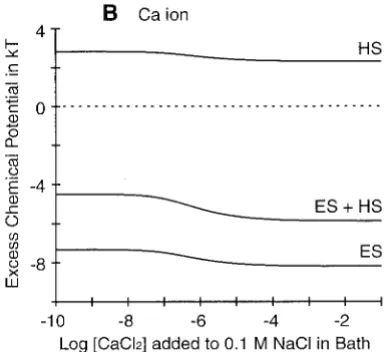
Fig. 4 shows how electrostatic screening (ES) and excluded volume effects among hard spheres (HS) contribute to the individual excess chemical potentials in the hypothesized filter. The repulsive HS contributions are nearly identical for Na⫹ and Ca2⫹ because of their similar diameters. The charges on Na⫹ and Ca2⫹are different, so their ES contri-butions are different enough to produce a substantial differ-ence in the overall excess chemical potential and binding. The overall excess chemical potential for Na⫹is dominated by HS repulsion and thus is mildly repulsive. The overall excess chemical potential for Ca2⫹is dominated by the ES contribution, and thus attractive. The difference in the total excess chemical potential for Ca2⫹and Na⫹represents the
[image:9.605.92.287.63.444.2]chemically specific properties of the system. These arise
entirely from the interplay of electrostatics and core-core repulsion.
The origin of the different ES contributions for Na⫹and Ca2⫹can be traced through the MSA equations. The elec-trostatic (ES) component of the individual excess chemical potentials depends on the square of the valency and the ionic diameter, e.g., Eq. 16. The electrostatic component of the excess chemical potential for Ca2⫹ is about four times that for Na⫹ (Fig. 4, A and B), given that these ions have about the same diameter. When ions have different diame-ters, electrostatic selection also involves the ionic diameter (see Fig. 6). The hard-sphere (HS) contribution to the excess chemical potentials increases superlinearly with ionic den-sity (Eq. 19), and becomes substantial when ⬎1/4 of the space is filled by the ions, as in our system (Fig. 1 B). Thus, replacing 4 Na⫹ by 2 Ca2⫹ substantially reduces the ex-cluded volume, changing the core-core repulsion and the HS
free energy of the filter (also see the curve ⫺T⌬SHS in Fig. 9 A).
Selectivities for other ions
It is interesting to see what predictions are made for other selectivities after our model has been tuned to give an appropriate Ca2⫹/Na⫹ selectivity. We predict selectivities using independently known crystal diameters of ions, so no adjustable parameters are involved. Figs. 5 and 6 give computations for alkali and alkali earth ions.
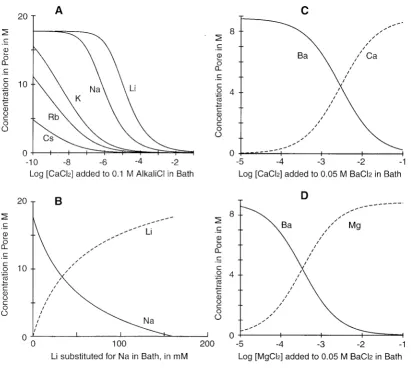
Fig. 5 A plots the concentrations of alkali metal cations at various concentrations of Ca2⫹in the bath. As the Ca2⫹in the bath is changed, the concentrations of the alkali metal ions in the selectivity filter change differently depending on the alkali ion present. Selectivity is seen. Indeed, the
vari-FIGURE 5 Predicted selectivities of alkali ions and Ba2⫹. (A) Replacement of alkali cations by Ca2⫹added as CaCl2to 0.1 M alkali Cl⫺in bath. (B)
Replacement of Na⫹by Li⫹by varying the mole fraction of Li⫹in 0.16 M sodium/lithium mixtures in the bath. (C) Replacement of Ba2⫹by Ca2⫹added as CaCl2to 50 mM BaCl2in the bath. (D) Replacement of Ba2⫹by Mg2⫹added as MgCl2to 50 mM BaCl2in the bath. Note that these computations do
[image:10.605.99.511.291.660.2]ations predicted in Fig. 5 A seem larger than those that have been observed in experiments. The binding curves imply a striking reduction of Cs⫹and K⫹currents by very low Ca2⫹ that seems to disagree with experimental finding of large Cs⫹ or K⫹ currents in the presence of Ca2⫹ chelators (Pietrobon et al., 1989). However, the experimentally found block of Li⫹ inward current occurs at a few micromolar Ca2⫹, which is less than predicted. [The Ca2⫹concentration needed depends on the direction of current and the side of calcium application (Kuo and Hess, 1993)]. These experi-mental observations were made using Ca2⫹ chelators to establish the desired low bath concentrations of Ca2⫹in the presence of a large background concentration of monova-lent salt. Their buffered solutions were designed using bind-ing constants that were adjusted for ionic strength, but not for the concentrations of specific alkali metal ions. If these chelators (which involve four carboxylate groups, like the EEEE locus) themselves are selective with respect to alkali cations, the above experiments would be sensitive only to differences between the cation selectivities of the Ca2⫹ channel and of the chelators of the Ca2⫹buffer.
Ca2⫹ chelation typically involves several carboxylate groups that are tethered together into one molecule. Our MSA computations show how such chelators can have a high Ca2⫹ affinity, and they suggest that an attached flu-orophore could function as a Ca2⫹indicator if it senses and reports the long-range electric field that emanates from the carboxylate/Ca2⫹mixture nearby. We imagine that the long-range electric field in the fluorophore varies with the concen-tration of free Ca2⫹in the solution, much as does the electric field of the selectivity filter shown in Fig. 2 D. The aromatic rings of the fluorophore (of the chelator) extend through much of that field and their absorption or fluorescence would change as the field changes.
Other observations made on ionic competition in Ca2⫹ channels do not depend on the accuracy of buffered Ca2⫹
concentrations. Prod’hom et al. (1989, their Fig. 5) mea-sured single-channel conductance in mixtures of Na⫹ and Li⫹. The mixture of 20 mM Li⫹and 140 mM Na⫹gave a conductance about halfway between the conductances in pure Li⫹or Na⫹solutions. Fig. 5 B plots the concentrations of Na⫹ and Li⫹ in the hypothesized filter, computed for these ionic conditions. The midpoint of the “replacement curve” is at ⬃30 mM Li⫹, in good agreement with the observation. Lansman et al. (1986, their Fig. 8) measured currents in the presence of 50 mM Ba2⫹ while adding a varied concentration of Ca2⫹. The transition between the current levels observed in pure solutions is half complete at ⬃3 mM Ca2⫹. The simulated filter concentrations for Ba2⫹ and Ca2⫹ (Fig. 5 C) are in good agreement with their experimental findings.
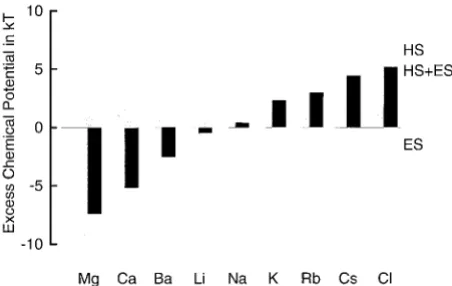
Fig. 6 summarizes how selective binding to various ions arises in the hypothesized filter. For each species, the ex-cluded volume HS and electrostatic ES contributions are shown by shaded columns, and the net excess chemical poten-tials are shown as a superimposed solid column. Note that these potentials were computed for a filter containing mostly Ca2⫹ as the counterion of the oxygen ions, as one would expect under physiological conditions. These potentials would be quite different if other ions were in the filter, because the potentials depend on the composition of the entire system.
Negative (i.e., attractive) excess chemical potentials arise for the divalent cations, Ca2⫹and Ba2⫹, and for the mono-valent cation Li⫹. The repulsive excluded volume terms of these three ions are not as large as the strong electrostatic terms because of their double valency and/or small ionic diameter. Alkali metal cations larger than Li⫹have positive (repulsive) excess chemical potentials due to their smaller electrostatic and larger excluded volume effects.
Specificity of Ca2⫹over Mg2⫹is important for calcium
channels and other calcium-selective proteins because their Ca2⫹-dependent functions are performed in the presence of
millimolar concentrations of Mg2⫹. In L-type calcium
chan-nels, 10 mM external Mg2⫹ half-blocks Ba2⫹ inward
cur-rents in the presence of 50 mM external Ba2⫹, and 3M
external Mg2⫹
blocks Li⫹ inward currents in 300 mM external Li⫹ (Kuo and Hess, 1993). These observations suggest that the affinity of the channel for Mg2⫹is slightly less than for Ca2⫹. When we simulate such experiments using the crystal diameter of Mg2⫹, half-saturation concen-trations for Mg2⫹ are predicted to be smaller by an order of magnitude than those for Ca2⫹. A more appropriate Mg2⫹ selectivity would be obtained using an effective Mg2⫹ diam-eter of⬃0.25 nm rather than the crystal diameter of 0.144 nm. This anomaly with regard to Mg2⫹will be discussed below.
[image:11.605.61.287.59.202.2]Conduction in L-type calcium channels is blocked by very low concentrations of some transition metal cations, such as Cd2⫹. About 10M external Cd2⫹blocks half of the inward currents supported by 50 mM external Ba2⫹ (Lansman et al., 1986), and⬃1 nM Cd2⫹blocks currents in the presence of 0.1 M Li⫹(Ellinor et al., 1995). Cd2⫹and
Ca2⫹have nearly the same crystal diameters. Thus, a 1000-fold higher binding affinity for Cd2⫹over Ca2⫹ cannot be accounted for in terms of the electrostatic and excluded volume interactions computed by the MSA, nor as a hydra-tion effect. About 7 kBT beyond the MSA figure are needed
to account for Cd2⫹ binding; such attractive effects likely involve strong dispersion or other quantum-mechanical co-ordination characteristic of transition metals like cadmium (Baes and Mesmer, 1976; Magini et al., 1988).
Selectivity over a range of oxygen ion densities and dielectric coefficients
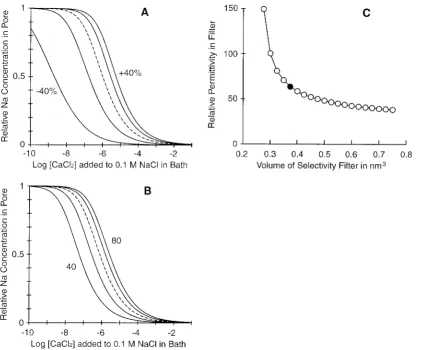
Fig. 7 A shows the effects of varying the volume of the selectivity filter from the reference value of 0.375 nm3. The
bath concentration of Ca2⫹ needed to displace half of the Na⫹is increased by⬃10-fold when the volume is increased by 40%; it is reduced more than a hundredfold when the filter volume is reduced by 40%. Fig. 7 B shows the effects of different dielectric coefficients (between 40 and 80). In the primitive MSA model, dielectric coefficients include hydration/solvation effects.
Fig. 7 C shows the values of the filter volumes and dielectric coefficients that combined give the observed mid-point of the Na/Ca replacement curve, 1M. For instance, a filter volume smaller than our 0.375 nm3can produce a
calcium/sodium replacement curve with midpoint at 1M bath Ca2⫹ if the dielectric coefficient is increased. The volume has to be within a certain range if the theory is to fit data. If the volume is increased twofold (and a lower
di-FIGURE 7 Effects on selectivity of (A) changes of filter volume or (B) changes of effective dielectric coefficient. The volume of the hypothetical selectivity filter is varied in steps of 20% from the reference value, 0.375 nm3(dashed curve). The dielectric coefficient is varied in steps of 10 between
40 and 80 (the dashed curve is for 60). The curves give the relative Na⫹concentration (with respect to the carboxyl concentration) remaining in the selectivity filter when CaCl2is added to 0.1 M NaCl in the bath. Small increases of the volume of the selectivity filter shift the calcium/sodium curve to
[image:12.605.98.522.271.622.2]electric coefficient 38 is chosen to allow fit to the replace-ment data), Cl⫺ is bound in the filter (Fig. 8 A) and thus would be conducted by the channel. Cl⫺can enter when the volume is large because hard-sphere repulsive effects are then reduced. The ions have more room. The reduced value of the dielectric coefficient required by the increased value of the volume (as specified in Fig. 7 C) strengthens electro-static attraction for all ions, leading also to a positive long-range potential (Fig. 8 B).
[image:13.605.94.510.187.611.2]However, reduction of the filter volume to 0.2 nm3 re-quires very large dielectric coefficients to fit the 1 M midpoint of the Na⫹/Ca2⫹replacement curve. If the dielec-tric coefficient is set to 80, the replacement midpoint is drastically shifted to lower bath Ca2⫹, and a complete Ca2⫹/Na⫹replacement requires many orders of magnitude of variation in bath Ca2⫹(Fig. 8, C and D), differing in both respects from the properties of the real channel. Cl⫺ repul-sion is enhanced under these conditions due to the strong
FIGURE 8 Effects of excessively large or small filter volumes. The oxygen ions are confined in filter volumes of 0.75 nm3(A and B) or 0.2 nm3(C and D), about twice or one-half the standard volume. If the effective dielectric coefficient is set to 38, the large filter volume (low density of selectivity oxygens)
excluded volume effects and a strong negative Donnan potential (Fig. 8 D).
DISCUSSION
The MSA model of specific ionic binding in Ca2⫹channels described here is remarkably simple. Long-range electro-static and excluded volume interactions among mobile ions and partially charged oxygens of carboxylate groups of the protein suffice to produce a range of selectivities, dependent on the volume density of oxygen ions and the dielectric conditions. This selectivity arises in a setting of minimal structure, where ions and tethered structural groups interact like molecules in a homogeneous solution without pre-ordained structure. The protein supplies only a volume, dielectric constant, and selectivity oxygens. Solvation is described implicitly in this model by the dielectric proper-ties assigned to the filter and bath solutions.
The hypothesized selectivity filter distinguishes between Na⫹and Ca2⫹by two effects: 1) divalent Ca2⫹screens the structural oxygen ions more effectively than monovalent Na⫹, and thus has a more negative (attractive) electrostatic potential there (Figs. 2, 4, and 9 A). 2) Four Na⫹ displace about twice the volume of two Ca2⫹, producing a repulsive excess potential for Na⫹(Fig. 1 B). With electroneutrality as a dominating constraint, the selectivity filter can use volume exclusion to distinguish ions of nearly the same diameter, such as Na⫹ and Ca2⫹, because equal charge
excludes different volumes depending on the valency of the mobile ion. In this way, electrostatics facilitates selection by
volume exclusion: substantial repulsion due to excluded volume selects against Na⫹(and other monovalent cations) compared to Ca2⫹(Fig. 6).
[image:14.605.60.287.53.558.2]The specific interactions inside the hypothesized filter are reflected in the long-range (Donnan) potential that extends from the filter into the baths. When Ca2⫹is present in the filter, the carboxylate ions are strongly screened and the long-range field is weak. When only Na⫹is available in the bulk solution, screening inside the filter is weaker and the long-range field is stronger. It is the long-range field that then attracts Na⫹or any other available cation into the filter when divalents are absent, and only monovalents are available to satisfy electroneutrality.
FIGURE 9 (A) Thermodynamic balance sheet of Ca2⫹selectivity. Curve
A shows the Helmholtz excess free energy of all the ions in the
hypothe-sized selectivity filter taken together, both the selectivity oxygens and the mobile species.⌬A has an electrostatic component⌬EES, and an entropic
contribution,⫺T⌬S. The entropy change is negative and arises from the
separation of co and counterions when electrostatic screening occurs (⫺T⌬SES) and from the mutual exclusion of ions that have a finite
hard-sphere diameter (⫺T⌬SHS). The entropic expense involved in electrostatic
screening is small compared to entropic effects resulting from volume exclusion. It is also small compared to the gain in electrostatic energy. The internal electrostatic energy term and the total entropic term are of opposite signs: electrostatic attraction is opposed by entropic repulsion of mobile ions. When Ca2⫹is replaced by Na⫹in the selectivity filter, both compo-nents of excess free energy change in the negative direction. The change in
The hypothesized filter selects also against anions such as Cl⫺ (Fig. 4 C). Experiments have shown that particles larger than Cl⫺ actually can pass through Ca2⫹ channels (McCleskey and Almers, 1985). MSA theory reveals that the rejection of Cl⫺is not a trivial consequence of negative structural charge. Surprisingly, the electrostatics of nega-tively charged groups alone cannot repel anions over the entire range of bath Ca2⫹. The stronger the electrostatics in the filter, the more Cl⫺is predicted to partition into the filter when CaCl2concentration is raised in the bath (Fig. 8 A).
The Ca2⫹/oxygen-ion mixture in the filter then attracts Ca2⫹by a low excess chemical potential and it attracts Cl⫺ by the resulting positive long-range (Donnan) potential (Fig. 8 B), much as the surface of a growing salt crystal attracts both cations and anions in equivalent amounts. Cl⫺ can be rejected only when excluded volume effects are substantial. Then, Cl⫺itself is repelled from the filter due to its large diameter, and a positive long-range potential cannot arise because local screening of the oxygen ions by Ca2⫹is reduced by excluded-volume interactions (compare Fig. 2). In the selectivity against Cl⫺, it is volume exclusion that facilitates selection by electrostatics, whereas in the selec-tivity against Na⫹, it is the electrostatics that facilitates selection by volume exclusion.
Parameters of the MSA model
With ions assigned fixed (crystal) diameters, affinities for physiological ions are chosen to fit experiment by adjusting the value of dielectric coefficient in the selectivity filter. The ionic density in the selectivity filter is determined by the fixed density of structural charge, and so the dielectric coefficient was assumed to be constant independent of bath composition. A second free parameter defines the unknown volume accessible to the tethered carboxylate oxygens in the filter. This volume also is taken as constant and thus unaffected by bath composition. The two free parameters have global roles in the model.
The filter volume sets ionic density and thus controls the strengths of both Coulombic and excluded volume effects. The dielectric coefficient independently scales the strength of electrostatic effects, and thus is able to balance attractive (electrostatic) against the repulsive (excluded volume) ef-fects. Experimental observations on Ca2⫹/Na⫹ and other selective ion/ion exchanges in calcium channels are de-scribed using reasonable settings of these global parameters (Figs. 2 A, 5 B and C). When comparing the selectivity filter of the theory with bulk solution, one should note that the MSA description of a 6 mol/l CaCl2 solution involves a
dielectric coefficient of 37.6 (Simonin, 1997), in line with experimental results in concentrated solutions (Barthel et al., 1995). Excluded volume effects in 6 mol/kg-H2O CaCl2
solution produce an experimental osmotic coefficient of 2.891 (Robinson and Stokes, 1959). We compute a value of ⬃6.65 for the osmotic coefficient of the 9 mol/l Ca2⫹
carboxylate solution that is the selectivity filter of our model.
The electrochemical potential consists of many compo-nents, for example, the Donnan electrical potential, the ideal chemical potential, the hard-sphere potential of uncharged spheres, and the excess electrostatic potential of the MSA, which in turn have entropy and energy components. Each component is different for each ion and may vary in differ-ent ways, as the concdiffer-entration of ions is changed in the bath. Thus, a large repertoire of behavior can arise in this simple
system, available to be exploited by evolution in biologi-cally useful ways. The selectivities described in this model
arise as a generic property of carboxylate/ion interactions. Such selectivities could have evolved in any system that has large ionic densities, large excluded-volume effects, and Coulombic interactions moderated by the dielectric. Evolu-tion could enforce and modulate selectivity simply by set-ting the filter volume and effective dielectric constant and volume of the selectivity filter.
Excluded volume effects arise here chiefly from the teth-ered carboxylate groups, which we have represented as two separate oxygen atoms with a charge of⫺1/2 each. While electrostatics thus might be described quite well (with in-tercarboxylic oxygen distances approaching intracarboxylic distance), we might expect to underestimate excluded-vol-ume effects of the rather bulky side chains of glutamate residues. We also may have ignored excluded-volume con-tributions from other uncharged side chains in the pore, or ionic packing restricted by confinement. To the extent that such conditions exist in the real pore, our model requires larger than actual densities of groups (a smaller volume), with the side effect that electrostatics are overestimated. Model optimization would yield a larger than actual dielec-tric coefficient (see Fig. 7 C). However, it must be remem-bered that the dielectric coefficient in our primitive MSA description is an effective parameter that concatenates at least two physical effects, one the change in solvation energy associated with moving an ion from the bath to the filter, and the other the attenuation of electrostatic interac-tions in a medium containing induced (i.e., dielectric) charge. These two contributions to the electrostatic energy are of opposite sign; their difference seems to be important in determining the net effect on selectivity, and so an explicit treatment of solvation in the solution and in the filter will be needed before the value of the local dielectric coefficient can be reliably estimated.
ionic affinities increase with decreasing ionic diameter for divalent and trivalent cations, but the smallest ion studied in each group, Mg2⫹ and Sc3⫹, break the trend (Drake et al., 1997). Low Mg2⫹affinity thus appears generic for carboxy-late-based binding sites. It seems plausible that oxygens in tethered carboxylate groups are sterically more impeded in screening a very small ion than are the oxygens of bulk water.
Thermodynamics of the selectivity filter
Fig. 9 A plots the Helmholtz excess free energy and its components, computed for the ensemble of our standard model as it undergoes Ca2⫹/Na⫹exchange. The excess free energy (curve⌬A) is positive when the filter contains Na⫹, and turns negative as Ca2⫹enters. Both entropic (T⌬S) and
energy (⌬EES) contributions to the free energy vary sub-stantially under these conditions, both favoring the entry of Ca2⫹. The entropic contribution involves the hard-sphere effect (T⌬SHS) and a small term related to creating the ionic screening arrangements in a real solution (T⌬SES).
T⌬SES is the energetic cost of screening arrangements that form spontaneously, and it is this term that is expected to be reduced if, e.g., carboxylate ions had been positioned in a specific spatial structure for optimal interaction with Ca2⫹. Both the electrostatic energy gained in screening as well as the repulsive excluded-volume work are substan-tially larger than the entropic work involved in screening. Spontaneous “coordination” as modeled here can underlie a range of selectivities, including those of Ca2⫹ channels (Fig. 7, A and B). Our computations thus do not support the notion that a specific three-dimensional atomic structure is crucial for selectivity in Ca2⫹channels.
Although crystallographic structures of Ca2⫹ channels are currently unavailable, Ca2⫹-binding motifs of other proteins have been resolved. Typically, they involve a cen-tral Ca2⫹in contact with seven oxygen atoms of carboxylate and other groups (e.g., the motif of galactose-binding pro-tein, Vyas et al., 1987), but there appears to be substantial variability in the conformations and organizations of EF-hand sites (Nelson and Chazin, 1998). It is not clear to what extent these three-dimensional structures, which apply to crystallographic temperatures, relate to physiological func-tion. MSA theory can estimate temperature dependency of ion binding (Blum and Rosenfeld, 1991). Even if filter volume and dielectric coefficient are assumed to be constant, the theoretical screening radii are reduced to⬃0.08 nm at 100 K, so a Ca2⫹charge is screened by a virtual sphere of coun-tercharge only ⬃0.18 nm in radius. Crystallographic Ca2⫹ -oxygen distances average 0.241 nm and water is essentially excluded from the complex (Vyas et al., 1987). Our MSA computations reveal substantial changes in binding character-istics. Cooling calcium channels to 100 K is predicted to increase Ca2⫹/Na⫹ selectivity 104-fold (Fig. 9 B). Low tem-perature enhances attractive effects due to electrostatic energy,
but does not affect repulsion by the entropic excluded-volume effects. Thus, it has a large net effect on binding.
Substantial excluded volume effects in a molecular pore raise the question of mechanical stability. An upper limit for the force exerted on the channel wall is given by the osmotic pressure that the filter contents would produce in a classical macroscopic Donnan system (Fig. 9 C). This pressure is very large. When the contents of the selectivity filter change, e.g., when Na⫹is replaced by Ca2⫹, osmotic pres-sure also changes substantially. The prespres-sure of 400 MPa corresponds to a force of 200 pN in the wall of pore of the dimensions given in Fig. 1 A, and this force varies by⬃50 pN when Na⫹is exchanged for Ca2⫹. The force would be substantially larger with a large counterion (such as Cs⫹), so it is conceivable that the pore dimensions increase under such ionic conditions. Mechanical forces of this kind might underlie Ca2⫹-induced conformational changes in calcium-regulated proteins, but the mechanical energy terms are necessarily ignored until a theory of the inhomogeneous system, e.g., Density Functional Theory (Rosenfeld and Blum, 1986; Henderson, 1992; Frink and Salinger, 1999), is developed, along with estimates of the electromechanical properties of channel and other proteins.
We are deeply indebted to Professor Lesser Blum, who has spent innu-merable hours and much effort teaching us the MSA. It is a pleasure to thank Karl Magleby for his advice and support and to thank him, Ellen Barrett, Gavriel David, and Tom DeCoursey for their critical reading of the manuscript. We are grateful to a referee for significant support and useful suggestions.
This work was supported by National Institutes of Health Grant GM30377 (to W.N.) and Defense Advanced Research Projects Agency Grant N65236-98-1-5409 (to B.E.).
REFERENCES
Almers, W., and E. W. McCleskey. 1984. Non-selective conductance in calcium channels of frog muscle: calcium selectivity in a single-file pore. J. Physiol. 353:585– 608.
Almers, W., E. W. McCleskey, and P. T. Palade. 1984. Non-selective cation conductance in frog muscle membrane blocked by micromolar external calcium ions. J. Physiol. 353:565–583.
Armstrong, C. M. 1989. Reflections on selectivity. In Membrane Transport: People and Ideas. D. C. Tosteson, editor. American Physio-logical Society and Oxford University Press, New York.
Ashcroft, N. W., and N. D. Mermin. 1976. Solid State Physics. Harcourt Brace College Publishers, New York.
Baes, C. F., Jr., and R. E. Mesmer. 1976. The Hydrolysis of Cations. Wiley, New York.
Barthel, J., R. Buchner, and M. Mu¨nsterer. 1995. Electrolyte Data Collec-tion Vol. 12, Part 2: Dielectric Properties of Water and Aqueous Elec-trolyte Solutions. DECHEMA, Frankfurt am Main, Germany. Bernard, O., and L. Blum. 1996. Binding mean spherical approximation for
pairing ions: an exponential approximation and thermodynamics.
J. Chem. Phys. 104:4746 – 4754.
Berry, S. R., S. A. Rice, and J. Ross. 1980. Physical Chemistry. John Wiley & Sons, New York.