Shuhei Morinaga, Hidenori Ohta, and Mario Nakamori
Abstract—The circle-packing problem is a problem of pack-ing circles into a two dimensional area such that none of them overlap with each other. The authors have proposed SPC (Sequence-pair for circle packing), a method of representing relative location of circle pairs, which is an extended version of sequence-pair for rectangles. The authors have proposed also a method of obtaining an approximate solution of the circle-packing problem, where all constraints are replaced by approximate linear inequalities. This method does not always give an optimal solution; sometimes the solution obtained is even infeasible. In the present paper, we propose a new method using nonlinear programming.
Index Terms—circle-packing, Sequence-pair, linear program, nonlinear program
I. INTRODUCTION
T
HE circle-packing problem is a problem of packing circles into a two dimensional area such that none of them overlap with each other. This problem is NP-hard and has a wide variety of application, e.g., fiber packing in a tube or transportation of pipes by a ship, since they are equivalent to the problem of packing rigid cylinders.One idea of solving the circle-packing problem is to formulate the problem as a nonlinear programming problem and solve it by some nonlinear optimization solver. This is an ideal method, because it assures the exact optimal solution especially if the given circles are of the same size [1]. If the sizes of the circles are not the same, however, the constraints are often very complex, and obtaining the optimal solution in practical computational time is almost impossible [5].
Thus, it is widely considered to be practical to obtain a quasi-optimal solution rather than the exact optimal solution for the case that the sizes of the circles are not the same. Most of the existing methods are based on heuristic search that locates circles sequentially; some of them are followed by relocation via beam search or simulated annealing [2], [3], [4], [5].
Each of the above methods, however, has its own diffi-culty; some of them are only applicable to the case that the area the circles are to be packed into has a special shape; some of them require different search technique according as the shape of the area. Also, most of the above methods search
Shuhei Morinaga is a graduate student at Tokyo University of Agriculture and Technology , 2-24-16 Naka-cho, Koganei-shi, Tokyo 184-8588 Japan e-mail: ([email protected]).
Hidenori Ohta is an assistant professor at Tokyo University of Agriculture and Technology , 2-24-16 Naka-cho, Koganei-shi, Tokyo 184-8588 Japan e-mail: ([email protected]).
Mario Nakamori is a professor at Tokyo University of Agriculture and Technology , 2-24-16 Naka-cho, Koganei-shi, Tokyo 184-8588 Japan e-mail: ([email protected]).
in a restricted neighbor. In addition, there exist unsearchable location of circles. These facts mean above methods cannot assure global optimization.
Apart from the circle-packing problem, many promising algorithms have been proposed for the rectangle packing problem. There are two main streams in the existing rectangle packing algorithms; locating sequentially rectangles and lo-cating via relative position. The boundary method [6] belongs to the former, whereas the Sequence-pair method [7] belongs to the latter.
It is a natural extension to apply these methods to the circle-packing problem. As previously mentioned, most of the existing methods of the circle packing are based on sequentially locating. That is, these methods are classified into the extension of the boundary method, which cause the above difficulties.
To avoid the difficulties, we can use relative position for the circle packing problem rather than sequential locating. The authors proposed SPC (Sequence-pair for circle packing) [8], a method of representing relative location of circle pairs, which is an extended version of sequence-pair for rectangles. SPC can represent any location of circles and does not require any special search technique if the shape of the area is convex. The authors proposed also a method of obtaining an approximate solution of the circle-packing problem, where all constraints are replaced by approximate linear inequalities. This method, however, does not always give an optimal solution; sometimes the solution obtained is even infeasible.
Hence, in the present paper, we examine and improve the method in our former research [8]. We first propose a method of obtaining an exact optimal solution of the circle-packing problem by a nonlinear optimization technique using the SPC code. We also compare several approximation methods and investigate more efficient search. Thus we show that our search method gives an exact optimal solution.
This paper constitute as follows: in section 2 we introduce SPC for circle representation; in section 3 we propose an algorithm using nonlinear optimization to obtain dense packing solution from SPC code; in section 4 we report the computational result; in section 5 we conclude and discuss the related topics.
II. REPRESENTATION OF CIRCLES BYSPCAND CIRCLE PACKING BY LINEAR APPROXIMATION
(a) (b)
Fig. 1. Grid representation and location of circles corresponding SPC (132456; 214635)
√
(xa−xb)2+ (ya−yb)2≥(ra+rb). (1)
In order to represent relative location of circle pairs by two sequences of circle names, we adopt SPC (Sequence-pair for circle packing). We denote an SPC as(Γ+,Γ−), where Γ+
andΓ− are sequences of circles. Given an SPC, the relative location of circles are determined as follows:
• If two circles appear in the same order in Γ+
and Γ−, i.e., both Γ+ and Γ− are of the form (. . . , a, . . . , b, . . .;. . . , a, . . . , b, . . .), then centers of cir-cles aandbsatisfy
xa≤xb, (2)
ya≤yb. (3)
• If two circles appear in the opposite order in Γ+
and Γ−, i.e., both Γ+ and Γ− are of the form (. . . , a, . . . , b, . . .;. . . , b, . . . , a, . . .)then centers of cir-cles aandbsatisfy
xa≤xb, (4)
ya≥yb. (5)
It is possible to transform the relative location among circles by the above Γ+ and Γ− to a grid representation
in the same way to synthesize the relative location among rectangles in sequence-pair representation through oblique grid [7]. A grid representation of SPC is a rotated form by 45 degrees clockwise of the oblique grid for a sequence-pair. An example of the grid representation for an SPC (132456; 214635) is shown in Fig.1(a).
Suppose a vertexain the grid representation is the origin of x and y axes. Then centers of circles corresponding to vertices in the first (second, third, or fourth) quadrant are in up-right (up-left, down-left, or down-right, respectively) of the center of the circle a. Thus, from Fig.1(a), we can see that the centers of circles 5 and 6 are up-right, the center of circle 3 is up-left, and the centers of circles 1 and 2 are down-left of circle 4.
SPC can represent any location of circles. In a simi-lar way as sequence-pair we can obtain from any SPC the corresponding consistent constraints of relative location among circles. Unlike sequence-pair, however, we have to make elaborate computation of mathematical optimization in order to obtain the most dense location of circles, since x and y direction of the constraints of relative location corresponding to an SPC. Especially the constraint (1) that prevents overlapping of circles is nonlinear, our problem
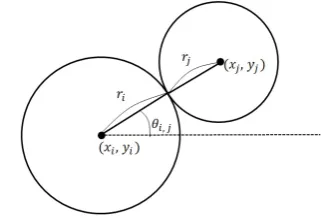
Fig. 2. Angleθi,j: the angle of the line passing through the centers of the circlesi,j
of obtaining the most dense location of circles is that of nonlinear optimization. Fig. 1(b) shows the most dense location of circles corresponding SPC (132456; 214635).
A. Linear approximation of constraints
Since we are going to search the optimal location of circles by simulated annealing as is often done for Sequence-pair, we have to decode SPC as quick as possible. Thus, we obtain an approximate optimal location corresponding the given SPC by linear programing solver by expressing constraints with linear inequality.
Let us denote byθi,j the angle of the line passing through the centers of circlesiadjand thexaxis, as shown in Fig. 2. Using this notation, we can translate constraints (2), (3), (4), and (5) with (1) as
(ra+rb) cos(θa,b)≥xb−xa, (6)
(ra+rb) sin(θa,b)≥yb−ya. (7)
Note that if circles a and b appear in the same order in
Γ+ and Γ−, i.e., (. . . , a, . . . , b, . . .;. . . , a, . . . , b, . . .), then 0≤θa,b≤ π2; if circlesa andb appear in the reverse order
inΓ+andΓ−, i.e.,(. . . , a, . . . , b, . . .;. . . , b, . . . , a, . . .), then
−π
2 ≤θa,b≤0.
Now we approximate trigonometric function by piecewise linear function in order to apply linear programming. The idea is as follows. Letθ1 satisfy 0≤θ≤π2.
1) When 0 ≤ θ ≤ θ1, we replace sinθ by following
equation (8).
f1(θ) =α1·θ+β, (8)
2) When θ1 < θ ≤ π2, we replace sinθ by following
equation (9).
f2(θ) =α2·θ+β2. (9)
Fig.3 shows an instance of approximation of sinθ with θ1=π4.
In order to select appropriate approximation we introduce a 0-1 variable. For example, the above (8) and (9) are expressed as
M ·P+θ−θ1≥0,
M·(1−P) +f1(θ)−α1·θ−β1≥0,
M·(1−P)−f1(θ) +α1·θ+β1≥0,
M·(P−1) +θ1−θ≥0,
M ·P+f2(θ)−α2·θ−β2≥0,
[image:2.595.51.293.53.161.2]Fig. 3. Linear approximation ofsinθ
Fig. 4. The case that constraints for the pair of circlesα, γare not necessary
whereP = 1implies 0≤θ≤θ1, andP = 0implies θ1<
θ≤ π2. Also, M is a sufficiently large number. In the same way we can approximatecosθas linear constraints. If we use more 0-1 variables, we can approximate nonlinear function by linear constraints with the range of variable into more than two subsets, to obtain more accurate approximation.
In the present paper we call the way of dividing uniformly the range of variable asmdivision. When the numbermof division grows, the approximation will be more accurate, but at the same time the number of constraints becomes large and computational time required grows larger.
B. Elimination of redundant constraints
When for three circles α, β, and γ such that SPC
(. . . , α, . . . , β, . . . , γ;. . . , α, . . . , β, . . . , γ, . . .) or SPC
(. . . , α, . . . , β, . . . , γ;. . . , γ, . . . , β, . . . , α, . . .)satisfies
rα+rγ≤
√
(rα+rβ)2+ (rβ+rγ)2,
then constraints for the pair of circlesα, γare not necessary, because these constraints are transitive result of those for the pair of circlesα, β and those for the pair of circlesβ, γ. Therefore, we can eliminate these redundant constraints to make the computational time short.
III. CIRCLE PACKING INSPCBY NONLINEAR OPTIMIZATION
[image:3.595.307.539.56.389.2]The authors proposed a quick method of obtaining an approximate optimal solution of the circle-packing problem,
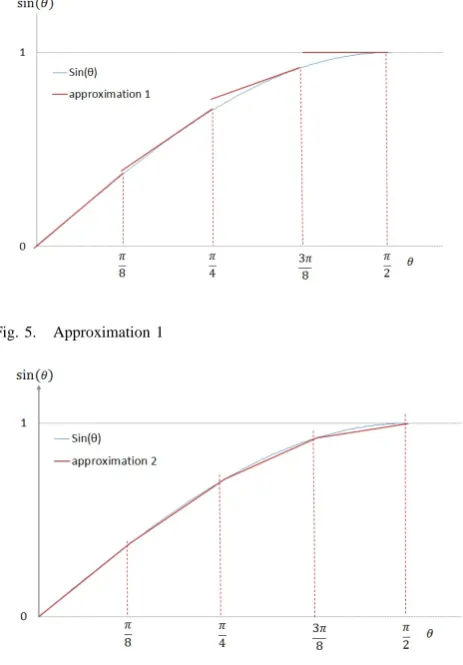
Fig. 5. Approximation 1
Fig. 6. Approximation 2
where all constraints are replaced by approximate linear inequalities. This method, however, does not always give a feasible solution. In this section we propose an algorithm using nonlinear optimization to remove the defects of the above approximation.
A. Circle packing by nonlinear optimization
Since existing nonlinear optimization algorithms require considerable amount of computational time as compared as linear optimization, we first search by simulated annealing on linear approximation. This does not always a feasible solution, so next we execute nonlinear optimization, which removes infeasibility and will give a nearly optimal solution in practical computational time.
It is known that appropriate initial solution will accelerate nonlinear optimization algorithm. Thus, after linear approx-imation search we do not make use of only the SPC code but also the coordinate data of location of circles.
As mentioned before, different circles do not overlap in an SPC representation yields constraints (2), (3), (4), (5), and (1). By transforming these constraints, we have constraints (7) and (6). We call the former constraint (A) and the latter constraint (B). We tried two types of nonlinear optimization both under constraint (A) and under constraint (B) and compared.
IV. COMPUTATIONAL EXPERIMENT
[image:3.595.78.267.64.403.2](a)
[image:4.595.360.509.48.270.2](b)
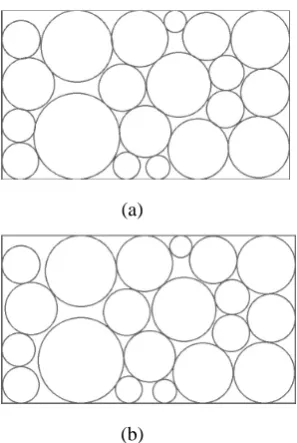
Fig. 7. Circle packing in a rectangle by approximation 1 and nonlinear optimization((a) packing density 77.91%, (b) packing density 79.81%)
12.4 and as for nonlinear optimization we used quasi Newton method. Our computational environment includes CPU (Intel Core i7-2600 @ 3.4 GHz) and memory of 4 GB.
The neighborhood of search by simulated annealing in SPC was obtained by random selection from the following three operations:
1) choose two circles at random and exchange the position inΓ−;
2) choose two circles at random and exchange the position inΓ+;
3) choose two circles at random and exchange the position both inΓ+ and inΓ−.
As for the linear approximation of trigonometric function mentioned in 2.1, we tried two types of approximation as we have done in our former research [8]. Fig.5 and Fig.6 show these two types of approximation. Note that there results small overlap among circles by approximation 2, because sine curve is approximated a little small.
A. Circle packing by nonlinear optimization
In order to evaluate the performance of our algorithm we tried to pack circles in a rectangle and an equilateral triangle.
1) Circle packing in a rectangle with fixed widthW: Let
us consider circle packing in a rectangle with fixed widthW. This problem is known as strip packing problem. Constraints are
ri≤xi≤W −ri,
ri≤yi≤H−ri,
for every circle i and the objective function is H to be minimized. Problem instances were taken from benchmark CODP: SY2.
Fig. 7(a) shows a location by approximation 1 with pack-ing density 77.91%, and Fig. 7(b) a location obtained by nonlinear optimization with packing density 79.81% where Fig. 7(a) is used as an initial solution. Fig. 8(a) shows a location by approximation 2 with packing density 84.06%,
(a)
[image:4.595.104.258.50.272.2](b)
Fig. 8. Circle packing in a rectangle by approximation 2 and nonlinear optimization((a) packing density 84.06%, (b) packing density 79.96%)
(a)
[image:4.595.352.497.317.604.2](b)
Fig. 9. Circle packing in an equilateral triangle by approximation 1 and nonlinear optimization((a) packing density 77.915%, (b) packing density 79.819%)
and Fig. 8(b) a location obtained by nonlinear optimization with packing density 79.96% where again Fig. 8(a) is used as an initial solution. We can observe that in Fig. 7(b) redundant space resulted by approximation 1 is removed and in Fig.8(b) overlap of circles resulted by approximation 2 is removed.
2) Circle packing in an equilateral triangle: Let us
con-sider circle packing in an equilateral triangle. Constraints are
ri≤yi≤√3xi−2ri,
(a)
(b)
Fig. 10. Circle packing in an equilateral triangle by approximation 2 and nonlinear optimization((a) packing density 81.78%, (b) packing density 80.51%)
for each circle i, and the objective function is Y to be minimized. Problem instances were taken from benchmark CODP: SY2.
Fig. 9(a) shows a location by approximation 1 with pack-ing density 77.96%, and Fig. 9(b) a location obtained by nonlinear optimization with packing density 79.82% where Fig. 9(a) is used as an initial solution. Fig. 10(a) shows a location by approximation 2 with packing density 81.78%, and Fig.10(b) a location obtained by nonlinear optimization with packing density 80.51% where again Fig.10(a) is used as an initial solution. Similar result of the difference of approximation is observed as in the case of packing in a rectangle.
B. Evaluation on approximation
The above results of circle packing in a rectangle and an equilateral triangle suggest that the way of approximation and the type of constraints yield different packing density. Therefore we have to investigate the best combination of approximation and constraint.
For circle packing in a rectangle we tried several search of simulated annealing with various temperature and time, where constraints (A), (B) and approximation 1, 2 for initial solution of SPC code and circle location were used. Problem instances were taken from benchmark CODP: SY2.
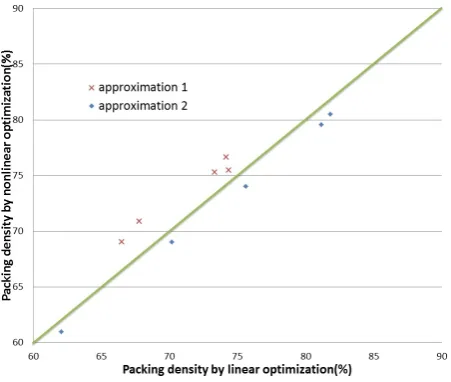
Fig. 11 and Fig. 12 show results of the experiment. There is no difference on approximation 1 and 2. In the final location, however, approximation 2 gives the best solution. Tables. I, II, III and IV show results of the comparison with constraints (A) and (B). Constraints (A) is better than constraints (B) in all instances. Also, there are some instances
(unit:second)
TABLE II
COMPARISON OF CONSTRAINTS(A)AND CONSTRAINTS(B) (CIRCLE-PACKING FOR A RECTANGLE,APPROXIMATION2)
approximation 2 constraints (A) constraints (B) 77.92 79.82 cannot solve
74.39 77.16 77.16
75.56 76.81 cannot solve 69.04 72.68 cannot solve 65.47 67.34 cannot solve
(unit:second)
that failed in obtaining feasible solution by constraints (B). This comes from the fact that quasi Newton method some-times fails when the initial solution is not adequate.
V. CONCLUSIONS
In the present paper we proposed a circle packing algo-rithm using nonlinear optimization in order to avoid overlap of circles and redundant space which remained pending in our former research [8].
Computational experiments show that our algorithm gives dense and feasible packing in a rectangle and an equilat-eral triangle. We compared sevequilat-eral ways of approximation followed by nonlinear optimization on packing density and computational efficiency.
Remained problems left for further research are more effi-cient algorithms, packing various forms of objects including circles and rectangles, and three dimensional packing.
REFERENCES
[1] E.G. Birgin and J.M. Gentil: New and improved results for packing identical unitary radius circles within triangles, rectangles and strips,
Computers and Operations Research, Vol. 37, pp. 1318-1327, 2010.
[2] H. Wang, W. Huang, Q. Zhang and D. Xu: An improved algorithm for the packing of unequal circles within a larger containing circle,
European Journal of Operational Research, Vol. 141, pp. 440-453,
2002.
[3] D. Zhang and A. Deng: An effective hybrid algorithm for the problem of packing circles into a larger containing circle, Computers and
Operations Research, Vol. 32, pp. 1941-1951, 2005.
[4] H. Akeb, M. Hifi, and R. M’Hallah: A beam search algorithm for the circular packing problem, Computers and Operations Research, Vol 36, pp. 1513-1528, 2009.
[5] C.O. L´opez and J.E. Beasley: A Packing unequal circles using formu-lation space search, Computers and Operations Research, Vol 40, pp. 1276-1288, 2013.
[6] Takashi SAWA, Akira NAGAO, Takashi KAMBE, Isao SHIRAKAWA and Kunihiro CHIHARA: A Method for Rectangle Packing Problem,
The Institute of Electronics, Information and Communication Engineers,
Vol 97(137), pp. 159-166, 1997.
[7] H Murata., K. Fujiyoshi, S. Nakatake and Y. Kajitani: VLSI Module Placement Based on Rectangle-Packing by the Sequence-Pair, IEEE
Trans. CAD, Vol. 15, No. 12, pp. 1518-1524, 1996.
[8] S. Morinaga, H. Ohta and M. Nakamori: A Method for Solving Circle-Packing Problem by Using Extended Seqence-pair, The 26th Workshop
on Circuits and Systems, pp. 489-494, 2013.
TABLE III
COMPARISON OF CONSTRAINTS(A)AND CONSTRAINTS(B) (CIRCLE-PACKING FOR AN EQUILATERAL TRIANGLE,APPROXIMATION
1)
approximation 1 constraints (A) constraints (B)
81.79 80.52 80.52
81.16 79.59 79.59
75.61 74.04 74.04
70.17 69.04 69.04
62.05 61.00 61.00
(unit:second)
TABLE IV
COMPARISON OF CONSTRAINTS(A)AND CONSTRAINTS(B) (CIRCLE-PACKING FOR AN EQUILATERAL TRIANGLE,APPROXIMATION
2)
approximation 2 constraints (A) constraints (B)
74.17 76.64 76.64
74.34 75.47 75.47
73.33 75.40 75.40
66.48 69.05 69.05
67.77 70.91 70.91
[image:6.595.57.283.549.740.2](unit:second)
Fig. 11. Relation between the result of circle-packing in a rectangle by linear optimization and that by nonlinear optimization from SPC codes