
warwick.ac.uk/lib-publications
A Thesis Submitted for the Degree of PhD at the University of Warwick
Permanent WRAP URL:
http://wrap.warwick.ac.uk/108758
Copyright and reuse:
This thesis is made available online and is protected by original copyright.
Please scroll down to view the document itself.
Please refer to the repository record for this item for information to help you to cite it.
Our policy information is available from the repository home page.
S T R U C T U R A I , S T U D I E S O F
A C T I N I D E C O M P O U N D S
by
D avid John F lan ders
A thesis su bm itted to the University o f W a rw ick in partial fulfilm ent o f the requirem ents for the degree o f D octor o f P h ilosop h y
D epartm en t o f C hem istry and M olecu lar Sciences, University o f W arw ick , C oven try C V 4 7AL
D E C L A R A T I O N
Parts o f the work contained in this thesis have been published, accepted, or submit ted for publication in the Scientific literature with the following references:
N.W. Alcock, D.J. Flanders and D. Brown, J. Chem. Soc., Dalton Trans., 1984, hi 9
N.W. Alcock, D.J. Flanders and D. Brown, tnorg. Chim. Acta, 1984, 94, 279.
N.W. Alcock, D.J. Flanders, T.J. Kemp and M.A. Shand, J. Chem. Soc., Dalton Trans., In Press, Paper No. 4 /810
A c k n o w le d g e m e n ts
I would like to thank my supervisor, Dr. N.W . Alcock, for his guidance in crystallog raphy throughout the course o f my work. For their supervision and assistance in prepara tive neptunium chemistry at the Chemistry Division o f A.E.R.E. Harwell I thank Dr. D. Brown, members o f his staff and past research students. I am indebted to Mr. G.S. Top ping for the preparation o f crystals o f Cs7(N p 0 2)jC l,2, Mr. M.A. Shand and Mr. R.V. Astley for the synthesis and crystal preparation o f U 0 2(gly)4( N 0 3)2, Mr. G.F. Payne for the preparation o f (TiS-C sHs)N p(IV)Clj.2m dppo and Professor K.W . Bagnall for supplying the crystals o f U 0 3(CCI3C 0 0 )C 1 .2 tp p o. I would also like to thank everyone in the Chem istry department for help and encouragement throughout the period o f my research.
This thesis has been written using the troff word processing program with the preprocessors refer, tbl and eqn running under the UNDCt operating system and printed on a Xerox 2700 laserprinter. I would like to thank Dr. R. Countryman and Mr. R. McMahon for their help with the system and the staff o f the computer unit for assistance and support during my project.
In particular I thank my wife Jane whose support in every way has enabled me to complete this work.
I gratefully acknowledge the support o f a CASE award from the Science and Engineering Research Council and the Chemistry Division o f A.E.R.E. Harwell.
A B S T R A C T
The work described in this thesis was an investigation into the coordination chemis try o f uranium(VI) and neptunium(VI). Structural determinations o f comparable uranium and neptunium compounds were used to examine the actinide contraction between uranium and neptunium, the changes in metal-ligand bond length on substituting nitrogen for oxygen as the donor atom and to establish the mode o f coordination o f certain ligands around the actinyl(VI) ion. These areas have been explored through the determination of the crystal structures of the following
compounds:-a) The 2,2'-dipyridyl complexes [UOa(N O ,),C 10H ,N ,], [NpOa(N O 3)aC 10H,Na], [UOa(CH3C O O )aC l0H9Na] and [NpOa(CH3C O O )aC 10H9Na].
b) The 1,10-phenanthroline complex [U 0 2(N C 3)aC laH ,N a].
c) The pentan-2,4-dionate complexes [UOa(CH3C O C H CO CH 3)aC 5HsN],
[NpOa(CH3COCHCOCH3)aC 5HsN], [UOa(CH3COCHCOCH3)a.HaO] and
[U 0 aCH3C 0 C H C 0 C H 3(N 0 3)a]* [(C H .J .C .H .N f.
d) The 4,4'-dipyridyl compound [(UOjINOjIjOH),]* [ClcHl0Na]**.
In addition the structure determination of the compound bis(nitrato)dioxo tetrakis(glycinato)uranium(VI) showed that the glycine ligands are coordinated via the oxygen atoms with two bidentate and two monodentate glycines. Other structures which have been determined are the mixed oxidation state neptunium alkali metal salt
[CsTNp( v,O a(N p( w|O a)aC lia], the organoneptunium(IV) compound
[(CsHs)CI3Np(OPPh3)a] and the photo-oxidation product [L'OjfCCIjCOO ICM OPPhj),]
T a b le o f Contents
C h a p te r i : In tr o d u c tio n ... 1
1.1 The Elements ... 1
1.2 The Aqueous Chemistry o f the M O , * ( n = 1,2,3) ions ... 1
1.3 Uranyl and Neptunyl Complexes - Coordination Geometry ... 3
1.4 Bonding Mechanisms in the Uranyl and Neptunyl Ions ... 3
1.4.1 The molecular orbitals ... 7
1.4.2 Possible orbitals used in equatorial bonding ... 7
1.4.3 The effects o f oxidation state and metal type on the bond lengths in the actinyl complexes studied ... 13
1.4.4 The length o f the M -O (M O ,"+) bond in actinyl complexes ... 13
1.4.5 The geometry o f the uranyl(VI) ion ... 14
References ... 16
C h a p te r 2: T h e C ry sta l and M o le cu la r S tru ctu re s o f F o u r A c t in y l( V l) C o m p le x e s w ith 2 ,2 '-d ip y r id y l ... 18
2.1 Introduction ... 18
2.2 Experimental ... 18
2.3 Discussion... 19
References ... 41
C h a p te r 3: T h e C ry sta l and M o le c u la r S tru ctu re s o f T w o U ra n iu m (V I) C o m p le x e s w ith 1 ,1 0 -p h e n a n th ro lin e ... 42
3.1 Introduction ... 42
3.2 Experimental ... 42
3.3 Discussion... 43
References ... 51
C h a p te r 4: T h e C ry sta l and M o le cu la r S tru ctu re s o f F o u r A c t in y l(V I ) C o m p le x e s w ith P e n ta n -2 ,4 -d io n e ... 52
4.1 Introduction ... 52
4.2 Experimental ... 52
4.3 Discussion... 55
References ... 72
C h a p te r 5: T h e C ry sta l an d M o le cu la r S tru ctu re s o f T w o F u r t h e r N ep tu n iu m C o m p o u n d s ... 73
5.1 T risch lorom on o(r| S-cyclopentadienyl)neptunium(rV)bis(methyldipyenyl phosphineoxide) ... 73
5.1.1 Intoduction ... 73
5.1.2 Experimental ... 73
5.1.3 Discussion ... 74 5.2 M ixed O x id a tio n S ta te N e p tu n iu m S a lt: C s7N p ( v ’0 , ( N p ' v
5.2.1 Introduction... 75
5.2.2 Experimental ... 75
5.2.3 Discussion ... 76
References ... 89
C h a p te r 6: T h e C ry sta l a n d M o le cu la r S tru ctu re s o f F u rth er U ra n iu m (V l) C o m p le x e s ... 90
6.1 B is n itra to d io x o te tr a k is (g ly cin a to )u r a n iu m (V I) ... 90
6.1.1 Introduction... 90
6.1.2 Experimental ... 90
6.1.3 Discussion ... 92
6.2 4,4'-dipyridinium bis(dinitratohydroxydioxouranate(VI)) ... 93
6.2.1 Introduction... 93
6.2.2 Experimental ... 93
6.2.3 Discussion ... 94
6.3 M o n o (tr ic h lo r a c e ta to )m o n o c h lo r o d io x o b is (tr ip h e n y lp h o s p h in e o x id e ) u ra n iu m (V I) ... 95
6.3.1 Introduction... 95
6.3.2 Experimental ... 95
6.3.3 Discussion ... 96
References ... 118
C h a p te r 7: E x p e rim e n ta l ... 119
7.1 Techniques used in handling Neptunium-237 ... 119
7.2 The collection o f X-ray diffraction d a t a ... 120
7.3 The use o f oscillation and Weissenberg photographic methods ... 125
References ... 130
C h a p te r 8: C o n clu sio n s a n d P ro p o sa ls fo r F u rth e r In vestiga tion s ... 131
8.1 Conclusions ... 131
8.2 Proposals for Further Investigations ... 135
References ... 136
A pp :n d ix A : A n O u tlin e o f C r y s ta llo g ra p h ic T h e o r y and S tru ctu re S o lv in g T ech n iq u es ... 137
References ... 149
L ist o f T a b le »
T a b le
1.1 Oxidation States o f the Actinides and Lanthanides 1.2 Orbital transformation scheme
2.1 Crystal Data and Data Collection Conditions 2.2 Atomic coordinates for 1
2 .3 Atomic coordinates for 2 2 .4 Atomic coordinates for 3 2 .5 Atomic coordinates for 4
2 .6 Bond lengths (A) and angles (°) for 1&2] 2.7 Bond lengths (A) and angles (°) for 3&4]
2.8 Deviations (A) from mean planes for [1&2] 2.9 Deviations (A) from mean planes for [3&4J 2 .1 0 Equatorial non-bonded contacts (A)
2.11 Distortions in the equatorial groups (°)
2 .1 2 Axial oxygen atom to equatorial ligand atom distances (A)
3.1 Atomic coordinates (xlO ) for [5] 3.2 Bond lengths (A) and angles (°) for [5] 3 .3 Deviations (A) from mean planes for [5] 4.1 Crystal Data and Data Collection Conditions 4.2 Atomic coordinates (xlO*) for 7
4 .3 Atomic coordinates (xlO ) for 8 4.4 Atomic coordinates (xlO ) for 9. 4 .5 Atomic coordinates (xlO ) for 10] 4 .6 Bond lengths (A) and angles (°) for 7&8] 4.7 Bond lengths (A) and angles (°) for 9] 4 .8 Bond lengths (A) and angles (°) for 10] 4.B Deviations (A) from mean planes for [7&8] 4 .1 0 Deviations (A) from mean planes for [9] 5.1 Atomic coordinates (xlO ) for [11] 5.2 Bond lengths (A) and angles (°) for [11] 5.3 Atomic coordinates (xlO ) for [12] 5.4 Bond lengths (A) and angles (°) for [12]
6.1 Atomic coordinates (xlO ) for [13]
6.2 Bond lengths (A) and bond angles (°) for [13] 6.3 Hydrogen bonds; distances (A) and angles (°) 6.4 Atomic coordinates ( x 10 ) for [14]
6.5 Bond lengths (A) and bond angles (°) for [14]
6 .6 Atomic coordinates (xlO ) for [15]
6.7 Bond lengths (A) and bond angles (°) for [15] 8.1 Contraction
(A)
o f the M -0 ( M 0 j* ) bond8.2 U - 0 ( U 0 j* ) b o n d len gth s (A) and equatorial coordination numbers 8.3 Metal-equatorial ligand bond lengths (A)
A . l . The 14 Bravais lattices and conventional unit cells A .2 . Determination o f translation elements o f symmetry
List o f F ig u res
F ig u re P a g e
1.1. Distorted octahedral coordination geometry 6
1.2. Pentagonal bipyramidal geometry 6
1.3. Hexagonal bipyramidal geometry 6
1.4. The molecular orbitals o f the uranyl(VI) ion 8
1.5. The molecular orbitals in U 0 2* 9
1.6. A possible energy-level scheme for actinyl ions 9
1.7. The orientation o f orbitals in the U 0 2 ion 10
1.8. Radial distribution functions 10
1.9. The valence orbitals o f uranium 11
1.10. Polar diagram for tpdf hybrid orbital 11
1.11. Radial part o f 5 / and 6 / atomic orbitals for uranium 11
1.12. Relative total energy as a function o f bond angle 15
1.13. Relative total energy as a function o f O-U-O bond angle 15
2.1. M O 2(N O 3)2C l0HllNJ](M = U or Np) molecule 22
2.2. M O 2(CH3C O O )2C l0H ,N 2]
(M = U or Np) molecule 23
2.3. The packing o f M 0 2( N 0 3), C l0HsNa] 24
2.4. The packing o f [M O jiC H jCO O JjC .oH .N ,] 25
2.5. Distortions in [MO2(X )2C 10HgN2] 26
2.6. Compression o f [MO2(CH3C O O )gC ,0HgNg] 27
3.1. The [U O jlN O jL C ^ H .N J molecule 45
3.2. The packing o f (U O ^ N O j), C 12HgN2] 46
4.1. The [M 0 2(CH3C 0 C H C 0 C H 3)2C 6HsN] [M = U or Np] molecule 57
4.2. The packing o f [MOa(CH3COCH CO CH 3)2C sHsN] [M = U or Np] 58
4.3. The [U 0 2(CHgC 0 C H C 0 C H 3)2.Hg0 ] molecule 59
4.4. The packing o f [U 02(CH3C 0 C H C 0 C H 3)2.H20 ] 60
4.5. The [U O jC H jC O C H C O C H jiN O jjj] anion 61
4.6. The packing o f [UOaCH3COCHCOCH3(NC>3)a] '
[(CH,)1C sHaN]+ 62
5.1. The [(CgHg)ClaNp(OPPh3)a] molecule 78
5.2. The packing of (C sH.)CUN'p(OPPh3)2] 79
5.3. The packing o f C s ^ p ^ ’ q J N p ' V,)0 2)2CI12] 80
6.1. The [UOa(O aCCHaNH3)4]J cation 97
6.2. The packing of [UOa(O aCCHaNH3)4],+
[N O ,],- 98
6.3. The [(U 0 1(N 0 3)20 H )1]1 anion 99
6.4. The packing o f [(L'0a(N 0 3)a0 H )a]1'
[C ,0H10N ]** 100
6.5? The [u O a(CClaC OO)Cl.(O PPha)a] molecule 101
6.6. The packing o f [UOa(C C laC OO)CI.(O PPha)a] 102
7.1. The distribution coefficient o f Np(VI) 121
7.2. The four circles o f the diffractometer 123
7.3. The pattern o f spots on film from a rotation photograph 123
7 .4 .& 7 .5 .The layer lines o f an oscillation photgraph 127
7.6. The axial reflections on a Weissenberg photograph 128
A . l . The diffraction o f X-rays from crystal planes 138
A .2 . The derivation o f Miller indices ( hki) 138
A .3 . The possible types o f lattice centering 140
A .4 . The variation o f the atomic scattering factor ( / )146
C H A P T E R 1
In tr o d u ctio n
1.1. T h e E lem en ts
The actinide elements, which are referred to as the 5 / transition series, are the four teen elements following actinium (Z = 8 9 ) in the periodic table. The series arises from the successive addition of electrons to the 5 / orbitals and is analogous in this respect to the lanthanide or 4 / transition series. The majority o f chemical investigations of the actinide elements have been carried out on thorium and uranium for the reason that both these elements are readily available in large quantities. O f the other actinides protactinium, neptunium, plutonium and americium are available in quantities ranging from a few hun dred grams in the case o f protactinium to hundreds o f kilograms in the case o f plutonium. The transamericium elements are available in much smaller quantities ranging down to a few atoms for the heaviest element, lawrencium (Z = 1 0 3 ).
All the known isotopes o f the actinides are radioactive, but the half-lives o f 232Th, 235U and 2” U are sufficiently long for them to be found in nature as primordial material. Protactinium is found in nature, despite the short half-life o f 23lPa (3.28 x 10⁴ years), since it is a member o f the 23SU decay chain. Actinium and the transuranium elements are produced synthetically since their half-lives are so short that any primordial deposits o f these elements have decayed completely.
The chemical investigations described in this thesis involve the elements uranium and neptunium, preparative work on the latter being carried out at A.E.R.E. Harwell. Neptunium was first discovered in 1940 by McMillan and Abelson1 as 23,\ p, but the most stable isotope is 237Np with a half-life o f 2.14 x 10* years which is the isotope used for the preparative chemistry described here. Neptunium is produced by neutron irradiation o f uranium:*
30% : ” SU(n,y) ” *U(n,y) ” 7U - ” 7Np
23«.,, „ . »37-, _ *37..
70% : L(n,2n) U — Np
and extracted from irradiated fuel elements.3
1.2. T h e aqu eou s ch em istry o f th e M O ,"* ( n = 1,2,3) ion s.
2
-T A B L E 1.1
O x id a tio n States o f the A ctin id e» and L a n th a n id e s
(The most stable oxidation states are in bold figures, those not known in solu tion are within parentheses.)
A ctin id e s L a n th a n id es
89 Ac 3 57 La 3
90 Th (3),4 58 Ce 3.4
91 Pa (3),4,5 59 Pr 3.(4)
92 U 3,4,5,0 60 Nd (2),3
93 Np 3,4,5,6,7 61 Pm 3
94 Pu 3,4,5,6,7 62 Sm 2,3
95 Am (2),3,4,5.6 63 Eu 2.3
96 Cm 3,4 64 Gd 3
97 Bk (2)3,4 65 Tb 3.(4)
98 C f 2,3 66 Dy 3
99 Es 2,3 67 Ho 3
100 Fm 2,3 68 Er 3
101 Md 2,3 69 Tm (2),3
102 No 2.3 70 Yb 2,3
103 Lr 3 71 Lu 3
attributed to their 4 / electrons being more strongly shielded than the 5 / electrons of the actinide elements, these latter also have higher energy and are therefore more available for covalent bonding. The compounds of the lanthanides involve predominantly ionic bonding, a metal ion o f charge + 3 being most common.
The most stable oxidation state for uranium and neptunium are +6 and + 5 , respec tively, which occur in solution as L'O j* and NpO^. The + 6 oxidation state o f neptunium (N p O ,* ) can only be maintained in solution in the presence o f an oxidising agent, as is illustrated by the comparative stability o f the two 4-6 actinyl species in 1M perchloric acid.*
U0,J* + e~ = UO* ; E° = 0.163 V
NpO** + e~ = NpO* ; E° * 1.238 V
(
1
.2
.1
) [image:13.698.19.673.13.699.2]3
-The Np(VI) species is stable enough in aqueous solution, however, for complexes to be formed which maintain the + 6 oxidation in the solid state. The + 5 oxidation state o f uranium (U O^), however, disproportionates very rapidly® to U4* and U O ,* , being least unstable at pH 2.5.
2U0a* + 4H* - U** + UO j* + 2H20 (1.2.3)
The NpOj* species is much more stable, only disproportionating at high acid concentra tions ( > 5M HCIO,) to give Np4* and N p O ,*, and the hydroxide N p 0 2(0 H ) only form ing when the acid concentration is reduced past pH 5.7.
The other stable oxidation state o f both elements is + 4 , which is stable in aqueous solution in the absence o f oxidising agents, but both L 4 + and Np4+ in solution undergo slow oxidation by atmospheric oxygen. Uranium(IV) is oxidised directly to U 0 2* and neptunium(IV) to N pO ^ , which is thermodynamically more favourable than the oxidation o f Np(lV) to Np(VI).7
U 0 2** + 4H* + 2e- = U4* + 2HjO ; E° = 0.319V (1.2.4)
NpO** + 4H* + 2e“ = Np4* + 2HaO ; E° = 0.918V (1.2.5)
The kinetics of the oxidative mechanisms are the major factors involved in these reactions,8 the rate o f the NpO^ - i\pO|+ oxidation being much faster than that o f Np4* - NpO^ or Np4+ - N p O j* . A major reason for the relative slowness o f these latter two reactions is the presence o f steps involving the formation o f Np-O bonds.
The U(IV) and Np(IV') ions have a greater complexing ability than U(VI), Np(V) and Np(VI) since the latter exist as the oxo-ions U 0 2 *, NpO,* and N pO j* which have a lower charge and larger size than the bare ions. The actual charges on the central metal atoms in the oxygenated ions are higher than the formal ionic charges o f +1 and + 2 so these ions do still have a relatively high tendency toward complex ion formation, in the order U(IV) > U(VI) and Np(IV) > Np(Vl) > Np(V).® The oxygen atoms in all the actinyl ions are non-basic and do not attract protons, even at high acidities;7 however in aqueous solu tions, both MO,+ and M O j* ions coordinate with water to form acidic hydrated species.
It is possible to prepare aqueous solutions o f Np(VlI) by oxidation o f Np(VI) with ozone in alkaline conditions8 which produces the stable NpO* species. In acid conditions, Np(VII) exists as the N p O ,4 ion which is much less stable. This latter species is a very strong oxidising agent which is capable o f oxidising Cr(III) to Cr(VI).
1.3. U ra n yl and n e p tu n y l com p lexes - c o o r d in a tio n g e o m e try .
4
-NpO^) complexes.10 The aim o f the work described here has been to contribute towards remedying this lack, and to increase the amount o f structural information o f uranyl com plexes. The effect o f different types o f donor ligand and coordination number on the geometry o f the actinyl group will be examined, and any structural changes due to a sub stitution o f uranium by neptunium will be discussed.
The dioxo-cation M O ^+ (M = U, n = 2; M = Np, a = 1, 2) can be considered to behave as a single charged centre, as a metal ion having the characteristics o f a “ hard” Lewis acid.11 As a result the ion is capable o f complexing with the more electronegative elements (N, O, F , Cl ) acting as donor atoms and is less likely to form complexes with those which are more polarisable and utilise rr-bonding (S, P, Se, I"). The “ h a rd /soft” principle also suggests that a nitrogen-donor ligand will be less strongly bound to the actinyl centre than would an oxygen-donor, since oxygen has the higher base strength.4 For this reason, M -O bonds are expected to be shorter than M-N bonds for the actinyl ions whereas for other “ softer” ions M-O and M-N bonds are very similar in length (e.g. Cu(II), Co(III)).
The MO^“* ion is generally very close to linearity (O -M -O ), and will accommodate between 4 and 6 donor atoms in a plane perpendicular to the axis of the ion. The ligands bond to the metal within the “ equatorial plane” and the arrangement o f the individual donor atoms becomes more puckered, with respect to the plane, as the coordination number is increased. The irregularities are decreased with a coordinating bidentate ligand with a small “ b ite ” , as is found in the case of N a U O ^ C H jC O O ), which has a planar ligand arrangement.12 If the size o f the donor atoms or the bite o f the ligand is increased then either the puckering will be exaggerated or the coordination number in the equatorial plane will be reduced from the value found for the analogous complex with the smaller ligands.
The lengths o f the M-O (M O a * ) and M-L (L — ligand atom ) bonds lie in the ranges 1.6 - 2.0A and 2.2 - 2.9A respectively and are denoted as primary and secondary bonds. This range allows the coordination geometry in these complexes to vary from a slightly distorted octahedron, through a pentagonal bipyramidal arrangement to a hexagonal bipyramid. These possible geometries are illustrated by the examples in Figures 1.1 - 1.3. If the coordinating ligands subtend a large ligand cone angle13 or the donor atoms are sufficiently large then a complex will be constrained to take up a distorted octahedral geometry. Examples are the structure o f N p O ,(O P P h ,)1C l114 and the anions o f CsaN pO ,C l4ls which accommodates four chlorine atoms in the equatorial plane. The abil ity o f chlorine to coordinate in this way is determined by its large van der Waals’ radius * of 1.75A.1® The Cl-Cl contact distances in the example are 3.89(2)A and 3.91(2)A, well
5
-outside the sum o f the chlorine van der W aals’ radii (3.5A). An attempt to increase the number o f chlorine atoms coordinated to 5, without an increase in the metal-chlorine bond length, would reduce the Cl-Cl contact distances to ca. 3.12 A, well inside the sum o f van der Waals’ radii. On the other hand it is possible to coordinate an oxygen atom together with four chlorine atoms in the equator as the example o f U 0 2C12.H20 17 demon strates.
A coordination number o f 5 is most comm on in the equatorial plane, particularly with oxygen donors. Where this occurs, the M -O (ligand) bond lengths are about 2.35 - 2.40A and the non bonded 0 . . . 0 separations in the ligand plane will be 2.70 - 2.80A. The contact distance here is very close to, although smaller than, the sum o f van der W aals’ radii for two oxygen atoms (2.84 A) and experimental data has shown that in some cases, particularly compounds with an equatorial coordination number o f 6, the oxygen-oxygen contact distances may be as low as 2.6A. This suggests that the simple addition o f two unconstrained van der W aals’ radii does not describe the limiting case and that a reduc tion of some 8.5% is possible. However, even if this reduction is applied, the sum o f the van der W aals’ radii o f two chlorine atoms is 3.20A which is greater than the contact dis tance for the equatorial coordination of five chlorine atoms. Both monodentate ligands and bidentate ligands (with a unidentate donor occupying the fifth equatorial position) form actinyl complexes with pentagonal bipvramidal geometry. Examples o f the former are U 0 2S 0 4.H2S 0 4.5H20 and 2 N p 0 2S 0 4.H2S 0 4.4H20 18 and o f the latter (CF3C 0 C H C 0 C F 3)2U 0 2. T H F 1» and (CH3C 0 C C IC 0 C H 3)2U 0 2. P hjP O .20
The hexagonal bipyramid is not an energetically favoured polyhedron and is gen erally only observed for the case o f compounds containing actinyl groups. This observa tion suggests that the dimensional requirements o f the actinyl group cannot be accomm o dated within any o f the lower energy polyhedra, and observation shows that neither the dodecahedron nor the square antiprism can accommodate a linear moiety without severe distortion. The alternatives o f the bicapped trigonal prism and the cube would also be considerably distorted in attempting to accommodate the short U = 0 bonds. The few examples o f hexagonal bipyramidal geometry not containing the actinyl group seem to arise as a result o f some special, steric conditions. The example o f tetramethylammonium triacetatodiphenylplumbate(IV) : [Me4N] (Pb(Ph)2(CH3C O O )3,21 has the special combina tion o f two bulky monodentate and three short bite bidentate ligands about the central metal atom.
6
-1.1. Distorted octahedral coordination geometry (from ref. 14).
1.2. Pentagonal bipyramidal geometry (from ref.18).
7
-ion (2.38A) is greater than the expected L...L donor atom separat-ion for an equatorial coordination number o f 6 (2.35A). This indicates that a sulphate group cannot give rise to this geometry, but will assume the 5-coordinate form. From this observation it can be deduced that only ligands with a bidentate chelating “ bite” less than this value will be able to form hexacoordinated complexes with a hexagonal bipyramidal geometry. Typical bidentate ligands in this category (with their bites) are 0 2 (1.5A), CO* (2.2A), C H jC O O ” (2.2A) and NO.|" (2.1 A). Examples o f compounds containing these ligands in a hexagonal bipyramidal geometry are Na4U 0 2( 0 2)3.9H20 , 23 K4U 0 2( C 0 3)3,24 N a N p 0 2(CH3C 0 0 ) 3 and R b N p 0 2( N 0 3)3.25 Bidentate ligands with larger bites ( > 2 .3 A) will tend to form actinyl complexes which display pentagonal bipyramidal geometry with the fifth equatorial position occupied by a monodentate donor (see above).
1.4. B on d in g m ech an ism s in th e u ranyl an d n e p tu n y l ions.
1.4.1. T h e m olecu la r o r b it a ls 28
Uranium , in its ground state, has the electronic configuration 5 / 3 6d‘ 7a* around a filled radon core and neptunium contains an extra /-electron . The electrons outside the radon core, [Rn] combine with the 2a and 2p orbitals o f the oxygen atoms to give the fol lowing sets o f molecular orbitals for the actinyl
ions:-lon E le c tro n ic co n fig u ra tio n
UO** UO,*, N p 0 2*
n po2*
[Rn] (la ,*)* (la .*)* (2a.*)* ( f c r . V K ) 4 ( » .) * (Rn] ( l a * ) * (
1
.0
* (2
a .* ) * (2
«r*)2
(it. ) 4
(t,,) 4
( * . ) * [Rn] ( l a * ) * ( l a * ) * (2
a .*)* (2
a,*)* (tt.) 4
(Wf)4
( * . ) ' (5
. ) 'The l<r, and l a . orbitals contain the lone pairs of electrons on the oxygen atoms triple- bonded to the metal atom through the filled 2 a ., 2 a ,, tt. and w, orbitals, making a total o f six bonds. The <t>. and 8 . metal orbitals are non-bonding,27 the former having a spatial distribution between the equatorial plane and the axis o f the actinyl ion. The 8, non bonding orbital has 6d character and is therefore higher in energy than either <b, or 8 ., which have 5 / character. O f the bonding orbitals. 2 a * is of the highest energy, as it interacts most closely with the orbitals on oxygen.28
1.4.2. P ossible o rb ita ls used in eq u a toria l b on d in g
8
9
-a j», z*
'
o o s S s e © - - « ;
2 « ,
*•>
- - • /
— 'if. “ V
0 0
<C
5
$S
> 0 0
1.5. The molecular orbitals in UO^* (from: 1.1. Chernyaev, Complex Compounds o f
Uranium, p376, Jerusalem, 1966). The 2<r% and 2<rf orbitals shown in Fig. 1.4 are identi
cal to l<r. and l«r here, the lowest energy ir-bonding orbitals.
-o .
6<i J M E M i--- 6,
5f 'W/W/YifiZ
jZfflM M 2p
o. r-JQ {
---AL L B 0 N 0 ING
1»
-1.7. Axes describing the orientation o f orbitals in the U O /* ion (from ref.26).
It
-1.10. Polar diagram for ipdf hybrid orbital (from ref.29).
1.11. Radial part o f 5 / and 8 / atomic orbital» for uranium (from ref.29).
( A S l a t e r 5 /. B T h o m a e - F e r m i 5 /.
to the z (actinyl) axis. The remaining / xy,, / f ^ dsa, and dya orbitals which do not
have a spatial distribution in the equatorial plane may be involved in cases of staggered bonding (Fig. 1.9). The Table (1.2) shows the compositions of the orbitals used for bond ing in uranyl(VI) complexes.
T a b le 1.2
Orbital transformation scheme according to Dxk symmetry
se n ta tio n M etal L igand O rb ita ls
O rb ita ls <r u
♦
(T J ,d .
t l / % +
-
4-<T % P .'f,. l / v 2(<r,-<r„
-TÏ - l / v 2(p, - p . )
I •
Tt - l / % 2(p, + p „ )
P .J ,
ZZ - I / v 2 (P ,~ P ,J
TT u - 1 /V 2 (p , + P y )
f>g -
-d' . -
--
-'» ■ -
--
-<t>m -
[image:23.702.24.678.19.711.2]13
-1.4.3. T h e effects o f o x id a tio n sta te and m etal ty p e o n th e b o n d len gth s in th e actinyl co m p le x e s stu d ie d .
It is stated above (1.4.1) that the <t>. orbital is not located along the actinyl axis and so an electron occupying this orbital is likely to have little effect on the length, geometry and strength o f bonds in the actinyl ion. Such an electron should not be responsible, there fore, for any differences between U O 3* and N pO 2* in identical ligand environments. Con versely, the 8 . orbital lies along the axis o f the actinyl ion, and an electron occupying this has the effect o f lengthening the NpO^ ion primary bonds relative to those o f NpO|* by about 0.09A. In these circumstances, a lengthening o f the secondary bonds also occurs which is probably due to the repulsion o f the partially filled <}>, orbital toward the equa torial ligands by the 8. electron. This effects an increase in metal-ligand repulsion and therefore M-L bond length.
Between analogous uranyl(VI) and neptunyl(VI) complexes the major change in bond lengths is a result o f the actinide contraction, the decrease in ionic radius that is observed from uranium to americium. 37 From protactinium (element 91) to uranium (element 92), the 5 / orbitals become lower in energy than the 6d and 7« orbitals with the increasing nuclear charge and as a consequence the 5 / orbitals start to fill. The 5 / electrons do not shield themselves well, so the shells contract as the atomic number increases. This con traction results in a stabilisation o f the orbitals which bond with those o f oxygen in the actinyl ions, giving a poorer overlap. As a result o f the poorer overlap there is a weaken ing o f the M-O (MO^+ ) bond, but nevertheless a net reduction in its length along the actinide series. A similar change is observed in the secondary bonds around M O ,* . Struc tural changes can also occur in analogous actinide compounds as a result o f this difference in ionic radius, for example the different crystal systems o f the tribromides o f neptunium and plutonium. 30
The higher energy of the 5 / orbital compared with the 8d orbital in protactinium explains the absence o f a linear PaO^ species comparable to that o f the higher actinides. The only known oxo-ion is [ P a = 0 ] 3* which occurs, for example, in (NEtt ), PaO C l5. 31
1.4.4. T h e len gth o f th e M -O (M O ,"* ) b o n d in a ctin y l co m p le x e s .
14
-secondary bonding o f the uranyl oxygen atom does increase the U-O bond length. This occurs in p -U 0 2S 0 4,where the uranyl oxygen atoms act as bridges to equatorial positions on neighbouring uranium atoms. 34 In this case the uranyl bond lengths are 1.80(2) and 1.73(1)A, the former being longer than expected due to the secondary bonding o f that uranyl oxygen into the pentagonal plane o f an adjoining molecule which is also seen in a high-pressure form o f UOs. 35 By contrast, a -U 0 2S e 0 4 has uranyl U-O bonds which are more nearly equal (1.79(2) and 1.78(2)A) despite the similar secondary bonding o f one of the uranyl oxygens.
1.4.5. T h e g e o m e tr y o f th e u ra n y l(V I) ion.
15
-1.12. Relative total energy as a function o f bond angle for Mo 4s, 5«, 5p (separately) and
dtp (all together) basis sets in M o O j* (top), and for U 5 / , 6d, 7», 7p (separately) and ¡dtp (all together) basis sets in U O ’ * (bottom ) (from ref.36).
1.13. Relative total energy as a function o f O-U-O bond angle for U 8p and 6p +• 5 / fi d .lt ,Ip basis sets in C O ,* (from ref.36).
R e fe re n ce s
1. E. McMillan and P. Abelson, Phys. Rev., vol. 57, p. 1185, 1940.
2. M. Smutz, Chairman, “ Symposium on the Production Technology o f 237Np and 238Pu.,” Ind. Eng. Chem. Proc. Des. Dev., vol. 3, p. 289, Denver, 1964.
3. W .W . Schultz and G.E. Benedict, “ Neptunium-237: Production and Recovery,” USAEC Report TID-25955, 1972.
4. U. Casellato, M. Vidali, and P.A. Vigato, Inorg. Chim. Acta, vol. 18, p. 77, 1976.
5. J.R. Brand and J.W. Cobble, Inorg. Chem., vol. 9, p. 912, 1970.
6. A. Ekstrom, Inorg. Chem.. vol. 13, p. 2237, 1974.
7. “ The Actinides,” in Comprehensive Inorganic Chemistry, Vol 5, ed. A.F. Trotman- Dickenson, Pergamon, New York, 1973.
8. C. Keller, The Chemistry o f the Transuranium Elements, Verlag Chemie, 1971.
9. S.K. Patil, V.V. Ramakrisha, and M.V. Ramaniah, Coord. Chem. Rev., vol. 25, p. 133, 1978.
10. C. Musikas and J.H. Burns, “ Structure and Bonding in Compounds containing the NpO^ and N pO j* Ions,” in Transplutontum Elements, ed. R. Lindler, pp. 237-245, North-Holland Publishing Company, Amsterdam. 1976.
11. R.G. Pearson, J. Am. Chem. Soc., vol. 85, p. 3533, 1963.
12. W.H. Zachariasen and H.A. Plettinger, Acta Cryst., vol. 12, p. 526, 1959.
13. K.W . Bagnall, Inorg. Chim. Acta, vol. 94, p. 3, 1984.
14. N.W . Alcock, M.M. Roberts, and D. Brown, J. Chem. Soc. Dalton Trans., p. 25, 1982.
15. N.W. Alcock, M.M. Roberts, and D. Brown, Acta Cryst., vol. B38. p. 1805, 1982.
16. A. Bondi, J. Phys. Chem., vol. 68, p. 441, 1964.
17. J.C. Taylor and P.W. Wilson, Acta Cryst., vol. B30, p. 169, 1974.
18. N.W. Alcock, M.M. Roberts, and D. Brown, J. Chem. Soc Dalton Trans., p. 869, 1982.
19. G.M. Kramer, M.B. Dines, R.B. Hall, A. Kaldor, A.J. Jacobson, and J.C. Scanlon,
Inorg. Chem., vol. 19, p. 1340, 1980.
20. J.C. Taylor and A.B. McLaren, J. Chem. Soc. Dalton Trans., p. 460, 1979.
21. N.W . Alcock, J. Chem. Soc. Dalton Trans., p. 1189, 1972.
17
-23. N.W . Alcock, J. Chem. Soc. (A), p. 1588, 1968.
24. A. Anderson, C. Chieh, D.E. Irish, and J.P.K .Tong, Can. J. Chem., vol. 58, p. 1651, 1980.
25. N.W . Alcock, M.M. Roberts, and D. Brown, J. Chem. Soc Dalton Trans., p. 33. 1982.
26. L. Cattalini, U. Croatto, S. Degetto, and E. Tondello, Inorg. Chtm. Acta Reviews, vol. 5, p. 19, 1971.
27. V.I. Spitsyn and J.J. Katz, in Proc. Mosc. Symp. Chem. Trans. Elem., p. 123, Per- gammon Press, Oxford, 1976.
28. R.G. Denning, J.O.W . Norris, I.G. Short, and T .R . Snelgrove, “ Electronic Structure o f Actinyl Ions,” in A C S Symp. Series (Lanthanide Actinide Chem. Spectroscopy), ed. N. Edelstein, vol. 131, p. 313, 1980.
29. C.A. Coulson and G .R . Lester, J. Chem. Soc., p. 3650, 1956.
30. D. Brown and J. Edwards, J. Chem. Soc. Dalton Trans., p. 1757, 1972.
31. D. Brown, C.T. Reynolds, and P.T. Mosley, J. Chem. Soc. Dalton Trans., p. 857, 1972.
32. R.G. Denning, “ Properties o f the UOj * (n = 1 .2 ) Ions,” in Gmelin Handbuch URAN
Suppl. Vol A6, pp. 31-79, 1983.
33. W.H. Zachariasen, A cta Cryst., vol. 7, pp. 795-9, 1954.
34. N.P. Brandenberg and B.O. Loopstra, A cta Cryst., vol. B34, p. 3734, 1978.
35. S.Siegel, H. Hoekstra, and E. Sherry, Acta Cryst., vol. 20, p. 292, 1966.
18
-C H A P T E R 2
T h e C ry sta l a n d M olecu la r S tru ctu re s o f F o u r A c tin y l (V I) C o m p le x e s with 2 ,2 '-D ip y rid y l.
2.1. In tro d u ctio n
A number o f complexes of nitrogen donor ligands with dioxouranium(VI) have been reported including a number containing 2,2'- dipyridyl,1 but structural information is based only on infra-red spectral analysis. No dipyridyl complexes o f dioxoneptunium(VI) have been prepared, while actinyl - nitrogen bonds in general have hardly been examined. It was therefore o f interest to prepare complexes o f this type and examine their structures in order that changes arising from the variation o f actinide element could be evaluated. The crystal structures of dinitrato dioxo(2,2'-dipyridyl)uranium(VI) (1), dinitrato dioxo(2,2'-dipyridyl)neptunium(VI) (2), diacetato dioxo(2,2'-dipyridyl)uranium(VI) (3) and diacetato dioxo(2,2’-dipyridyl)neptunium(VI) (4) are discussed here. These structures are compared and the effect o f variation o f the actinide element is discussed.
2.2. E xp erim en ta l
2.2.1. Preparations.
Complex (1) was prepared by the addition o f a cold ethanol (10 cm3) solution of 2,2'-dipyridyl (9.0 mM) to an ethanol solution (10 cm3) o f uranyl(VI) nitrate hexahydrate (4.0 mM). Crystals were formed rapidly and recrystallised from methanol.2 Complex (2) was prepared by adding an ethanol solution (1 cm3) of 2,2'-dipyridyl (0.37 mmol) to an ethanol solution (1 cm3) of freshly prepared neptunyl(VI) nitrate (0.25 mmol).3 Crystals precipitated rapidly on standing. Complex (3) was prepared by adding a hot aqueous solution (10 cm3) o f 2,2'-dipyridyl (6.0 mM) to a solution o f uranyl(VI) acetate (6.0 mM) in hot water. Pale yellow-green crystals were produced and recrystallised from methanol.4 Complex (4) was prepared by adding a hot aqueous solution (1 cm3) o f 2,2'-dipyridyl (0.26
mmol) to a warm aqueous solution (1 cm3) o f freshly prepared sodium
tris(acetato)dioxoneptunate( 1-) (0.25 mmol).5 The solid product formed slowly, and the supernatant was pipetted off after centrifugation. The product was washed in ice cold water to remove sodium acetate, and recrystallised from methanol.
19
-2.2.2.Data Collection and Structural Refinement.
The crystal data and data collection conditions for each compound are given in Table 2.1.
For (1) the systematic absences, hkl-.h + k *2n and hOl-.l *2 n , indicated two possible space groups, C2/e or C e. The former was chosen and the uranium atom was placed in special position 4e with 2-fold site symmetry, based on examination o f a Patterson synthesis,and the non-hydrogen atoms were located on successive Fourier syntheses. T he structure o f (2) was refined starting from the atomic positions o f (1). The systematic absences hOl:h + 1 *2n and 0k0:k*2n in the data collected for complex (3) indicated the space group P2l/n (a non-standard setting o f P 2 ,/e). The position o f the uranium atom s in the unit cell were found from a three-dimensional Patterson map, with the non- hydrogen atoms located on sucessive Fourier syntheses. The structure o f (4) was refined starting from the atomic positions o f the uranyl(VI) analogue (3). Final refinement o f the non-hydrogen atoms with anisotropic temperature factors was by least squares methods. Unit weights were used for (1). For (2), (3), and (4) a weighting scheme o f the form
w = X Y where X = 1.0 or (sin0/k)/A for (sin6/k)s A or B/(sin0/\) for (sin0/X)^ B and Y — 1.0 or F„ / C for F0s C or D/Fa for D was employed (constants in Table 2.1). These were shown to be satisfactory by a weight analysis. Calculations were carried out with the ’X-RA Y ’76’ system8 on a Burroughs B6700 computer. The final R values are given in Table 2.1.
Hydrogen atoms were inserted at calculated positions, in each case, with fixed isotro pic temperature factors, B — 5.0XJ , and were not refined.
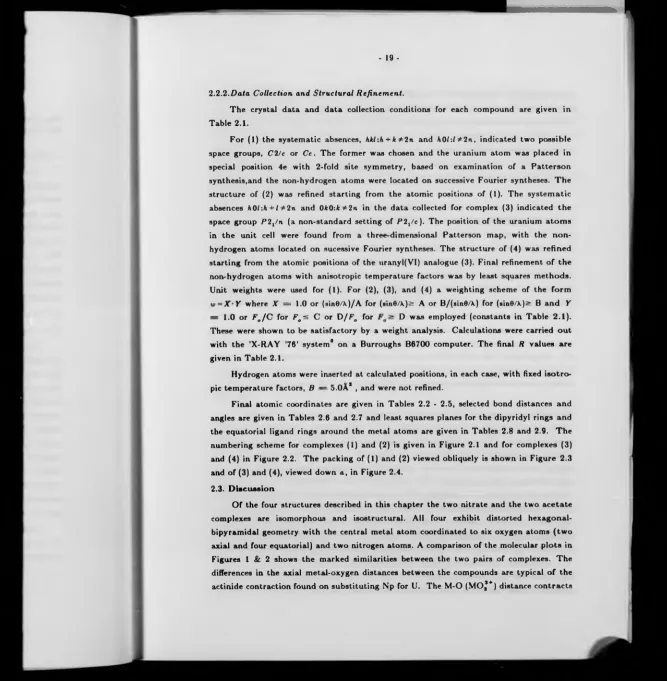
Final atomic coordinates are given in Tables 2.2 - 2.5, selected bond distances and angles are given in Tables 2.6 and 2.7 and least squares planes for the dipyridyl rings and the equatorial ligand rings around the metal atoms are given in Tables 2.8 and 2.9. The numbering scheme for complexes (1) and (2) is given in Figure 2.1 and for complexes (3) and (4) in Figure 2.2. The packing o f (1) and (2) viewed obliquely is shown in Figure 2.3 and o f (3) and (4), viewed down o, in Figure 2.4.
2.3. D iscu ssion
[image:30.697.12.679.20.701.2]20
-from 1.763(13)A to 1.728(7)A in the nitrates and -from 1.770(8)(mean) to 1.729(10)(mean)A in the acetates, a mean contraction o f 0.038 A, similar to those found in complexes with phosphine oxide ligands 7 where M-O (M O ^*) bond lengths decrease by 0.025 and 0.028A. The M -O (nitrate) bond distances show a very slight contraction from 2.49(1) and 2.48(1)A to 2.48(1) and 2.47(1)A and the M -O (acetate) bond lengths apparently increase slightly from 2.450(9)(mean) to 2.455(9)(mean) A, though neither o f these changes is sta tistically significant. Both M-O bonds are comparable with the distances in other uranyl nitrate and acetate compounds. *
U-N bond lengths have been found previously in the rather wide range o f 2.47 to 2.66 A *’*° which covers the values found in (1) and (3) (2.578(13),2.642(9) and 2.631(10)A). The substitution o f Np for U in (2) causes a small decrease in the M-N bond length is as expected from the contractions in the M -O bond distances. However there is a striking anomaly in the change in the M -N bond lengths in the acetate complexes. The substitution o f Np for U causes an increase in the bond length of no less than 0.20A (from 2.642(9) and 2.631( 10)A to 2.842(13) and 2.835(13)A). Examination o f the cell constants (in Table 2.1) also shows a surprising deviation. The normal expectation, on replacing U by Np, is o f a slight contraction corresponding to the decrease in ionic radius between the two elements as is found for the nitrates. In the case o f the acetate complexes the unit cell volume o f the neptunyl compound is significantly larger than that of the uranyl analo gue, and this change arises specifically from an increase o f 0.1 A in the b axis length. The packing o f the acetate compounds (Figure 2.4) shows that this axial length expansion is caused by the increases in M-N bond lengths because these are aligned broadly parallel to the b axis.
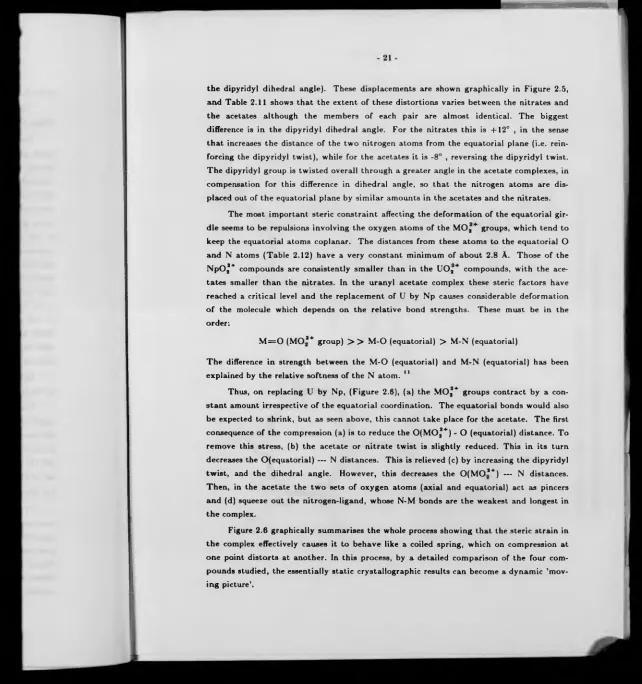
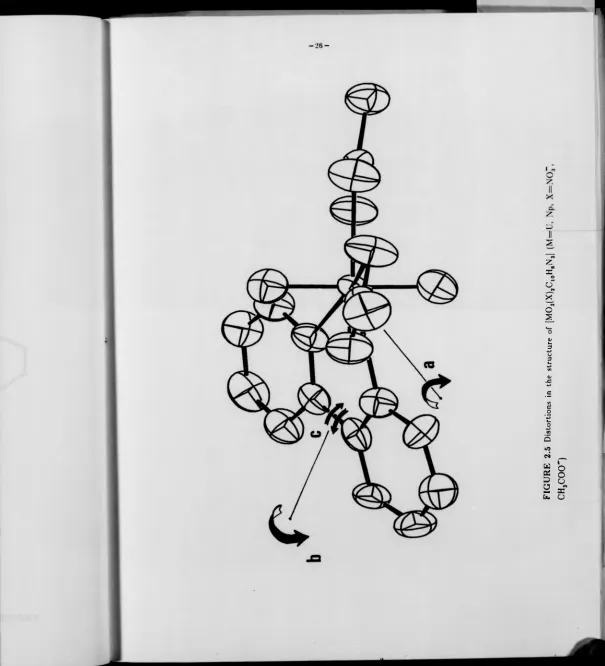
the dipyridyl dihedral angle). These displacements are shown graphically in Figure 2.5, and Table 2.11 shows that the extent o f these distortions varies between the nitrates and the acetates although the members o f each pair are almost identical. The biggest difference is in the dipyridyl dihedral angle. For the nitrates this is +12° , in the sense that increases the distance o f the two nitrogen atoms from the equatorial plane (i.e. rein forcing the dipyridyl twist), while for the acetates it is -8° , reversing the dipyridyl twist. The dipyridyl group is twisted overall through a greater angle in the acetate complexes, in compensation for this difference in dihedral angle, so that the nitrogen atoms are dis placed out of the equatorial plane by similar amounts in the acetates and the nitrates.
The most important steric constraint affecting the deformation o f the equatorial gir dle seems to be repulsions involving the oxygen atoms o f the M O ,* groups, which tend to keep the equatorial atoms coplanar. The distances from these atoms to the equatorial O and N atoms (Table 2.12) have a very constant minimum o f about 2.8 A. Those o f the NpO|* compounds are consistently smaller than in the U O ,* compounds, with the ace tates smaller than the nitrates. In the uranyl acetate complex these steric factors have reached a critical level and the replacement of U by Np causes considerable deformation o f the molecule which depends on the relative bond strengths. These must be in the
order:
M = 0 (M O ** group) > > M -O (equatorial) > M-N (equatorial)
The difference in strength between the M -O (equatorial) and M-N (equatorial) has been explained by the relative softness o f the N atom. 11
Thus, on replacing U by Np, (Figure 2.6), (a) the MO^* groups contract by a con stant amount irrespective o f the equatorial coordination. The equatorial bonds would also be expected to shrink, but as seen above, this cannot take place for the acetate. The first consequence o f the compression (a) is to reduce the O jM O j* ) - O (equatorial) distance. To remove this stress, (b) the acetate or nitrate twist is slightly reduced. This in its turn decreases the O(equatorial) — N distances. This is relieved (c) by increasing the dipyridyl twist, and the dihedral angle. However, this decreases the 0 (M 0 * * ) — N distances. Then, in the acetate the tw o sets o f oxygen atoms (axial and equatorial) act as pincers and (d) squeeze out the nitrogen-ligand, whose N-M bonds are the weakest and longest in the complex.
[image:32.689.12.654.18.702.2]F
IG
U
R
E
2
.3
The
p
a
ck
in
g
o
f
|
M
0
,(
N
0
3
),
C
10
H
,N
,]
v
[image:35.703.21.681.15.719.2]F
IG
U
R
E
2
.5
D
is
tor
tio
n
s
in
th
e
str
u
ct
u
re
o
f
[M
0
2(
X
),
C
10
H
,N
,|
(M
=
CH
jC
O
O'
[image:37.689.35.640.16.682.2]28
-C ry sta l D a ta and D a ta -C o lle c tio n -C o n d itio n s T A B L E 2.1
C o m p o u n d (1) (2 ) (3) (« )
Formula c10h sn4o,u C 10HsN4N pO , cI4h14n,o.u C I4Hl4N,NpO
M 550.24 549.20 544.32 543.28
System Monoclinic Monoclinic Monoclinic Monoclinic
Space Group C2/e C2/e P2x/n P 2x/n
a / k 13.370(2) 13.365(4) 7.949(1) 7.927(1)
b / k 9.977(3) 9.935(5) 19.032(5) 19.126(4)
e / k 10.538(2) 10.451(2) 10.602(3) 10.604(2)
P /° 99.81(1) 99.95(2) 95.66(2) 95.87(2)
u / k 1 1 385.1(5) 1 366.8(8) 1 596.1(7) 1 599.2(6)
X 4 4 4 4
Dc /g cm '3 2.64 2.67 2.26 2.26
| x (M o -/fJ /c m 'l 111.6 49.79 96.8 42.43
Crystal size/mm. ■ 12x.08x.30 .17x.02x.28 .3 8 x .iix .l0 ■42x.12x.12
Max. transmission factor 0.52 0.90 0.66 0.81
Min. transmission factor 0.31 0.48 0.50 0.70
T e m p .,# ,/0 C 16 -100 16 16
Scan range about K a -K n / ° -1 .0 /+ 1 .1 - 1.1 -1 .0 /+ 1 .1 -1 .0 /+ 1 .1
Reflections collected 1 367 1 358 3 072 3 160
Reflections observed 1 108 1 083 1 821 1 936
[7 /o(/)23.0]
Weighting constants:A and B 0.20;0.60 0.37;0.37 0.05;0.99
:C and D 50.0; 180.0 70.0; 180.0 24.0;200.0
29
-T A B L E 2.2
A to m ic co o rd in a te s ( x 10*) for (1), with standard deviations in parentheses.
A to m X V X
U 0.0 652.7(8) 2500.0
0 (1 ) 745(8) 619(12) 4050(9)
0 (2 ) 1663(8) 306(10) 1779(10)
0 (3 ) 842(9) -1473(11) 2062(12)
0 (4 ) 2327(9) -1636(12) 1478(12)
N (l) 1643(10) -961(12) 1754(12)
N(2) 566(9) 2863(12) 1570(11)
C (l) 355(11) 1066(13) 2028(14)
C(2) 764(13) 5244(15) 1631(17)
C(3) 1380(14) 5185(17) 707(18)
C(4) 1540(13) 3974(18) 156(18)
C(5) 1121(13) 2835(16) 612(15)
T A B L E 2.3
A to m ic c o o r d in a te s ( x 10*) for (2), with standard deviations in parentheses
A to m X » X
Np 0.0 655.9(6) 2500.0
0 (1 ) 727(6) 625(9) 4036(7)
0 (2 ) 1666(6) 325(7) 1796(7)
0 (3 ) 839(7) -1478(8) 2084(9)
0 (4 ) 2328(7) -1625(9) 1486(8)
N (l) 1646(8) -959(9) 1770(9)
N(2) 567(7) 2854(9) 1556(8)
C (l) 346(8) 4074(10) 2026(9)
C(2) 771(9) 5256( 10) 1629(11)
C(3) 1388(10) 5204(12) 711(12)
C(4) 1546(9) 3965(12) 161(12)
30
-T A B L E 2.4
A to m ic c o o r d in a te s (xlO*) for (3), with standard deviations in parentheses
A to m z 1 z
U 2197.9(6) 1696.4(2) 3407.4
0 (1 ) 4434(10) 1723(5) 3447(8)
0 (2 ) -29 1658 3324
0 (3 ) 1945(14) 2256(4) 5471(9)
0 (4 ) 2229( 13) 2945(4) 3886(8)
0 (5 ) 2312(13) 1319(4) 1184(8)
0 (6 ) 1962(10) 2431(5) 1514(8)
N (i) 1601(12) 333(5) 3223(10)
N(2) 3190(13) 871(5) 5328( 10)
C (l) 722(18) 90(6) 2167(13)
0(2 ) 167(20) -612(7) 2005(14)
0(3 ) 495(20) -1066(7) 3032(14)
0(4 ) 1347(17) -819(6) 4126(12)
0(5) 1886(15) -108(6) 4184(11)
0(6 ) 2822(16) 170(6) 5349(12)
0 (7 ) 3438(20) -249(7) 6351(13)
0 (8 ) 4436116) 54(6) 7368(12)
0(9) 4839(19) 749(8) 7311(13)
0(10) 4165(14) 1141(6) 6314(11)
0(11) 2050(16) 2876(6) 5039(12)
0(12) 1926(20) 3503(6) 5905(13)
0(13) 2203(16) 1940(6) 778(12)
31
-T A B L E 2.5
A to m ic c o o r d in a te » (x tO 4) l’or (4), with standard deviations in parentheses
A tom X » z
Np 2204.5(7) 1690.6(2) 3418.2
0 (1 ) 4379(13) 1730(6) 3476(8)
0 (2 ) 6(12) 1658(5) 3347(8)
0(3 ) 1934(15) 2253(5) 5474(9)
0 (4 ) 2228(16) 2948(5) 3886(8)
0 (5 ) 2340(14) 1307(4) 1200(8)
0(6 ) 1950(15) 2421(5) 1533(9)
N (l) 1573(15) 343(5) 3218(10)
N(2) 3181(15) 871(5) 5334( 10)
C (l) 729(20) 86(7) 2144(13)
0(2) 148(21) -593(7) 2011(13)
0(3) 483(22) -1055(7) 3017(16)
0(4) 1320(20) -801(7) 4125(14)
0(5) 1865(16) -110(6) 4202(11)
0(6) 2864(16) 175(6) 5363(12)
0(7) 3422(19) -245(7) 6392(13)
0(8) 4449(21) 49(8) 7385(14)
0(9) 4794(20) 757(8) 7345(14)
0(10) 4189(18) 1147(7) 6321(13)
0(11) 2038(18) 2866(7) 5040(13)
0(12) 1949(22) 3497(7) 5894(13)
0(13) 2187(17) 1925(6) 777(12)
32
-T A B L E 2.6
B ond len g th s (A) and bond angles (°) for [MO,(NO.,)SC 10HSN,] [M = U (1 ) or Np(2)], with standard deviations in parentheses (Primed atoms are related to unprimed by a two-fold axis)
a )B o n d len gth s (1) (2)
i) Around M
M -O (l) 1.763(13) 1.728(7)
M -0(2) 2.494(13) 2.484(8)
M -0(3) 2.481(12) 2.472(8)
M-N(2) 2.578(13) 2.564(9)
ii) Nitrate groups
N (l)-0 (2 ) 1.264(15) 1.277(12)
N( 0 -0 (3 ) 1.278(19) 1.288(14)
N (l)-0 (4 ) 1.210(19) 1.203(14)
iii) Dipyridyl groups
N (2)-C (l) 1.34(2) 1.36(1)
N(2)-C(5) 1.35(2) 1.35(2)
C (l)-C (0 ' 1.49(2) 1.47(2)
C (0 -C (2 ) 1.39(2) 1.40(1)
C(2)-C(3) 1.38(3) 1.37(2)
C(3)-C(4) 1.37(3) 1.39(2)
C(4)-C(5) 1.39(3) 1.37(2)
b ) B ond A n gles ( 0 (2)
i) Around M
0 (1 )-M -0 (1 )' 177.8(6) 177.9(4)
0 (l)-M -0 (2 ) 83.5(4) 83.3(3)
96.2(4) 96.4(3)
0 (l)-M -0 (3 ) 87.3(5) 87.0(4)
90.8(5) 91.2(4)
0(1)-M -N (2) 102.3(5) 102.5(3)
79.7(5) 79.3(3)
0 (2 )-M -0 (3 ) 50.8(4) 51.5(3)
0(2)-M -N (2) 70.6(4) 70.1(3)
0 (3 )-M -0 (3 )' 62.5(4) 61.9(3)
33
-T A B L E 2.8 c o n i.
ii) Nitrate groups (1) (2)
0 (2 )-N (l)-0 (3 ) 114(1) 114(1)
0 (2 )-N (l)-0 (4 ) 123(1) 123(1)
0 (3 )-N (l)-0 (4 ) 123(1) 123(1)
iii) Dipyridyl group
C (5)-N (2)-C(l) 118(1) 117(1)
N (2 )-C (l)-C (l)' 122( 1 ) 116(1)
N (2)-C(l)-C(2) 116(1) 121(1)
C(2)-C (l)-C ( 1)' 122(1) 122(1)
C(l)-C(2)-C (3) 119(1) 120(1)
C(2)-C(3)-C(4) 119(2) 118(1)
C(3)-C(4)-C(5) 118(2) 119(1)
34
-T A B L E 2.7
B on d lengths (A) and angles (°) for [MOjICHjC O O IjC ^ Hj.N,], [M— U(3) or Np(4)], with standard deviations in parentheses.
a)B on d lengths (3) (4)
i) Around M
M -O (l) 1.774(8) 1.720(10)
M -0(2) 1.765(8) 1.737(10)
M -0(3) 2.459(9) 2.460(9)
M -0(4) 2.429(9) 2.455(9)
M -0(5) 2.475(9) 2.476(9)
M -0(6) 2.438(9) 2.430(9)
M -N (l) 2.642(9) 2.842(13)
M-N(2) 2.631(10) 2.835(13)
ii) Acetate groups (3) (4)
C( 11)-C( 12) 1.514(8) 1.514(20)
C(11)-0(3) 1.271(9) 1.264(16)
C (ll)-0 (4 ) 1.252(9) 1.259(17)
C( 13)-C( 14) 1.526(8) 1.542(19)
C(13)-0(5) 1.257(9) 1.265(15)
C (13)-0(6) 1.245(9) 1.268(16)
iii) Dipyridyl groups
N (l)-C (l) 1.34(2) 1.35(1)
C (l)-C (2) 1.41(2) 1.38(1)
C(2)-C(3) 1.39(2) 1.40(2)
C(3)-C(4) 1.37(2) 1.38(2)
C(4)-C(5) 1.41(2) 1.39(2)
C (5)-N (l) 1.32(2) 1.36(2)
C(5)-C(6) 1.48(2) 1.50(2)
C(6)-N(2) 1.37(2) 1.36(2)
C(6)-C(7) 1.38(2) 1.39(2)
C(7)-C(8) 1.40(2) 1.38(2)
C(8)-C(9) 1.36(2) 1.38(2)
C(9)-C(10) 1.36(2) 1.36(2)
T A B L E 2.7 c o n t.
b) B ond A ngles (3) (4)
i) Around M
0 (l)-M -0 (2 ) 178.3(3) 179.3(4)
0(3)-M -O (4) 52.5(3) 52.6(3)
0 (4 )-M -0 (6 ) 67.0(3) 66.5(3)
0(5)-M -O (6) 52.3(3) 52.9(3)
N(l)-M-N(2) 60.6(3) 61.0(3)
N (l)-M -0(5) 70.6(3) 70.1(3)
N(2)-M -0(3) 67.3(3) 67.7(3)
0 (l)-M -O (3 ) 97.9(4) 97.3(4)
0 (l)-M -0 (4 ) 88.7(4) 87.9(5)
0 (l)-M -0 (5 ) 84.2(4) 84.6(4)
0 (l)-M -O (6 ) 89.9(3) 90.1(4)
0(1)-M -N (1) 101.6(4) 103.1(4)
0(1)-M -N (2) 77.0(4) 77.5(4)
ii) Acetate groups
C (1 2 )-C (ll)-0 (3 ) 120.2(4) 120.8(12)
C (l2 )-C (n )-0 (4 ) 122.0(4) 120.0(12)
0 (3 )-C (n )-0 (4 ) 117.8(6) 119.2(12)
C(14)-C( 13)-0(5) 119.8(4) 121.2(12)
C(14)-C(13)-0(6) 120.2(4) 119.4(11)
0(5)-C( 1 3)-0(6) 120.0(6) 119.3(12)
iii) Dipyridyl group (3) (4)
N (l)-C (l)-C (2) 123.9(12) 123.9(12)
C(l)-C(2)-C (3) 117.4(13) 119.0(13)
C(2)-C(3)-C(4) 119.1(12) 117.9(13)
C(3)-C(4)-C(5) 119.0(11) 120.3(13)
C(4)-C(5)-N (l) 123.4(11) 122.3(11)
C(4)-C(5)-C(6) 120.1(10) 122.0(11)
N(l)-C(5)-C(6) 116.4(10) 115.7(10)
N(2)-C(6)-C(7) 121.1(11) 122.7(11)
N(2)-C(6)-C(5) 115.3(10) 115.0(10)
C(5)-C(6)-C(7) 123.3(11) 122.3(11)
C(6)-C(7)-C(8) 119.2(11) 118.6(12)
C(7)-C(8)-C(9) 118.9(11) 118.5(13)
C(8)-C(9)-C( 10) 119.4(12) 120.4(13)
C(9)-C( 10)-N(2) 123.2(11) 122.2(12)
36
-D ev ia tion s (A) from mean planes for M O ,(C 10H8N2)(NO2)j [J Np(2)]. (Primed atoms are related to unprimed by a two-fold atoms define planes).
T A B L E 2 .8
Plane 1 (1)
M * 0.000
0 (2 ) * 0.234
0 (3 ) * 0.054
N(2) * -0.526
0 (2 )' * -0.234
0 (3 )' * -0.054
N(2)' * Plane 2
0.526
M * 0.000
N(2) * -0.027
C (I) * 0.049
C (l)' * -0.049
N(2)' * 0.027
Plane 3
0 (2 ) * 0.001
0 ( 3 ) * 0.001
0 (4 ) * 0.002
N (l) * -0.004
Line 4 (1)
0 ( 1 ) * 0.011
M * 0.022
0 (1 )' * 0.011
A ngles betw een plane n o rm a ls and line (°)
1:2 21.98 1:3 7.09 1:4 0.93 2:3 29.00 2:4 21.05 3:4 8.02
1 = U (l) or axis, starred
(
2)
0.000 0.237 0.066 -0.540 -0.237 -0.066 0.540 0.000 -0.025 0.046 -0.046 0.025 0.001 0.001 0.001 -0.003
(2)
37
-T A B L E 2.9
D ev ia tion s (A) from mean planes for M Oj(C ,0HsN,)(CH 3C O O )j [M = U(3) or Np(4)). (Starred atoms define planes).
P lane 1 (3) (4) P lane 2 (3) (4)
M * -0.004 0.004 N (l) * 0.000 0.000
0 (3 ) * -0.340 -0.339 C(5) * 0.000 0.000
0 (4 ) * 0.046 0.049 C(4) * 0.000 0.000
0 (5 ) * 0.244 0.261 N(2) -0.013 -0.070
0 (6 ) * -0.004 -0.018 C(6) 0.057 0.047
N (l) * -0.533 -0.548 C(7) 0.284 0.201
N(2) * 0.591 0.591
Plane 3 P lane 4
N (l) 0.337 0.155 M * -0.036 -0.028
C(5) 0.127 0.001 N( 1) * 0.065 0.058
C(4) 0.075 -0.106 C(5) * -0.057 -0.059
N(2) * 0.000 0.000 C(6) * -0.011 0.007
0 (6 ) * 0.000 0.000 N(2) * 0.039 0.021
0 (7 ) * 0.000 0.000
P lane 5 P lan e 8
0 (3 ) * 0.000 0.000 0 ( 5 ) * 0.000 0.000
0 (4 ) * 0.000 0.000 0 ( 6 ) * 0.000 0.000
0(11) * 0.000 0.000 C( 13) * 0.000 0.000
0(12) -0.025 0.010 C( 14) 0.032 0.074
Line 7 (3) (4)
0 ( 1 ) * 0.009 0.003
M * 0.018 0.007
38
-T A B L E 2.9 co n t.
A n g les b etw een plane n orm a ls and line (°)
(3) (4) (3) (4)
1:2 26.13 27.65 3:4 6.76 2.62
1:3 32.27 28.67 3:5 41.29 37.95
1:4 25.59 26.13 3:6 43.75 38.88
1:5 11.10 11.21 3:7 56.88 60.55
1:6 11.49 10.32 4:5 34.52 35.34
1:7 89.14 89.07 4:6 37.08 36.36
2:3 9.74 6.62 4:7 63.55 63.08
2:4 5.75 5.86 5:6 7.82 9.02
2:5 33.54 35.42 5:7 79.46 79.03
2:6 37.33 37.96 6:7 79.37 80.53
T A B L E 2.10
E q u a to ria l n o n -b o n d e d c o n ta c ts (Ä)
a) In tra -lig a n d ’ B ites’ U Np Avg.
N— N Nitrate 2.67(2) 2.69(2) 2.68
Acetate 2.66(1) 2.66(1) 2.66
O— O Nitrate 2.13(2) 2.15(1) 2.14
Acetate 2.16(1) 2.18(1) 2.175
2.17(1) 2.19(1)
b ) C o n ta c ts betw een ligand s
N— O Nitrate 2.93(2) 2.90(1)
Acetate 2.83(1) 2.83(1)
2.96(1) 2.93(1)
O — O Nitrate 2.57(2) 2.54(1)
Acetate 2.69(1) 2.68(1)
T A B L E 2.11
D isto rtio n s in th e eq u a toria l g r o u p s (°)
a) Oxyanion twist (dihedral angle between anion and mean equatorial plane)
Nitrate
U Np
7.0 6.5
Acetate
U Np
11.3 (avg.) 10.8 (avg.)
b) Dipyridyl twist (dihedral angle between mean N-C-C-N plane, and mean equatorial plane)
22.0 22.7 25.6 26.1
c) Dipyridyl dihedral angle (between two rings of dipyri dyl molecule)
39
-E q u a toria l n o n -b o n d e d c o n t a c t * (A) T A B L E 2.10
a) In tra -liga n d 'B ite * ' u Np Avg.
N— N Nitrate 2.67(2) 2.69(2) 2.68
Acetate 2.66(1) 2.66(1) 2.66
O
i
i
o
Nitrate 2.13(2) 2.15(1) 2.14
Acetate
b ) C o n ta cts b e tw e e n ligands
2.16(1) 2.17(1)
2.18(1) 2.19(1)
2.175
N— O Nitrate 2.93(2) 2.90(1)
Acetate 2.83(1) 2.96(1) 2.83(1) 2.93(1) 0 1 o
Nitrate 2.57(2) 2.54(1)
Acetate 2.69(1) 2.68(1)
T A B L E 2 .1 1
D istortion * in the e q u a to r ia l g ro u p s (°)
Nitrate Acetate
U Np u Np
a) Oxy anion twist (dihedral
angle between anion and
mean equatorial plane)
7.0 6.5 11.3 (avg.) 10.8 (avg.)
b) Dipyridyl twist (dihedral angle between mean N-C-C-N plane, and mean equatorial plane)
22.0 22.7 25.6 26.1
c) Dipyridyl dihedral angle (between two rings o f dipyri dyl molecule)
10
-T A B L E 2.12
D ista n ce s fr o m a c tin y l o x y g e n a to m s t o e q u a to ria l ligand a to m s (A)
u Np
Nitrate 2.85(2) - 3.42(2) 2.81(1) - 3.339(1)
Acetate 2.82(1) - 3.50(1) 2.80(1) - 3.46(1)
Nitrate 2.89(2) - 3.22(2) 2.86(1) - 3.18(1)
R eferen ces
1. K. W. Bagnali, Gmelin Handbuch URAN Suppl., E l, p. 40, 1979.
2. P. V. Balakrishnan. S. K. Patii, H. D. Sharma. and V. H. Venkatasetty, Can. J. Chem., vol. 43. p. 2052, 1965.
3. J. B. Laidler, J. Chem. Soc. A, p. 780, 1966.
4. V. P. Markov and V. V. Tsapkin, Russian J. Inorg. Chem., vol. 7, p. 250, 1962.
5. L. H. Jones, J. Chem. Phys., vol. 23, p. 2105, 1955.
6. J.M. Stewart, ‘ ‘ The X-RAY '76 System." TR-466. Computer Science Center, Univer sity o f Maryland. U.S.A., 1976.
7. N. W. Alcock, M. M. Roberts, and D. Brown, J. Chem. Soc., Dalton Trans., p. 25, 1982.
8. L. Cattalini, U. Croatto, S. Degetto, and E. Tondello, Inorg. Chim. A cta Reviews, vol. 5, p. 19. 1971.
9. G. Bandoli, D. A. Clemente, G. Marangoni, and G. Paolucci, J. Chem. Soc. Chem.
Commun., p. 235, 1978.
10. G. Bandoli, D. A. Clemente, G. Marangoni, and G. Paolucci, J. Chem. Soc. Dalton
Trans., p. 1304, 1980.
11. G. Bandoli, D. A. Clemente, U. Croatto, M. Vidali, and P. A. Vigato, J. Chem. Soc.
42
-T h e C ry sta l and M o le cu la r S tru ctu re s o f -T w o U ra n iu m (V l) C o m p le x e s w ith
1.10- p h e n a n th r o line.
3.1. In tro d u ctio n
As a result o f the work described in Chap. 2, and the effect o f the ability o f the bidentate A -donor ligand to twist about the 1,1' C-C bond allowing accomodation o f a bulky ligand in the equatorial plane o f a hexagonal bipyramid, it was o f interest to substi tute a more rigid ligand for 2.2’ -dipyridyl. The ideal ligand for this comparison is 1,10- phenanthroline which has a similar geometry to the dipyridyl, but has a benzene ring join ing the two pyridyl rings rather than a single C-C bond. The structure of dinitratodioxo( l,10-phenanthroline)uranium(VI) (5) is discussed here and compared with the 2,2'-dipyridyl analogue. A preparation and structure determination of diacetatodioxo(l,10-phenanthroline)uranium(VI) (6) was also attempted.
3.2. E xp erim en ta l
3.2.1. Preparation
Compound (5) was prepared by the technique o f liquid diffusion,1 placing a saturated ethanol (2cm3) solution o f uranyl nitrate in a small, narrow test tube and carefully layer ing a saturated solution o f 1,10-phenanthroline in ethanol (2cm3) on top. The tube was carefully sealed and the solutions allowed to mix by diffusion, being left undisturbed for
ca. one week. When the two solutions had mixed completely, the crystals were filtered off
and washed in ice-cold ethanol. Compound (6) was prepared in a similar fashion, with a saturated solution o f uranyl acetate in ethanol being layered on top o f the solution of
1.10- phenanthroline. Suitable crystals o f each compound were chosen and mounted on quartz fibres.
3.2.2. Crystal Data
[5] iC^HgN^OgU, M = 574.25, trigonal, space group 7*3,21, a — 11.303(2), e = 10.336(4) A, U = 1143.5(5) A3, / = 3, D „ — 2.72 g c m '3, 0 , = 2.48 gm c m '3, p(M o -
K J = 101.22cm "1.
[6] : C „ H ,4N4O 10U,, M = 1005.36. monoclinic, space group C e, a = 23.320(6), b =
9.945(4), « = I5.978(4)A, p = 119.14(2)°, U = 3237(2)A3, / = 4. D. = 2.07 g c m " 3,
ijl( Mo- K n) = 95.27 cm —1.
3.2.3. Data Collection and Structural Refinement
Data were collected with the Syntex P'2t automatic four-circle diffractometer. For (5), a crystal o f dimensions 0.15 x 0.16 x 0.46 mm was used which gave transmission


![FIGURE 2.2 The (VlO,(CH3COO),C10H,N,] (M=U or Np) molecule showing atomic](https://thumb-us.123doks.com/thumbv2/123dok_us/9882099.489444/34.687.22.662.13.703/figure-vlo-ch-coo-np-molecule-showing-atomic.webp)
![FIGURE 2.3 The packing of |M0,(N03), C10H,N,] vi](https://thumb-us.123doks.com/thumbv2/123dok_us/9882099.489444/35.703.21.681.15.719/figure-the-packing-of-m-n-c-h.webp)
![FIGURE 2.9 The sequence of reactions on compressing the [MO,(CHjCOO),Cl0HtiNt]](https://thumb-us.123doks.com/thumbv2/123dok_us/9882099.489444/38.691.38.648.14.689/figure-sequence-reactions-compressing-mo-chjcoo-cl-htint.webp)

![Table 4.1 . For complex [7], the systematic absences: hkl-.h + k,k + 1 * 2n; 0kl:k +1 *4n;](https://thumb-us.123doks.com/thumbv2/123dok_us/9882099.489444/65.686.10.667.10.708/table-complex-systematic-absences-hkl-h-k-kl.webp)
