University of Warwick institutional repository: http://go.warwick.ac.uk/wrap
A Thesis Submitted for the Degree of PhD at the University of Warwick
http://go.warwick.ac.uk/wrap/4524
This thesis is made available online and is protected by original copyright. Please scroll down to view the document itself.
A SAILWING VERTICAL AXIS WIND TURBINE
FOR SMALL SCALE APPLICATIONS
Philip Scott Revell
A thesis submitted for the degree of Ph.D.
at the University of Warwick
CONTENTS
page no.
List of illustrations and tables iv
Nomenclature xii
SUMMARY .XY
INTRODUCTION 1
1. PERFORMANCE THEORY FOR DARRIEUS TURBINES 10
1.1. Introduction 10
1.2. Analysis 13
1.2.1. The Effect of Reynolds Number 15
1.2.2. The Effect of Blade Aspect Ratio 16
1.3. Discussion 17
2. THE PERFORMANCE OF SAILWINGS IN DARRIEUS TURBINES 19
2.1. Introduction 19
2.2. Data 19
2.3. Results 22
2.3.1. Low Speed Performance 23
2.3.2. High Speed Perftrmance 24
2.3.3. The Influence of Aspect Ratio 24
244. Discussion 26
2.5. Conclusions 28
3. WIND TUNNEL TESTS OF SAILWINGS 30
3.1. Introduction 30
3.2. Experimental Apparatus 33
3.3. Test Details and Procedure 36
3.4. Results 39
-3.4.1. Solid Aerofoil and Rigid Trailing
Trailing Edge Tests 39
3.4.2. Elastic Trailing Edge Tests 41
page no.
3.5.
Conclusions 444. THE PERFORMANCE OF SAILWINGS IN DARRIEUS TURBINES
--A RE-ASSESSMENT 45
4.1. Introduction 45
4.2. Results and Discussion 45
4.3. Conclusions 50
5, A PROTOTYPE TURBINE 51
5.1. Introduction 51
5.2. Discussion 51
5.3. Design Details 53
5.4. Prototype Theoretical Performance 57
5.5. Conclusions
59
6. PERFORMANCE TESTS ON THE PROTOTYPE TURBINE 60
6.1. Introduction 60
6.2. Test Equipment and Measurements 61
6.2.1. Measurement of the Turbine Inertia 61
6.2.2. Measurement of Turbine Speed 62
6.2.3. Measurement of Windspeed 62
6.2.4. Measurement of the Trailing Edge
Tension 63
6.2.5. Test Method 64
6.3. Data Processing and Analysis 64
6.4. Results and Discussion 66
6.5. Comparison with other Turbines 68
6.5.1. Flow Curvature and the Prototype
Turbine 70
6.6. .Conclusions 72
7. THE PROTOTYPE TURBINE AS A WINDPUMP 73
7.1. Introduction 73
7.2. Turbulence in the Wind and Windpump Output 74
94
98
iii
page no.
7.4.
Performance Tests on a Diaphragm Pump79
7.4.1.
Apparatus and Procedure 807.4.2.
Results and Discussion 817.5.
Testing of the Prototype Turbine under Load 837.5.1.
Arrangement and Predicted Performance83
7.5.2.
Tests, Results and Discussion85
7.6.
Conclusions88
DISCUSSION AND CONCLUSIONS
89
REFERENCES
APPENDICES -- numbered according to chapter
Appendix 1 Derivation of some Equations & 6421z
artal,bsis
Appendix 2 Some Sample Computer Programs
99
1. A single streamtube program
2. A single streamtube program
including allowance for varying Reynolds
Number and finite aspedt ratio
Appendix
3
1001. Relationship between the tension
coefficients Corand
CC,
2. Calibration of the leading edge
strain gauges
3. An additional test with a jib-sail
Appendix
5
1031. Modified expressions for an
inclined blade
2. The power absorbed by a...rotating
strut
page no.
Appendix
7
1091. Turbulence in the wind
2. A simple theory for inertia flow
3. Pipe losses in the pump performance
tests
******************************
LIST OF ILLUSTRATIONS AND TABLES following
page no.
Fig.0.1. Various types of windmill
9
Fig.1.1. Section through a Darrieus turbine showing a
blade element at various positions 12
Fig.1.2. Actuator disc model of the turbine 12
Fig.1.3. Variation of the angle of incidence with
azimuthal angle at low tip speed ratios 12
Fig.1.4. Rate of change of angle of incidence vs.
azimuthal angle 12
Fig.1.5. Variation of angle of incidence along blade
chord 12
Table 2.1. Details of sailwings 20
Fig.2.1. Lift and drag coefficients used for the solid
aerofoil (NACA0012), taken from Shankar
(1976)
21Fig.2.2. Lift and drag coefficients for Sailwing 1
(from Robert and Newman,
1979)
21Fig.2.3. Lift and drag coefficients for Sailwing 2
(from Robert and Newman,
1979)
21Fig.2.4. Lift and drag coefficients for Sailwing 3
(from Robert,and Newman,
1979)
21Fig.2.5. Angle of incidence vs. azimuthal angle at low
following
page no.
Fig.2.6. Ratio evs. azimuthal angle at low tip speed
ratios
22
Fig.2.7. Tangential force and torque coeffs. vs.
azimuthal angle, solid aerofoil 25
Fig.2.8. Tangential force and torque coeffs. vs.
azimuthal angle, Sailwing
1
25Fig.2.9. Tangential force and torque coeff. vs.
azimuthal angle, Sailwing 2 25
Fig.2.10. Mean torque coefficient vs. tip speed ratio 25
Fig.2.11. Mean torque coefficients vs. tip speed ratio
for sailwing 1 with varying scale 25
Fig.2.12. Power coefficient vs tip speed ratio,
solid aerofoil 25
Fig.2.13. Power coefficient vs. tip speed ratio,
Sailwing 1 25
Fig.2.144 Power coefficient vs. tip speed ratio,
Sailwing 2 25
Fig.2.15. Power coefficient vs.
tip speed ratio,Sailwing
3
25Fig.2.16. Mean torque coefficient vs. tip speed ratio,
solid aerofoil, varying aspect ratio 25
Fig.2.17. Power coefficient vs. tip speed ratio for
solid aerofoil with AZ=4 25
Fig.2.18. Power coefficient vs. tip speed ratio for
solid
aerofoil
with AZ =8 25Fig.2.19. Mean torque coefficient vs. tip speed ratio,
Sailwing 1, varying aspect ratio 25
Fig.2.20. Power coefficient vs. tip speed ratio for
Sailwing 1 with
AZ. 8
25Fig. 2.21. Power coefficient vs. tip speed ratio for
vi
following
page no.
Fig.2.22. Power coefficient vs. tip speed ratio for
Sailwing 3 with AZ = 4 25
Fig.2.23. Power coefficient vs. tip speed ratio for
Sailwing . :3 with A =
8
25Fig.3.1. Experimental set-up 35
Table 3.1. Test details 35
Fig.3.2. View of experimental set-up with the tunnel
wall removed 35
Fig.3.3. Arrangement of the flexures and strain gauge
bridges 35
Fig.3.4. Rigid trailing edge 35
Fig.3.5. Blade geometry for elastic trailing edge tests 35
Fig.3.6. Comparison of lift and drag coefficient with
published data, NACA0012 • 35
Table 3.2. Fabric elasticity 36
Fig.3.7. Tangential force coefficient vs. angle of
incidence for NACA0012 aerofoil 43
Fig.3.8. Radial force coefficient vs. angle of incidence
for NACA0012 aerofoil 43
Fig.3.9. Tangential force coefficient vs. angle of
incidence for canvas sailwings 43
Fig.3.10. Tangential force coefficient vs. angle of
incidence for nylon sailwings 43
Fig.3.11. Tangential force coefficient vs. angle of
incidence for 'Dacron' sailwings 43
Fig.3.12. Radial force coefficient vs. angle of
incidence for canvas sailwings 43
Fig.3.13. Radial force coefficient vs. angle of
incidence for nylon sailwings 43
Fig.3.14. Radial force coefficient vs. angle of
vii
following
page no.
Fig.3.15. Lift coefficients for canvas sailwings 43
Fig.3.16. Lift coefficients for nylon sailwings 43
Fig.3.17. Lift coefficients for 'Dacron' sailwings 43
Fig.3.18. Drag coefficients for canvas sailwings 43
Fig.3.19. Drag coefficients for nylon sailwings 43
Fig.3.20. Drag coefficients for 'Dacron' sailwings 43
Fig.3.21. Lift and drag coefficients, canvas sailwings 43
Fig.3.22. Lift and drag coefficients, nylon sailwings 43
Fig.3.23. Lift and drag coefficients, 'Dacron' sailwings 43
Fig.3.24. Results from Buehring (1977) 43
Fig.3.25. Tangential force coefficient vs. angle of
incidence for sailwings with an elastic trailing
edge 43
Fig.3.26. Radial force coefficient vs. angle of
incidence for sailwings with an elastic trailing
edge 43
Fig.3.27. Lift coefficients -elastic trailing edge 43
Fig.3.28. Drag coefficients -elastic
trailing edge
43
Fig.3.29. Induced tension coefficient vs. angle of
incidence 43
Fig.3.30. Induced tension coefficient vs. angle of
incidence 43
Fig.4.1. Tangential force and torque coeffs. vs.
azimuthal angle -Calp 49
Fig.4.2. Torque coefficient vs. tip speed ratio
-solid aerofoil 49
Fig.4.3. Torque coefficient vs. tip speed ratio from
data for canvas sailwings 49
Fig.4.4. Torque coefficient vs. tip speed ratio from
viii
following
page no. Fig.4.5. T orque coefficient vs. tip speed ratio from
data for 'Dacron' sailwings 49
Fig.4.6. Variation of the ratio y . with azimuthal angle 49
Fig.4.7. Power coefficient vs. tip speed ratio,
single streamtube program, data from test Nylw 49
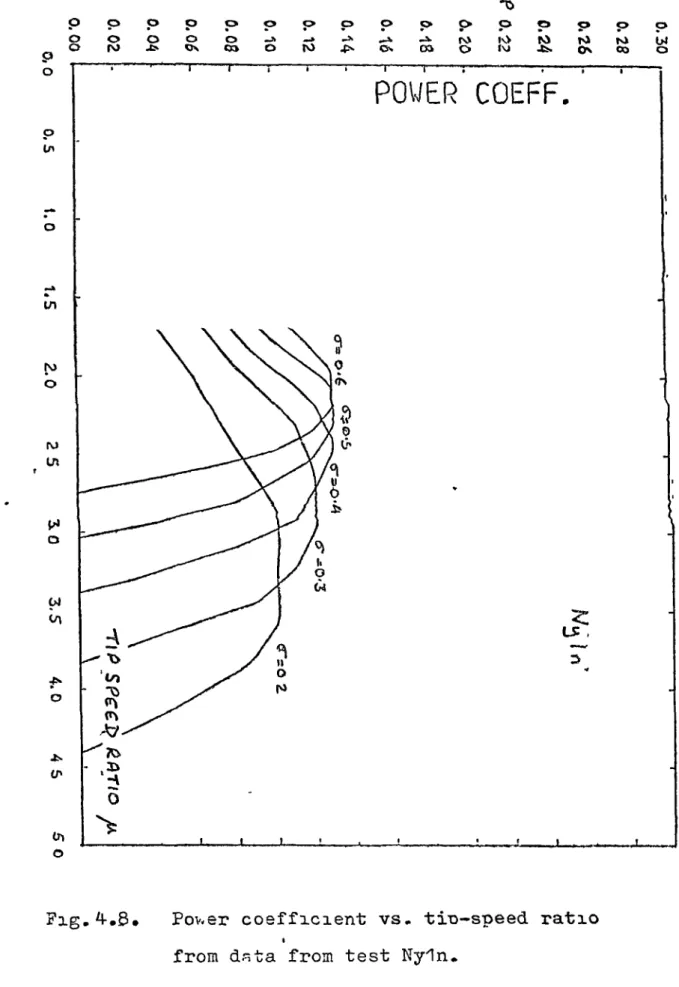
Fig.4.8. Power coefficient vs. tip speed ratio,
data from test Nyln 49
Fig.5.1. Some possible arrangements for a sailwing
turbine 56
Fig.5.2. View of the prototype turbine 56
Fig.5.3. Dimensions of a single sail 56
F ig.5.4. An inclined turbine blade 58
Fig.5.5. Torque coefficient vs. tip speed ratio
-prototype turbine, predicted 58
Fig.5.6. Predicted torque and power coefficient curves
for the prototype turbine 58
Fig.6.1. View of the wind turbine test site 71
Fig.6.2. Diagram of the tachometer arrangement 71
Fig.6.3. Schematic plan of the prototype turbine test
arrangement 71
Fig.6.4. Rotor and windspeed vs. time during a typical
test run 71
Fig.6.5. Torque and power coefficients vs. tip speed
ratio with a nylon trailing edge 71
Fig.6.6. Torque and power coefficients vs. tip speed
ratio with a wire trailing edge 71
Fig.6.7. Power coefficient vs. tip speed ratio,
McGill sailwing turbine (Newman and Ngabo 1 1978) 71
Fig.6.8. Power coefficient vs. tip speed ratio,
ix
following
page no.
Fig.6.9. Power coefficient vs. tip speed ratio,
solid bladed, high solidity turbine
(Stacey and Musgrove11981) 71
Fig.6.10 An approximation to the virtual blade profile 71
Fig.6.11. The variation of virtual pitch angle and virtual
virtual camber ratio with azimuthal angle at low
tip speed ratios 71
Fig.7.1. A spectrum of the horizontal windspeed
(van der Hoven 1 1957)
77
Fig.7.2. Some typical recordings of windspeed at the
test site
77
Fig.7.3. Turbine and load torque curves
77
Fig.7.4. Windspeed and rotor speed vs. time with various
load torques
77
Fig.7.5. Wind power and power absorbed by various loads
vs. time
77
Fig.7.6. Theoretical curve for dimensionless flow vs.
dimensionless speed 80
Fig.7.7. Arrangement for pump performance tests 80
Fig.7.8. Pump test rig and tensioner arrangement 80
Fig.7.9. Overall efficiency, average torque and
volumetric efficienCy vs. speed for diaphragm
pump 82
Fig.7.10. Overall efficiency, average torque and
volumetric efficiency vs. speed for diaphragm
pump 82
Fig.7.11. Water mass flow rate vs. pump speed. 82
Fig.7.12: Dimensionless flow vs. dimensionless speed
—comparison of measurements and theory 82
Fig.7.13. Assumed flow velocity curves for a diaphragm
following
page no.
Fig.7.14. Torque vs. speed curves for the turbine and a
pair of pumps 82
Fig.7.15. Arrangement of the pump drive shaft 87
Fig.7.16. Predictions for rotor speed and water flow
rate for the prototype windpump 87
Fig.7.17. A typical recording of ....turbulent wind 87
Fig.7.18. Section through air snifter 87
Fig.7.19. Rotor and windspeed vs. time -two pumps 87
Fig.7.20. Rotor and windspeed vs. time -one pump 87
Fig.A1.1. The relationship between the lift, drag and
tangential force coefficients 98
Fig.A1.2. The relationship between the lift ldrag and
thrust coefficients
98
Fig.A3.1. Loads in the sailwing frame due to
pre-tension in the sail 100
Fig.A3.2. Calibration load 101
Fig.A3.3. Mounting arrangement for jib sails 102
Fig.A3.4. Tangential force coefficient vs. angle of
incidence for a canvas sailwing with and without
a jib sail 102
Fig.A5.1. To define the nomenclature used in deriving
expressions for an inclined blade 104
Fig.A5.2. Estimated change in the power coefficient due t
to the power absorbed by the three struts of the
prototype turbine 105
Fig.A6.1. Calibration curve for the tachometer circuit 108
Fig.A6.2. Calibration curve for anemometers 108
Fig.A7.1. Auto-correlation function and power sDectral
xi following
page no.
Fig.A7.2. Theoretical flow velocity curves for full
and partial inertia flow 111
Fig.A7.3. Inlet and outlet valves to the pump 116
Fig.A7.4. Assumed flow velocity curve for the diaphragm
pump 116
Fig.A7.5. Half-sine curve with mean value giving the
xii
NOMENCLATURE
G. Slope Ciloco prior to stall
M. Slope glee prior to stall
4 Turbine swept area
As Blade plan area ,
Ai, Cross-sectional area of inertia pipe
Af Piston area of reciprocating pump
Aspect ratio of aerofoil = 6,/c
ii Length of aerofoil blade
C Blade chord or strut chord
Ci, Drag coefficient = Drag force/Wie,VR2
C; Thrust coefficient = Retarding force on airstream/10v
C. Lift coefficient = Lift force/AV:
C lot Induced drag coefficient = C,11/Trick
Cp Power coefficient = PiikANC3
CI;Power coefficient = P/11Z A V3
cp.,. Membrane tensiori coefficient = Pr / -1? V,:-
c
C
Q Torque coefficient = Turhivle. -Forcpue P2-. A V,,,,2" gCs2 Radial force coefficient = C.i.c.osoc.4- Czszeloe
'LW
Cis Mean torque coefficient = lid CA,2 "
0
Ci. Tangential force coefficient .
Cist,,..c-C6c0s04-(C14)Instantaneous torque coefficient for a blade = 1V-IRA8vIR.
CI Trailing edge tension coefficient = T.r/J-z-16vgt
C. A Induced tension coefficient
= chordwise component of tension induced/1(c ot DictmetP-r oC teck.clie,g ectse...
ciD Elemental drag force
olL Elemental lift farce
I i. Diameter of the inertia pipe
e. Ratio: force per unit width/strain, for membrane
Ratio: force/strain, for trailing edge line
C
FrequencyP
. Retarding force on windstream8 Acceleration due to gravity
h, Head Loss
Head of water
3
Moment of inertiak Constant =
04a.
k non-dimensional head loss coefficient h,43.
L Suspension length
L. Length of inertia pipe
m Turbine mass
Water mats flow rate
n Number of turbine blades
f Dynamic pressure or axis co-ordinate
P Power produced by turbine
P Membrane pre-tension per unit width
PwPower in the wind
Ratio:
Ve/V
Q Volumetric water flow rate
ri
Blockage ratio in wind tunnel cscv, 04• s wieres
R Rotor radius
Re Pump crank length
Ru Auto-correlation function
Rs Suspension radius
ke
Reynolds number = V/12.c4tairor
"LLD . /,i1)
-r
TorqueT.T. Pre-tension in trailing edge
u, Water flow velocity, or a length
v- Fluctuating component of windspeed
V
iz Relative windspeed Vw Free windspeedLA) A length
V/
Work donex Maximum hollow in trailing edge curve
Ratio:
7./g0,11
/
Z
Vertical distance along turbine axisdoZ
Angle of incidence of relative wind to blade chordoe Effective angle of incidence, with finite apsect ratio4ff
A
Virtual pitch anglee
Angle of inclination of turbine blade to the vertical,or piston angular position
& Dimensionless speed
6
Blockage factor7voL
Volumetric efficiencyEl' Azimuthal angle (blade angular position)
X
Piston angular postion/A Tip speed ratio
= RS1/Vw
,1
2 Tip speed ratio=
Rn-lV
/A
ar Viscosity of air it-. 1-e2-10 KA30AAS1) Virtual camber ratio or ieZne-ikka-t-c. vZscostk of watcr
1/4.S Dimansionless flow
=
Y/vo i. CS.IL
Air density A.:, 1- 2_kg
/ 3nAn,.
1 Mass of membrane per unit areaWater density e.: 103 k./w,3
cr Turbine solidity
-A/102A
le Time interval
05(4
Power spectral density •S/ Angular velocity
SUMMARY
The use of sailwing aerofoils in vertical axis wind turbines has been investigated. It was anticipated that this could make vertical axis turbines more suitable for water pumping and that this might help to meet the need for a cheap pump for irrigation existing in many parts of the world.
A numerical analysis of the theoretical performance of such a turbine, using existing aerodynamic data for simply constructed sailwings, has been made. This gave an improved understanding of the operation of such turbines but showed a need for further aerodynamic data. Some new wind tunnel tests
of sailwings are described in which the effect of pre-tension was investigated and four different fabrics were tested.
The results are presented for angles of incidence up to 180 degrees and compared with previous data.
With the fresh data, new performance predictions were made which led to the design of a two metre diameter prototype turbine. This used an inclined blade configuration with a guyed top bearing. Canvas was used for the sails. It was predicted that the turbine performance would be significan-qy affected by windspeed.
The turbine was built and later tested in the open air. An acceleration test method was used and the tests generally confirmed the predictions. The averaged starting torque
coefficient was about 0.07; the averaged peak power coefficient was about 0.1 at a tip speed ratio of 1.4.
Consideration has been given to improving windpump system efficiency by improving the gust energy utilisation. Some
tests of a diaphragm pump are described in which inertia flow effects were used. A pair of such pumps were later connected to the prototype turbine. A number of problems were encountered and satisfactory operation was not achieved in the time
INTRODUCTION
This thesis is the result of some research into the
potential for using sailwing aerofoils in vertical axis
wind turbines. It was anticipated that such a turbine could
be suited to low lift water pumping, particularly for
irrigation, in Third World countries.
There would not seem to be any doubt about the
considerable potential of renewable energy technologies in
meeting the energy needs of development. The people of
the Third World, in fact, already meet the majority of their
energy needs from solar-energy and, when wood, food, crop
residues etc. are included, the energy use is much higher
than might be supposed. However, as shown by Makhijani (1976),
the efficiency of energy usage is generally very low and
it is probably by increasing the efficiency of energy use
that some of the most pressing energy needs of the poor
may best be met in a short time.
Basic in an increase in the energy use efficiency,
is an increase in the productivity of agriculture. Properly
managed, an increased energy input to agriculture, in the
form of fertiliser, irrigation and machinery, may increase
the net energy output per unit of land; i.e. crops may
capture more solar energy. Hence, subsistance agriculture
may be transformed into one producing surplus energy, in
the form of food and crop residues, to other parts of the
If irrigation is available then it may be possible
to harvest several crops a year where rainfall may be
largely confined to one season and crop failure due to
erratic rains may be avoided. For widespread irrigation
a source of energy other than that of human labour or
draught animals is necessary, particularly if the land is
to be productively cultivated in the dry season. The use
of windpumps seems an obvious solution in areas where a
suitable wind regime exists.
Makhijani suggests some criteria for windmill design
in the rural Third World:
"1. Low cost; the total cost should be less than POO
and preferably less than 100 so that small farmers and
others who may need a source of power for cottage industries
would be able to afford it,
(1976
prices)2. It should have sufficient power to enable irrigation
of a small plot to i a hectare) and a power take off
to enable it to perform other functions such as sugar cane
crushing. The size of the windmill therefore depends on
the source and quantity of water needed,
3. It should be made of loc . al materials as far as
possible and with local skills (i.e. those available in
a small village). Among the reasons for establishing this
criterion are: i. low capital input and high labour intensity,
accessibili .py of the technology to the
poor,
iii. ease and quickness of maintenance and
repair when required,
satisfaction in ones work and control of it,
V.
high labour productivity,4. It should be stable under adverse weather conditions,
5. It should have a high starting torque so that
auxilary starting devices are not needed."
The quantity of water required for irrigation depends
on the climate, the crop and its stage of growth and the
efficiency of the water distribution system. Average
requirements seem to lie between 40 and 100 m 3 /ha per day
(Stern,1979; United Nations,1981). With a lift of 4m and
an average of six hours pumping per day, this would require
a power in the range 100 to 200 W/ha.
In recent years there have been a number of attempts
to produce cheap windpump designs suitable for irrigation.
In India, the Madurai Windmill Committee have produced a
Cretan design suitable for irrigation in low winds (Sherman,
1976) and work on a similar design has recently been done
at the National Aeronautical Laboratory at Bangalore
(Tewari,1978). Another irrigation project using a Cretan
windpump design, in Ethbpia, has been described by Fraenkel
(1976). The Dutch Steering Committee for Wind Energy for
Developing Countries(SWD) have some promising designs in
operation in Sri-Lanka and elsewhere of the multi-blade type.
(TOOL 1 1982). The Intermediate Technology Development Group
(ITDG) have designed a low maintenance multi-blade windpump
which is now in use in several countries (Fraenke1,1978).
Fraenkel (1982) has poitted out a tendency to underestimate
failure of many wind power projects; he also mentions a
tendency for research to concentrate on the aerodynamics
at the expense of system optimisation. Dixon (1979) has
drawn attention to the low system efficiency of most windpumps.
Wind power is hardly a new technology; Golding(1976)
mentions a reference to a wind powered irrigation scheme in
Babylon in the 17th century BC, and certainly windmills were
in common use in Persia in the 4th century AD. These
windmills had a vertical axis of rotation and relied on
drag forces for their operation, shield walls protecting the
blades as they moved upwind. It may have been from these
designs that the Chinese windmill described by Needham (1965)
derives. This design, still in widespread use, removes the
need for shield walls, as the rectangular, 'junk' type sails
luff automatically when moving into the wind.
Wind power developed in Europe in the 12th century AD
and became an important source of power, particularly for
grain milling but also for water pumping. These machines
had an horizontal 'Axis of rotation, with blades formed by
spreading sails aver a light wooden lattice. In the
Mediterranean region, a design of mono-directional, stone
tower windmill developed, with triangular cloth sails. It
was from this design that the Cretan windmill was adapted
for irrigating small intensively cultivated plots, early in
the 20th century.
Multi-blade windpumps were originally developed in
developing parts of America and Australia. This is now the
most common and widely distributed type of windmill.
Multi-blade windpumps tend to be optimised for high lift applications
and their high cost, all metal construction has restricted
their use in the Third World. Their need for regular skilled
maintenance has meant that those machines which have been ,
installed have often fallen into dis-repair.
The Savonius type of vertical axis windmill was
developed in the 1920's (Savonius 1 1930) and has found widespread
application for ventilation. It has also been used for
water pumping but it has a high material requirement and
is vulnerable in storms.
Developments in aerodynamics have led to very efficient
designs of propellor turbines and there is now a sizeable
effort directed towards the large scale generation of
electricity by wind power. The Darrieus type of vertical
axis wind turbine has undergone rapid development since 1971.
It has a comparable efficiency to propellor type designs
and has the advantages of a vertical axis turbine of not
requiring orientation into the wind and of a smaller support
tower.
Darrieus, a French engineer, filed a patent application
for his turbine in 1925. The design utilised a number of
blades of aerofoil cross-section and was intended to operate
with " the peripheral speed of the blades much exceeding
the speed of the current". It was not until 1971 that Rangi
and South developed the design as_a vertical axis wind turbine
so as to minimise the blade stresses- ari gaing- from the rotation. The design was found to combine the advantages of a vertical
axis with the performance of propellor type turbines. For
small machines, for stand alone applications, the design
has the drawback of not being reliably self-starting.
It is not essential to use a curved blade arrangement.
If the blades are set vertically and parallel to the axis
then more poweris produced near , the blade tips, although
this is likely to be offset by induced drag losses and the
drag incurred by struts. Straight blades are easier to
manufacture and, by allowing the blades to incline at high
speeds it is possible to arrange for self-regulation of the
power output in high winds. Straight blades also make
possible several methods of introducing a self starting
capability. One method is to arrange for a cyclic pitch
variation, as described by Grylls et al (1978), another
method is the use of very low aspect ratio blades (Mays and
Musgrove 1 1978). Another possibility would be to use sailwing
rather than solid aerofoils; the camber then changes
automatically depending on the relative wind direction and it
may offer a cheap method of aerofoil construction.
The sailwing concept was developed at Princeton
University in 1948 (Ormiston,1971). A sailwing is constructed
from a leading edge spar to which ribs are attached to form
a framework which supports a trailing edge cable. A membrane
is wrapped around the leading edge and attached to the trailing
edge so as to form the upper and lower aerofoil surfaces.
The trailing edge is tensioned and curved, imposing a
deflections due to aerodynamic loads. A horizontal axis
windmill using sailwings was developed at Princeton in 1960
(Sherman,1976) and has been adapted for water pumping in
India (Sherman,1973).
Attempts to use sailwing type aerofoils in vertical
axis wind turbines appear to date to have had only limited
success. Hurley
(1979)
has developed a vertical axis sailrotor which appears to have a maximum tip speed ratio of less
than one but which he reports develops a high torque at slow
speeds. New Age Access (PO Box 4 1 Hexham, UK) have
experimented with a similar design intended for electricity
generation but abandoned development after mechanical problems.
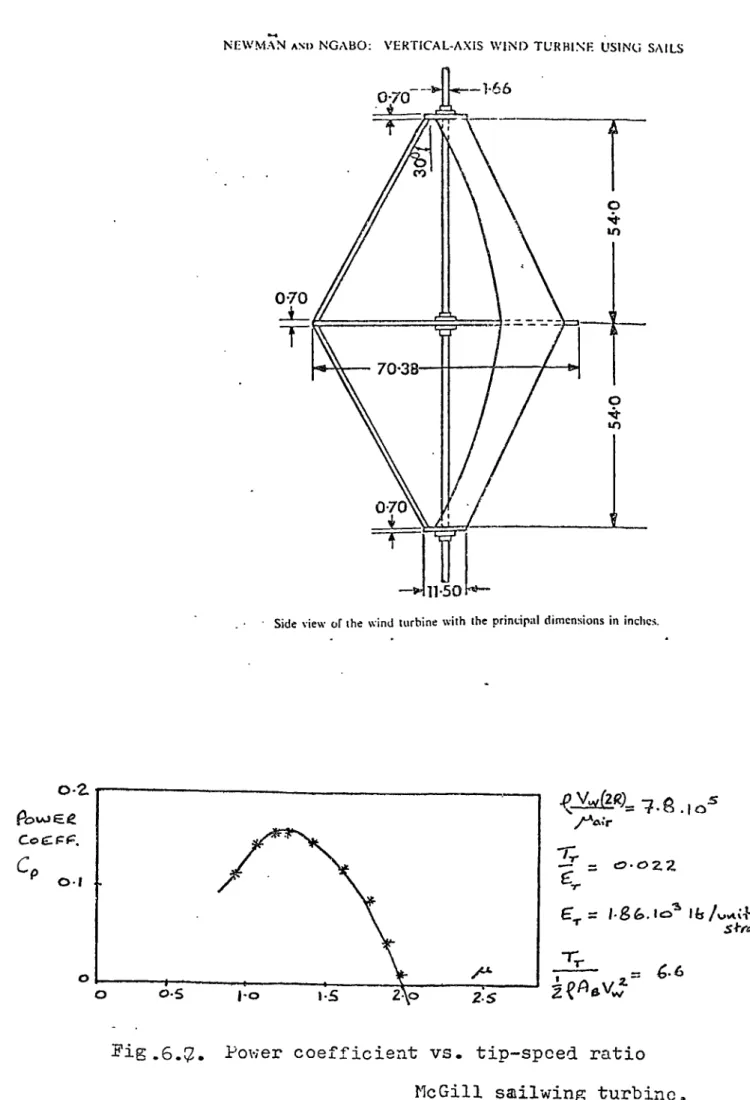
Newman and Ngabo
(1978)
describe some wind tunnel tests on adesign using sailwings and report a peak power coefficient of
0.15 at a tip speed ratio of 1.5.
Initially, the present research sought to ascertain
whether the apparently rather poor performance of vertical
axis sailwing turbines was inherent in the use of sailwings
or could be improved by suitable design. A numerical analysis
of the theoretical performance has been made, using a single
streamtube model of the induced flow through the turbine.
Existing aerodynamic data for sailwing aerofoils from wind
tunnel tests by Roberts and Newman
(1979)
was used. Adescription of the analysis and the results obtained are
given in the first two chapters.
It was apparent that there were a number of shortcomings
in the aerofoil data that was used and so it was decided to
aerodynamic data. In particular these tests sought to
investigate the effect of pre-tension in the fattric and the
performance with different fabrics. The design of suitable
measuring apparatus and the subsequent tests and results are
described in Chapter Three. The new data is compared with the
previous data and also with some limited data by Buehring
(1977).
The fresh aerodynamic data allowed a freah assessment of
the performance to be expected from suet( a turbine. This
suggested that the performance would inevitably be quite low but
the suitability, for pumping applications, of the predicted
torque charaeteristics encouraged the design and construction
of a 2m diameter turbine. This is described in Chapters
Four and Five.
To obtain data on the actual performance of the turbine
in a natural wind, a series of performance tests were made
with the turbine unloaded. Details of the tests and the
results obtained are in Chapter Six. The results gave
reasonable agreement with predictions. The average peak
power coefficient obtained was about 0.1 with a starting
torque coefficient of about 0.07.
The application of the prototype turbine as a windpump
was then considered with a view to low lift applications.
A large amount of energy was shown to be contained in the
gusts occurring in the wind. Consideration was given to
improving the utilisation of this energy by modifying the
pump torque characteristics; hence increasing the system
inertia flow effects were investigated. A pair of
diaphragm pumps were later connected to the turbine.
A number of problems were encountered and for various
reasons, satisfactory operation was not achieved in the time
available. Some possible modifications to the arrangement
are discussed. This is contained in Chapter Seven. Some
general conclusions concerning the future potential for such
1
1
-CI:1 VO r..1 1 0 s
i
Darrieus Rotor - curved blade arrangement,
i
1
,
CHAPTER ONE
PERFORMANCE THEORY FOR DARRIEUS TURBINES
1.1. Introduction
This chapter describes the method used to analyse the
performance of a sailwing vertical axis turbine. The 'single
streamtube' model is described together with the methods used
to allow for the variation of Reynolds number and the effect
of a finite aspect ratio. Some limitations of the method are
discussed and in particular, flow curvature and unsteady flow,
which are not accounted for in the theory, are mentioned.
' A qualitative understanding of the operation of a vertical
axis wind turbine may be gained from a study of Fig.1.1. This
shows a blade element at various azimuthal positions for a
particular windspeed and a given blade angular speed. If the
local azimuthal speed
ea
is large compared to the local windspeedV (Fig.1.1b), the blade element remains unstalled for all
azimuthal positions; the lift force dL contributes a positive
driving torque while the drag force dD detracts from it. When
i2rx<V on the other hand (Fig.1.1c), the angle of
incidence o( varies widely and the blade is in reversed flow
for part of the time. Then it is the drag force which provides
the driving torque.
It should be clear that the actual flow through the rotor
will be extremely complex. The earliest attempt at a
performance prediction model was made by Templin(1974) using
a 'single streamtube l approximation to the induced flow. This
combines one dimensional momentum theory with blade element
analysis. The turbine is modelled as an actuator disc
enclosed in a single streamtube and momentum theory is then
induced wind flow is thus modelled as being uniform at all
points in the rotor, wheraaa in reality, both the speed and
direction of the induced flow will vary throughout the rotor.
Using this approximation to the induced flow, integration of
the blade forces gives an estimate of the mean power output.
The blade forces are calculated as if the blades are always in
quasi-steady flow. Since the induced flow is assuted uniform,
the power output from the upwind pass of the blade (o>e> -rr )
is assumed to be the same as the power output from the downwind
pass ( 77->e>21r), so long as the blade chord is set on a tangent
to the circle which the blade describes. The angle of incidence
oc, at an azimuthal angle 0.2Tr-o, is the same magnitude,
though of different sign, as the angle of incidence at
e=21740.
Considering Fig1.2., in which the turbine is replaced by
an actuator disc exerting a decelerating thrust F on the
windstream, and applying the continuity, momentum and energy
equations to a large control volume, gives the result:
V=
E3
where C. is a thrust coefficient based on the local velocity V :
C 1 =
0-21
iqA0-and A is the frontal area of the turbine.
The power output is then given by P=V r and it is easy
to show, by the Betz analysis (Appendixl) ,that the maximum
fraction of the power in the wind that may be extracted is .
When the turbine is stationary, and at low tip speed ratios
this model of the induced flow may be simplified still further
by assuming that the induced wind velocity is actually equal
assumed to be negligable.
Some improvement in the model of the induced flow may be
made by replacing the single streamtube enclosing the actuator
disc by a bundle of stream filaments. Such a multiple
streamtube model was originally proposed by Strickland(1976)
and has since been refined by Read and Sharpe(1980), amo4g others.
This small refinement does give some improvement in the flow
model but also adds greatly to the complexity of the performance
calculations.
Several attempts have been made to develop a vortex mode
of the flow. Duremberg(1979) appears to have had some success
in applying the method developed by Fanucci(1976) and improved
by Migliore(1978) but was only able to obtain convergent
solutions with low turbine solidities and over a limited range
of tip speed ratios. This method would seem to have
considerable possibilities but is unable to handle stalled
blades.
The crudeness of the approximations used in the single
streamtube model of the induced flow are obvious but use of
this model here is justified by its simplicity, and hence
economical use of computer time, and by the previous success
with which it has been used in predicting the overall
performance of Darrieus turbines (pee for example Shankar,1976).
Although it has been shown to produce slightly optimistic
predictions of the peak power"coefficient it seems quite
adequate for use here where, as will be seen, the main
uncertainties in the predictions arise from uncertainties in
cl.13
Fig.1.1. Section through a Darrieus turbine showing a bl de
element at various positions.
..-Se.•
.ff...,40.
--'\-;---"---I v
-...--...'""•-•n•••.."^--... ...-......
"I
I
THETA g,
20 40 60 60 10 I ?0 140 fa) r`
AcTuAroA bIsc.
Fig.1.2. Actuator disc model of the turbine.
ANGLE.OF INCIDENCE VS AZIMUTHAL ANGLE I
I
Fig.1.3. Variation of angle of incidence with azimuthal
1.2. Analysis
The basic method of analysis used in the next chapter
is outlined below, b orne more detail may be found in Äppendix1.
The method follows that described by Shankar(1976).
T o avoid any need for iteration, the calculations are
performed at chosen values of the tip speed ratio
pe,
basedon the induced wind speed i.e.". /As= -$1- CI.33
coefficient
c' :
f 9
igAv3
and the thrust coefficient Cx defined above( eqn. s [1.23)•
Use of eqn.
ci.
13 enables calculation of the true tip speedratio/A: len.
V,A,
and the power coefficient C : I'
As is described below, this allows calculation of a power
c n = Power
c. = power, [1.61
P -2...Q L A V w 3 as:
and:
, AA.
(14-144
Ct. 73
C'
C = P
P
EI.83
04-1,74CF)3
At low tip speed ratios, when V, and hencep.=/t 1 this
problem is obviously avoided.
The analysis presented here is slightly simplified as it
is assumed that the blades are straight and parallelto the
axis of the turbine rotation.
The angle of incidence made by the relative wind to the
ratio: Sevi
14_42 C.c.S
C
The way in which the angle of incidence varies with
azimuthal position at low tip speed ratios (i.e.pAlg
i
L is shownin Fig.1.3.
The instantaneous contribution of the forces acting on
a blade to the driving torque, depends on the net force
component acting on the tangent to the circle described by the
blade. The tangential force coefficient
C
is related tothe lift and drag coefficients Cand C:
C =Cs o — CD Cos oe.
El.so]
The instantaneous driving torque per blade
7i,
is
therefore: -res = Vof-. .c EiJtj
where is the blade length, c the blade chord and the turbine
radius.
Now, substituting ev. -K1
a?
gives: "ra , ce,frz. iR v2. k c z).113in which the term
cce
may be considered as an instantaneoustorque coefficient for the blade.
The ratio is given by: SCAZ
Seri et- E1.14]
Integrating for all azimuthal positions gives the mean n
torque: —
c
617-. RV tiz c. a ea
2v
T 2.* EL'S)0
where A is the total number of turbine blades.
2if
The term -1 C t
2.1r
r
is a mean torque coefficient C;,
0
based on the total blade area A 3 (A il =n.ciO r rather than on the
turbine frontal area A : Cs'
and as angular velocity
C.51 n i VaAbc V___`
R.
E
IA93-.:-.
sz. = V1--- 1
1i.la3
12 eqn41.15] becomes: Power.
Since : Power . Torque x Angular Velocity
CI.173
Now the power coefficient
Cis:
CI; = q IA'. gria EI.103A
The torque coefficient Ca is defined as: C = -1- r—L--4" V8- Ct .2.1]
ct 10AV,A; A
2\
and from eqns. C1.6• 4 LL 141 C p .1:- fr" • C ex
a 1s A6
therefore when ,A.,....i.A2: C e= C. 1.
A
c1.2.23
The coefficient of thrust
C;
is given by:Zrr
f( C,54:A(€1--ex-) 4- C. ) cos (0-c()) oti5 . Cie [1.2,4]
0 A
The ratio iAswill be defined as the turbine solidity a- .
2- A
A computer program has been written to perform the
calculations. Numerical integration using the trapezium rule
was used with an interval in
e
of r radians. At each bladeso
position, the angle of incidence is calculated (aqn.El.q0. The
relavant values of lift and drag coefficient are selected from
the aerofoil data, linear interpolation between data points
being used.
1.2.1. The Effect of Reynolds Number
Blade Reynolds number is defined as:
Re_ tr
-•k C. AA .
/ our
The performance of aerofoils is strongly dependent
on the #eynolds number, particularly when the number is low
speed ratios, the variation of the Illative windspeed
Vi
z with azimuthal angle is large. It is therefore preferable that,if suitable data is available, the instantaneous blade
Reynolds number be calculated and then the relevant data
set used for each calculation position. Calculation of
the blade Reynolds number requires specification of a value
for the product of windspeed with blade chord (Vwxc).
At higher tip speed ratios the Reynolds number will be higher
and will vary less.
1.2.2. The Effect of Blade Aspect Ratio
When straight blades are used, the blade aspect ratio
may have an important influence on the aerodynamic properties.
The blade aspect ratio AZ is defined as the ratio of the
blade length to the blade chord, 4% . At high values of AZ
the flow over the aerofoil is essentially two dimensional
but as the ratio is reduced the effect of flow across the
blade tips becomes significant. The effect is to induce a
'downwash' velocity, reducing the effective angle of
incidence while additional drag arises from blade tip losses.
In the analysis of the next chapter, corrections
given by Glauert(1959) for rectangular aerofoils have been
used (Table 1.1.). The effective angle of incidence is
calculated from: 0- 4(
=
04-kwhere oktis given by eqn.E01. The value of k is taken from
the table, depending on the value of the ratio/R where cto is
a.
the slope of the curve of lift coefficient vs. angle of
incidence prior to stall. The lift and drag coefficients
corresponding to this angle of incidence have then been used
-17-coefficient, representing the tip losses, taken as:
-C4=
T ir AR
AZ
a.
k
0.25 0.426
0.50 0.587
0.75 0.675
1.00 0.729
1.25 0.767
1.50 0.794
1.75 . 0.815
Table 1.1.
The corrections have only been applied where the
aerofoil was unstalled. Above stall any small change in
the effective angle of incidence will have less effect as
the lift curve is then much less steep.
1.3. Discussion
The crude nature of the approximations used for the
induced flow through the turbine has already been mentioned.
Clearly there is no reason to assume that the Beta limit
should apply to a Darrieus turbine in which the energy is
extracted from the wind over a distance in the stream rather
than at a single position. Apart from this, two other factors
which affect the validity of the predictions will be mentioned
here. These are: the fact that the model assuljes quasi-steady
aerodynamic forces on the blades at each azimuthal position,
whereas the angle of incidence may infact be varying rather
rapidly; the possible flow curvature effect arising from the
variation of the angle of incidence along the blade chord.
dd _ 1
incidence (eqn.D.G0): gi ( 56,03 \
at 1 +
L
SCZ:l
osTs)
2- at ,...,=, cos% )This reduces to: dot- = il [ CLA.'-i- co s 0 ) co Se' + SC" 45 c.o s'133
2
a* (,..e+coSS)+SiAlt
V
For specified values of --ik the variation, of dc4 with azimuthal
al.
angle may be plotted for various tip speed ratios. Typical
curves are shown in Fig.1.4. Under certain conditions the
variation may clearly be quite rapid; it is not clear what
effect this may have. Further complications will arise in a
real wind due to its varying speed and direction.
Migliore and Wolfe(1979) have drawn attention to the
possible importance of flow curvature. When the ratio of the
blade chord to the turbine radius increases,then the change
in the angle of incidence made by the relative wind, between
the leading and trailing edge,becomes more significant (Fig.1.5)
e.g. if -s=0.2.4the difference is about .150. The magnitude of the
a
relative wind will also vary but this effect is small. The
aerofoil is then effectively in curvilinear rather than
rectilinear flow. Migliore and Wolfe suggest using conformal
mapping techniques to transform the geometric aerofoil in
curvilinear flow to a virtual aerofoil in rectilinear flow.
The magnitudes of the camber and pitch of the virtual aerofoil
will depend on the tip speed ratio, the azimuthal angle and the
blade chord to turbiDe radius ratio. For sailwingslthe
problem is complicated by the varying natural profile.
Any quantitative assessment of either of these effects
is beyond the scope of the present analysis which merely
sought to assess, ina general way, the potential performance
that could be expected from a Darrieus type turbine, employing
4
2
0
dc
a.t•
- 2
rads/s
- 4
-6
VIR= a s'
-8
-10
20 40 60 80 100 120 140 160
Fig.1.4. date of change of angle of incidence vs.
CHAPTER TWO
THE PERFORMANCE OF SAILWINGS IN DARRIEUS TURBINES
2.1. Introduction
A numerical analysis has been performed, using the
method described in the previous chapter, to examine the
performance of vertical axis, sailwing turbines at both high
and low tip speed ratios. The aerodynamic data for sailwings
has been taken from. Robert and Newman
(1979).
To see how the aerofoil characteristics affect the torque
at low tip speed ratios, the variation of the coefficient C.r
(the tangential force coefficient) and of the product
CI!"
(an instantaneous torque coefficient) with azimuthal position
is plotted. Also plotted is the variation of the mean torque
coefficient C.; with tip speed ratio. The effects of a change
of scale (and hence Reynolds number) and of low aspect ratio
are examined.
At high tip speed ratios, plots of power coefficient
vs. tip speed ratio have been derived for various scaidities
and the effect of low aspect ratio is again examined.
2.2. Data
In order to verify the analysis and to provide a
comparison, the analysis was first performed using data for
a standard solid aerofoil section. Data for the NACA0012
section f givenhyl_Shankar
(1976)
has been used. This was
taken from Critzos et al
(1955)
and Jacobs and Sherman (1939)
and is for a Reynolds number of the order of 300,000.
This
and drag coefficients are shown in Fig.2.1.
Aerodynamic data for sailwings has been taken from..
the results reported by Robert and Newman (1979) which appear
to provide the only existing data covering the full range of
angles of incidence. They used a simple sailwing construction
consisting of a circular rod over which was wrapped a membranes,
the two sides of which met at a sharp trailing edge. The
trailing edge was held fixed relative to the leading edge and
was of a wedge shape, pivoted about its vertex so as to allow
the sailwing to assume its natural camber. The sailwing had
a nominal chord of 100mm and was mounted between endplates.
lift and drag were measured with a nylon spinnaker fabric,
having a weight of 41 g/ml at Reynolds numbers from 9.104 to
30.104 . The data used here is for two different leading edge
rod diameters, 6.35mm and
9.53mmeThey also reported some
limited tests on a stiffer, polyester ('Dacron') fabric. The
data employed is shown in Figs.2.2. to .2.4, In all cases,
the fabric is described as being 'just taut' with the wind off.
Sailwing 1 : taut nylon, d= 6.35mm , c=990mm
Sailwing 2 : taut nylon, d=9.53mm, c=98.4mm
Sailwing
3 :
taut 'Dacron', d=9.53mm,
c=97.7mm
Table 2.1.
It can be seen from the data that the natural camber of
of the sailwings causes high lift coefficients at low incidence
but also high drag coefficients. The very late stall apparent
with the 'Dacron' material is surprising and Robert and Newman
The purpose of using a wedge sha p ed trailing edge was
to provide rigidity and so avoid twisting along the span. In
a vertical axis turbine, such a trailing edge would not be
practical; twisting would occur because of tie centrifugal
loads and this would prevent pivoting, if not causing breakage.
In a practical turbine it would seem necessary to use a wire
or cord trailing edge, curved and under tension. Such a
-trailing edge may be effectively rigid. (de p ending on the
tension l curvature and relative windspeed) but it will impart
a chordwise pre-tension in the sail fabric. The pre-tension
in the tests of Robert and Newman appears to be very low.
It is not immediately clear how this may affect the validity
of the results of the following analysis.
Another uncertainty in the analysis arises in the
calculation of the tangential force coefficient from lift and
drag data. The value of the coefficient is given by :the
sometimes rather small difference between two relatively
large terms (ean.
[1-103): c= CL.5 id% •-• odMeasurement errors on C
I
C and
ico4
are not given.
== EWE= - ..."1:...MMI.% ..'M=:1;:nr•••n••• ..M===••••*•=1=: •n• • ••• SS WM a. Mins
==1M.M....'"Ii. =-EirdnEs==-M
-mu
..: marram=
.a...„=...=-E=ammurx,..====m===2„.=,===0:-..-...
....Rai,.7
...a
. =JO -...WB:wM11 •••---=1=1=-.n•Miaaa = ==ma = M. M"-Mr-"=--* M=an =rol•sa• OE..===••••••:= 0.=
-=-="---=- =.0.:6-a.m. ....••• iiiii
=====.•.= ...
MOsOmta =SAMS,. 12.:M =11::: """'=":=ErA•M...•= -MffIrWIMMtaM.M.''''.7.Er."'"==l'EM,
.. ...,=====
112atira l =LaMmeammt-I ,, =LI_••• =C114-1-1-M 0 MONnMIIMMIrla=17 ••nn-...,,...,_-...= Nomm.=MM.=immau1=M lem,nnnnn... In
= aLimmar...••ISiMa....!=''''' ...---..z,=.
, .•••n=ww••======:11...mweassr•t
=•-anaM.M=:=1:==s...-=.-Mm...
=somm...===-M
...
B19.••• = MOSS= ...••••••••=0..mmos 0.2:2A :LT. ...am. ••••• BMW.
-.:-....- =FIL11.-i=
iffs".".AUMUI.arnSES==1M.Mal=.0MMEW1=1 =,--.s.-M=r===-===.W.
IBM
==•...M1---=====Mn=1•n••• n•n===romwo
rrannv...ma..•.nmt
-E man= we •=1-rs.YRNIwW1 W. ===.:ME.Ei
....1, =:=:=1n•••nnn.ft•M n
-,...
2.- i ...::...=man.. •••••••ma.
0...••••••
-...
1=---m==:...
•••••n•n••• .1=
8-0 0
N•M•0••••n
...= ,.,:
t,- oier:s, rsts-..,„ . c==st
ME
______.
9 c›.t
=
7_ .__M=1=M ==...=BMI=IM
=M. =MOM.M.M...nMolOMM•=S.W.
... ...=
•••••••••• Ma.. Imm...•• ••••••••n• ----..====
= l="s=
E".".=2...'
...nualmm...t.
=:...:aa
...--...=ra::=2:=== Z =a.m.= M =...• VOOMa..m ••=3 a.. ===---.
V= ____,____=MM.M
...00===1•••••
=
...=m...••=Pr=mm=n••••mMammmi....
====.
==.
OMAN ...."
= =:= • n••n• •••••...samm
E...-...
...mamma Mall.11
---- ..• =rim=.••• •.•• a.m... .'!..=1=MM•••••....••••n••n••n••••••••n••••••nnnn•.01• i•Ca ommi ===== ... ="'=''....MOONM.M.M.• ms...amm.
w...n••••nn•n•••••••••=0 I Ems...••••••••••n•nnn•••••. ...M =
imaymn
= 111=111•11.0=111111
,:w.•••wm=.•••=..
Naername•Mt.E=now= C1-- • •••n=.E.=,-..n...n
..
nmam• wsmarn.un wwww.lom
• 14:12 - .'
...0
•••n•=====1.1= --P1001 -- "•=31=C
.0. s
C.*-. ."..10.••••••'''''=:
sm OM....
••...••••••••11•Immi . _ ...11==
••••••••n•n•n WOMB MIME 1,1
ormomelow•
==.••••••••••...
snowy...ea im..:= mimmlma. =O..000.mmi.11.••=1„ rmiaMMEM•'''''==OMMEONall lioIMIMml mwes•
=M="."'.
•••n•oases= •nnwwwswas ....n.. nnn,.=
ROZ
. ..••••••...1. "' •MM. Matamamm•m••••••n•••n••...•...1 n•••
mawsmomm
=
..""n=LIT''= .1LE." - M=====2...liiMiiimMm•im===•••.••••••n•••n•••n••••n••..
==:=••=2.0n
MEM....mmm....74:27..mossma.0...fala•MMII imma•Insa • = • 1mmimeliM•Mi RMS....n1•10 MilMee•Mia MAMMY.:Sm.
n
MM....E'=
=in...--
-••••••n••••••••••••al=1,M=1 .W.V'T ow..•... --M. =:=
r=
E
_
Ilk=_
----=.--======== ...m== = ..=== ====..... -M.Im=====----
---..
..=..--
..:....:=.m....go es...ms...onn. =L..."'''
=
-
--...=MON=1•=14=swami .m...m...
...=...=
-... --=
moili
IM•M•
=a-....
ICA_ =M...n alr...
= __.......
M.
sil•Mia...msmimm
mas... M=1===MMMUM••••www=mon. 44:=•"q= nn• IC r
==...=:
moom....m...a...
reMI=Mr.r=
MMO.01.1a= a .0-0. =MEM.gimesImam.
Mm.“•• n
... ••••••
..m..=Minn
E--...1win
,u
OMMNI m ...~,=====•INNWINW m...= - ... =ammoMOM.
==a• =.1.011MOMM• =
mr•••1111.1. ==:=...=IMM=IIrilift=2111V •mmoM ...".=.,...affingE ...mia•sime
=1*..... ...mr...==r=
nam.L...m
L.. •••n•minsminim ams. MM. MM.
•MiNin•• ...Oa.MOWN... MOOR
==1•••n•• M..
MaM. .1•••n.... =...=. 1111.i. mi
smilwom.=•nnn••n••n.... -- . _....w
mia•MOS.
•ML•••••••11.1...
...m....
..m...Mmammms• um...m...= • MM..= 1...1 W.W.I Q
OM..
n••n••11nIMMILM.INI
==••=•...•n•• MINNS= •MMO....•.•=•••
n•
•••••MOON n•••n 0 Z2 - •••••• 0.0 0
==2.•;•=4...s....Im
Ms...mmom ...MOM....a. ms=•n•n=•....mmannn ''''....'.•==....MM. =Simon Mil•mma..mia=
-.1
-_ .6) t
amm. _ i 0
mm. ...Emma..
mom=
MMMIMMIMMMM
gr==.11.• O••.••••..a.aaa,..-annn.
.••n•••••...al ...m...m...MM.B...
... ...
..m.m.lima. =mom=••••••MMOMMM
il•II= MIN 011P=MN•W•1.1ma•m:W=
MIMMUM•Si OA.... •••••••••• MM.= ....= MIOM mmis=
; ei Ca-
-. CC.0130
• WM= We
•••n•• ••••:•••::
•
ara•ral=
ammss•es....
= am =a
__ :=1.'•E=...MEMO ...M..
...mew. 0•n••n...MM..MOM .".'9=a
Mi.
...e.r..== ...N.mr...n...
SM.=1.1.. •••••••••••••••••Mta. ...lismaa... 2...,a.m.-Fa="M--= ====== mamma
...n...=.1
Ms.
m
m
.-=
=MOS.MA=.=.=
-_
_
et
1-_
=VAS r- " •--'
...z...rara=== M
-_-z-__1_-_-__t-:_--702.5i=0
--
L
•••
n
•.10.11.
MM...
=1=4:...MM.M=.me.......p
==:=1/1n1".n
MMM•
=
...m...
n•••...a.n••• 4111110101116.
==.•M =
=: •••=.====----04 e. - 1:gil
..-Z-1:16
n -..
2.11Cti=t
-rtr:=1---17---=t---
-E7.
=:=M1SA:=2:==...1 . ...m...
===or - LmaLL „,, ..•••• -._ . "--...,
e,- _._ ---i soc)
MMEMIMM .- +ammo
====""•••li•••••M =,...---r-z...
...m...m•••• '"'''
1n1
'"."=2 Mono.L.'"'"' .. .•• =' =ammo -... .==11=1 mb••• , AMEN •=
••••• In.I.C= •••••••••••= me.".%nflA.AMn••.nl_ alworvomm..swg ••••n•••*.Ma.=MON W.MN.'
= -SO- ,,,. 0.2, 4 OC>
=== •=1••••••11...
.... ...nMile...=...
n
...n "... 10.•• .n.... ImmlaWIMM.1 amambEl=1. - =_....
. _ ____.•
=...
...
MMMS = 411.•NM.MNInMn....w2-=...
M mmI I nIMMOOMOMma.•MUMn••=z
S•••n••••••
...
EOM....=
=----
im
_
...--=m=rm
...
=,..., M.N..m•n=4=minmM••••la=a =
=OM=
=
71.W...====
-*--•-• =...•Map
22=••••••_1MMrm.
,,. w
rir=====n
Mo....•
n•• •mm••n•mem
Mo••••••n••mm.••n• omm. MMEMAMMI 6=1.0_ _
ermommt...
Wm...0
... ==
===.3=2 -.-- E.=••n•=3
- === ' 0:---moms. --=
. - - -134----6--:----1=ia
=mi.
=1:=1M=rm
==
Immo= ==
.r... nn
H-••••••••nnnn••non
sw.•n•n=91... =
nanb=r0===:: = ow.Mnra.M. .mm0.
...M.1.
....mma ,___ SIIM....•=.111M.MM 0.••n• reg. OMMOmmmil oar
=
3=11511...1 am...1mill. =...a..=NE
11= aaa.a• ... nMIOMO======... ...n. =
illria.n
wr.:==.9...,. SEM,
_
• - =---Celiz-c) 4-Fix C t q:St cro)
et
_
ct...tct.,5i-veYr _ ik4s- ' cwzr.
-Effn -
-
=====_
-M=
Com. -+- -n- =MI =11= -- .--- Mia==WE
ME - ---. =
= ...,= - :=1======re=gEM
'',...
"nVFEBIEv
-m_a_r______...
n---;4Z
=
,•-.1 -=== s 1 =.1=1 =====tra-.-G- -
--r---•
WEEMEE
sapcm=
---L--==1 --,-- _,___
6=0....===3M
,emi----oftt-Mn
=CM=
_
---=ffillW1.•0•EAr=
ME
EM,-.=
t -..i.,_- -'r- --':
-=, =. 0--
---EMIMW:=1=
monlw..crmals==
_
'..M..
E e
--0; - 72
Nam
p-atAn4p-atAn3p oiAboinbbo
cO:1
.--p000ppoo
0 VD Co Co Co oo •4 L4 0
".0wwslosrlona
".000p..pop
bk);DnokobooLlo
thmonJosow000. ocAwvpsoo".-..4
""o"""oop 00no0*,-0%0ZA"
;2;
CN 00. NJ '0 -30CD VD CD
000 . . . .
....00+0+W..+WDMND 0.030C.DOCC, \.+C.DUI00040:1 """""""oo
1.4
.oc000som"wim.p. 0
•nn• •
-1
00000 p000
ot4-4.1t.w '0-40n04cm.--.40%
0000pp000
.-4.4.,34nowwww 143
IQ ' 0000\ m o
• CD CD CD CD CD CD CD CD CD
"4...ou,ow-44w 03
00000p000
NDLOINCA%00CA4W A .+.,D+4•41A00‘40.—.
000000000 w
14 is) ;-+ 0 0 0 0 5'
A04WM0.100lAWN4 Wk0,4DL1000AA04
it
I
Fig.2.2. Lift and Drag coefficients for Sailwing11,
0 J% 0 U' 0 U' 0 V.0
-•
-9pppppo 00 W t4 i-4 — 0 0' • 000 .O 0 —
• oo-0po
(4 OS 0 0- - - U' '0
'005 (4- b- 0500(405
000 (4-00 - '0-I-4 - - U'
05(4 U'
500000500 '.4-4 b.1
00 (4
000% (4(4 000 50 00000 OS - 0 UI
00 (4-4 Us (4 0' - . '0 '.9 0
OS 0-4 -4.451.0559 '0 c
59
00
00
(4
p00 o op po 0 50
-400 5950 . OS 0 .
0' 000% 5900.4 - 000
00000P000 _
.(4-00O 59
U' -59 CS (1.
p op po pp o p 50 - -. 000' U'
-590% '-0 -JOC 5959-1
00 QQ0 P 000 oobb 000(40050 4 U' U' U'
-405590% 0
000-oop000pop
. 59 (4 000 0 0
-.
• 4'.-400550
Fig.2.3 Lift and drag coefficients for Sailwirig2,
4,“.1,0AMONMn0.4
SA t-vJ int G 3 Tctot ' Io-.crtv
9. 53 m- w,
T—I 9 7 . 7 ww.; I
000 • • • • . . • . •
Ln 0 A 05 05 00 00 to
▪
)
Reynolds no. o 9x10⁴
013x10 . axi . 24.1e .30.1e
0000 ...
10 a Degrees 20
000
WLACT.-.WNAWM W .4LA5000040
000 1-.14tri0A00 UI NW0500.-.WW40
0.5
000p0000p :PLW;-wo.ww..-bObbonm-am.o.w
Oopp00000 wchultQcomu,4,w 0tA05u0000...0
, 000pop000 ocALA.--oomiAww
000WW..4..A403
oopp00000
Lnoomw-400-C
D Reynolds no. so 0.4 m 9x10⁴
1313x104 • 18x104 24x10 4
••-• 0.3 a30%104
US
0.2
03
0.1
20 a Degrees
o-acitwo-4!An4p bLniDZAbino;alo
10
oppp00000 w
p
Fig.2.4. Lift and drag coefficients for Sailwing31