Restricted Three-Body Problem in
Different Coordinate Systems
—II-In Sidereal Spherical Coordinates System
Mohammed A. Sharaf1*, Aisha A. Alshaery2
1Department of Astronomy, Faculty of Science, King Abdulaziz University, Jeddah, KSA 2Department of Mathematics, Faculty of Science, King Abdulaziz University, Jeddah, KSA
Email: *[email protected], [email protected] Received July 10, 2012; revised August 10, 2012; accepted August 17, 2012
ABSTRACT
In this paper of the series, the equations of motion for the spatial circular restricted three-body problem in sidereal spherical coordinatessystem were established. Initial value procedure that can be used to compute both the spherical and Cartesian sidereal coordinates and velocities was also developed. The application of the procedure was illustrated by numerical example and graphical representations of the variations of the two sidereal coordinate systems.
Keywords: Spatial Restricted Circular Three Body Problem; Regularization; Coordinate Transformations
1. Introduction
In a previous communication to this journal [1], hereafter referred to as Paper I we started our studies towards es-tablishing new differential equations for the different forms of the three-body problem using some important coordinate systems. By this, we aims at obtaining differ- ential equations (see [1] for details) which are: 1) Regu-lar; 2) Suitable for the geometry to which they referred; 3) Producing slow variations in the coordinates during the orbital motion, a property which produces more stable numerical integration procedures. In Paper I, the equa- tions of motion for spatial restricted circular three body problem in cylindrical coordinates system was estab- lished together with a computational algorithm that can be used to compute both the cylindrical and Cartesian coordinates and velocities. In the present paper, the equa- tions of motion for the spatial circular restricted three- body problem in sidereal spherical coordinates system were established. Initial value procedure that can be used to compute both the spherical and Cartesian sidereal co- ordinates and velocities was also developed. The applica- tion of the procedure was illustrated by numerical exam- ple and graphical representations of the variations of the two sidereal coordinate systems.
2. Circular Restricted Three-Body Problem
in Sidereal System
If two of the bodies, say m1 and m2 in the three-body
problem move in circular, coplanar orbits about their common center of mass and the mass say m3 of the third
body is too small to affect the motion of the other bodies, the problem of the motion of the third body is called the circular, restricted, three body problem. The two revolv- ing bodies are called the primaries; their masses are arbi- trary but have such internal mass distributions that they may be considered point masses.
The equations of motion of the third body in a dimen- sionless sidereal (inertial) coordinate
x y z, ,
systemwith the mean motion n1, are [2] ,
V x
x
(1)
,
V y
y
(2)
,
V z
z
(3)
where V V x y z
, ,
is given as1 2
1
V
r r
(4)
denotes the mass of the smaller primary when the total mass of the primaries has been normalized to unity.
2
22 2; 1, 2
i i i
r xx yy z i (5)
and r ii; 1, 2 are the distances of the third body from
the primaries which are located at
x yi, ,0i
; i1, 2, these coordinates are functions of the time t and aregiven as
1 2
1 cos ; 12 cos ;
sin ; 1 sin
x t x t
y t y
t
(6)
3. The Equations of Motion in Sidereal
Spherical Coordinate System
Corresponding to the Cartesian sidereal coordinate sys- tem
x y z, ,
, ,, the coordinate system related to the sys- tem x y z
1, ,2 u3by certain transformation, is also called sidereal coordinate system. In this respect the system of Equation (7) is called sidereal spherical coordinate system.
u u
In what follows we shall establish, the differential equations for the spatial circular restricted three body- problem in sidereal spherical coordinate system.
3.1. Coordinate and Velocity Transformations
1sin 2cos ;3 1sin 2sin ;3 1cos 2
xu u u yu u u zu u (7)
1 3 2 1 2 2
1 3 2 3
cos sin cos cos sin sin
3
x u u u u u u u
u u u u
(8.1)
1 2 3 2 1 2
1 3 3 2
sin sin cos sin cos sin
y u u u u u u u
u u u u
3 2 π (8.2)
1cos 2 1 2sin
zu u u u u (8.3)
where
1 2 3
0 u , 0u π, π u (9)
3.2. Inverse Transformations
From Equation (7) we have
2 2 2
1 21 2 2 1 2 1 3 ; tan ; tan
u x y z
x y u z y u x
(10)
Differentiating the first and the third of Equation (10) and the third of Equation (7) with respect to the time t we
get:
1 1 2 2 22 1 1 1
2 2 3 1; ; ( ) u
u zu zu u x y
u xy yx x y
xx yy zz u
(11)
where u1 and u1 are given in terms of
, ,3.3. The Equations of Motion
The kinetic energy of a particle of unit mass in the spherical coordinate system is
2 2 2 2 2 2
1 1 2 1 3 2
1 sin
2
T u u u u u u (12)
By using the transformation equations (Equations (7)), the gravitational potential V could be expressed in term
of
u u u1, ,2 3
.
d dt T uj T uj V uj; j1, 2,3
Consequently, we deduce for the equations of motion in sidereal spherical coordinate system, the forms
2 2 2
1 1 2 3sin 2
u u u u u V u1 (13.1)
2 2
2 1 2 3sin 2 2 1 1 2 2 1 1
u u u u V u u u u 2 (13.2)
2 2
3 1 1 3csc 2 21 3 1 1 2cot 2
u u V u u u u u u u u ,(13.3)
where
j
V u
are given as
; 1, 2,3,
j j j j
V V x V y V z
j
u x u y u z u
(14)
j
x u
, y uj and z uj; can be com-
puted from Equation (7), while 1, 2,3
j V x
, V y and V z
can be computed from Equations (1)-(3), so we get
2 2 1
1
2 1 2 3 3 4 3 1 2
cos 1
sin cos sin ,
V
u Q Q
u
u Q Q Q u Q u Q Q
1 2 1 2
2
2 3 3 1 5 2
3 6 1 4 2 1 2
sin 1
cos cos
sin ,
V
u u Q Q
u
u u Q Q Q Q
u Q Q Q Q Q Q
7 1 1 2 1 2
3 V
Q u Q Q Q Q
u
,
where
2 2
3 21 2 1cos 3 sin 2 1
Q u tu u u ,
2
3 22 2 1 2 1 1 cos 3 sin 2
Q u tu u u1 ,
3 1 cos 1cos sin Q tu u3 u2 ,
4 1 sin 1sin sin
Q tu u2 u3 ,
5 1 cos 1sin cos
Q tu u2 u3 ,
x y z and
3 u
7 1 1sin 2sin
Q u u t . This initial value procedure using sidereal spherical
coordinate system will be described through its basic points, input, output and computational steps.
4. Computational Development
Input: 1) x y z x y z0, , , , ,0 0 0 0 0 at tt0, 4.1. Initial Value Procedure 2)the final time
f
tt
3) 1
, , ;
VF x y z x
In what follows, we shall establish a procedure that can
be used to compute t0 t tf (say) both:
2 , , ; 3 , , ;
V V
F x y z F x y z
y z
1) The spherical sidereal coordinates and velocities , and
u u u u u u1, , , , ,2 3 1 2 3
2) The Cartesian sidereal coordinates and velocities
x y z x y z, , , , ,
. Output: 1) u uj; ;j j 1, 2,3
t0 t tf
So, such procedure is a double usefulness computa- tional algorithm, for which a differential solver can be used for the spherical sidereal six order system to obtain . While the Cartesian sidereal coor- dinates and velocities
1 2 3 1 2 3, , , , ,
u u u u u u
x y z x y z, , , , , are obtained bythe substitutions in the direct transformation formulae (Equations (7) and (8)), rather than solving the six order system of Equations (1), (2) and (3). By this way, great time can be saved.
2) x y z x y z, , ; , , t0 t tf
Computational steps
1) Using the given values x y z x y z0, , , , ,0 0 0 0 0 at 0
tt and the inverse transformations to compute the
initial values u0j; j1, 2,3, 4,5,6.
2) Using the partial derivatives
1 2
; ;
V V V
3
u u u
[image:3.595.59.538.360.738.2] (func- tions of uj;j1, 2,3) to construct the analytical forms of equations of motion as first order system.
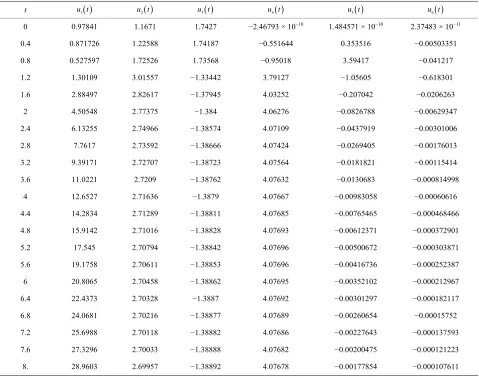
Table 1. The values of sidereal spherical coordinates and velocities.
6
u t
5
u t
4
u t
3
u t
2
u t
1
u t t
2.37483 × 10⁻¹¹ 1.484571 × 10⁻¹⁰
−2.46793 × 10⁻¹⁰ 1.7427
1.1671 0.97841
0
−0.00503351 0.353516
−0.551644 1.74187
1.22588 0.871726
0.4
−0.041217 3.59417
−0.95018 1.73568
1.72526 0.527597
0.8
−0.618301 −1.05605
3.79127 −1.33442
3.01557 1.30109
1.2
−0.0206263 −0.207042
4.03252 −1.37945
2.82617 2.88497
1.6
−0.00629347 −0.0826788
4.06276 −1.384
2.77375 4.50548
2
−0.00301006 −0.0437919
4.07109 −1.38574
2.74966 6.13255
2.4
−0.00176013 −0.0269405
4.07424 −1.38666
2.73592 7.7617
2.8
−0.00115414 −0.0181821
4.07564 −1.38723
2.72707 9.39171
3.2
−0.000814998 −0.0130683
4.07632 −1.38762
2.7209 11.0221
3.6
−0.00060616 −0.00983058
4.07667 −1.3879
2.71636 12.6527
4
−0.000468466 −0.00765465
4.07685 −1.38811
2.71289 14.2834
4.4
−0.000372901 −0.00612371
4.07693 −1.38828
2.71016 15.9142
4.8
−0.000303871 −0.00500672
4.07696 −1.38842
2.70794 17.545
5.2
−0.000252387 −0.00416736
4.07696 −1.38853
2.70611 19.1758
5.6
−0.000212967 −0.00352102
4.07695 −1.38862
2.70458 20.8065
6
−0.000182117 −0.00301297
4.07692 −1.3887
2.70328 22.4373
6.4
−0.00015752 −0.00260654
4.07689 −1.38877
2.70216 24.0681
6.8
−0.000137593 −0.00227643
4.07686 −1.38882
2.70118 25.6988
7.2
−0.000121223 −0.00200475
4.07682 −1.38888
2.70033 27.3296
7.6
−0.000107611 −0.00177854
4.07678 −1.38892
2.69957 28.9603
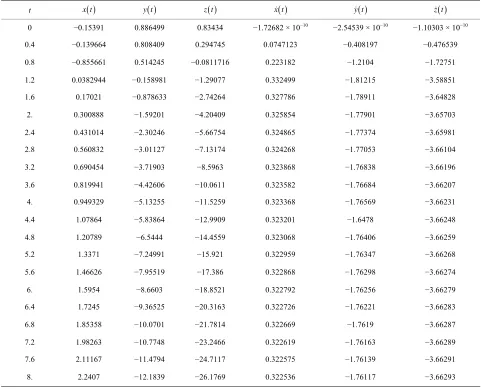
Table 2. The values of sidereal Cartesian coordinates and velocities.
z t
y t
x t
z t
y t
x t t
−1.10303 × 10⁻¹⁰ −2.54539 × 10⁻¹⁰
−1.72682 × 10⁻¹⁰ 0.83434
0.886499 −0.15391
0
−0.476539 −0.408197
0.0747123 0.294745
0.808409 −0.139664
0.4
−1.72751 −1.2104
0.223182 −0.0811716
0.514245 −0.855661
0.8
−3.58851 −1.81215
0.332499 −1.29077
−0.158981 0.0382944
1.2
−3.64828 −1.78911
0.327786 −2.74264
−0.878633 0.17021
1.6
−3.65703 −1.77901
0.325854 −4.20409
−1.59201 0.300888
2.
−3.65981 −1.77374
0.324865 −5.66754
−2.30246 0.431014
2.4
−3.66104 −1.77053
0.324268 −7.13174
−3.01127 0.560832
2.8
−3.66196 −1.76838
0.323868 −8.5963
−3.71903 0.690454
3.2
−3.66207 −1.76684
0.323582 −10.0611
−4.42606 0.819941
3.6
−3.66231 −1.76569
0.323368 −11.5259
−5.13255 0.949329
4.
−3.66248 −1.6478
0.323201 −12.9909
−5.83864 1.07864
4.4
−3.66259 −1.76406
0.323068 −14.4559
−6.5444 1.20789
4.8
−3.66268 −1.76347
0.322959 −15.921
−7.24991 1.3371
5.2
−3.66274 −1.76298
0.322868 −17.386
−7.95519 1.46626
5.6
−3.66279 −1.76256
0.322792 −18.8521
−8.6603 1.5954
6.
−3.66283 −1.76221
0.322726 −20.3163
−9.36525 1.7245
6.4
−3.66287 −1.7619
0.322669 −21.7814
−10.0701 1.85358
6.8
−3.66289 −1.76163
0.322619 −23.2466
−10.7748 1.98263
7.2
−3.66291 −1.76139
0.322575 −24.7117
−11.4794 2.11167
7.6
−3.66293 −1.76117
0.322536 −26.1769
−12.1839 2.2407
8.
3) Using the initial conditions 0
from step 1 to solve numerically the above differential system of step 2 for
u j; j1, 2,3, 4,5,6
,6 0 ; 1, 2
j
u j t t tf, (note
that 4 1 ).
4) Using j j from step 3 and the direct transformations of Equations (7) and (8) tocompute nu-merically
5 2
, ,
u u u u
; ;
u u
6 3 u u
1, 2,3
j
, ,
x y z and x y z , , t0 t tf.
5) End.
4.2. Numerical Example
Consider the initial values
0 0.153910449; x
0 0.886499068; y
0 0.384340387; z
0 0.00000000017268248; x
0 0.0000000002545393; y
0.0121505816;
8.0;
f
t
0 0.0; t
applying the above procedure we get the results as dis- played in Tables 1 and 2.
4.3. Graphical Representations
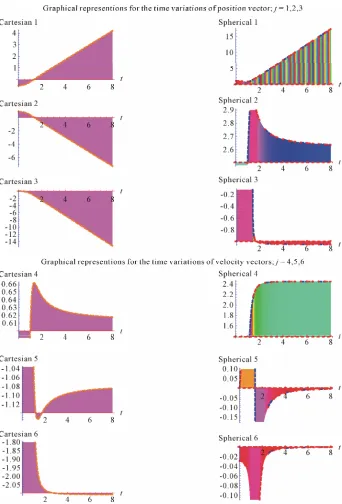
Figure 1 illustrates the time variations of the two sidereal
coordinate systems
x y z, ,
(left) and
u u u1, ,2 3
(right).5. Conclusion
In this paper of the series, the equations of motion for the spatial circular restricted three-body problem in sidereal spherical coordinates system were established. Initial value procedure that can be used to compute both the spherical and Cartesian sidereal coordinates and veloci- ies was also developed. The application of the procedure
Figure 1. The time variations of the two sidereal coordinate systems (x, y, z) (left) and (u1, u2, u3) (right).
was illustrated by numerical example and graphical rep- resentations of the variations of the two sidereal coordi- nate systems.
REFERENCES
[1] M. A. Sharaf and A. A. Alshaery, “Restricted Three- Body Problem in Cylindrical Coordinates System, (Paper
I),” Journal of Applied Mathematics, 2012, in Press. [2] V. Szebehely, “Theory of Orbits,” Academic Press, New