Translating Data
Between
Geographic Information Systems
A thesis
submitted in partial fulfillment of the requirements for the Degree of Master of Science in Computer Science
in the
University of Canterbury
by
RichardT. Pascoe
SCIENCES LIBRARY' THESIS 1 2 2.1. 2.2. 2.3. 3 3.1. 3.2.
4
4.1.4.2.
4.3. 4.4. 5 6 6.1 6.1.1 6.1.2 6.2 6.2.1 6.2.2 7 7.1.7.2.
7.3. 7.3.1.7.3.2.
7.4.Table of Contents
Abstract .. , ... iii
Introduction ... . 1
Geographic Data Translation ••...•...•••.•••...•....• 5
Geographic Data Representation ... 5
Notation of Data Translation ... 7
The Goals of Data Translation ... 9
Interfacing Strategies ... ... 13
Comparison of Interfacing Strategies ... 15
Interchange Formats ... 16
General Data Translation ...•••....•...•... 19
Language Translation ... 19
Electronic Manuscript Translation ... 21
Database Translation ... 22
Geographic Data Translation ... 25
The Translation Process ... ... 2 9 Translation Specification ...•..•... 3 3 Format Specification ... 33
Geographic Data Model Specification ... 34
Implementation Method Specification ... 37
Specifying the Source to Target Format Mapping ... 40
The Relational Data Model ... 40
Extending the Relational Model.. ... .41
The Decode Phase .. ... '• ... 4 3 Parser Generators ... 44
Simplified Ingres Interface ... .46
Decoding Techniques ... 47
Repeating Groups ... 47
Lexical Analysis of Dataflles ... 49
Processing Large Data Volumes ... 51
8 The Translate Phase ... · ... 53
8.1. QUEL ... ~ ... 53
8.2. Translation Algorithms ... 54
9 9.1. 9.1.1. 9.3. 9.4.
10
The Encode Phase . ... 59EQUEL ... : ... 59
Nested Retrieve Statements ... 61
Generating Format Encoders ... 65
The Structure of Format Encoders ... 67
Conclusions ... 69
Page ii
Data Translation between Geographic Injonnation Systems
Bibliography ... 7 3
A
Format Implementation Specifications ...••....••.... 7 7
A.1 The GeoVision GINA Format. ... 77
A.1.1 BNF Specification ... 77
A.1.2 uxicon ... 82
A.2 The BIF Format ... 83
A.2.1 BNF Specification ... 83
A.2.2 uxicon ... 83
A.3 The Colourmap Format ... 84
A.3.1 BNF Specification ... 84
A.3.2 uxicon ... , ... , .. ~ ... 85
B Format Decoders ... "' ... 8 7 B .1 The Colormap Format Decoder ... 87
B .1.1 Y ace Definition file ... 87
B .1. 2 Lex defmition File ... 96
B.2 The GINA Format Decoder ... 98
B.2.1 Yacc Definition file ... 98
B.2.2 Lex Defmition File ... 100
B.3 The BIF Decoder ... 102
B. 3 .1 Y ace Definition file ... 102
B. 3. 2 Lex Definition File ... 106
C
A Simplified INGRES Interface ... 107
C.1. eql.h ... 107
C.2. hash.h ... 107
C.3. eqlappend() ... 108
C.4. eqlreplace() ... 109
C.5. atctrl() ... 111
C.6. getattype() ... 111
C. 7. hash functions ... 112
D
Lexical Analysis of Repeating Groups .•...•...•.... 117
E
Example Translation Algorithm ... 119
E.l BIF Format Relational Data Model ... 119
E.2 Research Relational Data ModeL. ... 119
E.3 Translation Algorithm ... 120
F
Format Encoder Generator ... 125
F .1 Y ace Definition file ... ;, ... 125
F.2 Lex defmition File ... 129
G
An Example of a Format Encoder ... 131
G .1 tre .. h. .. .. . .. . . .. . . .. . . .. . . . .. . . . .. . . . .. . . . 131
0.2 tre.c., ... ... 131
Abstract
Transferring data from one geographic information system (GIS) to another is difficult because of the diverse, and often complex, structure of transfer file formats. Accordingly, the design and implementation of an interface for transferring data from one format to another is time consuming and difficult. The translation may be performed by an interface constructed for the two formats (the individual interfacing strategy), by two interfaces through an interchange format (the interchange format interfacing strategy), or by a number of interfaces through a series of formats (the ring interfacing strategy).
The interchange format interfacing strategy is widely adopted because it offers an acceptable compromise between the quality of the data translation and number of interfaces required. In contrast, the individual interfacing strategy achieves the best quality of translation but is generally rejected because of the impracticality of constructing a large number of interfaces.
The goal pursued in this thesis is to maximise the quality of the translation by overcoming the impracticality of the individual interfacing strategy. This is achieved in the following way. An interface is divided into three phases: the decode phase, in which the source format decoder places data from the source format into a relational data base; the translate phase, in which the data is restructured according to a translation algorithm written in a relational query language; and the encode phase, in which the target format encoder places data from the relational data base into the target format.
Chapter One
Introduction
Many organisations require the same gev5J..:tphic data. Organisations responsible for supplying electricity, tel nnmunications, and drainage, for example, have a common need for a digital representation of data such as coastal outlines, roads, and house boundaries. Data acquisition is achieved most frequently through the laborious procedure of hand digitising existing maps and editing this digital representation to achieve the desired quality of data.
It is wasteful for many organisations to capture the same data in this way; rather, the data should be digitised once and then made available to any organisation requiring it. In doing so, the enormous effort in capturing data by digitisation is performed once for all organisations. Furthermore, designating one source for shared data sets will result in a more consistent collection of data across organisations, and making this data readily available will reduce the time, effort, and cost of installing a new Geographic Information System (GIS).
Exchanging data is complicated because organisations use different geographic information systems, and these systems 'represent geographic data in different ways. For example, Colourmap, Geo Vision, and GDS are three geographic information systems that have individual external data representations, or
transfer file formats.
A transfer file format (TFF) defines the structure of a set of files that may act as the import/export gateway for data that is being transferred in or out of a GIS; data exported from the system will be made available, and data to be imported into the system must be provided, in this format. To achieve the transfer of data from one type of GIS to another, the data must be translated from the transfer file format of the source GIS into the format of the target GIS.This translation from one format to another is performed by a
geographic inteiface
Page2
Data Translation between Geographic Information Systems
Some formats are not associated with a specific GIS. Instead, these intermediate or
interchange formats
are used in conjunction with a particular type ofinterfacing strategy
that defines the way in which data is exchanged between geographic information systems. Two examples of an interfacing strategy are: the
individual interfacing
strategy,
where all GI Systems exchange data betWeen each other directly; and theinterchange format interfacing strategy,
where all GI systems exchange data between each other indirectly through an interchange format. Interfacing strategies such as these have evolved in an attempt to reduce the number of interfaces necessary for translating data from one format into another.The theme of this thesis is to reduce the effort of implementing a geographic interface to such an extent that the more desirable individual interfacing strategy can be applied. Employing this strategy allows the advantage of providing the optimum translation from one format to another to be gained. This theme is developed as follows.
In Chapter 2, a description is presented of the underlying data models that are the basis for the majority of the formats. A format is divided into two parts: a geographic data model, and a method of encoding this model into the transfer media. The geographic data model is further subdivided into a spatial model, and a descriptor data model. A notation is presented, and used throughout this thesis, for describing the various stages of the data translation process. A discussion is given of the goals to be achieved when considering translating geographic data.
In Chapter 3, a comparison is made of three interfacing strategies: the individual interfacing strategy; the ring interfacing strategy; and the interchange format interfacing strategy. Although the last of these strategies is widely adopted, it is shown by the author that the effectiveness of this strategy is reduced by the definition of many different interchange formats. In showing this weakness, the importance of being able to minimise the effort necessary for implementing an interface, regardless of the interfacing strategy adopted, is emphasized.
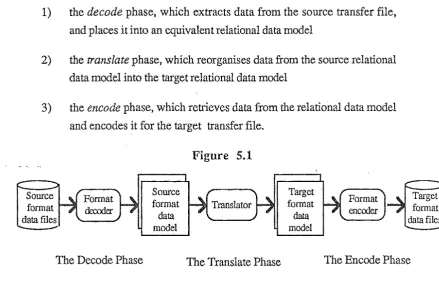
Introduction Page3
In Chapter 5, a structure is presented of a translation process for geographic data. The structure consists of three phases: the decode phase, the translate phase, and the encode
phase. An explanation is given of how this structure serves the purpose of this thesis. In Chapter 6, the specification of a data translation is described with the intention of processing this specification to implement the desired translation. In particular, a discussion is presented on the use of: various diagramming techniques to specify the geographic data model of a format; a BNF notation to specify the syntactic structure of files in a format; an extended relational query language to specify the translation
algorithm.
Chapter Two
Geographic Data Translation
The process of geographic data translation has many aspects that must be understood before a successful translation can be achieved. These aspects are: the different representations of geographic features used in various transfer file formats; the interfacing strategies that may be used; the steps needed to accomplish a translation; and the problems in implementing each of these steps. Each of these aspects is examined 'in detail in the following sections.
2
.1.
Geographic Data RepresentationGeographic data consists of features: a feature is "a defined entity and its object representation" [ DCDSTF 1988 ], with an entity being "a real world phenomenon that is not subdivided into phenomena of the same kind11
, and an object being "a digital
representation of all or part of an entity".
Data associated with real world entities is divided into two categories: the spatial data, which "portray the spatial locations and configurations of individual entities" [ Peuquet 1984] , and the non-spatial, attribute, or descriptor data which describe the non-spatial characteristics of the entities. For example, consider an object representing an oil well. The spatial data may describe the object as a point at some latitude and longitude. The descriptor data may define that point as an oil well with a name and rate of production. Accordingly, the objects that represent the entities are defined by a geographic data model that is composed of: a model for spatial data, which defines the topological
structures and geometry of the objects; and a model for descriptor data, which defines the attributes of, and the relationships between, the objects. A transfer file format
consists of a geographic data model that is encoded by some implementation method.
Page6 Translating Data Between Geographic lnfonnation Systems
Topology deals with the spatial configuration of an object, and conveys information
about its spatial relationship, such as incidence and adjacency, with other objects. In the recently published Spatial Data Transfer Specification [ DCDSTF 1988] the following set of cartographic objects are defined: 0-dimensional objects, points and nodes;
!-dimensional objects, lines, line segments, strings, arcs, links, directed links, chains, and rings; 2-dimensional objects: areas, interior areas, polygons, pixels, and grid cells.
Geometry deals with the location, size, shape, and orientation, of the objects within
some coordinate system. The geometry is frequently specified using one of the following coordinate systems: Geographical (longitude and latitude), Universal Transverse Mercator, Lambert and, in New Zealand, the New Zealand Map Grid. Geometric data such as the area of a polygon, length of a line, and the shortest path between two nodes of a graph, are computed using the locations of objects within the coordinate system.
Because, in both their topology and geometry, spatial data models can be complex [van Roessel et al 1986, Peuquet 1984] there is a wide variety of spatial models. These models, however, derive from either the vector model, or the tessellation model
[ Peuquet 1984 ].
A connected sequence of x,y coordinates is the .basic logical unit of a vector data model and it is used to construct more complex spatial objects such as polygon boundaries, or networks. Points are regarded as a special case where there is only one set of coordinates in the sequence. For example, in the Geo Vision GINA transfer file format. [ Geo Vision 1986 ] the linear feature type, commonly defined by a sequence of coordinates, also "includes single-point features". Peuquet points out that the following are all examples of the vector model: the spaghetti model, the topologic model, the GBF/DIME model, and the POLYVRT model.
The basic logical unit of a regular tessellation model is a pixel, or a grid cell. Peuquet notes that:
" .... tessellation, or polygonal mesh models, represent the logical
dual of the vector approach. Individual entities become the basic data
units for which spatial information is explicitly recorded in vector
models. With tessellation models, on the other hand, the basic data
unit is a unit of space for which entity information is explicitly
Geographic Data Translation Pagel
Peuquet identifies five forms of the tessellation model:
1) Grid and other regular tessellations. These are based around the three differing geometries of the square, triangular, and hexagonal meshes.
2) Nested tessallation models. These are based on subdividing the elemental polygon of the grid into polygons of the same shape. The most recognised of these models is the quadtree [Samet 1984]. 3) Irregular tessellations. These differ from grid and other regular
tessellation models in that the elemental polygons within a mesh are not necessarily of the same size. The most commonly used model of this form is called the triangulated irregular network (TIN).
4) Scan-line models. These are a special case of the square mesh where the cells of a mesh are organised into single, contiguous rows across the data surface, usually parallel to the x axis.
5) Peano scans. These scans are based on mappings of n-dimensional space on to lines and vice versa. Peano scans are found to be useful for image processing applications [Stevens et al, 1983]
For real world entities represented by objects in the geographic data model, a descriptor data model defines the attributes of, and the relationships between, those entities. Research into descriptor data models has, to a large extent, received less attention than research into spatial data models.
The problem of particular interest in this thesis is that of translating geographic data represented by a vector spatial data model and some form of a descn'ptor data model.
2. 2. Notation of Data Translation
Page8
Translating Data Between Geographic Information Systems
When the interlace is implemented, the data may be translated through a series of temporary formats, denoted by f1, that are internal to the interlace. These temporary formats are of interest only to someone wanting a detailed understanding of the interlace, perhaps with a view to modifying it for use in a different translation. The notation emphasises this limited interest by using lower-case f inside braces, that is
The translation process may also involve one or more interchange transfer file formats (Chapter 3), denoted by I. For example, a translation involving interchange transfer file format j can be described as:
The source to interchange format translation is perlormed by an
export interface;
correspondingly the interchange to target format translation is perlormed by an
import
interface.
Consider now the use of the notation developed above to describe a translation process to convert data provided by the Department of Survey Land and Information (DOSLI) for display on a system owned by the Christchurch Drainage Board. Source data was in the Geo Vision GINA transfer file format [ Geo Vision 1986], and the target format was the BIF transfer file format of the ODS system [ODS 1984]. The translation from GINA format to BIF format was made through the interchange transfer file format SIF [Intergraph 1986]; that is:
This translation was achieved using the import interface IsiF-+ FmF that was already available on the Christchurch Drainage Boards system, and the export interlace FoiNA ->
IsiF which was implemented by the author to demonstrate the techniques described in Chapters 7, 8 and 9 of this thesis. The export interlace consisted of three phases and two temporary formats:
FoiNA-} {foRM-} fsRM}-} IsiF
Geographic Data Translation
Page9
2. 3. The Goals of Data Translation
Deciding on the priority of the goals when developing a translation process depends on the user's perspective. The geographic database administrator will expect the translation to produce data of the highest possible quality; designers who have to construct a large number of different translations wish to minimise the effort required to develop each translation; users who frequently employ interfaces will expect the interface to operate efficiently without placing an excessively high demand on computing resources.
Any data translation is achieved, therefore, with a compromise between the following conflicting goals:
1) To minimise the time and effort involv~d in constructing interfaces. 2) To maximise the quality of the translation.
3) To maximise the performance of the interface.
It is not possible to achieve all three goals simultaneously. The complexity of transfer file formats, and the goal of achieving a translation of high quality, results in a complex interface; accordingly, the time and effort necessary to implement the interface, and the amount of computing resources used by the interface while translating the data, will increase.
The goal of minimising the time and effort involved in the construction of an interlace may be pursued by adopting methods to automate the construction of individual interfaces. The automatic generation of many types of programs has been a long term goal of computer science and three types of automatic programming systems have been described by Rich and Waters [ 1988 ]:
1)
Bottom up.
Programs are constructed using very high level languages which consist of powerful abstract data types and operations.2)
Narrow Domain.
Programs are automatically generated by a program generator that is constructed for a specific type of program domain.Page 10 Translating Data Between Geographic Information Systems
The goal of maximising the quality of the translation is approached by developing improved methods of specifying and implementing the mapping of the source data into the target format. In doing so, issues that determine the quality of translation may be addressed.
Examples of these issues are:
1) Can all that is represented in the source format be represented in the target format ?
2) Can cartographic objects from the source format be mapped onto equivalent cartographic objects in the target format ?
3) Can all data required in the target format be derived from that contained in the source format ?
4) If there are alternative representations in the target format, which is most suitable for the data being translated ?
For example, consider the translation
In the BI Format, a circle is represented by its centre point, and radius. In the SI Format, a circle is represented by its centre point and radius, with the optional specification of a transformation matrix, and whether the circle is a solid, or a hole. It
can be seen, therefore, that an accurate translation can be achieved from the BI Format representation of a circle to the SI Format representation. If the translation had of been
FBIF ---+ FoiNA
the translation would have been almost impossible because there is no representation for a circle in the GINA format (some other representation such as a hexagon may be an acceptable substitution). Other examples can be given where a target format cannot represent data in some other format.
Geographic Data Translation
Pagell
In many cases, the target format may explicitly represent data that is implicit within the source format. For example, in the Colourmap format [ CSIRONET 1986] the number of lines that define the boundary of a polygon is explicitly stored for each polygon in the polygon partition of a geographic map file.
In
the BI Format, however, this information is implicitly represented by the occurrence of the line primitive definitions associated with an object, and has to be calculated (see § 8.2, Example 1) for inclusion in the Colourmap format.In some cases, data necessary for the target format is absent from the source format. For example, in the Colourmap format there is no record that specifies the coordinate system used for the data. This information is contained within the definition of the format, therefore, it has to be provided by whoever implements the translation. The coordinate system in use for the data within a GINA format is explicitly stated by the coordinate system record of the database header file.
An interchange format may have alternative representations for data. For example, the SDTS offers three representations, or transfer forms: the Vector form, the Relational form, and the Raster form. In some cases, these representations may be incompatible with those of the target format, consequently, either the translation cannot be done, or there is a loss of data quality because of the mapping from one representation to another.
The goal of maximising the performance of an interface is considered is probably of much less importance than the other two because [Penny 1986]:
... the conversion is a once-only .operation for data
thatmay be used
hundreds of times. Simplicity of the transfer, rather than its
efficiency, is the
keyfactor .
Chapter Three
Interfacing Strategies
In an attempt to reduce the effort required to allow geographic information systems to communicate with each other, a number of different
interfacing strategies
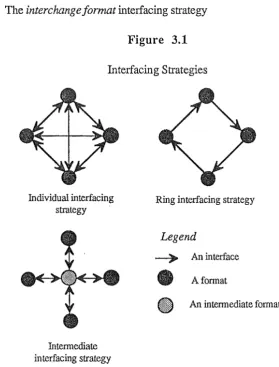
can be considered. In general, an interfacing strategy specifies the way in which interfaces are organised to transfer data between geographic information systems. Three types of interfacing strategies (Figure 3.1) are described by Fosnight and van Roessel [1985]:1) The
individual
interfacing strategy 2) Thering
interfacing strategy3) The
interchange format
interfacing strategyFigure 3.1
Interfacing Strategies
Individual interfacing strategy
Intennediate interfacing strategy
Ring interfacing strategy
Legend
-)1- An interface
e
Afonnat [image:19.595.140.420.304.672.2]Page14
Translating Data between Geographic Information Systems·
The individual interlacing strategy employs an interlace for each source-to-target format translation. Data in the source format is translated directly into the target format. The translation process is described as:
The
ring interfacing
strategy organises the use of interlaces in a way that connects all formats in series with the the last format in the series connected to the first. The best situation is when the target format is the next in the series after the source format, in which case the process is described as above. Otherwise, data in the source format is translated into the target format through one or more intervening formats; that is:The
interchange format
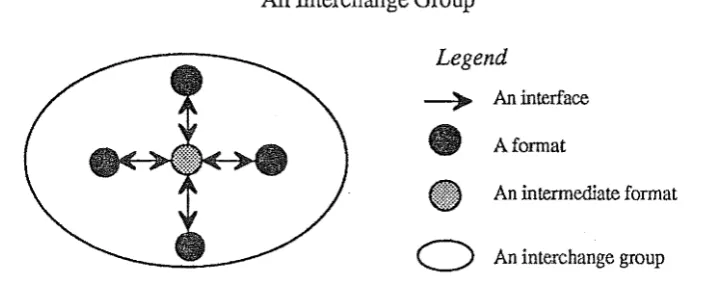
strategy revolves around the use of one interchange format. Data in the source format is translated into an interchange format by the export interlace, and then into the target format by the import interlace. The translation process is described as: [image:20.595.117.468.542.694.2]All those geographic information systems that have a pair of import and export interlaces for a particular interchange format will be referred to h~re as an interchange group (Figure 3.2). For example, all geographic information systems that have import and export interlaces for the SIF interchange format belong to one interchange group, and all those with import and export interlaces for the SDTS will belong to another.
Figure 3.2
An
Interchange GroupLegend
---).- An interface
41
Aformat(I}
An intermediate formatInterfacing Strategies
PagelS
3 .1. Comparison of Interfacing Strategies
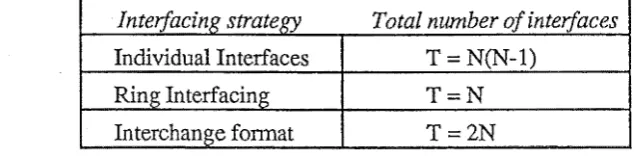
To compare the three strategies, suppose that there are N geographic information systems that exchange data with each other. Figure 3.3 presents the number of interfaces, T, that would have to be constructed for each of the three strategies. If an interfacing strategy were to be selected on the basis of minimising the total number of interfaces constructed, then the ring interfacing strategy would be the best. This basis is unsatisfactory for deciding on an interfacing strategy because it ignores the number of interfaces required to perform a translation for any pair of source and target formats.
Figure 3.3
The number of interfaces required according to each interfacing strategy
Interfacing strategy
Total number of interfaces
Individual Interfaces T= N(N-1)
Ring Interfacing T=N
Interchange format T 2N
There are two reasons for reducing the number of interfaces involved in any source-to-target format translation: fewer interfaces mean a quicker translation; and, more important, fewer intervening formats make it less likely that information will be lost. Information present in the source format and representable in the target format, may be
lost because the intervening formats are unable to represent that information. For each interfacing strategy, Figure 3.4 presents the for any pair of source and target formats.
Figure 3.4
The number of interfaces required to perform a translation from one format to another
Interfacing strategy
Number of interfaces
in a translation
Individual Interfaces 1
[image:21.595.133.453.303.381.2]Page 16
Translating Data between Geographic Information Systems
The number of interfaces required for a translation when operating under the ring interface strategy may be very high, up to N-1. The potential loss of information, therefore, makes the strategy undesirable. With the individual interface strategy, no information representable in both the source and target formats need be lost. If the interchange format strategy is used, no information representable in both the source and target formats will be lost,
provided
that the interchange format can represent data that may be represented in any format of that interchange group.Use of the interchange format strategy is wide-spread because an acceptable compromise is reached between the total number of interfaces constructed, and the number of interfaces used in a data translation. The use of the interchange format strategy does leave some problems unresolved and these are examined in the next section.
3. 2. Interchange Formats
Many interchange formats have been defined [Penny 1986]. During research for this thesis, the author has become familiar with three: the Standard Interchange Format (SIP) [ Intergraph 1986 ], the Spatial Data Transfer Specification (SDTS) [ DCDSTF 1988 ], and the proposed New Zealand Transfer File Format (NZTFF) [van Berkel 1987].
Without specifying the rules governing how many interface groups a format may belong to, the number of interfaces, T, which guarantees that data in one format, can be translated to and from any other, is given by the following formula:
T=2NM
where there are N formats and M interchange formats.
If an interfacing strategy is introduced between the different interfacing groups, each format need only belong to one interchange group. Depending on which interfacing strategy is used, the number of interfaces, T, can be given by any of the following formulae:
1) the individual interfacing strategy,
T=2N+M(M-1)
2) the ring interfacing strategy,
I nteifacing Strategies Page 17
3) The interchange format interfacing strategy,
T=2N +2M
With, or without an interfacing strategy, the definition of many interchange formats has resulted in an increase in the number of interlaces necessary to guarantee that data in one format can be translated to and from any other. In short, the initial interchange format interfacing strategy is undermined by the definition of many interchange formats.
Chapter Four
General Data Translation
The problem of data translation occurs in many areas other than geographic information · systems, and many of the techniques developed in these areas may be adapted for geographic data translation. In the following sections, a description is presented of the techniques used to achieve language translation, electronic manuscript translation, and database translation. The Chapter ends with a description of research into geographic data translation by van Roessel eta! at the EROS data center.
4 .1. Language Translation
The problem of translating geographic data from one format to another is analogous to the problem of translating a computer program from one language to another. The translation of a program is performed by a compiler which translates from a high level language, say LHLL, into a machine code, denoted LMC· The notation of §2.2 described geographic data translation from a source format, Fs to a target format FT, as:
Similarly, the translation of a program can be described as:
Steel [1960] introduced the idea of an intermediate language, denoted here as LJ. Incorporating this into the description of the translation of a program results in the following:
The translation is divided into two parts: the front end of a compilation translates the
program written in the target language into the functionally equivalent program written in an intermediate language; the back end of a compilation translates a program written
Page20 Translating Data between Geographic Information Systems
_ Suppose it is necessary to translate any one of N higher level languages into any one of M machine code languages. Figure 4.1 presents a comparison on the number of translators (compilers or front ends and back ends) necessary with, and without, the use of an intermediate language. It is apparent from Figure 4.1 that the use of an intermediate language reduces the programing effort from N*M compilers down toN front ends and M back ends. Furthermore, if another higher level language is developed then with the use of an intermediate language only one front for the new language woul~ have to be implemented because all of the existing back ends can be used to complete the translations. Without the intermediate language, however, another M compilers, one for each of the available machine code languages, would have to be developed.
Figure 4.1
Translation method Nwnber of translators
Without intermediate language N
*
M compilersWith an intermediate language N front ends
+
M back endsThe drawback to the use of an intermediate language is that it is not possible to design a single intermediate language that provides a suitably small range of instructions for every combination of high level language and machine code language. The EM intermediate language [Tanenbuam 1978] is designed for use with block structured high level languages such as Algol and Pascal.
In the area of geographic data translation, the use of an intermediate format is analogous to the use of an intermediate language. The front end, and back end of a compiler, are equivalent to the export interface and the import interface, respectively. The same drawback that occurs with intermediate languages also occurs with intermediate formats. To avoid restricting the translation of data from the source format to the target format, an intermediate format must provide a wide range of data representations. The SDT Specification illustrates this by incorporating three transfer forms to cater for a wide a range of source and target format combinations.
General Data Translation.
Page21
Parser generators generate programs based upon the grammar of the high level language. The author has applied a parser generator to the construction of a class of programs, called
format decoders,
that decode the implementation method of the source format and place the data into a temporary data structure. The way in which this type of program is used, and implemented, is described in Chapter 7.4. 2. Electronic Manuscript Translation
The exchange of electronic manuscripts is a problem similar to that of exchanging geographic data. In an article describing the Chameleon research project at the Ohio State University, Mamrak
et al [
1987 ] makes the point that: "the wide variety of electronic-manuscript representations presents an obstacle to widespread exchange". The same problem applies for the exchange of geographic data.In an attempt to reduce the problem of different representations for electronic manuscripts, many standard forms have been introduced. It is recognised, however, that standard forms "only reduce the number of translations required", and that "there are many different standards being proposed within the domain of electronic manuscripts, both nationally and internationally ... Thus the support of translation among standard forms themselves may become necessary." [op cit]. There is an obvious similarity between this problem and that created by the occurrence of many intermediate formats for geographic data. The formation of interchange groups due to the many different intermediate formats for geographic data was discussed in § 3.1.
The primary goal of the Chameleon research project is to "develop a software system that will (1) support programmers in building software tools to do translations, and (2) provide assistance in the use of these tools while translating manuscripts into and from standard-form representations." In short, the objectives are to design and implement a comprehensive translation architecture that supports both the building and use of translation tools.
The Standard Generalized Markup Language [ISO 1986] is used to specify the translation from a standard to a nonstandard form. The ·software for electronic manuscript translation is constructed by processing this specification, using a set of tools that:
1) produce an attribute grammar that formally specifies the translation, 2) inverts the formal translation grammar of 1) to produce the translation
from a nonstandard to a standard form,
Page 22 Translating Data between Geographic Information Systems
4) generates the software to implement the translation from a standard to a nonstandard form, and from a nonstandard to a standard form.
The method taken to the automatic generation of software for electronic manuscript translation is an example of the assistant approach,. described in §2.3. This approach has been taken by Mamrak et al because, in both the construction and the use of electronic manuscript translation software, there are aspects which are not readily automated. Mamrak et al found that, "the intent of the author ... cannot be derived automatically". Consequently, experienced users are required to apply effectively the software tools that assist in the construction of the translation software, and to oversee the use of translation software. As explained in Chapter 5, the author has taken the assistant approach to the construction of software for geographic data translation.
4. 3. Database Translation
In the area of database translation, the bottom up approach (§2.3) to the generation of data translation software has been researched in the development of the Extraction, Processing, and Restructuring System EXPRESS [Shu eta!, 1977 ]. EXPRESS was "originally developed as a research prototype in order to test the generality and applicability of applying high-level data description and high-level data manipulation techniques-to the data translation problem." [Taylor 1982]. For specifying the desired translation, the system provides two nonprocedural languages: DEFINE for data description, and CONVERT for data manipulation.
The DEFINE language is used to specify the, usually hierarchical, structure of data files. According to this specification, a program is generated that either reads data from the source files, or writes data into the target files. As well as describing the structure of files, the language provides facilities for: editing data, checking of data integrity, and incorporating user defined error detection and correction procedures.
General Data Translation
Page23
Figure 4.2 (Department)
(EMP) (Proj)
DNO MGR Budget (Equip)
FNO Job PJNO Leader
Item No Description
D1 OOE 40000 19 ENG J6 RAE 221 Computer
41 SEC J8 MEW 46 Scope
52 TECH 317 Laser
77 ENG Ill FAR 271 Computer
D4
so
20000 60 CHEM J9 lA 47 MicroscopeThe CONVERT language provides nine high level operators for manipulating the data. To illustrate the language, a brief description of three of these operations is provided here. The SLICE operator is used to transform hierarchical data into a flat file. For example, the following SLICE operation on the form in Figure 4.2 produces the form presented in Figure 4.3(a):
A= SLICE (DNO, MGR, PJNO, LEADER, DESC, FROM DEPT);
The SELECT operation selects part of a form which satisfies specified criteria. For example, the following applied to Figure 4.2 would produce the form shown in Figure 4.3(b):
B
=
SELECI'(DNO, MGR, PROJ(PJNO, LEADER) FROM DEPT WHERE DESC EQ 'COMPUTER};Figure 4.3
A B
DNO MGR PJNO Leader Description
DNO MGR (Proj)
Dl OOE J6 RAE Computer PJNO Leader
Dl OOE J8 MEW Scope D1 OOE J6 RAE
Dl DOE J8 MEW Laser Jll FAR
Dl OOE Jll FAR Computer
D4
so
J9 lA MicroscopeFigure 4.3(a) Figure 4.3(b)
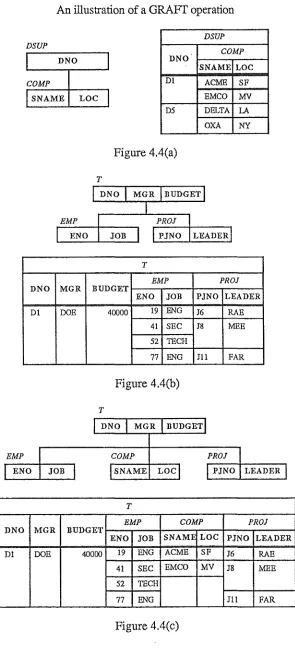
The GRAFT operation is used to attach data to a hierarchical tree. For example (based on one from Shu
et al
[1977]), the form shown in Figure 4.4(a) is grafted onto (b) to create the form shown in Figure 4.4(c) by the following operation:Page24 Translating Data between Geographic Information Systems
Figure 4.4
An illustration of a GRAFf operation
DSUP
DNO DNO
COMP Dl
SNAME LOC
DS
Figure 4.4(a) T
T
EMP PROJ
DNO MGR BUDGET
ENO JOB PJNO LEADER
Dl DOE 40000 19 ENG J6 RAE
41 SEC J8 MEE 52 TECH
77 ENG J11
~
Figure 4.4(b) T
I
DNOI
MGRI
BUDGET)EMP COMP PRO!
I
ENO JOBl
ISNAME LocJI
PJNO LEADERI
T
,~EMP
COMP PROJDNO MGR BUDGET
SNAME
0 JOB LOC PJNO LEADER
Dl DOE 40000 19 ENG ACME SF J6 RAE
41 SEC EMCO MV J8 MEE 52 TECH
[image:30.597.131.427.97.751.2]77 ENG J1l FAR
General Data Translation
Page25
From the specification of the translation using the languages DEFINE and CONVERT, EXPRESS generates a set of PL/1 programs which, collectively, achieve the desired translation. The translation process consists of three major steps: the
read step
where the data in the source format is read, checked for errors, and organised into an internal form; therestructuring
step where the data"is structured into the target files; and theload
step where the target files are loaded into the target database.
The idea of manipulating data using high level operators is sound, and the idea of using
relational
operators available with relational DBM Systems has been discussed [Penny 1986, van Roessel and Fosnight 1985 ]. The author stores and manipulates geographic data within a relational database management system called INGRES [Heldet al
1975, Date 1986 ].4. 4. Geographic Data Translation
The EROS Data Center has been working on a project called the Spatial Data Research and Support System (SDRSS) with a goal to providing "an integrated set of system resources to support data acquisition, storage, processing, analysis, and product generation requirements of a broad research program directed toward the integration and application of disparate spatial data types". During the development of SDRSS, research has been performed into the design and implementation of geographic interfaces to enable the transfer of vector data between geographic processing systems [van Roessel
et
al,
1986].The I2 intermediate data structure developed by van Roessel
eta/
is an implementation of the intermediate structure used in the interfacing model proposed by the Working Group on Data Organisation of the National Committee for Digital Cartographic Data Standards ( NCDCDS ) [ Nyerges, 1984 ]. The proposed model ( Figure 4.5 ) is the same as the interchange format interfacing.strategy described in § 3. The model, however, only describes the translation from the source to the intermediate format; the translation from the intermediate format to the target transfer file format is similar.Figure 4.5
The interfacing model proposed by the Working Group on Data Organisation of the National Committee for Digital Cartographic Data Standards.
Source Format
Translation
Tools (Tl) I1
Page26
Translating Data between Geographic Infonnation Systems
According to the NCDCDS workgroup model, there are two categories of tools, Tl and T2. Tools in category Tl are used to translate data into the "intermediate" intermediate (sic) data structure Il. Tools in category T2 are used to translate data from the I1 structure into the intermediate structure, I2.
If data is to be exchanged by employing the interfacing model proposed by the NCDCDS, two interfaces are required: the export interface, to translate from the source GIS format into the intermediate format, and the import interface, to translate data from the intermediate format into the target GIS format. When supplying data, the source system provides the data in the standard interchange format using the export interface. The data is then translated by the import interface of the target system into the native transfer file format.
van Roessel
et al
have implemented this interfacing model, using the relational data model for three reasons:1) elegance and simplicity of the data representation
2) the availability of the relational algebra and its unique relational operators
3) -the"availability of a number of different software systems on different hardware configurations
The I2 intermediate data structure is defined as an interchange format, and the data is maintained in a relational database management system; the RIM relational database management system was used at the EROS Data Center. The 12 data structure consists of six core relations containing spatial data:
regpol: region number, polygon number polarc: polygon number, arc number
archdr: arc number, start node, end node, left region, right region arcxy: arc number, x, y
nodearc: node number, arc number nodexy: node number, x, y
General Data Translation
Page27
The thrust of the research by van Roessel
et al
was to minimise the time taken to construct an interface, through the application of the relational operators in the translation process. In particular, the operators were considered useful as T2 tools. Tools in category Tl, such as the program RIMNET developed at the EROS Data Center, are used to translate data into the Il data structure. The function of RIMNET is to transform an unnormalised data representation into a normalised representation. The transformation is specified using a free-format syntax that defines the desired tracking sequence of data elements through the unnormalised form.Chapter Five
The Translation Process
The translation process is defined here as the method used to restructure data from the source format into the target format. The author's model of the translation process consists of three phases (Figure 5.1 ):
1) the
decode
phase, which extracts data from the source transfer file, and places it into an equivalent relational data model2) the
translate
phase, which reorganises data from the source relational data model into the target relational data model [image:35.595.75.515.217.511.2]3) the
encode
phase, which retrieves data from the relational data model and encodes it for the target transfer file.Source fonnat data files
The Decode Phase
Source format data model
Figure 5.1
The Translate Phase
Target fonnat data model
The Encode Phase
The translation of data from the GeoVision GINA format to the SIF format has been described (§2.2) as
FmNA-r {faRM
-r
fsRM}-r
IsiFIn the decode phase, the data is transferred from the GINA format FaiNA into this format's relational data model faRM:
Page30
Translating Data between Geographic Information Systems
In the translate phase, the data is mapped from the GINA relational data model foRM into the SIF relational data model fsRM:
faRM-+ fsRM
In the encode phase, the SIF relational data model is encoded into the SIF interchange format IsiF:
fsRM-+ IsiF
Each phase is to be performed by the user of the translation system. The user, most likely a technician, would have to be familiar with at least geographic data structures and computer storage media such as tape and floppy disk.
Three software tools are used in the translation process, each in one particular phase of this process. In Chapter 7, the use of parser generators and lexical analysers is described for implementing the decode phase of the translation process. In Chapter 8, the use of a relational DBMS is described for storing and manipulating the data into the target data model. In Chapter 9, a description is given of a new software tool, designed by the author, for implementing the encode phase of this process.
To use thes~to()ls effectively, the technicians who translate the data will have to develop expertise in using· relational database management systems, and parser generators. Experience gained with EXPRESS (§4.3) revealed the problem of achieving a balance between developing a translation system that is sufficiently general to be useful, and developing one that is easy to use [Taylor, 1982 ]. In the Chameleon Project (§4.2), it
is acknowledged by Mamrak
et al
[1987] that only users who are "experts in the theory and practice of formal languages" can effectively use the translation system which was developed. To gain the maximum benefit from translation systems that require experienced users, Taylor [ 1982] suggested that "a designated center of conversion expertise" could be set up.The rationale behind this three phase translation process is primarily to develop software modules that can be used for many different translations, thereby reducing the effort of implementing any future interfaces. For example, if the GINA to SIF translation
F GINA-+ {foRM -+ fsRM} -+ IsiF
The Translation Process
Page31
then only the decode phase, FcMP---+ fcRM, and the translate phase, fCRM ---+ fsRM• would have to be implemented because the encoder phase, fsRM---+ IsiF, used in the GINA to SIP translation could be used again. For any further translation from the Colourmap format, the decode phase, FCMP---+ fcRM• could be used.
Other advantages of the approach taken are that the modular architecture will minimise the impact of modifications to a format, and the division of the translation process into phases reduces the task into smaller problems that can be solved with the assistance of software tools. It can be classified, therefore, as an
assistant approach
to the automatic generation of interfaces.In Chapter 3, the advantages and disadvantages were discussed of three different interfacing strategies: the individual interfacing strategy, the ring interfacing strategy, and the interchange format interfacing strategy. The translation process described here can be used to provide an interface for use in any of these three interfacing strategies. The individual interfacing strategy, however, is favoured by the author because:
1) the effort required to implement the greater number of interfaces required for that strategy is reduced through the repeated use of the encode and decode phase implementations for each format and the use of relational database·management systems in the translate phase of the translation process
2) the use of the individual inte1facing strategy increases the quality of the translation for the reasons described in Chapter 3.
Chapter Six
Translation ·Specification
According to van Roessel et al [1986], "one of the first steps for developing a
conversion methodology is to obtain a consistent description" of a translation process. In this Chapter the form is given of the specification for a translation process which is to be implemented using the approach described in Chapter 5.
The description of a translation process should be in a form that is suitable for its intended use. To automate the implementation of a translation process, much of the specification should be in a form that can be used by software tools which are employed to implement the process.
Corresponding to the three phases of the translation process described in Chapter 5, there are three parts to specifying a particular translation process:
··1) A description of the source format
2) A description of the steps to be taken when translating data form the source format to the target format
3) A description of the target format.
In section 6.1, the way in which the description of a source format, used in the decode
phase, and the description of the target format, used in the encode phase, is discussed.
The specification of the source to target format translation, used in the translation
phase, is discused in section 6.2.
6.1 Format Specification
Page34 Translating Data between Geographic Information Systems
To encode and decode a format, specification is required of the geographic data model and the implementation method. The next two sub-sections describe the way in which the data model and the implementation method are to be specified when using the method of translating geographic data suggested here.
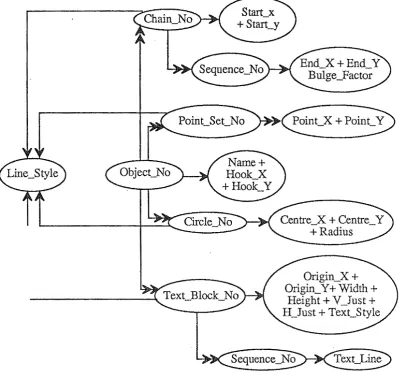
6.1.1 Geographic Data Model Specification The geographic data model of a format defines the topological structures and geometry of the objects, and the attributes of, and the relationships between, these objects. The definition of a geographic data model is used in the design of a relational structure for storing the data from a format. Two techniques for specifying the geographic data model of a format will be discussed here: dependency diagrams as used by Smith [ 1985 ], and entity-relationship diagrams [Martin and McClure, 1986 ].
Smith [ 1985] defines a procedure that enables fully normalized relations to be directly composed from a completed dependency list and dependency diagram. The list and diagram are used to specify the single-valued and multivalued dependencies between data fields. For a single-valued dependency to exist from data field A to data field B, one fact about A must determine a single fact about B. Each value of A must be nonnull and unique and any value of B may be null or duplicated. For a multivalued dependency to exist froniA to B, one fact about A must determine a set of facts about B.
Each data field of the data base is pictorially represented in a dependency diagram by enclosing the field's name within an ellipse. There may be more than one field within an ellipse. These ellipses are interconnected by lines with one or two arrow heads depending on whether they represent single-valued, or multivalued dependencies. A set of rules for the construction of a dependency diagram is given in a paper by van Roessel [ 1987] that describes the application of Smith's method to the design of a spatial data structure for a relational data base. In Figure 6.1, a dependency diagram is presented for the character form of the Binary Interface File format.
Translation Specification
Page35
[image:41.595.87.487.130.505.2]Figure 6.1
Dependency diagram for the character form of the BIF format geographic data model
In
an entity-relationship diagram, an entity type is represented by a named box and the attributes of an entity type are represented by an ellipse containing the attribute names. The entity type is connected to its attributes by a line and the associations between different entity types are represented by links. There are four types of associations [Martin and McClure, 1986] :1)
Basic associations,
which indicate how many instances of one entity can be associated with another entity,2)
Labeled associations,
which are basic associations with text that describe what the association represents,Page 36 Translating Data between Geographic Infonnation Systems
4) Linked associations, which indicate that there is some type of connection between the associations made; for example, associations may be linked together to indicate that all must exist for an occurrence of the entity types involved.
Three types of notation are used for entity-relationship diagrams: Crow's-foot notation, Arrow notation, and Bachman notation. In Figure 6.2, an entity-relationship diagram for the geographic data model of the character form of the BIF format is presented using Crow's-foot notation.
Figure 6.2
An Entity-Relationship diagram for the character BIF geographic data model
Consists of
Chain
Consists of
[image:42.597.92.516.301.730.2]Translation Specification
Page37
To compare the two techniques for specifying a geographic data model, consider the specification of the model for the character form of the Binary Interface File format using a dependency diagram (Figure 6.1) and an entity-relationship diagram (Figure 6.2).
In an Entity-Relationship diagram, the individual entities such as objects, chains, and circles, are explicitly represented whereas in a dependency diagram, entities are implicitly represented by the occurrence of the attributes associated with these entities. Because of this implicit representation in the dependency diagram, it can be difficult to specify structures such as the line and arc entity subclasses shown in the entity-relationship diagram of Figure 6.2. Another advantage of using entity-entity-relationship diagrams is that associations, such as linked associations, between entities can be specified.
In conclusion, either a dependency or an entity-relationship diagramming technique can be used to document the geographic data model of a format. Entity-relationship diagrams are preferred by the author because they can be used to provide more detail on the relationships between entities represented in a format.
6.1.2 Implementation Method Specification The specification of a format's implementation method will defrne at least the following:
1) the file structure, that is, what records occur within a file and the order in which these records occur,
2) the record structure, that is, what fields occur in a record, whether this occurrence is compulsory or optional, and whether the field repeatedly occurs in the record,
3) the field structure, that is, what type of values are found in each field.
Van Roessel et al [1986] suggested the use of a notation based on Backus Naur Form ( BNF ) as a method for concisely specifying the implementation method of a format. BNF, as used by Naur [1963] to define the syntax of ALGOL 60, consisted of metalinguistic formulae such as
Page38
Translating Data between Geographic Information Systems
Characters enclosed in the brackets<> represent metalinguistic variables whose values are sequences of symbols. A metalinguistic formula consists of two parts: the left hand side, which specifies the variable being defmed; and the right hand side, which specifies the valid sequences of symbols either directly, by listing the symbols themselves, or indirectly, through the use of variables. The two parts of a formula are separated by the connective symbol::=, and alternative sequences on the right hand side of a formula are separated by the connective symbol!. The order in which a symbol, or a variable occurs in a formula indicates the order in which they occur in the sequence of symbols being defined.
In
addition to the::= and I metalinguistic connectives used by Naur[op
cit], van Roesselet al
[1986] used an ampersand to indicate that both metalinguistic variables either side of the ampersand occur in the sequence, although not necessarily in the specified order. Curly brackets are used by van Roesseleta/
to indicate that the enclosed variables may be repeated an unspecified number of times and square brackets are used to indicate that the enclosed variables are optional.In
this thesis, BNF as defined by Naur[op cit]
is augmented by the use of alexicon
for defining those metalinguistic variables that consist of a sequence of symbols. An entry in a lexicon consists of: a token name, which is used in the BNF specification where the sequence of symbols would be expected to occur; and the regular expression that defines the sequence of symbols that the token name refers to. In Figure 6.3, a BNF specification and a lexicon is given for the implementation method of the character form of the Binary Interface File format, and the specification of the implementation method for other fonnats are given in Appendix A.A regular expression is a method of defining a regular set that consists of character sequences. In general, a regular expression is defined over a character set using operators that indicate repetition, and alternatives. There are various notations, and operators for defining regular expressions; the following examples are defined according to the requirements of the lexical analyser lex[ Lesk and Schmidt 1979]:
[0-9]+ denotes all sequences of digits of length 1
(ablcd) denotes either the character sequence
ab,
or the sequence cd (ab?c) denotes either the character sequenceac,
or the sequenceabc
Translation Specification
Page39
Figure 6.3
Specification of the Implementation method of the character form of the BIF format
«datafile» : := <<empty» I «drawing» «object list>> «empty» ::= (that is, the null string of symbols)
«drawing» ::=DRAWING REAL REAL REAL REAL
«object list» ::= «empty» I «objeet list>> «object» «object» := <<name» «hook» «primitive list>>
«name»::= NAME «ocd value»
«ocd value» ::= «compound value» I «ocd value» COLON «compound value» «compound value» ::= «a value» I «compound value» «a value>>
«a value» ::= INTEGER I REAL I STRING «hook» ::=HOOK REAL REAL
«primitive list>> ::= «primitive» I «primitive list» «primitive»
«primitive» ::= «line» «segment list» I «circle» I «text» «text line list>> I «points» «point list>> «line» ::=LINE REAL REAL «compound value»
«segment list» ::= «to» I «arc» I «segment list» «to>> I «segment list» «arc» «to» ::= TO REAL REAL
«arc» ::= ARC REAL REAL REAL
«circle>> :::::: CIRCLE REAL REAL REAL STRING
«text» ::= TEXT REAL REAL REAL REAL REAL REAL STRING «a value»
«text line list>> ::= «chars» I «text line list» «chars»
«chars» ::= CHARS STRING
«points» ::=POINT STRING
«point list» ::= «at» I <<point list>> «at» «at» ::= AT REAL REAL
Figure 6.3(a): the BNF specification
Lexical Symbol ReRular Expression Lexical Symbol
ARC "arc" NEWLINE
AT "at" POINT
CHARS "chars" REAL
CIRCLE "circle"
COLON tt.tt
DRAWING "drawing''
HOOK "hook" STRING
INTEGER [+-]?[0-9]+
LINE "Line" TEXT
NAME "Name" TO
Figure 6.3(b): the lexicon
Re~ular Expression
"\n" "point"
[image:45.600.81.483.76.737.2] [image:45.600.91.509.559.705.2]Page40
Translating Data between Geographic Infonnation Systems
BNF has become an established method for describing the syntax of computer languages after it was used to describe the syntax of ALGOL 60 [Naur 1963]. Consequently, software tools for processing these BNF descriptions have been developed for use in the construction of compilers. In Chapter 7, a description is presented of how the software tools Yacc and Lex, primarily intended to be used in the construction of parsers, are used to implement a format decoder for the decode phase.
6. 2 Specifying the Source to Target Format Mapping
A
translation algorithm
defmes a procedure for reorganising data from the source format into the target format. This procedure may involve:1) reorganising data from the source format into the structure of the target format
2) deriving data not contained explicitly within the source format
The use of high-level operators for concisely defining this procedure has been found to be successful [Taylor 1982, van Roessel
et al
[1986], Penny 1986 ]. As suggested by van Roessel etal
(see§ 4.4), and Penny [1986], a translation is specified here using the structures and operators of the relational data model defined by Codd [ 1970].6.2.1 The Relational Data Model At the core of the relational data model are relations, and a set of operations for manipulating these relations. Relations are two dimensional tables where a column of a table is referred to as an attribute, and the rows of a table are referred to as tuples. Codd [1972] originally defined eight operators, which can be divided into two groups [Date 1986 ]: the traditional set operations union, intersection, difference, and cartesian product where the interpretation of these have been modified for use with relations; and the special relational operations select, project, join, and divide.
Translation Specification
Page41
To illustrate the difference between relational algebra and relational calculus, a data base consisting of the following relations is defined: the polygon relation , consisting of the attributes polygon_name, and ring_name; and the ring relation, consisting of the attributes ring_name, sequence_number, and chain_name. Consider the formulation of an expression for constructing the relation poly _chain, which contains the set of chains that define the boundary of a polygon called "POLY2". Using relational algebra, the relational expression would be:
Join relations polygon and ring on the attribute ring_name;
From the result of that join, select tuples whose polygon_name attribute has a value of "POL Y2";
From those tuples selected, project on the attributes polygon_name, and chain_name
Using relational calculus, the relational expression would be:
Get polygon_name and chain_name for polygons such that there exists a polygon and a ring with the same ring_name value and the polygon_name attribute has a value of "POL Y2"
The INGRES relational DBM System provides a query language QUEL, which is an implementation of relational calculus [ Date 1986 ]. The use of this language for specifying a translation algorithm is discussed in Chapter 8.
In an article describing the use of a relational query language for specifying a "conversion algorithm" to reorganise data from the source format into the target format, Penny [1986] concluded that a set of spatial operators, in addition to the relational operators, would have to be provided by a query language. Systems that provide, or are designed to facilitate the provision of, such operators are described next.
6.2.2 Extending the Relational Model As a consequence of applying the relational data model to the storage and manipulation of geographic data, new data base management systems are being designed and implemented with this application in mind. Two examples of this evolution are:
Page42 Translating Data between Geographic Information Systems
POSTGRES (POST inGRES) is a new relational data base management system designed and implemented to incorporate new functions that are difficult to integrate with the existing data base management system INGRES. Of particular interest here are the design goals of:
1) supporting complex objects such as polygons, lines, and circles, 2) masking it easier to extend the data base management system to
provide: specialized data types such as a latitude and longitude position data type for mapping applications; and new operators for manipulating these data types.
Guting [1988] has proposed a model and query language for geometric data base systems based on relational algebra. The new language, geo-relational algebra, introduces the following into relational algebra:
1) attributes of relations may have geometric data values such as points, line, or regions, and new operators such as inside, outside, intersects, is_neighbour_of, and perimeter, are defined to manipulate these data values,
2) a tuple of a relation describes an object as a combination of geometric and non-geometric attribute values, and a relation consists of a homogeneous collection of geometric objects.
These advances in relational data base technology provide an ideal environment for reorganising geographic data from one format into another. The specification of this reorganisation is given as an algorithm written using a relational query language that has been extended to include spatial operators. In Chapter 8, a discussion is presented on . specifying these translation algorithms using the INGRES relational calculus query
Chapter Seven
.The Decode Phase
The purpose of the decode phase of a translation process is to decode the data from the implementation method of the format, and to place this data into a relational data base. Implementation methods for encoding the geographic data model of a format may be divided into those methods that encode the model in a binary file representation,