Professional boundaries: research report
DOEL, M., ALLMARK, P. J. <http://orcid.org/0000-0002-3314-8947>,
CONWAY, P., COWBURN, M., FLYNN, M., NELSON, P. <http://orcid.org/0000-0002-5124-1897> and TOD, A.
Available from Sheffield Hallam University Research Archive (SHURA) at:
http://shura.shu.ac.uk/1759/
This document is the author deposited version. You are advised to consult the publisher's version if you wish to cite from it.
Published version
DOEL, M., ALLMARK, P. J., CONWAY, P., COWBURN, M., FLYNN, M., NELSON, P. and TOD, A. (2009). Professional boundaries: research report. Project Report. General Social Care Council.
Copyright and re-use policy
See http://shura.shu.ac.uk/information.html
_____________
Centre for Health and Social Care Research
PROFESSIONAL BOUNDARIES
RESEARCH REPORT
The research team at Sheffield Hallam University
Principal Investigator
Professor Mark Doel, Research Professor of Social Work [email protected]
Research team
Dr Peter Allmark, Principal Lecturer in Nursing
Paul Conway, Information Adviser (Social Work) in Learning and IT Services
Dr Malcolm Cowburn, Principal Lecturer in Criminology
Dr Margaret Flynn, Senior Research Fellow
Pete Nelson, Principal Lecturer in Social Work
Dr Angela Tod, Principal Research Fellow
Acknowledgements
Our sincere thanks to the GSCC team, Rachel Newman, Yvonne Rogan and
Kerrin Clapton for their support and encouragement and to all those who
responded to the research study.
PROFESSIONAL BOUNDARIES
RESEARCH REPORT
CONTENTS
1. Summary 5
1.1 Background 5
1.2 The research questions 5
1.3 The findings 7
2. What are 'professional boundaries'? 9
3. The research process 10
3.1 Literature review 10
3.2 Snowballing and policy documents 11
3.3 Interviews 12
3.4 Strengths and limitations 13
3.5 Research ethics 15
4. Literature review 16
4.1 Key findings: social work literature 16
4.2 Key findings: nursing literature 21
4.3 Key findings: allied health and physiotherapy 24
4.4 Key findings: policing literature 28
4.5 Key findings: counselling and teaching 31
5. Scenarios 34
5.1 Purpose of the Scenarios 34
5.2 Results of the snowballing technique 34
5.3 Themes arising from the 12 scenario responses 35
6. Policy documents 52
6.1 Codes of conduct/ of practice, policies,
procedures, protocols, guidance, guides… 52
6.2 Justifications referencing legislation, principles
and norms 53
6.3 The bottom line – what to do and what not to do 54
6.4 The limits of personal agency 55
7. Interviews with key stakeholders 56
7.1 Who was consulted? 56
7.2 What form did the consultation take? 60
7.3 The interviews 61
7.4 Activity within work 62
7.5 Activity outside work 68
7.6 Summary 72
8. Key themes 75
8.1 Wall or Penumbra? 75
8.2 Prescription and interpretation 76
8.3 Distance and perspective 77
8.4 Contextual issues 79
8.5 Personal and professional moralities 81
8.6 Sliding scales and hierarchies of principles 82
8.7 Identification and investigation 83
8.8 Other themes 85
9. Discussion 88
9.1 Fitness to practice 88
9.2 Public confidence 89
10. Conclusions and recommendations 91
10.1 Conclusions 91
10.2 Ethical engagement 93
guidance 94
11. References 98
12. Appendices 105
1 Results for each database searched 105
2 The Scenarios 106
2a Responses to questions 107
3 Informants 108
4 Policy documents 109
5 The semi-structured interview information sheet 110
6 Lexicon of words used in professional boundaries 112
Figures and tables
table 5.1 Responses to the question, Would your agency
take action if the following information came to light? 35
figure 8.1 Boundary as a Wall 75
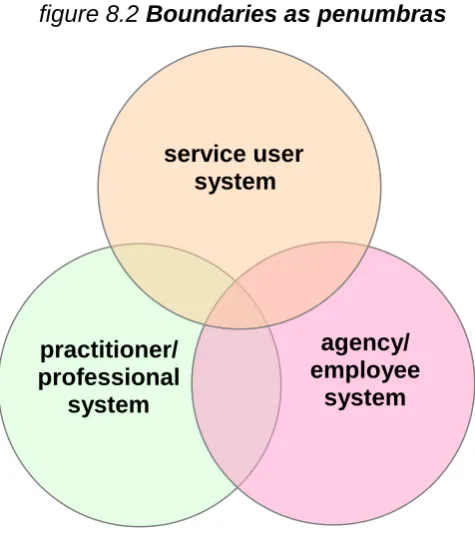
figure 8.2 Boundaries as penumbras 76
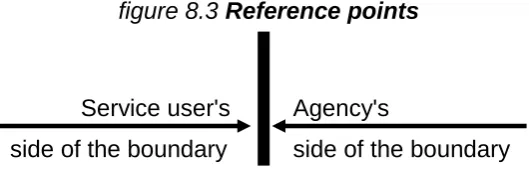
figure 8.3 Reference points 77
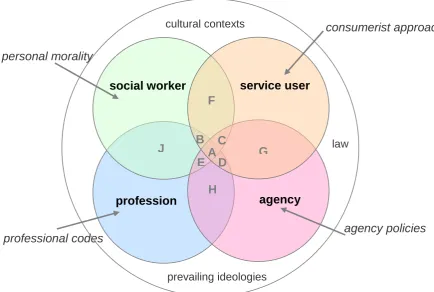
figure 8.4 Boundary Zones 80
figure 8.5 Identification and investigation over time 85
1 SUMMARY
1.1 Background
In 2009 the General Social Care Council (GSCC) published Raising
standards: Social work conduct in England 2003-2008. This constituted the GSCC‟s first report covering the work undertaken to uphold standards and protect people who use social care services. The GSCC‟s analysis revealed
that a considerable proportion of conduct cases, some 40%, involved
allegations of 'inappropriate relations'. In the light of this finding, and the
release by the Council for Healthcare Regulatory Excellence of sexual
boundaries guidance for healthcare workers at the beginning of this year
(Halter et al, 2009), the GSCC committed itself to exploring the possibility of
producing professional boundaries guidance for social workers.
To begin this exploration the GSCC commissioned a study in early 2009.
This is the report of that study. There were two main purposes. First, to
establish what professional boundaries1 guidance currently exists for social
workers, or for sections of the workforce that includes social workers in the
United Kingdom, and the content of any such guidance. Secondly, to identify
and discuss a number of other examples of professional boundaries guidance to act as points of reference for the GSCC‟s project. The aim was to identify and discuss examples relevant to the GSCC‟s project.
1.2 The research questions
What current professional boundaries guidance exists for social
workers specifically, or for sections of the workforce that include social
workers, in the United Kingdom? To what extent is such guidance
prescriptive?
1
With respect to the professional boundaries guidance identified, what does such guidance cover or not cover? How comprehensive is the
professional boundaries guidance? In other words, what scope does it
leave to professional judgment?
NB: safeguarding guidelines were not included in the scope of the study, but
they will be referred to where relevant.
Guidance currently exists in three ways.
Research as presented in the academic literature (in academic
journals, for example).
Professional and regulatory codes of ethics and practice.
Policy documents and conduct codes at agency and local levels.
The research reviewed the academic literature from a number of professions,
not just social work, and included professional codes. Analysis of agency
policies provided snapshots of the kinds of organisational codes of conduct in
daily use. This last objective was achieved by asking a sample of
professionals, managers, students and educators, including service user
educators, to respond to a set of brief scenarios, each representaing a
professional boundary issue. People responding to these scenarios were
asked to consider what guidance they would use to come to a decision. They
were asked to attach copies of any codes of practice that they had used. The
12 scenarios were deliberately set in the shadows, or 'penumbra', of
professional practice: in other words, we avoided the obviously illegal and
immoral, since these unambiguous situations are seen as less problematic
and therefore less illuminating.
The information from the review of the academic literature, the responses to
the scenarios and the analysis of agency codes of conduct was supplemented
by eight telephone interviews with key people in four regulatory bodies, three
professional organisations and one overseeing regulatory body. The findings
of the scenario responses in section 5 and the policy documents in section 6,
with a presentation of the themes arising in section 8 and a discussion of
these in section 9.
1.3 The findings
The findings suggest that academic research plays minimal, if any, part in the
guidance that individuals and agencies use to help them determine
professional boundaries and to help avoid transgressions or violations of
these boundaries. None of the 49 informants (those responding to the
scenarios) made reference to any academic research or literature, including
the eight informants who were primarily education-based. Some informants,
around 10%-15%, made reference to regulatory codes of practice, such as
the GSCC code (GSCC, 2002) or the Scottish code of practice (SSSC, 2005)
and a smaller number quoted specific sections from these codes. A similar,
slightly larger group (15%-20%) made reference to their agency's policy
documents - code of conduct, whistleblowing, media policy, etc., depending
on the scenario. There were also non-specific references to 'disciplinary
procedures', but with no particular cross-reference to a code of conduct or
practice. Clear majorities of those who responded to each scenario relied on
their own sense of what was appropriate or inappropriate, and made their
judgements with no reference to any formal guidance (see Table 5.1).
The research was also tasked with exploring what areas the guidance covers,
to make a judgement about how comprehensive it is and to consider what
scope it leaves for professional judgement - in other words how prescriptive it
is. We found no reviews in the academic literature of the day-to-day
documents that are available to social work agencies and professionals, still
less any analysis of how they are used to make professional boundary
judgements. In considering agency codes of practice, then, this current study
appears to break new ground.
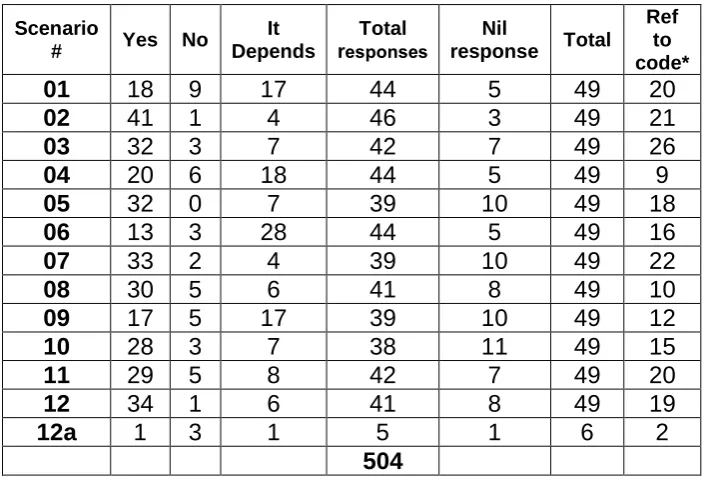
From the 49 individuals or teams who responded to the scenarios, 17
Appendix 4). These documents covered a range of agencies, types of work
and settings. It is impossible to know whether they are 'representative', but in
the totality of their 269 pages they provided a rich source of material,
especially when taken together with the analysis of 504 scenario responses.
The research found a relative absence of grey areas in the policy
documentation when compared to the discussion in the responses to the
actual scenarios. So, the penumbra, the ambiguous area in which guidance
is really needed, is overlooked in most of the guidance. However, as will
become evident from this research, we found that it is an impossible task to
provide a comprehensive bullet point list to steer professionals through these
shadows. The conclusions, presented in the final section, suggest a
metaphor where professional boundary issues are seen as a dense wood;
rather than expecting professionals to recognise individually named trees in
this wood, it is likely to be more effective for them to learn to navigate through
this wood. In other words, bullet points of prohibitions, warnings and
injunctions can grow like topsy, but it is unlikely that when a transgression
occurs it is the result of a missing bullet point.
A notion of ethical engagement is presented as critical to helping professional
and managers to navigate through difficult professional boundary issues.
Ethical engagement is a process whereby the ethical issues that underpin
professional boundary dilemmas are regularly discussed and addressed - in
the supervision of staff, in team development work and in the everyday
practices of the organisation. In this way, codes of conduct are not seen as
insurance policies to be dusted off when something goes wrong, but as an
active document, developed out of everyday practices ('bottom up' rather than
'top down') and seen as credible and relevant by those who work with
professional boundary dilemmas day by day.
The report concludes with some recommendations, based on the findings
from the research, to assist those who are charged with providing professional
2. WHAT ARE 'PROFESSIONAL BOUNDARIES'?
During the course of the research it was noted that the term 'Professional
Boundaries' can be used in various ways with slightly different meanings.
There are at least three related senses of the term:
the boundary between what is acceptable and unacceptable for a professional to do both at work and outside work (for example, whether
a social worker should have a sexual relationship with a former service
user);
the boundaries of a professional's expertise to practise (for example, whether complementary therapies can be undertaken by the
professional as part of their work); and
inter-professional boundaries (for example, whether a social worker should do a task usually undertaken by a nurse).
This research focused on the first two meanings but it is important to
3. THE RESEARCH PROCESS
The research had four main components. The first was a formal literature
search, the second was a 'snowballing ' technique to access the grey
literature and the use of codes of practice, the third was an analysis of policy
documents acquired through the snowballing process, and the fourth
component was telephone interviews with key stakeholders.
3.1 Literature review
A literature search was conducted using 22 databases in all subject areas
covered by the project, using the following keywords:
professional boundar* OR professional guid* OR professional conduct AND;
social work*; nurs*; criminal justice OR law; police OR policing; counsel*; physiotherapy OR health or therap*; teach*;
professional standard* OR professional ethic* AND
social work*; nurs*; criminal justice OR law; police OR policing;
counsel*; physiotherapy OR health or therap*; teach*;
GSCC or General Social Care Council AND
social work*; nurs*; criminal justice OR law; police OR policing;
counsel*; physiotherapy OR health or therap*; teach*.
We restricted the literature search to post-2000 results, except where the
article title was very alluring!
The results were made available to the research team via RefWorks
bibliographical software. Duplicate article records were deleted, using the
research team. The literature search results were divided up into folders
relating to the project's different subject areas to be examined by members of
the project group. A first sift of titles was undertaken, leading to a second sort
of abstracts. Articles of core relevance were selected and read for inclusion in
the analysis. Attempting to use exclusion and inclusion terms was found to be
insufficiently nuanced (especially given the different interpretations of the term
'professional boundaries'), so the decision to move from abstract to full article
review was individually judged by each research team member.
Appendix 1 lists the number of results for each database searched, minus
duplicate entries weeded out by RefWorks.
3.2 Snowballing and policy documents
An innovative aspect of this study has been the use of a modified snowballing
technique. In preliminary discussions with the GSCC (commissioners of the
research) it was agreed that the term 'boundaries' suggested grey areas and
that, in some respects, obviously illegal activities did not fall within the remit of
the research. For example, if a social worker were to steal from a service
user, that would be so clearly out of bounds that further discussion is not
necessary. Twelve very brief scenarios were developed to illustrate the
different kinds of more difficult boundary issues (see Appendix 2); these were
emailed, with an introductory and personalised email message, to a
convenience sample of 142 informants throughout the UK and abroad (see
Appendix 3). Each informant was asked to consider forwarding the scenarios
to further potential informants who might be interested to respond, hence the
'snowballing'.
Since the purpose of the responses to the scenarios was illustrative rather
than systematically scientific, it did not matter that the sample was not
'representative', or that we had little control over who might respond. 49
responses were received before the deadline date and these were all included
therefore excluded from the study. The responses to the scenarios were
analysed and coded for themes.
The responses were designed to provide a picture of a) the way professional
boundary issues are seen in actual practice and b) how people in positions to
make decisions come to their conclusions as to whether there has been a
transgression and what might be done about it. In relation to the 12
scenarios, informants were asked what codes of practice and agency policies
would be relevant and were requested to return electronic copies of these
where possible. In all, 17 policy documents were received from seven of the
49 respondents. An eighth agency sent a code of practice without the
scenarios. This amounted to 269 pages of information. Responses were
received from agencies with a wide range of characteristics (city and county
based, and ranging in size from a small local voluntary organisation to a large
national charity). A key finding was that the majority of all the respondents to
the scenarios made no reference to any specific local policy or professional
code of practice.
A number of informants mentioned how interesting they had found this
activity; some had involved their whole team in the exercise of deciding
responses and some, based in educational settings, had used it in class with
social work students. A number of informants asked permission to use the
scenario exercise in the future in staff development and student training and
we were happy to grant this.
3.3. Interviews
Telephone interviews were conducted with three types of professional body:
4 regulatory bodies General Medical Council, (GMC); General
Teaching Council, (GTC); Health Professions Council, (HPC); Nursing
1 overseeing regulator: Council for Healthcare Regulatory Excellence, (CHRE); and
3 professional organisations: Chartered Society of Physiotherapy, (CSP); College of Occupational Therapists, (COT); College of
Radiographers, (COR).
In all cases, the person interviewed was put forward by the organisation in the
light of email and phone enquiry. The precise title and role of the interviewee
varied but in all cases it was someone senior who felt able to give an
organisational view on the topics. The full report of this part of the project is
given in section 7.
3.4 Strengths and limitations of the research
The research group was a broad-based, experienced team and covered
several professions and disciplines; the team had a strong background in
ethics. Individual members were well-connected so that the snowballing
technique had a very wide and immediate reach. In addition, the team had
the specialist help of an Information Advisor to manage the complex task of
electronic literature searches.
The research design included a good range of strategies (described above),
some traditional and some a little experimental that, together, give us
confidence that the findings are 'triangulated' - not just from one perspective.
The gathering and analysis of in-use policy documents around professional
boundaries, linked to the snapshots we gained through the scenarios about
their use, is unusual - perhaps even unique. There were some examples of
the use of scenarios in the formal literature and one article that described
social workers' 'ethical journeys'; but none that we found considered local
The convenience sample is both a strength and a limitation. There was
strength in the fact that we were able to target a wide range of individuals
whom we judged would be interested to participate or to snowball to others;
but there were limitations in that we have no way of knowing whether
responses are at all representative. However, to design a sample that could
be considered representative of the groups that we wished to access would
have been a far larger undertaking; moreover, the intent was that this aspect
of the research be illuminative rather than representative. For these purposes
it worked well. There were indications of sub-group responses (for example,
the African doctors and nurses who made up five of the sample) but these
were not a large enough group to make any sound generalisations.
There was some surprise that the snowball exercise did not generate more
documents, though by happenstance the ones received were from diverse
agencies (Appendix 4). However, the fact that 86% of the informants did not
append any documentation (professional code or agency policy) could in itself
be significant as it might indicate that these codes and policies are not at the
forefront of informants' minds when considering these matters.
With hindsight, it would have been useful to have asked informants to rate the
seriousness of each scenario, to provide a quantitative measure by which to
compare responses (within one scenario from informant to informant, and
across scenarios). Any comparisons between the scenarios - and any sense
of the hierarchy of principles that is discussed in some of the literature - had to
be inferred from the text of the responses.
Time prevented some other explorations that would be useful, such as
stakeholders like Witness, or the way in which professional boundaries are
taught in the social work curriculum. Eight of the informants were wholly or
mainly based in social work education settings (as students or teachers), so
they came to the study from this perspective and one of the reviewed articles
concerned professional boundaries in academic settings (Stromm-Gottfried
and D'Aprix, 2006) but a systematic study of professional boundaries teaching
3.5 Research ethics
The literature review and scenario consultations did not require ethics
approval as research. However, the interviews with representatives from
professional bodies did constitute research albeit of a fairly informal type.
Approval to pursue this research was obtained from the Chair of the Faculty
Research Ethics Committee, Faculty of Health and Wellbeing, Sheffield
Hallam University. The potential interviewees were identified through
information on the organisation's websites. Once contacted, the interviewees
were sent an information sheet electronically (see appendix 5). The
researcher spoke to the potential interviewees over the phone and answered
their queries. The interview then proceeded on the basis of their verbal
consent. The reports from the interviews were checked with the interviewees
and the latter were invited to correct the report as they wishes. Details of who
was interviewed have been kept on the password-protected computer of the
researcher who did the interviews. However, all those interviewed were put
4. LITERATURE REVIEW
4.1 Key findings from the social work literature
Three hundred and fifty seven abstracts and titles were reviewed and these
were narrowed to 35 key abstracts. Of particular note is an analysis of
professional code violations coming to the attention of a professional body
(Strom-Gottfried, 2000). The key findings from the social work literature on
professional boundaries are summarised below.
i) Prevalence of transgressions and violations
The prevalence of professional boundary issues is difficult to estimate, not
least because of the discrepancies in what is considered to be a transgression
or violation. An extraordinary 29% of Israeli therapists who responded to a
questionnaire reported at least one of their patients had experienced sexual
relations with the most recent, former therapist (Aviv et al, 2006), though it is
not clear how 'sexual' was interpreted. Formal expulsions from professional
bodies is one way to consider prevalence and the evidence from
Strom-Gottfried (2003) and Phelan (2007), both in the US, suggests that rates are
steady or even in decline, but that they are disproportional across
organisations.
Sexual violations are the most commonly reported of boundary violations
(Stromm-Gottfried 2000), but the focus of our current research is less on
obvious violations and more on the grey areas that we might term
transgressions. The American literature makes a distinction between
professional boundaries and other kinds of violation, such as poor practice,
competence, record keeping, honesty, confidentiality, informed consent,
collegial actions, reimbursement, and conflicts of interest (Strom-Gottfried,
2000) and any single reported incident might result in a number of different
violations. Financial transgressions figure more prominently in the US
A report of social work activity in England between 2003-08 (GSCC, 2008)
recorded that allegations were received regarding less than 1% (n=503) of the
registered workforce in 2007-08 and in 2006-08 only 0.04% (n=36) of the total
workforce of social workers and students have appeared before a hearing. By
far the largest category of complaint was poor professional practice (46%),
and the pattern was for multiple and related transgressions. The most
common breach is 'behave in a way, in work or outside work, which would call
into question your suitability to work in social care services'. A considerable
proportion of complaints that end as conduct cases (40%) involve allegations
of inappropriate relations.
In 1993 the NASW Center for Policy and Practice reviewed a random sample
of 300 cases drawn from all complaints to NASW for the period 1982 to 1992.
The researchers found that, of 226 alleged violations, 72 were substantiated
through hearings. They found that 29% of those who breached the Code of
Ethics did so by violating the prohibition against sexual activity with clients.
This was followed by conflicts of interest (17% percent of violations);
precipitous withdrawal of services (17%); exploitation of professional
relationships for personal gain (16%); dishonesty, fraud, and deceit (14%);
succumbing to pressures that affect impartiality (violated by 13%); exploitation
of client (13%); and failure to terminate or transfer a case appropriately (12%).
Findings involving other tenets of the Code occurred in fewer than 12% of the
cases reviewed.
ii) Identification and resolution
It is one thing to determine a boundary, another to agree that it has been
transgressed (especially when this might be incremental) and yet another to
find out about it. The most likely people to be aware of boundary issues are
colleagues, but what likelihood is there of whistleblowing? A study of students
to service users, but this form of self-report is unreliable (Mansbach and
Bachner, 2009).
The literature included some studies that track 'the moral journey'. Asquith
and Cheers (2001) examined the moral issues that 15 social workers faced
over a one-month period and discovered that the main source of influence to
resolve these issues were the practitioners' personal moral perspectives.
Tellingly, most of these resolutions did not conform to accepted social work
ethical practice principles. This finding is reinforced by a study which
considered professional socialisation over time (Landau, 1999) and suggested
that professional socialisation did not seem to affect the ethical judgement of
the social workers and students in the study; the only variable which
significantly affected their ethical judgements was religiosity.
Reamer (2000) suggests that social workers need regularly to perform a kind
social work ethics audit. Certainly, in one study, American MSW students
indicated that they did not feel adequately prepared to handle sexual feelings
towards or from a service user (Berkman et al, 2000). The Social Work Ethics
Audit is described as an 'easy-to-use tool to [help practitioners] examine their
ethics related practices, policies and procedures' (Kirkpatrick et al, 2006: 225),
but the literature suggests that making boundary decisions requires ethical
competence rather than following a framework of instructions
(Peternelj-Taylor and Younge, 2003). Integrating ethical codes more fully into
professional training is seen as one way of managing the tension between
over-vague principles and over-instructive diktats (Gastman, 2002).
Iii) Contextual factors
Given social work's traditional role as working with
individuals-in-their-environment, it is unsurprising that issues of relativism and universalism are
considered in the literature. At the heart of this is the difficulty of applying
particular codes of ethics that may not be accepted by some social groups.
Squaring the circle of respecting culture while upholding professional ethics is
is, one in which certain principles or rules of ethics are said to hold universally
(for example, not to abuse children). Nevertheless, a comparative study of
Cuban and Canadian professionals found very different 'stories' about the
meaning of professional ethics, reflecting the strength of collectivist and
individualist societies respectively (Rossiter et al, 2002); prevailing ideologies
clearly have an impact on specific codes of practice.
Another significant contextual factor is the kind of work that the social worker
is undertaking. For example, a study by Düvell and Jordan (2001) found that
the boundary issues for social workers with asylum seekers were
exceptionally sharp given the workers' acknowledgement that the prevailing
standards in their agencies were unacceptable, in terms of human rights,
decency, efficiency and social justice. The rural/urban context also emerges
as significant, with the likelihood of dual relationships (knowing service users
in other guises) more common in rural communities (Austin et al, 2006; Pugh,
2007).
We will see in Section 5 that organisational contexts were strong, perhaps
even paramount, in the responses to the Scenarios, yet these were more
difficult to gauge from the formal literature. A study of expulsions from
professional bodies in the US context (Phelan, 2007) noted that organisational
sanctioning may be even more rigid than the state boards but
Stromm-Gottfried (2003) found a higher rate of violations amongst private
practitioners. Banks (2004) sees the increasing proceduralisation of social
work and other changes in role as a threat to the idea of a single code of
professional ethics, especially with the strengthening of a consumerist
approach to the social work profession. She considers that ethical codes
should be bottom up, reflecting daily practice.
iv) Inclusion and exclusion
The vocabulary used to discuss professional boundaries frequently puts
distance between service users and professionals, almost as though service
boundaries seem less designed to uphold the proper consideration of power
differentials, etc. and more to deny people who happen to use services certain
rights, privacies and possibilities. Dietz and Thompson (2004) contrast a
patriarchal 'distance' model of social worker-client relationships and a feminist
'relational' model; they view the drive to proceduralise social worker-service
user relationships as a strengthening of the patriarchal model. The difficulty in
moving between 'castes' is illustrated by the problems that workers and
agencies have in deciding when and in what circumstances a person
becomes a 'former' client or service user (Mattison et al, 2002).
So, in what circumstances can relationships between service users and
professionals that fall outside the service-based one (sometimes referred to as „dual relationships') be considered permissible or even desirable? NASW's
code of practice (2000) recognises that dual relationships can be part of
sound social work practice (Boland-Prom and Anderson, 2005), but Kabel and
Giebelhausen (1994) see dual relationships as, by definition, boundary
violations. This latter position implies that social workers never become users
of services and that service users never become professional providers, yet
another reinforcement of the 'caste' approach to social immobility.
As Lord Nelson et al (2004) discovered in their study of families with children
in special education, it is highly likely that service users themselves have a
preference for practitioners who are flexible with the boundaries. The families
in this study appreciated reliable and flexible availability and accessibility,
broad responsibility that went beyond a strict interpretation of the
professional's role, and dual relationships (i.e. fostering friendships, etc).
The successful resolution of professional boundaries issues seem to depend
on balancing personal privacy, the safety of vulnerable individuals and the
protection of the wider public. In a more general context, Clark (2006)
suggests that there should be more focus on the collective common good to
balance current obsessions with defending individual interests. A simple
example of this is a father who transports his child to school by car. He does
exacerbates the general social problem. In a similar way, focus on, say, the
individual social worker's right to act in any way that is legal might
nonetheless harm some clients. These issues are complex and suggest the
need for a broader view of boundaries than can be satisfied by a bullet point
list of injunctions.
4.2 Key findings from the nursing literature
There is wide interest in the nursing profession in issues relating to ethics and
professional boundaries and this has produced an extensive range of
literature. A large number of abstracts were reviewed and these were
narrowed to 28 key abstracts. Of these, of particular note, are papers which
were literature reviews themselves (for example, Meulenbergs et al, 2004). A
further feature of the literature is the regular reporting over time of
professional misconduct cases in the British Journal of Nursing (Castledine,
2002, 2003) where detail of specific practice is linked to codes of conduct and
learning points.
i) Codes of ethics and international boundaries
There is a wide range of interest across international boundaries in codes of
ethics and their relationship to moral obligations and conduct. The
International Council of Nurses Code of Ethics (2005) tends to be the starting
point with literature responding to that code in terms of comparisons: e.g. the
Belgian regulatory body having no specific code relying on general legislation
(Verpeet et al, 2003) and the UK one (at that time) having a detailed code
offering specific guidance in some areas such as consent for care procedures.
A further example is the guidance produced by the General Medial Council in
the UK on personal beliefs and medical practice where principles are linked to
specific guidance and specific situations (GMC, 2008). Literature comparing
UK, Poland, Ireland, Netherlands and Hong Kong was specifically identified.
1. many moral duties in the codes of different countries are the same, the
difference lies in the specificity with which they address issues
(Dobrowolska 2007); and
2. codes of ethics are seen as part of the professionalisation of nursing as a
means of self assertion and both an expression of identity and a means of
self regulation (Meulenbergs et al 2004).
ii) A critique of codes of ethics and codes of conduct
A critique of codes of ethics and of conduct is developed in the literature.
Codes include universal norms but also those related to specific problems
faced in each country. For example, in Ireland the code of professional conduct indicates “every effort should be made to preserve human life, born and unborn”, whereas this is not indicated in the UK code. Consequently,
professional ethics are relative and arguable dependant on prevailing ideology
(Dopbrowolska, 2007).
It has been suggested that professions are losing their exclusivity and identity.
In the health service this is seen in a move away from being a general nurse
and a move toward being someone trained to work in a specific area doing
whatever tasks are required. In this post-professional context, codes are
likely to become mechanisms of control rather than instruments for the
promotion of ethics in nursing (Meulenbergs, et al 2004). Ethical codes are
identified as too instructive and restrictive, framing morality in duty and
rule-based terms and undermining the development of ethical sensitivity as a
central element in professional competence (Hussey, 1996; Meulenbergs et
al, 2004). Consequently, codes can produce the opposite effect from that
commitment to act rightly according to moral standards is transferred to a
focus on compliance with the code (Pattison, 2001).
Ethical codes are seen as too vague in identifying virtues and principles which
are of no direct practical use in everyday work situations (Meulenbergs et al,
2004).
iii) Ways of providing guidance on ethically appropriate professional
behaviour
The critiques reflect dissatisfaction with codes of ethics because of the
outcomes of their application. If too instructive then the professional fears
sanctions, if too vague then no tangible guidance is offered. Ways of
managing this tension are seen as integrating ethical codes more fully into
professional training so they are seen as helpful and also contribute to the
cultivation of virtuous attitude (Gastman, 2002). Ethical expertise is seen as
wider than any clinical expertise and is interdisciplinary in nature (Yoder,
1998, in Meulenbergs et al, 2004). Codes can never replace a nurse‟s ethical
sensitivity and individual decision making. Consequently, codes and
guidance should not be formulated by a top-down approach which restricts participation to a profession‟s hierarchy but rather a bottom up approach
reflective of daily practice (Meulenbergs et al, 2004).
Behaviour beyond professional practice is not spelt out in codes but for
example the UK and Polish codes indicate that nurses should refrain from activity which would injure the reputation of the profession – this raises the
question of what activity or conduct is wrong and what is the norm which the
literature does not clarify other than in certain examples, such as the
significant literature on the nature of sexual relations between psychiatric
nurses and clients/patients (Bachmann et al, 2000). There is support for the
view that a code is not an algorithm of conduct in a morally difficult situation,
but rather a guideline that points to the values that need protection. Thus,
crossed – when the professional fails to act in the best interests of the client
(Peternelj-Taylor and Younge, 2003). Making decisions about crossing
boundaries is seen as more than following a framework of instructions but
requires ethical competence.
Dobrowolska et al (2007) argue that codes‟ norms are established according
to recurring situations – where moral conflict arises then the norms of conduct
become established. The British Journal of Nursing takes this approach
further by publishing professional misconduct case studies (e.g. Castledine,
2002, 2003) which allows specific cases to be considered in the light of
relevant clauses of the code.
4.3 Key findings from the allied health and physiotherapy literature
From the literature search 200 articles were retrieved from those related to
allied health and physiotherapy. 146 of these were from PsychINFO and 30
from ASSIA. After review of the abstracts 17 were identified as relevant to
professional boundaries and full text articles obtained. Following this, ten
articles were selected and included in this review. None were from
Sociological or Social Services. The rest were from ASSIA, PsychINFO,
ERIC, Web of Knowledge and Scopus.
The Allied Health professions literature included that from psychotherapy. It
considered a range of issues and examples that related to professionals
boundaries. Across the literature different examples were given of how health
care staff can breach professional boundaries (PBs) and strategies suggested
to prevent or address them. These are summarised below.
i) How are professional boundaries breached?
Examples of how professional boundaries are breached considered in the
articles varied from more severe acts of cruelty involving de-humanizing
serious, such as accepting gifts (Boon and Turner 2004; Browne and Russell,
2005). A consideration was distinguishing between a violation and a
transgression (Austin et al, 2006). A violation is recognised as harmful and /
or exploitative. However, in practice many people cross a boundary line
meaning to be helpful not to harm. The concern, then, is that crossing the line
can lead to violation in an incremental way. That is why guidance should
emphasise the principles behind judgement rather than being just a list of do's
and don'ts. Examples of how transgressions can lead to future violations
included use of touch, not recognising diversity and difference, and breaching
trust. Bowman and Hughes (2005) provide an example from medical
education. They describe how a breach in professional boundaries can occur
between tutors and students because of the nature of problem based learning
and the caring role. As they spend a lot of time together, socialize and share
views and experiences, normal teacher/student roles become blurred and can
make people vulnerable to breaching professional boundaries. In relation to
this type of situation, Austin et al (2006) also advise that guidance should help
professionals make the distinction between when their actions are motivated
by satisfying their own needs rather than those of their clients.
ii) "Crossing the line"
Much of the literature considered the issue of professional boundaries and the
difficulty distinguishing between violation and transgression in terms of
'crossing a line. It is sometimes difficult to know when the line is crossed.
Professionals and clients may consider the line should be crossed in different
places. If the line is crossed it can be difficult to know what to do. Browne
and Russell (2005) comment that professional organisations in Australia
provide guidelines to discourage carers from assisting clients with their sexual
needs. However, when participants felt a situation was getting out of hand a
few participants had clearly defined strategies and others felt uncertain about
what to do in such situations.
In relation to the example of health professionals praying with patients
that because a patient requests something the health professional is not
necessarily obliged to respond. They should refer elsewhere or seek advice.
Austin et al (2006) identified a number of factors that influence where a
professional should draw the line in terms of professionals boundaries with
patients and clients. These were the:
needs and personality of the client;
character and training of the professional;
status of the treatment alliance; and
the treatment setting.
It is therefore difficult to account for all eventualities in guidance as so many
variables are at play. Instead guidance should support the reflection,
judgement and decision making required in such demanding real world
situations (Bridges, 1999; Bowman and Hughes, 2005; Curton, 2000).
Guidelines should therefore respect differences but also promote
professionals taking responsibility for their actions (Austin et al, 2006).
iii) Remit of codes and guidance
Comment was made on existing codes and that little exists to guide
practitioners in such areas of uncertainty. There was a recognition that
professionals and guidance both needed to be flexible in order to best meet
client's needs. Reed et al (2002) raised the point that guidance had to
accommodate exceptions and unusual occurrences, whatever they may be
and that individual patient / client encounters can be at variance to codes.
This led to a consideration of a tension that exists where codes and guidance
advise professionals to act in a way to please the organisation or profession
rather than the individual client. Browne and Russell (2005) illustrated this
clearly when exploring the difficulties in helping disabled clients maintain their
sexual health and wellbeing. Here it was suggested that in protecting the
for maintaining professional boundaries is often seen to lie with the
professional but there was a suggestion that the client's views should have
more weight.
Codes seem to instruct against breaches of professional boundaries.
However, once a breach has occurred there is little guidance on what to do,
especially if it is not illegal.
iv) Advice on developing a code
One article by Davis (2007) was a discursive piece sharing his experience as
a philosopher involved in developing an ethical code for software engineers.
He drills this experience down to 18 rules for professional organisations in
developing professional codes. This advice is less about the content and
more about the process. Salient points for the GSCC to consider include:
the importance of having an open process. The way a code has developed should be clear, transparent and auditable and open to
comment from all relevant bodies within and outside the profession;
leave a paper trail so that the content of a code or guidance can be traced back to its source(s);
use scenarios that adequately reflect the reality of the working world in
that profession to stimulate debate regarding the code or guidance. If
this is done within the profession, for example at professional meetings
or conferences, it ensures a response and input from the profession;
the importance of not being too secular and involving external experts who can offer advice. Key examples here include ethicists and
philosophers;
guidelines are often based on expert / professional opinion - need to include users and to protect their interests; and
be clear what you are developing and its intended remit e.g. guidelines
Guidelines need to explain why behaviour should be a certain way, not just a
list of dos and don'ts. Guidelines can't address every eventuality.
Strategies to deal with professional boundary issues
A number of approaches were identified to either prevent or deal with
violations or transgressions in professional boundaries. They can be
summarized as follows:
professional conduct. Emphasis from training to practice on standards
of professional behaviour was seen as important. Characteristics such
as honesty, appearance, respect for law and others, and confidentiality
were cited as helpful in preventing professionals "crossing the line"
(Boon and Turner, 2004);
ongoing assessment in practice was also advised. Examples here included peer or observed assessment of practice,patient or service
user evaluations, and own account journals (Boon and Turner, 2004);
self-scrutiny and reflection strategies were recommended (Bridges, 1999). Self examination of ones own motives for action and honest
reflection were key approaches to self management at an individual
level (Curtin, 2000);
seeking advice as early as possible after an incident has emerged was crucial. Methods included consultation, supervision and mentorship
(Bridges, 1999; Bowman and Hughes, 2004); and
the use vignettes for training was also seen as valuable (Bowman and Hughes, 2004).
4.4 Key findings from the policing literature
From a review of abstracts and titles, 15 articles were considered as relevant
and the following principle themes emerged.
Moran (2002) reports strategies by the Metropolitan and Merseyside police to
combat corruption by establishing anti-corruption units and developing a
range of preventative measures. However, of key importance is the role
played by the anti-corruption units in the development of overall professional
standards. Punch (2000) suggests that to identify corruption and to maintain professional standards „strong leadership, a multifaceted organizational
strategy, a well-resourced internal affairs unit, proactive techniques of
investigation, and persistent efforts to promote professional standards‟ (Punch
2000: 301) are needed. Lamboo et al (2008) draw attention to the high
priority police senior management in the United States, United Kingdom and Holland have given to developing policies to developing professional probity –
particularly in relation to officers receiving gifts or services in kind. This is most notable in the development by Dutch police forces of „integrity policies‟.
Other commentators highlight the importance of considering organisational
context when considering the aetiology and response to corruption, which is
construed as the breaking of many professional boundaries (Punch, 2000;
Ekenvall, 2002; Alain, 2004; Westmarland, 2005). Highlighted as a key area
of concern is the relationship of official discourses (Lasthuizen et al, 2008) to
sub-cultural practices (Ekenvall, 2002; Westmarland, 2005); in other words,
the official line and what actually happens. Sub-cultures within the police are
strong and can undermine official guidance, codes and so forth.
(ii) The influence of employee sub-culture(s) on professional conduct
The policing literature pays particular attention to the importance of the culture
of the police forces in determining how police officers should act (Marc and
Martin, 2008; Catlin and Maupin, 2002; Westmarland, 2005). The research is
international in its scope but clearly points to what Westmarland (2005) refers to as the „blue code‟ or „Dirty Harry‟ belief systems. There is a significant literature on „police (sub) culture(s)‟ (Westmarland, 2001; Newburn and
Thus it is important to distinguish between the „profession‟ that is shaped by professional codes and indigenous „employee‟ codes (what Fielding, 1994, calls „cop canteen culture‟).
Professional sub-cultures produce alternative ethical hierarchies. Ekenvall
(2002) found Swedish police officers were most intolerant of colleagues who
engaged in theft during their professional duties, but were only moderately
intolerant of colleagues using excessive force with suspects of crime. He
found that these types of misconduct were ranked similarly in USA and Croatia. Westmarland (2005: 145) found similar hierarchies – namely that officers in her study regarded „the acquisition of goods or money as much
worse than behaviour involving illegal brutality or bending the rules in order to protect colleagues from criminal proceedings‟.
Underpinning these hierarchies is a reluctance of police officers to report the
wrong-doings of colleagues. Ekenvall (2002) identified a code of silence that is similar to the „Blue code‟ identified by Westmarland (2005). Alain (2004: 3) asked a representative sample of 455 Quebec police officers why „an officer
might or might not report instances of conduct that clearly violate police professional ethics‟. He identifies three types of respondent – „the reluctant, the relativist and the compliant‟ and suggests that resources should be focused on the „main determinants‟ of how police officers construe „corrupt conduct‟. This, he suggests, will better increase the chances of developing a
culture that prevents boundary transgressions.
(iii) ‘Ethical Burn-out’ or Changes in ethical construing and behaviour
Research into the early years of policing indicates that officers shift from
idealistic ethical standpoints to positions of self-interest. Catlin and Maupin
(2002) compared the ethical orientations of new male recruits (n=128) and
trainees who were one year into their training. They used a "parsimonious"
scale for judging ethical standpoint which consisted of two axes. Along one
axes, recruits could be either idealistic or not; an idealist believes there is a
could be either absolutist or relativist; an absolutist believes there are
universal moral rules and standards; a relativist believes these are relative to
time, place and individual. New recruits tended to be idealistic and absolutist;
their counterparts of one year's experience were predominantly non-idealist
and relativist. Additionally, whilst only 13 per cent of the new recruits
identified as having a subjectivist orientation (defined as accepting that
self-interest is the guiding principle in ethical decisions), almost 42 per cent of those with one year‟s experience identified as being subjectivist. Similar changes were identified in Alain and Grégoire‟s (2008) study of Quebec police
recruits. They point to a tension between an exogenous (externally imposed)
morality, particularly legal statute and the endogenous (internal to the
profession/workforce) morality. The latter is more concerned with preserving
colleagues from the threat of a hostile outside world by making
context/situation specific decisions, whereas the former is construed by police
officers that are two or more years into the job as being alien, as hostile rules
that must be managed.
4.5 Key findings from the counselling and teaching literatures
Counselling
A large number of abstracts were read and reduced to 14 key texts.
A feature of the literature regarding counselling is the lack of specific
exploration and guidance on boundary transgressions, particularly in literature
from the UK. As Khele et al (2008) indicate, despite media interest much of
the evidence is anecdotal. What evidence there is emanates primarily from
the USA (Pope and Vettner, 1992) and they identify only one study in the UK
which examines sexual contact between psychologists and patients (Garett,
1998). The British Association of Counselling and Psychotherapy (2002,
2007) provide an ethical framework for good practice in counselling and
psychology alongside codes of ethics for counsellors, trainers and
thinking rather than prescribing specific behaviours. Their analysis of
complaints against counsellors indicates only 12% of the overall sample
involved boundary transgressions but a large number 75% were upheld.
In the more theoretical literature a key concern is the examination of the
slippery slope concept of boundary dilemmas linked to a rule based approach
to ethical decision making (Martinez, 2000). This concept takes the view that
boundary violations are not a single event but a process, a slippery slope,
where minor boundary crossings precede more serious breaches. A further
and distinct theoretical distinction is drawn between boundary crossings and
boundary violations. A boundary crossing describes a departure from clinical
practice that may or may not benefit the client, for example accepting a gift
from the client, which can in itself be a focus for therapeutic work. A boundary
violation is a departure from practice that puts the client at serious risk (Smith
and Fitzpatrick, 1995).
Various attempts are made to group boundary transgressions under types, for
example, non-erotic physical contact, self disclosure, and sexual contact
(Smith and Fitzpatrick, 1995). In discussing how to avoid such boundary
transgressions in respect of clergy psychotherapists Haug (1999) argues that
establishing behavioural rules and guidelines is only partially helpful. What is
also required is addressing through supervision and training the attitudes and
practices that give rise to the misuse of power and authority. Hill (2004)
discusses the USA Standard of Care as a legal determinant that a counsellor
should practice in the same way as a reasonable similarly educated
counsellor would practice in a similar situation. The way to avoid boundary
transgressions is by discussion with colleagues to explore similar situations
and to regulate conduct in the light of the Standard.
Teaching
The literature on teaching provided little illumination or guidance in respect of
professional boundaries. There is considerable discussion of ethical issues
responsibilities to students with the teacher‟s duties to those students‟
families, for example in potential child abuse situations (Freeman and Swick,
2007). Resolving the ethical issues involves both applying professional codes
5. SCENARIOS
5.1 Purpose of the Scenarios
12 brief scenarios were devised in consultation with the commissioning team
at GSCC in order to give selected informants the opportunity to respond to a
variety of ambiguous boundary issues (see §3.2 for more details; see
Appendices 2 and 3 for the scenarios and the informants). Informants were
asked to 'snowball' these scenarios to other informants in order to achieve a
wide broadcast and potential catchment area. The scenarios were designed
to act as a trigger for informants to consider the actual response likely from
the informant's agency or in the informant's experience. Informants were
encouraged to append electronic copies of policy documents, formal guidance
and codes of conduct that would be used to help make a decision in the
various scenarios.
5.2 Results of the snowballing technique
142 informants were contacted across nine countries (UK, Eire, US, Canada,
Australia, New Zealand, South Africa, Sweden and Germany) and six
professions (social work, nursing, medicine, educational psychology,
probation and occupational therapy). By far the largest proportion of
informants were UK social work professionals, with these being employed in a
range of agencies in the statutory and voluntary sectors and educational
settings; and in a variety of different job roles. 63 responses were received,
49 of which arrived before the deadline. Of these, 59% were derived from
'snowballing', i.e. they were not direct informants (see Appendix 3).
This method is designed to be illustrative rather than representative; as a
convenience sample, then, we cannot infer any prevalence from the
information gained. However, in its intent to provide considerable, rich,
range of policy documents it was less successful, though this fact was in itself
illustrative, as we will explore in §5.3.
Were this exercise to be repeated the research team would recommend
including some numeric questions, such as 'rate on a scale of 1 to 10 how
serious you would consider this boundary issue'. This would have achieved a
more ready comparison between different informants' responses to the same
scenario, and enabled comparisons across scenarios to be more easily made.
There was a wealth of qualitative data, but any comparative judgements had
[image:36.595.116.470.346.585.2]to be inferred.
Table 5.1
Responsesto the question,Would your agency take action if the following information came to light?
Scenario
# Yes No
It Depends
Total responses
Nil
response Total Ref
to code*
01 18 9 17 44 5 49 20
02 41 1 4 46 3 49 21
03 32 3 7 42 7 49 26
04 20 6 18 44 5 49 9
05 32 0 7 39 10 49 18
06 13 3 28 44 5 49 16
07 33 2 4 39 10 49 22
08 30 5 6 41 8 49 10
09 17 5 17 39 10 49 12
10 28 3 7 38 11 49 15
11 29 5 8 42 7 49 20
12 34 1 6 41 8 49 19
12a 1 3 1 5 1 6 2
504
* this column documents the numbers of respondents who made reference to a specific agency code of conduct, professional code of practice, disciplinary action or legislation.
5.3 Themes arising from the scenario responses
In this section we present a brief overview of the themes arising out of each
scenario responses. The term 'social worker' was replaced by the appropriate
profession depending on the informant's own profession.
#1 A [social worker] becomes engaged to a person who until two
months ago was a user of the agency that employs the social
worker.
This scenario had the highest number of 'No' responses to the question,
would action be taken? (20% of the 44 who responded to this scenario) - and
a relatively high number of 'It Depends' (37%), almost as many as the
unequivocal 'Yes' responses (41%). The broadest consensus focused on
whether the professional worked directly with the service user and whether
the relationship had begun during that contact - so, it was a question of both
timing and of proximity.
'There would be very limited issues if, for example, a hospital social
worker get engaged to a person who used a service of the same
hospital but not the social work services' [ref 11§1].
In a number of instances it was stated that policies were not considered to
cover former service users. Factors specific to the service user, the
practitioner, the agency and the relationship were all considered relevant -
Perhaps they met outside of the agency? [ref 20§1]. One informant reported
that this situation would fall under the conflict of interest category: 'If you have
a personal interest in any group or individual you must declare it' [31§1 City
Council code]. This was one of only three scenarios (#1, #7, #11) in which
one informant made reference to the fact that they knew of this situation
actually happening.
# 2 A [social worker] over claims mileage allowance in order to fund a
This is the scenario with the highest proportion of unequivocal 'Yes, action
would be taken' responses (89% of the 46 responding) and the smallest
number of informants who did not address this scenario (94% addressed it).
Comments in the main were tough and, for most, the motivation was not
considered relevant:
'It is not appropriate and in my opinion, illegal, for a social worker to fraudulently claim mileage for any reason, however „worthy‟ it may
seem' [ref 13§2].
There were a few more low-key responses:
'This is misguided activity and needs to be stopped. This could be
done in a low key way during supervision' [ref 14§2].
The most sympathetic response came from an Educational Psychologist:
'This would be against council policy, but as people may have
sympathy with the situation I don't know if anyone would take action'
[ref 38§2].
For some the scale had a bearing but others were absolutist about the fact
that this was dishonest/illegal no matter what size the sum.
'How the disciplinary action is progressed (i.e. with a view to the likely
outcome) will be influenced by the scale of the inappropriate use of
mileage allowance' [ref 25§2].
A theme that a number of informants considered important was whether this
was a first-time breach or something that was recurring. There was also a
sense that the response of the practitioner (contrite, arrogant, etc.) would
have a bearing on the decision. Only one informant [ref 37] mentioned
#3 A [social worker] refuses to work with a same-sex couple because it
contravenes his/her religious beliefs.
There was quite wide agreement that equality and diversity policies would kick
in, but considerably more accommodation of the social worker's position than,
say, the mileage overclaim in #2, even though this had a 'good intention'.
Many informants made mention of the need for discussion in supervision and
further training before taking any further action. In particular, the fact that the
worker's behaviour was related to religious beliefs seemed to have the effect
of making informants nervous of any stiffer action:
The worker would have to agree to work with the family while getting
support from his or her supervisor to deal with his or her feelings.
While we respect religious beliefs we are a publicly funded agency
and must serve families regardless of race, religion, or sexual
orientation' [ref 11§3].
'More and more religious organizations are providing services and
their beliefs often come in conflict with how I personally read the
code of ethics' [ref 08§3].
The need for prevention and pre-emption was noted:
'If a particular case bothers SW, appropriate to know one‟s triggers
and to avoid getting in a sticky situation' [ref 06§3].
One of the few stronger statements was:
'Our Council has a strong diversity policy which we think would be
contravened in this situation and disciplinary action would be likely.
In our team it is not possible to know the sexuality of our clients
before we assess them and we do not feel this type of view is
The practical issue of the quality of the service likely from a 'coerced' social
worker was also called into question.
#4 A [social worker] invites a service user to pray with him/her.
This scenario gave the strongest evidence of subculture, in that five or the six
informants who said that no action should be taken were doctors and nurses
from Africa. Of the other 39 who responded to this situation, 97% thought
action should be taken, though for almost half of these, there were situational
factors which would determine whether and what that action would be.
A key theme was who initiates the prayer and the context (for example, if a
dying service user invited a social worker in attendance to say a prayer with
them; or the social worker and services user attended the same church).
However, a US informant noted that some agencies employing social workers
would expect the service user to pray 'before reaping the benefits in soup
kitchens and homeless shelters' [ref 08§4] which begs the question of the
agency's mandate and service users' knowledge and expectations of that
mandate (and, indeed, realistic choice to seek help elsewhere).
Where the GSCC Code of Practice was quoted there was little agreement as
to which part of the code might be called into question.
#5 A [social worker] masturbates a 25 year old man who has lost use of
his arms.
This was the only situation in which all informants felt that some action would
be taken, though 7 (18% of the 39 responding) felt that action would depend
on other factors and was therefore situational. The main situational factor