DA COSTA JÚNIOR, Edmilson P, DA SILVA, Carlos Eduardo
<http://orcid.org/0000-0001-9608-439X>, PINHEIRO, Marcos and SAMPAIO,
Silvio
Available from Sheffield Hallam University Research Archive (SHURA) at:
http://shura.shu.ac.uk/25227/
This document is the author deposited version. You are advised to consult the
publisher's version if you wish to cite from it.
Published version
DA COSTA JÚNIOR, Edmilson P, DA SILVA, Carlos Eduardo, PINHEIRO, Marcos
and SAMPAIO, Silvio (2018). A new approach to deploy a self-adaptive distributed
firewall. Journal of Internet Services and Applications, 9 (12).
Copyright and re-use policy
See
http://shura.shu.ac.uk/information.html
R E S E A R C H
Open Access
A new approach to deploy a self-adaptive
distributed firewall
Edmilson P. da Costa Júnior
1, Carlos Eduardo da Silva
1*, Marcos Pinheiro
2and Silvio Sampaio
1Abstract
Distributed firewall systems emerged with the proposal of protecting individual hosts against attacks originating from inside the network. In these systems, firewall rules are centrally created, then distributed and enforced on all servers that compose the firewall, restricting which services will be available. However, this approach lacks protection against software vulnerabilities that can make network services vulnerable to attacks, since firewalls usually do not scan application protocols. In this sense, from the discovery of any vulnerability until the publication and application of patches there is an exposure window that should be reduced. In this context, this article presents Self-Adaptive Distributed Firewall (SADF). Our approach is based on monitoring hosts and using a vulnerability assessment system to detect vulnerable services, integrated with components capable of deciding and applying firewall rules on affected hosts. In this way, SADF can respond to vulnerabilities discovered in these hosts, helping to mitigate the risk of exploiting the vulnerability. Our system was evaluated in the context of a simulated network environment, where the results achieved demonstrate its viability.
Keywords: Distributed firewall, Self-adaptive software, Network security, Software vulnerability assessment
1 Introduction
Several institutions all over the world deal with com-plex network infrastructure, involving an increasing num-ber of equipment (e.g., switches, routers) and servers, usually providing different services. These environments may contain several types of vulnerabilities that could be exploited by an attacker. In this way, it is extremely important to maintain software systems up to date with versions that fix known vulnerabilities. Considering the diversity of activities and variety of research topics con-ducted throughout an university, it is common to find situations where several services, and servers, need to be provided for different groups of people, and more often than not, maintained by these groups. This leads to an inconsistency in management and security procedures, where servers poorly configured, with outdated services, or both may become potential targets for attacks.
In this context, the traditional approach for network security, in which firewalls are deployed on the border
*Correspondence:[email protected]
1Digital Metropolis Institute, Federal University of Rio Grande do Norte (UFRN), Natal, RN, Brazil
Full list of author information is available at the end of the article
of the network is no longer effective, as centralized bor-der firewalls are not able to deal with attacks originated from inside the security perimeter [1]. Today’s technol-ogy movements, such as Bring Your Own Device (BYOD) and the availability of 3G/4G connections, mean that a malicious user has already penetrated the border defense. This is exacerbated when we consider university environ-ments, which are usually open to the public in general, and contains some servers maintained by researchers, with outdated and potentially vulnerable services.
Distributed firewall systems [2] have emerged as a solu-tion for dealing with incidents originated from inside the secure perimeter, by including firewalls in different points of the network and servers. In such systems, a centralized control mechanism is responsible for distributing firewall rules to each point of the network, and hence it is possi-ble to control what services running on those servers are exposed on the network, and only for specific client hosts. However, the application of distributed firewall also brings some challenges, such as the management of these firewalls and their rules, and the response time in case of an incident. Traditional solutions for intrusion detection
or vulnerability assessment usually notify an administra-tor, who then assesses and decides how to respond to deal with the situation [3]. However, this approach is usually not fast enough for avoiding information theft, the infec-tion of new systems/servers, or even service unavailability, mainly for attacks conducted during strategic times, such as the middle of the night or weekends, when the IT team is usually out of service.
Moreover, it is possible to identify a gap on the inte-gration between the several tools involved in securing a network environment. For example, a Vulnerability Assessment System (VAS) may detect a vulnerability on a particular server, but the firewall of such system may not react to such detection, as both systems are not inte-grated. Such problem becomes more evident when we consider the dynamic nature of a complex network envi-ronment, in which new devices and services are constantly added/removed, and new vulnerabilities are discovered and patched. Finally, it is worth mentioning that, although there are firewall solutions that inspect application pro-tocols, in 2016 more than half of the corporate networks were still using conventional firewalls [4].
In this context, the main contribution of this paper is an architecture for network security based on self-protection, named Self-Adaptive Distributed Firewall (SADF). SADF integrates different components that are part of a network for supporting the autonomic manage-ment of its infrastructure in response to security-related incidents. SADF has been deployed on a prototype inte-grating a configuration management system with a VAS for managing a distributed firewall, in which possible threats can be detected (i.e., servers with vulnerabilities) and appropriate decisions be made for mitigating their impacts with minimal human intervention.
The motivation for using self-adaptation is the proven effectiveness and efficiency of self-adaptation in dealing with uncertainty in a wide range of applications, includ-ing those related to security [5–7]. Our current prototype of SADF monitors the hosts of a network, which are then scanned by a VAS in the search for known vulnerabili-ties. Once a vulnerability is discovered, firewall rules for reacting to it are defined based on high-level policies. These rules are then applied to individual hosts, effectively mitigating the exposure window for the vulnerable server. SADF was first proposed in [8], in which the main issues related to the theme were presented, together with a proposal of architecture and a prototype implementation that demonstrated its viability. Compared to our previous work, this article further details the proposed architec-ture, which now fully implements a Monitor-Analyse-Plan-Execute-Knowledge (MAPE-K) feedback control loop [9] for managing the self-adaptation process. This article also presents details about high-level policies and the decision-making process used for controlling
adaptation, and an evaluation of the whole implementa-tion in a controlled environment.
The remaining of this paper is organized as follows: Section2contextualizes our work defining its scope and presenting some background on self-protection. Section3
presents a conceptual view of the proposed SADF archi-tecture. Section 4 describes a prototype that has been implemented to demonstrate our approach feasibility. Results from the experiments conducted in a controlled environment to evaluate the proposed approach are pre-sented and discussed in section 5. Section 6 discusses some related work. Section7concludes the paper.
2 Contextualization
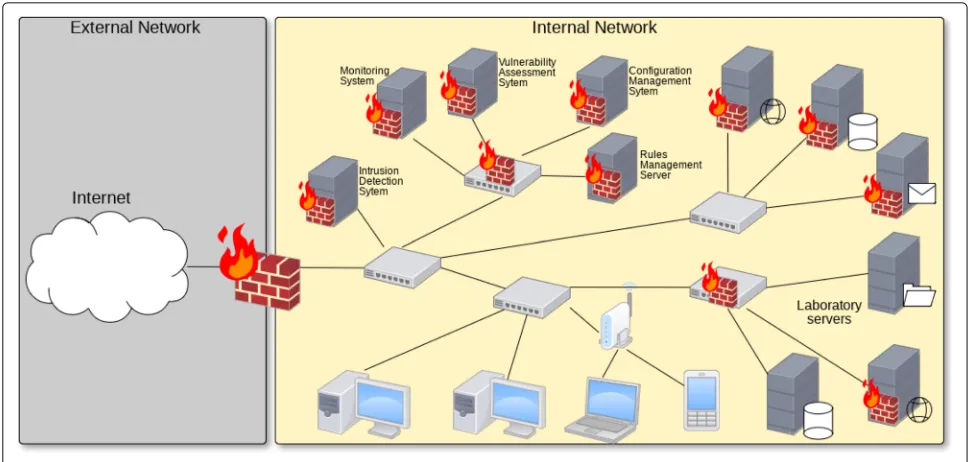
In a university network infrastructure, such as the Federal University of Rio Grande do Norte (UFRN) in Brazil, it is common to find several groups of servers hosting from basic services, like e-mail, Web, and DNS (Domain Name System), to specific applications. These institutions usually maintain a network team responsible for manag-ing these services. However, it is also common to find other servers and equipment providing a set of local ser-vices used and maintained by researchers in their respec-tive laboratories. Such a diverse environment is prone to inconsistency in management and security procedures, causing it to be likely susceptible to vulnerable servers due to misconfiguration or outdated software. Moreover, an university network contains some workstations and wire-less access points, which together with the trend of BYOD and the availability of 3G/4G connectivity, constitute a plethora of equipment outside the control of the central management team.
Fig. 1General view of the distributed firewall scope considered in this paper
Operating and maintaining this infrastructure requires a continuous effort as, even though there are different tools for facilitating management and maintenance actions, it is common to find out that most of these operations are still manually conducted. For example, the majority of institutions use, apart from firewalls, some tool for configuration management, resource and service moni-toring, intrusion detection and vulnerability assessment systems, which scans the network pointing out vulner-able services. These are important tools for maintain-ing the network infrastructure, but there is a lack of integration among them, requiring human intervention for conducting some tasks, and wasting valuable time between the moment an incident is detected, and an administrator performs some corrective action to mitigate its impact.
In this context, software self-adaptation can be used for integrating such tools, contributing for automating the security management of the network, with minimal human intervention.
A self-adaptive software system is able to modify its own structure or behaviour during run-time in order to deal with changes in its requirements, the environment in which it is deployed, or the system itself [9]. Among the different properties of a adaptive system, self-protection has been identified as a key concept for build-ing autonomous self-managed systems. While systems’ architectures are becoming more dynamic and adaptive, the majority of the protection mechanisms have kept sim-ple, with security policies usually manually defined, in a slow and costly way.
One way for achieving self-adaptation is through the Monitor-Analyse-Plan-Execute-Knowledge (MAPE-K) feedback control loop over a target system [11]. In this way, a self-protection mechanism allows the protected system to monitor and analyze its resources to detect possible problems, being able to react accordingly to deal with the detected problem. This reaction depends on the type of monitoring and analysis technique being employed, type of incident and the type of system being protected, and can range from emergency system shut-down, deactivation of damaged module and replacement for a new instance, user or connection blocking, etc. [7].
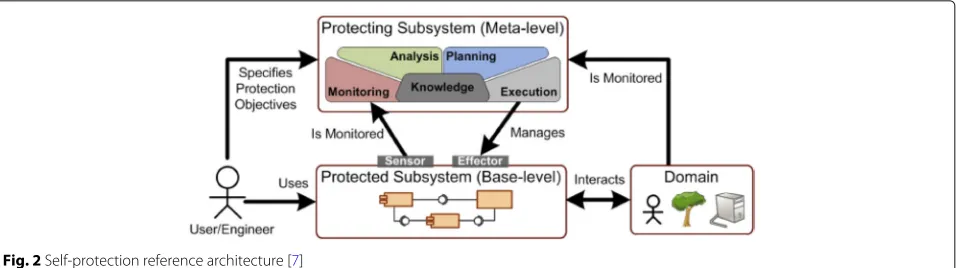
Figure 2 presents a reference architecture for a sys-tem that implements self-protection. At a meta-level, we have aprotecting sub-system, responsible for implement-ing the MAPE-K feedback control loop that protects the protected sub-systemat the base level. Theprotected sub-systemcontains the system functionality associated with the main application logic and may incorporate different security mechanisms, such as access control and cryp-tography, and different execution environment such as Software Defined Networks with or without support for Network Functions Virtualization. The meta-level subsys-tem is responsible for detecting security-related incidents and for the decision-making associated with the use of the mechanisms available at the base-level [7]. The base-level sub-system runs over and interacts with, a domain, which can also be monitored for helping in the decision making of the MAPE-K at the meta-level.
[image:4.595.56.540.86.317.2]Fig. 2Self-protection reference architecture [7]
well-known vulnerabilities. For example, whenever a par-ticular server contains a vulnerability with a score greater than a pre-defined value, the firewall could be configured to only allow access to the server from clients in the same network.
3 Architecture for self-adaptive distributed firewall
Our solution for a Self-Adaptive Distributed Firewall (SADF) is built on top of the MAPE-K reference model as the means for logically structuring the different tasks involved in the management of the security aspects for network infrastructure, and for integrating the different tools usually involved in those tasks, allowing for their
automation. Figure3presents a conceptual view of SADF architecture.
Each phase of the MAPE-K feedback control loop is implemented by an engine, which encapsulates the con-crete components that allow for each engine functionality. To perform self-adaptation, the Monitor, Analyze, Plan and Execute engine components use different models that provide an abstraction of relevant aspects of the managed system, its environment, and the self-adaptation goals [12]. These models are maintained by a knowledge base represented in Fig.3.
The Monitoring engine is responsible for collecting information about the different servers of the network infrastructure. This collection happens through Sensor
[image:5.595.61.540.87.221.2] [image:5.595.57.541.433.723.2]interfaces in each server. This data is represented by a Server description model, which is a format that can be manipulated and reasoned upon by the components of SADF. A service description model contains, among other information, details about the operating system, IP Address, services’ names, versions and network port. Fur-thermore, it captures the firewall rules currently in effect on the server. TheMonitoring engineis also responsible for obtainingVulnerabilitiesdescriptions from an exter-nal Vulnerability base. Vulnerabilities are represented through CVE1, which defines a dictionary and stan-dard representation format for vulnerabilities descrip-tions. These descriptions are published through the CVE List and maintained by different vulnerabilities databases (e.g., the NVD2). Vulnerabilities have an associated
sever-ity score calculated based on the CVSS3, which defines metrics and formulas for deriving a vulnerability score, and a standard format representation.
The Analyzer engine relies on a Vulnerability Assess-ment System (VAS) to search for known vulnerabilities on the services currently running on the network. A VAS works by scanning the network and conducting different tests to find vulnerabilities in systems and servers, pro-ducing a vulnerability report for each server. Based on the server descriptions, the VAS can be employed with higher priority to scan known services running on each server, usually, when there are changes in the server descrip-tions or new vulnerabilities have been published. In the meantime, full vulnerability analysis of servers can still be performed. AHigh-level policycaptures the requirements of the administrator, and together with the VAS report and the server description, is used for detection of policy violations. For example, servers with a vulnerability score greater than a particular threshold should only be acces-sible from machines in the same network, but the current firewall rules allow access from anywhere. All this data is used by theAnalyzer enginecomponent for producing Analysis report, which indicates, for example, servers with known vulnerabilities.
The Decision enginecomponent is responsible for the plan phase of the MAPE-K loop. This component is responsible for making decisions on how to respond to the encountered situation based on the analysis report, the server descriptions, the high-level policies, and a set ofFirewall rules templates. These templates provide a sort of parametrized firewall rules for different services, which can then be employed by the Decision engine for defining specific firewall rules to be applied. The creation of fire-wall rules must employ mechanisms for avoiding conflicts between rules. Besides creating firewall rules to be applied to the servers of the network, the Decision engine also produces a report intended for a human administrator.
At the execute phase we have aFirewall rule application enginecomponent, which is responsible for effecting the
new firewall rules on the servers. This component must take in consideration mechanisms for guaranteeing secure communication with each server, and configuration man-agement techniques.
The MAPE-K reference architecture allows for the use of different mechanisms for each of its phases, which can be integrated in a number of different interaction pat-terns [13,14]. Thinking along these lines, an SADF-based solution can be deployed with different components. In our particular architecture, we employed a configuration management system and a VAS with the roles of monitor-ing and analyzmonitor-ing the network infrastructure. These can be easily replaced by a metrics monitoring system, such as Zabbix, with threshold-based policies for identifying the necessity of adaptation, an IDS or any other analysis prod-uct that can detect abnormal situation on the network infrastructure. The decision-making process of our solu-tion is based on high-level policies defined by an adminis-trator, which must consider the execution environment to be controlled. One advantage of such approach is the sep-aration of concerns between the functions of the MAPE-K loop. SADF controls a distributed firewall, but our archi-tecture allows the management of more sophisticated environments such as Software Defined Networks with Network Function Virtualization capabilities when those are available. Since we have taken as a basis a real scenario, in which there is no support to SDN/NFV, we chose to focus on the control of a distributed firewall, acting as a proof-of-concept for deployment in such environment.
4 Instantiating the SADF
The proposed SADF architecture has been instantiated into a prototype implementation using a combination of existing open source and in-house developed compo-nents. This instantiation has been used to build a case study to demonstrate the feasibility of our approach. As a scenario for presenting its instantiation, in this paper we consider the protection of a Web server running the Apache HTTPD software and the JBoss Application Server.
In this section we present details about the different representation models employed in our instantiation, fol-lowed by a description of the developed prototype.
4.1 Model representation
One aspect that must be considered for a self-protection solution is the representation of the protected environ-ment, such as servers, services, and firewall rules.
main stages: compiling and applying a catalog. A cat-alog is a document that describes the desired system state. It lists all resources that need to be managed, as well as any dependencies between those resources. The core of the Puppet language is declaring resources. Groups of resources can be organized into classes, which are larger units of configuration. While a resource may describe a single file or package, a class may describe everything needed to configure an entire service or application.
An example of representation for a server and its services is shown in Listing 1. The node named sadf-target.info.ufrn.br was previously added to the Puppet ecosystem, which allows to describe and apply new con-figurations to this server. As shown in Listing 1, the node has two monitored services: the Apache HTTPD - a well-known open source HTTP server -, and the JBoss - an application server to theJava Platform, Enterprise Edition (Java EE).
Listing 1Example of a node description using thePuppet
language
1node ’ s a d f−t a r g e t . i n f o . u f r n . br ’ {
2
3 i n c l u d e a p a c h e : : mod : : php
4 a p a c h e : : v h o s t { ’ apache ’ :
5 p o r t => ’ 8 0 ’ ,
6 d o c r o o t => ’ / v a r /www/ html ’ ,
7 }
8
9 i n c l u d e j b o s s
10 j b o s s : : d e f a u l t { ’ j b o s s ’ :
11 h t t p _ p o r t => 8 0 8 0 ,
12 a j p _ p o r t => 8 0 0 9 ,
13 jmx_porp => 9 0 9 0 ,
14 xms => 1 0 2 4 ,
15 xmx => 1 0 2 4 ,
16 }
17
18 i n c l u d e f w _ s a d f _ t a r g e t
19}
Briefly, the settings on Listing 1 define that the Apache HTTPD server must run the PHP module (line 3), and cre-ate a VirtualHost listening to port 80 fromDocumentRoot /var/www/html (lines 4 to 7). Regarding JBoss service, three ports must be configured: 8080 which is bound to theHTTP connector, 8009 to theAJP connector, and 9090 that works as a managing interface to the JMX (lines 11 to 13). Moreover, the parametersxmsandxmxare used to determine the min and max memory size, respectively, to be allocated on theHEAP(lines 14 and 15). The class fw_sadf_target(line 18), which will be detailed later on, is applied to this node, defining a specific firewall rules for thesadf-target.info.ufrn.brnode.
Similarly, it is necessary to represent firewall rules in a format that can be reasoned upon. For this purpose, we
decided to employ the FLIP language [15,16] for defin-ing the firewall rules templates that SADF receives as input. In FLIP, firewall rules are defined using a high-level language that can be automatically translated into device-specific format. FLIP provides a well defined lan-guage with formal semantics, together with proven sound and complete algorithms for conflict resolution and trans-lation into device specific firewall rules. Its formalism was one of the main reasons for choosing FLIP.
Listing 2Example of firewall rules using the FLIP language
1domain s a d f−t a r g e t . i n f o . u f r n . b r = [ 1 0 . 3 . 1 2 8 . 1 2 ] ,
2 l o c a l−network = [ 1 0 . 3 . 1 2 8 . 0 / 2 4 ] ,
3
4s e r v i c e a p a c h e = t c p . [ p o r t = 8 0 ] ,
5 j b o s s = t c p . [ p o r t = 8 0 8 0 , p o r t = 8 0 0 9 , p o r t = 9 0 9 0 ] ,
6
7p o l i c y _ g r o u p v u l n e r a b l e _ j b o s s {
8 incoming :
9 a p a c h e { a l l o w ∗}
10 j b o s s { deny ∗ e x c e p t l o c a l−network }
11}
12
13a p p l y v u l n e r a b l e _ j b o s s on s a d f−t a r g e t . i n f o . u f r n . b r ;
Listing 2 presents an example of a rule in FLIP. The first block (lines 1-2) defines the domains, which can be networks or hosts. We define a target server ( sadf-target.info.ufrn.br) and a network (local-network) that represents the network in which the target is running. The second block (lines 4-5) of FLIP defines services, which may have one or more ports. In this example, Apache and JBoss were specified. In the sequence, we define a policy group (lines 7-11), which specifies the behavior that will be taken about services in a given scenario. One group was created that allows access to Apache HTTPD (line 9) and blocks access to JBoss (line 10) except when the con-nection comes fromsadf-engine.info.ufrn.br. Finally, it is necessary to make a connection between the group and the protected domain (line 13).
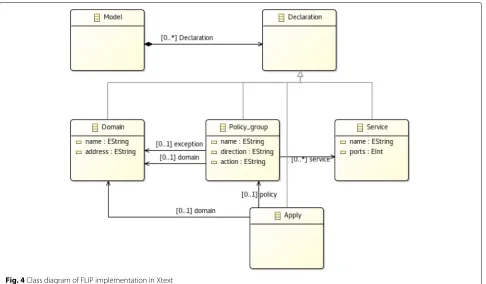
Fig. 4Class diagram of FLIP implementation in Xtext
services and domains that can be inserted into the pol-icy as the target domain of the action or exception to the target group. Finally, the Apply class assigns policies to domains, causing their traffic to meet the conditions described in the FLIP policy.
In order to apply firewall rules, FLIP models need to be translated intoConcrete firewall rules. Since we employ thePuppetlanguage for describing and managing servers and services, we employedPuppet’s firewall module5for representing concrete firewall rules, and hence the fire-wall rules can be applied by Puppet agents. To achieve that, FLIP rules expressed in text files are instantiated into Java objects, which are then used to createPuppetclasses. During the translation process, some fields are extracted from the FLIP rules’ fields and then written as aPuppet class describing each host and its services. This transla-tion has been implemented as a Java class that handles the FLIP Model and makes it possible to obtain its respec-tive rule declarations as domains, services, policy_groups and actions to perform the assembly ofPuppet’s classes. Listing 3 presents an example of the class that speci-fies the firewall rules to thesadf-target.info.ufrn.brnode, which have been generated from the example pre-sented in Listing 2. The first two rules (lines 3-12) are included by SADF to guarantee access from its com-ponents to the targeted host. The following rules (lines 13-30) blocks access to JBoss ports (8009, 8080, 9090) except when the connection comes from the network 10.3.128.0/24.
Listing 3Firewall rule created by usingPuppet
1c l a s s f w _ s a d f _ t a r g e t {
2 i n c l u d e f i r e w a l l _ m o d u l e
3 f i r e w a l l { ’ 0 0 1 a c c e p t c o n n e c t i o n s from puppet master ’ :
4 p r o t o => ’ a l l ’ ,
5 s o u r c e => ’ 1 0 . 3 . 2 2 5 . 1 6 3 ’ ,
6 a c t i o n => ’ a c c e p t ’ ,
7 }
8 f i r e w a l l { ’ 0 0 2 a c c e p t c o n n e c t i o n s from s a d f−s c a n n e r ’ :
9 p r o t o => ’ a l l ’ ,
10 s o u r c e => ’ 1 0 . 3 . 2 2 7 . 7 7 ’ ,
11 a c t i o n => ’ a c c e p t ’ ,
12 }
13 f i r e w a l l { ’ 1 0 0 deny a c c e s s t o p o r t 8 0 0 9 ’ :
14 d p o r t => ’ 8 0 0 9 ’ ,
15 p r o t o => tcp ,
16 a c t i o n => drop ,
17 s o u r c e => ! 1 0 . 3 . 1 2 8 . 0 / 2 4 ,
18 }
19 f i r e w a l l { ’ 1 0 1 deny a c c e s s t o p o r t 8 0 8 0 ’ :
20 d p o r t => ’ 8 0 8 0 ’ ,
21 p r o t o => tcp ,
22 a c t i o n => drop ,
23 s o u r c e => ! 1 0 . 3 . 1 2 8 . 0 / 2 4 ,
24 }
25 f i r e w a l l { ’ 1 0 2 deny a c c e s s t o p o r t 9 0 9 0 ’ :
26 d p o r t => ’ 9 0 9 0 ’ ,
27 p r o t o => tcp ,
28 a c t i o n => drop ,
29 s o u r c e => ! 1 0 . 3 . 1 2 8 . 0 / 2 4 ,
30 }
[image:8.595.58.544.85.369.2]We employ high-level policies to define how to respond to found vulnerabilities in the monitored environment. These policies are based on Event-Condition-Action (ECA) rules. The basics of an ECA rule imply that when-ever an event occurs, a predefined condition is evalu-ated, which trigger a specific action when the condition is true. The event may be represented by a complex structure involving a number of sub-events. Similarly to the event, the condition may be formed by several sub-conditions that must be evaluated under a spe-cific logic. Finally, an action may be a composition of actions according to the condition and event that activated it [17].
In our approach, an event is a discovered vulnerability, while the condition captures the context of this vulnera-bility in terms of its severity and other information that can be used for decision making on how to respond, i.e., the action.
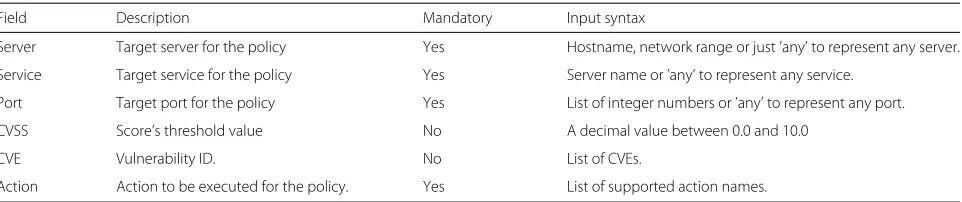
The syntax used to define a policy is given by the set of fields {server, service, port, CVSS, CVE, action} that can be mapped to four scopes: target, score, vul-nerability, and execution, as described in Table 1. The target scope defines the policy application range and is formed by the fields server, service, and port. The score scope - given by the CVSS field - specifies the CVSS threshold value, hence addressing vulnerabilities with CVSS equal or higher than this value. In contrast, the vulnerability scope - given by the CVE field - directly addresses the CVE, allowing to act only for specific vul-nerabilities. The score and vulnerability scopes may be optional, i.e., as long as one is provided, the other may be omitted.
The target, score and vulnerability scopes comprise the condition of our policy, while the action scope defines how to respond when the specified condition is eval-uated to true. Action in our policy refers to a fire-wall rule template, which must be provided together with the policy. In this way, the proposed system can dynamically select the appropriate parametric rule tem-plate for the detected situation, which is then popu-lated based on the information about the affected host description.
4.2 Prototype implementation
In this section, we describe our prototype implementa-tion, whose concrete architecture is illustrated in Fig.5. Implementation and functioning details for each devel-oped module are also presented. Moreover, the iterations between the modules and the tools/models employed in the solution are discussed.
As previously mentioned, we employ thePuppet con-figuration management language for describing servers’ configurations.Puppetprovides tools for applying config-urations, and for obtaining the current status of a host. A Puppet agent component runs on each host, and reports to (and receive commands from) thepuppet-master com-ponent, which stores servers description into thePuppet catalog. Hence, Puppet agents fulfill the roles of sen-sor and effector of servers, while the Puppet master is responsible for the monitor and execute phases of the MAPE-K.
4.2.1 Monitor engine
The function of this module is to collect information regarding all hosts members and so creating the Server descriptionwhich is used by SADF to represent the servers and its services. Allhostsmanaged by thePuppetare taken as members of our scheme. ThePuppetcollects informa-tion regarding the servers by pooling agents (see Fig.5) - that plays the role of a sensor on SADF architecture -and store it in itsCatalog. Thus, the monitoring module can gather information about all servers by communi-cating to thePuppetDB6- aData Warehousethat stores information and allows the access to it through a specific API7.
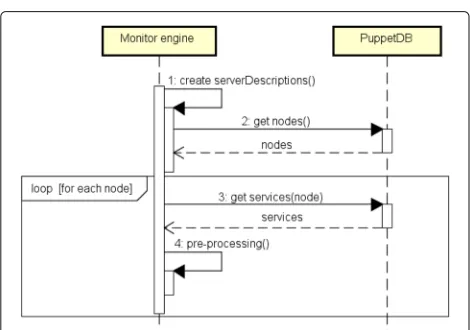
[image:9.595.58.539.630.731.2]The UML sequence diagram in Fig. 6 illustrates the interaction between the Monitor engine and the PuppetDB. TheMonitor enginefirst creates an empty list of descriptions (call 1), then it contacts thePuppetDBto collect the list of managed nodes (call 2), and finally, it starts a loop to recover the list of services to each node (call 3). TheMonitor enginemaintains a list of servers pre-viously collected to detect when there is a change in one of the servers. Thus, once all servers’ descriptions have been obtained, theMonitor engineperforms internal processing
Table 1High-level policy’s fields description
Field Description Mandatory Input syntax
Server Target server for the policy Yes Hostname, network range or just ’any’ to represent any server.
Service Target service for the policy Yes Server name or ’any’ to represent any service.
Port Target port for the policy Yes List of integer numbers or ’any’ to represent any port.
CVSS Score’s threshold value No A decimal value between 0.0 and 10.0
CVE Vulnerability ID. No List of CVEs.
Fig. 5Architectural view of the prototype implementation
Fig. 6UML sequence diagram for theMonitor engine
(call 4) in order to identify servers that need to be scanned again due to changes in their configuration.
It is important to mention that the description files defi-nition for servers inPuppetis out of the scope of this work. So there is an assumption that this task was previously performed by the network administrator team. Thereby the focus of this work is to define and apply the firewall rules according to the specified configuration, as well as targeting well-known vulnerabilities on servers.
4.2.2 Analyzer engine
[image:10.595.58.543.86.469.2] [image:10.595.57.292.545.710.2]is formed by a script for vulnerability detection, and a specification of the CVE and CVSS for each vulnerability detected. OpenVAS Manager gets NVTs through the OpenVAS NVT Feed, which is developed based on the CVEs from the NVD.
The OpenVAS Manager is responsible for control-ling the OpenVAS Scanner actions, by providing its inputs and processing its outputs. All the interactions between the Manager and the Scanner are performed through the OpenVAS Transfer Protocol (OTP). OTP supplies all the resources to control the scan’s execu-tions. The Manager also includes the OpenVAS Man-agement Protocol (OMP), an XML-based stateless API, which may be used to interact with and control the OpenVAS Manager.
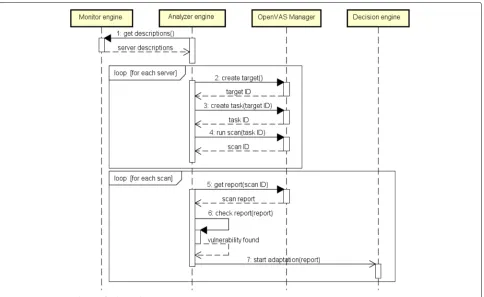
TheAnalyzer engineconfigures and runs the OpenVAS scans by using the server description. This interaction is allowed by the OMP, which receives an XML entry describing the target host and the scan tasks. A detailed view of the interaction between theAnalyzer engineand theOpenVASis presented in Fig.7. TheAnalyzer engine obtains theServer descriptionsof those hosts that need to be scanned (call 1) and builds scan tasks for each server (see calls 2 and 3 in the figure). Each target defines a host, listing the ports for all detected services, and thereby all services managed byPuppetin each host can be scanned.
Ataskis a scan configuration that defines how the target will be tested.
The Analyzer engine starts each scan (call 4 of the UML sequence diagram) and stores its ID. A scan may take several minutes to complete, as the current Open-VASdatabase includes more than 50,000 entries. Besides, the scan duration may vary according to the number of services on the target and the processing load on the Scan-ner and the Server being scanned. Currently, the VAS is queried every five seconds to check whether the scan has finished, at which point theAnalyzer engineuses the stored ID as a key to recover its report (call 5). Each report from theOpenVASincludes, among other data: the CVE, the CVSS, the host, the port bound to the affected ser-vice, the protocol, the suggested solution type, and the affected software name. TheAnalyzer engineprocess the received report (call 6) to check whether a vulnerability has been detected, or a vulnerability previously detected is no longer present. When a vulnerability is detected the Decision engineis activated to handle it (call 7).
4.2.3 Decision engine
Once activated, theDecision enginemust decide how to properly respond to the detected vulnerability. Its behav-ior is presented in Fig.8. Initially, it loads the high-level policies, the Analysis report, and theServer descriptions
[image:11.595.57.541.423.720.2]Fig. 8UML sequence diagram for theDecision engine
(calls 1, 2, and 3). Then the policies are evaluated to detect any violation (call 4). This verification involves a set of iterations and conditional operations used to assert the conditions according to the data collected from the Analysis report.
When a violation is detected, an adaptation loop is started. In the current prototype implementation, the exe-cution module allows two actions: (1) the configuration of the firewall rules on the affected servers, and (2) to send an alert to the system administrator. The action to be taken is defined by the high-level policy. If the selected action requires blocking a port, then theDecision enginecreates the firewall rules usingFLIPsyntax and then request its translation (calls 6 and 7). Following, theFLIPtranslates the rules and creates the Concrete firewall rulesmodel, which is written using thePuppet notation (call 8). The corresponding action is then requested to the Executor engine, either to apply new firewall rules to a server (call 9) or to notify the system administrator (call 10).
Figure 9 presents a simplified algorithm describ-ing the policy evaluation mechanism. Essentially, the evaluation consists in looping through each server in which a vulnerability has been detected, and checking whether the conditions of the high-level policies hold
[image:12.595.109.536.85.708.2] [image:12.595.57.541.86.405.2] [image:12.595.305.542.296.696.2]4.2.4 Executor engine
Once the planning phase is finished, theExecutor engine is invoked to apply all the necessary actions.
To block ports, it would apply the Concrete firewall rules by sending the generated classes to the directory /etc/puppetlabs/code/environments/production/manifests to be read by the puppet-master. Following this step, each agent can contact the master to apply the sched-uled firewall rules. Thepuppet-master together with the firewall module manages and configures the generated iptables and ip6tables rules to be applied directly to each host.
The Zabbix10 monitoring system is employed in order to support alerting system administrators. Zabbix is a network monitoring system with support to triggered notifications. SADF creates a list of alerts, which is used as the basis for populating a monitoring template con-figured into Zabbix. This template includes information about the affected host, its service, and the discovered vulnerability, with its respective CVSS. Through the tem-plate, Zabbix can detect the alerts sent by SADF, creat-ing triggers for each alert into Zabbix monitorcreat-ing screen that should be permanently exhibited on the Network Operation Center. We have employed Zabbix on SADF because this is the monitoring solution used by the network administration team of where SADF is being deployed.
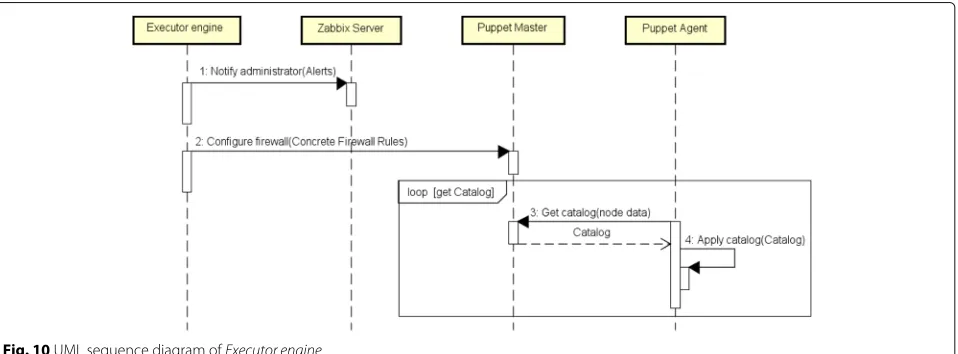
The behavior of the Executor engine is presented in Fig. 10. As previously mentioned, our current proto-type supports two actions, the notification of admin-istrators (call 1), or the application of firewall rules through puppet-master (call 2). In case of applying fire-wall rules, once the new rules have been saved, each puppet-agent obtain them through the Puppet catalog (call 3), and then applies the rules on their corresponding hosts (call 4).
5 Evaluation
This section presents an evaluation of SADF that has been conducted in a controlled environment.
First, we present the complete operational flow of SADF to demonstrate its feasibility (section 5.1). In the sequence, we present a set of experiments to evaluate SADF resource consumption (section 5.2). Finally, we discuss the achieved results (section5.3).
5.1 Demonstration
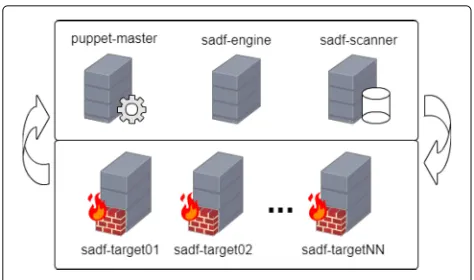
A set of servers and services in a controlled environ-ment were deployed in order to demonstrate the func-tionalities of the proposed SADF. All servers run the CentOS 7. Such services are similar to what can be found in a typical network infrastructure of a univer-sity. Figure 11 presents a general view of the deployed environment, in which we can find two groups of servers. The first group corresponds to SADF compo-nents and is composed by three servers: (i) puppet-master agent that acts as a configuration management server; (ii) sadf-engine, which contains all components of SADF; and (iii) sadf-scanner corresponding to the OpenVAS vulnerability assessment system. The second group of servers represents the target environment, which is controlled by SADF, and corresponds to the dif-ferent servers that will have their firewall rules man-aged by our solution. For this first demonstration, we have instantiated a total of 10 servers (sadf-target01 to sadf-target10), in which we have services managed byPuppet.
[image:13.595.61.540.548.725.2]Several services that are commonly found on complex network infrastructure were selected in order to demon-strate SADF functionality. The selection of services was based on past experiences with incidents that occurred in the UFRN11 network infrastructure. Therefore, we have some services with vulnerabilities of different severity
Fig. 11Environment deployed for testing SADF
levels. Table2presents details about versions, ports, and vulnerabilities of the services considered in this demon-stration.
These services have been distributed in 10 servers sadf-target according to Table 3. The column Vulnerability Severityrepresents the server status based on the vulner-abilities found on its deployed services. The classification of vulnerabilities is based on the CVSS V2 specification12,
which defines the intervals 0.0−3.9 asLOW, 4.0−6.9 as MEDIUM, and 7.0−10.0 asHIGH.
Once all target servers are configured and managed by puppet-master, SADF is capable of extracting their Server descriptions to monitor and control them. The next step is to configure thehigh-level policiesthat define the behaviour of SADF. For this demonstration, we have defined four policies that either block vulnerable services or alert network administrators in different contexts. The policies defined are listed below with an informal textual description, and then using the policy definition rules of SADF.
P1: Alert administrator if any vulnerability with CVSS higher than 5.0 is found in any server:
“Server = any”, “Service = any”, “Port = any”, “CVSS = 5.0”, “Action = alert”
P2: Block any port on any server assigned to any service in which with vulnerability “CVE-2013-4810” (regarding to JBoss 5.1.0) has been detected:
“Server = any”, “Service = any”, “Port = any”, “CVE = CVE-2013-4810”, “Action = block”
P3: Block any port assigned to any service with CVSS equal or higher than 7.0 running on the server sadf-target06.info.ufrn.br:
“Server = sadf-target06.info.ufrn.br”, “Service = any”, “Port = any”, “CVSS = 7.0”, “Action = block”
P4: Block any server or port assigned to the serviceftp with CVSS equal or higher than 9.0:
“Server = any”, “Service = Ftp”, “Port = any”, “CVSS = 9.0”, “Action = block”
P5: Only allow connections from a particular network on any server that belongs to this network in case any vulnerability is found.
“Server = 10.2.59.0/24”, “Service = any”, “Port = any”, “CVSS = any”, “Action = isolate”
Once the high-level policies are in place, SADF is ready to start monitoring and controlling the target servers, according to the MAPE-K feedback control loop. It starts by obtaining theserver descriptionsof the target servers and interacting with OpenVAS for creating the respective scan routines. Based on OpenVAS results, which identi-fied the existing vulnerabilities in the testing environment, SADF employed the high-level policies to decide how to respond. Following our case study, the OpenVAS found a vulnerability with CVSS score 7.8 in HTTP service that allows remote attackers to cause a denial of service (mem-ory and CPU consumption). An extract of the XML report is presented in Listing 4.
Listing 4Extraction of OpenVAS report to a vulnerable HTTP server
1 . . . < p o r t > 8 0 / t c p
2 < h o s t > 1 0 . 3 . 1 2 8 . 2 0 < / h o s t >
3 < s e v e r i t y > 7 . 8 < / s e v e r i t y >
4 < t h r e a t >High </ t h r e a t >
5 </ p o r t > < n v t o i d
= " 1 . 3 . 6 . 1 . 4 . 1 . 2 5 6 2 3 . 1 . 0 . 9 0 1 2 0 3 " >
6 <name>
7 Apache h t t p d Web S e r v e r Range Header D e n i a l o f S e r v i c e V u l n e r a b i l i t y
8 </name>
9 < f a m i l y > D e n i a l o f S e r v i c e </ f a m i l y >
10 < c v s s _ b a s e > 7 . 8 < / c v s s _ b a s e >
11 < cve >CVE−2011−3192</ cve >
12 < bid >49303 </ bid >
13 . . .
Based on policy P1, which defines the trigger of alerts for vulnerabilities with CVSS above 5.0, we have the list of alerts presented in Fig. 12, extracted from Zabbix. SADF creates several objects and triggers in Zabbix with information about the vulnerable services, using a color classification according to the severity of the vulnerabil-ity found. We can notice that some servers appeared more than once in the list (such as sadf-target10), which indi-cates that either the server contains more than one vul-nerability, or that the same vulnerability has been found in different ports.
Based on the other policies, SADF activated the Execu-tor enginefor blocking several ports. Policy P2 blocked port 8080 on serversadf-target09, while policy P3 blocked port 80 on serversadf-target06. policies P2 and P4 caused the blocking of ports 21 and 8080 on serversadf-target01, and policy P4 blocked port 21 on serversadf-target03.
Table 2Services and vulnerabilities used to test the prototype
Service Port CVE CVSS Vulnerability
Apache 2.4.6 443 CVE-2016-2183, CVE-2016-6329 5.0 Confidential information leak.
Apache 2.4.6 80 CVE-2004-2320, CVE-2003-1567 5.8 Cross site
Apache 2.2.15 80 CVE-2004-2320, CVE-2003-1567 5.8 Cross site
Apache 2.2.15 80 CVE-2011-3192 7.8 Denial-of-service (DoS)
MySQL 5.5.52 3306 - -
-ProFTPD 1.3.4a 21 CVE-2015-3306 10.0 Arbitrary remote code execution.
JBoss 5.1.0 8080 CVE-2013-4810 10.0 Arbitrary remote code execution.
JBoss 5.1.0 8009 - -
-JBoss 5.1.0 9090 - -
-Tomcat 8.5.16 8080 - -
-Tomcat 8.5.16 8009 - -
-Tomcat 8.5.16 9090 - -
-(10.2.59.0/24) when any vulnerability is found. Such pol-icy triggers the application of firewall rules on all servers managed by SADF that belong to the identified network.
The blocking of ports is achieved by manipulating objects based on the FLIP meta-model defined by us. These objects are then translated into Puppet classes con-taining concrete firewall rules. Each server has its own Puppet class with its respective firewall rules. Listing 5 presents an example of class for serversadf_target01.
Listing 5New class created by the SADF to block ports 21 and 8080 on the server sadf-target01
1 c l a s s f w _ s a d f _ t a r g e t 0 1 {
2 i n c l u d e f i r e w a l l _ m o d u l e
3 f i r e w a l l { ’ 1 0 0 ’ :
4 d p o r t => ’ 8 0 8 0 ’ ,
5 p r o t o => tcp ,
6 a c t i o n => drop ,
7 }
8 f i r e w a l l { ’ 1 0 1 ’ :
9 d p o r t => ’ 2 1 ’ ,
10 p r o t o => tcp ,
11 a c t i o n => drop ,
12 }
13}
The iptables tool was used on the affected servers in order to confirm if the firewall rules have been correctly applied.
Figure13presents the output for serversadf-target01 before SADF has run. We can notice explicit rules allow-ing (ACCEPT) packets from the servers that play the role ofpuppet-master(IP address 10.3.225.163) and sadf-scanner (IP address 10.3.227.77), and no closed ports (indicated by the absence of rules, which means that all connection are accepted). These rules are maintained by the firewall module of Puppet, defining the servers that are part of SADF as trusted. Figure14presents the ipta-bles output for the same server (sadf-target01) after SADF
detected a vulnerability and reacted according to its poli-cies. We can notice rules allowing connections from SADF components (puppet-masterandsadf-scanner), similar to Fig.13, and rules for blocking (DROP) incoming packets (INPUTchain) on ports 21/tcp and 8080/tcp.
This procedure was repeated to all servers where we confirmed the application of firewall rules according to the high-level policies defined. We have repeated these experiments, varying the services versions and known vulnerabilities, services, and high-level policies. In all occasions SADF worked as expected, demonstrating its effectiveness in blocking vulnerable services and trigger-ing alarms for alerttrigger-ing administrators when the blocktrigger-ing is deemed a too harsh response.
5.2 Resource consumption experiments
[image:15.595.56.290.440.567.2]After demonstrating the operational viability of SADF, we have conducted a set of experiments for evaluating its resource consumption. These experiments have been conducted with the objective of providing subsides for
Table 3Servers and services tested
Server Vulnerability severity Running services
sadf-target01 HIGH JBoss 5.1.0; ProFTPD 1.3.4a
sadf-target02 MEDIUM Apache 2.4.6; Tomcat 8.5.16
sadf-target03 HIGH Apache 2.4.6; ProFTPD 1.3.4a
sadf-target04 MEDIUM Apache 2.4.6; MySQL 5.5.52
sadf-target05 NONE Tomcat 8.5.16
sadf-target06 MEDIUM Apache 2.2.15
sadf-target07 NONE MySQL 5.5.52
sadf-target08 MEDIUM Apache 2.4.6
sadf-target09 HIGH JBoss 5.1.0; Apache 2.2.15
[image:15.595.55.289.444.568.2] [image:15.595.305.539.574.731.2]Fig. 12Vulnerability alerts triggered on Zabbix system
the allocation of resources for SADF deployment. A first observation allowed us to notice that the biggest overhead of SADF is related to the vulnerability analysis. Based on this, the experiments conducted have been divided into two groups. The first group considered whether there is an improvement in the use of OpenVAS when the ports to be scanned are explicitly indicated (based on the ser-vices’ ports configured via Puppet). The second group considered the impact of increasing the number of servers monitored and controlled.
These experiments have been conducted on the same environment used for demonstrating SADF (which has been presented in Fig. 11). The configurations of each server used in these experiments are presented in Table4. The resources allocated topuppet-masterserver are based on the official documentation of puppet13, which recom-mends a server with four cores and at least 4GB of RAM for attending a number of 1000 servers. The resources allocated for sadf-engine correspond to the server used for its development. The server responsible forOpenVAS, sadf-scanner, demands more computational power as it will potentially conduct more than 50,000 NVTs in each monitored host. The resources allocated to this server are
based on the resource allocation to similar services in our real network infrastructure.
To run the first group of experiments, we replicated the 10 servers used in the demonstration of SADF, consider-ing a growconsider-ing number of servers, respectively, 1, 10, 20, 30, 40 and 50 servers, while employing the same distribu-tion of services showed on Table3. For these experiments, OpenVAShas been used in its default configuration, up to 10 NVTs running in parallel for each host, and a max-imum of 30 hosts that can be verified simultaneously. In this context, in case there are more than 30 servers to be verified, the exceeding ones will be queued until the end of the scans in execution. OpenVAShas been restarted between each test, and the tests have been repeated three times for obtaining the average execution time for each run.
When considering the consumption of hardware resources, we did not identify any significant difference with and without the definition of ports. However, Open-VAS took around 2 hours and 43 minutes to scan 50 servers in its default configuration. When comparing the time necessary to run the tests with (Scan on defined ports) and without (Scan without ports definition) port
Fig. 14Iptables output of firewall rules that are managed byPuppeton the serversadf-target01after running SADF
indication, we have a difference up to 20.53% for 50 servers (2 h and 25 min with ports defined). We con-sidered these results as a substantial indication of the benefits of directing OpenVAS scans as done by SADF, which encouraged the execution of the second group of experiments.
After that, we started to experiment with the full SADF solution. As previously mentioned, the biggest overhead of SADF is related to the vulnerability analysis. Thus, our focus was on evaluating the analysis phase of SADF, which includes OpenVAS to scan hosts on specific ports.
During these experiments, we have observed the resource consumption of sadf-scanner to understand its behavior and profile its hardware requirements. We present the measurements for the experiments involving 50 hosts. Figure15presents CPU load, Fig.16presents the RAM utilization, and Fig.17presents the network usage.
The higher CPU-load is expected, due to the number of NVT executing simultaneously. Regarding memory and network load, we notice a low usage, with some peaks caused by the inner workings of NVTs, which involves discovery and test of ports and service, followed by load-ing and runnload-ing of tests. These peaks represent when the number of servers tested in parallel dropped below 30, and the tests for the next servers in the queue have been started. Regarding network consumption, a maximum of 6.78 Mbits/s is viewed as a good result, considering that the datacenter infrastructure is connected to at least 1Gbits/s, with 10 Gbits/s in several segments, and the duration of the peak when compared to the whole testing time.
Table 4SADF servers resource configuration
Server Memory Processor
puppet-master 4 GB 4 Cores
sadf-engine 16 GB 8 Cores
sadf-scanner 16 GB 16 Cores
The results obtained with these experiments have been considered satisfactory. The time of 2 hours and 25 min to scan 50 hosts is within the expected time given the complexity of the vulnerability analysis process, and the experience of the network administration team.
A more detailed discussion about the results obtained is presented in the sequence.
5.3 Discussion
The experiments conducted have shown that SADF can dynamically update firewall rules in response to dis-covered vulnerabilities, following the high-level policies defined by an administrator. Based on this, we conclude that SADF indeed provides a significant improvement in the administrative procedures of the network administra-tion team of UFRN in detecting and protecting vulner-able services. This is evidenced when we consider that such procedure used to be conducted manually by net-work administrators, usually by different teams, and the response to a detected vulnerability took hours (some-times days) to be implemented.
In its current implementation stage, SADF is only able to deal with hosts. Although SADF supports the speci-fication of more complex firewall rules using FLIP and our high-level policies, we do not consider the deploy-ment of firewall rules in other points of the network infrastructure, such as routers and switches. This is due to a simple decision-making implementation, which only targets hosts. Through the use of adaptation rules, the response can be anything supported by the controlled environment. Thus, although the proposed SADF can, for example, isolate a network employing firewall rules, such isolation is achieved by applying firewall rules at each host of the affected network.
[image:17.595.55.291.673.732.2]Fig. 15Load average on the SADF server for 50 servers
manual approach. One aspect that has not been explored is to deploy OpenVAS as a cluster using a master-slave architecture, which has the potential to provide horizon-tal scalability to our solution without any changes to its implementation.
Another aspect worth mentioning concerns thePuppet configuration management tool.Puppet presents a pull-based model, in which agents query the master at pre-determined intervals in search of new commands (usu-ally, 30 minutes). It might be considered an issue when responding on-the-fly to detected situations, which is not the case in this paper. We focused on preventing the exploitation of known vulnerabilities before they hap-pen, opposed to traditional IDPS systems, which focus on responding to incidents in real-time. Hence, we consider that 30 minutes is a reasonable time for applying fire-wall rules blocking vulnerable services, although this time could be reduced. We have changed this configuration to 10 minutes in our experiments, which is still considered
as a satisfactory time, since the blocking action occurs in a preventive way, upon discovery of a vulnerable server.
Regarding the secure communication between the SADF and protected servers, we employ the certificate based security provided by thePuppettool, which takes care of authentication and secure transit between the puppet-masterand its agents through SSL certificates.
The number of 50 hosts have been used for the tests due to limitation of the infrastructure available for this project at the time of the experiments. Nevertheless, this number has been considered relevant for the evaluation of the proposal when taking into account feedback from the network management team, simulating an infrastruc-ture capable of providing many applications and services. Also, this is the current number of servers that will be ini-tially monitored when deployed in the UFRN data center. Besides that, the results obtained provide us guidelines on how to allocate resources to SADF components to repro-duce the experiments with a larger number of servers.
[image:18.595.57.541.548.723.2]Fig. 17Network traffic on the SADF server for 50 servers
6 Related work
The discussion on centralized and distributed firewalls is well established in the literature [2, 18]. One of its first implementation proposals has been presented by Ioanni-dis [1], in which kernel extensions have been developed for the OpenBSD distribution, together with a policy defini-tion language (namedKeyNote) and use of IPsec for secure traffic amongst the hosts of the network. More recently [19] introduces a distributed firewall system for Linux platform that works upon Iptables/Netfilter for IPv6 net-works with IPsec support. A distributed firewall archi-tecture was proposed in order to improve performance, handling the additional costs of encryption of packages with IPsec.
Autonomic computing and self-protection have been gaining traction as the means for dealing with new secu-rity challenges and systems, in which static and rigid security practices are not enough to deal with security threats that need to be detected and mitigated at run-time [7]. In this context, Yuan et al. [7] have done an extensive systematic survey of the state of the art on self-protecting software, identifying trends, patterns, and gaps. Some works focus on adapting authorization poli-cies, such as the Self-Adaptive Authorisation Framework (SAAF) [5] that focus on adapting access control poli-cies on the PERMIS system [20], and SecuriTAS [6], a tool that enables dynamic decisions in awarding physical access, based on a perceived state of the system and its environment.
Several researchers focus on Intrusion Detection and Response Systems. For example, Uribe and Cheung [21] have looked into the integration between IDSs and fire-walls, proposing an approach for optimizing IDS config-uration by only analyzing traffic that is not considered by the firewalls’ rules. Zhang and Shen [22] employ a statis-tical learning based approach to reduce false positives on IDSs. Rahbarinia et al. [23] use graph mining techniques
for analyzing download events for detecting malware download. These works are concentrated on improving an IDS, and present interesting discussions that could complement SADF in a possible future work integrat-ing IDS into its architecture. Iannucci and Abdelwahed [24] employ a Markov Decision Process together with an Intrusion Response System for deciding which action to perform in response to a detected intruder. Compared to our work, their approach presents a formalism that can be used for deciding which action to perform, con-sidering cost and impact, from a list of possible actions. Of-IDPS [25] is a system that considers network usage his-tory and IDS alerts for extracting security rules that are applied through a Software Defined Network (SDN) based onOpenFlowcontrollers.
As stated by Shin et al. [26], SDN environment can be combined with traditional security mechanisms to rein-force the detection of attacks and to quickly react to them. In the context of our work, the major impact of SDN on a SADF solution would be twofold: at first, the decision making now needs to deal with flows fate besides firewall rules, and second, SADF can act upon switches through Access Control Lists (ACL) which allows creating rules connected to the network traffic [27]. In fact, our archi-tecture would fit perfectly with an SDN environment, and with the range of possibilities pointed out in the literature [26,27], being able to provide the link between a detec-tion tool, the decision making process for deciding how to react to the detected situation, and the commands that will change the SDN environment. Similarly, an environ-ment with NFV capabilities can provide more response options for our architecture.
Few works consider the analysis of vulnerabilities for making a decision at the network level (i.e., fire-wall rules). Debar et al. [30] present formalisms for the definition of security policies that can be dynam-ically modified in response to detected threats. The formalism presented in their paper is at an abstract level and may consider vulnerability analysis in the threat detection process. Compared to our work, their approach can be considered as complementary, pro-viding formalisms that could improve the robustness of our approach regarding the definition of high-level policies.
To the best of our knowledge, the closest work to ours has been presented by Sheridan et al. [31] and involves the automatic security of virtual machines in cloud comput-ing environments. Their approach is based on three flows: First, a VAS analyses a host during its instantiation, noti-fying an administrator by e-mail in case a vulnerability is found. Second, the firewall provided by the cloud platform is activated for allowing access to services known dur-ing instantiation. Third, the Chef configuration manage-ment system is employed for automatically installing and upgrading software packages for hardening and updat-ing the operatupdat-ing system. Although their approach also employs a VAS and activate firewall rules, the VAS out-put is not used for decision making on which firewall rules to apply, as we propose. Moreover, their approach only considers a virtual machine during its creation, not presenting any means for constant monitoring, and the automatic update of software packages without any super-vision (or an intelligence level) might be dangerous in a critical environment.
An aspect that must be considered for a self-protection solution is the representation of the protected environ-ment, such as servers, services, and firewall rules. We present here some of the options found in the litera-ture during our searches. The Network Markup Language (NML) [32] is a generic model defined by the OpenGrid Forum (OGF)14as a standard for modeling networks, such as switches and links, which is out of the scope consid-ered in this paper. Regarding the representation of firewall rules, apart from the FLIP language (already presented), there is also the AFPL2 [33] (Abstract Firewall Policy Language 2), a domain-specific language that provides an XML Schema for the definition of firewall rules indepen-dent of firewall product. Although its support of NAT rules, AFPL2 has not evolved as FLIP and does not pro-vide conflict resolution of firewall rules. The Distributed Management Task Force (DMTF) proposed the Com-mon Information Model (CIM), a specification aimed at allowing the interoperation of management informa-tion. The CIM also provides an extensible XML model and, although it has been employed by different ven-dors, its extension for Network Policy Management [34]
is still considered work-in-progress, and may be subject to changes.
The research in the area of self-protection, when con-sidering the network level, tend to focus on IDS/IRS. To the best of our knowledge, we have not found any work that employs vulnerability detection as the trigger for self-adaptation, or that consider the addition of self-adaptive capabilities to a distributed firewall.
7 Conclusions & future work
This article presented an approach for Self-Adaptive Dis-tributed Firewall (SADF) based on the synergies between the MAPE-K feedback control loop of self-adaptive sys-tems with the increased network security provided by distributed firewalls. The MAPE-K reference model is used as the means for logically structuring the different tasks involved in the management of network security, employing a vulnerability analysis system to detect vul-nerable hosts on the network infrastructure. Along these lines, our approach can cope with the complexity on the management of distributed firewalls, while reducing the exposure windows of vulnerable hosts by automati-cally applying firewall rules during run-time, according to specified high-level policies, in response to detected vulnerabilities.
We have developed a prototype of SADF using a com-bination of existing open source and in-house developed components, which has been used to conduct a series of experiments, involving different services with a var-ied degree of vulnerabilities. These experiments have demonstrated the feasibility of SADF, which is able to dynamically modify the firewalls on protected servers, and presented a satisfactory performance of the environ-ment in which it is being deployed. For example, SADF managed to achieve a 20% reduction on the scanning time for a group of 50 servers using the default configu-rations of the OpenVAS vulnerability scanning system, a significant performance gain which reduces the exposure window of a detected vulnerability. These experiments provided interesting feedback about its configuration and operation that has been incorporated into our solution.
Although we obtained very encouraging results, SADF presents some limitations. We employ thePuppet con-figuration management tool for describing servers and services, and for applying firewall rules on the affected hosts. Accordingly, we assume the infrastructure has been previously configured using this tool, as we employPuppet descriptions as part of our monitoring and execution engine.
measures to increase paid subscription to its service, which might delay the availability of new NVTs.
In its current stage, SADF only deal with hosts. Although SADF supports the specification of more com-plex firewall rules using FLIP and our high-level poli-cies, we do not consider the deployment of firewall rules in other points of the network infrastructure, such as routers and switches. This is caused by a simple decision-making process, which only targets hosts. Although it is possible to isolate a network through firewall rules, such isolation is achieved at each host of the affected network.
Other improvements on the decision making might allow more complex responses. For example, a host firewall might redirect all incoming connection to an application level firewall or IDS when a particular vulnerability has been detected, adding an extra layer of security while the vulnerability has not been fixed. Another future work involves the integration of our solution with traditional IDPSs on the monitoring and analyses phases, allowing it to react to attacks exploiting zero-day vulnerabilities. This would allow the use of less disruptive firewall rules, such as blocking of vulnerable services only from suspect sources. SADF can also be easily scaled up by deploying OpenVAS into a cluster con-figuration to deal with an elevated number of monitored servers.
Another possible future work is related to Software-Defined Networks (SDN) and virtualization. In our setup, we have not considered the impact of such technologies. An SDN-enabled infrastructure, combined with support for virtualized network functions, would allow for more sophisticated responses without direct host intervention. New challenges arise from the dynamicity of the Virtual Machines (VMs), which imposes frequent changes on the virtual network topology, where VMs might be migrated for resource management and optimization. We intent on conducting further research in this direction in order to support new responses, such as the dynamic redirection of traffic to an application proxy that could perform a second authentication.
Endnotes
1Common Vulnerabilities and Exposures sponsored by
US-CERT -https://cve.mitre.org
2National Vulnerability Database maintained by NIST
-https://nvd.nist.gov/
3Common Vulnerability Scoring System sponsored by
FIRST -https://www.first.org/cvss 4https://puppet.com/
5https://forge.puppet.com/puppetlabs/firewall
6PuppetDB-Overviewhttps://docs.puppet.com/puppetdb/
7PuppetDB5.0: API overviewhttps://docs.puppet.com/
puppetdb/latest/api/index.html 8OpenVAShttp://www.openvas.org/
9http://www.openvas.org/nvt-dev.html
10Zabbix is an enterprise-class open source monitoring
solution for network monitoring and application monitor-ing of millions of metrics -https://www.zabbix.com/
11Federal University of Rio Grande do Norte, Brazil
12NVD CVSS Support
https://nvd.nist.gov/vuln-metrics/cvss
13Puppet system requirements https://docs.puppet.
com/puppet/5.0/system_requirements.html 14https://www.ogf.org/
15Greenbone Communityhttps://www.greenbone.net/
en/community-edition/
Availability of data and materials
The datasets generated during the current work are not publicly available due to its private nature, as it is related to a real University, but are available from the corresponding author on reasonable request.
Authors’ contributions
EPCJ was responsible for the majority of the technical work, implementing the prototype, conducting experiments and collecting the obtained results, drafting the initial version of the article. CEDS made contributions to the conception and design of the proposed solution, validating the prototype implementation, and contributing for critically reviewing the manuscript. MP made contributions to the conception and design of the proposed solution, to designing the experiments conducted, and writing the manuscript. SCS participated in the drafting and critically reviewing the article for important intellectual content, and made substantial contributions to the analysis of the experimental data. All authors read and approved the final manuscript.
Competing interests
The author(s) declare(s) that they have no competing interests.
Publisher’s Note
Springer Nature remains neutral with regard to jurisdictional claims in published maps and institutional affiliations.
Author details
1Digital Metropolis Institute, Federal University of Rio Grande do Norte (UFRN),
Natal, RN, Brazil.2Department of Informatics and Applied Mathematics, Federal University of Rio Grande do Norte (UFRN), Natal, RN, Brazil.
Received: 24 August 2017 Accepted: 10 April 2018
References
1. Ioannidis S, Keromytis AD, Bellovin SM, Smith JM. Implementing a Distributed Firewall. In: Proceedings of the 7th ACM Conference on Computer and Communications Security. New York: ACM; 2000. p. 190–9. CCS ’00.https://doi.org/10.1145/352600.353052.
2. Bellovin SM. Distributed Firewalls. J Login. 1999;24(5):39–47.https://www. cs.columbia.edu/~smb/papers/distfw.pdf.
3. Meng G, Liu Y, Zhang J, Pokluda A, Boutaba R. Collaborative Security: A Survey and Taxonomy. ACM Comput Surv. 2015;48(1):1:1–1:42.
https://doi.org/10.1145/2785733.
4. Young G, Pescatore J. Magic quadrant for enterprise network firewalls. Tech. Rep. 141050, Gartner RAS Core G. 2008.http://www.eircomictdirect. ie/docs/juniper/gartner_magic_quadrant_2008.pdf.
5. Bailey C, Chadwick DW, de Lemos R. Self-adaptive federated authorization infrastructures. J Comput Syst Sci. 2014;80(5):935–52.