The exploration and development of tools for active
reading and electronic texts.
THOMAS, Stephanie Faye.
Available from Sheffield Hallam University Research Archive (SHURA) at:
http://shura.shu.ac.uk/20437/
This document is the author deposited version. You are advised to consult the publisher's version if you wish to cite from it.
Published version
THOMAS, Stephanie Faye. (2008). The exploration and development of tools for active reading and electronic texts. Doctoral, Sheffield Hallam University (United Kingdom)..
Copyright and re-use policy
See http://shura.shu.ac.uk/information.html
Sheffield Hallam University Research Archive
THE EXPLORATION AND DEVELOPMENT
OF TOOLS FOR ACTIVE READING
AND ELECTRONIC TEXTS
Stephanie Faye Thomas
A thesis submitted in partial fulfilment of the requirements of Sheffield Hallam University
for the degree of Doctor of Philosophy
ProQuest N um ber: 10701083
All rights reserved
INFORMATION TO ALL USERS
The qu ality of this repro d u ctio n is d e p e n d e n t upon the q u ality of the copy subm itted.
In the unlikely e v e n t that the a u th o r did not send a c o m p le te m anuscript and there are missing pages, these will be note d . Also, if m aterial had to be rem oved,
a n o te will in d ica te the deletion.
uest
ProQuest 10701083
Published by ProQuest LLC(2017). C op yrig ht of the Dissertation is held by the Author.
All rights reserved.
This work is protected against unauthorized copying under Title 17, United States C o d e M icroform Edition © ProQuest LLC.
ProQuest LLC.
789 East Eisenhower Parkway P.O. Box 1346
Abstract
This thesis presents the results of research into the process of editing and the decisions faced by editors when approaching early modern texts. By looking at problems faced by editors of Renaissance texts, such as the difficulty of editing and presenting texts that exist in more than one version, for example
Shakespeare’s King Lear, it has enabled me to gain a better understanding of
how these issues can be approached and how technology can assist in this.
The thesis outlines the areas of the domain into which research has been undertaken, those where it is currently being investigated, and those which may be explored in the future. A literature review of relevant texts has been included, as well as a review of some of the existing methods of viewing texts electronically. I have focused my practical research on how scholarly readers at Undergraduate level respond to being confronted with an unstable text. The term “Active Reading” is used in this case to refer to a level of dynamic involvement with the text, where editorial decision-making can affect the meaning of the text.
Acknowledgements
Undertaking this project has been a varied learning experience for me, and I
am grateful to many academic colleagues who have contributed to my
understanding through conferences, papers, and discussions.
I would like to thank my Director of Studies Professor Lisa Hopkins, and my
supervisory team: Dr Geff Green, and Dr Matthew Steggle. I would also like to
express my gratitude to the contributions made by Dr Chris Roast and Dr
Innes Ritchie to the development of the project, in particular Dr Roast who
offered a significant amount of his technological expertise.
I must also express my appreciation to Professor Chas Critcher, Dr Vicky
Seddon, Bev Chapman, Professor Ray Siemens, Dr Ester Ehiyazaryan,
Dr Keith Fildes, Joy Thomas, Pepper, Carlos & Lola, Geoff Thomas, and to
my friends and family. Last, not least, to colleagues and students at Sheffield
Hallam University, who allowed me access to their English Studies seminars,
Table of Contents
Abstract... ii
Acknowledgements... iii
Table of Contents...Iv List of Figures... viii
List of Tables... ix
1 Introduction and Overview ... 1
1.1 Introduction... 1
1.2 The Research Field and Scope of the Project... 5
2 Editing and Multiple Texts... 8
2.1 The Editing Process... 8
2.1.1 To Editor Not to E d it-T h e Role of the Editor... 8
2.1.2 Editing and Responsibility... 9
2.2 Producing New Editions... 14
2.2.1 Tools for effective editing (print and online)... 15
2.2.2 Stage Directions... 16
2.2.3 Accidentals and Substantives...16
2.2.4 Clarity/Noise... 17
2.2.5 Authorship and authenticity... 18
2.3 An Introduction to problems of Multiple Text Editions... 21
2.3.1 Multiple Text Editions in Shakespeare...21
2.3.2 Variants...24
2.4 Electronic Editions and Hypertext... 25
2.4.1 An Active Reading Edition... 33
2.4.2 Some definitions for Electronic Editing ...35
2.4.3 The Editor ... 35
2.4.4 The Author ...36
3 The Notion o f Active Reading... 38
3.1 The Reader and the Reading Process... 38
3.2 Creativity... 40
4 A Review o f Relevant Literature... 44
5 A Review o f Methods of viewing Multiple Texts... . 58
5.1 Paper-based Editions... 58
5.2 Mechanically: the use of Collators... 59
5.3 Electronically: Interactivity, Encoding and Multimedia... 62
5.3.1 The Cambridge King Lear CD-ROM... 62
5.3.2 The Arden Shakespeare CD-ROM ... 69
5.3.3 The Wife of Bath’s Prologue on CD-ROM...71
5.3.4 The Enfolded Hamlet (electronic version)... ....73
5.3.5 The MITH Versioning Machine... 76
5.3.6 The SCETI Editions...78
5.3.7 The Internet Shakespeare Editions (ISE)... 79
5.3.8 Textarc... 79
5.3.9 Wordle... 83
6 Design Considerations for Electronic E d itions... 85
6.1 Design Implementation Details...85
6.2 A Brief Characterisation of User Groups... 85
6.3 Scenarios of the Process of Editing ... 87
6.3.1 The New Bibliography...89
6.4 Discussing Methods of Viewing...89
6.5 The Interface... 92
6.5.1 Alternative Methods of Interaction and Display...92
6.5.2 A Scripting Language...92
6.5.3 Vertical scrolling...93
6.6 Navigation Issues and Tools...93
6.6.1 The Edition as a Tool ... 93
6.7 The Issue of Onscreen Reading... 94
6.7.1 Simultaneous Versions on Screen... 94
6.8 A Glossary of Term s ... 94
7 Prototype Im plem entation... 95
7.1 A Prototype Electronic Edition - “They Flee From Me” ... 95
7.2 Developing a Tagset: My Example Encoding ...99
8 Methodology... 104
8.1 A Theoretical and Methodological Approach... 104
8.2 Data Gathering: Questionnaires...106
8.2.1 Questionnaire Objectives... 106
8.2.2 Sample Size...106
8.2.3 Sample Type...107
8.2.4 Questionnaire Design... 107
8.2.5 Questionnaire Issues... 108
8.3 Data Gathering: The use of video recording...109
8.4 Designing trials of the prototype... 109
8.5 Observational Studies... 113
8.5 Problems Faced During Development...114
8.6 Initial Project Research... 116
8.6.1 A Pre-development Review of Supporting Technologies 116
9 Analysis and Critical Evaluation ... 119
9.1 Testing the Prototype... 119
9.1.1 Observing use of the text... ... ... .119
9.1.2 Target Audience Testing... ... 120
9.1.3 The Testing Environment... ... ... ...120
9.2 Test Evaluation (Prototype)... 121
9.2.1 Evaluative Phase (Prototype)... 121
9.2.2 Different User Groups and Trial Scenarios...121
9.2.3 Evaluation Techniques... 123
9.3 Questionnaire Findings and Analysis...128
9.4 Results and Findings (1): Observational Study...133
9.4.1 Findings... 133
9.4.2 User Interaction Analysis and Evaluation Findings...134
9.5 Results and Findings (2): English Studies Student Trials... 135
9.5.1 Results: Group A...136
9.5.2 Results: Group B...144
9.6 An Overview of Results and Findings...149
9.7 Troubleshooting and Debugging...151
9.8.1 Project Development Issues...152
9.9 Miscellaneous Project Issues...153
9.9.1 A Multidisciplinary project... 153
9.9.2 Fonts...153
9.10 Personal and Professional Development... 153
10 Conclusions, Retrospective Analysis and the Future...155
10.1 Statement of Originality... 159
10.2 Relevant Publications and presented papers... 161
Bibliography ... 163
Appendices ... 171
Appendix 1 ... 171
1.1 A Glossary of Terms: Definitions for Literary Studies...171
1.2 Glossary of Terms: Some Definitions for Computing...172
Appendix 2 ... 173
2.1 Participant Information Sheet...173
2.2 Participant Consent Form ... 174
2.3 Questionnaires... 175
Appendix 3 ... ... 180
3.1 “They Flee From Me” (Frames Edition)...180
3.2 “They Flee From Me” (Drag N’ Drop Edition)... 180
3.3 King Lear (Drop-down Box Prototype)... 180
3.4 An Example from my original scheme for XML Encoding... 180
3.5 Act I of King Lear in TEI XML... 180
3.6 Prototyping Storyboards in PowerPoint and Director...180
3.7 “They Flee From Me” (Experimental Editions)... 180
3.8 Available TEI Tagset used for encoding King Lear...180
Appendix 4... 180
List of Figures
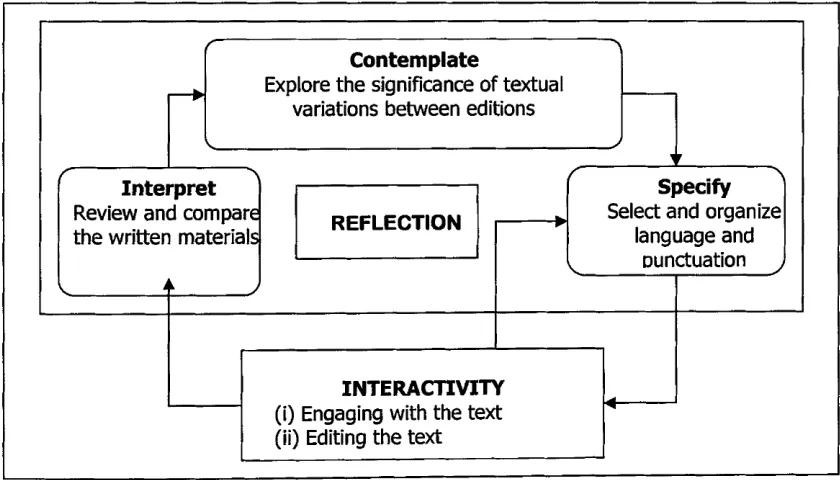
Fig. 1 The cycle of engagement and reflection in writing...41
Fig. 2 An adapted cycle of engagement and reflection in Active Reading...41
Fig. 3 “They Flee From Me”: Transparencies/Floats... 61
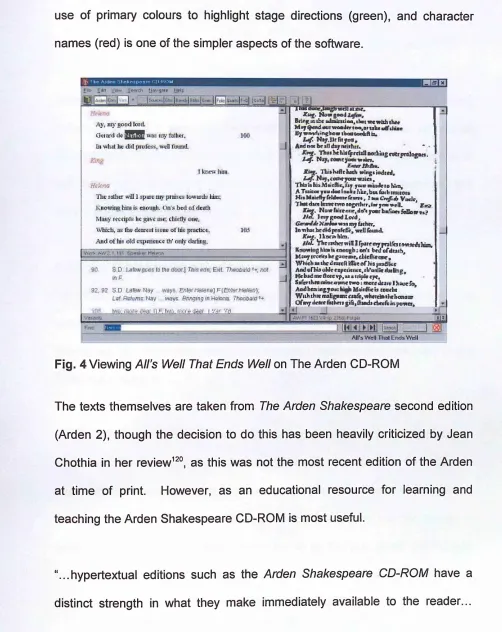
Fig. 4 Viewing All’s Well That Ends Well on The Arden CD-ROM... 70
Fig. 5 An extract from The Enfolded Hamlet... 73
Fig. 6 An Emily Dickinson poem viewed with The Versioning Machine...77
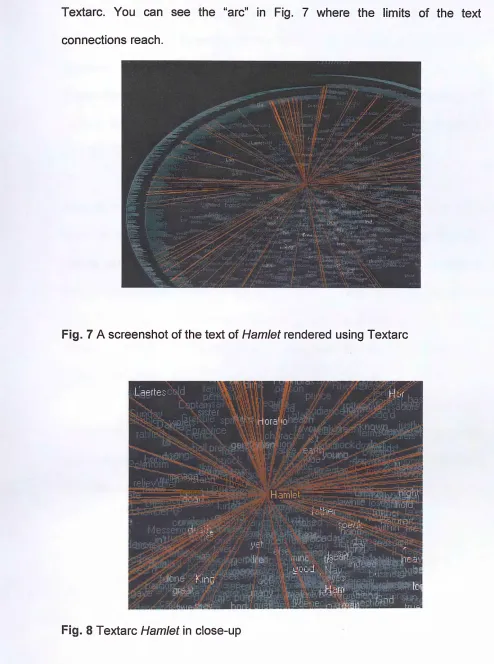
Fig. 7 A screenshot of the text of Hamlet rendered using Textarc... 80
Fig. 8 Textarc Hamlet in close-up... 80
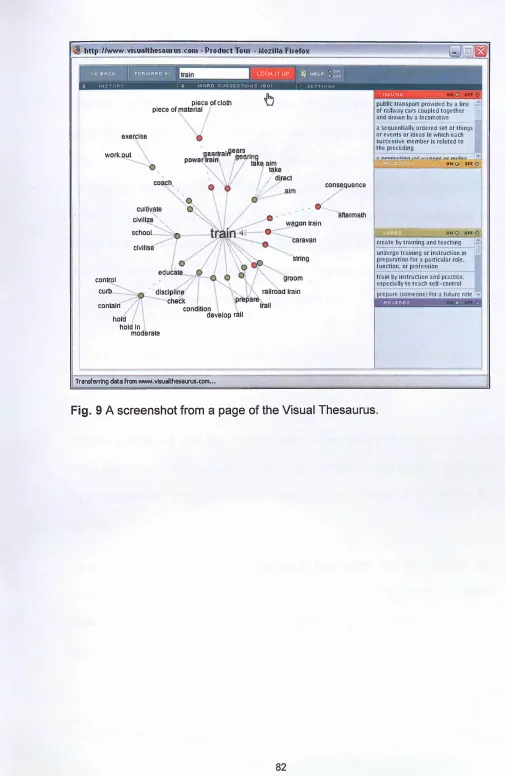
Fig. 9 A screenshot from a page of the Visual Thesaurus... 82
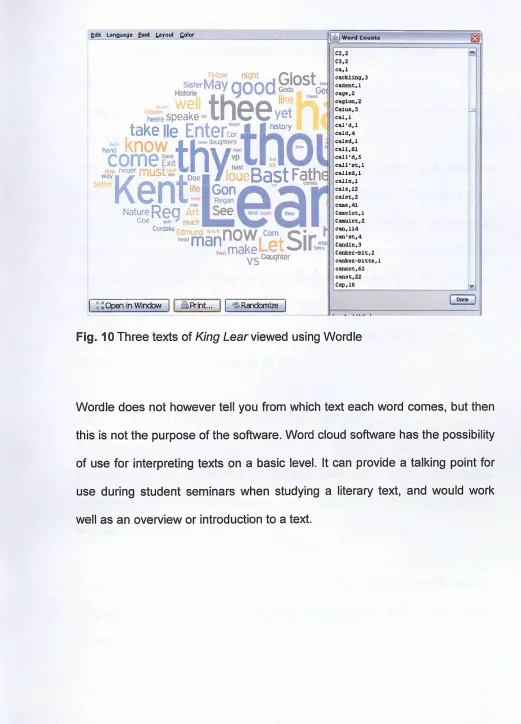
Fig. 10 Three texts of King Lear viewed using W ordle... 84
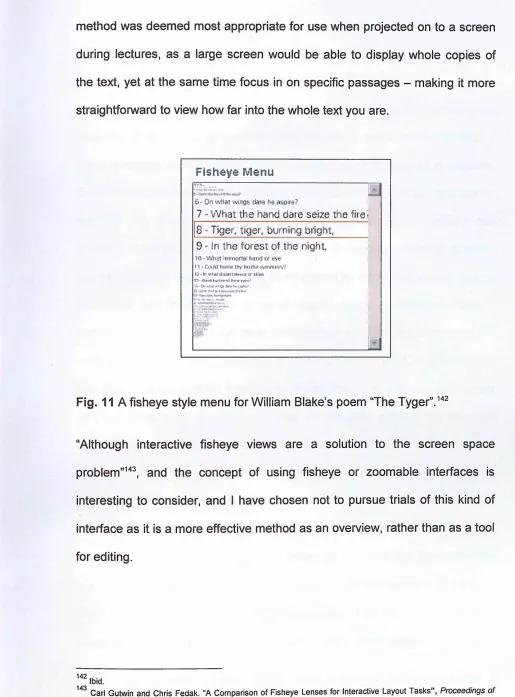
Fig. 11 A fisheye style menu for William Blake’s poem “The Tyger”...91
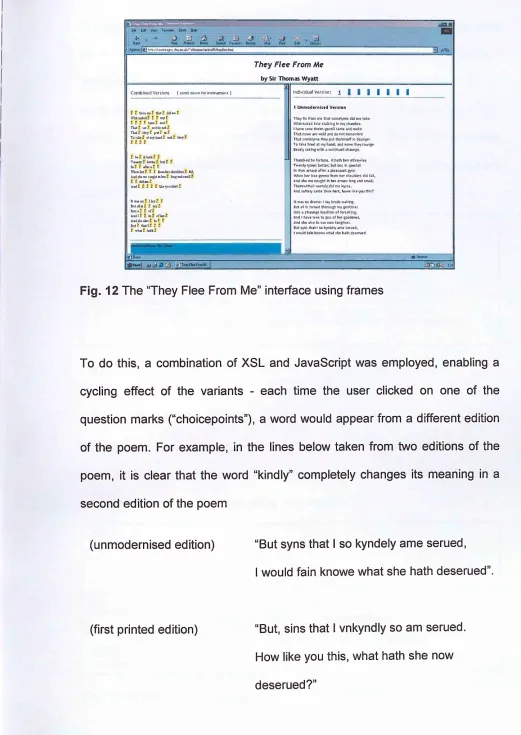
Fig. 12 The “They Flee From Me” interface using frames... 98
Fig. 13 An example segment of XML encoding for “They Flee From Me” ...99
Fig. 14 An example of encoding from my original tagset...99
Fig. 15 An example of the same piece of text using TEI encoding... 102
Fig. 16 Line endings in all three versions...114
Fig. 17 An example of data logging information on the status bar...124
Fig. 18 Mouse click interactions recorded with Group A ... 126
Fig. 19 Duration of computer usage across all users... 129
Fig. 20 Duration of Web usage across all users... 130
List of Tables
1
Introduction and Overview
This thesis has been submitted to Sheffield Hallam University in partial
fulfilment of the requirements for the degree of Doctor of Philosophy. Its aim
is to present a summary of the nature of research already completed and to
indicate possible future developments in this area. The thesis includes
background information on the research topic as a whole, in addition to a
discussion of literature relevant to the area of research.
1.1 Introduction
The aims of the research are to improve the techniques currently employed in
developing and presenting electronic editions of Renaissance texts, by
producing examples for a new edition upon which future editions of other
such works can be based. Currently no electronic edition exists that attempts
to display the variants between multiple published editions of a set text and
that allows for user interactions in editing the variants of this text. The
purpose of generating examples from which a new edition could be produced
is to:
■ Produce a template from which future editions can be created;
■ Enable students of literature to better understand both the editing
process and the ways in which variations between different editions of
a text can occur;
■ Design an effective interaction mechanism and interface for the
presentation of considerable amounts of text in combined form (that is,
Through the study of the editorial process, it is hoped that a better
understanding can be gained of how decision-making in editing can
completely transform the meaning of a text. In recent times there has been a
backlash against editorial tradition, with editors becoming divided over
whether it is appropriate to alter an “original” text or texts in any way, or
whether the emphasis should be placed on the production of new editions,
with the editor featuring almost as a secondary author to the work. Members
of the literary community such as Randall McLeod are ambassadors for the
belief that no two early modern printed texts are exactly the same, and that all
texts of this period are therefore unstable. McLeod believes that “photography
has killed editing”1 and that there is no longer any rationale for editing and no
point in producing critical editions.2
There is also the issue of multiple texts, and whether or not editors consider it
appropriate to publish more than one version of a text. In the case of King
Lear, two separate versions of the text exist which are generally conflated to
produce one version (with notes on the text referring to other editions). Some
texts are so different in fact that they contain the omission or addition of
hundreds of lines, whole speeches, and even scenes3. An example that
initiated considerable discussions within the literary community, in particular
amongst subscribers of SHAKSPER,4 the Electronic Shakespeare
1
W. Speed Hill, review of "Papers from ‘New Directions in Textual Studies’: The Harry Ransom Conference, University of Texas, 30 March-1 April 1989,” in TEXT 6 (1994): 373, also cited in Reginald A. Foakes, review article “Shakespeare Editing and Textual Theory: A Rough Guide", Huntingdon Library Quarterly 60.4, 430.
2 Reginald A. Foakes, “Shakespeare Editing and Textual Theory: A Rough Guide”, Huntingdon Library Quarterly
60.4 (1997), 430.
3 Peter A. Donaldson, "Digital Archive as Expanded Text: Shakespeare and Electronic Textuality”. Electronic Text: Investigations in Method and Theory, ed. Kathryn Sutherland, (Oxford: Clarendon Press, 1997), 183.
Conference, is that of the Arden third series edition of Hamlet, which
promised to be the first major edition to split the play into its three versions.5
Producing an interactive text for reference and comparison between different
published versions of a work carries a certain amount of responsibility
towards the reader. The process of Active Reading is then as much about
how much the reader wishes to engage with the text, and how simple and
effective that text is to engage with. Through the use of hypertext as a
medium in which to present literary texts, the occupation of the reader is
becoming more and more akin to that of the editor, and indeed the writer.
As the percentage of people with the ability to produce hypertext content
increases, as well as an increase in the frequency of Internet and computer
usage amongst college and University students, the reader can no longer
passively skim over the written word, but becomes increasingly more involved
in the creative process of reading and understanding.6 Therefore, the effect of
increasing readership of older literary works amongst young people may
enable an understanding and enjoyment of a broader reading matter.
The Active Reading project is concerned primarily with looking at ways of
displaying textual variants between several published editions of a text - in
this case, two quartos (1608, 1619) and the folio text (1623) of King Lear. By
combining these three editions it has been possible to examine textual
5 Colin Burrow, “Will the real Hamlet please stand up?” The Times Online (May 19 2002), also available: http://www.unibas.ch/shine/editinghamlet.htm l#Arden (accessed June 15, 2008).
variants independent from their respective edition, as well as looking at
variants in the context of the play as a whole. The interactive nature of some
of the prototypes produced for the project enables the user to “pick and
choose” from the available variants, and produce their own version of a
passage. In the following chapters I aim to demonstrate the issues associated
with developing prototype editions of Sir Thomas Wyatt’s poem “They Flee
From Me”, as well as an example of King Lear as a multiple text edition. The
potential for an editing tool of this kind to be used as a device for both
teaching and learning has been interesting to observe.
The work of the project is highly cross disciplinary, bridging the two cultures of
Computing and English Literature. In order to work more or less equally
between the two domains, ! have found a common ground in examining
editions as works in progress and as cultural artefacts, and by looking at
electronic text as a means to deconstruct this notion. By researching both the
editing process and the way readers interact with texts, it has been possible
to record what is expected of an electronic scholarly edition to be used by
undergraduate students. By producing a mental model of the elements users
would require, it is then possible for the computing aspect to begin work on
implementing these requirements.
At the forty-ninth Annual Conference of the Renaissance Society of America
(RSA), I briefly demonstrated a prototype of an edition of Thomas Wyatt’s
poem “They Flee From Me” in its eight available versions. This prototype and
conjunction with the teaching of the text. In observational studies of how the
application was used, it has been possible to gain insights into how the use of
technology in the English classroom can allow for greater collaboration
between students, and between student and tutor.
I am most interested in how users/readers interact specifically with different
interfaces - how they form their own conclusions about the texts/editions,
using the available tool(s), and how they would like to be able to examine the
texts. The value of finding different ways of interacting with texts, and of
providing multiple published editions of a set text to study - such as the
Quarto and Folio editions of King Lear, is important in allowing students to
realise the instability of texts and the changing role of the editor. These are
aspects which are covered by the MA English Studies module at Sheffield
Hallam University entitled: “Editing a Renaissance Play: Electronic Editions”,
the students of which have assisted me with generating requirements for the
multiple-text e-edition.
1.2 The Research Field and Scope of the Project
Art and science are two different streams which flow from the
same creative force and flow into the same ocean of common
culture, but the currents of these two streams flow in different
directions.7
7 Naum Gabo, 'The Constructivist Idea in Art” in Circle: International Survey Of Constructive Art, eds. J. L. Martin, Ben Nicholson, and Naum Gabo, (London: Faber, 1937), 8, in Simon Biggs, “Culture, Technology and Creativity" (lecture, Institute of Contemporary Arts, London, 1991),
The interdisciplinary nature of Humanities Computing allows for collaborative
experimentation by practitioners from many different domains. In some digital
humanities fields the computing emphasis may be greater or lesser
depending on the required outcomes of a particular project. Digital resources
for use in education and scholarly work should be the method by which
material is developed rather than a showcase for the technology itself, which
is often the case in Arts subjects. “Across the disciplines of application, there
are from the computational perspective three fundamental approaches....
algorithmic... metatextual... presentational...’* It is possible to incorporate all
three of these elements into the development of a text - to identify the way
the text can be produced or reproduced, to describe the text, and to
experiment with the appropriate presentation of that text.
Developers and designers of scholarly electronic editions are fortunate in that
they can look to the users or readers of these editions for inspiration on how
to create. The most fundamental aspect of developing an electronic
application in particular for non-computing users, is that it is usable, not just
that it should contain the wealth of information and material that we expect it
to. The densest electronic edition imaginable can be a fascinating resource,
but if it does not function easily, particularly in this case for use in teaching,
then it is simply a historical artefact and not a usable, fluid, working example
to be accessed alongside and in conjunction with the texts themselves.
a
Willard McCarty, "Humanities Computing As Interdiscipline". Is Humanities Computing an Academic Discipline?.
Renaissance texts can be found in electronic form across the Internet, and
many are not on peer-reviewed sites. Digital copies of the works of
Shakespeare typed out in HTML or scanned and saved as a PDF file have
limited the reading choices available to subscribers of electronic texts. There
seems little point in reproducing a Shakespearean text digitally for the sake of
it, when so many other electronic mirrors of the text exist. What is the benefit
in hundreds of institutions repeating the same task; of essentially making
back-ups of the same text over and over? A novel method of digitally
presenting text is to experiment with the format of the text, and to embrace
the possibilities that this medium can offer.
Deconstructing wholly text-based material allows for the possibility of greater
access and potentially fuller understanding for the reader. Encoding and
storing it within Extensible Markup Language (XML) provides a method for
which data can be shared between institutions with varying expectations for
learning outcomes. By separating form from content, each institution can then
experiment with the visual appearance of the text, and each user can decide
for themselves the way they wish to be able to read that text, or the tools they
2
Editing and Multiple Texts
2.1 The Editing Process
2.1.1 To Edit or Not to Edit - The Role of the Editor
It has long been debated whether to edit a text is necessarily a valuable
action. Opinions within the literary community differ widely on this issue, from
those such as Randall McLeod who believe that texts should not be interfered
with in any way, to those such as David Scott Kastan who observes that
editing is a “hot topic”9 and one which the academic community appear to be
embracing in increasing numbers thanks to the influx of hypertext and
hypertext editing packages.
The modern role of the editor could be considered to be somewhat of a
balancing act - to attempt to reconstruct an original text, but also to produce
an edition of the text that could be more accessible for reading purposes and
possibly for use in performance. It is important therefore to establish a task
model for the role of editor. Does one task specificaliy affect another? How
complex are the tasks that editors undertake? Are they well supported? In
modernising texts it is important to consider: “It is essential that, in reading
literature of any period, we engage with the language of the time as far as we
can, even if it is impossible for us to reconstruct exactly how it was spoken or
interpreted.”10 By modernising a text, it is imperative that none of the original
features or meaning be lost due to modernisation of sense or dialogue.
9 David Scott Kastan, Shakespeare After Theory (London: Routledge, 1999), 30. 10
Silvia Adamson, Lynette Hunter, Lynne Magnusson, Ann Thompson, and Katie Wales, Reading Shakespeare's
In researching and investigating different editing processes, in addition to
evaluating existing models of editing (both on paper and on the screen), a
preliminary model of editing can begin to be moulded. Models of editing
examined include that offered by Richard Proudfoot: “(The model) edition
would combine facsimile and modernised texts within a single volume,
arranging them in parallel on facing pages and supplying each with its own
kind of commentary.”11 The ideal model for producing an electronic edition
and for this project specifically would be divided into six areas: 1) encoding, 2)
evaluation, 3) refining of existing application, 4) further evaluation, 5) analysis,
and 6) publication of the edition.
2.1.2 Editing and Responsibility
With editing comes responsibility - the responsibility of fulfilling the
expectation(s) of the reader, of fulfilling your own expectations for the piece
you are editing, and of course, most importantly for the majority of editors,
fulfilling the author’s original intentions for the piece as adequately as
possible. Not everyone can become a professional editor, though there is no
reason why they cannot undertake editing tasks for the purposes of aiding
their own understanding of a text. Taking on the role of editor of a document
or text can help a reader to experience a deeper consideration of the piece,
and hopefully, this further engagement with the text will allow them to reach a
better understanding of the work as a whole.
11 Richard Proudfoot, “New Conservatism and the Theatrical Text: Editing Shakespeare for the third millennium”, in
This view is supported by David Scott Kastan, in his article “The Mechanics of
Culture: Editing Shakespeare Today”12. Kastan identifies modern editing as a
highly popular activity which many people want to attempt no matter how
qualified they are to do so. “For years, we just read whatever edition we
happened to have at hand, confident that the text was accurate and
authoritative.”13This quotation highlights even more so the importance of
being able to distinguish between versions of a text, and to be presented with
a choice as to which edition to select.
The sheer number of editions of certain specific texts is testament to the
concept Martin Spevack14 refers to as “me-tooism” - the constant need for
editors to produce their own personal edition of a text. In his article “The End
of Editing Shakespeare”15 Spevack casts an eye over the sheer number of
Shakespeare editions to have been produced over the last sixty or so years.
He is of the same view as Kastan; that “...the way is being cleared for
Everyman and Everywoman turning editor”16
All editors are, or try to be, collaborators. The traditional role
of the editor has been to recover the author’s text from the
corruptions of the printing house, and thereby restore the
author’s linguistic and lexical intentions.17
12 David Scott Kastan, Shakespeare After Theory (London: Routledge, 1999), 30. 13 Ibid., 31.
14 Martin Spevack. “The End of Editing Shakespeare”, Connotations 6.1 (1996-7): 78.
Editing, through the passage of time, has progressed considerably from
Shakespeare’s day. Modern editors can hopefully assume that, for the most
part, the need to “recover the author’s text from the corruptions of the printing
house”18 is not of immediate concern to them, considering the plethora of
editions that have been created dealing with this issue. Stanley Wells,
however, can see “no worthwhile future in the editing of Shakespeare unless
reasoned decisions are permitted to take precedence over the claims of
tradition.”19
Shakespeare’s plays in particular are read and used in performance by so
many different people, for a variety of purposes - whether it be for teaching
as part of the curriculum in schools, as a script for use in play productions, or
simply just for enjoyment. An editor producing a general edition of a play for a
non-specific reader-base, would have to take all these areas into
consideration.
There appears to be a whole new breed of modern editor; one who has
become educated on their chosen topic or text through the consultation of the
many editions preceding them. They no longer appear to be so concerned
with restoring “the author’s linguistic and lexical intentions”20, but rather more
with uncovering some new or previously undiscovered element of the text so
far along the line, that it would necessitate a new edition being produced. It
seems that in trying to dissect a text to be edited, editors over the years have
18 Ibid., 235. 10
made it increasingly difficult for themselves by basing their editorial decisions
on those already made by others, as opposed to basing them on the earliest
surviving text or texts and forming fresh opinions. Wells again notes:
It is proper that texts should be freshly examined from time to
time in the light of the latest scholarship, but it would be
dishonest of an editor to make changes merely so that his
edition would be different from someone else’s.21
Modern editors appear to have adopted the rule that, by providing copious
textual notes giving alternatives to the text provided, there is less of a need to
reproduce features of the original text itself, “...a modern editor will totally
replace with modern equivalents many features of the copy-text (such as
page-length, stick-width, and so on).”22 An “original” text can therefore never
be reproduced completely for modern readers in its original printed format.
Printing formats are different today, the size of the pages themselves are of a
different scale, due to the popularity of the modern Duodecimo page size of
the modern paperback book. The average size of computer monitor screens
on the other hand, is a new and different matter to be addressed for the future
of editing and publishing.
W. Speed Hill presents two extreme views of the editor in modern times in his
article “Where We Are and How We Got Here: Editing after
Wells, Re-Editing Shakespeare for the Modem Reader, 3.
Poststructuralism”.23 There are those who believe “the-best-editor-is-a-dead-
editor”,24 who find any kind of alteration to the original text or texts as being
“parasites on an authorial host.”25 Randall McLeod is one who follows this
extreme belief in refraining from editing totally if at all possible. There are also
those who preach the positive features of hypertext, seeing “its web-
structure(s) as the electronic embodiment of poststructuralist visions of the
work as a node within a web of intertextuality...”26 This idea leads to issues
associated with publishing a text electronically, and the fact that, at the click
of a button (or link), the reader can move from a text by one author, to
another by a second author - virtually merging the two texts together, through
the use of hyperlinks.
A new electronic edition is exactly this, a “new” presentation of the material. It
is important that a new edition has individualism, and an originality of its own
with which to present the material. The principal way to identify a newly
created edition is to recognise that it has an editor who is an individual (or a
series of editors). By doing this, it is clear that this editor (or editors) will have
left their mark on the text, and will have formulated the original text or texts in
their own style - perhaps modernising spelling or punctuation, or altering the
layout of the text on the page or screen. It is therefore important to determine
what the role of an editor is, and how much of a responsibility they hold with
regard to adhering to knowledge (if any) of the author (or authors’) original
intentions for the text.
23 W. Speed Hill. ‘Where W e Are and How W e Got Here: Editing after Poststructuralism”, Shakespeare Studies 24 (1996): 38-46.
4 Ibid., 40. 2 5 i u
Peter Robinson discusses the role of the editor with regard to the impact of
computers on textual editing:
At this moment in the history of editing as the old gives
way to the new, the editor must be a collaborator: part of
a shared enterprise...We are part of a floating world
wide conversation about editing and computers.27
Robinson sees the editor of electronic texts as having the shared
responsibility of being a scholar and a developer, as well as a communicator.
He recognizes the need for the editor to be a collaborator, sharing in the
experience of the text and its creation.
2.2 Producing New Editions
My advantage as a “common reader”; one who approaches the text from a
multi-disciplinary background as opposed to that of a strictly literary scholar,
has enabled me to be more objective when considering editing, than an
expert reader of a specific text might have been. Whilst editing I have not
experienced a strong obligation to stay true to any of the authorial intentions
for the text, as in many cases these would prove difficult to realise. My aims
are to recreate as simply as possible any and all available versions of a text in
order to provide a choice for the reader, rather than limiting them by the
choices that would’ve been made for them by an editor - an “editorial
avoidance" of sorts.
There are a number of questions to be addressed when considering
producing a new edition of a text. Should the process of reading (how the
reader reads) have an impact on how the material is presented? Is it
acceptable to change the format from that of a paper-based text, to one that
is perhaps more suited for a particular audience or reader? This last question
is particularly pertinent in the realm of the electronic literary edition, as the
format of an originally “paper-based” play such as King Lear, would be
completely transformed into an online and intangible copy of the play.
2.2.1 Tools for effective editing (print and online)
The tools an editor must equip themselves with in order to edit effectively for
both print and online documents can be very different, although they have
many base similarities.
■ Objectivity is an important trait when considering undertaking editing
of any kind, whether it is of a newspaper story, a film, or indeed of a
new online edition of a play.
■ Familiarity with the subject material being edited.
■ Sensitivity for the way the text is manipulated and presented, and for
the needs of the reader, particularly if it is to be a scholarly edition.
Objectivity is probably one of the more difficult skills to possess, as each
editor will bring their own bias to the material whether or not they are
preferences in this case can also be a disadvantage when it comes to being
objective. Sensitivity for the needs of the reader is possibly the most
important factor when considering the appearance and functionality of an
online edition.
2.2.2 Stage Directions
“Since stage-directions and the rest were often suspected of originating with
someone other than the author, editors tended unconsciously to accord a
lower textual status to them”.28 This is an example of an editor taking
temporary ownership of a text - a simple decision, based on what could have
been misconceived ideas about authorship, can lead to an original text being
altered seemingly forever, until another editing decision is made, perhaps
years later, and the ideas become of importance again. It is important when
presenting a number of versions of a text (in my case, electronically), to
maintain a consistent format for displaying stage directions, regardless of the
specific edition being displayed. This will enable readers to navigate easily
between versions, with minimal disorientation.
2.2.3 Accidentals and Substantives
An interesting area of editing concerns that of accidental and substantive
variants, and whether an element does or does not belong to the original text
with regard to meaning; if an editing decision was conscious or simply a slip
of the pen or typesetting error. “If the punctuation is persistently erroneous or
defective an editor may prefer to discard it altogether to make way for one of
28
his own.”29 This is another danger of editing - that the editor has the power to
change the author’s text in this way. Subsequent generations of readers may
not have been able to access the pre-edited material, and the history of that
text could have been altered incorrectly.
2.2.4 Clarity/ Noise
A major issue for modern editors attempting to edit from older editions of a
text, such as Shakespearean plays, is the “noise” factor. By this I mean that
early texts can have very cluttered content on their pages, many of which may
be handwritten in ink, or printed using relatively primitive methods by today’s
standards. This must firstly have caused problems for the printers and
typesetters if they were working from rough copies of the text or foul papers,
as they would probably have had difficulty deciphering the manuscripts due to
this lack of clarity, and might therefore have printed incorrect information.
The difficulties for modern editors editing older material such as this is much
the same, but they do not just have unclear handwritten documents to
contend with, but also printing idiosyncrasies, as well as any mistakes in their
own readings of what they perceive to be the text. For example, the printing of
sentence fragments by mistaking colons for commas.
The arrival of the computing age has done little to alleviate the problem of
noise either, as techniques such as OCR (Optical Character Recognition)
were still unable to distinguish certain elements from others. OCR is the
recognition of printed or written text characters by a computer, whereby the
text is scanned in character by character; the resulting scanned image is then
analysed, and the character images are then translated into character codes,
such as ASCII (the most common format for computer-based text files)30.
“Give a Kurzweil OCR a page from a seventeenth-century text, and it is likely
to be able to read only 40% - 60% of the signs on that page correctly.”31
However, the readers/ users of future electronic editions of these works will
almost certainly have no such problems with clarity of page and text, as 1) all
editions will have the capability to be able to be produced using the same font
face or font size if desired, and 2) users may be able to edit the material on
screen themselves if it is found to be incorrect or differing from the original
version of that text. The second wave of the World Wide Web, Web 2.0 allows
for many such folksonomic activities - such as the mass editing and tagging
of sites such as Wikipedia.
2.2.5 Authorship and authenticity
Many modern editors feel the need to attribute a text to one specific author.
They are unable to accept that the work simply exists, but must be able to
recognise the style of a particular playwright or writer within it. One reason for
the need to attribute a text to a certain author is the popularity of specific
authors or playwrights amongst readers. For example, if another proven
Shakespeare manuscript were to be uncovered, the attention from the
30 Whatis.com definition of “OCR”, http://whatis.techtarget.eom/definition/0,,sid9_gci214132.00.html (accessed 15 June 15, 2008).
academic and theatrical worlds would be unprecedented. More information
could be extracted about meaning in the text based on biographical
knowledge of that author, or used to draw historical conclusions from the
content based on other known works by that author.
If it was possible for an editor or bibliographer to reveal the authentic writer or
author of a work, then the task of editing a text might also be simplified, and
connections more easily made between this and other texts. Editors can
compare chosen texts with other previous works by that author, and base
their editing decisions upon this; they could calculate for example the number
of occasions in the text where an element appears, or a trait of its author can
be identified. Computer programs exist designed for just this purpose -
keeping a record of all the instances of specific words in a text. Modern
editing, therefore, can probably be described as being more about adding to
existing material and keeping records of versions of texts, than of excluding
written matter or anything else.
“Neither the Folio nor the quarto texts of Shakespeare’s plays bear the seal of
final authorial intention, the mark of decisive closure that has served, at least
ideally, as the guarantee of textual authenticity.”32 Can editors ever hope to
reproduce or recreate Shakespeare’s plays, as they would originally have
existed? “...it becomes clear that no decision about the presentation of a
literary work can be made that does not involve some loss of desirable
information.”33 This idea also relates back to McLeod’s theories that all editing
is tampering with the original text or texts in some way.
Kastan agrees that the problem over the issue of “authorship” in modern
times, is that it is no longer concerned simply with an individual, but more so
with the process of authoring, collaborators, methodologies, and the “network”
or “pathway” through which a text came into existence. Editors and
bibliographers are constantly seeking to find the source of all references
made by an author, and seeking to attribute works to them, which are
purportedly produced in the writer’s style.
“For many years it was thought that Shakespeare himself did little or no
revising.”34 However, it is now thought that he did in fact make many
revisions, and that his play scripts were in fact more like “open texts,” and that
“...the playwright and his company expected to add, cut, and rewrite as the
occasion demanded.”35 This leaves a problem for the editor of a “definitive”
Shakespeare edition, as he or she will never be able to find a “perfect” or
“final” copy of the play from which to work, and will therefore never be able to
generate a “final” copy of their new edition.
By creating and editing electronic scholarly editions we seem to be getting
even further away from the original text or texts. “Many modern readers of
Shakespeare, particularly younger readers...probably have little idea of what
33
a sixteenth-century printed play text actually looked like.”36 Therefore, by
making plays more accessible to these readers by incorporating technology
into the reading experience, are we not making the original physical texts
appear more distant from them and more inaccessible again?
“Increasingly textual criticism, if not editing itself, has attempted to uncover
the full network of agency involved in the production of the text, restoring the
literary work to the collaborative economies necessary for its realisation.”37
Working on developing new ways of reading texts will allow for the focus to be
more upon the text as a historical work of literature; enabling, through
interactivity, a greater understanding of the textual variants between versions
and the possible reasoning behind authorial and editorial decisions. The aim
of this project is not to provide a timeline for bibliographers to trace every
addition and deletion within the text; the emphasis is instead on scholarly
understanding of the creation of one text, the result of which could be applied
to many other texts.
2.3 An Introduction to problems of Multiple Text Editions
2.3.1 Multiple Text Editions in Shakespeare
For many years editors have approached Shakespeare plays, confident that
they were enhancing a text that was relatively stable and that had altered very
little from the early days of its production. They had no awareness that the
36 Graham Holdemess, Cultural Shakespeare: Essays in the Shakespeare Myth, (Hatfield: University of
Hertfordshire Press, 2001), 111.
plays themselves would turn out to be the subject of debate over whether
each was not one play, but actually two.
An entire publication entitled The Division of the Kingdoms: Shakespeare’s
Two Versions o f King Lear, is devoted to essays supporting the hypothesis
that King Lear was not one play but in fact two separate plays, and that
“...both texts represent independent Shakespearian versions of King
Lear...”38
Steven Urkowitz suggests that:
The agent most likely to have produced the spelling, spacing,
lineation, textual illegibility, verbal structures, patterns of
dialogue, and dramatic designs in the Quarto of King Lear is
Shakespeare himself.39
However, since the 1980s it has been argued that conflated editions of the
text(s) of King Lear were not providing a clear view of the “real’' text at all.
Instead, the thinking was that there were two distinct texts; an original
published in 1608 as The History of King Lear, and a second revised version,
published in 1623 as The Tragedy o f King Lear. The History has around 300
lines which are not present in the Folio, the Tragedy has about 100 lines not
found in Q1. The overall difference in length between the two versions is clear
with 3,100 lines of Q1, and only 2,900 lines of the Folio40.
38 Gary Taylor and Michael Warren, “Preface”, The Division of the Kingdoms: Shakespeare’s Two Versions of King Lear, eds. Gary Taylor and Michael Warren (Oxford: Clarendon Press, 1982), v.
Although scholars in the 1980s established that the Quarto
and Folio versions of King Lear were substantively different
texts, interest in such variation was quelled by "revisionist"
critics assuming "to revise" simply meant "to perfect," so that
they deemed the Quarto a failed attempt to produce the
supposedly more refined Folio.41
Length of text is not the only problematic aspect of having two versions of a
text. Between these two versions of Lear “several speeches are differently
assigned; and there are more than 850 verbal variants, some of them
obviously the correct version of manifest errors in the Quarto, others offering
an alternative sense.”42
“By including two texts of King Lear, the Oxford Complete Works became the
first major edition to apply the two-text theory in editorial practice”43. Similarly,
the Norton edition of Shakespeare is based on the Oxford edition; it too
contains three texts of Lear. The History of King Lear (1608), The Tragedy of
King Lear (1623), and a conflation version. Many other editions have also
been published which seek to present all major versions of the text, rather
than limiting the reader to one conflated text constructed by an editor.
As I mentioned in Chapter 1, a recent and contentious discussion along
similar lines is that of the publication in 2006 by Arden of their third edition of
41 Robert B. Hornback, “The Fool in Quarto and Folio King Lear". English Literary Renaissance 34 (3) (2004). 306-338.
Hamlet An illustration of some of the problems arising from multiple textual
versions is in Colin Burrow’s discussion of the excerpts from Hamlet below:
...everybody knows Hamlet says "To be or not to be, that is
the question", and "To sleep, perchance to dream. Ay, there's
the rub". Except in one version of the play he doesn't say
either of these things. He says: "To be, or not to be, ay,
there's the point,/To die, to sleep, is that all? Ay, all: / No, to
sleep, to dream; ay, marry there it goes". And instead of dying
with "The rest is silence", in one version he ends: "The rest is
silence. O, o, o".44
2.3.2 Variants
By looking at the possible variants that could exist between published
versions of a work, it is apparent how potential mistakes and textual
peculiarities could have come to exist between several editions of a published
work. In particular, by looking at variants of spelling and punctuation, it has
been possible to distinguish between different edited versions and the
possible reasons for these differences.
Individual editors choose to deal with variations between texts in certain
specific ways. If no methodology of this specific editing process is kept, it
would then be the task of future editors to decipher the reasoning by which
they had included certain features, but excluded others. In addition there is
the problem of completely unedited texts, where errors and ambiguities may
have occurred due to any number of reasons during the printing process, or
during transcription, and have not been documented.
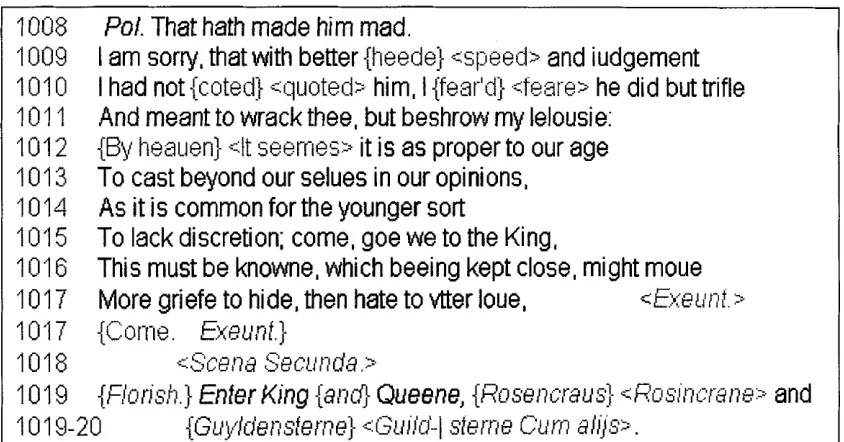
Through the encoding of Act I of the three texts of King Lear I have found that
the majority of the time Q1 and Q2 have the most similar variants, but
occasionally Q2 and F appear to have more similarities in spelling and so on.
Obviously there are major textual differences between the editions - the
quartos contain around 300 lines which are not to be found in the folio, and in
turn, the folio contains 100 lines not present in either of the two quartos.
Changes in the character name reading the same part are also present, for
example in line 204 of the quartos the part is read by Gloucester, but in the
folio it is Cordelia / Cornwall. This kind of variant could have a major impact
on the meaning of the text and the action within a scene.
2.4 Electronic Editions and Hypertext
The use of hypertext in the creation of new editions and for the purpose of
editing in general has been aimed at making texts more available and more
accessible by a wide range of readers. The possibilities of creating new online
material encoding three versions of a text such as King Lear could contribute
to the beginning of a whole new way of reading, editing, and cross-
referencing textual material.
Instead of having to sift through many reams of different paper versions of a
combine these versions to illustrate aspects such as differences (variants) in
the text. As well as saving an immense amount of time, hypertext allows us to
explore parallels between works that we might not have discovered given the
same amount of time, and cross-referencing is immediate.
“With hypertext, however, Everyman/ Everywoman - or shall we say,
Hyperperson - is invited to become editor: Hyperperson, rear’d arm poised
with mouse, in his livery floppy disks and manuals.”45 In an amusing, yet
rather outdated view of the users and creators of today’s electronic editions,
Martin Spevack makes clear his opinion of the amateur electronic editor. He
appears to support the view that hypertext, although having many uses, is too
vast and perhaps “gimmicky” to have a long-term future in the editing of texts.
He adds: “Editing Shakespeare has become in certain areas
inforentertainment, in the manner of hypertext.”46
He describes the wealth of information that can be enabled by the use of a
hypertext system as leading “...to a traffic jam, with standstill.”47 Having too
many options is not always a good thing, and no matter how good the
intentions of the editor of the edition, the outcome for the user may still
ultimately be confusion. This is true to a certain extent, but provided the user/
reader can be supplied with suitable directions and constraints within the
edition, any possibility of “information overload” can be avoided.
Spevack, “The End of Editing Shakespeare”, 81. 46 Ibid., 82.
Much can be taken from existing research into what a definitive electronic
scholarly edition should and can encompass. Peter Shillingsburg presents his
own set of eight general principles for electronic scholarly editions:
(i) Usability;
(ii) Transportability;
(iii) Archive specifications;
(iv) Security and order;
(v) Integrity;
(vi) Expandability;
(vii) Printability;
(viii) User friendly.48
These principles can be very useful for defining a framework specific to this
thesis, and can help in creating an independent set of guidelines for an
edition concerned primarily with the presentation of textual variants and
versions. Of course these principles are not all relevant to the area of
concern, and therefore each must be considered carefully with regard to what
the edition should contain, (see also Appendix 1.1 for Shillingsburg’s
definitions for literary studies).
Randall McLeod believes that literature should be stable, and I agree with this
to the extent that there should always be made available a base template of a
text wherever possible - a “starting point” text if you will, from which to begin
and to overlay changes upon. I do not, however, agree that a literary text
should necessarily be static, as this implies that it is an unmoving sedentary
object, unable to be adapted or flexible and not of interest to modern or new
readers.
The most popular way of ensuring that literature remains far from static, is to
transform it into electronic form. Existing as electronic text as opposed to text
on a physical page, both forms retain the ability to encompass aspects such
as footnotes and general notes, and the two forms of medium appear quite
similar. However, the introduction of hypertext is where the similarities end;
there are few comparable features in the world of the paper-based
publication, other than perhaps page references and footnotes, as they direct
the reader to other pages much as a hyperlink would in a hypertext
document.
To introduce hypertext into editing (or vice versa) is to deconstruct the
physical form of the book; to scatter the pages far and wide, and still be able
to access every last one at the click of a button. On the one hand, it breaks up
the text as a singular form, but on the other hand, it interweaves and cross-
references the material within itself more than a paper-based book would be
capable. This not only offers new ways of reading, but also new ways of
editing early modern texts.
This movement from the page to the screen means that literature may never
be wholly stable again. The majority of servers on the Internet that support
and host new electronic editions produced in hypertext will all have been
accessed or remotely edited, unless of course a mirror site provides a current
backup of the data.
Another concern with storing electronic copies of texts might be in retaining
electronic backups of the versions of texts that have been edited. As is often
the case with software, one version supersedes another and the previous
version is no longer available to view or compare or be supported. This is
obviously different from life in the tangible world as when new or revised
editions are published, their older versions physically remain to be viewed
and referred to.
If, for example, the second edition of a play is published, the first edition will
likely still be on bookshelves, and can still be physically accessed. When
electronic editions are published on the Internet, any versions that are not
current are often completely removed from the public domain and even
deleted without record, particularly if they are reliant on a form of technology
which is no longer available or supported.
Kastan49 has some interesting observations about hypertext and the
electronic edition, which are extremely relevant issues to the Active Reading
edition. He believes that a hypertext edition of Shakespeare’s plays would
enable the majority of original information to be included, such as early
substantive printings in the text, as well as the possibility of including a variety
of critically edited texts. This is the principal aim behind the generation of my
49
work; that all available editions of the play King Lear be available in a
hypertext document for viewing online - a virtually impossible task were it to
be considered with paper as the medium.
“The hypertext is less an edition than an archive, and it is one thing to have
such (hyper)textual richness available and quite another to read it.”50 Kastan’s
view is probably the main argument against the creation of the new electronic
edition, as there will seemingly always be the issue of the feasibility of reading
vast amounts of text from the screen. I must disagree to a certain extent with
Kastan’s opinion that we as a literary community will continue as we have
done previously, to read, teach, and edit on paper and using books alone,
rather than also using the medium of the computer. There will always be the
issue of reading from the screen, but there is no reason why sensitively and
intelligently produced electronic editions cannot be used or referred to for
teaching purposes, learning purposes, and/ or research purposes on a daily
basis.
Computers are utilised by students in schools on a daily basis as part of their
academic programmes. Most young people have grown up with computers
and are familiar with using them, both in and outside of school for work and
leisure. Incorporating technology into a taught subject such as English
Literature has almost become seamless, as the majority of undergraduate
students who took part in the prototype trials for this project had been using a
Students incorporates use of electronic journals in the library. Children have
been found to be very responsive when their school subject is presented in
conjunction with some kind of new technology, and many “children are
exposed to computers from a very early age.”51 Even as a general reference
tool for adults, an online scholarly edition could be relevant. An electronic
edition would also be much more accessible than many books, as it is
virtually independent of specific location (no carrying heavy books around),
and could be accessed from any computer terminal with an Internet
connection and browser or software reader.
A problem for contemporary editors dealing with early modern textual material
is that it does not often use the common modern English language that is in
use today. Shakespeare’s English was “non-standard English, both
structurally and contextually very different from its modern counterpart.”52 This
therefore means that editors producing electronic scholarly editions cannot
simply present the text alone on the screen as with many modern plays, but
must include a lengthy apparatus or glossary, or links to them, in order for the
text to be comprehensible to a modern reader. This can contribute an
additional problem, making the screen cluttered and difficult to read visually.
A sensitive editor would then be required to create a comprehensible edition
that is both simple to use and view, minimizing the amount of text on the main
part of the screen at any one time.
51 Kori M. Inkpen, “Drag-and-drop versus point-and-click mouse interaction styles for children , ACM Transactions on Computer-Human Interaction (TOCHI) (2001), v.8 n.1, 1-33.
This also leads to issues of reading and editing large amounts of text on the
screen. The immediate response of most people when confronted with a large
amount of onscreen text to read is to print it out. If the readers of an electronic
edition of a lengthy text were given the ability to alter certain aspects of the
onscreen material such as font size, style, or colour, this might help to
alleviate somewhat the problem of “information overload" or at the very least
make the text more readable and digestible onscreen. If users/ readers could,
for example, enlarge the size of the font to a suitable size of their own
preference, this would perhaps make reading from the screen more
pleasurable, and would perhaps contribute to making the text more personal
to individual users/ readers. Using a browser such as Microsoft Internet
Explorer (IE) or Mozilla Firefox, it is possible for a user to increase or
decrease font sizes on a webpage, providing that page does not restrict this
feature.
The option of printing out some of the text could always remain as an option,
but this should be avoided if at possible as it is defeating the purpose of
electronic text. By printing out, the reader is not really accepting the electronic
medium of the edition, but rather trying to retain a grasp, on the original
format of the text; the paper. It is the linear nature of texts that makes them so
suitable for the medium of print, but it is also this medium which creates
restrictions on any further interactions with texts. For example, physically
turning the pages and navigating around a text from appendices to footnotes
tasks should they be undertaken incorporating a technology such as
hypertext, where links between pieces of text can be made instantly.
Although primarily intended for visual or aural performance, the poetic nature
of some of Shakespeare’s texts perhaps reflected his intention for his plays to
be referenced again, and perhaps quoted - thus almost implying that the
reader’s experience might be an interactive one; flicking back and forth
through the pages to find a favourite character quote or scene.
Complex texts of the early modern period in some ways
anticipated recent developments and concerns in electronic
media, reflecting their producers' sense that non-serial
access could both make the texts more usable and could
shape the ways in which they are used.53
2.4.1 An Active Reading Edition
The Active Reading has involved producing part of an electronic scholarly
edition, aiming to have the capacity to display all the available textual
versions of T hey Flee From Me” or King Lear onscreen at the same time.
This might at first sound like an ambitious and perhaps puzzling concept, and
in attempting to compare the paper-based texts of the various versions of
King Lear available in print, there is an immediate issue of disorientation.
Attempting to examine four or five different paper-based texts of the same
work at the same time can be extremely confusing and can leave a reader
under a mountain of textual material which is difficult to compare and keep
place within.
The advantage of combining a number of texts on one screen digitally is that
hypertext can allow links to connect the versions together without the need for
individual copies to be displayed in their entirety. For example, by clicking on
one word in one version of the text, a series of alternative words from other
versions could appear, and the user/ reader can then compare version
variants without having to navigate away from their starting page. This also
offers an additional advantage in that the reader can essentially take on the
role of editor; they can choose the variant of a word which they feel is best
suited to that version of the play, an