Facilitating collaboration in the new product development
process of science-based SMEs: a communities of practice
perspective
PATTINSON, Steven <http://orcid.org/0000-0003-3352-5738>, PREECE, David and DAVIES, Mark
Available from Sheffield Hallam University Research Archive (SHURA) at: http://shura.shu.ac.uk/12596/
This document is the author deposited version. You are advised to consult the publisher's version if you wish to cite from it.
Published version
PATTINSON, Steven, PREECE, David and DAVIES, Mark (2015). Facilitating collaboration in the new product development process of science-based SMEs: a communities of practice perspective. In: SOFI Seminar Series, Teesside University Business School, November 2015. (Unpublished)
Copyright and re-use policy
See http://shura.shu.ac.uk/information.html
1
Facilitating collaboration in the new product development process of
science-based small firms: a communities of practice perspective
Steven Pattinson
School of Social Sciences, Business and Law, Teesside University, Borough Road, Middlesbrough TS1 3BA, UK. [email protected]
David Preece (retired)
School of Social Sciences, Business and Law, Teesside University, Borough Road, Middlesbrough TS1 3BA, UK. [email protected]
Mark Davies
School of Social Sciences, Business and Law, Teesside University, Borough Road, Middlesbrough TS1 3BA, UK. [email protected]
Corresponding author:
Steven Pattinson, School of Social Sciences, Business and Law, Teesside University, Borough Road, Middlesbrough TS1 3BA, UK
2
Abstract
New product development innovation rarely, if ever, occurs through the ideas and actions of isolated individuals. It invariably requires collaboration between people with a range of skills, knowledge, contacts and experience. Initiating and developing collaboration can be
challenging for SMEs, not least science-based ones, who are often unreceptive to knowledge sharing because of lack of trust, internal conflicts, motivation issues, limited resources and the absence of sharing mechanisms. We contend that communities of practice are a vehicle for networking and collaboration. Our findings contradict suggestions in the extant literature that lack of trust inhibits knowledge sharing and collaboration in SMEs. Indeed, our findings demonstrate that regular mutual engagement and the sharing of expertise internally with colleagues and externally with customers and suppliers, led to the emergence of a variety of trust-based communities of practice in the science-based SMEs, improving their ability to acquire new knowledge that influenced innovation and new product development.
3
1. Introduction
Successful innovation is reliant on the identification, cultivation and maintenance of effective relationships between different actors in the global value-chain (van Dijk & Trienekens 2012). Addressing weaknesses in networking and collaboration capability is increasingly important for small and medium sized enterprises (SMEs) (Gronum et al., 2012). These enterprises rely on the support of their networks, including communities of practice (CoPs) (Lave & Wenger, 1991), to access new opportunities, obtain new knowledge, learn from experiences, and benefit from the synergistic effect of pooled resources (Chetty & Blankenburg Holm 2000). Indeed, it is claimed that CoPs, ‘by their nature, provide a helpful antidote to network failures’ (Autio et al., 2008, p. 62). However, collaboration between various actors can be particularly challenging for science-based SMEs, which are typically very secretive about their processes and who operate within a culture of customer confidentiality (Bagchi 2010). CoPs are more tightly-knit than other networks (Brown & Duguid 2002) and potentially offer science-based SMEs a means to improve their networking potential and therefore ability to innovate. The role of CoPs in science-based SMEs has not been the subject of detailed empirical research (Pattinson & Preece 2014), and given the importance of supporting innovation and SME competitiveness this lacuna is worthy of further investigation.
4 CoPs should be viewed as a flexible construct for examining the complex and informal intra and inter-organizational relationships that emerge in science-based SMEs, and that are a key element of the innovation processes of such firms. Our study aimed to gain a deeper understanding of how SMEs acquire new knowledge and generate innovations that lead to the development of new products through the construction of CoPs. The specific research questions were:
1. How is knowledge acquired in science-based CoPs?
2. How does the knowledge acquired in science-based CoPs influence innovation and new product development?
Three main forms of intra-organizational CoPs were identified in the literature:
apprentice-based, cultivated, and managed, and these are outlined and discussed later. Drawing on our fieldwork and the organizational networking and CoPs literature, we identified a fourth form of CoP, which we have labelled inter-organizational. Our paper makes a contribution to understanding of CoPs as an enabler of both internally and externally oriented knowledge-related capabilities, which few studies have considered (Maes & Sels 2013), and how such capability-based knowledge improves knowledge acquisition and innovation. Our findings contradict suggestions in the extant literature that lack of trust inhibits knowledge sharing and collaboration in SMEs. Indeed, our findings demonstrate that regular mutual engagement and the sharing of expertise internally with colleagues and externally with customers and suppliers, led to the emergence of a variety of trust-based CoPs in the science-based SMEs, improving their ability to acquire new knowledge that influenced innovation and new product development.
5 methodology and our findings and discussion. Our conclusion outlines the contribution of the paper, its limitations, and areas for further study.
2. Defining science-based business
A science-based business has been defined as a commercial organization that, ‘attempts not only to use existing science but also to advance scientific knowledge and capture the commercial value of the knowledge it creates’ (Pisano 2006, p. 2). This definition differentiates science-based business from ‘pure’ research and development activity that may value R&D activity as an end in itself, and encompasses the key elements of science, business and innovation that are central to this paper. Science-based businesses need to leverage collective wisdom to generate innovation for economic advantage (Von Hippell, 1987) but experience the challenge of integrating diverse scientific disciplines. Sharing experiences over a sustained time frame is, therefore, essential to the success of science-based businesses involved in innovation.
6 (represented by R&D activity) and the commercialization of their innovations, i.e. incremental innovation (Gassmann & Reepmeyer 2005). Incremental innovation refers to small-scale changes that take place regularly (Rothwell & Gardiner 1985). Radical innovation refers to the commercialization of major advances (Tidd & Bessant 2009).
In the next section we discuss the theoretical framework of communities of practice.
3. Theoretical framework: communities of practice
A community of practice is a group of people, who share a concern, set of problems, or passion for a topic, and who deepen their knowledge and expertise by interacting on an ongoing basis (Wenger et al., 2002). It has been suggested that CoPs help underpin the conversion and connection of knowledge exchanges between networks (Tidd & Bessant 2009). Learning is seen as the, ‘the primary way to engage with others in an ongoing practice, it is what enables actors to modify their relations to others while contributing to the shared
activity’ (Gherardi et al., 1998, p. 276). It has further been suggested that CoPs can be an effective way to capture and share tacit knowledge, as well as to leverage the social capital necessary for innovation (Allee 2000; Landry et al., 2002; Lesser & Prusak 1999; Wenger 1998, Wenger 2000). Social capital relies on a social network of relationships, and is summed up by Field (2008, p.1) in two words: ‘relationships matter’. Connections, developed over time, enable individuals to work together to achieve things they could not achieve in isolation, or that could only be achieved alone with great difficulty or at an extra cost (Nahapiet and Ghoshal 1998).
7 innovation in four communities of serious sports enthusiasts. Innovators in these user-led communities operated on the basis of ‘generalized exchange’ which they explain: ‘is not conditional, [and] there is an expectation that if a community member provides assistance today, someone else will provide him with assistance when he needs it’ (ibid, p.173). They observed that members shared their innovations freely within their respective community. Users rather than manufacturers were considered to be responsible for most innovations and that these users could be considered to be a metaphor for emergent inter-organizational CoPs.
The contribution of CoPs to innovation has been identified as arising through a variety of means, including the elicitation of tacit knowledge (Bertels et al., 2011), supporting knowledge sharing (Hayes & Fitzgerald 2009), and improving organizational learning (Autio et al., 2008). By tacit knowledge we mean knowledge that is personal, experiential, context-specific and hard to formalize and communicate, for example, how to ride a bicycle (Tidd & Bessant 2009, 543). An obstacle to knowledge transfer can be misunderstanding between different functional specialists; this can lead to conflict which stifles any willingness to be open, participative, and to share knowledge- creating functional silos (Ellegaard, 2012).
8 when institutions are relatively unstable, unfamiliar to the actors and ambiguous. Reciprocity is an important expectation of community participation, and members of a CoP know that their contribution will be honoured in some form of future benefit (Wenger et al., 2002).
On the other hand, Meeus and Oerlemans (2000) comment that the often limited resource base available to small firms does not negatively impact on innovativeness, and argue that they are able to develop adaptive behaviour conducive to innovative performance. This suggests that lack of trust rather than resources is a more likely barrier to innovation through collaboration. Trust promotes cooperation (La Porta et al., 1997), but presents particular difficulties for SMEs in that a lack of trust can be an issue in networks such as CoPs which tend to be formulated as informal rather than formal agreements (Braun 2006).
Below, we outline and discuss four main formulations of CoPs which we have garnered from diverse literatures: (1) the original, apprentice-based, one of Lave and Wenger (1991); (2) cultivated; (3) managed; (4) inter-organizational. The first three all have an internal/intra-organizational focus, whereas (4) has an external/inter-organizational focus.
3.1 Apprentice-based CoPs
Initial CoP research (Lave & Wenger 1991) focused on the way people learn, and contributed to an important argument in learning theory: the notion that learning is socially situated, the product of the activity, context, and culture and language in which it is developed and used (Botha et al., 2008; Brown & Duguid 1991; Hamilton 2011). Lave and Wenger (1991) observed how over time apprentices joining a community moved from an initial position of ‘legitimate peripheral participation’ into a community of practice. Through participation in peripheral activities that occur at the outer edge of CoPs, the apprentice
gradually moves from the position as a ‘newcomer’ to become a full participant as an ‘old
9 (2005) consider ‘legitimate conflicts’ that occur when legitimacy of a participant is
challenged by other members, can have both positive and negative effect on CoP development, sometimes resulting in individuals withdrawing from the community.
Hsiao et al., (2006) support the view that the situated learning occurring in CoPs is
important for innovation, noting that ‘capability-based knowledge’ (i.e. knowledge generated
from practitioners’ work activities) is acquired through the process of ‘learning by doing’,
which CoPs support. Similarly, Sense and Clements (2006) refer to CoPs as ‘situated learning
opportunities’ which contribute to learning and innovation. Also, Chen and Tseng (2011) posit that situated learning is essential for innovation, and CoP membership enables effective
knowledge transfer by providing access to other local ‘experts’. Anand et al., (2007) concur that CoPs support learning and knowledge-based innovation, and note that the role of ‘key
actors’ in embedding CoPs within organizations is often downplayed in the literature.
Amin and Roberts (2008), on the other hand, warn that some differentiation is
required between the varieties of ‘knowing in action’ that CoPs represent in relation to
Wenger’s original notion of situated learning, suggesting that use of the term ‘community of
practice’ has become imprecise within the extant literature and is now being applied to,
‘social practices of all kinds in all sorts of collaborative setting and all manner of learning and
knowledge outcomes are becoming folded together into one undifferentiated form’ (Amin
and Roberts, 2008, p. 355). In their opinion such homogenisation and of the term, in relation
to the varieties of ‘knowing in action’, is unhelpful and glosses over the varieties of situated
10 CoP theory has subsequently been adapted by knowledge management theorists and
used to highlight its value in relation to increasing firms’ absorptive capacity, i.e. the ability to recognize the value of new, external information, assimilate it, and apply it to commercial advantage (Cohen & Levinthal 1990). External knowledge is increasingly seen as a critical element of successful innovation (Brunswicker & Vanhaverbeke 2014). Nevertheless, it has been suggested that apprentice-based CoPs fail to acknowledge that in complex, knowledge intensive industries (such as ICT) innovation usually occurs across, rather than within organizational boundaries (Carayannis & Alexander 1999). Amin and Roberts (2008) challenge the view that the value of face to face, or localized, interactions are any different from those formed at a distance. They identify that: ‘efforts to innovate involving interactions between CoPs give rise to greater diversity and, therefore, a wider range of possible outcomes than innovation within a single community of practice’ (ibid, p.360).
More recent treatments (for example, McDermott & Archibald 2010) have moved away from an emergent, apprentice-based view of CoPs, suggesting they can and should be managed with, ‘specific goals, explicit accountability, and clear executive oversight’ (ibid, p. 84). The governance of CoPs is a disputed area within the literature, the main arguments revolving around whether they can be managed for strategic purpose or cultivated, or whether they are a fundamentally emergent phenomenon (Pattinson & Preece 2014).
3.2 Cultivated CoPs
11 ‘innovation communities’ are focused on fostering unexpected ideas and innovations (ibid, p. 76). Cross and Prusak (2002) also identify four common role-players in the CoP cultivation
process: ‘central connectors’, ‘boundary spanners’, ‘information brokers’ and ‘peripheral
specialists’.
It should be noted that SMEs may have a limited number of boundary-spanning opportunities available to them (Sawyerret al., 2003) because they lack critical mass in terms of size and number of employees, and therefore find it difficult to cultivate CoPs. Saint-Onge and Wallace (2003) suggest that organizations need to develop a shared sense of purpose and ownership of CoPs based on mutual trust. This might be difficult for SMEs, who can be secretive about their processes and often operate within a climate of ‘customer confidentiality’, making knowledge sharing difficult because of a lack of trust (Bagchi, 2010). Loyarte and Rivera (2007) argue that CoPs are closely linked to the personal, intrinsic motivation of members, and are therefore largely outside the (potential) control of the organization. According to Dewhurst and Cegarra Navarro (2004), SMEs are often risk
averse and focus on the ‘traditional’ aspects of CoPs, such as lunch meetings/ discussions and other informal activities, thus undervaluing the innovation potential of a more focused approach, for example providing time for CoP participation or training CoP leaders.
12 3.3 Managed CoPs
McDermott and Archibald (2010) argue for a managerial approach to CoP governance, claiming that CoPs require ‘real’ structure, rather than being independent and self-organizing. They identify four ‘principles’ (ibid, p. 85) for the design and integration of effective communities: (1) focus on issues important to the organization - sustainable CoPs tackle problems defined by senior management; (2) establish community goals and deliverables - formal goals/deliverables energize CoPs and provide focus; (3) provide governance - to be integrated into the organization, CoPs need formal relationships with top leadership; (4) set high management expectations – these have a strong influence on community success and senior management should therefore engage with CoPs. However, their work fails to consider whether structure, discretion and empowerment are mutually exclusive. Equally, McDermott and Archibald (2010) do not consider the nature of the formal CoP relationships with top management, or how levels of formality might affect the flexibility and/or constrain the construction of CoPs.
The above, of course, are at odds with Lave and Wenger’s (1991) original notion of CoPs as emergent and independent, although McDermott and Archibald (2010) do propose other ways to maximize the impact of CoPs, which are closer to the cultivation approach, including setting aside time for participation, training CoP leaders, holding face to face events and using simple IT tools. Probst and Borzillo (2008) discuss the role of sponsors in relation to issues of governance and view CoPs as a form of intra-organizational network suitable for the development and sharing of knowledge across organizational divisions.
13 balance between the levels of support provided and the amount of independence the CoP is allowed to exercise. For SMEs with informal management structures, a managerial approach does not seem to offer a practical means of constructing CoPs.
3.4 Inter-organizational CoPs
Allee (2000) suggests that CoPs offer a mechanism to support knowledge sharing
between organizations, but acknowledges that because communities have looser bonds than other types of network, organizations need to develop new techniques for constructing CoPs. Furthermore, Du Plessis (2008) suggests that CoPs in SMEs are used as learning vehicles, where the transfer of tacit knowledge into explicit knowledge becomes a critical resource for innovation (see also Stephenson 2006). Wenger’s (1998) research focused on CoPs within individual organizations and failed to acknowledge that a lot of scientific research and technological development work is done between organizations. The general criticism of this initial analysis is that CoP theory is amorphous, group-centric and inward looking (Assimakopoulos 2007). In other words, the traditional view of CoPs is that members are closely connected and have few external linkages outside of their immediate organization. CoP theory largely ignores the inter-organizational networks and relationships that are required in complex, technology-rich, innovation-driven, knowledge intensive organizations, where research and development is organized at and across distributed locations.
The argument for the support and development of inter-organizational CoPs is taken up by Moingeon et al., (2006, 2), who note that CoPs can bring together professionals who
belong to different organizations, and that ‘for the organization, [they] indirectly represent a powerful monitoring and innovation force, making both knowledge production and
14 between firms, universities, research laboratories, suppliers and buyers’ (ibid, p. 13). CoP research to date has focused on large firms (Brown & Duguid 1991; Loyarte & Rivera 2007; Probst & Borzillo 2008; Swan et al., 2002; Wenger et al., 2002) and there is a limited amount of data relating to their construction in or across the organizational boundaries of SMEs. In the next section we outline the research methodology we employed to address this lacunae.
4. Methodology
This study adopted a qualitative, interpretive methodology, for a number of reasons. Firstly, a qualitative approach addresses the research questions through improving our understanding of the experiences, views, attitudes and interpretations of the actors involved. Secondly, a qualitative approach follows from the ontological position of the authors that knowledge is socially constructed. This position has resonance with Botha et al.’s (2008) conceptualization of CoPs from a social constructionist stance, which is summed up in their
‘key elements’ of CoPs: learning is viewed as a social phenomenon; knowledge is integrated into the culture, values, and language of the community; learning and community membership are inseparable; we learn by doing and, therefore, knowledge and practice are inseparable; empowerment is a key contributor to learning, i.e. more productive learning environments are created when there are real consequences for both the individual and their community of practice. Understanding and learning are, therefore, constructed from and through a variety of sources, including the social and physical environment, and the histories of the people involved (Brown & Duguid 1991). Thirdly, a qualitative approach is aligned with extant CoP theory and the view that learning is socially situated which supports a relationally responsive social constructionist approach (Cunliffe 2008).
There is some debate over whether the correct term to use is ‘constructivism’ or
15 example, notes that the terms are often used interchangeably. For Papert and Harel (1991), the term constructivist implies that knowledge is constructed by the learner, not supplied by the teacher. On the other hand, constructionist implies that this knowledge-building occurs felicitously, when the learner is engaged in the construction of something external, or at least sharable. In other words, constructivism sees meaning as being constructed by an actor through reflection upon their practice, whereas constructionism views meaning as being constructed through shared practices.
The study used critical case sampling (a sub-set of purposive sampling techniques) in order to select a small number of important cases that were likely to yield the greatest insight central to addressing the research questions (Patton 2002). This sampling technique enabled us to develop generalizations from the interview data. When considering the question of ‘how
16 ---
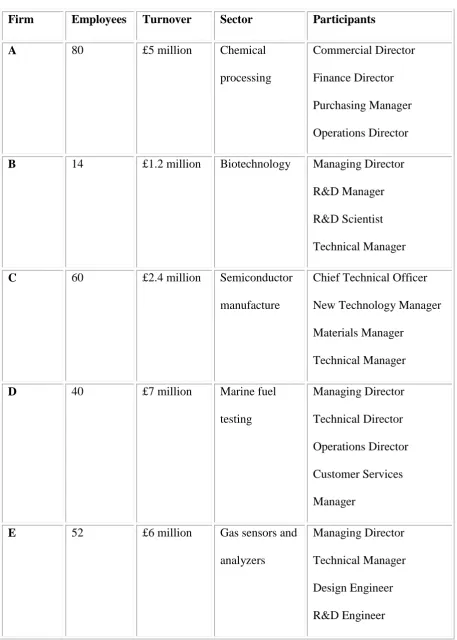
Table 1 about here
---
Company A is a contract chemical processing company providing bespoke outsourcing solutions to the process industry, such as agrochemicals, biocides and herbicides. It is the largest and longest established of the four firms, employing around 80 staff. Company B employs 14 staff and manufactures a range of ‘in-vitro’ diagnostic products for use in the detection, prevention, and monitoring of medical conditions related to haemostasis and platelet function. Company C, employing around 60 people, is a university spin- out, manufacturing semi- conductor materials in the cadmium telluride family, which have a variety of applications in the areas of medical imaging, security screening, industrial inspection and space exploration. Company D is a marine fuel testing company that employs 40 staff. Its main business activity is to provide an integrated fuel testing service for ship owners, managers or anyone involved in the purchasing or use of marine fuels. Company E specializes in the design and manufacture of gas sensors and analyzers, and provides innovative solutions to gas monitoring in a variety of environments. They currently employ around 52 staff.
17 sequentially narrower, more defined themes as the analysis progresses. Template analysis was chosen because, when combined with a social constructionist epistemology, it is an effective method for exploring relationships and meanings and for capturing the different perspectives of interviewees.
Crabtree and Miller (1999) suggest that template analysis offers an intermediate approach, allowing the researcher to combine some initial a priori codes with an immersion/crystallization style of analysis. Immersion/crystallization is considered a suitable reflexive technique to demonstrate the validity of qualitative data (Borkan 1999) and is the process whereby researchers immerse themselves in the data they collect by reading or examining some portion of the data in detail. Crystallization (Richardson 1994) is the process of temporarily suspending the process of examining or reading the data (immersion) in order to reflect on the analysis experience and attempt to identify and articulate patterns or themes noticed during the immersion process (ibid, p.182). These complimentary processes continue until all the data have been examined and patterns and claims emerge from the data that are meaningful and can be well articulated and substantiated. We adopted this immersion/crystallization approach in an attempt to ensure we were reflexive in both the collection and the analysis of the data we gathered for this study.
NVivo qualitative data analysis software was used to code the data and create the final thematic template. NVivo helped in organizing and storing the data, as well as generating a hierarchical structure (Bazeley & Jackson, 2013). It also supported an iterative process, allowing for codes to be added, deleted or changed more readily than a ‘cut and glue’ approach would allow. The analysis began with three broad themes: ‘knowledge acquisition’,
18 flexible, iterative methodology facilitates a systematic, yet reflexive approach to data analysis (King 2006).
5. Results and discussion
There was no evidence of any attempt to manage CoPs in any strategic way in the participant organizations. This is not surprising given that our finding that previous research has, by and large, focused on CoPs in the innovation processes of large organizations, and often taken a managerialist approach (see Loyarte & Rivera 2007; Probst & Borzillo 2008; Swan et al., 2002; Wenger et al., 2002). Small, science-based firms often have limited networking capability (Havnes & Senneseth 2001) and struggle to participate in collaborative innovation due to limited resources (Hamburg 2008), lack of trust concerning the receipt and disseminating of knowledge (Harding & Pawar 2001) and knowledge transfer problems caused by organizational and cultural differences (Van de Vrande et al., 2009). However, the three other forms, often overlapping in the same organization, were found to be present (albeit to a limited extent in some cases), as illustrated and discussed below.
5.1 Apprentice-based CoPs
In these science-based SMEs there was little evidence of the ‘traditional’
apprentice-based CoPs described by Lave and Wenger (1991), with the exception of Company B. Here, although ostensibly working as part of a team, the less experienced junior scientist and two technicians often worked in isolation, seeking advice and support from the R&D Manager as and when they required it. As the R&D Scientist confirmed: ‘You’re part of a team, but you work alone a lot of the time and so when I want to find something out I can go to [R&D
Manager] for advice…’. The R&D Manager could be viewed as the ‘master’, passing on his
knowhow by engaging in knowledge exchanges closely related to the ‘novice’s’ area of
19 In this instance, the apprentice-based CoP had emerged through a process of community- building, i.e. mutual engagement, centred around a specific domain of scientific knowledge (joint enterprise), out of which came a sense of shared repertoire. The R&D Manager was, in turn, mentored by the Managing Director, who, through his personal network of contacts, brought the R&D Manager and the more junior scientists and technicians into contact with people outside of the organization, enabling them to access external knowledge in addition to calling on members of their internal community.
In the SMEs dealing predominantly with R&D customers, this shared expertise was strongly linked to generating radical innovation: ‘Somebody from outside looking in has…no idea why a person is doing [x]… there’s no-one even knows how to do what we’re doing
so…’ (Materials Manager, Company C). Apprentice-based CoPs might be more appropriate for supporting learning in SMEs involved in incremental innovation, where there is a high level of reliance on building a shared repertoire to facilitate passing on existing knowledge between in-company scientific staff. On the other hand, in firms involved in radical innovation, e.g. Company C, CoP development and deployment might be inhibited by the absence of a shared repertoire, related to a lack of appropriate existing knowledge, but also to
the uniqueness or ‘novelty’ of the innovation.
5.2 Cultivated CoPs
20 participate could comment on ideas, or add their initials to an idea as a form of endorsement, or expression of interest. The system was self-selecting; if an idea reached a ‘critical mass’, in terms of employee interest, those who had endorsed the idea were encouraged to get together and work on the idea/innovation.
Whilst all employees were encouraged to use the wall, it was R&D staff who posted
most ideas. This was partly because of their status as ‘experts’ and partly because of the
added incentive of a 10% time allowance, which allowed them to pursue their own ideas, or those they selected from the wall. All participation was voluntary and employees formed intra-organizational CoPs centred around their chosen innovation idea:
… [employees] can do it on their own terms… there’s no sort of a rule that at 9 a.m.
on a Monday morning you go and look at the ideas wall [laughs]… it’s a case of when
you feel you want to… or, you know, as part of taking time out of your day… you can
spend [that time] on problems and ideas that interest them. (Managing Director, Company E).
The wall was divided into three sections. The first section was where people posted their initial ideas. If an idea gathered enough momentum, it was moved to the second section, where the idea could be developed further by those employees who wanted to work on it. At this stage, the purpose is to find out if the idea is feasible (in terms of design rather than commercial viability) and whether there is the expertise to develop it further. If an idea reaches the third section of the wall, it is formalized and a business case is developed for continuing with the project, primarily in terms of development costs versus potential benefits to the company.
21 ‘wall activities’ had produced six ‘new and improved’ versions of products that were on the market and a further four projects that were in the early stages of development. Quantifying the number of CoPs that had emerged and the nature and depth of participant involvement was difficult - the company did not keep records of employee’s informal ‘wall activities’ until these became formal projects. This approach meant that an employee could move from one project to another without having to inform anyone and, therefore, might be engaged in multiple CoPs at any one time. The ‘Imagineering Wall’ acted as a shared artefact, a boundary object, encouraging the practice-based discussion and participation that is expressive of the cultivation of intra-organizational CoPs.
Not all interviewees expressed such positive views of the Imagineering Wall and some employees were skeptical about employing the wall to generate new ideas: 'It’s a good
idea [but] after the novelty is worn off everybody’s sort of got rid of their ideas and it is now
sort of sat… we don’t really have enough external stimulation to keep it going… (R&D
Engineer, Company E). This implies that the wall initially provided an outlet for employees to share their unrealized ideas. However, once they had posted their ideas on the wall, their
initial spurt of creativity was over. To maintain the wall’s creative momentum, the
interviewee suggests that it requires external stimulus. Another issue was that R&D staff did not encourage the participation of none-technical members in these emerging CoPs and, as Harris and Sheswell (2005) observed, the result was that some employees feeling marginalized and withdrew from community membership. The long term success of the wall might depend on how it is used and on the ability of the company to engage both internal membership and external partners.
22 boundary object in Company E stimulated the cultivation of multiple intra-organizational CoPs, leveraged in the main for incremental rather than radical innovation.
5.3 Inter-organizational CoPs
Inter-organizational CoPs (IoCoPs) had emerged through mutual engagement and collaborative relationship building centred round two distinct sets of customers: commercial and R&D organizations. The former consisted of a variety of customers from ‘for profit’ businesses, and tended to be seeking solutions to specific problems, for example, commercializing new science-based products, or scaling up production of a new chemical process. The R&D organizations consisted of universities and research institutions whose main activity is ‘pure’ research and development, but which also wanted to generate additional revenue streams through filing patents for new products and processes and the commercialization of their inventions by the formation of spin-out companies. The construction of IoCoPs involved the building and maintenance of strong trust and credibility- based relationships with customers, closely linked to the development of reciprocal relationships. Trust-building facilitated effective knowledge sharing and helped the SMEs understand their customers’ needs. Through regular mutual engagement and the sharing of expertise internally with colleagues and externally with customers and suppliers, trust-based IoCoPs emerged, generating social capital, developing their capabilities and improving their ability to problem- solve on behalf of their customers.
23 establishment of trust was linked to building credibility with customers, and presented particular problems to the two start-up companies (C and D), which were wary of sharing knowledge and expertise externally, as they felt they must protect the intellectual property that was the basis of their innovations. Some larger SMEs (notably Companies A and E) encountered similar difficulties when engaging in trust building activities and sometimes had to adopt a pragmatic approach in order to source external expertise. For example, for Company C, which was engaged in radical innovation in order to develop new products, trust building was sometimes a secondary consideration, coming after finding someone with the required expertise, i.e. trust was predicated on competency, especially if the person was not within its existing external network. Company E, on the other hand, brought in external expertise for collaboration purposes, thereby enhancing their absorptive capacity.
Reciprocity was an important element of the trust building process, and was often achieved through offering free advice or additional services. Companies A, B and D all offered their services free to both commercial and R&D customers. The provision of ‘free’ services to commercial customers by Company A helped them to maintain regular, informal contact, build collaborative relationships and generate future business. In a similar vein, Company B also provided free training and informal advice to customers. For non-commercial customers, Company D provided their services free in exchange for access to equipment or other testing facilities. These types of reciprocal arrangements often led to informal knowledge exchanges and the emergence of IoCoPs.
24 through regular contact’ (Managing Director, Company B). Regular interaction with customers produced a shared understanding, with these emergent IoCoP members developing a shared jargon-free language. Members worked together towards a mutual goal, with the SME staff seeking to develop innovative solutions in partnership with customers.
Whilst relationship building through mutual engagement often took place informally, it was nonetheless considered important in developing solutions for customers. The MD of Company B, for example, once he had identified a company he wanted to work with, would initiate and then attempt to maintain mutual engagement. Although an initial contact with a particular potential customer first occurred in 2005, the company did not receive an order from them until two years later. During the intervening period the MD established a strong relationship with one of the executives at the firm by inviting him to ‘keep in touch’ and sharing expertise: ‘When the ‘exec’ of the company came over to see his distributor in
Stockton he’d come into Hartlepool and have a meal and… chew the fat... and through that
relationship building we helped them develop solutions’ (Managing Director, Company B).
Strong personal relationships are closely linked to trust (Kautonen 2010). Trust underpinned the expectation that an individual could be relied on to ‘perform’, especially where they were involved in radical innovation projects: ‘…it’s much easier to go with
25 external expertise from individuals who were not from their immediate ‘trusted’ community. For the SMEs working with universities and other R&D organizations, trust was less of an issue than for those seeking external expertise from commercial organizations, which were often viewed as competitors.
In one SME, the Managing Director, a prolific networker, regularly visited customers, sharing his expertise in the area of Warfarin management, an anti-blood clotting agent. The
MD was willing to provide advice on the use of competitors’ products and used these visits as
opportunities to build personal relationships with existing and potential customers. As the Technical Manager explained: ‘He was willing to provide advice on the use of competitors’ products and used these visits as opportunities to build personal relationships with existing
and potential customers’. Some SMEs held events to bring together customers and suppliers and showcase their expertise, thus encouraging the informal interactions that are commonly the basis for CoPs formation. This approach was often adopted as a stratagem to create closer bonds between organizations: ‘…we invite major suppliers here and we will give them seminars on different sort of process techniques which… has a reciprocal effect in that they put us in touch with [other] businesses who want help’ (Managing Director, Company A).
Networking events enabled the two start-up SMEs to meet with competitors and engage in knowledge sharing activities, exchange ideas and build the informal relationships that are the basis of inter-organizational CoPs. The IoCoPs that emerged through continuing interaction after such events frequently led to more formal partnerships, such as joint ventures, based on their mutual need for expertise not possessed internally. Engagement in activities that led to such joint enterprises also enabled the science-based SMEs to develop
26 organizations, and their formation and development makes an important contribution to the generation of knowledge exchange and innovation. Participating in IoCoPs increases firms’ absorptive capacity and promotes collaborative approaches to innovation, both of which help science-based SMEs build new networks and ensure better knowledge transfer, leading to more focused innovation and new product development.
6. Conclusion
This research project has contributed to our knowledge of the facilitation of new product development in science-based SMEs through (a variety of forms of) CoPs. It has focused upon two particular matters: how is knowledge acquired in science-based CoPs, and how does the knowledge acquired in CoPs influence new product development?
6.1 How is knowledge acquired in science-based CoPs?
27 as well as leverage the social capital necessary for innovation (Allee 2000; Landry et al., 2002; Lesser & Prusak 1999; Wenger 1998).
6.2 How does the knowledge acquired in CoPs influence new product development?
Both apprentice-based and cultivated CoPs were found to support individual learning and the transfer of existing intra-organizational knowledge. The findings show that inter-organizational CoPs were most effective in supporting knowledge acquisition, innovation and new product development in these science-based SMEs, as they enabled them to access new knowledge by building effective collaborative relationships outwith the organization. Collaboration was a key element of the commercialization of innovation for all the SMEs, for a variety reasons, including sourcing external scientific expertise from other firms and universities, seeking commercial expertise to help them exploit their innovations, as a route to market through licensing agreements for new products and as a source of funding.
At the same time, customers often sought collaboration with the SMEs in order to acquire external knowledge. Companies A, B and G in particular used this approach to bind customers to them, thus cultivating an inter-organizational CoP by building a shared repertoire through regular contact. There was much evidence of the internal pooling of expertise and the exchange of tacit knowledge through collaborative activities, often resulting in or from the emergence of CoPs. SMEs acted as ‘consultant experts’, solving problems on behalf of their customers, and there was also evidence of increased absorptive capacity, for example in Company E, which brought in external expertise for collaboration purposes when problem- solving on behalf of customers.
28 external scientific knowledge, as well as providing access to research and development funding and specialist scientific knowledge, equipment and facilities – all essential in the development of innovative new products. However, for SMEs seeking external expertise from commercial organizations, trust represented a barrier to building successful IoCoPs.
Importantly, our analysis showed that lack of shared repertoire, particularly in SMEs involved in radical innovation, did on occasion inhibit CoP construction, for example, the
Imagineering wall, where ‘legitimate conflict’ resulted in limited CoP participation for some
employees. This finding highlights that the status of some members’ relative centrality or
peripherality to the community (in this case R&D staff) negatively influenced internal CoP membership.
7. Areas for future study
29
References
Allee, V. (2000). Knowledge networks and communities of practice, OD Practitioner Online
32(4), 4-13.
Amin, A. & Roberts, J. (2008). Knowing in action: Beyond communities of practice,
Research Policy 37(2), 353-369.
Anand, N., Gardner, H. K. & Morris, T. (2007). Kio-based innovation: emergence and embedding of new practice areas in management consulting firms, Academy of Management Journal 50(2), 406-428.
Anderson. A.R. & Jack, S. L. (2002). The articulation of social capital in entrepreneurial networks: a glue or lubricant? Entrepreneurship and Regional Development 14(3), 193-210.
Assimakopoulos, D. (2007). Technological Communities and Networks, Triggers and Drivers for Innovation. London: Routledge.
Autio, E., Kanninen, S. & Gustafsson, R. (2008). First- and second-order additionality and learning outcomes in collaborative R&D programs, Research Policy 37(1), 59-76.
Bagchi, N. (2010). Innovation and knowledge framework for SME competitiveness Case study of SMEs in a pharmaceutical industry cluster, Tech Monitor, Sep-Oct 2010.
Bazeley, P. & Jackson, K. (2013). Qualitative Data Analysis with NVivo. London: Sage.
30 Borzillo, S., Anzar, S. & Schmitt, A. (2011). A journey through communities of practice: how and why members move from the periphery to the core, European Management Journal, 29(1), 25-42.
Botha. A., Kourie, D. & Snyman, R. (2008). Community of practiceing with Continuous Change in the Business Environment. Oxford: Chandos.
Braun. J. (2006). Linking small business networks with innovation. In E. Coakes & S. Clarke (Eds), Encyclopaedia of communities of practice in Information and Knowledge Management
(pp. 346-352). London: IG Group.
Brown, J. S. & Duguid, P. (1991). Organizational learning and communities of practice,
Organization Science 2(1), 40-57.
Brown. J. S. & Duguid, P. (2002). Local knowledge: innovation in the networked age,
Management Learning 33(4), 427-437.
Brunswicker, S. & Vanhaverbeke, W. (2014). Open innovation in small and medium-sized enterprises (SMEs): external knowledge sourcing strategies and internal organizational facilitators. Journal of Small Business Management. doi: 10.1111/jsbm.12120
Bryman, A. (2001). Social Research Methods. Oxford: Oxford University Press.
Carayannis, E. & Alexander, J. (1999) Winning by co-operating in strategic government-university-industry partnerships: the power of complex dynamic knowledge networks,
Journal of Technology Transfer 24(2), 197-210.
Chen, C. & Tseng, K. (2011). Knowledge transfer and innovation performance of
31 Chetty, S. & Blankenburg Holm, D. (2000) Internationalisation of small to medium-sized manufacturing firms: a network approach, International Business Review 9(1), 77–93
Cohen, W. M. & Levinthal, D. A. (1990). Absorptive capacity: A new perspective on learning and innovation, Administrative Science Quarterly 35(1), 128-152.
Crabtree, B. F. & Miller, W. L. (1999). Doing Qualitative Research, 2nd edition. Newbury Park, California: Sage.
Cross, R. & Prusak, L. (2002). The People Who make organizations go - or stop, Harvard Business Review 80(6), 104-112.
Cunliffe, A. L. (2008). Orientations to social constructionism: relationally-responsive social constructionism and its implications for knowledge and learning, Management Learning
39(2), 123-139.
Davies, M. A. P. & Prince, M. (2005). Dynamics of trust between clients and their advertising agencies: advances in performance theory, Academy of Marketing Science Review
11(1), 1-32.
Dewhurst, F. & Cegarra Navarro, J. (2004). External communities of practice and relational capital, The Learning Organization 11(3), 322-331.
Du Plessis, M. (2008). The role of knowledge management in innovation, Journal of Knowledge Management 11(4), 20-29.
Ellegaard, C. (2012). Interpersonal attraction in -seller relationships: A cyclical model rooted in social psychology, Industrial Marketing Management 41(8), 1219-1227.
32 Franke, N. & Shah, S. (2003). How communities support innovative activities: an exploration of assistance and sharing among end-users’, Research Policy, 32, (1), 157-178.
Fuglsang, L. & Jagd, S. (2015). Making sense of institutional trust in organizations: bridging institutional context and trust. Organization 22(1): 23-39.
Fukuyama, F. (1995). Trust: The Social Virtues and the Creation of P rosperity. New York: Penguin Books.
Gassmann, O. & Reepmeyer, G. (2005). Organizing pharmaceutical innovation: from science-based knowledge creators to drug-oriented knowledge brokers, Creativity and Innovation Management 14(2), 233-245.
Gherardi, S., Nicolini, D. & Odella, F. (1998). Towards a social understanding of how people learn in organizations, The notion of a situated curriculum, Management Learning 29(3), 273-297.
Granovetter, M. (1985). Economic action and social structure: the problem of embeddedness,
American Journal of Sociology 91(3), 481-510.
Gronum, S., Verreynne, M. L. & Kastelle, T. (2012). The role of networks in small and medium-sized enterprise innovation and firm performance, Journal of Small Business Management 50(2), 257-282.
Guest, G., Bunce, A. & Johnson, L. (2006). How many interviews are enough? An experiment with data saturation and variability, Field Methods 18(1), 59-82.
33 Hamilton, E. (2011). Entrepreneurial learning in family business: a situated learning
perspective, Journal of Small Business and Enterprise Development 18(1), 8-26.
Harding, S. & Pawar, K. (2001). Know-how share and transfer in SME networks: a contingent approach, in the proceedings of the International Conference on Concurrent Enterprising (ICE2001), Bremen, Germany.
Hayes, K. J. & Fitzgerald, J. A. (2009). Managing occupational boundaries to improve innovation outcomes in industry-research organizations, Journal of Management and Organization 15(4), 423-437.
Hellström, T. (2004). Innovation as social action, Organization 11(5), 631-649.
Hsiao, R. L., Tsai, S. D. H. & Lee, C. F. (2006). The problems of embeddedness: knowledge transfer, coordination and reuse in information systems, Organization Studies 27(9), 1289-1317.
Kautonen, T., Zolin, R., Kuckertz, A., & Viljamaa, A. (2010). Ties that blind? How strong ties affect small business owner-managers’ perceived trustworthiness of their advisors.
Entrepreneurship and Regional Development 22(2), 189-209.
King, N. (2006). Template analysis. University of Huddersfield School of Psychology website. http://www.hud.ac.uk/hhs/research/template-analysis/ (accessed 12 April 2015)
Kroeger, F. (2011). Trusting organizations: the institutionalization of trust in interorganizational relationships, Organization 19(6), 743-763.
34 Landry, R., Amara, N. & Lamari, M. (2002). Does social capital determine innovation? To what extent? Technological Forecasting and Social Change 69(7), 681-701.
Lave, J. & Wenger, E. (1991). Situated Learning: Legitimate Peripheral Participation. Cambridge: Cambridge University Press.
Lechner, C. & Dowling, M. (2003). Firm networks: external relationships as sources for the growth and competitiveness of entrepreneurial firms, Entrepreneurship & Regional Development 15(3), 1-26.
Lee, C., Lee, K. & Pennings, J. M. (2001). Internal capabilities, external networks and performance: study on technology-based ventures, Strategic Management Journal 22(6-7), 615-640.
Lesser, E. & Prusak, L. (1999). Communities of practice, social capital and organizational knowledge. In J. W. Cortada & J. A. Woods (Eds), Knowledge Management Year Book 2000 – 200 (pp. 251-259). Woburn: Butterworth Heinemann.
Lesser, E. & Storck, J. (2001). Communities of practice and organizational performance, IBM Systems Journal 40(4), 831-841.
Lewicki, R. J. & Bunker, B. B. (1996). Developing and maintaining trust in work relationships. In R. M. Kramer & T. R. Tyler (Eds), Trust in Organizations: Frontiers of Theory and Research (114-139). Thousand Oaks, CA: Sage.
Li, F., D. Pieńkowski, A., van Moorsel & Smith, C. (2012). A holistic framework for trust in online transactions, International Journal of Management Reviews 14(1), 85-103.
Loyarte, E. & Rivera, O. (2007) Communities of practice: a model for their cultivation,
35 Maes, J. & Sels, L. (2014). SMEs radical product innovation: the role of internally and externally oriented knowledge capabilities, Journal of Small Business Management 52(1), 141–163.
McDermott., R. & Archibald, D. (2008). Benchmarking the impact of communities of practice: insights into community performance across industrial sectors, Knowledge Management Review 11(5), 14-19.
Meeus, M. & Oerlemans, L. (2000). Firm behaviour and innovative performance. An empirical exploration of the selection-adaptation debate, Research Policy, 29(1), 41-59.
Miettinen, R., Lehenkari, J. & Tuunainen, J. (2008). Learning and network collaboration in product development: how things work for human use, Management Learning 39(2), 203-219.
Moingeon. B., Quélin, B., Dalsace, F. & Lumineau, F. (2006). Inter-organizational
communities of practice: specificities and stakes, Les Cahiers de Recherche 857, HEC Paris, 226.
Nahapiet, J. & Ghoshal, S. (1998). Social Capital, intellectual capital and the organizational advantage, Academy of Management Reviews 23(2), 242-266.
Papert, S. & Harel, I. (1991) Constructionism. Norwood, New Jersey: Ablex Publishing.
36 Pattinson, S. & Preece, D. (2014). Communities of practice, knowledge acquisition and innovation: a case-study of science-based SMEs, Journal of Knowledge Management 18(1), 107-120.
Patton, M. Q. (2002). Qualitative Research and Evaluation Methods. Thousand Oaks, CA: Sage.
Pisano, G. P. (2006). Can science be a business? Lessons from Biotech, Harvard Business Review 84(10), 114-125.
Pisano, G. P. (2010). The evolution of science-based business: innovating how we innovate,
Industrial and Corporate Change 19(2), 465-482.
Probst, G. & Borzillo, S. (2008). Why communities of practice succeed and why they fail,
European Management Journal 26(5), 335-347.
Putnam, R. D. (2000). Bowling Alone: The Collapse and Revival of American Community.
New York: Simon and Schuster.
Richardson, L. (1994). Writing: a method of inquiry. In N. K. Denzin & Y. S. Lincoln (Eds)
Handbook of Qualitative Research (pp. 516-529). Thousand Oaks, California: Sage.
Roberts, J. (2006) Limits to communities of practice. Journal of Management Studies 43(3), 623-39.
Rothwell, R. & Gardiner, P. (1985). Invention, innovation, re-innovation and the role of the user, Technovation 3(1), 167-186.
37 Sawyerr, O. O., McGee, J. & Peterson, M. (2003). Perceived uncertainty and firm
performance in SMEs, the role of personal networking activities, International Small Business Journal 21(3), 269-290.
Scarbrough, H., Swan, J. Laurent, S., Bresnen, M., Edelman, L. & Newell, S. (2004). Project-based learning and the role of learning boundaries, Organization Studies 25(9), 1579-1600.
Sense, A. J. & Clements, M. D. J. (2006). Ever consider a supply chain as a “community of
practice”? Embracing a learning perspective to build supply chain integration. Development
and Learning in Organizations 20(5), 6-8.
Stephenson, K. (2006). What knowledge tears apart, networks make whole. Internal
Communication Focus, number 3. http://www.netform.com/html/icf.pdf. (accessed 13 April 2015).
Swan, J., Scarborough, H. & Robertson, M. (2002). The construction of “communities of practice” in the management of innovation, Management Learning 33(4), 477-496.
Thatcher, S. (2001). The mediating role of identity fit: understanding the relationship between communication media, demographic differences, and creativity, Proceedings of the 34th Annual Hawaii International Conference on System Sciences (HICSS), Waikoloa, HI.
Tidd, J. & Bessant, J. (2009). Managing Innovation, 4th edition.Chichester: Wiley.
Tödtling, F. (2001). The role of the region for innovation activities of SMEs. European Urban and Regional Studies 8(3), 203-215.
38 van Dijk, M. P. & Trienekens, J. (2012). Global Value Chains: Linking Local Producers from Developing Countries to International Markets, EADI, Amsterdam University Press.
Von Hippel, E. (1987). Cooperation between rivals: informal know-how trading, Research Policy, 16(6), 291-302.
Wenger, E. (1998). Communities of practice: Learning, Meaning and Identity, Cambridge: Cambridge University Press.
Wenger, E. & Snyder, W. (2000). Communities of practice: the organizational frontier.
Harvard Business Review 78(1), 139-145.
39
Table 1 Participants
Firm Employees Turnover Sector Participants
A 80 £5 million Chemical processing
Commercial Director Finance Director Purchasing Manager Operations Director
B 14 £1.2 million Biotechnology Managing Director R&D Manager R&D Scientist Technical Manager
C 60 £2.4 million Semiconductor manufacture
Chief Technical Officer New Technology Manager Materials Manager
Technical Manager
D 40 £7 million Marine fuel testing
Managing Director Technical Director Operations Director Customer Services Manager
E 52 £6 million Gas sensors and analyzers