High-Performance Computer Algebra: A Hecke Algebra
Case Study
MAIER, Patrick <http://orcid.org/0000-0002-7051-8169>, LIVESEY, Daria,
LOIDL, Hans-Wolfgang and TRINDER, Phil
Available from Sheffield Hallam University Research Archive (SHURA) at:
http://shura.shu.ac.uk/18618/
This document is the author deposited version. You are advised to consult the
publisher's version if you wish to cite from it.
Published version
MAIER, Patrick, LIVESEY, Daria, LOIDL, Hans-Wolfgang and TRINDER, Phil (2014).
High-Performance Computer Algebra: A Hecke Algebra Case Study. In: Euro-Par
2014 Parallel Processing. Springer, 415-426.
Copyright and re-use policy
See
http://shura.shu.ac.uk/information.html
Sheffield Hallam University Research Archive
High-Performance Computer Algebra:
A Hecke Algebra Case Study
Patrick Maier1
, Daria Livesey2
, Hans-Wolfgang Loidl3
, and Phil Trinder1
1
School of Computing Science, University of Glasgow, Glasgow, UK 2
School of Natural and Computing Sciences, University of Aberdeen, Aberdeen, UK 3
School of Mathematical and Computer Sciences, Heriot-Watt University, Edinburgh, UK
Abstract. We describe the first ever parallelisation of an algebraic computation at modern HPC scale. Our case study poses challenges typical of the domain: it is a multi-phase application with dynamic task creation and irregular parallelism over complex control and data structures.
Our starting point is a sequential algorithm for finding invariant bilinear forms in the representation theory of Hecke algebras, implemented in the GAP compu-tational group theory system. After optimising the sequential code we develop a parallel algorithm that exploits the new skeleton-based SGP2 framework to par-allelise the three most computationally-intensive phases. To this end we develop a new domain-specific skeleton,parBufferTryReduce. We report good par-allel performance both on a commodity cluster and on a national HPC, delivering speedups up to 548 over the optimised sequential implementation on 1024 cores.
1
Introduction
Computational algebra is an important area of symbolic computation with many com-plex and expensive computations that would benefit from parallel execution. The area is served by a variety of systems, many specialising in some mathematical domain, for ex-ample GAP [7], a computational algebra system (CAS) specifically designed for group theory and combinatorics.
Some discrete mathematical problems are embarrassingly parallel, and this has been exploited for years even at Internet scale, e. g. the “Great Internet Mersenne Prime Search”. Other problems have more complex coordination patterns and both parallel algorithms and parallel CAS implementations have been developed, e. g. ParGAP [5]. Many parallel algebraic computations exhibit high degrees of irregularity, at multiple levels, with numbers and sizes of tasks varying enormously (up to 5 orders of magni-tude) [16]. They tend to use complex user-defined data structures, exhibit highly dy-namic memory usage and complex control flow, often exploiting recursion. They make little, if any, use of floating-point operations.
This combination of characteristics means that symbolic computations are not well suited to conventional HPC paradigms with their emphasis on iteration over floating point arrays, and has motivated the development of scalable domain-specific scheduling and management frameworks like SymGrid-Par [16] and SymGridPar2 (SGP2) [20].
important tool in the study of symmetries that arise in many branches of mathematics, e. g. in topology and knot theory, with applications in theoretical physics and chemistry. Our starting point is a sequential algorithm for computing bilinear forms, imple-mented in GAP. Prior to parallelising, we optimise the sequential algorithm, reducing sequential runtime by a factor of 350 (Section 2).4The paper makes the following
re-search contributions.
(1) The development of a parallel algorithm for finding above bilinear forms. The parallelisation exploits the new SGP2 framework designed for scalable GAP compu-tations. Core elements of SGP2 are a set of algorithmic skeletons, implemented in the parallel Haskell DSL HdpH [21], and a GAP binding for Haskell. We parallelise the three most time-consuming phases of the algorithm: (a) solving homomorphic images of linear systems over finite fields, (b) solving interpolation problems over rationals, and (c) bilinear invariance check (over polynomial matrices). All algebraic computations are performed by sequential GAP instances and coordinated by HdpH (Section 4).
(2) Some SGP2 skeletons are generic, e. g. theparMapparallel map of a function over a list. Other skeletons are specific to the algebraic domain. Specifically to compute with homomorphic images, a technique that is typical for a large class of algebraic algorithms, we have developed a new algebraic skeletonparBufferTryReducethat repeatedly checks whether the homomorphic results accumulated thus far are sufficient to reconstruct the final result (Section 3).
(3) Many mathematicians have access to commodity clusters rather than HPCs, so SGP2 is designed for both. We report good speedup and efficiency for a range of bilin-ear form problems, both on a Beowulf cluster and on medium-scale configurations of the HECToR UK supercomputer [12]. For example, one problem instance achieves a speedup of 548, coordinating 992 GAP instances on 1024 cores (Section 5).
2
Algorithm for Finding Invariant Bilinear Forms
Background. Using the terminology of [8], letR =Z[x, x−1
]be the ring of Laurent polynomials in an indeterminatex. For the purpose of this paper, it suffices to know that aHecke algebra5His anR-algebra with a basis{T
w|w∈W}overR, whereW is a finite Coxeter group with set of generatorsS. In this paper, we only consider Hecke algebras of typeEm(m= 6,7,8), that is,Wis the exceptional Coxeter groupEm, and the cardinality of the set of generatorsSism.
Ann-dimensionalrepresentationρof a Hecke algebraHis anR-algebra homo-morphism fromHtoMn(R), theR-algebra ofn×nmatrices overR. Note thatρis
generatedby the matricesρ(Ts),s∈S.His known to have a finite number of so-called
cellrepresentationsρ. Moreover, Howlett and Yin [13] have brought each of these cell representationsρinto a form where allmmatricesρ(Ts)are sparse.
Graham and Lehrer [11] and Geck [8] show that for any givenρthere exists a non-trivial symmetric matrixQ∈Mn(R), unique up to scalar multiplication, such that
Q·ρ(Ts) =ρ(Ts)T·Q (1) 4
Such dramatic optimisations are not unusual in computer algebra as the typical high-level pre-sentation of computational mathematics often omits opportunities for sequential optimisation.
for all generatorsρ(Ts). We callQthematrix of an invariant bilinear form.
Depending on the representationρ, finding the invariant bilinear formQmay require substantial computation. For each algebra type, the table below lists the number of cell representations ρ, the range of dimensions of ρand the range of spreads of degree bounds of Laurent polynomials inQ. These numbers (and hence the difficulty of the problem) vary by several orders of magnitude.
Hecke algebra type E6 E7 E8
number of cell representationsρ 25 60 112 dimension ofρ 6–90 7–512 8–7168 spread of degree bounds of polynomials inQ29–54 45–95 65–185
Sequential algorithm for computingQ. In principle,Qcan be computed by viewing Equation (1) as a system of linear equations and solving for the entries ofQ. How-ever, solving linear systems overZ[x, x−1
]is too expensive to obtain solutions for high dimensional representations.
Instead, we solve the problem by interpolation. We view each entry ofQas a Lau-rent polynomial withu−l+1unknown coefficients, whereu−l+1is the spread between lower degree boundland upper degree boundu. Solving Equation (1) atu−l+ 1data points will provide enough information to compute the unknown coefficients by solv-ing linear systems over the rationals instead ofZ[x, x−1
]. To avoid computing with very large rational numbers (due to polynomials of high degree), we solve homomorphic im-ages of Equation (1) modulo small primes and use the Chinese Remainder Theorem to recover the rational values.
The algorithm takes as inputmgeneratorsρ(Ts)of dimensionn, lower and upper degree boundslandu, and a finite set of small primesP. From the degree bounds, we construct a setVluofu−l+ 1small integers (excluding zero) to be used as data points for interpolation. The primes inPmust be chosen large enough not to divide any of the integers inVlu. The algorithm runs in three phases:
1. For allp∈P andv∈Vlu, GENERATEa modular interpolated solutionQvpof (1) by instantiating the unknownxwithvand solving the resulting system modulop. 2. For allv ∈ Vlu, REDUCEthe modular matricesQvpby rational Chinese
remain-dering and obtain a rational interpolated solutionQvof (1). Construct each Laurent polynomialqij inQby gathering the(i, j)-entries of allQvand solving a rational linear system for the coefficientsqij. SinceQis symmetric, there are(n+ 1)n/2 such systems, each of dimensionu−l+ 1.
3. For all generatorsρ(Ts), CHECKthat the resultingQsatisfies (1) overZ[x, x−1]. After some (offline) pre-processing, the theory of Hecke algebras admits a particularly efficient way to GENERATEQvp. Instead of solving a linear system, the rows ofQvpare computed by aspinning basis algorithm[9,17], multiplying, orspinning, the basis vec-toreof a pre-determined one-dimensional sub-space with npre-determined products of the generatorsρ(Ts).
Sequential optimisations. Profiling the GAP code on Hecke algebras of typeE6lead
to a number of improvements. The three most important ones are:
1. Avoiding unnecessary copying during the GENERATEphase by reducing the size of lambda abstractions encoding the generators.
2. Reducing the memory footprint by storing generators in a sparse matrix format. 3. Spinning the basis more efficiently by exploiting associativity.
For typeE6these optimisations reduced sequential runtime of the algorithm (cumulative
over all representations) by a factor of about 350, and the memory footprint by an order of magnitude from several GB to hundreds of MB.
3
The SymGridPar2 Framework
SGP2 system architecture. GAP [7] is the leading free system for computational dis-crete algebra. It is designed to be natural to use for mathematicians; to be powerful and flexible for experts and to be freely extensible so that it can encompass new math-ematics. GAP supports very efficient linear algebra over small finite fields, multiple representations of groups, subgroups, cosets and different types of group elements, and backtrack search algorithms for permutation groups.
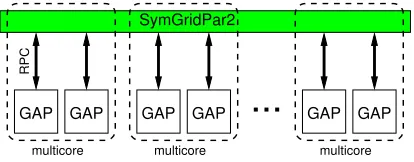
This case study used the most recent stable GAP distribution, GAP 4.6, which does not support parallelism. Hence the sequential GAP 4.6 instances are coordinated over the network by a distributed middleware, the SymGridPar2 (SGP2) framework [20]. The middleware occupies one core per multicore node and controls (via a RPC-like protocol) independent GAP 4.6 instances running on the remaining cores (Figure 1).
SGP2 itself is implemented in HdpH [21], a domain-specific language (DSL) for distributed-memory task parallelism, embedded in Haskell. SGP2 consists of two parts: (1) a GAP binding, enabling calls from HdpH to GAP, including automatic marshaling, and (2) a number of general-purpose and domain-specific parallel skeletons.
SGP2 programming model. HdpH is a monadic DSL, embedding a high-level co-ordination language into Haskell. Figure 2 introduces two central types of the HdpH DSL:Par, the monad type constructor for parallel computations, andClosure, the type constructor for serialisable values including unevaluated computations, or thunks.
GAP GAP GAP GAP GAP GAP
multicore multicore
...
RPC
multicore
[image:5.612.205.412.552.633.2]SymGridPar2
-- HdpH types
typePar a -- parallel computation, returns result of type ’a’
typeClosure a -- serialisable value/computation of type ’a’
typeTask a=Closure (Par (Closure a)) -- serialisable parallel computation -- returning serialisable result of type ’a’
-- sample general-purpose skeletons
parMap :: Closure (a→b)→[Closure a]→Par [Closure b] parReduce :: Closure (a→a→a)→[Closure a]→Par (Closure a)
-- novel domain-specific skeleton; repeatedly reduces the results of a lazy list of input tasks -- until the reducer computes a result
parBufferTryReduce :: ([Closure a]→Par (Maybe(Closure b))) -- reducer
→Int -- reducer batch size
→Int -- number tasks eval’d in parallel
→[Task a] -- lazy list of input tasks
→Par (Maybe(Closure b)) -- result
Fig. 2.HdpH types and some SymGridPar2 skeleton signatures.
ATaskis defined as a serialisable monadic computation returning a serialisable result. Thanks to serialisability, tasks and their results can be distributed over the network, and HdpH exploits this to provide automatic load management by work stealing.
At the lowest level, HdpH exposes fork/join style primitives for parallel program-ming. Using the primitives the HdpH library defines a number of general-purpose poly-morphic skeletons (Figure 2), e. g. parallel maps (applying a function closure to a list of closures, in parallel) and reductions. The skeletons evaluate their input lists strictly as they coordinate monadic computations, and hence are unsuitable for computing with potentially infinite lazy lists.
Our case study requires solving an unknown number of subproblems in parallel un-til there are enough intermediate results to construct the solution. More specifically, the algorithm of Section 2 requires the use of an unknown number of primes in the GEN -ERATEphase. A typical Haskell program would parametrise the GENERATEphase with an infinite lazy list of primes, and rely on demand from the REDUCEphase to decide how many primes are actually needed. As the monadic context of HdpH precludes lazy lists, we capture this domain-specific pattern6 in a new skeleton that combines a task
farm with a reducer.
The newparBufferTryReduceskeleton takes as input (in reverse order) a lazy list of tasks, the number of tasks to evaluate in parallel, the reducer batch size and the re-ducer function. A call toparBufferTryReduce f b n taskscontinually forks from the head of listtasks, aiming to keepntasks under evaluation, accumulating a listaccuof intermediate results (not necessarily in the order oftasks). The reducerf is executed every time the length ofaccuis a multiple of the batch sizeb. The skeleton returns a result as soon as the reducer finds one; it returnsNothingonly if the reducer fails to produce a result even after alltasksare evaluated.
6
The HdpH DSL greatly simplifies developing domain-specific skeletons, particu-larly skeletons with complex parallel coordination such asparBufferTryReduce. A case in point is the implementation of the latter spanning less than 90 lines of code.
4
Parallel Algorithm for Finding Invariant Bilinear Forms
Each of the three phases of the sequential algorithm (Section 2) contains significant amounts of parallelism. Deciding what and how to parallelise is guided by the ratio between computation and communication costs on the distributed target architectures.
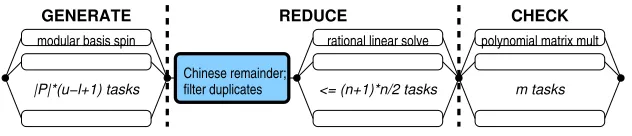
Parallel phases. Figure 3 shows the parallel structure of the algorithm to computeQ, with lower and upper degree boundslandu, for ann-dimensional cell representation given bymgeneratorsρ(Ts);P is the set of primes used in the GENERATEphase.
TheGENERATEphase forks|P|(u−l+1)parallel tasks, each taking as input a pair of integers(p, v)∈ P×Vlu, whereVluis defined as in Section 2. Each task runs the spinning basis algorithm to compute ann×nmatrixQvpof integers modulop. Thus the input size of GENERATEtasks is small and constant but the output size is quadratic in the dimension.
The REDUCEphase first constructs k ≤ (n+ 1)n/2 interpolation problems by Chinese remaindering and filtering duplicates, then forksk parallel tasks solving the interpolation problems. Each task takes as input a vector ofu−l+ 1rational values, solves a linear system ofu−l+ 1equations over the rationals, and returns a vector of
u−l+ 1polynomial coefficients. Thus input and output size of REDUCEtasks depend (linearly) on the degree spread (and on the size of the rational numbers, which depends on the choice ofP.)
TheCHECKphase forksmparallel tasks, each checking the validity of Equation (1) w. r. t. one generatorρ(Ts). To this end, each task requires as input the whole matrixQ, i. e.(n+ 1)n/2polynomials with up tou−l+ 1rational coefficients. Thus the input size of CHECKtasks is quadratic in the dimension and linear in the degree spread (and depends on the size of the rational coefficients), whereas the output is a single bit.
Overall coordination. Figure 3 depicts a parallel structure where REDUCE synchro-nises on the completion of GENERATE, which depends on the set of primesP. Instead,
polynomial matrix mult
m tasks
rational linear solve
<= (n+1)*n/2 tasks
GENERATE REDUCE CHECK
|P|*(u−l+1) tasks
modular basis spin
[image:7.612.146.462.565.633.2]filter duplicates Chinese remainder;
the parBufferTryReduce skeleton (Section 3) decouples GENERATE from RE -DUCE: The listtasks is a (possibly lazy and infinite) list of GENERATE tasks, the reducerfruns the REDUCEphase followed by the CHECKphase, and the batch sizeb determines the frequency of (attempted) reductions.
Note that most tasks in Figure 3 run on GAP workers and have a small memory footprint. However, the big task constructing the interpolation problems at the begin-ning of the REDUCEphase is executed on a dedicated GAP instance, theGAP master, because it must gather allQvpmatrices and mangle them simultaneously, which may require substantial amounts of memory.
5
Evaluation of Parallel Performance
We evaluate the parallel algorithm (Section 4) on all cell representations (reps) for Hecke algebra of typeE7and on the smaller reps of typeE8. The reps for typeE6don’t
warrant parallel execution as their sequential runtimes are less than 150s. We evaluate on three different architectures:
– up to 16 nodes of a commodity cluster (Beowulf, 8 cores/node, 2.0GHz Intel Xeon CPUs, 12GB RAM/node, Gigabit Ethernet),
– up to 32 nodes of a Cray XE6 (HECToR [12], 32 cores/node, 2.3GHz AMD Inter-lagos CPUs, 32GB RAM/node, Cray Gemini interconnect), and
– a large memory NUMA server (Cantor, 48 cores, 2.8GHz AMD Opteron CPUs, 512GB RAM).
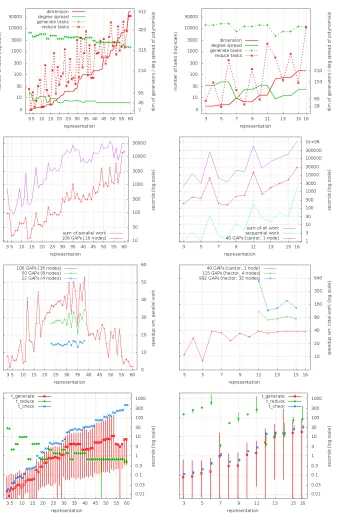
Figure 4 displays our results, organised into 2 columns: to the left data about theE7reps
3 to 60, to the right about theE8reps 3 to 16; reps 1 and 2 forE7resp.E8are trivial and
easy to solve sequentially.
Problem size. The top row of Figure 4 plots the representations’ dimensions and degree spreads (righty-axis) as well as the numbers of GENERATEand REDUCEtasks (lefty -axis); recall that the number of CHECKtasks is constant at7and8, respectively.
We observe that the number of GENERATEtasks tracks the degree spreads curve, whereas the number of REDUCE tasks oscillates by an order of magnitude or more though its trend is rising with the dimension.
To obtain reproducible results, the set of primes was chosen somewhat bigger than minimal, and the batch size parameter of theparBufferTryReduceskeleton was set so high that the reducer runs only once, after the GENERATEphase is completed.
Runtime. The second row of Figure 4 plots parallel runtimes, on 16 Beowulf nodes (using 15 * 7 + 1 = 106 GAP workers) in the case ofE7, and on Cantor (using 40
GAP workers) in the case of E8. The graph forE8 also plots the total work, i. e. the
parallel tasks.7The reported times reflect single experiments as a statistically significant
number of repetitions would be prohibitively expensive.
We observe that the amount of (total, parallel, sequential) work and the parallel runtime oscillate noisily due to the dramatic oscillation in the number of REDUCEtasks. The trend of work and runtime appears to grow with the dimension; the degree spread appears to have no influence.
Speedup. The third row of Figure 4 plots speedups on 16 Beowulf nodes (E7, using 106
GAP workers) and on Cantor (E8, using 40 GAP workers).
Since sequential runtimes are not available, we compute speedups w. r. t. parallel work (forE7) or total work (forE8). This method systematically underestimates the true
speedup (particularly forE7) as it fails to account for some of the costs of sequential
execution, e. g. more time spent on sequential garbage collection.
We observe that mostE7reps up to 22 are too small to produce significant speedups
on 16 Beowulf nodes. Reps 39 and above, and particularly reps above 55, suffer from Amdahl’s law due to significant time spent in the sequential part of REDUCE. Similarly, theE8 reps up to 5 are too small for good speedups on Cantor. However, we cannot
observe the effect of Amdahl’s law forE8; there is so much parallel work that speedups
for reps 11 to 16 are close to the maximum of 40×despite rep 16 spending more than 1000 seconds in the sequential phase.
For theE7reps 23 to 38, we also investigate strong scaling from 4 to 8 to 16 Beowulf
nodes. We observe that speedup oscillations increase with scale, i. e. some representa-tions scale, others don’t; best speedup (53×) is achieved for rep 38, corresponding to a best case efficiency of 50%. The picture is similar for the E8 reps 11 to 15 when
investigating strong scaling from 4 to 32 nodes on HECToR; rep 11 achieves the top speedup of 548×, top efficiency of 55%, but the other reps do not scale so well. Note that for multi-phase symbolic computations with irregular and dynamic parallelism an efficiency of 40% is good, as previously reported on smaller architectures [15,16,26].
Task size. The bottom row of Figure 4 shows the average, minimum and maximum runtimes of GENERATE, REDUCEand CHECKtasks; the time recorded is GAP compute time, excluding communication and marshaling overheads.8
We observe that CHECK tasks are generally expensive but regular, and REDUCE tasks are largely regular, with only some reps showing moderate irregularity (E7rep 48
is an outlier). However, GENERATEtasks are wildly irregular, varying by at least two orders of magnitude. The average cost of GENERATEand CHECKtasks appears to grow with the dimension, whereas the cost of REDUCEtasks appears to depend strongly on the degree spread.
7
We failed to record the runtime of the sequential REDUCEstep forE7, thus can’t provide total work; parallel work is an under-approximation.
8Overheads for calling GAP, including marshaling and data transfer, vary with task input and
Limitations. Two issues preclude solving the remainingE8reps with the current
algo-rithm. First, the sequential time spent in the REDUCEphase, which grows quadratically with the dimension, obliterates speedups beyond dimension 200 (forE7). The parallel
algorithm needs to be redesigned to scale to dimensions between 1000 and 2000 (which are typical ofE8), let alone the maximum of 7168.
The second issue is the memory consumption, growing quadratically in the dimen-sion, of the GAP master at the start of the REDUCEphase. The 12GB RAM of a Beowulf node prove insufficient already fromE8rep 12, dimension 168.
6
Related Work
Computational algebra skeletons. This paper gives further evidence to the success of a parallel pattern, or skeleton, approach [2] in the domain of computational mathemat-ics. We combine specialist domain knowledge, in the area of computational group the-ory, with language and systems knowledge, specifically for high-level orchestration of parallelism on large-scale clusters. This continues our work on domain-specific parallel patterns for symbolic computation, and some recent examples are as follows. We have designed a parallel Orbit, that achieves a speedup of up to 36 on a 64-core machine [14]; a critical-pair-completion pattern, with the Gr¨obner Bases computation as one instance that achieves a speedup of 6.9 on an 8-core machine; and the multiple-homomorphic images pattern, that achieves speedups of up to 11.9 on a 16-node cluster [18].
Parallel computational algebra. Several computer algebra systems offer dedicated support for parallelism (see [10, Sec 2.18] and [25]). Distributed Maple [26] provides a portable Java-based communication layer to permit interaction of Maple instances over a network. It uses future-based language constructs for synchronisation and communi-cation, and has been used to parallelise several computational geometry algorithms. The Sugarbush [1] system is another distributed-memory extension of Maple, which uses Linda as coordination language. A distributed-memory parallel extension to GAP is the GAPMPI [3] package, which provides access to MPI functionality from within GAP. In contrast to this model of explicit message passing, our approach provides higher level abstractions, such as theparBufferTryReduceskeleton.
The TOP-C system provides task-oriented parallelism on top of a distributed shared-memory system [4], implementing several symbolic applications, including parallel computations over Hecke algebras [6] on networks of SPARC workstations.
Several efforts of parallelising computational algebra have targeted previous gen-erations of HPC architectures. Sibert et al [27] describe the implementation of basic arithmetic over finite fields on a Connection Machine. Roch et al [24] discuss the im-plementation and performance of a parallel Gr¨obner basis algorithm on the Floating Point System hypercube Tesseract 20 with 16 nodes. Another parallel Gr¨obner basis algorithm is implemented on a Cray Y-MP by Neun and Melenek [23] and later on a Connection Machine by Loustaunau and Wang [19]. We are not aware of any other work within the last 20 years that targets HPC for computational algebra.
effort of defining a protocol for symbolic data exchange on such infrastructures allows interchange between different computer algebra systems [16]. In contrast to these Grid-based infrastructures, our technology targets massively parallel supercomputers.
Invariant bilinear forms for Hecke algebra representations. The invariant bilinear formsQcarry data that enables us to find so-calledJantzen filtrations[17], which sim-plify the general understanding of transformations of Hecke algebra representations.
Such bilinear formsQfor Hecke algebras of typeE7andE8have previously been
computed by Geck and M¨uller in an ad-hoc way; their paper [9] describes the math-ematical basis for their approach but does not consider parallelism or evaluate perfor-mance. This paper and [17] are part of an ongoing project, started by Geck, to build a systematic GAP database of bilinear formsQfor Hecke algebras of typeE6,E7andE8.
7
Conclusion
We have described what we believe is the first ever parallelisation of an algebraic com-putation on a modern HPC. The comcom-putation of invariant bilinear forms for Hecke algebra representations is multi-phase and exhibits irregular parallelism over the com-plex control and data structures typical of computer algebra. The parallelisation ex-ploits the new skeleton-based SGP2 framework and required the development of a new domain-specific skeleton,parBufferTryReduce. The performance on a medium-scale HPC configuration and a commodity cluster is good, if noisy, reflecting the com-plexity of the problems solved. For example, for medium-size Hecke algebra represen-tations (23 to 38) of typeE7we obtain speedups of between 25 and 53 on 16 Beowulf
nodes (128 cores, 106 GAP workers). For smallE8 representations (11 to 15) we
ob-tain speedups of between 116 and 548 on 32 HECToR nodes (1024 cores, 992 GAP workers).
In related and ongoing work we report good performance results for small algebraic kernels on far larger HPC configurations, e. g. weak scaling of thesumEulerkernel (summing up Euler’sϕfunction over large intervals) on up to 32K HECToR cores [20]. Core failures are predicted to rise along with the number of cores. To insure large and expensive symbolic computations against core failures, we have implemented and are evaluating automatic recovery of idempotent computations in SGP2 [28].
Acknowledgements. This research was supported by the grants HPC-GAP (EPSRC EP/G05553X), AJITPar (EPSRC EP/L000687/1), RELEASE (EU FP7-ICT 287510).
References
1. Char, B.W.: Progress report on a system for general-purpose parallel symbolic algebraic computation. In: ISSAC 1990, Tokyo, Japan. pp. 96–103. ACM Press (1990)
2. Cole, M.I.: Algorithmic Skeletons: Structured Management of Parallel Computation. MIT Press (1989)
4. Cooperman, G.: TOP-C: Task-oriented parallel C for distributed and shared memory. In: Workshop on Wide Area Networks and High Performance Computing, Essen, Germany. pp. 109–117. LNCS 249, Springer (1999)
5. Cooperman, G.: Parallel GAP: mature interactive parallel computing. In: Groups and Com-putation III, Columbus, OH, USA. pp. 123–138. De Gruyter (2001)
6. Cooperman, G., Tselman, M.: New sequential and parallel algorithms for generating high di-mension Hecke algebras using the condensation technique. In: ISSAC 1996, Z¨urich, Switzer-land. pp. 155–160. ACM Press (1996)
7. GAP Group: GAP – groups, algorithms, and programming (2007), http://www. gap-system.org
8. Geck, M.: Hecke algebras of finite type are cellular. Invent. Math. 169, 501–517 (2007) 9. Geck, M., M¨uller, J.: James’ conjecture for Hecke algebras of exceptional type, I. J. Algebra
321(11), 3274–3298 (2009)
10. Grabmeier, J., Kaltofen, E., Weispfenning, V.: Computer Algebra Handbook. Springer (2003)
11. Graham, J.J., Lehrer, G.I.: Cellular algebras. Invent. Math. 123, 1–34 (1996) 12. HECToR: UK National Supercomputing Service,www.hector.ac.uk
13. Howlett, R.B.: W-graphs for the irreducible representations of the Hecke algebras of typeE7 andE8, private communication with J. Michel (December 2003)
14. Janjic, V.,et al: Space exploration using parallel orbits. In: ParCo 2013, Munich, Germany. Advances in Parallel Computing, vol. 25, pp. 225–232. IOS Press (2014)
15. Konovalov, A., Linton, S.: Parallel computations in modular group algebras. In: PASCO 2010, Grenoble, France. pp. 141–149. ACM Press (2010)
16. Linton, S.,et al: Easy composition of symbolic computation software using SCSCP. J. Symb. Comput. 49, 95–19 (Feb 2013)
17. Livesey, D.: High Performance Computations with Hecke Algebras: Bilinear Forms and Jantzen Filtrations. Ph.D. thesis, University of Aberdeen (2014)
18. Loidl, H.W.,et al: Comparing parallel functional languages: Programming and performance. Higher-order and Symbolic Computation 16(3), 203–251 (2003)
19. Loustaunau, P., Wang, P.Y.: Towards efficient parallelizations of a computer algebra algo-rithm. In: Frontiers of Massively Parallel Computation, McLean, VA, USA. pp. 67–74. IEEE (1992)
20. Maier, P., Stewart, R., Trinder, P.W.: Reliable scalable symbolic computation: The design of SymGridPar2. Computer Languages, Systems & Structures 40(1), 19–35 (2014)
21. Maier, P., Trinder, P.: Implementing a high-level distributed-memory parallel Haskell in Haskell. In: IFL 2011, Lawrence, KS, USA. pp. 35–50. LNCS 7257, Springer (2012) 22. Maple Grid Computing Toolbox, www.maplesoft.com/products/toolboxes/
GridComputing
23. Neun, W., Melenk, H.: Very large Gr¨obner basis calculations. In: CAP 1990, Ithaca, USA. pp. 89–99. LNCS 584, Springer (1992)
24. Roch, J.L., S´en´echaud, P., Franc¸oise Siebert-Roch, F., Villard, G.: Computer algebra on MIMD machine. In: ISSAC 1998, Rome, Italy. pp. 423–439. LNCS 358, Springer (1989) 25. Roch, J.L., Villard, G.: Parallel computer algebra. Tech. rep., IMAG, France (1997), tutorial
at ISSAC 1997
26. Schreiner, W., Mittermaier, C., Bosa, K.: Distributed Maple: parallel computer algebra in networked environments. J. Symb. Comput. 35(3), 305–347 (2003)
27. Sibert, E.E., Mattson, H.F., Jackson, P.: Finite field arithmetic using the Connection Machine. In: CAP 1990, Ithaca, USA. pp. 51–61. LNCS 584, Springer (1992)