organic papers
o3212
Herreraet al. C12H19NO doi:10.1107/S160053680502787X Acta Cryst.(2005). E61, o3212–o3213
Acta Crystallographica Section E Structure Reports Online
ISSN 1600-5368
4-(Hexyloxy)aniline
Ana M. Herrera,a‡ Sylvain Berne`sb* and Delia Lo´pezc
a
Centro de Investigaciones en Materiales y Metalurgia, Universidad Auto´noma del Estado de Hidalgo, Carretera Pachuca-Tulancingo Km. 4.5, 42074 Pachuca, Hgo., Mexico,bCentro de
Quı´mica, Instituto de Ciencias, Universidad Auto´noma de Puebla, A.P. 1613, 72000 Puebla, Pue., Mexico, andcFacultad de Ciencias
Quı´micas, Universidad Auto´noma de Puebla, Boulevard 14 Sur, Col. San Manuel, 72570 Puebla, Pue., Mexico
‡ Current address: Facultad de Ciencias Quı´micas Universidad Auto´noma de Puebla Boulevard 14 Sur Col. San Manuel 72570 Puebla, Pue. Mexico
Correspondence e-mail: [email protected]
Key indicators
Single-crystal X-ray study
T= 296 K
Mean(C–C) = 0.003 A˚
Rfactor = 0.050
wRfactor = 0.149
Data-to-parameter ratio = 15.4
For details of how these key indicators were automatically derived from the article, see http://journals.iucr.org/e.
#2005 International Union of Crystallography Printed in Great Britain – all rights reserved
The title molecule, C12H19NO, crystallizes with a head-to-head
tail-to-tail arrangement, including very weak N—H N and
N—H O hydrogen bonds.
Comment
Low molecular weight imines (Demuset al., 1998; Sudhakaret al., 2000) and polyimines (Natansohnet al., 1991) with meso-morphic behavior continue to be studied. The title compound, (I), is the starting material for the synthesis of some imines by condensation with functionalized aldehydes. A suitable func-tionalization of these imines with allyl groups may afford polymerizable monomers (Lo´pezet al., 2005).
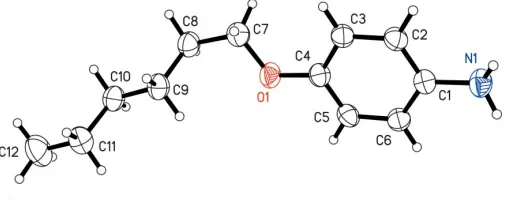
Compound (I) is stabilized in the solid state as a bent molecule (Fig. 1) due to thegaucheconformation of the alkyl chain with respect to the aryl moiety [O1—C7—C8—C9 =
70.1 (3)]. Geometric parameters (Table 1) are as expected.
For instance, the amine group presents a pyramidal arrange-ment of bonds around the N atom, very close to that observed for aniline. One measure of thesorpcharacter of the N atoms in primary amines is given by the angle between the C—N bond and the bisector of the H—N—H angle (Carey, 2003). In the case of aniline, for which the structure has been deter-mined at 252 K (Fukuyo et al., 1982), this angle is 139.1 and
141.1 for two independent molecules, while for (I), the
equivalent angle is 140.6 (4). It is thus clear that the para
substitution of the aniline by a hexyloxy group has very little influence on the amine functionality.
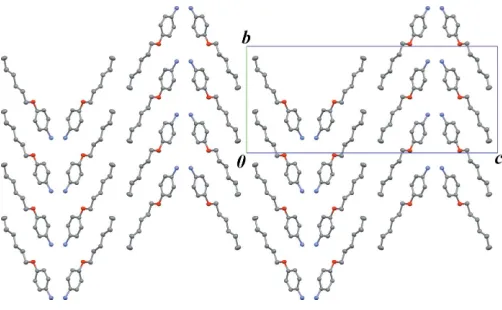
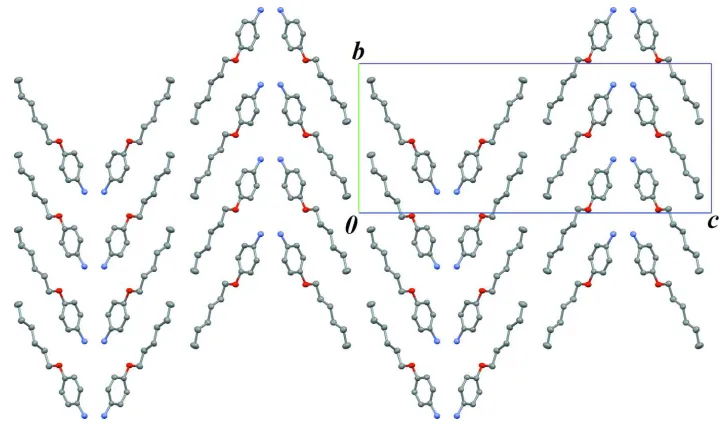
A common head-to-head tail-to-tail arrangement is
observed for the crystal structure (Fig. 2). The angle between
[image:1.610.207.460.623.723.2]Received 5 September 2005 Accepted 6 September 2005 Online 14 September 2005
Figure 1
two neighboring benzene rings is 76.62 (6)(rings related by
symmetry code 1
2+ x,y, 3
2z). As the O atom of an alkoxy
group is a very poor donor and acceptor for hydrogen bonding, very weak intermolecular interactions are observed
in the crystal structure (Table 2); N—H N bonds link
mol-ecules along [100] and N—H O interactions link molecules
along [010]. The weakness of these intermolecular contacts, together with the low molecular weight of (I), may be related to the low melting point for this material (m.p. 316 K).
Experimental
Compound (I) was prepared by reacting 4-hydroxphenylacetamide and 1-bromohexane, as described in the literature (Sudhakaret al., 2000), and was crystallized from hexane as dark brown crystals. Analysis found: C 74.6, H 9.8, O 8.3, N 7.2%; calculated for C12H19NO: C 74.6, H 9.8, O 8.2, N 7.2%.
1
H NMR (400 MHz, CDCl3):
0.89 (d, J= 6.4 Hz, 3H, CH3), 1.32–1.42 (m, J= 6.8, 5.6 Hz, 6H, 3
CH2), 1.73 (m, J= 6.8, 7.2 Hz, 2H, CH2), 3.21 (s, 2H, NH2), 3.87 (m, J
= 6.8, 6.4 Hz, 2H, O–CH2), 6.25 (m, J= 8.8 Hz, 2H, Ph), 6.74 (m, J=
8.8 Hz, 2H, Ph).
Crystal data
C12H19NO Mr= 193.28 Orthorhombic,Pbca a= 5.4659 (10) A˚
b= 13.6278 (19) A˚
c= 32.124 (4) A˚
V= 2392.8 (6) A˚3 Z= 8
Dx= 1.073 Mg m 3
MoKradiation Cell parameters from 75
reflections
= 4.8–12.5 = 0.07 mm1 T= 296 (2) K
Irregular fragment, colorless 0.60.30.3 mm
Data collection
BrukerP4 diffractometer 2/!scans
Absorption correction: none 3385 measured reflections 2111 independent reflections 1159 reflections withI> 2(I)
Rint= 0.031
max= 25.0 h=6!2
k=16!1
l=38!1 2 standard reflections
every 48 reflections intensity decay: 2.5%
Refinement
Refinement onF2 R[F2> 2(F2)] = 0.050
wR(F2) = 0.149 S= 1.02 2111 reflections 137 parameters
H atoms treated by a mixture of independent and constrained refinement
w= 1/[2(F
o2) + (0.0563P)2
+ 0.637P]
whereP= (Fo2+ 2Fc2)/3
(/)max< 0.001
max= 0.13 e A˚
3
min=0.18 e A˚
3
Extinction correction:
SHELXTL-Plus
Extinction coefficient: 0.0112 (16)
Table 1
Selected geometric parameters (A˚ ,).
O1—C4 1.384 (3)
O1—C7 1.427 (3)
N1—C1 1.407 (3)
N1—H1A 0.90 (3)
N1—H1B 0.87 (3)
C7—C8 1.512 (3)
C8—C9 1.510 (3)
C9—C10 1.519 (3)
C10—C11 1.502 (3)
C11—C12 1.521 (4)
C4—O1—C7 118.22 (18)
C1—N1—H1A 117.2 (18)
C1—N1—H1B 112.8 (18)
H1A—N1—H1B 114 (3)
Table 2
Hydrogen-bond geometry (A˚ ,).
D—H A D—H H A D A D—H A
N1—H1A N1i
0.90 (3) 2.40 (3) 3.277 (3) 166 (2) N1—H1B O1ii
0.87 (3) 2.38 (3) 3.217 (3) 162 (2)
Symmetry codes: (i)xþ1
2;y;zþ12; (ii)xþ12;y12;z.
The H atoms bonded to N1 were found in a difference map and refined with free coordinates and isotropicUparameters. H atoms bonded to C atoms were placed in idealized positions and refined as riding on their parent C atom [C—H distances and isotropicUiso(H)
parameters: methylene 0.97 A˚ and 1.2Ueq(C); methyl 0.96 A˚ and
1.5Ueq(C); aromatic 0.93 A˚ and 1.2Ueq(C)].
Data collection: XSCANS (Siemens, 1996); cell refinement:
XSCANS; data reduction: XSCANS; program(s) used to solve structure: SHELXTL-Plus (Sheldrick, 1998); program(s) used to refine structure:SHELXTL-Plus; molecular graphics: SHELXTL-Plus; software used to prepare material for publication: SHELXTL-Plus.
Partial support by VIEP–BUAP/CONACyT (project No. 7/ I/NAT/05) is gratefully acknowledged. AMH is indebted to PROMEP (Mexico) for providing a research grant.
References
Carey, F. A. (2003).Organic Chemistry, 5th ed., pp. 916–918. New York: McGraw–Hill.
Demus, D., Goodby, J., Gray, G. W., Spiess, H. W. & Vill, V. (1998).Handbook of Liquid Crystals, Vol. 2A,Low Molecular Weight Liquid Crystals. New York: Wiley VCH.
Fukuyo, M., Hirotsu, K. & Higuchi, T. (1982).Acta Cryst.B38, 640–643. Lo´pez, D., Herrera, A. M. & Berne`s, S. (2005). Unpublished results. Natansohn, A., Yang, H. & Clark, C. (1991).Macromolecules,24, 5489–5496. Sheldrick, G. M. (1998).SHELXTL-Plus. Release 5.10. Brruker AXS Inc.,
Madison, Wisconsin, USA.
Siemens (1996).XSCANS. Version 2.21. Siemens Analytical X-ray Instru-ments Inc., Madison, Wisconsin, USA.
[image:2.610.314.565.69.224.2]Sudhakar, S., Narasimhaswamy, T. & Srinivasan, K. S. V. (2000).Liq. Cryst.27, 1525–1532.
Figure 2
supporting information
sup-1
Acta Cryst. (2005). E61, o3212–o3213
supporting information
Acta Cryst. (2005). E61, o3212–o3213 [doi:10.1107/S160053680502787X]
4-(Hexyloxy)aniline
Ana M. Herrera, Sylvain Bern
è
s and Delia L
ó
pez
S1. Comment
Low molecular weight imines (Demus et al., 1998; Sudhakar et al., 2000) and polyimines (Natansohn et al., 1991) with
mesomorphic behavior are continuously studied. The title compound, (I), is the starting material for the synthesis of some
imines by condensation with functionalized aldehydes. A suitable functionalization of these imines with allyl groups may
afford polymerizable monomers (López et al., 2005).
Compound (I) is stabilized in the solid state as a bent molecule (Fig. 1) due to the gauche conformation of the alkyl
chain with respect to the aryl moiety [O1—C7—C8—C9 = 70.1 (3)°]. Geometric parameters (Table 1) are as expected.
For instance, the amine group presents a pyramidal arrangement of bonds around N atom, very close to that observed for
aniline. One measure of the s or p character of the N atoms in primary amines is given by the angle between the C—N
bond and the bisector of the H—N—H angle (Carey, 2003). In the case of aniline, for which the structure has been
determined at 252 K (Fukuyo et al., 1982), this angle is 139.1 and 141.1° for two independent molecules, while for (I),
the equivalent angle is 140.6 (4)°. It is thus clear that the para substitution of the aniline by an hexyloxy group has very
little influence on the amine functionality.
A common head-to-head tail-to-tail arrangement is observed for the crystal structure (Fig. 2). The angle between two
forheading benzene rings is 76.62 (6)° (rings related by symmetry code 1/2 + x, y, 3/2 − z). As the O atom of alkyloxy
groups is a very poor donor and acceptor for hydrogen-bonding, intermolecular interactions of very weak strength are
observed in the crystal structure (Table 2); N—H···N bonds link molecules along [100] and N—H···O interactions link
molecules along [010]. The weakness of these intermolecular contacts, together with the low molecular weight of (I),
may be related to the low melting point for this material (m.p. 316 K).
S2. Experimental
Compound (I) was prepared by reacting 4-hydroxphenylacetamide and 1-bromohexane, as described in the literature
(Sudhakar et al., 2000), and was crystallized from hexane as brown dark crystals. Analysis found: C 74.6, H 9.8, O 8.3, N
7.2%; calculated for C12H19NO: C 74.6, H 9.8, O 8.2, N 7.2%. 1H NMR (400 MHz, CDCl3): δ 0.89 (d, J = 6.4 Hz, 3H,
CH3), 1.32–1.42 (m, J = 6.8, 5.6 Hz, 6H, 3 × CH2), 1.73 (m, J = 6.8, 7.2 Hz, 2H, CH2), 3.21 (s, 2H, NH2), 3.87 (m, J = 6.8,
6.4 Hz, 2H, O–CH2), 6.25 (m, J = 8.8 Hz, 2H, Ph), 6.74 (m, J = 8.8 Hz, 2H, Ph).
S3. Refinement
The H atom bonded to N1 were found in a difference map and refined with free coordinates and isotropic U parameters.
H atoms bonded to C atoms were placed in idealized positions and refined as riding to their parent C atom [restrained C
—H distances and isotropic Uiso(H) parameters: methylene 0.97 Å and 1.2Ueq(C); methyl 0.96 Å and 1.5Ueq(C); aromatic
Figure 1
The structure of (I), with displacement ellipsoids drawn at the 30% probability level.
Figure 2
Part of the crystal structure of (I), viewed along the [100] axis.
4-(n-Hexyloxy)aniline
Crystal data
C12H19NO
Mr = 193.28
Orthorhombic, Pbca
Hall symbol: -P 2ac 2ab
a = 5.4659 (10) Å
b = 13.6278 (19) Å
c = 32.124 (4) Å
V = 2392.8 (6) Å3
Z = 8
F(000) = 848
Dx = 1.073 Mg m−3 Melting point: 316 K
Mo Kα radiation, λ = 0.71073 Å Cell parameters from 75 reflections
θ = 4.8–12.5°
µ = 0.07 mm−1
T = 296 K
[image:4.610.122.484.243.458.2]supporting information
sup-3
Acta Cryst. (2005). E61, o3212–o3213
Data collection
Bruker P4 diffractometer
Radiation source: fine-focus sealed tube, FN4 Graphite monochromator
2θ/ω scans
3385 measured reflections 2111 independent reflections 1159 reflections with I > 2σ(I)
Rint = 0.031
θmax = 25.0°, θmin = 3.0°
h = −6→2
k = −16→1
l = −38→1
2 standard reflections every 48 reflections intensity decay: 2.5%
Refinement
Refinement on F2 Least-squares matrix: full
R[F2 > 2σ(F2)] = 0.050
wR(F2) = 0.149
S = 1.02 2111 reflections 137 parameters 0 restraints
Primary atom site location: structure-invariant direct methods
Secondary atom site location: difference Fourier map
Hydrogen site location: See text
H atoms treated by a mixture of independent and constrained refinement
w = 1/[σ2(F
o2) + (0.0563P)2 + 0.637P] where P = (Fo2 + 2Fc2)/3
(Δ/σ)max < 0.001 Δρmax = 0.13 e Å−3 Δρmin = −0.18 e Å−3
Extinction correction: SHELXTL-Plus, Fc*=kFc[1+0.001xFc2λ3/sin(2θ)]-1/4 Extinction coefficient: 0.0112 (16)
Fractional atomic coordinates and isotropic or equivalent isotropic displacement parameters (Å2)
x y z Uiso*/Ueq
O1 0.0919 (3) 0.47944 (11) 0.15025 (5) 0.0736 (6) N1 0.4875 (6) 0.14137 (17) 0.22184 (7) 0.0738 (7) H1A 0.637 (5) 0.146 (2) 0.2334 (8) 0.095 (11)* H1B 0.467 (5) 0.088 (2) 0.2073 (9) 0.094 (10)* C1 0.3936 (4) 0.22534 (16) 0.20195 (6) 0.0573 (6) C2 0.1932 (5) 0.21883 (17) 0.17627 (7) 0.0651 (7)
H2 0.1258 0.1574 0.1710 0.078*
C3 0.0883 (5) 0.30087 (16) 0.15803 (7) 0.0637 (7)
H3 −0.0448 0.2941 0.1402 0.076*
C4 0.1829 (5) 0.39274 (16) 0.16650 (7) 0.0595 (6) C5 0.3809 (5) 0.40042 (17) 0.19291 (7) 0.0646 (7)
H5 0.4447 0.4620 0.1990 0.078*
C6 0.4855 (5) 0.31844 (16) 0.21030 (7) 0.0645 (7)
H6 0.6195 0.3253 0.2279 0.077*
C7 −0.1076 (5) 0.47404 (17) 0.12171 (8) 0.0728 (7)
H7A −0.2475 0.4432 0.1349 0.087*
H7B −0.0619 0.4353 0.0976 0.087*
C8 −0.1716 (5) 0.57743 (17) 0.10858 (8) 0.0743 (8)
H8A −0.3267 0.5761 0.0939 0.089*
H8B −0.1932 0.6172 0.1334 0.089*
C9 0.0167 (5) 0.62597 (16) 0.08102 (7) 0.0700 (7)
H9A 0.0249 0.5906 0.0549 0.084*
H9B 0.1756 0.6209 0.0943 0.084*
H10A −0.1973 0.7386 0.0597 0.086*
H10B −0.0380 0.7691 0.0981 0.086*
C11 0.1461 (6) 0.78094 (19) 0.04332 (8) 0.0865 (9)
H11A 0.1479 0.7454 0.0172 0.104*
H11B 0.3078 0.7755 0.0555 0.104*
C12 0.0934 (7) 0.8885 (2) 0.03453 (11) 0.1192 (12)
H12A 0.2200 0.9150 0.0171 0.179*
H12B 0.0882 0.9242 0.0603 0.179*
H12C −0.0614 0.8944 0.0206 0.179*
Atomic displacement parameters (Å2)
U11 U22 U33 U12 U13 U23
O1 0.0891 (13) 0.0518 (10) 0.0800 (11) 0.0026 (9) −0.0186 (11) 0.0042 (8) N1 0.093 (2) 0.0590 (14) 0.0693 (14) 0.0078 (14) −0.0141 (14) −0.0022 (11) C1 0.0685 (16) 0.0555 (13) 0.0480 (12) 0.0031 (13) 0.0045 (13) −0.0023 (11) C2 0.0735 (17) 0.0528 (14) 0.0691 (14) −0.0066 (13) −0.0063 (14) −0.0036 (12) C3 0.0708 (16) 0.0580 (14) 0.0622 (13) −0.0049 (13) −0.0083 (13) −0.0005 (11) C4 0.0673 (16) 0.0531 (14) 0.0582 (14) 0.0032 (13) 0.0017 (13) −0.0016 (11) C5 0.0759 (18) 0.0503 (13) 0.0676 (14) −0.0082 (13) 0.0000 (14) −0.0004 (11) C6 0.0684 (16) 0.0633 (15) 0.0618 (14) −0.0038 (13) −0.0067 (13) −0.0023 (12) C7 0.0718 (17) 0.0659 (16) 0.0805 (17) 0.0015 (14) −0.0019 (16) 0.0067 (13) C8 0.0757 (18) 0.0682 (17) 0.0791 (16) 0.0111 (14) −0.0020 (15) 0.0071 (13) C9 0.0784 (18) 0.0654 (15) 0.0661 (15) 0.0118 (14) 0.0016 (14) 0.0024 (12) C10 0.0756 (18) 0.0647 (15) 0.0740 (15) 0.0124 (14) −0.0026 (14) 0.0033 (13) C11 0.095 (2) 0.0796 (19) 0.0849 (18) 0.0012 (17) 0.0061 (17) 0.0099 (15) C12 0.145 (3) 0.076 (2) 0.136 (3) −0.009 (2) 0.003 (3) 0.0267 (19)
Geometric parameters (Å, º)
O1—C4 1.384 (3) C7—H7B 0.9700
O1—C7 1.427 (3) C8—C9 1.510 (3)
N1—C1 1.407 (3) C8—H8A 0.9700
N1—H1A 0.90 (3) C8—H8B 0.9700
N1—H1B 0.87 (3) C9—C10 1.519 (3)
C1—C2 1.374 (3) C9—H9A 0.9700
C1—C6 1.391 (3) C9—H9B 0.9700
C2—C3 1.386 (3) C10—C11 1.502 (3)
C2—H2 0.9300 C10—H10A 0.9700
C3—C4 1.382 (3) C10—H10B 0.9700
C3—H3 0.9300 C11—C12 1.521 (4)
C4—C5 1.380 (3) C11—H11A 0.9700
C5—C6 1.374 (3) C11—H11B 0.9700
C5—H5 0.9300 C12—H12A 0.9600
C6—H6 0.9300 C12—H12B 0.9600
C7—C8 1.512 (3) C12—H12C 0.9600
supporting information
sup-5
Acta Cryst. (2005). E61, o3212–o3213
C4—O1—C7 118.22 (18) C9—C8—H8A 108.6
C1—N1—H1A 117.2 (18) C7—C8—H8A 108.6
C1—N1—H1B 112.8 (18) C9—C8—H8B 108.6
H1A—N1—H1B 114 (3) C7—C8—H8B 108.6
C2—C1—C6 117.5 (2) H8A—C8—H8B 107.6
C2—C1—N1 120.7 (2) C8—C9—C10 113.9 (2)
C6—C1—N1 121.5 (2) C8—C9—H9A 108.8
C1—C2—C3 122.1 (2) C10—C9—H9A 108.8
C1—C2—H2 119.0 C8—C9—H9B 108.8
C3—C2—H2 119.0 C10—C9—H9B 108.8
C4—C3—C2 119.5 (2) H9A—C9—H9B 107.7
C4—C3—H3 120.2 C11—C10—C9 114.1 (2)
C2—C3—H3 120.2 C11—C10—H10A 108.7
C5—C4—C3 118.9 (2) C9—C10—H10A 108.7
C5—C4—O1 116.7 (2) C11—C10—H10B 108.7
C3—C4—O1 124.4 (2) C9—C10—H10B 108.7
C6—C5—C4 121.0 (2) H10A—C10—H10B 107.6
C6—C5—H5 119.5 C10—C11—C12 113.9 (2)
C4—C5—H5 119.5 C10—C11—H11A 108.8
C5—C6—C1 120.9 (2) C12—C11—H11A 108.8
C5—C6—H6 119.6 C10—C11—H11B 108.8
C1—C6—H6 119.6 C12—C11—H11B 108.8
O1—C7—C8 107.9 (2) H11A—C11—H11B 107.7
O1—C7—H7A 110.1 C11—C12—H12A 109.5
C8—C7—H7A 110.1 C11—C12—H12B 109.5
O1—C7—H7B 110.1 H12A—C12—H12B 109.5
C8—C7—H7B 110.1 C11—C12—H12C 109.5
H7A—C7—H7B 108.4 H12A—C12—H12C 109.5
C9—C8—C7 114.5 (2) H12B—C12—H12C 109.5
C6—C1—C2—C3 1.9 (3) C4—C5—C6—C1 −0.4 (4)
N1—C1—C2—C3 176.4 (2) C2—C1—C6—C5 −0.9 (3) C1—C2—C3—C4 −1.6 (4) N1—C1—C6—C5 −175.4 (2)
C2—C3—C4—C5 0.3 (3) C4—O1—C7—C8 −179.8 (2)
C2—C3—C4—O1 −179.6 (2) O1—C7—C8—C9 70.1 (3) C7—O1—C4—C5 177.9 (2) C7—C8—C9—C10 −173.6 (2) C7—O1—C4—C3 −2.2 (3) C8—C9—C10—C11 −177.9 (2) C3—C4—C5—C6 0.7 (3) C9—C10—C11—C12 −179.7 (2) O1—C4—C5—C6 −179.4 (2)
Hydrogen-bond geometry (Å, º)
D—H···A D—H H···A D···A D—H···A
N1—H1A···N1i 0.90 (3) 2.40 (3) 3.277 (3) 166 (2) N1—H1B···O1ii 0.87 (3) 2.38 (3) 3.217 (3) 162 (2)